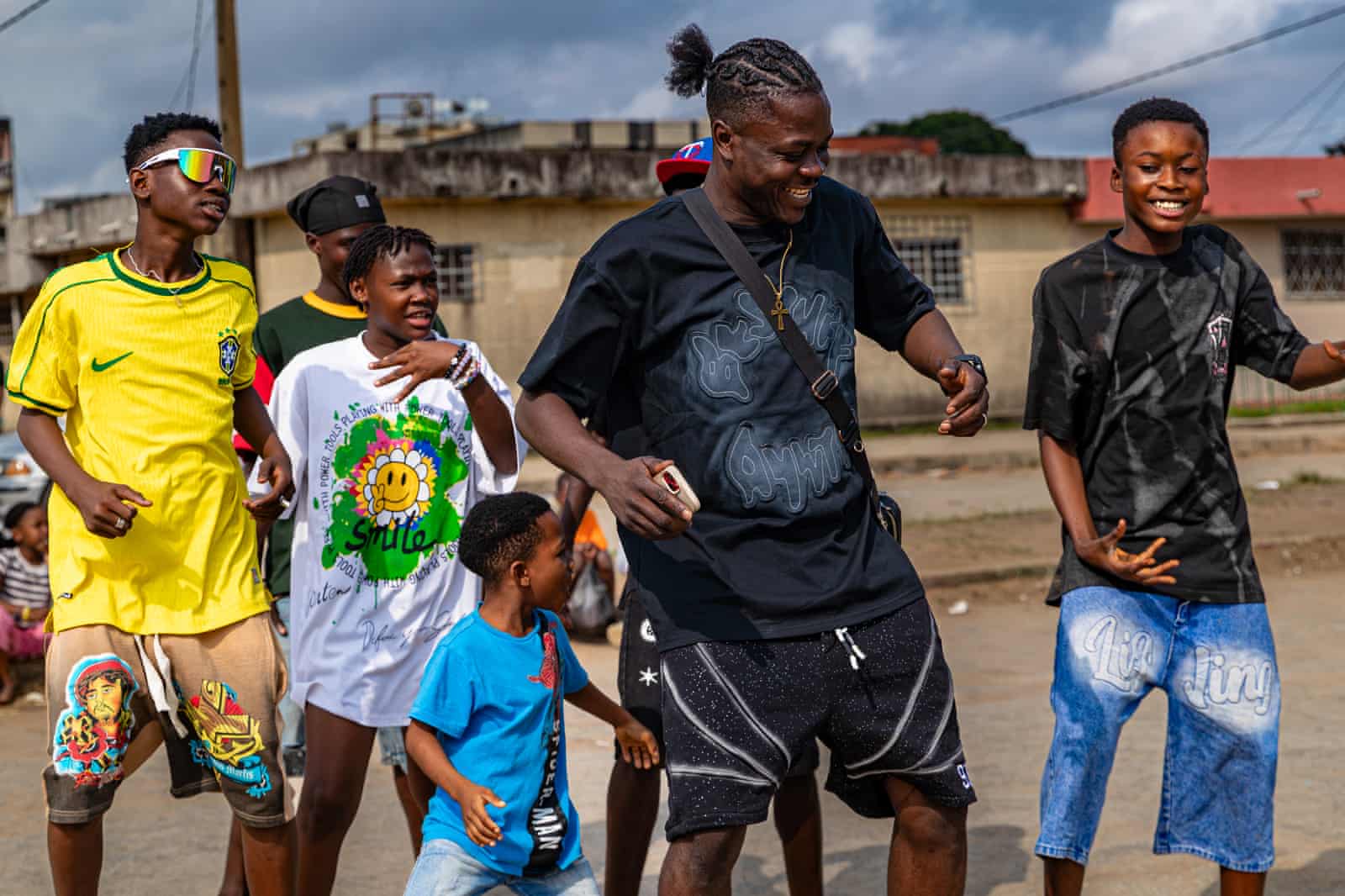
Photo: Miléquêm Diarassouba.
Biama is a frenetic subgenre of the dance style coupé-décalé, popular on TikTok and in the Ivory Coast.
There’s a joyful kind of dance in East Africa that just makes people want to laugh and join in. According to this article in the Guardian, it’s not unusual for happy dances to emerge in Côte d’Ivoire, but the silly elements added to coupé-décalé, have special appeal to the young.
Eromo Egbejule writes, “The 400-strong crowd, perched on plastic chairs and wooden benches in Abidjan’s Yopougon-Selmer neighbourhood, roared with approval as Sauce Graine twisted and turned on the spot with breathtaking speed and dexterity.
“The dancer, named after the Ivorian palm nut delicacy, was competing in a series of street dance battles set to biama, a frenetic offshoot of coupé-décalé, a type of percussive dance music popular across west Africa that originated in Côte d’Ivoire around the turn of the century.
“A neighborhood square in Yopougon-Selmer had been transformed into a dance arena. … The performers were all under 25, with some as young as five. Audience members, some munching on skewered meat or drinking from beer bottles or plastic cups, periodically joined in as one competitor after another showcased intricate footwork and dramatic chest pops. …
“Says Sauce Graine, a 15-year-old whose real name is Arnold and who began dancing to biama six years ago, ‘Since many people aren’t very familiar with the dance yet, they think it’s just a neighborhood thing. All we have to do is create the dance so that more people can see it and love it.’ …
“Biama has become emblematic of the resurgence of Ivorian pop culture over the past decade. There is some debate over exactly when biama emerged, but it exploded in popularity after the coronavirus pandemic as young people turned to TikTok to post and respond to dance challenges that fused acrobatics with goofiness that pushed bodies to their limits. …
“Says Cédric Kouamé, a music producer and chief archivist at Baoulecore Archive Center in the Angrè district of Abidjan, ‘Like maïmouna, it comes from Yopougon [where] a lot of artists started their career.’
“For decades, this working-class district has dictated the cultural zeitgeist of both Abidjan and Côte d’Ivoire. Stéphane Doukouré, better known as Douk Saga, grew up there before founding coupé-décalé with his Jet 7 crew after returning from Paris in the early 2000s. There, he had made a name for himself in a nightclub frequented by wealthy young partygoers by setting light to thousands of euros.
“Their genre championed the philosophy of sagacité – the shrewdness needed to outwit authority – alongside farotement, the flamboyant display of wealth. …
“The genre was propelled to new heights by Ange Didier Houon, who was born in Yopougon to an icon of the Ivorian sound engineering industry. In his teens, his Lebanese friends gave him the stage name DJ Arafat, after the Palestinian political leader. …
“Over time, he increased the tempo of his music to match the high-energy, acrobatic roukaskas routines devised by his dancers, drawing on traditional Ivorian dance. Their feet shuffling quickly in lêkê – the ubiquitous Ivorian water-resistant plastic sandals – the dancers performing Arafat’s roukaskas continued a long tradition of audience participation in Ivorian popular music. …
“Today, a new generation of artists is vying to be the next megastar of Ivorian pop. Among those hoisting the flag for maïmouna are Didi B, who has gained international recognition, and the more street-famous Himra. The rappers’ rivalry entered a new phase last year when both filled stadiums just weeks apart in different parts of the country.
“Biama remains the more popular of the two subgeres, particularly among children and young people, who proudly call themselves biamaseurs and eagerly accept dance challenges shared across social media. …
“Kouamé argues that dance has always been inseparable form Ivorian music. ‘Since the beginning of Ivorian music, as artists were creating their sounds, they were also thinking of the dance moves,’ he says. …
“Some cultural observers in Côte d’Ivoire dismiss the genre as little more than ‘street music,’ but biamaseurs remain undeterred. ‘People will love us,’ Sauce Graine says. “[They] will spread the word through their social networks. Then it will take off.’ ”
More at the Guardian, here.