Feeds:
Posts
Comments

Posts Tagged ‘air quality’

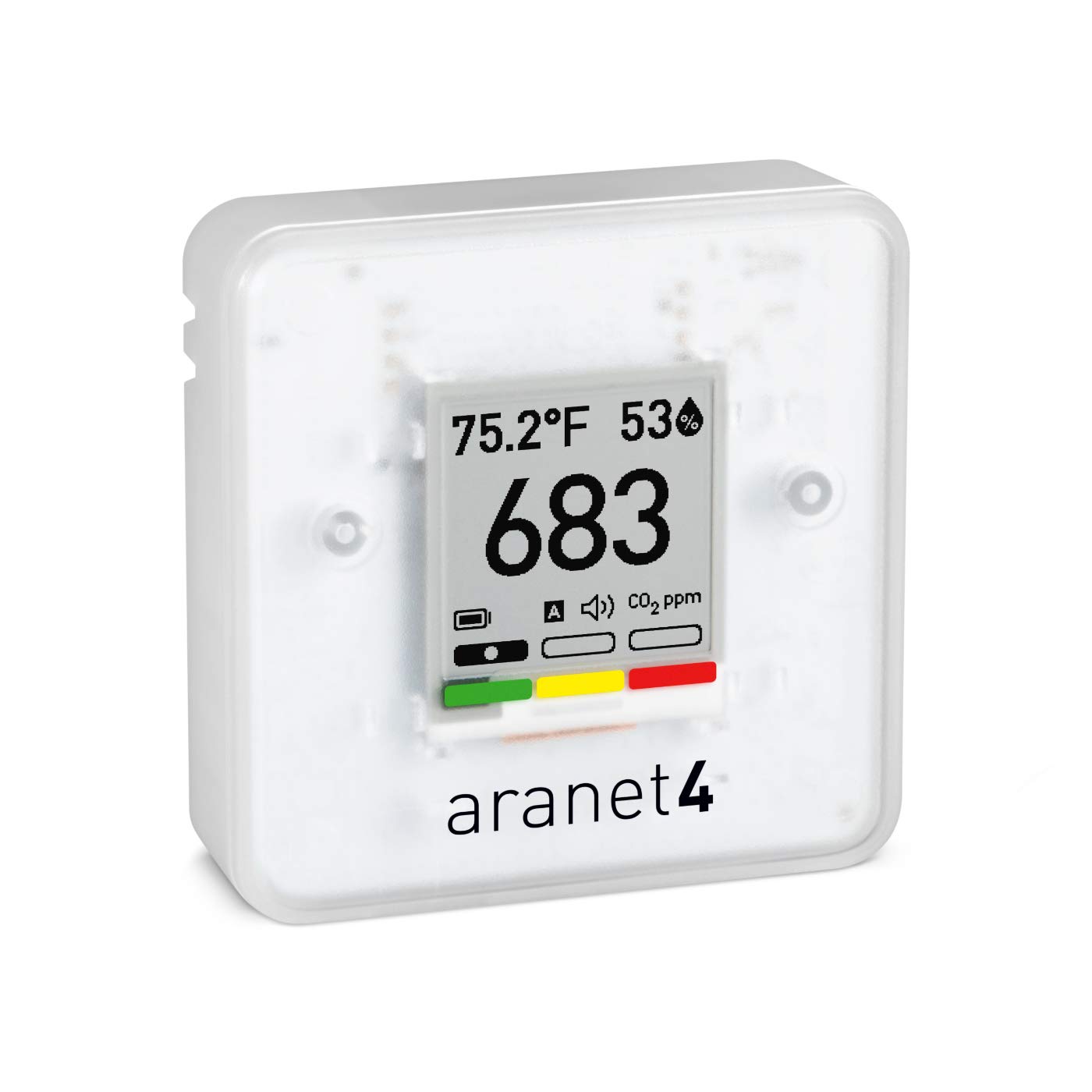
Ad from a gadget company: SAF Aranet4 Home: Wireless Indoor Air Quality Monitor for Home, Office or School [CO2, Temperature, Humidity and More] Portable, Battery Powered.”

Trust anxious parents to come up with an extra level of protection for their school-age children! Something different is going in lunch boxes now.

Emily Anthes reports at the New York Times, “When Lizzie Rothwell, an architect in Philadelphia, sent her son to third grade this fall, she stocked his blue L.L. Bean backpack with pencils, wide-ruled paper — and a portable carbon dioxide monitor.

“The device gave her a quick way to assess how much fresh air was flowing through the school. Low levels of CO2 would indicate that it was well-ventilated, reducing her son’s odds of catching the coronavirus.

“But she quickly discovered that during lunch, CO2 levels in the cafeteria rose to nearly double those recommended by Centers for Disease Control and Prevention. She shared what she’d learned with the principal and asked if students could eat outside instead.

“ ‘He expressed surprise that I had any data at all,’ she said.

“Ms. Rothwell is one of a growing number of parents who are sneaking CO2 monitors into schools in a clandestine effort to make sure their children’s classrooms are safe. Aranet, which makes a monitor popular with parents, says orders have doubled since the new school year began.

“Some school systems have made the monitors part of their official pandemic precautions. New York City has distributed the devices to every public school, and the British government has announced plans to do likewise.

“But elsewhere, parents are taking matters into their own hands, sneaking in the monitors — which can cost a hundred dollars or more — in their children’s backpacks or pants pockets.

“Although the devices, which can be set to take readings every few minutes, work best when exposed to the open air, they can generate informative data as long as they are not completely sealed away, said Dr. Alex Huffman, an aerosol scientist [who] has sent the monitors to school with his children. …

“Some school officials have frowned upon these guerrilla air-monitoring efforts, but parents say the devices have armed them with data to advocate for their children. …

“The coronavirus spreads through tiny, airborne droplets known as aerosols. Improving indoor ventilation reduces the concentration of these aerosols and the risk of infection in an indoor space, but there is no easy way for members of the public to measure the ventilation rate — let alone the accumulation of viral aerosols — in shared spaces.

“ ‘Ideally there’d be some machine that cost $100 and it starts beeping if the virus is in the air,’ said Jose-Luis Jimenez, an aerosol scientist at the University of Colorado Boulder, who is sending a carbon dioxide monitor to school with his son. But in the absence of such a device, he said, ‘CO2 is something that provides an affordable and very meaningful shortcut.’

Every time we exhale, we expel not just aerosols but also carbon dioxide; the worse the ventilation, the more carbon dioxide builds up in an occupied room. …

“Jeanne Norris, who lives in the St. Louis area, said that she bought her monitor after losing confidence in officials in her son’s school district.

“ ‘They just hadn’t been very transparent about their ventilation,’ she said. ‘They say that it’s fine and that they did their own testing but then they wouldn’t share that data with me.’

“Ms. Norris and her husband are both science teachers, and so far their data suggest that the ventilation is excellent in both of their classrooms. But CO2 levels in her son’s classroom sometimes surpass 1300 parts per million. The C.D.C. recommends that indoor carbon dioxide levels remain below 800 p.p.m. After she collects more data, she plans to take her findings to school officials and ask them to improve the ventilation. …

“Some parents have gotten results. When Jeremy Chrysler, of Conway, Ark., sent a monitor in with his 13-year-old daughter, this fall, the CO2 readings were a sky-high 4,000 p.p.m.

“He brought his findings to district officials, who discovered that two components of the school’s HVAC system were not working properly. After the units were fixed, CO2 levels plummeted.

“ ‘What my measurements showed was, hey, measuring CO2 can identify problems and sometimes those problems are easy to fix,’ he said.”

More at the Times, here.

Wish I had one of these monitors the other day when I was worried enough about air quality to risk asking someone if she was vaccinated!

Read Full Post »

Photo: Sierra Mar via Forbes.
A California restaurant has initiated impressive air-quality controls post-pandemic.

In the beginning, we were wiping everything down with bleach. I know I kept sharing a video from a doctor who’d worked with Ebola protocols. And for quite a while, I was treating all my groceries as if they could kill me.

Then we learned Covid was contracted mainly through the air, in invisible droplets from people breathing. So now that it’s possible once more to eat indoors in restaurants, the wary among us are asking how well restaurants are doing on ventilation.

At the Washington Post, Chris MooneyAaron Steckelberg and Jake Crump report on a few restaurants in California.

“When California’s Monterey County allowed restaurants to reopen in March, indoor dining returned to the cliff-perched Sierra Mar, known for its spectacular views of the Pacific Ocean.

“The Big Sur restaurant now featured some new pandemic touches: 18 tabletop mini-purifiers, 10 precisely distributed HEPA air purifiers, an upgraded heating and air conditioning system, and four sensors measuring the air quality in real time.

“The bar was closed, and at a table in the back sat someone new: an engineering professor whose specialty is air quality.

‘If this is going to work right, the ventilation keeps up with the head count,’ explained the expert, Mark Hernandez of the University of Colorado.

“Every 15 minutes, he would walk to the front desk to check how many people were now seated indoors. Then he would compare that number to the air’s current levels of carbon dioxide and particulate matter, to see how much exhaled breath lingered in the air and what expelled aerosols it could contain.

“Indoor dining remains risky, as the pandemic rages on, propelled by highly transmissible new coronavirus variants that threaten gains from widespread vaccination. The virus has been brutal for the restaurant industry. … Thousands of restaurants already have shut down permanently.

“Those struggling to hold on are considering a broad range of air ventilation and filtration techniques to keep customers and staff safe. Sierra Mar’s new air-quality experiment, partly funded by a regional foundation, cost about $30,000. That’s a hefty expenditure that might be out of reach for many restaurants running on thin profit margins.

“Mike Freed considers it a worthy investment. He’s the managing partner of the Post Ranch Inn, the exclusive resort that contains Sierra Mar and caters to an affluent eco-conscious traveler. Since the setup, if successful, could potentially be utilized in other restaurants and indoor spaces, the Washington Post asked several experts on indoor air to review the restaurant layout and strategy. They agreed it should work to make the dining experience considerably safer, while noting 100 percent safety is unattainable.

“These experiments in the restaurant industry may usher in a new data-driven relationship with indoor air, with people able to judge where they dine, vacation and work based on the quality and transparency of real-time readings. …

“[One] interior air circulation has been designed, says Hernandez, as a ‘seat belt in a place where you can’t control your peers … This is long overdue for public places.’

“At a time when its vista is clouded by recurrent wildfires, the Post Ranch Inn now displays the restaurant’s air quality updates on its website, so diners can time their escape around what they want to eat — and breathe.”

Check the Post, here, for a variety of new air-quality gizmos. For example: “An air purifier about the size of a water bottle [that] sits on each table. It can’t clean a lot of air quickly, but it can direct filtered air in a small area. And it runs on batteries.

“While the portable air purifier can be tilted toward a person’s face, Hernandez positioned it straight up, to reduce the risk of unmasked diners infecting others by breathing across the table. Instead, the device, made by Wynd and marketed as a personal air purifier, should push any shared or unfiltered air aloft”!

I keep thinking how the the pandemic has created new opportunities for obscure products like that and has also made rock stars out of certain kinds of engineering professors. Those are among the changes we’ll keep.

Read Full Post »

Pigeons are often associated with pollution underfoot, but in London, pigeons are being harnessed in the fight against another kind of pollution.

Melissa Breyer reports at TreeHugger that the ubiquitous birds are being “outfitted with light-as-a-feather backpacks that collect air pollution data and tweet back live info in an effort to track air quality.

“Putting pigeons to work was the brainstorm of Pierre Duquesnoy, creative director at the global marketing and technology agency DigitasLBi. He entered the curious concept into the #PoweredByTweets competition which was launched last year in conjunction with the London Design Festival.

“Currently there are 120 stations monitoring air pollution in London but they are in fixed locations. ‘That means there are blind spots,’ Duquesnoy tells the Evening Standard. ‘The stations are really accurate but only for the immediate vicinity, so scientists don’t have a clear idea of what is happening elsewhere.’ …

“Pigeon Patrol was one of six winning entries that was built and exhibited – and now, the patrol is actually patrolling. [They will] measure levels of nitrogen dioxide and ozone, the main gases behind harmful urban air pollution …

“For the project Duquesnoy worked with Plume Labs, a tech firm that helps citizens track their exposure to air pollution.” More here.

Video: Newsy

Read Full Post »

Back in June, Jane Devlin tweeted a link to a story on a curious “urban algae canopy” designed for EXPO 2015 in Milan.

Ross Brooks wrote at Inhabitat, “The Urban Algae Canopy by ecoLogic Studio is a piece of bio-digital architecture that combines micro-algal cultures and real time digital cultivation protocols. To be displayed at Expo Milano 2015, the structure is able to control the flow of energy, water and carbon dioxide based on weather patterns, visitors’ movements, and other environmental variables. It’s the first of its kind in the world, and … will be able to produce the oxygen equivalent of four hectares of woodland, along with nearly 330 pounds of biomass per day.” More at Inhabitat.

DOMUSweb adds that Claudia Pasquero and Marco Poletto of ecoLogicStudio “proposed a new vision of future bio-digital architecture powered by microalgae organisms as part of the Future Food District project, curated by Carlo Ratti Associati at the central crossroads of the EXPO site. …

“The flows of energy, water and CO2 are … regulated to respond and adjust  to weather patterns and visitors’ movements.  As the sun shines more intensively, algae would photosynthesise and grow, thus reducing the transparency of the canopy and increasing its shading potential.” More from DOMUS.

Photo: ecoLogicStudio
Urban Algae Canopy

Read Full Post »