Feeds:
Posts
Comments

Posts Tagged ‘architect’

Photo: Jeenah Moon/Bloomberg.
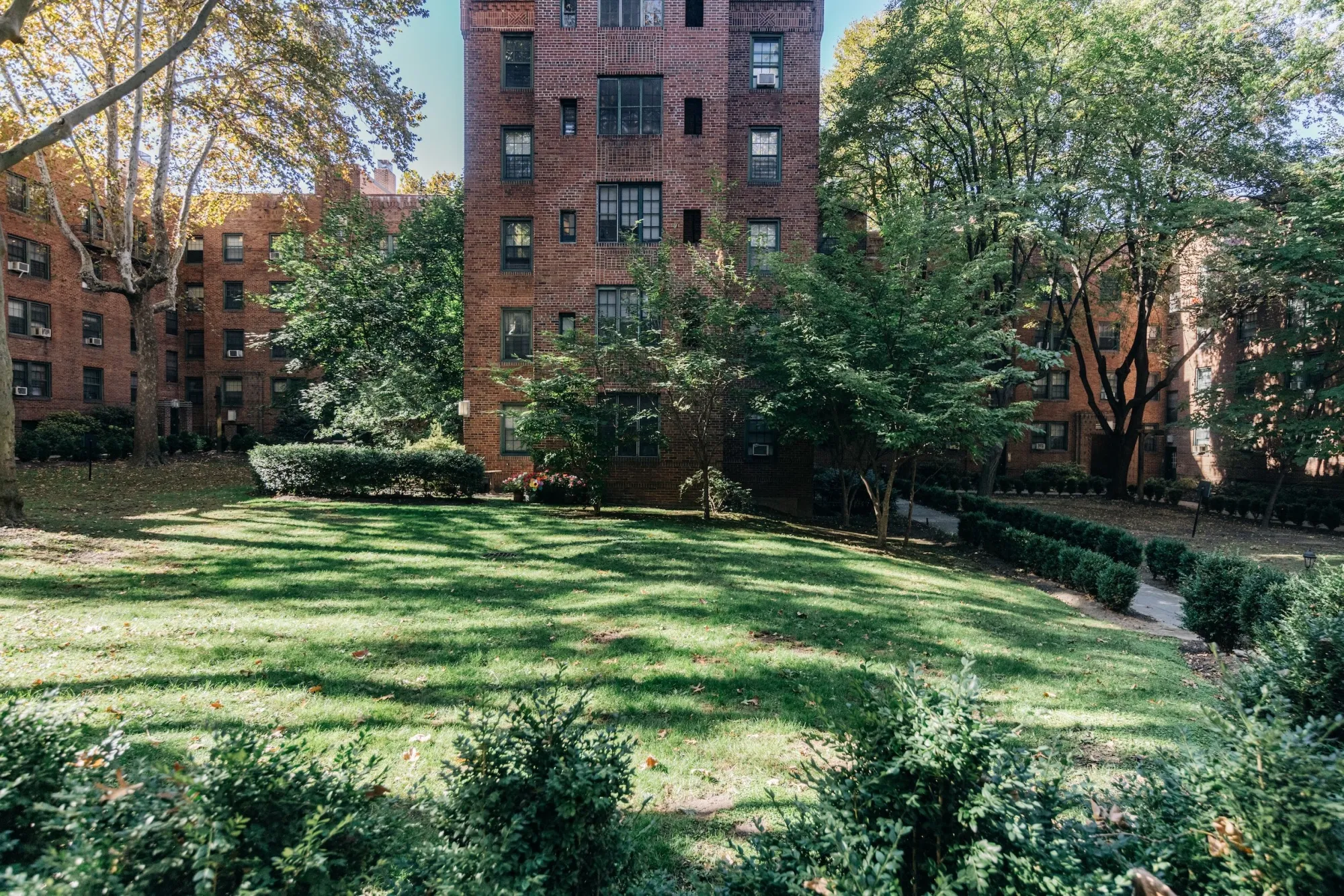
An interior courtyard at the Sunnyside Garden Apartments in Queens, New York. Completed in 1928, it remains a beacon of quality of life.

Growing up on the Copeland Estate in a suburb of New York, I would have been quite isolated from humanity if not for a scattering of nearby homes that had children. Having playmates meant so much to me. But for years, US community designers forgot about the importance of human interaction for both children and adults. One way to build it in, especially in cities, is the classic courtyard.

Alexandra Lange notes at Bloomberg CityLab that the shrinking population of children under five across the US “is bad news for the diversity and stability of cities, which are improved by the amenities that families seek — parks, public libraries, safe streets. It’s also discouraging for families who prefer to live in the city or don’t have the option or desire to move to the car-dominated suburbs. Any effort to retain families has to start with housing, their primary expense.

“That one weird trick for making cities more family-friendly? We’ve known it for decades: It’s the courtyard. …

“While Europe can claim centuries-old courts, America dabbled in them for decades, before the suburbs became the dominant housing type of both government subsidy and political propaganda.

“Courtyards don’t have to belong to the past. While textbook examples in brick and stone are lovely — and still home to thriving communities — contemporary architects are making courts in all sorts of materials, and for all types of housing, from apartments to townhomes.

“One of the first influential figures to advance the idea of the courtyard as the ideal urban type for families was Henry Darbishire, the mid-19th century English architect. His first patron, Angela Burdett-Coutts, was inspired by Charles Dickens and his novels of the urban poor to apply her wealth to reformist housing. ‘Nurturing the family and protecting children from the street was a huge part of the logic — turning the city inward,’ says Matthew G. Lasner, housing historian and the author of High Life: Condo Living in the Suburban Century.

“Architects and philanthropists quickly embraced an easily replicable courtyard model, with a single entrance on the street and interior vertical access off a planted court. The concept came to America in the 1870s via developers like Alfred Treadway White, responsible for the Cobble Hill Towers in Brooklyn. In the 1920s, more reformist developers — including everyone from the Rockefellers to communist unions — constructed many more of these courtyard projects.

“As architecture critic John Taylor Boyd wrote in 1920 of the Linden Court complex in Jackson Heights, the courtyard’s ‘benefits are apparent when it is remembered that the streets are the only playground of New York children, including the children of the rich.’ …

“When you’re talking courtyards in America, it’s hard to avoid Sunnyside Gardens. Not only does the Queens community remain one of New York City’s best neighborhoods, but it was home to one of America’s best critics, who made his affection clear.

“Lewis Mumford was one of the first residents of Sunnyside Gardens, completed in 1928, and constantly returned to its balance of private and public space, building and garden, in his analysis of other lesser New York City housing options. In “The Plight of the Prosperous,” published in the New Yorker in 1950, Mumford takes aim at the new white-brick residential buildings ‘that have sprung up since the war in the wealthy and fashionable parts of the city.’ While new low- and middle-income housing projects like his own ‘provide light and air and walks and sometimes even patches of grass and forsythia,’ these other private buildings, clustered in uptown rich neighborhoods, lack multiple exposures, outdoor space, cross-ventilation and quiet. …

Clarence Stein and Henry Wright were the primary architects and planners behind Sunnyside Gardens, with Marjorie Sewell Cautley the landscape architect; all three would subsequently collaborate on Radburn, New Jersey, the ‘town for the motor age’ that in fact applied these communal principles for a result that we would now call transit-oriented development.

“The planners’ primary insight, in both the city and the suburbs, was to prioritize protected, communal open space over private yards or interior amenities. The courts, or courtyards, could be much larger if not subdivided by owner, and even in areas with public parks, having play space (and play companions) directly outside your door was a huge amenity. …

“On the West Coast, the courtyard evolved a little differently: surrounded by lower density, semi-detached houses with, eventually, a swimming pool in the center instead of a lawn. Irving Gill, considered the father of California modernism, designed prototype bungalow court in Santa Monica in the teens, with parking out of sight in the back and doorstep gardens. On tighter sites, U-shaped buildings with Spanish- and Italian-influenced architecture featured tiled fountains at center court. …

“ ‘When people have families with children, the home is important, but equally important are the people who are there with you,’ says Livable Cities president Meredith Wenskoski. “Your neighborhood is crucial. …

Bay State Cohousing, a 30-unit development outside Boston, has common amenities as part of its charter, including a shared kitchen and activity rooms. But the pastel, clapboard complex, intended to blend in with single-family neighbors, also forms a U around a southwest-facing courtyard, with outdoor circulation providing plenty of opportunities for casual run-ins with the neighbors.

“ ‘The courtyard is a nested boundary that allows interaction with other children, and more importantly, with other adults who become a kind of network,’ says Jenny French, whose firm French 2D designed Bay State. ‘In an urban setting, the barrier that the contemporary parent has to letting their child out the door, thinking about the car-dominated city where they are unable to play in the street – the courtyard is a natural alternative.’

“French, who has also been coordinating the housing studio at the Harvard Graduate School of Design for seven years, can’t help but extend these design observations into the cultural and political spheres. Everyone talks about loneliness in America for people of all ages. For teens and seniors alike, French sees a solution. It’s one we’ve had all along: ‘Could a courtyard house actually be the friendship apparatus we need?’ ”

Lots more at Bloomberg, here.

Read Full Post »

Photo: José Hevia.
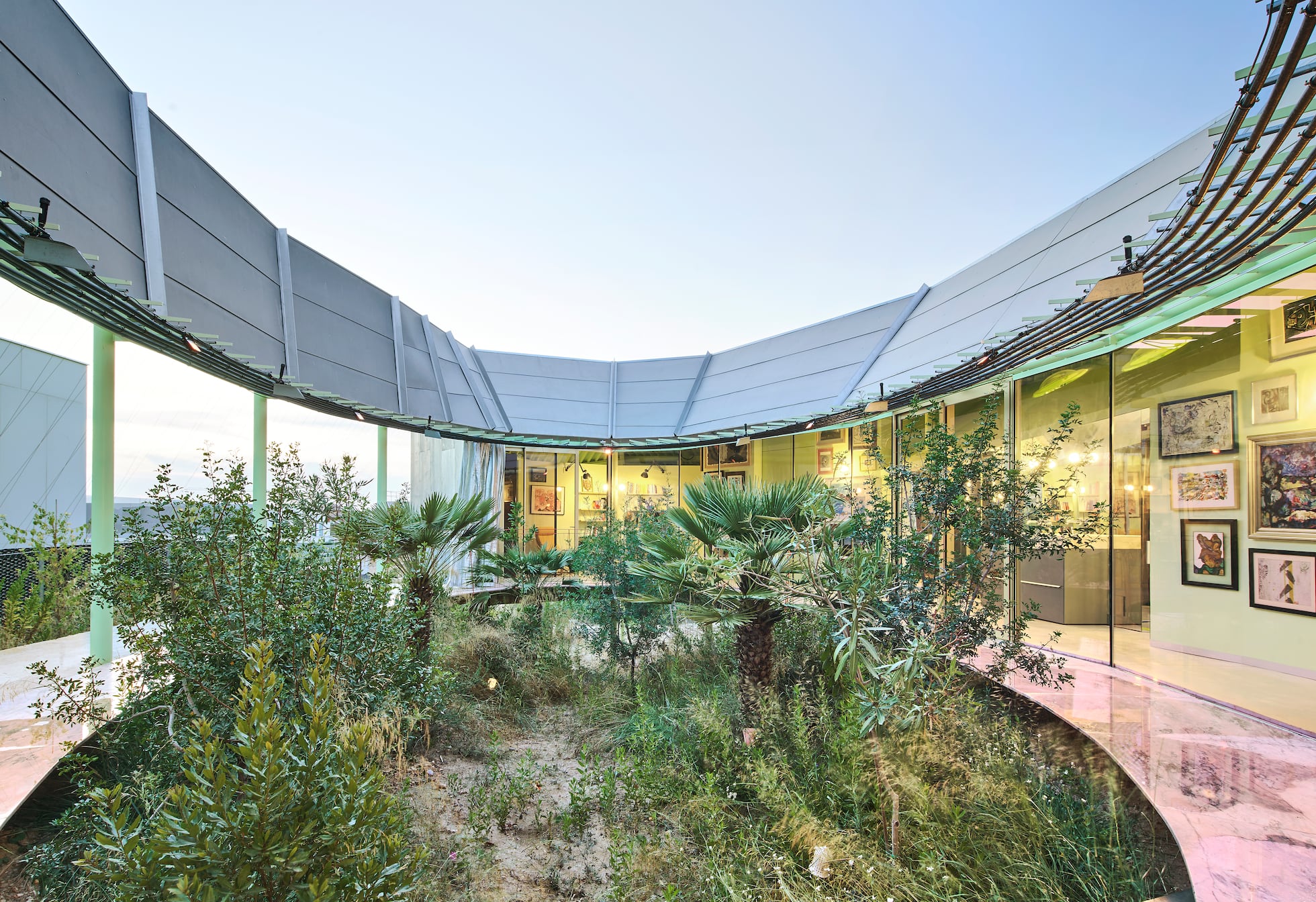
Rambla Climate-House by architect Andrés Jaque in Molina de Segura, Spain.

Today’s article addresses how architecture can and should repair our ecological system. How in cities, for example, a comprehensive vision would extend beyond beautifying downtown to embracing the understanding that we are not the only species on the planet.

At El País, Miguel Ángel Medina interviews architect Andrés Jaque about buildings that can be good for the environment.

“For three years,” he says, “Andrés Jaque, 53, has been dean of the Graduate School of Architecture at Columbia University, one of the most cutting-edge centers in architectural innovation. The Madrid-born architect is spending his time at the university rethinking how buildings and cities should face climate change. He believes that we must commit to an ‘interspecies alliance’ and that buildings, beyond just being sustainable, should also contribute to repairing our ecology.

“Jaque has proposed several projects with this concept in mind, such as the Reggio School in Madrid — designed to create life within its walls and attract insects and animals. …

Andrés Jaque
“Architecture is the discipline that has most clearly assumed the responsibility of responding to the climate crisis. In the last 15 years, there’s been a radical transformation [in the field]: materials have gone from being sustainable to [repairing the ecology]. And [the architectural field] has revised its own mission, which is no longer to just build new buildings, but to manage the built environment. Additionally, it has brought about an intersectional vision: understanding that the material, the social, the ecological and the political are inseparable and that climate action has to coordinate these fronts of transformation. This has placed architecture at the center of environmental action.

Miguel Ángel Medina
“Do architects share this interpretation?

Jaque
There’s a part [of the field] that’s anchored in a heroic vision of modernity and another that’s commercial… but there’s another that has a political commitment to the planet. And [those who adhere to this] understand that architecture must respond not only to the most immediate circumstances of a commission, but also to action for the planet. …

“There are two systems: a material world of extractivism — which is a mix of carbonization, colonialism, anthropocentrism, heteropatriarchy and racialization — that’s currently collapsing. And, in the cracks of this system, another kind of architecture is emerging, which seeks alliances between species based on symmetry, which pursues a global regime of solidarity and which advances along a line of decarbonization that marks the esthetics, the materialities [and] the types of relationships that constitute contemporary culture. This is gaining undeniable strength. In the future, we’ll see a change that’s as important as the one that modernity once represented.

Medina
“What do we do with urban planning, given so many extreme phenomena?

Jaque
“We’ve been pioneers in proposing a change of focus, from an emphasis on the city as a kind of stain on the territory, to a trans-scalar approach. This is a way of understanding [the physical structure that is] an urban block of apartments, the microbial relationships that occur in the bodies of those who live on that block, as well as the large networks of resource extraction that make life on that block possible.

“The city has lost the capacity to contain all realities, [which is necessary] in order to think in a climatic and ecosystemic way. And we need a new model that allows us to understand that what happens on a molecular scale has implications on the scale of bodies, buildings, streets, neighborhoods, the planet and the climate. Designing [cities] in a trans-scalar way requires changes in the methodologies of architecture, which we’re exploring. …

“Cities are going through a period of great transformation. A transformation in which the city has to be understood as something physically porous, which allows for the circularity of water, which contributes to multiplying life… a transformation of materiality that promotes a flow of materials that also contributes to the health of bodies. [We require] a very different way of urbanizing the air – in such a way that it’s understood that there’s a direct relationship between our lungs and the climate – and a commitment to the generation of diverse and empowered living environments. The main difficulty is how to do this quickly, so as to mitigate the impact of the climate and environmental crises.

Medina
“What’s this new ‘interspecies diplomacy’ that you advocate in favor of?

Jaque
“Humans are just one of many forms of life. And the idea that humans can decide to sacrifice the rest of the species to serve their own interests has been shown to be harmful. Understanding that we’re dependent on many other species — and that we’re actually inseparable from them — is more realistic. We depend on the quality of the soil, on the ecosystems. An interspecies alliance based on protecting the living conditions of diverse species is beneficial for all life on the planet.”

More at El País, here.

Read Full Post »

Photo: Hufton+ Crow.
This affordable housing in New York was designed by the firm of famed architect Daniel Libeskind.

If you’ve spent your career catering to the wealthy, where do you go for other worlds to conquer? One architect turned to the poor.

The story is from Justin Davidson at Markets Today via MSN.

“Walk down an ordinary blah-colored stretch of Marcus Garvey Boulevard in Bedford-Stuyvesant, past the dispiriting bulk of Woodhull Hospital and the brown-brick boxes of the Sumner Houses project, and you come upon an incongruous apparition, a great white sugar cube that’s been carved, beveled, and knocked askew. Stranger still, this work of obviously ambitious architecture was executed on a spare budget for residents with meager incomes. Even more startling, the Atrium, an affordable-housing development for seniors and veterans of the shelter system, was designed by the firm of Daniel Libeskind, he … of the kind of jagged form that would defy attempts to gift-wrap it.

“With the Jewish Museum in Berlin, opened in 2001, Libeskind established himself as a pioneer of deconstructivism, a style based on the illusion that buildings were lifting off, bursting, imploding, or peeling apart. After the 9/11 attacks, when he was appointed master planner of the World Trade Center rebuilding project, he became famous as the embodiment of advanced architecture, headlining a period when a dozen or so celebrities scattered the world with signature structures. You might not know where a building was or what it was for or how it stood up, but you could quickly identify who designed it. His global brand would seem like an odd choice for the most basic tier of New York’s urban shelter. …

“Spend some time in and around the Atrium, though, and you begin to see that the pairing of high-design auteur and low-income residents meets an assortment of needs and isn’t just noblesse oblige. Erected by a cluster of nonprofits — Selfhelp Community Services, Riseboro Community Partnership, and the nonprofit developer Urban Builders Collaborative — on a patch of NYCHA [New York City Housing Authority] land, the Atrium leavens the neighborhood with 190 new apartments, a spacious community room, fresh landscaping, and a jolt of jauntiness.

“Like many public-housing projects, the original Sumner Houses, built in the late 1950s, withdraw from the street, lurking behind a perimeter of pointless lawn. The Atrium does the opposite, hugging the sidewalk, peppy and reassuring. This is an active, even restless building that greets passersby with a smooth dance move. … The whole structure makes a quarter-twist from ground to roof, and you can trace its sinews stretching diagonally across the grid of ribbon windows.

“Inside, comfortable apartments encircle the raised, skylit courtyard that gives the building its name. That arrangement is a resonant one for Libeskind, who grew up in the Amalgamated Houses in the Bronx, a complex developed in the 1920s by the garment workers union. …

” ‘It stood out,’ Libeskind told me. ‘It was populated by working-class people, but it had a sense of elegance.’ The courtyard was essential, a way for mostly Jewish immigrants to replace the tenement’s narrow, stinking air shaft with a form of genuinely gracious living. …

“Still, there’s a difference between an outdoor courtyard and an indoor atrium. Carelessly handled, the nine-story doughnut form could easily have evoked stifling precedents. … To avoid any hint of that oppressiveness, Libeskind laced the floor with diagonal walkways between raised planters and sculpted the inner façade almost like a climbing gym, with protrusions, ledges and trapezoidal windows placed in an apparently random arrangement. The goal was to make the court a destination rather than a vestibule. Since it’s one floor up from the lobby, going there requires an affirmative decision. …

“The success of a low-income housing complex depends on its social warmth. Selfhelp maintains a small team of social workers on-site, mostly to help residents navigate the welfare bureaucracy but also just to be there if they want to chat. …

“The residents I spoke to enjoy the Atrium, not because of its architectural pedigree but because it is clean and safe and orderly and bright, a rare haven for New Yorkers whose lives have often been turbulent. Still, loneliness is a tough enemy. …

“Designing a building and running it are different arts, but doing each one well fortifies the other. With the Atrium, Libeskind has given vulnerable people a place they can gradually make their own. He has also demonstrated that the daunting list of rules, requirements, prohibitions, and economic strictures that govern affordable housing in New York don’t have to choke off inventive architecture. …

“Ahmed Tigani, a deputy commissioner at the city’s Department of Housing Preservation and Development, insists that the Atrium shouldn’t be a one-off showcase of precious design. Recruiting architects like Libeskind makes it clear that low-income housing is an integral part of the cityscape. City housing staffers should wrestle with loftier questions than those described by the number of units built, Tigani says. ‘What is the physical impact of our investment, but also the social and spiritual impact? What does a building visually contribute? Does it feel like a part of your neighborhood? Does it feel like a statement of belief in what that housing can be?’ ”

More at MSN, here.

Read Full Post »

Photo: Mitchell Joachim/Terreform ONE.

Most builders rely on steel and concrete in construction, but the production of those materials is bad for the environment. That’s why innovative thinking in architecture is so important. At Fast Company, Nate Berg describes one unusual experiment.

“In a forest along the Hudson River north of New York City, a strange new building is slowly rising. The strangeness of the building is that it’s meant to be occupied by humans, animals, and plants. The slowness of the building is that it’s made out of — made by, really — growing trees.

Fab Tree Hab is a 1,000 square foot tent-shaped pavilion that uses grafted white willow trees to form its walls and roof. Using a computer-designed scaffolding system to precisely guide their growth, these trees are bent to create a living canopy that will, through specifically placed tree grafts and planter boxes, fill out the form and structure of the almost-entirely bio-based building. The scaffold can eventually be removed and reused elsewhere. Within 10 years, it would be a kind of multi-armed and interconnected mega tree house. It’s a prototype that could show how buildings may eventually be grown rather than built.

“The project comes from Terreform One, a nonprofit art, architecture, and urban design research group led by architect Mitchell Joachim. The idea behind this project has had a tree-like maturation period, starting from seed around 2002. Habitat for Humanity had launched a design competition looking for new approaches to building suburban housing. At the time, Joachim was pursuing a PhD in architecture at the Massachusetts Institute of Technology, exploring the application of ecological processes to design.

“Along with fellow doctoral researchers Lara Greden and Javier Arbona, he began to explore new ways ecological processes might be applied to the design brief of getting massive amounts of housing built. …

“The idea of shaping trees into usable structures goes back thousands of years. ‘You can find examples of this within illuminated manuscripts, within the bible,’ Joachim says. The main problem, though, is that these structures take a long time to grow.

“Joachim and his collaborators began thinking of ways to accelerate the process. Initially they explored growing trees hydroponically, and transplanting them into a scaffold. This would have given them height very quickly, but the strength of the trees would have been less than naturally grown trees. With hopes of turning this tree-based system into a viable approach to building, Joachim and his collaborators decided they also needed that strength.

“By this point, Joachim was years into the research process, and had launched Terreform One. In looking at other methods for growing trees quickly, the team learned about biomass farms, which grow trees that are harvested and burned to create electricity. These farms grow tightly packed rows of trees that rise dozens of feet in height within just a few years. The tall, slender trees seemed perfect for use in the scaffold Joachim and his team envisioned. The design shifted and the project was reoriented around replanting white willows harvested from a commercial biomass farm.

“The Fab Tree Hab pavilion that’s now standing in the forest in New York is made up of these replanted trees. Planted together in clusters, the trees make up a few dozen vertical ribs of the pavilion. Designed to graft together over time into a thicker tree, each cluster forms what will be a pillar of the building.

“While they’re still young and pliable, the clusters have been bent into the mass timber scaffold, which is itself a unique piece of architecture, appearing somewhat like an upside-down boat hull. The ribs of the scaffold guide the trees upwards and along the path of what will eventually be a sloping pitched roof. In the wall space between the vertical trees, the scaffold is outfitted with planters and habitat for other plant and animal species, each made from biodegradable materials like hand-crocheted jute and bioplastic. After a year’s growth, it’s estimated that the tree elements will be able to physically support the weight of these planters and habitat structures.

“ ‘It is kind of a land coral, or a terrestrial reef. It attracts all kinds of things to live inside it and around it and underneath it and then thrive in that section of the forest,’”’ Joachim says.

‘On day one we had frogs move into the shelter.’

“About halfway up the arched pavilion, additional planters create space for the Fab Tree Hab’s key architectural element. This is where additional trees can be grafted onto the tree structure as it matures, enabling the building to rise even taller. …

“ ‘The point of the entire structure is a prototype to really get this right so that this could be replicated anywhere,’ Joachim says. He envisions the system being scaled up, made into a kit of parts people could use to grow, say, a garage or a backyard pergola, and eventually even a house. There could be tree-walled museums grown over a decade, or even opera houses with resonant walls of willow timber that are alive and still growing.”

More at Fast Company, here. No paywall.

Read Full Post »

Photo: Rafael Viñoly Architects.
This airport in Italy will incorporate “multi-modal transport” links as well as … a vineyard.

No matter how innovative and complicated an architectural design is, it’s the quirkiest little thing that captures the attention of the public. As a member of the public, I am really hoping that the plans for a working vineyard on the roof of an airport in Florence will work out.

Lizzie Crook writes at Dezeen, “US studio Rafael Viñoly Architects has unveiled its plans for an international terminal at Florence Airport in Italy that will be crowned by a 7.7-hectare [19 acre] vineyard.

“The airport terminal will encompass 50,000 square meters [538,196 square feet] and is expected to be used by more than 5.9 million passengers annually. …

“The terminal’s main feature will be a vast sloping roof, which will be lined with skylights and 38 rows of usable vineyards.

“According to Rafael Viñoly Architects, this is a nod to Florence’s reputation as ‘the heart of Italy’s renowned wine country. … A leading vintner from the region will cultivate the vineyards, and the wine will be crafted and aged in specialized cellars beneath the terminal’s roof.’

“Inside, the terminal will feature a large piazza-like space at its centre, which will be flanked by the arrivals and departures areas on opposite sides. This central space will be linked to transport, parking and retail spaces open to both passengers and local people, and is hoped to streamline circulation for the terminal.

“Other key elements of the proposal include the reorientation of Florence Airport’s, formerly Aeroporto Amerigo Vespucci, existing runway by 90 degrees. This move will turn the runway away from the surrounding hills and lengthen it to better suit modern aircraft.

“The plans will also improve the airport’s links to the city and wider region through ‘multi-modal transport options including a new light rail system,’ the studio said. [The] construction of the airport terminal will be carried out in two phases, with the first slated for completion in 2026 and the second in 2035.”

The architects’ website adds this: “Linear structures of precast concrete contain the soil and irrigation to sustain the vineyard and are held aloft by a network of branching columns that preserve layout flexibility for the terminal’s internal components. …

“Between each of these sloping, elevated structures [are] insulated skylights that flood the interior with natural light. The structures’ trapezoidal section (narrower on the bottom than the top) increases the view angle of the sky from below. In all there are 38 rows of productive vineyards that will grow on the building’s roof while providing excellent thermal insulating characteristics that contribute to the building’s targeted LEED Platinum sustainability rating. …

“The wine will be crafted and aged on-site in specialized cellars below the area where the ground begins to slope up to become the terminal’s roof. This enormous surface, which hides the airport terminal when viewed from Brunelleschi’s Duomo and other prominent vantage points in the city, will not only serve as a new landmark for the city’s sustainable future, but also as a symbol of the traditions, history and innovative spirit that continue to drive the Italian economy into the 21st Century.” More here.

More at Dezeen, here.

Read Full Post »

Photo: Philippe Ruault.
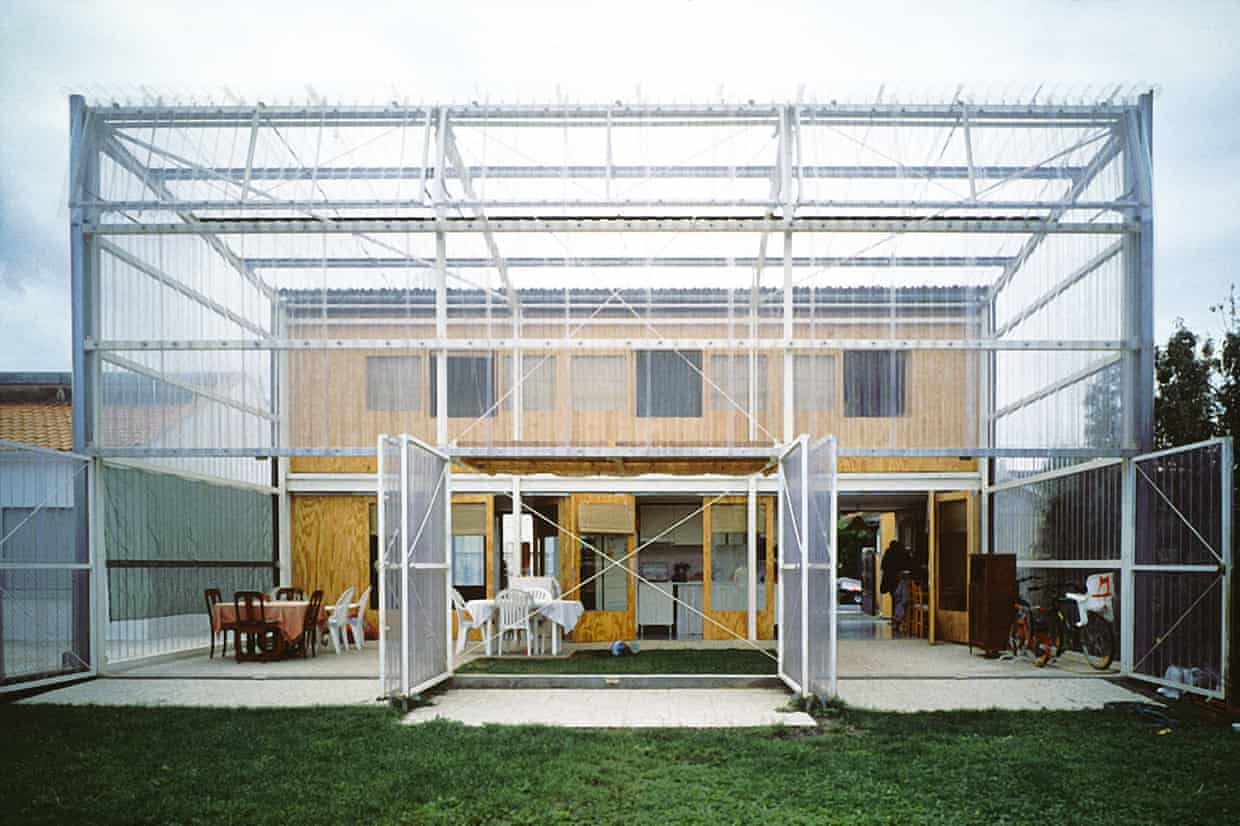
By adding a double-height conservatory at a family home in Floirac, Bordeaux, the architects “doubled the floor area their clients expected, while staying within a very limited budget,” the Guardian reports.

It’s generally considered cheaper and more efficient to tear down a building and build new than to renovate or reuse. Two acclaimed French architects have found the opposite, and their insights are timely. More people are realizing that standard construction practices are unnecessarily wasteful — and damaging to the planet.

Rowan Moore describes the architects’ approach at the Guardian. “The French architects Anne Lacaton and Jean-Philippe Vassal are famous for their belief in keeping existing buildings whenever possible, no matter how unpromising or unloved they may be. They follow, in effect, an architectural version of the Hippocratic oath – ‘first, don’t demolish.’ It’s a message that has never been more pertinent, as it dawns on the construction industry that constant demolition and rebuilding is an environmentally devastating activity.

“The husband-and-wife team have been putting this idea into practice for decades. … Keeping the already-there is not, though, their only concern, nor is it to do with sustainability alone. They like to use words such as ‘generosity,’ ‘kindness’ and, above all, ‘freedom,’ which means that they are always looking to find and create spaces additional to those asked for in a brief, ‘with no utility, no function,’ as Vassal puts it, ‘in which the user will feel the possibility to be inventive for themselves.’ …

“ ‘We really feel enclosed in a brief,’ says Lacaton, ‘that has so many rules, so many recommendations and impositions.’ … They strive against an attitude that ‘in architecture everything must be quantified… everything should be uniform.’ …

“In the early 1990s, they designed a new family house in their home city of Bordeaux, where they doubled the floor area their clients expected, while staying within a very limited budget. Their secret was to erect a double-height conservatory built like a simple greenhouse, which gave a sense of generosity and freedom to the rest of the house, a two-story structure with also basic construction. …

“[They have] a fondness for adapting humble and disregarded ways of building. ‘We found we were conditioned by our education as architects,’ says Lacaton, ‘to say that one way of constructing is the right one and the other one is not good. We discovered that we could use any tool, any material, anything if it’s used in an intelligent way.’ They also developed the idea of reusing the already-there, as with a seaside house in Gironde, south-west France. which was built among 46 pine trees, along with arbutuses and mimosas, without cutting any down. With the Palais de Tokyo in Paris, a 1930s building remodeled as a centre of contemporary art in two phases, in 2001 and 2012, they took pleasure in making only minimal alterations to its damaged interior. …

“Where they differ from other architects is in their attitude to control. In the John Soane museum, every detail and experience is minutely managed and directed. Contemporary practitioners often photograph their works unpopulated, at the precise moment between completion and inhabitation, where the perfection of their idea is most immaculate. For Lacaton and Vassal, it’s important to know when to stop, when to leave it to residents to occupy and embellish their homes. They enjoy and photograph the different things that people do to their spaces.

“Their way is humane and intelligent. It’s also invaluable. In Britain and elsewhere, there’s a desperate need to create more homes without incurring unacceptable bills for carbon emissions and energy consumption. Reuse is an obvious answer.”

More at the Guardian, here.

Read Full Post »

Photo: Asif Hassan/AFP/Getty Images.
A resident with her flood-resistant hut made from bamboo at a cost of about $87.

The news of floods this week is tragic. In Libya a dam suddenly broke, wiping away villages, and even near me, a quixotic rainfall — 11 inches in about 6 hours — submerged many homes in one city while the rest of the region was untouched.

Pakistan, of course, has suffered worse. That’s why it’s extra interesting to read about a sustainable, cost-efficient way that some poor areas there are rebuilding.

Zofeen T Ebrahim writes at the Guardian, “A year ago, Shani Dana’s mudbrick house was swept away in the worst floods on record to hit Pakistan. More than 1,700 people were killed and 900,000 homes damaged or destroyed. Sindh province, where Dana lives, was the worst affected.

“While waiting for government money to rebuild her home in Wasram village, in the Tando Allahyar district, word reached Dana that the Heritage Foundation of Pakistan (HFP), founded by a renowned architect, Yasmeen Lari, was building one-room homes in neighboring Pono village.

“The buildings ‘looked like rounded chauhras [traditional huts], but were octagonal in shape and the walls were much sturdier,’ says Dana.

“The foundation agreed to help Wasram rebuild and in March the HFP team joined villagers to construct 50 new homes. Prefabricated bamboo frames were built on meter-high raised platforms. Walls made of bamboo canes were fixed and plastered with mud mixed with rice husk and lime, and radial-style conical roofs were fitted. Four solar panels, six water hand pumps and 25 toilets were also built.

“ ‘This will not be swept away if the floods come again. It is not built at ground level, it’s airier and brighter since there is a window – ours didn’t have one before – and also looks much neater, since the walls and floor are plastered,’ says Dana outside her new home. …

“The HFP has helped build more than 5,000 chauhras since September [2022]. ‘In the next two months, I should be able to build another 2,600 homes,’ says Lari, who is urging every villager who has built their home to help 10 others build theirs.

“A year after the floods, tens of thousands of people are still waiting for help to rebuild. Organizations like HFP and the NGO Karachi Relief Trust have been stepping in.

“About 250 of the 1,000 one-room homes KRT is building in villages across Sindh, Punjab and Balochistan provinces … are being built using burned-earth bricks or cement blocks with roofs made of steel girders and precast cement slabs. ‘The houses we built in 2010 have survived and aged well,’ said Ahsan Najmi, the trust’s architect. …

“The Sindh People’s Housing Foundation (SPHF), which is overseeing the rebuilding, hopes 50,000 one-bedroom ‘resilient’ cement, brick and steel homes will be livable by September. It has enough money to cover the cost of 350,000 homes, but needs at least $500m to finish all the work. …

“However, Lari questions the cost of the project and believes rebuilding could be cheaper and more sustainable. The houses SPHF is asking people to build cost 300,000 rupees [~$1,030] each, about the same amount KRT’s homes are costing.

“HFP homes, which are made of fully cured bamboo, the ends of which are covered with lime to protect them from termites, cost just 25,000 rupees. The lime in the plaster and bamboo also absorb and store carbon from the air, helping mitigate the effects of the climate crisis.

“ ‘I’m not doing anything new. I may have tweaked the design, but the material used is age-old, indigenous and easily available,’ says Lari, who began her humanitarian work after a 7.6-magnitude earthquake shook northern Pakistan in 2005. …

“Lari, who is this year’s recipient of the Royal Institute of British Architects’ royal gold medal, one of the world’s highest honours for architecture, says she would like the government to adopt sustainable alternatives to housing. ‘I am happy to provide any assistance if they would like to provide a better quality of life for the poor,’ she says. ‘Our design is open source, available free. We can also identify many trained master artisans. It is up to the government. We are there to further the cause.’

“An essential part of Lari’s work is involving communities in the rebuilding process so they learn a trade. While the foundation pays for the bulk of the materials and brings its expertise, local people collect the mud and rice husk, and provide the labor.”

More at the Guardian, here. No firewall. Donations encouraged.

Read Full Post »

Photo: Dezeen magazine.
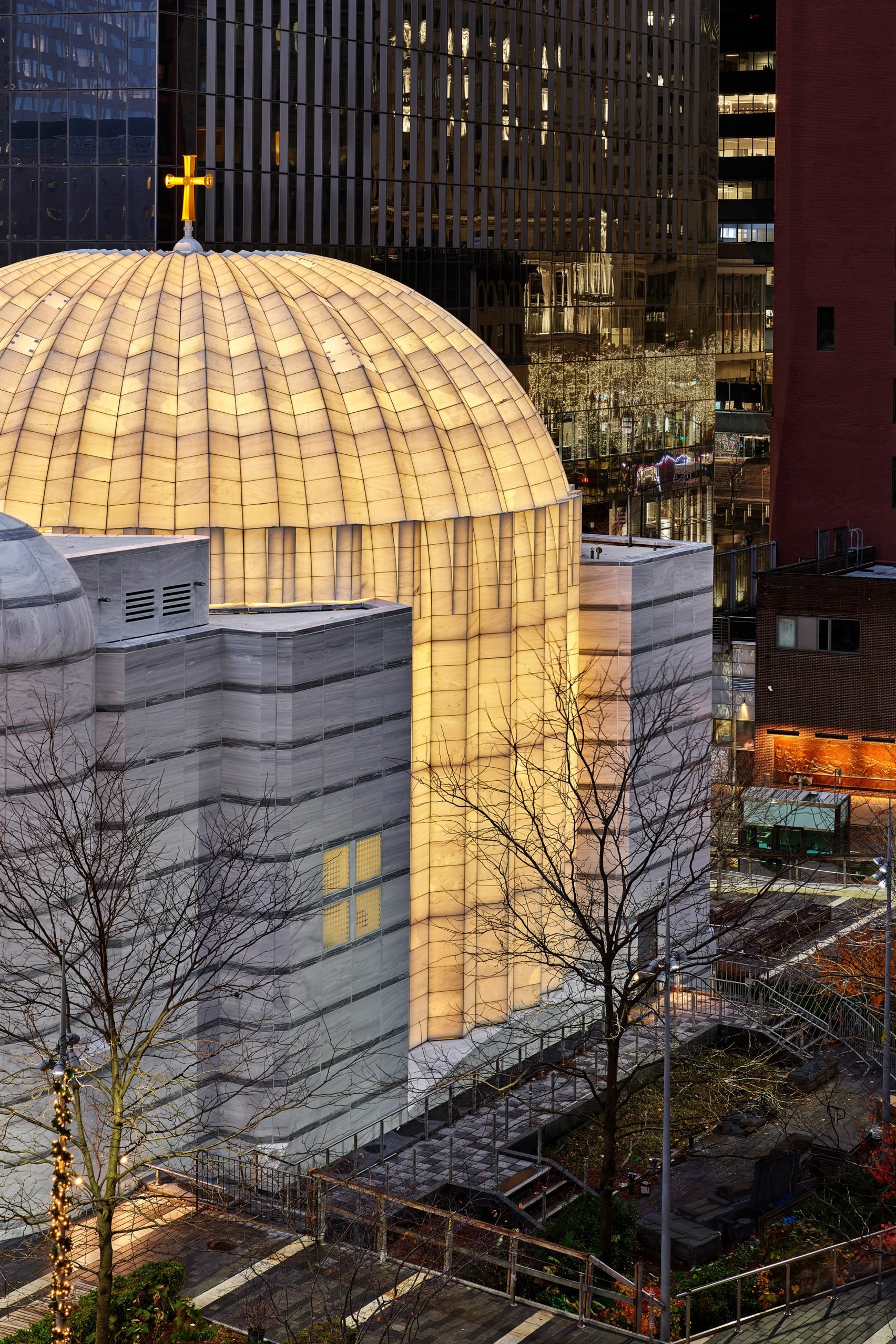
The translucent walls are made of Pentelic marble. So lovely!

You may recall reading about the Greek Orthodox church near the World Trade Center in New York City that was ruined on September 11, 2001. Fortunately, 9/11 was not the end of the story for that church. Tom Ravenscroft reports at Dezeen about Santiago Calatrava’s new illuminated wonder.

“The St Nicholas Greek Orthodox Church, which replaces a church destroyed in the 9/11 attack, has officially opened at the World Trade Center site in New York.

“Designed by Spanish architect Santiago Calatrava, the building replaces a 19th-century church that was destroyed on 11 September 2001. … The church is located alongside the 9/11 memorial that stands on the site of the former twin towers.

“It was designed by Calatrava to be a ‘sanctuary for worship’ but also a reminder of the impact of the terrorist attacks. …

“Said Calatrava, ‘I hope to see this structure serve its purpose as a sanctuary for worship but also as a place for reflection on what the city endured and how it is moving forward. [Architecture] can have an intrinsic symbolic value, which is not written or expressed in a specific way but in an abstract and synthetic manner, sending a message and thus leaving a lasting legacy.’

“Built on top of the World Trade Center Vehicle Security Center, the church is raised around 25 feet above (seven metres) above street level and was designed to be a beacon.

“Informed by Byzantine architecture and the Hagia Sofia in Istanbul in particular, the church is arranged around a central drum-shaped form that is topped by a dome.

“The walls of this central section were made from thin sheets of Pentelic marble so that the building can be illuminated at night.

” ‘This Shrine will be a place for everyone who comes to the sacred ground at the World Trade Center, a place for them to imagine and envision a world where mercy is inevitable, reconciliation is desirable, and forgiveness is possible,’ said Ioannis Lambriniadis archbishop elpidophoros of America.

” ‘We will stand here for the centuries to come, as a light on the hill, a shining beacon to the world of what is possible in the human spirit, if we will only allow our light to shine before all people, as the light of this Shrine for the nation will illuminate every night sky to come in our magnificent city.’

“Surrounding the central domed spaces are four stone-clad towers that give the building an overall square shape.

“The entrance to the church, which faces a large open plaza, was placed between two of these towers and leads directly to the main series of liturgical spaces.

“The altar directly faces the entrance, while the two side niches were completed with translucent arched windows. Above the main space, the domed is surrounded by 40 translucent windows divided by 40 stone ribs, reminiscent of the Hagia Sofia.

“Alongside the main liturgical spaces, several community rooms and offices were placed on the upper floors of the towers.

“To mark the 20th anniversary of the 9/11 attacks last year, Dezeen explored how the site was rebuilt and the numerous buildings created on the site including the World Trade Center Transportation Hub, which was also designed by Calatrava.”

More at Dezeen, here. Lots of beautiful photos by Alan Karchmer. No firewall.

The New York Times and many other publications reported on the reopening of the church, now a national landmark. From the article by Jane Margolies: “Olga Pavlakos grew up going to St. Nicholas Greek Orthodox Church in Lower Manhattan. She was baptized there. Her parents were married there. She has memories of her father, who worked in restaurants, volunteering there on Sundays, and of celebrating Epiphany every January, when parishioners would walk to the Hudson River, toss a gold cross into the frigid water and watch divers plunge in to retrieve it. …

“Her connection to St. Nicholas can be traced to her grandparents, who left Greece in the early 1900s and settled in Lower Manhattan, then a bustling immigrant community. Residents there scraped together money and bought a tavern on Cedar Street that they converted to a place of worship, eventually adding a bell at the top.

“These original parishioners, who had arrived by boat, named their church after the patron saint of seafarers — a saint who fed the hungry and clothed the needy and inspired the character of Santa Claus. … The tiny church was obliterated during the terrorist attacks.

“Twenty-one long and difficult years later, St. Nicholas has reopened. But it is no longer a humble church, exclusively for its parishioners. Its mission is larger, as is its splendor.

“St. Nicholas Greek Orthodox Church & National Shrine, as it’s now called, has become a destination for all. It offers a bereavement center that will serve as a place for meditation and prayer for people of any faith. … The new church is a prominent expression of Orthodox Christianity in the city, and it is a source of great pride for the Greek American community.

“For the few remaining longtime parishioners of St. Nicholas, there is relief that their beloved church has finally reopened. But now, their intimate community hub is a global destination, and some wonder about the future of their once tight-knit parish.” More at the Times here.

Read Full Post »

Photo: Kevin Scott/Dezeen.
The designers of this sauna aimed to build a structure that engaged the local waterways and encouraged people to use them throughout the year, says Dezeen.

When Erik saw my post about a birdhouse championship, he told me one picture reminded him of floating saunas in Sweden. I had to look that up. I found out that saunas on the water are both like and unlike ice-fishing huts. You definitely have to dress differently.

Jenna McKnight at Dezeen writes about the sauna in the above photo: “Visitors can take a plunge into a cold lake after warming up in this floating wooden sauna by Seattle firm goCstudio – the latest example of the trend for buoyant architecture (+ slideshow).

“The structure is intended to be used all year round on Seattle’s lakes and can accommodate up to six people. It is called WA Sauna. … It follows the growing trend among architects to explore the possibilities afforded by building on water rather than land.

” ‘Following in the Scandinavian tradition of saunas as a place for gathering, WA Sauna provides a place for Seattle’s community to share a unique experience on the water,” said goCstudio, a firm founded in 2012 by Jon Gentry and Aimée O’Carroll. …

“Inspired by the concepts of fire, water and community, the designers aimed to build a structure that engaged the local waterways and encouraged people to use them throughout the year. The $25,000 (£17,000) project was funded through community donations and a Kickstarter campaign hosted in the fall of 2014.

“The deck consists of a pre-manufactured aluminum frame and marine-grade plywood with a clear varnish. Boats and kayaks can be tied up to the deck. The floating structure is powered by a 36-volt electric trolling motor. More than two dozen 208-litre plastic drums keep the vessel afloat. …

“Spruce was used to clad the interior and to form the benches. A wood-burning stove heats the space. Users can easily exit the vessel via a door or side hatch and dive into the cool water. …

“The structure was built by studio employees and skilled volunteers. It was erected within a warehouse owned by the local brewery, Hilliard’s, which allowed the team to use the space for free.

“One of the greatest challenges was getting the structure to the lakefront for the first time. … ‘Towed on six steel casters with a 1980 Volkswagen Vanagon, we slowly crept along at dawn making the eight-block trip to the boat ramp in just under three hours.’ …

“Rising sea levels and a shortage of development sites are leading to a surge of interest in floating buildings, with proposals ranging from mass housing on London’s canals to entire amphibious cities in China.

“Other examples that, like WA Sauna, are targeted at communities include a buoyant Nigerian school and a travelling London cinema.”

You can read about another nice sauna at designboom, a site that doesn’t seem to believe in capital letters: ” ‘löyly’ is a prefab floating sauna made of swiss douglas fir. gently swaying in the middle of lake geneva, ‘löyly’ is a floating prefab sauna designed by trolle rudebeck haar – a graduate from the lausanne university of art and design. haar completed this project after spending a year in finland, where he found a true appreciation for the sauna concept and translated it into ‘löyly’ – his final year project. 

“haar designed the structure as a 24 sq. ft floating sauna made of locally sourced swiss douglas fir – a lightweight yet durable material that he salvaged from a sawmill nearby. the entire structure was then coated with teak oil to create a more resistant shell all while preserving the fir’s natural look and feel.

“the interior of the floating sauna oozes with tones of intimacy and comfort. using sliding doors that echo japanese shoji screens, visitors are met with a small wooden burning stove from morzhand. … the choice of stove was made based on practicality: ‘I chose it because it’s compact, transportable, lightweight, and easy to heat up’,  comments haar. 

“haar also had to consider balance and weight while designing the sauna. ‘I was calculating the mass of every unit,’ he explains. the presence/absence of people aboard the floating structure, as well as the placement of the barrels underneath it were all carefully studied to create a safe and enjoyable experience. 

“in just six hours, the floating sauna was built – but haar made it easy to disassemble and scale for different uses.” 

You might also want to click at the Gessato website to see a sauna created by an Italian design team.

Beautifully integrated into its natural surroundings and context, this floating sauna conceptually links Sweden, Italy, and Japan.

“The structure stands on a floating platform, connecting the lake to the land and providing a relaxing space for the guests staying in the clients’ small bed and breakfast. … Self-built by the studio, the project pays homage to nature and sustainability, with impact on the birch forest minimized by moving the sauna on the surface of the water. …

“A glazed wall provides stunning views over the lake, helping guests relax completely and contemplate the beauty of nature. This floating sauna project was presented during the Superdesign Show 2017, held at Superstudio Più via Tortona 27, Milano in April 2017.”

More at Gessato, here, at Designboom, here, and at Dezeen, here. Lots of super pictures.

Read Full Post »

Photo: James O Davies/The Historic England Archive, Historic England.
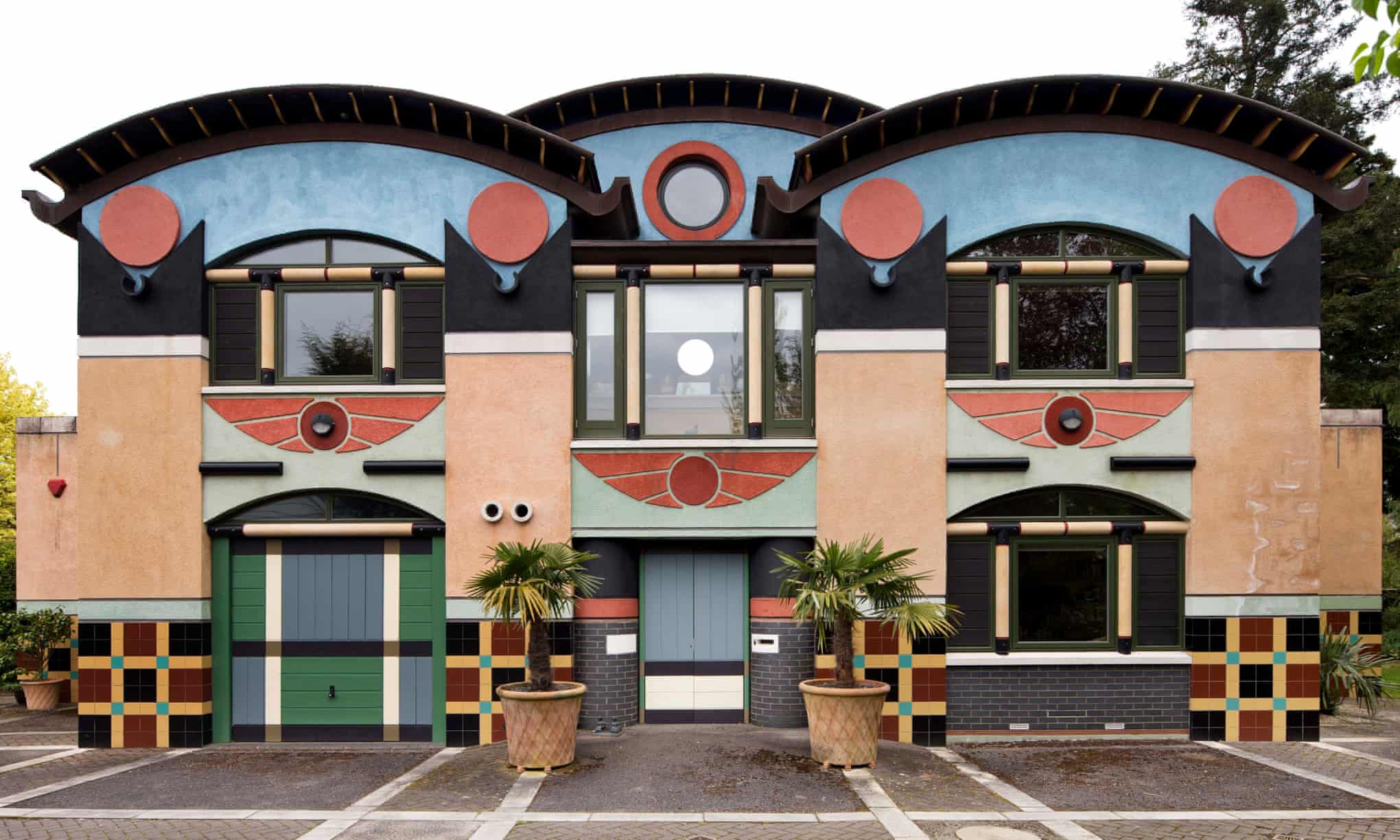
Sphinx House, Moulsford, Oxfordshire, is an example of Egyptian influences on the work of newly rehabilitated British architect John Outram.

Sometimes a person whose work hits a wall of resistance from contemporaries is merely ahead of the times. That may be the case with UK architect John Outram.

Guardian reporter Oliver Wainwright talks to the architect about his philosophy and rehabilitation. ” ‘Our beginning was a worm,’ says John Outram. ‘It had light-sensitive cells at one end that later turned into eyes.’ He is standing in the bathroom at the top of his house in London’s Connaught Square, explaining the symbolism of the patterns that line the walls of his shower.

“Three white worms wiggle their way across a background of blue mosaic tiles at the base of the cubicle, while a black I-shape floats against a band of red tiles above, denoting ‘the emergence of the ego.’ A third yellow band at the top marks the realm of light, where the figure of ‘thought’ appears between two triangles, signifying the parted halves of the ‘heap of history.’

“It’s a lot to digest before breakfast – and we haven’t even got on to the symbolic ceiling (the ‘raft of reason’) or the hexagonal serpent-skin floor tiles.

“ ‘I stand here every morning to do my exercises,’ says Outram, breaking into an infectious giggle. ‘A good dose of metaphysics sets one up for the day.’

“The eccentric architect has reason to be cheerful. At the age of 87, he is enjoying an unexpected wave of popularity. Having been stamped with the label of postmodernism – out of favor since the 1990s, when his work was described as ‘architectural terrorism’ – he has been rediscovered by a new generation, thirsty for color, pattern, ornament and fun.

“The last few years have seen several of his buildings listed, from the Isle of Dogs pumping station, that cartoonish temple to summer storms, to an opulent country house in Sussex built for the Tetra Pak billionaires Hans and Märit Rausing. Illustrations of Outram’s buildings can now be found emblazoned on T-shirts and mugs, while he has a growing following on Instagram, which he joined during lockdown, where he expounds his esoteric theories to a rapt audience. And now, for the first time, the full breadth of his maverick output has been brought together in a monograph. So how does it feel to be recognized so late in life, after years in the wilderness?

” ‘I call it being dug up,’ he says with a chortle. ‘Disinterred, as it were. It’s quite entertaining.’

“As Geraint Franklin, the book’s author, observes, the English have never quite known what to do with Outram. His buildings are hi-tech, neoclassical and postmodern all at once, yet they fit neatly into none of these categories. His chubby columns house sophisticated mechanical systems for ventilation, wiring and drainage, while simultaneously alluding to ancient mythologies in their richly layered ornament.

“A huge jet engine fan in the pediment of the pumping station helps to cool the machinery inside, while also standing as the symbolic source of the ‘river of somatic time.’ A pyramidal glass fireplace in the Egyptian-themed Sphinx Hill house in Oxfordshire summons momentous Pharaonic allusions, while cleverly sucking smoke beneath the floor to a hidden flue.

“In Outram’s world, embracing technology and modernity did not preclude the presence of poetry and history. … Outram piled it all on, mining inspiration from Sumerian, Egyptian, Chinese and Mayan cultures with magpie glee. …

“Born in Malaysia, where his army officer father was stationed, Outram’s outsider status owes something to his upbringing. His childhood saw spells in Burma and India, before he arrived at prep school in England at the age of 11, feeling like ‘a refugee from the British empire.’ His early exposure to the vivid sights and sounds of South Asian cities informed his impression of the classical world, as being ‘much more like India than like the British Museum. Very noisy, very smelly, very colorful.’ …

“Unlike his hi-tech peers, his projects rarely exceeded the capabilities of the average builder. ‘The problem with hi-tech is that it’s very expensive, and the tech isn’t very high,’ he says. ‘I’d been a pilot, so I knew what real hi-tech was – and it wasn’t suitable for architecture.’ …

“As Franklin writes, base materials are subject to an almost alchemical transformation in Outram’s hands. Humdrum concrete – which he once described as a ‘funereal porridge of muddy ashes’ – could be transformed into ‘blitzcrete with fragments of colored brick, ground and polished to an edible nougat finish. It debuted at his New House for the Rausings in Wadhurst, Sussex, in 1986, where five types of crushed brick swirl across the facade like confetti in the wind.”

More at the Guardian, here. Great Pictures. No firewall.

Read Full Post »


Photo: Georges Lentz.

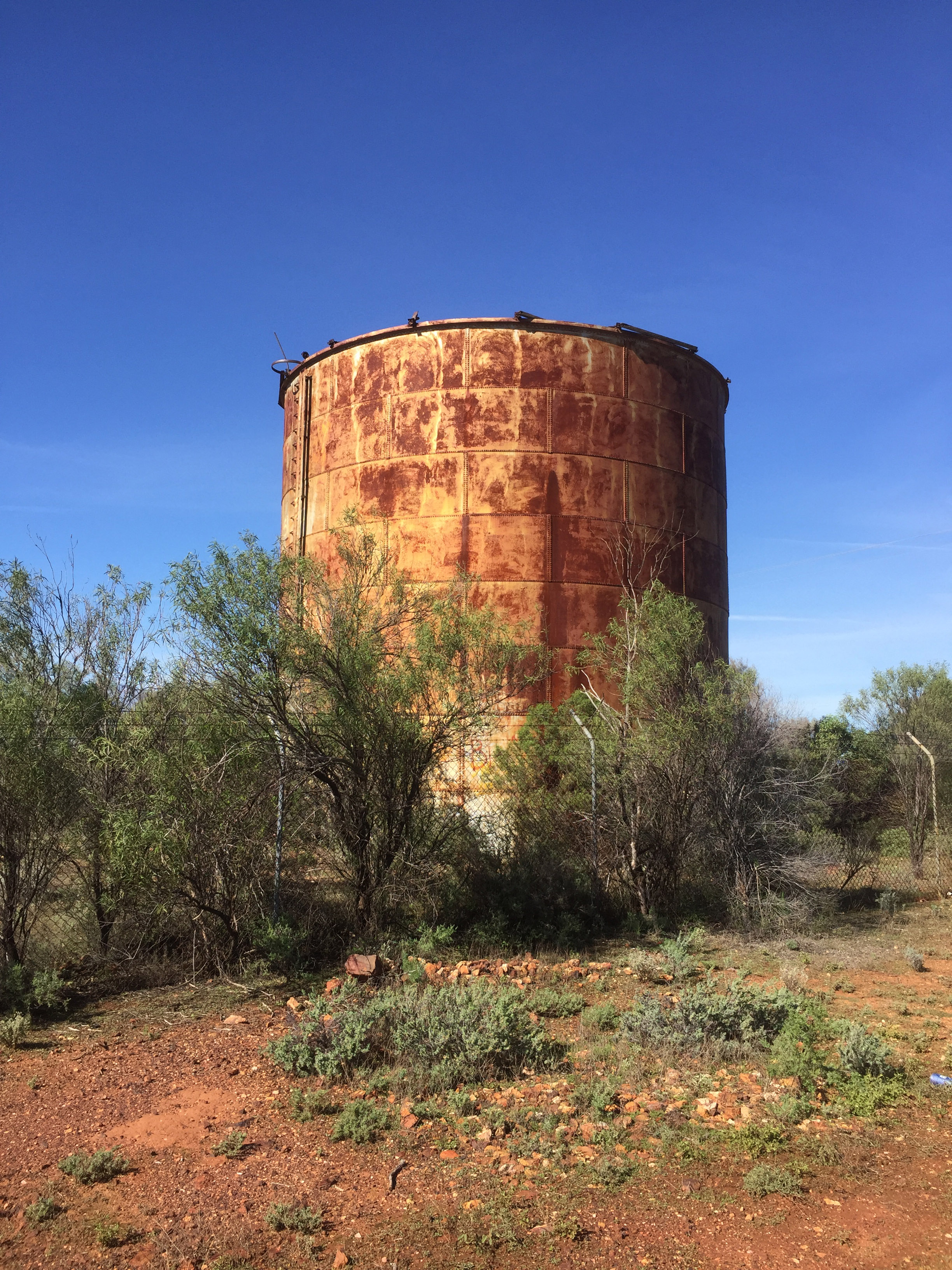
This water tank is also known as the Silver Tank because once upon a time it was painted in silver anti-rust paint. Read about a sound-art installation here that was a collaboration between the composer Georges Lentz and the architect Glenn Murcutt, in Cobar, Australia.

It’s always interesting to learn what inspires an artist. Inspiration from an old, rusted water tank may be unusual, but creative people are like that. It’s not really surprising.

Casey Quackenbush reported the story at the New York Times in January, “Life in Cobar was a delicate thing until the arrival of the Silver Tank.

“In the vast, red-dirt hinterland of Australia, over 400 miles northwest of the shores of Sydney, rainwater is scarce. ​​For thousands of years, the nomadic Aboriginal Ngiyampaa people excelled at the art of survival by creating natural rock reservoirs. But after European settlers discovered copper and gold in the area in the 1870s, enough water was needed to sustain a booming mining town. Reservoirs were dug. Water was trained in from afar. Then, in 1901, a 33-foot-high steel water tank painted silver, hence its nickname, was erected about a mile outside of town. While the threat of drought remained (and remains to this day), it turned dusty Cobar, a freckle at the edge of the Outback, into something of a desert oasis.

“Nowadays, Cobar pipes in its water from the Burrendong Dam, about 233 miles east, and the tank, whose silver finish long ago succumbed to rust and graffiti, is empty of water. It has, however, been filled with something new — music.

“On April 2, after two decades of work, it will be officially reborn as the Cobar Sound Chapel, an audacious sound-art collaboration between Georges Lentz, one of Australia’s leading contemporary composers, and Glenn Murcutt, an Australian Pritzker Prize- and Praemium Imperiale award-winning architect.

“For his reimagining of the roofless tank, Murcutt installed an approximately 16-foot cube within its cylindrical space, in which Lentz’s ‘String Quartet(s)’ (2000-21), a 24-hour-long classical-meets-electronica work, will play on loop via a quadraphonic sound system. Inside the chamber is a concrete bench that seats up to four, from which one can look out through the ceiling’s gold-rimmed oculus. Morning, noon and night, then, the otherworldly sonic stream will reverberate throughout the concrete booth. …

“Lentz has been consumed by questions of cosmology and spirituality ever since he was a child. Born in Echternach, a small town in Luxembourg that formed around a seventh-century abbey, he grew up attending classical music festivals and stargazing with his dad. Later, he studied music in Hanover, Germany. While riding the train to university in the fall of 1988, he happened upon a story in the German science magazine Geo about the creation of the universe. It threw the tininess of humanity into sharp relief for him. …

“Ever since, Lentz has devoted his entire body of work to exploring the questions of the cosmos, transforming his initial fear into a quest for contemplation, one that only intensified following his 1990 move to Australia and exposure to the Outback’s ocean of sky. Both a continuation and culmination of his work, ‘String Quartet(s)’ began as an attempt to translate that sky into a score.

“To do so, he collaborated with the Noise, an experimental string quartet that’s based in Sydney. They used a range of techniques; to mirror a starry night, for example, the musicians invoked the pointillism of the contemporary Aboriginal painter Kathleen Petyarre, plucking their bows at the top of their instruments to create contained bits of sound. …

“They ended up with about six hours’ worth of music, which, through digital editing, Lentz expanded into a 24-hour, techno-infused soundscape of terror, wonder and reverence. …

“Around 2000, Lentz began dreaming of a music box amid a copper landscape, a place where his music could live alongside its muse. But it wasn’t until he played a concert in Cobar in 2008 that he considered the town as a potential site.

“He pitched the idea to the Cobar Shire Council, which later proposed the hilltop bearing the tank, suggesting it be demolished to make room. ‘Absolutely not!’ Lentz said. Soon after, he called Murcutt, 85, who is celebrated for hand-drawn, landscape-specific designs inspired by Australian vernacular architecture. …

“Murcutt has always been drawn to the desert, whose sparseness resonates with the Aboriginal mantra — touch the earth lightly — by which he tries to abide. In keeping with that idea, he set out to design, largely thanks to governmental funding, a simple, solar-powered chapel that would unify sound, site and atmosphere.

“Two large slabs of concrete mark the entrance outside. Inside, the cubic space (which is slightly slanted to optimize acoustics) is stark, just like the desert itself. In the four corners of the ceiling, sunlight streams through windows of Russian blue glass painted by the local Aboriginal artist Sharron Ohlsen, who also employs pointillism in her work. And, over the course of each day, an ellipse of light traverses the floor and concrete walls.”

More at the Times, here.

Read Full Post »

Photo: IHISADC.
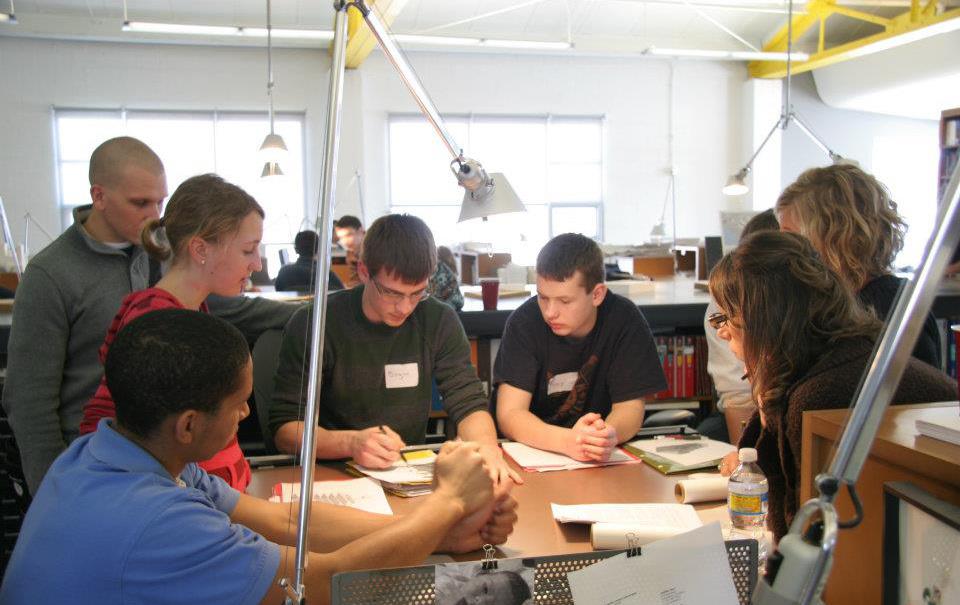
Participants in the 2021 Indiana High School Architectural Design Competition.

It makes a difference when professionals offer their expertise to school students. In today’s story we see what happened when an architect returned to his old high school to teach in its STEM [Science, Technology, Engineering, and Math] program.

Victoria St. Martin reports at the Washington Post, “It can happen in an instant: that moment when you go from not knowing what you want to do for the rest of your life, to having absolute certainty about it. For Tarik El-Naggar, it happened in 1970, when he was in the seventh grade working on a project for English class.

“The assignment? Construct a reproduction of Shakespeare’s Globe Theatre out of everyday objects. He built a 2-foot-diameter cardboard model — and an architect was born. … Says El-Naggar, who’s now 63 and co-owner of an architecture and interior design firm, ‘I don’t know what it was about the building. It had all the seating, the stage and the open roof — it was just awesome. It was a lightbulb moment.’

“El-Naggar’s life came full circle when he added ‘high school teacher’ to his résumé nine years ago — building a STEM curriculum with members of the administration at his former school in northwest Indiana. Inside his Valparaiso High School classroom, students have their own lightbulb moments by creating projects using ping-pong balls, cardboard, computers and 3-D printers. ‘Instead of just teaching the basics of architecture, I’m actually really teaching them design theory,’ says El-Naggar, whose class is similar to what he taught at a nearby college.

“And he’s gotten results: [In 2021] his Valparaiso students swept the Indiana High School Architectural Design Competition, winning all nine awards out of 72 entries from eight schools. …

“Valparaiso, a middle-class community about 55 miles southeast of Chicago, began incorporating more STEM courses into its curriculum about six years ago. A school official said the district wanted to place more emphasis on skills such as critical thinking, communication, creativity and problem-solving, and secured several grants from the county redevelopment commission to bolster tools across K-12 classrooms. The high school roughly ranks in the top 10 percent in Indiana, and its standardized test scores in reading and math significantly outpace the rest of the state.

‘There are schools around the country that have great basketball programs. So, what do parents do? You move there because you want your son or daughter to go there,’ says El-Naggar. ‘I want people to look at what we’re doing here and say, “My kids are going to be engineers, architects. They need to be here.” ‘

“For high-schoolers who want to pursue architecture as a career, taking classes with El-Naggar is paying off: In the past three years, all five of the students who applied to university-level architectural programs have been accepted. ‘People were really impressed that I had already had this experience,’ says Henry Youngren, now a freshman at Carnegie Mellon University in Pittsburgh. … ‘It’s really guided me on how I want to live the rest of my life.’

“Brandon Farley, an architect who is the chair of the high school design competition, says he has some records that date back to the 1970s and he’s ‘never seen anything where one school won all the awards.’ It’s rare that judges see high school teachers with formal architectural training, he adds. With Valparaiso High School’s entries, he says, ‘you can see it immediately in the way the students address the problems and their solutions, and in the way that they talk about their designs. It really raised the bar on the competition.’

“Seventeen-year-old Olivia Lozano received one of the awards. ‘It kind of got the ball rolling for me,’ she says of the contest, for which she created a reading room filled with glass windows that opened to the outdoors. ‘Then it turns into a vortex and you’re down in El-Naggar’s classroom like four hours a day, and then you’re here after school, and then you’re here on the weekends and over spring break.’

“El-Naggar says the lightbulb moment for his students today really happens when they first see a 3-D view of their building. ‘The ones that go, “Oh, my gosh,” and they start “walking” through it and they’re telling other people, “Look at this.” ‘ …

“When the University of Notre Dame, near South Bend, Ind., asked him to critique student projects, he met a fellow architect and professor who would help him get his first teaching gig, at Andrews University in Michigan. Once he started, he knew he’d discovered a second passion. Several years later, he was asked to fill in and teach architecture in his hometown at the high school. He welcomed the opportunity to teach five minutes from his home.

“Now his fervor for teaching is gaining more attention, earning him a teacher of the year award from a national project-based-learning group this past fall. ‘We consider ourselves very blessed to have a teacher like him in the classroom,’ says Nick Allison, the school district’s assistant superintendent for secondary education.”

More at the Post, here.

Read Full Post »

Photo: CBS News
Blind architect Chris Downey explains to CBS News correspondent Lesley Stahl on
60 Minutes how his disability has made him a better architect.

Talk about making lemonade if life hands you lemons! This story about a man who suffered a devastating loss and eventually came out ahead of the game is inspiring.

Lesley Stahl reported on Chris Downey’s saga for 60 Minutes.

“Several mornings a week, as the sun rises over the Oakland estuary in California, an amateur rowing team works the water. It’s hard to tell which one of them is blind. And Chris Downey thinks that’s just fine.

“CHRIS DOWNEY: It’s really exciting to be in a sport where nobody looks in the direction they’re going. You face this way in the boat and you’re going that way. So, okay even-steven.

“It’s not exactly even-steven in this design meeting, where Downey is collaborating with sighted architects on a new hospital building. But he hasn’t let that stop him.

“LESLEY STAHL: Here you are in a profession that basically requires you to read— read designs and draw designs. You must’ve thought in your head, ‘That is insurmountable?’ …

“DOWNEY: Friends that were architects and anybody else would say, ‘Oh my God, it’s the worst thing imaginable, to be an architect and to lose your sight. I can’t imagine anything worse.’ But I quickly came to realize that — the creative process is an intellectual process. It’s how you think, so I just needed new tools.

“New tools? Downey found a printer that could emboss architectural drawings so that he could read and understand through touch. …

“At age 45, Chris Downey had pretty much constructed the life he’d always wanted. An architect with a good job at a small housing firm outside San Francisco, he was happily married, with a 10-year-old son. He was an assistant little league coach and avid cyclist. And then — doctors discovered a tumor in his brain. He had surgery, and the tumor was safely gone, but Downey was left completely blind. As we first reported in 2019, what he has done in the decade since losing his sight, as a person and as an architect, can only be described as a different kind of vision.

“And he came up with a way to ‘sketch’ his ideas onto the plans using a simple children’s toy — malleable wax sticks that he shapes to show his modifications to others. And he says something surprising started to happen. He could no longer see buildings and spaces, but he began hearing them. …

“DOWNEY: I was fascinated — walking through buildings that I knew sighted. But I was experiencing them in a different way. I was hearing the architecture, I was feeling the space. … It was sort of this — this excitement of, ‘I’m a kid again. I’m— I’m relearning so much of architecture.’

It wasn’t about what I’m missing in architecture, it’s what— was about what I had been missing in architecture.

“Chris Downey’s upbeat attitude doesn’t mean that he didn’t go through one of the most frightening experiences imaginable — and struggle. He and his wife Rosa were living in this same home with their son Renzo, then 10, when Downey first noticed a problem while playing catch with Renzo. The ball kept coming in and out of sight. The cause turned out to be a tumor near his optic nerve. Surgery to remove it lasted nine and a half hours. He says his surgeon had told him there was a slight risk of total sight loss, but that he’d never had it happen. … The next day half his field of vision disappeared. And then —

“DOWNEY: The next time I woke up it was — all gone. It was just black. …

“After days of frantic testing, a surgeon told him it was permanent. Irreversible. And sent in a social worker.

“DOWNEY: She says, ‘Oh, and I see from your chart you’re’— you’re an architect, so we can talk about career alternatives.’ …

“Alone that night in his room, Downey did some serious thinking. About his son, and about his own father, who had died from complications after surgery when Downey was seven years old.

“DOWNEY: I could quickly — appreciate the wonder, the — just the joy of, ‘I’m still here.’ …

“He knew that how he handled this would send a strong message to Renzo. … Motivated to set an example, he headed back to work only one month later.

“Just nine months after going blind, the recession hit and he lost his job. But he got word that a nearby firm was designing a rehabilitation center for veterans with sight loss. They were eager to meet a blind architect.  …

“DOWNEY: It took my disability and turned it upside down. All of a sudden, it defined unique, unusual value that virtually nobody else had to offer. …

“Starting with that job, Downey developed a specialty, making spaces accessible to the blind. He helped design a new eye center at Duke University Hospital, consulted on a job for Microsoft, and signed on to help the visually impaired find their way in San Francisco’s new, and much-delayed, four-block long Transbay Transit Center, which we visited during construction. …

“DOWNEY: I’m absolutely convinced I’m a better architect today than I was sighted.

“STAHL: If you could see tomorrow, would you still wanna be able to feel the design? …

“DOWNEY: I don’t know. I would be afraid that I’d — I’d sorta lose what I’ve really been working on.” More.

Hat tip: Kristina.

Read Full Post »

14tmag-ban-slide-qges-master675-v3

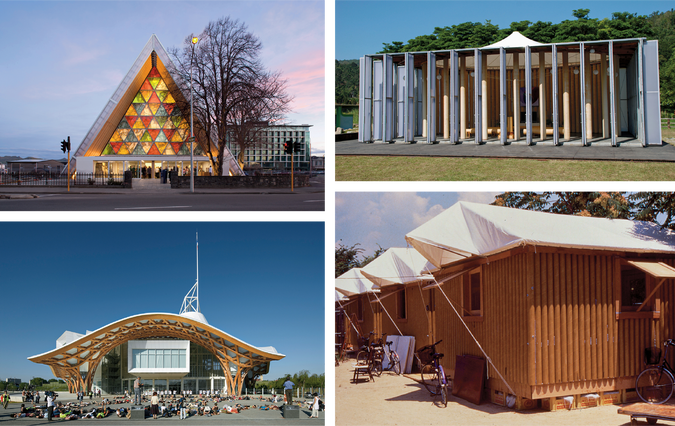
Photos: clockwise from top left, Emma Smales/View; Afyen Hsin-Chu; Takanobu Sakuma; Hufton+Crow/View
The bottom right photo shows Shigeru Ban’s Paper Log Houses, temporary housing in Kobe, Japan, created after a 1995 earthquake left many residents homeless. The
New York Times took an in-depth look at Ban’s body of work here.

It’s inspiring to see a successful person in any field turn her or his talents to a humanitarian cause. That is what innovative Japanese architect Shigeru Ban did after seeing problems with post-disaster housing in Africa. He knew he could do better.

Nikil Saval at the New York Times wrote an in-depth feature on Ban’s larger body of work and explained how he got into building temporary paper-tube shelters.

“His move to create shelter architecture came out of seeing the temporary structures offered to Rwandan refugees in Zaire (now the Democratic Republic of Congo) in 1994. At the time, the United Nations High Commissioner for Refugees was handing out plastic tarps and aluminum poles to hold them up, but many people were instead selling the aluminum and harvesting nearby wood to frame their tents, contributing to massive deforestation.

“Ban wrote to the U.N.H.C.R. several times before flying to Geneva. There, he encountered the organization’s senior physical planner, Wolfgang Neumann, who became interested in Ban’s idea of using recycled paper tubes to build shelters. Ban was hired as a consultant and the concept was later implemented at a camp in northern Rwanda.

“The first time Ban used paper tubes for a disaster relief project was in Kobe, Japan, in 1995, where a series of small houses — about 170 square feet each — were constructed for victims of an earthquake that killed more than 6,000 people.

As is typical for Ban’s humanitarian projects, each shelter cost less than $2,000 and took a single day to construct; according to Ban, about 30 were built over the span of a few weeks, mostly by volunteers.

“These shelters remained in Kobe for about a year, after which they were dismantled and recycled. But a church and community center in the city, also designed by Ban and built out of recycled paper, stood for 10 years, a testament to the durability of his work.

“He has also used shipping containers to build thousands of small housing units in Onagawa, on Japan’s northeast coast, following the 2011 earthquake and tsunami there, and beer crates weighted with sandbags have occasionally served as the foundation for his Paper Log Houses (including in Kobe), illustrating Ban’s commitment to relying on ‘local materials’ in the most expansive sense: whatever is cheap and locally available that won’t result in waste.

“These structures are off-the-cuff, constructed quickly by staff members of the Voluntary Architects Network, a nongovernmental organization founded by Ban in 1995, along with the help of local students and volunteers. Initially, he was able to pay for them through donations and his own earnings; some of his relief projects now receive public funding. But he often uses his expensive commissions to test out ideas for his aid work, toying with cheap materials in structures for the rich so he can use them later to help those who have lost everything. …

“Ban is not given to displays of pity or indignation; he usually explains his humanitarian efforts by citing his horror at waste rather than some charitable impulse. It is an austere, utilitarian front for the architect to present, considering that, at the moment, he is trying to expand his humanitarian efforts beyond temporary structures and has just begun working with the southeast Indian state of Andhra Pradesh to develop housing for its new capital, Amaravati — multistory units for which paper tubes would not likely be appropriate (he has instead been considering fiberglass foam-core panels). But disasters will continue to preoccupy him.

“He spoke of doing larger urban-scale planning, preparing cities for disaster relief. More earthquakes, certainly in Japan, are likely, to say nothing of climate-change induced nightmares. ‘This moment, the beginning of the 21st century, is a big moment to change the direction — toward sustainability and disaster relief,’ he said. ‘This will continue as the main theme of this century.’ Times had changed since the Modernist era: ‘Those times, people believed that they would have utopia some day. But we know that it’s not true. There’s no utopia.’ ”

More at the New York Times, here.

Read Full Post »

Photo: Suzanne Kreiter/Globe Staff
A stage in the back of a U-Haul (paid for in part by Fresh Sound Foundation) allows the Grammy Award-winning Parker Quartet to perform anywhere.

Classical musicians who believe their music will bring a blessing to whoever hears it have been presenting in offbeat locales in the Greater Boston area. Tomorrow, too. Malcolm Gay has the story at the Boston Globe.

“The 17-foot U-Haul truck sat parked in an empty field, ringed by trees. With the touch of a button, a roof-mounted winch whirred into action, unspooling cable as a fan-shaped stage lowered like a drawbridge from the rear. The U-Haul’s modified rear doors acted as a band shell, flanking the stage to project sound, and a custom-made sail, supported by deep-sea fishing rods, projected as a visor from above.

“Fifteen minutes later and the vehicle, dubbed the Music Haul, was a fully functioning stage — a 21st-century gypsy caravan that will bring live performances to the streets and schools of Greater Boston, Sunday through Tuesday.

“ ‘It really is more boat than truck,’ said Catherine Stephan, executive director of the Yellow Barn music center. ‘We got to know RV dealerships really well.’ …

“ ‘It’s supposed to be as close to magic as possible,’ said architect John Rossi, one of the traveling venue’s principal designers. …

“Its creators say the Music Haul’s main mission is to bring world-class concert performances to the most unlikely of places: schools, underserved neighborhoods, hospitals, perhaps even prisons.

” ‘We exist in the world as musicians that is in a way so finely controlled and tuned,’ said Yellow Barn’s artistic director, Seth Knopp. ‘Music Haul removes some of the ceremony, which can be a barrier for people who are not often exposed to that world. There’s an element of taking something out of its accustomed place and allowing it to take people by surprise.’ ”

What a good thought! Reminds me how you can suddenly start seeing the pictures on your walls again if you move them to a new location in the house.

Read more about this enchanting initiative here.

Read Full Post »

Older Posts »