Feeds:
Posts
Comments

Posts Tagged ‘art’

Photo: David Swanson/AFP/Getty Images.
The hillside along the Pacific Coast Highway burns in front of the driveway to the Getty Villa in the Pacific Palisades neighborhood in Los Angeles on Jan. 7.  

Planning, courage, and commitment saved California’s Getty Museum in the last big conflagration, but how long can it escape what few others did?

Kelsey Ables at the Washington Post explained how the famous art collection was protected in January.

“As wildfires ravaged greater Los Angeles … the J. Paul Getty Museum faced encroaching flames on two fronts. Blazes nearly surrounded the Getty Villa in Pacific Palisades, coming within six feet of its walls. Days later, ominous red clouds were visible from the Getty Center in Brentwood, hovering on the horizon like a warning.

“The fire at the Villa was the closest flames had ever come to either building. But through it all, the institution made no evacuation plans. On the most intense nights at each location, a team of more than a dozen people at the Villa and 28 at the Center waited it out, and the museums’ vaunted artworks — the ancient sculptures, the Gentileschis, the Manets and Monets — remained inside.

“This was no gamble, though. Those familiar with the Getty describe it as a place one would evacuate to, rather than from.

“With the fire about a mile away from the Center on Jan. 10, a security staff member suggested to J. Paul Getty Trust chief executive Katherine Fleming that she might want to leave. ‘I was thinking, “I actually feel really good here,” ‘ she said in an interview. ‘This feels like a very safe place to be.’

“That is by design. … As the fires have killed more than 20 and razed swaths of the Los Angeles region, the Getty — with its more than $8 billion endowment — has emerged as a beacon of fire preparedness as well as a symbol of the defenses that wealth can build.

“From its grounds to the museum’s core, the $1.3 billion Getty Center, which was designed by architect Richard Meier and opened in 1997, was built to resist flames. …

“High on a hilltop, the campus has sprawling plazas made of fire-resistant travertine imported from Italy. Open spaces surround imposing, elevated buildings that boast walls constructed from reinforced concrete or fire-protected steel. The roofs are covered with stone aggregate, which is fire-resistant. Inside, the buildings are equipped with special doors that prevent flames from traveling. Temperature and humidity are closely monitored during red-flag warnings.

“Outside, the grounds are routinely cleared; the plants, selected for their drought-resistant qualities, are pruned regularly to prevent them from becoming fuel. During a previous fire, the museum said: ‘There is no need to evacuate the art or archives, because they are already in the safest place possible.’

“ ‘It’s very much like a fortress,’ said [Todd Cronan, an L.A. native and art history professor at Emory University in Atlanta], who briefly lived at the Center as a fellow. …

“To Cronan, though, the Getty’s unassailable features say ‘more about privatization and their … endowment than anything else,’ he wrote [by email].

“While the Getty stresses that it does not hire private firefighters or seek special treatment, it maintains its own water tanks — including a 1 million gallon tank at the Center — year-round. …

“When the Villa emerged largely unscathed last week, the museum in a press release credited its own ‘extensive efforts to clear brush from the surrounding area,’ noting that it also stores water on-site and that the grounds were irrigated ahead of the blaze. …

“Fleming, the CEO, said they were confident in their preparations but described a nail-biting evening watching the fire move closer as 15 staff members remained on-site. … The next day, with staff unharmed and the Villa still standing, Fleming found a strange calm in the collections. The galleries were ‘cleaner than an operating room.’ “

More at the Post, here.

Update April 4, 2025. The Getty is selling bonds to raise money for more protection. Article here.

Read Full Post »

Photo: Gabriela Contreras González.
Saint Catherine of Alexandria, patroness of students, teachers, librarians, and lawyers.

Today’s post is about art restoration, a field that always seems brave to me. Imagine charging into some time-honored work and presuming to “fix” it! I guess a good restorer becomes the artist, too — perhaps in the way that a skilled translator of a literary work becomes a coauthor.

This month, with trepidation, my husband and I put a lovely Inuit watercolor into the hands of a conservator. Would she be able to remove all the mildew from life in a damp summer cottage? The results were nothing short of miraculous.

At Artnet, Min Chen writes about a larger work of conservation in Mexico.

“For decades, the interior of the Temple of Our Lady of the Assumption, a church in the town of Santa María Huiramangaro in Mexico, stood stark white, with blue accents. But the parish was not always so bare. A new restoration has revealed a host of resplendent 16th-century religious paintings that once spanned the ceiling of the historic church.

“The project, undertaken by participants including the Ministry of Culture of the Government of Mexico and the National Institute of Anthropology and History (INAH), dispatched a team of professionals to conserve the roof of the church. What they discovered instead were ancient images of saints and martyrs — hagiographic works rarely found in the Michoacán region — which had been painted over during the 1940s.

“The work, said Laura Elena Lelo de Larrea López, expert restorer at the INAH Michoacán Center, in a statement, ‘allowed us to recover an extraordinary work on the horizontal roof of the main altar, and to discover the rich artistic, technical and iconographic evolution that has marked this religious site.’

“The Temple of Our Lady of the Assumption was constructed in the early 16th century, when Santa María Huiramangaro was designated a district head, overseeing the communities of San Juan Tumbio, Zirahuén, and Ajuno. The building reflected the architectural styles of Mudéjar, which featured ornate motifs believed to have been originated by Muslim craftspeople in the 13th century, and Plateresque, a late-Gothic and early Renaissance aesthetic imported by the Franciscans.

“During restoration work, three pictorial layers of religious iconography were uncovered on the church’s ceiling. The oldest, from the 16th century, saw the use of tempera paint, which was applied in thin glazes to depict various characters corresponding to Saints Paul, Peter, Agatha of Cantania, and Catherine of Alexandria, as well as baby Jesus in Franciscan habit. The works were retouched with oil paints in the following century, adding volume and colors to the depicted figures’ clothing.

“When water ran dry in the region in the 17th century, the church fell largely into disrepair, as Santa María Huiramangaro lost its capital status. ‘The misfortune was a blessing in disguise, in terms of conservation,’ said Lelo de Larrea López, ‘since, not having the resources to renew its religious furnishings, the parish priests of the Temple of Santa María preserved its Plateresque ornaments. …

“Still, experts uncovered evidence of a restoration effort in the 20th century. Acrylic paints were deployed to touch up the faces of the saints. …

“During remodeling work in the 1940s, the iconography on the church’s roof was painted over in white, with blue designs. The repainting, noted Lelo de Larrea López, ’caused an alteration in the appearance of the place.’

“The latest conservation removed the repainted layer and restored missing portions of the paintings. Additionally, the ceiling was cleaned of dust and animal droppings, reinforced with joints and wood grafts, and fumigated to deter wood-eating insects. Other roof elements, such as corbels, partitions, and Franciscan cord carvings, were also given a refresh.

“The work marks the latest phase in a major restoration of the Temple of Our Lady of the Assumption, which began a decade ago with a focus on its main altarpiece. Despite a dismantling (undertaken to tackle a collapse in the church’s rear wall), conservators found the artifact in a well-preserved state. Over 2022 and 2023, they addressed damage to its cornices and carvings, and undid a repainting job to reveal its original gold leaf and polychrome.”

I admire the commitment it takes to work on projects of ten years or more like this. Have you ever had a piece of art restored?

More at Artnet, here.

Read Full Post »

Photo: David L. Ryan/Globe Staff.
Maya Lin’s landscape artwork in Kendall Square in Cambridge. It’s an “undulating wave field” in front of the Volpe Transportation building on Binney Street.

For most of us, sculptor Mia Lin first came to our attention when she was chosen to create the Vietnam war memorial in Washington, DC. The solemn listing of the names of the dead on black granite was a brilliant idea, endlessly moving.

Until now Lin had never created landscape art in Massachusetts, so people were surprised to learn that in fact she had had an impressive earthwork in busy Cambridge since 2023.

Scott Kirsner writes at the Boston Globe, “What if someone spent $1.3 million on a work of art, installed it in one of the busiest parts of Cambridge, and forgot to tell anyone?

“That’s effectively what happened with a piece called ‘The Sound We Travel At,’ by the New York City artist Maya Lin. She is best known for works like the Vietnam Veterans Memorial in Washington, D.C., and the Civil Rights Memorial in Montgomery, Ala. …

“But she also makes works of landscape art … and that’s what was created in Kendall in 2023. You can find it on Binney Street as you head toward Boston, to the left of a new 13-story building that houses the Volpe National Transportation Systems Center, a research center run by the US Department of Transportation. Sandwiched between a row of trees and lampposts is a series of 11 grass-covered, wave-like mounds of earth.

“Apropos of the Volpe Center’s work … the artwork outside is a physical representation of the Doppler effect. You know: the phenomenon of a sound, like a train’s horn, changing in pitch as it races past you. Some of the rippling mounds in Lin’s work represent sound waves that are approaching the viewer, and some of them represent sound waves that are receding from the viewer. Visitors are invited to walk atop, or even sit on, the work.

“There’s so much construction work in Kendall Square right now that I only noticed the artwork in November 2023, when I was visiting the Volpe Center to write a piece. … A year later, I noticed that there’s still no sign, and it doesn’t appear on the website of either the Volpe Center or the Maya Lin Studio. I couldn’t find a single museum curator or former curator in town who knew about it. …

“The artwork is part of a 14-acre site that MIT’s real estate management arm acquired from the federal government in 2017, and is redeveloping to include housing, retail, office space, parks, and a new community center. Part of that deal involved MIT building a newer home for the Volpe Center, and any time a new federal building goes up, half of one percent of the building’s cost goes to art. (That’s even true when MIT is footing the construction bill, as it was in this case.)

“Paul Ha, the director of MIT’s List Visual Arts Center, helped make the connection to Lin for the project. He was one of the few people in the local art world I could find that was aware of its existence. Ha had worked with Lin on a major exhibit when he was running the Contemporary Art Museum in St. Louis. …

“Aprile Gallant of the Smith College Museum of Art says, ‘I do believe this is Lin’s first landscape piece in Massachusetts, so it is a milestone.’ That museum hosted a major exhibit of Lin’s works in 2022, when a library that she’d designed opened on campus. …

“Did ‘The Sound We Travel At’ fall through the cracks, in a neighborhood peppered with cranes and construction fencing, and tech and biotech workers who go from garages to offices perhaps two or three days a week?

“ ‘We felt that way,’ says James Ewart, manager of the Maya Lin Studio.

“But according to the government’s General Services Administration, by the time spring rolls around, a sign will finally be installed next to the artwork.”

More on the Maya Lin project at the Globe, here.

Read Full Post »

Photos: John and Suzanne’s Mom.
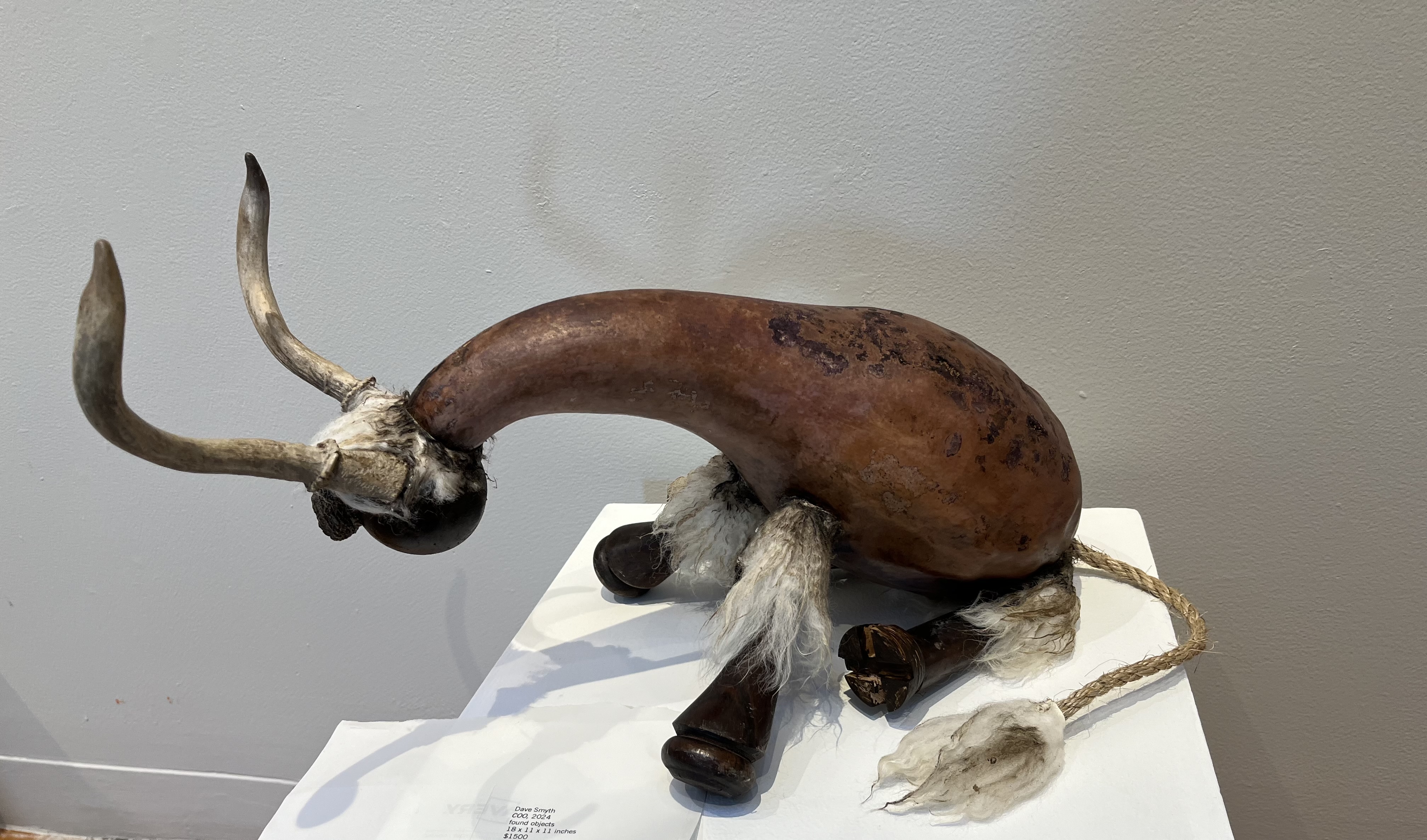
A gourd-body bull by Dave Smyth is being shown at Concord Art’s juried member show, 2025. Don’t you love how artists see potential that so many of us miss?

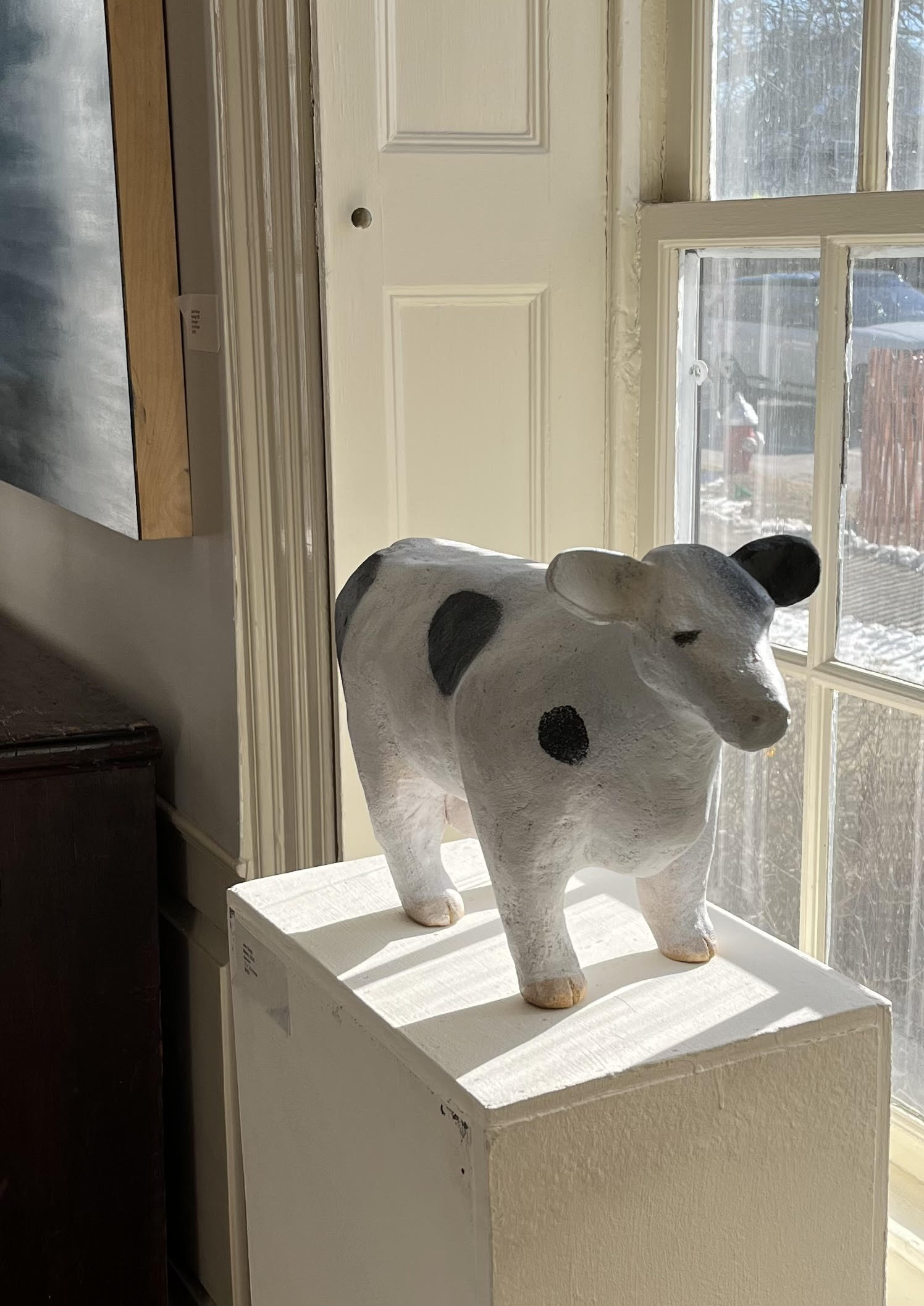
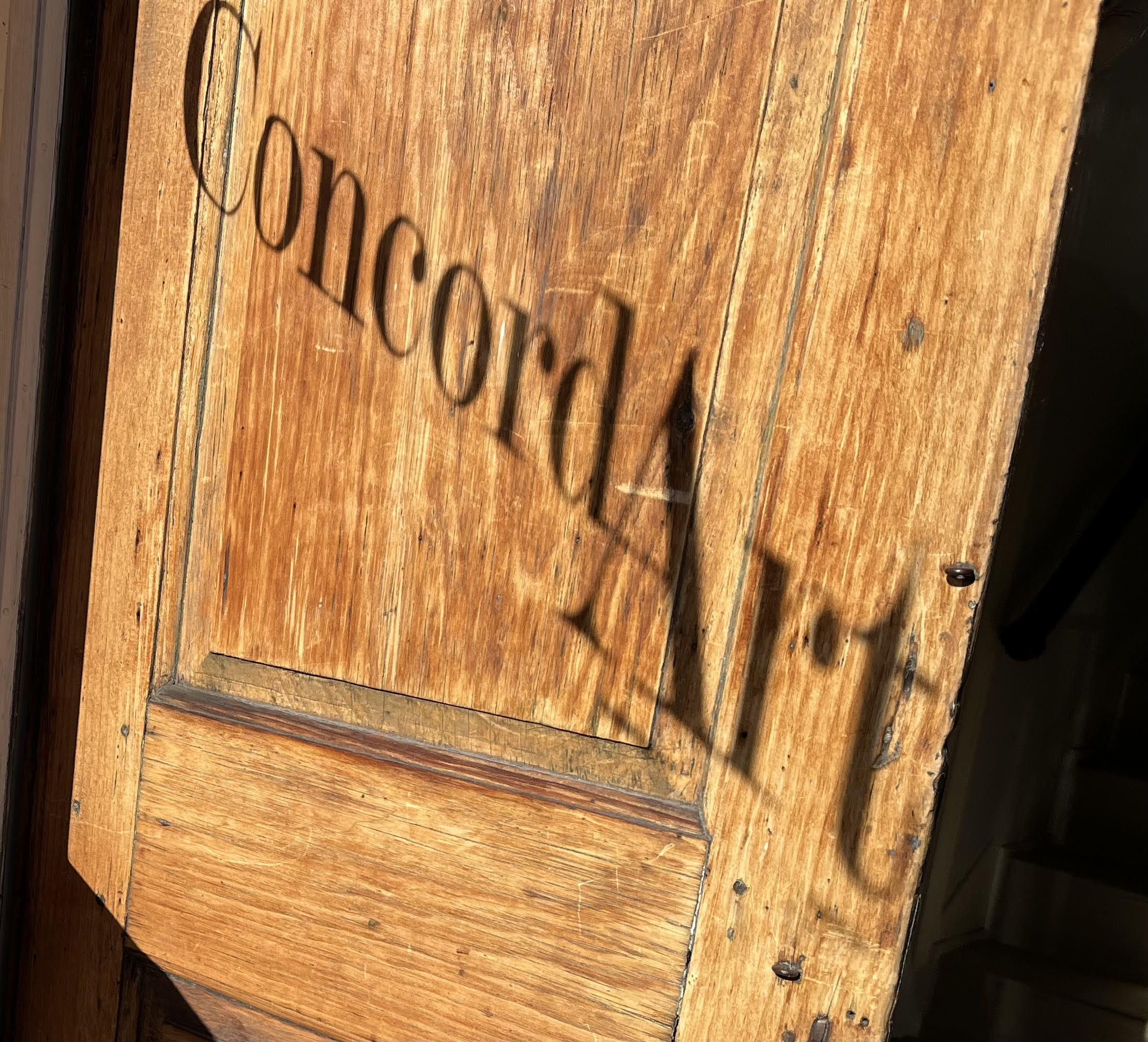
Today’s pictures are mostly from art exhibits I attended this month. The show at Concord Art, above, was in the process of being set up when Meredith and I went. She aims to submit work for the next show and has appeared in several earlier ones.

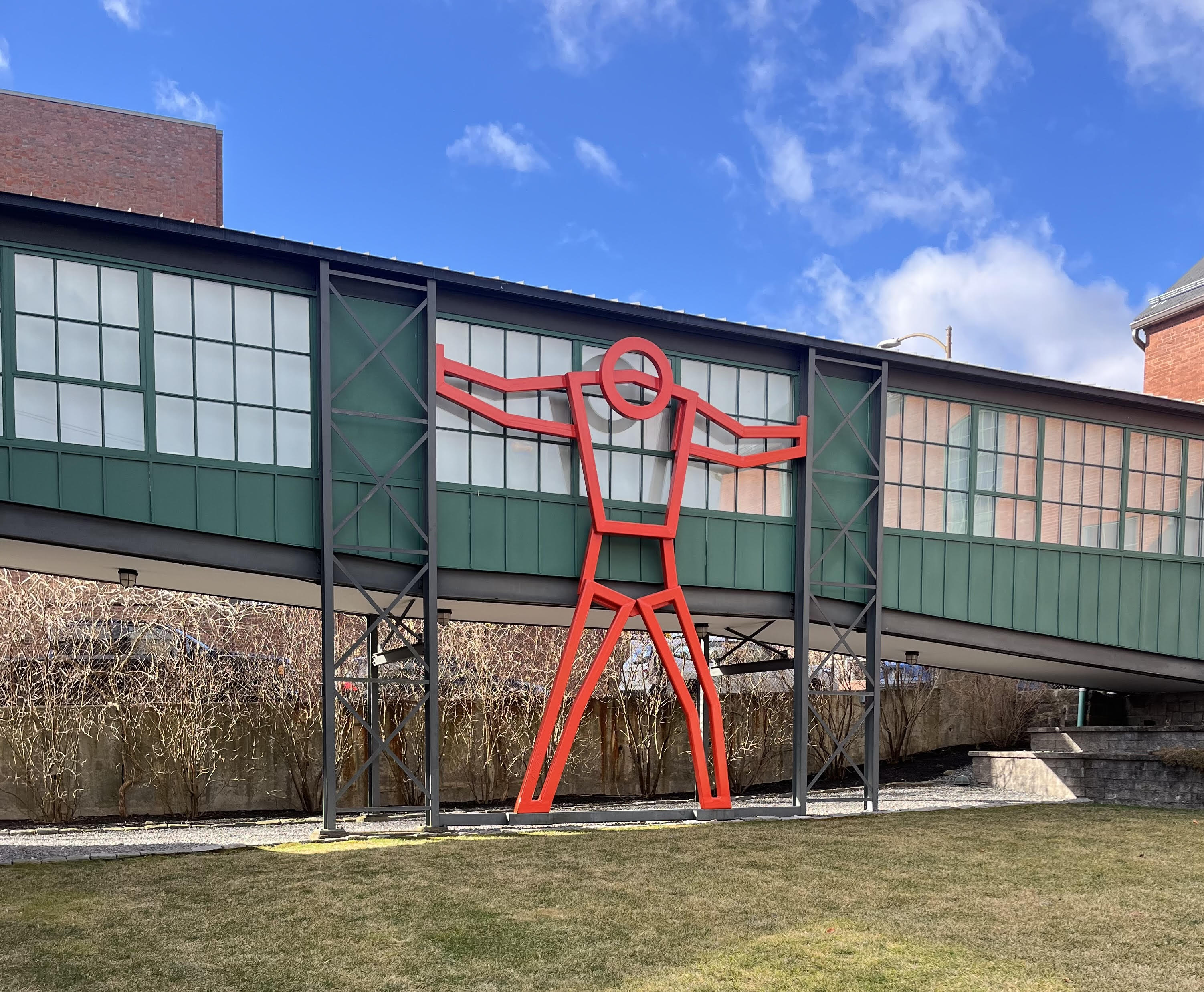
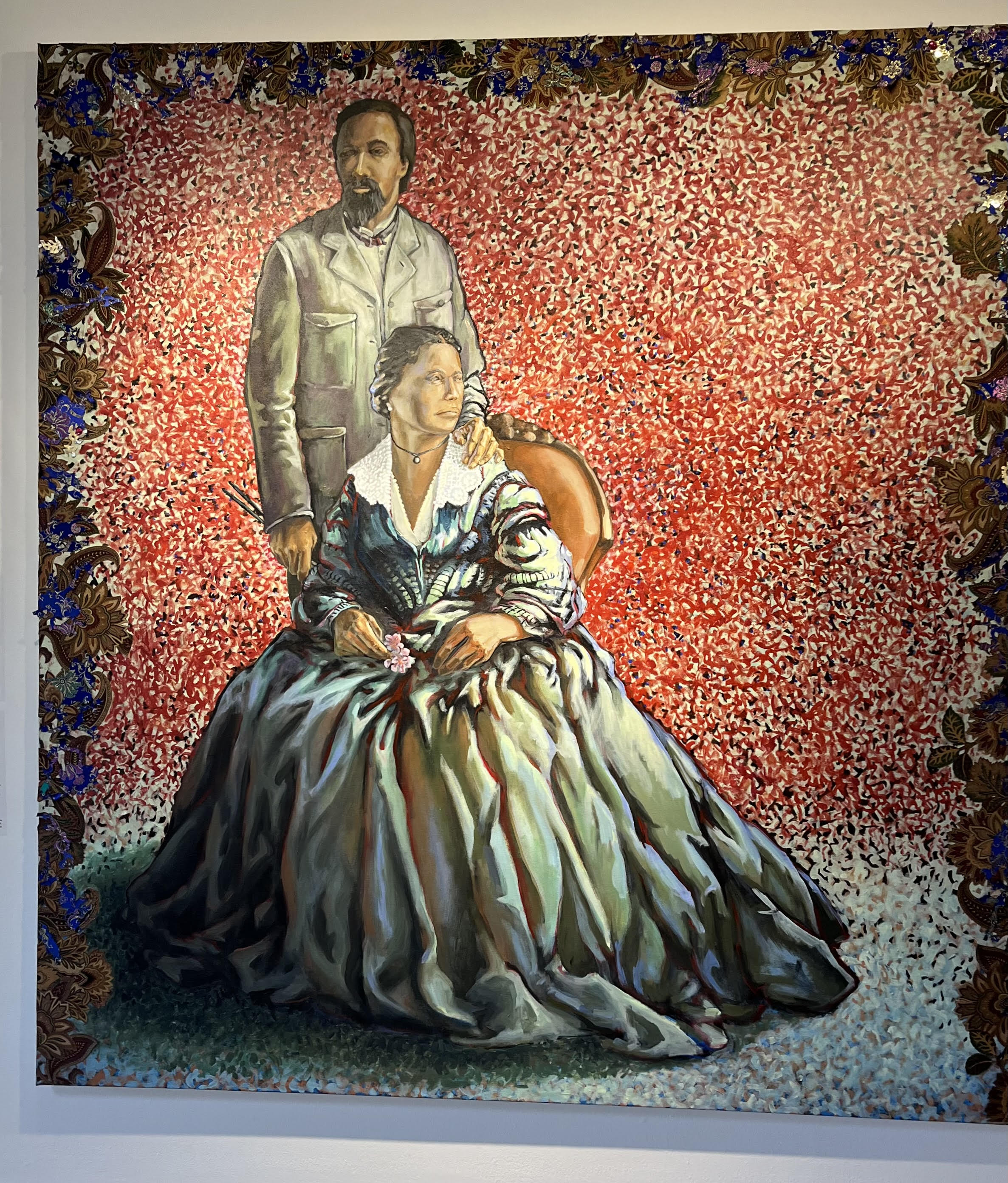
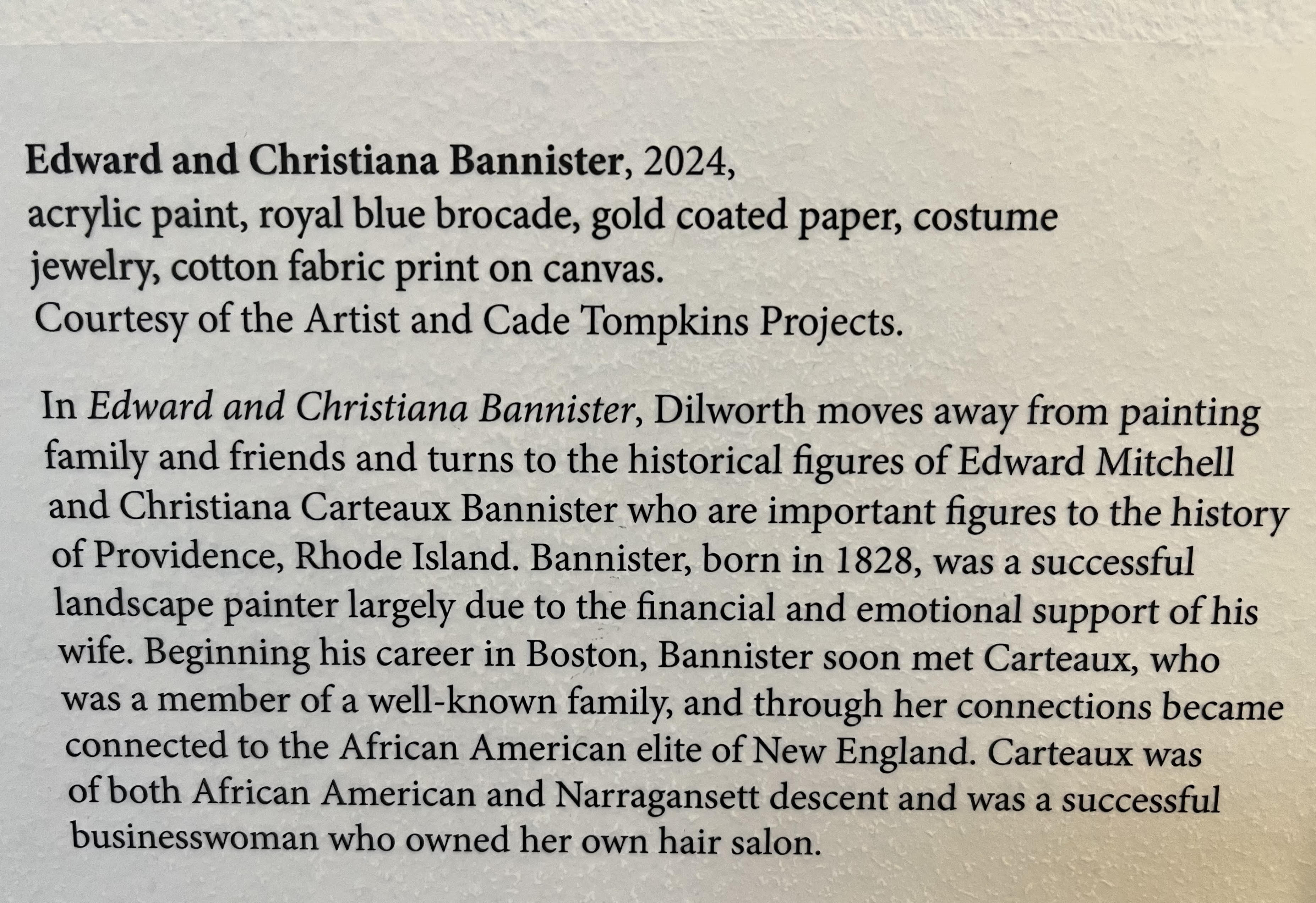
The orange giant who is holding up the world is at the Fitchburg Art Museum, where Ann and I took in several exhibits — in particular the Bob Dilworth. Born in Virginia, Dilworth taught art for many years in Rhode Island. I liked learning more about noted 19th century Black landscape painter Edward Bannister, seen in the portrait with his wife. Dilworth’s paintings, which he often worked on for years, feature a collage-like effect from the layering of textiles, stenciling, more.

I knew about Bannister before, but was glad to read something about his wife here.

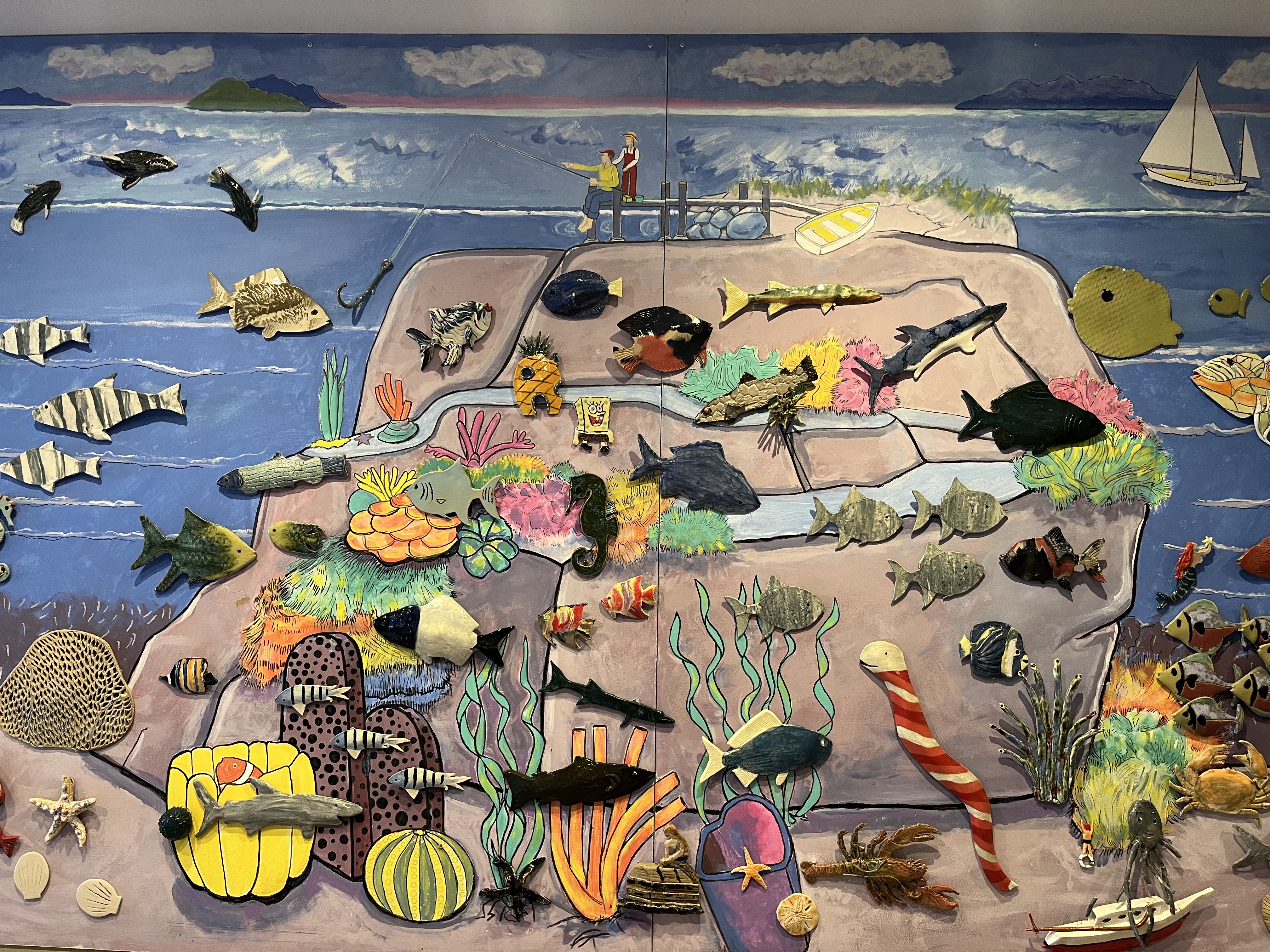
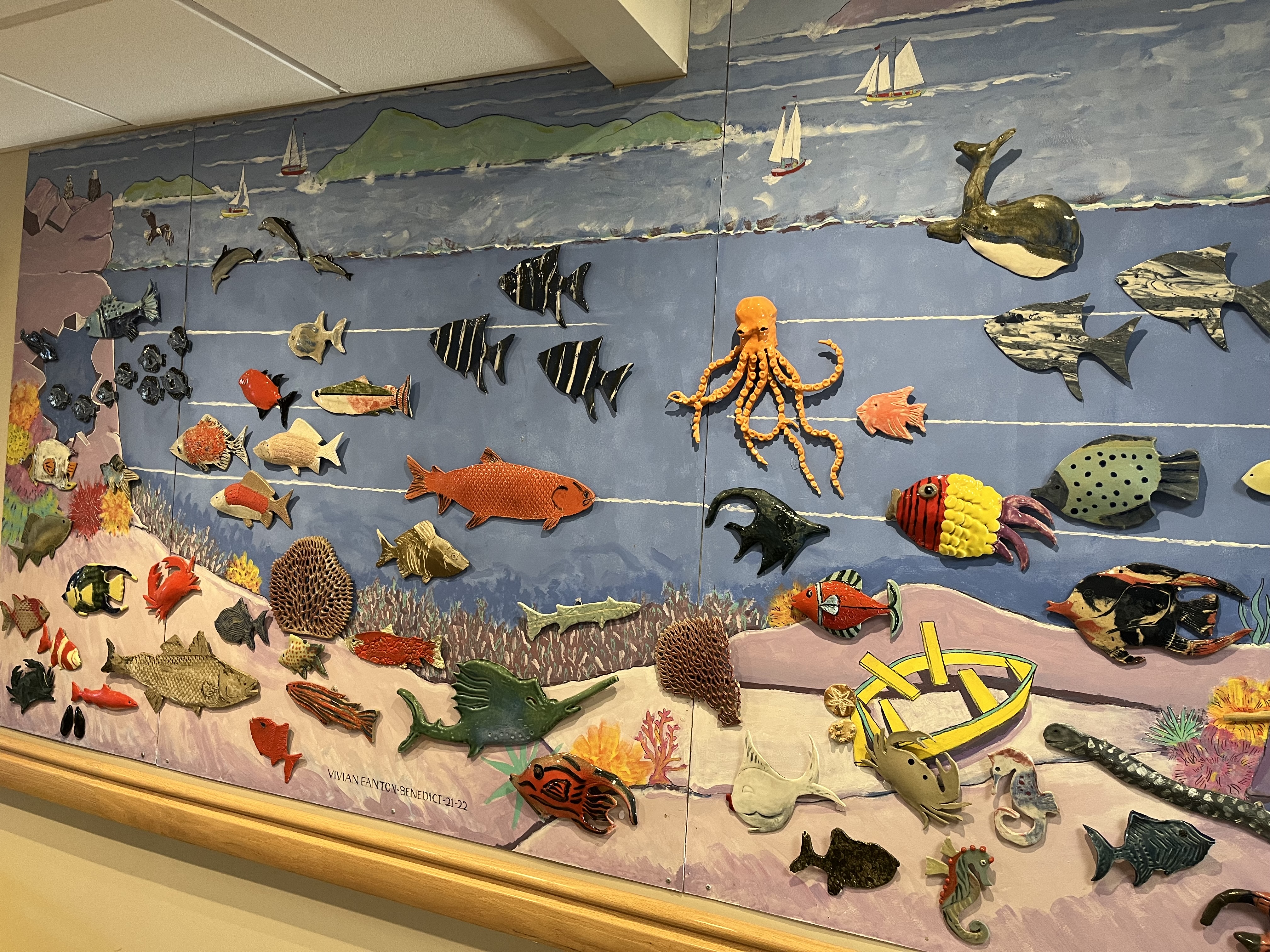
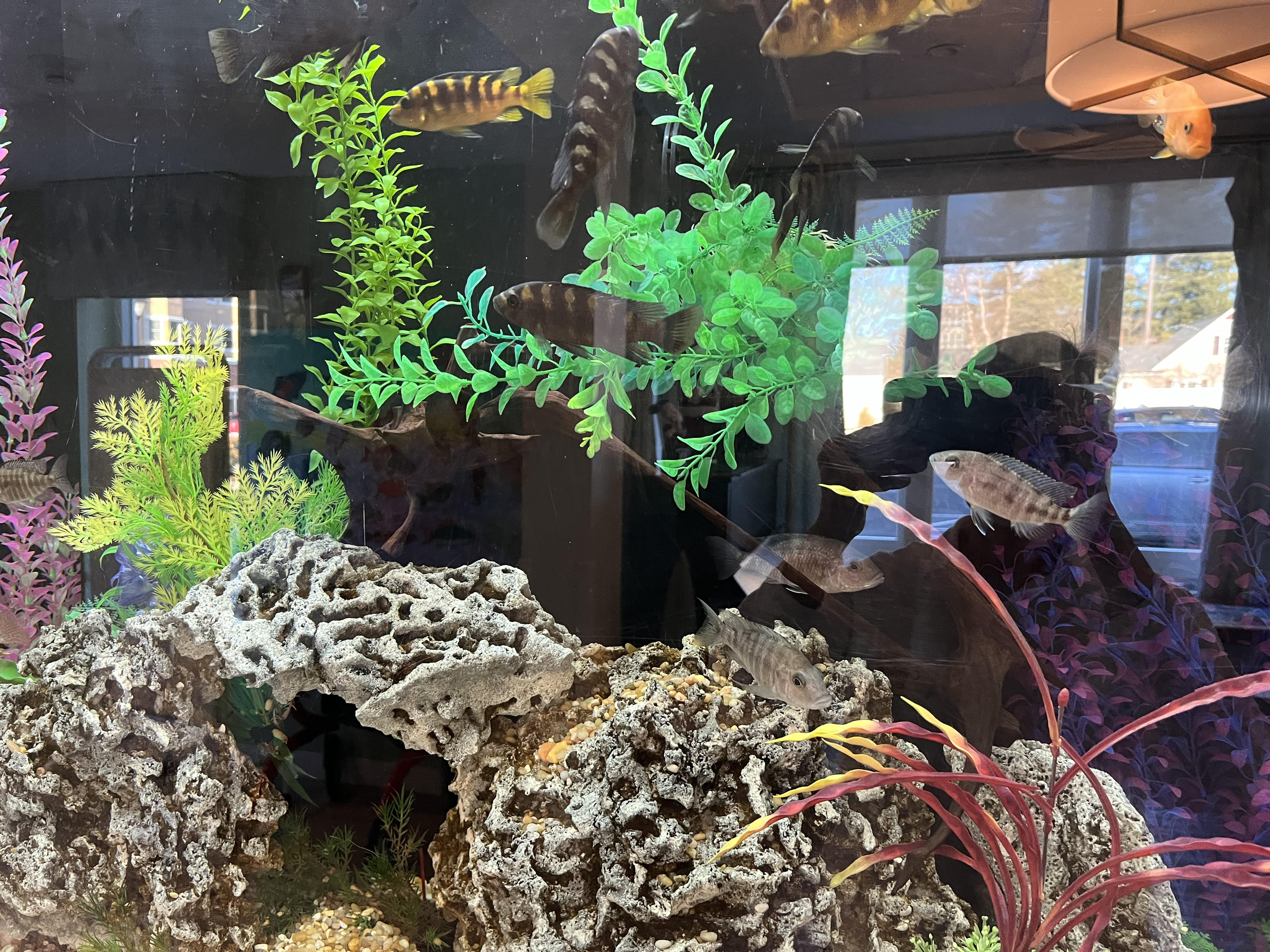
The next two photos do not show such professional work but rather are ceramics created by people of many skill levels who live in my retirement community. They made sea creatures for display in the nursing building. There’s a marine theme throughout that section, including a big salt water fish tank. I visited a friend there, and now I visit her in the memory-care building.

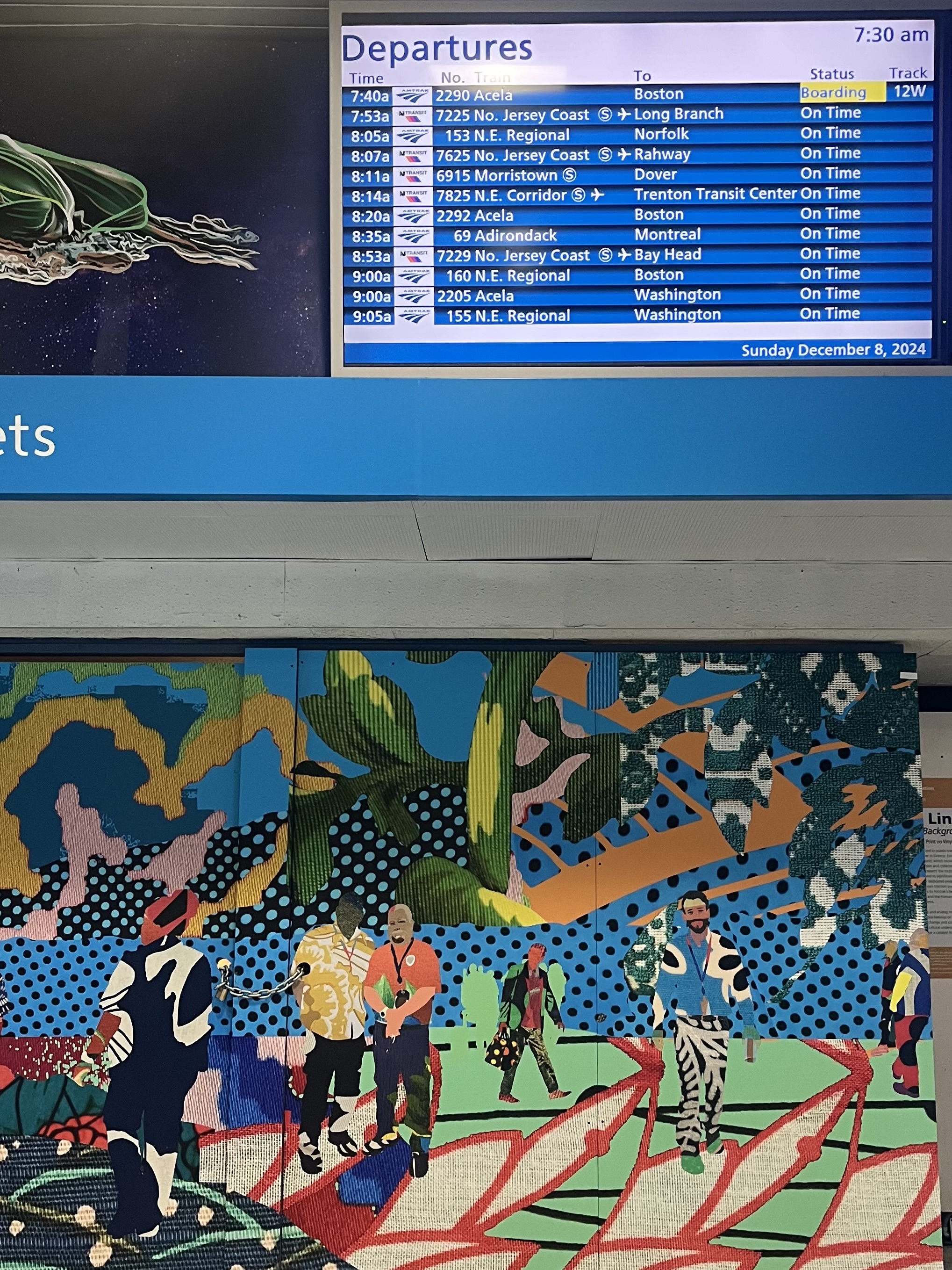
The final photo is actually from my December trip to New York City. There is loads of public art in Penn Station. Nice to have something to look at if your are too early for your train!

Read Full Post »

Photo: Michael Blackshire/Los Angeles Times.
Carol and Dave Clark in front of artist Ray Vasquez’s works exhibited in one of the micro-galleries they built. 

I wrote about Stacy Milrany’s mini art gallery a while back and have been following her work ever since via Instagram. Her idea was to create an art gallery similar to what most of us know as the Little Free Library, a box to hold free books, set up like a mailbox in residential neighborhoods.

Now a couple in California have taken the idea a step farther.

Stacy Perman wrote at the Los Angeles Times, “Two years ago, Long Beach artist Dave Clark exhibited a small sculpture of his called ‘Together. Forever. Maybe. Regret’ at the local Mantel Gallery — itself a small, repurposed Little Free Library that does double duty: When it’s not filled with books, it displays the works of artists like Clark.

“At the time, Clark and his wife, Carol, were struck by the concept. ‘That’s cool,’ he said. ‘But what if I had something bigger? You can put more art in there, and it becomes more of a real functional art gallery.’ While his neighborhood had many artists, he noted, it did not have any galleries.

“Inspired, he designed and built a micro-gallery measuring about 16 inches wide and 14 inches tall. It has movable walls, a floor and a ceiling that could be adapted for rotating artworks; a solar panel powers the little ceiling light. He installed it on the front yard of their house in the Wrigley neighborhood. They named it Gallery 17, the sum of the numbers on their Eucalyptus Avenue address.

“Last summer, the couple organized an exhibit by local artist Cody Lusby. About 40 people showed up. One of their neighbors saw it and wanted a Clark micro-gallery too. Soon, others began commissioning Clark to build micro-galleries on their front lawns. And then, artists from around Los Angeles and as far away as Ecuador began asking to show their works in them.

“An archipelago of 10 micro-galleries stretches around neighborhoods in Long Beach as well as in San Pedro and Lomita. Two more, also in Long Beach, are set to be built in the coming weeks. …

“ ‘It’s important that art become a part of everyday life,’ said Linda Grimes, executive director of the San Pedro Waterfront Arts District, who’s husband commissioned a micro-gallery for her birthday in April. ‘Not everybody feels welcome going into an art gallery or a museum. We started painting those traffic signal boxes so that people could see art and appreciate it outside, on the street every day. And then we painted large scale murals.’ …

“ ‘I thought what a great idea Dave had,’ [said Eric Almanza, a classically trained oil painter]. ‘Instead of books, this has little masterpieces that can brighten someone’s day. There’s been many times I’ve headed outside the house to run an errand and encounter someone at the box looking inside.’ …

“Almanza, whose own photo realistic paintings examine the nexus between politics, culture and identity with a focus on the border wall and immigration, initially made scaled down prints to show in the box and sold them for $50. …

“ ‘I like the idea of being able to bring art to the masses in the community,’ he said. ‘I think nowadays we don’t see much public art. I feel like art in general is not as appreciated as in the past. This felt like a good way for artists to show their work and to put public art in my neighborhood.’ ”

More at the LA Times, here.

Read Full Post »

Photo: Artists for Humanity.
At Artists for Humanity, teenagers are able to express their artistic creativity and talents while also earning money, bridging passion and profit.

Today’s story is about a wonderful nonprofit I visited several times in the years I was working at the Boston Fed. Its mission to involve urban kids in making art — and earning some money from it — is still sending joy into the world.

Kana Ruhalter and Arun Rath have an update at GBH radio.

Artists for Humanity (AFH), they report, has been giving “talented teens — most of whom are people of color from low-income communities — the opportunity to earn and create. 

“Through murals, sculptures and more, Artists for Humanity … brings joy, beauty and a sense of belonging to their community. And, by paying its artists, they’re addressing economic inequities as well.

“Anna Yu, the executive director, and Jason Talbot, co-founder and managing director of program, joined GBH’s All Things Considered host Arun Rath to discuss the decades-long history of the nonprofit. …

Jason Talbot: Back in 1991, they had just defunded art in schools. I was a Boston Public School student at the Martin Luther King Jr. Middle School, and [AFH’s] former executive director, Susan Rodgerson, came to the King School to reintroduce art. … I found her willingness to hear out my ideas and implement them in projects was super refreshing. We continued to work together with the other fellow co-founder, Rob Gibbs, in a studio over in SoWa [South of Washington Street].

“There were just us six boys in that studio, and we painted and we created a gallery exhibition. It just showed us the capabilities of art, it helped us understand this artist community and we just loved doing work there.

“Our organization has evolved over the years. We’ve built in this entrepreneurial aspect where we’re producing and selling art to clients. It’s just been an extremely enriching experience. …

Arun Rath: Anna, tell us about that enrichment. How has the organization evolved since that? …

Anna Yu: While the core of the model is essentially the same — meaning this radical idea of paying teens to create client project work that is of the quality of a professional — that piece is always running through our work. But today, we are the largest employer of youth in the city of Boston, which is over 400 teens that we employ.

“[Today] we not only provide after-school employment, we also partner with schools during the school day in a program we call Co-Lab. …

Rath: What are some of the success stories? …

Talbot: Teenagers — one thing that’s pretty universal is they really are looking for adult experiences, you know? So to be in the workplace, to be respected, to be able to attend meetings, to be able to propose ideas, it really gets our young people super excited about having a career and really re-invested in their education.

“And teens are graduating at a higher rate; AFH graduates 100% of our high school students, and we’re able to offer secondary education to 100% of our teen artists. …

Rath: Tell us about the business side of this. How do you get these young artists paid? …

Yu: Something that is so radical about the organization — it’s hard to believe that Artists for Humanity has been doing this for 33 years — is that clients actually hire us to create work for them. So it’s often beautifying office spaces, it’s creating a unique or custom piece of art for them, it can even be branding and promotional materials. It could be a website.

“The beautiful thing is they are paying teens to do this work, and they are valuing their voices, their creativity. And they’re getting a very unique product at the end of the day. …

Rath: Talk about the collaborative process between these young artists and the professionals.

Talbot: Well, AFH is a tremendously collaborative organization. … Our clients really get visionary work. Our teens are up on the latest trends. They’re digital natives — they know what’s going on — and they’re really able to help our clients have some really great new innovative ideas. …

“Rath: You’ve seen so many go on to become adults and blossom in amazing ways. Are there any moments of joy you’d like to share? …

Yu: The beautiful thing about Artists for Humanity is that a lot of our alumni are actually not just artists. Many of them do become artists. Many of them actually pursue a career in STEM, or some of them go on to become lawyers. We have [one] who’s actually on our board of advisors right now, and she’s a lawyer at the Fed. … We have someone who is an alumni from AFH and is at Harvard Medical School. So it’s really this idea that by opening up these pathways, by inspiring them to think creatively, by building that confidence, they can really achieve anything.”

More at GBH, here.

Read Full Post »

Art: Xiomara Morgan and Kathy Urbina, “Found in New York City” (2023), styrofoam life preserver, found Metrocards, plastic water bottles, candy wrappers, snack bags, labels, and bottle tops with a crocheted ribbon of plastic, rope, and caution tape.

Artists can turn anything into art. And I have learned that among New York City Parks employees, there are a few who are artists like that and a few who just have fun playing at art.

Maya Pontone wrote about a New York City Parks’ exhibition called “Wreath Interpretations” in 2023.

“More than 30 original holiday wreaths handcrafted from unexpected materials, including discarded Metro cards, thumbtacks, artificial hot dogs, pharmaceutical vials, and candy wrappers,” she reported were “on display in Central Park for the 41st iteration of New York City Parks’‘Wreath Interpretations‘ exhibition [bringing] together an eclectic assortment of alternative wreaths created by Parks employees, commissioned artists, and New York City residents for a whimsical display.

“Wreaths have historically played a number of roles. In Roman and Greek antiquity, they were emblems of power and victory, frequently awarded to the winners of sporting competitions and appearing in depictions of various deities, such as Apollo in Antonio Canova’s marble sculpture ‘Apollo Crowning Himself‘ (1781–1782). In Christianity, evergreen wreaths symbolize eternal life and everlasting faith; during Advent season, laurel rings are decorated with four candles that are subsequently lit each week leading up to Christmas.

“But the artists in ‘Wreaths Interpretations,’ go beyond these classic meanings to transform a holiday staple into new works of art, from an aluminum and gold leaf display commemorating Caribbean cooking to a diorama wasp nest containing a hidden memorial honoring Ukraine. On one wall, an unsettling wreath crafted out of plastic eyeballs tackles sleep deprivation, while another piece made of yellow Post-It notes playfully comments on work-life imbalance.

“In another corner, a pizza box with wiry rat tails emerging from the center — an unmistakable homage to the viral ‘Pizza Rat‘ — is situated between a spiral of playing cards and a ring of glistening frankfurters, humorously titled ‘The Wurst Wreath Ever Made: You Never Sausage a Terrible Wreath’ (2023). As Elizabeth Masella, Public Art Coordinator for the NYC Department of Parks & Recreation, told Hyperallergic, ‘the weirder, the better.’ …

“Many of the artworks are constructed out of found objects and recycled materials, such as Xiomara Morgan and Kathy Urbina’s joint project ‘Found in New York City’ [above]. … Marie Ucci’s ‘The Shape of Dreams’ (2023) is an assemblage of ceramic shards, dried fruits and vegetables, scraps of felted wool, and feathers, carefully pieced together like a bird’s nest, while Suzie Sims-Fletcher’s ‘All is Calm, All is Bright (Home for the Holidays)’ (2023) comprises cleaning puffs, scouring pads, plastic mesh, and rubber gloves. …

“Several of the displays also focus on environmental issues plaguing the city’s parks. A work by Maria Magdalena Amurrio employs repurposed water bottles for a wreath of butterflies, an insect increasingly threatened by climate change and human development, while Jean-Patrick Guilbert’s ‘Coral Wreath’ (2023) calls attention to the destruction of our oceans’ coral reefs. Another wreath made of saltmarsh cordgrass, hay, lavender branches, and other natural materials native to Staten Island’s William T. Davis Wildlife Refuge tackles the issue of marsh degradation. The work was created over two days by a team of eight ecologists, wildlife biologists, and botanists from NYC Parks Environment and Planning.

“ ‘The wreath is meant to symbolize how New York City salt marshes are at risk of drowning from sea level rise under climate change,’ Desiree Yanes, an NYC Parks wetlands restoration specialist, told Hyperallergic, pointing out the materials’ symbolic placement around the circle.

“ ‘We’re very much a science driven team, but it was a really refreshing mindset shift just to undertake an artistic endeavor together,’ Yanes added.”

More at Hyperallergic, here. No paywall. Does it make you want to try your hand at a wreath this year? You still have time.

Read Full Post »

Photo: Hansons Auctioneers.
Ten rediscovered Salvador Dalí prints were scheduled to be auctioned off in September. 

Have you ever bought something and stored it away, only to forget about it for years? I have. Mystery objects turned up when I was downsizing, but nothing of great value. I remember a folk art candle holder of brown painted pottery, for example. It was sweet, but I have no idea why or when I bought it.

Lianne Kolirin at CNN wrote about a different kind of discovery.

“Ten signed Salvador Dalí lithographs have been discovered in a garage in London, where they have been stashed for half a century. The artworks, which were discovered by an auctioneer during a routine valuation, are now expected to fetch several thousand dollars at auction.

“The colorful prints were uncovered when the expert was called to a property in Mayfair, central London, to give the customer an assessment of some antiques at the property. But the visit took a turn when the pair went out to the garage of the client, who has not been identified.

“Chris Kirkham, associate director of London’s Hansons Richmond auction house, recalled … ‘It was an amazing find. … I was invited to assess some antiques at a client’s home. During the visit the vendor took me to his garage and, lo and behold, out came this treasure trove of surrealist lithographs – all 15 of them.’

“Together with the 10 Dalí lithographs, which are a mixture of mostly mythological and allegorical scenes, were another five by Theo Tobiasse, a French painter, engraver, illustrator and sculptor.

“ ‘They’d been tucked away and forgotten about for around 50 years. It felt quite surreal. You never know what you’re going to uncover on a routine home visit,’ said Kirkham. … ‘The prints ended up in his garage. They were rediscovered because the seller has been having a clear out. He’s looking to retire and move abroad, so now his lithographs will finally see the light of day at auction. …

“Dalí, a leading member of the Surrealist group, was born in Figueres in Catalonia in 1904 and died there in 1989. A prolific artist, he was renowned for his bizarre images which famously included melting clocks.”

According to Artnet News, the seller, who “paid just $655 for the lot in the 1970s,” sold them in September for $26,200. (Click here.)

More at CNN, here. I once read that it’s advisable to do downsizing regularly — maybe every year. That way you find out what you’ve got that would be better to move elsewhere. Maybe it would help if every time we acquired something new, we promised ourselves to give away something else.

Read Full Post »

Photo: Tamara Merino/The Guardian.
Chilean muralist Alejandro ‘El Mono’ González compares the dimensions between his mock-up and a recent mural. 

For a long time, I’ve been curious about murals and street art. (Search on those terms at the top of this blog if you are interested.) Whether the art is shared openly or under cover of darkness, it seems to convey messages we don’t usually hear from smaller, less public works.

At the Guardian recently, John Bartlett wrote that “in Chile, walls and public buildings are blank canvases to express dissent, frustration and hope.” Blogger and friend of Chile Rebecca will know all about that.

“Bridges across dry riverbeds in the Atacama desert,” Bartlett continues, “are daubed with slogans demanding the equitable distribution of Chile’s water, and graffiti on rural bus stops demand the restitution of Indigenous lands from forestry companies. Every inch of the bohemian port city Valparaíso is plastered with paint and posters. …

“One renowned street artist in paint-spattered jeans spent two weeks transforming a water tower at the country’s national stadium into a powerful symbol of Chile’s battle to remember its past.

“ ‘I have always had a strong social conscience,’ Alejandro ‘Mono’ González exclaims brightly. ‘The fight was born inside me, it just didn’t have an escape. There’s so much you can say with paint and a blank surface.’

“González, 77, has painted across Latin America and Europe, and his murals adorn hotels and public buildings in China, Cuba and Vietnam.

“González’s giant creations combine bright petals of color, separated by thick black lines, and resemble stained-glass windows.

“ ‘I wouldn’t say it’s cheerful, but they’re hopeful colors, which go beyond victimhood, pain and sadness,’ he said.

“The stadium was one of Chile’s most notorious detention centers, where thousands were held after Gen Augusto Pinochet’s 1973 coup d’état. …

“González talks animatedly about how colors vibrate and interact. … His approach reflects a selfless view of the collective.

“ ‘In the streets, anonymity is important,’ he says, ‘The individual isn’t, it’s the message that is interpreted by the viewer that I care about.’

“González was born in the city of Curicó, 120 miles (193km) south of Santiago, in 1947, the son of a laborer and a rural worker. At primary school, his friends named their energetic classmate ‘Mono’ – monkey. …

“After dark, González would go out painting with his parents, both committed members of Chile’s Communist party. In art, he found a release for his burning social conscience. González joined the communist youth ranks in 1965 to develop its propaganda activities, and painted his first mural at the age of 17 during socialist candidate Salvador Allende’s presidential campaign.

“He was among the founders of the Brigada Ramona Parra, a street art and propaganda collective named after a murdered activist, during the heady days of the Allende campaigns. ‘We’d go out every night, sometimes to paint murals, sometimes just to write ‘Allende’ on any blank surface,’ he remembers.

“After Allende won the presidency in 1970, a sinister black spider began to appear on walls, sprayed by the adherents of a fascist paramilitary group. A battle for the streets began, and it has never truly died away.

“In 2019, protesters thronged the streets of Chile’s cities demanding a host of improvements to their lives and an end to the country’s entrenched inequalities. … Those protesters included members of Todas, a collective of more than 100 female muralists who mobilized in a WhatsApp chat.

“ ‘We organized ourselves so we could occupy the walls,’ said Paula Godoy, 34, an artist and muralist from a southern Santiago suburb. ‘We were talking all the time – “Where is there a wall free? Where do we need to get this message across?” – it was a really beautiful period.’ …

“Half a century earlier, González was 24 when Pinochet seized power on 11 September 1973, deposing Allende. … González slipped into the shadows. He stopped wearing his glasses, shaved off his mustache, and went by the name Marcelo as he worked as a set designer in the Municipal Theatre in Santiago.

“When the end of the dictatorship neared, González helped design the most famous campaign in Chile’s political history, the NO campaign against Pinochet’s continued rule in a 1988 plebiscite. …

“ ‘Chile is very conservative and reactionary – we advance, and then we go backwards,’ he says, stepping back from the water tower and shielding his eyes. ‘But memory is the one constant. The most important thing is having a lasting effect. This will still be here in 50 years’ time, and people will still have their memory.’ ”

More at the Guardian, here. No firewall. Donations solicited.

Read Full Post »

Photo: Andy Hall/The Observer.
The Banksy cat mural in Cricklewood, north-west London, before the billboard was removed last summer.

I love the stealth artworks of Banksy and have taken a few photos of murals that could have been his, except that they were in Boston and New York.

People love guessing what the pieces mean, what his angle is.

At the Guardian last August, Vanesa Thorpe demonstrated that Banksy’s views are increasingly transparent.

“A big cat by Banksy appeared briefly, ­stretching in the morning sun, on a bare advertising hoarding on Edgware Road in Cricklewood, north-west London, on Saturday. A few hours later,” Thorpe writes, “it had gone, removed by contractors who feared it would be ripped down.

“The anonymous artist known as Banksy, who confirmed the image was his at lunchtime on Saturday, also promised a little more summer fun to come. …

“For a week now, the streets of the capital have been ­populated by a string of unusual animal sightings, courtesy of Banksy, ­including ­pelicans, a goat and a trio of monkeys.

“The artist’s vision is ­simple: the latest street art has been designed to cheer up the public ­during a period when the news headlines have been bleak. … Banksy’s hope, it is understood, is that the uplifting works cheer ­people with a moment of unexpected ­amusement, as well as to ­gently underline the human capacity for ­creative play, rather than for destruction and negativity.

“Some recent theorizing about the deeper significance of each new image has been way too involved, Banksy’s support organization, Pest Control Office, has indicated.

“When a goat teetering on a ­precipice first appeared on Monday near Kew Bridge, in south-west London, some thought it might be a symbol of humanity’s folly. Others speculated it might be a visual pun on the idea of the goat, now standing for ‘greatest of all time’ in popular parlance.

“On Tuesday, two silhouetted elephant heads popped up, their trunks reaching out to each other through the bricked-up windows of a house in Chelsea.

“Next came perhaps the most joyous so far when a trio of monkeys was revealed on Wednesday, swinging their way across a bridge over Brick Lane in east London.

“On Thursday, an outline of a howling lone wolf, painted on to a large satellite dish on a roof in Peckham, was removed by two masked men with a ladder, who made off with their prize. …

“On Friday, a pair of hungry pelicans appeared above a Walthamstow fish and chip shop on a corner of Pretoria Avenue, their long beaks snapping at fish. …

“While Banksy’s new menagerie has been springing up, the rescue boat the artist funds has been working to help endangered asylum seekers to reach safety. The M V Louise Michel, a high-speed lifeboat, patrols migrant routes in the Mediterranean.

“It has picked up at least 85 ­survivors in the past couple of days, taking them safely to Pozzallo, Sicily. … Five years ago, Banksy announced that he would finance the vessel, named after a French feminist anarchist, with the intention of rescuing refugees in difficulty as they fled north Africa.

“In June, at Glastonbury, an inflatable migrant boat created by Banksy was used to crowdsurf during performances by Bristol indie punk band Idles and rapper Little Simz. The Conservative home secretary at the time, James Cleverly, said the artist was ‘trivializing‘ small boat ­crossings and ‘vile.’

“Banksy responded that the detention of the Louise Michel by Italian authorities at the time was the really ‘vile and unacceptable’ development.

“His latest street art, however, is deliberately lighthearted, like Banksy’s lockdown series the Great British Spraycation of 2020. Banksy’s seaside series also memorably featured chips, with an image of a seagull hovering over oversized ‘chips.’ …

“Another image from the lockdown campaign made reference to the ­refugee crisis. It showed three children sitting in a rickety boat made of scrap metal. Above them, Banksy had inscribed: ‘We’re all in the same boat.’ “

More at the Guardian, here. No paywall. Delightful photos.
Read Full Post »

Most photos: John and Suzanne’s Mom.

Time for photos from the last few weeks, starting with a typical New England sight — the stone wall. When my husband’s uncle visited us years ago, he couldn’t get over all the stone walls, having lived in a busy city or at the shore.
And you may remember all the stories of the early colonists not fighting “fair,” according to British soldiers used to marching in straight lines. Our side was unfairly fighting from behind stone walls.

The next photo shows the dry Sudbury River out back of our retirement community. The asters on our balcony did not last long, but the asters in the wild flourished weeks after ours were all brown.

I liked the starlike effect of a dried weed. My PictureThis app says it’s a wild carrot. Next I show bittersweet. You can understand why people picked it for floral displays and wreaths — it’s so pretty. But inadvertently, they spread the seeds and it became a plague. Next is a bee, drunk on sunflower nectar.

Musician Len Solomon plays his homemade pipe organ in front of the British shop at our town’s harvest market. Nowadays Americans love the British. We stopped shooting at them from behind stone walls.

There are two photos of the new boardwalk where we live. Everyone was excited for the opening. The path accommodates wheelchairs.

Kristina Joyce took the picture of the little house Ralph Shaner built for his grandchildren to decorate in the height of the pandemic.

The little painted rock was along a trail in the woods.

David Smyth created the whale ship for the juried show at Concord Art.

I wind up with a couple of my favorite photographic interests — reflections and shadows.

Read Full Post »

Photo: Julia Kochetova/The Guardian.
Leonid Marushchak with artworks from his private collection. He launched a death-defying rescue plan to help museums save Ukraine’s art from the invaders.  

You may know about the Monuments Men, charged by President Roosevelt with protecting cultural heritage during World War II. In Ukraine, after the Russian invasion, private individuals took on a similar task. One man especially.

At the Guardian, Charlotte Higgins has a fascinating piece about what historian Leonid Marushchak and his cohorts have accomplished.

“In early March 2022, when his country seemed in danger of falling to the Russians, it occurred to Leonid Marushchak, a historian by training, to call the director of a museum in eastern Ukraine to check that a collection of 20th-century studio pottery was safe.

“He had loved the modernist works by artist Natalya Maksymchenko since he had encountered them almost a decade earlier. There were vessels covered with bold abstract glazes in purple, scarlet and yellow; exuberant figurines of musicians and dancers with swirling skirts; dishes painted with birds in flight. The collection was the radiant highlight of the local history museum in Sloviansk, the ceramicist’s home town.

“It was remarkable that they were in this small museum at all. Though she was born in Ukraine in 1914 and studied in Kharkiv, Maksymchenko had lived the rest of her life in Russia. But, after her death in 1978, her family, fulfilling her wishes, oversaw the transfer of about 400 works from her studio in Moscow to the city of her birth. … Maksymchenko’s final gift to her home town and country seemed like a statement of defiance.

“Now, as the Russian army inched nearer and nearer to the museum, Marushchak worried that these works in delicate porcelain could be destroyed by a missile in a moment – or, if Sloviansk were occupied, taken by the invaders back to Moscow. Had the ceramics been prioritized for the first round of evacuations, Marushchak asked the museum director on the phone.

“ ‘Lyonya, what round?’ came the reply. ‘We still haven’t got the order to evacuate!’

“Marushchak phoned his friend Kateryna Chuyeva, who was then Ukraine’s deputy minister for culture. ‘Katya,’ he asked her, ‘why have you still not given the order for the Sloviansk museum?’ She explained that she couldn’t just authorize it herself – the regional authorities needed to request it first. So he called the region’s culture department. They said that to issue an order, they would first need a full list of items to be evacuated.

“Marushchak was furious. The situation was urgent; there was no time for that kind of paperwork. ‘Let’s just say I have sometimes had to take my time and breathe slowly,’ said Chuyeva, in the face of her friend’s sometimes volcanic passion. She found a way to break the bureaucratic impasse. Before the official order had even arrived, Maruschak was on his way to Sloviansk.

“Marushchak cannot drive. … Without his own means of getting to Sloviansk, Marushchak had his brother-in-law drive him from Kyiv 300 miles east to the city of Dnipro. From there, friends took him a further 50 miles, to the city of Pavlohrad. Then he walked to the last checkpoint in town and hitched a lift for the last 120 miles – this time, on a Soviet-era armored personnel carrier.

“In Sloviansk, artillery boomed alarmingly close; the opposing armies were fighting over a town only 18 miles away. When Marushchak reached the museum, staff were finally packing up the exhibits – though, to his annoyance, the official instructions on what should be prioritized dated from 1970, and stated that what he referred to as ‘an old bucket of medals’ from the second world war should be rescued first. Aside from the Maksymchenko ceramics and the medals, there was also a natural history collection to deal with – AKA, stuffed animals, which, just to add another layer of danger to the enterprise, had probably been preserved with highly toxic arsenic. …

“Since those early days of the war, with the help of a motley group of intrepid friends, Marushchak has achieved something quite extraordinary. He has organized the evacuation of dozens of museums across Ukraine’s frontline – packing, recording, logging and counting each item and sending them to secret, secure locations away from the combat zone. Among the many tens of thousands of artifacts he has rescued are individual drawings and letters in artists’ archives, collections of ancient icons and antique furniture, precious textiles, and even 180 haunting, larger-than-life medieval sculptures known as babas, carved by the Turkic nomads of the steppe.

“ ‘At times,’ said Chuyeva, ‘he has been doing almost unbelievable things’ – putting himself into extreme personal danger for the sake of often humble-seeming regional museum collections on Ukraine’s frontline.

“A nation’s understanding of itself is built on intangible things: stories and music, poems and language, habits and traditions. But it is also held in its artworks and artifacts, fragile objects that human hands have made and treasured. Once lost or destroyed, they are gone for ever, along with the stores of knowledge they contain, and potential knowledge that future generations might harvest from them. For Marushchak, his country’s culture, no less than its territory, is at stake in this war: a culture that Vladimir Putin has repeatedly claimed has no distinct existence, except as an adjunct to Russia’s.

“On that day in Sloviansk, something became clear to him: there was no point relying on official evacuation efforts. If he wanted to see the job done, he was going to have to do it himself. ‘He had to do it with his own hands,’ his friend, the artist Zhanna Kadyrova told me. ‘There was no one else.’

This is a long article. Read it at the Guardian, here. No paywall, but contributions are solicited.

Read Full Post »

Photo: Judith Jockel/The Guardian.
As part of outreach to people in the Netherlands with dementia, Yke Prins uses a paint palette and spinning tops for a demonstration about colors.

About a year ago, I saw a meditation and breathing exercise that involves focusing on one’s five senses. Very interesting. (Click here.) Just as we don’t think about our breathing all the time, we don’t always think about how important each of our five senses is either.

Now I’m reading that one approach to reaching people with dementia also taps into the five senses. That is happening in the Netherlands, which is generally ahead of the curve on senior care. It’s from there that Senay Boztas reported today’s story for the Guardian.

“Eight people approached a fragrant carpet of lavender in the Kunstmuseum Den Haag gallery,” she writes. “Four of them had dementia and four were their relatives and carers. ‘Put your nose nearer the ground and smell it, it’s wonderful!’ called Annie Versteeg, 88, to Bwieuwkje Bruinenberg-Haisma, 90, in her wheelchair nearby.

“ ‘This tour is about color and here we have a color and it goes with a smell,’ said Yke Prins, the museum guide. ‘Do you know what it is? It is lavender. What does it make you think about?’

“This was no ordinary gallery tour, but a dedicated effort to welcome visitors with dementia and their carers. The new Art Connection tour ran for the first time [in June] and is scheduled for the last Friday afternoon of every month.

“ ‘The heart does not get dementia,’ said Maaike Staffhorst, the museum’s spokesperson. ‘People with dementia still have feelings [that] can give a sense of fulfillment. For the carer, this brings a level of equality. You can talk about the same thing.’ …

“On the inaugural tour, the residents of the Nebo care home and their carers looked at four artworks. … Prins opened up a bag of tricks: she whipped spinning tops to demonstrate how dots of color blend in front of the eye; pulled out palettes of color and, at the last work, coloring-in sheets.

“Bruinenberg-Haisma, who, her son Harry said, had been in the care home for four months after it became too difficult for him to look after her, wore a constant smile. ‘Beautiful!’ she said, several times.

“Another visitor, Jeroen Smit, 74, who was diagnosed with dementia after falling from his bicycle two years ago, said over tea before the tour that he struggled with daily life. ‘I can’t do it any more – I’m rudderless,’ he said. As the afternoon progressed, he visibly relaxed.

“The free art tours in The Hague– organized thanks to a bequest – were inspired by the Museum of Modern Art in New York’s Alzheimer’s Project. They are part of a larger push to adapt Dutch society as the population ages and one in three women and one in seven men will be diagnosed with dementia.

“This was a priority for Conny Helder, the last minister of long-term care. ‘It’s vital that we keep working to ensure that people with dementia are treated as valued members of society,’ she told the Guardian. … ‘Science shows that this can enhance cognitive functioning in many people with dementia, effectively giving them their lives back. All this requires a major change in thinking.’

“One driving force towards a ‘dementia-friendly‘ society is Alzheimer Nederland. The charity has helped create free, online training videos so everyone can recognize and respond correctly to signs of Alzheimer’s. …

“ ‘This is hugely urgent,’ said the director, Gerjoke Wilmink. ‘Right now, about 300,000 people are living with dementia in the Netherlands and this number will rise explosively to around half a million in 2040. But care and carers are not growing in tandem. It is essential that people with dementia can continue to participate … and this needs to be systematically embedded in our society.’ …

“Rotterdam’s deputy mayor for care, Ronald Buijt, described initiatives such as multilingual awareness programs for city workers and taxi drivers, and Alzheimer’s cafes for old and young. ‘The most important thing is for us to learn that these people should live as good a life as possible, and as normal a life,’ he said. ‘Let them do what they can still do.’ …

“Elsewhere in the Netherlands, a ‘participation choir‘ initiative matches singers with dementia with two supportive buddies, who pick them up and help them find their way in the songbook. ‘The musical memory stays intact for the longest time,’ said the choir’s founder, Erik Zwiers. ‘Caregivers, the audience, musicians all see that people with dementia can reach a higher artistic level than they often think. It gives a completely new view on how to deal with people with dementia – and it’s fun.’ ”

More at the Guardian, here.

Read Full Post »

Art: Charlotte Holden.
A watercolor by Charlotte Holden, one of the artists in the Bartels Science Illustration Program at the Cornell Lab of Ornithology in Ithaca, New York, was used on the 2023 mug sent to members of the Ornithology Lab.

Our family has a lot of bird mugs. You may have some, too, especially if you have supported any environmental organization. As important as it is to protect creepy crawly insects, say, or an ugly fungus, those things don’t make great tea cups. Everyone, however, loves birds.

Today’s story is about the contemporary artists behind the bird art on your holiday cards, calendars, and coffee mugs.

Stephanie Hanes wrote at the Christian Science Monitor, “When international researchers recently discovered that a population of hummingbirds in South America was actually two distinct species – a finding made after much trekking and tracking and genome sequencing – they called on Jillian Ditner to help explain their work.

“Ms. Ditner is a bird illustrator at Cornell University’s Lab of Ornithology. And in her rendering, she could highlight the distinctions between Patagona gigas, the southern giant hummingbird, and Patagona sp. nov., the new northern giant hummingbird. …

“The birds look nearly the same. But look closely, and the plumage on the right has a bit more reddish-brown saturation. There is more distinct coloration around the northern’s neck; a beak that extends just a bit longer. 

This is one of the skills of the bird illustrator. More so than a photographer, Ms. Ditner explains, these artists can accentuate and highlight differences in species.

“They can exaggerate just a bit the ideal features that help reveal an animal’s distinct parts; play with that boundary between reality and understanding. 

“ ‘Photographs are always going to be limited,’ she says. ‘With scientific illustrations – you can take endless angles of a photograph and put them in one picture … there’s the ability to condense a lot of detail into one visual.’

“Ms. Ditner runs Cornell’s unique Bartels Science Illustration Program, a year-long fellowship for bird artists that has seen skyrocketing popularity since its founding two decades ago. (This year, Ms. Ditner received 215 applications for the solo spot; that’s up from a few dozen, she says, when she started in her position six years ago.) The Bartels program is part of Cornell’s Lab of Ornithology, which many birders in the area just call ‘the Lab.’ …

“At a time when a global library of digital images lives in one’s pocket, when attention is fought over and commoditized, there is something precious about the act of deep observation and the hand-drawn beauty that science illustration requires.  

“The bird artists at the Lab are specialists in that larger field of science illustration, a profession that includes everything from botanical sketches and renderings of the solar system to medical drawings and wildlife art. 

“Despite advances in both photography and artificial intelligence, the scientific illustration field is growing, say those who work in the field. According to The Franklin Institute, Philadelphia’s renowned natural history museum, new technology has only increased the need for science illustrators, who can help bring either nanoparticles or galaxies to a comprehensible scale; a handful of colleges have science illustration programs.

“Charlotte Holden, an artist and longtime bird lover, was one of the Bartels Illustrators in 2002. During her time in the program, Ms. Holden worked with researchers, studied bird anatomy, and honed her realism style by combining bird images with illustrations of their native flora. Like many who go through the program, her work appeared in Cornell’s Living Bird magazine, on posters, and on other materials. …

“Although Ms. Holden has been watching birds ever since she was a child outside of New York City, it was only by drawing, she says, that she began to recognize details like a bird’s different feather groups, or unique colors. 

“It’s like life, she says. It’s hard to see the details when everything is in motion. Ornithological art slows us down. It has a long history that blurs science and art and wonder; a moment to pause and appreciate the world around us. …

” ‘Art in itself is just very inspiring,’ says Maria Klos, a 2023 Bartells Illustrator who now lives in California. ‘It seems to always draw people in.’  

“One of Ms. Klos’ projects during her time in the program was to draw a pair of life-size American condor wings, which are now attached to one of the Lab’s exterior walls. Visitors can put their arms up against the image to see how their own ‘wingspans’ measure up; one more moment of art, bird, and human together.  

“Both Ms. Klos and Ms. Holden have continued their jobs as professional illustrators; both recently put on shows of their art and both say they are inspired to continue drawing nature professionally. The Bartels program has opened doors to new professional contracts, they say, but also a new way of seeing the world.

“ ‘It fosters a deeper connection to nature … when you just sit with it and observe it,’ Ms. Klos says. ‘You see things that you might have been overlooking for a long time, or might never have noticed if you didn’t sit down with it and draw it.’ ”

More at the Monitor, here. No paywall.

Read Full Post »

Photos: Suzanne and John’s Mom.

I went out to the deck early one morning and caught my breath. I knew I had to take a photo of the scene above even though all I use is a cellphone. The aperature was open a long time and my unsteady hand distorted the image a bit. My husband noticed that it created extra levels to the deck.

The next photo shows how much I admire Nature creating her own kind of art, often using shadows. Then for manmade art, I love visiting the late Ben Wohlberg‘s open houses. Part of the delight is to see his gardens and creatively decorated home.

As Catherine Wohlberg told me, her husband was able to support himself with art his whole life, from magazine illustration to portraiture to abstract. He focused on abstract work in his last years, and I include one of the quotes she posted for the 2024 show. Ben’s obituary is here.

Sandra M Kelly took the next photo, the best we got from the lotus pond this year. Such an amazing flower, but one that can take over if not confined in a small space.

The next few photos are also from New Shoreham, including the one of my granddaughter helping her mom make fresh spaghetti. (It tasted wonderful!)

The final two pictures were taken back in Massachusetts, where we’re heading into September and harvest season.

Read Full Post »

« Newer Posts - Older Posts »