Feeds:
Posts
Comments

Posts Tagged ‘art’

Maser-Flanagan-quilt-Concord-Library

This was a weekend for looking at art. The quilts on the left are by Valerie Maser-Flanagan and are on display at the Concord Library. My favorite was the one with the vertical stripes.

My husband and I also visited Brandeis University’s Rose Art Museum, back in action after being threatened with extinction by a president who lost his job over the ensuing uproar. I must say, the Rose presents some pretty inaccessible stuff, but the weird films by Mika Rottenberg were the highlight of the visit for me today. Mesmerizing.

The films carried me back to Kenneth Anger’s and Andy Warhol’s experimental movies in the ’60s. I didn’t understand those films either, but I was fascinated. Rottenberg’s kooky stories also was reminded me (my husband, too) of an offbeat video Asakiyume lent us recently called Cold Fever, which we loved. (Saying it was about a young Japanese businessman getting lost in Iceland in winter — on a quest to honor his dead parents with ceremonies he doesn’t believe in — hardly does it justice.)

Sebastian Smee at the Boston Sunday Globe has more on Rottenberg’s videos, and he covers the other exhibits, too.

Also this weekend, I stopped in at a gallery I like in Lincoln. They were featuring several interesting artists, including the photographer Leonard Freed, below. And they have other great work coming up March 4 — take a taste here.

Photo: Leonard Freed
From “Black and White in America” exhibit at the Clark Gallery in Lincoln. See review by Mark Feeney in the Boston Globe, here.

Read Full Post »

Kai the World Traveler and Titan of Industry knows the kind of story that catches my eye. He sent me this one from the New York Times about a street artist who spoofs Banksy, Tom Hanks, and a lot else.

John Leland writes, “This is a story about art in the age of social media

“In April 2011, a law school dropout in Bushwick, Brooklyn, newly arrived from the Midwest, had an idea that he thought might make a splash. He admired the street artist Banksy; he grew up on the movies of Tom Hanks. Why not mash up the two?

“Using simple computer software, he downloaded a Banksy painting of a rat holding a paint roller, then added an image of Mr. Hanks’s face. The whole thing took 10 or 15 minutes to create. He printed a cutout and pasted it on a wall at Mulberry and Kenmare Streets in Little Italy, signing it Hanksy.

“He photographed the wall for his Instagram and Twitter accounts, and emailed it to the Wooster Collective, a popular street art website. Then he went to sleep.

“ ‘And then it just went viral,’ Hanksy said the other day

“RJ Rushmore, who runs the street art blog Vandalog, said he was among many who initially dismissed Hanksy as an opportunist. ‘I thought it was not art, not brilliant, just taking the stupidest ideas and presenting them in ways that were very friendly for Tumblr and Instagram,’ Mr. Rushmore said. ‘It’s not art in the sense of a graffiti writer who spent 15 years developing his style.’

“Mr. Rushmore has since warmed to Hanksy, for comic relief in a scene that sometimes gets too serious. ‘He makes the best cat videos,’ he said. ‘That’s still something to be applauded.’

“Ellen Lupton, senior curator of contemporary design at the Smithsonian’s Cooper-Hewitt, National Design Museum, said more was at stake in Hanksy’s visual gags.

“ ‘It’s more than a pun,’ she said. ‘Banksy’s work is hypermasculine and serious about its underground, tough, outlaw image. And Tom Hanks is just not that guy. So the humor is putting that identity on this hyper-butch material. It’s the revenge of the nerd.’ ” More.

Photo: Nicole Bengiveno/The New York Times
Street artist Hanksy merged Banksy’s famous rat with Tom Hanks.

Read Full Post »

2014-DeCordova-in-winter

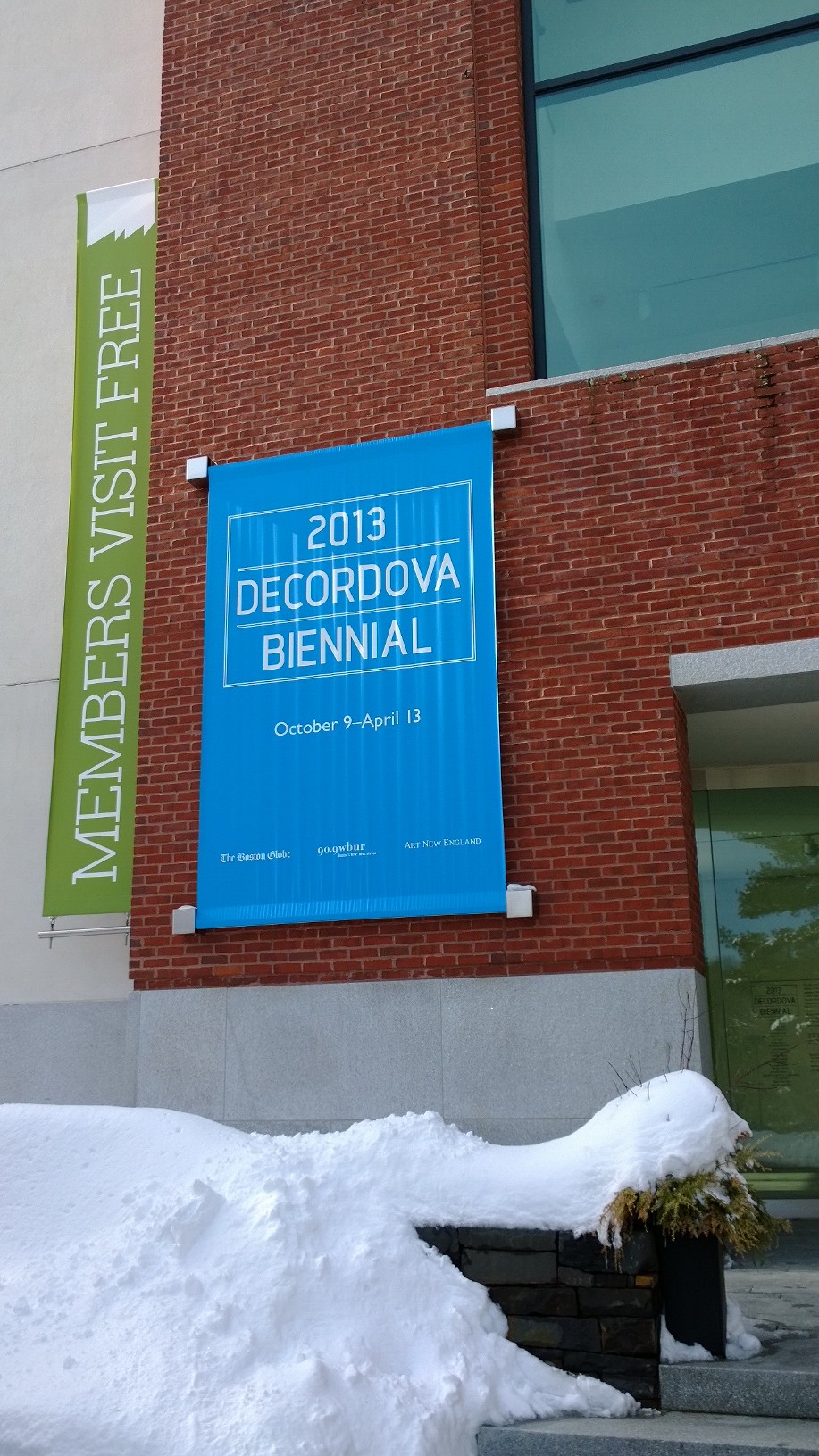
On Sunday, my husband and I decided to see what’s new at the DeCordova Museum in Lincoln.

A favorite in the biennial show of New England artists was Laura Braciale of Manchester, NH. It took me a minute, but when I realized she had displayed everyday objects along with what they looked like once she had turned them into art, I thought, Yes, art really is in everything if you look.

The blurb about her says, “close observation reveals subtle differences between the three-dimensional structures and their two-dimensional renderings. …  Her works engage a question concerning representation—which image is more ‘real’? As both her items and her illustrations occupy the same physical reality, however, Braciale’s work suggests that neither is more real than the other.” (Sigh. I’m not really fond of the way museums write.)

In a different DeCordova exhibit we saw three tintype photo portraits by the late David Prifti, Suzanne’s high school photography teacher. (A solo show in Winchester, Mass., goes through March 2, here.)

The biggest surprise was a documentary about Laos, a country we are interested in largely because of the the mystery books of Colin Cotterill. (Read one of my posts about him, here.)

The film, Route 3, shows a small mountain town that, having been leased to China for 75 years, was utterly destroyed to make way for casinos, hotels, entertainments, and jobs for Chinese people alone. Hard to imagine selling a part of your country like that, but Laos is desperately poor.

The documentary was by Patty Chang and David Kelley, who live and work in Boston and Brooklyn.

The DeCordova says on its website, “Blending the genres of documentary and road trip films with surrealist cinematic passages, Patty Chang and David Kelley present a compelling trip through the physical and psychological landscape of a community in transition. … Enlisting the help of tour guides and local entrepreneurs in this tightly controlled area, the artists immersed themselves in this community to create a unique portrait of a changing society.” More information on the artists here and here.

Read Full Post »

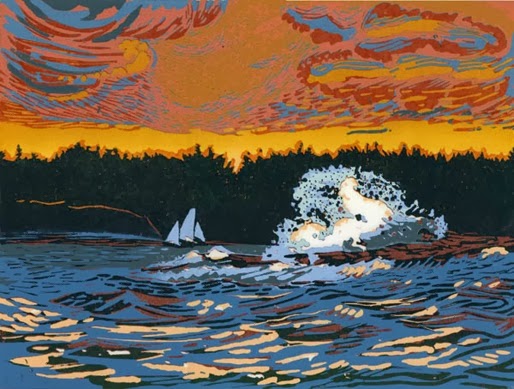
Artist Susan Jaworski-Stranc is having a show she’s calling Water Blues at Centro Restaurant and Bar in Lowell. The exhibit, which includes oil paintings and linoleum prints, runs to March 17 at 24 Market St.

If you can get to Lowell on Sunday, Feb 23, there’s a reception where you can meet the artist, 1 pm to 3 pm.

My husband and I have been to a number of art shows in Lowell, which is quite a creative community. Our favorite Lowell artist is a former boss of mine, Meredith Fyfe Day, who held down a newspaper job while she was artist in residence at the Whistler House. I worked for her at the Harte-Hanks community newspaper chain in the early 1990s.

Here’s the intriguing artist statement from Jaworski-Stranc: “I am a printmaker, specializing in the creation of linoleum block prints. After each successive printing of a color, the surface of the block is reduced while at the same time the printing surface is built up with multi-layered colors. Born from one block of linoleum, my relief prints have the nuance and rich textural surfaces of an oil painting.

“Although Picasso coined this method of working, a ‘suicide print,’ I rather think of this printmaking process as emulating the journey of life. While creating my prints, I am never able to re-visit past stages. I can only proceed forward with the acceptance of all good and not so good choices which were mediated and acted upon with the hope and joy of completion.”

When Asakiyume and I met in December at the Worcester Art Museum, there was an exhibit on printmaking that showed what prints looked like at each of the layering stages. Challenging work. I love that Jaworski-Stranc sees the printmaker’s role as accepting each previous stage and working with it. As she says, “The journey of life.” Another good topic for a poem.

Find out more about Susan Jaworski-Stranc here. And thank you, Vyü magazine, for the lead.

Read Full Post »

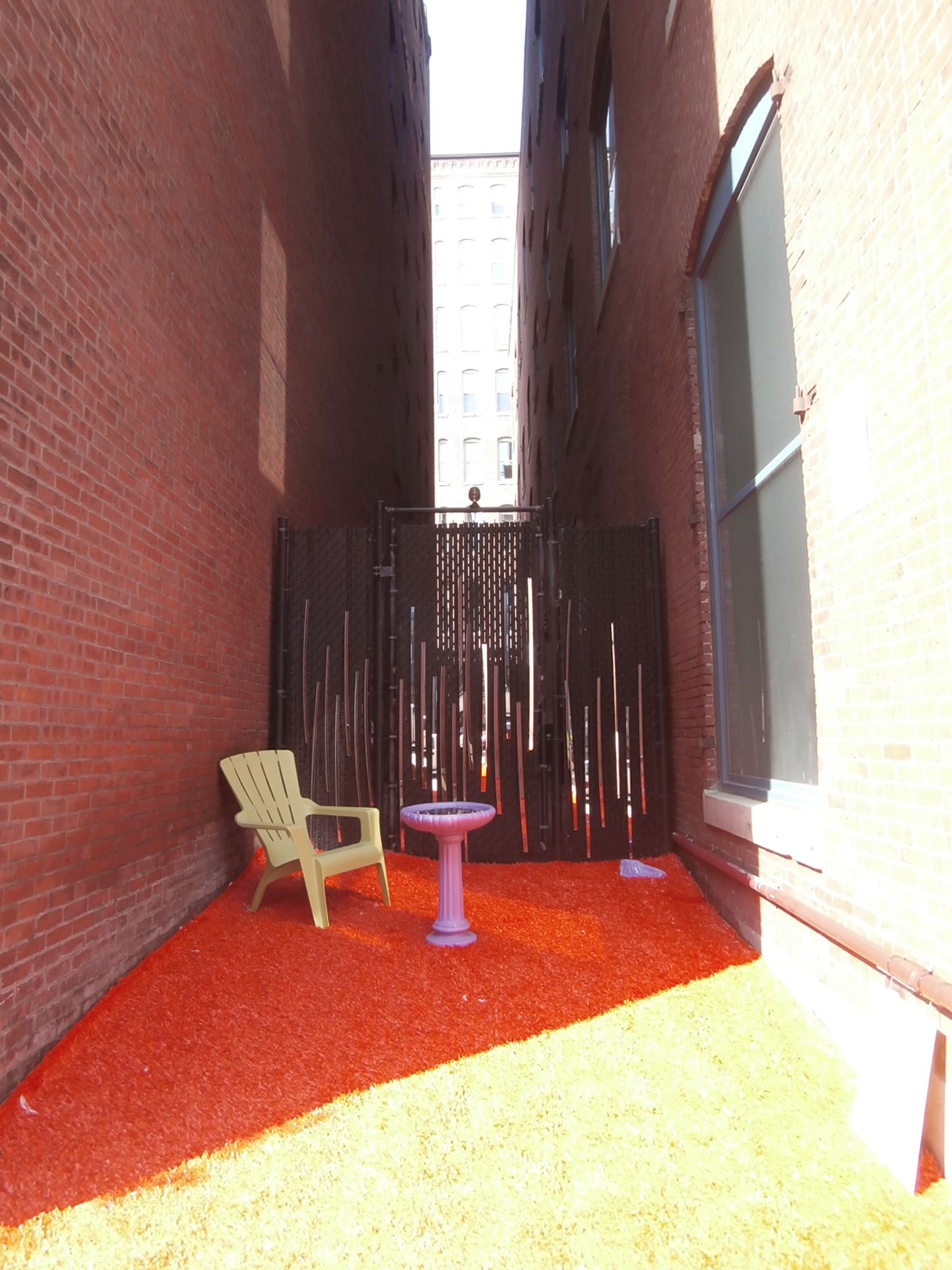
congress st nook

The City of Boston has a nice opportunity for folks with ideas about making cities more livable.

The City says, “In Boston, a third of the land is open to the public. We invite you to reimagine that space. How can our streets, plazas, sidewalks, street furniture, and public buildings better serve people?

“The Mayor’s Office of New Urban Mechanics Streetscape Lab is sourcing ideas from designers, makers, artists, and engineers to improve Boston. We are asking members of our vibrant creative community to submit project ideas to make our public spaces simple, intuitive, and literally awesome. Project ideas can be entirely new creations or a new way of using an existing product. The City will review the submissions and may select up to six ideas total to implement in the following categories:

“The Streetscape: sidewalks, streets, medians, plazas, and our other civic front porches. What improvements would you make to space? What is the next iteration of our classic street furniture? Look at the sample locations to get you thinking.

“Boston City Hall: rethinking the indoor and outdoor space, signage, improving service delivery and the user experience. These designs may help inform future improvements to the building.

“Random Awesome Designs: great ideas that defy classification or location.” Guidelines here.

I see no reason you have to be an artist or an engineer. What’s to stop you from sending in a good idea? Go for it.

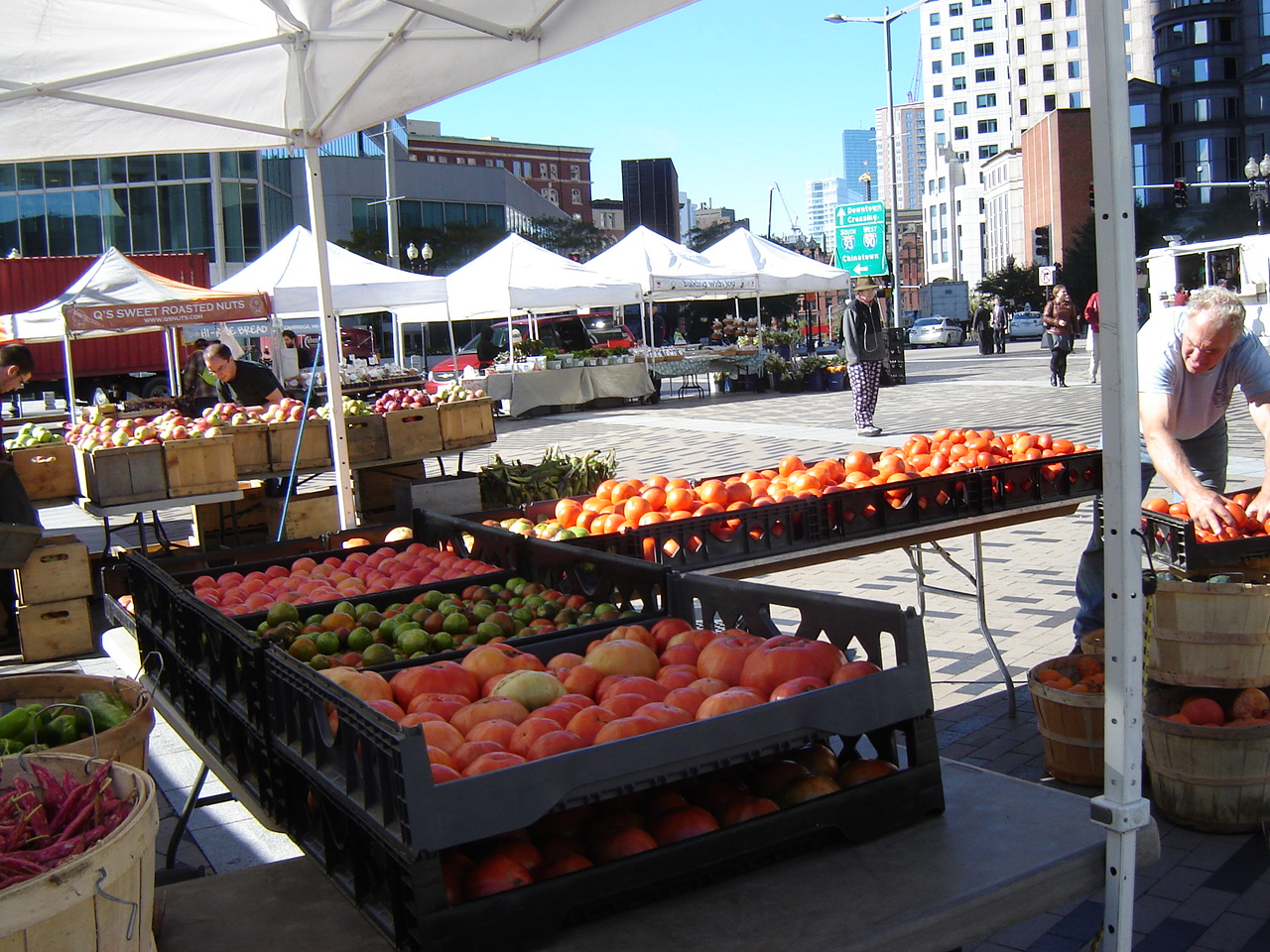
Dewey-Sq-_farmers_market

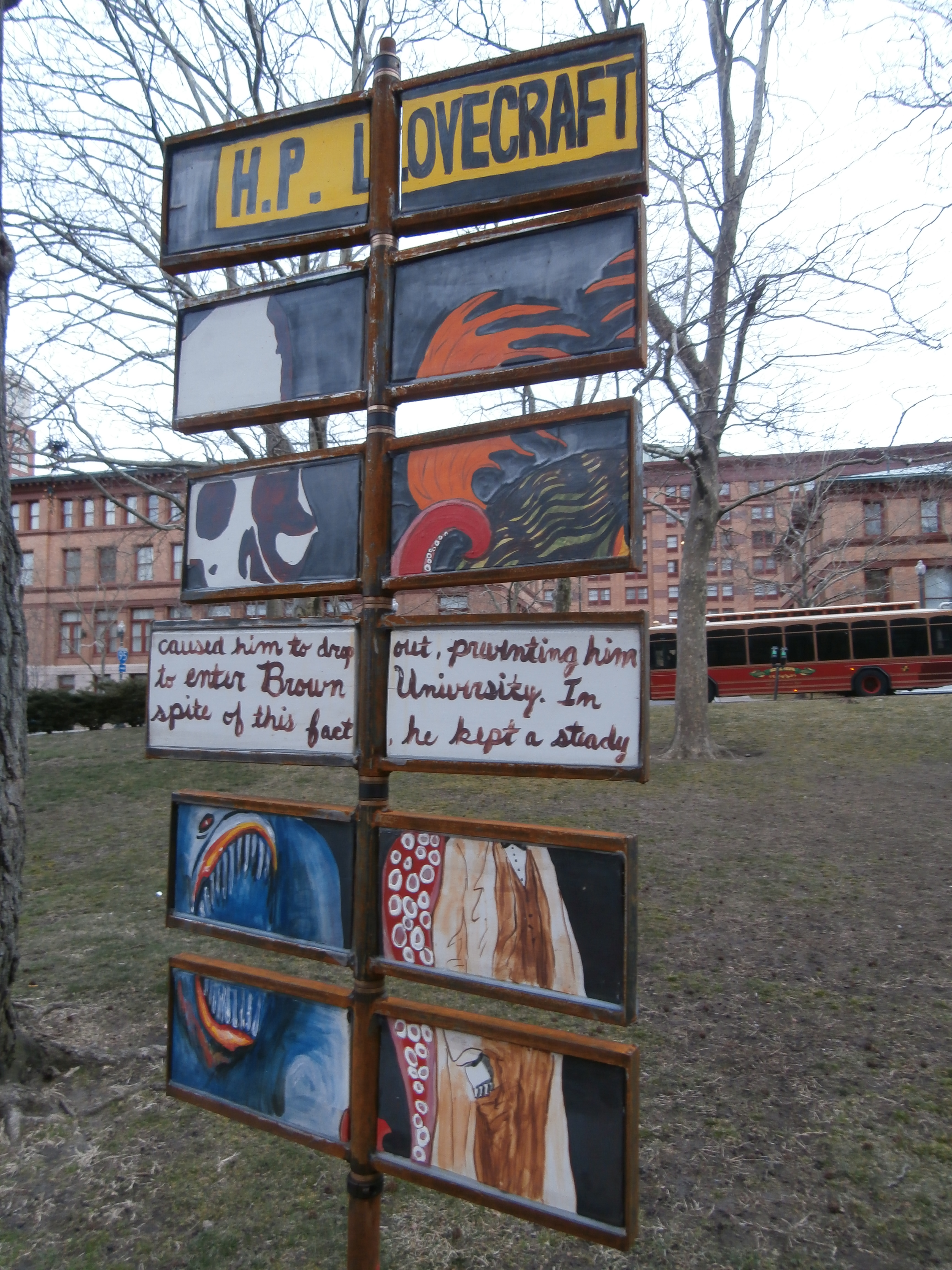
providence author lovecraft

Read Full Post »

Mary Ann put this trompe l’oeil art on Pinterest, bless her heart. She’s an endless source of cool stuff.

The online magazine Feel Desain has the story.

“In Potsdam, Germany, street artists Daniel Siering and Mario Shu have recently created a clever piece of illusion that depicts a surreal hovering tree. After wrapping a part of the tree truck with plastic sheeting, they made an amazingly detailed and realistic spray-painting of the surrounding landscape on it.

“The result is a brilliant illusion that the tree has been sawed through and is floating in mid-air over its stump.”

Watch the video showing how it’s done,  here.

Read Full Post »


Lately, I have been following a very artistic art consultant on twitter called Liz Devlin.

Here is what her website says about her: “Since launching FLUX. in 2008, I have provided an online resource for local artists and Arts enthusiasts in the Boston area, and beyond. Through weekly event coverage, artist interviews, Open Studios recaps, and educational posts, the site enables readers to feel informed, engaged in, and connected to the pulse of Boston Arts.”

Here’s the part that floors me: “My 9-5 is in the corporate world as a Financial Analyst.” Gosh, how can she possibly have time for it all?

She continues, “My downtime, in-between times and restless nights are spent actively pursuing and supporting creative endeavors.”

A reason to follow her on twitter is that she keeps up on everything in the Boston arts scene for you. You can also check out weekly lists of events — with commentary — at her website. For example, here.

I especially like the nostalgic, off-kilter look of this piece in the current  Montserrat exhibit.

Art: Andrew Houle’s “Leaving East Gloucester.”
Montserrat College of Art Galleries, 23 Essex St., Beverly, Mass., through February 14

Read Full Post »

Photo and Art: Andrés Amador

Much obliged to Paul for posting about this sand-painting artist on Facebook.

Andrés Amador, of San Francisco, creates lovely designs with a rake. He maintains that his work is “more about the process and less about the result.”

The website Viral Nova explains that Amador “uses a rope as a guide so that he can make the geometric patterns. … By raking up the wet sand at low tide, he is able to make contrasting sand colors.”

And he apparently takes orders — for marriage proposals (“Love Letters in the Sand”?) and even for corporate team-building exercises.

If I lived in San Francisco, I might ask Amador to create a message about something — maybe peace or kindness or helping the homeless. Some year, a sand painting could be my donation to the San Francisco-based Homeless Prenatal Program, an outstanding organization that Suzanne told me about.

Check out the collection of Amador’s other works is at Viral Nova, a site that bears watching.

Photo and Art: Andrés Amador
I caught my breath when I saw the inevitable happening to this painting. With sand art, it seems that “Ars longa, vita brevis” becomes “Memoria longa, ars brevis.”

Read Full Post »

Above, “I” Formation, by Ann Ribbens
Ann says, “This piece is a combination of a purchased hand-dyed top panel and an Arashi (pole-wrapping) shibori piece that I made. The panels were assembled, heavily machine quilted and embellished with beads.”

My ex-boss in Minnesota is a very fine quilter. That doesn’t mean that I’m a quilter. It means that she was my boss in her day job.

Ann is exhibiting the piece above in the show “A Common Thread” at the Textile Center in Minneapolis, here, through February 26. She has a number of other pieces available for viewing at the Minnesota Artist website, here. I think you will find the variety quite remarkable.

I often wonder if an artist is better off finding a way to make a living from art or doing art on the side. The first way means doing art all the time but maybe compromising to please clients.

The second means never having enough time but always having freedom. Ann is an example of someone who has made the latter approach work. Her day job is completely unrelated to quilting. But I suspect that while she is focused on it, her unconscious is working away on her next textile project.

Sometimes it’s not a bad idea to let one part of your mind lie fallow while the other is busy.

Below, “Carnelian Sunbursts,” by Ann Ribbens
Ann says, “This work incorporates shibori dyeing. It is intensively machine quilted. It was completed in 2011 and is a table runner, 15 x 43 inches.”

This work incorporates shibori dyeing. It is intensively machine quilted. It was completed in 2011 and is a table runner, 15 x 43 inches.

Read Full Post »

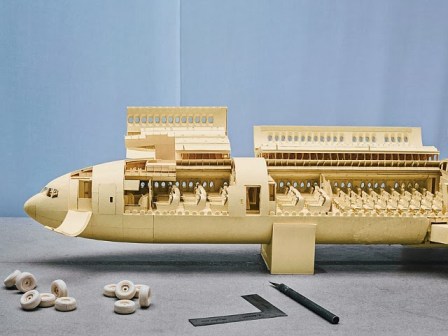
Someone on twitter linked to this delightful post at Junk Culture this week. It’s an extraordinarily detailed replica of a Boeing airplane — made out of manila folders.

Writes Junk Culture, “Using nothing but manila folders and dabs of glue, Luca Iaconi-Stewart has been putting together a very detailed model of a Boeing 777 that is almost as complex as the real thing.

“The doors open and close on paper hinges and the landing gear retracts up into the fuselage. The project which has been a labour of love for five years grew out of his passion for airplanes and the models he made from manila paper in a high school architecture class.

“Iaconi-Stewart told Wired, ‘There’s something rewarding about being able to replicate a part in such an unconventional medium.’ ”

A collection of amazing photos — some that move — may be found here. The retractable wheel carriage has to be seen to be believed.

Without meaning to suggest that there is anything bizarre about such remarkable precision in a young man, I have to say actor Benedict Cumberbatch’s version of Sherlock Holmes keeps coming to mind as I look at the photos.

This is an unusual mind at work.

Photo: Luca Iaconi-Stewart and Mark Mahaney

Read Full Post »

Photo of John Bauer: Wikimedia Commons

When I was poking around the web for art to illustrate my post Iceland Has Elves, I found a lovely picture by John Bauer.

I didn’t know anything about him. But Stuga40 wrote in the comments that he was Swedish. She knew where he had lived before his untimely death in 1918 and said she grew up on his fairy stories.

I decided I wanted to know more.

Wikipedia says John Bauer is “best known for his illustrations of Bland tomtar och troll (Among Gnomes and Trolls). Princess Tuvstarr and the Fishpond  [is] perhaps Bauer’s most notable work. …

“Bauer’s early work was influenced to a large extent by Albert Engström and Carl Larsson, two contemporaries and influential painters. Bauer’s first major work was commissioned in 1904, when he was asked to illustrate a book on Lappland. It was not until 1907 that he would become known for his illustrations of Bland tomtar och troll, the yearly fairy tale book.”

A contemporary story collection called Swedish Folk Tales uses Bauer’s illustrations and is available here. Also, someone posted a bunch of his illustrations on Pinterest, including a sweet Santa Lucia.

John Bauer art showing a boy and a troll: Wikimedia Commons

Read Full Post »

I can’t remember at the moment how I came across this tidbit, but I knew as soon as I saw it that I wouldn’t be able to resist something cool about  Stockholm.

I took the Stockholm subway a few times in the 1990s, but I don’t remember anything like this. Relatives living in Stockholm will have to let me know if the subway today is really the magical mystery tour that Dangerous Minds suggests.

Go to the Dangerous Minds website for a wonderful array of pictures. It sure doesn’t look like the Red Line. If the Red Line looked like this, I would expect to encounter Ming the Merciless around every corner.

Might make the commute more interesting.

Click here.

Photo: Dangerous Minds
A human emerges from a wall in the Stockholm subway’s “wild underground fantasia.”

ssssdddwwwcccc

Read Full Post »

Today the public radio program Studio 360 featured a shortened version of a wonderful WNYC documentary about the year 1913. That was the year Stravinsky’s The Rite of Spring was only one of many “shocking” arts events to usher in the modern age.

From the Studio 360 website: “What a year was 1913! In an exhibition in a New York Armory, American viewers confronted Cubism and abstraction for the first time. In Vienna, the audience at a concert of atonal music by Schoenberg and others broke out into a near-riot. And in Paris, Stravinsky and Nijinsky’s new ballet The Rite of Spring burst on stage with inflammatory results.

Culture Shock 1913 tells the stories behind these and other groundbreaking events that year, and goes back to consider what led to this mad, Modernist moment.

” ‘I think in a lot of ways it was just the beginning of a century just of absolute chaos and nightmare, and as so often, the artists heard it and reflected it first,’ notes the critic Tim Page.

“WNYC’s Sara Fishko speaks with thinkers, authors, musicians, art curators, and historians about this unsettling era of sweeping change — and the not-so-subtle ways in which it mirrors our own uncertain age.

“This Studio 360 episode is an abridged version of a one-hour documentary Sara Fishko produced for WNYC.” More here.

I liked how the documentary explains that the shock was derived from artists not wanting to master and perfect what was done in the past or to replicate nature but rather to be different and to focus on structure, taking things apart and putting back again differently. Artists themselves organized the Armory Show, not curators or galleries. They went to Europe, where change was erupting like crazy, and they brought back art never seen in conservative America.

A key takeaway was that when we see something really new we often think it is ugly, as people thought the Eiffel Tower ugly. But once they look and look some more, they begin to like it.

That helps me think about some of the art Asakiyume and I saw yesterday at the Worcester Museum of Art. It sure looked ugly to me, but it’s a good idea to keep an open mind. Asakiyume sets a good example in that department.

(My mother was born in 1913. Perhaps something was in the air that year that can explain her rebellious nature.)

Photograph taken by spDuchamp/flickr
Marcel Duchamp’s NudeDescending a Staircase, No. 2, was featured in the landmark Armory Show and outraged most visitors because she wasn’t reclining like traditional nudes and she was in motion and it was hard to see her.

Read Full Post »

Michelle Aldredge runs an outstanding arts blog called Gwarlingo. Recently, she wrote about snowflake art by the identical twins who created the Big Bambú installation at the Met. (I wrote here about the second life of Big Bambú when it was done being art.)

Asks Aldredge on December 21. “What do photographs of snow have to teach us about artistic originality?

“Today is the winter solstice, the shortest day of the year, and snowflakes have been on my mind, specifically the snowflakes of Doug and Mike Starn.

“Born in New Jersey in 1961, Mike and Doug Starn have worked collaboratively in photography since the age of thirteen. …

“The Starns’ approach [to snowflakes] is partly science, but mostly art. It took the brothers years to hammer out the logistics that would allow them to capture flakes during their fleeting existence — there were microscopic lenses, plasma-emitting lights, snowstorm photo sessions. But the results speak for themselves. There is a poetic quality about their flakes.” More.

The twins called Os Gemeos, whom I wrote about here are an artistic team, too. In fact, they say, they always know what the other twin is thinking as they work on giant murals like the one they did in Dewey Square, Boston.

After seeing the musical Sideshow, I became aware that even Siamese twins may have very different personalities, but it’s intriguing to think about the close communication many twins have.

 Art: Doug + Mike Starn, from the series alleverythingthatisyou, 2006-2007.

Read Full Post »

I’m adding Julian Peters to the blog roll on your right. He’s a genius. A graphic artist from Canada who has chosen to illustrate some of the greatest poems ever. At least, some of my favorites.

Matthew Gilbert did a spread about Peters and his work on T.S. Eliot’s “The Love Song of Alfred J. Prufrock” for the Boston Globe. Illustrations that could break your heart. I am in Matthew Gilbert’s debt for this gift of happy-sad. Read his essay, here.

Below are a few frames from Peters’s “La Belle Dame Sans Merci,” by Keats, a poem I can’t read without hearing my father’s voice choke up on my cassette tape.

Go to Peters’s website, here, and luxuriate.  

Art: Julian Peters

Read Full Post »

« Newer Posts - Older Posts »