Feeds:
Posts
Comments

Posts Tagged ‘Atlanta’

Photo: Melanie Stetson Freeman/CSM.
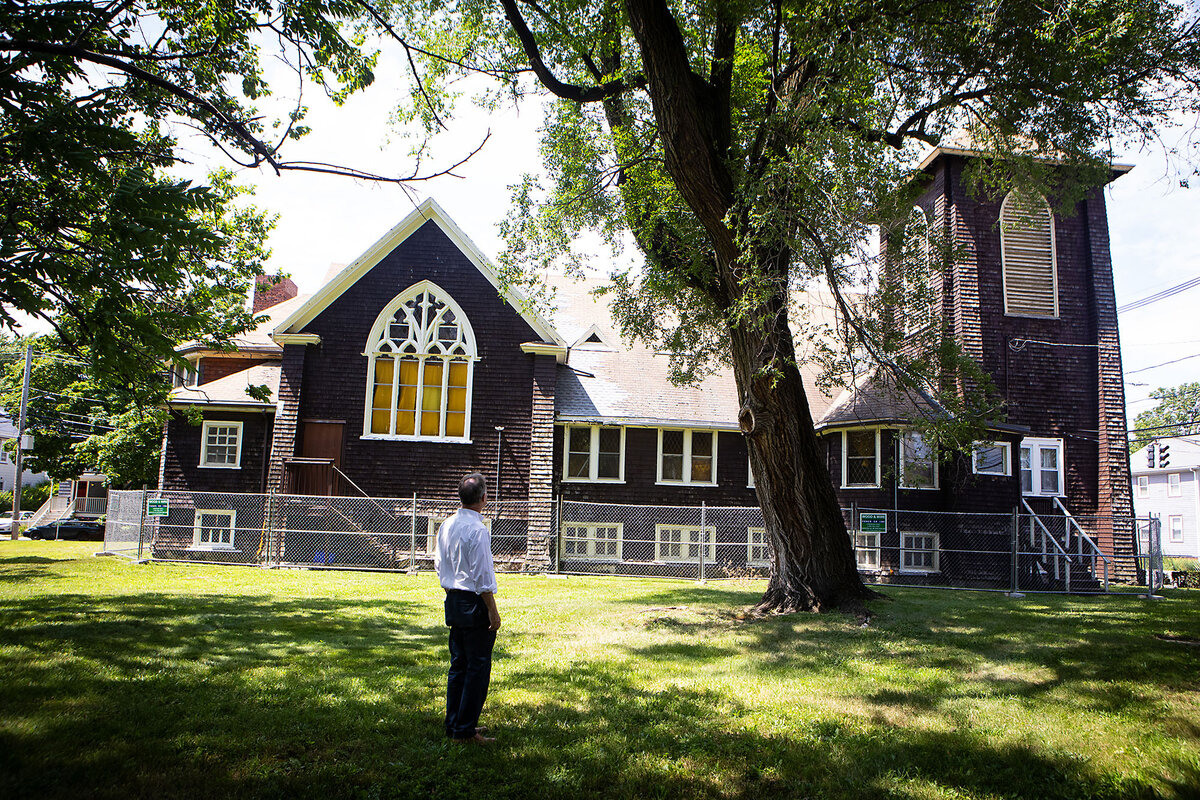
John Woods, director of Allston Brighton Community Development Corp. in Massachusetts, stands in front of Hill Memorial Baptist Church in July. The church and grounds are being turned into a housing complex for older adults.

My 9-year-old granddaughter assures me that the best place to stay overnight in Nova Scotia is a converted church. The light from the stained glass was beautiful, she says, and so was the rest of the building.

Her family’s rental was privately owned, but in today’s story we learn about a Boston-area initiative to turn other unused churches into subsidized housing. And Boston is not alone.

Troy Aidan Sambajon reports for the Monitor, “With its 58-foot bell tower standing sentinel, Hill Memorial Baptist Church has witnessed Allston-Brighton’s dramatic transformation. Upscale apartments and condos now stand on the site of once-bustling stockyards. Gourmet food shops have replaced affordable grocery stores. Now, the 120-year-old church is set for its own transformation. … The church is finding a new role in the community: much-needed affordable housing for older people.

“Churches and faith communities across the United States are increasingly closing their doors. Five years ago, The American Baptist Churches of Massachusetts, noting a dwindling congregation in Allston-Brighton, considered downsizing or repurposing the land. The choice was ultimately left to Hill Memorial’s congregation.

“In a final act of generosity, members chose to sell the land to fulfill the church’s ‘mission of giving back to the Allston community in the form of senior housing,’ says the Rev. Catherine Miller, former pastor, over email. With the blessing of its former congregation, the site will become 50 apartments for older adults on a fixed income. Today, the average price to rent a one-bedroom apartment in Allston is $2,786 per month, according to Apartments.com. The average wait time for senior housing in Boston currently stretches more than five years.

“ ‘Something good needed to happen here,’ says John Woods, executive director of Allston Brighton Community Development Corp., a housing developer. …

“Across the country, more faith communities are opening their doors to creative affordable housing solutions: Some are building homes on underutilized land or converting unused residences.

“In California, the grassroots ‘Yes in God’s Backyard’ movement led to the Affordable Housing on Faith Lands Act. This makes it legal for faith-based institutions to build affordable, multifamily homes on lands they own by streamlining the permitting process and overriding local zoning restrictions.

A federal version, the Yes in God’s Backyard Act, was introduced this spring by Ohio Sen. Sherrod Brown. …

” ‘It’s sad when a church closes,’ says Donna Brown, executive director of the South Boston Neighborhood Development Corp., which is leading the conversion of a former convent. ‘When they sit empty, it leaves a real void in the neighborhood. But when a building can be converted to housing so that people can stay in that community – it can be a wonderful thing to knit a community back together.’

“The U.S. is not building housing fast enough to support America’s aging population, according to Housing America’s Older Adults 2023 report, recently released by Harvard University’s Joint Center for Housing Studies. … By 2030, Americans age 65 and older will make up more than 20% of the population, according to Census Bureau projections. The need for affordable housing for this demographic will only grow. Meanwhile, homelessness is rising among older adults. …

“Sometimes, those being priced out of a neighborhood have lived there for decades. Moving means leaving not only friends but also support structures. Take Allston-Brighton, which was once a very affordable neighborhood, says Karen Smith, president of Brighton Allston Elderly Homes Inc. With rising rent costs and the cost of care, it’s tough for older adults on a fixed income to stretch their budgets thousands of dollars more a year. …

“In densely populated cities, the space to build affordable housing is often far from where it is needed most, says the Rev. Patrick Reidy, associate professor of law at the University of Notre Dame. However, faith communities and former churches are typically located in high-density areas that are accessible to the most people.

“ ‘These kinds of adaptive reuse projects for affordable housing are a win-win-win,’ says Professor Reidy. ‘The local governments that are desperately in need of land for affordable housing are given access by faith communities seeking to live out their religious mission, and those who need affordable housing don’t always have to uproot their lives from their neighborhood.’

“Boston is a prime example of this trend. The transformation of former churches … illustrates how adaptive reuse can unite communities in finding solutions to the housing crisis. The locations of older church properties in New England are unique for other reasons. Many are quite literally older than zoning laws, which were first passed around the 1920s.

“Blessed Sacrament Church sits at the heart of the historic Latin Quarter. It is set to become a sanctuary of affordable living, with 55 income-restricted units, along with a performance and community space.

“The building sat empty for years. High restoration costs prompted its owners to contemplate selling it to developers on the open market to become high-end apartments. Former parishioners and residents opposed the sale and advocated for community input. In the end, after meetings attended by hundreds in the area, the selected proposal from developer Pennrose aimed to preserve the historic exterior of the church while renovating the interior to create affordable housing.”

More at the Monitor, here. No firewall. Subscriptions are reasonable. For more on repurposing old church buildings, see the other part of the Monitor series, here.

Read Full Post »

Photo: Rainbow Skateland.
Roller skating — often in the street — has been part of African American culture for years.
Today it’s really an art form.

The world of roller skating is a world I know nothing about. The one time I tried it at a kid birthday party, I was mostly frozen. But wait till you hear about the expertise of today’s Black roller skating world!

James Thomas reports from Atlanta for the New York Times, “To parse the different regional roller skating styles in metro Atlanta rinks, watch the traffic patterns.

“Sparkles Family Fun Center in Smyrna, Ga. on a recent Thursday night offered a case study: Locals skating in the hometown style churned the floor’s edge, punctuating their synced steps with hand claps that rose from the shoulder. Skaters in the New York-New Jersey-style bobbed steadily and pivoted in tight circles at the center of the crowded rink. A critical mass of skaters doing Chicago’s brand of fluid, James Brown-inspired footwork, or JB skating, carved a jet stream between the crowds.

“It was the warm-up party for the Jivebiscuit Skate Family Reunion, one of the longest-running national gatherings of Black roller skaters. The 17-year-old event, held in February, is one of several annual parties that have made Atlanta a skating hub, bolstered by a steady, decades-long influx of Black residents from other cities.

“ ‘It’s definitely like the Great Migration meets the skate migration,’ said Reggie Brown, 40, a JB skater and music producer who grew up in Chicago. Though he now lives in New York, Brown visits Atlanta frequently to skate. …

“That commingling has Atlanta’s stalwart skaters concerned about keeping their distinctly energetic and percussive style alive. They say Atlanta’s newer skaters, who have wide access to regional variants, increasingly practice a hybridized type of skating that’s not rooted in any one tradition.

“ ‘If you don’t understand the foundation, you have the potential to lose it altogether,’ said Vaughn Newton, the skating choreographer for the 2006 coming-of-age movie ATL. Newton, 58, is a respected bridge between the city’s younger and older skaters. …

“On any given night in Atlanta — certainly on a destination party night — a D.J.’s song choices can activate or chill the various pockets of culture swirling the floor. So when D.J. Arson played ‘Presha‘ by 2 Chainz and Lil Wayne, a standout of the trap subgenre, on the second night of Jivebiscuit at Stone Mountain Skates in Stone Mountain, Ga., the Atlanta-style skaters took their cue.

“Paul Antonio Johnson led a procession along the perimeter, his high knees evoking a drum major in a marching band. He called out routines; the skaters behind him clapped and matched cross slides to the pounding beat. The maneuver is a foundational element of the Atlanta style, where a skater crosses feet laterally in sync with the music. Though known by different names across regions, Atlanta skaters in the 1970s first termed it the crisscross. Younger generations smoothed it out, lifting their skates for a cross-body step they called the cross slide.

“ ‘If you know what you’re looking for,’ says Newton, ‘you’ll see the crisscross. And that’s what everything is built on.’

“Arson stayed in trap mode for the next half-hour before shifting smoothly out of the simmering, drum-heavy hip-hop into mid-tempo R&B with muscular grooves and few lyrics. The Atlanta skaters slowed down and cycled off the floor while the JB skaters took over, swaying and lunging, arms high. They had buoyancy and finesse.

“Atlanta style embodies ‘a lot of energy, showmanship, ugly face. It’s real hype,’ said Kenneth Anderson, known as Kojak. He and his wife, Tijuana Anderson, or Lady Tee, 61, are pillars of the Atlanta skating community. ‘It’s like riding a motorcycle on 285 and just letting your hair down,’ Kojak, 62, said. ‘It’s a real aggressive style.’ …

“When Joi Loftin moved to the area from Detroit in 1988, synth-funk and early hip-hop were prevalent. In 1995 she and other transplanted Detroit skaters, who were used to up-tempo R&B, began to pool their money each week. ‘We would rent Golden Glide rink just so we could play the music that we wanted to skate to,’ she said. ‘That session is still going on to this day.’

“Loftin soon developed relationships with other rink owners, D.J.s and skaters. She and John Perkins, a transplant from New York, started Sk8-a-Thon in 1996, one of the first recurring national parties that showcased Black roller skating styles. Their first event drew 836 skaters from around the country to the Golden Glide in Decatur, six miles east of downtown Atlanta. Over the years it grew to accommodate thousands in multiple rinks over four days, making a Labor Day trip to Atlanta a Black roller skating ritual Loftin hopes will continue now that she’s held her last Sk8-a-Thon in 2023.

“ ‘It’s a beautiful thing,’ said Terron Frank, 34, who traveled from Portsmouth, Va. for Jivebiscuit. ‘You can pretty much see every style you’d want to see in Atlanta.'”

More at the Times, here. Great photos.

Read Full Post »

Photo: Georgia State University.
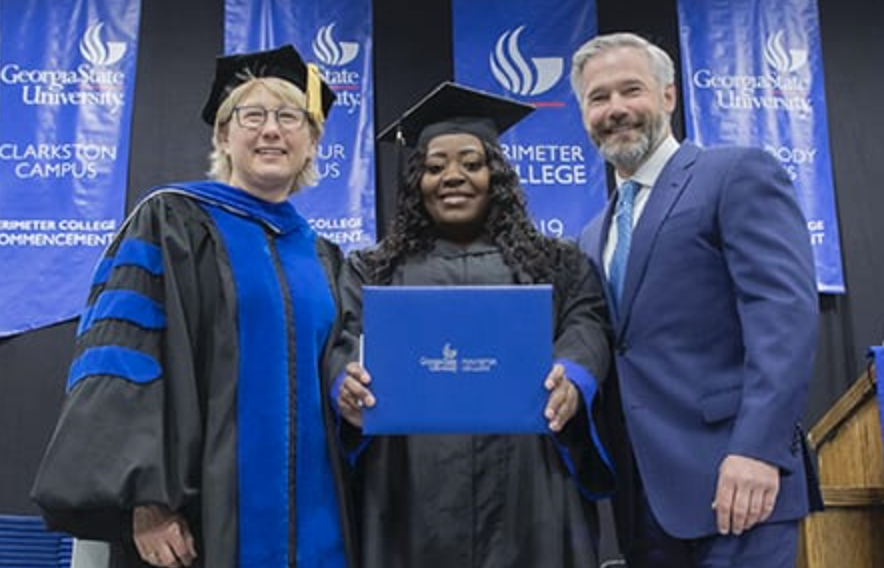
Latonya Young was able to finish college after Kevin Esch, her Uber passenger, secretly paid off previous school costs.

This feel-good story was widely reported, but just in case you missed it, I want you to know that once upon a time when an Uber driver mentioned to a passenger that she couldn’t finish college because of a debt for classes already taken, the passenger knew he had to help out. And — secretly at first — he did. But it may have been the ongoing friendship and support that had the biggest effect.

Sydney Page has the story at the Washington Post. “Latonya Young, a 44-year-old single mother of three, received a bachelor’s degree [in May]. It was a lifelong goal — and she credits one of her Uber passengers with making it possible.

“She met the passenger three years ago when she pulled over in downtown Atlanta to pick him up. Kevin Esch, who had just come from an Atlanta United soccer game, got into her car. The two started chatting.

“ ‘The conversation was easy and felt authentic,’ said Esch, 45.

“He shared details about his recent divorce, and Young — whose marriage ended in 2011 — offered advice.

“During the half-hour ride to Esch’s home, he learned that Young, who had been an Uber driver for three years, was working late that night because she needed money to pay a utility bill.

“And he learned something else: Young wanted to be the first member of her family to graduate from college. Although Young started taking classes at Georgia State University in 2010, she dropped out a year later because she couldn’t pay the tuition.

“Once they arrived at his home, Esch, an estate manager, tipped Young $150 — enough to cover the utility bill — and gave her his phone number.

“ ‘She promised me that she would go back to school,’ he said, adding that he asked her to keep him informed throughout the enrollment process. It was the start of an unexpected friendship.

“After the Uber ride, ‘I had my mind made up that I wanted to go back to school,’ she said. ‘He motivated me.’

“But a few weeks later, when Young tried to re-enroll at Georgia State, she was told that she wasn’t permitted to register until her balance from eight years earlier was paid in full. She owed $693 — a sum she couldn’t afford.

“When she told Esch about the financial hold, he immediately went to the university, without Young’s knowledge, and paid off her debt.

‘I didn’t want that to be a roadblock, because it was something that I could change,’ Esch said. ‘I was in a place to be able to do it, and it was the right thing to do.’ …

“ ‘I was in shock,’ Young said. ‘This person barely knew me, and yet he wanted to help me.’

“She vowed to pay him back, but his response was: ‘Pay me back by graduating.’

“Young was grateful for the support, she said, after years of working multiple jobs and putting off her education. …

“ ‘It was like I was stuck inside a box and couldn’t get out. I was just trying to do whatever I had to do to take care of my kids,’ Young said, adding that she was also in a car accident in 2015, which further set her back financially. …

“After meeting Esch, though, ‘I felt it was time for me to do something for myself, and to set an example for my kids,’ Young said. Plus, she added, ‘I wanted to remain a woman of my word and do exactly what I told Kevin I was going to do.’

“She re-enrolled in courses, and in December 2019, Young received her associate’s degree in criminal justice from Georgia State’s Perimeter College. Esch was there on graduation day, cheering her on in the stands. …

“Still, ‘I knew I wasn’t finished,’ she said. Getting a bachelor’s degree was her ultimate goal, ‘so I went straight ahead. Not only was I aiming for that, but I was aiming to raise my GPA as much as I could before I graduated.’

“Young continued with her studies while working part time as a substitute teacher, as well as a hairstylist. She also received support from the Jeanette Rankin Women’s Scholarship Fund, which offers financial aid to low-income women older than 35 pursuing postsecondary education. …

“ ‘The funding helped me get through the hardships,’ Young said, adding that it was often difficult to manage being a single mother while working two jobs and keeping up with her classes. …

“Despite the challenges, though, Young graduated with her bachelor’s degree in criminal justice from Georgia State’s Andrew Young School of Policy Studies on May 6. Of course, alongside her family, Esch was in the stands once again — beaming with joy.”

Read the rest of the story at the Post, here.

Read Full Post »

This story comes from Heather Dockray at Good magazine (by way of the Huffington Post). It’s about a life-affirming project in Atlanta.

“Good, local, nutritious food shouldn’t be expensive,” she writes, “and shouldn’t only be enjoyed by people who can afford it.  A homeless shelter in Atlanta decided that their residents desperately needed access to healthy food — but instead of sourcing out, encouraged residents to grow their own. Now, the shelter is home to a huge rooftop garden planted by the residents themselves, which is expected to yield hundreds of pounds of great quality greens. …

“While eating discounted snacks might give homeless residents short-term financial benefits, the long-term health consequences are substantial. The Metro Atlanta Task Force for the Homeless, who runs the gardening program, wanted to give homeless people access to food previously considered out-of-reach. Now, residents are responsible for 80 garden beds, producing kale, carrots, chard, and squash, among other vegetables.” More here.

Dockray doesn’t mention how gardening and donating to the shelter makes residents feel, but I am going to guess it builds their self image and confidence.

Photo: Metro Atlanta Task Force for the Homeless

Read Full Post »

Did you catch Luke Runyon’s story about a trend in suburban housing that sites homes near farms for the fresh food? It was at National Pubic Radio today (courtesy of Harvest Public Media).

According to Runyon, “There’s a new model springing up across the country that taps into the local food movement: Farms — complete with livestock, vegetables and fruit trees — are serving as the latest suburban amenity.

“It’s called development-supported agriculture, a more intimate version of community-supported agriculture — a farm-share program commonly known as CSA. In planning a new neighborhood, a developer includes some form of food production — a farm, community garden, orchard, livestock operation, edible park — that is meant to draw in new buyers, increase values and stitch neighbors together.

” ‘These projects are becoming more and more mainstream,’ says Ed McMahon, a fellow with the Urban Land Institute. He estimates that more than 200 developments with an agricultural twist already exist nationwide. …

“In Fort Collins, Colo., developers are currently constructing one of the country’s newest development-supported farms. At first blush, the Bucking Horse development looks like your average halfway-constructed subdivision. But look a bit closer and you’ll see a historic rustic red farm house and a big white barn …

“When finished, Bucking Horse will support more than 1,000 households. Agriculture and food production are the big draws, [developer Kristin] Kirkpatrick says. Land has been set aside for vegetables. There will be goats and chickens, too, subsidized by homeowners. Soon they’ll be hiring a farmer for a 3.6-acre CSA farm. There’s also a plaza designed for a farmers market, and an educational center where homeowners can take canning classes.”

Sounds like fun. Read more.

Photo: Serenbe Farms
Paige Witherington is the farmer at Serenbe Farms, a 30-acre certified organic and biodynamic farm adjacent to a housing development outside Atlanta. It’s one of more than 200 subdivisions with an agricultural twist nationwide.

Read Full Post »

Here’s an interesting thought for harvest time.

In the NY Times, T. Lynne Pixley writes about Kelly Callahan and other Atlanta residents who forage for food among the many neglected, foreclosed properties in their neighborhoods.

Walking her dog in her neighborhood, Callahan saw “plenty of empty, bank-owned properties for sale.”

She also noticed that the “forlorn yards were peppered with overgrown gardens and big fruit trees, all bulging with the kind of bounty that comes from the high heat and afternoon thunderstorms that have defined Atlanta’s summer. So she began picking. First, there was a load of figs, which she intends to make into jam for a cafe that feeds homeless people. Then, for herself, she got five pounds of tomatoes, two kinds of squash and — the real prize — a Sugar Baby watermelon.” Others have joined in. Read more here.

I was interested to learn about “foraging” in Atlanta because I had recently read about a related activity in Vermont, called “gleaning.” Gleaning is a bit more out in the open. Farmers who are finished harvesting their crops give permission to gleaners, usually volunteers, to pick over what’s left and take it to families in need and to food pantries. One group engaged in this effort is the Addison County Gleaning Program. Read about it here.

It turns out that there is a lot of food that would otherwise go to waste. So it seems good that the food benefits someone.

Read Full Post »