Feeds:
Posts
Comments

Posts Tagged ‘bangladesh’

Photo: Mark Stockwell/Boston Globe.
Mohammed Hannan of Hannan Healthy Foods farm in Lincoln, Massachusetts, holds garlic, one of many organic greens grown on his farm.

After the US takes a step forward, it always seems to take two steps back. In today’s story, We learn about federal funds that have been supporting sustainable agriculture. Until now.

Jocelyn Ruggiero reports for the Boston Globe, “It’s dreary, gray, and unseasonably chilly on the first day of Community Supported Agriculture pickups at the Hannan Healthy Foods farm. As CSA members trickle in to collect their bags of produce, they chat with Mohammed Hannan and passersby who’ve stopped to buy green garlic, beets, collards, and various herbs and greens at the farm stand. Hannan’s 11-year-old daughter, Afsheen, sits bundled up at the checkout table, reading a book alongside volunteer and longtime CSA member Tricia Moore. Aside from the weather, the scene looks similar to opening day last summer. But circumstances are vastly different from what they were 12 months ago.

“One person is notably absent. Hannan’s wife, Kaniz Fouzia, died of pancreatic cancer in March. And even as the family grieves, Hannan confronts the practical challenges of running the farm without his primary support.

“He also faces another crisis. Last year, as with every year since it launched, the farm’s biggest buyer was the New Entry Sustainable Farming Project’s Food Hub, which purchased $7,000 in produce, primarily funded by two federal grants: the Local Food Purchase Assistance and Local Food for Schools Cooperative Agreement programs.

“Since 2021, the Food Hub has bought more than $32,000 of produce from Hannan, supported by these food grants, both part of the 2021 American Rescue Plan. These initiatives enable local schools, food banks, and senior centers to purchase produce from the Hub and, by extension, local farmers and producers. They’ve brought close to $20 million to the Massachusetts economy. Both the LFPA and LFS were originally scheduled to run through December 2025, [but the federal] administration abruptly and prematurely terminated funding for both programs. …

“Established in 2005, the Food Hub aggregates and distributes vegetables grown by more than 35 beginning, immigrant, and refugee farmers in the Boston region. It is an initiative of the Friedman School of Nutrition Science and Policy at Tufts University, which was founded in 1998 to integrate recent immigrants and refugees with farming backgrounds into Massachusetts agriculture. …

“[The] sudden termination of multiple streams of support disrupted many long-planned efforts and, in some cases, left farmers holding the bill for purchases they had already made based on awards that were withdrawn.

“It’s no coincidence that Hannan is the steward of a successful farm. He’s always had close ties to agriculture. He grew up on his family’s organic farm in Bangladesh, which was both a source of food and income. Hannan went on to earn a master’s degree in wildlife biology, studying the country’s ecologically critical coastal areas. In 2014, he gave up an opportunity to accept a Duke fellowship when his wife received a US Diversity Visa; the family left Bangladesh to settle in Cambridge.

“He eked out a living at multiple minimum-wage jobs — Walgreens, Indian restaurants, and MIT facilities — before landing work in biotech, then as a lab manager at MIT. During the lean years, he yearned for the affordable organic food that was so accessible in Bangladesh. He wondered, ‘How can I change my situation? How can I grow food here?’ …

“Unsure about whether working a full-time job while running a farm would be feasible, Hannan spent the summer of 2017 volunteering mornings, nights, and weekends at White Rabbit Farm in Dracut. … He began the New Entry Sustainable Farming Project farmer training program that winter, leasing a small piece of land through New Entry and growing produce to feed his family. By 2019, he had launched his first 30-member CSA and was selling to the Food Hub. In 2020, he graduated and set his sights on a plot in Lincoln.

“The weeds were chest-high on the 2.5-acre barren plot, and there was no potable water for washing produce. … ‘I came up with a plan: I’ll grow veggies that do not need washing: bottle and bitter gourds, tomatoes, eggplants, peppers.’ As he expanded, Hannan connected with the Lincoln community through an online forum. There, he met Tom Flint, an 11th-generation Lincoln farmer. Flint introduced him to Lincoln Land Conservation Trust trustee Jim Henderson, who let Hannan use his backyard sink and cure garlic in his barn. These were the first of many new friends who welcomed him to Lincoln. …

“During COVID, unsolicited, strangers started contacting Hannan: ‘I had accountants, engineers, doctors. They were helping on the weekends. … We were laughing, harvesting … and eating from the farm. It was really good.’ Town residents later responded to his query on the town’s forum and helped Hannan build a deer fence when he couldn’t afford a contractor. His robust volunteer network has strengthened and extended beyond Lincoln, and today includes such groups as the Boston-based climate justice nonprofit Mothers Out Front. …

“[Today] Hannan’s MIT job subsidizes his farm, and his volunteer community provides supplemental support. However, for many other small farmers affected by funding cuts, the consequences will be existential. As Hannan puts it: ‘Small farmers like me … will definitely choose other options.’ ”

More at the Globe, here.

Read Full Post »

Photo: Zakir Hossain Chowdhury/Anadolu Agency/Getty Images/Anadolu.
In Bangladesh, there’s hope that stacking bricks in a new way in kilns — in a zig-zag pattern that increases airflow — will ensure that coal-fired kilns operate more efficiently and with less pollution.

Too often I think in black and white terms, right and wrong, good and bad. There are plenty of times times when things are that clear, but not always. Life is complicated.

Take the issue of burning coal in a poor country. At this point in its history, Bangladesh, for example, doesn’t have many choices. Bricks house the population, and coal-fired kilns are what’s available. So although coal is bad, just reducing some of the pollution will have to be good enough for now.

Jonathan Lambert reports at National Public Radio, NPR, “During the dry winter months in Bangladesh, thousands of workers shovel millions of tons of coal into kilns across the country. As columns of hand-packed bricks bake and harden, dark plumes of smoke pour out of more than 8,000 smokestacks that mark the skyline of both rural and urban areas.

” ‘It’s a lot of black smoke, impacting the workers and nearby villagers, but also the overall air quality of the region,’ said Sameer Maithel, an engineer with Greentech Knowledge Solutions, a consulting firm in Delhi, India.

“Bangladesh’s air consistently ranks among the most polluted on Earth. Brick kilns contribute anywhere from 10 to 40% of the tiny particles that make up that pollution. Those particles can enter our lungs and even our bloodstream, causing health problems, including respiratory diseases, stroke and even cognitive problems.

“But something as simple as stacking the bricks a different way could put a significant dent in that pollution, according to a new study of over 275 kilns published in Science by Maithel and his colleagues.

” ‘This is wonderful evidence of how simple low cost interventions can have a big impact on energy use,’ said William Checkley, an epidemiologist at Johns Hopkins University who wasn’t involved in the study. ‘If we can implement these, we could have a significant impact in energy use and emissions, improving air quality throughout southeast Asia.’

“Bricks are the main building block for Bangladesh. The densely populated and rapidly urbanizing country produces nearly 30 million bricks a year – more than 90% from loosely regulated, coal-burning kilns.

” ‘It’s quite simple and inexpensive to set up traditional-style brick kilns, so they’ve just proliferated,’ said Nina Brooks, a global health researcher at Boston University.

“The process goes something like this: First, dun-colored clay bricks are molded with a wooden box and stacked in the sun to dry. Next, hundreds of thousands of bricks are stacked in the firing chamber and covered with ash. Then, workers shovel lots and lots of coal as the bricks fire, firming them up.

” ‘The combustion efficiency of these brick kilns is really low,’ said Brooks, meaning they end up burning a lot more coal than they need to, ‘Which is why they’re so heavily polluting here.’

“Each kiln can employ up to 200 workers. They’re the most directly impacted by the smoke, with one study finding nearly 80% report some kind of respiratory problems. But they’re not the only ones. Kilns are often close to densely populated areas, adding to the smog that comes from city life.

“While there are regulations on where kilns can and can’t operate, they’re not always followed, said Brooks. ‘We found that 77% of brick kilns are illegally located too close to a school.’

“Modern, high-tech kilns produce substantially less pollution, but they’re up to 25 times more expensive to build and operate. ‘They’ve not really taken off,’ said Brooks.

“Instead, the team looked for solutions that would be easier and cheaper for the average brick producer to adopt.

“In his decades of working with brick kiln owners in India as a consulting engineer, Maithel has noticed questionable practices.

“Many kiln operators pack too many bricks in the kiln too tightly, he said. That tight spacing chokes out oxygen flow, which is needed for efficient burning. It also means hot coals get stuck at the top of the stack instead of falling to the bottom, leading some bricks to be overbaked and others not fired enough. …

“As an energy systems engineer, Maithel knew that a few simple changes could really help. Simply stacking the bricks in a zig-zag pattern that increases airflow and ensuring coal gets delivered more consistently should help the kilns operate more efficiently, he said. ‘The better you are able to provide fuel and air mixing, the probability of black smoke will be less.’

“To see if such simple interventions could help reduce air pollution and boost profits, the team planned a massive experiment across 276 kilns. One group of kiln owners and workers were taught how to implement these interventions. Another group got the same training plus info on how the changes would save money. The control group got no training.”

Read about results that benefited both the air and the kiln operators at NPR, here.

Learn how to protect NPR and other public media here.

Read Full Post »

Photo: Kaamil Ahmed.
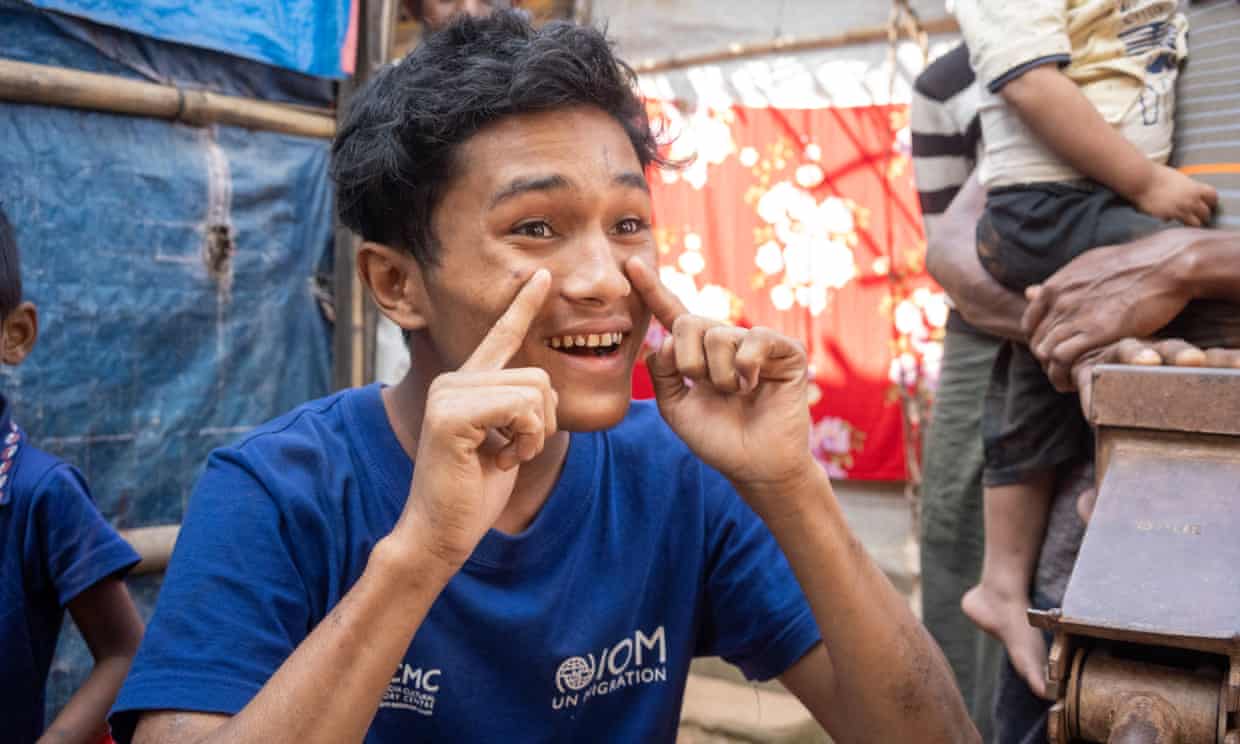
The Guardian writes: Asom Khan, who is deaf and mute, uses his own version of [signing] to communicate with friends and family in Bangladesh.” And he takes photos that speak, too. 

What a powerful need human have to communicate! Here’s a story of a boy with the deck stacked against him many times over who wanted badly to communicate and figured out his own way to do it.

Kaamil Ahmed  writes at the Guardian, “His own sign language of sweeping, dramatized gestures is rarely fully understood by those outside Asom Khan’s closest friends and family, but the 15-year-old is able to speak through his art and photography.

“From his shelter in the Rohingya refugee camps of south-east Bangladesh, Khan takes photos to share the stories of his community – of his elderly neighbors, disabled people, and of women at work and in times of crisis.

“It was a journey that started with a photograph of him in 2017 – tears running down his face as he hung on to the side of an aid truck – that won awards for a Canadian press photographer, Kevin Frayer, as 700,000 Rohingya fled to Bangladesh from massacres in what the UN described as ethnic cleansing by the Myanmar military.

“That photo has stuck with Khan, who is deaf and mute, and when he saw other Rohingya becoming photographers, using budget smartphones to document daily life, he fully understood the power of an image.

“ ‘I was inspired by other Rohingya photographers. When there were floods or fires or other issues, they would come and take pictures. I saw that there was some power in it,’ says Khan, whose friend interprets for him.

“Since arriving in Bangladesh, he has also been producing vivid paintings, sometimes of idyllic Myanmar villages scenes, others of those villages under attack and the chaos he witnessed.

“Raised by his aunt and uncle after his mother died in childbirth, Khan had no opportunity to learn formal sign language so he improvised, teaching his own version to those around him. But art and photography has given him a freedom to communicate without an interpreter. …

“The camps Khan arrived at six years ago quickly became the world’s largest, with almost 1 million Rohingya crammed into bamboo and plastic shelters. As conditions have worsened, with education, work and movement limited, international attention has died down, leaving the refugees to deal with their own problems. …

“ ‘I feel like when I show pictures of the Rohingya situation to the world, they understand a bit more what we face.’

“Frayer, the photographer now with Getty Images who took Khan’s photo in 2017, says … ‘I remember taking a few frames and then he disappeared into the crowd below. I remember feeling quite moved by how much courage this young boy showed,’ says Frayer.

“He found Khan again in 2018 and spent time with him, finally learning more of his story as they communicated through his sign language and his drawings.

“ ‘I was so moved and astounded to learn that he had taken an interest in photography. I saw in his artwork that he was incredibly talented at telling his story through his art, and that photography would indeed be a very strong tool for him,’ says Frayer.”

More at the Guardian, here. No firewall. Donations solicited.

Read Full Post »

Photo: Melanie Stetson Freeman/CSM Staff.
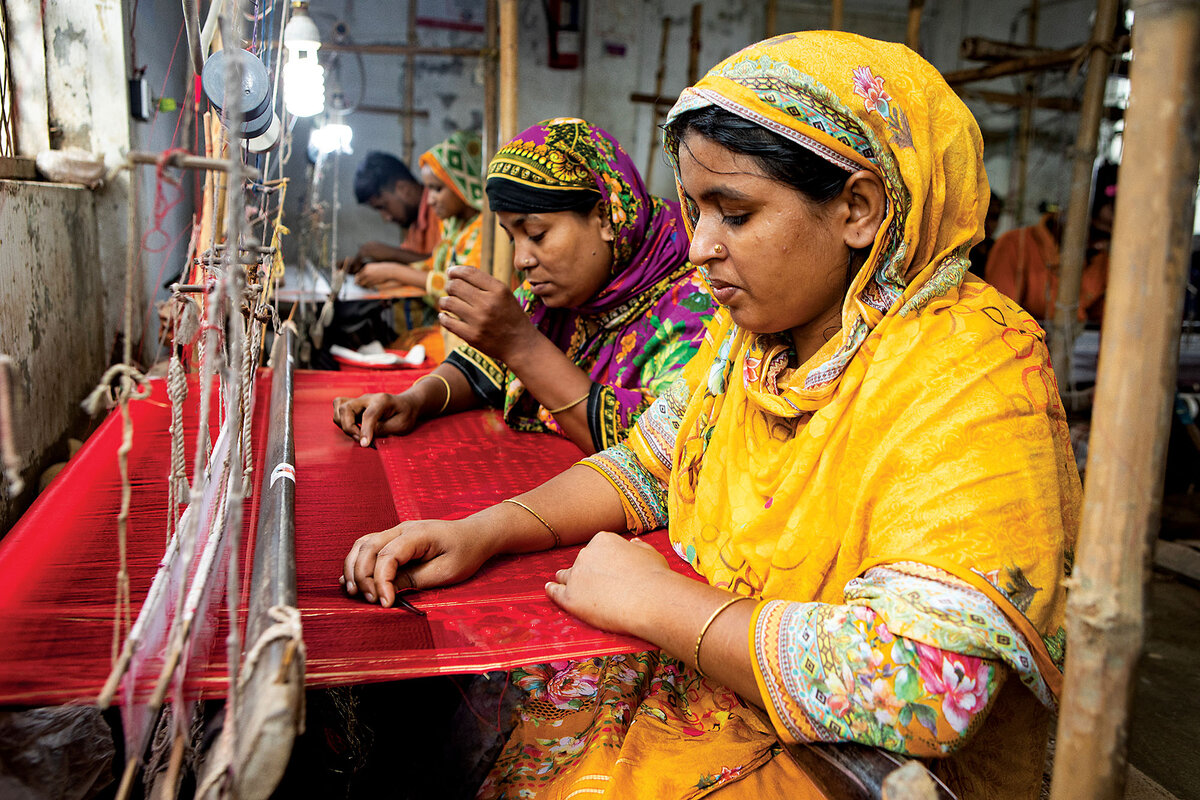
Artisans do “respectful” work on jamdanis at Abul Kalam Jamdani Weaving Factory in Bangladesh.

Recently I wrote about the the Fuller Craft Museum’s exhibit of the Red Dress, an embroidered garment “worked on by 380 individuals from 51 countries, mostly female, many of whom were vulnerable and living in poverty” — women who felt uplifted by an art project that honored their skills.

Today’s post is also about women’s handcrafts.

Sara Miller Llana reports at the Christian Science Monitor, “Two dozen artisans crouch over hand looms threaded with bright-orange and sky-blue cottons. Their fingers nimbly create a jamdani, an intricately woven sari dating back to the [16th century] Mughal Empire. …

“Made of fine cotton or silk, the jamdani was a pinnacle of fashion centuries ago. But in the 19th century, British colonizers brought in their iteration of fast fashion, and the tradition nearly went extinct. …

“After Bangladesh became an independent nation in 1971, the nongovernmental organization BRAC set out to revitalize the weaving practice. It approached artisan families like that of Anwar Islam, owner of this shop. ‘I didn’t think it was feasible, but I was happy to be part of the solution,’ says Mr. Islam. 

“Today he employs 120 weavers at Abul Kalam Jamdani Weaving Factory. …

“But this is not just a business success story. … The jamdani is seen as a story of cultural success, too. It’s part of the championing and preservation of objects from sealskin parkas in the Arctic to duck decoys and quilts across the United States that otherwise may be forgotten.

” ‘People have been striving to decorate their lives to tell the world who they are for centuries,’ says Chris Gorman, a deputy director of the American Folk Art Museum in New York. … ‘Without people championing the study and preservation of objects like these, and others, there is the possibility that people will simply forget about them, and it is hard to revive them or prove their relevance.’

“About the time the jamdani was being revived, a women’s collective was coming to life at the northernmost tip of Canada, in the town of Taloyoak.  

“Begun in 1972, the group, called Arnaqarvik, garnered a burst of fame in its day with its Inuit parkas, mitts, and boots made from caribou, wolf, and seal and patterned with dyes from tundra lichen and flowers. The collective’s work — including, eventually, duffel-wool ‘packing dolls, or miniature stuffed animals carrying their babies in parkas as the Inuit do — was showcased in New York City and the 1974 Arctic Winter Games in Alaska.

“Yet today, just as the jamdani is enjoying global appeal, the work of Arnaqarvik has been largely forgotten. So the Kitikmeot Heritage Society in Cambridge Bay, in Canada’s Nunavut territory, has set out to restore its memory in a digital archive. 

“And to mark the 50th anniversary of the collective, about 250 items in 2021 were sent back to Taloyoak in an exhibition. It was the first time most in the community found out what Arnaqarvik even was. ‘Everybody was really surprised by what their parents did in those days,’ says Arnaoyok Alookee, Arnaqarvik’s co-founder.

“Brendan Griebel, an Arctic anthropologist and manager of collections and archives for the Kitikmeot Heritage Society, says this reconnection is about far more than just the production of goods. ‘Having that physical contact ignites something in the memory and in the senses,’ he says.

“When Arnaqarvik began, the semi-nomadic Inuit of Taloyoak had only gradually moved into this permanent settlement the decade prior. The collective helped the community bridge a gap — between its Indigenous traditions and the new wage economy into which it was settling. 

“Judy McGrath co-founded the collective with Ms. Alookee when her husband was posted for work in the Arctic community. She says she still recalls the sense of purpose that craft-making gave all of them. They collected flowers with their children in 24-hour sunlight; they’d use the 24-hour darkness of winter to boil their dyes on the stove. ‘I can still feel the confidence that the skills they had mattered, and the excitement over making new things from the old, from the land,’ Ms. McGrath says.

“In Bangladesh, the rise of the jamdani was also driven by economics, to help artisans whose enormous skills couldn’t find the market for livelihoods. BRAC, the country’s largest NGO, created the brand Aarong to distribute their products. …

“Making a jamdani, which derives from the Persian words jam (floral) and dani (vase), is what weaver Mohammed Monir calls a ‘respectful’ job. … ‘When I see someone famous wearing something I made, I feel proud,’ he adds.

“Today jamdani weaving is included on UNESCO’s Representative List of the Intangible Cultural Heritage of Humanity.”

More at the Monitor, here. No firewall. Reasonable subscription. You can also sign up for their free weekend updates.

Read Full Post »

Photo: SBS News.
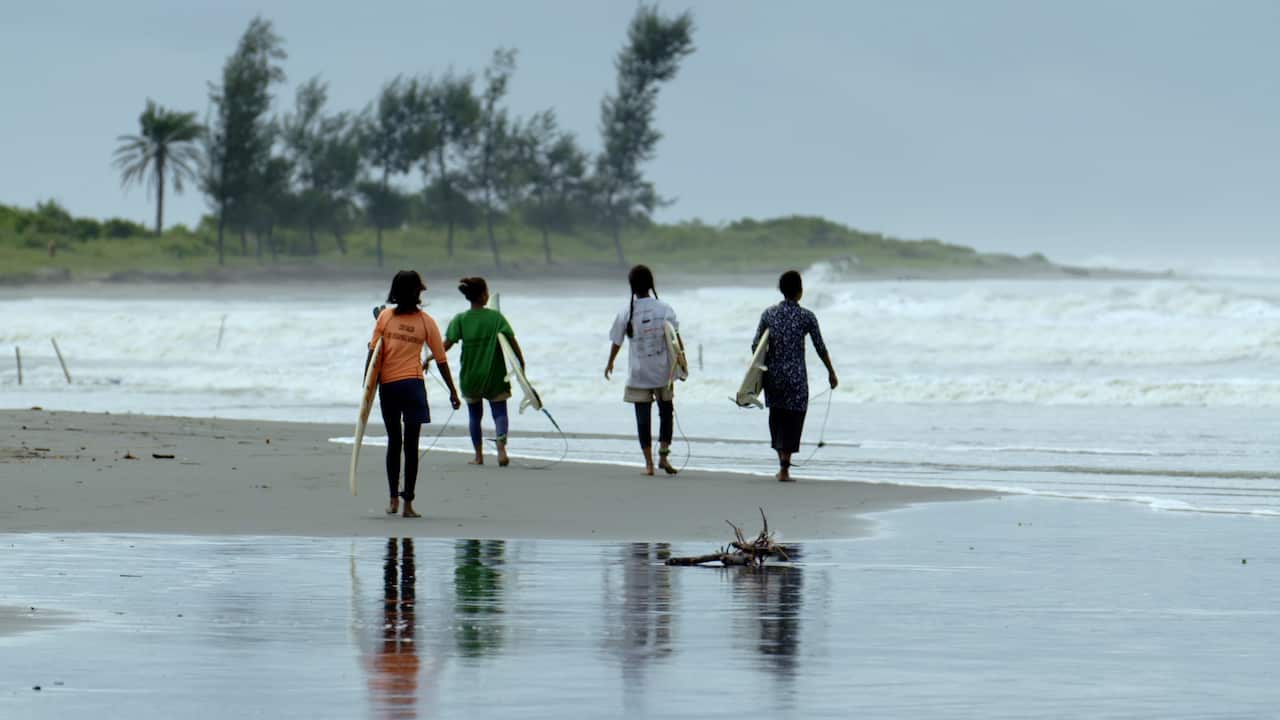
The surf club in Cox’s Bazar teaches girls in Bangladesh how to surf.

From the little I know about Bangladesh, it’s a hard life there. It’s hard even for a man, even for a famous one like Nobel Peace Prize winner Muhammad Yunus, who has drawn the resentment of the country’s prime minister. But for most females, it’s almost out of the question to have any kind of independent life.

Today’s story suggests that some young women in Bangladesh are bucking tradition. Rhiona-Jade Armont writes at SBS News, “Along one of the longest uninterrupted beaches in the world, two young surfer girls paddle out past the break.

“The conditions out here are rough and unruly, but these fearless teens cling to their boards, waiting for the perfect wave to ride back to shore.

“Here, in the coastal town of Cox’s Bazar in Bangladesh, Shobe and Ayesha are not your average 13-year-olds.

“ ‘Everybody says I live like a boy,’ Shobe says. ‘I go everywhere wearing a t-shirt. I’ve been surfing since childhood, so people are used to seeing me like this.’

“Girls in Cox’s Bazar are often expected to follow a set path, including working from a young age, marrying early and bearing children. Bangladesh has one of the highest rates of child marriage in the world.

“Parents who struggle to earn a steady income often marry off their teenage daughters, despite it being illegal until age 18. … Shobe’s older sister was married at 13. …

“These girls often come from poorer households and are more likely to miss out on a full education. But a small surf club has given girls like Shobe a chance to change their fate and do something they love. …

“Blazing a new trail has meant breaking tradition, and girls like Ayesha have fought hard battles at home. Her father has been the toughest to win over.

“ ‘If I tell [people] my girls do surfing they ridicule us,’ he says. ‘I want a good future for them. I don’t want to live from their earnings. Now that they are 14 and 15 years old, I have to think about their marriages.’

“For Ayesha, the pressures at home only drive her further away. ‘I don’t feel good at home. That’s why I spend as much time as I can at friends’ home or school.’

“Ultimately, she always ends up where she feels the most free. ‘My best friend is the sea.’

“For Shobe and Ayesha, surfing provides a future filled with possibility. They’ve excelled in local competitions, but the next stage is seeking out opportunities to compete on the international circuit.

“Shobe in particular dreams of one day being a famous surfer and representing Bangladesh. But fame is not only a shiny way to a new life. It’s a means of finding family who she’s lost contact with and receiving recognition.”

More more at SBS News, here. No firewall.

Read Full Post »

Photo: Oxfam.
Folktales help preserve the threatened Rohingya culture.

To understand anything about a foreign culture, you need to turn to its arts: the music, the crafts, the folktales, for example.

Stephen Snyder at PRI’s the World reports about a threatened culture holding on by a thread far from home: “Mohammed Rezuwan is on a rescue mission: The 24-year-old who lives in Cox’s Bazar — the world’s largest refugee camp — is working to save Rohingya traditional stories before a generation of storytellers dies off.

“Rohingya people have lived in the region for over a thousand years, but Myanmar’s government considers them foreigners from neighboring Bangladesh. Over the last four years, hundreds of thousands of Rohingya have been driven out of Myanmar [Burma] by government troops and local militias. Many now live in dozens of refugee camps.

“ ‘We, Rohingya people, have our own culture, tradition. We are on the brink of losing all of them, unfortunately,’ Rezuwan said in a WhatsApp voice message from Kutupalong, one of more than two dozen encampments in Cox’s Bazar, on the coast of Bangladesh.

“The crowded area accommodates families who live in tents and shelters along narrow alleyways. United Nations figures put the exile population in the camp at nearly a million — four times the number of Rohingya still living in Myanmar.

“Rezuwan lives in a bamboo shelter with his wife, his mother, a brother and a sister. The family fled their home in Maung Daw, in the Rakhine district of Myanmar, on Aug. 25, 2017, as their village was set ablaze in a campaign that has forced most Rohingya out of Rakhine.

“ ‘I remember the gunshots ringing out like thunderclaps, the bullets strafing the sky like clouds of hungry locusts,’ Rezuwan wrote in the author’s note of his book, Rohingya Folktales: Stories from Arakan, as told by Rohingya refugees. …

“In 2020, after several years at Cox’s Bazar, he took on the role of folklorist — recording stories passed along in the oral tradition by Rohingya elders. …

“Rezuwan speaks his native Rohingya and learned to speak and write Burmese in school, but his English is largely self-taught. He spent a year collecting material for his English-language book, and the online version now includes 19 stories from storytellers in several of Cox’s Bazar’s camps.

“Research was no easy task. Rezuwan doesn’t have a car or bike, so he walked, sometimes up to five miles, to meet with each storyteller and record his or her story on the phone. …

“ ‘The hardest part is finding and meeting the people from different sorts of camps,’ Rezuwan said. ‘After all, not everyone has the same talents to remember the stories — just because they are uneducated — and so, finding the right person to tell the story was finding a gem from the ocean.’

“The Rohingya language is primarily spoken, without a standardized written script. Rezuwan translated the stories by playing back his recordings and, word by word, constructing English versions of the tales. He then pasted them into WhatsApp and sent them to his editor and friend, Alex Ebsary, in Buffalo, New York, who corrected grammar and word usage. Ebsary said he intentionally edited the stories with a light touch.

“ ‘Folktales are not a universal language,’ he said in a phone interview.

‘If you read these folktales, some of them are quirky. They’re kind of not even the morals that I would think of when thinking of a folktale.’ …

“Rezuwan said his mother used to tell him the story known as ‘A Hunter and a Flock of Heron.’ The version he collected from Rashid Ahmod, a 60-year-old resident of Kutapalong, was essentially the same story he heard as a boy, he said.

“The story is about a hunter who catches a group of beautiful herons in his net. The herons all try to escape by flying around in all directions, Ebsary explained. Rezuwan said the moral of the story is that birds — and people — can’t manage to go anywhere until they cooperate.

“Rezuwan and Ebsary both singled out a story from the collection called ‘A Queen’s Dream,’ which could serve as an allegory for Rohingya as an ethnic minority.

“The story is about a powerful queen who has a vivid dream about torrential rains after a period of drought. Everyone who drinks from the rain loses their minds. So the queen sends advisers to warn everyone.

“ ‘But of course, they don’t listen and everyone drinks the rain and goes mad. And in the end, the queen decides to join them by drinking the rain herself,’ Rezuwan said.

“The moral of the story is that if a country’s majority are wrongdoers, they have the power to ‘force [the] entire country into a very bad situation,’ Rezuwan said. ‘It’s what we are facing right now.’

“Rohingya have long faced discrimination and marginalization in their home country. The United Nations has called it ‘a textbook example of ethnic cleansing.’ If life in Myanmar was untenable, Rezuwan said, ‘in [the] camps, it seems like we are facing the second genocide.’

​​”Since coming to Kutupalong, Rezuwan has organized an educational network where Rohingya children — unable to attend schools — can follow the same curriculum taught in Myanmar. …

“ ‘I wanted the international community to know about our culture, about tradition and about the existence of Rohingya people in Arakan,’ he said.

“Arakan, the name Rohingya people give to their homeland in Myanmar, no longer appears on any maps of the region.”

More at PRI’s the World, here. There is no firewall. You can also listen to the recording of the show there.

Read Full Post »

Image: Mayyu Khan/Mohammed Rezuwan.
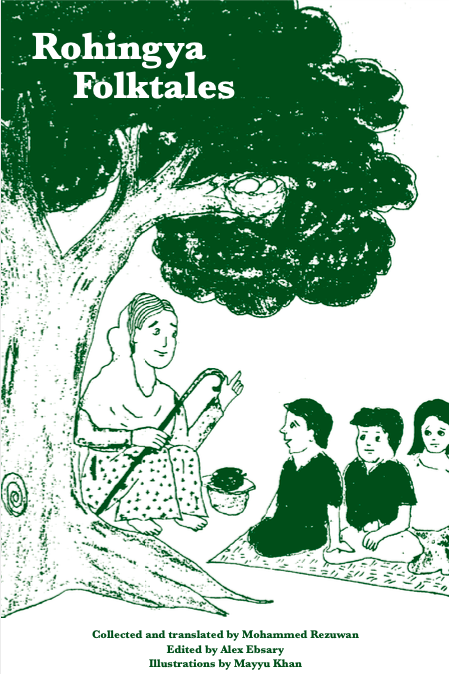
“The Blind Mother,” an illustration by Mayyu Khan, a Rohingya artist living in a Bangladesh refugee camp, from Rohingya Folk Tales, by Mohammed Rezuwan. 

While we’re on the subject of saving languages (see yesterday’s post), let’s look into how preserving folk tales can help keep a threatened culture from disappearing.

Few cultures are more threatened than that of the Rohingya of Myanmar, and today’s article is about a young folklorist in a Bangladesh refugee camp who is determined to do something about that.

Stephen Snyder has the report at Public Radio International’s The World. “Mohammed Rezuwan is on a rescue mission: The 24-year-old who lives in Cox’s Bazar — the world’s largest refugee camp — is working to save Rohingya traditional stories before a generation of storytellers dies off.

“Rohingya people have lived in the region for over a thousand years, but Myanmar’s government considers them foreigners from neighboring Bangladesh. Over the last four years, hundreds of thousands of Rohingya have been driven out of Myanmar by government troops and local militias. Many now live in dozens of refugee camps.

” ‘We, Rohingya people, have our own culture, tradition. We are on the brink of losing all of them, unfortunately,’ Rezuwan said in a WhatsApp voice message from Kutupalong, one of more than two dozen encampments in Cox’s Bazar, on the coast of Bangladesh.

“The crowded area accommodates families who live in tents and shelters along narrow alleyways. United Nations figures put the exile population in the camp at nearly a million — four times the number of Rohingya still living in Myanmar.

“Rezuwan lives in a bamboo shelter with his wife, his mother, a brother and a sister. The family fled their home in Maung Daw, in the Rakhine district of Myanmar, on Aug. 25, 2017, as their village was set ablaze in a campaign that has forced most Rohingya out of Rakhine.

“ ‘I remember the gunshots ringing out like thunderclaps, the bullets strafing the sky like clouds of hungry locusts,’ Rezuwan wrote in the author’s note of his book, Rohingya Folktales: Stories from Arakan, as told by Rohingya refugees.

“ ‘On that terrible day, my family and I ran to a nearby mountain where we hid for three days before we decided to cross the border to Bangladesh.’

“In 2020, after several years at Cox’s Bazar, he took on the role of folklorist — recording stories passed along in the oral tradition by Rohingya elders.

“ ‘Folk tales are used by Rohingya people to teach morals and lessons to their youngsters,’ he said. ‘I, myself, decided to make a book.’

“Rezuwan speaks his native Rohingya and learned to speak and write Burmese in school, but his English is largely self-taught. He spent a year collecting material for his English-language book, and the online version now includes 19 stories from storytellers in several of Cox’s Bazar’s camps.

Research was no easy task. Rezuwan doesn’t have a car or bike, so he walked, sometimes up to five miles, to meet with each storyteller and record his or her story on the phone. …

“ ‘The hardest part is finding and meeting the people from different sorts of camps,’ Rezuwan said. ‘After all, not everyone has the same talents to remember the stories — just because they are uneducated — and so, finding the right person to tell the story was finding a gem from the ocean.’

“The Rohingya language is primarily spoken, without a standardized written script. Rezuwan translated the stories by playing back his recordings and, word by word, constructing English versions of the tales. He then pasted them into WhatsApp and sent them to his editor and friend, Alex Ebsary, in Buffalo, New York, who corrected grammar and word usage. Ebsary said he intentionally edited the stories with a light touch.

“ ‘Folktales are not a universal language,’ he said in a phone interview. ‘You know, if you read these folktales, some of them are quirky. They’re kind of not even the morals that I would think of when thinking of a folktale.’ …

“Rezuwan said his mother used to tell him the story known as ‘A Hunter and a Flock of Heron.’ The version he collected from Rashid Ahmod, a 60-year-old resident of Kutapalong, was essentially the same story he heard as a boy, he said.

“The story is about a hunter who catches a group of beautiful herons in his net. The herons all try to escape by flying around in all directions, Ebsary explained. Rezuwan said the moral of the story is that birds — and people — can’t manage to go anywhere until they cooperate. …

“​​Since coming to Kutupalong, Rezuwan has organized an educational network where Rohingya children — unable to attend schools — can follow the same curriculum taught in Myanmar. He also works with humanitarian groups as a guide and interpreter.”

Read more here.

Read Full Post »

20180814-mahmud-hossain-opu_mg_1940-57_custom-58d8f66d74749b77651d11ebf426360c09b5646c-s1000-c85

Photos: Mahmud Hossain Opu for NPR
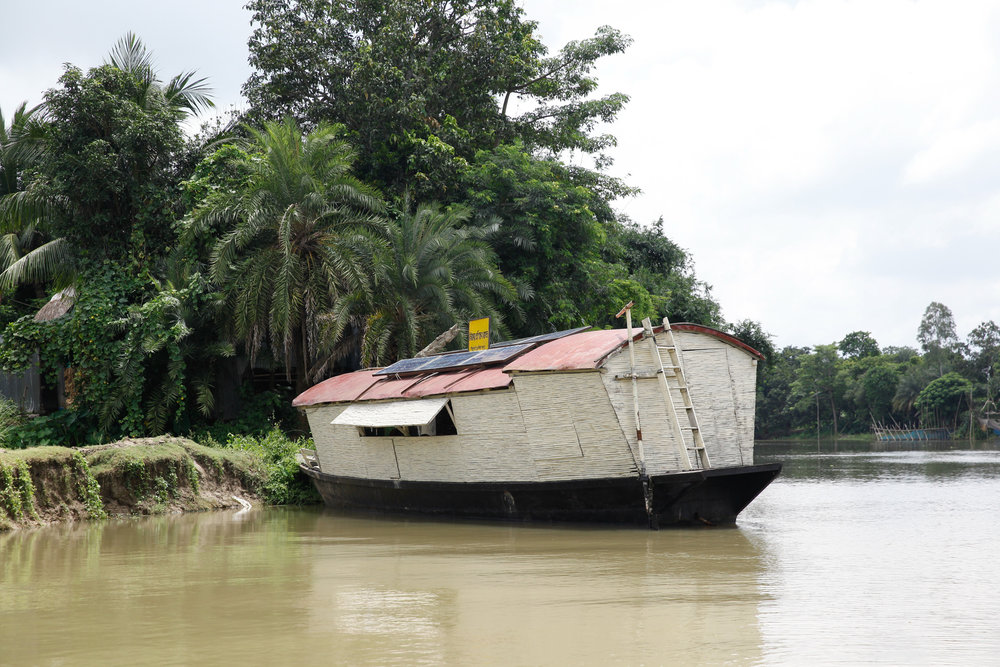
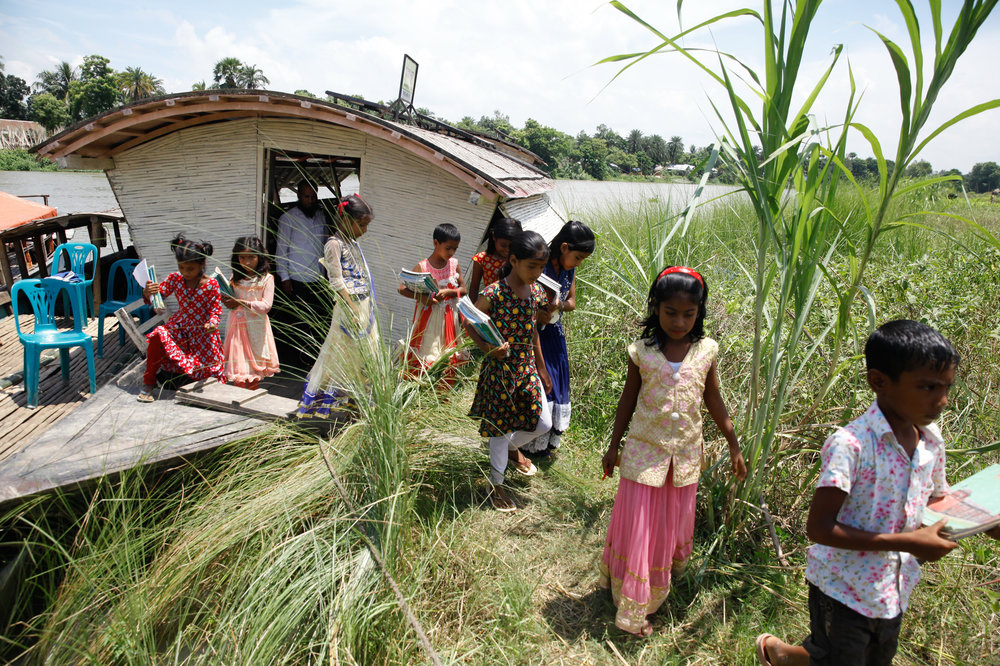
The nonprofit group Shidhulai Swanirvar Sangstha has a fleet of 23 school boats in Bangladesh. The boats pick up kids along the river, then pull over into the marshy riverbank to hold class.

Kids complain about school when school is a given, but what about when it is hard to access? I have been reading about a fire-ravaged county in California that has no schools right now (story here). California is sure to get it together before long, but what about poor countries with drastic education challenges?

Jason Beaubien reports about Bangladesh at National Public Radio (NPR). “On the Atrai River in the northwest of Bangladesh, a small beige boat is tied up in tall grass that lines the riverbank. The interior of the boat is packed with narrow benches which in turn are jammed with children.

“There are 29 students in this third-grade class and it would be hard to fit any more into the narrow vessel. The kids sit shoulder-to-shoulder facing a blackboard at the back of the boat.

“When the teacher asks for a volunteer to recite a multiplication table, 8-year-old Nila Khatun’s hand shoots straight toward the unpainted ceiling.

“She leads the class in a chant that begins with ‘6 times 1 equals 6’ in Bengali. They end with ‘6 times 9 equals 54.’

“Educators in Bangladesh have a problem. Not only do they face many of the same challenges as teachers in other resource-poor countries — funding constraints, outdated textbooks, overcrowded classrooms — they also have to worry about monsoon rains. Flooding is so common in Bangladesh that students often can’t get to the classroom.

“So one local charity has decided to take the classrooms to the students in the form of schools on boats.

“This boat is one of 23 floating year-round schools in this part of Bangladesh run by Shidhulai Swanirvar Sangstha, a local nonprofit group. …

“Mohammed Rezwan, the founder of Shidhulai Swanirvar Sangstha, grew up in this part of Bangladesh.

” ‘If you visit these areas you’ll find that during the monsoon season they get isolated,’ he says. ‘It becomes very difficult to have the normal life.’ …

” ‘In the rural areas. the parents are mostly concerned with the safety of the girls,’ he says. ‘If they [girls] have to travel a long way to go to school, then the parents would not let them go to school.’ …

“That’s true for the family of third-grader Nila. Her mother Musa Khatun says that if it wasn’t for the floating school, Nila probably wouldn’t be in school at all. …

“Khatun says that during the monsoons the village is only accessible by boat. Their family primarily survives by raising jute in the nearby plains. The long, fibrous plant is used to make burlap bags. Nila’s mother, however, sees a different future for Nila. She says Nila is the smart one of the family. No one in their family has ever gone to college, yet Khatun insists her daughter is going to be a doctor.

“And Nila nods her head enthusiastically.”

More here, including eleven wonderful pictures.

When class is done for the day, the boat putters along the river to drop off its students. 

20180814-mahmud-hossain-opu_mg_1893-55_custom-122eae13eda791e7a5e5fd1c79bb7214dfd74015-s1000-c85

Read Full Post »

Rohingya-in-Bangladesh-ARC-photo

Photo: @coryt
American Refugee Committee, a nonprofit with Charity Navigator‘s highest rating, is one of a few organizations helping Myanmar’s persecuted Rohingya Muslims in Bangladesh camps.

With so many languages still in use, I have sometimes wondered how aid workers in refugee camps find people to translate languages that are rare.

Malaka Gharib reports about some of the challenges at National Public Radio (NPR).

“Imagine an aid worker in Bangladesh. Her mother tongue is Chittagonian. She’s trying to help a Rohingya refugee, whose language is similar to hers — but not 100 percent. The refugee tells her gaa-lamani biaram, ‘my body is falling apart.’ Would she know that phrase meant the refugee had diarrhea?

“That’s why a new glossary is being developed. And one of the 180 entries is that Rohingya phrase, indicating that a person is suffering from diarrhea.

“In June, a nonprofit group called Translators Without Borders, in partnership with Oxfam and UNICEF, created a special online glossary for humanitarians working in Rohingya camps in Bangladesh. The app, which aid workers can download on their mobile phones, includes terms with translations in five languages spoken in the camps: English, Bangla, Rohingya, Chittagonian and Burmese. …

“A November 2017 study from Internews, a nonprofit group that helps people in low-income settings access news and information, reported that almost two-thirds of the 570 Rohingya refugees surveyed at Cox’s Bazar [a Bangladesh camp] were unable to communicate with aid providers.

“That can be particularly dangerous when it comes to health care, says [Irene Scott, the program director for Translators Without Borders in Bangladesh]. … To create the glossary, Translators Without Borders assembled a focus group of aid workers and refugees to come up with ‘a dictionary list of terms they use at the camps every day and terms that field workers are having trouble trying to communicate,’ says Scott. Then they worked with members of the community and a staff sociolinguist to translate the words into the four languages. …

“Most of the words in this first iteration of the Bangladesh glossary focus on water, sanitation and hygiene. Over the past few months, the camps have faced acute water shortages, putting people at risk of waterborne diseases like cholera, bloody diarrhea, typhoid and hepatitis E. …

” ‘Chlorine tablet’ is an important word for aid workers to clearly translate, says Scott, because they’re asking refugees to put a foreign substance into their drinking water to make it safe to consume. ‘It’s hard to tell a traumatized community to put that tablet in water and drink it.’ …

There are a few unexpected words in the glossary — like ‘poem.’ Rohingya aid volunteers in the camps specifically asked for this word to be added.

” ‘Since Rohingya is an oral language, written communications like fliers or pamphlets [to convey important health information] may not be effective given the lack of a standardized script,’ says Krissy Welle, senior communications officer for Translators Without Borders.

“Rhyming conventions are a key way to transfer knowledge and historical facts in Rohingya culture, explains Eva Niederberger, Oxfam’s community engagement adviser in Cox’s Bazar, in a statement to NPR. So an aid worker might say something like, ‘Here’s a poem that will teach you how to protect yourself from certain diseases. …

” ‘When we talk about language with Rohingya women and men, they’re happy that someone is paying attention to something so crucially important to their cultural identity. For so long they’ve had their rights denied to them. It’s all about respect at the end of the day.’ ”

More at NPR, here.

Read Full Post »

Here’s an interesting start-up by a couple of entrepreneurs who love to eat. The two women decided to build a business around helping travelers find truly authentic cooking.

According to Aashi Vel and Steph Lawrence’s website, “Traveling Spoon believes in creating meaningful travel. We are passionate about food, and believe that by connecting people with authentic food experiences in people’s homes around the world we can help facilitate meaningful travel experiences for travelers and hosts worldwide.

“To help you experience local cuisine while traveling, Traveling Spoon offers in-home meals with our hosts. In addition, we also offer in-home cooking classes as well as market tours as an extra add-on to many of the meal experiences. All of our hosts have been vetted to ensure a safe and delightful culinary experience.

“Traveling Spoon currently offers home dining experiences in over 35 cities throughout Bangladesh, Cambodia, China, Hong Kong, India, Indonesia, Japan, Singapore, South Korea, Sri Lanka, Taiwan, Thailand, Turkey and Vietnam, and more countries are coming soon!” More here.

I have no doubt that Traveling Spoon is also boosting international understanding. What a good way to use an MBA! Business school is not all about becoming an investment banker, as Suzanne and Erik would tell you.

Photo: Traveling Spoon
Traveling Spoon founders Aashi Vel and Steph Lawrence met at the Haas School of Business.

Read Full Post »

Sweden has taken in a lot of refugees from troubled countries, but like the U.S., it sometimes struggles to find the best approach for absorbing the influx.

At the NY Times, Suzanne Daley writes about one Swede who may have found an important way to speed integration, a way that enriches the experience of Swedes and newcomers alike.

“Last year, when Ebba Akerman, 31, was teaching Swedish to immigrants in the suburbs of this city, she ran into one of her students on the train and asked him whether he enjoyed living in her country.

“She found the answer deeply disturbing. The man shrugged, saying his life here was not much different from the one he had left behind in Afghanistan. It became clear to her that most of her students, living in neighborhoods packed with immigrants, had virtually no contact with native Swedes.

“In the months that followed, Ms. Akerman decided to try to change that, calling herself the minister of dinners in charge of the Department of Invitations and using Facebook and Instagram to try to bring individual Swedes and immigrants together for a meal, something like a dating service.

“ ‘We let people into our country, but not into our society,’ Ms. Akerman said on a recent Friday night. … ‘I finally decided that I had to do something. I could be the connector.’ …

“On a recent evening, Ms. Akerman was feeding about a dozen people, including a middle-aged couple from Bangladesh who had brought a chicken dish, a recent arrival from Cameroon with her two children, a Swedish marketing expert, the mother of one of Ms. Akerman’s friends and a young Swedish doctor in training, all of whom had been early participants in her project. All told stories of good times and miscues.

“The marketing expert, Henrik Evrell, said he had served spaghetti Bolognese, the most Swedish dish he knew, to his guest from Ivory Coast. At first they had trouble communicating because his guest’s Swedish was so poor. But soon they discovered that they both spoke French and loved the same Ivory Coast musicians. After eating, they spent the rest of the evening in front of a computer, taking turns pulling up music on Spotify that each thought the other would like.” More here.

Photo: Casper Hedberg for The New York Times
Ebba Akerman set a table on her backyard for a meal that brought Swedes and immigrants together. 

Read Full Post »

Global Envision is part of an effort at the nonprofit Mercy Corps “to foster a richer conversation about global poverty.”

Last fall, Global Envision’s Erin Butler set off to investigate technologies that help schools in impoverished parts of of the world.

“For some students, hopping on the school bus is hopping into the classroom. Four communities are using solar-powered mobile classrooms to overcome inaccessibility to the power grid.

“Last week,” writes Butler, “we looked at a bus in Chitradurga, India, that brought modern computer technology to students in energy-poor rural schools through solar power. SELCO, a private energy company, engineered the bus with 400 watts of solar modules, 10 laptops, fans, and lights.

“Circumventing the area’s erratic power supply with its solar panels, this bus provides much-needed modern computer education and exposure to the advantages of solar energy. Motoring through rural villages in Chitradurga since January 2012, the bus has reached ’60 schools and 2,081 children,’ the New Indian Express reported in early September. …

“Where there’s more water than land, boats replace buses, and with rising sea levels, low-income Bangladeshi students have difficulty getting to school altogether.

“Pushed to inaccessible riverside settlements that lack basic infrastructure, students often can’t get to school due to monsoon flooding. Shidhulai Swanirvar Sangstha, a nonprofit organization started by Mohammed Rezwan, rides the rising tides with his solar-powered floating schools.

“Trained as an architect and personally experienced with soggy school disruptions in Bangladesh, Rezwan rode a brainwave that led him to floating schools. Combining the best of traditional boat design and modern sustainable practices, the organization’s 54 boats have been operating since 2002 and have served over 90,000 families.”

Read about the other solar-powered schools here.

Photograph: Jayanta Shaw/Reuters/File
Students in Kolkata, India, check out their solar sunglasses as they prepare to watch the transit of Venus across the sun. The sun is being harnessed in India and Africa to power mobile solar classrooms for students.

Read Full Post »

Alice Feiring has an interesting story in Newsweek.

She writes that Kazi Anis Ahmed of Bangladesh, the 41-year-old cofounder and president of a company called Teatulia, was getting his doctorate in comparative literature when his father suggested expanding the family media and construction business into tea farming. The location he had in mind was the barren northwest of the country, not far from India’s tea-growing region.

Kazi Anis Ahmed liked the idea but felt strongly that any farm of his should be organic. Additionally, says Feiring, the family’s “mission was to provide jobs to the region. …

“The lack of agricultural tradition proved a blessing because the land was virginal, not ravaged by the government-supported, synthetic-fertilizer-dominated ‘Green Revolution.’ After reading the poetic One Straw Revolution by the master Japanese farmer, Masanobu Fukuoka, Ahmed went one step beyond organic and tried to do low-intervention farming.

“The tea garden functions on minimal irrigation. They installed a plethora of plants next to the tea plants to feed and aerate the soil. What now exists is a breathtaking vision. The barren area has been transformed into an Eden with a resurgence of wildlife never seen before — recently, a pair of monkeys was spotted. The animals had not been seen in the area for decades.”

Read more at the Daily Beast. (Thanks for alerting me to this lovely story, Asakiyume.)

Photograph: Habibul Haque, Teatulia

Read Full Post »