Feeds:
Posts
Comments

Posts Tagged ‘berlin’

Photo: Adrian Susec/Unsplash.

Film buffs, it turns out, are not only creative about making movies, they’re creative about ways to screen movies. That’s because a different locale can lend a whole new feeling to the movie-going experience.

Bryn Stole writes at the New York Times, “Some of international cinema’s biggest names gathered on [a Tuesday in February] at the Berlin International Film Festival as the event honored Martin Scorsese with a lifetime achievement award. Before accepting his trophy, Scorsese listened as the German director Wim Wenders gave a laudatory speech to an audience including celebrities and local dignitaries.

“Just around the corner, parked in the middle of a busy thoroughfare, a group of Berlin’s taxi drivers crammed into the back of a worn-out taxi van to watch a double-feature capped by Scorsese’s 1976 movie Taxi Driver.

“Klaus Meier, who has been driving a cab in Berlin since 1985, handed out bottles of soda and beer, popping the caps with the blade of a pocketknife. Irene Jaxtheimer, who runs a taxi company, passed around homemade popcorn. A generator outside the cab powered a modest television, a DVD player and a small electric heater.

“The unconventional screening, just outside a centerpiece event for one of Europe’s most prestigious film festivals, was part of the makeshift TaxiFilmFest. Running through Sunday, it is partly a protest over the miserable state of the taxi industry these days and partly a counterfestival to celebrate the taxi cab’s iconic place in the urban cultural landscape.

“It’s also in objection to an exclusive partnership deal between the festival, known locally as the Berlinale, and the ride-hailing giant Uber to ferry filmmakers between the city’s movie theaters during the event. … Beeping horns from the busy street outside — some of them coming from sleek black Uber vehicles emblazoned with the Berlinale logo — blended with the street scenes from Taxi Driver playing on the tinny television speakers. ‘Ah, I really miss those mechanical fare boxes!’ Meier said as the fares ticked away in the onscreen cab of the movie’s unhinged antihero, Travis Bickle, who drives around mid-’70s New York with growing hatred and menace.

“The back-seat festival is showing only taxi-themed flicks, and the potential repertoire is deep. Meier polled friends and fellow taxi drivers about which films to show, and said he had received dozens of suggestions about movies in which a cab plays a starring role.

“The early feature on Tuesday was Barry Greenwald’s 1982 quirky slice-of-life documentary Taxi! about some odd characters driving cabs in Toronto. The previous evening, a small rotating crowd beat the rain to catch portions of the 1998 French action-comedy Taxi, a lighthearted flick from the director Gérard Pirès about sinister, Mercedes-driving German gangsters, hapless Marseilles cops and a lead-footed rookie cabdriver who turns out to be the only person fast enough to catch the criminals.

“An early hit at the TaxiFilmFestival, which kicked off last Thursday, was Under the Bombs, a Lebanese drama set during the 2006 conflict between Hezbollah and Israel. In the movie, a Beirut taxi driver is hired to drive a woman into the war-torn south of Lebanon in hopes of finding her sister and son. Meier described it as ‘Shakespearean’ and ‘a masterpiece,’ and Berndt said it was clearly the ‘most moving taxi film’ he’d ever seen.

“But the clear favorite among attendees was Jim Jarmusch’s Night on Earth, a quirky, episodic 1991 film about taxi drivers and passengers in five cities around the world. The selection for TaxiFilmFest’s Sunday night finale had yet to be chosen, and Meier said he remained open to suggestions. …

“The festival attendees, squeezed into the back of the van on Tuesday, also reminisced about better days for taxi driving, such as ferrying around American and British soldiers from the occupying Allies stationed in West Berlin. (The French troops, the small crowd agreed, had less cash and rarely hailed cabs.) …

“The days before the fall of the Berlin Wall were ‘blissful times, hard to even imagine anymore,’ said Stephan Berndt.” More at the Times, here.

See also my 2014 post about a theatrical production in a taxi in Iran, here.

By the way, I hated the movie Taxi Driver when I saw it around 1976 — and walked out. Still don’t get what’s to like. You?

Read Full Post »

Photo: Stiftung Jüdisches Museum Berlin/Jewish Museum Berlin/ Convolute 816/Curt Bloch collection
Het Onderwater Cabaret, 1943. The satirical magazine, now on exhibit in Berlin, was produced by a German Jew hiding in a Dutch attic during the war.

Both the New York Times and the Guardian reported recently that a German Jew, hiding like Anne Frank in a Dutch attic during WWII, produced an angry, humorous magazine because he could. His magazine was in the news thanks to an exhibit in Berlin.

Nina Siegal writes at the Times that many people hid in attics during the war but that Curt “Bloch’s experience was different because, in addition to sustenance and care, his helpers brought him pens, glue, newspapers and other printed materials that he used to produce a startling publication: his own weekly, satirical poetry magazine.

“From August 1943 until he was liberated in April 1945, Bloch produced 95 issues of Het Onderwater Cabaret, or the Underwater Cabaret. … Writing in both German and Dutch, [he] mocked Nazi propaganda, responded to war news and offered personal perspectives on wartime deprivations.”

Charlie English at the Guardian has more from the perspective of Bloch’s daughter, Simone, now 64.

“As the daughter of antiques dealers, Simone Bloch grew up in a New York house filled with rare and mysterious materials. The dining room was packed with precious volumes, including a collection of small, hand-written magazines, illustrated with collages in a dadaist or surrealist style.

“ ‘All of my parents’ books were kind of intimidating,’ Simone, now 64, says. ‘But this was weirder. It wasn’t something I would ever want to pick up.’

“She found them a little creepy, with their frequent images of Adolf Hitler and other wartime leaders. It was only many years later that Simone came to understand that these magazines represented her father’s resistance to the Holocaust.

“Born in Dortmund in 1908, Curt Bloch was the first in his family to go to university, studying law in the German capital, which at that time was the centre of the buzzing avant-garde cabaret scene. Curt was Jewish and objected to Hitler from the first. In 1933, when Hitler introduced a law banning Jews from civil service positions unless they had fought in the first world war, Bloch wrote a biting response to the authorities, declaring that, no, he hadn’t served in the war since he was only five when it had broken out. When the Gestapo came knocking, Curt was ready. He slipped out of a top floor window with some cash he’d hidden, and fled across the rooftops, eventually reaching Holland.

“But he wasn’t safe for long. The Germans invaded the Netherlands in 1940, and … Bloch took refuge in the crawlspace above the attic of a small suburban house in Enschede, on the German border. It was here that he began to produce the first issue of his magazine. He wrote in fountain pen, made collages from cuttings and stitched the pages together by hand. He called his volume the Underwater Cabaret in reference to the Dutch term for people in hiding, ‘divers,’ and to the favored form of political theatre in Weimar Berlin. Friends in the Dutch resistance helped circulate the Underwater Cabaret to 30 or so other ‘divers.’ They would bring the issue back a week later, by which time Bloch had prepared a new one.

“Alongside political commentaries, Bloch published highly personal writing. His mother Paula and little sister Hélène had followed him to the Netherlands, and had also gone into hiding. In May 1943 they were detained. … He devoted several poems to Hélène, one of which contained the lines: ‘Stay strong against the hatred, betrayal, and scorn / And when the war someday comes to an end / I will go looking for you.’

“Writing this kind of material was extremely dangerous. … Why take the risk? Simone believes it was a way for her father ‘to fight his own despair.’ It was a demonstration that, even in such circumstances, resistance was possible. ‘It’s getting away with something when you can’t get away with anything,’ Simone suggests. …

“In all, Bloch produced 95 magazines. The last issue is dated 3 April 1945. By that day Enschede had just been liberated, and Bloch could leave his hiding place. He travelled back to Amsterdam, where he met and married an Auschwitz survivor, Ruth Kan. In 1948 they emigrated to the US. …

“It was only recently, after years of research conducted in part by her daughter, Lucy, that Simone came to understand the full significance of the zine as a rare literary monument capturing a terrible period in history.”

More at the Times, here. And at the Guardian, here. Is it any wonder that today’s Germany is a loyal supporter of Israel? Unlike America, I suggest, Germany has reckoned with the weight of history.

All 95 copies of the Underwater Cabaret are on loan to the Jewish Museum Berlin, where an exhibition will run to 26 May.

Read Full Post »

img_5016-f520f9fd787c7488d3b9ceda7cf25a3dd9ca05aa-s800-c85

Photo: Martin Kaste/NPR
Tempelhof, a German airfield once used for the Berlin airlift, is now a big, open park featuring recreational activities and temporary housing for refugees.

I recently learned that Germany has a reputation for repurposing old buildings in ways that maintain aspects of historical significance. That seems to be true of how the country is adapting an old airfield to modern uses.

Sam Shead reported at Business Insider, “Berlin is a city full of abandoned buildings with long and troublesome histories. But one building has been through more turmoil than most: Tempelhof Airport. …

“Tempelhof has been used to test some of the world’s first aircraft, house World War II prisoners, and give the people of West Berlin a vital lifeline to the outside world during the Cold War. It’s also been used to film movies such as ‘The Hunger Games,’ ‘The Bourne Supremacy,’ and ‘Bridge of Spies.’ …

“Tempelhof was designed to wow visitors to the new Third Reich capital of Germania. It represents the monumental thinking behind Nazi architecture and it’s a landmark in civil engineering. …

“Berliners flocked to the airfield to see early airships and balloons being tested. It was here, for example, that the Humboldt balloon was launched on its maiden voyage on March 1, 1893. …

“At the end of World War II, the US, British, French, and Soviet military forces divided and occupied Germany. Berlin, which was also divided into occupation zones, was located far inside Soviet-controlled eastern Germany.

“There was initially an alliance between the Western Allies and the Soviet Union in Berlin, but on June 24, 1948, the Soviet forces blockaded rail, road, and water access to parts of Berlin that were controlled by the Western Allies.

” ‘The United States and United Kingdom responded by airlifting food and fuel to Berlin from Allied airbases in western Germany,’ the US Office of The Historian website says. ‘The crisis ended on May 12, 1949, when Soviet forces lifted the blockade on land access to western Berlin.’ …

“The airport eventually ended up with many of the things that are commonplace in airports today, such as restaurants.” Shead adds that the airfield is now used by “kite surfers, rollerbladers, allotment enthusiasts, artists, cyclists, joggers, jugglers, batton twirlers, and dancers. …

“Tempelhof is also home to Germany’s largest refugee shelter. There were 3,000 refugees from countries like Iraq and Syria living in a hangar at one point, but that number has fallen to about 600 as German authorities have relocated many of them, while others have returned home. There is enough space in the hangar for 7,000 refugees. … The shelter is closed to the public, but there is a refugee cafe in Hanger 1 the public can visit and provide German lessons.”

I must say, I like to think how very unhappy the WW II owners of this airfield would be about that. Justice served.

More at Business Insider, here.

Read Full Post »

I really like Michelle Aldredge’s blog on writing and the arts, Gwarlingo. (The word gwarlingo, Aldredge says, is Welsh for the rushing sound a grandfather clock makes before striking, “the movement before the moment.”)

See my post about Gwarlingo and artistic Japanese manhole covers here.

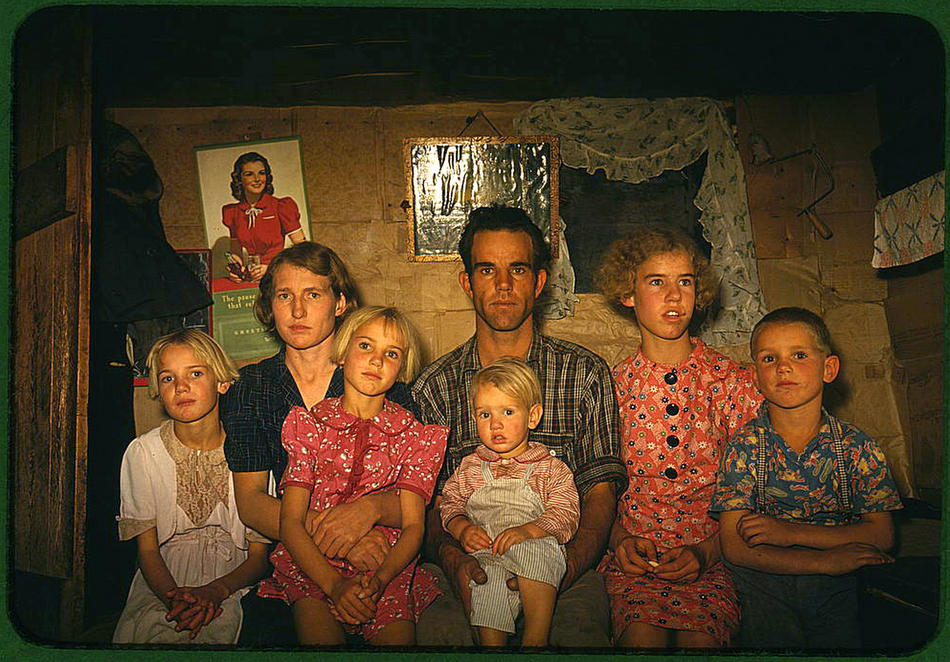
This week Aldredge wrote that she had recently “stumbled across a small online collection of rare color images taken by photographers from the Farm Security Administration and Office of War Information. The … photograph of Jack Whinery and his family was so remarkable and surprising that I immediately began exploring the online archive of the Library of Congress, which owns the images. The 1,610 Kodachrome transparencies were produced by FSA and OWI photographers like John Vachon, Marion Post Wolcott, Jack Delano, and Russell Lee. They are less well known and far less extensive than their black and white images, but their rarity only increases their impact.”

Check out the America in Transition photos.

*Jack Whinery, homesteader, and his family. Pie Town, New Mexico, October 1940. Photo by Russell Lee. Prints and Photographs Division, Library of Congress*

Another great Gwarlingo post was on poetry bombing.

“Since 2001,” writes Aldredge, “the Chilean art collective Casagrande has been staging ‘Poetry Rain’ projects in cities like Warsaw, Berlin, Santiago de Chile, Dubrovnik, and Guernica – all cities that have suffered aerial bombings in their history. The most recent event took place in Berlin in 2010 and was part of the Long Night of Museums. Crowds of thousands gathered in the city’s Lustgarten as 100,000 poems rained down from the sky.” Read more here.

I also found a happy video.

Read Full Post »