Feeds:
Posts
Comments

Posts Tagged ‘books’

072516-Little-Free-Library-Providence


If you don’t already follow Maria Popova’s Brain Pickings on twitter or receive her emails, you might want to consider it.  For me, she is a source of science ideas and children’s book reviews and all sorts of deep thoughts on a myriad of topics. And she always suggests complementary readings at the end of her posts.

Here she reports on a short, animated Ted-Ed that romps through the history of books.

“Carl Sagan saw books as ‘proof that human beings are capable of working magic,’ Popova begins. ‘Reading books is the most glorious pastime that humankind has yet devised,’ Polish Nobel laureate Wisława Szymborska observed in her memorable meditation on why we read. …

“Books, Susan Sontag wrote in her beautiful letter to Borges, grant us ‘a way of being fully human.’

“Indeed, any thinking, feeling human being knows that it is impossible to be fully alive and awake to the world without reading, and so we’ve come to see books not only as essential to our humanity.

“But this wasn’t always so. …

“How did something so nascent become so elemental to our humanity? That’s what educator Julie Dreyfuss and animator Patrick Smith … explore in this short TED-Ed animation chronicling the history of books:

As the book evolves and we replace bound texts with flat screens and electronic ink, are these objects and files really books? Does the feel of the cover or the smell of the paper add something crucial to the experience, or does the magic live only within the words, no matter what their presentation?

More here.

Read Full Post »

You never know what you will pick up from twitter. I started following Ferguson Library tweets after the death of Michael Brown. The library has wonderful tidbits about books, among other topics.

A tweeted tidbit on the antiquity of fairy tales is from Science magazine.

David Shultz writes, “A new study, which treats these fables like an evolving species, finds that some may have originated as long as 6000 years ago.

“The basis for the new study, published in Royal Society Open Science, is a massive online repository of more than 2000 distinct tales from different Indo-European cultures known as the Aarne–Thompson–Uther Index, which was compiled in 2004. Although not all researchers agree on the specifics, all modern Indo-European cultures (encompassing all of Europe and much of Asia) descended from the Proto-Indo-European people who lived during the Neolithic Period (10,200 B.C.E.–2000 B.C.E.) in Eastern Europe. Much of the world’s modern language is thought to have evolved from them.

“To conduct the study, Jamshid Tehrani, an anthropologist at Durham University in the United Kingdom, and colleagues scanned the repository. They limited their analysis to tales that contained magic and supernatural elements because this category contained nearly all the famous tales people are familiar with. This narrowed the sample size to 275 stories, including classics such as Hansel and Gretel and Beauty and the Beast. …

“Tehrani says that the successful fairy tales may persist because they’re ‘minimally counterintuitive narratives.’ That means they all contain some cognitively dissonant elements—like fantastic creatures or magic—but are mostly easy to comprehend.

“Beauty and the Beast, for example contains a man who has been magically transformed into a hideous creature, but it also tells a simple story about family, romance, and not judging people based on appearance. The fantasy makes these tales stand out, but the ordinary elements make them easy to understand and remember. This combination of strange, but not too strange, Tehrani says, may be the key to their persistence across millennia.”

More.

(from a Ferguson Library tweet)

An illustration of Beauty and the Beast from 1913.

Read Full Post »

Do we praise the work of librarians enough? I started following the Ferguson Library on twitter and Facebook after reading how it was the calm eye of the storm in Ferguson, Missouri, amid the 2014 riots. As a result, I now get good leads about other libraries. Here is a report on Ohio librarians who go the distance — and beyond.

Katie Johnson at School Library Journal describes her experience with “Play, Learn and Grow, a pop-up storytime and early learning program created through a collaboration between Twinsburg (OH) Public Library and Akron Metropolitan Housing Authority (AMHA). …

“I noticed that none of the children living in the housing development were coming to storytime at our library. I reached out to AMHA representatives, hoping they would be open to the idea of the library hosting a weekly program at the development. They were, partnering me with one of their employees, Kellie Morehouse, who was already working with families within the complex.

“We set up Play, Grow, and Learn in an unused room behind the apartment leasing office. Our initial goal was to get to know children age five and younger and their families through storytime, crafts, and free play. As the weeks went on, we saw everything that these families lacked: employment, education, transportation, healthy food, proper healthcare, access to preschool, even reliable phone service.”

They got involved in all those areas — helping children get vaccinations and nutritious food, for example, and arranging for isolated young mothers to address depression.

“Early experiences with storytime revealed a desire of the young mothers to interact with one another.  This led the AMHA representative to suggest teaming storytime with one of the organization’s programs for moms.  AMHA and a local behavioral health agency had been working together to provide maternal depression support groups to low-income women in other parts of the county. …

“Twice a month, the moms in our storytime are able to meet in a group setting with a professional to discuss their frustrations and worries. Mom-ME Time has become key, as so many of our moms are dealing with heavy pressures every day, and most do not have a strong support network. Being able to vent and get helpful parenting advice can be crucial to the choices they are making for their young children.”

It is worthy of applause when a librarian sees the whole child, not just a child in storytime, and tries to tackle the barriers to a better life. More here.

Photo: Katie Johnson/School Library Journal
Moms are included in programming for children.

Read Full Post »

In December, when the Association of Rhode Island Authors (ARIA) was having its annual expo, Erik sent me an email alert. Even though I couldn’t get there, I was curious.

I don’t think of myself as an author, and I’ve never joined a writing group despite the well-known advice from Anne Lamott. But I guess I’m an honorary author as my oldest grandchild once thought it was the same thing as being an editor. (The magazine I used to edit came to his house, and when he saw my photo in it and John explained that I helped to write the articles, he said, “Is Grandma an author?”)

I know that at least one reader of this blog is a Rhode Island author, Tracy Lee Karner.

According to the Association of Rhode Island Authors website, the December meeting was focused on memoirs.”The Lively Literati returns to The Elephant Room in Cranston’s Pawtuxet Village on Thursday, December 17, with authors Patricia Mitchell, Connie Rose Ciampanelli, and Debbie Kaiman Tillinghast. The authors will be discussing memoir writing and sharing short excerpts from their most recent works. Following the presentation, audience members are invited to share their own short writing or poetry, on any topic, at our open mic.”

Also at the website, you can read about the members and many association activities. Note that the “next regular meeting of the Association of Rhode Island Authors will take place on Thursday, January 14, in the Community Room at the Thundermist Health Center, 186 Providence Street, West Warwick. Informal networking begins at 6:30 p.m. and the meeting begins at 7:00 p.m. New authors, members and guests are always welcome.”

Photo: Association of Rhode Island Authors
ARIA member Mark Perry, who agreed to a stint as ‘Post’ Mark, the elf who works in Santa’s mail room. He fielded some surprising questions from kids.

Read Full Post »

In a delightful post at BookRiot.com, blogger David Attig offers some of his research on bookmobiles and libraries in out-of-the-way places.

In one example, he writes about “a delightful twist on the Pack Horse Library. Since 1990, teacher-turned-mobile-librarian Luis Soriano has brought books to thousands of children in rural Colombia, all from the back of a donkey. The biblioburro, as Soriano calls it, helps poor children have access to more books and thus a chance at a better education. ‘That’s how a community changes and the child becomes a good citizen and a useful person,’ Soriano told CNN. ‘Literature is how we connect them with the world.’ Soriano and his biblioburro are the subject of a children’s book by Monica Brown and John Parra, proceeds from the sale of which go to support Soriano’s work.”

“Derek Attig writes and teaches about book culture, technology, and history,” says BookRiot. “In addition to writing a book about bookmobiles in American life, he blogs at Bookmobility.org.”

Read the whole post at BookRiot, where you will find a Works Progress Administration bookmobile visiting Bayou De Large, Louisiana, pack horse librarians posing in Hindman, Kentucky, a booketeria in a Nashville supermarket, a vending machine library at a Bay Area school, a library at Amsterdam Schiphol Airport, and more.

Photo: Luis Soriano

Read Full Post »

The American Booksellers Association has a surprise for anyone who thinks that independent bookstores are a dying breed.

According to their website, “In 2014, the American Booksellers Association welcomed 59 indie bookstores that opened in 25 states, the District of Columbia, and the U.S. Virgin Islands. This is the largest number of new stores joining ABA in a single year since the start of the Great Recession in 2008.

“The new stores include nine branches or satellites of existing businesses and five stores selling primarily used books. In another sign of the health of independent bookstores, 29 established ABA member businesses were bought by new owners. …

“Bookends and Beginnings, which was opened by spouses Jeff Garrett and Nina Barrett in June in Evanston, Illinois, has succeeded despite the presence of what some might assume to be obstacles: potential competition from an enormous Barnes & Noble a few blocks away, campus bookstores associated with Northwestern University and the University of Chicago, and multiple small, used bookstores throughout the neighborhood.

“The general bookstore offering new, used, and bargain books is in the former location of the well-known antiquarian bookstore Bookman’s Alley. …

“It was Garrett, a rare library collections expert, who introduced one of the store’s surprise top sellers: a carefully curated selection of international children’s books in 26 different languages. Barrett said the success of these books makes sense because of the surrounding area’s diverse demographics, including Skokie, which Barrett described as ‘the biggest melting pot you can imagine.’ ”

The Booksellers Association offers more shop profiles and a complete list of new stores, branches, and satellites joining the association in 2014, here.

While we’re on the subject, you might enjoy a WordPress blog by Wendy Welch, Little Bookstore of Big Stone Gap, in Virginia, here. In addition to writing book reviews, she has many stories about life in her town and about the book trade in general.

Read Full Post »

It always seems so limiting to put anything in a category. Some WordPress bloggers are good at categorizing their posts, and I’m sure that helps many readers, but my posts are never about one thing only.

Netflix makes movie recommendations based on categories that pigeonhole movies we’ve rated highly. But the approach seems clunky. Just because we have liked a lot of foreign films (Wadjda, Son of Rambow, Princess Mononoke), that doesn’t mean we like all foreign films. Maybe we like the ones we’ve seen for some other reason than being foreign. Maybe they are less glitzy, more honest, or more entertaining.

He are some funny categories Netflix recommended for my husband and me: “emotional, independent films based on books,” “critically acclaimed foreign movies,” “mind bending movies,” “anime,” “musicals,” “social & cultural documentaries,” “critically acclaimed emotional movies,” and “horror movies.” Horror!? Where did they get that?

At the late, lamented Kate’s Mystery Books in Cambridge, you could get pretty sound advice on books from Kate herself. She would ask you to name some mysteries you liked, and you might say you had read all of Tony Hillerman and Arthur Upfield. Then she would say, “Different cultures.”

Well, ye-es. But what kept me coming back to those authors were detectives who were likable and endings that were positive in some way. no matter how small. Kate did give me some authors I loved, like Eliot Pattison (mysteries about Tibet and, more recently, several about 18th century American Indians), but other books about different cultures might be too noir for me or too fluffhead, like mysteries with animal detectives.

I suppose categories help a bit. I just think they are clunky. Where would I file this post, now? Movies? Books? Retail? Misconceptions? Colin Cotterill, Dr. Siri, Laos?

Colin Cotterill writes a series that is both funny and deadly serious about a 70+ coroner in Laos, Dr. Siri, a likable antihero with an offbeat bunch of equally likable cronies.

Read Full Post »

Jordan Teicher at National Public Radio reports that Icelanders really love their books.

“Iceland publishes more books per capita than any other country in the world,” writes Teicher, “with five titles published for every 1,000 Icelanders. But what’s really unusual is the timing: Historically, a majority of books in Iceland are sold from late September to early November. It’s a national tradition, and it has a name: Jolabokaflod, or the ‘Christmas Book Flood.’ …

“Iceland has a long literary history dating to medieval times. Landmarks of world literature, including the Sagas of the Icelanders and the Poetic Edda, are still widely read and translated there, according to the United Nations Educational, Scientific, and Cultural Organization. …

” ‘Generally fiction and biographies would be the mainstays, although it varies a lot,’ [book researcher Baldur] Bjarnason says. Two years ago one of the surprise best-sellers was a pictorial overview of the history of tractors in Iceland.’ …

“The Book Flood tradition, according to The Reykjavik Grapevine‘s Hildur Knutsdottir, dates to World War II, when strict currency restrictions limited the amount of imported giftware in Iceland.

” ‘The restrictions on imported paper were more lenient than on other products, so the book emerged as the Christmas present of choice. And Icelanders have honored the tradition ever since,’ Knutsdottir writes. …

“The book in Iceland is such an enormous gift, you give a physical book. You don’t give e-books here,” [Bryndís Loftsdottir of the book chain Penninn-Eymundsson] says.”

More at NPR, here.

Turning briefly to the UK, here’s a columnist who believes in books. She aims to solve any personal problem you send her by recommending a book.

My own advice? Reread another Dickens.

Photo: Bryndís Loftsdottir
Browsing at an Icelandic book chain.

Read Full Post »

Maria Popova, at Brain Pickings, spends a lot of time in the library. Although she blogs about all manner of interesting things, I have especially liked her reports on children’s picture books, including the breathtaking array of illustrated Alice in Wonderland editions out there.

A recent post highlighted a fancifully illustrated biography of the late Chilean poet Pablo Neruda.

Popova opines, “Nobel laureate Pablo Neruda was not only one of the greatest poets in human history, but also a man of extraordinary insight into the human spirit — take, for instance, his remarkable reflection on what a childhood encounter taught him about why we make art, quite possibly the most beautiful metaphor for the creative impulse ever committed to paper.

“As a lover both of Neruda’s enduring genius and of intelligent children’s books, … I was instantly smitten with Pablo Neruda: Poet of the People (public library |IndieBound) by Monica Brown, with absolutely stunning illustrations and hand-lettering by artist Julie Paschkis.

“The story begins with the poet’s birth in Chile in 1904 with the given name of Ricardo Eliecer Neftalí Reyes Basoalto — to evade his father’s disapproval of his poetry, he came up with the pen name ‘Pablo Neruda’ at the age of sixteen when he first began publishing his work — and traces his evolution as a writer, his political awakening as an activist, his deep love of people and language and the luminosity of life.

“Embedded in the story is a sweet reminder of what books do for the soul and a heartening assurance that creative genius isn’t the product of conforming to common standards of excellence but of finding one’s element.”

More here.

Art: Julie Paschkis 

Read Full Post »

I have blogged before about the Little Free Library movement (for example, here), and I have sometimes wondered if everyone uses the libraries as intended, taking a book and returning it or contributing another.

Today John sent this link from BookRiot.com. A woman who sponsors a Little Free Library, Swapna Krishna, is stamping all her books with a message that folks should play by the rules.

She writes, “One thing I started doing a month ago (and I’m very glad of now) is that I ordered a custom stamp for my library and started stamping the books I put out. It doesn’t require that the person return the book (and honestly, I don’t care whether they do or not), but it does tell a used bookstore or library that they really shouldn’t be buying that book or accepting it for donation. And I hope that if something like this happens, they’ll make their way back to me eventually.

“I purchased the stamp off Etsy from TailorMadeStamps. They were easy to work with and did a pretty awesome job in not much time!” The stamp is below, with her address blotted out for the Internet.

I love the idea of TailorMadeStamps and can think of a number of stamp messages that might come in handy. How about this variation on an old friend’s rejection to rejection slips: “Thank you for your recent scam letter about reducing my debts. I’m obliged to inform you that it does not meet my needs at the current time. However, I have forwarded it the attorney general, who may have a use for it.”

On second thought, that might be a little too long for a stamp — and expensive. How about “Just returning your unsolicited credit card account offer in this unstamped envelope”?

Read Full Post »

I need to ponder a bit before deciding how I feel about publishing books that don’t earn anything for the author and that cost the “buyer” only an unenforceable promise to make a donation to a charity.

I was discussing this with Asakiyume by e-mail this morning. She self-published the delightful Pen Pal and has often said she is more interested in getting people to read the book than in making a lot of money off it. But neither us feels that artists should be expected routinely to give away the fruits of their labors. (If they really want to, there are worthy groups like Artists for a Cause that can make it happen.)

Kathleen Burge describes the new publishing concept in today’s Globe. “When the Concord Free Press was just a radical idea with a one-title book list, founder Stona Fitch nervously pitched Wesley Brown, hoping to persuade the acclaimed author to let him publish Brown’s latest novel.

“ ‘You want me to give you this novel I’ve been writing for years,’ he recalls Brown saying. ‘You’re not going to pay me. And you’re going to give it away for free and hope that readers donate money to something else.’

“ ‘I said, “Wes, yeah, that’s pretty much it.” There’s this long pause and I’m waiting for something bad to happen. And he said, “I’m in.” ’ …

“Readers agree to give away money, in any amount: to a charity, a stranger on the street, or someone who needs it. Donations since 2008 total $409,250 — and that is just those reported back to the publisher. Readers are also asked to pass along the book once they are finished, so donations continue to multiply. …

Gregory Maguire , who wrote Wicked, the wildly popular novel that became a Broadway musical, saw a chance to free himself from his reputation as only a fantasy writer — the way he is promoted by his publisher, HarperCollins — and try a new kind of novel.

“After the book, a tragic farce titled The Next Queen of Heaven, debuted with the Concord press, his publisher paid him a very welcome advance to issue a second — much larger — edition of the work.”

More here.

I can see how this rather Utopian approach could work for an established writer who wants to try a new genre. But the big hurdle for new writers is publicity. They can’t generate their own very well. How do they get into the right hands once they are published?

Photo: Lane Turner/Globe Staff
The Concord Free Press gives away books for free to readers who will donate to a charity or person in need.

Read Full Post »

The independent bookstore where I live is assuming the whole town knows that the publisher Hachette is fighting with Amazon. I say that because it has devoted a whole window to Hachette books, with a statement about carrying any book you want but no statement about the Amazon fight.

Amazon may finally have gone too far. People are fighting back against its absolute power. Asakiyume, for example, is practically a one-woman campaign to get its warehouse staff better working conditions.

And there are other initiatives. Jennifer Rankin writes at the Guardian, “Independent booksellers are being sent reinforcements in the battle against Amazon …

“My Independent Bookshop, a social network for book lovers from Penguin Random House, [is] an online space where anyone can review their favourite books and show off their good taste on virtual shelves.

“Crucially, readers can also buy books from the site, with a small proportion of takings going to support scores of local independent book stores. …

“A reader’s nominated home store – which doesn’t have to be geographically close – will get 5% of the revenues from every physical book they buy and 8% on an ebook. The site is a tie-up with the e-commerce website Hive, which has been offering a similar service to local shops since 2011.”

Read more at the Guardian, here. Check out the lively comments there, too.

Photo: Sarah Lee for the Guardian
The new Penguin Random House may give independent booksellers a boost in online sales. 

Read Full Post »

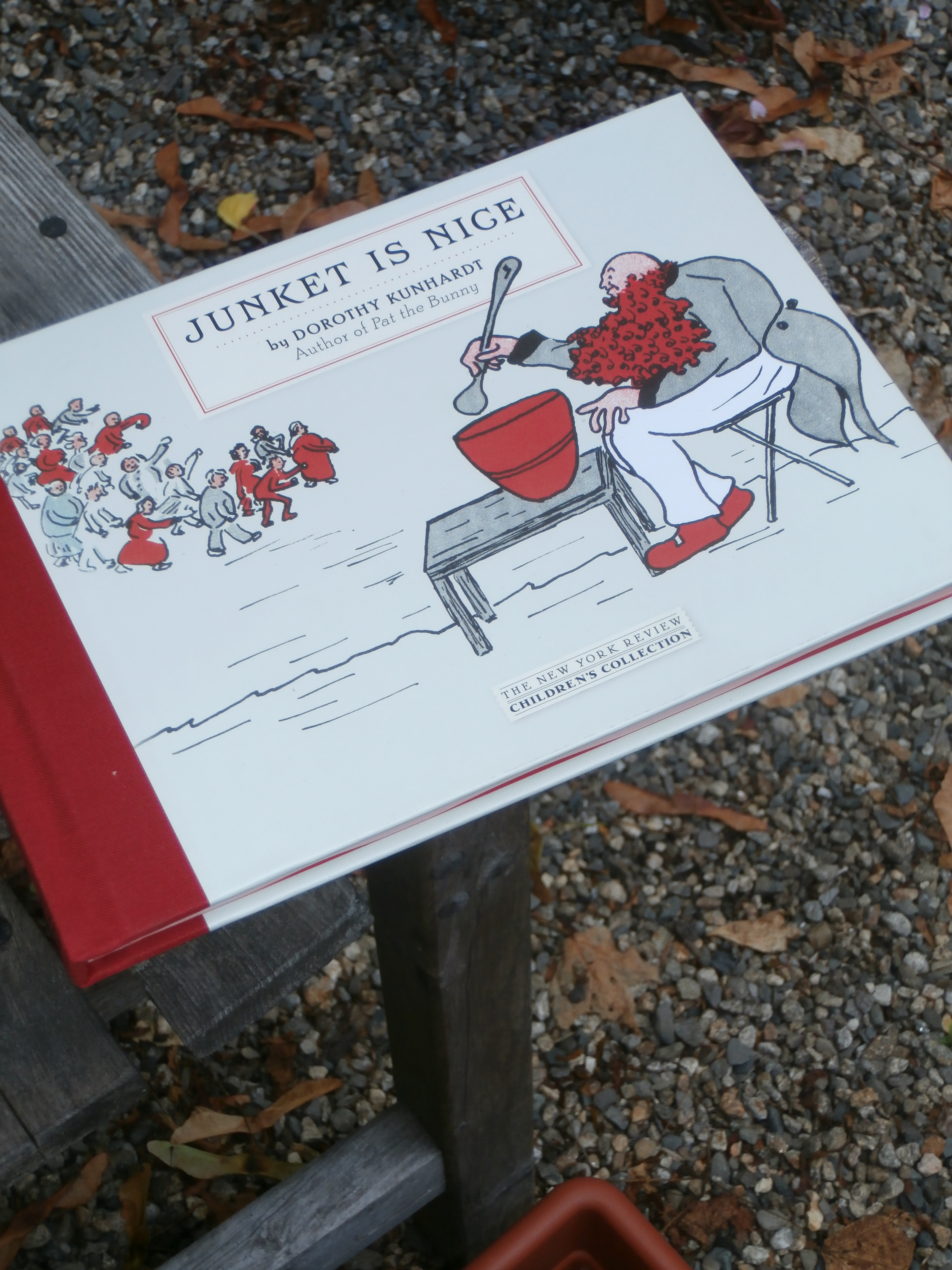
junket-is-nice

Everybody knows the baby book Pat the Bunny. But that is not the only book Dorothy Kunhardt wrote. She published 50, including some for grownups.

When we were kids, we loved her book Junket Is Nice, about an old man with a red beard eating a rennet custard called junket while crowds of people try to guess what he is thinking.

We children used to eat a lot of junket, a dessert that is not around much anymore. It’s tricky to make because the milk has to be at a very precise temperature.

One day my friend and I got it in our heads to bury some treasure that we could dig up later, and we included in the cache Junket Is Nice. Needless to say, by the time we followed our map to “X marks the spot” several months later, Junket Is Nice was mildewed.

Which is why, when I saw it was reissued, I jumped to get a copy.

Read a bit more about Dorothy Kunhardt here.

Read Full Post »

Asakiyume is a wonderful writer. I have read many of her stories for adults and her three main young adult books. The latest is perhaps the most marketable so far. Kids, teachers, librarians — all sorts of people — will be as riveted as I was. (Perhaps she will comment below with a few words on the theme.)

While waiting for an agent, Asakiyume asked Kelsey Michele Soderstrom to paint the main characters, below, and began to plan a website about the book and its exotic settings.

I thought of Asakiyume when I read an article in the Concord Journal the other day about high schoolers who weigh in on galley proofs of young adult books.

The Journal says, “Just two years after the group’s inception, the Concord Carlisle High School Young Adult Galley has been selected as one of 16 Young Adult Library Services Association Teen Top 10 review groups.

“Members of the group will read galleys, or uncorrected proofs of books, before they are sent off to be published, and select 10 they like best. This information will be used to select YALSA’s top 10 galleys this year.

“Jennifer Barnes, ex-teen library services consultant at Concord Carlisle High School, was the head of YALSA’s teen fiction division and used to bring galleys into the high school’s libraries for interested students to read. The galley group formed …

“When Barnes left the school, students still wanted to review galleys but had a harder time procuring them. …

“Using Kindles, group members would download galleys off of NetGalley, available to bloggers, educators and members of the media. The CC Group members would also send letters to publishers requesting galleys.

“Then, still looking for more galleys to review, the group decided to apply to be a YALSA  Teen Top 10 Review group. …

“ ‘Sometimes authors will respond [to reviews],’ [recent grad Clare] Bannon said. … ‘It was so cool when an author would respond to something you wrote. It would encourage you to keep reading and keep reviewing stuff.’

“The group will continue to get together and meet up to discuss books throughout the YALSA Teen Top 10 process.” More at WickedLocal.com.

Art for Asakiyume’s latest story: Kelsey Michele Soderstrom


Read Full Post »

Back in first-grade, we learned to read from books featuring invariably blond, blue-eyed children. Today, primers have more variety, but multicultural pleasure reading, where it exists, is not always available to poor children.

Leslie Kaufman wrote recently at the NY Times that a  “nonprofit called First Book, which promotes literacy among children in low-income communities, announced the Stories for All project, a program intended to prod publishers to print more multicultural books. …

“In a 2012 study, the Cooperative Children’s Book Center at the University of Wisconsin-Madison evaluated some 3,600 books, looking for multicultural content. Of the books examined, 3.3 percent were found to be about African-Americans, 2.1 percent were about Asian-Pacific Americans, 1.5 percent were about Latinos and 0.6 percent were about American Indians.” More.

First Book picked two winning publishers in its first Stories for All competition — HarperCollins and Lee & Low Books — and purchased $500,000-worth of books from them. The books “will be available beginning in May through the First Book Marketplace, a website offering deeply discounted books and educational materials exclusively to schools and programs serving kids in need.”

Among the books are:  “Shooter”, Walter Dean Myers (HarperCollins); “Tofu Quilt”, Ching Yueng (Lee & Low Books); “In the Year of the Boar and Jackie Robinson”, Bette Bao Lord (HarperCollins); “The Storyteller’s Candle: La Velita de Los Cuentos”, Lucia Gonzalez (Lee & Low Books); “El Bronx Remembered: A Novella and Stories”, Nicholasa Mohr (HarperCollins); and “Passage to Freedom: The Sugihara Story”, Ken Mochizuki (Lee & Low Books).

More information at FirstBook.org.

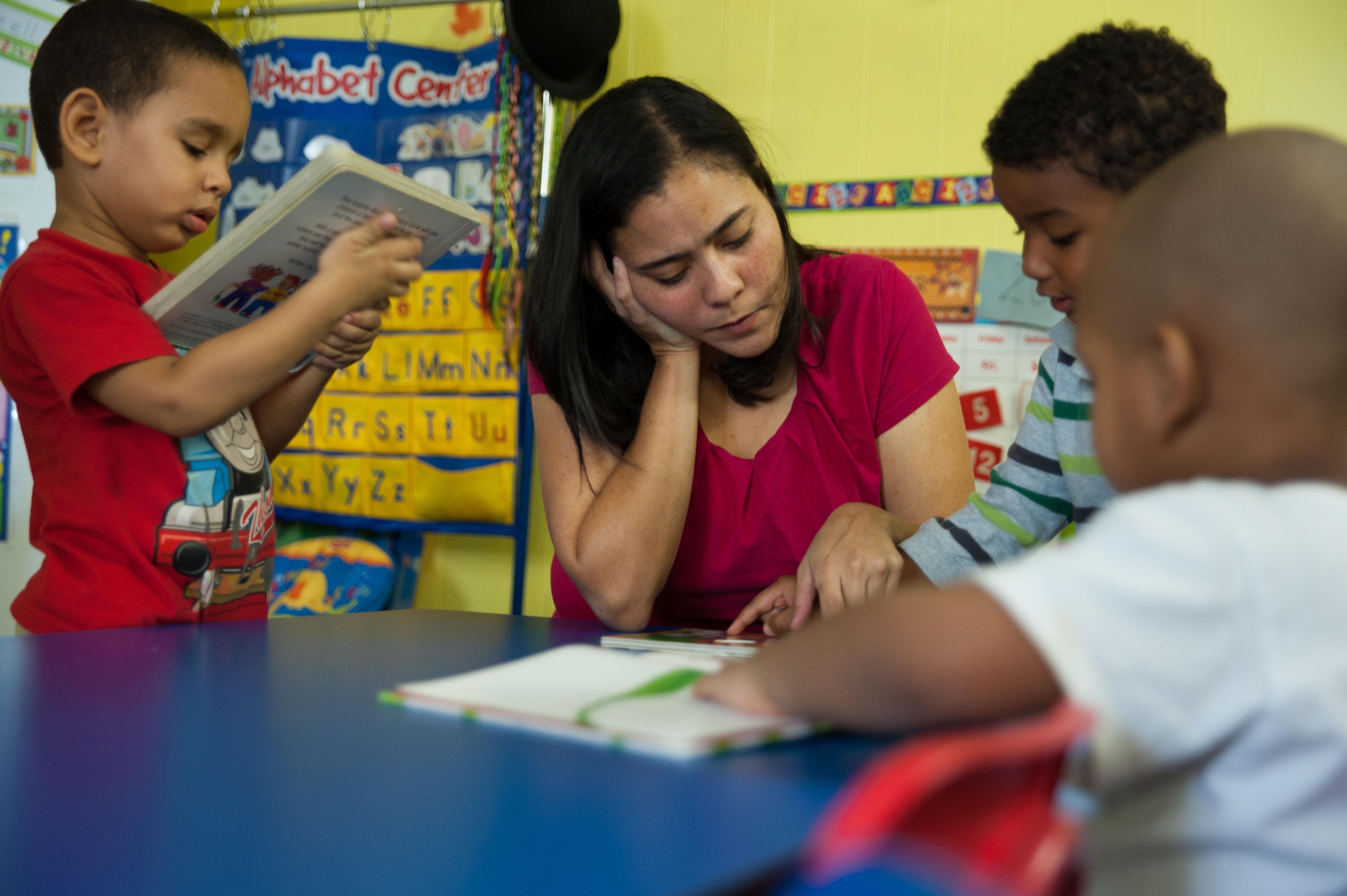
Photograph: Strategies for Children

kids--teacher

Read Full Post »

« Newer Posts - Older Posts »