Play is important for all kinds of reasons in childhood, including testing out skills and experiencing the satisfaction of creativity.
John Poole at National Public Radio focused on the socialization aspects of play in a recent report.
He began, “Why do we humans like to play so much? Play sports, play tag, play the stock market, play duck, duck, goose? We love it all. And we’re not the only ones. Dogs, cats, bears, even birds seem to like to play. …
“The scientist who has perhaps done more research on brains at play than any other is a man named Jaak Panksepp. And he has developed a pretty good hypothesis.
“In a nutshell, he, and many others, think play is how we social animals learn the rules of being social. …
“Play seems so deeply wired by evolution into the brains of highly social animals that it might not be a stretch to say that play is crucial to how we and they learn much of what we know that isn’t instinct. …
“Not surprisingly, Panksepp and others think the lack of play is a serious problem. Especially at younger ages. And particularly in school settings. …
” ‘It’s not just superfluous,’ says Panksepp. ‘It’s a very valuable thing for childhood development. And we as a culture have to learn to use it properly and have to make sure our kids get plenty of it.’ ” More here.
More still from Jon Hamilton, another reporter in the NPR series on play, here.
Photo: David Gilkey/NPR
Deion Jefferson, 10, and Samuel Jefferson, 7, take turns climbing and jumping off a stack of old tires at the Berkeley Adventure Playground in California. The playground is a half-acre park with a junkyard feel where kids are encouraged to “play wild.”
The NY Times contains a Science section on Tuesdays, and it always has delightful tidbits. Today Sindya N. Bhanoo writes that if you had music lessons at a young age, the experience may benefit you in old age.
“A new study reports that older adults who took lessons at a young age can process the sounds of speech faster than those who did not.
“ ‘It didn’t matter what instrument you played, it just mattered that you played,’ said Nina Kraus, a neuroscientist at Northwestern University and an author of the study, which appears in The Journal of Neuroscience.
“She and her collaborators looked at 44 healthy adults ages 55 to 76, measuring electrical activity in a region of the brain that processes sound.
“They found that participants who had four to 14 years of musical training had faster responses to speech sounds than participants without any training — even though no one in the first group had played an instrument for about 40 years.” More here.
Now, of course, I am looking back and trying to count how many years of piano lessons I had as a kid. I’m sure it was at least the four Kraus deems necessary. But I hardly ever practiced, so probably the effect was small.
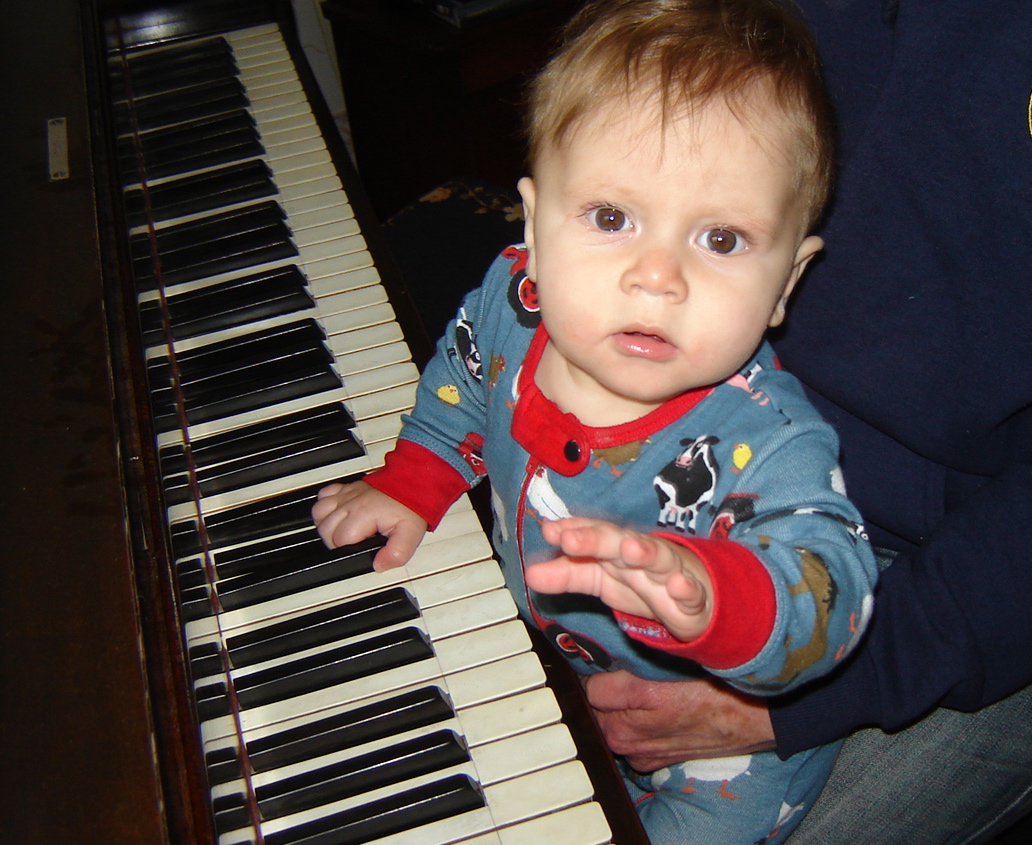
The serious pianist below was sitting on my lap when the picture was taken in 2011.
If you need more hours in the day, be sure to read “How to trick your brain into thinking your day is longer,” an article John found. (But if time is dragging and you want fewer hours waiting in line or being stalled on the subway, I suggest you try reciting poetry.)
Belle Beth Cooper writes at LifeHacker that intense concentration can make you feel like you have added on all the time you need to do whatever you are doing.
“Can you remember a period in your life when, if you look back on it now, time seemed to stretch on forever? … Chances are, you were probably doing something—or a whole bunch of somethings—that was brand new to you and demanded your attention.
“The funny thing is, by focusing on what you were doing, you actually slowed down time (or how your brain perceived that time, anyway). Neuroscientist David Eagleman” explains how it works here. …
“As we age, this process comes into play even more, making time seem to fly by much faster. This is because the more we age, the more often we come into contact with information our brains have already processed. This familiar information takes a shortcut through our brains, giving us the feeling that time is speeding up and passing us by.
“For young children, it’s easy to see how this would work in reverse, since the majority of information their brains are processing would be brand new, and require more time to process. …
“According to the research, if we feed our brains more new information, the extra processing time required will make us feel like time is moving more slowly.” Try it out. More of the science at LifeHacker.
Photo: Andrada Misca, lovingphotography.wordpress.com
The very image of concentration.
I love stories like this in any field, even a field as foreign to me as mathematics.
A mathematical puzzle that most experts didn’t expect to see solved in their lifetime has been quietly mastered by a professor in New Hampshire. He just got an idea and worked it out.
Carolyn Y. Johnson covers the story for the Boston Globe:
“A soft-spoken, virtually unknown mathematician from the University of New Hampshire has found himself overnight a minor celebrity, flooded with requests to give talks at top universities.
“On May 9, mathematician Yitang Zhang, who goes by Tom, received word that the editors of a prestigious journal, Annals of Mathematics, had accepted a paper in which he took an important step toward proving a very old problem in mathematics.”
He showed that there are “an infinite number of primes separated by less than 70 million. [It] excites mathematicians because it is the first time anyone has proved there are an infinite number of primes separated by an actual number. … News of the feat rippled across the math world.
“ ‘This is certainly one of the most spectacular results of the last decade,’ Alex Kontorovich, a mathematician at Yale University, wrote in an e-mail. ‘Many people expected not to see this result proved in their lifetime.’
“Zhang said that he began to think seriously about solving the problem four years ago. … The epiphany did not come to him until July 3 of last year, when he realized he could modify existing techniques, building on what others had tried.
“ ‘It is hard to answer “how,” ‘ Zhang wrote in an e-mail. ‘I can only say that it came to my mind very suddenly.’
“The mathematician lives a simple life that he says gives him the ability to concentrate on his work. … Zhang’s achievement shows what can be accomplished by the elegant instrument of the human mind, working alone.
“ ‘Keep thinking, think of it everyday,’ Zhang said he would tell himself. ..
“ ‘The old adage is that mathematics is a young person’s game, and moreover most of the top results come from people or groups of people known to produce them,’ Kontorovich wrote. “Professor Zhang has demonstrated not only that one can continue to be creative and inventive well into middle-age [he’s in his 50s], but that someone working hard enough, even (or especially) in isolation, can make astounding breakthroughs.’ ”
I love the reminder about the importance of time to think. Everyone needs time to think. Even people who are not solving math puzzles for the ages.
Science Daily reports on new research that reaffirms the value of daydreaming.
It’s all about letting our conscious mind take a rest while our unconscious mind puts random but important pieces together for us. Getting enough sleep matters for the same reason.
“In recent years, researchers have explored the idea of rest by looking at the so-called ‘default mode’ network of the brain, a network that is noticeably active when we are resting and focused inward. Findings from these studies suggest that individual differences in brain activity during rest are correlated with components of socioemotional functioning, such as self-awareness and moral judgment, as well as different aspects of learning and memory.”
That’s a mouthful, but you know what they are getting at, right?
I can’t imagine life without daydreaming. Unfortunately, a lot of people seem almost afraid of the empty spaces. I think they miss out on a certain amount of insight and creativity.
Like many Swedes, Erik is fluent in several languages and understands others. It’s a riot to hear him “conversing” with Svein. Svein says something in Norwegian. Erik answers in Swedish.
Language skill has come in handy for both Erik and Suzanne recently, as they are able to converse with the Honduran worker who is painting their new residence. Not only will the paint job be better, but Erik thinks he may have found a new group with whom to play pick-up soccer.
Beyond such practical matters, speaking other languages can improve brain capability and even keep Alzheimer’s patients functioning longer, as Jessica Marshall writes at Discovery News. The longer you speak two languages, the better.
“Being able to use two languages and never knowing which one you’re going to use right now rewires your brain. The attentional executive system which is crucial for all higher thought — it’s the most important cognitive piece in how we think — that system seems to be enhanced.” Read more.
This week I heard Mahzarin Rustum Banaji, a Harvard psychology professor, speak about unconscious bias, or blind spots. She conducted experiments with the audience to show (a) that there are things we see but simply don’t register consciously and (b) that we have unconscious biases that we may not want to have.
She showed a video of a basketball game, with two blurry films superimposed. Audience members were supposed to concentrate hard on how many times the ball got passed. After showing it, Banaji asked if anyone had seen anything unusual, and only one person mentioned seeing a woman walk through the basketball game carrying an umbrella. Most of us had no memory of that.
Banaji said a colleague at Yale has observed some brain activity in people who are “not seeing” that woman, but registering her presence doesn’t rise into the conscious zones. (Apparently only 1 to 10 percent of our brain function is conscious.) If Banaji hadn’t pointed out the woman by showing the video a second time and if I was still unaware of her walking through the game, I wonder if the next time I saw a woman with an umbrella I would think of a basketball game and wonder why.
Banajee said that our eyes have not evolved past 500,000 years ago, when people did not deal with 2-D representations, so some 2-dimensional info cannot be processed even today. None of the audience could believe, for example, that in a slide showing two perspectives of a table, the table was the same size in each drawing. We could not see it even when she proved it was true.
Other tests showed that we associate women more with household tasks, and men more with the office, even though we think we have left those views behind. In one slide the same AP editor had described a black Katrina victim swimming with a loaf of bread as “a looter” and a white couple doing the same as having “found” supplies in a a store.
You probably also know that until people auditioned for orchestras behind a screen, without the judges knowing anything about the candidates, there were few women selected. The judges had no idea that they had been deciding on the basis of unconscious bias. They believed they’d been really trying to find qualified women musicians. I asked if in a workplace it would help to point out to people in a nice way when something they said might unintentionally have sounded biased. She said people don’t like to hear that about themselves, but she recommends people from one minority group advocating for people from another group. For example, a gay person might advocate for a woman’s right or a white woman might advocate for an Asian immigrant.
I have always loved puzzling out subliminal messages and asking myself why I react in a mysterious way to certain innocuous things. Even when I was a child, I sensed something about hidden messages. I once pointed out a model in a magazine to my mother and said I thought the woman was beautiful. My mother said it was more important for the woman to have a “beautiful character.” For a couple years afterward, if I could get my mother sitting down, I’d point out women in magazines and ask if she thought they were “beautiful by character.” (She got tired of this game pretty fast.)
Even today, when I see an ad for Calvin Klein, say, or Tanqueray gin, I study the models and ask myself what daily life we are supposed to intuit from the photo. Drug addict who is very creative but depressed? Ad company CEO? Saxophonist?
Someone is sending nonverbal messages to my unconscious mind. What are they?
Ever since the kids were little, we used the term “collapsing fit” to mean an emotional meltdown. It doesn’t need much explanation.
Then around 1990, I read about fainting goats and was fascinated by the idea that some animals collapse when frightened. Needless to say, goats that collapse when frightened by an enemy are fairly rare. Makes it hard to get away.
*
*
But one time I saw the ability to collapse benefit the human animal. Or maybe not.
It happened that a bunch of us teachers back in my first career, were concerned about an angry, out-of-control sixth-grader, so we called a meeting with his mother. After we laid out the problems as gently as possible, she fainted. After she came to, no one ever said anything to her about her son again. His classmates and teachers went for decades thinking they would read a headline about about some guy going postal and it would turn out to be this kid. I’m happy to say we were wrong. I never did learn the medical reason for his mother’s collapse.
This train of thought is the result of my reading in the science section of yesterday’s NY Timesabout a rare illness associated with the death of certain brain cells. It’s called cataplexy. And cataplexy is — get this — “a tendency to collapse when swept by strong emotions.”
I should write a poem. “A tendency to collapse when swept by strong emotions.” How great is that?
Or maybe one of you poets reading this blog would follow your personal train of thought, and write a poem related to cataplexy or collapsing. I would love to print one here.
I think I have always cut articles out of the paper to give people or to post on my fridge. (At the office, I post work-related clippings on the wall of my cubicle.) Suzanne and her brother, John, often teased me about how often the stories were dire warnings in the news. Around this time every year, they would be deluged with clippings about sun screen and melanoma or deer ticks and Lyme disease.
Now that they have grown up and have their own homes, the fridge is rather empty of news articles. But since they are reading this blog, I’ll post a typical dire warning from today’s Boston Globe, something I’ve been harping on since the mid-1990s. (Oh, well. They laughed at Columbus.)
Hiawatha Bray’s column for June 2 is about protecting oneself from possible cancer-causing effects of mobile phones. He has several pieces of advice any mother would love: “make like a teenager, and text instead of talking. Sending SMS or e-mail messages keeps the phone well away from your skull. The farther your brain is from the phone, the lower the risk of brain tumors. If you must talk, most handsets have a speakerphone feature to let you converse at a distance. I often use it because I’m too lazy to hold the phone. Now I’ve got a better reason.”
And a study done in Sweden a few years ago suggests that it isn’t just brains we need to worry about. Cellphones left on in a pocket can affect reproductive function.
Bray says, “I carry the phone on my hip, in a holster which keeps it the required distance from my body. I’ve mocked my wife for losing her Android smartphone in her purse, but carrying it well away from the body is the safest way to go.”







 Suzanne's Mom's Blog