Feeds:
Posts
Comments

Posts Tagged ‘camps’

The Arabic Sesame Street was designed especially for children in refugee camps, but it’s a delight for other children, too.

I posted about the development of a “Sesame Street” for Middle East refugees in 2016 (here) and for Bangladesh refugees in 2019 (here).

To give you the latest, I’m sharing a recent interview that National Public Radio’s Deborah Amos conducted in Beirut.

NPR Host Audie Cornish
” ‘Sesame Street’ is taking on one of the world’s biggest crises — the plight of Syrian refugee children. The Muppets are reaching out to millions of displaced children in a new program. Refugee children face special issues — losing their homes, missing time from school and frequent moves. They grapple with emotions and fears they barely understand. NPR’s Deborah Amos reports from Beirut.

Deborah Amos
“The Syrian refugees at this soccer practice are part of the target audience for ‘Ahlan Simsim’ — ‘Welcome Sesame,’ a new show on Arab TV stations and online — also for refugee kids in Jordan, Iraq and Syria. Some here are old enough to remember the war. Many more were born as refugees, raised by parents who fled violence and devastating loss and can pass on the trauma. …

Bassil Riche
“Definitely, these kids have experienced something that no kid should have to experience.

Amos
“Bassil Riche, the soccer coach, has seen the signs in these kids.

Riche
“Maybe the kid misses a shot or something. You know, you can see kind of over-the-top anger or frustration or disappointment in themselves. It’s important for them to talk about these things and not keep it inside.

Amos
“Getting those emotions out is the aim of the new program. … Produced in Amman, Jordan, the scripts are in consultation with regional educators and researchers. For 50 years, ‘Sesame Street’ has pioneered programs to address childhood challenges. The new challenge — to create a show for children who are likely to remain refugees throughout their childhood. Scott Cameron is the executive producer in New York.

Scott Cameron
“The show was developed to help children become smarter, stronger and kinder and give them skills to be — to thrive and be resilient. …

Amos
“[Grover] speaks Arabic in ‘Ahlan Simsim.’ The newcomers are Jad — bright yellow — Basma is purple. She becomes Jad’s best friend when he arrives in the neighborhood. Jad is sometimes sad because he’s had to leave everything behind, including his favorite toys. Research shows displaced children don’t have the language to identify emotions and the skills to cope, says Cameron. So that’s a key educational goal.

Cameron
” ‘Ahlan Simsim’ focusing an entire season on emotions is … a bold move that is born out of a need.

Amos
“The teaching techniques are sometimes silly. They’re always fun.

Cameron
“Debka dancers are three animated dancers whose sole function is to identify emotions and label them in a really funny way. … They pop into frame out of nowhere, sometimes. So it’s always fun to see where they’re going to come from. Sometimes, they pop up out of the bushes. They do a dance. They are a very important way for us to make sure that the children pay extra attention when we’re first introducing the vocabulary word that matches the emotion.

Amos
“Syrians are now the largest refugee population in the world. The statistics for going home are grim. Displacement lasts longer than ever before, sometimes for decades. Head writer Zaid Baqaeen says he never uses the label.

Zaid Baqaeen
“It was never put in any script that, oh, you’re labeled as a refugee or not because our focus is about welcoming. …

Amos
“The welcome is extended on the ground. In a partnership with the International Rescue Committee, the IRC is sending thousands of outreach workers to four countries and extend the lessons of the TV production and tackle some of the hardest subjects, says Cameron. … The ‘Ahlan Simsim’ project is a new way to correct the shortcomings of traditional humanitarian aid that provides for immediate needs but does little to prepare a generation to become resilient adults.”

NPR transcript and audio are here.
Read Full Post »

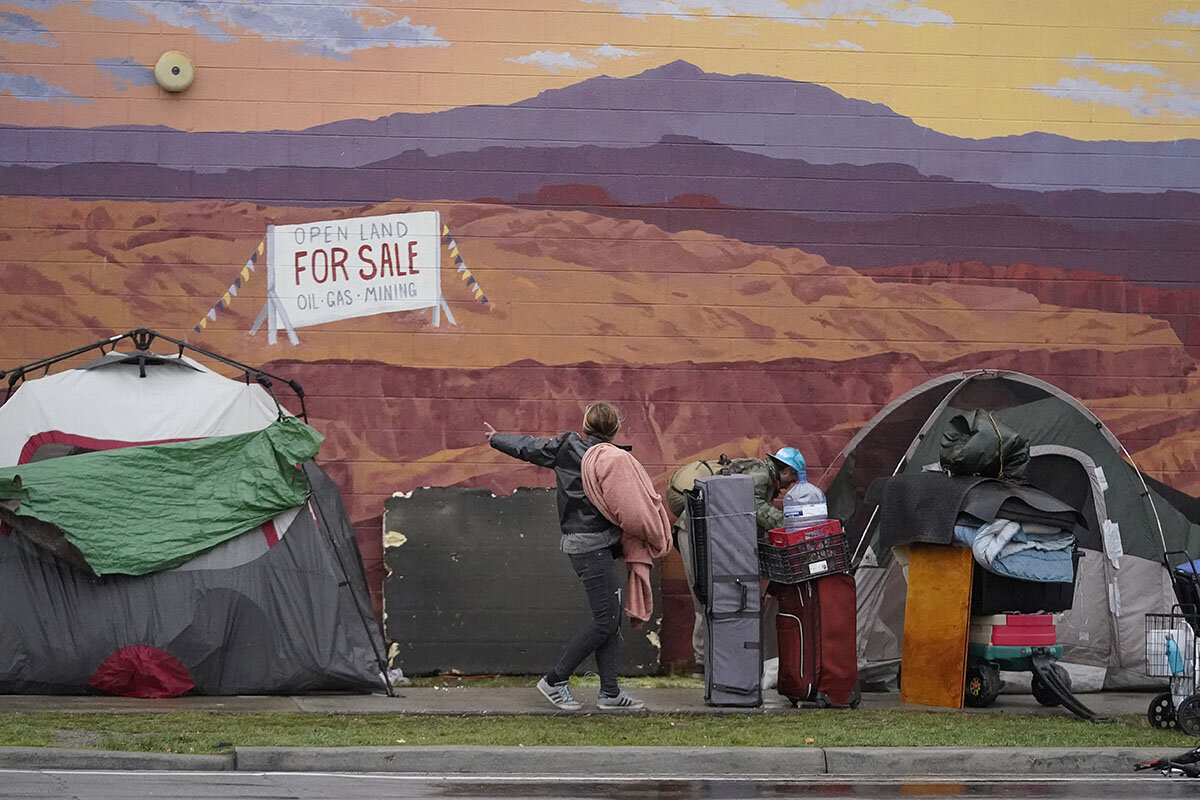
Photo: Rick Bowmer/AP/File.
People collect their belongings as Salt Lake County conducts a homeless camp cleanup of the Fleet Block area in 2021. Today Utah and a few other states are considering government-sanctioned tent encampments as steppingstones for those without homes.

One has to appreciate politicians who try to solve problems rather than sweep them under the rug. If people are homeless, kicking them out of an encampment with nowhere to go just creates an encampment somewhere else. Some states are considering a different approach.

Patrik Jonsson reports at the Christian Science Monitor, “When Salt Lake City began enforcing an urban camping ban several years ago, hundreds of Utahns picked up their belongings and headed toward the Jordan River.

“For centuries, the river has been a trading post, a border, and a nexus of nomadic activity. But most of all, it has been ‘a place of refuge,’ says Søren Simonsen, executive director of the Jordan River Commission.

“Today, growing numbers of encampments filled with Americans without permanent homes dot the banks of the river. And Mr. Simonsen is on the front line of what to do about it.

“A decade ago, Utah claimed it had largely ‘solved’ homelessness, reducing it by 91%. Now it is considering an idea, supported by Mr. Simonsen, that is gaining traction across the United States: outlawing unsanctioned camping and instead creating government-sanctioned tent encampments as steppingstones for those without homes to find more permanent housing.

“For much of the recent past, one assumption in addressing homelessness has been that everyone wants a solid roof. The debate over encampments is shifting those assumptions.

“Increasingly, cities and states are exploring whether there can be a sense of dignity and agency in ‘safe outside spaces’ as an end in themselves. As some carry out sweeps to clear out encampments, others are experimenting with the idea of making them more humane, hygienic, and livable as one potential part of the solution to the housing crisis. …

Says Mr. Simonsen. ‘Can’t we make space for people that aren’t ready, aren’t capable, aren’t interested in living such a fixed-address kind of lifestyle?’

“The situation is Utah is common across the country. Tent encampments have ‘definitely become more of a visible issue since the pandemic,’ exacerbated by a national housing shortage, says Courtney Anderson, an expert on social welfare law at Georgia State University College of Law in Atlanta. ‘It’s a problem that people can see, so they need a solution where they can’t see it.’

“Under pressure from voters, officials are taking action. Authorities in Rhode Island cleared an encampment from the steps of the state capitol in December. Washington, D.C., conducts regular camp removals. New York City has conducted hundreds of ‘sweeps’ under Mayor Eric Adams. Residents have largely hailed the efforts, but the majority of those affected haven’t moved into more permanent housing. …

“ ‘The raiding of camps is really tragic,’ says Professor Anderson. ‘The more you dehumanize people, the easier it is to do that kind of thing.’

“The 9th U.S. Circuit Court of Appeals ruled it is unconstitutional to ban sleeping in public if there are no other sleeping options available, and some municipal courts have made similar rulings. But this year, Tennessee made camping away from sanctioned areas a felony. Other states are following suit.

“The Georgia Senate is considering a bill that would criminalize camping and force municipalities to comply. But the bill would also allow the state to designate areas for sanctioned camps.

“In Savannah, Georgia, Shirley Walkowicz says the move to criminalize what she is doing – living in her car – ‘just shows that people don’t [care] about me and people like me.’ …

“The Georgia bill is significantly based on the thinking of Judge Glock, a senior fellow at the nonpartisan Cicero Institute. Dr. Glock saw the early potential of ‘housing first’ – an Obama-era policy that ended requirements such as drug testing for housing recipients. But he now says the policy has largely failed. An average of five homeless people die on the streets of Los Angeles every day, he says – more than twice as many as a decade ago.

“ ‘This is a crisis situation,’ he says. ‘It’s about what we can do this month, this year. We can’t just sit on our hands until the housing [shortage] is solved.’

“He points to cities such as Austin, Texas, and Portland, Oregon, which are banning makeshift encampments but creating safe spaces for people without homes.

“ ‘The argument is, if cities are going to allow it, make sure they provide the things you need: sanitation, social services, security,’ says Dr. Glock. …

“Birmingham, Alabama, has just voted to erect a tiny house village to accomplish many of these goals. For City Council member Hunter Williams, the logic is clear. …

“ ‘We don’t have to have tent cities under every overpass in America. … We can do better than that.’ ”

More at the Monitor, here. No firewall; subscriptions welcome.

Read Full Post »

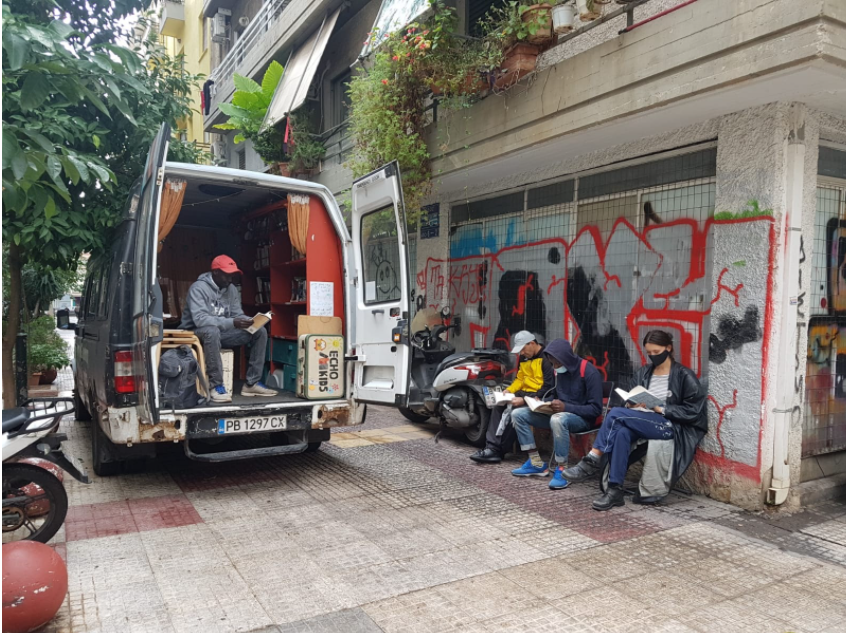
Photo: Book Aid.
Says Book Aid International, “With very little to do in the camps, many [refugees] enjoy coming to the library to read.

Having learned from the Guardian in early 2020 how Greek refugees were enjoying the services of a mobile library, I was happy to find a post from this year that says it’s still going — despite Covid challenges.

Book Aid reports, “ECHO is a mobile library based in Athens, Greece. Founded in the summer of 2016, its mission is to provide people seeking asylum with books, learning resources and a shared community space whilst they live in the camps. …

“We spoke to one of the coordinators of ECHO, Becka, about the library, the people who use it and the ways it impacts the many lives it reaches. 

People often say, ‘If the library wasn’t there, people would still be living,’ and yes, they’d be alive, but they’d be existing.

“ ‘The educational services within the camps are extremely limited, the WiFi is patchy or non-existent and these camps are not safe places. There is no neutral community space, nowhere you can just relax that’s warm and comfortable, like a library. If we wanted to set up permanent library spaces it would be extremely challenging, so we bring in our lending library service once a week. Even though it’s just once a week and it’s an outside space, which isn’t ideal, we have a rug for children and we have spaces for adults so people come to us to relax and learn. 

” ‘There’s very little to look forward to in these camps, and one of the very few things you can actually do is sit and read a book, either for study or for the sake of exploring a different world. With the pandemic affecting our access to the camps, it’s clear that people notice when we’re not there. Covid-19 has exacerbated a situation which was already very bad. …

” ‘Thanks to Book Aid International, English books are fortunately one of our less stressful things. These are one of our most used resources because they support people who are learning English. Greek is a very challenging language, and not everyone living in the camps will settle in Greece for life.

” ‘There is no effective long-term integration programme or much holistic support for refugees. Most people imagine Greece as a sort of stopping off point; so learning English can be a useful tool for the future. It’s part of building up self-reliance and self-confidence to be able to support yourself in a new life in Europe. Without access to books that becomes really difficult.

” ‘For many people, like young mothers, grappling with the alphabet and being able to start to have basic conversations in English can be extremely empowering. It’s almost like repairing that sense of “I am capable, even in really terrible situations, of taking control of my own learning to benefit me and my children for the future.” …

” ‘People like new books… who doesn’t!? It makes a difference seeing something that is not battered and torn. It’s like, “this is for me. Everything else in this camp and this life is old and horrible. But here is a new book that they brought for me to use.”  

“I think people often say, “If the library wasn’t there, people would still be living,” and yes, they’d be alive, but they’d be existing. For our library users and friends in the camps, books are invaluable.’ ”

Read more at Book Aid, here, and at the Guardian, here.

Read Full Post »

Photo: Ryan Donnell/Sesame Workshop
Grover from “Sesame Street” in a Rohingya camp in Bangladesh. The Lego Foundation will provide $100 million over five years to the makers of “Sesame Street” and their partners for a program for refugee children.

Most of what we know about the situation of Rohingya refugees — expelled from Myanmar (Burma) for their Muslim beliefs — is pretty dire. But here and there we see positive efforts to lessen the pain of living in overcrowded camps in Bangladesh, especially for children. Read about this partnership among humanitarian relief organizations, Sesame Street, and Lego.

Karen Zraick writes at the New York Times, “Can play help refugee children heal from trauma?

“That’s the belief behind a new partnership formed by the Lego Foundation, Sesame Workshop and organizations working with Syrian and Rohingya refugees. In its first major humanitarian project, announced [in December], the foundation will provide $100 million over five years to the makers of ‘Sesame Street’ to deepen their work with the International Rescue Committee in the countries around Syria, and also to partner with the Bangladeshi relief organization BRAC.

“The aim is to create play-based learning programs for children up to age 6 in Lebanon, Jordan, Iraq and Bangladesh. The programs will teach basics like the alphabet and numbers, but will also emphasize social and emotional development to counter the effects of stress and suffering. They will be offered both to displaced children and to some of their potential friends in host communities.

“Officials at the organizations involved said that helping children’s brains develop during their first years — when they are absorbing information like sponges — is crucial to helping them become healthy and successful later in life, and that play is an excellent way to do it.

“ ‘We know from child development research that the best way for children to learn is through exploring their world and play,’ said Sarah Smith, the senior director for education at the International Rescue Committee. …

“The families’ needs are great. In addition to basics like adequate food and shelter, children need to foster ties with nurturing caregivers to heal from what they have witnessed and endured, said Hirokazu Yoshikawa, a director of Global TIES for Children, a research center at New York University that will conduct testing and evaluation for the program.

‘Part of the magic of human development is that very few experiences doom a child to ruin,’ Dr. Yoshikawa said. ‘But we have to address the risks early. This is particularly critical in these first years.’ …

“Erum Mariam, a program director for BRAC, said that many of the 240 play labs the organization has created for refugees were built by the children’s fathers and painted and decorated by mothers and children.

“ ‘We place a lot of emphasis on culture and on strengthening community engagement,’ she said. Within those centers, trained facilitators focus on providing enough structure to make children feel safe, while allowing for spontaneous joy.

“ ‘When a child enters the humanitarian play lab, we want the child to feel very happy and very connected to their culture and heritage,’ she said.” More here.

You may recall I wrote about Sesame Street helping Syrian refugee children, here.

Read Full Post »

It’s hard to read about the deprivations of refugees, especially the children and especially in winter. That’s why I appreciate hearing about any kindness extended to them. National Public Radio recently had a story on the kindness of Clowns without Borders.

Laura Secorun-Palet writes, “On a cold November morning, 300 children gather in a soccer field in Zaatari, a Jordanian village next to the country’s largest refugee camp. …

“Today the children are not lining up to collect food coupons or clothes from NGOs: They are here to watch the clowns.

“On the ‘stage’ — a space in front of a velvet curtain covering the goal — a tall, blond woman performs a handstand while doing the splits, while two other performers run around clapping and making funny faces. As the upside-down woman pretends to fall, the children burst into laughter.

“The performers are circus artists from Sweden …

“Clowns Without Borders is a global network of nonprofit organizations that, for the past 20 years, has been spreading laughter in the world’s saddest places. The group’s most recent annual report says more than 385 artists performed 1,164 shows for its chapters in 2012 in 38 countries, both in the developing world and for refugees and other disadvantaged children in Western countries.

” ‘It’s very important to give kids a chance to be kids again,’ explains Lilja Fredriksson, one of the Swedish performers.” More here.

Another way to help refugees is through the wonderful Minneapolis-based nonprofit American Refugee Committee.

Photo: Bilal Hussein/AP
Lebanese clown Sabine Choucair, a member of “Clowns Without Borders,” performs for children in June at a Syrian refugee camp in the eastern town of Chtoura, Lebanon.

Read Full Post »