Feeds:
Posts
Comments

Posts Tagged ‘canada’

Photo: Submitted to CBC by Elinor O’Donovan.
Visual artist Elinor O’Donovan was chosen to be part of the Irish government’s basic universal income program for creatives. She says the money she receives every month is ‘transformative.’ 

A couple years back, I blogged about Ireland’s experiment in basic income for artists, here. Looks like it met its goals, because now the government is making the experiment permanent.

CBC’a As It Happens guest host Saroja Coelho has an interview with a beneficiary.

“Elinor O’Donovan says Ireland’s basic income program for artists completely changed her life and her work for the better.

“The Dublin-based multidisciplinary artist was a participant in Ireland’s three-year pilot program that saw 2,000 artists and creative arts workers receive a weekly stipend of €325 ($528.90 Cdn) between 2022 and 2025.

“ ‘It’s pretty huge,’ O’Donovan told As It Happens guest host Saroja Coelho. ‘It’s been transformative for my work, and for my well-being in general.”

“Now, Ireland has decided to make the program permanent, saying its benefits to society have far outweighed the costs to the government.

“Advocates for basic income in Canada are celebrating the announcement, hoping it drives momentum to enact a similar — and more widespread — program in this country. 

“But, despite evidence from the Parliamentary Budget Office that basic income could alleviate poverty, economists are warning Canadians not to hold their breath. 

“Basic income is any policy in which the government gives individuals unconditional cash transfers to meet basic needs.

“In 2022, Ireland launched Basic Income for the Arts (BIA), a pilot program designed to help the arts sector recover from losses sustained during the COVID-19 pandemic.

“ ‘This scheme is the envy of the world, and a tremendous achievement for Ireland, and must be made futureproof and sustainable,’ Patrick O’Donovan, Ireland’s culture minister, told reporters last week as his government unveiled its 2026 budget.

“The pilot, while expensive, generated a lot of bang for its buck, the minister said. 

“Overall, the government says it spent €105 million ($170.8 million Cdn) on the BIA. But an external report from Alma Economics found those costs were offset by a boost in audience engagement with the arts, increased tax generation, a reduction in social welfare payments, and improved psychological wellbeing for participants.

“With those benefits factored in, the report estimates the net cost of the pilot was €72 million ($117.1 million Cdn). …

“Basic income is something that artists in Canada have long been calling for. 

“In 2020, at the height of the pandemic, 75,000 Canadian artists, writers, technicians and performers, organizations and labour unions launched a campaign and public letter to the federal government calling for a universal guaranteed basic income.

“Now, they’re hoping the news out of Ireland can act as a springboard for the movement here at home. 

“ ‘We’re thrilled. What can I say?’ said Craig Berggold, spokesperson for the Ontario Basic Income Network, the organization behind the campaign. ‘It’s harder and harder for people to not only live, but also to get into the arts.’

“While basic income has massive support in creative industries, Berggold says he and his colleagues are campaigning for something more all-encompassing than Ireland’s BIA — guaranteed basic income for all Canadians who earn under a certain threshold.

“In a report published this summer, the Parliamentary Budget Office, the federal government’s fiscal watchdog, found that a guaranteed basic income program at the federal level could cut poverty rates in Canada by up to 40 per cent.

“ ‘Poverty is expensive for people and for the government,’ said Berggold, an artist based in Kingston, Ont.

“Berggold says basic income reduces spending on social welfare systems that don’t allow recipients to live with dignity and independence.

“ ‘It empowers people to make choices so that they can be bettering their lives, rather than having the kind of a system we have now which is surveillance based, which is checking in on you,’ he said.”

More at CBC, here. I’ve had a number of posts on basic income around the world. Search this site on the phrase.


Read Full Post »

Photo: Jeff McIntosh/Associated Press.
Emma Eastwood stretched before competing in women’s ranch bronc during rodeo action in Alberta.

I’ve mentioned before how interesting it was to me that my husband’s director of manufacturing at the Maple Grove company was a bull rider on the side. We told Craig we’d love to see a Minnesota rodeo, and he sent us off to nearby Buffalo, where we had a wonderful time.

In today’s story, we learn about the rising numbers of women getting a kick out of riding bucking broncos.

The Associated Press (AP) reports, “Sophia Bunney launched the first time she tried ranch bronc riding, landing ‘quite a ways away from the horse.’

“ ‘I’m very stubborn, and I don’t like being defeated,’ said the 18-year-old from Cessford, Alberta.

“In other words, the teenager was hooked on a sport that pits women against bucking horses for eight seconds.

“ ‘I always kind of wanted to hop on a bronc,’ Bunney told the Canadian Press. ‘In Grade 3 … I said I wanted to be a female bronc rider.’

“Unlike saddle bronco riding, a rodeo mainstay, ranch bronc uses a regular western saddle — not a specialized one — and riders hang on with two hands instead of one. A hand is on a rein and the other on a strap wrapped around the saddle horn.

“Pearl Kersey, who won the Canadian women’s ranch bronc title [recently] in Ponoka, Alberta, is president of Women’s Ranch Bronc Canada and teaches it at clinics.

“ ‘I’ve got teenagers, 20-year-olds, 30-year-olds, and this year a woman in her 50s. I was like, “You sure?” ‘ Kersey said. ‘She doesn’t want to compete. She wants to try it before she gets too old. We have bucking machines. She doesn’t necessarily need to get on a horse’. They can go through all the drills and the bucking machine, and if they’re comfortable enough, they can get on a horse.’ …

“It took a while for 19-year-old Blayne Bedard, who grew up cow riding in the Canadian Girls Rodeo Association, to master keeping her feet forward toward the horse’s shoulders.

“ ‘If they come back, I’m like a pendulum and I just go head over teakettle,’ Bedard said. … She’s improved to the point where Bedard has competed in the last two Canadian championships.

“ ‘I like the look of it, too,’ Bedard said. ‘You get cool pictures.’

“One of the lessons Bedard picked up at a Kersey clinic had nothing to do with riding form — and everything to do with what goes inside a boot.

“ ‘I put baby powder in my boots every time before I ride, and I wear my mom’s boots that are a size too big for me, because if you get your foot stuck in a stirrup — which I’ve had a few times — you need your boot to be able to come off so you’re not being dragged by the horse,’ she said. …

“Kersey, 36, has qualified for the world finals July 19-20 in Cheyenne, Wyoming, where she won in 2019 and has twice finished second. Kersey intends to retire from competition after this year, but continue teaching.

“One of her students, Calgary’s Emma Eastwood, picked it up quickly thanks to years of riding horses and a stint as an amateur jockey. She attended Kersey’s clinics last fall and this spring, and won an event in just her third time competing.

“ ‘It is difficult to try and think through your ride and hang on through all that adrenaline,’ said the 27-year-old massage therapist. ‘Things kind of get a little blurry, and it’s hard to process everything going on so quickly.’ …

“Kersey said … ‘Women have come up to me and said, “Thank you for doing what you’re doing.” They might not go into ranch broncs, but it just gave them the power in themselves to go pursue something that they wanted that they didn’t think they could because they were women,’ Kersey said. ‘Other girls tell me, ‘” saw you ride at Ponoka,” and they’re like, “I want to try it.” Sometimes it’s a confidence-booster thing. Sometimes they want to see if they’ll like it and some are like, “Yeah, I’m doing this.” ‘

More at the Associated Press via the Boston Globe, here.

Read Full Post »

Illustration: The Guardian.
Why did a province in Canada decide to provide universal childcare for only $7 a day? And how was it supposed to decrease the budget deficit?

When I read in June that Quebec was providing universal childcare for very little cost to families, all I thought was, How can they manage it?

Isabeau Doucet explains at the Guardian that the system actually pays for itself.

“When asked how much she pays for childcare, Leah Freeman chuckles and says she isn’t sure. ‘It’s like C$93 (about $67) every two weeks or something. I barely see it leaving my bank account,’ she said.

“To most parents in the US, where the average cost of childcare is $1,000 per month and can reach more than $2,000 a month in some states, the idea of paying so little sounds impossible. But it’s happening – north of the US border in Quebec, Canada, where Freeman’s three-year-old daughter, Grace, attends a subsidized early childhood education center (centres de la petite enfance, known by its acronym CPE), for C$9.35, or less than $7 a day.

“As soon as she found out that she was pregnant, Freeman, a social worker, placed her daughter on a handful of waiting lists through a government website. Now she can drop her daughter off for up to 10 hours a day, between 6am and 6pm, five days a week, all year round. In addition to childcare, Grace sees a speech therapist at the CPE. A daily menu of the home-cooked meals and snacks is posted at the building’s entrance every morning; meals are on a monthly rotation with seasonal changes and locally sourced produce when available.

“All this is possible because in 1997, Quebec lawmakers enacted a universal childcare program as part of an effort to give equal opportunities to all children – especially kids from low-income families – to get young mothers back to work and to increase the government’s tax revenue and eliminate the province’s budget deficit.

“The massively popular program has been a win for everyone involved: it offers high-quality early education to toddlers; good, unionized jobs to childcare workers; has helped close the gender pay gap; affords young families crucial support in the earliest years of their children’s lives and has been a financial boon to the government. It’s been so popular that now the model is being built up across the rest of Canada.

“Perhaps ironically, Quebec’s approach was partly inspired by the groundbreaking research into early childhood coming out of the US – that providing high-quality education early on was not just socially good but a smart economic investment.

“ ‘The best way to reduce social inequalities is to invest in small children very early in their lives,’ said Nathalie Bigras, a retired professor at Université du Québec à Montréal who spent her career researching Quebec’s childcare. …

“On the ground floor of a redbrick school that also houses an adult education center, Les Trottinettes (‘The Scooters) is a CPE that serves 26 kids from nine months to five years old. It’s part of a network of five CPEs in Verdun, a traditionally working-class, though rapidly gentrifying, neighborhood of Montreal.

“Asylum seekers who are single parents can enroll their children here while they take French language classes and continuing education courses upstairs.

“Across two big rooms with a maze of different play stations, children paint bright colors at small easels. There’s a water table, a sand box, wooden construction blocks, colorful bricks, a quiet reading nook and lots of well-loved, sturdy wooden furniture. …

“ ‘You can learn so much about a society by studying its approach to early childhood,’ said Stéphane Trudel, a trained sociologist and the general manager of Les Trottinettes. ‘We’re at the frontline of social inequalities, of gender inequalities, of cultural clashes.’ Yet he finds that very few anthropologists or journalists are interested in it. ‘It’s a blind spot,’ he said.

“Trudel credits research from the US as having influenced Quebec’s approach to early childhood education. American research spanning child welfare, psychological development, nutrition, education and economics was extensively cited in the 1991 report that led to Quebec’s new family policy. And even in terms of pedagogy, Les Trotinette’s curriculum, for instance, is based on HighScope, an approach started in Michigan designed to close the opportunity gap for low-income families.

“HighScope’s longitudinal study, conducted by the Nobel prize-winning economist James Heckman, found lasting intergenerational benefits to high-quality early childhood education, calculating an estimated C$12.90 return for every C$1 invested – from success in school, higher earning over decades, reduced crime and use of social assistance programs.

“The roots of Quebec’s childcare model go back decades, to the French-speaking province’s ‘Quiet Revolution’ in the 1960s, which booted the Catholic church out of state institutions and made them more secular and egalitarian. Marriage went out of fashion and rates plummeted, leading to dire poverty among children of single mothers.

Social movements, feminist activists, labor unions and single-parent family associations demanded new policies, such as parental leave and universal childcare, to address the new family structures. Later, in 1997, the secessionist Parti Québécois government enacted the new family policy as part of an effort to restructure the social safety net and eliminate the budget deficit.

“The crown jewel of this new policy was the creation of the centres de la petite enfance (CPE), an autonomous network of subsidized childcare centers, offering high-quality, low-cost care (C$5 at the time), with unionized staff and parent-led governance.

“ ‘It’s the parents who run the show,’ said Pauline Marois, the architect of Quebec’s family policy who was also Quebec’s first female premier, and is now chancellor of Université du Québec à Montréal. …

“Marois described the key ingredients for this public system’s success as investment into educational programs, universal access through low fees and high parental involvement – because no institution could protect children’s interests better than their parents. …

“It might seem like a public childcare network offering high-quality education, homemade meals and help for children with special needs for about C$10 a day would be expensive for taxpayers, but it actually generates a profit, said Pierre Fortin, an emeritus economist at Université de Quebec at Montreal.

“ ‘The system pays for itself – it brings women into the workplace and they pay taxes,’ said Fortin, a leading expert on the economics of subsidized childcare. ‘You get more money flowing into government coffers.’ This extra tax revenue actually exceeds what the government initially paid to establish the universal childcare system, he said. …

“Today, Quebec has among the highest female labor force participation rates in the world right next to Sweden, while the US lags more than 10% behind. In addition, the gender pay gap . …

“Measuring the causal impact of Quebec’s subsidized childcare on factors such as poverty and social assistance is an imprecise science, but Fortin points out that the number of single-parent families on social assistance in Quebec plummeted by more than 50% in the decade following the reform. Today, Fortin calculated exclusively for the Guardian, that Quebec has 75% fewer single-parent families on social assistance than it did in 1996.

“It’s also had a tremendous impact on childhood wellbeing. In 1996, child poverty rates across Canada were at an all-time high and children in Quebec were among the worst off. Today, it’s the opposite. …

“Fortin estimates that poverty in Quebec decreased by more than 60% in two decades, but points out that universal childcare wasn’t implemented in isolation, but alongside other important social policies, such as enhanced parental leave (now up to 55 weeks of paid leave), high rates of education and employment and pay equity legislation. …

“ ‘I’m convinced that the more women we have in politics, the more we’ll move towards public policies that promote gender equality and the fight against poverty,’ said Marois.”

Lots more at the Guardian, here. No paywall there, but please consider giving them a donation.

Read Full Post »

Photo: Jules Struck.
Jim Borrowman was part of a successful lobby to create an ecological reserve in western Canada’s Johnstone Strait in the 1980s.

Today’s story is about a few people whose determination helped to reverse the decline of a group of Orca whales — people who just don’t give up.

At the Christian Science Monitor, Jules Struck wrote recently about their work.

“Jim Borrowman cut the engine of the Nisku in the gray water of the Johnstone Strait, relinquishing his boat to an eastbound tide. He unraveled the line of a hydrophone – a cylindrical, underwater microphone – and dropped it portside.

“On the other end of the cord a pint-size Honeytone speaker in the cabin broadcast a conversation from the deep: the ethereal, two-toned call of an orca whale to her clan.

“ ‘I think they’re what we call “A1s,” ‘ said Mr. Borrowman, browsing a database of local orcas on his phone.

“Mr. Borrowman has been watching, and watching over, these whales for decades. He was one in a band of Vancouver Islanders who successfully lobbied in the early 1980s to set aside a protected area for Northern resident orcas, which lost a third of their population to hunting and capture in the 1950s and ’60s.

“This early act of ocean preservation laid a foundation from which decades of important research – and a deep local allegiance to the whales – have flourished. Galvanized by this data, environmentalists and First Nations just won a battle to evict commercial open-net fish farms from the area, which compete with the orcas’ food supply.

“With early signs of abundant salmon, and a small but decades-long uptick in Northern resident population numbers, it feels to some like nature rallying.

“ ‘You can see the whales coming back,’ says Alexandra Morton, an author and marine biologist who has studied salmon in the Johnstone Strait since the 1980s. She was part of a group that occupied a Vancouver Island fish farm in 2017 in protest of the industry.

“The A1s spotted by Mr. Borrowman from the bow of the Nisku are one pod of one type of orca, called Northern resident killer whales, which number some 400 and live along the coast of British Columbia.

“They’re doing particularly well, and have been growing by a handful of members each year since the ’70s. Northern residents are the most reliable visitors to the Robson Bight (Michael Bigg) Ecological Reserve, where Mr. Borrowman has served as a warden and run a whale-watching tour business with his wife, Mary, for decades until recently retiring.

“ ‘This is a beautiful, sensitive estuary at the terminus of a 100,000-acre watershed, the last untouched one on the east coast of Vancouver Island at the time,’ he says.

“It’s unique for another reason. At two known beaches at the mouth of the Tsitika River, Northern resident orcas rub gracefully along the seafloor pebbles in what scientists have dubbed a unique ‘cultural behavior.’

“It was this behavior, first captured in underwater footage by Robin Morton, Alexandra Morton’s late husband, that convinced the public, the press, and finally the federal government to set aside about 3,000 acres of water plus shore buffer as a protected area closed to boat traffic.

“Today, volunteer wardens with the Cetus Research & Conservation Society Straitwatch program monitor the reserve and gather population data on the whales and their pods. …

“Today, the whales’ major issues are food scarcity, noise, and chemicals in the water. But if the threats to orcas have become more complex, the responses have grown increasingly well-informed by a bedrock of research, much of which has come out of the ecological reserve and its orbit. …

“Decades of research have since shown that major pathogens and lice leak from [salmon] farms’ huge, suspended net pens straight into the paths of migrating salmon, ravaging their thin-skinned young and immobilizing the adults.

“Pacific salmon are also an important food source and cultural pillar for First Nations. They are intricately linked to the ecosystem, and scientists have even tracked nutrients from decomposed salmon high into the mountains.

“Ms. Morton campaigned for decades to close the fish farms. Nothing changed until she and Hereditary Chief Ernest Alexander Alfred, with a group of other First Nations people, peacefully occupied a Vancouver Island salmon farm owned by Marine Harvest.

“That protest led to a 2018 agreement with the British Columbia government requiring the consent of three First Nations – ‘Namgis, Kwikwasut’inuxw Haxwa’mis, and Mamalilikulla – for fish farms to operate around Vancouver Island.

“First Nations closed more than a dozen salmon farms in and near the strait. Then, the federal government announced it would ban all open-net farms in British Columbia by 2029.

“The decision is not universally supported by First Nations along the coast: 17 have agreements with salmon farming companies, which collectively employ around 270 Indigenous people, according to the Coalition of First Nations for Finfish Stewardship. Overall, open-net salmon farming accounts for 4,690 jobs and $447 million in gross domestic product across Canada, according to the BC Salmon Farmers Association.

“But for many, it was a turning point. Coho and especially Chinook salmon stocks spiked this year in Vancouver Island and its inlets, according to the Pacific Salmon Foundation, after years of downturn.”

Read more at the Monitor, here.

Read Full Post »

Photo: Ning Zeng.
An ancient log excavated and likely buried naturally, cleaned and dried, with the lower end sawed off for lab analysis.

And while we’re on the subject of reducing carbon in the atmosphere, consider an ancient process that works without our help. You may find it a little weird, however, especially as intentionally pursuing this natural approach merely postpones carbon escape for a few thousand years!

Dino Grandoni writes at the Washington Post, “On the outside, its rust-red bark had peeled. Its sweet, distinct cedar smell had disappeared. But at its core, it’s still as hard as a tabletop — and may just contain a way of slowing down rapidly rising temperatures.

“A 3,775-year-old log unintentionally discovered under a farm in Canada may point to a deceptively simple method of locking climate-warming carbon out of the atmosphere for thousands of years, according to a study published [in September].

“ ‘This accidental discovery really gave a critical data point,’ said Ning Zeng, a University of Maryland climate scientist whose team unearthed the ancient chunk of wood. ‘It’s a single data point,’ he added, but it ‘provides the data point we need to really say under what conditions we can preserve wood for a thousand years or longer.’

“Figuring out ways of sequestering carbon may be crucial to meeting the world’s goal of halting warming beyond 2 degrees Celsius above pre-industrial levels. … Doing something as simple as burying wood underground in the right spot, these researchers say, may be a cheap and scalable way of doing just that.

“Forests are Earth’s lungs, sucking up six times the amount of carbon dioxide (CO2) that people pump into the atmosphere every year by burning coal and other fossil fuels. But much of that carbon quickly makes its way back into the air once insects, fungi and bacteria chew through leaves and other plant material. …

“What if that decay could be delayed? Under the right conditions, tons of wood could be buried underground in wood vaults, locking in a portion of human-generated CO2 for potentially thousands of years. While other carbon-capture technologies rely on expensive and energy-intensive machines to extract CO2, the tools for putting wood underground are simple: a tractor and a backhoe.

“Finding the right conditions to impede decomposition over millennia is the tough part. To test the idea, Zeng worked with colleagues in Quebec to entomb wood under clay soil on a crop field about 30 miles east of Montreal.

“ ‘We were trying to do a small pilot project at first,’ said Ghislain Poisson, an agronomist with Quebec’s Agricultural Ministry who worked with Zeng. … But when the scientists went digging in 2013, they uncovered something unexpected: A piece of wood already buried about 6½ feet underground. The craggy, waterlogged piece of eastern red cedar appeared remarkably well preserved. …

“Radiocarbon dating revealed the log to be 3,775 years old, give or take a few decades. Comparing the old chunk of wood to a freshly cut piece of cedar showed the ancient log lost less than 5 percent of its carbon over the millennia.

“The log was surrounded by stagnant, oxygen-deprived groundwater and covered by an impermeable layer of clay, preventing fungi and insects from consuming the wood. Lignin, a tough material that gives trees their strength, protected the wood’s carbohydrates from subterranean bacteria. The team wrote up their results in a paper in the journal Science. …

“Said Daniel L. Sanchez, an assistant professor at the University of California at Berkeley who was not involved in the study, ‘Scientists and entrepreneurs have long contemplated burying wood as a climate solution.’

“The next step is to find prehistoric logs in other locations, to see how well other types of soil preserve wood. … The researchers estimate buried wood can sequester up 10 billion tons of CO2 per year, which is more than a quarter of annual global emissions from energy, according to the International Energy Agency.

“One of the biggest challenges isn’t so much the supply of wood but rather the cost of transporting it to the right spots, Poisson said. ‘There’s probably a lot of unmerchantable wood right now that doesn’t have any market or doesn’t have any purpose.’ “

Hmmm. What do you think? Transporting wood to a burial site wouldn’t just be costly, it would cause more emissions. Not sure the scientists have thought this through. More at the Post, here.

Read Full Post »

Photo: Kat Baulu/Wikipedia.
Alanis Obomsawin in photo of the crew of Canadian film
Waseteg, 2010.

What caught my attention in one story about Alanis Obomsawin was that when an instagrammer I follow went to a dinner with the filmmaker, the 91-year-old prepared the food herself. That is, she’s still going strong.

CBC Radio interviewed Alanis Obomsawin not long ago in an episode produced by Nicola Luksic.

“At the age of 91, prolific Abenaki artist and filmmaker Alanis Obomsawin is not slowing down. For nearly 70 years, her storytelling and documentary work has served as a mirror for Canada, vividly capturing and reflecting Indigenous experiences, providing a space for all Canadians to witness perspectives that have otherwise been suppressed and ignored.

“Obomsawin talks about her life’s influences and the quiet power of listening in her 2023 Beatty Lecture at McGill University.

” ‘I continue making documentaries. In those days, everything was so full of pain and danger. It was hard for our people to imagine change,’ she told an audience at Pollack Hall on McGill’s downtown campus. ‘My dear brothers and sisters, we are all born with a gift. And to each one of you. Your life is sacred. You must change the perspective from limitations to all is possible. Slowly change came.’ …

“Making documentaries was a way to provide a space for Indigenous experiences that would otherwise go unseen and unheard, nurturing better Indigenous and settler relations. …

“After her Beatty Lecture, the legendary documentary filmmaker and artist spoke to IDEAS host Nahlah Ayed. …

Nahlah Ayed
“You said that you see this as a moment when all is possible. Can you speak a bit more about you know, you’ve seen a lot of change in the relationship between the Indigenous people of this country and the settlers on this land? 

Alanis Obomsawin
“I think that it didn’t happen overnight. It’s been very bad for many generations. And part of that is why I’m still here, because I really believe what is possible. But the extraordinary thing, like let’s say even 10 years ago, I could not have talked the way I do now.

“For instance, if you’re in conversation with anybody from anywhere, if you mentioned the word treaty, the reaction I know with me was all, ‘Oh, that doesn’t even exist anymore. No, there’s no treaty.’ And it really annoyed me. Something awful. But I made a film called Trick or Treaty. That tells you a lot. And since then, it is very much used at all levels. …

Ayed
“What’s changed? 

Obomsawin
“I think the educational system has changed. For many generations, the books that were used in places were called The History of Canada, written by the brothers of the Catholic Church, which was pretty ugly, full of lies and designed to create hate towards our people. I was getting beat up all the time as a child. When I figured it out, I thought if the children could hear a different story, they wouldn’t be like that. They’re not born racists. And that’s when I started singing and it took quite a while to get to that point. But telling stories to children. I’ve done hundreds of schools over the years, and I still do whenever I can. …

“I can say that now I can see Canada is at the front for a lot of things concerning education. So then this is a big change. And I don’t want anybody who is making the changes to get discouraged. I want to praise them because I see the difference. And I think I’m lucky to have lived this long to see the difference. …

Ayed
“What do you look forward to as evidence of a genuine attempt at truth and reconciliation in Canada?

Obomsawin
“Well, you’re not going to believe me, but it’s happening. I don’t know what exactly it will come to. And I never thought that, for instance, I could be part of a group with the government that we criticize and you know, they’re listening. We have some of our own people who are working there [in government]. There are the possibilities and the strength is there. I’m not saying it’s going to happen tomorrow, but we work on it.” More at CBC Radio, here.

This post about Obomsawin was inspired by Eve Respini (Curator_on_the_Run), who wrote at Instagram: “Honored to be invited to dinner at home with 91 year old legend, film-maker, singer and activist #alanisobomsawin. She cooked us (colleague @sirishr and I) a wonderful meal, serenaded us with songs and stories, and reminded us to cherish the sweet moments in life. Merci Alanis.”

Read Full Post »

Photo: Melanie Stetson Freeman/CSM Staff.
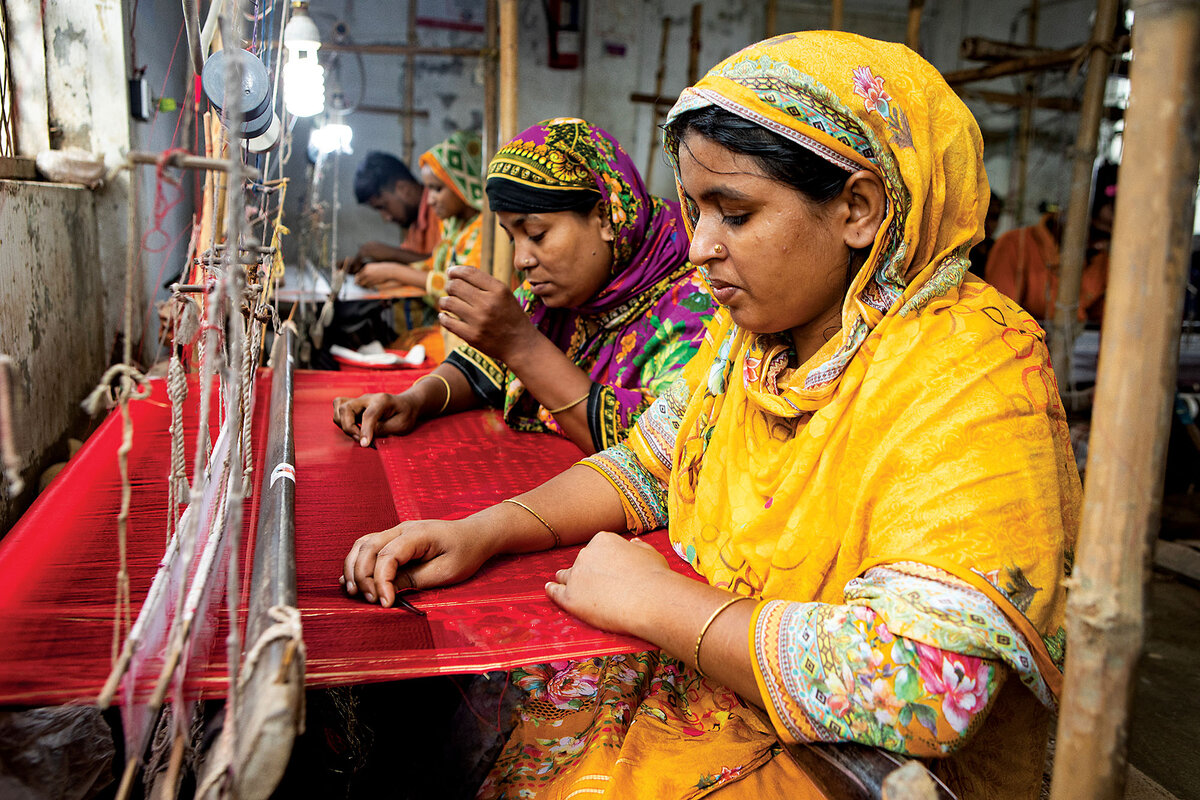
Artisans do “respectful” work on jamdanis at Abul Kalam Jamdani Weaving Factory in Bangladesh.

Recently I wrote about the the Fuller Craft Museum’s exhibit of the Red Dress, an embroidered garment “worked on by 380 individuals from 51 countries, mostly female, many of whom were vulnerable and living in poverty” — women who felt uplifted by an art project that honored their skills.

Today’s post is also about women’s handcrafts.

Sara Miller Llana reports at the Christian Science Monitor, “Two dozen artisans crouch over hand looms threaded with bright-orange and sky-blue cottons. Their fingers nimbly create a jamdani, an intricately woven sari dating back to the [16th century] Mughal Empire. …

“Made of fine cotton or silk, the jamdani was a pinnacle of fashion centuries ago. But in the 19th century, British colonizers brought in their iteration of fast fashion, and the tradition nearly went extinct. …

“After Bangladesh became an independent nation in 1971, the nongovernmental organization BRAC set out to revitalize the weaving practice. It approached artisan families like that of Anwar Islam, owner of this shop. ‘I didn’t think it was feasible, but I was happy to be part of the solution,’ says Mr. Islam. 

“Today he employs 120 weavers at Abul Kalam Jamdani Weaving Factory. …

“But this is not just a business success story. … The jamdani is seen as a story of cultural success, too. It’s part of the championing and preservation of objects from sealskin parkas in the Arctic to duck decoys and quilts across the United States that otherwise may be forgotten.

” ‘People have been striving to decorate their lives to tell the world who they are for centuries,’ says Chris Gorman, a deputy director of the American Folk Art Museum in New York. … ‘Without people championing the study and preservation of objects like these, and others, there is the possibility that people will simply forget about them, and it is hard to revive them or prove their relevance.’

“About the time the jamdani was being revived, a women’s collective was coming to life at the northernmost tip of Canada, in the town of Taloyoak.  

“Begun in 1972, the group, called Arnaqarvik, garnered a burst of fame in its day with its Inuit parkas, mitts, and boots made from caribou, wolf, and seal and patterned with dyes from tundra lichen and flowers. The collective’s work — including, eventually, duffel-wool ‘packing dolls, or miniature stuffed animals carrying their babies in parkas as the Inuit do — was showcased in New York City and the 1974 Arctic Winter Games in Alaska.

“Yet today, just as the jamdani is enjoying global appeal, the work of Arnaqarvik has been largely forgotten. So the Kitikmeot Heritage Society in Cambridge Bay, in Canada’s Nunavut territory, has set out to restore its memory in a digital archive. 

“And to mark the 50th anniversary of the collective, about 250 items in 2021 were sent back to Taloyoak in an exhibition. It was the first time most in the community found out what Arnaqarvik even was. ‘Everybody was really surprised by what their parents did in those days,’ says Arnaoyok Alookee, Arnaqarvik’s co-founder.

“Brendan Griebel, an Arctic anthropologist and manager of collections and archives for the Kitikmeot Heritage Society, says this reconnection is about far more than just the production of goods. ‘Having that physical contact ignites something in the memory and in the senses,’ he says.

“When Arnaqarvik began, the semi-nomadic Inuit of Taloyoak had only gradually moved into this permanent settlement the decade prior. The collective helped the community bridge a gap — between its Indigenous traditions and the new wage economy into which it was settling. 

“Judy McGrath co-founded the collective with Ms. Alookee when her husband was posted for work in the Arctic community. She says she still recalls the sense of purpose that craft-making gave all of them. They collected flowers with their children in 24-hour sunlight; they’d use the 24-hour darkness of winter to boil their dyes on the stove. ‘I can still feel the confidence that the skills they had mattered, and the excitement over making new things from the old, from the land,’ Ms. McGrath says.

“In Bangladesh, the rise of the jamdani was also driven by economics, to help artisans whose enormous skills couldn’t find the market for livelihoods. BRAC, the country’s largest NGO, created the brand Aarong to distribute their products. …

“Making a jamdani, which derives from the Persian words jam (floral) and dani (vase), is what weaver Mohammed Monir calls a ‘respectful’ job. … ‘When I see someone famous wearing something I made, I feel proud,’ he adds.

“Today jamdani weaving is included on UNESCO’s Representative List of the Intangible Cultural Heritage of Humanity.”

More at the Monitor, here. No firewall. Reasonable subscription. You can also sign up for their free weekend updates.

Read Full Post »

Photo: TJ Watt/Ancient Forest Alliance.
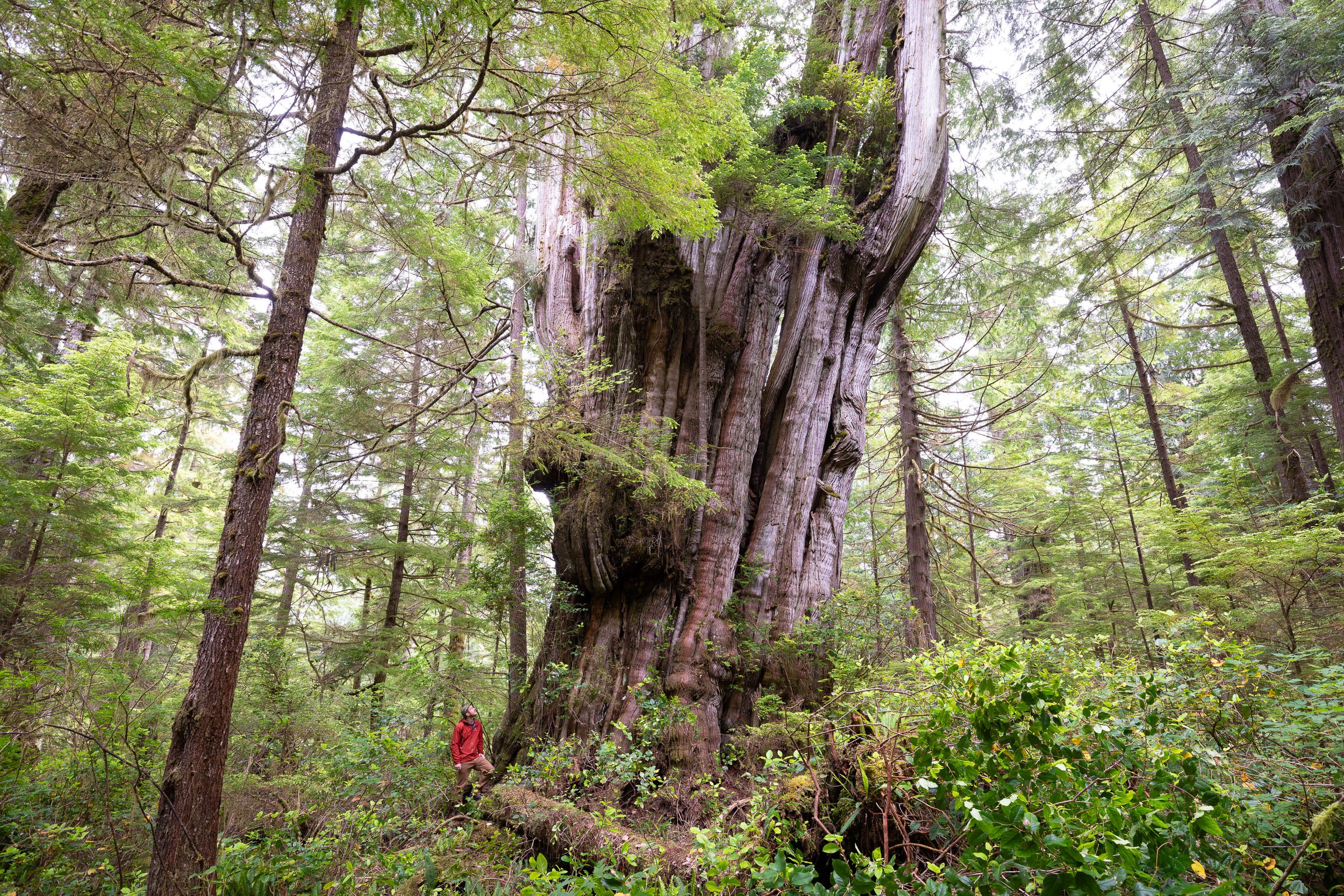
Ancient Forest Alliance photographer TJ Watt and an ancient Western red cedar. The tree is estimated to be 46 metres high [150 feet]. It is located on Flores Island, in Clayoquot Sound off Vancouver Island in the territory of Canada’s Ahousaht tribe. 

I love reading about unusual careers and pursuits people have devoted their lives to. There’s so much to learn!

Chad Pawson reports at Canadian Broadcasting (CBC) about a guy at the Ancient Forest Alliance in Canada who hunts down big, old trees. Although the local indigenous people probably always knew about the tree he calls “The Wall,” it can’t hurt to teach others about why it needs protection.

“For 20 years, Victoria’s TJ Watt, 39, has trekked through the province’s vast and verdant landscape seeking out giant, old trees to document them and make a case for their conservation. Now, at a time when exceptionally large trees have dwindled due to logging, he’s recorded what he calls the tree of his lifetime.

” ‘No tree has blown me away more than this one,’ he said. ‘It literally is a wall of wood.’

“Watt photographed the tree, a Western red cedar, in 2022 on Flores Island in fabled Clayoquot Sound on Ahousaht First Nations territory while on a field trip as a National Geographic and Royal Canadian Geographical Society explorer. (The species is also spelled redcedar because it’s not deemed to be a true cedar.)

“It’s estimated to be 46 metres tall [151 feet] and five metres wide at its base. The old-growth tree, part of forests that store carbon and support many species of plants and animals, is estimated to be at least 1,000 years old, according to Watt.

“Its dimensions put it at the very top of the biggest and oldest trees in the province and across Canada.

” ‘Unlike most other trees, it actually gets wider as it goes up,’ said Watt. …

“Watt and the Ahousaht First Nation have now revealed images and details of the tree to the public — although keeping its location secret — to show it as an example of the importance of the province meeting commitments to overhaul forestry to balance harvesting with ecological values.

” ‘It’s representative of a healthy, intact, coastal, temperate ecosystem,’ said Tyson Atleo, 36, a hereditary representative of the Ahousaht First Nation. ‘We don’t see a lot of trees that size anymore.’

“The tree has been nicknamed ‘The Wall or [a word meaning] ‘big redcedar’ in the Nuu-chah-nulth language. It’s in a type of forest that’s in danger of disappearing from B.C.’s landscape due to a history of intense logging. …

“The tree is not currently in danger of being logged as it’s in an area where old-growth logging is being deferred as part of work between First Nations and the province to protect old-growth forests at risk of permanent biodiversity loss.

“The Ahousaht First Nation, whose territory spans Clayoquot Sound, a globally recognized biosphere reserve, is at the forefront of work to keep significant trees in biodiverse forests standing while finding other ways, such as tourism, to replace lost revenues. …

“Ahous Adventures, an Ahousaht-owned and operated eco-cultural tour company in Tofino, won’t be taking visitors to the tree in order to keep the area protected but does other tours to show off the region’s other impressive trees.

“Nations like the Ahousaht are hoping for more conservation funding from the province to be able to develop [alternatives to logging]. …

“In order to raise funds on its own, the Ahousaht has established a voluntary stewardship fee for its territories, much like B.C. Parks’ day-use passes.

“Meanwhile, others also making careers of trying to locate and document massive old-growth trees that still exist, say coming across trees like The Wall is akin to a religious experience.

” ‘You feel so small, and you realize it is so incredibly important what these things are. They represent so much more than just a tree. It’s an ecosystem unto itself,’ said Colin Spratt, a conservation photographer who takes people on tours of Vancouver’s Stanley Park to show off old-growth trees there.”

More at the CBC, here. Other details at the Washington Post, here.

Read Full Post »

Photo: Eldred Allen.
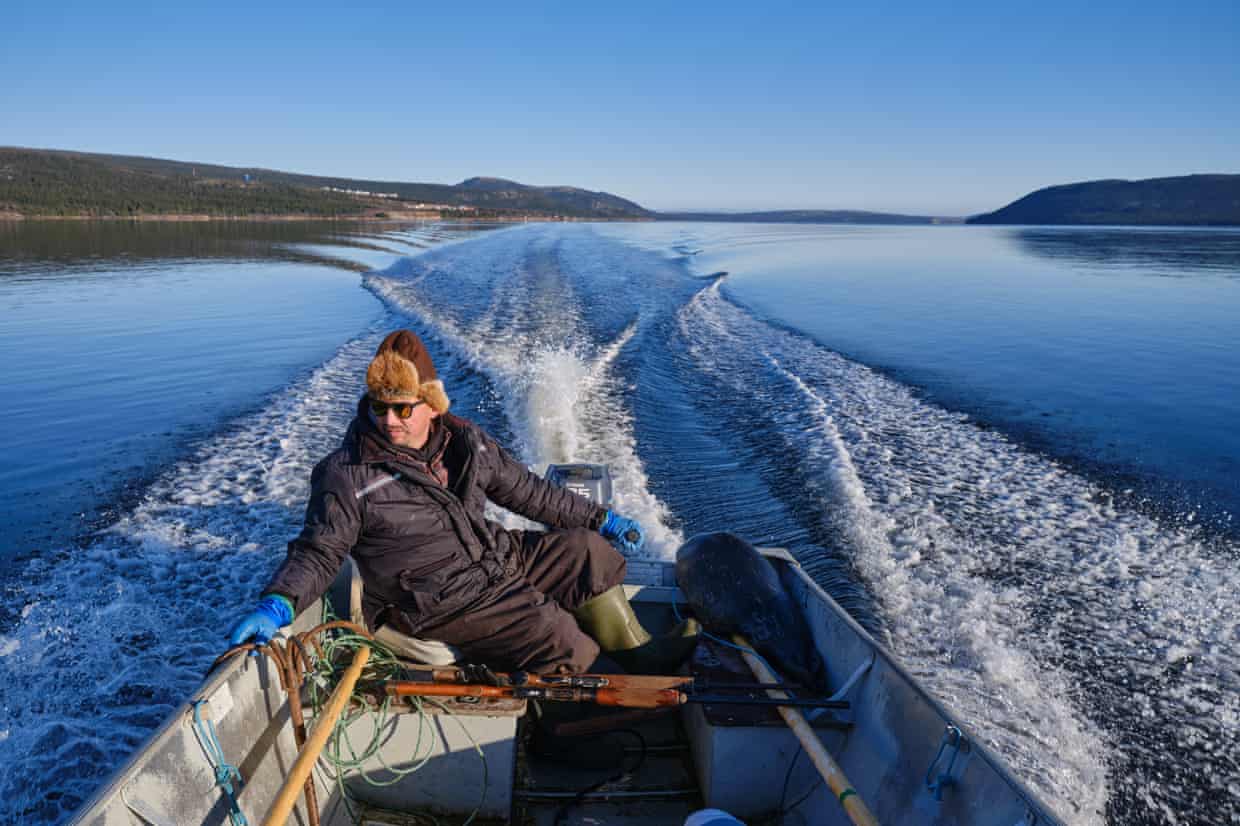
Martin Shiwak, an Inuit, with his hunting rifle in his boat, on Lake Melville, near Rigolet in Nunatsiavut, Canada.

Can you handle another story about how we are finally learning that indigenous ways are better for everyone in a changing climate? I don’t mean we all need to hunt and fish. I’m talking about protecting land and water from resource exploitation.

Ossie Michelin writes at the Guardian that “the environment Inuit have lived in for millennia is changing fast. Canada’s government once ignored Indigenous knowledge of it but now they are jointly creating the Nunatsiavut conservation area. …

“Martin Shiwak accelerates his boat to grab the seal he has shot before the animal sinks out of sight. Shiwak has hunted for years in the waters of Lake Melville, by the Inuit community of Rigolet in Nunatsiavut.

“As he hauls the ringed seal into the vessel, he says he counts himself lucky to have found one so quickly. ‘Sometimes you have to drive around here in the boat nearly all day to find a seal,’ Shiwak says. ‘Nowadays you can’t even afford to – C$60 only gets you five gallons of gas.’

“Nunatsiavut – one of four Inuit homelands in Canada – is where the subarctic becomes the Arctic. An autonomous region of Labrador-Newfoundland province, it is located at the extreme north-east corner of North America.

“Winter temperatures here can average -30C (-22F) with the windchill, as the Labrador current brings Arctic ice floes down along the coast, and a host of marine life from, plankton to polar bears. From November to June, shipping is impossible because sea ice covers the entire 9,320-mile (15,000km) coastline, so all food and supplies must be flown in. In Rigolet, a frozen 1.5kg (3.3lb) chicken will set you back C$25 (£15). Hunting is not just a tradition but a necessity. …

“As a young boy, he learned to hunt and fish with his father and grandfather, who in turn had learned these vital skills from their elders. It is also how Shiwak learned the core Inuit values of taking only what is needed, sharing, sustainability and respect for nature – values he is passing down to his own children. …

“But while traditional knowledge has allowed Inuit to survive in this harsh environment for so long, the climatic conditions they rely on are changing quickly. Since 1950, Nunatsiavut has lost 40 days of ground snow a year. Its sea ice is vanishing faster than anywhere in the Canadian Arctic. …

“There is very little local people can do about that: although the region is roughly the size of the Republic of Ireland, Nunatsiavut’s population is less than 3,000, spread among five small towns. What they can do, however, is work to protect what they have. That’s why Nunatsiavut is partnering with the Canadian government to co-develop the world’s first Inuit Protected Area of this type.

“While there are other Inuit-led marine conservation programs in Canada, this will be the first to bear the title of Inuit Protected Area. … Built on Inuit values and culture, this type of conservation area would allow Indigenous people to continue traditional practices of hunting and fishing.

“That was not always the case. Past conservation policies saw Inuit at best only consulted and at worst completely ignored. Many Inuit hunters and fishers faced fines, had their equipment confiscated and their catches from hunting and fishing taken.

“Despite being granted the power to self-govern in 2005 (after 30 years of negotiations with the Canadian government), Nunatsiavut still lacked the final say over conservation in its waters. Final decisions defaulted to federal or provincial ministers.

“Now, at last, Nunatsiavut can jointly create and co-manage the protected area, based on Inuit priorities, as an equal authority. This will allow Inuit to practice traditional hunting and fishing in the area, while protecting the waters from industry and development.

“ ‘Just because we’re small doesn’t mean we can’t do something,’ says James Goudie, deputy minister of lands and natural resources in the Nunatsiavut government. ‘We can show the world that a small region can protect a massive amount of biodiversity.’

“The Inuit Protected Area would only cover about a third of Nunatsiavut’s nearly 50,000 sq km of offshore waters, but the region is home to important populations of fish such as salmon and Arctic char, the breeding grounds for many migratory birds, and the habitat of Arctic marine mammals including polar bears, beluga whales and seals.

“Establishing a protected area is also a pre-emptive strike against resource exploitation. Significant natural gas deposits have been found offshore along the Labrador shelf, but it has remained largely unexplored because of the ice. As the climate warms, however, the region is becoming more accessible – the Inuit Protected Area would prevent such resource exploration. …

“The borders of the new area have not been finalized, with the feasibility report expected in 2024 or 2025. But [Rodd Laing, Nunatsiavut’s environment director] notes: ‘You don’t need lines on a map to recognize the great work that happened already with Inuit relative to conservation and the management of ecological resources.’

“After all, he says, for countless generations of Inuit, conservation was not an option that could be ignored: it was a way to ensure there would be enough to eat, and enough next time as well.”

More at the Guardian, here. Nice photos. No firewall.

Read Full Post »

Photo: Whpq at Wikimedia Commons.
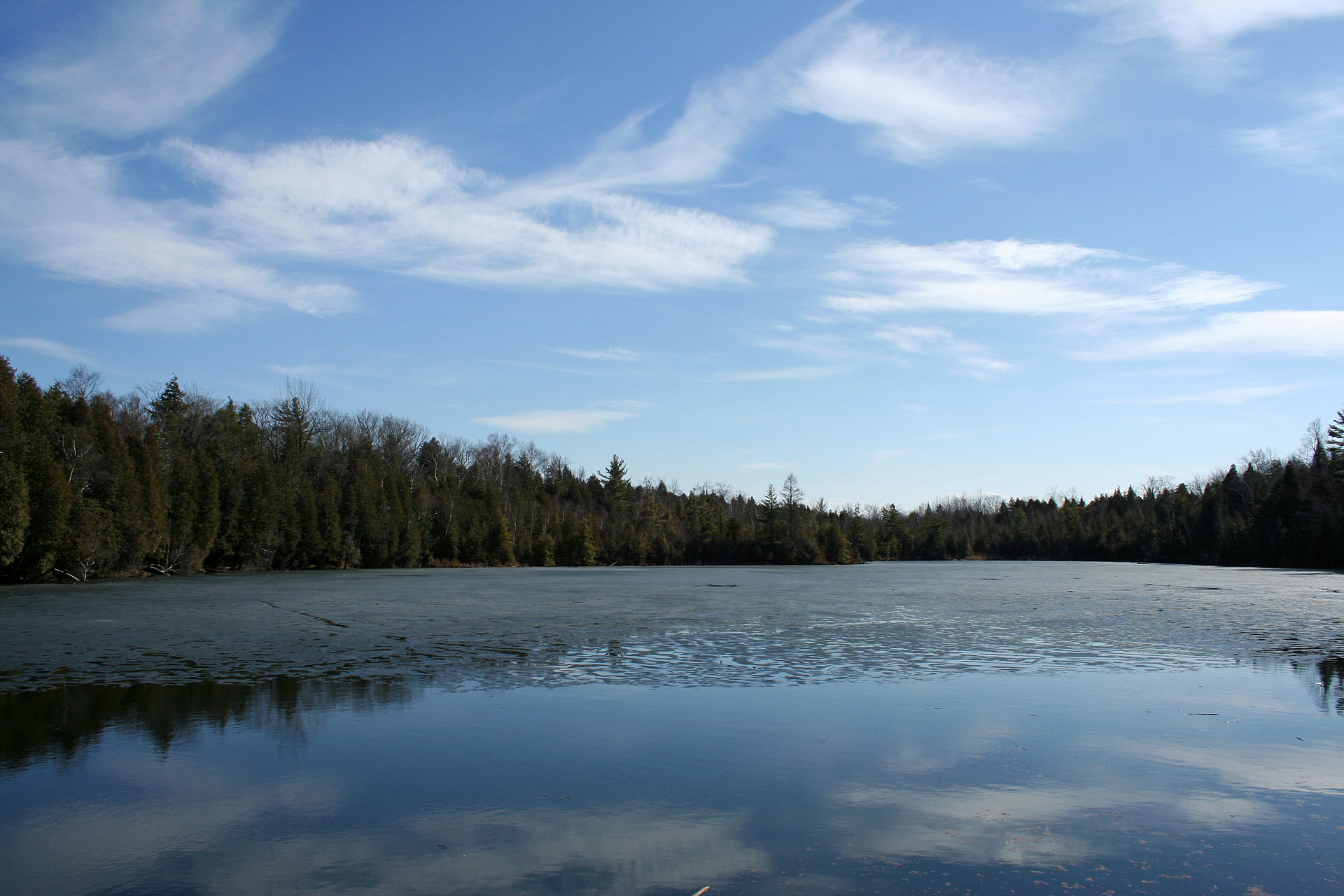
Crawford Lake in Ontario, Canada, is giving up its secrets to geologists.

There is always something new to learn from the ancient record if we know how to read it. Case in point: the unusual characteristics of a deep lake in Canada are helping geologists understand a bit more about today’s rapid changes to the planet.

Sarah Kaplan, Simon Ducroquet, Bonnie Jo Mount, Frank Hulley-Jones, and Emily Wright each contributed to the story at the Washington Post.

“This summer, researchers will determine whether Crawford Lake should be named the official starting point for [the current] geologic chapter, with pollution-laden sediments from the 1950s marking the transition from the dependable environment of the past to the uncertain new reality humans have created.

“In just seven decades, the scientists say, humans have brought about greater changes than they did in more than seven millennia. Never in Earth’s history has the world changed this much, this fast. Never has a single species had the capacity to wreak so much damage — or the chance to prevent so much harm.

“ ‘It’s a line in the sand,’”’ said Francine McCarthy, a professor of Earth sciences at Brock University in Ontario, who has led research on Crawford Lake. …

“Every new phase of Earth’s history begins with a ‘golden spike‘ — a spot in the geologic record where proof of a global transformation is perfectly preserved.

“An exposed Tunisian cliff face bearing traces of an ancient asteroid impact marks the transition from the age of the dinosaurs to the Cenozoic era. Hydrogen molecules uncovered in Greenland’s ice denote the start of the Holocene — the 11,700-year stretch of stable temperatures that encompasses all of human civilization, up to and including the present day.

“These spikes are like exclamation points in the story of the planet, punctuating a tale of shifting continents, evolving species and temperatures that rose and fell as carbon levels fluctuated in the atmosphere. They mark the starts of epochs — small segments of geologic time. And they have helped scientists interpret the forces that shaped Earth’s past climates, which in turn allows them to forecast the effects of modern warming.

“In 2009, the International Commission on Stratigraphy — an obscure scientific body responsible for defining the phases of Earth’s past — created a new working group to investigate the evidence for the Anthropocene. The group’s mission: to identify a potential ‘golden spike’ site that might convince fellow scientists of the new epoch’s validity.

“Their search spanned from mountain summits to the depths of the ocean, from the Antarctic ice sheet to tropical coral reefs. And, in 2018, it led them to McCarthy’s office door.

“Before that moment, few beyond her field knew of McCarthy’s research studying lake sediments for signs of past climate change. Her outreach work was meaningful, but largely local: advocating for conservation of the Great Lakes, teaching geology to students at her midsize public university.

“Crawford Lake was similarly modest. … Yet McCarthy’s colleague Martin Head, a geologist at Brock who had been involved with the Anthropocene Working Group, was intrigued by the rare chemistry uncovered at Crawford.

“Crawford Lake developed thousands of years ago, as water filled a sinkhole in the limestone cliffs of Southern Ontario. Though tiny, the lake is exceptionally deep — so deep its waters are separated into two distinct layers.

“The upper waters are warmed by the sun and mixed by the wind. The layer below is cold and dark, with barely any life to disturb the sediments that accumulate at the bottom. All year long, a constant stream of dead microbes, animal droppings and other organic debris drifts through the Crawford’s waters to settle on the lake bed.

“But during summer, when the the temperature and acidity levels are just right, the water also produces minerals of a white color called calcite that falls to the lake bed forming a thin white cap. Each annual pair of dark and light sediments is also laced with material from outside the lake — pollen grains, pollution particles — that can serve as indicators of the changing environment.

“No other water body is known to possess this particular combination of attributes, making Crawford Lake a unique bellwether of global change. …

“As she considered her colleague’s proposal, McCarthy thought about the decades she’d spent studying prior planetary upheavals. Her work on lake sediments from the past several million years had shown her how dramatic swings in temperature destabilized ecosystems and drove species to extinction.

“Without drastic action to stave off modern climate change, she said, that history could repeat. …

“First, researchers had to tether a wooden raft in the deepest part of the lake, right over the spot they wanted to sample. To extract the lake’s layered sediments, the team used a tool called a ‘freeze corer.’ … The long aluminum wedge was filled with a mixture of alcohol and dry ice, making it much colder than the surrounding water, soil and air.

“They suspended the freeze corer from a tripod and lowered it through a hole in the raft. Down, down it went, through 75 feet of water, until finally it sank into the squishy mud on the lake bottom. Then they waited. It would take about 40 minutes for the lake sediments to freeze onto the corer’s chilly surface.

“Finally, it was time to pull the corer back up. Clinging to its face was a five-foot slice of mud, cut from the lake bottom like a piece from the center of a cake.

“Back on shore, McCarthy traced a gloved finger over the core’s delicate brown and white stripes — sharper than any other sample she’d seen. … Each sample, she knew, would give her a glimpse into a thousand years of the lake’s history, revealing its deepest responses to the changing world above. Each was like a new page from the diary of the Earth. …

“The archive inside Crawford Lake’s cores shows how human pressures on the lake built up over the centuries like steam inside a kettle, until finally the kettle boiled over.

“But humanity’s influence hasn’t always been so destructive.The first people to make their mark on the lake were Native villagers who built longhouses near the lakeshore. Researchers have counted more than two centuries’ worth of sediments from the lake’s ‘Indigenous period’ containing crop pollen and other evidence of human habitation alongside ancient goose droppings and traces of trees.

“Around the start of the 16th century, all signs of the settlement vanished for reasons still unknown. … Sediments from subsequent eras showed Europeans’ growing influence on the landscape. White pine pollen counts dwindled as people cut down trees. Traces of ragweed marked how different species flourished in the cleared land.

“The impacts piled up throughout the 19th and 20th centuries. Tiny black bits of fly ash — a byproduct of burning coal and oil — drifted into the lake from rapidly industrializing cities. Heavy metals like copper and lead increased in the mud.

“And then, around 1950, the world reached a tipping point.

“ ‘This is when humans essentially overwhelmed the Earth as a functioning system,’ said Head, McCarthy’s collaborator. Crawford Lake — and the rest of the planet — were fundamentally, irrevocably transformed.

“The sharpest sign of change was a surge in radioactive plutonium that started in Crawford Lake’s mud around 1950. … A lighter form of nitrogen — a molecular signature of burning fossil fuels — proliferated. The amount of fly ash increased eightfold in less than five years.”

More at the Post, here. If you have a subscription, you can see very cool graphics showing odds and ends floating downward through water.

Read Full Post »

Photo: Dan Plaster/CBC News/Creative City Centre.
An aerial view of “The Path to Reconciliation” (2023) in downtown Regina, Saskatchewan.

There’s a new effort in Canada to make the art of indigenous people more visible to all. At Hyperallergic, Rhea Nayyar reports on one public project, “The Path to Reconciliation,” a pavement mural painted in the style of traditional beadwork.

“Hundreds gathered in downtown Regina, the capital city of the Canadian province of Saskatchewan,” writes Fayyar, “for the unveiling of a new public artwork on National Indigenous Peoples’ Day last Wednesday, June 21. Cree-Métis artist Geanna Dunbar and Inuvialuit-Gwich’in artist Brandy Jones designed ‘The Path to Reconciliation’ (2023), a 300-foot-long and eight-foot-wide footpath mural on pavement rendered in the style of traditional First Nations beadwork. The piece featured over 2,600 painted circular ‘beads,’ also referencing the significance of the circle as a broader Indigenous symbol rooted in healing, community gatherings, and mutual support without hierarchies.

“The mural occupies a stretch of a downtown pedestrian-only city block at the F.W. Hills Mall on Scarth Street. Dunbar and Jones incorporated motifs such as flowers for their ubiquitous representation in every culture; bison bones to honor how First Nations peoples use every part of an animal for sustenance and survival and in acknowledgment of their near extinction due to colonial overhunting; and the colors of the aurora borealis that represent late ancestors looking down and offering guidance to those still on Earth. The path begins in front of late artist Joe Fafard’s buffalo sculpture, ‘oskana ka-asasteki’ (1998), and is marked by a painting of a white buffalo, which signifies the sacred loop of life for several Indigenous cultures. …

“ ‘Reconciliation begins with starting these conversations and improving education around these subjects,’ Jones said, reflecting on her community work on top of this project. ‘There’s so much interest in wanting to learn more and help out.’ …

“Dunbar and Jones sought guidance and knowledge from Muscowpetung First Nation Elder and residential school survivor Brenda Dubois as well as Indigenous cultural art advisor Audrey Dreaver for this endeavor.

“ ‘Dubois told us a very powerful story about how river water and ocean water pass through obstacles to meet each other, and that really resonated with us so we made blue background beads to represent the journey of water along the path,’ Dunbar noted. Jones mentioned that Dubois had a grounding presence that helped the artists tone down their perfectionistic tendencies for this project and that Dreaver was a great resource for historical knowledge about the ubiquity of beadwork as a post-colonial impact on First Nations cultures across North America.

“The artists joined forces on this project through the Creative City Centre (CCC), an artist-run community space in Regina that provides employment opportunities and professional development assistance to independent creative workers, and the Regina Downtown Business Improvement District.

“ ‘It was interesting to see a bunch of people coming together from different places, financial classes, cities, and so on really endure the harsh weather of an extreme heat wave for this,’ Dunbar said of the public turnout. ‘We were all uncomfortable, and that also represents the path of reconciliation — to feel what it’s like to be uncomfortable in situations and work together as a team.’ She stated that reconciliation for non-Indigenous people to foster and maintain respectful relationships with First Nations people means knowing where your money is going, and ‘putting in the work and creating jobs.’

“ ‘You can wear an orange shirt for Every Child Matters Day (September 30), or you can come out on Indigenous Peoples’ Day (June 21), but where did you get your orange shirt?’ Dunbar asked. ‘Did you buy your shirt at Walmart, or did you purchase it from an Indigenous artist?’ “

We do not seem to have enough colors for all the serious issues dyed T-shirts represent nowadays. Today I am learning about orange for indigenous children, but I know orange is also used in MS ribbons and, separately, for ending gun violence.

More at Hyperallergic, here. Nice pictures. Subscriptions welcome.

Read Full Post »

Photo: Michael Briones via Vancouver Island Free Daily.
Vancouver Island Walking Soccer Alternate’s Rob Jonas (left) and Bob Unwin try to stop Harry Hubbal of UBC Masters.

The second time my neighbor Ralph broke his leg playing pick-up soccer with other old folks, he decided maybe it was time to give it up. But he loved playing the game. Giving it up was going to be hard.

Wait! There’s hope for people like Ralph! Meeri Kim describes the interesting alternative at the Washington Post.

“Aside from his wife, soccer is the love of Gary Clark’s life. He started playing at age 7 and kept it up for more than four decades, even representing his home country Canada at the international level.

“His involvement in the sport, though, was cut short at age 48, following a knee replacement surgery. When Clark asked about getting back on the field, his doctor told him to go ahead — but only if he wanted another knee replaced.

“He dipped his toe in the water by joining a pickup game and tore the cartilage in his other knee.

“ ‘There was a sense of loss at not being able to go out and partake in my passion,’ said Clark, now 68, of Coquitlam, B.C. ‘And I knew that if I tried, I would injure myself again.’ …

“The game requires rapid accelerations, decelerations, turns and stops, which take a toll on players’ knees and ankles. A standard soccer pitch, at 115 yards long and 74 yards wide, is larger than an American football field. Players cover, on average, nearly seven miles, in a single match.

“So when a variant of the sport with no running allowed emerged in 2011, some laughed it off as a joke. Walking soccer, however, has become a global phenomenon.

“In 2011, Chesterfield FC Community Trust launched its walking football program in Derbyshire, England, as part of an initiative for older adults.

“Players can’t run or jog, with or without the ball, and one foot must be in contact with the ground at all times. Other rules also differ from regular soccer, to prioritize players’ health and safety. For example, tackling is only allowed with no contact; all free kicks are indirect; and the ball must never go over head height.

“Walking soccer is played on a smaller field (55 to 65 yards long, and 35 to 45 yards wide) and with six people on each team instead of 11.

“There are about 600 walking football clubs in England alone, for men and women.

“The country is also home to the international governing body for walking football, the Federation of International Walking Football Associations (FIWFA), which includes member organizations from countries such as Italy, Nigeria, Australia, South Korea and India. And the inaugural World Nations Cup — the equivalent of the World Cup for walking soccer — will take place in August in the United Kingdom.

Clubs have cropped up in Seattle, Chicago, Southern California, Vancouver and a few other cities and regions in the United States and Canada. …

“ ‘I have lost weight playing, so I think that’s a good sign,’ said Clark, who has played with the Tri-City Walking Soccer Club for about a year. He logs up to 13,000 to 18,000 steps in a single game, but notes that most players average around 3,500 to 7,000 steps.

“George Gorecki, 62, started Walking Soccer Chicago in early 2019, after hearing about the sport from a U.K.-based friend. The Chicago resident used to play competitive amateur soccer with a club before arthritis in his left knee and right hip slowed him down. Many older members of Walking Soccer Chicago found themselves in the same boat — unable to play because of medical conditions. …

“ ‘The guys really took to it because they were able to reconnect with their teammates, both on the field and in a social setting after the game,’ Gorecki said. …

“Most studies on walking soccer have small sample sizes, but a 2020 review of research on the sport determined that it may have health benefits and help build social connections. A 2015 study found that 12 weeks of walking soccer, in the form of a two-hour training session per week, significantly reduced body mass and percentage body fat in 10 older men. Participants, with an average age of 66, had various comorbidities, including hypertension, knee osteoarthritis and Type 2 diabetes.

“The researchers concluded that walking football is safe and effective as a public health intervention — for not only healthy individuals but also those with various exercise-limiting medical conditions.

“Other research has focused on the mental and social aspects of the sport. In a 2022 study, seven men with mental health conditions such as depression or anxiety underwent a walking football intervention. It involved up to an hour playing a game, followed by an opportunity to meet and socialize. The men reported several positive effects on their well-being. They enjoyed socializing, developed new friendships and felt a renewed sense of purpose.” More at the Post, here.

I don’t know why I am chuckling my way through this story. I do think it’s a great idea for soccer lovers — maybe even less dangerous than pickleball.

Read Full Post »

Photo: Jenna Hauck/ Chilliwack Progress.
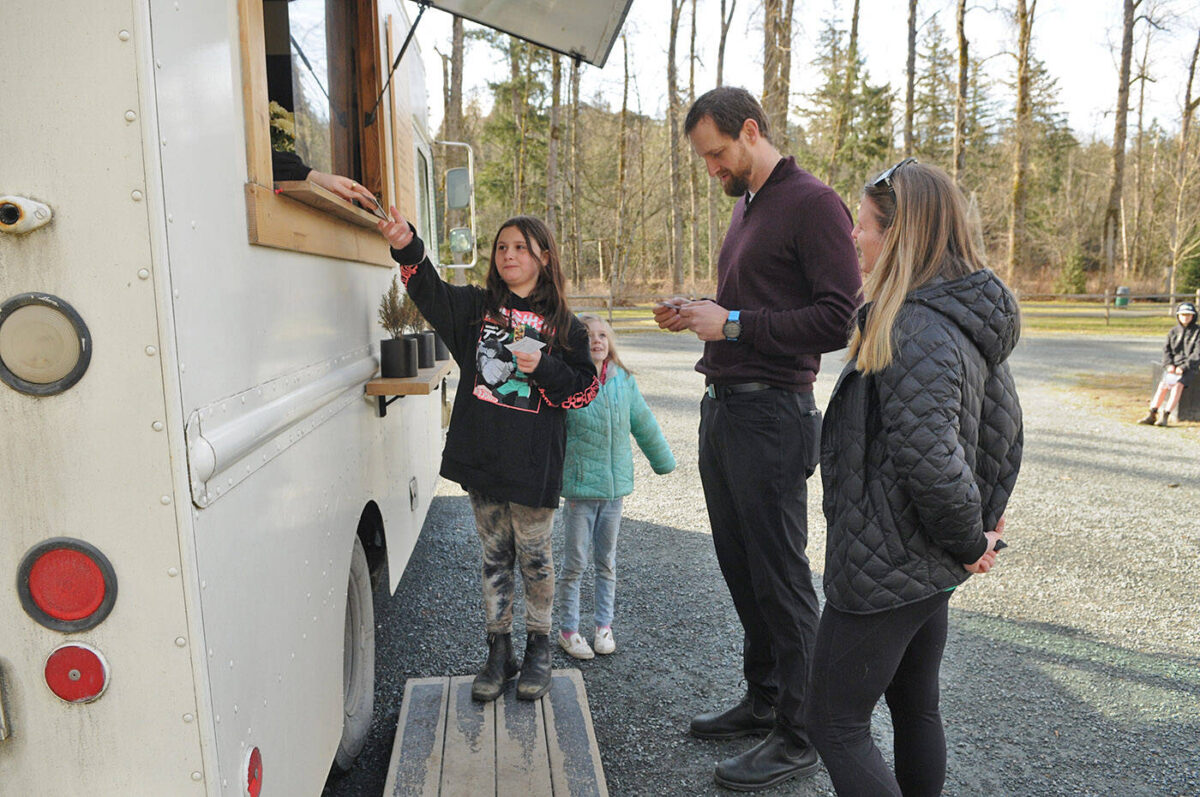
Children in Canada buying coffee for two strangers at Vedder Park during Watson Elementary’s Kindness Project on March 15. It’s all part of the curriculum.

How do you raise children who are kind? Partly by example. And maybe partly by putting generosity in the school curriculum. It can’t hurt to set aside a time for kids to know the satisfaction of committing random acts of kindness.

Sydney Page at the Washington Post writes about an experiment in Canada.

“While writing report cards several years ago, Jennifer Thiessen was troubled by something. Her third-grade students were being evaluated on subjects such as math and science, but not on life skills — such as social responsibility and kindness.

“ ‘That’s the stuff that I feel is really important for them to learn and carry forward in their lives,’ Thiessen said. … ‘There are so many important life lessons I wanted to teach them outside of the curriculum,’ said Thiessen, a teacher at Canada’s Watson Elementary School in Chilliwack, British Columbia.

“She mentioned her concerns to Kyla Stradling, then a fellow teacher at the school, and they hatched a plan. They assigned their students a project that had nothing to do with standard school subjects. Instead, it was centered on spreading goodwill. They called it the ‘Kindness Project.’

“ ‘If we could be that spark of kindness, we could inspire others to do acts of kindness,’ Thiessen told her third-graders in 2018.

“Students from two separate third-grade classes made cupcakes at home and sold them for $1 during a series of bake sales at the school. They raised about $400 and used the proceeds to purchase small gifts — things like bouquets of flowers, dog treats, chocolate bars and coffees — and handed them out to strangers near the school.

‘The students felt joy inside of them; that they did something that day that mattered,’ Thiessen said.

“Many of the gift recipients seemed ‘caught off guard’ at first, she said, though they were all in when the students explained what the project was about. Some were moved to tears. … She decided to make it a yearly activity for third-graders at the school.

“ ‘This project isn’t about who can read the best and who is best at math,’ she said. ‘This is an everybody project. It doesn’t have any limitations when it comes to ability.’

“For the past five years, third-grade students at Watson Elementary have embraced the Kindness Project. They host several bake sales to raise money, and each class adds their own spin to the assignment. During the pandemic, for instance, students collected funds to put together care packages for front-line workers.

“ ‘Every year, we sit down with them and ask them how they want to spend the money,’ Thiessen said. …

“Occasionally, students can be ‘a little overzealous,’ she said. As she brainstormed with her class this year, one child enthusiastically said: ‘Let’s buy someone a house!’ …

“Given the success of the project, the school decided to broaden it this year to involve five classes — including three third-grade classes, and some students in second and fourth grades. They started selling cupcakes each week at the school in February, and over five weeks, they raised more than $1,000 — the highest amount yet. …

“This year, the 100 students split up into several groups to focus on different initiatives. While one group wrote cards and bought small gifts to hand out to strangers, another put together care packages with essential supplies — including toothbrushes, snacks, gloves, socks and sanitizer — for homeless children and teens. Other students made a ‘teacher appreciation bin’ filled with treats and goodies and dropped it off at a nearby school.

“On March 15, the students and chaperones divided and carried out their various kindness missions. Some stayed at coffee shops surrounding the school, offering to buy beverages for strangers, while others waited around a local park, passing out dog treats and fresh flowers. Several students did a forest cleanup. …

“Though the goal of the project is to start a chain of kindness within the community (one man offered up $20 toward next year’s fundraising effort, Thiessen said), it’s also intended to show the students what they are capable of.

“ ‘I think what I want most for them is to know that it doesn’t matter where you come from or how old you are, you can do something that is good,’ Thiessen said.”

The idea of buying someone a house is not necessarily “overzealous,” I’d say. It shows the kid is already thinking about about adult-sized needs. Isn’t that the point?

More at the Post, here. For a version with no firewall, click on the Chilliwack Progress, here.

Read Full Post »

Photo: Conférence PPL 2022.
Brian Maracle shares his technique for teaching the Mohawk language at Canadian conferences such as Multidisciplinary Approaches in Language Policy and Planning (LPP or in French, PPL).

I love learning about other languages and sometimes pick up tidbits through my volunteering with ESL teachers. But languages in danger of dying out are especially interesting to me. If they die out, we lose too much about the ways others see the world.

Today’s story is about a technique for teaching a particular endangered language.

Ian Austen wrote at the New York Times from Ontario, Canada, “When Brian Maracle returned in his mid-40s to the Mohawk community near Toronto that he had left when he was just 5, he didn’t have a job and knew almost no one there.

“But perhaps the biggest challenge facing him was that he neither spoke nor understood much Kanyen’keha, the Mohawk language. More than a century of attempts by Canada’s government to stamp out Indigenous cultures had left Mr. Maracle and many other Indigenous people without their languages.

“Now, 30 years later, Mr. Maracle has become a champion of Mohawk, and is helping revive it and other Indigenous languages, both in Canada and elsewhere, through his transformation of teaching methods.

“ ‘I never studied linguistics, don’t have any teacher training, my parents weren’t speakers,’ he said in his office at an adult language school he founded about two decades ago in his community, the Six Nations of the Grand River territory, southwest of Toronto. Yet, linguistics academic conferences now feature him as a speaker. …

“From the 19th century into the 1990s, thousands of Indigenous students were taken from their homes, sometimes by force, and placed into Canada’s residential schools system. There, they were forbidden from speaking their languages and from practicing their traditions in what a national commission later characterized as ‘cultural genocide.’

“The system failed to entirely eradicate Indigenous languages, but its effect was nevertheless devastating for the 60 Indigenous languages found in Canada.

“Today restoring Indigenous languages has been a component of Canada’s push for reconciliation with its Indigenous people. … Four years ago, the government passed the Indigenous Languages Act, which formally recognizes the importance of these languages and requires the allocation of money — more than 700 million Canadian dollars to date — for teaching them.

“But none of that was around when Mr. Maracle arrived at Six Nations, and the program that was available, he found, was ill-suited for adult students.

“ ‘Indigenous languages are extremely different from English,’ said Ivona Kucerova, the director of the Center for Advanced Research in Experimental and Applied Linguistics at McMaster University in Hamilton, Ontario. ‘But typically what you see is that the local Indigenous language teaching methodologies are designed to teach Western languages.’

“Mr. Maracle said the problem with his first, unsuccessful lesson was that the instructors, generally Mohawk elders without training as language teachers, were tossing out ‘whole words.’

“ ‘They just expected by dropping a word on you and saying it louder that you’d somehow figure it out,’ Mr. Maracle said. ‘They didn’t understand how the language really is structured.’ …

“Mr. Maracle found the answer about 25 years ago in the office of David Kanatawakhon-Maracle, no direct relation, a lecturer at the Western University in London, Ontario.

“ ‘There were little bits of paper all over this big table,’ Mr. Maracle recalled. The lecturer told Mr. Maracle words he had been longing to hear: ‘He said: “I think I’ve got a new way of teaching the language.” ‘

“There were about 60 slips of paper on his office table, and they ‘were the Rosetta Stone of all the things that you need to be a competent beginning speaker,’ Mr. Maracle said.

“Kanyen’keha is a polysynthetic language, where a single word can function as an entire sentence. Those words are made up of morphemes, small elements that change their meaning depending on how they are combined. …

“Understanding that these elements were the key to unlocking the language was the breakthrough Mr. Maracle needed to attain fluency. But other students at the school he helped start in 1999 were still struggling. It became apparent that someone needed to build a curriculum and teaching program around the morphemes, including a color-coded system for grouping them, which Mr. Maracle did through trial and error.

“One essential discovery was figuring out that learning Kanyen’keha requires ‘looking at the world with Mohawk language eyes,’ he said. In comparison with other languages, Kanyen’keha relies heavily on verbs.

Objects are generally described by what they do. The word for ‘computer,’ for example, roughly translates as ‘it brings things up.’

“ ‘We don’t teach you how to say “pencil,” “chair,” ”shoe” for six months,’ Mr. Maracle said. ‘Because the language is a verb-based language, the names of things are less grammatically important.’

“Prof. Kucerova, the director of the linguistics center in Hamilton, regards Mr. Maracle as a linguist despite his lack of formal training. She said tests showed that his students emerged with a university-level fluidity in two years.

“ ‘I have never seen anyone else bring adult learners to that level of language, to be able to speak at this level after two years,’ she said, adding that Mohawk ranks with Arabic in terms of difficulty for English-speaking students. ‘That’s really astonishing.’

“ ‘I became literally mesmerized by the extent of his work,’ Prof. Kucerova said. ‘He’s figured out this improbable, but linguistically extremely smart, method of delivering this radically different language to adults.’ ”

More at the Times, here.

Read Full Post »

Photo: John and Suzanne’s Mom.
Do we know what’s in our drinking water? University of British Columbia researchers are working on an experimental material to remove toxic “forever chemicals” from water. 

As soon as we learn about a new hazard to humans, it seems, science labs pop up to address it. Lately, we’ve been hearing a lot about “forever chemicals,” dangerous compounds that are often in drinking water. Thank goodness, a variety of labs are on the case.

For example, as Allyson Chiu reports at the Washington Post, Canadian researchers “have developed a method to filter toxic ‘forever chemicals’ from water and potentially destroy the long-lasting compounds permanently.

“Commonly known as ‘forever chemicals’ because they can persist in the environment for years, these hazardous compounds have long troubled environmentalists and regulators. Their harmful effects on human health are well documented, but their ubiquitous use and the challenges in breaking them down have complicated efforts to eliminate them.

“Pressure to do so is growing. In March, the Environmental Protection Agency proposed the nation’s first drinking-water standards requiring water utilities to reduce levels of PFAS — perfluoroalkyl and polyfluoroalkyl substances.

The new technology, described by one of its developers as a ‘Brita filter, but a thousand times better,’ could help address the problem, experts say.

“ ‘The potential impact will be huge,’ said Madjid Mohseni, a professor of chemical and biological engineering at the University of British Columbia who led the research. …

“Polyfluoroalkyl and perfluoroalkyl substances are a class of thousands of different chemicals with varying properties. The highly durable chemicals have been used for decades to make nonstick cookware, moisture-repellent fabrics and flame-retardant equipment, and they are found in other commonly used consumer goods such as cosmetics and food packaging.

“Several U.S. states and other countries have banned certain types of PFAS, and many major companies say they have discontinued their use, but the compounds have shown up in the water supplies of communities across the country and the world. The chemicals have been linked to infertility, thyroid problems and several types of cancer.

“Technologies already exist to remove PFAS from water, but Mohseni and other experts say these approaches have limitations.

“Activated carbon, for example, can filter what is known as long-chain PFAS but does not as effectively trap the shorter-chain variants of the chemicals. Short-chain PFAS, some of which can be toxic at low doses, are becoming more prevalent as many manufacturers use them as a replacement for the long-chain compounds.

“Existing methods also typically create waste products that contain high concentrations of PFAS, which often end up in landfills or are incinerated, said Erik Olson, a senior strategic director at the Natural Resources Defense Council.

“From landfills, the harmful chemicals could leech back into the environment. Burning them is not ideal, either. ‘Only extremely high-temperature incineration can even start to destroy PFAS,’ Olson said. ‘Normal incineration just simply sends PFAS up the smokestack.’

“Mohseni said the material his team developed — which looks like tiny porous plastic beads — can remove long- and short-chain chemicals at rates that match or exceed industry standards. The PFAS it captures could be stripped away, also making the beads potentially reusable or recyclable, he said.

“Additionally, Mohseni said, the team engineered techniques designed to break the leftover PFAS down into harmless compounds.

“The beads eventually could be used in products to filter water in homes, industrial sites and at municipal levels, he added. However, for in-home applications, users would have to send the used filters to centralized locations for regeneration or recycling, and for the PFAS to be broken down fully — somewhat like how some used coffee pods are sent back to manufacturers for recycling, Mohseni said.

“His team’s findings have been published in several peer-reviewed journals.

“Although the technology is promising, experts not involved in the research say it has yet to be proved in real-world settings at scale. The UBC research team has launched pilot trials in British Columbia, but none of the sites are yet sources of drinking water. …

“Removing the chemicals from water and breaking them down is only part of the solution to the PFAS problem, said Cora Young, an associate professor of chemistry at York University in Toronto who studies the chemicals.

“ ‘Destroying PFAS that already exist is a useful thing, but a lot of other approaches have to be used to actually reduce its impact as an environmental problem,’ Young said.”

More at the Post, here. Good on you, Canada!

Read Full Post »

Older Posts »