Feeds:
Posts
Comments

Posts Tagged ‘children’

At the Paper Mill Playhouse in Millburn, New Jersey, a group of children are learning the joy of theater.

Tammy La Gorce writes in the NY Times that the playhouse now has a class for children with disabilities.

“The class is a logical next step for Paper Mill, which last year began offering a series of sensory-friendly presentations for children with autism in its ‘Theater for Everyone’ programming. Sensory-friendly shows are scripted to be more literal, with innuendo kept to a minimum, and the theater’s lighting and volume are adjusted to help audience members feel more comfortable.

“This year, in a partnership with VSA New Jersey, a nonprofit organization that provides arts programming for children and adults with disabilities, Paper Mill joined the ranks of theaters welcoming such children who have an interest in learning to perform.

“Parents of children with developmental disabilities ‘are seeing the benefits of arts education,’ said Lisa Cooney, 46, director of education for Paper Mill. ‘And they’re a lot more proactive than they used to be.’

“Those who run the programs find them rewarding as well. The children ‘give so much to us,’ said Mickey McNany, the director of Paper Mill’s Theater School, after the recent class. In it, her 10-year-old granddaughter, Mary McNany, who has Down syndrome, identified Mozart as the composer of ‘Eine kleine Nachtmusik,’ performed an improvised roller-skating scene and used sign language, as well as her voice, to sing a song.” Read more.

Below, Marnie McNany takes part with her children Finn and Mary.
Photograph: Aaron Houston for the New York Times

Read Full Post »

Last night I went to a jazz benefit for the nonprofit Kids4Peace Boston, which sponsors a summer camp and other events for children of three faiths — Christian, Muslim, and Jewish. The children are from both the United States and Jerusalem and are 11 to 12. Read more about the program here.

The fundraising event was held in the Grand Circle Gallery in Boston, which features magnificent travel posters and travel photography from the 1930s and 1940s. The entertainment was provided by Indian vocalist Annette Philip and her jazz quartet. Very impressive.

Read Full Post »

The other day John brought up the topic of Andrew Carnegie. Whatever else might be said about this 19th Century steel baron, you have to give him credit for putting so much of his fortune into philanthropy, especially libraries.

Today John Wood is carrying on that work in impoverished countries around the world. As Nicholas Kristof writes in the NY Times, “Wood’s charity, Room to Read, has opened 12,000 … libraries around the world, along with 1,500 schools. …

“He has opened nearly five times as many libraries as Carnegie, even if his are mostly single-room affairs that look nothing like the grand Carnegie libraries. Room to Read is one of America’s fastest-growing charities and is now opening new libraries at an astonishing clip of six a day. …

“He also runs Room to Read with an aggressive businesslike efficiency that he learned at Microsoft, attacking illiteracy as if it were Netscape. He tells supporters that they aren’t donating to charity but making an investment: Where can you get more bang for the buck than starting a library for $5,000? …

“ ‘In 20 years,’ Wood told me, ‘I’d like to have 100,000 libraries, reaching 50 million kids. Our 50-year goal is to reverse the notion that any child can be told “you were born in the wrong place at the wrong time and so you will not get educated.” ‘ ” Read more.

Photograph of John Wood: Room to Read

Read Full Post »

A reason that poor children are sometimes unprepared for school is that the words they are starting to read in books may not convey meaning to them. What does it mean to park a car if you have never ridden in a car?

The NY Times has a lovely article about one NYC school’s unusual field trips, designed to fill some gaps in knowledge that textbook writers take for granted.

Michael Winerip writes, “Experiences that are routine in middle-class homes are not for P.S. 142 children. When Dao Krings, a second-grade teacher, asked her students recently how many had never been inside a car, several, including Tyler Rodriguez, raised their hands. ‘I’ve been inside a bus,’ Tyler said. ‘Does that count?’

“When a new shipment of books arrives, Rhonda Levy, the principal, frets. Reading with comprehension assumes a shared prior knowledge, and cars are not the only gap at P.S. 142. Many of the children have never been to a zoo or to New Jersey. Some think the emergency room of New York Downtown Hospital is the doctor’s office. …

“Working with Renée Dinnerstein, an early childhood specialist, [Ms. Levy] has made real life experiences the center of academic lessons, in hopes of improving reading and math skills by broadening children’s frames of reference.

“The goal is to make learning more fun for younger children. … While many schools have removed stations for play from kindergarten, Ms. Levy has added them in first and second grades. [And] several times a month they take what are known as field trips to the sidewalk. In early February the second graders went around the block to study Muni-Meters and parking signs. They learned new vocabulary words, like ‘parking,’ ‘violations’ and ‘bureau.’ JenLee Zhong calculated that if Ms. Krings put 50 cents in the Muni-Meter and could park for 10 minutes, for 40 minutes she would have to put in $2. They discovered that a sign that says ‘No Standing Any Time’ is not intended for kids like them on the sidewalk.” Read more.

One thinks of all the small daily interactions one has with one’s own children and the learning occurring without forethought. There are interactions and learning in poor families, too, but if the words and concepts are not what they kids will encounter in school, I think these excursions can be very helpful.

Photograph: Librado Romero, NY Times

Read Full Post »

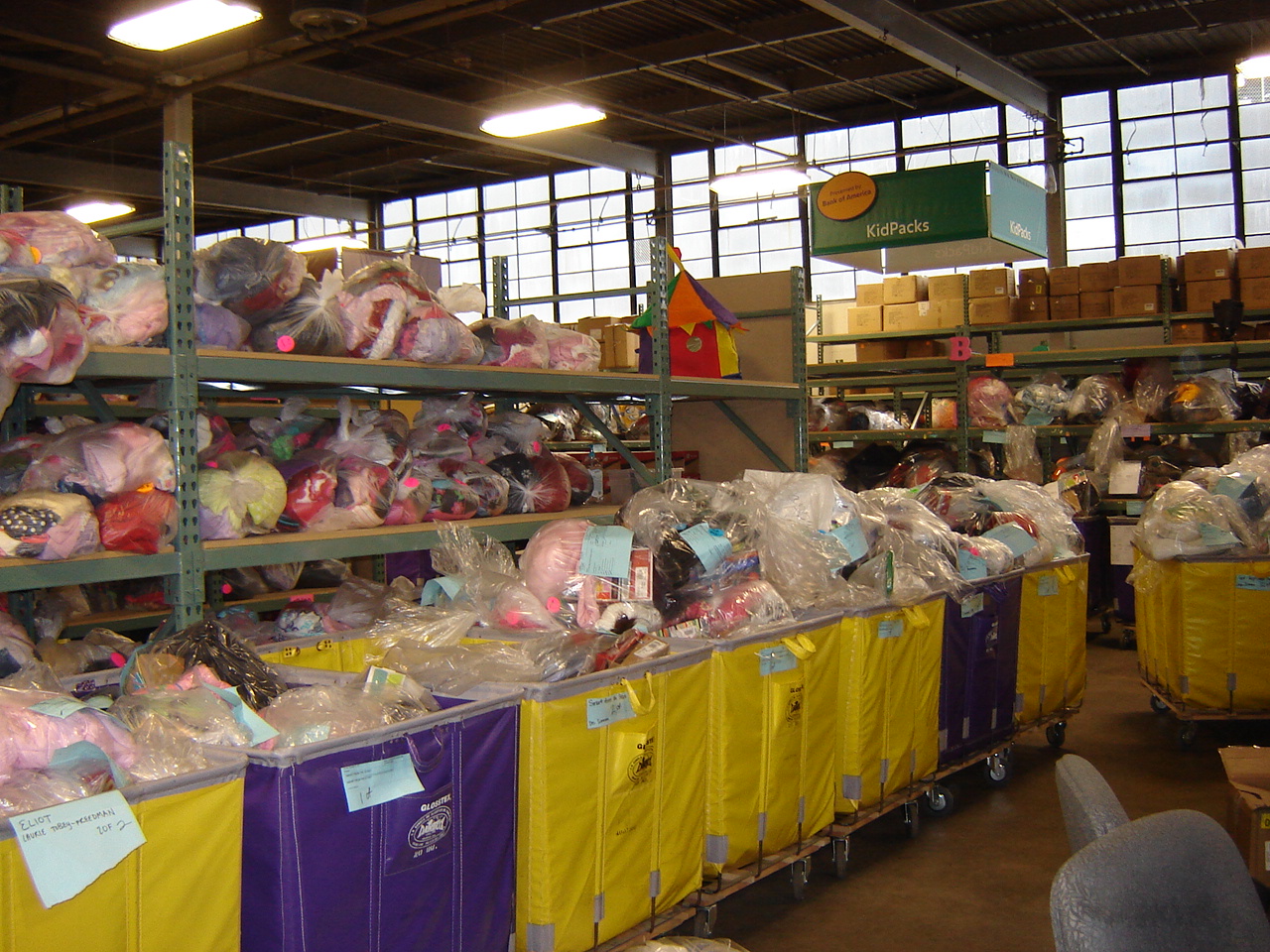
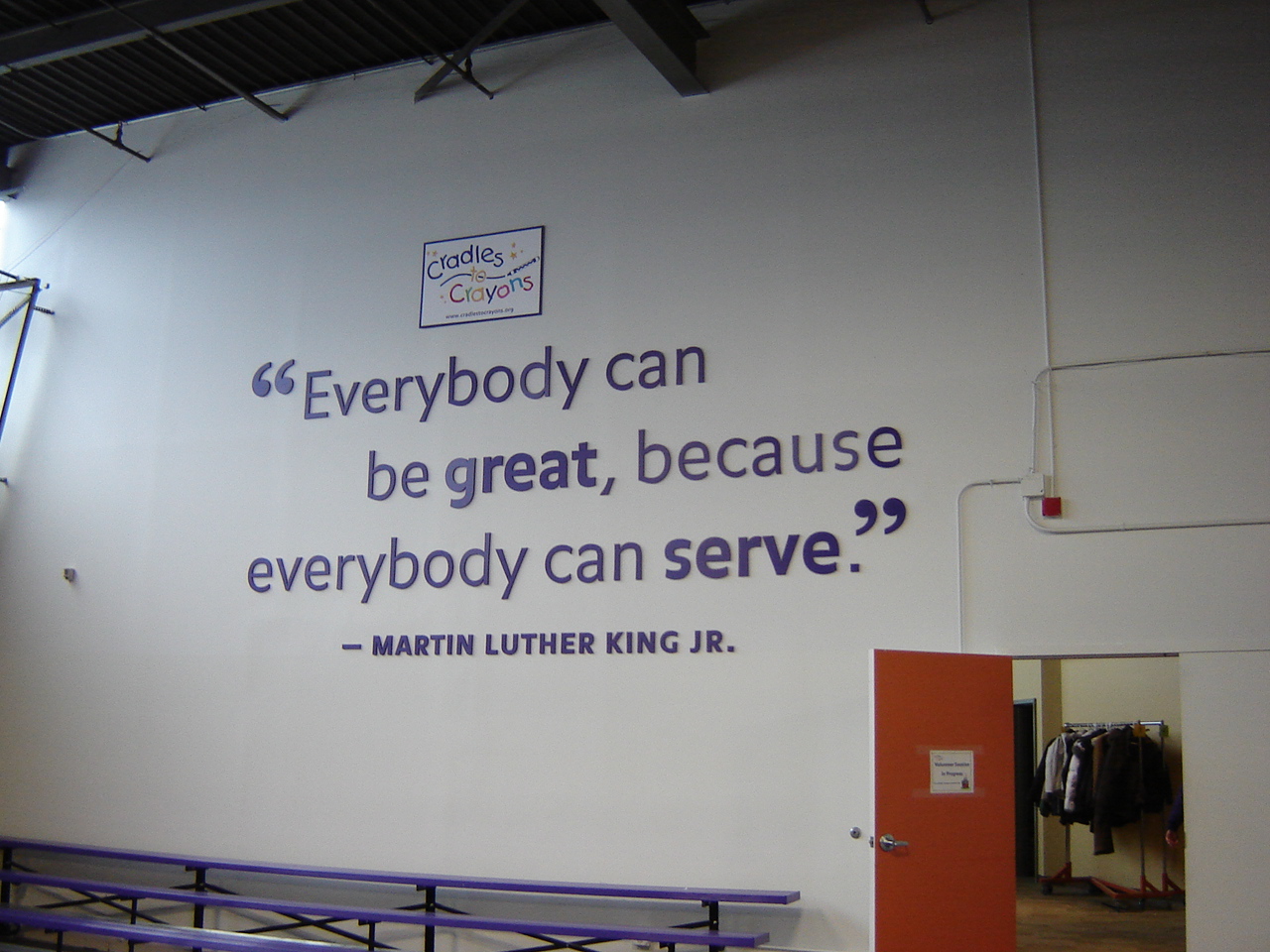
Today at work we had a holiday team-building outing to the nonprofit Cradles to Crayons. A lot of organizations bring employees to the group’s Giving Factory for their community service projects. Our team volunteered at the same time as Blue Cross Blue Shield and Bank of America.

First we watched a video about the history of the organization, which takes donations of clothes and equipment for children, sorts them, and fills orders for individual children at the request of social service agencies. The donations come from ordinary people and from partner corporations.

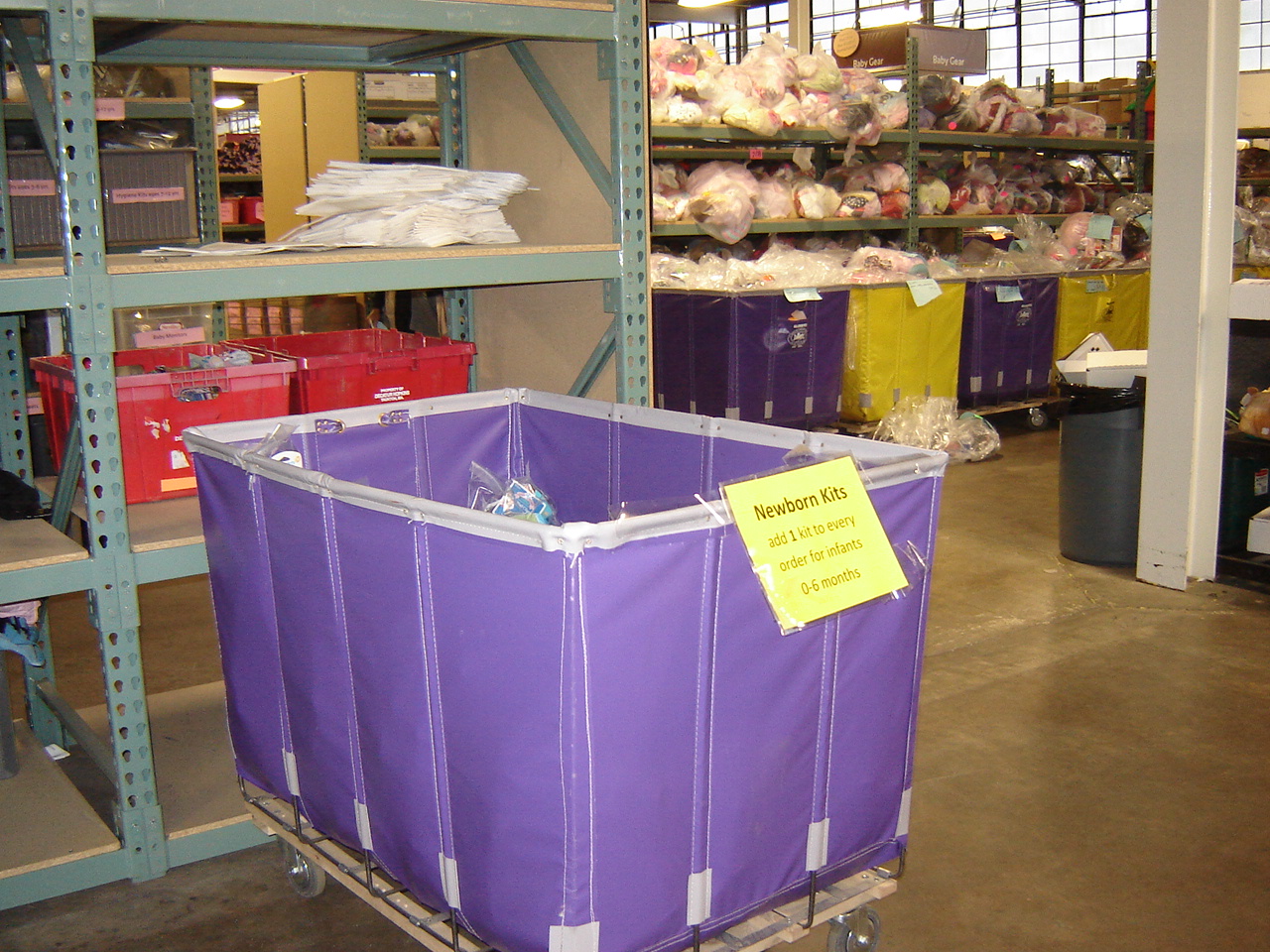
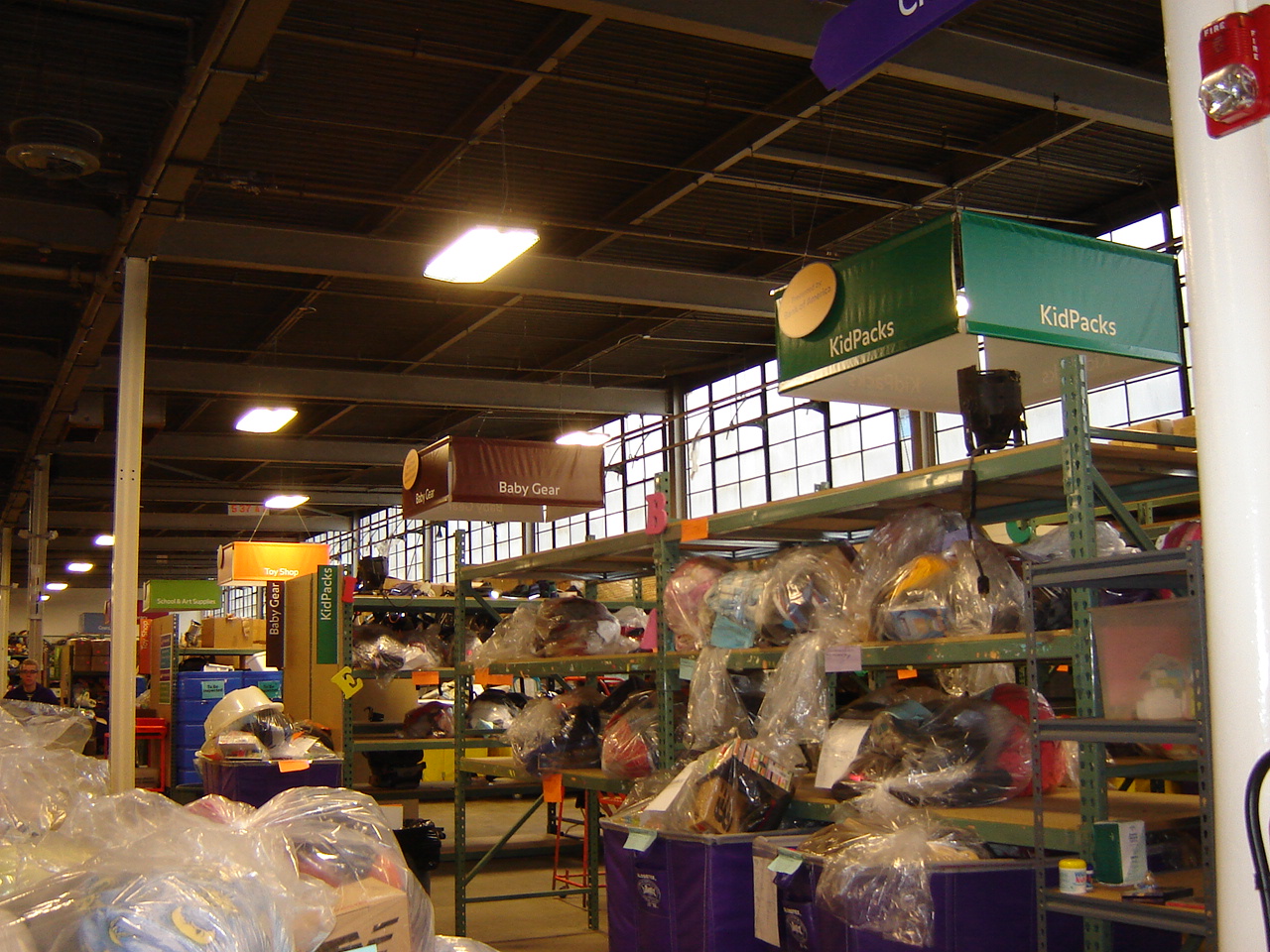
A group of us sorted donated coats. I was with the group that “shopped” among the warehouse shelves for bundles of sorted and age-labeled items, looking for the needs listed on individual order sheets. For example, we might have a sheet for a boy, age 4, that said “clothing pack, book bundle, craft packet, boots size 6, coat size 6.” It was very well organized. If we found that Cradles to Crayons was  out of something, the staff would fill the order anyway and invite the requesting agency to reapply for missing items. They like to provide whatever they can as fast as they can.

Cradles to Crayons says, “Our vision is that one day every child will have the essentials they need to feel safe, warm, ready to learn and valued. Through the Giving Factory, we provide those essentials, as donated clothes, shoes, books and school supplies to homeless and low-income children. We also offer meaningful volunteer opportunities to hundreds of corporations and thousands of individuals and families each year.”


Read Full Post »

Having blogged about the troubling documentary “Waiting for Superman” here, I thought you might be interested in hearing about a school district that has found one way to overcome a significant barrier to quality education.

The documentary’s critique of U.S. public education centers on the inadequacy of teacher evaluation and the near impossibility of firing bad teachers.

Montgomery County (MD) doesn’t have that problem. Can you guess why?

Deep, broad collaboration. Critical constituencies are in on the evaluation and the decisions about coaching and firing.

A June 5 NY Times story by Michael Winerip, “Helping Teachers Help Themselves,” explains.

“The Montgomery County Public Schools system here has a highly regarded program for evaluating teachers, providing them extra support if they are performing poorly and getting rid of those who do not improve. The program, Peer Assistance and Review — known as PAR — uses several hundred senior teachers to mentor both newcomers and struggling veterans. If the mentoring does not work, the PAR panel — made up of eight teachers and eight principals — can vote to fire the teacher. … In the 11 years since PAR began, the panels have voted to fire 200 teachers, and 300 more have left rather than go through the PAR process, said Jerry D. Weast, the superintendent of the Montgomery County system, which enrolls 145,000 students, one-third of them from low-income families. In the 10 years before PAR, he said, five teachers were fired. ‘It took three to five years to build the trust to get PAR in place,’ he explained.”  Read more here.

Having started out my work life as a teacher, I feel pretty strongly that teachers have been given a bad rap lately and that most are experienced, creative, and deeply dedicated (and overworked and underpaid). My daughter-in-law is also a teacher.

But there is no doubt that the bad apples are hard to fire and that every year that they get away with bad teaching turns thousands of children off the whole idea of education, to the lasting detriment of the nation. So I hope everyone will think about the PAR program described in the Times and how they might help influence school policy.

I will post comments sent to suzannesmom@lunaandstella.com.

Read Full Post »

« Newer Posts