Feeds:
Posts
Comments

Posts Tagged ‘climate change’

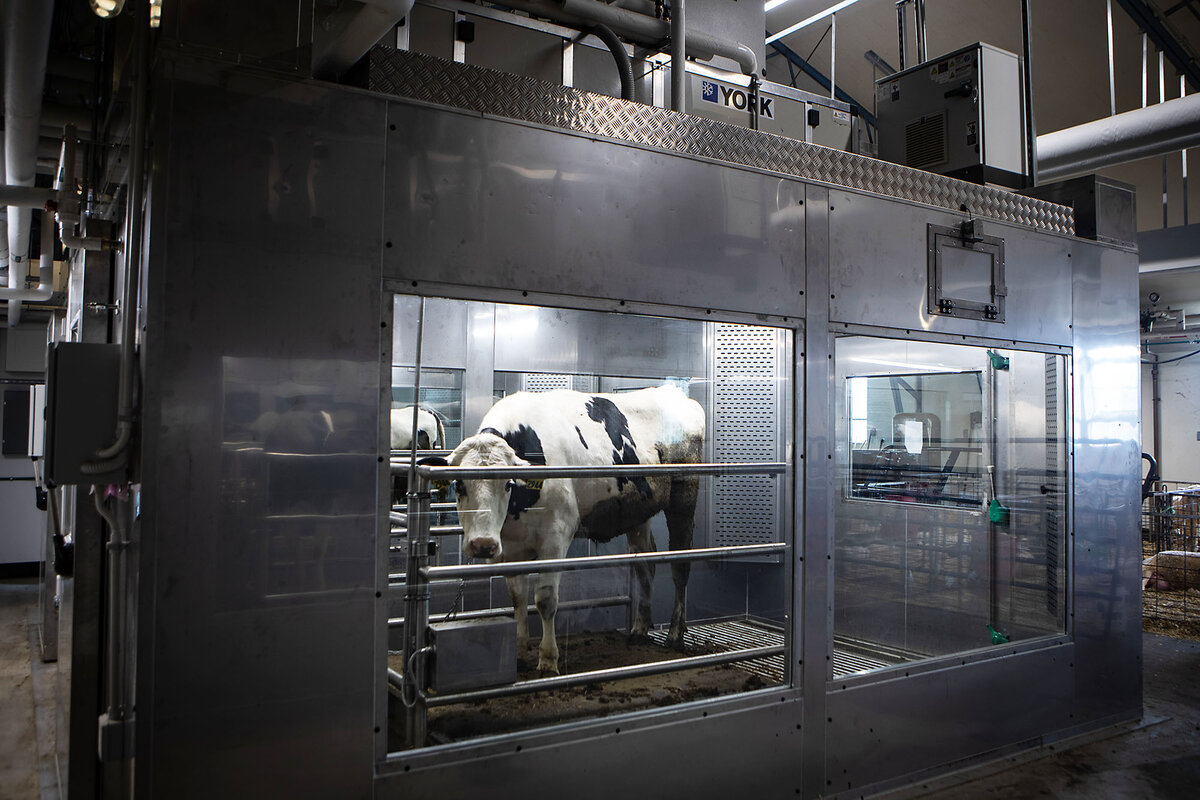
Photo: Melanie Stetson Freeman/CSM.
A heifer stands inside a methane chamber at Cornell University, June 7, 2024, in Ithaca, New York. Researchers are studying how to reduce methane emissions from dairy cows.

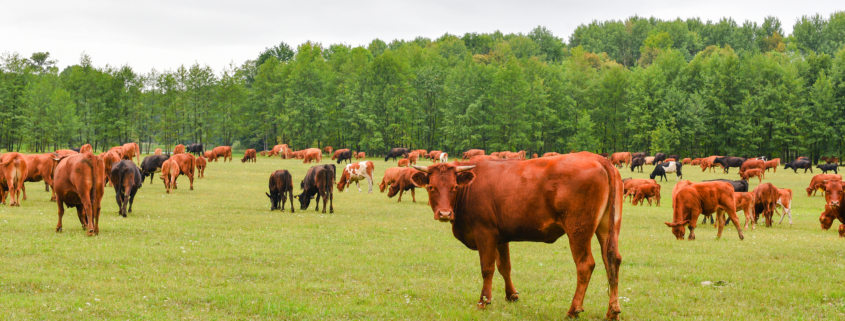
When he was only 11, one of my grandsons gave up eating beef after learning in school about the effects of cows’ methane emissions on global warming.

I guess it’s fortunate that there are people researching ways to make cows “less gassy.” But some of the research sounds like it’s not much fun for the cow.

Stephanie Hanes of the Christian Science Monitor reported recently on work at Cornell.

“On the campus of Cornell University, within an intricately monitored and carefully sealed chamber, there is a cow. Scientists carefully record what this cow eats and what she drinks. They open the chamber only once a day, so as to limit disturbances to her environment. Every breath she takes – or more crucially, exhales – is also measured to its molecular level. There is hydrogen. There is carbon, recorded down to its isotopic composition. There is oxygen. And, most important to this state-of-the-art study, there is methane.

“Methane is a naturally occurring gas that comes from a variety of biological and industrial sources, from oil- and gas-well leaks to decomposing garbage to, well, cow burps. It is also one of the world’s most potent greenhouse gases – far more heat-trapping than carbon dioxide. …

“ ‘There is growing awareness amongst environmental advocates, policymakers, that reducing methane emissions is the fastest way to reduce warming,’ says Dan Blaustein-Rejto, director of food and agriculture at the nonprofit Breakthrough Institute. …

“Although exact percentages are difficult to determine, researchers estimate that cows are responsible for around 30% of U.S. methane emissions. This is largely because cattle, like goats or sheep, are ruminants: animals with four-chambered stomachs that ferment grass and other vegetation into consumable food. And a natural by-product of rumination is methane. …

“According to the U.S. Department of Agriculture, there are 28.2 million beef cattle in the U.S., along with 9.36 million dairy cows and 33.6 million calves. And those numbers pale in comparison to countries such as India, which has an estimated 61 million milk cows, or Brazil, with around 234 million beef cattle. 

“With growing pressures from policymakers and climate advocates, then, agribusiness and scientists are trying to figure out how to make individual dairy cows more productive, which could lead to smaller herds, while at the same time trying to find ways to make cow burps — the body function that produces the most methane — less gassy.

“The first step to doing that, says Cornell associate professor Joseph McFadden, is to get good measurements of bovine methane in the first place. …

“ ‘The challenge comes in capturing the methane,’ says Joe Rudek, lead senior scientist at the Environmental Defense Fund. ‘Cows are breathing out this methane. You’ve got them walking around in a pasture, how do you capture that methane that’s coming out of the cows’ mouth and nostrils?’

“So instead of individually measuring each cow, scientists are trying to build up a robust sample size of measurements that would let them statistically predict methane emissions, both broadly and specifically. One contraption they use now is called the GreenFeed – basically a high-tech box with cow treats. When the cow puts her head into it to eat, the box measures methane and other gases. These instruments are portable, so theoretically farmers can use them in different locations.

“But, Dr. McFadden says, those measurements are not always exact. That’s why his respiration chambers are important. Because the pods are highly accurate, closed systems, they can calibrate other machines. … The chambers can help him monitor other inputs and outputs that can give clues about animal health and well-being, and about how the animal uses energy – as well as about other greenhouse gases, such as nitrous oxide. …

“Across the country, at the University of California, Davis, professor Ermias Kebreab is also working with dairy cows, and has his eye on some solutions. In addition to feed additives, he is measuring what happens when cows eat local agricultural by-products, such as the grape residue from winemaking. GreenFeed measurements are finding some promising initial results, he says.   

“ ‘We found a 10% to 12% reduction in emissions,’ he says. ‘Animals were happy to eat it … and it avoids the emissions from putting it into a landfill.’ Not only that, he says, but grape pomace — the fruit’s leftover skin, seeds, or stems — seems to improve milk quality. 

“ ‘It’s a win-win kind of situation,’ he says.”

More at the Monitor, here.

Read Full Post »

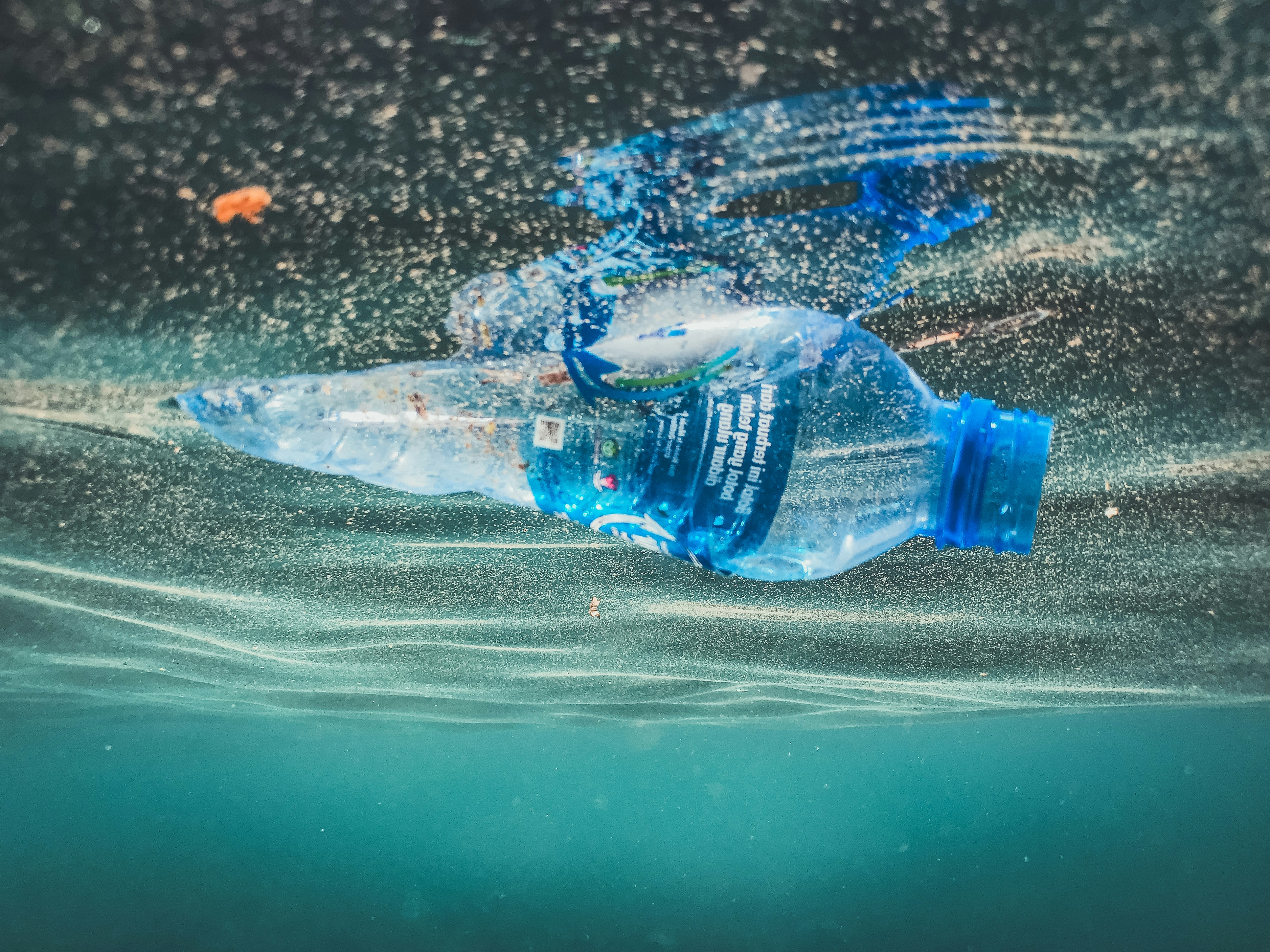
Photo: Naja Bertolt Jensen/Unsplash.
Can we ever escape plastic?

When I think about all the plastic we have created and put into our landfills and oceans, I am close to despair about ever cleaning it up.

Still, there are always people willing to fight the odds. Consider the initiative called Plastic Free July. Jacob Fenston has the story at the Washington Post.

“The idea took root in Australia more than a decade ago, and in recent years it has been gaining popularity in the United States. It all began when Rebecca Prince-Ruiz visited her local recycling sorting center in Perth, Australia, in 2011. She had always thought of herself as being eco-conscious, but after looking around at the heavy machinery sorting an endless stream of bottles, tubs, jars, cans and boxes, she had an aha moment.

“ ‘I suddenly realized that filling my recycling bin each fortnight didn’t make me the great green citizen I thought I was,’ Prince-Ruiz says. ‘The most important thing I should be doing was actually reducing my waste in the first place.’

“She decided to try to avoid single-use plastic for an entire month. The next month happened to be July. So Plastic Free July was born.

“Since then, the idea has spread around the globe. According to the Plastic Free Foundation, the nonprofit that Prince-Ruiz founded, 89 million people in 190 countries pledged to reduce their plastic use during July last year. The countries with the most participants are China and India.

“Over the last five years, participants have avoided more than 1.5 million tons of plastic waste, according to the campaign. That’s enough to fill about 80,000 garbage trucks. …

“Sending anything to the landfill or incinerator has a negative impact on the environment. But plastic is particularly problematic, experts say.

“ ‘Plastics are one of the greatest threats facing our planet today,’ says Melissa Valliant, a spokesperson for Beyond Plastics, a plastic-pollution-fighting nonprofit. … ‘We are not going to recycle our way out of this problem,’ Valliant says.

“Plastic waste chokes oceans and the creatures who live there. And plastic production is a major contributor to climate change: The industry emits four times the planet-warming emissions as the airline industry, according to a recent U.S. Energy Department report.

“But from the beginning, the Plastic Free July campaign has focused on solutions rather than the problem. In fact, the campaign’s website contains almost nothing about the harms of plastic, other than its sea turtle logo — a reference to one of the animals most at risk from ocean plastic.

The website offers ideas for plastic-free beginners — small changes like using reusable shopping bags. There are also suggestions for those further along the journey, including making your own toothpaste, sans plastic tube.

“Prince-Ruiz says that first plastic-free month was harder than she’d thought it would be. … Her best advice for newbies: Don’t try to quit plastic cold turkey. Instead, start with a quick inventory of your plastic use — go through your fridge and pantry and trash — and choose one or two places to work on eliminating or reducing your consumption. …

“Freweyni Asress, a D.C. resident who has written about living a zero-waste lifestyle, recommends finding a buddy or two to do the plastic-free challenge with.

“ ‘When there’s a community of people participating in something like Plastic Free July, it really reinvigorates you,’ Asress says. …

“Of course, going plastic-free can be more challenging depending on your circumstances. In the Midwest, for example, store clerks are not always receptive to the idea of skipping plastic bags, Harper says. On one shopping trip where he was only buying a few things and didn’t need a bag, the checker forced one on him, citing concerns about shoplifting.

“ ‘She would not let me leave without a bag,’ Harper says.

“When Asress started her zero-waste journey in 2016, she was working at a food co-op that had a large bulk section and many plastic-free products. But she found not all plastic-free products worked for her.

“ ‘A lot of the hair products that were sustainably packaged or provided in bulk bins were specifically for White people’s hair,’ says Asress, who is Black. … ‘It has to be practical, and we have to be able to figure out ways to be able to include everybody.’ …

“Valliant says the key is to move away from disposable containers and packages and go with materials that can be used over and over. Refundable deposit systems can make this economical.

“Travel to Latin America, Africa or Asia, for example, and you’ll find refillable soda and beer bottles are still common — each one can be filled, purchased and returned as many as 30 times before it breaks or is worn out.”

More at the Post, here.

Read Full Post »

Photo: Jackson School.
A research team treks across a field in South Africa in search of carbon-sequestering termite mounds.

Termites in South Africa build mounds that sequester carbon in the soil, which unbeknownst to them, benefits a planet struggling with climate change. Can humans learn to extend those benefits?

Michele Francis, a researcher in the department of soil science at South Africa’s Stellenbosch University, shares some ideas at the Conversation.

“The landscape along the Buffels River in South Africa’s Namaqualand region is dotted with thousands of sandy mounds that occupy about 20% of the surface area. These heuweltjies, as the locals call them (the word means ‘little hills’ in Afrikaans), are termite mounds, inhabited by an underground network of tunnels and nests of the southern harvester termite, Microhodotermes viator.

“I’m part of a group of earth scientists who, in 2021, set out to study why the groundwater in the area, around 530km from Cape Town, is saline. The groundwater salinity seemed to be specifically related to the location of these heuweltjies. We used radiocarbon dating; dating the mounds, we reasoned, would allow us to see when minerals that were stored in the mounds were flushed to the groundwater.

“The tests revealed far more than we expected: Namaqualand’s heuweltjies, it turns out, are the world’s oldest inhabited termite mounds. … This is more than just an interesting scientific find or historical curiosity. It offers a window into what our planet looked like tens of thousands of years ago, providing a living archive of environmental conditions that shaped our world.

“It is also hugely important today: there is growing evidence that termites have a substantial, but still poorly understood, role in the carbon cycle. By studying these and other termite mounds, scientists can gain a better understanding of how to sequester (store) carbon. This process removes CO₂ from the atmosphere and is vital for mitigating climate change.

“Namaqualand is a global biodiversity hotspot renowned for its spring flowers, but it is a dry area. Surface water is in short supply and the groundwater is saline.

“Although most of Namaqualand receives very little rainfall, there are rare, high intensity rainfall events. When these do occur, the termite burrows on the mound surfaces serve as water flow paths that can harvest rain and channel water into the mound. This causes the salts that built up in the mounds over thousands of years to be flushed into the groundwater system via flow paths created by the tunneling action of the termites, pushing the dissolved minerals ever deeper. This process also pushes down the carbon that slowly built up in the center of the mounds when termites collected plant material and brought it into the mound. …

“The ability of these mounds to sequester carbon is linked to the termites’ unique behavior. The insects transport organic material [from] small woody plants – deep into the soil. This way, fresh stores of carbon are continuously added. …. Deep storage reduces the likelihood of organic carbon being released back into the atmosphere. So the mound acts as a long-term carbon sink.

“Not only do the termites take the organic carbon material deep underground into their nests, but their tunnels also allow dissolved inorganic carbon (known as soil calcite or calcium carbonate) in the mound soil to move into the groundwater along with other soluble minerals. So the termite mounds also offer a mechanism to sequester carbon dioxide through dissolution and leaching of soil carbonate-bicarbonate to groundwater. …

“These findings are further evidence that termites fully deserve their reputation as ecosystem engineers. They modify their soil surroundings to maintain ideal humidity and temperature conditions. …

“Termite mounds can help provide a more comprehensive understanding of global carbon dynamics. In Namaqualand, mounds occupy 27% of the total area but contribute 44 % of the total soil organic carbon stock. …

“Public awareness and policy integration are key, too. Termite mounds are often cleared for agriculture or termites are considered pests. Raising awareness about the ecological importance of termite mounds and integrating these findings into environmental policies can help promote practices that support natural carbon sinks.”

More at the Conversation, here. Listen to the story at The World, here.

Read Full Post »

Photo: Trilogy Captain’s Log.
“Lahaina Strong Paddle Out” expresses the determination of young Hawaiian climate activists after the fires in Maui.

I am so relieved to see young people taking charge of some of the issues that have messed up our planet. They focus on goals and don’t get distracted by the usual specious arguments for not upsetting the apple cart or for taking more time. Good things do happen when you don’t realize your goal is “impossible.”

Consider these young people in Hawaii.

Dharna Noor and Lois Beckett write at the Guardian, “Hawaii officials have announced a ‘groundbreaking’ legal settlement with a group of young climate activists, which they said will force the state’s department of transportation to move more aggressively towards a zero-emission transportation system.

“ ‘You have a constitutional right to fight for life-sustaining climate policy and you have mobilized our people in this case,’ Josh Green, the Hawaii governor, told the 13 young plaintiffs in the case, saying he hoped the settlement would inspire similar action across the country.

“Under what legal experts called a ‘historic’ settlement, announced [in June], Hawaii officials will release a roadmap ‘to fully decarbonize the state’s transportation systems, taking all actions necessary to achieve zero emissions no later than 2045 for ground transportation, sea and inter-island air transportation,’ Andrea Rodgers, one of the attorneys representing the plaintiffs in the case, said at a press conference with the governor.

“ ‘This is an extraordinary, unprecedented victory for the youth plaintiffs,’ Michael Gerrard, the faculty director of the Sabin Center for Climate Change Law at Columbia University, told the Guardian.

“While Hawaii has long embraced a progressive climate change agenda, with 2045 as a target year for decarbonization, the new settlement is ‘as big a deal as everyone said it is,’ said Denise Antolini, an emeritus professor of law at the University of Hawaii Law School, who has followed climate change litigation for decades. …

“The June 2022 lawsuit, Navahine F v Hawaii Department of Transportation, was filed by 13 young people who claimed the state’s pro-fossil fuel transportation policies violate their state constitutional rights. By prioritizing projects like highway expansion instead of efforts to electrify transit and promote walking and biking, the complaint says, the state created ‘untenable levels of greenhouse gas emissions.’ As a result, state officials harmed the plaintiffs’ ability to ‘live healthful lives in Hawaii.’ …

“It named the Hawaii Department of Transportation and its director, as well as the state of Hawaii and its former governor David Ige, as defendants.

“The plaintiffs, most of whom are Indigenous, alleged that by contributing to the climate crisis, the state hastened the ‘decline and disappearance of Hawaii’s natural and cultural heritage.’ When the case was filed, the plaintiffs were between the ages of nine and 18. …

“Navahine, whose name is on the lawsuit, is a 16-year-old Native Hawaiian whose family has been farming the land ‘for 10 generations.’ Drought, flooding and sea level rise were all having immediate effects on her family’s crops, she said. ‘Seeing the effects, how we were struggling to make any money for our farm, kind of pushed me to this case,’ she said.

“Officials said the legal settlement brings together activists with all three branches of the state’s government to focus on meeting climate change goals, including mobilizing the judicial branch. The court will oversee the settlement agreement through 2045 or until the state reaches its zero emission goals, Rodgers said.”

More at the Guardian, here. No paywall. Donations sought.

Read Full Post »

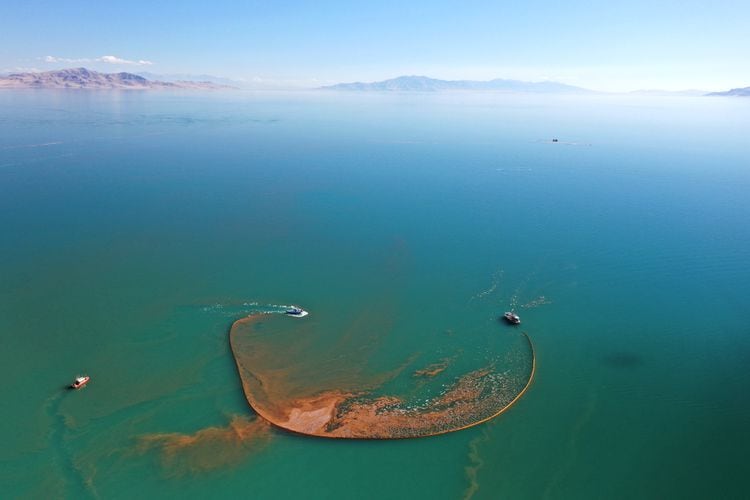
Photo: The Salt Lake Tribune.
Harvest watercraft encircle brine shrimp in Great Salt Lake using containment booms in preparation for harvesting.

Although today’s story about brine shrimp feeding the world is interesting in itself, the thing that stands out to me is thinking of Uzbek scientists. Uzbekistan feels so foreign to me, it’s like talking about scientists from the far side of the moon. That’s how limited my world view is, alas.

Here’s what Leia Larsen and Levi Bridges have to say at the Salt Lake Tribune about scientists in Uzbekistan and elsewhere who are studying brine shrimp.

“As the rising sun casts golden rays over the Aral Sea, a group of Uzbek fishermen wearing sweatshirts and knit caps gathered on a chilly beach to discuss the day’s plan.

“For two days they had waited in vain for brine shrimp. A dead calm in the first cold days of winter replaced winds that usually blow large slicks of the tiny crustaceans to shore.

“Standing and smoking cigarettes beside ramshackle cabins covered in sheets of plastic to keep out the elements, the fishermen debated whose turn it was to check if any shrimp had drifted in. Two volunteers jumped on a rattling old truck and chugged off miles into the distance to scour the beach.

“When the winds blow just right, Aral Sea fishermen work up to 36 hours gathering brine shrimp eggs, also known as cysts. They often labor with headlamps through the darkness. Winter temperatures can dip as low as minus 40 degrees Fahrenheit.

“ ‘Sometimes we get so sleepy you feel drunk,’ said Miyrbek Mirzamuratov, an Uzbek fisherman who has spent two winters gathering cysts on the Aral Sea.

“The Great Salt Lake remains the world’s largest source of brine shrimp cysts, exporting 40% of the global supply. The shrimp are a key food source used in aquaculture. Seafood is the main source of protein for billions of people across the planet, and aquaculture, fueled by brine shrimp, now produces roughly half of the world’s commercial seafood.

“But drought and decreasing water resources have put new pressure on brine shrimp in both Utah and Central Asia. In 2022, the Great Salt Lake’s shrimp populations almost collapsed due to record-low water elevation and spiking salinity.

“ ‘We’re all starting to realize just how much the lake touches us in many ways that we don’t appreciate,’ said Tim Hawkes, a former Utah state representative and current general counsel for the Great Salt Lake Brine Shrimp Cooperative. …

“Environmental challenges are also forcing scientists in Uzbekistan to devise ways to save their own brine shrimp – and help keep the world fed if Utah can’t ensure its own inland sea survives. Despite being too salty for fish, the Great Salt Lake’s aquaculture industry infuses Utah’s economy with up to $67 million each year, thanks to brine shrimp.

“That’s because their cysts, no bigger than a grain of sand, tolerate extreme conditions.

“ ‘You can boil them, you can freeze them, you can send them to outer space,’ Hawkes said. ‘And still, under the right conditions, if you put them in a little bit of salt water and give them some light, they’re going to hatch out.’

‘It makes brine shrimp cysts an ideal product to package and ship across the world, where they’re raised as an essential food source for the farmed seafood humans eat, particularly prawns and cocktail shrimp.

“Although farm-raised seafood has generated controversy due to its runoff pollution and impacts to wild fisheries, the United Nations issued a 2020 report identifying it as a critical player in global food security. It provides nutritious protein at low cost to rural and developing communities that have a hard time producing other farmed goods. …

“Globally, the average person ate 44.5 pounds of seafood in 2020, up from 31.5 pounds in the 1990s, according to the U.N. More than half of that came from farms.

“ ‘If we lost the Great Salt Lake,’ Hawkes said, ‘or we lost the ability to produce brine shrimp from the Great Salt Lake, it would have a significant impact on our ability to feed the world.’ …

‘Companies on the Great Salt Lake gather brine shrimp cysts from the water with boats and floating booms similar to those used to contain oil spills, but the work is still mostly done by hand in Uzbekistan and other Asian countries. …

‘Islambek Shumomurodov said he earns about $1.50 for every pound of Aral Sea cysts he gathers. The average annual household income in Uzbekistan is around $1,600. ‘Some people even buy new houses and cars from working here,’ Shumomurodov said.

“Although Uzbekistan’s brine shrimp production represents just a fraction of Utah’s output, the crustaceans created an economic opportunity after the Aral Sea’s traditional fishery shriveled.

“The Aral Sea, like the Great Salt Lake, has declined significantly from agricultural demand and human water consumption. Once a freshwater lake teeming with fish, the Uzbek portion of the Aral turned saline — a trend scientists don’t expect will change.

“Neighboring Kazakhstan spent millions damming off their portion of the North Aral Sea to keep the freshwater fishery viable. Brine shrimp, which likely hitchhiked to the region as cysts stuck to the feathers of visiting shorebirds, are the only creatures with commercial value able to survive in the shrinking southern Uzbek portion of the lake. …

“ ‘It’s just a matter of years now before [the Uzbek side of] the Aral Sea can no longer support brine shrimp,’ said Ablatdiyn Musaev, a biologist at the Uzbek Academy of Sciences.”

More at the Salt Lake Tribune, here. No firewall. Nice photos. There’s an audio version of the story at PRX’s The World.

Read Full Post »

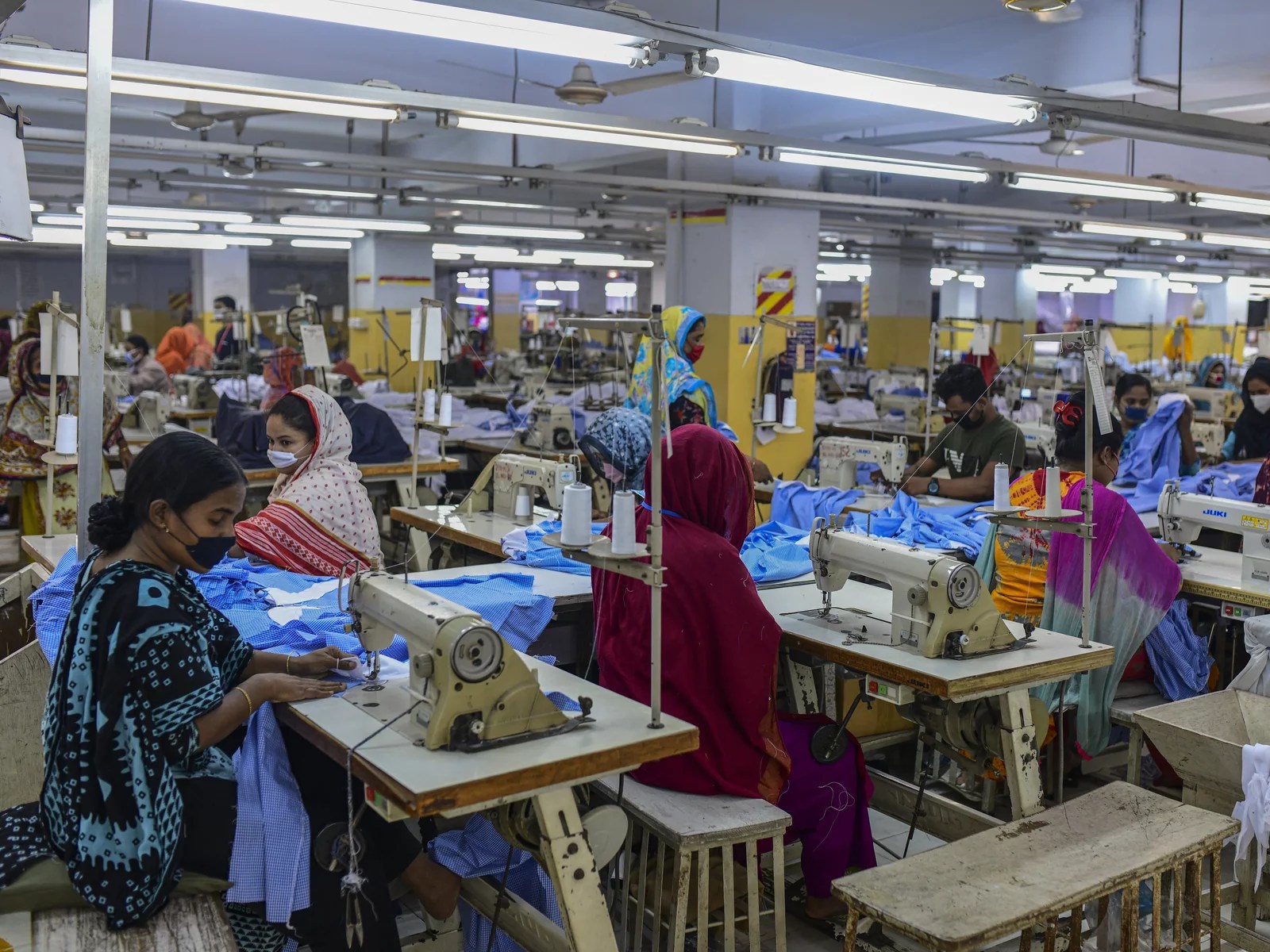
Photo: Zabed Hasnain Chowdhury/SOPA Images/LightRocket via Getty Images.
Garment workers were deemed essential employees during the Covid lockdown in Bangladesh, when workers were more worried about hunger than the pandemic and customers in wealthier places were still demanding new clothes.

Here’s a support group that most of the world needs. It’s one that recognizes capitalism — or at least acquiring more and more “stuff” — as an unhealthy addiction for Spaceship Earth.

Gerry Hadden reports at Public Radio International’s The World, “Twice a month, members of the support group Capitalists Anonymous gather in a small room in Paris, France, beset by chronic buyer’s remorse. 

“Some arrive worried over how much they consume and don’t know how to stop. 

“On a recent night, each of the eight people stood up, introduced themselves, and gave their reasons for coming to the support group. A woman named Claire, who didn’t want to share her last name, said she wants to be with people who share her concerns for the planet and mental health. …

“ ‘Where I live in southwest France’ [said participant Olivier Montegut], ‘it reached 90 degrees one day — in April. We’ve just had a baby, and I am scared for her future,’ he told the group. 

“Most scientists agree extreme weather is being fueled by climate change, which is exacerbated by the burning of fossil fuels. And capitalism is the force behind it all, said the group’s founder, Julien Lamy. 

“He said it’s a global system that pushes unfettered consumption on the rich and poor alike, and virtually everyone, he said, is addicted.

“ ‘To push back, I searched for support groups with a focus on recovery and eventually found Alcoholics Anonymous, with its 12-step method,’ Lamy explained. …

Capitalists Anonymous has just eight steps but starts with the same one — admitting that you have a problem. 

“ ‘It means recognizing that we’re participating in a system that’s destroying life on our planet,’ he said. …

“These steps might sound familiar to people in drug or alcohol programs, but Lamy said in some ways, capitalism is harder to shake because it permeates every part of modern life.

“ ‘I often say that what we’re trying to do is like striving for sobriety,’ he said, ‘but while living inside a bar.’ A planet-sized bar. 

“To avoid feeling overwhelmed, Lamy suggests people take small steps to reduce their impact just to feel better in their personal lives, such as biking to work or cutting back on red meat. …

“Resident Anne-Christelle Beauvois said she heard Lamy on the radio and reached out to learn more.  

“Beauvois worked for years in the fashion industry. She said she became alarmed in the 1990s when so-called fast fashion arrived — that system of mass-producing cheap clothes in sweatshops that then get shipped all over the world.

“ ‘It’s nuts,’ she said. ‘You can wake up in the middle of the night, jump on Instagram to follow some influencer or brand and click, you place an order.’

“Beauvois said she has never ordered anything online in her life. But she’s hardly ‘holier than thou,’ she said as she lit a cigarette and took a puff on another addiction. 

“It may be hard to avoid capitalism when the entire global economy depends on it, but Beauvois said people can still produce differently. 

“ ‘Do we need to make stuff we don’t need?  Must we work 50 hours a week? Is it such a problem to add more pleasure to our lives and less work?’ she said. …

“Lamy, the founder, said people from all over Europe — even Mexico — have written to ask how to start their own chapters.”

So my question is, How do we stop unnecessary acquiring and still ensure that the people who are providing all the “stuff” not only have enough to eat but can have a decent life?

“Houston, we have a problem.”

More at PRI’s The World, here.

Read Full Post »

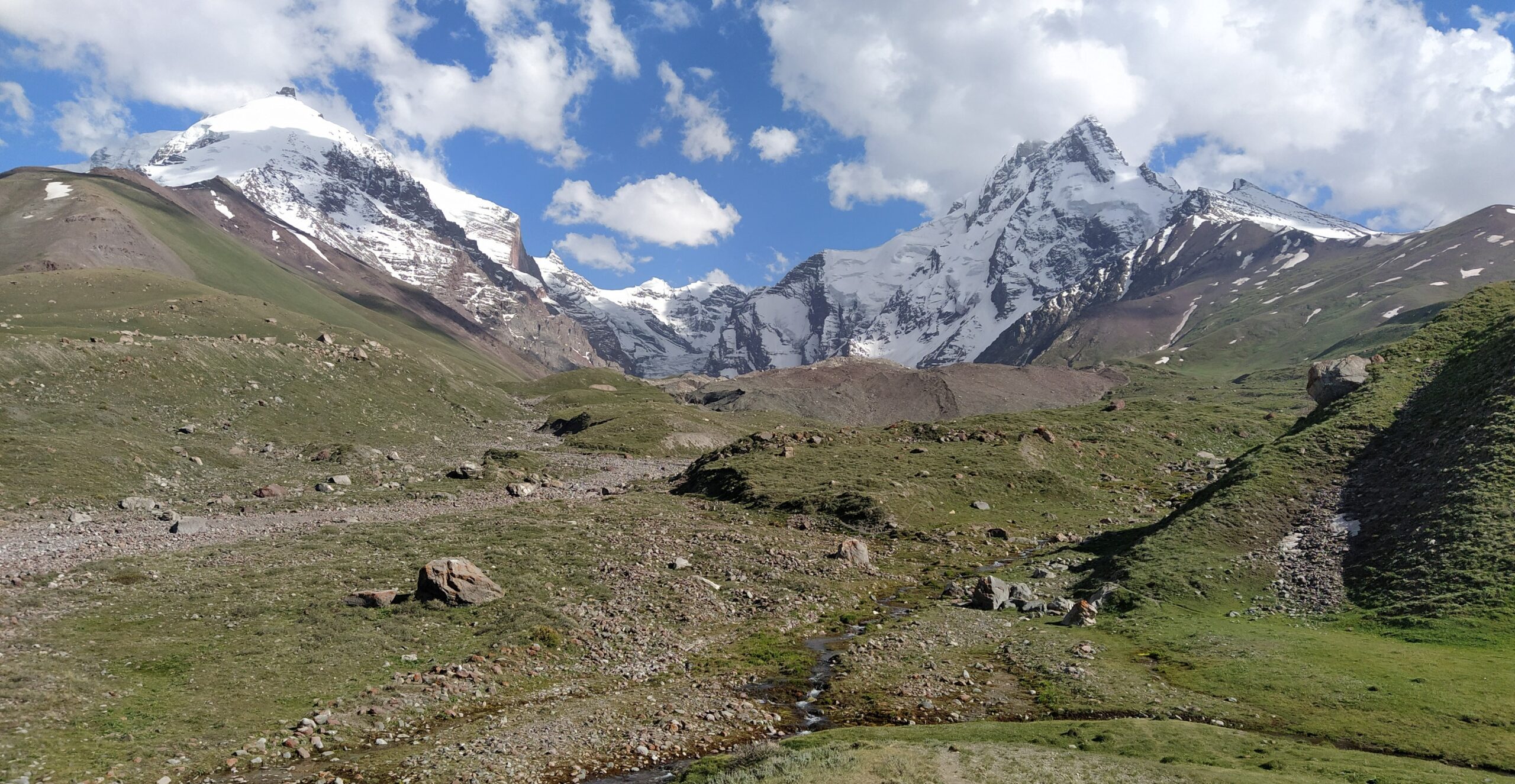
Photo: Achille Jouberton at the Pamir Project.
Swiss scientists are tackling the mysteries of ice in countries that can be dangerous to work in.

Today Levi Bridges at the great international radio show The World brings you the latest on glaciers in Kyrgyzstan and Tajikistan, countries that could be more important to us than we realize as we wallow in the anxieties of our own places, those bits of Earth we imagine are the only important ones.

“On a sunny summer day two years ago,” Bridges reports, “a massive chunk of ice broke off from a glacier on a mountain in the Central Asian country of Kyrgyzstan.  An avalanche quickly raced down the mountain toward a group of hikers below, which one man caught on film.

“The hikers braced themselves for impact as the cascade of snow and ice poured down the mountain toward them. Miraculously, the group survived with only several people receiving minor injuries

“The event highlighted the challenges facing the world’s glaciers. This year, the UN declared that climate change reached record levels in 2023. And glaciers, which hold most of the Earth’s freshwater, are melting at an unprecedented rate. 

“But some glaciers located in mountainous parts of Central Asia aren’t melting and, in some cases, are actually growing. This cold, arid region, known as the Third Pole, is one of the only places in the world outside the interior of Antarctica where ice has so far been relatively unaffected by the climatic changes associated with rising temperatures.

“Even during the summer it remains so cold in parts of Tajikistan that ice on a glacier’s surface can turn into a gaseous state instead of melting through a process known as sublimation. That can cause spectacular ice formations on a glacier’s surface that look like inverted icicles or ice pyramids, according to Evan Miles, a glaciologist at the Swiss Federal Research Institute who studies Tajikistan’s glaciers. …

“Miles is the scientific coordinator for a team of Swiss and international scientists who have formed a research group known as the Pamir Project that hopes to discover what makes some of the region’s glaciers so unique. Each summer, they travel to isolated locations in Tajikistan’s mountains to study glaciers.  Scientists must spend days trekking up to altitudes sometimes as high as 15,000 feet just to visit their research sites, carrying in supplies and scientific equipment by donkey. 

“Miles said the remote locations the team visits in Tajikistan pose different challenges than research sites he has visited on Mount Everest where there are established trails and usually other people nearby.

“ ‘In Tajikistan, there’s nobody — there’s no helicopter that’s going to come rescue you if something goes wrong,’ he said. 

“But understanding these glaciers is worth the risk because millions of people in Asia depend on them as a water source.

“Scientists believe these glaciers aren’t melting because water is evaporating from vast, irrigated farmland in nearby Pakistan, China and Uzbekistan. An increase in atmospheric moisture drives changes in weather patterns, so more snow gets dumped on Tajikistan’s glaciers and helps their size remain stable. 

“These mountains are just one of many unsolved mysteries glaciologists are working on. It can be difficult for scientists to predict how much ice most glaciers will lose — and when — because there are still basic unanswered questions, like how much snowfall many mountains get. …

“Scientists who are part of the Pamir Project have [teamed up] with historians and geographers who are searching for Soviet documents that contain earlier data about Tajikistan’s glaciers. Some members are also conducting oral histories with locals in Tajikistan’s mountains.

“Sofia Gavrilova, a researcher at the Leibniz Institute for Regional Geography in Germany that’s helping with the initiative, met a Tajik schoolteacher as part of her oral history work who kept dated records of changes in the level of a local river.

“ ‘This is really very valuable, large-scale data that you cannot necessarily capture any other way,’ Gavrilova said. …

“Although some of Tajikistan’s glaciers remain stable for the moment, scientists predict that they, too, will eventually start to melt and get smaller. Researchers believe it will prove very difficult to stop that process after it starts.

“ ‘Let’s say that we actually manage to withdraw carbon from the atmosphere effectively by 2050, there’s still actually going to be quite some time, probably 20 to 30 years, that the glaciers will continue shrinking and losing mass,’ said Miles, of the Pamir Project.

“He stressed that every effort we make to stop global warming — even by lowering the Earth’s temperature by just a tenth of a degree — can help save the world’s glaciers in the long run.”

More at The World, here. There’s no paywall, and you might enjoy some delightful pictures of the local people in that part of Asia.

Read Full Post »

Photo: Michel Doutemont.
“European bison disappeared from Romania more than 200 years ago,” says the Guardian, “but the species was reintroduced to the southern Carpathian mountains in 2014.” 

We think of bison as iconically North American. Who knew about the bison in Europe — also nearly wiped out by humans? It turns out they are worth bringing back, if only to store carbon.

Graeme Green explains at the Guardian, “A herd of 170 bison reintroduced to Romania’s Țarcu mountains could help store CO2 emissions equivalent to removing 43,000 US cars from the road for a year, research has found, demonstrating how the animals can help mitigate some effects of the climate crisis.

“European bison disappeared from Romania more than 200 years ago, but Rewilding Europe and WWF Romania reintroduced the species to the southern Carpathian mountains in 2014. Since then, more than 100 bison have been given new homes in the Țarcu mountains, growing to more than 170 animals today, one of the largest free-roaming populations in Europe. The landscape holds the potential for 350-450 bison.

“The latest research, which has not been peer-reviewed, used a new model developed by scientists at the Yale School of the Environment and funded by the Global Rewilding Alliance, with the bison paper funded by WWF Netherlands. The model, which has been published and peer reviewed in the Journal of Geophysical Research: Biogeosciences, calculates the additional amount of atmospheric CO2 that wildlife species help to capture and store in soils through their interactions within ecosystems.

“The European bison herd grazing in an area of nearly 50 sq km [~19 square miles] of grasslands within the wider Țarcu mountains was found to potentially capture an additional 54,000 tonnes of carbon a yearThat is nearly 9.8 times more carbon than without the bison – although the report authors noted the 9.8 figure could be up to 55% higher or lower, so making the median estimate uncertain. This corresponds to the yearly CO2 released by a median of 43,000 average US petrol cars, or 84,000 using the higher figure, or a median of 123,000 average European cars, due to their higher energy efficiency, the researchers said.

“Prof Oswald Schmitz of the Yale School of the Environment in Connecticut in the US, who was the lead author of the report, said: ‘Bison influence grassland and forest ecosystems by grazing grasslands evenly, recycling nutrients to fertilize the soil and all of its life, dispersing seeds to enrich the ecosystem, and compacting the soil to prevent stored carbon from being released.

“ ‘These creatures evolved for millions of years with grassland and forest ecosystems, and their removal, especially where grasslands have been plowed up, has led to the release of vast amounts of carbon. Restoring these ecosystems can bring back balance, and “rewilded” bison are some of the climate heroes that can help achieve this.’

“[Alexander Lees, a reader in biodiversity at Manchester Metropolitan University, who was not involved with the study] said more in-the-field research would help validate the models and assist understanding of how long it would take for bison benefits to accrue, adding: ‘This study reinforces an emerging consensus that large mammals have very important roles in the carbon cycle.’ …

“A keystone species, bison play an important role in ecosystems – their grazing and browsing helps maintain a biodiverse landscape of forests, scrub, grasslands and microhabitats. In the Țarcu mountains, their return has also inspired nature-based tourism and businesses around rewilding. Schmitz noted that the Carpathian grasslands have specific soil and climate conditions, so the effect of the European bison could not necessarily be extrapolated internationally – American prairies, for example, have much lower productivity.

“ ‘This research opens up a whole new raft of options for climate policymakers around the world,’ said Magnus Sylvén, the director of science policy practice at Global Rewilding Alliance. ‘Until now, nature protection and restoration has largely been treated as another challenge and cost that we need to face alongside the climate emergency. This research shows we can address both challenges: we can bring back nature through rewilding and this will draw down vast amounts of carbon, helping to stabilize the global climate.’ …

“Schmitz said the team had looked at nine species in detail, including tropical forest elephants, musk oxen and sea otters, and had begun to investigate others. He added: ‘Many of them show similar promise to these bison, often doubling an ecosystem’s capacity to draw down and store carbon, and sometimes much more. This really is a policy option with massive potential.’ “

More at the Guardian, here.

Read Full Post »

Photo: Tulsi Rauniyar.
Climate-ravaged monasteries in Lo Manthang, Tibet, have been meticulously restored by the local community with guidance from experts.

Tulsi Rauniyar wrote recently at the BBC about ordinary Tibetans learning to restore Tibetan monasteries, rescuing them from the consequences of climate change.

“Extreme weather is threatening these intricate 15th Century Tibetan monasteries,” Rauniyar reports, “but local people are rising to the challenge to preserve them.

“Tashi Kunga stands before the Kag Choede monastery, built into the Dhaulagiri mountain range on the Tibet-Nepal border. The monk’s carmine robes glint in the rain, as he recounts the ancient legend of Guru Rinpoche’s battle with a demon.

“The legend goes that centuries ago, a demon wreaked havoc on a monastery in Tibet. Guru Rinpoche chased it south to Upper Mustang in Nepal and defeated the demon following a ferocious battle, burying the demon’s remains across the mountain range. The people of Mustang hono The people of Mustang honoured the sacred grounds by building monasteries atop the demon’s body parts.

” ‘And right on the demon’s heart, the capital of Lo Manthang [was built] in 1380,’ says Kunga, pointing towards the narrow alleys, ancient monasteries, and flat roofs adorned with prayer flags of one of the last medieval walled cities in the world.

“For centuries, Lobas, the indigenous people residing here, have thrived in this remote region situated on top of the Tibetan Plateau. One thing that has remained constant is the monasteries, locally known as ‘Gonpas,’ the most treasured heritage of the region. But almost two decades ago, many of these monasteries, which date back to the 15th Century, started crumbling.

Experts sounded the alarm, attributing the collapse to the severe impacts of climate change. Data indicates a significant increase in the intensity of storms and rainfall across the region. Increased rainfall saturates the rammed-earth buildings, as moisture in the soil is drawn upward into the walls, leading to issues such as leaking roofs and rising damp.

” ‘For us, Buddhists, the paintings and the artifacts in the monasteries are embodiments of the gods themselves, and we can’t worship a half-damaged idol,’ says Kanga.

‘There was no one to repair it. Our heritage was slowly decaying away. We thought the deities were angry.’

“Buddhist monasteries have long been revered as the foundation of Tibetan culture, serving as a vital hub for the creation and safeguarding of both tangible artifacts and profound intellectual traditions. But as unprecedented weather patterns pose a threat to their cultural heritage, local community members have stepped up to restore them. Local people have gained diverse skills, from reinforcing walls to crafting metal statues and restoring paintings.

“Over the past 20 years, a team of local Lobas trained by Western art conservationists have replaced the old, leaky roofs of the temples with round timbers, river stones, and local clay for waterproofing, and have restored the wall paintings, statues, sculpted pillars and the ceiling decorations, giving these centuries-old monuments a new life.

“Luigi Fieni, the lead art conservator at Lo Manthang, has spearheaded the restoration project. Transforming a community of farmers into conservators has been challenging, he says. Most of the Lobas had never held a pen or a paint brush before, and undertook extensive training before they began restoring the 15th Century paintings.

” ‘But it all worked out,’ says Fieni. ‘Tourists visiting Mustang were keenly interested in religion. So we felt these sacred artifacts needed preservation not only for their historical significance but also for sustaining livelihoods here.’

“The team, initially made up of 10 members, has grown to 45 conservators, mostly women, although there was initial reluctance to accept any women in the group. According to local tradition, women are prohibited from touching sacred objects. However, women did eventually take part in the Lo Manthang restoration project.

” ‘It took years of discussion and negotiation with the local clergy and community, but we succeeded in including local women in the wall-painting conservation team,’ says Fieni. …

“Tashi Wangmo, 40, used to spend her time herding yak, collecting and selling herbs, and doing various odd jobs, but it never provided much income. When she received the opportunity to pursue new training and earn a daily wage in the restoration project, she jumped at it.

” ‘It enabled many of us [women] to break free from the limits of our homes, expand our skillsets, and find new opportunities,’ she says.”

More at the BBC, here. No paywall.

If you want to learn about Tibet through some wonderful fiction, check out the Tibet mysteries by Eliot Pattison, starting with The Skull Mantra.

Read Full Post »

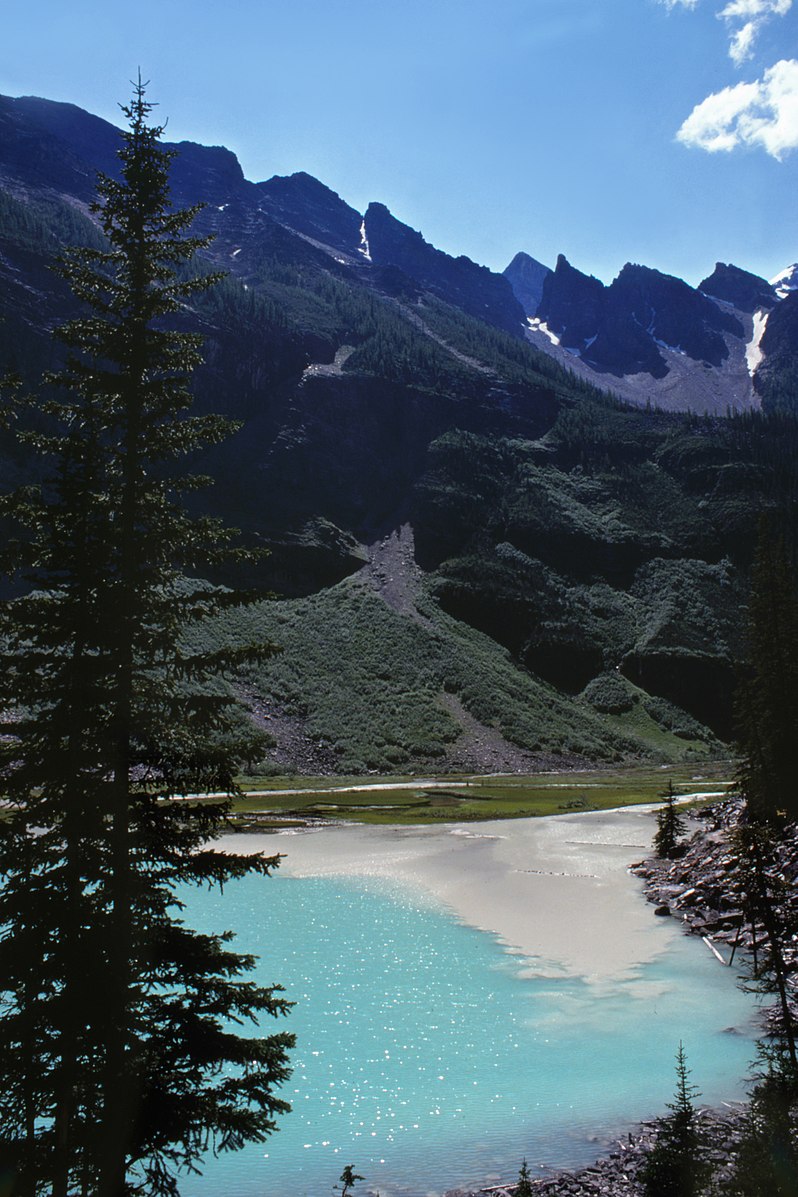
 Photo: WikiPedant/ Wikimedia.
An example of “glacial rock flour” pours into Lake Louise, Alberta, Canada. 

Here’s a new-to-me theory: a discharge from our melting glaciers may be able to soak up some of the unwanted carbon in the atmosphere.

Dino Grandoni writes at the Washington Post, “Minik Rosing grew up around the fine mud flowing from Greenland’s glaciers. It wasn’t until much later, when his own daughter had grown up and was in her mid-20s, that he realized how special it is.

“During a family vacation in rural Greenland, where there was no electricity, she was fishing ice out of a milky-blue fjord for a gin and tonic when that mud gripped her feet so tightly that she had to abandon one of her boots.

“As temperatures rise, meltwater is flushing out millions of tons of this stuff: ultrafine powder ground down by the island’s melting glaciers. Geologists have a culinary-sounding name for the microscopic particles: ‘rock flour.’

“The loss of his daughter’s boot got Rosing thinking. Maybe those tiny grains of rock could be used to trap something much bigger: the carbon emissions that are altering the frozen landscape and way of life on the island.

“ ‘Greenland has been seen as the example and the horror story of climate change, and never been portrayed as a part of the solution,’ said Rosing, a geology professor at the University of Copenhagen in Denmark who was born in Greenland.

“As global emissions continue to rocket, he is part of a growing group of scientists looking for ways to suck carbon right out of the sky, an example of a sometime contentious suite of technologies called geoengineering. …

“Give it enough time and most of the carbon dioxide that humanity is pumping into the air will be taken back by the planet. CO2 dissolves in rainwater and reacts with rocks to form carbon-containing compounds that lock the gas out of the atmosphere. That naturally occurring process, called ‘chemical weathering,’ literally petrifies the air.

“The problem — at least for us humans — is that chemical weathering takes millennia to work its carbon-absorbing magic. Humanity doesn’t have that kind of time: The U.N. Intergovernmental Panel on Climate Change says society needs to drastically reduce CO2 emissions by the end of the decade. The situation has gotten so bad that the panel of scientists says we need to develop ways of pulling carbon from the air to avert catastrophe.

“So what if we could speed things up? What if, Minik Rosing and other scientists wonder, we exposed more carbon-absorbing rocks to the carbon-laden air? They call that technique ‘enhanced weathering.’

“Most enhanced-weathering proposals involve pulverizing tons of basalt or other rocks and spreading them across the land. But all that crushing would consume an enormous amount of energy that might result in more greenhouse-gas emissions. That’s where rock flour comes in.

“Glaciers flow over the bedrock like a slow-moving river. Over centuries, the tremendous weight of the ice grinds the rock underneath into a fine powder only a few ten-thousandths of a centimeter, or microns, in diameter — finer than most sand found on a beach. …

“The fineness of the grains is the flour’s advantage. It gives the substance an enormous surface area to expose to the air, making it an attractive candidate for enhanced weathering. …

“To test how well rock flour stashes carbon, Rosing and [Christiana Dietzen, a soil scientist working with Rosing] hauled about 200 tons of the stuff from Greenland for experiments.

“The material packed a one-two punch, according to a pair of papers the researchers published last year: Not only did it suck up carbon when spread over farm fields in southern Denmark, but it also enriched the soil with nutrients and increased the yield of corn and potatoes in the first year of application.

“The researchers estimate that, given enough time, spreading rock flour on all agricultural land in Denmark would suck up a quantity of carbon approximately equal to the annual emissions of that country (or of Hong Kong or Syria). Preliminary results show longer-lasting crop yields in nutrient-poor soil in Ghana.”

More at the Post, here.

Read Full Post »

Photo: Marek Lumi via Unsplash.
Barcelona, 2023.

How do you get people to change behavior? Even if they know something is good for the world and good for themselves (driving less, for instance), how do you get them to do it? Often people won’t change until they feel the reality of disaster.

But as Andrew Kersley reports at Wired magazine, “people hate the idea of car-free cities — until they live in one.” He notes that one of the best ways to get them started is “from the ground up.” Read on.

“London had a problem,” he begins. “In 2016, more than 2 million of the city’s residents—roughly a quarter of its population — lived in areas with illegal levels of air pollution; areas that also contained nearly 500 of the city’s schools. That same air pollution was prematurely killing as many as 36,000 people a year. Much of it was coming from transport: a quarter of the city’s carbon emissions were from moving people and goods, with three-quarters of that emitted by road traffic.

“But in the years since, carbon emissions have fallen. There’s also been a 94 percent reduction in the number of people living in areas with illegal levels of nitrogen dioxide, a pollutant that causes lung damage. The reason? London has spent years and millions of pounds reducing the number of motorists in the city.

“It’s far from alone. From Oslo to Hamburg and Ljubljana to Helsinki, cities across Europe have started working to reduce their road traffic in an effort to curb air pollution and climate change.

“But while it’s certainly having an impact (Ljubljana, one of the earliest places to transition away from cars, has seen sizable reductions in carbon emissions and air pollution), going car-free is a lot harder than it seems. Not only has it led to politicians and urban planners facing death threats and being doxxed, it has forced them to rethink the entire basis of city life.

“London’s car-reduction policies come in a variety of forms. There are charges for dirtier vehicles and for driving into the city center. Road layouts in residential areas have been redesigned, with one-way systems and bollards, barriers, and planters used to reduce through-traffic (creating what are known as ‘low-traffic neighborhoods’ — or LTNs). And schemes to get more people cycling and using public transport have been introduced. The city has avoided the kind of outright car bans seen elsewhere in Europe, such as in Copenhagen, but nevertheless things have changed.

“ ‘The level of traffic reduction is transformative, and it’s throughout the whole day,’ says Claire Holland, leader of the council in Lambeth, a borough in south London. Lambeth now sees 25,000 fewer daily car journeys than before its LTN scheme was put in place in 2020, even after adjusting for the impact of the pandemic. Meanwhile, there was a 40 percent increase in cycling and similar rises in walking and scooting over that same period.

“What seems to work best is a carrot-and-stick approach — creating positive reasons to take a bus or to cycle rather than just making driving harder. ‘In crowded urban areas, you can’t just make buses better if those buses are still always stuck in car traffic,’ says Rachel Aldred, professor of transport at the University of Westminster and director of its Active Travel Academy. ‘The academic evidence suggests that a mixture of positive and negative characteristics is more effective than either on their own.’ …

“Urban driving doesn’t make up the majority of a country’s car use, but the kind of short journeys taken when driving in the city are some of the most obviously wasteful, making cities an ideal place to start if you’re looking to get people out from behind the wheel. That, and the fact that many city residents are already car-less (just 40 percent of people in Lambeth own cars, for example) and that cities tend to have better public transport alternatives than elsewhere. …

“But as effective as policies to end or reduce urban car use have been, they’ve almost universally faced huge opposition. When Oslo proposed in 2017 that its city center should be car-free, the backlash saw the idea branded as a ‘Berlin Wall against motorists.’ The plan ended up being downgraded into a less ambitious scheme consisting of smaller changes, like removing car parking and building cycle lanes to try to lower the number of vehicles.

“In London, the introduction of LTNs has also led to a massive backlash. In the east London borough of Hackney, one councilor and his family were sent death threats due to their support for the programme. Bollards were regularly graffitied, while pro-LTN activists were accused of ‘social cleansing.’ It was suggested that low-traffic areas would drive up house prices and leave the only affordable accommodation on unprotected roads. ‘It became very intimidating,’ says Holland. ‘I had my address tweeted out twice, with sort of veiled threats from people who didn’t even live in the borough saying that we knew they knew where I lived.’ …

“Any attempts to reduce urban car use tend to do better when designed from the bottom up. Barcelona’s superblocks program, which takes sets of nine blocks within its grid system and limits cars to the roads around the outside of the set (as well as reducing speed limits and removing on-street parking) was shaped by having resident input on every stage of the process, from design to implementation. Early indicators suggest the policy has been wildly popular with residents, has seen nitrogen dioxide air pollution fall by 25 percent in some areas, and will prevent an estimated 667 premature deaths each year, saving an estimated 1.7 billion euros.” More at Wired, here.

What local policies for helping you use your car less would you welcome?

Read Full Post »

Photo: Dominique Soguel.
Michael Antonopoulos, president of the Agricultural Cooperative of Kalamata, tells the Christian Science Monitor, “We want to adjust as soon as possible to the environment and be pioneers. Our place has to be fully ecological.”

In Greece, where farmers have grown olives for millennia, global warming has imposed a new normal. Nevertheless, writes Dominique Soguel at the Christian Science Monitor, “the result is not resignation. Rather, it’s fresh thinking and approaches.”

Soguel continues, “Olives and olive oil have become synonymous with Greece, and are credited, in part, with fueling the rise of Greek civilization. But despite a history spanning thousands of years, these culinary pillars of Greek identity are under threat. Small farmers expect this year’s harvest season, which got underway in November, to be one of the worst years on record, thanks to climate change and the irregular seasonal shifts it has wrought upon the flowering process and fruit development.

“ ‘We are collecting olives much earlier than ever before. Our producers do not recall any year like this,’ says Michael Antonopoulos, president of the Agricultural Cooperative of Kalamata. …

“He is not alone in expecting southern Europe to look like northern Africa in the span of 50 to 100 years. But Mr. Antonopoulos, a geologist and geotechnical environmentalist by training, is optimistic. He points to a series of steps that the community is taking to adapt to unseasonal temperature variations.

‘You can’t change the climate, but you can adjust.’

“[He] notes that traditional olive groves have an important role to play in combating climate change. They are carbon sinks and could easily be integrated into carbon-offsetting projects, increasingly popular but also controversial methods used to reduce the carbon footprint of a company or country. Kalamata is among six Greek cities participating in the European Union mission for 100 climate-neutral and smart cities by 2030.

“ ‘We want to adjust as soon as possible to the environment and be pioneers,’ he says. ‘Our place has to be fully ecological. We don’t care about higher productivity. We care about sustainability. We know people in the future will appreciate that more than anything.’

“One November day in Kalamata, as the mill that serves a community of roughly 300 olive oil producers operates at full throttle, the rain outside turns to hail. … It’s been that kind of year for Kalamata’s olive crop. In 2023, it endured winter conditions during the spring and, unlike much of Greece, experienced relatively low summer temperatures. That unusual weather, coupled with low rainfall, resulted in fewer and smaller olives. …

“ ‘If you don’t have certain weather conditions at a certain time,’ explains Mr. Antonopoulos, ‘you can’t have olive oil.’

“But the mill is also representative of how Greek olive farmers are adapting to the new environment. It is designed to run as sustainably as possible. Waste compost from the mill enriches the soil of the surrounding groves. It is the first mill in the region to rely on solar panel energy, and it recently secured a deal to sell electricity to the Greek government. Further, its farmers have adjusted their pruning tactics to optimize water use. And geothermal energy heats the olive oil extraction plants. …

“ ‘It’s all about feeding the soil,’ says George Kokkinos, head of the Nileas olive oil producers cooperative in the broader Messenia region, which encompasses Kalamata. ‘Soil health is top priority.’ …

“ ‘The philosophy was to look at how olive tree cultivation adapts to climate change,’ adds Mr. Kokkinos. ‘It was the first time that we heard of the expression “climate change.” … The consequences only start to be seen and felt here in 2016.’

“One of the most visible of these consequences, he says, are warmer, humid winters. This led to the spread of fungal diseases. Another change … summer now starts in July and lasts longer. All that confuses the olive tree, which decides in February whether to flower and delivers olives in April. …

“ ‘The normal, maximum temperature for this place this time of year would have been 16-18 C [60-66 F]. Typically, we would start the harvest wearing heavy clothes. Now we harvest in our T-shirts.’

“The mitigation measures are working, he says, even though recent summer heat waves dried up thesoil. He sees evidence of that in a 30% loss of productivity this year on his grove, compared with much higher losses among those who took no measures. The techniques they tested in the project now form part of the EU sustainable agricultural policy. But he worries that the Greek government is not prioritizing action and the spread of know-how to other farmers.

“ ‘The farmer stands in the middle and does not connect the dots,’ he says. ‘The average farmer in Greece is 60 years old. It’s a hard time. That’s true. But there are opportunities. The key is to adjust.’ ”

More at the Monitor, here. No paywall.

Read Full Post »

Photo: Institute For Figuring.
Coral Forest – Helsinki, crocheted from recycled plastic. A collaboration between Christine and Margaret Wertheim and the Helsinki Satellite Reefers, hosted by Helsink Art Museum and Helsinki Biennial 2021.

Remember my post on how crochet art was drawing attention to dying coral reefs? (See it here.) Well, after my friend Kristina told me about seeing some of the new additions to the crochet project, I decided to post a follow-up.

Siobhan Roberts reported at the New York Times in January, “Every year after the full moons in late October and November, Australia’s Great Barrier Reef begins its annual spawning — first the coral species inshore, where waters are warmer, then the offshore corals, the main event. Last year, this natural spectacle coincided with the woolly propagation of two new colonies of the Crochet Coral Reef, a long-running craft-science collaborative artwork now inhabiting the Schlossmuseum in Linz, Austria, and the Carnegie Museum of Art in Pittsburgh.

“To date, nearly 25,000 crocheters (‘reefers’) have created a worldwide archipelago of more than 50 reefs — both a paean to and a plea for these ecosystems, rainforests of the sea, which are threatened by climate change. The project also explores mathematical themes, since many living reef organisms biologically approximate the quirky curvature of hyperbolic geometry. …

“The surface of a sphere displays constant positive curvature; at all points, the surface bends inward toward itself. And a hyperbolic plane exhibits constant negative curvature; at all points, the surface curves away from itself. Reef life thrives on hyperbolism, so to speak; the curvy surface structure of coral maximizes nutrient intake, and nudibranchs propel through water with frilly flanges.

“In the artworks, marine morphologies are modeled — crocheted — with loopy verisimilitude. A bit like Monet’s water lilies, the crochet corals are abstract representations of nature, said Christine Wertheim, an artist and writer now retired from the California Institute of the Arts. Dr. Wertheim is the driving artistic force behind the project, which she created with Margaret Wertheim, her twin sister, a science writer who is in charge of scientific and mathematical components as well as management. …

“Crochet Coral Reef exhibitions typically have two main components: The Wertheims provide an anchor, of sorts, with works from their collection that they have crocheted over the years. They also incorporate pieces by select skilled international contributors. One is a ‘bleached reef,’ evoking corals stressed by increases in ocean temperature; another, a ‘coral forest’ made from yarn and plastic, laments the debris that pollutes reef systems.

“Then in response to an open call, volunteers far and wide crochet a pageant of individual specimens that agglomerate in a ‘satellite reef,’ staged by a local curatorial team with guidance from the Wertheims. … All contributors are credited.

“The largest satellite reef thus far coalesced in 2022 at the Museum Frieder Burda in Baden-Baden, Germany, with some 40,000 coral pieces by about 4,000 contributors. The Wertheims call this the Sistine Chapel of crochet reefs (documented in a splashy exhibition catalog). But the show at the Linz Schlossmuseum, which is dedicated to natural science as well as art and culture, is reminiscent of the work of the painter Giuseppe Arcimboldo, whose collage portraits from depictions of fruits, vegetables and flowers are ‘fantastically heterogeneous, also very funny and clever,’ Ms. Wertheim said.

“The Linz satellite reef unites some 30,000 pieces by 2,000 crocheters. The disparate parts take colorful inspiration from traditional Austrian ‘craftswomanship,’ as the exhibit text puts it, and there is a vast, glittery coral wall that gives a nod to the artist Gustav Klimt. In the Wertheims’ view, however, the crochet coral project is proof that it is not always lone geniuses who create great art, but also communities. In the art world, that is a radical idea, they noted, yet in science big collaborative projects and papers with thousands of authors are not unprecedented. …

“The mathematical dimension of the story intersects (from afar) with research by the applied mathematician Shankar Venkataramani and his students at the University of Arizona. They use idealized models to study hyperbolic surfaces in nature. [The] benefit, he said, is that it helps optimize processes like circulation and nutrient absorption. …

“When Margaret Wertheim, who studied math, physics and computer science at university, learned hyperbolic geometry, she found it ‘a bit bamboozling.’ She took the principles more on faith than understanding. Yet through crocheting models, she said, ‘you really do learn in a very deep way what a hyperbolic structure is, and in a way that I think is very powerfully pedagogical.’ “

More at the Times, here. Gorgeous photos.

See also Crochet Coral Reef, here. As the website notes, “Every crafter who contributes to the project is free to create new species of crochet reef organisms by changing the pattern of stitches or working with novel materials. Over time, a Darwinian landscape of wooly possibility has been brought into being. What started from simple seeds is now an ever-evolving, artifactual, hand-made ‘tree of life.’ “

Read Full Post »

Photo: Melanie Stetson Freeman
The
Christian Science Monitor highlights indigenous “Guardians” who made a “hole in Arctic Ocean ice – a window on climate-related changes – where they monitor water quality and measure ice thickness.

Cold parts of the world are threatened. The cold-loving people who live there are deeply concerned and are monitoring the losses for climate scientists.

Sara Miller Llana writes for the Christian Science Monitor, “Masked against the Arctic glare in orange-tinted sunglasses, Tad Tulurialik is a modern conservation ‘Guardian’ of his fast-melting homeland.

“At the start of an early summer workday that never sees the sun set, he kicks his all-terrain vehicle into gear. Safe in his ancestors’ knowledge of sea currents and ice fissures, he navigates a course right off the edge of the Canadian shore onto the aqua iridescence of the frozen Arctic Ocean. He’s following older Guardians to a manmade hole in the ice shelf, a window toward understanding climate-related changes in the sea.

“Even out on the ocean surface, his rifle is always swung over his shoulder. Wherever he sees a caribou or musk ox, it’s an existential given that he’ll take it. Food security isn’t found in a grocery aisle in this northernmost Canadian mainland settlement, tellingly named with the Inuktitut word for a caribou hunting blind.

“In some ways, as a government-paid conservation Guardian in training, the 24-year-old Mr. Tulurialik is doing what he’s done his whole life. Like most Inuit boys, he was ‘on the land’ as soon as he could walk. His childhood was spent on tundra and on sea and lake ice to hunt and fish with his grandparents, who raised him. His life was marked not by school grades but by first fox trapped, first polar bear shot. These were such priorities that he dropped out of high school.

“That could have made him part of Canada’s persistent social inequality – Indigenous youth in some of the remotest parts of the country, undereducated, underqualified, and often losing touch with rich traditions and fleeing homelands for economic opportunity. Except today, he’s part of a solution, as a member of Canada’s Indigenous Guardians, a conservation corps working in 170 far-flung Indigenous communities.

“Guided and taught by elders, he and other young Inuit born since 1989, when warming of the Arctic turned precipitous, are part of an effort to safeguard their homelands and their cultural ‘right to be cold.’ They’re also helping Canada achieve international conservation commitments made last year, when it led a global pledge at the United Nations Biodiversity Conference in Montreal to protect 30% of its land and oceans by 2030.

“For Mr. Tulurialik, who worked in construction and sewer maintenance after leaving school, a paid job as a conservationist is a dream: ‘I never thought I would work and get paid for what I grew up doing.’ 

“Together, he and his Guardian colleagues are tasked with creating a sustainable future, transforming Western-style conservation work into something that more closely resembles a traditional Indigenous environmental ethos. Guardians blend science with Indigenous knowledge in a budding conservation economy dependent on the transfer of knowledge from elders to youth. 

“The ultimate aim of the Guardians’ work in Taloyoak is to use their sustainable Inuit practices – learned orally over millennia – to support the creation and maintenance of an Indigenous Protected and Conserved Area. The size of Maine, it is one of more than 90 in development across Indigenous Canada. Here in northern Nunavut territory, the IPCA conservation plan is led by the local hunter and trapper association.

It’s nurturing an economy of land-based jobs and markets as an alternative to a future in extractive industries in a territory long eyed by mining and oil interests.

“The land will be protected from development, conserving both biodiversity and a way of life based on sustainable hunting and fishing – while sequestering huge amounts of carbon, the culprit in global warming.

“ ‘This is a win-win situation’ … says Paul Okalik, the first premier of Nunavut who now works with Canada’s World Wildlife Fund (WWF), which is supporting Taloyoak’s efforts. …

“Indigenous lands, from the Brazilian Amazon to Hawaii coastlines to Canada’s high-latitude forests, represent 20% of the globe but hold 80% of the world’s biodiversity. Inhabitants have stewarded the land for centuries. Yet in a warming climate, their homelands are in some of the most at-risk environments. 

“The Arctic is this nation’s – and arguably the world’s – crisis point. Here, warming is happening at up to four times the rate of the rest of the world, leading to melting permafrost, retreating glaciers, and receding sea ice. This has broad implications for the global ecosystem. Arctic ice melt slows ocean currents and makes the oceans more acidic – changes that have global implications for both climate patterns and sea habitats. Increased melting also creates what scientists call a ‘positive feedback loop’: As dark water replaces white snow on ice, the surfaces of the ocean and Earth absorb more sunlight rather than reflecting it. This causes even more warming. …

“Taloyoak locals have already worried about warming changing their ways. Last summer was the Northern Hemisphere’s hottest on record. The year prior, Taloyoak recorded its all-time hottest temperature of 78.8 F. Locals stayed home rather than go outside in, for them, the unbearable temperature.”

Imagine the high 70s being unbearable! The rest of North America will be learning about “unbearable” soon — if it hasn’t already.

The Monitor‘s long and intriguing feature on the work in the far north is here. No firewall.

Read Full Post »

Photo: Melanie Stetson Freeman/CSM Staff.
The Christian Science Monitor says, “Deon Shekuza is a peripatetic presence at climate summits as well as at the grassroots – like the class on green hydrogen he taught to young teens in an informal settlement in Windhoek, Namibia, last July.”

Climate activism is no longer mainly the purview of the industrialized Northern Hemisphere or those with enough income and time to worry about it. Now people on the front lines are leading the way. For them it’s a matter of survival.

Sara Miller Llana writes at the Christian Science Monitor about Deon Shekuza, a climate influencer in Namibia, who is “as comfortable proselytizing green energy to youth on the hardscrabble roads and villages of this former German colony as he is in Namibia’s government ministries and the halls of United Nations conferences.

“Paid with respect if not a salary, he’s part of a rising breed of young climate activists across the Global South whose work, suggests one climate expert, may well determine the temperature of your world.

“Africa, which has contributed least to climate warming, is the continent most threatened by the droughts, floods, and heat intensified by climate change. In that extremity, the relentlessly positive Mr. Shekuza sees great opportunity for progress for Namibia.

“In the dusty chaos of an informal settlement on the edge of this capital city one recent morning, he faces his biggest challenge: capturing the imaginations of young teens on a complex topic. The kids have gathered in a bright community center classroom, not for school credit and certainly not for fun on their Saturday off, but to hear Mr. Shekuza teach green hydrogen 101. Namibia has staked its future on this next big solution for a global clean energy transition. …

(The process, simply put, would use solar or wind power to extract hydrogen molecules from desalinated seawater, producing green ammonium that would be used for regional and global fuel markets to power transportation and electricity production.)

“No one here knows what green hydrogen is, let alone how it might be the route to social justice that Namibia’s leaders proclaim.  Grasping for something understandable, Mr. Shekuza gestures out the window at the ancient and humble street scene of women laden with bushels of branches gathered from the forest for heating and cooking fuel. ‘This is exactly what we do not want for our people, right? Some energy sources keep you in the past, and some energy sources move you into the future. This is why we are here talking about green hydrogen.’

“After 90 minutes, Mr. Shekuza is satisfied. These kids might not exactly understand Namibia’s renewable energy policy, but they understand green hydrogen potential: jobs for them in a new economy that could turn Africa’s perpetual sunlight into clean fuel for electricity and transportation here and for export. …

“For activists across Namibia – like the Inuit in the Arctic, or youth from small island nations – caring and conserving is the easy part. These youth grew up living sustainable lives well before it was trendy. Many were born on the land, in the bush, on the coast, with no playgrounds except the natural environment around them. They conserved not for environmentalism, but for survival. …

“Mr. Shekuza and young African activists like him across the continent who are part of the Climate Generation, as we’re calling it, see a chance – the kind Mr. Shekuza tells the children in the informal settlement to seize, the kind he has seized for himself. …

“Mr. Shekuza can barely afford to do the work he has cut out for himself. For all his social confidence, he hesitates at the doorstep of his home before inviting visitors in for the first time ever. Descending from sunny daylight down a step at the side of a large old house, he enters the tiny basement space he shares with his mother.

“With a revealing flourish of humility, he pulls the worn blue curtain separating his mother’s bed from his floor space: ‘This,’ he says, ‘is climate activism in Africa.’

“In his windowless corner lies his bed. … On the chipped yellow paint of a cement wall are dozens of badges from U.N. conferences. A single business suit hangs from the curtain rope.

“This is the headquarters of his nongovernmental organization. With just the grants and fees he cobbles together from government and U.N. funding, the 33-year-old college dropout educates himself, hatches ideas for mentoring youth, and speaks via Zoom to august groups, all on the floor here. For an online speech on climate justice for a British Museum conference, he had no option but to give his speech right there, cross-legged on his sleeping pad, dressed in a traditional African tunic, surrounded by clothes, caps, shoes, and [policy] documents. …

“The environment, he says, was always a part of his interest: Nature was his escape from the noise and dilapidation of poverty in his rural hometown of Grootfontein. … ‘We are people who never look at the environment like something that is separate, because you grew up looking at it as part of you,’ he says. …

“He co-founded the NGO Namibian Youth on Renewable Energy (NAYoRE); gave himself the title ‘youth advocate for sustainable development’; worked with other organizations and networks on biodiversity, farming, and climate change; and started crisscrossing the globe on invitations to attend and address government, U.N., and private conferences. …

” ‘[Young people] may see me with a fancy English up here, but my lifestyle is no different from that kid in the shack. So when I speak for the youth, I’m coming from experience and I’m speaking something solid.’

“He pulls out a binder on agriculture in Namibia and how to use regenerative practices in one of the most water-stressed nations on the planet. It’s the latest document he’s read, and he’s read all of it: ‘I have dedicated hours and hours and hours … like trying to upgrade and up-skill myself. And I did that in and out of school, but I found the most benefit came out of it.’ …

“On a late Friday afternoon, Mr. Shekuza meets at a cafe with Micky Kaapama, whom he has been tutoring to be a climate activist, or, as they put it, a ‘biodiversity enthusiast.’ The glamorous fashion model studied biology and, crucially, has 12,000 Instagram followers. …

“As if trying to convince her of what she has to gain, he pulls out his phone to show an invitation from the Namibian president’s office that he’s just received. Addressed to Deon Shekuza, ‘Youth Advocate for Sustainable Development,’ it’s for a luncheon with Hyphen, a German- and British-financed Namibian company that signed a deal last May with Namibia to build the largest green hydrogen project in the country. It’s an $11 billion agreement.

“But there’s a hitch in the impressive invite. He has no idea how he can even afford to get to the event five hours away in Keetmanshoop.”

Find out what happens at the Monitor, here. No firewall.

Read Full Post »

« Newer Posts - Older Posts »