Feeds:
Posts
Comments

Posts Tagged ‘climate change’

Photo: BioCarbon Engineering
Drones can have a peaceful purpose. These are fighting climate change by “bombing” seeds into places that need trees. Trees are essential for decreasing carbon dioxide in the atmosphere.

Drones can have peaceful purposes. Some folks use them for photography or research on birds. Others have tapped drones to plant the trees our planet needs to reduce carbon dioxide and combat global warming.

Leo Shvedsky writes at Good, “Technology is the single greatest contributor to climate change but it may also soon be used to offset the damage we’ve done to our planet since the Industrial Age began.

“In September 2018, a project in Myanmar used drones to fire ‘seed missiles’ into remote areas of the country where trees were not growing. Less than a year later, thousands of those seed missiles have sprouted into 20-inch mangrove saplings that could literally be a case study in how technology can be used to innovate our way out of the climate change crisis.

“ ‘We now have a case confirmed of what species we can plant and in what conditions,’ Irina Fedorenko, co-founder of Biocarbon Engineering, told Fast Company. …

“According to Fedoranko, just two operators could send out a mini-fleet of seed missile planting drones that could plant 400,000 trees a day — a number that quite possibly could make massive headway in combating the effects of manmade climate change.

“The drones were designed by an ex-NASA engineer. And with a pressing need to reseed an area in Myanmar equal to the size of Rhode Island, the challenge is massive but suddenly within reach. Bremley Lyngdoh, founder and CEO of World Impact, says reseeding that area could theoretically house as many as 1 billion new trees. …

“For context, it took the Worldview Foundation 7 years to plant 6 million trees in Myanmar. Now, with the help of the drones, they hope to plant another 4 million before the end of 2019.

“Myanmar is a great case study for the project. In addition to the available land for the drone project, the nation has been particularly hit by the early effects of climate change in recent years. Rising sea levels are having a measurable impact on the population. In addition to their ability to clear CO2 from the atmosphere, healthy trees can also help solidify the soil, which can reduce the kind of soil erosion that has been affecting local populations in Myanmar.”

Adele Peters at Fast Company explains, “The drones first fly over an area to map it, collecting data about the topography and soil condition that can be combined with satellite data and analyzed to determine the best locations to plant each seed. Then the drone fires biodegradable pods — filled with a germinated seed and nutrients — into the ground. For the process to succeed in a mangrove forest, several conditions need to be right; if the tide comes in unexpectedly, for example, the seeds could wash away. In tests, Biocarbon Engineering has looked at which species and environmental conditions perform best.

“If drones do begin to replant entire forests, humans will still play a critical role. That’s in part because some seeds don’t fit inside the pods. But people living nearby also need a reason to leave the trees standing. ‘The project in Myanmar is all about community development and enabling people to care for trees, providing them with jobs, and making environmental restoration in a way that it’s profitable for people,’ says Fedorenko. ‘The forest didn’t vanish by itself—the forest was cut down by local people.’ ”

More at Good and Fast Company.

Hat tip: Maria Popova on Twitter.
Read Full Post »

More and more people are recognizing that the mass migrations we’re seeing today — and the wars that seem to be the main cause — are tied to climate change.

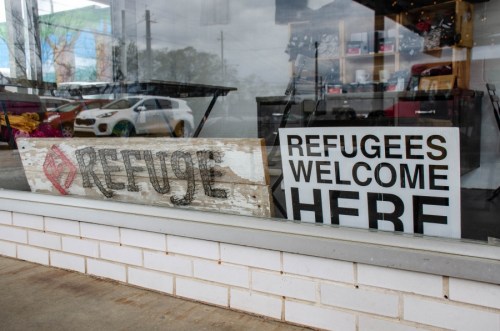
Here is a story about a small city in Georgia, home to many immigrants, that has put two and two together and is determined to be part of the solution.

Writes Jason Margolis at Public Radio International’s show The World, “Clarkston, Georgia, is often referred to as the Ellis Island of the South. Some 60 languages are spoken in this city of 13,000 just outside of Atlanta, and perhaps half the population is foreign born. Many are refugees.

“Felix Hategekimana is a refugee from Rwanda, a soft-spoken man who doesn’t talk much about his backstory, except to say that he fled violence back home: ‘We have political issues and security [issues].’

“But Hategekimana says there’s more to the troubles in Rwanda. Droughts and floods have plagued his country in recent years, and that’s led to more people migrating.

“ ‘Some people lose life in the disaster of the rain,’ Hategekimana said. ‘Some people lose life, others lose their homes and they lose their property, like their farms where they plant their vegetables.’

“You hear a lot of stories like this from refugees in Clarkston. Legally, there’s no such thing as a ‘climate change refugee.’ Refugee status is only awarded based on a well-founded fear of persecution due to race, religion, nationality, political opinion or membership in a social group — not because your home got wiped out by a flood, or your crops were destroyed by a drought.

“But Clarkston’s mayor, Ted Terry, says the impacts of more extreme weather are woven throughout the lives of many new residents here. …

“Climate scientists agree that storms are becoming more severe, and the trend is only going to continue. Case in point, the Category 4 cyclone that struck southern Africa recently has left at least 600,000 people displaced. The immediate needs there — food, clean drinking water and shelter — are stark. After that, a big question: rebuild or relocate?

“It’s a dilemma that many people across the globe are facing, which will inevitably lead to more people on the move. But the world still hasn’t agreed on what to do with so-called climate refugees. Take a place like Syria.

“ ‘It becomes more drier, I think,’ said Malk Alarmash, a Syrian refugee now living in Clarkston. … But Alarmash can’t say that a lack of rainfall led people to flee Syria.

“ ‘I don’t know. I don’t have any information about that, like climate change,’ Alarmash said.

“An inability to pin the seeds of conflict on climatic shifts isn’t unusual; the relationship between climate change and forced migration is immensely complicated. … A drought can destroy people’s food supplies and livelihoods. That can lead to internal migration, inflame tensions and maybe even contribute to conflict and a refugee crisis. But all of this can unfold over years. …

“ ‘The climate is the last thing in their mind. They know it’s all related, but they just say, “This is from God,” ‘ said Omar Shekhey, a Clarkston resident who is originally from Somalia. …  ‘It goes together — the civil war, the war and the climate, you cannot separate them.’ …

“Shekhey says most Somali refugees aren’t connecting the dots to climate change. But as global temperatures continue to rise, Mayor Terry, who also works with the Sierra Club, believes that those dots will become clearer, even in the US.

“ ‘We’re looking at a future, I think, if we don’t take steps to reverse global warming, we’re looking at potentially hundreds of millions of people around the world, including you know, in America, Louisiana. Their coastline is disappearing,’ Terry said. ‘And so, at some point, there has to be some sort of recognition and define what it means to be a climate refugee.’ …

“Clarkston’s mayor [wants] to address the root of the problem, starting in his own community. It’s one reason Clarkston is committing to 100 percent renewable energy — instead of fossil fuels — by midcentury.

“ ‘In some way, we’re trying to alleviate future calamities. We just have to do our part; we have to consider ourselves part of the global community.’ ”

More at PRI, here.

dsc5861

Read Full Post »

Photo: Alexander Koerner/Getty Images
Teenage sisters Melati and Isabel Wijsen of Bali have received many honors for their efforts to ban plastic bags. Here they’re seen accepting the 2017 “Award for Our Earth” from Germany’s Bambi Awards.

An impressive phenomenon that’s emerging as climate change threatens communities and plastic waste clogs waterways is the emergence of children and teens as leaders — in particular, young people from developing nations.

Consider this story from National Public Radio [NPR].

“Five years ago, two young women decided they were going to do something about the plastic problem on their island of Bali. And Bye Bye Plastic Bags was born.

“How young?” asks NPR reporter Michael Sullivan. “So young one of them couldn’t make it to our midweek interview. ‘She’s at school,’ explained 18-year-old Melati Wijsen, talking about her 16-year-old sister Isabel. ‘She’s just halfway through grade 11 and she’s putting her focus more into graduating high school.’

“Bali is part of the island nation of Indonesia, which is the world’s second biggest polluter when it comes to marine plastic, trailing only China. And when ocean currents carry that plastic to the tourist island of Bali, it’s a public relations nightmare. This video taken by British diver Rich Horner last year pretty much sums up the scale of the problem as he tries to navigate through a sea of plastic just below the water’s surface.

“The two sisters got the idea for Bye Bye Plastic Bags in 2013 after a lesson at school about influential world leaders — change-makers — including Nelson Mandela, Martin Luther King Jr. and Mahatma Gandhi.

” ‘My sister and I went home that day thinking, “Well, what can we do as kids living on the island of Bali?” ‘ Melati Wijsen says. … The answer was right in front of them. Literally. On the beach in front of their home. …

” ‘It got to the point where on weekends when we would go to our childhood beach, if we went swimming there, a plastic bag would wrap around your arm,’ Wijsen says. …

“They went online and discovered that over 40 countries had already banned or taxed plastic bags.

” ‘We thought, “Well, if they can do it, c’mon, Bali! C’mon, Indonesia! We can do it, too!” ‘ Wijsen says. …

“They got some friends together, went online to start a petition and got 6,000 signatures in less than a day, Wijsen says. They spread awareness through school and community workshops. They organized massive beach cleanup campaigns, all the while drawing international attention and that of local politicians too. Especially when they decided to up the ante optics-wise.

” ‘I think one of the biggest tools that pushed us forward was our decision to go on a food strike,’ Wijsen says, inspired, she says, by one of the tools used by Gandhi. ‘He also had peaceful ways of reaching his goals, of getting attention, So that was a huge inspiration for us.’

“[The governor did] what any savvy politician would do when faced with two teenage girls threatening a hunger strike. He invited them to come see him. ‘Within 24 hours, we had a phone call and then the next day we were picked up from school and escorted to the office of the governor,’ Wijsen says.

“[Governor] Pastika signed a Memorandum of Understanding with the sisters to work toward eliminating plastic on the island. … Melati Wijsen says she learned a lot about dealing with politicians. …

” ‘Being 14 and skipping school on a Tuesday because I had to learn about draft regulations and suggestions really was an interesting learning curve for me,’ she says. Dancing with politicians, she says, is like three steps forward, two steps back and again, and again. ‘It’s almost like the cha-cha.’ …

“Just last month, the new governor of Bali announced a law banning single-use plastic in 2019, thanks in part to the sisters’ efforts and those of like-minded NGOs. …

” ‘We literally prove that kids can do things, and Bye Bye Plastic Bags has become this platform where kids can feel like their voices are being heard. … This is my No. 1 focus right now,’ she says. ‘It consumes almost every thought in my body. I mean, it’s like a full-time job.’

“Is she obsessed or just focused? ‘A healthy chunk of both,’ she says, laughing, adding that her mother helps keep her balanced. ‘Some days, she’ll just be like, “Melati, take a day off, like go to the beach with your friends and just don’t pick up the plastic, just sit there.” ‘ ” More at NPR, here.

I have to give a shout-out to teachers like the ones who motivated these teens. Can anyone doubt that teachers are important?

Read Full Post »

Photo: Matthew Podolsky
Conservationist Alfred Larson, 96, has installed hundreds of bluebird next boxes in southern Idaho, allowing scientists to study Mountain Bluebirds as the species recovers from a decline.

In my area of New England, I don’t often see bluebirds. I see lots of bluebird houses people put up to entice them, but few bluebirds. You can imagine how excited I was one wintry day a few years back when a whole flock showed up in our deciduous holly. It was amazing. And never repeated.

A conservationist in his 90s who wanted to learn more about Western and Mountain Bluebirds has turned southern Idaho into a bluebird haven. Now, that’s something I’d like to see!

James Crugnale writes a the Audubon website, “In 1978, Alfred Larson was looking for a hobby that would keep him busy after he retired from his job at a sawmill plant near Boise, Idaho. He remembers reading an article in National Geographic that captured his imagination—about crafting wooden nests for bluebirds to save them from dizzying declines. Around this same time, he and his wife Hilda welcomed a new guest to their backyard: a Western Bluebird.

“ ‘We noticed a bluebird going in and out of a cavity of an old, dead snag,’ Larson says. … I had heard about bluebird trails out East that Lawrence Zeleny had set up. If I put up boxes on my ranch, I’d have a captive group of birds to take pictures of.’ …

“Four decades later, at the age of 96, Larson is monitoring almost 350 nest boxes on six different bluebird trails across Southwest Idaho. From the Owyhee Mountains to Lake Cascade, he and his fellow community scientists peek into the rustic abodes every nine days to band any residents and jot down notes on behavior and growth. Larson organizes the data and shares it with the Cornell Lab of Ornithology‘s Nestwatch program. …

“Prior to the big nest box craze, all three North American species—Western, Mountain, and Eastern—saw a major dip in population numbers, due to ‘the elimination of dead trees with the invention of gas-powered chainsaws in the 1930s . . . along with the widespread use of pesticides to kill insects,’ says bluebird photographer and expert Stan Tekiela. Studies in the 1970s tied DDT to the death of hundreds of Mountain Bluebird chicks in western Canada. …

“Many of Larson’s trail buddies are wary of the day he decides to retire again. Boyd Steele, a volunteer who regularly assists Larson with the nest boxes, says the nonagenarian has been steadily passing down his knowledge. But his devotion to bluebirds will be hard to replace. ‘I don’t think there’s anybody who is as dedicated as Al,’ Steele says.

“Filmmaker Matthew Podolsky echoes that sentiment. After being introduced to Larson through a graduate advisor at Boise State University, he and his peer Neil Paprocki tracked the local legend with a camera for weeks. The resulting 30-minute documentary, titled Bluebird Man, of course, went on to be nominated for an Emmy Award in 2015.”

More here, at the Audubon website.

Read Full Post »

This is Greta Thunberg, the 16-year-old climate activist from Sweden. She started the Friday school strikes that are spreading around the world and made a splash scolding power brokers at the World Economic Forum in Davos, Switzerland.

You have probably heard of the ubiquitous Greta Thunberg, the Swedish teen who is leading a youth movement to address global warming. But there are many other climate movements right now, as I learned when I read Mary Robinson’s inspiring book Climate Justice. One example she cites is an Australia-based organization called 1 Million Women, which was started by a woman who was able to cut way, way back on her family’s carbon footprint and wanted to share what she learned.

One Million Women’s website includes a pollution-cutting activity center that “has 50+ ways to cut pollution, covering energy, money, household, food, travel, shopping, sharing and a special girls section. Each activity has a pollution value attached. Choose the activities that work for you,” it suggests.

For those of you who really want to roll up your sleeves and tackle daily activities, 1 Million Women also has a handy feature called the Carbon Challenge, which provides sustainability tips and helps you track your progress in reducing pollution. See that here. I confess that I haven’t taken the challenge yet, but I’d love to hear from anyone who gives it a shot.

The blog for 1 Million Women features entries from many activists, each focusing on a different aspect of climate change activism. The toilet paper post was funny. In another post, Eve White, “mum of two and a freelance editor with a PhD in Ecology, … founding member of Australian Mums for a Safe Climate and Australian Parents for Climate Action,” asks, “Why are we leaving it up to our kids?”

She writes, “In November, 2018, 15,000 Australian kids went on strike from school to demand stronger action on climate change. Other actions will follow, with the next climate strike planned for March, 2019. Listening to these kids speak, it is clear that they are articulate and informed. They include school captains and future doctors, leaders and business people; not the kind of kids who’d routinely skip school. But without the power to vote they are worried about their future, frustrated with inaction on climate change and desperate to be heard.

“It is wrong that it has fallen on the kids to do this. As one young speaker said, ‘We are expected to tidy up after ourselves. Adults should tidy up their own mess, not leave it for us. This is not fair.’ ”

White goes on to list “ways that parents can support their kids in the fight for the future, and not all of them require a lot of effort,” like talking to more people about the issue, supporting the kids’ movement logistically and financially, writing to the local paper, and getting active in national environmental groups. Another “not a lot of effort” thing to do if you are on social media might be to follow people who are working on this issue and share information with your followers.

More.

Read Full Post »

Photo: Rebecca Kordas/UBC
Limpets are easy to overlook — so too is their effect on the environment. But careful consideration of how all the life forms in an area interact is key to understanding how ecosystems thrive.

I’ve been reading a small book called The Sound of a Wild Snail Eating. A friend offered to lend it to me, and much to my surprise, I’m finding it fascinating. It’s by a woman with a debilitating illness who describes her growing interest in a snail brought to her on a wild violet plant. As the author learns, there is more to snails than meets the eye. A lot more.

The same may be said of limpets. Christopher Pollon explains why at Hakai Magazine.

“As the ocean temperature rises, it may be the little things that make the biggest difference to the survival and resilience of living things.

“Take the limpet, a tiny snail-like gastropod with a hefty appetite for the minute plants that live in the intertidal — the space between low and high tide. In 2014, Becca Kordas, then a zoology doctoral candidate at the University of British Columbia, tested the effect these creatures have on the ecosystem when exposed to ocean warming. She found that their influence was huge.

“Kordas launched her project by sinking four sets of settlement plates in the intertidal zone of Saltspring Island, British Columbia, about 55 kilometers southwest of Vancouver. For 16 months, Kordas and her colleagues tracked which plants and animals established themselves on the four different types of plots. Kordas controlled the limpets’ access to half of the plates, while they were free to graze on the other half. She also simulated the effects of ocean warming by tinting some of the plates black to attract the sun’s heat.

“By the end of the study, the differences between the four sets of plates were stark. Kordas found that when limpets’ access is restricted, the artificially warmed intertidal ecosystem collapsed — the diversity of life largely replaced by a mat of microalgae. Limpets with access to the plates, however, maintained a healthier ecological community, even in a warming environment.

“What is it about limpets that helps maintain a diverse and complex community, even when their environment warms?

“Kordas says limpets eat huge amounts of microalgae, including microscopic diatoms and the spores of larger algal species. This clears the terrain for a variety of life.

“ ‘When limpets are allowed in, they make space for things like barnacles, and then those barnacles in turn create little condos for other animals to live in,’ she says.

“In a sense, limpets are tiny ecosystem engineers. … The study comes at a critical time for intertidal life in the northeast Pacific Ocean. In this area, the summer low tide typically occurs around noon, which exposes intertidal species to warm summer temperatures. The heat shakes up the intertidal community, but shakes it up more without limpets around.

“The lesson of Kordas’s study, however, is not about limpets per se. It’s about the need to better understand the role of every organism in an ecosystem.”

Hat tip: Pablo Rodas-Martini, @pablorodas, on Twitter.

More here.

Read Full Post »

Photo: South West News Service
Pat Smith, married mother of two, grandmother, and owner of a B&B in Cornwall, cleaned plastic from 52 English beaches in 2018 and is still going strong.

Doesn’t 2019 feel like the year that environmentalism will pick up more proponents than ever? Thanks to activists and journalists, people are really up in arms about the plastic that’s defacing our beautiful beaches and about what fossil fuels and giant agribusinesses are doing to the climate. Humanity seems to take steps forward and then take steps back, but I feel like this is a forward year.

Consider these three anti-plastic, anti-litter stories.

Maddy Foley writes at Inverse about the origins of plogging, which is a “mash-up of ‘jogging’ and plocka uppa, the Swedish word for ‘picking up.’ …

“Plogging first emerged in 2016,” she says, “started — or at least branded — by Erik Ahlström, following his move from a resort town to Stockholm. Ahlström was reportedly struck by the amount of trash he passed by during regular runs — so he began picking it up along the way, often sporting medical gloves. Soon Ahlström was organizing community runs throughout the city, marrying environmental advocacy with sensible amounts of exercise.

“The practice supposedly grew from the long-standing Swedish philosophy of lagom, the Goldielocks of lifestyle tenets. Meaning ‘not too much, not too little.’ Lagom values moderation; it heralds the pleasure of existence, without being seduced by the lure of consumption.

“In plogging, those tenets translate to picking up some trash (not every single piece), while jogging (not sprinting). It’s about being out in the world, while accepting that it’s become a world beset by trash.” More at Inverse.

There’s also a nice story at Public Radio International’s The World about Ripu Dama, a long-distance runner in India who caught the plogging bug and who recently spread the word on a run through Europe.

Marco Werman reports on Dama’s efforts in India, “Dama, who is being called ‘India’s first plogger,’ is spreading a message of physical activity and environmental protection in Mumbai while participating and organizing clean ups — documenting everything on social media @ploggersofindia.

“ ‘I’m a runner. I run marathons and ultras. When you’re a runner and you run in the mornings, the thing that you observe most is trash and plastic. So [members of my running group and I] were already cleaning up individually. In 2017, we came across the term “plogging” and we thought “this is exactly what we do.” It was kind of becoming a global trend.’ …

“Dama hopes to make an impact on the younger generations. … ‘Schoolchildren take it up like fish to water. And that’s been the biggest high out of all of this. When we are doing this activity in our local parks or somewhere and kids see us doing it … they just come and join us and the habits that get inculcated at this young age will last a lifetime.’ ” Listen to the PRI interview here.

But wait! You don’t need to be a runner or a kid.

As Ed Riley writes at the Daily Mail, an English grandmother walked 52 beaches in 2018 cleaning up plastic, and she has no intention of slowing down.

Pat Smith, “founder of the environmental campaign group Final Straw Cornwall, said: ‘Doing 52 beach cleans in 2018 was my New Year’s Resolution and it’s finally done. I won’t stop as our beaches need me.

” ‘A lot of the rubbish I have picked up consists of everyday items. These things are used by all of us and it is shocking to find them polluting our beautiful beaches. …

” ‘I’m driven to try and protect our living planet for my children and grandchildren, and I will continue to do everything in my power to achieve that. …

” ‘I grew up in the generation where plastic use was at its worse. … [But] even though it was everywhere, we had no plastic at home — we would walk to the shops or get the bus to get groceries.’

“Mrs Smith said that she was often joined by other volunteers who were determined to keep our beaches clean. But she said not everyone understood, and on some occasions, she would be mistaken for doing community service.

“She said: ‘People don’t understand I’ve been doing this voluntarily. We should all take responsibility for picking up the litter, as well as ensuring we don’t drop litter in the first place.’ ” More at the Daily Mail, here.

If you are ever in Cornwall, you might consider staying at Mrs. Smith’s B&B. She sounds like a good person to know.

Read Full Post »

Photo: Buzzfeed
Reducing our intake of meat, especially beef, can reduce global warming. Want to help me find quick non-meat recipes that work for the whole family?

Back in the 1970s, my sister gave me Frances Moore Lappé‘s Diet for a Small Planet. So even back then, I was hearing that eating meat was bad for Planet Earth. But I never gave it up completely. I had a few non-meat recipes that I liked, including a delicious Eggplant Parmesan from that book, but my commitment wavered.

Lately, there’s been a lot in the news about what the individual can do to fight global warming, and one of the most frequently mentioned ideas is to give up meat, especially beef. There are lots of reasons, including the fact that livestock gives off too much methane and requires extensive grazing land that could be better used. Also, destroying trees in the rainforest and elsewhere is like destroying the lungs of the planet.

Photo: One Green Planet
Many environmentalists say that beef production is killing rainforests, which are the lungs of the planet in that they absorb carbon dioxide and give off oxygen.

Suzanne and I are giving meatless meals another shot. We’re unlikely to get as far as a true vegan diet, but we can start by serving smaller and smaller amounts of meat and larger and larger amounts of grains, nuts, fruits, eggs, veggies, and dairy products. (Dairy cows are just as flatulent as cattle raised for meat, so in California, scientists are experimenting with seaweed added to food to cut down on the methane released.)

Both Suzanne and I value prep speed. We have meat-centered meals we make quickly on autopilot. Now we need to retrain our muscle memory to make vegetarian recipes quickly.

I’ve started searching the web and would be open to ideas from readers, many of whom probably had this whole concept nailed down years ago. John’s family has an ongoing Tofu Tuesday, so I hope to get a favorite recipe from them.

BuzzFeed offers a list of 30 intriguing meals here. They’re a bit heavy on the bean component, which won’t work for me, but how do you like the one pictured at the top of the post, which BuzzFeed found at the Bojon Gourmet? It involves tofu and shiitake mushrooms roasted in a mixture of toasted sesame oil, tamari, and sriracha and transferred to a miso soup containing noodles, ginger, and kale. Mmmm.

Photo: Yale Environment 360
According to environmentalists, when humans destroy the rainforest to graze cattle, they are shooting themselves in the foot.

Read Full Post »

Photo: Reuters/Bob Strong
Cities consume more than two-thirds of the world’s energy. Copenhagen is a city that’s determined to become the first carbon-neutral capital and, in the process, is showing that sustainability improvements are good for the economy.

Copenhagen, where Erik’s Swedish-Danish relatives live, is showing the world that cutting carbon emissions to fight global warming can actually reduce energy prices and boost the economy. In a win-win for all concerned, big steps by the local energy company are complemented by the small steps of individuals who know that biking everywhere is good for both the environment and personal health.

Lin Taylor writes for the World Economic Forum, “Around the world, more than 70 major cities have pledged to end their reliance on fossil fuels and stop pumping out climate-changing emissions by 2050.

“But Copenhagen — a city of wind turbines, bicycles and reliable public transportation – thinks it can go even further: It intends to accomplish that shift in just seven years. It will require a complete reimagining of how the Danish capital is powered and designed — and a lot of cyclists. …

“While other cities have parking garages for cars, Copenhagen has them for bicycles. Virtually all its 600,000 residents own a bicycle, and the city has 375 kilometres of dedicated cycle lanes.

“The harbour-rimmed municipality also is mostly powered by clean energy — and it has its own renewable energy company and wind turbines. Running its own energy systems is one of the reasons Copenhagen is already well on track to being carbon neutral – meaning it will produce no more carbon emissions than it can offset elsewhere. …

“In 2017, Copenhagen produced about 1.37 million tonnes of climate-changing gases, down 40 percent from 2005, according to city figures. That’s about 2.2 tonnes of emissions per capita, one of the lowest rates for a European city. The city said the reduction in emissions was largely due to a switch to wind energy under HOFOR, the city’s own utility company. …

“Around the world, cities consume more than two-thirds of the world’s energy and account for about three-quarters of carbon dioxide emissions, according to the United Nations. That means finding ways for cities to become carbon neutral will be key to meeting the Paris commitment to keep the rise in global temperatures to ‘well below’ 2 degrees Celsius above pre-industrial levels. …

“In its quest to cut emissions, Copenhagen has another distinct advantage: For over 100 years, the city — and Denmark as a whole — has relied on district heating, a system where heat is produced and supplied from one neighbourhood or area plant, instead of per household. That means the city itself can make the switch to cleaner energy for large numbers of residents, cutting carbon emissions by over half compared to the use of individual gas or oil boilers, HOFOR says.” It adds:

“The city also has a newly-built district cooling system, which uses seawater to cool buildings and households, cutting energy consumption up to 80 percent compared to traditional methods of air-conditioning.

“By 2025, the city aims to be powered entirely by wind, sun, geothermal energy, waste, and wood and other biomass. Yet despite its huge investment in new, clean technologies, one of the city’s big priorities is cutting prices for energy users. …

“[Jørgen Abildgaard, director of the city’s climate programme,] said it was crucial to work closely with industries such as construction and transport to devise business models and technologies that work both to meet business goals and cut emissions. …

“As the city’s emissions-cutting commitments have grown, so has its economy, which has seen 25 percent growth over the past two decades.” More at the World Economic Forum, here.

Photo: Thomson Reuters Foundation/Lin Taylor
On a typical day in August, numerous bicycles are parked on a street in central Copenhagen, Denmark.

Read Full Post »

2048

Photo: Gemeente Zwolle
The plastic bicycle path in Zwolle, the Netherlands, is a test for building roads from plastic waste in the future.

I don’t know if it’s because, historically, they’ve had to protect their land from the encroaching sea, but the Dutch seem to be repeat innovators. This blog has covered a lot of new ideas from the Netherlands. (3-D printed houses, anyone? Wind power for trains?) Today’s post is on a possible use for discarded plastic bottles.

Daniel Boffey writes at the Guardian, “The world’s first plastic bicycle path made of recycled bottles, cups and packaging has opened in the Netherlands, as part of a pilot that could see similar roads open up across the country.

“The 30-metre path, made of recycled plastic equivalent to more than 218,000 plastic cups, is expected to be three times as durable as an asphalt alternative. It also contains sensors to monitor the road’s performance, including its temperature, the number of bikes that pass over it and its ability to cope with the traffic.

“The prefabricated sections of cycle path are light and hollow making them easy to transport and 70% quicker to install. Cables and utility pipes are able to be easily fitted inside, and the path is designed to drain off rainwater. … It is believed that many of the benefits of the paths will apply to plastic roads.

“The path’s inventors, Anne Koudstaal and Simon Jorritsma, said: ‘This first pilot is a big step towards a sustainable and future-proof road made of recycled plastic waste. When we invented the concept, we didn’t know how to build a plastic road, now we know.’

“Asphalt concrete is responsible for 1.5m tonnes of CO2 emissions a year, equivalent to 2% of global road transport emissions. …

“Earlier this year the EU [European Union] launched an urgent plan to clean up Europe’s act on plastic waste and ensure that every piece of packaging on the continent is reusable or recyclable by 2030. … Each year, 25m tonnes of plastic waste is generated by Europeans, but less than 30% is collected for recycling.”

The idea has real possibilities, but the concerns of groups hoping to end the use of plastics altogether need to be addressed. “Plastic Soup has warned that small particles of the plastic could find their way into the living environment due to heat, wear and run-off.” More at the Guardian, here.

I’m just glad people are trying to find solutions to some of the damage that human activity has done to the planet. The issues are in the news right now as both great powers and small, climate-impacted countries are meeting in Katowice, Poland, to improve on the Paris Agreement.

By the way, if you are on twitter, do follow Sweden’s 15-year-old climate activist Greta Thunberg (@GretaThunberg), who is speaking truth to power in Poland: “I will not beg the world leaders to care for our future. I will instead let them know change is coming whether they like it or not.” I just read that Venice is likely to succumb of sea-level rise. Greta’s urgency is warranted. Young people give me hope.

And read a wonderful, inspiring book by former president of Ireland Mary Robinson called Climate Justice, which connects human rights and poverty to the effects of global warming and offers hope in the shape of brave, ordinary people.

Read Full Post »

nwhi-full_1

Photo: Smithsonian
A surfeit of carbon in the oceans is destroying coral reefs, home to a wide variety of marine life. But a few reefs may offer lessons for survival.

Earlier this month, I posted about an improbably successful coral reef in the busy harbor of Cartagena in South America. Scientists were thinking that if they could figure out why the reef was doing well despite inimical conditions, they might be able to save other reefs.

Now comes a story about scientists finding hopeful reefs in the Pacific Ocean and elsewhere.

Josh Gabbatiss reports at the UK’s Independent, “Sections of coral in the Pacific and the Caribbean are fighting back against the global threats that have decimated reefs worldwide. While the discovery does not allow any room for complacency in the fight to save the world’s reefs from extinction, scientists are tentatively optimistic about what they can learn from these pockets of resistance.

“Climate change, hurricanes and human activities such as intensive fishing have destroyed vast swathes of the planet’s reefs, but in a new study scientists found this destruction was not uniform. …

” ‘There are a number of reasons why one coral reef might survive while its neighbour dies,’ said Dr James Guest, a coral reef researcher at Newcastle University who led the study. ‘It could be that the location is simply better for survival – deeper water that is outside the storm tracks, for example.’

“Coral reefs might also possess certain biological characteristics that make them able to resist damage, or characteristics of their environment may allow them to rebuild themselves effectively following damage. …

“These findings were laid out in a study published in the Journal of Applied Ecology that explored dozens of these cases from tropical regions around the world. …

“The study’s lead author, Professor Peter Edmunds from California State University, Northridge, [says], ‘There are kernels of hope in places where corals are doing better, or where they are doing less badly than elsewhere and these places provide us with a focus of attention that might be used to enhance coral conservation efforts.’ …

“Scientists have voiced the need for ‘radical interventions’ such as genetic modification of corals.”

OK, I’ll let you read the rest at the Independent while I ponder the metaphors here.

Since my sister’s surgery and her diagnosis of a serious kind of cancer, I feel like I’m living in metaphor, by which I mean a couple things. For example, I can’t read about certain reefs that heal themselves because they have unique characteristics (or about scientists racing the clock to figure out how to replicate that) without thinking about how every cancer and every patient’s response to cancer is different and how researchers and physicians are trying to understand all the ways that plays out (sometimes using genetics, like the coral researchers). I also mean that literary metaphor, especially poetry, is among the few things that can help me get my head around what is going on. When you can’t understand, metaphor can be calming and provide a sense that eventually there might be answers.

Read Full Post »

Photo: Aeromate
An urban farm flourishes on a rooftop in the heart of Paris.

I never can resist a story about urban rooftop gardens, which not only bring fresh produce to city dwellers but also make use of empty space and help reduce carbon in the atmosphere.

I have blogged about them a lot. There was the post about a rooftop garden in Montreal, here. Another about Higher Ground in South Boston, here. Suzanne and Erik’s former church in San Francisco, Glide Memorial, made its rooftop garden a community-building activity for Tenderloin residents. And this was an article about a Whole Foods that aimed to harvest 10,000 pounds of food a year from its rooftop in Lynnfield, Mass.

Today’s story comes from Paris.

Freelance blogger Aimee Lutkin writes at the World Economic Forum blog, “The mayor of Paris, Anne Hidalgo, was elected in 2014 with the intention to improve the city’s green spaces as a part of her platform. …

“In 2016, her administration launched Parisculteurs, a campaign that is working to cover 247 acres of rooftops and walls in Paris with greenery by 2020.

“One third of that greenery will specifically be set aside for urban farming. To date, 74 organizations have signed a charter to work with the city on planning this enormous enterprise. The city has already approved 75 projects for development, which are estimated to produce more than 500 tons of vegetation.

“The deputy mayor of Paris, Penelope Komites, [told CNN] … ‘Citizens want new ways to get involved in the city’s invention and be the gardeners.’ …

” ‘Three years ago, people laughed at my plan. Today, citizens are producing [food] on roofs and in basements. We are also asked by numerous cities around the world to present the Parisian approach,’ she said.

“And they already have their success stories. … La Chambeaudie started shortly after Parisculteurs was announced in 2016, but now grows over 40 varieties of plants and herbs using a hydroponic system …

” ‘We’ve seen a real craze among Parisians to participate in making the city more green,’ said Komites. ‘Urban agriculture is a real opportunity for Paris. It contributes to the biodiversity and to the fight against climate change.’

“And it also means jobs. According to Komites, Parisculteurs has created 120 full-time jobs.”

More at World Economic Forum blog, here.

Read Full Post »

Photo: Sonia Narang/PRI  
Inka Saara Arttijeff is the adviser to the president of the Sámi Parliament and hails from a family of Sámi reindeer herders. She represents Finland at international climate change summits. 

When I was in Sweden last year, I visited the history museum in Stockholm, where I learned a little about an indigenous population called the Sámi. I had previously heard them called Laplanders, but Wikipeida says they don’t like that term:

“The Sami people (also known as the Sámi or the Saami) are a Finno-Ugric people inhabiting Sápmi, which today encompasses large parts of Norway and Sweden, northern parts of Finland, and the Murmansk Oblast of Russia. The Sami have historically been known in English as the Lapps or the Laplanders, but these terms can be perceived as derogatory.”

Sonia Narang of the GlobalPost recently reported on the Sámi people and the threat that global warming poses for their way of life.

“Inka Saara Arttijeff and her family gather in the cozy kitchen of their red, wooden house, as a pot of soup simmers on the stove. They live at the edge of a frozen lake in the storybook village of Nellim, up toward the far reaches of northern Finland. … Arttijeff is part of a family of indigenous Sámi reindeer herders who are unfazed by short days in subzero weather.

“The Sámi [are] known for their centuries-old tradition of herding reindeer. … However, the warming climate has threatened to disrupt the Sámi people’s tradition of reindeer herding. … The combination of weather changes and increased tree cutting has made it harder for reindeer to find food, and it’s altered their migration patterns.

“ ‘Reindeer herding represents a way of life,’ Arttijeff said. … Arttijeff is one of a growing number of outspoken Sámi women who are taking their voices well beyond the borders of their small villages. The 33-year-old is the adviser to the female president of the Sámi Parliament, Tiina Sanila-Aikio, and represents Finland on the world’s stage. Every year, Arttijeff joins a delegation of indigenous representatives at the UN’s climate change talks. In between all that, she is also a graduate student in international relations and law. …

” ‘For reindeer herding, [we] need forest that is healthy,’ Arttijeff said. … Finland’s state-owned forestry agency, Metsähallitus, manages about one-third of the country’s forests, and it’s also responsible for harvesting and selling timber. Kirsi-Marja Korhonen, a regional director and environmental specialist at Metsähallitus, … notes 60 percent of trees on Sámi lands are in protected areas.

“That still leaves large swaths of Sámi forests up for grabs, reindeer herders say, and they point to clear-cutting of productive forests. …

“[Saara Tervaniemi, a reindeer herder] says it’s critical to monitor forestry activities on her people’s lands since logging is eroding the culture she hopes to pass down to her children. …

“Since Sámi women are primarily responsible for child care and passing on their culture to the next generation, reindeer herding has become an important issue for them, especially as logging and climate change have intensified in recent years. …

“It’s not just reindeer herding that’s at risk — it’s the four other Sámi livelihoods, too: fishing, gathering, hunting and handicrafts. ‘For all of those, you need materials from nature,’ Arttijeff says. ‘If the nature changes, you cannot do traditional livelihoods anymore. So, if that changes, everything changes for us.’ ”

More here. Hat tip: @morinotsuma on twitter.

For more on the importance of forests, see my post reviewing The Gospel of Trees, here.

Read Full Post »


Photo: Auscape/Getty Images/Universal Images Group
Scientists hope to restore damaged coral on the Great Barrier Reef with a technique that has seen success in the Philippines.

As I was preparing this post on an effort to save the Great Barrier Reef, I stumbled upon the news that the 37-year-old ocean warrior behind the climate-change movie Revolution, Rob Stewart, died a year ago in a dive off Key Largo.

That gives a whole different cast to my thoughts. I was going to say something about how happy he must be about the new coral-breeding program that offers a “glimmer of hope” to the Great Barrier Reef. Now it’s “how happy he would have been.” The world can ill-afford to lose an energetic ocean crusader like Stewart.

As the Guardian reports, the coral-breeding project has seen success in the Philippines and is now being tried in Australia.

“Scientists have stepped in as environmental matchmakers by breeding baby coral on the Great Barrier Reef in a move that could have worldwide significance.

“Coral eggs and sperm were collected from Heron Island’s reef during [the November 2016] coral spawning to produce more than a million larvae. The larvae were returned to the wild and placed on to reef patches in underwater mesh tents, with 100 surviving and growing successfully.

“The lead project researcher and Southern Cross University professor Peter Harrison, who discovered mass coral spawning in the 1980s, says the ‘results are very promising.’ …

“The project has the ability to restore damaged coral populations and has seen similar success in the Philippines where blast fishing using explosives to kill schools of fish has destroyed coral.

“The Great Barrier Reef Foundation managing director, Anna Marsden, said the research is an important step for the reef, but one that should not lessen the strong action needed against climate change.”

That’s because, as I learned watching Stewart’s movie, it’s the CO2 resulting from climate change that is the big danger.

More at the Guardian, here. See also my review of the movie Revolution, here.

Read Full Post »


The Swinomish community in Washington State has seen the future in rising waters. Much of the tribe’s 15-square-mile reservation is at or near sea level.

Today I have a story about how recognizing climate change can put a community one step ahead of the game. Indigenous people around the country are taking steps to deal with the inevitable before it’s too late.

Terri Hansen writes at Yes! magazine, “Chief Albert Naquin was astounded when emergency officials warned him in September 2005 that a second hurricane would soon hammer the southern Louisiana bayous where Hurricane Katrina had struck less than a month earlier. The leader of the Biloxi-Chitimacha-Choctaw tribe, Naquin took to the Isle de Jean Charles’ lone road to urge residents who had returned home after Katrina to leave their listing, moldy homes once again. …

“Hurricane Rita flooded the island for weeks, adding insult to injury that had already reduced the tribe’s homeland to a sliver of what it once was. Rising sea levels, hurricanes, erosion from oil production, and subsidence have since shriveled the Isle de Jean Charles peninsula from 15,000 acres to a tiny strip a quarter-mile wide by a half-mile long. There were once 63 houses flanking the town’s single street. Now only 25 homes and a couple fishing camps remain. …

“In January, Louisiana received a $48 million grant from the Department of Housing and Urban Development to move the Biloxi-Chitimacha-Choctaw and Houma Nation tribal members to more solid ground and reestablish their communities, making tribal members the first climate change refugees in the United States. …

“Across the country, 24 tribes have responded to climate change with plans for adaptation and mitigation, and more are in development. …

“As rising temperatures cause heatwaves, droughts, floods, wildfires, and increase the severity of weather events, tribes are on the forefront in respect to both degree of impact and in initial efforts to respond to adaptation, said Ed Knight, director of planning and community development for the Swinomish tribe in Washington state. …

“Using a unique model based on an indigenous worldview, the tribe updated its adaptation strategy in 2014 with environmental, cultural, and human health impact data. It now views health on a familial and community scale, and includes the natural environment and the spiritual realm, said Jamie Donatuto, Swinomish community and environmental health analyst.”

Will government support for tribes’ efforts continue? Read more here.

Read Full Post »

« Newer Posts - Older Posts »