Feeds:
Posts
Comments

Posts Tagged ‘coal’

Photo: Zakir Hossain Chowdhury/Anadolu Agency/Getty Images/Anadolu.
In Bangladesh, there’s hope that stacking bricks in a new way in kilns — in a zig-zag pattern that increases airflow — will ensure that coal-fired kilns operate more efficiently and with less pollution.

Too often I think in black and white terms, right and wrong, good and bad. There are plenty of times times when things are that clear, but not always. Life is complicated.

Take the issue of burning coal in a poor country. At this point in its history, Bangladesh, for example, doesn’t have many choices. Bricks house the population, and coal-fired kilns are what’s available. So although coal is bad, just reducing some of the pollution will have to be good enough for now.

Jonathan Lambert reports at National Public Radio, NPR, “During the dry winter months in Bangladesh, thousands of workers shovel millions of tons of coal into kilns across the country. As columns of hand-packed bricks bake and harden, dark plumes of smoke pour out of more than 8,000 smokestacks that mark the skyline of both rural and urban areas.

” ‘It’s a lot of black smoke, impacting the workers and nearby villagers, but also the overall air quality of the region,’ said Sameer Maithel, an engineer with Greentech Knowledge Solutions, a consulting firm in Delhi, India.

“Bangladesh’s air consistently ranks among the most polluted on Earth. Brick kilns contribute anywhere from 10 to 40% of the tiny particles that make up that pollution. Those particles can enter our lungs and even our bloodstream, causing health problems, including respiratory diseases, stroke and even cognitive problems.

“But something as simple as stacking the bricks a different way could put a significant dent in that pollution, according to a new study of over 275 kilns published in Science by Maithel and his colleagues.

” ‘This is wonderful evidence of how simple low cost interventions can have a big impact on energy use,’ said William Checkley, an epidemiologist at Johns Hopkins University who wasn’t involved in the study. ‘If we can implement these, we could have a significant impact in energy use and emissions, improving air quality throughout southeast Asia.’

“Bricks are the main building block for Bangladesh. The densely populated and rapidly urbanizing country produces nearly 30 million bricks a year – more than 90% from loosely regulated, coal-burning kilns.

” ‘It’s quite simple and inexpensive to set up traditional-style brick kilns, so they’ve just proliferated,’ said Nina Brooks, a global health researcher at Boston University.

“The process goes something like this: First, dun-colored clay bricks are molded with a wooden box and stacked in the sun to dry. Next, hundreds of thousands of bricks are stacked in the firing chamber and covered with ash. Then, workers shovel lots and lots of coal as the bricks fire, firming them up.

” ‘The combustion efficiency of these brick kilns is really low,’ said Brooks, meaning they end up burning a lot more coal than they need to, ‘Which is why they’re so heavily polluting here.’

“Each kiln can employ up to 200 workers. They’re the most directly impacted by the smoke, with one study finding nearly 80% report some kind of respiratory problems. But they’re not the only ones. Kilns are often close to densely populated areas, adding to the smog that comes from city life.

“While there are regulations on where kilns can and can’t operate, they’re not always followed, said Brooks. ‘We found that 77% of brick kilns are illegally located too close to a school.’

“Modern, high-tech kilns produce substantially less pollution, but they’re up to 25 times more expensive to build and operate. ‘They’ve not really taken off,’ said Brooks.

“Instead, the team looked for solutions that would be easier and cheaper for the average brick producer to adopt.

“In his decades of working with brick kiln owners in India as a consulting engineer, Maithel has noticed questionable practices.

“Many kiln operators pack too many bricks in the kiln too tightly, he said. That tight spacing chokes out oxygen flow, which is needed for efficient burning. It also means hot coals get stuck at the top of the stack instead of falling to the bottom, leading some bricks to be overbaked and others not fired enough. …

“As an energy systems engineer, Maithel knew that a few simple changes could really help. Simply stacking the bricks in a zig-zag pattern that increases airflow and ensuring coal gets delivered more consistently should help the kilns operate more efficiently, he said. ‘The better you are able to provide fuel and air mixing, the probability of black smoke will be less.’

“To see if such simple interventions could help reduce air pollution and boost profits, the team planned a massive experiment across 276 kilns. One group of kiln owners and workers were taught how to implement these interventions. Another group got the same training plus info on how the changes would save money. The control group got no training.”

Read about results that benefited both the air and the kiln operators at NPR, here.

Learn how to protect NPR and other public media here.
Read Full Post »

Photo: Garcés de Seta Bonet Arquitectes/Marvel.
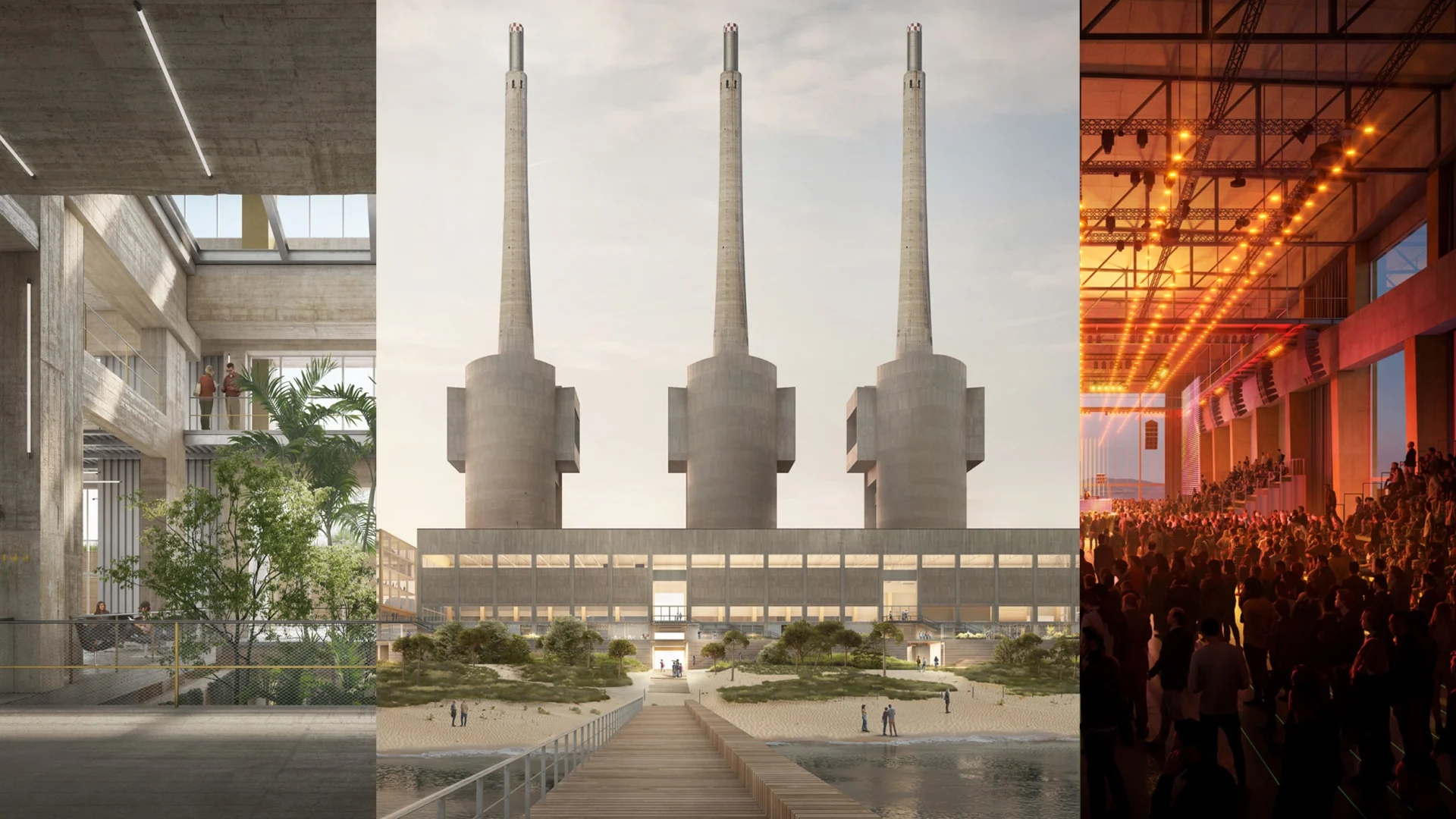
Barcelona is transforming its skyline’s biggest eyestore into a beautiful tech hub.

I have a dear friend who is so keen on the possibilities of artificial Intelligence that she doesn’t seem to care how much energy it takes from other purposes — or whether the energy is clean. She says China uses coal; China is ahead.

I, on the other hand, rejoice to see coal going by the wayside and creative uses for the coal plants that once stained the landscape.

Jesus Diaz has a story about that at Fast Company.

“Tres Xemeneies (Three Chimneys) is a former coal-fired power plant in Sant Adrià de Besòs. … Barcelona’s plant is set to undergo a radical transformation into the new Catalunya Media City — a cutting-edge hub for digital arts, technology, and education. 

“The winning design is called E la nave va, a nod to Federico Fellini’s film of the same name, which translates to And the Ship Sails On, a reference to how this long-dead structure that resembles a three-mast ship will keep cruising history in a new era. According to its creators — Barcelona-based Garcés de Seta Bonet Arquitectes and New York-Barcelona firm Marvel — the project promises to honor the site’s industrial legacy while propelling it into a sustainable, community-centric future. The project is slated to break ground in late 2025 and be completed by 2028.

“Three Chimneys looks exactly how it sounds: a gigantic structure dominated by three 650-foot-tall chimneys. The brutalist plant was built in the 1970s and faced controversy even before its opening. Many of the residents of Badalona and Barcelona hated it both for the aesthetics and the environmental implications. Its problems continued in 1973, when workers building the station went on strike. … The company that ran the station was also sued because of the pollution it caused, and the plant eventually shuttered.

“The structure is imposing. Its giant concrete vaults, labyrinthine floors, and towering chimneys presented a unique challenge to preserving its industrial DNA while adapting it for the 21st century. … Rather than force modern elements onto the existing framework, the team used the building’s features to organize its function.

“For instance, the lower floors — with their enclosed, cavernous spaces — will host incubators and exhibition halls, while the airy upper levels with their panoramic coastal views will house vocational training classrooms and research labs.

“ ‘We kept the existing structure largely unaltered,’ [Guido Hartray, founding partner of Marvel] says, ‘retaining its experiential qualities and limiting modifications.’ This approach ensures that the power plant’s raw, industrial essence remains palpable, even as it accommodates immersive media studios and a modern, 5,600-square-meter exhibition hall likened to London’s Tate Modern Turbine Hall. …

“The architects leveraged the building’s robust concrete skeleton — a relic of its industrial past — as a sustainability asset. Barcelona’s mild climate allows the thermal mass of the concrete to passively regulate temperatures, reducing reliance on mechanical systems. Spaces requiring precise climate control, such as recording studios and laboratories, are nested in a ‘building within a building,’ insulated from external fluctuations, according to the studios.

“The rooftop will double as a public terrace and energy hub, with 4,500 square meters [~48,438 square feet] of solar panels generating renewable power. This dual function not only offsets the energy demands of lighting and HVAC systems but also creates a communal vantage point connecting Barcelona, Sant Adrià de Besòs, and Badalona. ‘The rooftop’s role as both infrastructure and gathering space embodies our vision of sustainability as a social and environmental practice,’ Hartray says.

“The project’s most striking intervention — the ‘transversal cuts’ that slice through the turbine hall — emerged from a meticulous study of the building’s anatomy. Marvel and Garcés de Seta Bonet identified natural breaks in the long, warehouse-like structure, using these to carve openings that link the interior to the outdoors. These cuts create fluid transitions between the industrial hall and the surrounding landscape. …

“The north facade’s new balcony, overlooking the Badalona coastline, epitomizes this connectivity. Jordi Garcés, cofounder of Garcés de Seta Bonet Arquitectes, tells me via email that they have designed a proposal that plays with connections and knots — temporal, landscape, and territorial. … ‘The architectural elements at different heights will offer new landscape perspectives, as if it were a land art piece.’ In this ‘shared communal space,’ he says, residents and visitors alike can engage with the Mediterranean horizon.

“The building is the core of Catalunya Media City, which is a project that the regional government says will democratize access to technology and creativity. It claims that it will house educational programs for more than 2,500 students annually, including vocational training; research incubators partnering with universities and corporations; immersive installations and performances in a monumental hall with 56-foot-tall ceilings; and production studios, including an auditorium, soundstages, and UX labs.”

More at Fast Company, here.

Read Full Post »

Photo: Tom Hansell.
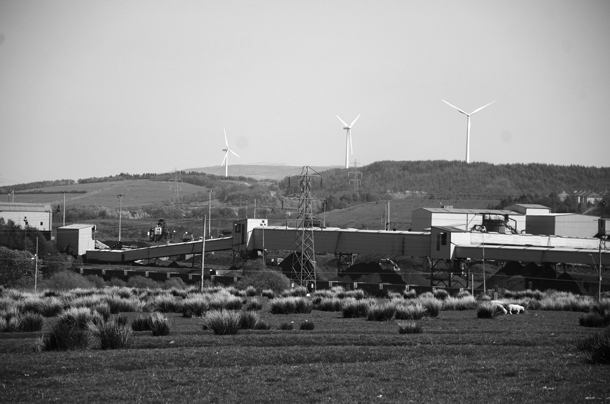
Wind farm in Wales coal country.

It’s possible that a US Senator who makes money off coal hasn’t gotten the message, but there are miners and mining unions getting practical about the future. This Living on Earth story appeared even before the devastation of Covid was added to the troubles of mining communities.

“STEVE CURWOOD: Some of the fiercest opposition to climate action in the US has come from regions that built their economies on fossil fuel extraction. Think Texas and Oklahoma for oil and gas and especially Wyoming, Kentucky, West Virginia, Pennsylvania, and Ohio for coal. Those regions have been hit hard economically as coal production dropped, leaving miners out of work, and their communities with shrunken tax bases and fewer paying customers for local businesses. It’s a story that has also played out in Wales in the UK. The experiences on both sides of the Atlantic are the theme of Tom Hansell’s new book, After Coal: Stories of Survival in Appalachia and Wales. … So, Tom, how did you get involved with the story of After Coal?

“TOM HANSELL: I learned about this long-term exchange that had been started by, through the center for Appalachian studies here and learned that they were bringing students and community members over to South Wales where the coal mines had shut down in the 1980s. And so I thought that would be really interesting to go over, gather stories of how those communities had survived, bring them back to Appalachia, and start an international conversation about how communities can survive the loss of the main industry that they were built around.

“CURWOOD: Now, one of the most interesting parts of your reporting here, Tom, is about the unions. And in both places, unions have been a major part of how these coal communities’ function. And one of the things that’s really interesting about the union phenomenon, it’s like a huge, almost secular society of the people who live in these communities. …

“HANSELL: I was really interested to learn that in Wales, the unions were not just doing these gathering spaces you were talking about and building political power for the miners, but they were also providing continuing education services. There was a whole system of miners’ libraries and free courses after hours so that miners could continue their education and fully participate in civic life. [And] then other kind of cultural aspects of the unions including male voice choirs or brass bands are big things happening in the UK. In Appalachia, union halls also very much community gathering places, places where local foods are celebrated, places where you can hear great traditional music.

“But the difference between the actually complete domination, closed shop and nationalized industry in the UK and the private industry and the lesser power of the unions in the United States was also pretty much a stark contrast. … These cultural spaces, these democratic spaces, for the most part, were built up around this industry, and what is there to take their place when the industry crumbles? [People] are still gathering sometimes in churches or chapels, sometimes around arts projects. There were some interesting arts projects, particularly the higher ground of Harlan County project that I followed in Eastern Kentucky that provided really interesting ways for diverse groups of people to participate in making something new that spoke to their identity and their history and their hopes for the future. [In America, there] is a lot of community life happening, but it’s perhaps a lot more dispersed than it was in the days when union halls were the place that you went to see your neighbors. …

“CURWOOD: How do we support those communities affected by taking the economy greener and climate disruption? …

“HANSELL: The only way to get deep and lasting solutions is to reach out very first to people that have been part of an extractive economy, whether that’s the oil fields, or the gas fields or the coal fields. These places that have been built up around a single industry need other options [and] maybe need some extra support. … For most of the 20th century, there was coal that helped us win world wars, there was coal that helped build the strongest industry and economy in the world.

And very little that wealth was left behind. Most of that wealth went to corporations that were headquartered outside of the coal fields. And there needs to be some system where some of that wealth gets returned. …

“I was actually really impressed at the amount of local farming that’s sprung up really during the time of the After Coal Project. My last project was actually looking at the controversy around a coal-fired power plant in southwestern Virginia. In Wise County, Virginia. That plant eventually was built. … But it was interesting at those forums, people wanted to talk about farming and agriculture and local foods. And it took me a while to listen and to understand that when they were talking about diversifying the economy, that’s where they saw their assets.”

More at Living on Earth, here.

Read Full Post »

Photo: Morgan Hornsby
Elk on view at the Salato Wildlife Center. Kentucky is reintroducing elk where coal mines are no longer operating.

It’s interesting to me that when people compare the economic benefits of, say, working in the coal business with working in the elk-tourism business, they don’t routinely include the economic benefits of things like better health. High unemployment is a serious concern, but I do know that miners routinely got black lung disease and that there were pollution dangers to their families.

The story that made me think about this was by Oliver Whang at the New York Times.

“On a bright morning early this spring, David Ledford sat in his silver pickup at the end of a three-lane bridge spanning a deep gorge in southeast Kentucky.

“The bridge, which forks off U.S. 119, … spills out onto Mr. Ledford’s 12,000-acre property, which he and his business partner, Frank Allen, are developing into a nonprofit nature reserve called Boone’s Ridge. ..

“When Boone’s Ridge opens in 2022, it will offer a museum and opportunities for bird-watching and animal spotting. Two independent consultants have estimated that it could draw more than 1 million annual visitors and add over $150 million per year to the regional economy. This is in Bell County, in rural Appalachia, which has a poverty rate of 38 percent and an average household income of just under $25,000, making it one of the poorest counties in the United States.

The decline of the coal industry created a multibillion-dollar hole in the economy and left hundreds of thousands of acres of scarred land. But it has also created opportunities.

“Boone’s Ridge is being established on reclaimed mine land, and one of its biggest selling points is a big animal that has only recently returned to Kentucky: elk.

“When Daniel Boone wandered through the Cumberland Gap and into Kentucky in the late 1700s, the state was filled with wildlife. … But in less than a century, land development and hunting decimated or eliminated buffalo, turkey, whitetail deer, river otters, bald eagles, quail and other animals. Elk — their presence enshrined in place-names like Elk River and Elkhorn City — were among the first to go. …

“In 1944, the Kentucky Department of Fish and Wildlife Resources was established and charged with reintroducing animals of all kinds and regulating their numbers for hunting and conservation. Whitetail deer, which numbered fewer than 1,000 after the Depression, now number more than 1 million and generate $550 million in state revenue from hunting licenses, tourism and the sale of rifles and other hunting-related paraphernalia. …

“With most of the region’s threatened game restored, attention turned to restoring other species, among them elk. In 1997, the Rocky Mountain Elk Foundation, an association of hunters, offered to fund a multimillion-dollar six-year plan to airlift more than 1,500 elk to Kentucky from the western United States. …

“The plan was popular; more than 90 percent of state residents supported it. There was only one problem: Each elk eats over 40 pounds of vegetation a day, and the grassland habitats of western Kentucky, where the animals were populous in pre-settlement times, had all been developed. Farm owners did not want half-ton animals destroying their crops,. …

“But in the eastern half, where craggy mountains had previously prevented elk population growth, hunters and conservationists were presented with a remedy to this problem: abandoned coal mines. …

“Unregulated, the environmental effects of mountaintop removal-mining can be devastating and lasting. … But when reclaimed correctly, the landscape can offer opportunities for different kinds of land use, including cattle farming, housing developments and sites for tourism. …

“In 1997, a year before the bridge leading to Mr. Ledford’s land was constructed, 4,000 people gathered on the grassy slope of a reclaimed mine in Perry County as Governor Patton threw open the doors of a trailer and an elk stepped foot on Kentucky land for the first time in more than 150 years. …

“Absent any real predators, the animal’s population has exploded: The state is now home to 13,000 elk and counting, all clustered in the 16 counties of coal country. …

The economic impact is tangible. The state now issues a couple hundred tags for elk hunting each year, and a small market has developed — elk sightseeing tours, elk hunting guides — that adds about $5 million to local economies, according to the state fish and wildlife department.

“The elk industry will not come close to replacing what was lost when coal left, but ‘coal business will not be back,’ said Rodney Gardner, a naturalist at Jenny Wiley State Resort Park in Floyd County.” Read more here.

Now I want to know what Steven Stoll, author of Ramp Hollow: The Ordeal of Appalachia, thinks about all this. Through his book, I was made aware for the first time that when conservation efforts preclude subsistence farming, families often suffer.

Read Full Post »

Photo: Kacper Pempel/Reuters
In the top photo jeweler Katarzyna Depa, 26, holds a silver ring with coal at her atelier in Katowice, Poland. Below, Grzegorz Chudy, 36, paints at his atelier in Katowice, where affordable rents have drawn artists.

Having recently watched the devastating 1976 documentary Harlan County, USA about a Kentucky mining strike, I’ve become a little more skeptical about longtime miners’ ability to transition to a new kind of life. Although I have blogged about efforts to help miners learn programming skills, for example, or be trained for jobs in the solar industry, such things may attract only younger people.

In this story from Public Radio International (PRI), we learn about recent changes in Poland, where the conservative government still supports the mining despite climate-change issues.

“When the Wieczorek mine, one of the oldest coal mines in Poland, closed [last] March, Grzegorz Chudy noticed for the first time the neighborhood was vibrant with trees in the full bloom of spring. The smell was heady.

” ‘It was incredible. You never knew all those trees were there,’ he told Reuters in his art studio in a housing estate for mining families in the southwestern Polish city of Katowice. ‘The smell wasn’t there while coal was being transported on trucks. The dust covered it up.’

“The Wieczorek mine in Katowice, with its towering brick shaft, is among dozens closing down throughout Poland, home to one of the most polluted coal mining regions in Europe. …

“Poland has had a painful and difficult experience with the economic transition from coal. Even as it counts down to [November 2018 climate talks], it announced plans for a new coal mine in the south of the country.

“Its government drew support in part from those with an emotional attachment to the job security, social fabric and national pride associated with mining that overlooked the downsides for health and the planet. …

“Chudy, 36, whose paintings often depict the life and architecture of Nikiszowiec, is one of hundreds of people who have moved to the area, drawn by its industrial feel and affordable housing.

“Built to house the families of miners at the start of the 20th century, Nikiszowiec was designed as a self-sufficient neighborhood with its own communal bread ovens and pigsties, as well as a bath house for miners and laundry facilities. …

“Those in the artistic community say their work could only exist with the inspiration provided by decades of mining.

” ‘For me using coal in a different way than it used to be, which was energy, shows its completely new face, so we can call it our new, cool black gold,’ said Katarzyna Depa, who makes jewelry from coal.

“But for those with mining in the blood, moving on is harder and the smell of coal dust is as sweet as blossom. Above all, they miss the community spirit even if it meant shared danger and hardship.”

More at PRI — which is, by the way, an amazing window on the world. Check it out if you don’t know it.

Read Full Post »

crawick-multiverse_140715_01

Photos: Charles Jencks
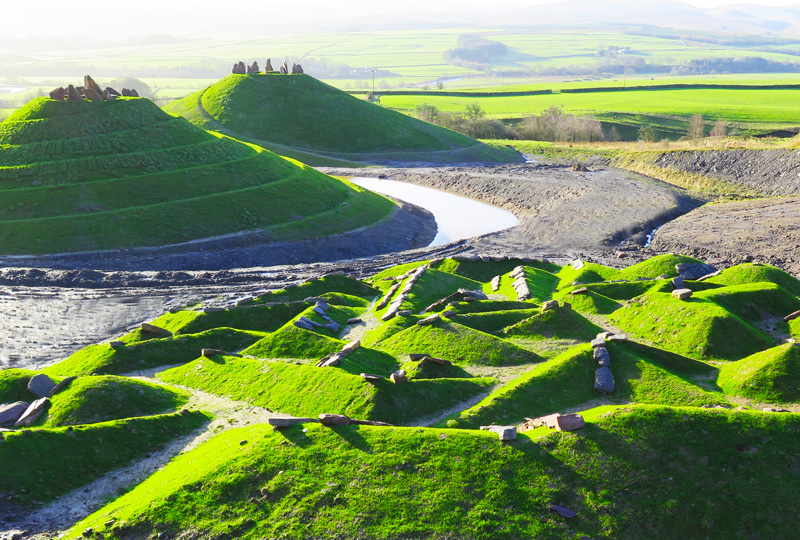
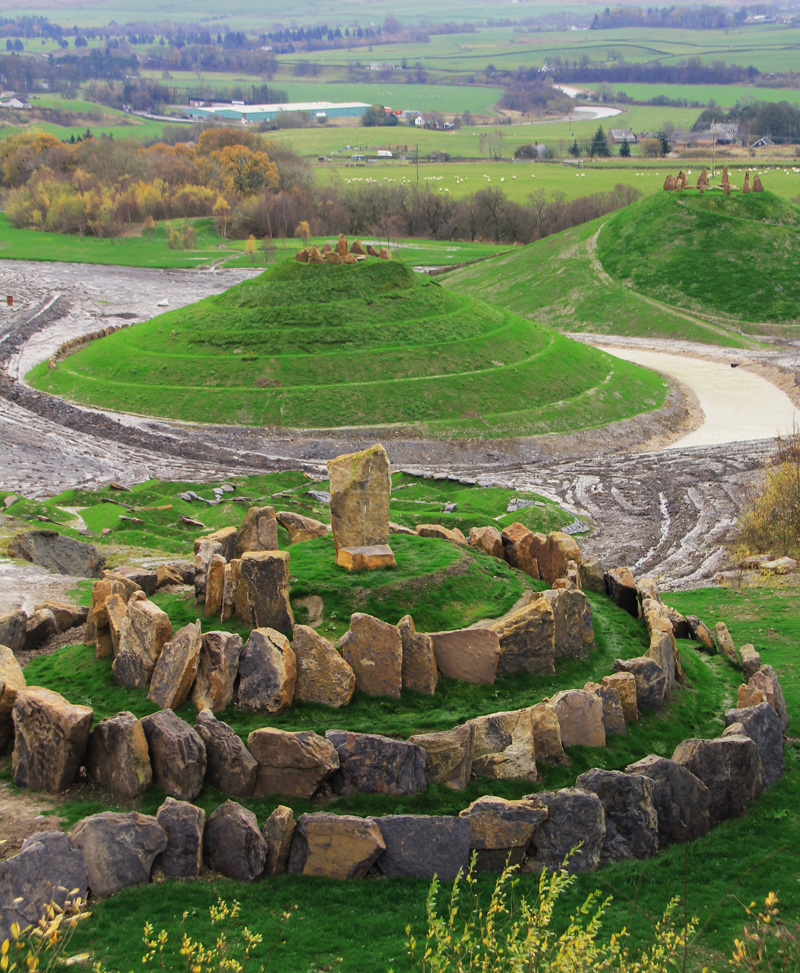
Landscape artist Charles Jencks has turned a Scottish coal mine into a work of art reminiscent of Stonehenge.

It’s not news that to save the plant we need to move away from using coal. Every few days, it seems, someone else is getting on board. Yesterday, for example, I saw that a big Italian insurance company decided to stop insuring coal plants. (Story at Reuters, here.) And remember this post about a German coal town turning an old mine into a giant, water-powered battery?

Well, human ingenuity continues to work at the problem of coal mines present and past. In this story, a Scottish mine was turned into artwork.

Writes Contemporist, “Landscape artist Charles Jencks has completed the transformation of Crawick Multiverse, a former coal mine that has now become a 55-acre artland, visitor attraction and public amenity. …

“Crawick Multiverse is a major land restoration and art project in Dumfries & Galloway, utilising landscape art to transform a former open cast coal mine into an outdoor space that can be enjoyed by future generations.

“Privately funded by the Duke of Buccleuch and designed by globally-renowned landscape artist Charles Jencks, Crawick Multiverse … links the themes of space, astronomy and cosmology, creating a truly inspiring landmark that will appeal to everyone from art enthusiasts and scientists to the wider community. …

“The site is managed by the Crawick Artland Trust which includes trustees from the local communities surrounding the site.”

The BBC adds that the project “follows on from other works by Mr Jencks including the likes of Northumberlandia in north east England, the Garden of Cosmic Speculation north of Dumfries and the Beijing Olympic Park’s Black Hole Terrace.

“He said: ‘This former open cast coal site, nestled in a bowl of large rolling hills, never did produce enough black gold to keep digging. But it did, accidentally, create the bones of a marvellous ecology.

” ‘The landscape had to be healed, it had to welcome the nearby communities of Sanquhar, Kelloholm and Kirkconnel, and help restore the locality both economically and ecologically.’ ” More.

More great pictures at Contemporist, here.

crawick-multiverse_140715_03

Read Full Post »

Photo: Marcus Teply/PRI
Dr. Andre Niemann with a partial model of his plan to turn Prosper-Haniel into a pumped storage system (basically a giant, water-powered battery). “It shows responsibility. It shows that if mining is over you’re not leaving the place.” 

Recently I read a sad story about a coal miner in the U.S. who once thought he and his infant son would have secure jobs long into the future. Now his mine is closing and he’s off to find another.

What’s sad to me is that although there are opportunities to retrain in up and coming industries, he and his family are chasing a dead one. But I can understand that he wants to keep earning six figures, a salary unlikely in most fields for which he might train.

Meanwhile, in Germany, people in an old coal town are biting the global-warming bullet and moving on.

Valerie Hamilton reports at PRI’s the World, “For most people, the top of the mine shaft at the Prosper-Haniel coal mine in Bottrop, Germany, just looks like a big black hole. But Andre Niemann looked into that hole and saw the future.

“Niemann leads the hydraulic engineering and water resources department at the University of Duisberg-Essen, in the heart of German coal country, western Germany’s Ruhr Valley. For more than 150 years, Germany mined millions of tons of anthracite, or hard coal, from coal mines here that at their peak employed half a million miners. But that’s history now — Germany’s government decided a decade ago to end subsidies that made German hard coal competitive with imports. …

“The end of hard coal mining in Germany comes just as Germany is working to slash its CO2 emissions by replacing fossil fuels with renewable energy sources like wind and solar. The country calls it the Energiewende, or ‘energy transition.’ But wind and solar aren’t always there when they’re needed, so a key challenge of the Energiewende is to find ways to store sun and wind energy for later use.

“One way to do that is with a pumped energy storage system — basically a giant, water-powered battery. When the sun is shining or the wind is blowing, the excess energy is used to pump large amounts of water uphill into a reservoir. When the sun goes down or the wind dies, that excess energy can be released by letting the water flow back downhill, through turbines that generate electricity like in a hydroelectric dam.

“Existing pump storage systems make use of hills or mountains for the necessary difference in altitude. But Niemann says the depth of a coal mine — like Prosper-Haniel — would work just as well.

“He and a team of researchers have worked up a plan to turn the mine into a pumped energy storage system that could generate 200 megawatts of power, enough for almost half a million homes. Water would be pumped through a closed system of pipes from 2,000 feet below ground level up to the surface and fall back down again on demand, regenerating 85 percent of the renewable energy used to pump the water up in the first place — energy that would otherwise be wasted. …

“Niemann, who grew up in a coal-mining family in the coal city of Ibbenbueren, says it would be a powerful symbol that as Germany transforms its energy landscape, coal regions won’t be left behind. …

“[Miner Ernst] Mueller explains the deal offered to him and every other mine worker in 2007, when the German government moved to end the subsidies that kept Germany’s hard coal mines afloat. …

“Underground workers over 50, and above-ground workers over 55, like Mueller, can retire early, paid by a company fund, as long as they have 20 years on the job. About 400 of their younger co-workers can stay on to maintain the mine area after it closes. The rest get job placement and training. Beike says [the company] promises to find every worker a new job. …

“The hope is, eventually, green business will pick up where coal left off. To prepare, the region has opened a new technical college in Bottrop to train the next generation of workers — not in coal, but in fields like green tech, water management and electro-mobility.”

More at Public Radio International, here.

Read Full Post »

Photo: Jason Margolis
Solar Holler founder Dan Conant, foreground, observes a solar roof installation in Lewisburg, West Virginia.

As warehouse and distribution jobs proliferate and meet a need for lower-skilled employment, I’m beginning to accept that companies like Amazon that destroy traditional industries have some redeeming social virtues. After all, times change.

Perhaps no American workers feel the changing times more deeply than do those in the coal industry. But displaced workers who are open to new opportunities seem to be emerging from the disruption OK.

Jason Margolis provided a coal-country report for Public Radio International’s excellent 50 States series.

“Tanner Lee Swiger graduated from high school in Wayne County, West Virginia this spring,” writes Margolis. “His father and grandfather both worked in West Virginia’s coal industry. But not Swiger, or any of his high school classmates.

“Nobody from his graduating class is working in coal, says Swiger. ‘[They’re] working in fast food or not working at all.’

“Not Swiger. He has a job installing rooftop solar panels. He says his family is delighted with it. …

“Swiger is working as an apprentice with Solar Holler, which was founded four years ago by 32-year-old Dan Conant. Conant doesn’t see solar energy and coal at odds with each other.

“ ‘The way I think about it, as a West Virginian, is that West Virginia has always been an energy state, and this is just the next step. It’s the next iteration,’ says Conant. …

“He left his job at the US Department of Energy to start Solar Holler, to try to help slow his state’s economic slide. By many metrics, West Virginia is one of the poorest states in the country. …

“ ‘We need to find new things,’ says Conant. ‘It’s not going to be the coal industry of the past.’ …

“Solar may be an energy of tomorrow, but … coal mining jobs in West Virginia typically pay more than twice the starting wages for solar. But those jobs are increasingly hard to find, and Solar Holler, and other solar installers, need workers now. …

“Solar Holler is partnering with a non-profit called the Coalfield Development Corporation. They own the building. Beyond solar jobs, Coalfield Development is teaching former coal workers skills like woodworking and farming.

‘Apprentices with Coalfield Development work 33 hours, spend six hours a week at a community college, and three hours engaged in ‘life-skills mentorship.’ Nearly 90 people have entered the program. ”

More at “50 States: America’s place in a shrinking world,” here, where you can listen to the story or read it.

Read Full Post »

Photograph: Cassady Rosenblum
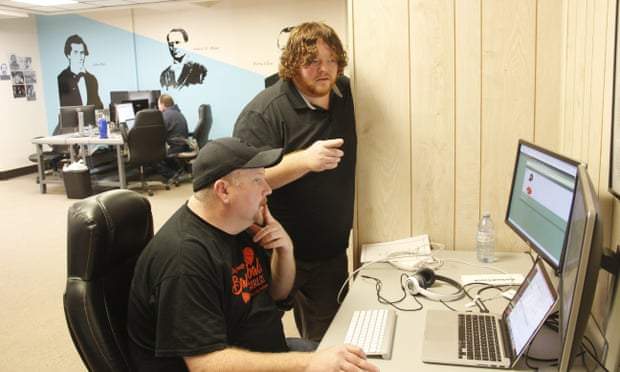
Garland Couch (seated) works on some code with James Johnson. The men are part of an effort to turn coal country into Silicon Holler.

About a year ago, I wrote a post about Mined Minds, a nonprofit founded by two young Northerners to help jobless miners learn computer coding skills.* This follow-up shows that the idea is taking root and spreading.

Cassady Rosenblum writes at the Guardian, “As Highway 119 cleaves through the mountains of eastern Kentucky, exposed bands of black gold stretch on for miles – come get us if you can, they tease. And for years, miners did: they had good employment that earned them upwards of $70,000 a year and built a legacy of blue-collar pride in the region. ‘We felt like what we did was important,’ says Rusty Justice, a self-described entrepreneur who hauled his first truck of coal in eighth grade. And it was. In 2004, coal powered half of America’s electrical needs.

“But by 2011, Justice and his business partner, Lynn Parish, who worked in coal for 40 years, began to worry. … So the two coal men from Pikeville began thinking about how they could diversify.

Coal country must transform itself into something else, a new place on the map the hopeful call ‘Silicon Holler.’

“In its own, proud way, Pikeville has a new message for America: we’re ready to move on if you’re ready to let us do it our way. That means some help from the government, but not a handout. ‘We need to identify the doers and facilitate their ideas,’ Justice says. …

“ ‘We considered just about everything. Windfarms, solar farms, hog farms – you name it,’ he laughs. As unemployment tore through their 7,000-person town, Justice and Parish prayed for a business idea that would not just pay, but pay people what they had been making before in the mines. …

“Their breakthrough came when Justice and Parish visited a workforce retraining expo in 2014 in Lexington, where they learned about coding.

“The concept appealed to them. Each year, 600,000 US tech jobs go unfilled, jobs that ultimately go overseas but could be on-shored if more Americans had the right skills. Even better, the job paid the same as the mines.

“Justice had seen first-hand how miners employed logic to solve life or death problems underground. Still, he wondered, could a coal miner really code? He called his computer-savvy friend Justin Hall with that question. ‘I don’t see why not,’ Hall said. ‘Great, you’re hired,’ Justice told him.

“They placed ads for their new web and app design company, Bitsource, in 2015, then watched as more than 900 applications rolled in. From this pool, they chose 11 former miners who scored highest on a coding aptitude test. Two years later, in an old Coca-Cola factory by the Big Sandy river, nine men and one woman remain.

“On a late March day, Hall stands at a whiteboard [and] fills the board with modules and nodes as the guys shout out ideas in lingo that eventually makes Garland Couch, a 55-year-old coder, pause at how far they’ve come. ‘Man, we’re nerds now,’ he laughs, pushing his Under Armour cap back on his head. After the session, they break for lunch, then return to work with Drupal software on laptops whose Apple icons glow next to bumper stickers that say ‘Friend of Coal.’

“Despite the team’s new profession, the stickers are a nod of respect to an industry they all got their start in, an industry that still employs some of their friends and family. As Parish is fond of saying, change is necessary, ‘but you don’t want to upset the one who brought you to the dance.’ ”

Read about other companies retraining miners in Kentucky, here.

*Update May 12, 2019: Uh-oh. Read about an unfortunate outcome, described at the New York Times, here. I still think it was a worthy effort.


Read Full Post »

When I told my husband that playwriting teacher Peter Littlefield wanted class members to base a scene on an early moment when we first looked objectively at the adult world, he volunteered memories of his own.

Last weekend, Suzanne, John, and their spouses got to hear about a Philadelphia childhood and the horse that delivered milk, going reliably to the next house while the deliveryman placed bottles at the last one. They learned about an elementary school visit to a dairy company, and how it hit my husband so young that some men spend their whole lives lifting bottles into crates. He also remembered catching the tail end of the street lamplighter age. He has since mentioned ice delivery at the Jersey Shore and how you would put a special sign in the window indicating how many pounds of ice you wanted for that week.

There was also coal delivery in large canvas bags. Believe it or not, my husband is not that old.

Even Suzanne and John should remember that coal was delivered next door for several years after we moved to town. And clearly coal is still being delivered somewhere, as in this video a guy put on YouTube. I especially like the speech balloons he added.

Read Full Post »