Feeds:
Posts
Comments

Posts Tagged ‘coding’

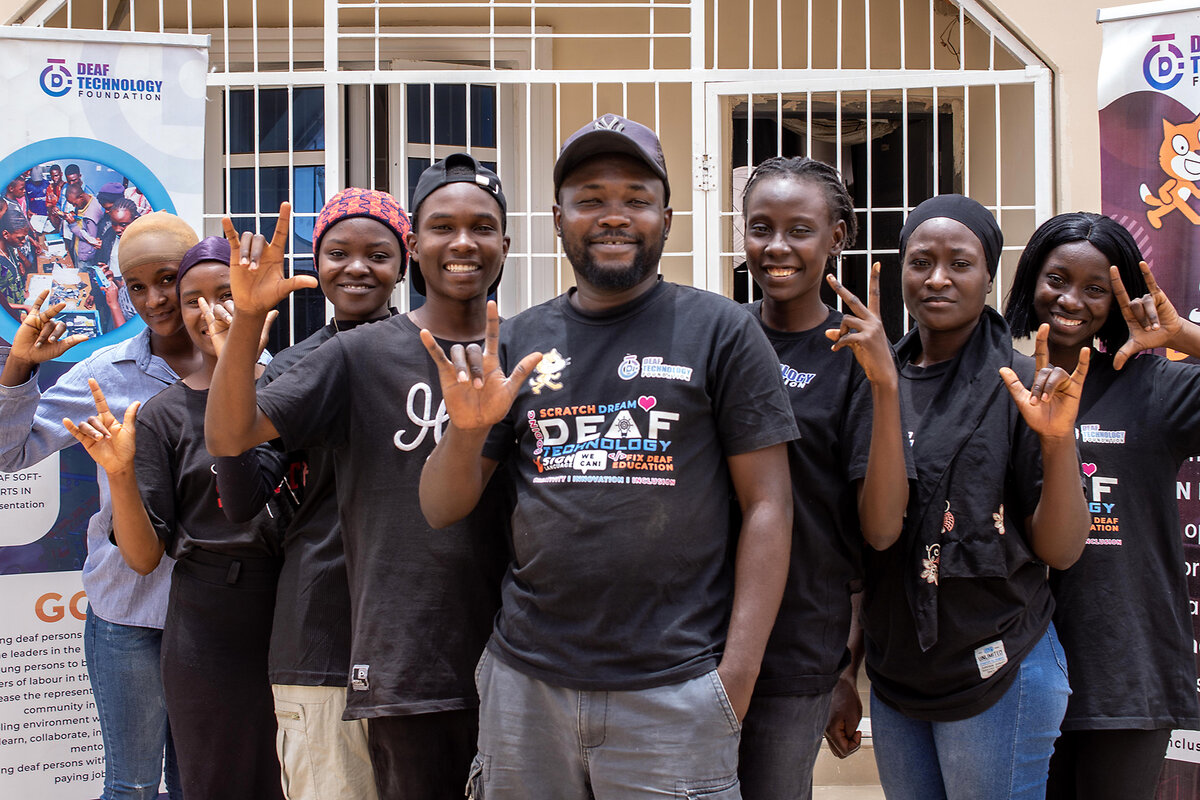
Photo: Nathaniel Bivan.
Wuni Bitrus (co-founder of the Deaf Technology Foundation) and some of his students sign “I love you” in Jos, Nigeria.

Things change so fast in our world that I can only hope a positive story I read in June is still true in August. It’s a worry. At the same time, we do know that people keep a good thing going — somehow — even with turmoil all around them.

I preface today’s story with that observation because I have been hearing about protests and riots in Nigeria that started with grievances about the economy and then went berserk as the government overreacted.

Nathaniel Bivan at Christian Science Monitor wrote in June about progress for the deaf community in Nigeria.

“In a one-room apartment in Jos, Nigeria, instructor Wuni Bitrus and almost a dozen students gather around a table cluttered with equipment – a toolbox, a 12-volt adapter, a coding panel, a set of jumper cables, a mix of colored wires. The students’ idea: to build the prototype for a ‘smart’ door that opens with the touch of a finger.

“The students chat back and forth in sign language, and Mr. Bitrus signs back. The group discusses using Arduino, an open-source electronics platform, and one student wonders how fingerprints can be stored. Mindful of Nigeria’s electricity problems, Mr. Bitrus genially advises the group to use a battery-powered keypad lock system first and incorporate a fingerprint feature later. 

“ ‘It works well, rather than waste time reinventing the wheel,’ Mr. Bitrus says. After nodding in agreement, the students excitedly start working.

“This is just another afternoon in a club run by the Deaf Technology Foundation, a nonprofit co-founded by Mr. Bitrus in 2017 that trains Nigerian children and young adults who are deaf in computer programming and robotics. The students also work to improve their reading skills, and receive career guidance and counseling to help them believe in themselves.

“Mr. Bitrus’ … desire to change the prospects of Nigeria’s deaf and hard-of-hearing community was sparked in 2014 by his encounter with a 13-year-old girl while he was teaching as part of the National Youth Service Corps in Zamfara state. Mr. Bitrus had noticed that the teen faced discrimination, and he became determined to learn sign language and teach her to use a computer. Three years later, he marshaled the resources, including funding from the Massachusetts Institute of Technology, to form the Deaf Technology Foundation.

“One of the darkest memories that Mercy Samson Grimah, a foundation student, has about growing up is looking at the faces of people around her and recognizing insults and negative energy directed at her. 

“ ‘That hurt me so bad because I knew in my heart that I could do anything. They just see us as lesser human beings,’ she says. ‘I wanted to show them that deaf people can become whatever they want to be.’ … 

“Ms. Grimah says her private secondary school did not formally teach sign language to her, nor much of anything else. But there was one teacher who knew how to sign, and she taught Ms. Grimah. … She dropped out in her third year because her parents could not pay her school fees, but fortunately, she had already formed a bond with the Deaf Technology Foundation. …

“Five years ago, Ms. Grimah and several other students made a road trip from Jos to Nigeria’s capital, Abuja, to compete in MakeX, a robotics contest. … Although Ms. Grimah’s team was not chosen to go on to represent Nigeria in the international competition, it emerged fourth among about 15 teams.

“ ‘Our team was the only one made up of the deaf,’ says Ms. Grimah, her eyes lighting up.

“Her father, Grimah Samson, adds, ‘What they are doing changed her.’ …

“Joy Yusuf, another Deaf Technology Foundation student, had wanted to become a doctor. But she was moved to a new school where the principal and staff said there was no way that could happen, even though the school welcomed students with disabilities.  

“ ‘It was a blow for me,’ Ms. Yusuf says. ‘I cried. I had to call Mr. Bitrus and my father to beg them, but [the principal and staff] still refused. For me, Deaf Tech is the only way I can have anything close to [studying] medicine.’  Now, she, too, wants to become a web developer.” 

More at the Monitor, here. No paywall.

The part of Nigeria where this story takes places is Jos. Online I found something interesting about it: “The state has over forty ethno-linguistic groups. Some of the indigenous tribes in the state are the Berom, Afizere, Amo, Anaguta, Aten, Bogghom, Buji, Challa, Chip, Fier, Gashish, Goemai, Irigwe, Jarawa, Jukun, Kofyar (comprising Doemak, Kwalla, and Mernyang), Montol, Mushere, Mupun, Mwaghavul, Ngas, Piapung, Pyem, Ron-Kulere, Bache, Talet, Taroh (Tarok), Youm and Fulani/Kanuri in Wase.” Wow.
Read Full Post »

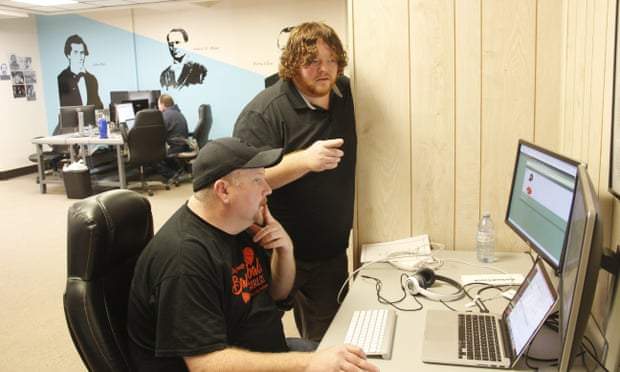
Photograph: Cassady Rosenblum
Garland Couch (seated) works on some code with James Johnson. The men are part of an effort to turn coal country into Silicon Holler.

About a year ago, I wrote a post about Mined Minds, a nonprofit founded by two young Northerners to help jobless miners learn computer coding skills.* This follow-up shows that the idea is taking root and spreading.

Cassady Rosenblum writes at the Guardian, “As Highway 119 cleaves through the mountains of eastern Kentucky, exposed bands of black gold stretch on for miles – come get us if you can, they tease. And for years, miners did: they had good employment that earned them upwards of $70,000 a year and built a legacy of blue-collar pride in the region. ‘We felt like what we did was important,’ says Rusty Justice, a self-described entrepreneur who hauled his first truck of coal in eighth grade. And it was. In 2004, coal powered half of America’s electrical needs.

“But by 2011, Justice and his business partner, Lynn Parish, who worked in coal for 40 years, began to worry. … So the two coal men from Pikeville began thinking about how they could diversify.

Coal country must transform itself into something else, a new place on the map the hopeful call ‘Silicon Holler.’

“In its own, proud way, Pikeville has a new message for America: we’re ready to move on if you’re ready to let us do it our way. That means some help from the government, but not a handout. ‘We need to identify the doers and facilitate their ideas,’ Justice says. …

“ ‘We considered just about everything. Windfarms, solar farms, hog farms – you name it,’ he laughs. As unemployment tore through their 7,000-person town, Justice and Parish prayed for a business idea that would not just pay, but pay people what they had been making before in the mines. …

“Their breakthrough came when Justice and Parish visited a workforce retraining expo in 2014 in Lexington, where they learned about coding.

“The concept appealed to them. Each year, 600,000 US tech jobs go unfilled, jobs that ultimately go overseas but could be on-shored if more Americans had the right skills. Even better, the job paid the same as the mines.

“Justice had seen first-hand how miners employed logic to solve life or death problems underground. Still, he wondered, could a coal miner really code? He called his computer-savvy friend Justin Hall with that question. ‘I don’t see why not,’ Hall said. ‘Great, you’re hired,’ Justice told him.

“They placed ads for their new web and app design company, Bitsource, in 2015, then watched as more than 900 applications rolled in. From this pool, they chose 11 former miners who scored highest on a coding aptitude test. Two years later, in an old Coca-Cola factory by the Big Sandy river, nine men and one woman remain.

“On a late March day, Hall stands at a whiteboard [and] fills the board with modules and nodes as the guys shout out ideas in lingo that eventually makes Garland Couch, a 55-year-old coder, pause at how far they’ve come. ‘Man, we’re nerds now,’ he laughs, pushing his Under Armour cap back on his head. After the session, they break for lunch, then return to work with Drupal software on laptops whose Apple icons glow next to bumper stickers that say ‘Friend of Coal.’

“Despite the team’s new profession, the stickers are a nod of respect to an industry they all got their start in, an industry that still employs some of their friends and family. As Parish is fond of saying, change is necessary, ‘but you don’t want to upset the one who brought you to the dance.’ ”

Read about other companies retraining miners in Kentucky, here.

*Update May 12, 2019: Uh-oh. Read about an unfortunate outcome, described at the New York Times, here. I still think it was a worthy effort.


Read Full Post »

This story has received coverage in a bunch of different venues, but I caught it on WNYC’s the Takeaway, with John Hockenberry, on my drive home from Providence today. Just had to share it.*

“General Electric’s CEO announced that all new hires, whether or not they’re working in tech, will now be required to know how to code. New York public schools are also introducing mandatory computer science classes into their curricula.

“These initiatives seem to indicate that coding is the key to getting hired and the panacea to all employment problems, and as the needs of the U.S. job market shifts, people are putting that theory to the test.

“Coal miners in particular have suffered the brunt of the changing job market. With 40 percent fewer jobs than in 2012, coal miners are seeking out second jobs to support their families, and many have turned to coding.

Amanda Laucher, co-founder of Mined Minds, a free computer coding training program in Waynesburg, Pennsylvania, is helping struggling coal miners in her area. Click on the ‘Listen’ button.”

I loved that Laucher told Hockenberry she and co-founder Jonathan Graham were “having a blast.” They didn’t feel like the free service they are self-funding was even a chore. She added that the support of the community made it all possible.

PBS had a bit more background, here:

“When tech consultant Amanda Laucher realized her brother in Greene County, Pennsylvania, the third largest coal-producing county in the country, was at risk of losing his job as a coal miner, she and her husband, Jonathan Graham, decided to help. They began driving about 500 miles from Chicago every weekend to teach him and others in the community how to code.

“Laucher and Graham said they saw an opportunity to wean Greene County off an economy that is heavily dependent on energy. They recently relocated to Waynesburg, Pennsylvania, and co-founded Mined Minds, a nonprofit that offers free coding classes to laid-off coal miners and other unemployed workers.” Oh, my. Bless their hearts!

*Update May 12, 2019: Uh-oh. Read about an unfortunate outcome, described at the New York Times, here. I still think it was a worthy effort.

Read Full Post »