Feeds:
Posts
Comments

Posts Tagged ‘comedy’

Photo: Ghiath AlHaddad Ayoub/The World.
Comedy is having a moment in Syria as a new wave of artists tests the limits of expression under a new government.

Syria suffered many years of extreme oppression, so the recent overthrow of the Assad government brought hope for change. That doesn’t mean everything is fine, as recent fighting with the Druze ethnic group has shown. Still, it’s time to celebrate any encouraging baby steps.

Shirin Jaafari reports at PRI‘s The World about something that hasn’t been heard in Syria for a long time.

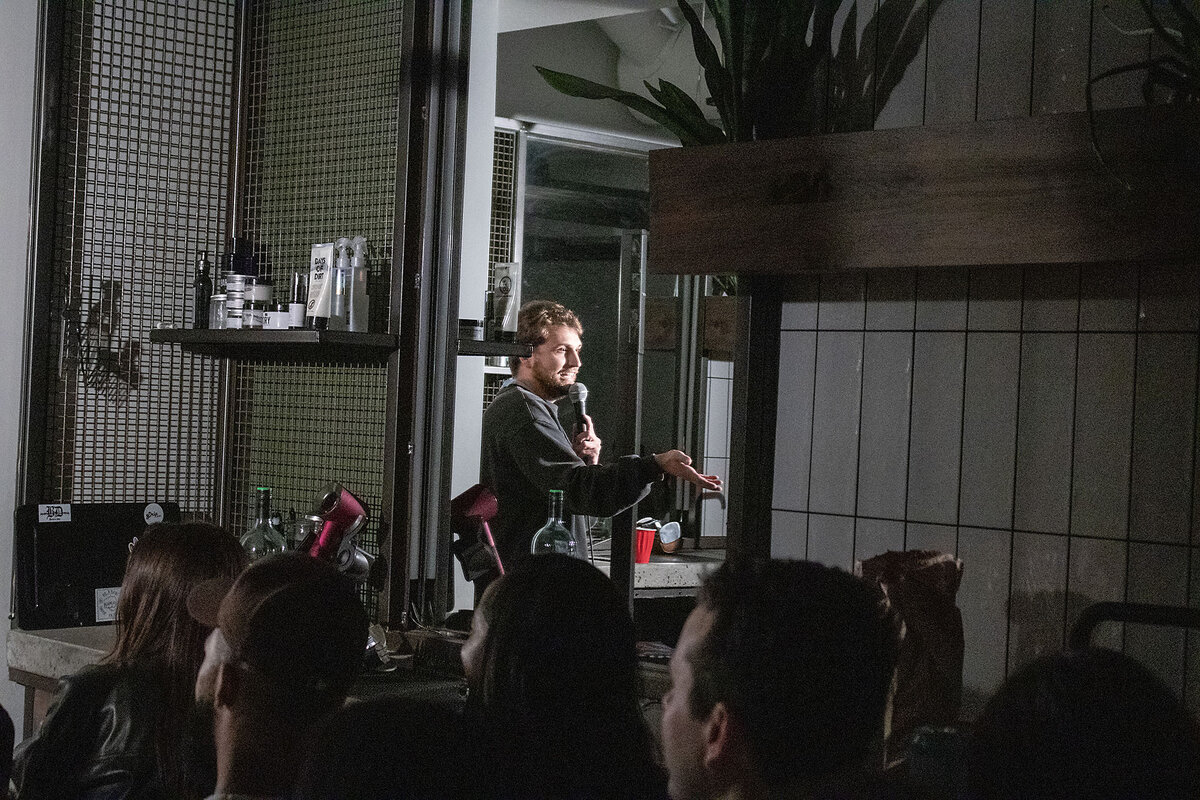
“As the sun set over central Damascus, laughter spilled out from the Karma Café. Inside, a young crowd gathered — some in headscarves, others without. But all were ready to experience stand-up comedy in a free Syria.

“Comedy is having a moment in the country.

“With the fall of the Assad regime, a new wave of artists is testing the limits of expression. Among them is Styria, a stand-up troupe whose name fuses Syria with hysteria, a nod to the absurdity and pain of living under dictatorship. …

“Sharif Homsi, founder of the group, [started] writing comedy long before it was safe. Living under a regime that silenced dissent, he described the past as a kind of suspended state: ‘You’re not allowed to die, but you’re not allowed to live.’

“In 2016, he left for Dubai, trained with Arab comedians, and later returned to his homeland to form Styria. Even then, performing comedy felt dangerous.

“ ‘One wrong word and someone could report you,’ Homsi recalled. ‘You could disappear in a blink.’

“So, the group played it smart, he said, avoiding politics, tiptoeing around religion and carefully crafting jokes about sex and social taboos. But now, with the old red lines shifting, they’re pushing the envelope further.

“At the cafe in Damascus, Homsi took the mic, greeting the audience with humor and ease. His jokes, often about his own frugality or his dad’s job as a dog walker, sparked laughter and a sense of connection. But he didn’t shy away from sharper edges, even referencing the extremist past of Syria’s new leader, Ahmad al-Sharaa. …

“Fellow comedian Ammar Daba, who returned after the regime fell, said the challenge now is not just legal limits, but social ones.

“ ‘It’s exciting and confusing. I don’t know where the lines are,’ he said. 

But Daba thinks comedians have a role to play in this new environment.

“ ‘It is our time, as stand-up comedians, to be the pioneers,’ he said, ‘to tell people that “yeah, you can talk about that! You can talk about that outside of your private rooms and homes. You can say whatever you want even on the streets.” ‘

“The night’s only woman performer, Mary Obaid (aka Meme), steered away from politics, instead poking fun at her own life and body image.

“ ‘Every problem, when spoken out loud, becomes smaller,’ Obaid said. ‘Comedy helps us do that.’

“After the show, a man who only gave his first name, Ibrahim, reflected on the performance.

“ ‘This is what we need here. We need to communicate our fears, our taboos, in a healthy way,’ he said. ‘And this is the best way to discuss those really difficult issues.’

“The crowd spilled into the Damascus night, still laughing and exchanging numbers.

“For Sharif Homsi, the founder of Styria, this is the power of comedy. It can create moments of relief and respite, and it can start conversations that otherwise would not take place.

“ ‘Fifty, sixty people to a hundred sharing a room, laughing about similar things. … If they can laugh together, they can live together.’

“Syrians have been divided for so long, he added. ‘It’s time for that to end.’ ”

More at The World, here.
Read Full Post »

Photo: Brooke Holder/The Christian Science Monitor.
Eddie Lorah performs at Barber’s Den in Somerville, Massachusetts, Sept. 14, 2024. Every Don’t Tell Comedy show is located at an unconventional venue. 

People often say, “I have to laugh so I don’t cry.” And goodness knows, we all need laughter. In fact, a doctor I met when I was working for Minnesota Physician actually taught people how to make themselves laugh. Because it boosts endorphins that are good for you. He called himself the Laugh Doctor.

Now I’m learning that there’s such a thirst for comedy these days that live clubs are popping up everywhere. Including in barbershops.

Stephen Humphries writes at the Christian Science Monitor, “Of all the options for a night out in Boston, an immigration lawyer’s office probably doesn’t rank high on many lists. Yet that’s where Hayley Licata and Renee Tracy found themselves last fall. The two recent college grads had such a blast that they’ve opted to repeat the experience.

“Tonight, they’ve arrived at a barbershop. This location was a secret – just as the law office had been. A man at the door checks that they’re on the guest list. Then he welcomes them to Don’t Tell Comedy.

“Every weekend, in over 200 cities around the world, Don’t Tell Comedy hosts secret shows by stand-up comedians. Venues range from boxing gyms to boats. For one night only, this dimly lit salon in Somerville, Massachusetts, has been transformed into a pop-up comedy club. In one corner, a microphone stand basks in the flat halo of a spotlight. Forty folding chairs have been set up between work stations sporting arrays of electric razors. …

“Founded in 2017, Don’t Tell Comedy has had a success that reflects the remarkable boom of live comedy since the pandemic. In large part, the demand for stand-up has been fueled by filmed specials on streaming platforms and funny clips on TikTok and YouTube. But, paradoxically, it’s also a reaction to those media. Events such as Don’t Tell Comedy are inspiring people to get off their couches, because online entertainment is no substitute for participating in intimate, in-person events.

“ ‘It feels a little bit like magic,’ says Brendan Eyre, the headliner among the five performers at the barbershop. … ‘You’re sharing an experience with strangers. You’re laughing at the same thing. They’re laughing at the same thing, which brings people together. You feel a sense of community.’ …

“In an era when many people can’t seem to watch television without constantly checking their phones, the audiences for both sets at the barbershop are fully unplugged for more than 70 minutes. Attendees may even become part of the show. For instance, one comedian cracked a joke about first-timers Gilbert Paredes and Kelly Emmons.

“ ‘If you sit at the front, they might give you attention,’ says Ms. Emmons. ‘But that’s part of the fun. If you wanted something that was one-way, you would stay at home and watch your TV.’ …

“For her, part of the appeal of the inexpensive Don’t Tell Comedy event is discovering talents she hasn’t heard of before. The lineups are a secret prior to each show. (Very occasionally, big-name acts such as Jeff Garlin and Michael Che will drop by to road test new material.)

“Tonight, audiences are especially enamored with comic Janet McNamara. She tells the audience about her audition for Season 9 of ‘American Idol.’

“ ‘You know how they have “bad people”? I was one of the bad people,’ Ms. McNamara tells the room, which erupts with laughter. ‘I went on as, like, a goof to make my friends laugh. But then it didn’t occur to me that it would be on TV.’

“Ms. McNamara, who mercifully didn’t sing during her set, performed at the first-ever Don’t Tell Comedy show. It was staged in a backyard in Los Angeles in 2017. She says fringe stand-up venues aren’t a novel concept – shows in laundromats predate Don’t Tell Comedy – but what the company does especially well is showcase fast-rising stars on its YouTube channel.

Case in point: Susan Rice, a septuagenarian comic from Portland, Oregon.

“ ‘Her set really just did well,’ says Don’t Tell Comedy’s chief operating officer, Brett Kushner. ‘It’s over a million [viewers] now. She’s now taping her special down in LA from that momentum.’ “

More at the Monitor, here. No firewall.

Read Full Post »

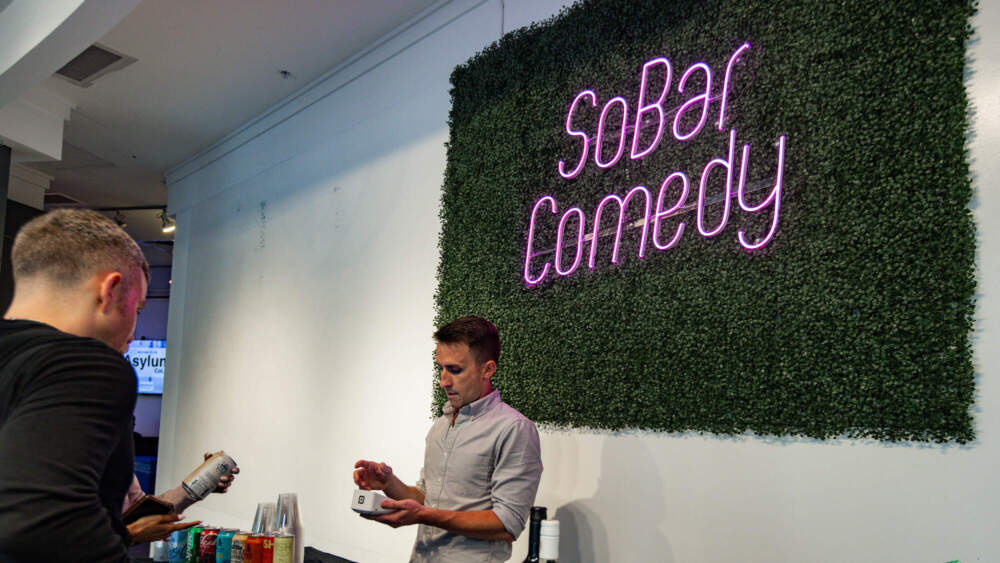
Photo: SoBar Comedy.
SoBar Comedy worked in collaboration with Dray Drinks, Boston’s first non-alcoholic bottle shop to assemble its lineup of non-alcoholic beers, wines and mocktails.

We’ve featured articles about watering holes that ban cellphones (here, for instance) so people can socialize without distractions. Turns out, there are also people who hate all the alcohol that flows at comedy clubs, people who would really like to enjoy the comedy. Enter, Boston’s SoBar.

WBUR Radio’s Elijah Nicholson-Messmer reports, “When John Tobin started working as a door person at a local comedy club in the early ‘90s, his boss asked him how he liked the work.

“ ‘I love being in the comedy business,’ Tobin said.

“But his boss Dick Doherty, a legend in the city’s comedy scene who drank and drugged his way through the ‘60s, ‘70s, and early ‘80s, was quick to correct him.

” ‘You’re not in the comedy business,’ Tobin recalled Doherty saying. ‘You’re in the alcohol business.’

“Over three decades later, that business has started to change. Younger adults are drinking less than they did 10 or 20 years ago and show producers like Tobin and his business partner Norm Laviolette are taking notice.

[In June] they launched SoBar Comedy, the country’s first sober-curious comedy club [to host] bi-weekly improv and stand-up shows, located in Faneuil Hall.

“Tobin and Laviolette own and operate some of the biggest comedy clubs across New England, including Laugh Boston and Improv Asylum. Laviolette said they started noticing the trend at their other comedy clubs, where food and beverage sales form a cornerstone of the business model. The pattern soon became clear — younger audience members were increasingly forgoing beers and cocktails when going out.

“ ‘As we started to watch we’re like, “Well, geez, maybe there’s an opportunity . . . to do something that speaks directly to that mindful drinking, sober-curious [mindset],” ‘ Laviolette said. …

“On opening night at SoBar, some folks were excited to sample the non-alcoholic beers and mocktails on offer, crafted in collaboration with Dray Drinks, Boston’s first non-alcoholic bottle shop. …

“Performing comedy for an all-sober audience is a daunting task for some comedians, but for Corey Manning, who headlined and hosted SoBar’s inaugural show, having an alcohol-free night of comedy comes with plenty of upside.

“ ‘One of the things that’s different about a sober show than the regular comedy show is that I didn’t have to deal with a drunk audience member, which is always a good thing not to have to do,’ Manning said.

“This December, Manning will celebrate 30 years of sobriety from drugs and alcohol. Now, he helps others as a substance misuse counselor. But in the early years of his sobriety, performing in comedy clubs across the country made that journey challenging. …

“Crowds and performers expect alcohol at comedy clubs like they expect popcorn at a movie theater, Manning said. But for audiences and comedians who want a fun night out without the drinking, that relationship can be far from ideal. Over the years, Manning’s sobriety has helped other comedians as well.

“ ‘Because I have been consistently the person that didn’t drink at comedy shows, it actually has inspired other comedians who are having difficulties with drinking and stuff like that to not drink,’ Manning said. ‘And one of the things that I also started trying to do is work that material into my set, because sometimes I hit home with someone in the audience.’

“Other comedians like Mary Spadaro, who performed at SoBar’s opening night, make an asset of their sobriety, flipping what could easily be a heavy subject into fresh comedy material.

“Decades after Tobin got his start as a comedy club door person, his old boss’s words still ring true for much of the industry today. Many comedy clubs across the country are still very much in the alcohol business. But for Tobin and Laviolette, it’s all about putting the comedy first.”

Uh-oh. I found that the club is on hold until “early 2025.” I hope it succeeds long term. With two successful clubs under their belts, I think the owners know what they’re doing. Maybe summer was just not the best time to launch in Boston. Do you think a sober comedy club could thrive where you live?

More at WBUR, here.

Read Full Post »

China/Taiwan Comedy Act

Photo: An Rong Xu for NPR.
Vickie Wang (left) is from Taipei, Taiwan, and Jamie Wang is from Shanghai, China. Together they make a funny team.

Recently a resident in my retirement community was telling a dinner table of avid listeners about his (non-Chinese) grandson who speaks perfect Mandarin and has a comedy act that’s a hit both in Taiwan and on the US West Coast. I thought, it can’t be easy for a Caucasian to make comedy about China, especially if he ever hopes to go there.

I thought of this young man when I read Ailsa Chang‘s interview with two Chinese comedians at National Public Radio.

“Vickie Wang calls Jamie Wang her ‘mirror sister.’ No, they are not related, but they share an inverse history. Vickie, who’s originally from Taipei, Taiwan, spent about a decade living in Shanghai, where she began her stand-up comedy career, notably under Chinese censorship. Jamie, who’s from Shanghai, came across the Taiwan Strait and fell into a stand-up career in Taiwan.

“They both met at the bar in a bilingual comedy club, tucked inside Taipei’s red-light district and began performing together. Their recent show, A Night of Cross-Strait Comedy, was so well-received that their friends suggested they start touring together.

“Vickie jokes that if they were to tour together it would feel like something of a ‘peace and reconciliation tour.’ … They spoke to All Things Considered host Ailsa Chang at the very bar where they first met.”

Here are some excerpts from the conversation.

Vickie Wang [of Taiwan]: I grew up thinking that people in mainland China are not to be trusted, that they spit, and that they’re really aggressive and they’re not, like, polite and civilized like Taiwanese people. And it took years in Shanghai to consciously undo that kind of stereotype and prejudice. …

Jamie Wang [of Mainland China]: I think people kind of have this stereotype about Taiwanese where they’re, like, villagers because they live on a small island and they haven’t seen much of the world. They’re very backwards.

“Because I’m a Chinese student here, there’s a lot of unfair regulation towards us. Like, Chinese students are the only international students who cannot work here. Luckily, this February, Chinese people can have health insurance in Taiwan now. But for the past seven years, I couldn’t. [Most] Chinese people are also not allowed to work here, so there’s no way for Chinese people to stay and live and work in Taiwan unless, like, you get married to a Taiwanese citizen.

Vickie: When I first started doing stand-up in China, I was immediately briefed on the three Ts: Tibet, Tiananmen Square and Taiwan. These are hard red lines that we’re not supposed to talk about. It’s interesting. It means that I can’t talk about politics. I can’t really talk about LGBTQ issues. …

Now that I’m not living in China anymore, right now, I’m also revenge bingeing on democracy and freedom of speech. I’m really enjoying being able to say whatever I want.

“Jamie: I posted two jokes, and they were all viral, obviously because I’m very funny. But one of the jokes touched the fine line. And I thought it was OK, but a lot of Chinese people were trolling me on the internet. I also received death threats. Trolls DMd me, they were like, ‘I’m going to kill you.’ And I’m like, ‘You can’t. Because you can’t get a visa here.’ I don’t think you can ever be free as long as you are Chinese.

Vickie: There are a lot of things that I can say that Jamie can’t say. And I don’t want to speak over my Chinese friends, but I’m also very aware that, like, there’s things that I have to amplify for them. And in the meantime, I can also call out my own people. Ever since COVID started, I had Taiwanese friends on my Facebook feed who were saying things like, ‘Oh, yeah, they deserve it. These commies, they deserve a plague on their house.’ And I was so, so devastated to feel, like, oh my God, my people, who I’d like to think are generally decent, kind people, have so dehumanized this other population that they’ve never actually encountered. And, you know, I feel like having both of us on stage performing together, I hope that somehow bridges the gap.

“Jamie: I think comedy is a very powerful thing ’cause it’s not, like, a debate. Comedy is like, ‘I make you like me. I make you feel weird together. And then let me tell you what I have to say.’ I think it’s a very non-hostile, very friendly way to make people listen to you.

“Vickie: When someone laughs with you, it’s the closest thing you get to changing someone’s mind. When you’re laughing with someone, it means you — in that moment — you get their perspective. To a degree, you agree with them. It’s a very proactive kind of empathy. And it’s a very joyful kind of empathy. … I think that’s the best thing we can do, is to make jokes about it. I just still struggle to make everything funny. I’ll get there. I’ll figure it out, or Jamie will first.”

More at NPR, here.

Read Full Post »

My older granddaughter is having a birthday this week, and her joker dad told her she wouldn’t really be 8 until after the pandemic. Maybe sometime in the summer.

She is on to his tricks, but I laughed as I unnecessarily reassured her over What’s App that she would be 8 on her real birthday. Gotta be grateful for any wisp of humor in a pandemic, even goofy humor.

Comedian Mike Birbiglia always knew that laughter was important, but since he started putting his comedy online, he’s learned just how hungry people are to laugh in difficult times.

At Vulture, Birbiglia how his virtual shows got started. “On March 10, 2020, I drove from my apartment in Brooklyn to a weekend of club shows in Buffalo, New York, to work out new material for a theater tour. … I like Buffalo because I like the people at my shows and the hotel near the club and the people at the hotel and the coffee shops near the hotel. In general, those are the folks I encounter when I’m on the road.

“And I love being on the road. I like meeting people from all over the country and performing shows. … The further you go into more remote locations, the more people seem to crave live comedy.

“When I was 24, I was asked to perform in Seward, Alaska, which has a population of 2,700 people. I was booked there by, I believe, the town of Seward. If memory serves, I was pretty terrible and the crowd was pretty great. Same with Fargo, North Dakota. I remember driving there with my brother Joe through many feet of snow and thinking, This show is gonna be as bad as these roads, and then it was one of the most appreciative crowds I’ve ever played for. …

“These types of shows are typically called ‘hell gigs’ by comics — shows that don’t take place in clubs, but instead loud bars, town gymnasiums, bowling alleys, sometimes even laundromats.

I’ve performed in the center of all-night college walkathons and in the deli lines of cafeterias in the afternoon. I’ve shown up to at least 30 shows that didn’t have a microphone and 100 that didn’t have a stage. Hell gigs are part of the job.

“But the location actually doesn’t really matter. People just want to watch comedy. Everyone’s reason for watching comedy is different, but for me, it’s the shared catharsis of a person onstage talking about the same anxieties you might be experiencing. …

“At its best, stand-up comedy is one person taking the mic and providing the audience with an hour of escapism from the predictability of life. … In one moment, it shocks us, and in the next, it hangs a lantern on the universality of the absurd.

“Stand-up comedy on TV can shrink the format. It can feel like reheated pizza. When you show up in Fargo or Seward, you’re delivering the fresh, hot pizza of comedy right to their door. Showing up in people’s towns cements the communal upside of comedy, which is that it isn’t just the comedian who is seen and heard, but it’s also the audience.

“On March 11, 2020, I was driving to Buffalo via Ithaca, listening to epidemiologists on NPR weigh in on the spreading virus. I stopped at a local pizzeria called Thompson and Bleecker and sat down at the communal table. I was sitting with a couple of strangers who just drove in from Maryland, and they were concerned about the virus too. The guy said, ‘We were listening to Joe Rogan, and he had this scientist on, and we’re starting to think this is really serious.’

“That was the moment I knew I had to drive home. When the Venn diagram of Joe Rogan intersects with NPR, I know there’s something of a national consensus. Things are bad and are about to get worse.

“I drove the four hours back to Brooklyn. We postponed the Buffalo shows for what we thought was a shocking amount of time: four months. My agent asked me to consider doing some virtual shows, to which I was completely resistant.

“The next person I talked to was comedian Sam Morril, who [said] to me, ‘I actually get a lot out of it. I also didn’t expect that not only are you performing for people who can’t leave their houses from the shutdown, but you’re also performing for people who maybe couldn’t even leave their houses before COVID.’

“That’s when I decided I would try this at least once.

“In summer 2020, I did one night of Mike Birbiglia: Working It Out Virtually for 500 people who were located around the world. It was weird. And fun. Then I decided to do more.

“I started adding virtual crew members: a cinematographer, a sound technician, a director. We added three more iPhones to give us new camera angles. We lit my brother Joe’s Rhode Island office like a TV studio. It became this strange hybrid stand-up comedy interactive talk show.

“What I discovered was that the same thing people enjoyed about the live shows were things they were able to enjoy on the Zoom show. One of our producers noticed that during one of the shows someone wrote in the live Zoom chat: ‘I can’t unmute! I want to laugh!’ Those folks were unmuted by the hosts. They were seen. They were heard. …

“People Zoomed in from the most remote locations: living rooms with their cats and dogs and rabbits, gathered around bonfires with whiskey, families huddled in their children’s playroom because it has the best Wi-Fi, a woman knitting a shawl in her TV room, a couple carving a pumpkin with their family in the kitchen. Five continents and over 20 different countries were represented. …

“I’ve done about 18 of these virtual shows, and I’ve learned things from them that I thought I had long understood after 20 years of being a professional comedian. People need comedy. At very least, they need to laugh — particularly when life is most burdensome and unwieldy. People need to laugh to be reminded what laughter feels like and why anyone would have laughed in the first place. It’s the defibrillator that sends a shock to the heart to restore a normal rhythm. …

“I enjoy it because I feel connected to people all over the country and all over the world. I’m not saying it’s ideal. Arguably these are the worst conditions imaginable for comedy, but I think the people participating appreciate that I’m showing up at all. I mean, let’s be honest. It’s a hell gig.”

More at Vulture, here.

Read Full Post »

Did I ever mention that John Cleese (“Monty Python,” “Fawlty Towers”) was the speaker at Suzanne’s college graduation? A very good choice if you like a bit of laughter with your deep thoughts.

Now an old video of the early Cleese has been unearthed.

The BBC has the story: “Two episodes of 1960s TV comedy ‘At Last The 1948 Show,’ which starred pre-Monty Python John Cleese and Graham Chapman, have been found after almost 50 years. The ITV programme, which was first screened in 1967, also featured Tim Brooke-Taylor, Marty Feldman and Aimi Macdonald. …

” ‘It represents a key moment in the history of British television comedy featuring the combined talents of some of its greatest exponents,’ BFI television consultant Dick Fiddy said. …

“The two episodes were found when Mr Fiddy was invited to explore the collection of Sir David Frost, who died last August, and who was executive producer on the show.

“They were contained on two reels of 16mm film and had been filmed directly from a television screen. …

“Cleese will present the two episodes, on loan from the Frost family, as part of ‘Missing Believed Wiped’ – the BFI’s annual celebration of recovered TV programmes — on 7 December in London.” More here.

Recently rediscovered in the effects of the late David Frost, a comedy featuring a young John Cleese. 

Read Full Post »

I like the radio show “Studio 360” for its kooky interviews. Comedienne and multifaceted creative force Jenny Slate provided an especially fun one this weekend.

Jenny, now 32, graduated as valedictorian from Milton Academy in Milton, Mass., and suffered through the dubious distinction of being hired and fired by “Saturday Night Live” at a young age. The daughter of a poet and a ceramic artist, she is creative enough to keep reinventing herself.

Just for no reason, she made an oddball video that went viral, “Marcel the Shell with Shoes On,” which her husband filmed using stop-motion. It’s about an extremely awkward and self-deprecating snail.

You can read more about Jenny at wikipedia, here. Listen to the interview at Studio 360, here, and look for Jenny’s “Catherine” series on YouTube. It’s even more offbeat than “Marcel the Shell.”


Read Full Post »

Photo: Daniel Balter
Moby Disc, a creature sculpted from 6,000 CDs salvaged from landfills by Fireseed Arts.

Central Massachusetts is getting its own arts and music festival this weekend in Devens (what used to be the military base Fort Devens).

Nancy Shohet West writes at the Globe, “During her years as a university student in Austin, Texas, Monica Hinojos witnessed firsthand the way the city’s iconic festival, South by Southwest, grew meteorically from a music festival with 700 participants in 1987 to an amalgam of music, film and interactive media that drew 25,000 people to this year’s gathering in March.

“So it’s understandable that when Hinojos took up the reins as executive director for 3Rivers Arts, a Groton-based nonprofit whose mission is to support local artists and the arts while spurring the creative economy and enriching community life in the towns in and around Central Massachusetts, she arrived with grand visions.

“One of those visions will materialize this weekend in the form of ‘The Nines.’ The multistage music and arts festival’s inaugural edition kicks off Saturday at Willard Field in the Devens property off Route 2.

“Hinojos concedes the scale of the event might seem a little bit outsized for the normally low-key performance scene in the Nashoba Valley, but she says it is time to start building up local cultural offerings — and that’s why she’s choosing to do it with a bang.

“’ I had a vision of a music, film, multiart festival, modeled on South by Southwest,’ Hinojos said. ‘We want to provide a platform for artists in Central Massachusetts by which we can elevate their work. We have some world-class artists out here. My vision is to amplify their presence so that others throughout New England and the world can see it.’ …

“ ‘In the end, we found a little bit of something for everyone,’ she said. ‘Most of the musical performers are nationally touring, emerging acts …’

“Identifying local artists appropriate for the event was the job of 3Rivers Arts art director Christopher Cyr, a Rhode Island School of Design graduate now living in Pepperell. One of the studios he chose to highlight was FireSeed Arts of Framingham, known for its ‘art with a repurpose’ mission and focus on eco-design.

“ ‘We call it locally harvested trash,’ said Daniel Balter, a cofounder of FireSeed Arts. ‘We try to bring awareness to the role of repurposing trash as art. The Nines festival is a perfect opportunity to provide platforms for local artists, and create some great things.’ ”

“Gates open at noon; the music begins at 1 p.m. and will continue until 11 p.m. … www.theninesfestival.com or  800-653-8000. Children under 10 admitted free if accompanied by parent or guardian. ” More.

Photo: Colm O’Molloy for the Boston Globe
Monica Hinojos of 3Rivers and Benjamin Jachne of Great Northeast Productions are co-sponsoring The Nines music, comedy, arts festival in Devens.

Read Full Post »

The NY Times had an article today about the subtleties of standup comedy in different languages.

Not only can jokes get lost in translation, but an immigrant from one country may be completely hilarious to an immigrant from another country while falling flat with temporary visitors from his own country.

Sarah Maslin Nir writes, “In a city where a priest, an imam and a rabbi really could walk into a bar on any given day — along with just about anyone from around the globe — what different cultures laugh at is as diverse as the city itself. …

“Cultural stumbles are a theme in immigrant comedy in New York, said Oleg Boksner, a Brooklyn comedian who is preparing a one-man show called ‘From Russia With Laughs.’ In it he has fun with his heritage through caricatures like the transplant from Communist Russia who tries to join in with the American custom of Halloween, but  scares away trick-or-treaters with his Soviet-style treats: a raw potato and an onion. ‘I’ve had people from Mexico relate to it as well,’ Mr. Boksner said of his act, ‘because they relate to the difficulties of being an immigrant in one form or another.’

“But when he played before a crowd of Russian visitors at B. B. King Blues Club and Grill in Midtown a few years ago, those jokes bombed. …

“And every foreign comedian must tackle the thorny task of figuring out which jokes just will not translate. Take the Mexican one about the chicken who was the height of foolishness. Why? Because he was looking for a pencil when he was surrounded by pens! ‘Plumas’ in Spanish, means ‘pens’ but also, critical to the joke, ‘feathers.’ ”

More.

Photograph: Yana Paskova/NY Times
Ali Sultan, a Yemeni-American comedian who lives in Minnesota and performed at the Comic Strip in Manhattan last month, claims to have studied at the University of I’ll Just Google It.

Read Full Post »

Remember all the talk-show ridicule of the woman who sued McDonald’s and won big bucks for coffee that was too hot? Well, it turns out she was sitting still, she was badly burned, and McDonald’s had failed to correct the scalding temperature in spite of 700 complaints.

Now attorney Susan Saladoff, who believes that the tort-reform posse was defining the tone of the discussion, has made a movie countering the frivolous-lawsuits-run-amok mantra. She argues persuasively that lawsuits like the one in Hot Coffee protect the little guy from corporations run amok.

A review at American Prospect says, “no matter how many times the suit was used in Jay Leno monologues there was nothing funny about it. Liebeck [the complainant] was not careless, but spilled the coffee when she, as a passenger in a parked car, took the lid off the cup. The spill did not cause a trivial injury, but severe burns that required multiple operations and skin grafts to treat. McDonald’s, which served its coffee at 180 degrees [your home coffee maker is at 135 degrees], had received more than 700 complaints from customers, constituting a clear warning, but it nonetheless required its franchises to serve it at that temperature without warning customers.”

Stella Liebeck sued only after the medical bills overwhelmed her. Little of the settlement was left her after costs, and she didn’t live long to enjoy it.

More comments at AndrewSullivan.com.

Read Full Post »

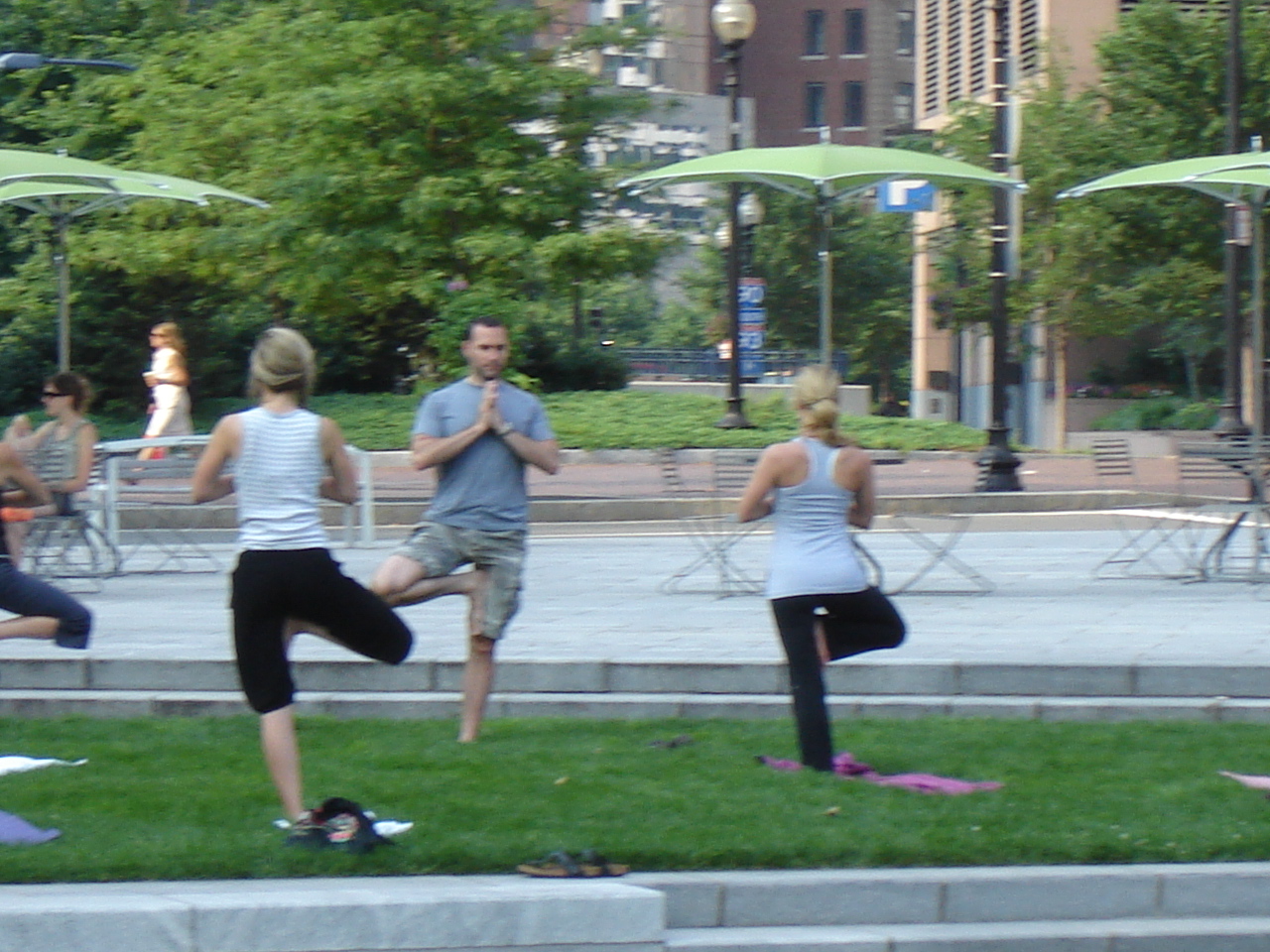
Before it got hot this morning, a yoga class was exercising at one end of the Greenway.

At the other end, carousel horses waited for riders.

Meanwhile in New York, an improv troupe approached a different carousel.

Read Full Post »