Feeds:
Posts
Comments

Posts Tagged ‘concert’

Photo: Alex Hecht for the New York Times.
A team helps Hunter Noack and his piano travel to scenic locations to give his concerts an outdoor vibe.

What I’m wondering as I read today’s story about classical piano in the great outdoors is whether the project is more about bringing nature into the concert experience or about attracting new audiences. Doesn’t it draw traditional concertgoers? Besides the whale, that is.

Sopan Deb reports at the New York Times that “for the last decade, the classical pianist Hunter Noack has been embarking on an unusual journey: He hauls a thousand-pound 1912 Steinway concert grand piano to places in the outdoors not known for hosting concerts. …

“This summer, Noack, 36, is in the midst of a 10th-anniversary tour of his ‘In A Landscape’ project, which has taken him to Jack London State Historic Park in Glen Ellen, Calif.; Black Butte Ranch in Sisters, Ore.; and Warm Springs Preserve in Ketchum, Idaho. …

“Inspired by the preservationist John Muir, Noack started the project as a way of getting closer to nature, and bringing classical music to rural areas where it is not typically accessible. The idea, Noack said, is to remove the barriers that typically limit classical music to concert venues like Carnegie Hall.

“ ‘What John Muir was trying to articulate is that we don’t just need the wild to recreate in,’ Noack said in an interview. ‘We need the wild to be human, and to be more compassionate, and to be more empathetic. And that’s the medicine that I needed. To be outside.’

“The roots of the project can be traced back to 2015. Noack, a native of Sunriver, Ore., had just moved to Portland, a couple of years after graduating from the Guildhall School of Music in London. He was working odd jobs and struggling with student debt. He considered joining the National Guard, but instead applied for a small grant from a regional arts and culture council in Portland to try an experiment. …

“After graduating from college, Noack, along with a friend from boarding school, created an immersive play in San Francisco. In London, Noack eagerly took in shows by the experimental theater company Punchdrunk.

“ ‘These theater and opera companies were really pushing the boundaries, and that’s what I wanted to do with my art: classical piano,’ Noack said.

“A traveling group of six helps Noack bring his piano to the various remote locations. The team has developed a system for moving the nine-foot instrument. The piano sits on a custom-designed 16-foot flatbed trailer, and can go anywhere that a four-wheel-drive vehicle can. Once they have arrived at a destination, the trailer turns into the stage.

“The first year, Noack rented a piano from a local dealer. But when he said he wanted to bring the rented piano to Mount Bachelor, in Bend, Ore., and the Alvord Desert, in the southeastern part of the state, the dealer did not want to take on the insurance liability. Afterward, in 2017, a philanthropist purchased and donated the piano that Noack uses today.

“Noack didn’t intend for ‘In A Landscape’ to be a full-time job, but the initial audience response was so large that he kept going. … The concerts are held rain or shine, hot or cold. (The temperature during concerts has ranged from subfreezing to above 100 degrees.)

“Among the notable locales where Noack has played are the entrance to Yellowstone (via the Roosevelt Arch in Montana), Joshua Tree National Park in California, Crater Lake in southern Oregon and Banff National Park in Canada. …

“Noack’s shows have even appeared to attract wildlife. He recalled that at a two-night run near the Oregon coast, the piano was located near a cliff. A whale swam up to shore for both performances and lingered for their entirety.

“ ‘I like to think that the whale was enjoying this show,’ Noack said.

“Among other wildlife that made appearances were free-range horses, birds and deer.

“Noack’s ambition to bring a piano to unfamiliar territory is expansive. He said he wants to perform at, among other striking sites, remote villages in Canada; at the Preikestolen, a steep cliff in Norway; during a safari in Africa; atop Vinicunca, the rainbow mountain in the Andes of Peru; and by the salt flats of Bolivia.

“ ‘My hope is that I can use this project, my love of the music and my curiosity about how public lands and natural resources are managed, to explore the world and learn,’ Noack said.”

More at the Times, here.

Read Full Post »

Photo: The Albertina.
Thousands of Taylor Swift fans flooded museums in Vienna in August after multiple institutions waived entry fees when security threats forced the cancellation of three concerts. Fans also traded bracelets with museum employees.

We’ve all seen the influence that singer Taylor Swift directly exercises over her fans. Indirectly, she has probably made some of them museum fans, too. That’s because museums in Vienna saw an opportunity when her concerts were cancelled.

Karen K. Ho reports at ArtNews, “Thousands of Taylor Swift fans flooded museums in Vienna [last August] after multiple institutions waived entry fees after three of the singer’s concerts were cancelled due to security threats.

“ ‘We weren’t really sure what to expect,’ Haus der Musik managing director Simon Posch told ARTnews.

‘The participating institutions were the Mozarthaus Vienna, House of Music, KunstHausWien and the Jewish Museum Vienna owned by the City of Vienna; MAK Vienna (Museum of Applied Arts) and MAK Geymüllerschlössel; the modern art museum Mumok, the art museum The Albertina, as well as the museum at the House of Strauss. The Museum quartier also offered Taylor Swift ticket holders free guided tours in English and German on August 10 and 11.

“The initiative was publicized through the Vienna Tourist Board and statements by the city’s mayor, Michael Ludwig, especially on social media.

“Several museum professionals in Vienna told ARTnews the slew of additional visitors were a pleasant surprise to their institutions. The demographics were mostly English-speaking young women, often between the ages of 18 to 25, traveling to the city from countries as far away as China, South Africa, Australia, Canada, and the United States. Many of them were also easily identifiable while wearing the singer’s concert merchandise, colorful outfits intended for the concert, and arms covered in friendship bracelets they intended to trade with other fans.

“The Albertina fully embraced the moment, waiving its [regular entrance fees] for more than 20,000 Swifties. … ‘On a normal and regular weekend, we would have, I would say 2,000 a day,’ spokesperson Nina Eisterer told ARTnews, noting that these types of visitor numbers are usually for blockbuster exhibitions like the one for Claude Monet in 2018.

“Eisterer said she and her colleagues in The Albertina’s marketing division were Swifties themselves, with several people planning to go to the concerts and personally devastated by the news of the cancellations. After the idea for waived entry fees was approved, the art museum’s security and ticketing teams were informed on August 6 that additional staff would be needed.

“The Albertina’s line for Swifties was so long that some fans stood outside in the sun and 91°F heat for approximately 20 minutes. ‘But there was no fuss about it,’ Eisterer said. ‘People were super nice.’

“The museum also switched the soundtracks playing its in 20 historical staterooms from classical music to Taylor Swift albums, prompting several large singalongs that went viral on TikTok.

“ ‘I love classical music, I love Mozart, I love Beethoven, I love all these classical artists, but it was really nice to have a Taylor Swift singalong more or less in the state rooms that normally stand for something else,’ Eisterer said. …

“Other institutions also saw an unexpected bump in activity. … Mozarthaus Vienna said they had 2,663 Swifties between August 9 and August 11, with additional staff called in on Saturday and Sunday. ‘Due to the large number of Swifties, guided tours in English were spontaneously added,’ spokesperson Jasmine Wolfram told ARTnews.

“Mumok’s head of press, Katharina Murschetz said 884 Taylor Swift fans stopped by. Eva Grundschober, the spokesperson for Capuchin’s Crypt said ‘exactly 500 Swifties’ used the option for the free ticket. And Josef Gaschnitz, the chief financial officer of the Jüdisches Museum der Stadt, said visitor numbers were ‘over 100% more’ compared to normal days. …

“Multiple people told ARTnews that social media played a major role in informing Swifties of the ‘super last-minute decision’ for the city’s offers and attracting them to the various museums. [Said] Posch, a self-professed Taylor Swift fan, ‘I think social media is the only way to reach this target group, because it didn’t help if the Austrian National Broadcasting System showed it in the evening news and they put it on their web page. None of these kids is going to visit the ORF home page.’ …

“ ‘We didn’t think about the money or the losing the money at all,’ Eisterer said, noting that its entry fees can be very expensive for young people. ‘It was, for us, important to set like a sign for this concert that had been canceled because of this horrible reason, and to give somehow a bit of hope and say to people, “Hey, we know it’s devastating. You can’t go to the concert, but hey, you can enjoy a bit of of art in Vienna, that’s what we can offer you.” ‘ …

“Some museums, like the Haus of Musik and The Albertina, also planned on extending the free entry offer to Swifties for one or two days beyond the weekend. ‘We will definitely still give them free access if they come with the Taylor Swift ticket,’ Posch said. ‘If they didn’t make it on the weekend and they’re still here, there’ll be no discussion, there’ll be our guests.’ “

More at ArtNews, here.

Read Full Post »

Photo: Toronto Star.
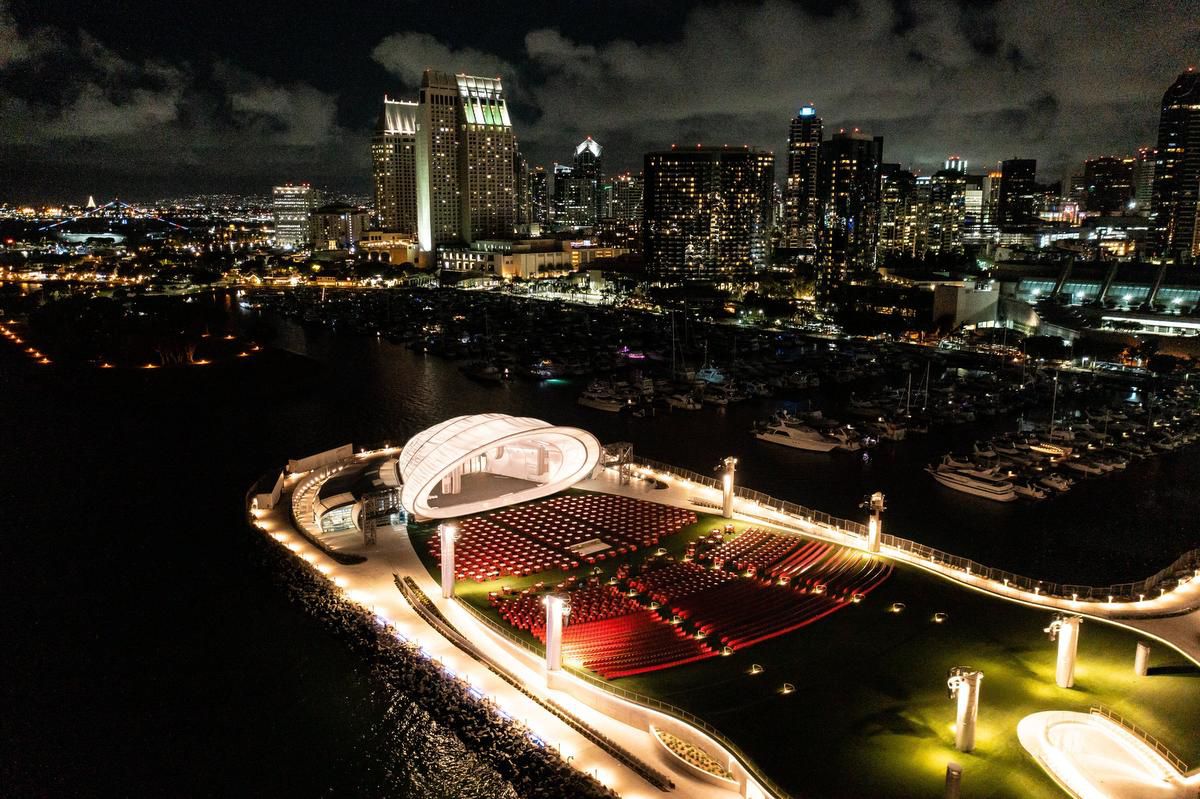
The San Diego Symphony’s waterfront venue, the Rady Shell.

The pandemic made us take a close look at the possibilities of moving the performing arts outdoors. Maybe outdoor performance is a good idea even without a pandemic.

William Littler writes at the Toronto Star, “Yes, San Diego is an outdoors city, blessed with an enviable oceanside location and a climate worthy of a snowbird’s dreams. No wonder the local symphony orchestra wants to come out and play.

“It has an even better reason now, thanks to last month’s opening of Rady Shell in Jacobs Park, a downtown al fresco setting for up to 10,000 people, picturesquely surrounded on three sides by water.

“The setting is nature’s gift, slightly reminiscent of the days when the Toronto Symphony Orchestra had a popular series at Ontario Place. And I say slightly because Ontario Place offered the orchestra a shared residence in a multi-purpose facility, whereas Rady Shell was developed specifically as a home for the San Diego Symphony.

“Described as the only permanent waterfront performance space on the West Coast, the handsome shell stretches forward as if to embrace the audience, with a series of speakers lined up on each side of the upward sweeping, (imitation) grass-covered audience area.

“At an afternoon rehearsal I took the opportunity to walk around and sample the sound from different standpoints and was not surprised to find the best sound — which was surprisingly good — closer to the front, where most of it came directly from the stage. …

“The arrival of COVID-19 has led orchestras to seek ways to enhance their outdoor profiles.

“The Montreal Symphony Orchestra has taken to its city’s parks. The Boston Symphony Orchestra heads for Western Massachusetts and Tanglewood. The Los Angeles Philharmonic has Hollywood Bowl.

“Though never an ideal solution, Ontario Place gave the Toronto Symphony an opportunity to broaden its audience and lengthen its season.

“Rady Shell demonstrates what more can be achieved through years of careful planning. A community effort, because it is part of a park, 85 per cent open to the public, people have routine access to the site.

“According to CEO Martha Gilmer, the orchestra plans to present about 110 events there per year, including the first part of its fall season, thanks to San Diego’s friendly climate. …

“The Southwest is clearly America’s fastest growth area; witness the fact that Phoenix, Arizona, recently passed Philadelphia to become the country’s fifth largest city. A can-do attitude helps explain how the new facility was built almost entirely without government support.

“The architects clearly wanted to design a people place, even providing a 12-foot-wide walkaround with benches just outside the porous perimeter fence for those who would like to hear, if not actually see the concert, without buying tickets. During the opening concert I even saw passing sailboats pause to share the experience.

“Of course I am describing a special place, not the kind of home most orchestras could hope to build in their neighbourhood. But the need is the same, to reach out to more people in a friendly environment.

“The San Diego Symphony has obviously understood this: the opening event at Rady Shell was a full-scale symphony concert, conducted by its popular music director, Rafael Payare, who will add the Montreal Symphony Orchestra to his schedule in 2022, but the second event was a Broadway program presided over by a different maestro, and the third was a concert by Gladys Knight.

“Three substantially different audiences attended these concerts, testimony to the orchestra’s wish to open its doors wide. It is a strategy for survival for symphony orchestras in Canada as well as the United States.

“In the program handed out for the opening concerts, Payare declared unequivocally: ‘From the moment I first stood on the stage of what would become Rady Shell at Jacobs Park, I knew that it was going to be an incredibly powerful acoustic for the orchestra.’ ” More at the Toronto Star, here.

In related news, there’s an interesting New York Times article about an outdoor theater space that was launched by black-listed artists in the McCarthy era and got a new lease on life during the pandemic.

Read Full Post »

Photo: Katherine Taylor for the Boston Globe
Eureka Ensemble, whose mission is to nurture social change, launched a Women’s Chorus that welcomes women experiencing severe poverty and homelessness.

How does one write a headline for a story like this? It’s not exactly about music giving homeless people hope. It’s more that focusing on music — music performed for you and music you make — activates a positive side of who you are. It’s that positive things can lead to other positive things.

During the 2018 Christmas season, there was quite a bit of comfort and joy being spread by music in the Greater Boston homeless community. Zoë Madonna wrote about it at the Boston Globe.

“The CASPAR homeless shelter, a low-slung brick building, crouches on Albany Street in Cambridge. When percussionist Jennie Dorris wheels her marimba through the front door, half of a large central room has been cleared, and a line of grizzled men sits at a long row of tables, watching. An enthusiastic older man in a Boston Strong T-shirt marches up, introducing himself as Danny. ‘Finally, the marimba’s here!’ he exclaims, grinning. ‘I wait all year for this.’…

” ‘What compels me is to take music where it’s needed and treat everyone with respect,’ says founder Julie Leven, a violinist. This year, its eighth, Shelter Music Boston has mounted scores of concerts in shelters throughout the Greater Boston area, including a full schedule in the days leading up to Christmas.

“It’s not the only music group focusing on the homeless around Boston. Eureka Ensemble, whose mission is to nurture social change, launched a Women’s Chorus that welcomes women experiencing severe poverty and homelessness. …

“Eureka’s most ambitious project, according to cofounder and conductor Kristo Kondakci, was a commissioned composition, Stephanie Ann Boyd’s ‘Sheltering Voices.’ Auditions for choral fellowships for women were held at Pine Street Inn and Women’s Lunch Place, says Kondakci, a recent graduate of New England Conservatory who has worked with the homeless since his student days at Boston College High School. Around 15 took part.

“Carrie Jaynes and Rottisha Mewborn are friends who met at Pine Street Inn. When they saw the audition sign-up sheet, they were initially skeptical, they say — they’re used to well-meaning outsiders putting in a few hours and then disappearing. But they went to the audition in March, in a room where the heater was going haywire. To cool it down, Kondakci threw open the door of a nearby freezer.

“And that, Mewborn says, put them at ease. … As Eureka Fellows, Jaynes and Mewborn rehearsed weekly with Kondakci, learning ‘Sheltering Voices.’ They were never treated as anything less than important and independent, they say.

“ ‘We became so desensitized at Pine Street that we forgot how we can be treated like a normal person,’ says Jaynes. At the rehearsals, she says, ‘we knew that we were in this together. We knew that we were all right . . . we could be human again. We could show emotion and not be judged if we cried, or laughed, or showed a softer side of us.’ …

“Shelter staff say that after Shelter Music Boston concerts, the atmosphere is more peaceful, and nights are more restful, notes Leven, who also plays with Handel and Haydn Society and the Boston Pops Esplanade Orchestra. …

“As for the Eureka fellowships, Jaynes and Mewborn say their experiences were powerful. ‘Having Kristo say “We’ll get you there no matter what” built up our trust and our safety,’ Mewborn says. Because Pine Street Inn has a daily lottery, she explains, she never knows if she’ll have a bed to sleep in each night. There’s little in her life she can truly count on. ‘So just having this little safety — even if things are going crazy out here, we can get there — it’s amazing.’ ”

More here.

Read Full Post »

Photo: Graeme Richardson / Ice Music

And speaking of ice hotels, you might want to try an ice concert one of these days. That is, if you get yourself as far north as Swedish Lapland (also known as “the world’s best place for experiencing the Northern Lights“).

Tod Perry writes at Good that ice instruments have an ephemeral quality that is reminiscent of Buddhist mandelas.

“Tibetan Buddhists have a tradition of making elaborate artwork out of colored sand and, upon its completion, blowing it all into a river. The ritual is to show their belief in the transitory nature of life.

“On the other side of the world, a man [from Colorado who is working] in Sweden has created another form of temporary art by making music out of ice. Twenty years ago, Tim Linhart made his first ‘ICEstrument’ on a snowy mountaintop and his obsession led him to create an entire frozen orchestra and chamber hall.

“In Lulea, Sweden, [the ice sculptor] has made his own igloo concert hall where musicians perform with string and percussion instruments made of ice.

“One of the major problems with conducting an ice orchestra is that the instruments eventually fall out of tune due to body heat from the performers and audience. This has led Linhart to create a unique venting system in his ice theater that filters the body heat out of the igloo.

“Linhart’s ice instruments have a beautiful sound that play on our deep connection to water.

” ‘The ice instrument is made of frozen water, we’re made of melted water. And that physical connection opens the door for a spiritual connection,’ he says.”

Read more at Good, here.

Read Full Post »

Recently, I read an article explaining why beautiful music is often heard flowing from a particular soup kitchen in New York City.

Michael Wilson wrote at the New York Times, “The church’s soup kitchen program fills quickly, bringing a din of chitchat and the scraping of chairs on floor tiles and the thud of trays being knocked against the inside of a trash can. But above it all, each and every weekday, hovers another sound, wholly unexpected: the clear, clean notes of a concert grand piano, there in a far corner. …

“The man at the piano, 61 years old, with a head of cropped gray hair bobbing in time over the keys, plays on, for two hours straight, as anonymous an entertainer as one is likely to find in this town.

“His name is Scott Croly. His most recent job was driving a truck, and that was a while ago. He is just on the roof-over-head side of homelessness, staying at a girlfriend’s house while he looks for work. Suffice it to say that when he first started visiting the soup kitchen some 13 years ago, it was not because they had a piano.”

The piano program, writes Wilson, “started with a former naval cryptographer on the Upper West Side, George Van Pelt, 90, who served in World War II and Korea and, along the way, taught himself to play the piano. He was visiting a friend who helped run a soup kitchen in San Francisco, and pitched in himself, chopping vegetables while a woman banged away at a piano. But the people there enjoyed it. She moved away, and he thought he could do better, and did, and after performing there many times, came back to New York with that old familiar bug bite. Mr. Van Pelt figured, rightly, that soup kitchens weren’t turning away pianists, and he heard about the Church of the Holy Apostles. ‘I gave them a hundred bucks to bribe them to let me play,’ he said. …

“Barry Weiss, a member of the Peace of Heart Choir and a pianist out of the American Songbook, plays on Fridays. A classically trained Armenian pianist, Jeannette Chirikdjian, plays on Mondays after several years of serving food at the lunches.

“ ‘It makes them happy,’ she said matter-of-factly before launching into Chopin’s ‘Grande Valse Brillante.’ ”

Read more at the Times. And watch the  Stephen Farrell video interview with one of the piano players here.

Photo: Andrew Renneisen for The New York Times.
The Holy Apostles soup kitchen in New York has a grand piano.

Read Full Post »

After a delightful morning with my granddaughter and my older grandson, I went to Providence to hang out with my younger grandson and Suzanne and a good friend.

I caught up with them at the park, where the farmers market was winding down and a free summer concert was revving up: the annual Summit Music Festival. (Check it out here.)

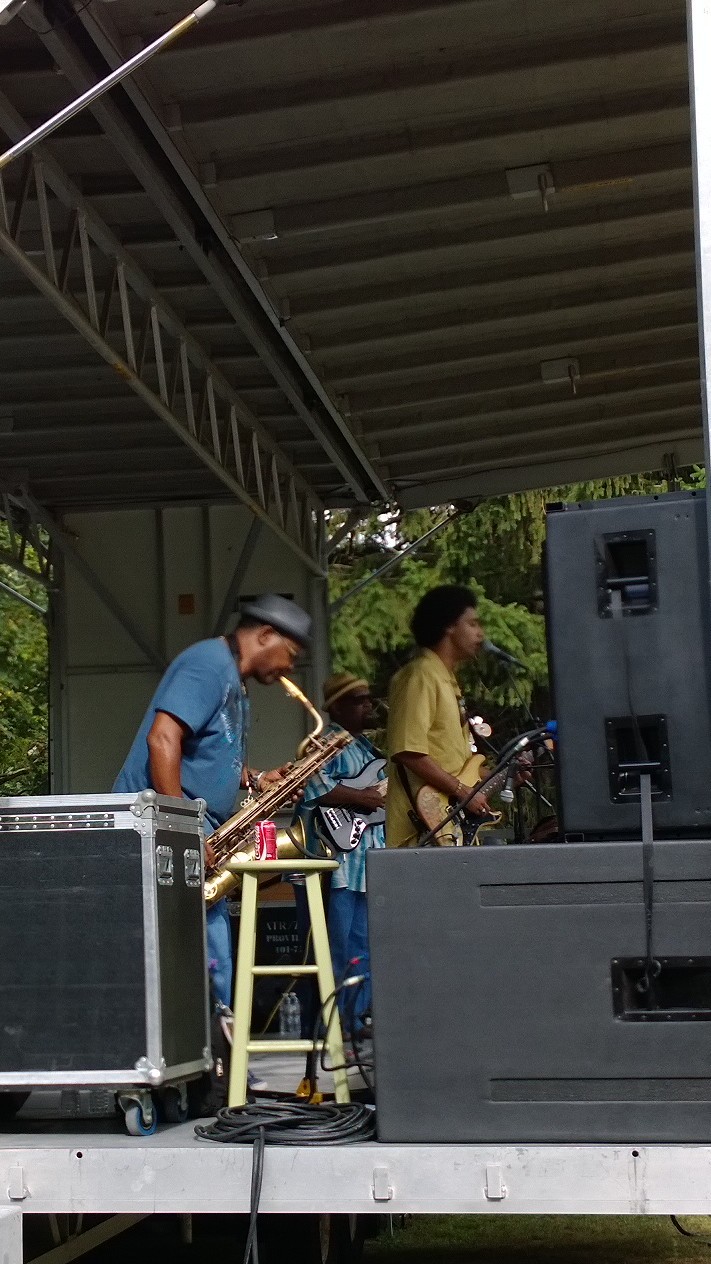
The four of us liked a blues group called the Selwyn Birchwood Band (pictured) and another band called Smith and Weeden. The ice cream eater below had reservations about a third performance. Everyone’s a critic.

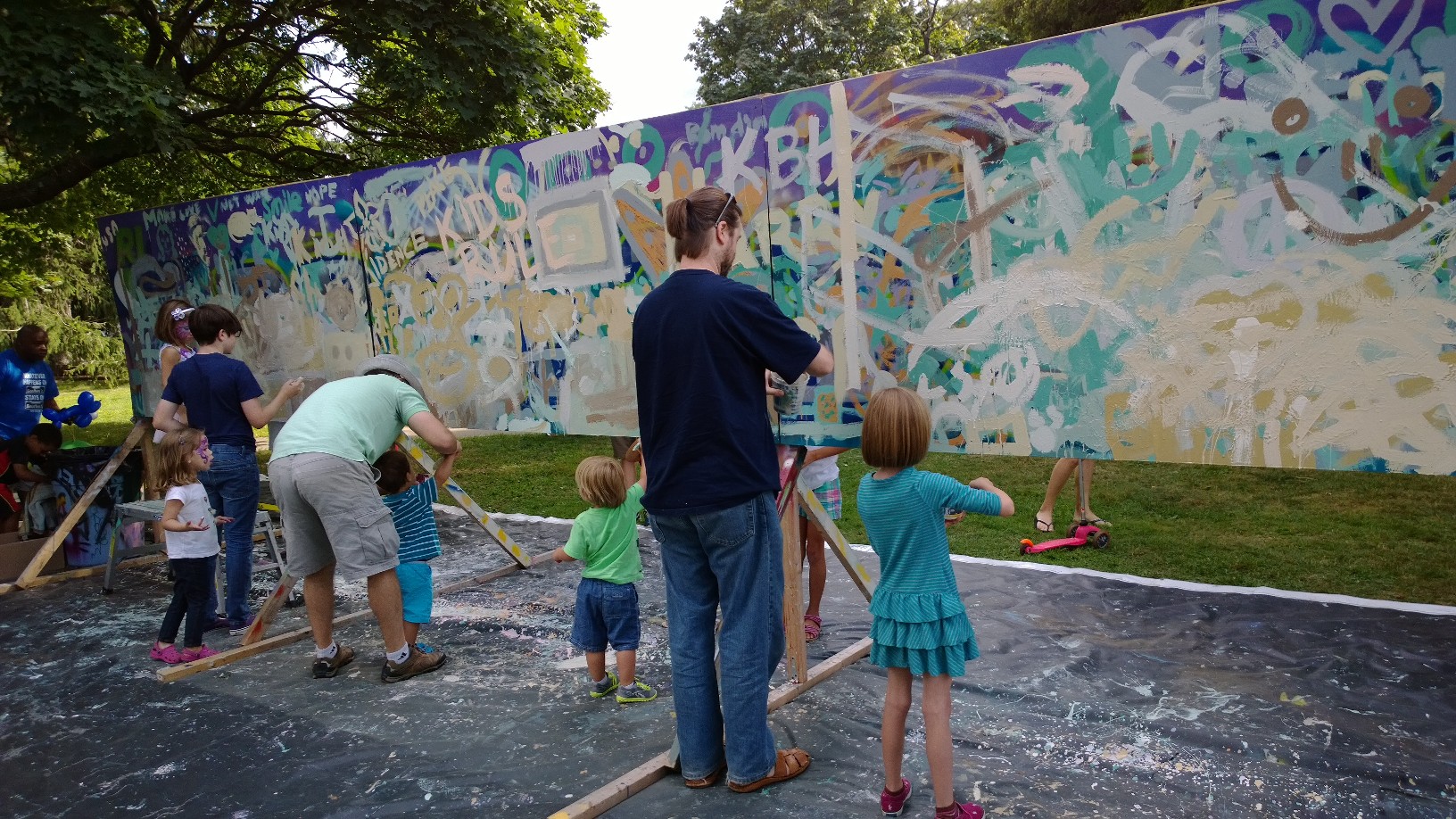
We spent a chunk of time going “higher, higher” on the swing in the playground and watching a multi-ethnic group of small boys kick a soccer ball. (How brave it is to go up to boys you don’t know and ask to play!) We skipped the face painting, which was gorgeous but, to a 2-year-old, kind of pointless. We watched kids and grownups painting a mural wall.

live-music-Providence


concert-critic-with-ice-cream


paint-the-wall-providence

Read Full Post »

Longtime concert pianist Byron Janis recently wrote an essay for the Wall Street Journal about programs using music to help veterans with PTSD and other traumas to heal.

“Can music heal?” he asks. “There’s been a great deal of study by neuroscientists on the different ways music acts upon the brain, affecting our behavior, memory and the like. …

“I recently witnessed the healing effects of music first hand. As part of their ‘National Initiative for Arts and Health in the Military,’ I was invited by Americans for the Arts to visit the Walter Reed National Military Medical Center and participate in ‘Stages of Healing.’ This program, created by Dr. Micah Sickel, helps patients learn how to play a musical instrument and facilitates live performances whose aim, according to the hospital, is to ‘enhance the healing process’ …

I knew what I wanted to play for them—two Chopin waltzes and ‘A Hero’s Passing By’ … I then played two songs from a musical I had written about the Hunchback of Notre Dame. One was a love song and the other is titled ‘Like Any Man,’ which I felt very much suited the occasion. The Hunchback sings that although he is so disabled, he is just like any man.” Read more.

Photo of Byron Janis in 1962: Wikimedia Commons

Read Full Post »

A high-minded concert may be a drop in the bucket when it comes to fighting global poverty, but as you know, I’m a believer in the power of “One and one and 50 make a million.”

In May, James C.McKinley Jr. wrote for the NY Times, “When the Global Poverty Project staged a benefit concert with Neil Young, the Black Keys and Foo Fighters in Central Park last fall, skeptics wondered if that nonprofit’s attempt to generate pressure on world leaders to help the poor would fade as soon as the amplifiers and guitars were put away.

“But this week the charity proved it had won converts, at least within the music industry. More than 70 artists, among them Jay-Z, Beyoncé, Bruce Springsteen, Pearl Jam and Bruno Mars, have pledged to give the project two tickets from each of their concerts over the next year, creating a pool of more than 20,000 tickets.

“The tickets will be used as prizes to encourage people to become involved in causes like fighting poverty in the third world, eradicating polio, building schools and ending famine. To win the tickets, fans are asked to earn points by taking action through a related Web site, globalcitizen.org. They can sign petitions, pledge to volunteer their time as aid workers, write elected leaders or donate money to aid organizations.

“‘It provides us with an opportunity to get really powerful activism worldwide,’ said Hugh Evans, the chief executive of the Global Poverty Project.” More.

Do check out a related post from 2011 on a countertenor who runs Artists for a Cause, a collaboration that provides talent for fundraising events — here.

Photo: Julie Glassberg for The New York Times
Neil Young with Crazy Horse performing in Central Park in September 2012 in a benefit concert for the Global Poverty Project.

Read Full Post »

Summer concerts on the lawn in front of the library mean lawn chairs and group participation. Toddlers in pajamas gradually get up their courage to dance. Young gymnastic girls do sudden cartwheels and back flips, then walk away casually, pretending not to check if anyone was impressed.

Last Wednesday, the featured band, PanNeubean Steel, consisted of steel drum, electric guitar, drums, and saxophone.

The band played some New Orleans jazz. “The Saints Go Marching In” brought back memories of my brother Will playing his sax every New Year’s Day to family acclaim.

Read Full Post »

For several years now, there has been a concert series right in the middle of all the comings and goings at Boston’s busiest Amtrak Station. Sometimes chamber music is played, sometimes it’s movie music, sometimes it’s cabaret. The concerts go from 11:30 to 12:30, and people just wander in and wander out. It’s great to see the look of surprise on travelers’ faces and the cellphone cameras being whipped out. Chairs are set up for those who want to sit to listen, or to eat their lunch. This year’s schedule is here.

Today we heard jazz harpist Deborah Henson-Conant, who has a website with a great URL, www.hipharp.com. She plays a small, 11-pound, blue electric harp from France and dances and sings while playing blues and jazz and songs she wrote. She has been called the Jimi Hendrix of harp and had us all singing along.

See the demo. It starts out with an original song that she also performed in South Station today.

Read Full Post »