Feeds:
Posts
Comments

Posts Tagged ‘creativity’

Photo: Alex Majoli/Magnum.
“Since at least the time of Greek philosophers, many writers have discovered a deep, intuitive connection between walking, thinking, and writing,” says Ferris Jabr at the New Yorker.

Charles Dickens kept few notes about where his plots were headed. From what I’ve read about him, he kept it all in his head, forming and saving his ideas on long walks wherever he was at the time.

In today’s article, we learn a bit about the science of that.

Ferris Jabr writes, “In Vogues 1969 Christmas issue, Vladimir Nabokov offered some advice for teaching James Joyce’s Ulysses: ‘Instead of perpetuating the pretentious nonsense of Homeric, chromatic, and visceral chapter headings, instructors should prepare maps of Dublin with Bloom’s and Stephen’s intertwining itineraries clearly traced.’ He drew a charming one himself. Several decades later, a Boston College English professor named Joseph Nugent and his colleagues put together an annotated Google map that shadows Stephen Dedalus and Leopold Bloom step by step. The Virginia Woolf Society of Great Britain, as well as students at the Georgia Institute of Technology, have similarly reconstructed the paths of the London amblers in Mrs. Dalloway.

“Such maps clarify how much these novels depend on a curious link between mind and feet. Joyce and Woolf were writers who transformed the quicksilver of consciousness into paper and ink. To accomplish this, they sent characters on walks about town. As Mrs. Dalloway walks, she does not merely perceive the city around her. Rather, she dips in and out of her past, remolding London into a highly textured mental landscape, ‘making it up, building it round one, tumbling it, creating it every moment afresh.’

“Since at least the time of peripatetic Greek philosophers, many other writers have discovered a deep, intuitive connection between walking, thinking, and writing. … ‘How vain it is to sit down to write when you have not stood up to live!’ Henry David Thoreau penned in his journal. ‘Methinks that the moment my legs begin to move, my thoughts begin to flow.’ Thomas DeQuincey has calculated that William Wordsworth — whose poetry is filled with tramps up mountains, through forests, and along public roads — walked as many as a hundred and eighty thousand miles in his lifetime, which comes to an average of six and a half miles a day starting from age five.

“What is it about walking, in particular, that makes it so amenable to thinking and writing? The answer begins with changes to our chemistry. When we go for a walk, the heart pumps faster, circulating more blood and oxygen not just to the muscles but to all the organs — including the brain. Many experiments have shown that after or during exercise, even very mild exertion, people perform better on tests of memory and attention. Walking on a regular basis also promotes new connections between brain cells, staves off the usual withering of brain tissue that comes with age, increases the volume of the hippocampus (a brain region crucial for memory), and elevates levels of molecules that both stimulate the growth of new neurons and transmit messages between them.

“The way we move our bodies further changes the nature of our thoughts, and vice versa. … When we stroll, the pace of our feet naturally vacillates with our moods and the cadence of our inner speech; at the same time, we can actively change the pace of our thoughts by deliberately walking more briskly or by slowing down.

Because we don’t have to devote much conscious effort to the act of walking, our attention is free to wander. …

“This is precisely the kind of mental state that studies have linked to innovative ideas and strokes of insight. Earlier this year, Marily Oppezzo and Daniel Schwartz of Stanford published what is likely the first set of studies that directly measure the way walking changes creativity in the moment. They got the idea for the studies while on a walk. …

“In a series of four experiments, Oppezzo and Schwartz asked a hundred and seventy-six college students to complete different tests of creative thinking while either sitting, walking on a treadmill, or sauntering through Stanford’s campus. In one test, for example, volunteers had to come up with atypical uses for everyday objects, such as a button or a tire. On average, the students thought of between four and six more novel uses for the objects while they were walking than when they were seated. …

“Where we walk matters as well. In a study led by Marc Berman of the University of South Carolina, students who ambled through an arboretum improved their performance on a memory test more than students who walked along city streets. A small but growing collection of studies suggests that spending time in green spaces — gardens, parks, forests — can rejuvenate the mental resources that man-made environments deplete. Psychologists have learned that attention is a limited resource that continually drains throughout the day. A crowded intersection — rife with pedestrians, cars, and billboards — bats our attention around. In contrast, walking past a pond in a park allows our mind to drift casually from one sensory experience to another, from wrinkling water to rustling reeds.”

More at the New Yorker, here.
Read Full Post »

Photo: James Lee Chiahan/Procedure Press.
“Tone Shift,” by James Lee Chiahan. depicts musician Yoko Sen’s journey from being patient in the hospital to working to improve the sounds of ICU alarms around the world. Chiahan is a Taiwanese-Canadian artist currently working out of Montreal, Canada.

Those of us who have ever had a hospital stay know how difficult it is to get any sleep. Part of the reason is noise. Today’s article suggests that since artists started applying their creativity to the challenge, hospitals have new ways they could improve sounds and doctors have new ways to improve patient interactions.

Mara Gordon at NPR (National Public Radio) begins her story with Emily Peters, who had a rough time with the health care system when her daughter was born. “Peters, who works as a health care brand strategist, decided to work to fix some of what’s broken in the American health care system. Her approach is provocative: she believes art can be a tool to transform medicine.

“Medicine has a ‘creativity problem,’ she says, and too many people working in health care are resigned to the status quo, the dehumanizing bureaucracy. That’s why it’s time to call in the artists, she argues, the people with the skills to envision a radically better future.

“In her new book, Artists Remaking Medicine, Peters collaborated with artists, writers and musicians, including some doctors and public health professionals, to share [ideas] about how creativity might make health care more humane. …

“For example, the book profiles electronic musician and sound designer Yoko Sen, who has created new, gentler sounds for medical monitoring devices in the ICU, where patients are often subjected to endless, harsh beeping.

“It also features an avant-garde art collective called MSCHF (pronounced ‘mischief’). The group produced oil paintings made from medical bills, thousands and thousands of sheets of paper charging patients for things like blood draws and laxatives. They sold the paintings and raised over $73,000 to pay off three people’s medical bills.

“It’s similar to a recent performance art project not profiled in the book: A group of self-described ‘gutter-punk pagans, mostly queer dirt bags’ in Philadelphia burned a giant effigy of a medical billing statement and raised money to cancel $1.6 million in medical debt. …

“There’s very little in the way of policy prescription in this book, but that’s part of the point. The artists’ goal is to inject humanity and creativity into a field mired in apparently intractable systemic problems and plagued by financial toxicity. They turn to puppetry, painting, color theory, and music, seeking to start a much-needed dialogue that could spur deeper change.

Mara Gordon: What made you want to create this book?
Emily Peters: I think I’m always very curious why so many people – really the majority of everybody in any way involved in the health care system – feel so powerless. … And so the book came about as thinking about power and change. And then I realized that artists have this unique intersection where they are very powerful, they bring a lot of the things that were missing in health care, trying to build a better future.

MG: What is it about art that feels like a tool to challenge that feeling of powerlessness?
EP: The very first person I interviewed for the book was a photographer, Kathleen [Sheffer], who was a heart-lung transplant survivor. She used her camera in the hospital to try to be seen as more powerful, to be seen as a full person by these very fancy transplant surgeons who are whisking in and out of her room, viewing her as just a body. I saw that she had gained that power through being an artist.

“I had another conversation with a physician out of New York, Dr. [Stella] Safo. … She really highlighted that there’s this crisis of imagination. Everybody feels so demoralized that we can’t even imagine what we want to ask for to make it better.

“That’s a creativity problem. And the people who are creative are artists. They are really good at sitting in complexity and paradox, and not wanting everything to be perfect, but being able to imagine. And so that was the hypothesis: Oh, there’s something really interesting at this intersection between art and medicine. …

“MG: My favorite part of the book was the section where there’s a color palette, named for different medical phenomena: pill bottle orange, Viagra blue.… I think a lot of people in health care worry that too much color somehow distracts from the seriousness of medicine.
EP: So many of these things, somebody chose, and they didn’t do a huge amount of research on it. They just chose it, and we take it as gospel now.

“The white coat ceremony. [I had thought it must have started in] medieval Florence: they were putting white coats on medical students and welcoming them into the guild, it just feels like this ancient tradition. And it’s something that was invented in Chicago in 1989. A professor was complaining that the students weren’t dressing professionally enough. …

We surveyed a couple hundred people [and published the results online]: ‘What colors would you want to see in the hospital?’ I was expecting those soothing pastel tones. And it was totally different: it was neon purples and oranges and reds. Don’t assume what people want. We have the technology and the capability now to build in systems that give people some control and some agency over things like color. …

MG: Has anyone told you that they think that health care is too important for art?
EP: I’ve heard the criticism that this is just about wallpaper on a pig: ‘You’re talking about adding more sculpture gardens and increasing the cost of health care.’

“I did not want it to be a book about creating more luxurious hospitals. We have a crisis of financial toxicity, we have a crisis of outcomes. It’s specifically a book about fighting those things. …

“MG: Do you think medicine takes itself too seriously? Do we need more humor in health care?
“EP: You’re holding somebody’s heart in your hand – this is a very intense job. You’re trying to convince somebody to enter hospice – that is not easy. This is not an easy job. But that seriousness can feel almost like play acting and really inauthentic to people. …

“And that’s such a waste to me, because it is such a beautiful, incredible profession. We, as patients, also want you guys to be humans. We’re on your side.”

More at NPR, here. No paywall.

Read Full Post »

More on Naps

Image: Art Furnace/Shutterstock via Nautilus.

As a longtime proponent of naps, I try to share every new angle I read about them. Today’s article is on narcolepsy, which is not something you want, but it does show how creative work may go on when you’re asleep.

Kristen French writes at Nautilus, “George Church looks like he needs a nap. I’m talking to him on Zoom, and his eyelids have grown heavy, inclining toward slumber. Or maybe my mind is playing tricks on me. He assures me he is wide awake. But sleeping and waking life are often blurred for Church. One of the world’s most imaginative scientists, Church is a narcoleptic.

“A rare disorder, narcolepsy causes sudden attacks of sleep, and Church has fallen asleep in some unfortunate circumstances — at The World Economic Forum, just a few feet away from Microsoft founder Bill Gates, for instance. He also had to give up driving due to the risk that a bout of sleepiness will strike while he is behind the wheel. But Church, a Harvard geneticist known for his pathbreaking contributions to numerous fields — from genetics to astrobiology to biomedicine—says the benefits of his condition outweigh the inconveniences. Many of his wildest and most prescient ideas come from his narcoleptic naps.

“ ‘The fact is, I fall asleep several times a day, and so almost everything comes from there,’ Church says. His idea for a quick and simple way to ‘read’ DNA — which resulted in the first commercial genome sequence, of the human pathogen H. pylori — came from a narcoleptic nap.

“He also conceived of editing genomes with a method analogous to CRISPR, and building new genomes with off-the-shelf molecules, during narcoleptic naps. More recently, in December, a wild idea for a space probe that could reach distant stars within just 20 years, at one-fifth the speed of light, came to him after a narcoleptic nap. He proposed that these lightning-speed interstellar missions could be launched by microbes and powered by laser sails. The ideas that come to him are often the result of collisions of unexpected images in his head. ‘I try to turn science fiction into science fact,’ Church tells me.

“The relationship between sleep, dreaming, and creativity has been the subject of conjecture for hundreds of years. Reports of creative inspiration and discoveries made by artists, inventors, and scientists while dreaming suggest these states of mind are intimately bound together. The symbolist poet Saint-Pol-Roux was known to guard his sleep at night with a sign on his bedroom door that read ‘Do not disturb: Poet at work.’ Russian scientist Dimitri Mendeleev reportedly had a vision of the periodic table in a dream after three days of exhaustive effort (though it may have just been the perfection of an idea he had while awake). Stephen King claims he dreamt up his novel Misery during a somnolent transatlantic flight.

“Rather than leave such inspirations to chance, American inventor Thomas Edison designed a strategy for mining his dreams for material. He would doze off with a steel ball in each hand. Once his body went limp with sleep, the balls would drop to the floor with a clatter and wake him up. He could then recall details of his dreams and record any insights. …

“Scientific studies seem to validate these tales. Study participants asked to ‘incubate’ a problem in their dreams often come up with a useful solution, and both the frequency and complexity of one’s dream recall have been correlated with higher scores on creativity evaluations. 

“The stage of sleep most closely associated with creative inspiration is known as REM, short for rapid eye movement. REM sleep begins about 70 minutes after a person loses consciousness and is rich with dream life. Lucid dreams, in which the dreamer knows he or she is dreaming and can sometimes direct the dream, are thought to primarily occur in REM. Waking from REM sleep has been shown to improve study subjects’ ability to solve anagrams. …

“But researchers have recently identified another state of mind that lies in the transition between waking and sleeping and may be even more fertile for creative inspiration than REM. It is called N1 or sleep onset, and it is the first of three stages in pre-REM sleep.

People with narcolepsy frequently fall into and out of N1 during daytime naps, giving them much greater access to these borderland perceptual states than normal sleepers.

“N1 is a hybrid, or ‘semilucid’ state of mind, says French neuroscientist Celia Lacaux, when individuals are just beginning to detach from the waking environment. It is a mental twilight that allows one to ‘freely watch the mind wander while maintaining a logical ability to identify creative sparks,’ says Lacaux. This shadowy frontier between waking and dreaming, to which all sleepers have access, may be the source of many of humanity’s most novel ideas, inventions, and works of art. Psychologists call it ‘hypnagogia,’ after the Greek words for ‘sleep’ (hypnos) and ‘to lead’ (agogo). The French sometimes refer to it as ‘entre chien et loup,’ literally ‘between dog and wolf.’ …

“ ‘Hypnagogia happens to be a time period where you are much more subject to outside influence and where you’re doing much more auditory processing and where your dream recall rates are much higher,’ says Adam Haar, a dream researcher at MIT Media Lab. It is characterized by phenomenological unpredictability, distorted perception of space and time, and spontaneous, fluid idea association.

“A relationship between hypnagogia and creativity makes intuitive sense. One major theory of creativity posits that it results when our minds make connections between distantly related concepts stored in our memories. This is a process that is thought to occur naturally during sleeping and dreaming: New memories mingle in novel and abstract ways with older ones as a means of consolidating them, laying down tracks in our brains for later recollection. Neuroscientist Karl Friston, who studies consciousness, proposes that this mashing together of old and new is a process that helps to minimize redundancy and complexity in our memory system, and prepares us to navigate a fuller range of possible scenarios in our waking lives.”

More at Nautilus, here. No firewall.

I know that when I wrote theater reviews, they came out better for weekly papers than dailies because I had a chance to “sleep on it.”

And then there’s the famous story of Samuel Taylor Coleridge composing “Kubla Khan” in an opium-induced sleep. (Not recommending the opium part.)

Read Full Post »

qa8yx8zyrhobzjys_optwa2frothkothumb800

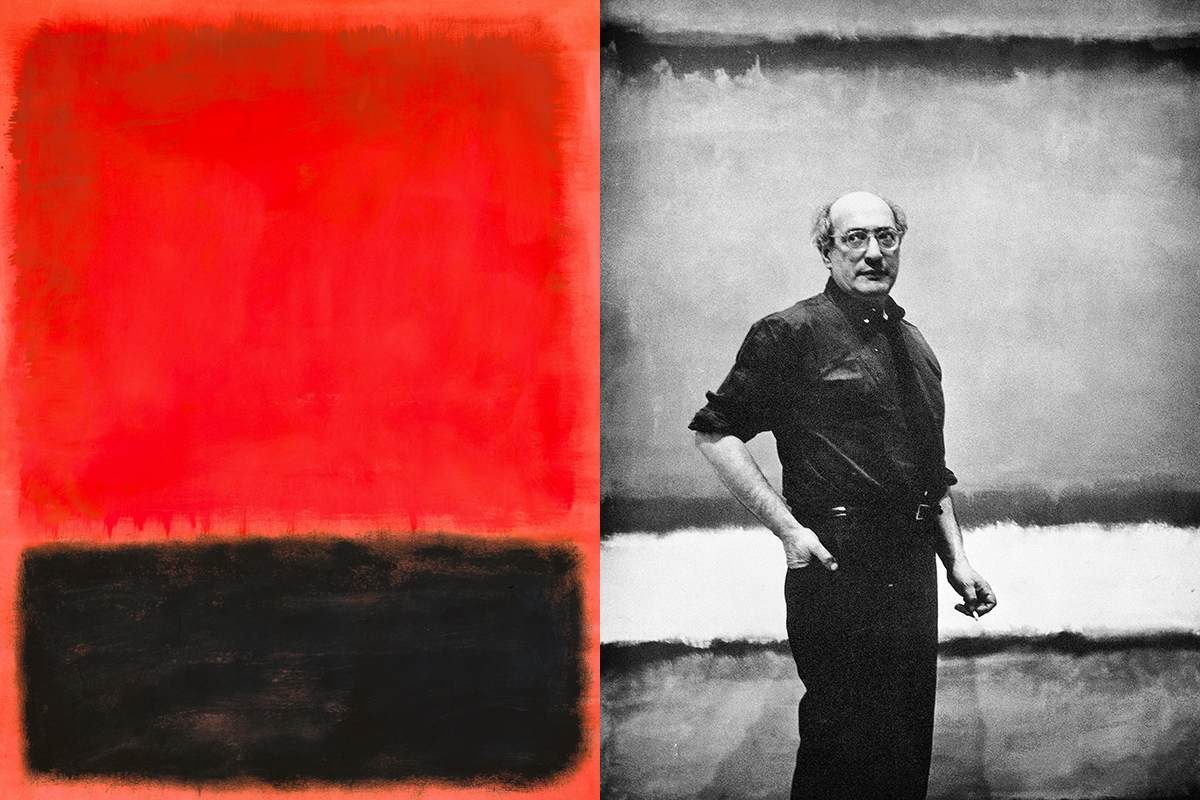
Abstract Expressionist artist Mark Rothko had strong opinions on how to teach children art without dampening their natural creativity.

The little I know about modern artist Mark Rothko is from a theatrical production called Red that I saw in Boston. It was pretty comprehensive, but I don’t believe it covered Rothko’s views on teaching art to children. That is something I learned about from an Artsy editorial.

Sarah Gottesman wrote, “If you’ve ever seen Mark Rothko’s paintings — large canvases filled with fields of atmospheric color — and thought, ‘a child could do this,’ you’ve paid the Abstract Expressionist a compliment.

“Rothko greatly admired children’s art, praising the freshness, authenticity, and emotional intensity of their creations. And he knew children’s art well, working as an art teacher for over 20 years at the Brooklyn Jewish Center. To his students — kindergarteners through 8th graders — Rothko wasn’t an avant-garde visionary or burgeoning art star, he was ‘Rothkie.’ ‘A big bear of a man, the friendliest, nicest, warmest member of the entire school,’ his former student Martin Lukashok once recalled.

“Rothko was a thought leader in the field of children’s art education. He published an essay on the topic (‘New Training for Future Artists and Art Lovers’) in 1934, which he hoped to follow up with a book. Though he never completed the project, he left behind 49 sheets of notes, known as ‘The Scribble Book,’ which detailed his progressive pedagogy — and from which we’ve taken five lessons that Rothko wanted all art teachers to know.

“Lesson #1: Show your students that art is a universal form of expression, as elemental as speaking or singing

“Rothko taught that everyone can make art — even those without innate talent or professional training. According to the painter, art is an essential part of the human experience. … For Rothko, art was all about expression — transforming one’s emotions into visual experiences that everyone can understand. And kids do this naturally. …

“Lesson #2: Beware of suppressing a child’s creativity with academic training

“As Rothko saw it, a child’s expressiveness is fragile. When art teachers assign projects with strict parameters or emphasize technical perfection, this natural creativity can quickly turn to conformity. ‘The fact that one usually begins with drawing is already academic,’ Rothko explains. ‘We start with color.’ …

“When children entered his art room, all of their working materials — from brushes to clay — were already set up, ready for them to select and employ in free-form creations. No assignments needed.

“ ‘Unconscious of any difficulties, they chop their way and surmount obstacles that might turn an adult grey, and presto!’ Rothko describes. ‘Soon their ideas become visible in a clearly intelligent form.’ With this flexibility, his students developed their own unique artistic styles, from the detail-oriented to the wildly expressive. …

“Lesson : Stage exhibitions of your students’ works …

“For Rothko, an art teacher’s premier responsibility was to inspire children’s self-confidence. To do this, he organized public exhibitions of his students’ works across New York City, including a show of 150 pieces at the Brooklyn Museum in 1934. And when Rothko had his first solo exhibition at the Portland Art Museum a year earlier, he brought his students’ works along with him and exhibited them next to his own. … Rothko wanted critics to see that fine art only requires emotional intensity to be successful.

“Lesson #4: Introduce art history with modern art (not the Old Masters) …

“With 20th-century art, children can learn from works that are similar to their own, whether through the paintings of Henri Matisse, Milton Avery, or Pablo Picasso. These iconic artists sought pure, personal forms of visual expression, free from the technical standards of the past. … But while exposure to modern art can help boost children’s confidence and creativity, it shouldn’t interfere with the development of a unique style. Rothko discouraged his students from mimicking museum works as well as his own painting practice. …

“Lesson #5: Work to cultivate creative thinkers, not professional artists

“In addition to fanning students’ creative instincts, great art teachers can help students become more self-aware, empathetic, and collaborative — and this generates better citizens in the long run, Rothko believed. At the Brooklyn Jewish Center, he hardly cared whether his students would go on to pursue careers in the arts. Instead, Rothko focused on cultivating in his students a deep appreciation for artistic expression.

“ ‘Most of these children will probably lose their imaginativeness and vivacity as they mature,’ he wrote. ‘But a few will not. And it is hoped that in their cases, the experience of eight years [in my classroom] will not be forgotten and they will continue to find the same beauty about them. As to the others, it is hoped, that their experience will help them to revive their own early artistic pleasures in the work of others.’ ”

More here.

Read Full Post »

Photo: Hulton Archive/Getty Images
Trumpeter Miles Davis, circa 1959. He once said, ‘”There are no wrong notes in jazz. It’s the note you play afterwards that makes it right or wrong.”‘ A small study suggests that jazz and classical music have different effects on the brain.

Pacific Standard loves these small-scale studies because they are fun and interesting. But as a retiree from an organization dominated by economists, I feel compelled to remind you that larger studies are needed.

Now for the fun. Tom Jacobs writes at Pacific Standard, “Can creativity be taught? Not directly, perhaps. But if such a curriculum exists, it would train one’s brain to regard unforeseen occurrences as potential springboards, rather than disturbing anomalies.

“Fortunately, there is at least one type of specialized training that shapes neural activity in precisely that way. …

“In a new, small-scale study, a Wesleyan University research team led by Psyche Loui and Emily Przysinda report the brains of jazz musicians are uniquely attuned to surprising sounds. Electronic monitoring revealed these players have ‘markedly different neural sensitivity to unexpected musical stimuli,’ the researchers write.

“These musicians are trained not only to anticipate unpredictable turns, but also to engage with them in a positive, creative way. That dynamic reflex stimulates creative thinking.

“The study in … Brain and Cognition featured 36 students from Wesleyan University and the Hartt School of Music. Twelve were studying jazz (including improvisation), 12 classical music, and the final 12 were non-musicians. …

“The participants completed a short version of a well-known creative thinking test, in which they were given six open-ended prompts such as ‘List all the uses you can think of for a paper clip’ in three minutes. They were scored on both the number of items they came up with, and their originality (that is, how often each answer was also given by other students). …

“The young musical improvisers were uniquely receptive to unexpected sounds. …

” ‘The improvisatory and experimental nature of jazz training can encourage musicians to take notes and chords that are out of place, and use them as a pivot to transition to new tonal and musical ideas,’ Loui and her colleagues write. ‘This could lead to the increased cognitive flexibility in jazz musicians.’ …

“It’s possible that people who decide to learn an instrument have brains that are pre-wired in a certain way, but previous research suggests that’s unlikely. Loui plans to study that issue, as well as whether other types of artistic training — say, improvisational theater — will yield similar results.”

More here.

Read Full Post »

My high school friend Susie posted this KQED article on Facebook. I couldn’t agree more with its focus on the value of daydreams and allowing everyone adequate  time to recharge batteries.

Referencing today’s many distractions, KQED reporter Katrina Schwartz writes, “Many people believe they are skilled multitaskers, but they’re wrong. Neuroscience has shown that multitasking — the process of doing more than one thing at the same time — doesn’t exist.

“ ‘The brain doesn’t multitask,’ said Daniel Levitin, author and professor of psychology, behavioral neuroscience and music at McGill University on KQED’s Forum program. ‘It engages in sequential tasking or unitasking, where we are shifting rapidly from one thing to another without realizing it.’ The brain is actually fracturing time into ever smaller parts and focusing on each thing individually. …

“The brain has a natural way of giving itself a break — it’s called daydreaming. ‘It allows you to refresh and release all those neural circuits that get all bound up when you’re focused,’ Levitin said. …

“[Daydreaming] is particularly important for students, who are often asked to sit through a long school day with very few breaks. Lots of research has shown the importance of recess and free play time for academic success, but schools still tend to emphasize time spent in class ‘learning’ over a more nuanced view of how and why kids learn.

“ ‘Children shouldn’t be overly scheduled,’ Levitin said. ‘They should have blocks of time to promote spontaneity and creativity.’ Without that time, kids don’t have the mental space to let new ideas and ways of doing things arise. Daydreaming and playing are crucial to develop the kind of creativity many say should be a focal point of a modern education system.” More.

Time to think, time to free associate, is not just important for kids. If the electric handwarmers I use in winter take twice as long to recharge as to expend their stored heat, then I, too, should have double time to recharge after engaging on anything. You, too.

Photo: Brynja Eldon/Flickr

Read Full Post »

Here’s a story from Fast Company on the role of boredom in creativity.

Martin Lindstrom writes, “According to the Kaiser Family Foundation, young people cram an average of more than 10 hours of media content into each and every day—close to 10 times the amount of time they spend with their parents.

“Recently, the International Center for Media and Public Agenda asked 1,000 students to live without any electronic devices for 24 hours. Not such a monumental task, you’d think? But more than half had given up within two hours, and the ‘survivors’ reported an overwhelming sense of emptiness and boredom. …

“While boredom may threaten your ability to work quickly and efficiently, it may be essential to working well. As writer and philosopher Robert Pirsig claimed, ‘Boredom always precedes a period of great creativity.’ Even if that isn’t always the case for you, chances are you need to be a little bored in order to generate your most inventive ideas and produce your highest-quality work. …

“Some of the most talented and successful people all share the ability to combine two or more ordinary things in an completely novel way. That kind of creative thinking doesn’t happen as a result of brute-force cogitation. In my experience, and in the experiences of the many creatives I’ve interviewed about this process, it happens during those transition zones, the moments of unforced boredom that they’ve each made an intentional effort to restore to their lives. …

“The transition zones that work for you … might be taking a leisurely walk around the neighborhood. Or it might mean a 10-mile run. It might be in the car. It might involve a glass of iced tea in an Adirondack chair on your patio. Whatever it is for you, it’s a time when you give yourself permission to put the electronics away, stop forcing your thought process forward at a frantic clip, and allow your thoughts to take their own meandering course.” More here.

It’s worth acknowledging that long-term boredom can be debilitating. But I agree it’s important to give yourself plenty of spaces to do nothing, to think. Plenty of spaces every day, I’d say.

Photo: Annabel Fitzsimmons

Read Full Post »

New research in the UK is providing confirmation of my belief that boredom is not always a destructive thing but often a path to creativity. Other people have had the same impression. After all, the site with some of the most creative links on the web calls itself Bored Panda.

Recently, my husband sent along a relevant article by the BBC’s David Robson, who caught my interest at once with his claim that boredom was first mentioned in Bleak House, by Charles Dickens. (I’ve read that novel enough times to know that Robson spelled Lady Dedlock’s name wrong, though.)

For his report, Robson interviewed Sandi Mann, coauthor with Rebekah Cadman of a University of Central Lancashire study on boredom.

He begins, “I’ve met lots of people with a talent to bore in my time, but Sandi Mann is one of the few to have honed it as a craft. Eager volunteers visiting her lab may be asked to carry out less-than-thrilling chores like copying out lengthy lists of telephone numbers. They mostly tolerate the task politely, she says, but their shuffling bottoms and regular yawns prove they are hardly relishing the experience. …

“Mann has found that their ennui boosted their performance on standard tests of creativity – such as finding innovative uses for everyday objects. She suspects the tedium encouraged their minds to wander, which leads to more associative and creative ways of thinking. ‘If we don’t find stimulation externally, we look internally – going to different places in our minds,’ she says. ‘It allows us to make leaps of imagination. We can get out of the box and think in different ways.’ Without the capacity for boredom, then, we humans may have never achieved our artistic and technological heights. …

“Given this benefit, Mann thinks we should try not to fear boredom when it hits us. ‘We should embrace it,’ she says – a philosophy that she has now taken into her own life. ‘Instead of saying I’m bored when I’m stuck in traffic, I’ll put music on and allow my mind to wander – knowing that it’s good for me. And I let my kids be bored too – because it’s good for their creativity.’ ”

My own approach to being stuck at the end of a long line is to recite the poems I know. I also carry in my bag a few other poems in case I run out.

More here, at the BBC, which also covers the darker side of boredom.

Photo: Socialphy
Yawning.

Read Full Post »

Even when I take my walk in the house on a bad day in winter, I find that walking helps me think. My pace indoors or out is not very energetic, but I like that all sorts of ideas and memories pop into my head as I walk.

At the NY Times blog called “Well,” Gretchen Reynolds describes new research that ties walking to creativity.

“A brief stroll, even around your office, can significantly increase creativity, according to a handy new study. Most of us have heard by now that exercise, including walking, generally improves thinking skills, both immediately and in the longer term. …

“Similarly, exercise has long been linked anecdotally to creativity. For millenniums, writers and artists have said that they develop their best ideas during a walk …

“Researchers at Stanford University recently decided to test that possibility, inspired, in part, by their own strolls. ‘My adviser and I would go for walks’ to discuss thesis topics, said Marily Oppezzo, at the time a graduate student at Stanford. ‘And one day I thought: “Well, what about this? What about walking and whether it really has an effect on creativity?” ‘

“With the enthusiastic support of her adviser, Daniel Schwartz, a professor in the Stanford Graduate School of Education, Dr. Oppezzo [gathered] her volunteers in a deliberately dull, unadorned room equipped with only a desk and (somewhat unusually) a treadmill, Dr. Oppezzo asked the students to sit and complete tests of creativity … Then the participants walked on the treadmill, at an easy, self-selected pace that felt comfortable. The treadmill faced a blank wall. While walking, each student repeated the creativity tests, which required about eight minutes.

“For almost every student, creativity increased substantially when they walked.”

The study was published this month in the Journal of Experimental Psychology: Learning, Memory, and Cognition.

 More here, where Reynolds notes that there was no difference when the volunteers walked outdoors instead of on a treadmill.

Embed from Getty Images

Read Full Post »

No one needs to be told that art is healing. I find it can cheer me up when I’m just having a bad day. I even tell coworkers who are stressed out, “Go over to Fort Point and look at some art.”

But for those who care more about data than folk wisdom, there is research.

Genevra Pittman writes at Pacific Standard, “Music, art, and dance therapy may relieve anxiety and similar symptoms among people with cancer, according to a new analysis of past studies.

“Researchers who analyzed results from trials conducted between 1989 and 2011 said the benefits tied to creative arts therapies were small, but similar to those of other complementary techniques such as yoga and acupuncture. …

“The analysis included 27 studies of close to 1,600 people who were randomly assigned to receive some form of creative arts therapy or not, during or after cancer treatment. Patients with breast cancer or blood cancers—such as leukemia and lymphoma—made up the majority of study participants. Music, art, and dance therapy programs varied in how often sessions were conducted and over what time span. …

“On the whole, people with cancer who were assigned to creative arts treatments reported less depression, anxiety, and pain and a better quality of life during the programs than those who were put on a wait list or continued receiving usual care.” More.

I didn’t get into art therapy when I had cancer, but I’m sure I would have liked it. I did have a booklet created by past patients that contained daily readings, and more often than not the choices hit the spot. The patients named the booklet “No Other Way but Through.”

Photo: Memorial Sloan-Kettering Cancer Center
Art therapy program

Read Full Post »

Deanna Isaacs has a funny post at the Chicago Reader. It’s about the Storefront Playwright Project.

“Tired of sitting around watching paint dry?” she asks.

“Then get yourself over to 72 E. Randolph, where, thanks to the League of Chicago Theatres and the Department of Cultural Affairs and Special Events, you can watch a real, live writer at work.

“The Storefront Playwright Project is putting 27 authors on exhibit this month in the big front window at Hot Tix/Expo 72.

“Never mind that writing is right up there with sleeping as a potential spectator sport, so stimulating that the writer him- or herself often has to bring the action to a complete stop in order to check e-mail, clean a closet, or book a flight and get the hell out of there. …

“Guessing that dramatists would be more dynamic at work than, say, novelists (readily observed in deep rumination at most any coffee shop), I stopped by last week, when Emilio Williams was on display.

“The playwrights each take a four-hour shift. Williams was a couple hours into his afternoon stint, gamely focused on his laptop, which was perched on a small white table and hooked into a large screen mounted in the window. The big screen faces outward, allowing passersby a look at the creative product the instant it emerges from the writer’s brain. …

“Behind the glass, Williams pursed his lips and crossed his ankles. …

“He leaned his chin on his hand and scrolled through several pages of dialogue that went something like this:

“Mar: Done?

“Ted: Yep.

“Mar: You don’t sound very enthusiastic.

“Williams paused.

“He blinked.

“He scrolled again.

“And then, it happened!

“On the big screen, before my very eyes, the cursor hesitated. It stopped. And it backed up, deleting as it went, wiping out ‘tucitcennoC’ and replacing it with ‘Lake Geneva.’ ” More from Deanna, even funnier.

Readers may recall several posts I wrote on a playwriting class I took the summer before last. (For example, here.) I thought the class got playwriting out of my system. Should I reconsider now that playwrights have the opportunity to sit in storefronts where strangers can watch them think?

Um, maybe not.

Photograph: The Chicago Reader

Read Full Post »

Jim Dwyer writes lovely human-interest stories for the NY Times. On September 5, he wrote about a guy who plays music by the Hudson River for an audience of birds, fish, and whatever friends or strangers wander by.

On Tuesday morning, Jose Modesto Castillo, retired from a job in a plastics factory, walked just about as far west in northern Manhattan as it is possible to go, to the end of a long pier fingering into the Hudson River at Dyckman Street. A harmonica rigged to his head was just a breath away from his lips. Lashed to his hands with hair ties were 17 miniature percussion instruments made from items like a Snapple cap, the lid of a prescription bottle, a Spider-Man figurine, the shells of plastic eggs that once held toys from supermarket vending machines.

“Strike up the one-man mambo band.

“Mr. Modesto’s mouth danced across the harmonica, and his fingers made rhythm out of junk. He played and he bobbed. At the end of the nameless number, he raised his arms as if waving to the Palisades on the far shore. Suddenly, he noticed that he was being watched, and called out, ‘Hello señor,’ and burst into a laugh.

“It was the Tuesday after Labor Day, the first day after the spiritual end of summer, though not yet the true beginning of autumn. At the pier and tiny cove on Dyckman Street, calendars were beside the point. Mr. Modesto, 66, comes every day to play, even if only the birds and fish are there to hear him.”

Some artists can get joy even if no one is around. As a musician, Modesto sees potential in bottle caps and plastic eggshells the way a painter might see it in clouds or the sun on the subway stairs.

Read more.

Photograph: Marcus Yam for the NY Times

Read Full Post »

John pointed me to an article on the kinds of work environments that encourage innovation.

Aimee Groth at Business Insider writes, “In his article, Groupthink, the New Yorker‘s Jonah Lehrer says there are two types of brainstorming — a free-for-all exchange of ideas in a structured environment, and a random, unplanned debate. Only the second type really works.

“He says M.I.T.’s famous Building 20 … became one of the most innovative spaces in the country because it fostered the best kind of brainstorming.

“The building was created to provide extra room for scientists during WW II, reports Lehrer, and ‘violated the Cambridge fire code, but it was granted an exemption because of its temporary status. … The walls were thin, the roof leaked, and the building was broiling in the summer and freezing in the winter. Nevertheless Building 20 quickly became a center of groundbreaking research, the Los Alamos of the East Coast.’

“It wasn’t demolished after the war because there were too many students and too little space on campus. So the building became a hodgepodge of offices, with professors and students from all different departments squeezed in small spaces and long corridors. …

” ‘Walls were torn down without permission; equipment was stored in the courtyards and bolted to the roof. … The space also forced solitary scientists to mix and mingle.’ ”

More.

Makes me think of the layout at Mass Challenge, the accelerator incubator for entrepreneurs that I blogged about here. (Did I mention that a family member read that post, sent in an application under the wire, powered through layers of screening, and is now working away as part of the class of 2012?)

The Mass Challenge space is not dangerous like Building 20, but the founders probably heard about the benefits of Building 20’s layout through their connection to MIT. The Mass Challenge work space is an unfinished floor in an upscale office building on the waterfront, 1 Marina Park. Everything is open and interactive.

The harbor views are a bonus unknown at Building 20.


Read Full Post »

Sunday evening I went over to Concord Academy to hear Seán Curran talk about how he creates choreography. Betsy, one of the dancers from his company, did a beautiful job of demonstrating what he meant.

As a little boy growing up in Watertown, Seán said, he waited eagerly for the mail that brought Look magazine. He liked to cut out pictures and make collages with them.

He says that his approach to choreography is similar. He arranges many snippets or dance phrases in different ways. His challenge is to edit down the many ideas so that the choreography doesn’t topple from too much weight.

I make collages, too. I have always liked the idea of taking a bunch of random things people have said and trying to make a play out of them, for example.

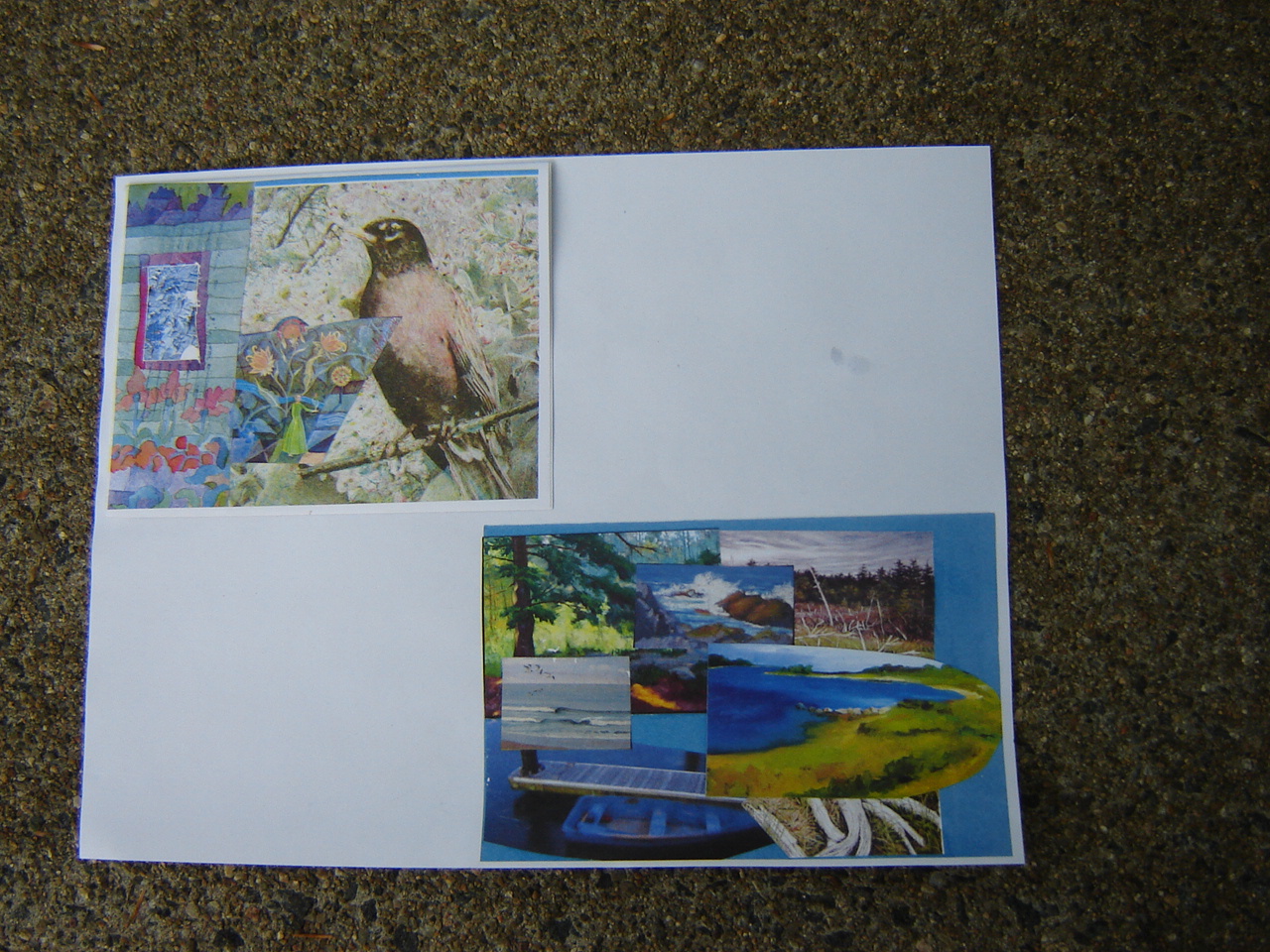
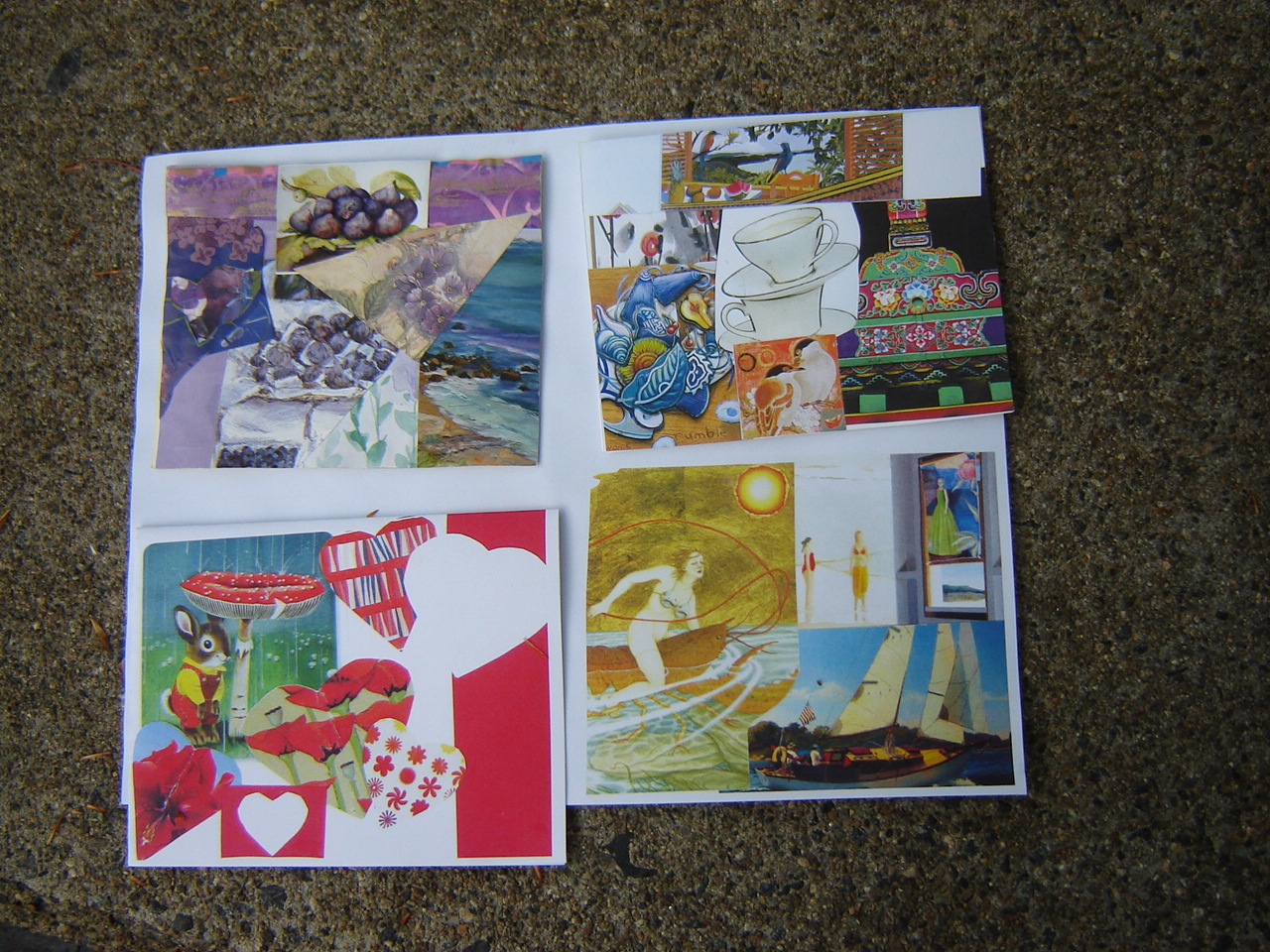
I also make collage greeting cards. I keep a box of promising pictures, cut from magazines and gallery postcards. I go through the whole pile and set aside maybe 20 items that somehow remind me of the person for whom I am making the card. Then I edit them down to the few pieces that will be best for the particular occasion.

All that happens before I cut the shapes and decide on how to arrange them. Sometimes I do a cutout of a cutout and put something else in the space: for example, I cut a vista out of a painting of a window and put a girl in the space (bottom right).

Here are examples.

Read Full Post »

Science Daily reports on new research that reaffirms the value of daydreaming.

It’s all about letting our conscious mind take a rest while our unconscious mind puts random but important pieces together for us. Getting enough sleep matters for the same reason.

“In recent years, researchers have explored the idea of rest by looking at the so-called ‘default mode’ network of the brain, a network that is noticeably active when we are resting and focused inward. Findings from these studies suggest that individual differences in brain activity during rest are correlated with components of socioemotional functioning, such as self-awareness and moral judgment, as well as different aspects of learning and memory.”

That’s a mouthful, but you know what they are getting at, right?

I can’t imagine life without daydreaming. Unfortunately, a lot of people seem almost afraid of the empty spaces. I think they miss out on a certain amount of insight and creativity.

Read more on the research here.

Read Full Post »

Older Posts »