Feeds:
Posts
Comments

Posts Tagged ‘deaf’

Photo: Nathaniel Bivan.
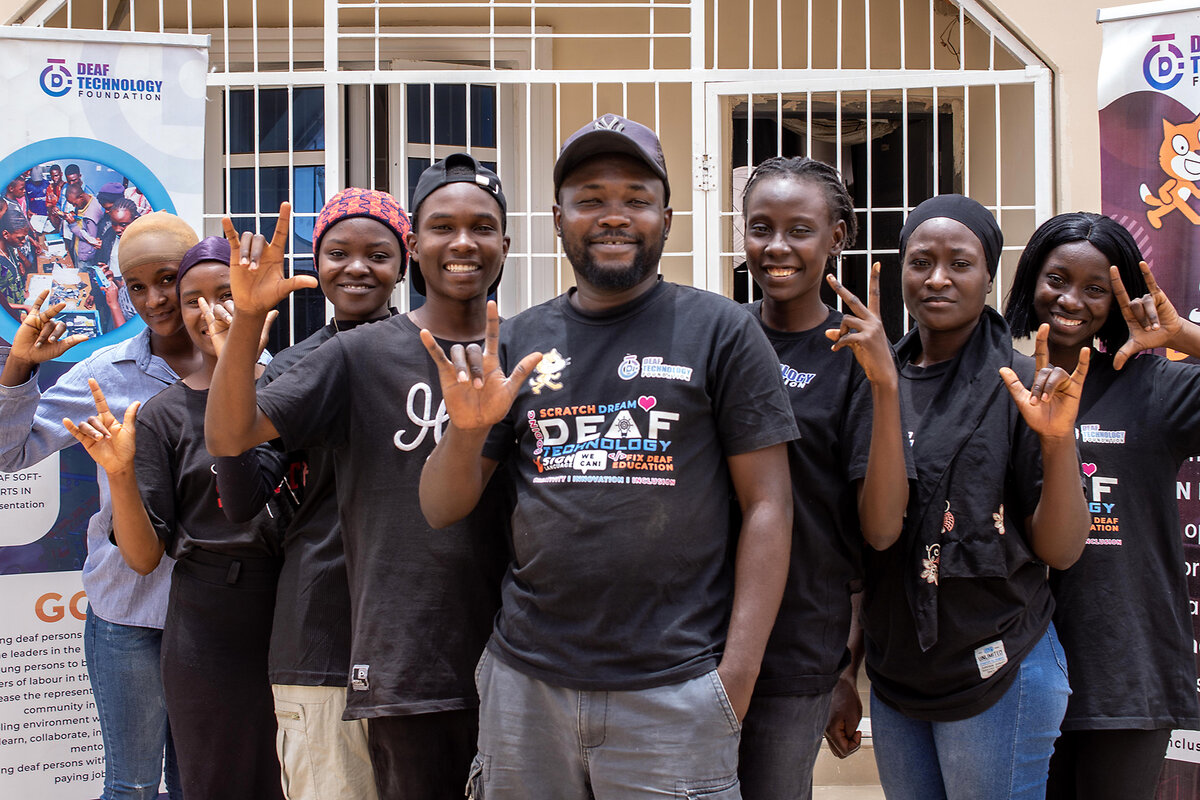
Wuni Bitrus (co-founder of the Deaf Technology Foundation) and some of his students sign “I love you” in Jos, Nigeria.

Things change so fast in our world that I can only hope a positive story I read in June is still true in August. It’s a worry. At the same time, we do know that people keep a good thing going — somehow — even with turmoil all around them.

I preface today’s story with that observation because I have been hearing about protests and riots in Nigeria that started with grievances about the economy and then went berserk as the government overreacted.

Nathaniel Bivan at Christian Science Monitor wrote in June about progress for the deaf community in Nigeria.

“In a one-room apartment in Jos, Nigeria, instructor Wuni Bitrus and almost a dozen students gather around a table cluttered with equipment – a toolbox, a 12-volt adapter, a coding panel, a set of jumper cables, a mix of colored wires. The students’ idea: to build the prototype for a ‘smart’ door that opens with the touch of a finger.

“The students chat back and forth in sign language, and Mr. Bitrus signs back. The group discusses using Arduino, an open-source electronics platform, and one student wonders how fingerprints can be stored. Mindful of Nigeria’s electricity problems, Mr. Bitrus genially advises the group to use a battery-powered keypad lock system first and incorporate a fingerprint feature later. 

“ ‘It works well, rather than waste time reinventing the wheel,’ Mr. Bitrus says. After nodding in agreement, the students excitedly start working.

“This is just another afternoon in a club run by the Deaf Technology Foundation, a nonprofit co-founded by Mr. Bitrus in 2017 that trains Nigerian children and young adults who are deaf in computer programming and robotics. The students also work to improve their reading skills, and receive career guidance and counseling to help them believe in themselves.

“Mr. Bitrus’ … desire to change the prospects of Nigeria’s deaf and hard-of-hearing community was sparked in 2014 by his encounter with a 13-year-old girl while he was teaching as part of the National Youth Service Corps in Zamfara state. Mr. Bitrus had noticed that the teen faced discrimination, and he became determined to learn sign language and teach her to use a computer. Three years later, he marshaled the resources, including funding from the Massachusetts Institute of Technology, to form the Deaf Technology Foundation.

“One of the darkest memories that Mercy Samson Grimah, a foundation student, has about growing up is looking at the faces of people around her and recognizing insults and negative energy directed at her. 

“ ‘That hurt me so bad because I knew in my heart that I could do anything. They just see us as lesser human beings,’ she says. ‘I wanted to show them that deaf people can become whatever they want to be.’ … 

“Ms. Grimah says her private secondary school did not formally teach sign language to her, nor much of anything else. But there was one teacher who knew how to sign, and she taught Ms. Grimah. … She dropped out in her third year because her parents could not pay her school fees, but fortunately, she had already formed a bond with the Deaf Technology Foundation. …

“Five years ago, Ms. Grimah and several other students made a road trip from Jos to Nigeria’s capital, Abuja, to compete in MakeX, a robotics contest. … Although Ms. Grimah’s team was not chosen to go on to represent Nigeria in the international competition, it emerged fourth among about 15 teams.

“ ‘Our team was the only one made up of the deaf,’ says Ms. Grimah, her eyes lighting up.

“Her father, Grimah Samson, adds, ‘What they are doing changed her.’ …

“Joy Yusuf, another Deaf Technology Foundation student, had wanted to become a doctor. But she was moved to a new school where the principal and staff said there was no way that could happen, even though the school welcomed students with disabilities.  

“ ‘It was a blow for me,’ Ms. Yusuf says. ‘I cried. I had to call Mr. Bitrus and my father to beg them, but [the principal and staff] still refused. For me, Deaf Tech is the only way I can have anything close to [studying] medicine.’  Now, she, too, wants to become a web developer.” 

More at the Monitor, here. No paywall.

The part of Nigeria where this story takes places is Jos. Online I found something interesting about it: “The state has over forty ethno-linguistic groups. Some of the indigenous tribes in the state are the Berom, Afizere, Amo, Anaguta, Aten, Bogghom, Buji, Challa, Chip, Fier, Gashish, Goemai, Irigwe, Jarawa, Jukun, Kofyar (comprising Doemak, Kwalla, and Mernyang), Montol, Mushere, Mupun, Mwaghavul, Ngas, Piapung, Pyem, Ron-Kulere, Bache, Talet, Taroh (Tarok), Youm and Fulani/Kanuri in Wase.” Wow.
Read Full Post »

Photo: Kaamil Ahmed.
The Guardian writes: Asom Khan, who is deaf and mute, uses his own version of [signing] to communicate with friends and family in Bangladesh.” And he takes photos that speak, too. 

What a powerful need human have to communicate! Here’s a story of a boy with the deck stacked against him many times over who wanted badly to communicate and figured out his own way to do it.

Kaamil Ahmed  writes at the Guardian, “His own sign language of sweeping, dramatized gestures is rarely fully understood by those outside Asom Khan’s closest friends and family, but the 15-year-old is able to speak through his art and photography.

“From his shelter in the Rohingya refugee camps of south-east Bangladesh, Khan takes photos to share the stories of his community – of his elderly neighbors, disabled people, and of women at work and in times of crisis.

“It was a journey that started with a photograph of him in 2017 – tears running down his face as he hung on to the side of an aid truck – that won awards for a Canadian press photographer, Kevin Frayer, as 700,000 Rohingya fled to Bangladesh from massacres in what the UN described as ethnic cleansing by the Myanmar military.

“That photo has stuck with Khan, who is deaf and mute, and when he saw other Rohingya becoming photographers, using budget smartphones to document daily life, he fully understood the power of an image.

“ ‘I was inspired by other Rohingya photographers. When there were floods or fires or other issues, they would come and take pictures. I saw that there was some power in it,’ says Khan, whose friend interprets for him.

“Since arriving in Bangladesh, he has also been producing vivid paintings, sometimes of idyllic Myanmar villages scenes, others of those villages under attack and the chaos he witnessed.

“Raised by his aunt and uncle after his mother died in childbirth, Khan had no opportunity to learn formal sign language so he improvised, teaching his own version to those around him. But art and photography has given him a freedom to communicate without an interpreter. …

“The camps Khan arrived at six years ago quickly became the world’s largest, with almost 1 million Rohingya crammed into bamboo and plastic shelters. As conditions have worsened, with education, work and movement limited, international attention has died down, leaving the refugees to deal with their own problems. …

“ ‘I feel like when I show pictures of the Rohingya situation to the world, they understand a bit more what we face.’

“Frayer, the photographer now with Getty Images who took Khan’s photo in 2017, says … ‘I remember taking a few frames and then he disappeared into the crowd below. I remember feeling quite moved by how much courage this young boy showed,’ says Frayer.

“He found Khan again in 2018 and spent time with him, finally learning more of his story as they communicated through his sign language and his drawings.

“ ‘I was so moved and astounded to learn that he had taken an interest in photography. I saw in his artwork that he was incredibly talented at telling his story through his art, and that photography would indeed be a very strong tool for him,’ says Frayer.”

More at the Guardian, here. No firewall. Donations solicited.

Read Full Post »

Photo: John Labarbera.
Company 360 Dance Theatre in the show Nine.

To follow up on my recent post about deaf actors performing for general audiences, I have a related story about the use of signing in dance. I always felt that watching signing was like watching dance.

Lauren Wingenroth writes at Dance Magazine, “For Deaf audiences, watching performances with traditional sign language interpretation can feel like watching a tennis match: Their focus has to toggle between whatever is happening onstage and the interpreter, often off to the side, who might be communicating what the music sounds like or what’s being said. That’s if the performance even has an interpreter, which all too often is not the case.

“But attend a Company 360 Dance Theatre performance and the tables are turned. The Fredericksburg, Virginia–based company, led by choreographer Bailey Anne Vincent, who is Deaf, incorporates American Sign Language into all its productions. ‘If you’re a Deaf person, you’re in on the story more than a hearing person,’ says Vincent.

“For Vincent, using ASL in her choreography — which might mean incorporating a sign to emphasize an emotion a character is feeling, or to communicate what a lyric is saying — is both an artistic choice and an accessibility-related one. Though her audience is mostly hearing, ‘I still try to approach all our shows assuming there might be someone who is Deaf in the audience,’ she says. But it’s also just a natural extension of the fact that ASL is Vincent’s preferred language. ‘When I choreograph, the way that my mind thinks is in my own language,’ she says. …

“Deaf actress and dancer Alexandria Wailes feels similarly. ‘Dance and using ASL are both so embedded in who I am, as part of my identity,’ says Wailes through an interpreter. ‘I can’t really separate one from the other.’ …

“To get a sense of the deepening relationship between dance and ASL, look at choreographer and performer Brandon Kazen-Maddox’s career thus far. A GODA (grandchild of Deaf adults) and native ASL signer, Kazen-Maddox was long one of the New York City performing arts scene’s go-to interpreters, a reliable presence at performances, talkbacks, and more.

“But in 2019, choreographer Kayla Hamilton asked Kazen-Maddox to join her New York Live Arts Fresh Tracks piece not as an interpreter but as an artist. ‘She asked me to represent all sounds in sign language, and also use my body as a dancer,’ says Kazen-Maddox. ‘It was the most mind-shifting thing for me.’ …

“The experience was the beginning of a shift in Kazen-Maddox’s career, away from simply facilitating communication between­ Deaf and hearing individuals as an interpreter­ and towards an emerging genre Kazen-Maddox calls ‘American Sign Language dance theater.’ …

“Always key to this work, says Wailes: Deaf or Hard of Hearing performers who are ‘bilingual’ in dance and ASL. ‘If you’re trying to be more inclusive, great,’ she says. ‘Who are the people who are onstage? What are their lived experiences and how does this reveal itself­ in the work?’ …

“Until recently, Betsy Quillen experienced performances for Deaf audiences and hearing audiences separately. ‘It’s one or the other — it’s very isolated,’ says Quillen, who is a Hard of Hearing actor and theater director. …

“So when choreographer William Smith asked Quillen to collaborate with him on a piece for Roanoke Ballet Theatre that incorporated sign language, they had a clear goal: to make something that both Deaf and hearing audiences could understand and enjoy.

“ ‘My specific role was making sure that Deaf eyes would understand it, and that we were making our Deaf audiences feel welcomed and included and respected,’ says Quillen. ‘But we also made sure to show our hearing audience that this piece is made even more beautiful because we’ve included the Deaf audiences — that all of this ASL in every part of the production is enhancing the experience for everybody in the audience.’ “

More at Dance Magazine, here.

Read Full Post »

Photo: Signature Theatre.
A behind-the-scenes look at the rehearsal process for the musical Private Jones, featuring deaf and hard-of-hearing artists.

When we were watching the Hulu series Only Murders in the Building, we noticed efforts by the producers to be inclusive. For example, a key character is deaf. When he is on, he uses sign language and we read subtitles. A few other characters use signing for his benefit. He can also read lips.

A push for diversity and inclusion is not happening only in streaming services. At the Signature Theatre in Virginia, for example, deaf and hard-of-hearing characters powered a whole musical.

As Thomas Floyd has the story at the Washington Post.

“Signing, singing and soundscapes are intermingled on a late-January afternoon at Signature Theatre’s Arlington, Va., rehearsal studio, where the cast of Private Jones is marching through the world-premiere musical’s opening scene.

“Loosely inspired by Gomer Jones, a deaf sniper who fought in World War I, the show opens in rural Wales with an 8-year-old Jones getting a lesson from his gruff father in sharpshooting and hard truths. As the only scene before Jones loses his hearing, it uses radio-play-like foley effects to create the sounds that will echo in the character’s head through the rest of his life — and give deaf and hard-of-hearing audiences visual cues to associate with those sounds.

“When Johnny Link, the hard-of-hearing actor playing Jones, raises a prop rifle, another performer flaps an umbrella to conjure the sound of birds fluttering overhead. A ratchet replicates a rifle cocking. A snare drum stands in for a gunshot. All the while, two actors narrate — one in spoken English, one in American Sign Language — and writer-director Marshall Pailet reminds his cast to be aware of the open captions that will flank the stage at every show. …

“Accessibility is a guiding principle for [writer-director Marshall Pailet], the hearing playwright and composer who wrote the book, music and lyrics for Private Jones. … The musical features a cast of hearing, hard-of-hearing and deaf actors performing dialogue in three languages — English, ASL and British Sign Language — while also delivering Pailet’s Celtic-inspired score. To Pailet and Alexandria Wailes, the show’s director of artistic sign language, no scene should be staged without careful consideration of how narrative intent is both seen and heard.

“ ‘If the piano does something that is supposed to evoke an emotion and there’s not a visual equivalent of that, we haven’t done our job,’ Pailet says. ‘Theater is taking psychology and turning it into behavior. So everything is visual, everything is behavioral, and it’s also therefore a perfect medium for sign language, which is a visual language. It exists to be seen.’

“Pailet acknowledges that the origins of Private Jones are fairly mundane: He was interested in writing a World War I trench warfare story — specifically exploring how being asked to commit violence can reorient a person’s worldview — when he came across an article with a couple of sentences about the deaf Welsh sniper. …

“After traveling to Wales … and tracking down war records he believes belonged to Jones, Pailet took an early iteration of the show to Connecticut’s Goodspeed Festival of New Musicals in January 2020. He subsequently connected with Wailes, the ASL master on the Oscar-winning film CODA, and the duo began swapping ideas during the pandemic on how to better integrate deaf and hard-of-hearing perspectives.

“While the show features a narrator performing in ASL, Wailes pitched the idea of also incorporating British Sign Language during dialogue exchanges between characters who would have spoken in that wholly different dialect. …

“Finding the right actor to enlist as Jones — a deaf character who tricks his fellow soldiers into thinking he’s hearing and carries much of the show’s vocals — also proved critical. As a musical theater performer who has used hearing aids since childhood, Link came with connections to the hearing and deaf worlds that the character bridges. …

“ ‘I have never felt so seen in a character,’ Link says. ‘Truly, this is one of the most special projects I’ve ever worked on because it pulls from different parts of my life. I feel a lot of the things that Gomer feels. I just knew I had to do it.’

“Pailet says unfamiliar perspectives are at the core of Private Jones, which uses its innovative soundscapes to place the audience in Jones’s shoes while interrogating how people empathize with or dehumanize those they don’t understand. …

“Having spent the better part of five years developing the show, Pailet hopes this isn’t his last shot at envisioning Jones’s journey onstage.”

More at the Post, here.

Read Full Post »

Photo: Carrie Shepherd/Axios.
The Lyric Opera of Chicago’s SoundShirts use “patterns and pulses” to make opera more accessible for the deaf.

It used to be that, for people with a disability, there were certain experiences they knew they would probably never access. With technology, that is changing. Consider how “feeling” the music in new, more subtle ways is helping those with hearing loss.

Michael Andor Brodeur reports at the Washington Post about the SoundShirt.

“Opera is everything all at once: music and drama, poetry and dance, grandeur and intimacy, spectacle and sound. This all-encompassing aspect makes it one of the most accessible art forms yet one of the most challenging to make accessible.

“For audience members who are deaf or hard of hearing, or who are blind or have low vision, attending an opera can be a deeply frustrating experience.

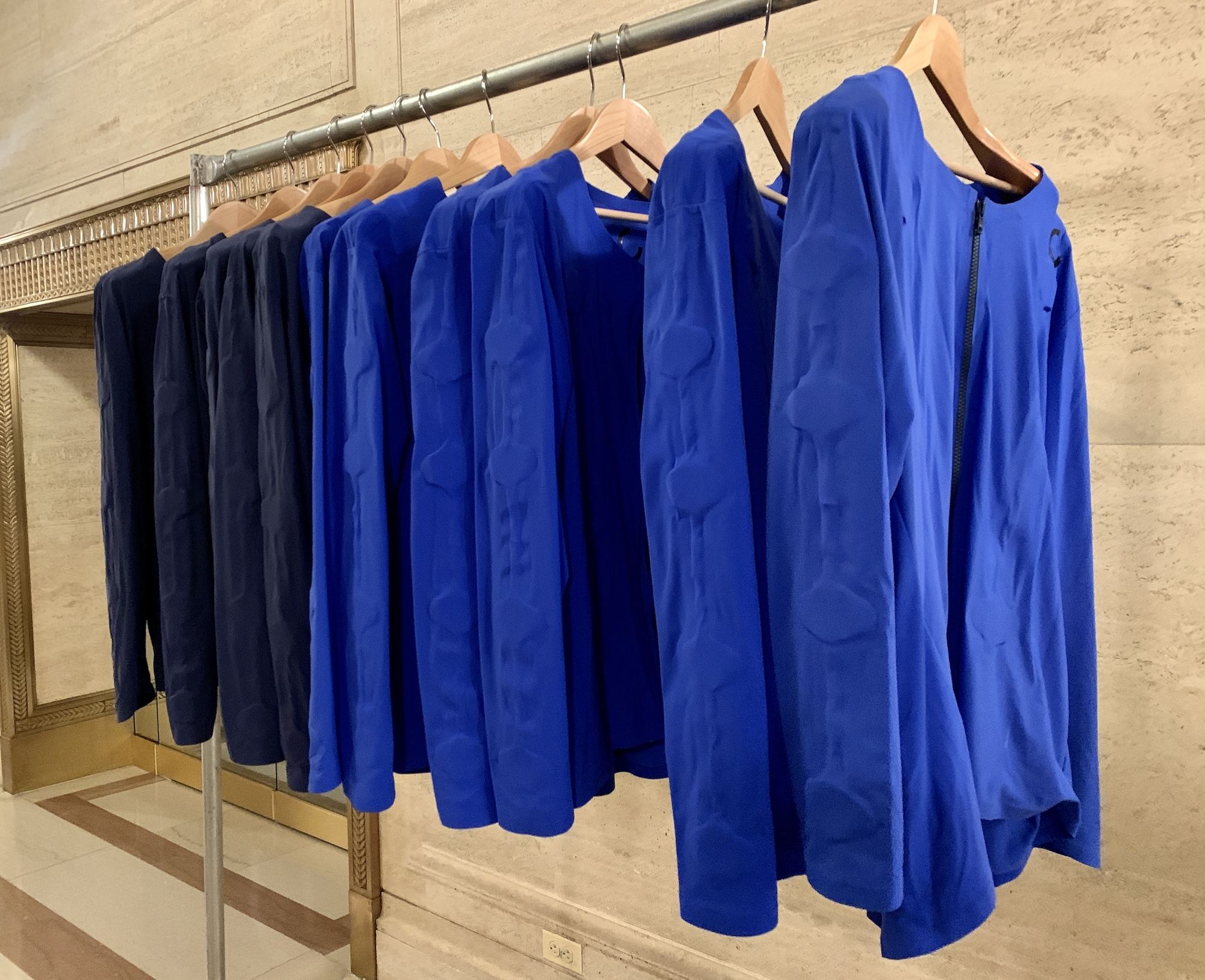
“A pilot program at the Lyric Opera of Chicago is trying on a new approach for deaf and hard-of-hearing people to experience opera: the SoundShirt, a jacketlike garment equipped with 16 haptic actuators* that transmit sound from the orchestra and stage into pulses, vibrations and other forms of haptic feedback in the shirt itself. …

“In addition to accommodations for mobility disabilities such as ramps and wheelchair seating, like many opera houses, the Lyric offers performances with American Sign Language interpretation, projected subtitles, and assisted listening devices for deaf and hard-of-hearing patrons. For blind people and those with low vision, the Lyric provides Braille and large-print programs, audio-described performances, high-powered glasses and pre-performance ‘touch tours,’ allowing audience members to feel various props, costumes and surfaces before the curtain rises.

“The SoundShirt, though, is cut from a different cloth than most accessibility technology, providing a mediated experience of the music that registers as physical and personal.

‘It doesn’t re-create the experience of listening to music,’ [director of digital initiatives Brad Dunn] says. ‘It’s its own thing.’

” ‘It translates the music into a different sensory experience that can be felt by people. And what I’ve seen through all of the early testing that we did is that audiences who are deaf or hard of hearing have responded very viscerally to it.’ …

“For attendees at a Lyric production of West Side Story earlier this year, input from the SoundShirt didn’t just help provide additional detail to the performance — it also illuminated the musical spaces in between, the interludes and interstitial passages of music, the overtures overloaded with crucial cues. Dunn recalls one tester’s eyes welling up with tears after the performance. …

“Lyric’s SoundShirt project was launched in partnership with the city of Chicago’s Mayor’s Office for People With Disabilities (MOPD), but the garment itself was designed by CuteCircuit, a London-based wearable technology design firm. …

“At the Lyric, an array of microphones positioned over various sections of the orchestra feeds audio information to a central computer. Dunn and his crew adapt the software to respond to the specific instrumentation of a given piece. … Those audio signals are divided across seven channels, each mapped to one of 16 different ‘zones’ on the SoundShirt, where motifs and melodies register as patterns and pulses across the garment’s 16 actuators.

“Thus, for a production of The Flying Dutchman, the violins and cellos are assigned to trigger haptic feedback along the right and left shoulders and upper arms. Timpani and bass, meanwhile, are sent down to the lower torso and hips. Wagner’s mighty horns are split across the upper arms like goose bumps, while vocals register at the wrists like a pulse. …

“Rachel Arfa is a longtime disability advocate and civil rights attorney who serves as commissioner of MOPD. As a deaf person who wears bilateral cochlear implants, the issue of accessibility has been close to her heart for a long time. … But while expanding accessibility is her life’s work, Arfa also knows that good intentions can often pave the road to nowhere.

“ ‘When Lyric approached me with this shirt, I was highly skeptical,’ Arfa said via email. [But she] agreed to test the SoundShirt at a recent Lyric production of West Side Story. Arfa was surprised to find the shirt actually felt like a good fit for the problem it is trying to solve. …

“ ‘I began to understand that the haptics on the SoundShirt vibrated in conjunction with the orchestra sounds. One example is when string instruments were played, the haptics followed the pitch and rhythm. A second example is when a singer was singing a long melody, the haptics picked up on this and I could experience this through the vibration. I am not able to hear this sound, but I could feel it. It was such a surprise and a thrill.’

“Tina Childress, an audiologist who lives in Champaign, Ill., is a late-deafened adult who wears cochlear implants and works as an advocate for accessibility in the arts. … Childress appreciated the haptic feedback at the wrists to indicate dialogue, and the way the shirt clarified the various elements of the score. After intermission, she lent the shirt to another audience member to try out. ‘I didn’t realize how much I was using it until I didn’t have it.’ ”

More at the Post, here. Axios Chicago has still more, here.

* haptic actuators are gizmos that provide localized bodily sensations and tactile effects

Read Full Post »


Photo: Lanna Apisukh for NPR.
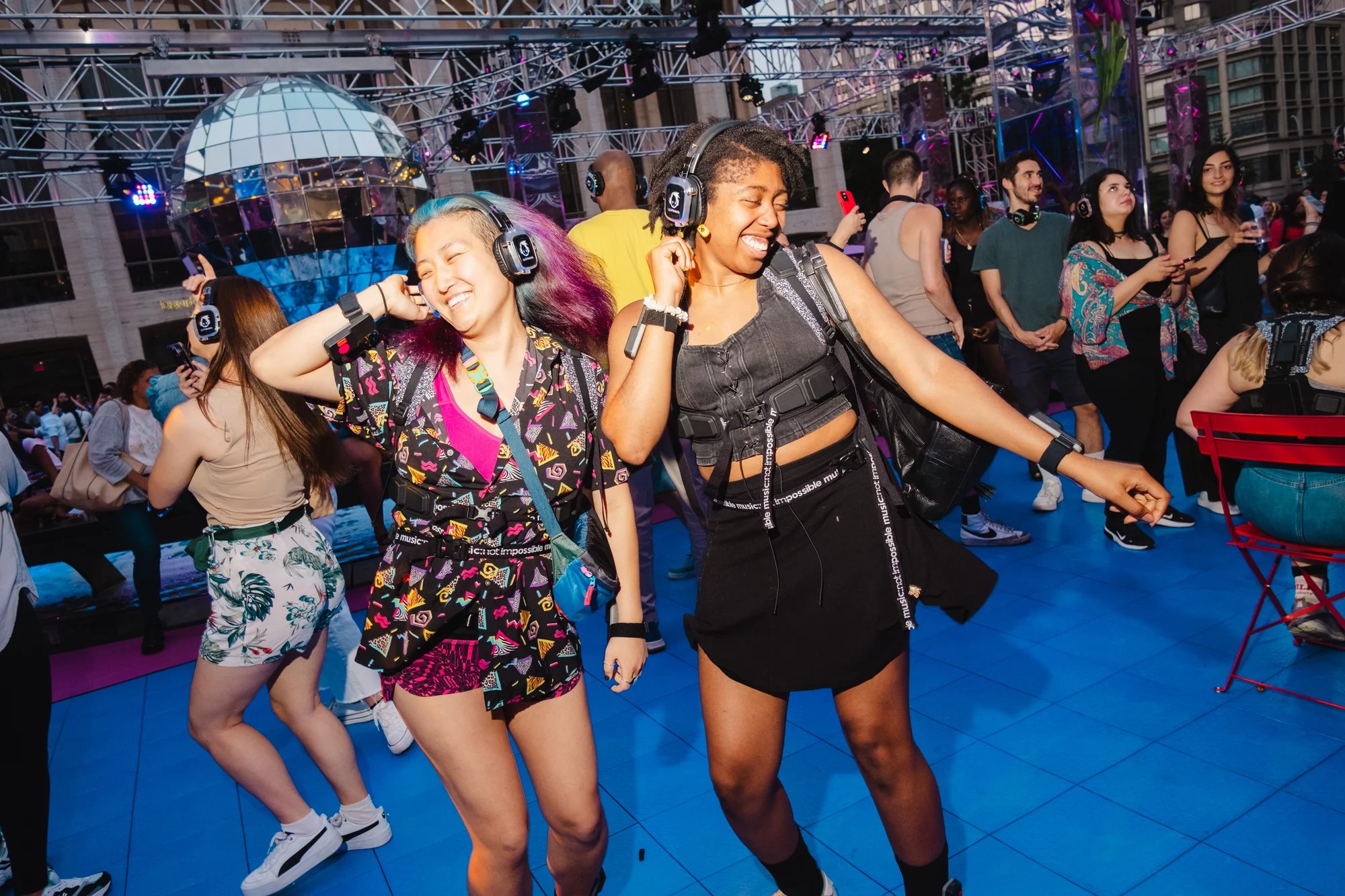
Concertgoers dancing at the Silent Disco dance party at Lincoln Center, New York City, on Saturday, July 1, 2023. “Haptic” suits designed for the deaf community were provided by Music: Not Impossible.

Of the many interesting kinds of jobs in the world, I bet you never heard of this one: “Chief Vibrational officer”! Jennifer Vanasco explains at National Public Radio (NPR).

“When Daniel Belquer was first asked to join a team to make a better live music experience for deaf and hard-of-hearing people, he was struck by how they had developed work-arounds to enjoy concerts.

” ‘What they were doing at the time was holding balloons to feel the vibrations through their fingers, or go barefoot and flip the speakers facing the floor,’ Belquer said.

“He thought the team could make something to help hard-of-hearing people enjoy live music even more with the technology now available. 

“Belquer, who is also a musician and theater artist, is now the ‘Chief Vibrational Officer’ of Music: Not Impossible, an off-shoot of Not Impossible Labs, which uses new technology to address social issues like poverty and disability access. …

“His team started by strapping vibrating cell phone motors to bodies, but that didn’t quite work. The vibrations were all the same. Eventually, they worked with engineers at the electronic components company Avnet to develop a light haptic [3D touch] suit with a total of 24 actuators, or vibrating plates. There’s 20 of them studded on a vest that fits tightly around the body like a hiking backpack, plus an actuator that straps onto each wrist and ankle.

“When you wear the suit, it’s surprising how much texture the sensations have. It can feel like raindrops on your shoulders, a tickle across the ribs, a thump against the lower back.

It doesn’t replicate the music — it’s not as simple as regular taps to the beat. It plays waves of sensation on your skin in a way that’s complementary to the music.

“The vibrations are mixed by a haptic DJ who controls the location, frequency and intensity of feeling across the suits, just as a music DJ mixes sounds in an artful way.

“The evening’s haptic DJ was Paddy Hanlon, co-founder of Music: Not Impossible. ‘What we’re doing is taking the feed from the DJ, and we can select and mix what we want and send it to different parts of the body,’ he said. ‘So, I’ll kind of hone in on, like, the bass element and I’ll send that out, and then the high hats and the snare.’

“The haptic suits were just one component of the event, which was celebrating Disability Pride Month as part of Lincoln Center’s annual Summer for the City festival. There were American Sign Language interpreters; the music was captioned on a screen on the stage; there was audio description for those who were blind, and there were chairs to sit in. There’s also a chill-out space with noise-reducing headphones, earplugs and fidgets for those who feel overstimulated. Because it’s a silent disco — meaning you can only hear the music through headphones — attendees could adjust the sound. …

“The suits are the star attraction. Lily Lipman, who has auditory processing disorder, glowed when asked about her experience.

” ‘It’s cool, because I’m never quite sure if I’m hearing what other people are hearing, so it’s amazing to get those subtleties in my body.’

“Said Kevin Gotkin, one of the evening’s DJs and the curator of disability artistry events at Lincoln Center, ‘This is a chance for us to be together and experience access that’s integrated into a party artistically and not as, like, a compliance thing. … Disability is the center of the party.’ “

More at NPR, here. No paywall.

Read Full Post »

gordon-stewart
Photo: Victory Hall Opera.
Miriam Gordon-Stewart (above), artistic director of Victory Hall opera in Charlottesville, Virginia, and music director Brenda Patterson had the original idea for deaf opera.

Right before the pandemic, a cutting-edge company in Virginia put on an opera with deaf performers. The company is still going strong. Undaunted by Covid, it claims it was made for this moment and is offering a roster of outdoor performances for its 2021-2022 season.

An example of the company’s creativity was the deafness project. Thomas Floyd wrote the report for the Washington Post.

“Alek Lev understands that he’s not exactly a member of the deaf family, but he feels comfortable enough calling himself an ‘in-law.’ As a student at Wesleyan University, he took a sign-language class on a whim and subsequently dated a deaf person. Over the past two decades, the writer, director, actor and American Sign Language interpreter has largely worked in the deaf community on films and stage productions.

” ‘As someone who is fluent in sign language and has done this for such a long time, just seeing people sign onstage isn’t particularly thrilling now,’ Lev says. ‘It needs to be thrilling for some other reason.’

“One such reason arose in 2018, when Miriam Gordon-Stewart and Brenda Patterson of the boundary-pushing Victory Hall Opera in Charlottesville pitched Lev on a production of Francis Poulenc’s 1957 opera Dialogues of the Carmelites, but with deaf performers.

“The concept came about after Gordon-Stewart, Victory Hall’s artistic director, and Patterson, the music director, read Andrew Solomon’s 2012 nonfiction book Far From the Tree, about how families accommodate children with disabilities. The book mentioned ASL’s roots in French Sign Language, dating to the deaf community of 18th-century Paris. They then drew parallels to Dialogues of the Carmelites, which follows a convent of Carmelite nuns pressured to renounce their vocation during the French Revolution.

” ‘Within the deaf community, there are a lot of similar issues that come up,’ Gordon-Stewart says. ‘There’s a pressure to assimilate with hearing culture, for example, which is intensely political. These things worked together for us into the idea of a production of Dialogues of the Carmelites that would be set in a deaf convent.’

“Victory Hall Opera [took] a step toward making the production a reality with a workshop Feb. 27 [in 2020, featuring] three sopranos singing alongside three deaf actors. …

” ‘There’s something about the challenge of figuring out how to do this and why to do this each time that is just more exciting to me than putting on yet another version of a play that’s been put on several times. … I like that we have a whole new problem now. We have sign language. We have deaf actors. We have hearing actors who don’t know sign language. I love the puzzle.’

“ ‘I’ve done a lot of workshops and productions that include hearing and Deaf actors, but the fascinating thing about those experiences is that it’s never the same,’ [Sandra Mae Frank, who in 2015 played the lead role of Wendla in Deaf West Theatre’s Tony-nominated revival of Spring Awakening on Broadway] writes in an email. …

“Most of the roles in that Spring Awakening production were doubled by a deaf actor, who used sign language, and a hearing actor, who simultaneously performed the vocals. Although that has become a common template for deaf theater, the [Victory Hall] team wants its performers to complement one another in an artistically innovative way. … The deaf actors act out the plot while the singers serve as spiritual guides, representing women who have endured similar oppression.

” ‘If we’re going to create an art form out of this, then we need to push the concept one step further than it’s been pushed before,’ Gordon-Stewart says. ‘There’s a potential for the result being a marriage between two art forms, rather than just the two art forms being simultaneously performed. You bring a potentially heightened physicality to both ends of that equation, making it a more visually compelling art form for the deaf performance, and making it a more heightened experience for the hearing audience.’ ”

More at the Washington Post, here.

Read Full Post »

Photo: Colorado Public Radio.
Cherish Ross is with FLOW, a sign language interpreting agency that specializes exclusively in performing arts.

So many interesting kinds of jobs in the world! And the luckiest people are the ones whose work aligns with what they love doing. Consider those who interpret for the deaf at concerts.

Corinna da Fonseca-Wollheim has a cool story at the New York Times. “On a recent afternoon in a brightly lit studio in Brooklyn, Mervin Primeaux-O’Bryant and Brandon Kazen-Maddox were filming a music video. They were recording a cover version of ‘Midnight Train to Georgia,’ but the voices that filled the room were those of Gladys Knight and the Pips, who made the song a hit in the 1970s. And yet the two men in the studio were also singing — with their hands.

“Primeaux-O’Bryant is a deaf actor and dancer; Kazen-Maddox is a hearing dancer and choreographer who is, thanks to seven deaf family members, a native speaker of American Sign Language. Their version of ‘Midnight Train to Georgia’ is part of a 10-song series of American Sign Language covers of seminal works by Black female artists that Kazen-Maddox is producing for Broadstream, an arts streaming platform.

“Around the world, music knits together communities as it tells foundational stories, teaches emotional intelligence and cements a sense of belonging. … As sign language music videos proliferate on YouTube, where they spark comments from deaf and hearing viewers, the richness of American Sign Language, or A.S.L., has gotten a broader stage.

“ ‘Music is many different things to different people,’ Alexandria Wailes, a deaf actress and dancer told me in a video interview, using an interpreter. Wailes performed ‘The Star-Spangled Banner’ at the 2018 Super Bowl, and last year drew thousands of views on YouTube with her sign language contribution to ‘Sing Gently,’ a choral work by Eric Whitacre. …

“A good A.S.L. performance prioritizes dynamics, phrasing and flow. The parameters of sign language — hand shape, movement, location, palm orientation and facial expression — can be combined with elements of visual vernacular, a body of codified gestures, allowing a skilled A.S.L. speaker to engage in the kind of sound painting that composers use to enrich a text.

“At the recent video shoot, Gladys Knight’s voice boomed out of a large speaker while a much smaller one was tucked inside Primeaux-O’Bryant’s clothes, so that he could ‘tangibly feel the music,’ he said in an interview, with Kazen-Maddox interpreting. Out of sight of the camera, an interpreter stood ready to translate any instructions from the crew, all hearing, while a laptop displayed the song lyrics.

“In the song, the backup singers — here personified by Kazen-Maddox — encourage Knight as she rallies herself to join her lover, who has returned home to Georgia. In the original recording the Pips repeat the phrase ‘all aboard.’ But as Kazen-Maddox signed it, those words grew into signs evoking the movement of the train and its gears. A playful tug at an invisible whistle corresponded to the woo-woo of the band’s horns. Primeaux-O’Bryant signed the lead vocals with movements that gently extended the words, just as in the song: on the drawn-out ‘oh’ of ‘not so long ago-oh-oh,’ his hands fluttered into his lap. The two men also incorporated signs from Black A.S.L.

‘The hands have their own emotions,’ Primeaux-O’Bryant said. ‘They have their own mind.’

“Deaf singers prepare for their interpretations by experiencing a song through any means available to them. Many people speak about their heightened receptivity to the vibrations of sound, which they experience through their body. As a dancer trained in ballet, Primeaux-O’Bryant said he was particularly attuned to the vibrations of a piano as transmitted through a wooden floor.

“Primeaux-O’Bryant was a student at the Model Secondary School for the Deaf in Washington in the early 1990s when a teacher asked him to sign a Michael Jackson song during Black History Month. His first reaction was to refuse.

“But the teacher ‘pulled it out’ of him, he said, and he was thrust into the limelight in front of a large audience. Then, Primeaux-O’Bryant said, ‘the lights came on and my cue happened and I just exploded and signed the work and it felt good.’ Afterward the audience erupted in applause: ‘I fell in love with performing onstage.’ ”

Find information on things like the role of ballet training in ASL interpretation, the impact of the pandemic, and Egyptian Arabic Sign Language at the Times, here.

Read Full Post »

image2

Photo: Susan Meisalas/Magnum Photos
A deaf girl using Nicaraguan Sign Language at the Esquelitas de Bluefields, Managua, Nicaragua, 1999.

Lately, I’ve been impressed with the leadership of young people. I’ve told friends, “Wherever they lead, I’m going to follow.” One thing I like about young people is that they don’t know what’s impossible, so they just set about to do it.

In Nicaragua several decades ago, it was the youngest children who began to invent a language. The older children followed, and then, eventually, the adults.

Shoshi Parks has the story at Atlas Obscura, “Of all the changes within Nicaragua to come out of the overthrow of the Somoza regime by the Sandinistas in 1979, perhaps the least anticipated was the birth of a new language.

“Nicaraguan Sign Language is the only language spontaneously created, without the influence of other languages, to have been recorded from its birth. And though it came out of a period of civil strife, it was not political actors but deaf children who created the language’s unique vocabulary, grammar, and syntax.

“When the Sandinista National Liberation Front gained power, they embarked on what has been described as a ‘literacy crusade,’ developing programs to promote fluency in reading Spanish. One such initiative was opening the first public school for deaf education, the Melania Morales Special Education Center, in Managua’s Barrio San Judas. According to Ann Senghas, a professor of psychology at Barnard College who has studied NSL, it was the first time in the history of the country that deaf children were brought together in large numbers.

“These children, who ranged in age from four to 16, had no experience with sign language beyond the ‘home signs’ they used with family members to communicate broad concepts. American Sign Language, which has existed since the early 19th century, is used throughout the Americas and is often considered a ‘lingua franca’ among deaf people whose first sign language is a national or regional one. But the first Nicaraguan deaf school did not use ASL or any signs at all. Instead, they focused on teaching children to speak and lip-read Spanish. …

“The Sandinistas’ focus on Spanish literacy resulted in the immersion of deaf students in Spanish speaking and reading skills. But while the country’s deaf children were being taught Spanish inside the classroom, outside the classroom they were spontaneously developing their own method of signed communication. …

“All languages have grammar and syntax, but the first children at Managua’s deaf school had no model for how a language worked because they had been isolated from signed, spoken, and written language all their lives, notes [James Shepard-Kegl, co-director of the Nicaraguan Sign Language Project, which administers programs to empower the Nicaraguan deaf community through the use of sign language].

“When the children interacted, instead of adapting their signs to fit an existing language, they developed something unique. While the older students had more life experience, it was actually the younger kids that drove the language’s development. ‘As you get older, your language instincts tend to diminish,’ says Shepard-Kegl. ‘A lot of those older kids weren’t generating grammar the way little kids did. They copied the grammar the little kids generated.’ …

“The critical mass needed to spontaneously develop Nicaraguan Sign Language only occurred with the opening of Melania Morales. Within a few years, teachers and education officials recognized that something incredible was happening at the school.” More at Atlas Obscura, here.

Photo: Susan Meisalas/Magnum Photos
Deaf students using Nicaraguan sign language at the Esquelitas de Bluefields, Managua, Nicaragua, 1999.

image3

Read Full Post »


Photo: The Stage
Open Access Smart Capture’s glasses enable deaf theatergoers in Britain to read live captioning during a performance.

Earlier this month I posted about how the Vienna State Opera provides captions in six languages.

Today’s entry is on making dramatic productions more accessible to the deaf by means of glasses that churn out captions.

Georgia Snow writes at the Stage, “The National Theatre has unveiled new technology that will enable deaf audiences to see captions for performances in front of their eyes using special glasses, … removing the need for captioning screens in the auditorium.

“Developed by the NT with its innovation partner, consultancy firm Accenture, Open Access Smart Capture is being introduced during a year-long pilot.

“If it is a success, the result would be ‘transformational,’ [NT director Rufus] Norris said. …

“The glasses boast 97% accuracy in the timing of the captions, and can also facilitate audio description, for audiences with restricted vision. …

“The project is one of two new initiatives being introduced by the NT around accessibility, the second being an online video database showcasing deaf and disabled actors. …

“It is part of a drive to tackle the under-representation of disabled actors working in the profession, Norris said. …

“He added that ProFile also hopes to remove some of the barriers for deaf and disabled performers, for whom travelling to auditions and meetings can be difficult and expensive.” More at the Stage, here.

If nothing the else, the glasses will be fun. A few years ago, I got to see that for myself using Google Glass. An executive where I worked was having summer interns play around with programming the glasses to test the possibilities for the Fed. That didn’t go anywhere, but it was definitely fun.

Read Full Post »

Here’s a new idea. A couple of young entrepreneurs have found a way to convert sign language into audible speech with their prize-winning electronic gloves.

National Public Radio has the story.

“For years, inventors have been trying to convert some sign language words and letters into text and speech. Now a pair of University of Washington undergraduates have created gloves called SignAloud. Sensors attached to the gloves measure hand position and movement, and data is sent to a computer via Bluetooth and is then converted into spoken word and text.

“Theirs is one of seven inventions recently awarded a Lemelson-MIT Student Prize, with awards ranging from $10,000 to $15,000.

“Inventors Navid Azodi and Thomas Pryor, both college sophomores, say the gloves will help create a communication bridge between deaf and hearing communities. The gloves, they say, will help deaf people better communicate with the rest of the world without changing the way they already interact with each other.

“However, the invention has been met with criticism that the bridge they want to create goes only one way — and it’s not necessarily one the deaf community has been clamoring for. …

“Azodi says he and Pryor are moving beyond their prototype and are working closer with those who use American Sign Language to develop new versions. They’re also working on better understanding ASL, which is more than just hand movements; it also uses facial expressions and body language to convey meaning.” Read more.

I don’t know much about the culture of the deaf community, but I do remember reading about resistance to cochlear implants a few years ago. It’s hard for people who can hear to understand that some people really don’t mind deafness and prefer their own ways of dealing with the world. But kudos to all inventors anyway, especially young ones open to continuous revision!

Photo: Conrado Tapado/Univ of Washington, CoMotion
SignAloud gloves translate sign language into text and speech.

Read Full Post »

You remember that breathtaking moment in the movie The Miracle Worker, when a fiercely determined Annie Sullivan finally gets through to a recalcitrant Helen Keller that her hand signals are words and words have meaning? Well, revelations like Helen’s continue to happen to children, as in the recent viral video of a baby getting a first pair of glasses. The dawning wonder and smiles are so touching.

Today, Maria Popova posted a video at Brain Pickings of a deaf teen in Uganda whose silent world opens in a similar flash, and it is powerful. The TV report that captured that moment is obviously edited, but I find it convincing and moving.

According to the YouTube blurb, Patrick Otema, 15, is profoundly deaf. “In the remote area of Uganda where he lives, there are no schools for deaf children, and he has never had a conversation. Raymond Okkelo, a sign language teacher, hopes to change all this and offer Patrick a way out of the fearful silence he has known his whole life.”

Popova recommends you watch the video, then pair it with Helen Keller’s thoughts on optimism.

Once I knew only darkness and stillness. Now I know hope and joy. Once I fretted and beat myself against the wall that shut me in. Now I rejoice in the consciousness that I can think, act and attain heaven. … Can anyone who escaped such captivity, who has felt the thrill and glory of freedom, be a pessimist?
My early experience was thus a leap from bad to good. If I tried, I could not check the momentum of my first leap out of the dark; to move breast forward as a habit learned suddenly at that first moment of release and rush into the light. With the first word I used intelligently, I learned to live, to think, to hope.

Read Full Post »

A while back, I wrote about the BBC National Orchestra of Wales launching a series of concerts to bring the joy of music to deaf children and adults, here.

I’ve been thinking about that lately. If you don’t love Christmas music, you might say that people who have hearing loss are better off at this time of year. But I like that there are so many initiatives to help the deaf enjoy Christmas music and other sorts of music.

Did you see this Clarke Canfield story in the Boston Globe? He writes about a sign language interpreter of lyrics who is adding a whole new level of fun to rock music — delighting the hearing and nonhearing alike.

“Teaming American Sign Language with dance moves and body language, [Holly Maniatty] brings musical performances alive for those who can’t hear,”  he writes, “Her clients are a who’s who of rock, pop, and hip-hop: Bruce Springsteen, Eminem, Mumford and Sons, Jay-Z, Billy Joel, Marilyn Manson, U2, Beastie Boys, and Wu-Tang Clan, to name a few.

“Along the way, videos of her fast-motion, helter-skelter signing have become popular online.

“There’s the video of Springsteen jumping down from the stage at the New Orleans Jazz Fest and joining Maniatty and another interpreter. There, he dances and signs to ‘’Dancing in the Dark.’’

‘‘ ‘Deaf people were commenting, “Oh, the Boss knows he has deaf fans. That’s awesome,’’ ‘’ she said. ‘When artists connect with their interpreters, they also connect with their deaf fans.’

“In another video, rap artist Killer Mike approaches Maniatty in front of the stage after noticing her animated signing.

‘‘I’ve never seen that before .”… At a Wu-Tang performance, Method Man took notice of her signing, came down from the stage, and joined her.”

Read all about it here. See her dancing with Bruce Springsteen here.

 Photo: Robert F. Bukaty/Associated Press

Read Full Post »

“Good good good good vibrations.”

I wonder if the Beach Boys ever thought about this aspect of good vibrations — how they can bring the joy of music to those who can’t hear.

According to Gramophone magazine, “The BBC National Orchestra of Wales will perform a series of free concerts in Cardiff on February 26 and 27, which aim to make orchestral music accessible to deaf and hard of hearing adults and children. …

“The events will feature sign language and live subtitles, and will allow audience members to sit within the orchestra, in order to feel the vibrations from instruments as the musicians play. The five concerts will demonstrate concepts including pitch, tempo and dynamics through music including ‘Hoe-Down’ from Copland’s Rodeo, ‘In the Hall of the Mountain King’ from Grieg’s Peer Gynt and the theme tune to Doctor Who. Four of the concerts will be aimed at students from primary and specialist schools, and adults in care homes and day centres. The fifth concert will be open to the public, allowing deaf and hard of hearing children and adults to take part alongside friends and family.”

More.

Photograph: Betina Skovbro
BBC NOW presented a pilot event for the deaf and hard of hearing in October 2012

Read Full Post »