Feeds:
Posts
Comments

Posts Tagged ‘denver’

Photo: Sarah Matusek/The Christian Science Monitor.
Nixon Garcia, a teaching artist at El Sistema Colorado, conducts students at the music school in Denver.

People sometimes forget that we need more immigrants, not fewer. Their contributions to the economy are well documented. In 2021, for example, they contributed more than $500 billion just in taxes (see Forbes here). Not to mention that they willingly apply for necessary jobs that go begging, sometimes for years.

And there are other contributions getting less attention. Consider what this one musician is doing. Sarah Matusek wrote about his work recently at the Christian Science Monitor.

“A few dozen children in Denver settle into seats, violins and violas in hand. With short cropped hair and a focused gaze, Nixon Garcia observes from off to one side. …

“This is a fall show-and-tell for parents at El Sistema Colorado, a free music school that prioritizes kids from low-income families. The Denver program was inspired by the original El Sistema in Venezuela, which since its founding in 1975 has sparked similar projects around the world. …

“With flutters of his hands and flicks of his wrists, the 22-year-old conjures up simple songs that he learned as a boy in the Venezuelan program. He’s brought that same sheet music to students in the United States, along with hopes for asylum. Working as a teaching artist at the Colorado program, he’s come full circle.

“ ‘El Sistema has been my second home throughout my whole life,’ says Mr. Garcia, who teaches in Spanish and English. 

“The original program’s catchphrase, ‘tocar y luchar‘ – or ‘play and fight’ in English – has evolved into a personal mantra of perseverance for the young conductor who can’t imagine returning home.  By the time he left Venezuela, in 2022, says Mr. Garcia, he’d been kidnapped three times. 

“Backdropped by mountains in northwest Venezuela, the town of La Fría sits near the Colombian border. Mr. Garcia’s family, who ran a poultry farm there, enrolled their son in the popular music program at a young age. …

“At age 5, he began learning the Venezuelan cuatro, which has four strings. Later on came the clarinet. As a teenager, Mr. Garcia began teaching other El Sistema students – a key mentorship feature of the program – and developed a love of conducting. But basic needs were stark; some students he taught sat on the floor, because there weren’t enough chairs. And beyond the solace of class, violence lurked.

“When he was a young teenager, in 2015, a criminal group, called a colectivo, kidnapped him and his family at a gas station. The group held them for several hours, his family says, and demanded thousands of dollars for their release. 

“Venezuela, meanwhile, devolved into further economic, political, and human rights crises under President Nicolás Maduro, causing millions to flee. Mr. Garcia began attending pro-democracy protests. …

‘You can see how everything is terrible. But in the end, you still love your country,’ he says. ‘You don’t want to leave.’ …

“Mr. Garcia was captured again by an insurgent group on his family farm in La Fría. Yet neither was he safe at college in another city, Mérida, where he studied engineering. … Although his family had arranged private security for him in La Fría, they decided that he had to leave. …

“A tourist visa that his family had secured some years prior still hadn’t expired. That became his ticket to the U.S. last year. Yet even as he moved into his cousin’s home in Monument, Colorado, an hour south of Denver, the adjustment was isolating. … A family member suggested he retreat to nature, take a moment to breathe. A prayerful hike in the nearby mountains, Mr. Garcia says, helped right his course. 

“Inspiration struck, tuning-fork clear: Why not return to music?  A Google search for nearby orchestras yielded a name he knew. The young conductor, in awe, reached out to El Sistema Colorado. …

“Mr. Garcia started out as a volunteer at El Sistema Colorado before the federal government issued the asylum-seeker his work authorization. That allows him to work legally while his asylum case moves forward. Now paid, he teaches groups of strings-learning students in an orchestra group called Allegro.

“The teaching artist is a ‘positive light’ at the music school, says Ingrid Larragoity-Martin, executive director of El Sistema Colorado. ‘He’s passionate about kids, and he knows how to work with them.’ …

“Meanwhile, he awaits the outcome of his asylum application, which may take years. Mr. Garcia says he wants to ‘work, make a life, and try to share as many things as we can from our country.’ ” 

More at the Monitor, here.
Read Full Post »

Clouds

Photo: Joshua Ware.
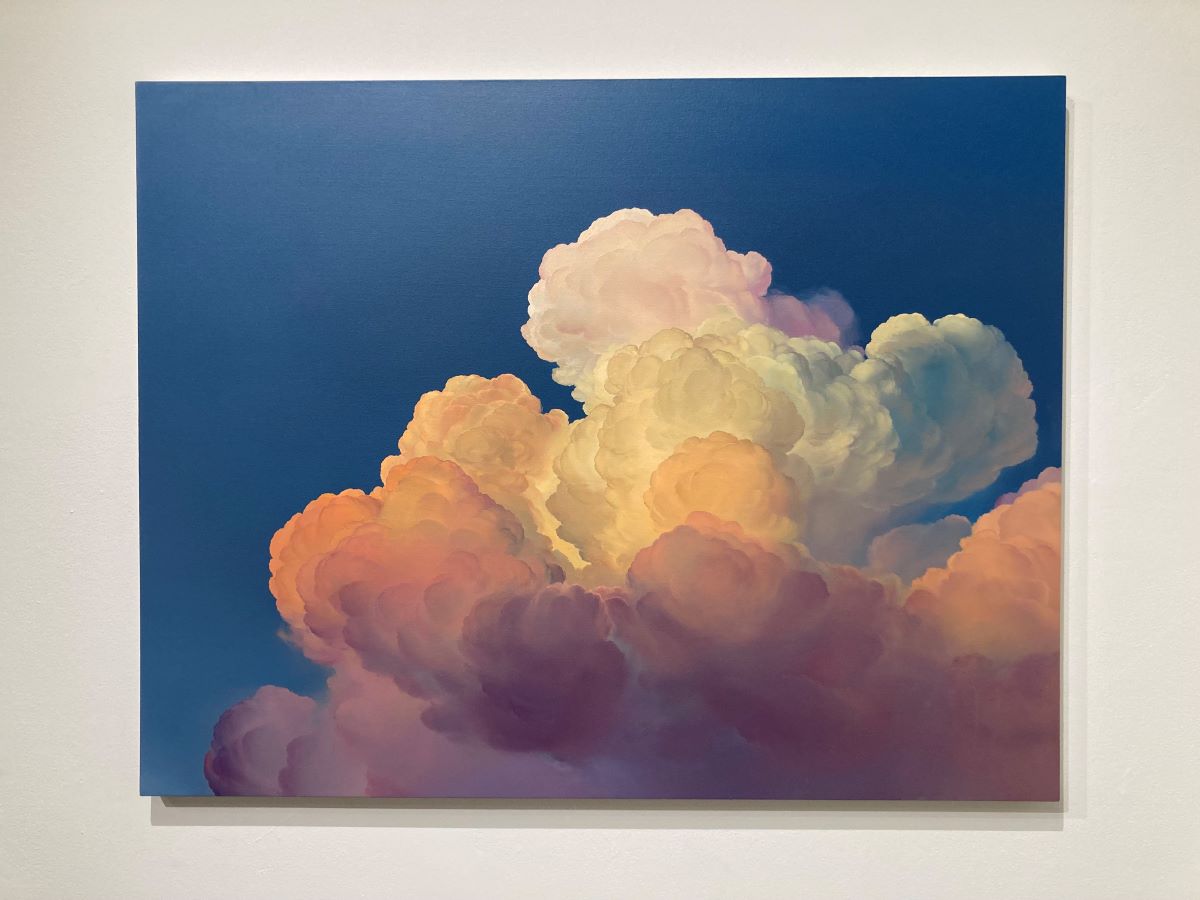
Ian Fisher art, “Atmosphere No. 139 (Nate & Marissa)” (2022), oil on canvas.

My friend Nancy L. is a fan of beautiful cloud formations. She is also a member of the Cloud Appreciation Society, where she signed up for cloud-a-day photos and bought a bumper sticker that reads, “I brake for clouds.”

If you think about it, gazing at clouds can really enrich a life. Try stopping where you are sometime and just looking up.

An article by Sommer Browning at Hyperallergic talks about what clouds have meant to a couple of artists.

She writes that the paintings in the “Carey Fisher” exhibit at the Redline Contemporary Art Center in Denver last December were “as expansive and composed as one might expect from landscape paintings, though there isn’t much land in them. The exhibition of new works by Albuquerque-based Beau Carey and Denver-based Ian Fisher, alumni of RedLine’s artist residency program, takes place mainly in the sky, among mountain tops, the moon, and the clouds. The horizon line is often thousands of feet below view or occluded by giant ancient rocks. 

“Carey chooses realistic depictions of mountain peaks and ranges as one of his main subjects, but his work in this exhibition is kaleidoscopic. In ‘Solaris’ (2022), a celestial sphere seems to rise multiple times behind multiple mountain ranges. It might be a moon the color of the sun, or the sun looking as cold and harsh as the moon. The mountain range vibrates with rich purples and Martian-like colors.

“Some of the paintings, like ‘Folie a Deux’ (2022), look like reflections of themselves — the mountain ranges repeat down the canvas, almost upside down at times. In ‘Magdalenfjorden’ (2022), a stark heavenly circle casts a cold glow across a mountain valley. The mountain paintings remind me of the delirium of standing on a cliff. The moon/sun paintings evoke quarantine feelings of desolation; I remembered wondering, after a couple of weeks, if I had forgotten how to interact with other people.

“Fisher paints exquisite hyperrealist oil paintings of cloud formations. He manages to paint these ephemeral, giant puffs of water vapor with such attention and detail that the paintings seem somehow more real than real clouds. … What is approaching transcendent really, is the perspective. I’d have to be flying to see clouds at these angles, to see them this close. But here there was nothing — not a 747’s plexiglass window, not a camera lens — between me and the cloud. It’s as though what I was seeing is how clouds see each other in the sky. …

“The effect of seeing both painters’ work together is disorienting, unmooring. The longer I looked at Carey’s orange moons and icy mountain-scapes and Fisher’s impossible, vertiginous vistas, the more I wobbled. To be removed from the world by looking at paintings of our world is a wonderful experience. That would have been enough to carry (no pun intended) the show, but the exhibition wall text encourages viewers to draw connections to climate change, which feels a bit unearned. … For a while there, Carey and Fisher had me floating.”

I am reminded of a beautiful N.C. Wyeth painting you may have seen of an old man and a young boy digging a trench in the snow. The boy is looking down, focused on the digging. The old man is standing still, gazing up at the light on the snow, the sky, the clouds. So moving.

More at Hyperallergic, here. No firewall. Subscriptions solicited.

Read Full Post »

Denver is now constructing what is likely the largest sewer heat-recovery project in North America.

I have no idea what leads one to a career in sewers, but judging from this story, it can involve tackling really interesting challenges to help the environment.

As Sam Brasch reported at National Public Radio, “A secret cache of clean energy is lurking in sewers, and there are growing efforts to put it to work in the battle against climate change.

“The U.S. Department of Energy estimates Americans wash enough energy down the drain every year to power about 30 million homes. The sources are often everyday items inside homes. Think hot showers, washing machines and sinks. Evolving technology is making it easier to harness that mostly warm water.

“Denver is now constructing what is likely the largest sewer heat-recovery project in North America, according to Enwave, a Canadian energy company set to operate the system.

“Over the next few years, a $1 billion remodel will turn the 250-acre site, home to the National Western Stock Show and Rodeo, into a hub for art, education and agriculture. The revamped National Western Center will include about a million square feet of new indoor space, all of which will be heated and cooled with energy from the sewer pipes below.

“Brad Buchanan, the CEO leading the redevelopment, said the project has already changed how he thinks about the best location for real estate. Big pieces of sewer infrastructure have long repelled development. Now he imagines they might be sought out as a way to save energy costs and avoid greenhouse gas emissions.

The National Western Center estimates the project will help it annually avoid the carbon equivalent of driving an average gas-powered car around the equator 250 times. …

“The technology to harvest sewer heat isn’t complicated. At the National Western Center, construction crews have already completed a pit exposing the main sewer line. The wastewater inside stays a mild 55 to 75 degrees year-round, local officials say, no matter the weather outside. That consistent temperature can be tapped to heat and cool above-ground buildings.

“The key is a massive heat pump, which will be housed in a central plant on the campus. The device works like a reversible air conditioning unit. In the winter, it will transfer energy from the sewage into a clean-water loop connecting the buildings, adding heat to indoor spaces. The process can then be flipped to keep things cool in the summer.

“And to answer an obvious question: No, the raw effluent is never exposed to the air, so people occupying the buildings won’t get hit with waves of sewer stink. …

“If sewer energy catches on, one reason could be the potential benefits for wastewater districts. That’s because warm sewage causes its own environmental problems. In Denver, wastewater is often hotter than the South Platte River, its final destination after running through a treatment plant. This ‘thermal pollution’ can imperil native plants and wildlife. …

“The National Western Center has moved to protect its supply in the event of a kind of sewer-heat gold rush. The City and County of Denver, a partner in the project, exercised a three-year option for exclusive access to the energy inside the pipelines running through the campus. Buchanan, the project CEO, said it amounts to a new sort of environmental resource. Instead of mineral rights or water rights, his development holds sewer thermal energy rights.

” ‘We have it protected because we’re counting on that energy in perpetuity,’ he said.”

More at NPR, here.

Read Full Post »

I’ve really enjoyed how artists have addressed the pandemic situation, whether designing socially distant ballets and theater or specifically coronavirus-related paintings, constructions, and photos.

Today we learn from Hyperallergic that the lowly face mask has been a particular inspiration. Hakim Bishara reports on a Denver exhibition of artistic face coverings.

“Face masks in all forms and colors have become an essential part of our lives. … A new exhibition at the Vicki Myhren Gallery at the University of Denver comes to remind the nonbelievers and the COVID-fatigued among us that face masks are not only crucial to our health but that they can also be delightful means of self-expression.

MASK … celebrates the centuries-long use of masks as ritual and ornamental objects throughout human history with new works by a group of 41 artists. The dozens of masks are positioned on mannequin heads throughout the gallery space. While some of the face coverings on display are not functional, they are a creative reminder of the times, and the creativity that can emerge from isolation. …

“As the COVID-19 crisis continues to worsen in Denver, the gallery says that it hopes that the exhibition will ‘call attention to the [significance] of masking as an issue of public health and a demonstration of civic responsibility.’ …

“As part of the exhibition, the gallery has joined forces with RedLine Contemporary Art Center in Denver to fabricate free, functional masks that will be distributed to members of the community.

“Ranging in style from the classical to the otherworldly, the masks on view offer inventive notions of what face-coverings can look like. Serge Attukwei Clottey’s science fiction-esque mask appears to be constructed from plastic pipes and found industrial materials. Elizabeth Morisette’s avian mask is a beak made out of zippers. Kate Marling designed a mask that invokes a classical sculpture as if freezing half of her face in stone. Trey Duvall’s ‘COVID19 (Mask for the Art World)’ covers the mouth area with a brick fastened over surgical hand gloves, perhaps hinting at the silencing of certain voices. By contrast, Tobias Fike attached a sizeable megaphone to a mask titled ‘Mouthpiece.’

“A virtual panel discussion with some of the featured artists will be held on November 5.”

A selection of the works, including images of some of the artists modeling their masks, may be viewed at Hyperallergic, here.

Looking for an unusual mask for yourself? Check out the variety at Etsy, here, where you can also get beautiful masks by a family member of mine, good for preventing foggy glasses.

Read Full Post »

Julie Turkewitz writes at the NY Times about a mountain library planned by two not-exactly-wealthy book lovers with big ideas.

“The project is striking in its ambition: a sprawling research institution situated on a ranch at 10,000 feet above sea level, outfitted with 32,000 volumes, many of them about the Rocky Mountain region, plus artists’ studios, dormitories and a dining hall — a place for academics, birders, hikers and others to study and savor the West.

“It is the sort of endeavor undertaken by a deep-pocketed politician or chief executive, perhaps a Bloomberg or a Buffett. But the project, called the Rocky Mountain Land Library, has instead two booksellers as its founders.

“For more than 20 years, Jeff Lee, 60, and Ann Martin, 53, have worked at a Denver bookshop, the Tattered Cover, squirreling away their paychecks in the pursuit of a single dream: a rural, live-in library where visitors will be able to connect with two increasingly endangered elements — the printed word and untamed nature. …

“They have poured an estimated $250,000 into their collection of 32,000 books, centering the collection on Western land, history, industry, writers and peoples. There are tales by Norman Maclean; wildlife sketches by William D. Berry; and books on beekeeping, dragonflies, cowboys and the Navajo. …

“Mr. Lee and Ms. Martin have a grant from the South Park National Heritage Area and this summer will finally begin renovations, repairing two leaky roofs. Construction will be limited, however, as they have gathered less than $120,000 in outside funds. An estimated $5 million is needed to build out their dream.” More here.

Photo: Michael Ciaglo for The New York Times

Read Full Post »

Jeremiah Gallardo, a Colorado native, clicked on yesterday’s post, and I thought I’d have a look at his blog, too.

I don’t know much about Colorado. The closest I got to knowing anything at all was having a college roommate from Boulder.

Jeremiah has a nice entry today about a German Christmas market, the Denver Christkindle Market, which he took photos of. He says it runs until December 25.

“The vendors are in little wooden houses,” he writes, “that were built days before the market event.

“My first stop at the market was the hand-blown glass vendor.  I watched him make a glass icicle decoration in a few minutes, right before my eyes. I bought a green glass pickle decoration.

“Why on earth did I buy a green glass pickle? Because it’s linked to a German tradition where you hide a pickle deep inside the tree and the first child to find it gets to open an extra gift.”

You know, if I had a glass pickle, I might just try it myself.

More about the German market’s crafts and food at Jeremiah’s blog, WhiteLiger.net. You will like his pictures. And his enthusiasm.

Photo:

Read Full Post »