Feeds:
Posts
Comments

Posts Tagged ‘discovery’

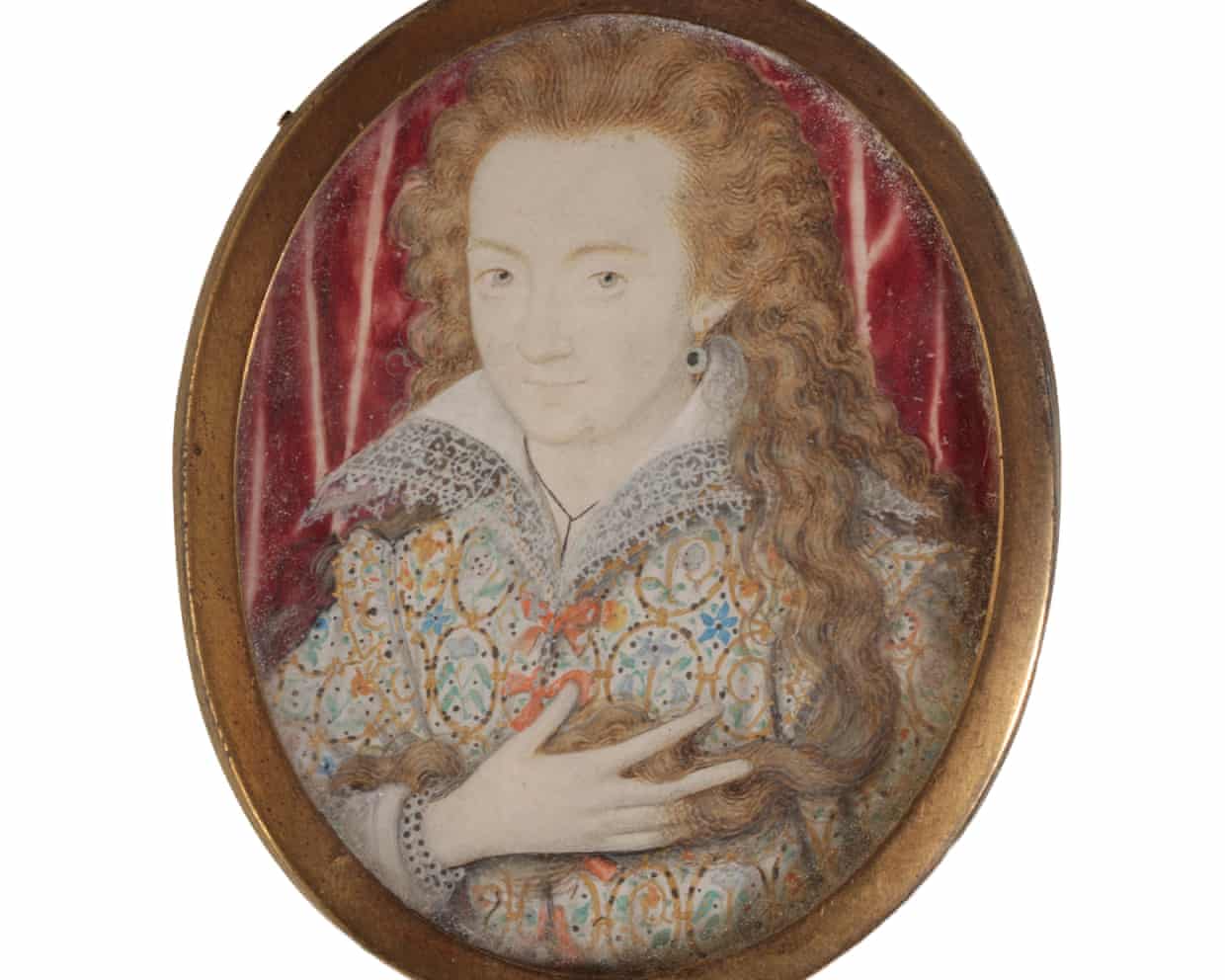
Photo: Handout of a miniature by Nicholas Hilliard.
Shakespeare’s friend Henry Wriothesley, 3rd earl of Southampton, was known for his androgynous beauty and vanity. A newly discovered miniature from his teenage years adds mystery to his story.  

There is always something new to learn about Shakespeare. Blogger Carol let us know a while back about her brother-in-law’s research into Thomas North as an important source for Shakespeare. More recently, there was “news” about Shakespeare’s wife.

Now Dalya Alberge writes at the Guardian that “the discovery of a previously unknown portrait miniature by one of Elizabethan England’s greatest artists would be significant enough. But a work by Nicholas Hilliard that has come to light is all the more exciting because it has a possible link to William Shakespeare, and a 400-year-old enigma of a defaced red heart on its reverse, suggesting a love scorned.

“Hilliard was Queen Elizabeth I’s official limner, or miniature painter. His exquisite portraits, small enough to fit in the palm of one’s hand, are among the most revered masterpieces of 16th-century British and European art.

“This example depicts an androgynous, bejeweled young sitter with long ringlets, thought to be the earliest known likeness of Henry Wriothesley, 3rd earl of Southampton, Shakespeare’s friend and patron – and possibly the ‘fair youth’ of the sonnets, as some have speculated.

“Shakespeare dedicated [‘Venus and Adonis’] and ‘The Rape of Lucrece,’ to Southampton, declaring: ‘The love I dedicate to your lordship is without end.’

“Such miniatures were painted on vellum as thin as onion skin that was pasted on to playing cards for a stiff support. This portrait’s reverse reveals a card whose red heart has been painted over with a black spear or spade, seemingly indicating a broken heart.

“The portrait has been identified by the leading art historians Dr Elizabeth Goldring and Emma Rutherford, who were taken aback by the defacement.

“Goldring, an honorary reader at the University of Warwick and author of an award-winning Hilliard biography, told the Guardian: “You always know that there’s a chance that there could be a clue on the back or tucked inside the frame, but there almost never is. On this occasion, there was – and it was absolutely thrilling. Shivers down the spine. Someone had gone to great effort to spoil the back of this work.’

“Rutherford, the founder of the Limner Company, a consultancy and dealership, said … ‘Everybody would have known that a miniature would be backed by a playing card, but the playing card back was never visible. Originally, this would have been encased in a very expensive, possibly jeweled locket. You’d have to get the miniature out of the locket in order to vandalize the back like this.’ So it is an extraordinary discovery, a 400-year-old mystery.”’ …

“Their research, jointly written with Prof Sir Jonathan Bate, a leading Shakespeare scholar, is published in the Times Literary Supplement on 5 September.

“They write: ‘The fact that the heart has been painted over with a spade, or spear, inevitably calls to … mind thoughts of Shakespeare, whose coat of arms, drawn up c1602, incorporated a spear as a pun on his surname. …

“The historians suggest there is the possibility that this portrait was a gift from Southampton to Shakespeare who returned it, perhaps in 1598, the year that he married. …

“The portrait’s owners have a family connection to Southampton, but they were unaware of Hilliard’s hand or the work’s significance, having long kept it in a box. They contacted Goldring and Rutherford after reading of [the researchers’] discovery of another Hilliard miniature. …

“They write: ‘Again and again, the sonnets return to the fair youth’s androgynous beauty. So, for example, in sonnet 99 his hair is compared to “marjoram,” the tendrils of which are long and curly: could this be an allusion to Southampton’s distinctive long ringlets?’

“They argue that everything about this miniature, including the sitter’s gesture of clasping his cascading ringlets of auburn hair to his heart, suggests an intimate image.

“Long hair was unusual at the late Elizabethan court, Rutherford said. ‘We know there was some criticism of how long hair made men “womanish.” ‘

“Two pearl bracelets adorn the sitter’s wrist. Rutherford said bracelets, though frequently encountered in portraits of women in this period, were rarely seen in portraits of men.”

More at the Guardian, here. And check out the post on Carol’s brother-in-law and his hunt for a little-known Shakespeare source, here.

Read Full Post »

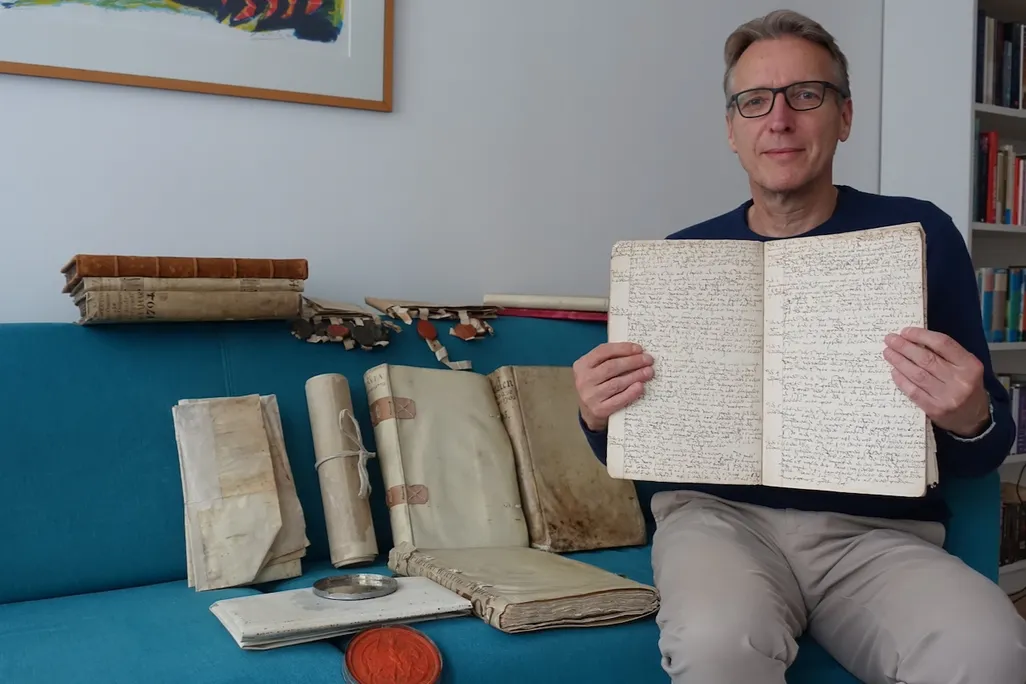
Photo: Arthur Brand.
A box given to art sleuth Arthur Brand contained records from the Dutch East India Company. They had been stolen a decade ago from the Hague in the Netherlands.

Everyone likes a mystery, especially one that gets solved in a satisfactory way. Of course, “satisfactory” is in the eye of the beholder. I myself like to have the perp brought to justice. Other people prefer something brutally realistic.

France 24 reported recently on a mystery solved by Arthur Brand, the “Indiana Jones of the Art World.” In this case, the perp is long gone.

“A Dutch art sleuth has recovered a priceless trove of stolen documents from the 15th to the 19th century, including several UNESCO-listed archives from the world’s first multinational corporation. Arthur Brand [ said] the latest discovery was among his most significant.

” ‘In my career, I have been able to return fantastic stolen art, from Picassos to a Van Gogh … yet this find is one of the highlights of my career,’ Brand told AFP.

“Many of the documents recount the early days of the Dutch East India Company (VOC), whose globetrotting trading and military operations contributed to the Dutch ‘Golden Age,’ when the Netherlands was a global superpower.

“VOC merchants criss-crossed the globe, catapulting the Netherlands to a world trading power but also exploiting and oppressing the colonies it conquered. The company was key to the slave trade during that period, with generations of enslaved people forced to work on Dutch plantations. …

“The company was also a leading diplomatic power and one document relates a visit in 1700 by top VOC officials to the court of the Mughal emperor in India.

” ‘Since the Netherlands was one of the most powerful players in the world at that time in terms of military, trade, shipping, and colonies, these documents are part of world history,’ said Brand.

UNESCO agrees, designating the VOC archives as part of its ‘Memory of the World’ documentary heritage collection.

” ‘The VOC archives make up the most complete and extensive source on early modern world history anywhere,’ says UNESCO on its website.

“The trove also featured early ships logs from one of the world’s most famous admirals, Michiel de Ruyter, whose exploits are studied in naval academies even today. …

“No less enthralling is the ‘who-dunnit’ of how Brand came by the documents.

“Brand received an email from someone who had stumbled across a box of seemingly ancient manuscripts while clearing out the attic of an incapacitated family member.

“This family member occasionally lent money to a friend, who would leave something as collateral – in this case the box of documents. …

“Brand investigated with Dutch police and concluded the documents had been stolen in 2015 from the vast National Archives in The Hague. The main suspect – an employee at the archives who had indeed left the box as collateral but never picked it up – has since died. …

“The art detective said he spent many an evening sifting through the documents, transported back in time.

” ‘Wars at sea, negotiations at imperial courts, distant journeys to barely explored regions, and knights,’ he told AFP.

” ‘I felt like I had stepped into Robert Louis Stevenson’s Treasure Island.’ ” More at France 24, here.

Don’t you love that UNESCO has a category of valuables called “Memory of the World”? Wow, what else belongs to the Memory of the World, and is it being protected for the very reason that we don’t remember it? Is Robert Louis Stevenson in Memory of the World?

Read Full Post »

Photo: NASA Worldview, NASA Earth Science Data and Information System.
Satellite imagery showing the iceberg calved from George VI Ice Shelf in the Bellingshausen Sea, Antarctica, on 19 January 2025.

Not much of a recompense for ruining our planet, but it’s true that global warming is giving scientists a chance to study previously unknown places.

At Schmidt Ocean Institute, we learn about some unexpectedly vibrant communities of ancient corals and sponges in Antarctica.

“An international team on board Schmidt Ocean Institute’s R/V Falkor (too) working in the Bellingshausen Sea rapidly pivoted their research plans to study an area that was, until last month, covered by ice. On January 13, 2025, an iceberg the size of Chicago, named A-84, broke away from the George VI Ice Shelf, one of the massive floating glaciers attached to the Antarctic Peninsula ice sheet.  The team reached the newly exposed seafloor on January 25 and became the first to investigate an area that had never before been accessible to humans.

“The expedition was the first detailed, comprehensive, and interdisciplinary study of the geology, physical oceanography, and biology beneath such a large area once covered by a floating ice shelf. The ice that calved was approximately 510 square kilometers (209 square miles), revealing an equivalent area of seafloor.

“ ‘We seized upon the moment, changed our expedition plan, and went for it so we could look at what was happening in the depths below,’ said expedition co-chief scientist Dr. Patricia Esquete of the Centre for Environmental and Marine Studies (CESAM) and the Department of Biology (DBio) at the University of Aveiro, Portugal. ‘We didn’t expect to find such a beautiful, thriving ecosystem. Based on the size of the animals, the communities we observed have been there for decades, maybe even hundreds of years.’

“Using Schmidt Ocean Institute’s remotely operated vehicle, ROV SuBastian, the team observed the deep seafloor for eight days and found flourishing ecosystems at depths as great as 1300 meters. Their observations include large corals and sponges supporting an array of animal life, including icefish, giant sea spiders, and octopus. The discovery offers new insights into how ecosystems function beneath floating sections of the Antarctic ice sheet. …

“The team was surprised by the significant biomass and biodiversity of the ecosystems and suspect they have discovered several new species.

“Deep-sea ecosystems typically rely on nutrients from the surface slowly raining down to the seafloor. However, these Antarctic ecosystems have been covered by 150-meter-thick (almost 500 feet) ice for centuries, completely cut off from surface nutrients. Ocean currents also move nutrients, and the team hypothesizes that currents are a possible mechanism for sustaining life beneath the ice sheet. The precise mechanism fueling these ecosystems is not yet understood.

“The newly exposed Antarctic seafloor also allowed the international team, with scientists from Portugal, the United Kingdom, Chile, Germany, Norway, New Zealand, and the United States, to gather critical data on the past behavior of the larger Antarctic ice sheet. The ice sheet has been shrinking and losing mass over the last few decades due to climate change.

“ ‘The ice loss from the Antarctic Ice Sheet is a major contributor to sea level rise worldwide,’ said expedition co-chief scientist Sasha Montelli of University College London (UCL), United Kingdom, also a 2019 Schmidt Science Fellow. ‘Our work is critical for providing longer-term context of these recent changes, improving our ability to make projections of future change — projections that can inform actionable policies. We will undoubtedly make new discoveries as we continue to analyze this vital data.’

“In addition to collecting biological and geological samples, the science team deployed autonomous underwater vehicles called gliders to study the impacts of glacial meltwater on the physical and chemical properties of the region. Preliminary data suggest high biological productivity and a strong meltwater flow from the George IV ice shelf. …

“ ‘The science team was originally in this remote region to study the seafloor and ecosystem at the interface between ice and sea,’ said Schmidt Ocean Institute Executive Director, Dr. Jyotika Virmani. ‘Being right there when this iceberg calved from the ice shelf presented a rare scientific opportunity. Serendipitous moments are part of the excitement of research at sea – they offer the chance to be the first to witness the untouched beauty of our world.’ ”

More at Schmidt Ocean Institute, here, and at radio show The World, here. No firewalls.

Photo :A large sponge, a cluster of anemones, and other life is seen nearly 230 meters deep at an area of the seabed. Sponges can grow very slowly, and the size of this specimen suggests this community has been active for decades, perhaps even hundreds of years.

Read Full Post »

Photo: Joanna Hawkins/BBC.
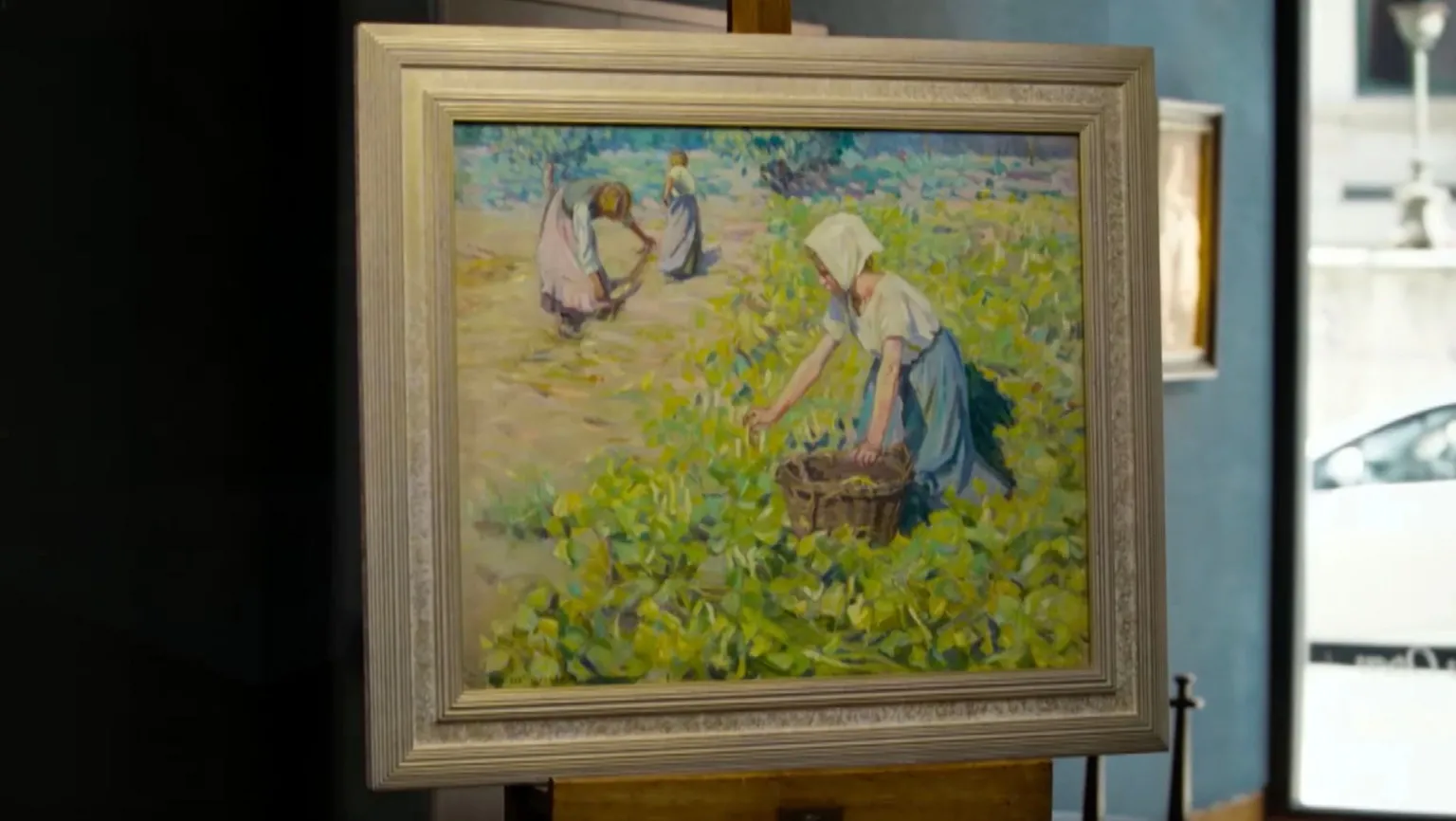
Artist David Taylor spotted this early 20th Century by Canadian impressionist Helen McNicoll at a UK auction house. It is valued at 150 times what it cost.

Let’s start 2025 with another fun story of a rediscovered treasure. The person who found it wasn’t just some guy. He was an artist who knew quality when he saw it and was willing to pay a large amount for it — just not as large an amount as it turned out to be worth.

David McKenna writes at the BBC, “A painting bought for just over £2,000 [~$2500] has been authenticated as a long-lost masterpiece worth £300,000 [~$374,000].

“The buyer, [Lincolnshire] artist David Taylor, said he had been ‘bowled over’ by the artwork while browsing a sale at a regional auction house.

“Experts on the BBC’s Fake of Fortune? were able to prove the painting, known as ‘The Bean Harvest’ and depicting a scene of women in a field, was a piece from the early 20th Century by Canadian impressionist Helen McNicoll. …

“McNicoll is one of Canada’s most celebrated female artists, achieving considerable international success during her career.

“Deaf from the age of two, McNicoll was known for her impressionist representations of rural landscapes.

“In 1915, her career was cut short when she developed complications from diabetes and died at the age of 35.

“It was revealed [in an October 2024] episode of Fake or Fortune? that the artwork had been exhibited in Canada five times between 1912 and 1913, but its whereabouts had since been unknown.

“During the episode, the show’s team — including presenters Fiona Bruce and Philip Mould — helped Mr Taylor to prove its authenticity.

” ‘I’d not heard of Helen McNicoll before we started investigating this painting,’ Bruce said. ‘But what a pioneer she was — a woman at that time, the early 20th Century, traveling abroad with her easel while profoundly deaf. I’m so glad we’ve been able to bring her name to wider attention.’ …

“Co-host Mould described the find as a ‘once-in-a-lifetime discovery,’ adding there was a massive desire on both sides of the Atlantic for the work of high-quality women artists.

“Canadian philanthropist Pierre Lassonde, a major collector of McNicoll’s work, flew over to London to see the painting in person. During the show, he said: ‘For a painting that has been missing for 110 years, I think it’s fantastic… I wouldn’t mind adding one more piece to my collection.’

“Mr Taylor described the experience as ‘an absolute adventure.’ “

More at the BBC, here. Find out more about the artist at Sotheby’s, where her painting was offered for sale in November.

Read Full Post »

Photo: Hansons Auctioneers.
Ten rediscovered Salvador Dalí prints were scheduled to be auctioned off in September. 

Have you ever bought something and stored it away, only to forget about it for years? I have. Mystery objects turned up when I was downsizing, but nothing of great value. I remember a folk art candle holder of brown painted pottery, for example. It was sweet, but I have no idea why or when I bought it.

Lianne Kolirin at CNN wrote about a different kind of discovery.

“Ten signed Salvador Dalí lithographs have been discovered in a garage in London, where they have been stashed for half a century. The artworks, which were discovered by an auctioneer during a routine valuation, are now expected to fetch several thousand dollars at auction.

“The colorful prints were uncovered when the expert was called to a property in Mayfair, central London, to give the customer an assessment of some antiques at the property. But the visit took a turn when the pair went out to the garage of the client, who has not been identified.

“Chris Kirkham, associate director of London’s Hansons Richmond auction house, recalled … ‘It was an amazing find. … I was invited to assess some antiques at a client’s home. During the visit the vendor took me to his garage and, lo and behold, out came this treasure trove of surrealist lithographs – all 15 of them.’

“Together with the 10 Dalí lithographs, which are a mixture of mostly mythological and allegorical scenes, were another five by Theo Tobiasse, a French painter, engraver, illustrator and sculptor.

“ ‘They’d been tucked away and forgotten about for around 50 years. It felt quite surreal. You never know what you’re going to uncover on a routine home visit,’ said Kirkham. … ‘The prints ended up in his garage. They were rediscovered because the seller has been having a clear out. He’s looking to retire and move abroad, so now his lithographs will finally see the light of day at auction. …

“Dalí, a leading member of the Surrealist group, was born in Figueres in Catalonia in 1904 and died there in 1989. A prolific artist, he was renowned for his bizarre images which famously included melting clocks.”

According to Artnet News, the seller, who “paid just $655 for the lot in the 1970s,” sold them in September for $26,200. (Click here.)

More at CNN, here. I once read that it’s advisable to do downsizing regularly — maybe every year. That way you find out what you’ve got that would be better to move elsewhere. Maybe it would help if every time we acquired something new, we promised ourselves to give away something else.

Read Full Post »

Delta Rhythm Boys singing “Dry Bones.”

I should have remembered that it was Ezekiel who was the original source for a song we used to sing in elementary school. It took this old video of the Delta Rhythm Boys singing “Dry Bones” to put me straight last Saturday. The reason I was looking for it on YouTube then was that a Pilates class got me thinking about how the sections of my backbone connected. I’m glad to share this in time for Halloween, when bones are a thing!

Dracula is also a thing at Halloween, and so a recent literary discovery is another just-in-time item. At Public Radio International, you can learn about a newly discovered Bram Stoker story — written before his Dracula masterpiece but unknown until now.

From The World: “All Dracula-inspired movies, TV shows and breakfast cereals can be traced back to a story published in 1897 by the Irish writer Bram Stoker.  His work is honored annually at the Bram Stoker Festival. … This year, the festival will highlight a a scary but lesser-known tale called ‘Gibbet Hill.’ …

“The story was published seven years before the original Dracula came to be, but received little attention until blogger and Stoker enthusiast, Brian Cleary, rediscovered the story in a library.  Cleary joined The World’s host Carol Hills to discuss his forgotten find.

Carol Hills: Give us a brief synopsis of the short story, but no spoilers.
Brian Cleary: The narrator of the story is a man who’s leaving London and going down to Surrey for a walk in a place called Gibbet Hill. He encounters what’s called the Sailor’s Stone. The stone is there because the sailor was murdered by three thieves, and they were actually gibbetted [and the bodies were] displayed as a warning to other criminals. Stoker sets his story off from that jumping-off point. …

Hills: Tell us how you found this short story, “Gibbet Hill.”
Cleary : I was interested in Stoker for years. I read Dracula when I was 12. I moved to Marino when I was an adult. Marino is where Bram Stoker was born. So, I was interested in local history and probably spent the last 15 years or so reading about every little detail I could get on Bram Stoker. I had some free time and ended up in the National Library of Ireland. While there, I systematically searched the British newspaper archives for all articles mentioning Bram Stoker between 1880 and 1897, when he published Dracula.

“A few weeks into that process, after reviewing a few thousand results, I got lucky. I hit on an advertisement for Christmas Supplement, the Dublin edition of the Daily Express, and it was referring to something published two weeks prior to that. The supplement had a story called ‘Gibbet Hill,’ by Bram Stoker, which just froze me in my seat because I knew this was something that I hadn’t come across before. I did some quick searches, and it was not on the internet or in any of the Stoker biographies or bibliographies. So, I went racing back through the editions of the Daily Express, got back to the relevant one from December 17th, and sure enough, there it was. …

Hills: What went through your mind when you realized, ‘Jeez, this is a big find’?
Cleary Well, I’m sitting in this churchlike atmosphere. It’s a Victorian building, big, high domed ceilings and beautiful, old paneled walls. So, it’s a really reverent space. And I’m holding my breath and I’m reading it, and I’m surrounded by proper historians and real writers. I just want to shout out and tell people what I found. But I just put my head down and read through, and I was amazed. It was a really good ghost story, you know, it was on a par with some of his other well-known short stories. …

“Hills: ‘Gibbet Hill,’ was written seven years before Dracula, but what does it tell you about Bram Stoker’s evolution as a writer? 
“Cleary: It shows how he was gradually working his way up to this masterpiece. So, in March 1890, he made the first notes for Dracula. … During that year, he went to Whitby for summer holidays in August 1890. While he was there, he got a book out of the library, and he found the term ‘dracula’ in that book, and he wrote it down lots of times. I think he liked how it sounded on his tongue. And then a few weeks later he was writing ‘Gibbet Hill.’ So, there are themes. … You can see he’s very much a writer developing his craft.” Lots more at The World, here.

Note to Hannah: Did we go see The Horror of Dracula together as young teens? On Fire Island? It made an impression on me that has lasted all these years.

Photo: John and Suzanne’s Mom.

Read Full Post »

In my town, everyone knows who Louisa May is, but you may know her better as Louisa May Alcott, author of Little Women.

When Alcott was first starting out as a writer, she wrote dramatic potboilers under various pseudonyms. Researchers keep discovering more. Michael Casey at AP has the story.

“The author of Little Women may have been even more productive and sensational than previously thought,” he writes. “Max Chapnick, a postdoctoral teaching associate at Northeastern University, believes he found about 20 stories and poems written by Louisa May Alcott under her own name as well as pseudonyms for local newspapers in Massachusetts in the late 1850s and early 1860s.

‘One of the pseudonyms is believed to be E. H. Gould, including a story about her house in Concord, Massachusetts, and a ghost story along the lines of the Charles Dickens classic ‘A Christmas Carol.’ He also found four poems written by Flora Fairfield, a known pseudonym of Alcott’s. One of the stories written under her own name was about a young painter. …

“Alcott remains best known for Little Women, published in two installments in 1868-69. Her classic coming-of-age novel about the four March sisters — Meg, Jo, Beth and Amy — has been adapted several times into feature films, most recently by Greta Gerwig in 2019.

“Chapnick discovered Alcott’s other stories as part of his research into spiritualism and mesmerism. As he scrolled through digitized newspapers from the American Antiquarian Society, he found a story titled ‘The Phantom.’ After seeing the name Gould at the end of the story, he initially dismissed it. … But then he read the story again.

“Chapnick found the name Alcott in the story — a possible clue — and saw that it was written about the time she would have been publishing similar stories. The story was also in the Olive Branch, a newspaper that had previously published her work.

“As Chapnick searched through newspapers at the society and the Boston Public Library, he found more written by Gould — though he admits definitive proof they were written by Alcott’s has proven elusive.

“ ‘There’s a lot of circumstantial evidence to indicate that this is probably her,’ said Chapnick, who last year published a paper on his discoveries in J19, the Journal of Nineteenth-Century Americanists. …

“When first contacted by Chapnick about the writings, Gregory Eiselein, president of the Louisa May Alcott Society, said he was curious but skeptical. … But he has come to believe that Chapnick has found new stories, many of which shed light on Alcott’s early career.

“ ‘What stands out to me is the impressive range and variety of styles in Alcott’s early published works,’ he said. ‘She writes sentimental poetry, thrilling supernatural stories, reform-minded non-fiction, work for children, work for adults, and more. It’s also fascinating to see how Alcott uses, experiments with, and transforms the literary formulas popular in the 1850s.’

“Another Alcott scholar at Kansas State, Anne Phillips, said … his paper makes a ‘compelling case’ that these were her writings.

“ ‘Alcott scholars have had decades to compare her work in different genres, and that background is going to help us evaluate these new findings,’ she said in an email interview. ‘She reworked and reused names and situations and details and expressions, and we have a good, broad base from which to begin considering these new discoveries,’ she said. ‘There’s also something distinctive about her writing voice, across genres.’ …

“In the 1940s, Leona Rostenberg and Madeleine Stern found thrillers written under the name A. M. Barnard, an Alcott pseudonym. She also wrote nonfiction stories, including about the Civil War where she served as a nurse, under the pseudonym Tribulation Periwinkle.

“It wasn’t unusual for female writers, especially during this period, to use a pseudonym. …

“ ‘She might not have wanted [her family] to know she was writing trashy stories about sex and ghosts and whatever,’ Chapnick said. …

“ ‘The detective work is fun. The not knowing is kind of fun. I both wish and don’t wish that there would be a smoking gun, if that makes sense,’ he said.”

More at AP, here.

Read Full Post »

Photo: The Foundation for Documentation of Rock Carvings in Bohuslän.
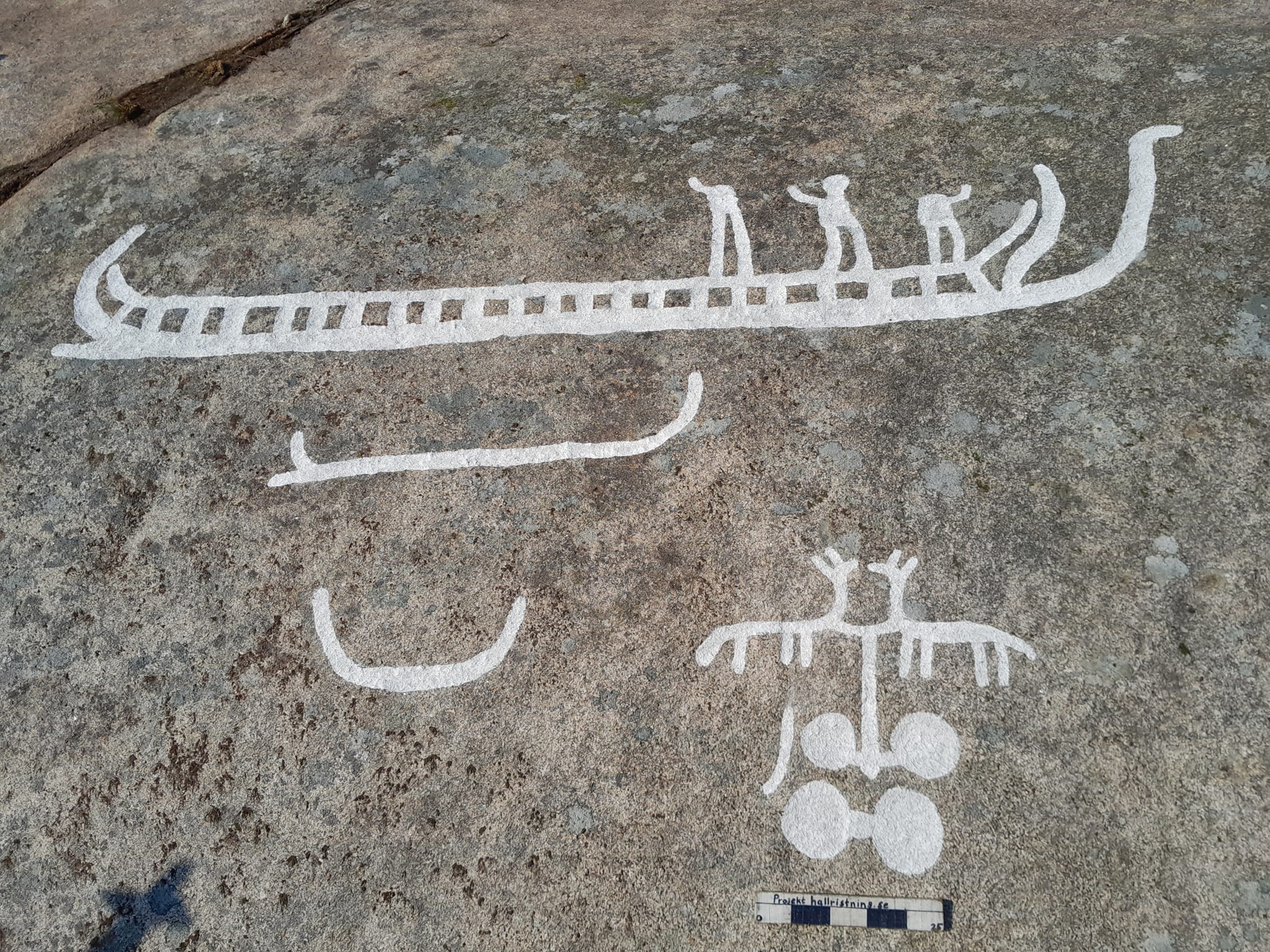
One of the petroglyphs recently discovered on a farm in western Sweden.

Erik is from Sweden, so he takes Suzanne and the kids there every summer for about a month, where they connect with his sister’s lively family and his mother (Stuga40 on WordPress).

My husband and I paid Stuga40 a visit back in 2017, and one of the many fun things we did with her was visit a UNESCO World Heritage Site featuring ancient petroglyphs. (See a post on that here.)

It turns out that ancient civilizations in Sweden are not done revealing their secrets. Recently, researchers found more petroglyphs, startling the farmer who lives on the land and adding to the world’s pool of knowledge.

Richard Whiddington reports at Artnet, “In early May, a group of researchers scouring the western Swedish province of Bohuslän spotted irregular markings on a moss-covered rock face. They seemed man-made and so the team carefully removed the vegetation and uncovered scores of rock carvings, around 40 in total, depicting ships, animals, and people.

“The rock carvings, or petroglyphs, date back around 2,700 years and are the latest find in Bohuslän, an area known for its rock art, most notably the Bronze Age images at Tanum, a UNESCO site. …

“The recently discovered petroglyphs were found on a steep rock face that once formed the edge of an island before sea levels gradually dropped an estimated 40 feet over the course of several hundred years. This has led researchers to speculate the artists used boats, or a form of scaffolding laid on ice, to reach the rock surface. …

“The designs were made through a laborious process of smacking stones against the granite rock that exposed an underlayer of white. This color, in addition to their size, made them highly visible from both the mainland and passing ships.

“ ‘What makes the petroglyphs completely unique is that they are located three meters above today’s ground surface,’ Foundation for Documentation of Bohuslän’s Rock Carvings wrote in a statement. ‘The motifs lie on an even line that follows the height of the sea surface from approximately 700 to 800 BCE. The motifs are also stylistically consistent with this time period.’

“The latest group of petroglyphs found includes a 13-foot-long ship, as well as carvings of people, chariots, carts, and horses. Their meaning remains unknown. Sometimes petroglyphs were used to mark out territory, though researchers believe the repeated motifs carved into rocks outside the town of Kville may suggest they were used to tell a narrative.

“Lennart Larsson, on whose farm the rock carvings were found, was pleased by the discovery. ‘I haven’t actively been looking for petroglyphs, but it’s a lot of fun,’ he told SVT, the country’s national broadcaster in interview. ‘I can sit at home on the balcony and watch the stick figures and the ships outside.’ ” More at Artnet, here.

Also, at Live Science, Martin Östholm, a project manager with the foundation, noted that he petroglyphs include depictions of ships, people and animal figures, “including four-legged creatures that may be horses. … It’s not certain why people created the carvings, he said, but they may have served to mark ownership. …

James Dodd, a researcher at Aarhus University in Denmark and the Tanums Hällristningsmuseum’s Rock Art Research Centre Underslös in Sweden [said that] some of the motifs — including chariots, carts and animal figures — were depicted multiple times. … ‘On the basis of the repetition of the motifs, it is possible that this collection of figures forms a narrative,’ Dodd told Live Science in an email. Studies of other petroglyphs in the region have suggested that, in some cases, they may have been used in this way, but the exact meaning in this case is uncertain, he added.”

Artnet and Live Science have good pictures — and no firewalls.

Read Full Post »

Photo: British Museum.
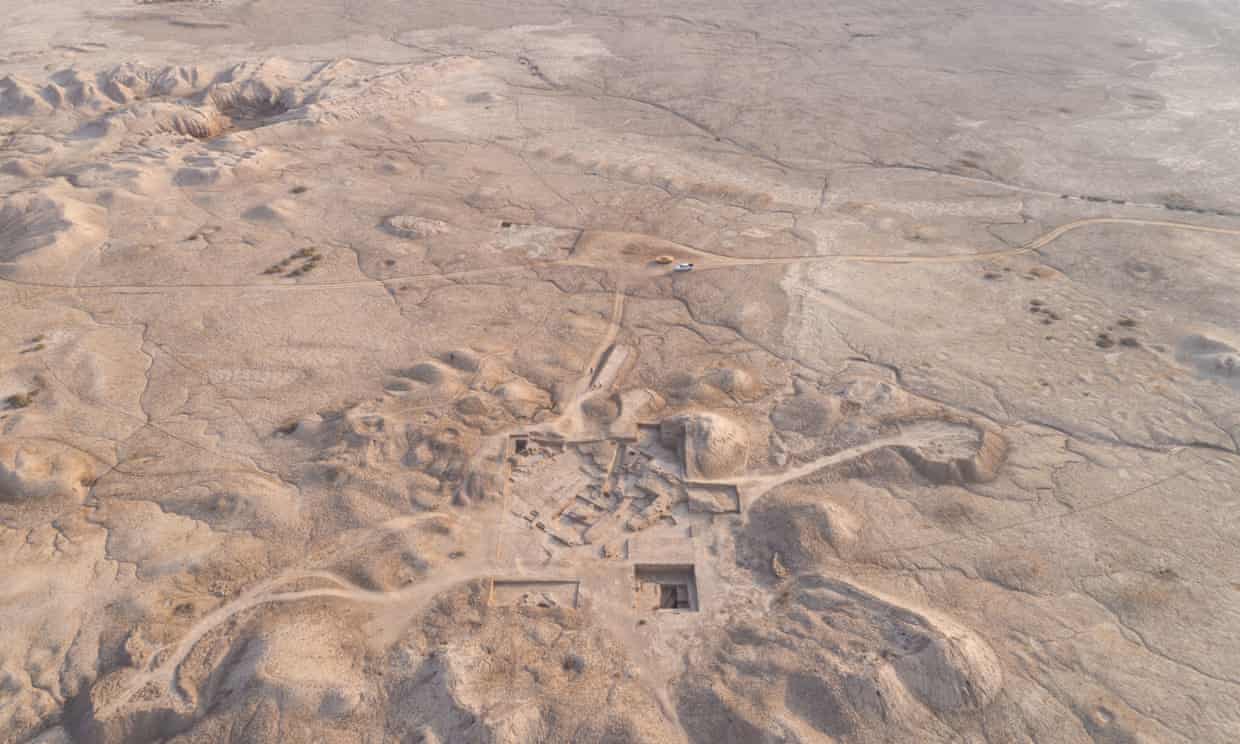
An aerial view of the ancient city of Girsu in Tello, Iraq. The Sumerians inhabited the ancient eastern Mediterranean region of Mesopotamia. 

Today we have more archaeology for people who love stories about newly discovered ancient places — particularly stories about archaeologists no one believed.

Tobi Thomas reports at the Guardian that “the archaeologist who led the discovery of a lost Sumerian temple in the ancient city of Girsu has said he was accused of ‘making it up’ and wasting funding.

“Dr Sebastien Rey led the project that discovered the 4,500-year-old palace in modern-day Iraq – thought to hold the key to more information about one of the first known civilizations.

“The Lord Palace of the Kings of the ancient Sumerian city Girsu – now located in Tello, southern Iraq – was discovered during fieldwork last year by British and Iraqi archaeologists. Alongside the ancient city, more than 200 cuneiform tablets were discovered, containing administrative records of the ancient city.

“Rey said that when he first brought up the project at international conferences no one believed him. ‘Everyone basically told me, “Oh no you’re making it up you’re wasting your time you’re wasting British Museum UK government funding.” ‘ …

“Girsu, one of the earliest known cities in the history of humankind, was built by the ancient Sumerians, who between 3,500 and 2,000 BC invented writing, built the first cities and created the first codes of law. The ancient city was first discovered 140 years ago, but the site has been the target of looting and illegal excavations. …

“Alongside the discovery of the palace and the tablets, the main temple dedicated to the Sumerian god, Ninĝirsu, was also identified. Before this pioneering fieldwork, its existence was known only from ancient inscriptions discovered alongside the first successful excavation of the ancient city.

“The project follows the Iraqi scheme first funded by the British government in response to the destruction of important heritage sites in Iraq and Syria by Islamic State. Since its establishment, more than 70 Iraqis have been trained to conduct eight seasons of fieldwork at Girsu. …

“The Sumerians inhabited the ancient eastern Mediterranean region of Mesopotamia, and were responsible for many technological advancements, including measurements of time as well as writing.

“According to Hartwig Fischer, the director of the British Museum, the site of the ancient city in southern Iraq was ‘one of the most fascinating sites I’ve ever visited. …

” ‘The collaboration between the British Museum, state board of antiquities and heritage of Iraq, and the Getty represents a vital new way of building cooperative cultural heritage projects internationally. … While our knowledge of the Sumerian world remains limited today, the work at Girsu and the discovery of the lost palace and temple hold enormous potential for our understanding of this important civilization, shedding light on the past and informing the future.’

“The ancient Sumerians may not be as well known a civilization as the ancient Egyptians or Greeks, but according to Dr Timothy Potts, the directory of the Getty Museum, Girsu is ‘probably one of the most important heritage sites in the world that very few people know about. … This innovative [Girsu Project] provides critical support for the uniquely important archaeological site of Girsu, through the training of Iraqi specialists entrusted with its development for sustainable archaeology and tourism.’

“Iraq’s culture minister, Ahmed Fakak Al-Badrani, said: ‘The British archaeological excavations in Iraq will further unveil significant ancient eras of Mesopotamia, as it is a true testimony to the strong ties between the two countries to enhance the joint cooperation.’ ” More at the Guardian, here.

The Guardian adds the “explainer” below is case your memory of the Sumerians is as fuzzy as mine.

“The Sumerians were the inhabitants of Sumer, which is the earliest known civilization in the historical region of Mesopotamia, located in modern-day southern Iraq. According to archaeological evidence, they built about a dozen city-states in the fourth millennium BC.

“Girsu, which is located in Tello, Iraq, was first discovered 140 years ago, and was significant in that it first revealed to the world the existence of the Sumerian civilization, as well as bringing to light some of the most vital monuments of Mesopotamian art and architecture.

“The Sumerians were ancient pioneers, having advanced the craft of writing, writing literature, hymns and prayers. They built the first known cities as well as creating the first known code of law. They also perfected several existing forms of technology, including the wheel, the plough and mathematics.

“The epic of Gilgamesh, considered the world’s oldest surviving piece of literature, derives from five Sumerian poems.

“They were also notably one of the first civilizations to brew beer, which was seen by the ancient people as a key to a healthy heart and liver.”

Read Full Post »

Photo: Ahmed Zakot.
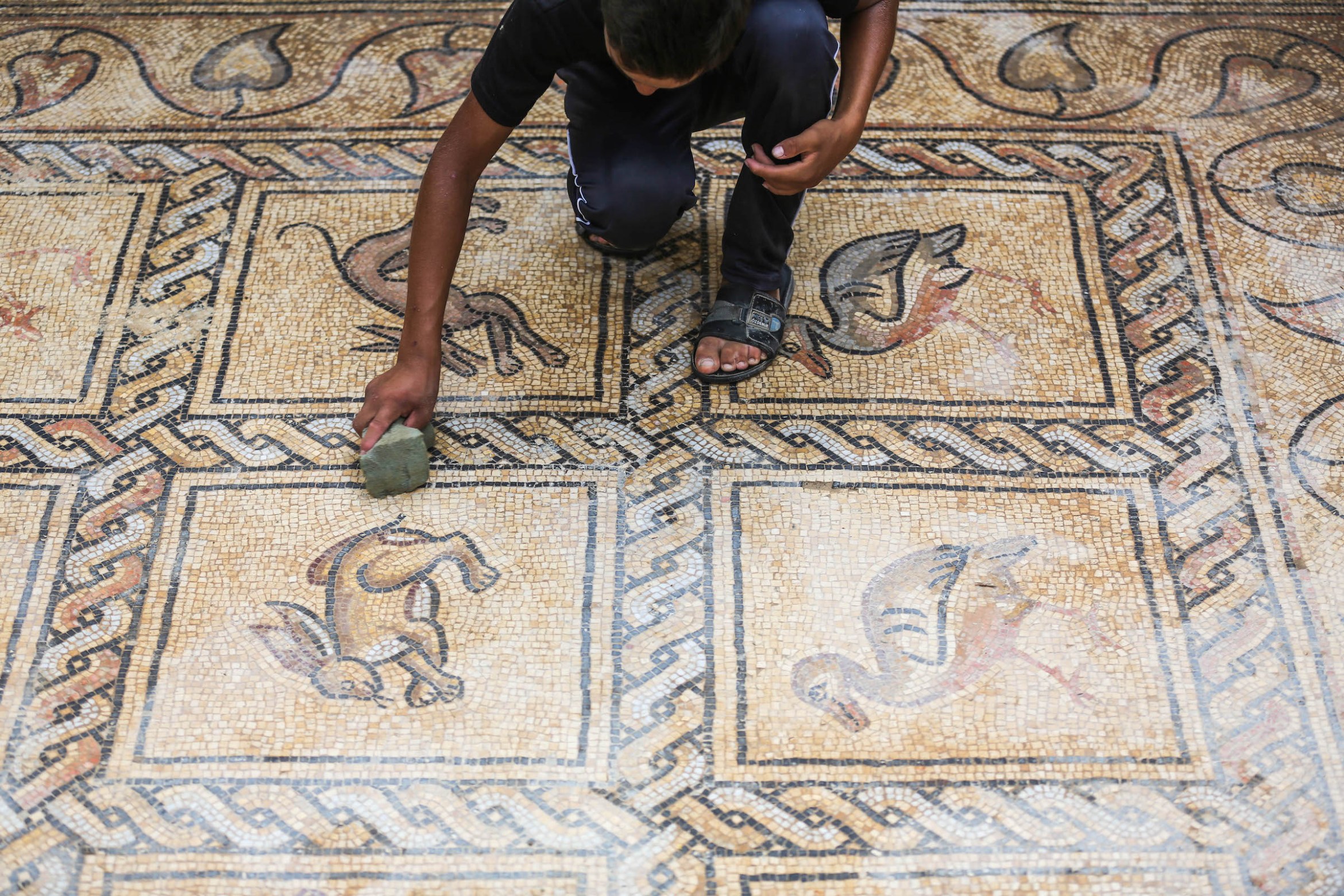
A Palestinian farmer unearthed a Byzantine floor mosaic beneath his olive grove.

We keep learning that beautiful discoveries can still be made, even in mundane settings. Perhaps you have discovered yellowed letters your parents wrote to each other when courting. Perhaps there was an antique bottle inside a wall when you renovated.

Such items can be exciting, but it’s hard to beat the discovery a farmer in today’s stumbled upon.

Elaine Velie reports at Hyperallergic, “Salman al-Nabahin, a farmer from Gaza’s Bureij refugee camp, was trying to plant new olive trees in his orchard but something underneath the soil was standing in his way. He investigated for three months, digging out the soil with his son until they unearthed a stunningly well-preserved Byzantine floor mosaic.

“Al-Nabahin told Reuters that he searched the internet to asses the mosaic’s origins. An archaeologist from the French Biblical and Archaeological School of Jerusalem, René Elter, later confirmed the work as a Byzantine mosaic, placing the mosaic between the fifth and seventh centuries CE. …

“ ‘Never have mosaic floors of this finesse, this precision in the graphics and richness of the colors been discovered in the Gaza Strip,’ Elter [told the Associated Press], adding that more research is needed to determine the work’s intended function.

“The Palestinian Ministry of Culture stated that investigation into the mosaic was still in its early stages and a team of national experts would partner with experts at the French Biblical and Archaeological School of Jerusalem to research the work.

“Gaza is situated on a thriving ancient trade route, and dozens of important archaeological discoveries have been uncovered there in the last few years. The recently revealed mosaic, however, sits less than a mile away from the Gaza-Israel barrier, which Elten said puts the discovery in ‘grave danger.’ …

“ ‘I see it as a treasure, dearer than a treasure,’ al-Nabahin told Reuters. ‘It isn’t personal, it belongs to every Palestinian.’ “

Sarah Kuta at the Smithsonian adds, “Now, archaeologists with the Palestinian Ministry of Tourism and Antiquities and the French Archaeology School are hard at work studying the flooring to learn more about its ‘secrets and civilization values,’ says the ministry in a press statement.

“The mosaic features 17 iconographies of birds and other animals depicted in bright colors. Archaeologists … don’t know whether the mosaic had religious or secular origins.

“The farmer has been covering the unearthed areas of the mosaic floor with tin sheets to protect them; so far, he’s dug up three separate sections, the widest measuring 6 feet by 9 feet, according to Fares Akram of the Associated Press. In total, the land covering the entire mosaic is about 5,400 square feet, and the mosaic itself measures about 250 square feet. Some parts of the mosaic appear to be damaged, likely from the roots of an old olive tree.

“ ‘These are the most beautiful mosaic floors discovered in Gaza, both in terms of the quality of the graphic representation and the complexity of the geometry,’ [Elter] tells the AP. …

“The Bureij refugee camp [is] located about half a mile from the border with Israel. Archaeologists and other experts are concerned about the mosaic’s future because of the ongoing Israeli-Palestinian conflict, as well as looting and a lack of funding for historical preservation.

“ ‘It is a spectacular find, especially as our knowledge of archaeology is sadly so spotty given circumstances there,’ Asa Eger, an archaeologist at the University of North Carolina at Greensboro, tells the Art Newspaper’s Hadani Ditmars. ‘Gaza was very important during the period of this mosaic and known for its burgeoning wine production exported across the Mediterranean.’ “

You’ll love the photos at Hyperallergic, here, and at Smithsonian, here. No firewalls.

Read Full Post »

Photo: Andy Chopping/MOLA.
This newly unearthed mosaic is thought to have adorned the floors of a Roman dining room. The spot where it stands is close to London Bridge.

There are still surprises to be found on Planet Earth. Sometimes right beneath your feet. In today’s story, it was a Roman mosaic buried below a parking lot. Wouldn’t you have liked to be the chap who first realized what was there? As often happens in archaeology, the mosaic was discovered in the process of prepping a site for new construction. Jeevan Ravindran had the story at CNN.

“A large area of well-preserved Roman mosaic — parts of it approximately 1,800 years old — has been uncovered in London near one of the city’s most popular landmarks. The mosaic is thought to have adorned the floors of a Roman dining room, and the spot where it stands is near the Shard — the capital’s tallest building, close to London Bridge.

“Archaeologists from the Museum of London Archaeology (MOLA) unearthed the mosaic earlier this month during an excavation ahead of building work due to take place on the site, which previously served as a car park.

“The find is the largest area of Roman mosaic to have been discovered in London in at least 50 years, according to a press release from MOLA.

” ‘It is a really, really special find,’ Sophie Jackson, MOLA’s director of developer services, told CNN Wednesday, adding that large Roman mosaics were not often built in London due to it being a ‘crowded’ city. …

“The dining room where the mosaic was found is thought to have been part of a Roman ‘mansio,’ or ‘upmarket “motel” offering accommodation, stabling, and dining facilities,’ the team said in the press release. The lavish decorations and size indicated only ‘high-ranking officers and their guests’ would have stayed there.

“The mosaic itself is [composed] of two panels, with the larger dating to the late 2nd or early 3rd century AD. However, the team spotted traces of an earlier mosaic underneath, which Jackson said an expert will now attempt to retrace and reconstruct.

“The larger panel is decorated with ‘large, colorful flowers surrounded by bands of intertwining strands’ and patterns including a Solomon’s knot (a looped motif). …

“As there is an ‘exact parallel’ to this design in a mosaic found in the German city of Trier, the team believes the same artists worked on both, suggesting a tradition of ‘traveling Roman artisans at work in London.’ …

“Near the spot where the mosaic was found, the team also found traces of ‘lavishly’ painted walls, terrazzo-style and mosaic floors, coins, jewelry and decorated bone hairpins, suggesting the area was occupied by wealthy inhabitants.

“Although the mosaic’s future is not yet decided, Jackson said it will likely go on public display. The archaeologists will now proceed to the final stage of the excavation, at a spot that has not previously been examined.”

Bet the folks behind the planned construction are feeling a little frustrated! More at CNN, here.

You may also like to read about the mosaics in Trier, a World Heritage site. Dr. Marcus Reuter, director of the Rheinisches Landesmuseum, says, “Most of the mosaics come from our own excavations in the region. Many impressive objects that point to the Roman city’s significance have been found in the former Roman Imperial Residence of Trier.” More from Germany here.

Read Full Post »

Photo: Phuong Tâm.
‘I was lucky – I sang every night’: Phuong Tâm on the front cover of Đẹpmagazine, Saigon, 1965.

I first heard this story at Public Radio International’s the World, but decided to use the Guardian version here because it has more details. It tells what a Vietnamese American woman did after discovering that her mother was once a rock star.

Here’s Sheila Ngoc Pham with an interview at the Guardian.

“In early 1960s Saigon, Nguyễn Thi Tâm would appear on stage in the city’s vibrant phòng trà (tearooms) and nightclubs. She embodied quintessential young womanhood, with long, straight black hair and wearing a white áo dài, an elegant Vietnamese dress. But instead of traditional songs, she would belt out music that recalled American hot rods, hip-swinging dance crazes and even teenage abandon: using the stage name Phuong Tâm, she was one of Vietnam’s first rock’n’roll singers. ‘Back then, everyone was singing Vietnamese, some French, but no one else was singing American music,’ says Tâm, now 76. ‘Just me.’

“Lost for decades, 25 of the brilliantly crafted songs she recorded – all rich in verve and atmosphere – can now be found on Magical Nights, a landmark compilation that required an international collective effort to recover a lost era of early Vietnamese rock.

“Tâm and I speak in Vietnamese, logging on from our homes in two of the world’s largest Vietnamese-diaspora communities: she is in San José, California; I am in Sydney, Australia. Given that we are talking about events from more than half a century ago, I’m astonished by her vivid recall. ‘Of course, these are precious memories. I was lucky. I sang every night.’ …

“When she was 12, she started learning music from a mandolin-playing neighbor who suggested she use the more feminine-sounding Phuong Tâm as her stage name. In 1961, at the age of 16, she auditioned for the Biet Doan Van Nghe, the art and culture brigade of South Vietnam: the government scheme enlisted performing artists to be part of the war effort. Her father wanted her to keep studying, but she had made up her mind – ‘I was in love with singing’ – and quit high school.

“During the 1960s, the live music and dance scene in Saigon was flourishing, flush with the injection of capital from American GIs and Vietnamese businessmen. Tâm’s voice was in high demand. During the day she would rehearse and at night she would perform to successive foreign and Vietnamese audiences. ‘I would sing from five in the afternoon until one in the morning. I would start at the airport base, then at 7pm I would sing at the officers’ club. I’d go to another dancing club after that.’ …

“When a position came up for her new husband hundreds of miles north of Saigon in Da Nang, as a flight surgeon in the South Vietnamese air force, she didn’t hesitate to follow him. Although she earned far more as a singer than he did as a physician, she left it all behind. ‘I forgot about all of it,’ Tâm says. ‘I didn’t have time to feel regret because I was soon busy taking care of three kids.’ In April 1975, in the final days of the war, the family fled to the US, where they were accepted as refugees.

“Tâm never divulged her musical past to her children. Only once while browsing in a Vietnamese music store in Orange County did she find a CD with some of her recordings, but she didn’t think to show it to them. …

“Tâm’s eldest daughter, Hannah Hà, joins the two of us on the call from St Louis, Missouri, where she lives and works as a doctor. Growing up in the US, Hà didn’t particularly like Vietnamese music compared with jazz, rock and pop, ‘but now I can’t get enough of it.’

“Hà always knew her mother wasn’t an amateur, thanks to the way she would steal the show at karaoke parties. As she writes in her moving essay in the liner notes: ‘Swaying and singing with her eyes closed, she transported the entire room back to a pre-1975 Saigon nightclub.’ She didn’t give her mother’s singing much thought, however, until the end of 2019, when a producer of the film Mat Biec (Dreamy Eyes) wrote to Tâm to discuss using her music. The approach piqued Hà’s curiosity: did her mother really sing rock’n’roll? Soon she found a 7-in vinyl single for sale on eBay with three tracks. …

“Hà put in a maximum bid of $2,000. ‘I just had this intense desire to have it,’ she says (in the end, she scored it for $167). Hà then sought the help of Mark Gergis, producer of the cult compilation Saigon Rock and Soul (2010), but finding the rest of Tâm’s music seemed impossible, given all they had to go on were three tracks and some incorrectly labelled YouTube videos.

“Gergis drew on his own collection and reached out to his extensive network; Hà messaged strangers on YouTube and Discogs before finding Adam Fargason, an American collector living in Vietnam.

‘Adam took me on these Saigon shopping trips which were virtual, because this was during the pandemic,’ Hà says.

” ‘He would visit these mom-and-pop antique shops and they would have these records on the floor in the back. They often had layers and layers of dirt, just naked albums without sleeves. He would put his phone to them so I could see, and we would go through them one by one.’ It was eventually discovered that Tâm recorded 27 tracks in total.

“ ‘When Hannah sent the music to me, I cried listening to every song,’ says Tâm. … ‘The project seemed tiring, but Hannah insisted,’ she says. ‘It’s taken 18 months because of all the scratched records; it’s been like climbing a mountain backwards. She’s very stubborn.’ “

More at the Guardian, here. Listen to the mother and daughter at the World, here.

Read Full Post »

Photo: IPHES.
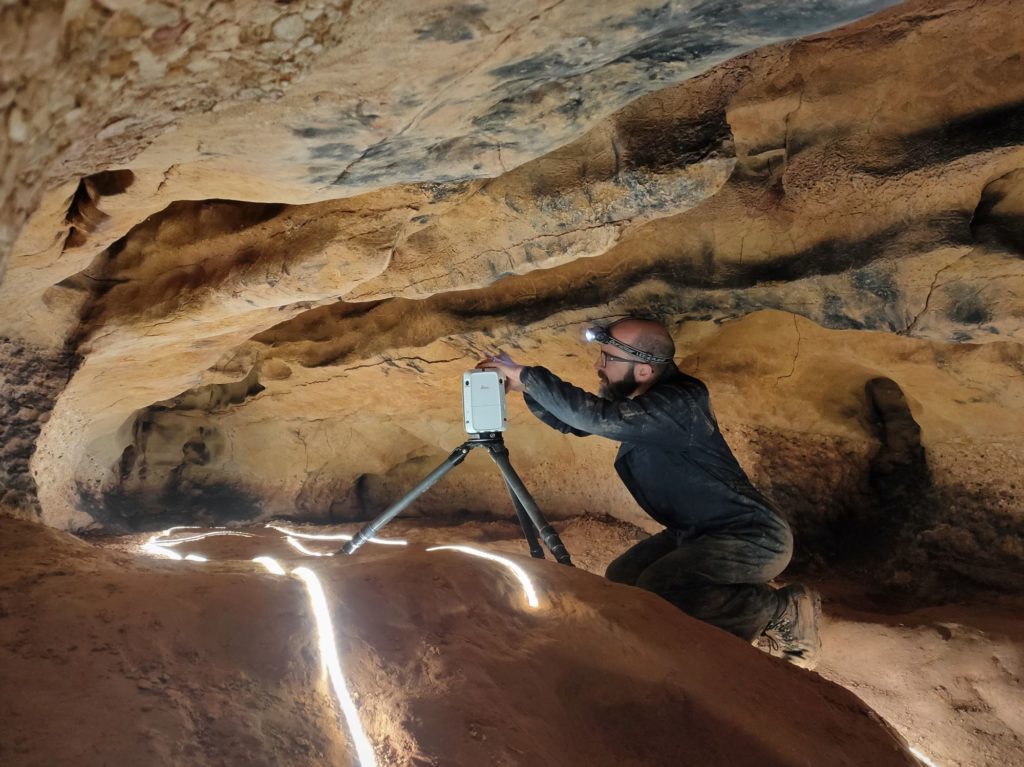
Archaeologist makes a 3D scan of the prehistoric cave art at Font Major in Spain.

Without going into space and littering it with our detritus and conflicts, there are plenty of unknowns here to satisfy our taste for exploration. In this article from ArtNet News, we learn, for example, about a recent discovery made in Spain that opened up a whole new batch of mysteries.

Javier Pes writes, “Experts have discovered a cave full of prehistoric carvings in northern Spain. Among the hundreds of rock carvings, some believed to be 15,000 years old, are vivid depictions of horses, deer, and bulls, as well as a wealth of mysterious and abstract symbols. Unlike the famous prehistoric paintings at Altamira, also in northern Spain, the recently discovered cave art in Catalonia is carved directly into the soft surface of the rock.

“A team of archaeologists stumbled across the richly decorated cave at the end of October 2019. … Josep Maria Vergès, who led the team from IPHES (the Catalan Institute of Human Palaeoecology and Social Evolution) described the find as ‘exceptional’ in a statement, and compared the cave to a ‘shrine.’

“The cave art is now being recorded and studied using 3D scanning technology. The engravings were created on a layer of soft sand deposited on the cave’s surface in an area that is difficult to access. The artworks are extremely fragile. … Several figures seem to have been damaged in the past by visitors who were unaware of their existence. Experts are now studying the best way to preserve the remarkable finds.

“Vergès tells Artnet News, that he felt a ‘mixture of surprise and disbelief, followed by great satisfaction,’ when the he first saw the ancient works of art. ‘Surprise because the cave is not an ideal place to find engravings due to the characteristics of the rock, the walls were very irregular, and the specialists thought that it was not suitable for painting or engraving.’ …

“The oldest art in the cave is believed to date back to the Late Stone Age, or Upper Paleolithic period. The earliest cave paintings at Altamira date from the same period, although they are around 20,000 years older. 

“Researchers uncovered the art within a nearly two-mile-long complex of caverns about 60 miles from Barcelona called the Cave of Font Major, which was first discovered in 1853. Parts of this cave complex, one of Europe’s largest, are open as a subterranean museum, although the specific stretch containing these carvings is closed to the public. …

“[In a related event] anthropologists working at Abri Blanchard in France’s Vézère Valley announced in 2017 the rediscovery of a 38,000-year-old rock engraving. It depicts an aurochs, or wild cow, and rows of dots. That ancient image is believed to be one of the earliest artworks found in Europe.”

More at ArtNet News, here.

Read Full Post »

There are always new things to discover. We’ll never stop needing scientists to discover treatments and cures for emerging illnesses or new kinds of energy to replace fossil fuels. We’ll never stop needing diplomats and non-diplomats to discover ways to make peace or artists to lead us to new frontiers of imagination.

And what about archaeologists? New discoveries of ancient artifacts continue to teach us so much about both our history and our future.

Hakim Bishara writes at Hyperallergic, “In a remarkable discovery, archaeologists have found one of the world’s largest collections of prehistoric rock art in the Amazonian rainforest. Tens of thousands of paintings of animals and humans, made up to 12,600 years ago, were found on an eight-mile rock surface along the Guayabero River in the Colombian Amazon.

“Called ‘the Sistine Chapel of the ancients,’ the collection includes drawings of large mammals, birds, fish, lizards, handprints, and masked figures of dancing humans. The ancient paintings also record interactions between humans and extinct species of giant Ice Age mammals like mastodons.

“The discovery belongs to a joint team of Colombian-British researchers, led by Jose Iriarte, a professor of archaeology at Exeter University in the United Kingdom. The archeologists conducted the main bulk of excavations in the area between 2017-2018 with the intent of revealing their findings in the [British] documentary series Jungle Mystery: Lost Kingdoms of the Amazon. … The documentary’s presenter is Ella Al-Shamahi, an archaeologist and explorer. The findings are also outlined in an article in the journal Quaternary International.

“In an email to Hyperallergic, the researchers wrote: ‘The excavations, in the deep soil around the shelters, have revealed one of the earliest secure dates for the occupation of the Colombian Amazon and clues about people’s diet at this time, as well as the remains of small tools and scraped ochre used to extract pigments to make the paintings.’

“The team has also found realistic drawings of deer, tapirs, alligators, bats, monkeys, turtles, serpents, and porcupines. There are also depictions of creatures resembling a giant sloth, camelids, horses, and three-toe ungulates with trunks.

‘These native animals all became extinct, probably because of a combination of climate change, the loss of their habitat and hunting by humans,’ the researchers wrote.

“According to the researchers, communities that lived in the area at the time of the drawings were hunter-gatherers who fished in the nearby river. Remains of bones and plants found during the excavations shed information about their diets, which included palm and tree fruits, piranha, alligators, snakes, frogs, rodents such as paca, capybara, and armadillos. …

“The archaeologists wrote, ‘At the time the drawings were made temperatures were rising, starting the transformation of the area from a mosaic landscape of patchy savannahs, thorny scrub, gallery forests and tropical forest with montane elements into the broadleaf tropical Amazon forest of today.’ “

More pictures at Hyperallergic, here. That list of animals is reminding me of Suzanne at age 5, when she was a huge fan of the capybara. We saw a few at Disney World that year.

Read Full Post »

Sometimes when scientists are doing basic research with no practical application in sight they land on the missing piece to understanding a rare disease. And when conservationists preserve some creature no one else cares about, the world may later find that the creature is essential to a whole ecosystem. Unexpected discoveries are often the best kind.

Meanwhile, in the department of Treasures Found While Seeking Something Else, there’s a delightful report at the BBC on the unsought discovery of a rare copy of Shakespeare’s last play. No one would have found it if they were looking for it.

Reevel Alderson from BBC Scotland writes, “The Two Noble Kinsmen, written by Shakespeare with John Fletcher, was found by a researcher investigating the work of the Scots economist Adam Smith. …

“In the 17th Century, the seminary in Madrid was an important source of English literature for Spanish intellectuals. The Two Noble Kinsmen was included in a volume made up of several English plays printed from 1630 to 1635.

“Dr John Stone, of the University of Barcelona, said he found it among old books in the library of the Real Colegio de Escoceses — Royal Scots College (RSC) — which is now in Salamanca.

” ‘Friendship turns to rivalry in this study of the intoxication and strangeness of love,’ is how the Royal Shakespeare Company described the play, which is based on Chaucer’s The Knight’s Tale.

“It was probably written around 1613-14 by Shakespeare and John Fletcher, one of the house playwrights in the Bard’s theatre company the King’s Men. …

“Described as a ‘tragicomedy,’ the play features best friends, who are knights captured in a battle. From the window of their prison they see a beautiful woman with whom they each fall in love. Within a moment they have turned from intimate friends to jealous rivals in a strange love story which features absurd adventures and confusions.

“Dr Stone, who has worked in Edinburgh and Aberdeen, said: ‘It is likely these plays arrived as part of some student’s personal library or at the request of the rector of the Royal Scots College, Hugh Semple, who was friends with the Spanish playwright Lope de Vega and had more plays in his personal library. …

” ‘In the 17th and 18th Centuries, collections of books in English were rare in Spain because of ecclesiastical censorship, but the Scots college had special authorisation to import whatever they wanted.’ …

“The rector of the Scots College, Father Tom Kilbride, said the college was proud such an important work had been discovered in its library.

“He said: ‘It says a lot about the kind of education the trainee priests were getting from the foundation of the college in Madrid in 1627, a rounded education in which the culture of the period played an important part. To think that plays would have been read, and possibly performed at that time is quite exciting. There was clearly a great interest in Spain at that time in English literature.’

“The RSC no longer trains men for the priesthood in Scotland, but offers preparatory six-month courses for those expressing a vocation, and holds regular retreats and conferences for the Scottish Catholic community.” More at the BBC, here.

Hat tip: ArtsJournal.com.

Read Full Post »

Older Posts »