Feeds:
Posts
Comments

Posts Tagged ‘drought’

Photo: RJ Sangosti/MediaNews Group/The Denver Post via Getty Images.
Above, Las Vegas Valley Water District Water Waste Investigator Devyn Choltko puts a water waste violation into the computer system outside a home in north Las Vegas, Nevada.

When water is seen running into the gutter from a lawn in a desert city, Water Waste Investigator 9393 steps in. The good news is, water conservation efforts like those in Las Vegas are paying off.

Yvette Fernandez reports at National Public Radio by way of the Mountain West News Bureau, an NPR regional hub, in collaboration with Nevada Public Radio in Las Vegas. 

“About two dozen investigators patrol neighborhoods throughout Las Vegas every day searching for signs of wasted water. They’re known as water waste investigators who are part of the Southern Nevada Water Authority. For more than 20 years, they have been helping conserve water in the growing desert city.

“Devyn Choltko is one of the investigators with the Las Vegas Valley Water District, which is part of SNWA. … On an early July morning, she stops her patrol car in a neighborhood where water flows onto the street.

” ‘Water Waste Investigator 9393,’ Choltko reports into her cell phone to record the incident. ‘Some misaligned sprinklers as well as over-irrigation causing some run-off,’ she continues. …

“Choltko says ‘spray and flow’ violations are among the most common problems. This is when water from a sprinkler head sprays out onto the sidewalk or street, and that’s considered wasted water.

“Choltko marks a yellow flag with the date, time and alleged violation, then places the marker on the property to notify the resident. The investigators can only leave the yellow flag if they have actually witnessed the violation.

” ‘Most people don’t even know they have a problem,’ Choltko says. …

“Residents get a few notices to take corrective action. If they are ‘repeat’ violators, a fine ‘is recommended,’ says Choltko. They face a fee of $80 initially, which can continue to double if ignored.

“Choltko says some homeowners may have issues they aren’t aware of. A homeowner, for example, may have taken proactive steps to conserve water by removing their grass and switching to desert landscaping. Succulents and drought-resistant plants should be watered using drip irrigation to get water directly to the roots and reduce evaporation. But faulty or worn-out tubes can result in water spewing onto sidewalks. …

“For low-income homeowners who cannot afford repairs, the SNWA can provide financial assistance to make necessary repairs. It will also provide help in detecting leaks.

“More than twenty years ago, drought gripped the Colorado River Basin. … By 2003, the Southern Nevada Water Authority, a not-for-profit water provider with a half dozen water collaborative agencies in southern Nevada, responded with several water conservation efforts, which included starting the water patrol. …

“Says Bronson Mack, a spokesperson with the SNWA, the goal [is] to educate people about the importance of water conservation and encourage people to change their behavior. That change can be as small as people taking shorter showers or reusing water for plants or cleaning.

” ‘We collected in the neighborhood of about $1-$1.5 million over the recent years in water waste violations,’ says Mack. The Las Vegas Valley Water District uses those dollars to support conservation programs, such as incentives to remove turf and rebates to install smart irrigation systems. …

“Just east of Las Vegas, receding ‘bathtub rings’ are etched into one of the country’s largest reservoirs, Lake Mead — a reminder of how much water there once was. The reservoir provides water to Las Vegas and surrounding Clark County. Lake Mead and Lake Powell are at less than 35% normal capacity.

“The Southern Nevada Water Authority … has a significant effort to recycle water that’s already been used by treating it and putting it back into use. According to SNWA, it returned more than 245,000 acre-feet of water to Lake Mead in 2024. …

“The population of Las Vegas has grown by over 800,000 people since 2002. And, the city has seen over 40 million visitors during that time. Despite that growth, ‘we have reduced our consumption of Colorado River water by more than 30% over the past two decades,’ Mack says. …

“Low levels at Lake Mead and Lake Powell are expected to continue, according to the latest data released by the Bureau of Reclamation. The Department of the Interior’s Acting Assistant Secretary for Water and Science, Scott Cameron, said in a news release: ‘forward-thinking solutions’ that prioritize conservation will be increasingly important.”

More at NPR, here.
Read Full Post »

Photo: ItalianNotes.
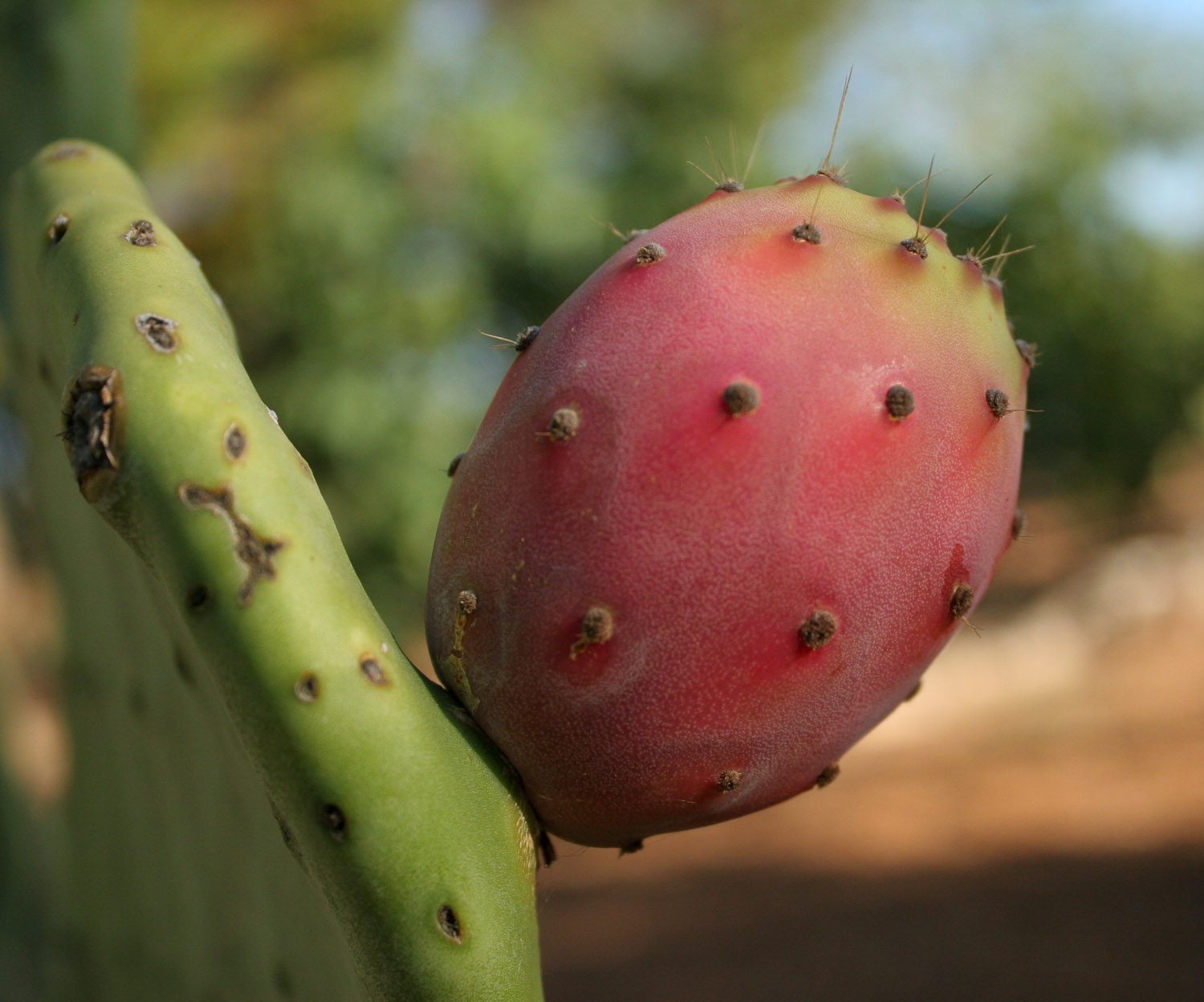
Prickly pear, or cactus pear. When Italy suffers from drought, some people turn to an edible cactus.

A while ago I posted photos I’d taken in New England and was surprised to see a cactus this far north. Hannah called it “prickly pear” and told me it was known for its versatility. It’s apparently the same cactus that Italy is looking to as a reliable food source.

Stefano Bernabei and Gavin Jones write at Reuters, “Global warming, drought and plant disease pose a growing threat to agriculture in Italy’s arid south, but a startup founded by a former telecoms manager believes it has found a solution: Opuntia Ficus, better known as the cactus pear.

“Andrea Ortenzi saw the plant’s potential 20 years ago when working for Telecom Italia in Brazil, where it is widely used as animal feed. On returning to Italy he began looking at ways to turn his intuition into a business opportunity.

“He and four friends founded their company, called Wakonda, in 2021, and began buying land to plant the crop in the southern Puglia region where the traditionally dominant olive trees had been ravaged by an insect-borne disease called Xylella.

“The damage from the plant disease has been compounded by recurring droughts and extreme weather in the last few years all over Italy’s southern mainland and islands, hitting crops from grapes to citrus fruits.

“Ortenzi is convinced the hardy and versatile cactus pear, otherwise called the prickly pear or, in Italy, the Indian fig, can be a highly profitable solution yielding a raft of products such as soft drinks, flour, animal feed and biofuel. …

” ‘As an industry, cactus pear production is growing rather quickly, especially for fodder use and as a source of biofuel,’ said Makiko Taguchi, agricultural officer at the United Nations’ Food and Agriculture Organization headquartered in Rome.

“The cactus produces a tasty fruit eaten in much of Latin America and the Mediterranean, while in Mexico the flat green pads that form the arms of the cactus, are used in cooking. In Tunisia, where it covers around 12% of cultivated land, second only to olive trees, the cactus pear is a major source of income for thousands, particularly women who harvest and sell the fruit.

“In Brazil, which has the world’s largest production, it is mainly cultivated in the north-east for fodder, while Peru and Chile use it to extract a red dye known as Cochineal, used in food and cosmetic production.

Sportswear group Adidas and carmaker Toyota have recently shown interest in using the cactus to produce plant-based leather sourced mainly from Mexico.

“The cactus pear is not yet included in the FAO’s agricultural output statistics, but Taguchi cited the rapid expansion of CactusNet, a contact network of cactus researchers and businesses worldwide which she coordinates. …

“The plant, native to desert areas of south and north America, thrives in the increasingly arid conditions of Italy’s south, and needs ten times less water than maize, a comparable crop whose byproducts also include animal feed and methane. …

“Of the roughly 100,000 hectares of olive trees destroyed by Xylella in southern Puglia, only 30,000 will be replanted in the same way, [Ortenzi] told Reuters in an interview. ‘Potentially 70,000 could be planted with prickly pears,’ he said. …

“Wakonda’s business model discards the fruit and focuses instead on the prickly pads, which are pressed to yield a juice used for a highly nutritious, low-calorie energy drink. The dried out pads are then processed to produce a light flour for the food industry or a high-protein animal feed.

“Wakonda’s circular, ecological production system also includes ‘biodigester’ tanks in which the waste from the output cycle is transformed into methane gas used as a bio-fuel either on site or sold. …

“Under Ortenzi’s business plan, rather than buying up land to plant the cactus, Wakonda aims to persuade farmers of its potential and then license out to them, in return for royalties, all the equipment and know-how required to exploit it.

” ‘The land remains yours, you convert it to prickly pears and I guarantee to buy all your output for at least 15 years,’ Ortenzi said.”

Hmmm. I have two issues. Throwing out the fruit seems super wasteful. And methane may be a biofuel, but it’s no better for the environment than fossil fuel. What do you think?

More at Reuters, here. No firewall.

Read Full Post »

Photo: Roberto Nutlouis.
Danielle Kaye builds a berm spillway on the farm of Roberto Nutlouis. The berm holds back water, flooding the cornfield behind it. Navajos are using ancient ways to restore parched earth.

In their eagerness to invent, humans seem to be programmed to forget why ancient ways worked. Then they have to reinvent the wheel. Fortunately, indigenous people often are repositories of that wisdom and can produce it as needed.

Lela Nari writes at YaleEnvironment360, “Here in Burnt Corn Valley, smack in the middle of the Navajo reservation’s vast Black Mesa region, the hilly land both craves water and is brutalized by it. The sandy Arizona soil cracks under a punishing August sun as red-striped blister beetles search for moisture across its baked surface. Cottonwood trees and sagebrush rise from deep gullies carved by floodwaters that, during the intensifying summer monsoon, sluice off surrounding mesas and wash away fragile topsoil — reminders that with climate change, even quenching rains harbor powers of destruction.

“This portrait of climatic havoc belies a softer reality, though. Farming once thrived in this parched region and could once again — if the right practices are adopted. Exhibit A: The crops on Roberto Nutlouis’s 12-acre Sliding Rock Farm, in his reservation hometown of Piñon, a five-hour drive north of Phoenix.

“ ‘The corn is actually pretty big and thriving,’ Nutlouis says. He believes — and both Western science and the lived experience of his Native elders affirm — that the traditional rock and stick structures he’s built on his property, which help store water and prevent erosion, have a lot to do with it.

“These structures, similar to those used by Native peoples long before Europeans arrived on the continent, are not only delivering water to crops. … They are also restoring Nutlouis’s watershed and those of his neighbors, helping to sequester carbon, and reviving this high-desert ecosystem. It’s all part of a bigger effort among a range of local and regional grassroots organizations to build back the reservation’s fragile, depleted ecosystems and bring greater sovereignty over food, water, and health to its communities.

“Diné (the Navajo name for themselves) are well aware that climate change is making the weather on their semi-arid plateau weirder, wilder, and more destructive. … The ecological health of the reservation has also been weakened by deforestation from timbering operations and from overgrazing over the years.

“Still, this season, Nutlouis, 44, has been able to skip his usual two-hour roundtrip drive to a reliable well to haul water home for his corn. His crop is healthy and hydrated because his land still holds last winter’s snowmelt. Clearly, his heavy labor over the past 20 years — during which he has built woven brush dams, gabions (wirework cages filled with rocks), earthen berms, concrete spillways and trenches, limestone aprons and walls, and stone-lined ‘Zuni bowls,’ which stabilize eroding streambeds — is paying off.

“Diné and others living in arid zones around the world have long used structures made of naturally occurring materials to capture and control water to grow crops and to mitigate the devastation of floods in ephemeral stream systems. …

“Time and again over the last 15 years, Laura Norman, a research scientist with the U.S. Geological Survey, has seen evidence that when these structures — which Norman calls Natural Infrastructure in Dryland Streams, or NIDS — are placed in gullies, they slow water to mitigate erosion, collect nutrient-rich sediment and plant debris that nourish both crops and wild plants, help store carbon, improve groundwater recharge, and increase downstream water availability by as much as 28 percent. ‘It’s a snowball effect that counters degradation, and you get all of these ecosystem services,’ she says.

“The structures on Nutlouis’s farm are integral cogs in a larger system. … Nutlouis’s property lies in an alluvial fan, where mineral-rich sediments and plant waste atop mesas and other uplands wash down onto flatter ground with rainwater, snowmelt, and spring water. Across the valley, similar farms rely on this kind of system, many of which feature stone and stick constructions that Nutlouis helped build. The organic materials trapped behind the structures, says Jonathan Sandor, an emeritus agronomy professor at Iowa State University, ‘are a major input into keeping the fertility of the soils up.’ …

“Whether rock walls or ramps, hand-dug depressions in the soil, earthen walls, or branches plaited into dams, NIDS splash water over a wider area and slow its flow so it can better soak into the soil. Many trap sediments behind them, fertilizing whatever grows nearby. The stone structures create a hyperlocal cooling effect, especially when they’re combined with shade-making vegetation.

“Here, too, smallness is a boon. ‘Even tiny little one-rock dams can make big changes on the landscape,’ Norman says. …

“Lately, climate change has thrown extra challenges at the reservation. … But the ecosystem services provided by Nutlouis’s structures on his farm and elsewhere do seem to be meeting those climatic challenges. He’s noticed small juniper trees popping up on hillsides around his property despite the dryness; A cottonwood tree towering over one cornfield is also lush and full. ‘The idea that Earth will restore itself with natural seed dispersal’ after NIDS begin to do their job ‘has been my observation,’ says Norman.

“Or as Nutlouis puts it, ‘We’re allowing nature to do its own thing and restore itself.’ ”

More at Yale e360, here. Fascinating pictures. No firewall.

Read Full Post »

Photo: Jack Thompson.
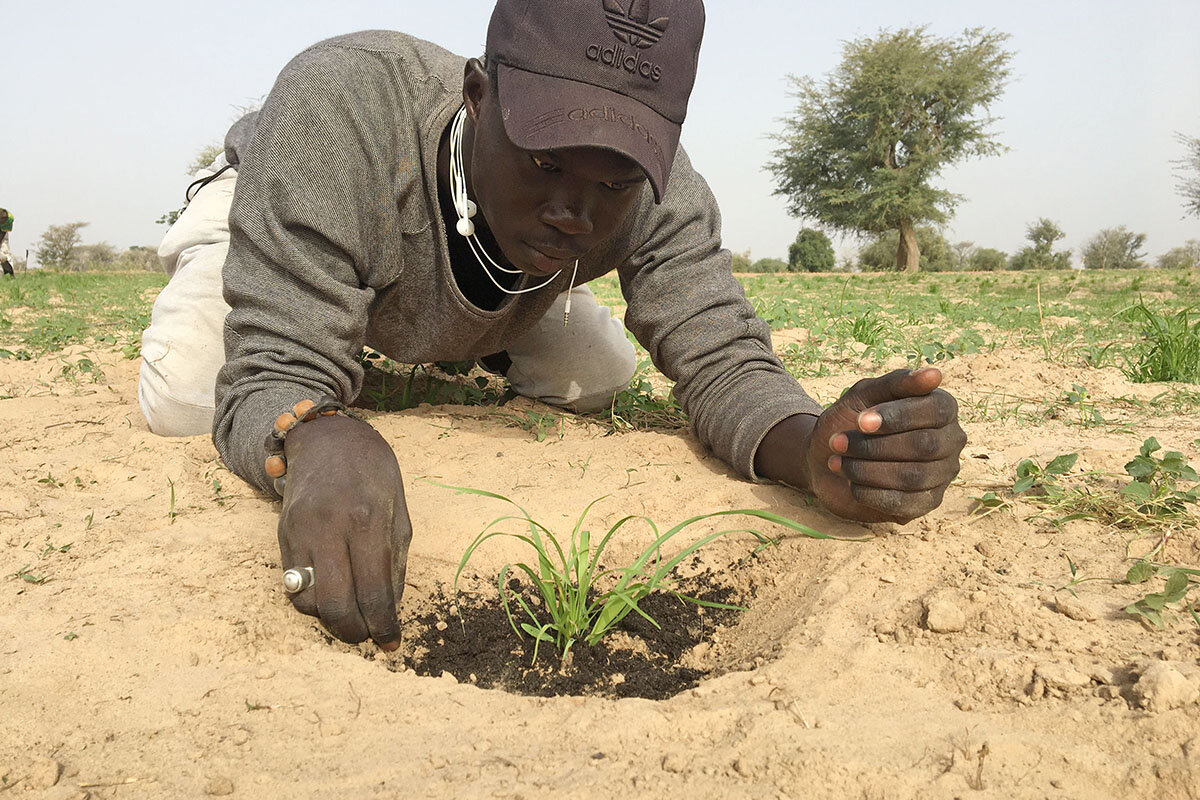
From the Christian Science Monitor: “Farmers in Ndiob, Senegal, are experimenting with ‘zaï’ planting pits, an ancient practice to conserve moisture even during acute droughts.

With climate change and drought in Africa affecting crop yields, some farmers are adopting ancient techniques for conserving water.

Jack Thompson writes at the Christian Science Monitor, “Rain is like alchemy for farmer Thialla Badiane in the Sahel region of Senegal. Suddenly, it transforms dusty dunes into rich verdure, barren plains into crop-laden fields. 

“But rain is increasingly scarce here on the edge of the Sahara desert. Temperatures are rising by 50% more than the global average and threatening Mr. Badiane’s most precious resource to feed himself and his seven children. 

“Annual rainfall could drop by 38% in Senegal in the coming decades, a threat to the way of life for the nation’s 8 million farmers. Already the growing climate emergency means rainfall has become more unpredictable, water scarcer, and droughts longer.

“So in Mr. Badiane’s hometown of Ndiob, hundreds of farmers seeking to combat those effects have revived an ancient farming technique – with a 21st-century twist. ,,,

“Mr. Badiane [drills] repeatedly into the thick crust of the earth with a giant motor-powered corkscrew, leaving a pattern of perfectly spaced holes. In one hectare, he will drill 10,000 holes for his millet seeds, a planting technique known as zaï

“Originally from neighboring Burkina Faso, zaï is the traditional technique of making small indentations in the ground that capture rainfall and increase the fertility of the soil. It’s painstaking work, but a lot easier than digging the holes by hand with a hoe.

“Millet has been making waves on the international stage … because the crop can grow on arid land, can survive extreme heat, and is high in protein and micronutrients.

“And with his modern take on an ancient practice, Mr. Badiane has increased his yield of millet by 50% – though research shows zaï can triple production. If it were to become widespread, this Indigenous technique could help farmers become more resilient to a changing climate. …

Zaï combats [water runoff] by creating pockets for the water, making sure it doesn’t run off and take nutrients and minerals with it. 

“This is the ambition of Ndiob’s Mayor Oumar Ba, renowned in Senegal for his commitment to agroecology, a form of sustainable farming based on millennia of Indigenous knowledge and innovation. …

“Across the continent, many officials, scientists, and ordinary citizens are already looking to adapt. Faced with increasingly unpredictable weather in Ndiob, Mr. Ba traveled to Burkina Faso, a landlocked nation that gets even less rain than Senegal, to search for ways to beat intensifying drought. Four years ago, he brought back zaï

“ ‘Before, it used to rain consistently for five months; it would start in June and end in November,’ says the mayor’s agricultural advisor, Mame Kor Faye. ‘Now, not one farmer can tell you when the season will start.’ …

“Drought is a vicious circle for farmers: As rainfall decreases, the soil compresses. When it finally does rain, the dehydrated, packed  land cannot absorb the water and the top layer of fertile topsoil washes away. … ‘Zaï is a solution to this scarcity of water and to restore the fertility of our soils,’ Mr. Faye says.

“For Mr. Badiane, the planting plots are a double win.  Under the burning November sun, he bends over each small pit and delicately places a handful of rich, dark fertilizer. It’s a far smaller amount than he used when he composted his entire field. 

“Prices of fertilizer have skyrocketed since Russia, the world’s top exporter, invaded Ukraine and supplies were squeezed. Since then, animal manure, an alternative to chemical fertilizer, has been in short supply.

“ ‘The reason zaï interested me is because I wanted to save on organic manure,’ Mr. Badiane says. ‘Before, you didn’t have to pay for manure – livestock herders would give it to you. Now it’s hard to find, and you have to pay.’ 

“ ‘When the rain falls on the manure, it retains the humidity that the plant needs,’ says Isidore Diouff, an agronomist from the Senegalese nongovernmental organization Enda Pronat and who has been leading the zaï experiments in Ndiob. He kneels down to inspect a newly planted seed in its pit. ‘You can go 20 days without rain, and the pit will still be damp.’ 

” ‘Four months later, Mr. Badiane admires his ready-to-be-harvested, fingerlike plants. Nurtured by the moist soil, their soaring leaves tower over the 6-foot-tall farmer. Assessing the plant’s density and weight, Mr. Badiane predicts a good yield.”

More at the Monitor, here. No firewall. Subscriptions encouraged.

Read Full Post »

Photo: Sarah Matusek/The Christian Science Monitor.
Jeff Dollente, a zanjero for the Imperial Irrigation District, greets the sunrise on his morning shift delivering water to farm fields in Imperial County, California, Feb. 15, 2023. The water originates from the Colorado River.

Suzanne’s friend Kevin was here last month. He had some interesting thoughts about floods in California, droughts other places, and how great it would be to move excess water from flooded places to drought-stricken ones.

Today’s story, by Sarah Matusek at the Christian Science Monitor, is a bit different, but it describes one way people are already moving water to where it’s needed.

“In the right light, Jeff Dollente seems to make the sun rise. Standing over a canal, he cranks a wheel as the sun ascends and the sky yawns off the dark. … He delivers Colorado River water – a vital resource at risk to farms that feed the rest of the United States.

“He’s a ‘zanjero,’ Spanish for ditch rider, for the Imperial Irrigation District, the area’s public-water and energy agency. California is entitled to the largest share of Colorado River water among seven basin states, and within that, the agency has the single largest entitlement, almost all of which goes to agriculture. Upping the ante: The river is the Imperial Irrigation District’s only water source. 

“The crisis on the Colorado River, strained by overuse and the effects of climate change, is unlikely to reverse due to recent heavy rain and snow, experts say. While critical lows along the river threaten water supplies and hydropower, California hasn’t agreed with other states this year on who should conserve how much – though the Imperial Valley is a controversial target of calls for cuts.

“As the federal government prepares to weigh in and high-level talks continue, so do zanjero daily duties on the ground. It takes focus and precision to safeguard each drop of liquid gold. …

“The Imperial Irrigation District is entitled to 3.1 million acre-feet of Colorado River water a year, though it uses less. (In 2021, for example, the district reports conserving 485,709 acre-feet.) The district also has among the most senior water rights on the river; junior water rights holders are generally expected to take cuts first. Imperial Valley growers – touting their efforts in farm-based conservation – are trying to hold on to a water-intensive farming tradition that’s more than a century old.

“Greening nearly half a million acres of farmland flanked by desert, the district gets its Colorado River water from the Imperial Dam on the California-Arizona border. The water nourishes alfalfa, winter vegetables, and other crops to the west – passing through some 3,000 miles of canals and drains – and then runs off into the Salton Sea. Robert Schettler, public information officer, calls it a daily miracle. …

“It’s a high-stakes relay race. From the Imperial Dam, water flows into the major All-American Canal, which feeds into three main canals, and then is directed into a series of lateral canals. Zanjeros – who oversee the lateral canals 24/7 – usher that water to delivery gates at the edge of farm fields, according to how much has been ordered. …

“Today on the Redwood Canal, he’s tasked with delivering water measured in cubic feet per second. At one stop, he raises a gate a mere inch higher to adjust the flow.

‘They’re the face of the district to the farmer,’ says Ralph Strahm, co-owner of Strahm Farms Inc. in Holtville. ‘They’re the ones that save the system from breaching if there’s a problem.’

“Some days are stressful for Mr. Dollente. But he’s never fallen in. He’ll often clean canals of trash – a tumbleweed today. One time he found a cow, another time a gun. 

The water district employs around 140 zanjeros, currently all male. … The term comes from the word zanja, or ditch, and describes part of the irrigation practices introduced by Spanish settlers in what would become California. Zanjeros have worked for the Imperial Irrigation District since it formed in 1911, once living in houses near the waterways they tended. …

“The role has also evolved alongside technology like cellphones. Mr. Strahm, the farmer, works closely with zanjeros and keeps their contacts in his phone. Still, he says he’d like to see the water district adopt more automation, which is widespread but most extensive along the larger canals, to support conservation.

“ ‘We need more accurate and timely delivery of water with recording devices to alert the zanjero when the water fluctuates,’ says the grower.

“Water-saving measures that he favors, like sprinkler or drip irrigation, don’t work when water fluctuates, he adds. ‘If there’s too little, the system shuts off. And if there’s too much, it can’t be used. It just goes to waste.’ ”

More at the Monitor, here. No firewall.

Read Full Post »

Photo: Serious Shea.
Community members stand by a tree planted in Senegal during the launch of the Great Green Wall Corporate Alliance, an initiative that is part of larger efforts to prevent desertification in Africa’s Sahel region. “Serious Shea,” says the Christian Science Monitor, “is transforming a previously firewood-dependent shea industry in Burkina Faso.”

When it comes to human rights and climate justice, corporations can get into the act. It can even boost their brand. Blogger Rebecca told me about a clothing company, Fair Indigo, where she buys clothes because the cotton is organic and she knows the workers are paid a fair wage. I myself have bought cotton towels at Patagonia, which has protected the environment for decades and now promises not to use cotton from Chinese forced labor.

At the Christian Science Monitor, Taylor Luck, Whitney Eulich, Ahmed Ellali, and Sandra Cuffe write about how various countries are working on water conservation — and how certain companies are helping.

“In Guatemala, farmers are setting up ‘living fences’ around fields, creating a buffer of roots to protect their soil during increasingly strong rainy seasons. In Jordan, local Bedouin communities and authorities are pioneering resilient desert agriculture in a region that has been hit by longer and more intense heat waves.

“And in Burkina Faso, William Kwende has been working to revolutionize shea butter production – by substituting renewable energy for traditional wood-burning methods that result in deforestation. He has introduced an approach with 100% renewable energy, self-sustaining biomass burners, and a closed water system, which is curbing emissions while also reducing crop losses. 

“At a time of global strain on food production, including an emerging famine in parts of East Africa, his story symbolizes the potential for using innovation to adapt to a changing climate.

The business Mr. Kwende co-founded, called Serious Shea, is designed to promote reforestation and to secure fairer wages and independence for the local women at the heart of the process. 

“A key part of the innovation: Serious Shea’s eco-processing centers transform shea tree biomass into natural biofertilizer and biochar, enriching soils that are at risk of desertification and reducing reliance on expensive imported chemical fertilizers. 

“ ‘People talk about water and food imports, but when you talk about food crises and adaptation, fertilizer is at the heart of it,’ Mr. Kwende tells the Monitor on the sidelines of COP 27 [Conference of Parties 27], this year’s global climate summit, at Sharm el-Sheikh. …

“Across the globe, innovative ideas like that are greatly needed. Extreme weather events are affecting the vital sector of food production – with the shifts especially hard for Indigenous communities and small-scale farmers. In Peru, rising temperatures have upended the livelihoods of alpaca farmers. In Pakistan, massive floods have sidelined several million acres from crop production. In Somalia and Kenya alone, drought threatens to push millions into food-poverty and starvation. …

“With its own farmers suffering losses amid intense heat waves and drop in Nile waters, atop the food-security crisis in the Horn of Africa, Egypt has placed agriculture front and center to an unprecedented degree at the current [COP]. …

“Agriculture experts say some of the solutions will involve mass-produced technologies such as battery-operated farm equipment. But it will also involve the rise and transfer of hundreds of local, homegrown solutions emerging across the world, many of which advocates say can cut carbon, improve resilience, and be replicated elsewhere. 

“In Mexico, where last summer eight of 32 states experienced moderate to extreme drought and where half of all municipalities in the country face water shortages, some farmers turn 2-liter soda bottles upside down over saplings to capture morning dew or dig holes and line them with organic materials like leaves, to retain rainfall around young trees.

“To the south in Peru, Alina Surquislla’s family has never seen anything like the current effects of rising temperatures in their three generations of alpaca herding. 

“There’s no water; the grass is turning yellow and disappearing for lack of rain,” says Ms. Surquislla. Alpacas are dying out at worrying rates. Speaking over a Wi-Fi satellite connection while walking at nearly 16,000 feet above sea level in the Apurimac region … for now, she says the answer for herders is to go to higher and higher elevations in search of water and grazing.

“Water is also scarce in Jordan. There, local Bedouin communities and authorities are scaling up pioneering desert agriculture in Al Mudawara, a border region near Saudi Arabia that has been hit by longer and more intense heat waves in the past few years. 

“Since 2019, under a directive by Jordan’s King Abdullah, each family in the area has been tending to 6-acre plots of yellow corn and green onions, watered from an underground aquifer. The crops have proved resilient to more frequent 120 degree F temperatures, sprouting up into green waves amid reddish desert sands that have not been utilized for agriculture in modern history. 

“Now over 4,000 acres of corn stalks stand 3 feet high and onions sprout in Al Mudawara. These provide alternative sources of income and living for Bedouin families, many of whom have been forced to abandon traditional camel shepherding due to the mounting costs of imported animal feed. …

“Says Abu Fahed al Huweiti, former director of the Al Mudawara Agricultural Cooperative that has steered the project. ‘It has given a new hope for people here.’

“In Tunisia, amid the lush fig and olive groves of Djebba, clinging to the tops of the Gorraa mountain, farmers continue a centuries-old terraced farming that has helped them cope with massive heat waves and drought that has hit much of Tunisia. 

“A series of cement-lined canals crisscross down the hill through the terraced farms, carrying water from natural springs fed by winter’s snow to groves of figs, pomegranates, quince, and olives on a rotating basis of collective water-sharing. 

“This ingenious method of traditional Berber farming provides timed irrigation of entire land plots, allowing local farmers to grow not only trees but also herbs and diverse flora and fauna, feeding livestock and chickens – all from the same measured water delivery. …

“ ‘We in Djebba keep using the same old techniques because it has shown success. It is an inherited model of coexistence and represents the ideal use of available water resources,’ says Fawzi Djebbi, Djebba farmer, activist, and head of the annual Djebba Fig Festival.  ‘Here we use the water as a collective resource from the mountains. This water belongs to all of us.’  

“Knowledge- and expertise-sharing has also been critical to speeding up farmers’ adaptation to the pummeling effects of severe weather events. 

“The CCDA, an Indigenous and small farmers movement for land rights and rural development in Guatemala, is working with many of their 1,300 affiliated communities around new techniques to help farmers adapt. This year’s rainy season has been one of the longest and heaviest this century, for example.

“One technique is planting trees and plants with deep roots around crop plots. The plants are a buffer against erosion, provide shade during the hot and dry season, and sometimes include edible plants as well. …

“Global organizations are seeking to spread helpful practices and information. The United Nations Food and Agriculture Organization (FAO) has been teaming up with Vodafone to get early warning systems and messages to rural farmers across Africa to better prepare for projected climate trends and to provide advice on mitigation measures.” 

More at the Monitor, here.

Read Full Post »

Photo: Jorge Sierra/WWF Spain.
“Hundreds of freshwater basins across the world, including the dried-up Santa Olalla permanent freshwater lagoon in Spain’s Doñana National Park, are the most likely to experience social and ecological impacts due to freshwater use,” says Xander Huggins at the Conversation.

I’ve been trying to learn meditation. Doctor recommendation. It seems to be mostly about focusing on breathing — in, out, in, out. I am starting to appreciate what a miracle breathing is. Unless we have asthma or COPD, we are too likely to take that miracle for granted.

Same thing with water.

Xander Huggins, a PhD Candidate in the Department of Civil Engineering, University of Victoria, writes at the Conversation, “When people use freshwater beyond a physically sustainable rate, it sets off a cascade of impacts on ecosystems, people and the planet. These impacts include groundwater wells running dry, fish populations becoming stranded before they are able to spawn and protected wetland ecosystems turning into dry landscapes.

“Developments in computer models and satellites have fostered a new understanding of how freshwater is being redistributed around the planet and have made clear the central role that people play in this change. This human impact is so significant that organizations like the United States Geological Survey are redrawing their water cycle diagram to include the impacts of human actions.

“Equally important to understanding how people affect freshwater availability, is understanding how people and ecosystems will respond to amplified freshwater challenges including drought, water stress and groundwater depletion. While these challenges impact localized sites, their impacts are scattered across the world. To address this global water crisis, global action is urgently needed.

In our recent study, we identified the basins of the world that are most likely to be impacted by two central and interrelated aspects of water scarcity: freshwater stress, which occurs when the consumption of water surpasses renewable water supply, and freshwater storage loss, which is the depletion of freshwater in reservoirs or in groundwater bodies due to persistent overuse.

“We identified 168 basins across the world that are the most likely to experience social and ecological impacts due to insufficient freshwater availability. These hotspot basins are found on every continent — a clear indication of the widespread, global nature of these challenges.

“To identify these hotspot basins, we assessed patterns in freshwater stress and freshwater storage trends and compared these to patterns in societal ability to adapt to environmental hazards and freshwater-based ecological sensitivity indicators.

“The hotspot basins are most vulnerable largely because they are likely to experience social and ecological impacts at the same time. … Hotspot basins are vulnerable as they are likely to face impacts such as low streamflow that harms aquatic biodiversity, reduced food security as agriculture is heavily reliant on freshwater supply, wells running dry and higher potential for social unrest.

“Reducing vulnerability in intertwined societal and environmental systems requires improved policy and management integration across sectors. Integrated Water Resources Management considers and balances social, ecological and hydrological sustainability goals by co-ordinating management across water, land and other related resources. Its inclusion in the United Nations Sustainable Development Goal framework highlights its importance. …

Afghanistan, Algeria, Argentina, Egypt, India, Iraq, Kazakhstan, Mexico, Somalia, Ukraine, Uzbekistan and Yemen have hotspot basins yet low implementation levels of much-needed integrated management practices. …

“While we focus on the identified hotspot basins, this does not mean that impacts cannot occur in basins with lower vulnerabilities. For instance, only a number of Canadian basins — all located in the prairies — are identified with moderate vulnerability in our global study. Yet, dry streams on Vancouver Islandfalling groundwater levels in the Lower Mainlandcrop yields affected by drought throughout the prairies and potential for salt-water intrusion along the East Coast are all instances of freshwater security challenges being faced in Canada. …

“While global studies, such as ours, are helpful at systematically highlighting regions for prioritization, they do not — and should not — provide explicit solutions. Rather, in such intricate social and ecological environments, actions to reduce impacts need to be attuned to place-based social norms, cultural values, hydrological conditions and local knowledge systems.

“Our hotspot basins can help guide such community-driven local action to help conserve freshwater resources that are most under threat and mitigate the ripple effects of these threats on people and ecosystems.”

More at the Conversation, here. See also this Christian Science Monitor post about water drying out in Egypt and all around North Africa and the Middle East. Neither site has a firewall.

Read Full Post »

Photo: Svetozar Cenisev/ Unsplash.
When vegetation that beavers flood is dying, neighbors object to the smell. But often they like the lake that comes later.

There was a woman in my town who was up in arms about beavers flooding part of her property to build a dam. That is, she was angry until the odor of dying grasses dissipated and a beautiful lake appeared.

According to Catrin Einhorn at the New York Times, farmers out West are finding other reasons to appreciate the work of beavers.

She reports, “Horace Smith blew up a lot of beaver dams in his life. A rancher here in northeastern Nevada, he waged war against the animals, frequently with dynamite. Not from meanness or cruelty; it was a struggle over water. Mr. Smith blamed beavers for flooding some parts of his property, Cottonwood Ranch, and drying out others.

“But his son Agee, who eventually took over the ranch, is making peace. And he says welcoming beavers to work on the land is one of the best things he’s done.

“ ‘They’re very controversial still,’ said Mr. Smith, whose father died in 2014. ‘But it’s getting better. People are starting to wake up.’

“As global warming intensifies droughts, floods and wildfires, Mr. Smith has become one of a growing number of ranchers, scientists and other ‘beaver believers’ who see the creatures not only as helpers, but as furry weapons of climate resilience.

Last year, when Nevada suffered one of the worst droughts on record, beaver pools kept his cattle with enough water.

“When rains came strangely hard and fast, the vast network of dams slowed a torrent of water raging down the mountain, protecting his hay crop. And with the beavers’ help, creeks have widened into wetlands that run through the sagebrush desert, cleaning water, birthing new meadows and creating a buffer against wildfires.

“True, beavers can be complicated partners. They’re wild, swimming rodents the size of basset hounds with an obsession for building dams. When conflicts arise, and they probably will, you can’t talk it out.

“Beavers flood roads, fields, timber forests and other areas that people want dry. They fell trees without a thought as to whether humans would prefer them standing. In response to complaints, the federal government killed almost 25,000 beavers last year.

“But beavers also store lots of water for free, which is increasingly crucial in the parched West. And they don’t just help with drought. Their engineering subdues torrential floods from heavy rains or snowmelt by slowing water. It reduces erosion and recharges groundwater. And the wetlands beavers create may have the extra benefit of stashing carbon out of the atmosphere.

“In addition to all that, the rodents do environmental double duty, because they also tackle another crisis unleashed by humans: rampant biodiversity loss. Their wetlands are increasingly recognized for creating habitat for myriad species, from salmon to sage grouse.

“Beavers, you might say, are having a moment. In Colorado, Idaho, Montana, Nevada, Oregon, Utah and Wyoming, the Bureau of Land Management is working with partners to build beaver-like dams that they hope real beavers will claim and expand. In California, the new state budget designates about $1.5 million a year to restoring the animals for climate resiliency and biodiversity benefits.

“ ‘We need to get beavers back to work,’ Wade Crowfoot, California’s secretary of natural resources, said in a webinar this year. ‘Full employment for beavers.’ (Beaver believers like to note that the animals work for free.) …

“Instead of killing beavers, the federal government should be embracing them as an important component of federal climate adaptation, according to two scientists who study beavers and hydrology, Chris Jordan of National Oceanic and Atmospheric Administration Fisheries, and Emily Fairfax of California State University Channel Islands.

“ ‘It may seem trite to say that beavers are a key part of a national climate action plan, but the reality is that they are a force of 15-40 million highly skilled environmental engineers,’ Dr. Jordan and Dr. Fairfax wrote this year in a perspective article in the research journal WIREs Water. …

“When human-beaver conflicts arise, they can be addressed without killing the animals, experts say. Paint and fencing can protect trees from gnawing. Systems like the Beaver Deceiver secretly undo their handiwork with pipes that drain water from beaver settlements even when the animals keep building. Such measures are actually a more effective solution than removing the animals, according to advocates, because new beavers tend to move into empty habitat.

“If coexistence is impossible, a growing number of groups and private businesses are seeking to relocate, rather than kill, nuisance beavers.

“ ‘We put the nuisance in air quotes,’ said Molly Alves, a wildlife biologist with the Tulalip Tribes, a federally recognized tribal organization just north of Seattle that moves unwanted beavers to land managed by the United States Forest Service.

“The group’s impetus was a desire to expand the extraordinary habitat that beavers offer salmon, a culturally and economically important species. When they started in 2014, the Tulalip Tribes had to invoke their sovereign treaty rights to relocate beavers because doing so was illegal in their area under Washington State law. After a lobbying push, beaver relocation is now legal statewide and the tribes are advising state officials on a program to train others in best practices.”

More at the Times, here. Hat tip: John.

Read Full Post »

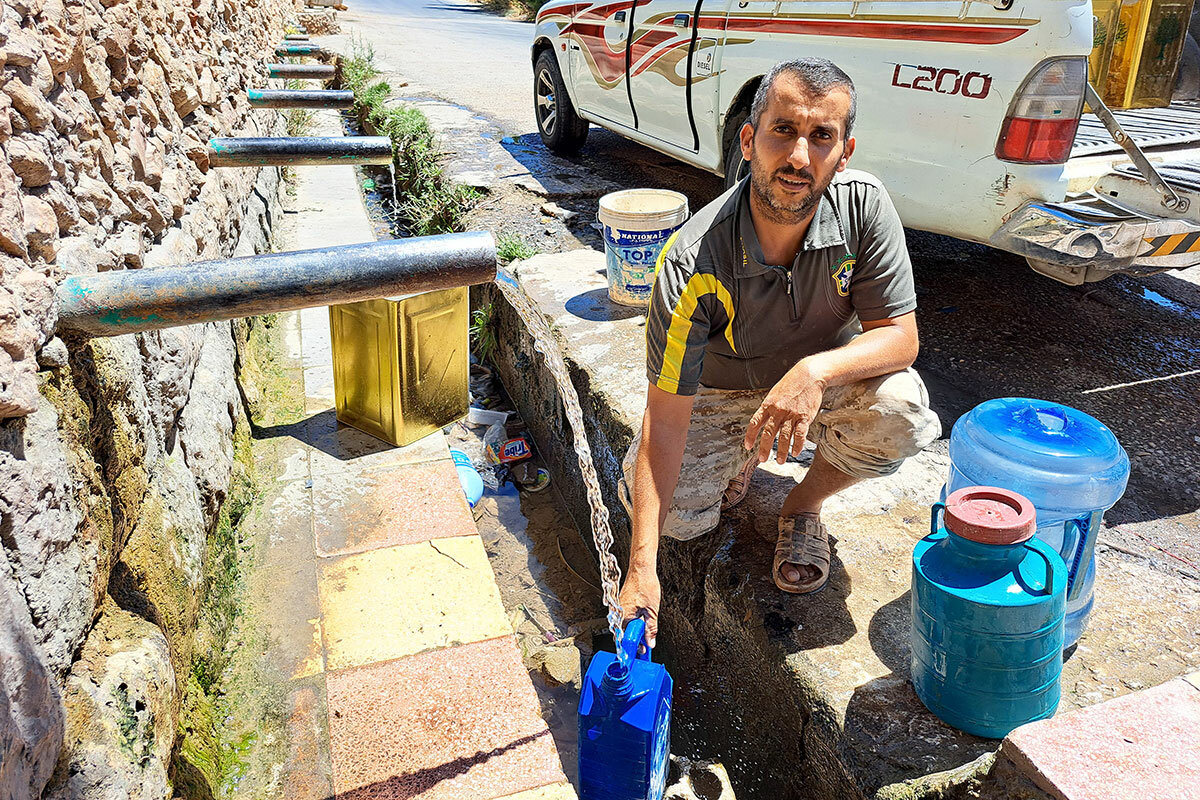
A sheep farmer in northern Jordan fills up water containers for his flock at a spring that for generations has been used to water livestock — Souf, Jordan, Aug. 24, 2022.

Either there is too much water or too little. In New England, where I live, there’s a drought, but when we get a heavy rain, the roads flood, the storm drains overflow, and instead of water going into the places where we need it, it washes into the sea.

Today’s story shares advice on water from those who have had little over the centuries and have learned to conserve.

Taylor Luck reports at the Christian Science Monitor, “In towns and cities across Jordan, ‘water day’ announces itself with a cacophony of high-pitched screeches filling the air. Motors groan and strain to pump a trickle of water from ground-level pipes up five stories to aluminum and plastic rooftop storage tanks – tanks that will hold a family’s water for an entire week or more.

“Families race to and fro across their apartments to run the pumps, do laundry, wash dishes, and water the garden before their 12-hour period is up. If they miss it, they have to wait until the next week – or perhaps weeks – for the next trickle.

‘Water day is more important than an anniversary or birthday in our household,’ says Um Uday, a working mother of five in West Amman.

“In Jordan, the second-most water-poor country in the world, people have long learned to live without the constant running water that most American families take for granted. Yet the dwindling resources due to climate change and population growth mean the most effective innovation in parched Jordan is not novel water distribution schemes, technology, or dam construction – but how people change their daily lives to get the most out of each drop. …

“In largely arid Jordan, water resources are less than 90 cubic meters (almost 24,000 gallons) per person annually, a fraction of the 500 cubic meters (about 132,000 gallons) per capita the United Nations defines as ‘absolute water scarcity.’

“Instead of supplying constantly running water, authorities release water through networks to a given village or neighborhood for one day on a weekly or twice-monthly basis as part of a rotation. The water distribution schedule is designed to distribute water equally in different parts of the country, without waste, while maximizing the rapidly diminishing reserves. …

“Suleiman, a retired air force officer who gave only his first name, stops his pickup at a roadside natural spring in the village of Souf, 35 miles north of Amman, to fill containers for his thirsty flock of sheep. As they have for generations, area residents come to this spring to stock up on water for livestock or washing; a second, purer, cold-water spring 2 miles up the hill is used for drinking water. With official water distributed to the village for a few hours once a month in the summer, these springs have become a main source. …

“Suleiman says, wiping his brow from the noon sun., ‘We have to make the most of each water source we have.’

“Yet this year has been particularly hard; Jordan’s Ministry of Water and Irrigation described 2022 as ‘the most difficult year’ yet. A shift in weather patterns means Jordan is witnessing a slight decline in rainfall. The rainfall it now receives occurs in intense, shorter time periods in concentrated areas, leaving its network of dams struggling to catch the torrential runoff.

“The dams are dry or nearing dry; green patches of earth mark where once mighty reservoirs stood. Plans to desalinate seawater at Aqaba, the nation’s only port, are two decades off at best and are costly. … With the capital getting priority for dam and aquifer water, towns and villages north and south of Amman bear the brunt of shortages – often going months without fresh supplies as summer demand spikes.  

“Um Mohamed, a widowed mother of four in Bayt Idis, a hilly, tree-dotted village in northern Jordan, heads one of thousands of households going without state-supplied water for the summer.

“On this day she purchased from a licensed private well 3 cubic meters (792.5 gallons) for $21 – enough for her family’s weekly consumption, but taking 15% of her monthly income. She will try to make it last one month. Like many, she is sticking to tried-and-true methods to stretch out each drop.

“She does the dishes in a single bucket of water placed in the sink, careful not to splash out of the bucket. Once she soaps and rinses the pots, dishes, and silverware, she pours the food-clouded water onto a few of her plants, watering in a rotation.

“Showers are timed and scheduled. Laundry is hand-washed in a large plastic basin utilizing the same water. Her backyard is dotted with jugs and buckets filled with water from her purchase; they will be used to water the plants and wash the floors over the next two weeks.

“ ‘We have entire summers where we don’t get water from authorities, so we have to rely on ourselves,’ she says. ‘If we don’t manage what we consume, then we consume ourselves.’ ”

More at the Monitor, here. No firewall. Want to read a novel about building a well in a dry land? Try Red-Haired Woman by Turkish Nobel laureate Orhan Pamuk. It’s kind of dark, though.

Read Full Post »

Photo: Kyle Peavey.
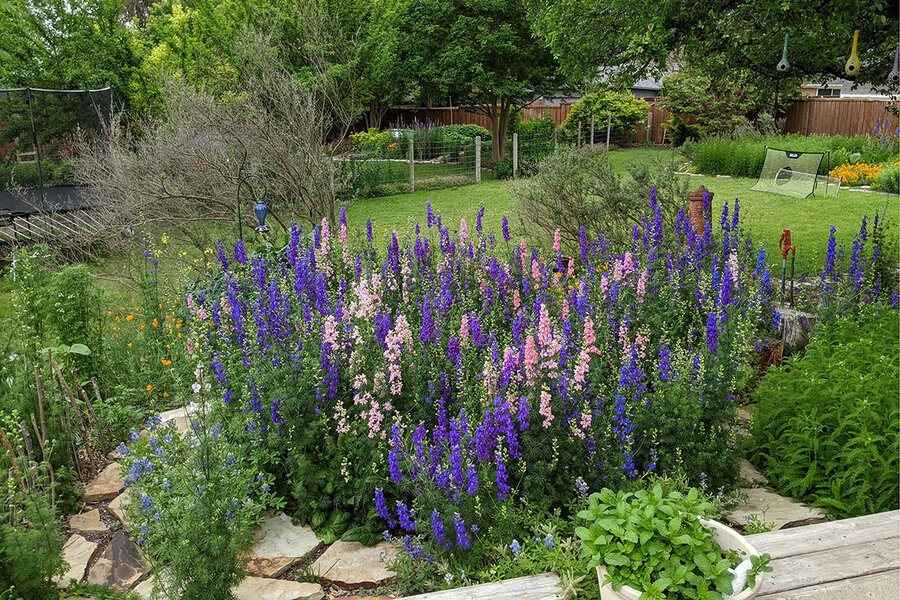
Kyle Peavey’s backyard in Richardson, Texas. He collects water in a 1,100 gallon rainwater tank to grow his flowers and vegetables.

One way that people are conserving natural resources these days is by being more thoughtful about the water they use in their homes and gardens.

To some extent this is going back to the old ways. On a recent Zoom panel discussing rural America, Montana Senator Jon Testa recalled how conservative with water his mother had to be when he was growing up. He said she could wash a sinkful of dishes with one cup of water.

Sen. Testa’s mother wouldn’t have been thinking about climate change, but she knew scarcity. Here is a report from Tara Adhikari at the Christian Science Monitor on conserving water today.

“In one Texas suburb, a battle of rainwater harvesting tanks is on. During a neighborhood garden tour in May, Kyle Peavy spotted Richard Townsend’s 260-gallon tank and decided to go even bigger. Just two months later, Mr. Peavy installed his own rainwater harvesting system – four times the size. 

“ ‘I’m both proud and slightly envious,’ says Mr. Townsend of Mr. Peavy’s system.

“The two neighbors use the tanks to water their backyard gardens. And while plants like rainwater better than sink water, the men installed these water systems for another reason besides gardening. Both see rainwater harvesting as a practical way to respond to water scarcity. They’re not alone.  

“Rainwater harvesting dates back more than 4,000 years to early Roman and Mayan civilizations. In its simplest form, it involves collecting water as it falls from the sky into barrels, so the water can be saved for later use. Today, this ancient solution is seeing a resurgence among homeowners, businesses, school districts, and at least one church. 

“Among green solutions to climate change, rainwater harvesting stands out in its potential to address two sides of a water paradox – flooding that destroys critical infrastructure, as well as drought conditions that threaten freshwater supplies. 

“ ‘We know that some areas are going to become drier. We know that storms are going to become bigger. And thinking about any practice that can help us address multiple of these issues is really important,’ says Sarah Sojka, associate professor of physics and environmental studies at Randolph College in Lynchburg, Virginia. 

“As Americans across the United States turn back to one of the oldest methods in the book, there’s a sense of empowerment that comes from knowing one small action can have a ripple effect. One small tank might just inspire something bigger.

“Typically, when rainwater falls on a roof, it is routed through a gutter system out into the yard or driveway and eventually into the road. Along the way, the water picks up pesticides and road contaminants, before flowing into curbside cuts that direct it into a nearby stream or lake. 

As the urban landscape has become more and more built up, the number of impermeable surfaces, such as paved roads, has increased, forcing larger quantities of water – and pollutants – into local waterways. …

“Rainwater harvesting tanks divert that flow path, reducing the amount of water that hits local systems all at once. As stored tank water replaces tap water for outdoor use, the draw on the municipal supply is reduced, and water that soaks in through the ground eventually helps to replenish baseline flow.

“But it’s not just an old-new way to water. It’s also a new way to think about water as more than an unending supply that spews from the tap. In drier climates especially, rainwater harvesting can provide a visual reminder of natural cycles, which can precipitate the ultimate goal: an actual reduction in water use. …

“Although Mr. Townsend doesn’t consider himself a ‘green warrior,’ he wants his children to understand these cycles. The rainwater tank, which shows natural ebbs and flows, helps him share greater water consciousness with his children. …

“Although one rainwater harvesting tank is unlikely to change local water quality and supply, when implemented at scale, the tanks can aid in overall water conservation – and local governments are taking notice. 

“To encourage widespread adoption, cities across the U.S. are subsidizing the costs of tank installation, which can range from a few hundred to several thousand dollars. Tucson, Arizona, started its rainwater harvesting rebate program in 2012, after residents had been living under drought conditions for over a decade. In Arizona, water is sourced from groundwater and the Colorado River, which was put under a drought contingency plan in 2019. …

“ ‘Americans just really like being self-sufficient, and … at its core, this is self-sufficiency,’ says Jaimie Galayda, a rebate participant who now works for Tucson Water. …

“When rainwater is collected, says [Fouad Jaber, a professor and water resources extension specialist at Texas A&M University] it reduces the amount of water used from the municipal supply, which comes from local waterways. And if used for outdoor purposes, the water will soak into the ground, eventually feeding back into local bodies of water. …

“St. Louis has a different problem, but rainwater harvesting is helping just the same. Like many older cities, St. Louis has a combined sewer system, meaning storm pipes connect with wastewater pipes. Normally, all the water is treated before entering the Mississippi River, but large storms overwhelm the system, creating direct overflow into the river. And when large quantities of water enter all at once, the water quickly swells out into the surrounding communities.  

“Large rainwater cisterns like the one at Jubilee Community Church help to divert the water before it overflows. In 2018 the church installed a 150,000-gallon cistern with funding and other support from St. Louis’ municipal sewer district and The Nature Conservancy. Rain flows off the church’s roof to the underground catchment, then irrigates a large garden and orchard, which includes tomatoes, cucumbers, beets, figs, and even juju berries.  

” ‘Building the rainwater tank with the garden on top is a way of reinvesting in the community, says Andy Krumsieg, the church’s pastor. ‘This is a very sustainable project because it will keep water out of the sewer system forever … and it created a tool for urban agriculture.’ “

More at the Monitor, here.

Read Full Post »

researcher20deborah20goffner20discussing20the20koyli20aplpha20gardens20with20samba20fall20garden20manager20and20change20agent2

Photo: Stockholm Resilience Centre
Discussing the Great Wall of Africa among drought-resistant plants in the village of Koyli Alpha in Senegal. Reforestation efforts include providing fodder for livestock.

Sometimes the places with the biggest needs are the places with the biggest innovations. Consider the greening initiative that Africa is taking on to fight drought.

Aryn Bakerwrites for Time magazine, “The seedlings are ready. One hundred and fifty thousand shoots of drought-resistant acacia, hardy baobab and Moringa spill out of their black plastic casings. The ground has been prepared with scores of kilometer-long furrows leading to a horizon studded with skeletal thorn trees. It’s early August, and in less than a week, 399 volunteers from 27 countries will arrive in this remote corner of northern Senegal to participate in one of the world’s most audacious efforts to combat the effects of climate change: an $8 billion plan to reforest 247 million acres of degraded land across the width of Africa, stretching from Dakar to Djibouti.

“The Great Green Wall project, spearheaded by the African Union and funded by the World Bank, the European Union and the United Nations, was launched in 2007 to halt the expansion of the Sahara by planting a barrier of trees running 4,815 miles along its southern edge. Now, as concerns mount about the impact of climate change on the Sahel, the semiarid band of grassland south of the Sahara that is already one of the most impoverished regions on earth, the Great Green Wall is filling a new role. The goal now, say its designers, is to transform the lives of millions living on the front line of climate change by restoring agricultural land ruined by decades of overuse; when done, it should provide food, stem conflict and discourage migration. When the project is completed in 2030, the restored land is expected to absorb some 250 million metric tons of carbon dioxide from the atmosphere, the equivalent of keeping all of California’s cars parked for 3½ years. …

“When people think of potential fixes for global warming, they tend to focus on big projects. But if human activity is at the root of climate change, whether it be the carbon emissions of the industrialized world or the overgrazing of the Sahel, then that is where the solution lies as well. Environmentalists celebrate the Great Green Wall for its epic territorial ambition, but its biggest impact will come from allowing people to meet their needs without destroying nature in the process.

“The Sahara isn’t expanding so much as the Sahel is shrinking, destroyed by decades of overgrazing, climate-change-induced drought and poor farming practices that have stripped the once lush grasslands of the fertile topsoil needed to regenerate. … Planting trees not only reduces carbon on a global scale—research in the journal Science estimates planting more than 2 billion acres of trees could remove two-thirds of all the emissions that human activity has pumped into the atmosphere since the Industrial Revolution­—it also recharges the water table and creates micro­climates that increase local rainfall. … Though it may not sound like much, the solution to climate change in the Sahel starts with getting grass to grow.

“ ‘If we can solve people’s problems by improving their living conditions now,’ says Goudiaby, ‘they will be able to help themselves by protecting the trees that protect their future.’

After all, stopping global warming isn’t about saving the planet. … It’s about saving humanity. One way to do that is by helping those who are most vulnerable to what chaos we have already created.

“Just 25 miles south of Mbar Toubab, near the village of Koyli Alpha, 50-year-old Dienaba Aka pulls her heavily laden donkey cart to the side of the road. She and her extended family have spent the day cutting grass in a ‘forage bank’ managed by the national Great Green Wall agency. … Now herders pay $1.70 a day to harvest the waist-high grass for their cattle until the rains bring new grazing opportunities. For Aka, the idea of a grass ‘bank’ is a radical departure from an itinerant childhood spent following the family herd in search of forage. Now she can feed her cattle in the lean season without stripping trees.

“Aka, like women from many villages in the region, has been planting trees for the GGW project since 2012. She earns $96 during the six-week planting season. It’s good money, she says, but most women do it because they have been told it will bring back the rain, which in turn brings the grass that feeds their livestock.

“There is another advantage to forage banking, Aka says, gazing proudly at her two 10-year-old nieces perched atop several bags of recently cut grass. ‘Before­ the Great Green Wall, the kids had to go with us when we took the cattle to graze. Now they can stay in school.’ ” More here.

Hat tip: UN Environment Programme on Twitter

Read Full Post »

spanish-stonehenge-1024x604

Photo: Ruben Ortega Martin, Raices de Peraleda
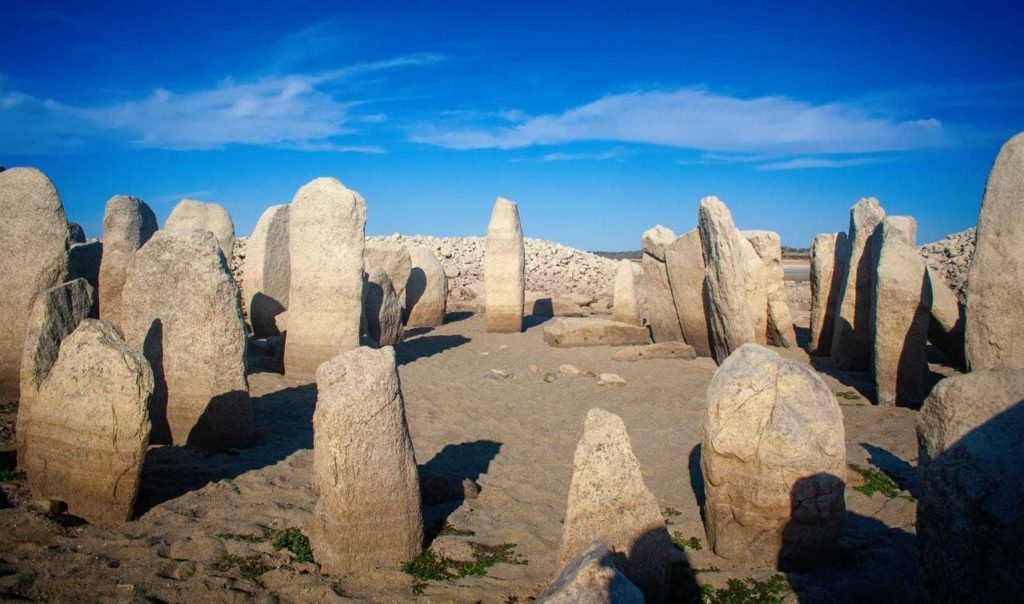
Drought has uncovered a Spanish version of Stonehenge, the 7,000-year-old Dolmen of Guadalperal.

As global warming brings changes to our planet, the permafrost is melting and releasing dangerous bacteria. But sometimes other, less harmful things come to light.

Caroline Goldstein writes at ArtNet, “If there’s even the slightest silver lining to the ravages of climate change, it’s that the warming conditions are revealing some previously unknown archaeological sites and artifacts.

“This past summer, an extreme drought in the Extremadura area of Spain that caused the Valdecañas Reservoir’s water levels to plummet has revealed a series of megalithic stones. Previously submerged underwater, the Dolmen de Guadalperal, often called the Spanish Stonehenge, are now in plain sight.

“Though the Dolmen are 7,000 years old, the last time they were seen in their entirety was around 1963, when the reservoir was built as part of Franco’s push toward modernization. …

“Angel Castaño, who lives near the reservoir and serves as the president of a Spanish cultural group, told the website the Local, ‘We grew up hearing about the legend of the treasure hidden beneath the lake and now we finally get to view them.’

“The approximately 100 menhirs are, like Stonehenge, hulking megalith stones — some standing up to six feet tall — that are arranged in an oval and appear oriented to filter sunlight. Evidence suggests that these stones could actually be 2,000 years older than Stonehenge.

“Castaño is working with the group Raices de Peraleda to move the dolmen before rains come and re-submerge them. ‘Whatever we do here needs to be done extremely carefully.’ he said.”

I guess so. I can’t help wondering if it would be better to move the reservoir and leave the stones, which obviously were placed where they are for a reason. But not being an engineer, I suppose moving the reservoir would be even more difficult. And already access to water is becoming a serious problem around the world. (For a heartbreaking story about the difficulty many Navajo people have getting clean water, read this.)

So hard to balance conflicting goods!

More here.

Read Full Post »

dsc0221-2_wide-3fcfb07127773efdd138130d9f2491856f240005-s700-c85

Photo: Claire Harbage/NPR
Susan van Rooyen and Moe Kekana of communications firm King James Group were behind the 2-Minute Shower Song project the helped rescue Cape Town, South Africa, from a severe water crisis.

When it’s a matter of life and death, people can cooperate. That’s what we saw in Cape Town, South Africa, this year, when residents threatened with the very real possibility of running out of water were able to cut down enough on consumption to save the day.

And one way they cut down on consumption was by singing in the shower.

In this January report from National Public Radio (NPR), Ari Shapiro explains. “When the drought in Cape Town, South Africa, was worsening in late 2017, one of the country’s leading insurance companies, Sanlam, wanted to help get the word out that people needed to save water. Sanlam’s idea was to make a billboard telling people to cut down on water use.

“But that seemed boring to copywriter Susan van Rooyen and art director Moe Kekana. They’re with the King James Group, the communications firm that Sanlam pitched.

“So van Rooyen and Kekana started brainstorming. Cape Town’s government was asking people to save water by taking showers that lasted two minutes or less. Inspiration struck soon enough.

” ‘What do people do in the shower?’ says 30-year-old van Rooyen. ‘They sing.’

“She and Kekana, 28, came up with something of a musical challenge: the 2-Minute Shower Songs campaign. The team asked South Africa’s biggest pop stars to record new, shortened versions of their most famous songs.

” ‘I remember sending an email where somebody said, “How many do you want?” And I said, “I could live with four or five, but 10 would be the dream,” ‘ Kekana says. ‘And we got 10.’ …

“The idea of 2-Minute Shower Songs is fairly simple: You hit play as you jump in the shower, sing along and finish by the time the song ends. …

“In June — after the city cut down on water usage by more than half — Cape Town officials proclaimed that ‘Day Zero’ had been averted. The term refers to the day it was predicted the city would have had to turn off its taps and distribute rationed water. …

“During this water crisis, everyone had a role to play.

” ‘Sometimes you don’t know what you can do to help within a crisis,’ van Rooyen says, ‘and [the pop stars] were doing what they do best.’ ” More at NPR, here.

I take away the encouraging message that if you contribute whatever you’re good at to save your place, you can be successful.

Image: Gifer

2idr

Read Full Post »

The Christian Science Monitor series People Making a Difference (“ordinary people taking action for extraordinary change”) has so many great leads, I have to restrain myself from using one every day. The Monitor staff don’t write all the stories but, like me, harvest from hither and yon.

This story, about “sack farming,” is from the Thomson Reuters Foundation, which I wouldn’t have known about either but for the Monitor.

Caroline Wambui writes, “Central Kenya’s Nturukuma region is not kind to farmers – its erratic rainfall, desert vegetation, and drying riverbeds push most people into making a living through trade rather than agriculture.

“Jane Kairuthi Kathurima toiled for years as an animal herder in the semi-arid conditions of Laikipia County, but struggled to feed her family – until she discovered sack farming, which has transformed her life and those of her children.

“ ‘Being in an environment where food was scarce and lacking in nutrition, I had to find an alternative way to survive,’ said Kathurima. …

“Sack farming involves filling a series of bags with soil, manure, and pebbles for drainage, and growing plants on the top and in holes in the sides. The sacks allow people to grow food in places with limited access to arable land and water.

“Two years after setting up her sack farm, Kathurima now grows enough vegetables – including spinach, lettuce, beets, and arugula to feed her family and sell the surplus to the community. … Now she is supporting other food-insecure farmers by encouraging them to think differently.

“The group behind sack farming in Kenya is GROOTS (Grassroots Organizations Operating Together in Sisterhood), a global network of women-led groups which help women solve problems in their communities by changing the way they do things.

“Rahab Ngima Githaiga, vice chairman of one of the GROOTS member organizations, says sack farming has empowered women and changed lives by improving family nutrition and enabling children to go to school.”

More here.

Photo: Thomson Reuters Foundation/Caroline Wambui
Jane Kairuthi Kathurima cuts kale at her sack farm in central Kenya. She grows enough vegetables to feed her family, selling the surplus to the community. 

Read Full Post »

According to a feature provided by the Christian Science Monitor, drip-irrigation systems are becoming a boon to regions suffering from persistent drought.

Kizito Makoye writes for Reuters, “Peter Chuwa has long flooded his paddy field using a canal that draws water from the river. These days, however, water is scarcer and growing rice this way is proving hard to sustain. A period of drought set in two years ago, and the abundant water that once helped suppress weeds in his fields and assure him of a crop regardless of rainfall has disappeared, hurting his harvests and his income. …

“Now, however, a drip irrigation system, introduced to help his village deal with worsening drought, is restoring his harvests, building his resilience to erratic weather, and saving time, he says.

” ‘You simply open the tap and leave the kit to supply water to the roots, unlike the traditional system, which takes a lot of time and energy,’ he said.

“Under pressure from drought, the 65-year-old farmer at Kikavu Chini village in Hai district in Tanzania’s northern Kilimanjaro region has switched to crops that need less water, including vegetables, maize, potatoes, and beans. A drip irrigation system, which uses far less water, supplies plenty to grow those crops, he says. …”

Nguluma Mbaga, a Kikavu Chini agricultural field officer, says the technology has come at the right time as farmers try to find ways to cope with worsening drought and other effects of climate change.

” ‘I believe farmers will be in a better position to cope with the changing weather patterns. This village is located in a dry area that does not get adequate rains, so farmers must try to use water wisely,’ he says.”

More here.

Photo: Mariana Bazo/Reuters/File
A farmer cleans prickly pear cacti irrigated with water collected by nets that trap moisture from fog on a hillside in Lima, Peru.

Read Full Post »

Older Posts »