Feeds:
Posts
Comments

Posts Tagged ‘Ecologist’

Art: Asher Durand.
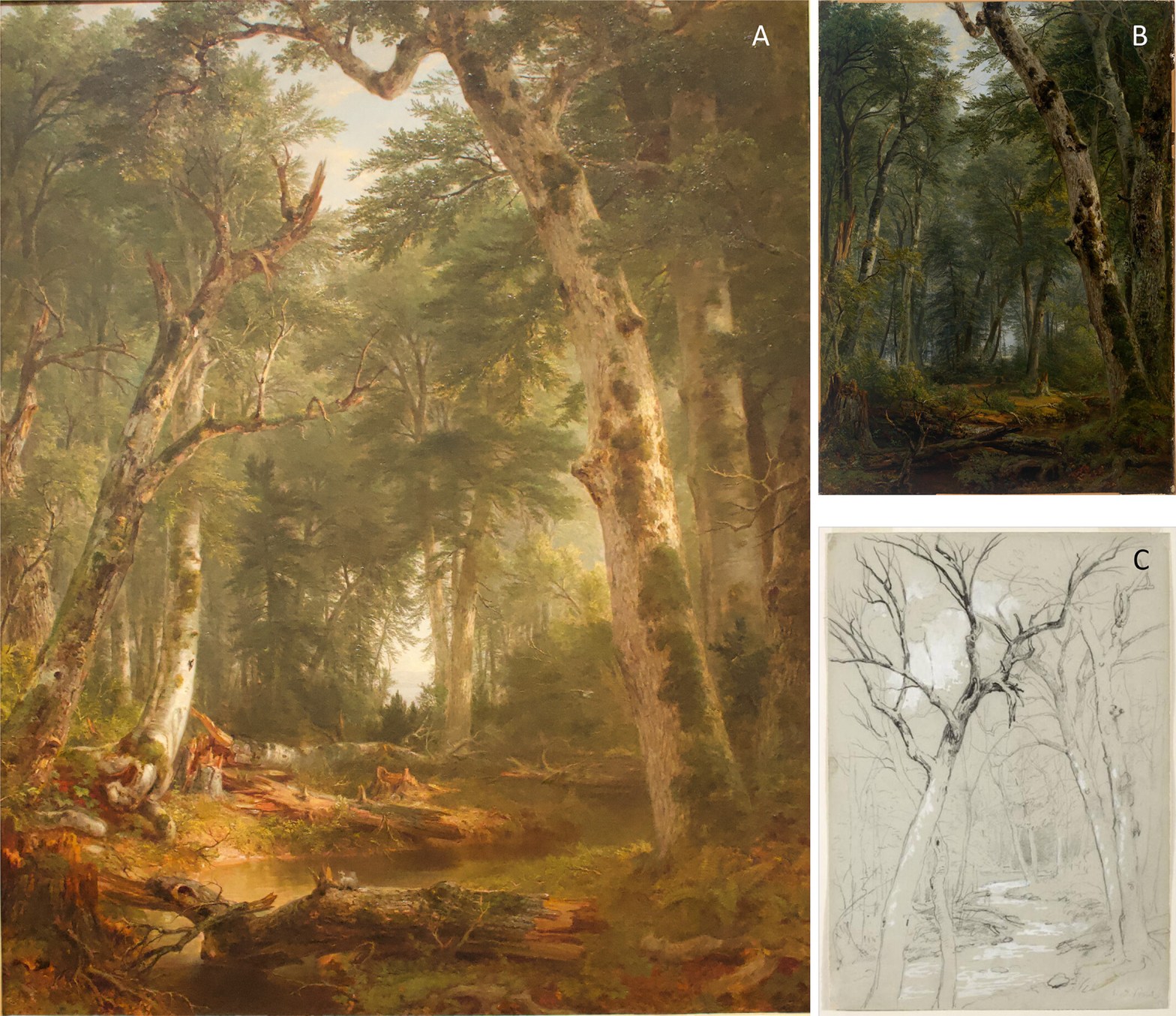
Nineteenth-century paintings of old growth forests are helping ecologists learn about what we have lost. Asher Durand, for example, understood the way that beech trees fit into their forest habitats. A) “In the Woods” (1855); B) “Woodland Interior” (c. 1854), oil on canvas; C) “A Brook in the Woods” (c. 1854), graphite, gouache, and white lead on paper.

Call me retro, but I’ll always love the Hudson River School paintings of a long-gone majestic American wilderness. So do ecologists, as it turns out.

Elaine Velie reports at Hyperallergic on a new study showing that the 19th-century paintings have a value beyond the aesthetic.

“The Hudson River School movement is an enduringly popular slice of 19th-century American art history,” Velie writes, “but as beloved as it is, its paintings of bucolic hills drenched in golden light are not particularly known for their adherence to reality. In a recently published study, a team of ecologists and art historians set out to determine just how true to life these works really were.

“Using onsite sketches and historical writings, the team determined that some of these paintings were true to life. … 

Some were so detailed that they could even help scientists today learn about the centuries-old forests that were destroyed before the advent of color photography.

“Dana Warren and Harper Loeb of Oregon State University published their findings last month in the academic journal Ecosphere along with scholars Peter Betjemann, Isabel Munck, William Keeton, David Shaw, and Eleanor Harvey.

“ ‘I have been interested in understanding older forests and old growth forest systems in the Northeast for a while,’ Warren told Hyperallergic. … ‘I was interested in these 19th-century paintings, but I had always thought that issues of artistic license removed the potential for any of these images to be used in a rigorous quantitative way.’ She paired up with art historians to investigate.

“The interdisciplinary team focused on Hudson River School paintings completed between 1830 and 1880, when Northeastern forests were being cleared for farms but more remote regions still remained untouched by European colonizers. Blights and invasive species had yet to arrive, and trees like the chestnut, ash, and elm still shaded the woodland floor. …

“In the early 1800s, American painters began working en plein air. Portable oil paints had come into fashion, and growing infrastructure made it easier to venture upstate. A fascination with ‘wilderness’ in literature and art emerged alongside the dark underpinnings of ‘manifest destiny‘ and colonial expansion. 

“As creators emphasized nature, they were acutely aware of the changing landscapes around them.

“ ‘The beauty of [untouched] landscapes is quickly passing away,’ Thomas Cole, the painter credited with founding the Hudson River School movement, wrote in 1836. ‘The ravages of the axe are daily increasing — the most noble scenes are made desolate.’

“While painters like Cole crafted dramatic allegorical renderings of the forests disappearing around them … other artists adhered to observational truth. 

“Warren and her team used the interior forest scenes of prominent Hudson River School painter Asher Durand (1796–1886) as a case study, examining his onsite sketches, writings, and oil paintings to establish the veracity of his finished works. …

“Durand explicitly stated his emphasis on depicting the natural world just as he saw it. Like other artists, Durand had been familiarized with the specimen-based botany that had been available in published form since the 1700s. 

“The scholars examined an 1855 Durand painting of the Catskills titled ‘In the Woods’ — a calm depiction of a shady stream lined with beech trees. Notably, an 1854 painting of the same scene excludes these plants, but an onsite sketch of a similar setting includes them, signifying that the artist added the trees into his final painting from a real sketch. …

“Warren said her recent study is a ‘proof of concept,’ and that she thinks the team’s exploration of Durand’s paintings can extend to the work of other artists. For now, Hudson River School depictions of microhabitats — groupings of flora like mushrooms on tree trunks and mats of moss on bark — can help ecologists learn about what old growth forests were really like. 

“With an interdisciplinary approach to ecology and art history, the scholars think paintings of the American West could help scientists learn about long-melted glaciers and plowed prairie biomes, and artworks showing the coast could help researchers study lost marsh habitats.”

Today we have lots of color photography, but if any of you artists out there want to help the scientists of the future, you know the way.

Check out the art at the Hyperallergic, here. No firewall, but subscriptions solicited.
Read Full Post »

Love for Fungi

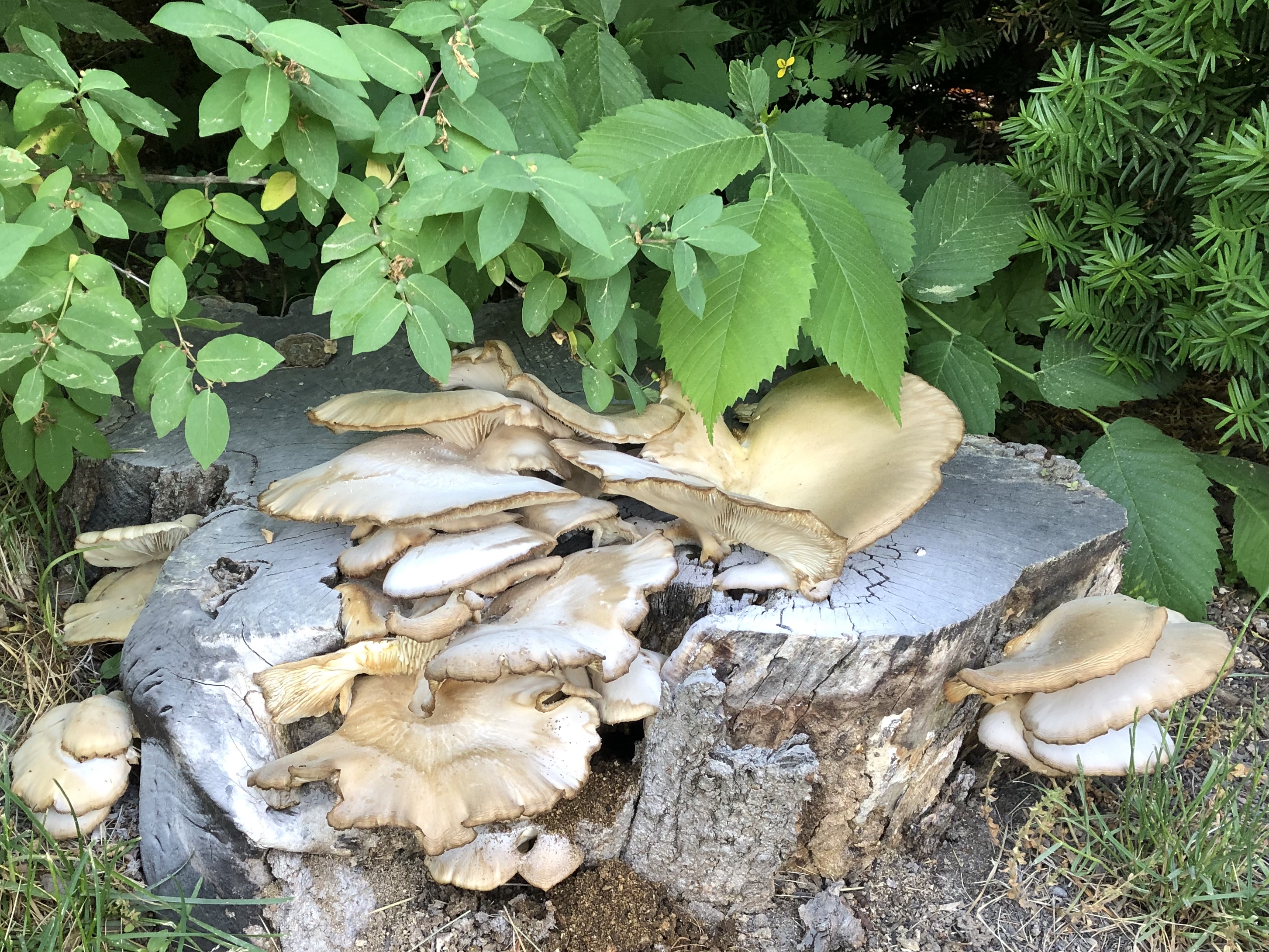
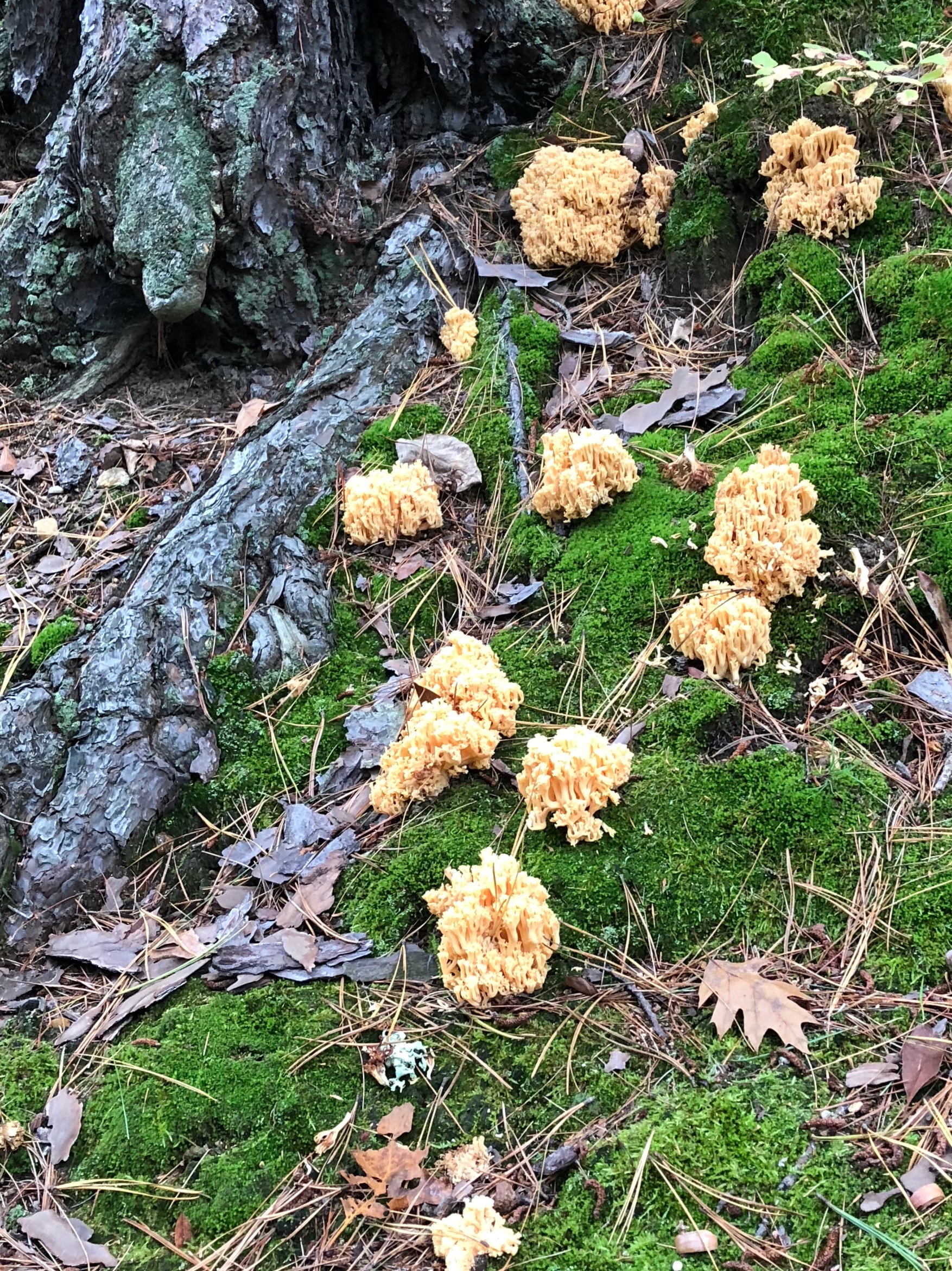
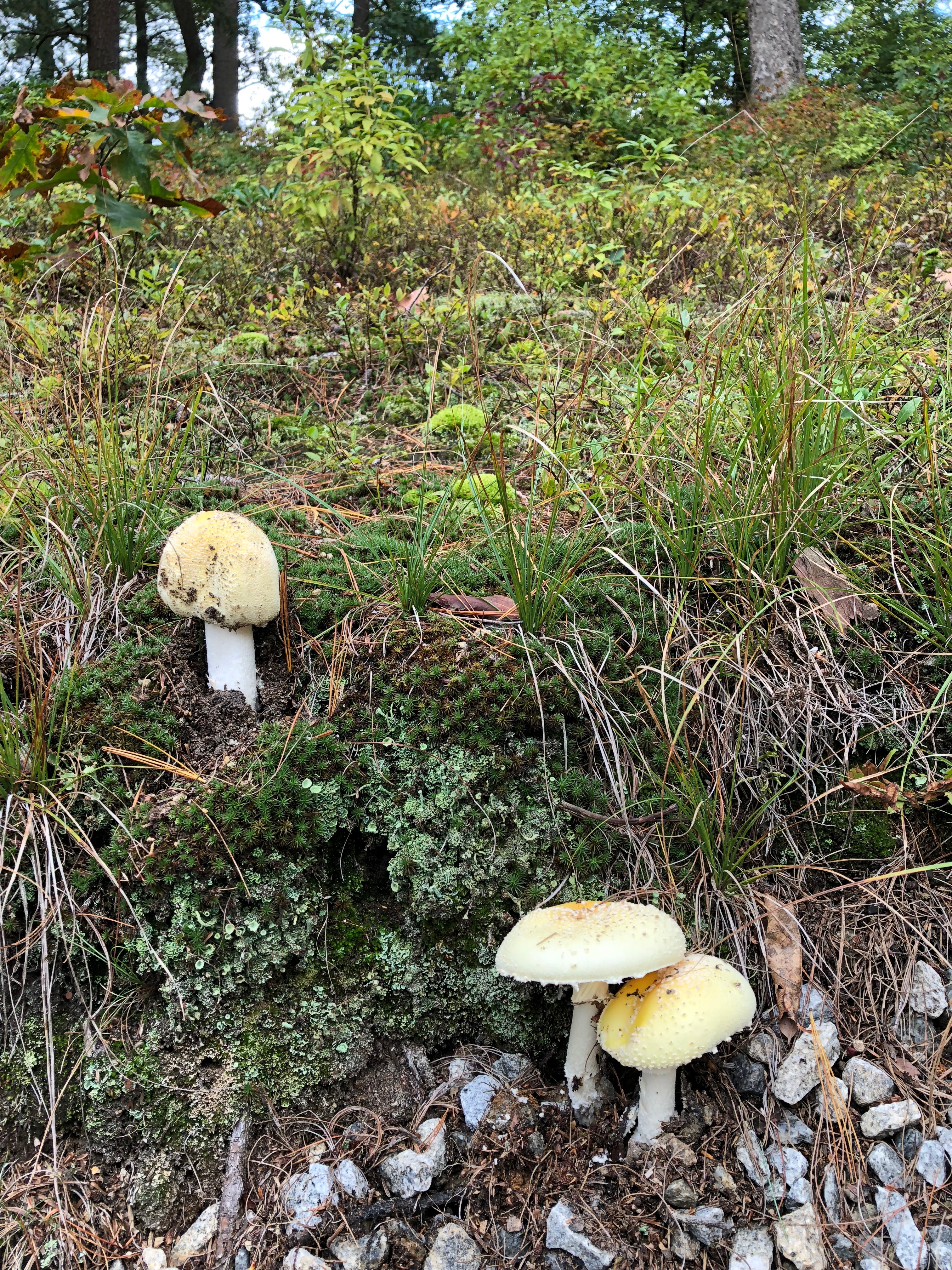
As a kid, I was kind of creeped out by fungi, but in recent years I’ve found myself fascinated by their unexpected beauty and mystery. And I’ve taken lots of pictures, three of which are here.

In an article at the New York Times, Ferris Jabr, describing the symbiotic relationship between trees and fungi, talks to forest ecologist Suzanne Simard about what trees are communicating with one another through their subterranean networks of fungi.

“By the time she was in grad school at Oregon State University, [Simard] understood that commercial clearcutting had largely superseded the sustainable logging practices of the past. Loggers were replacing diverse forests with homogeneous plantations, evenly spaced in upturned soil stripped of most underbrush. Without any competitors, the thinking went, the newly planted trees would thrive. Instead, they were frequently more vulnerable to disease and climatic stress than trees in old-growth forests.

“In particular, Simard noticed that up to 10 percent of newly planted Douglas fir were likely to get sick and die whenever nearby aspen, paper birch and cottonwood were removed. The reasons were unclear. The planted saplings had plenty of space, and they received more light and water than trees in old, dense forests. So why were they so frail?

“Simard suspected that the answer was buried in the soil. Underground, trees and fungi form partnerships known as mycorrhizas: Threadlike fungi envelop and fuse with tree roots, helping them extract water and nutrients like phosphorus and nitrogen in exchange for some of the carbon-rich sugars the trees make through photosynthesis.

“Research had demonstrated that mycorrhizas also connected plants to one another and that these associations might be ecologically important, but most scientists had studied them in greenhouses and laboratories, not in the wild. For her doctoral thesis, Simard decided to investigate fungal links between Douglas fir and paper birch in the forests of British Columbia. …

‘The old foresters were like, Why don’t you just study growth and yield?’ Simard told me. ‘I was more interested in how these plants interact. They thought it was all very girlie.’

“Now a professor of forest ecology at the University of British Columbia, Simard, who is 60, has studied webs of root and fungi in the Arctic, temperate and coastal forests of North America for nearly three decades. Her initial inklings about the importance of mycorrhizal networks were prescient, inspiring whole new lines of research that ultimately overturned longstanding misconceptions about forest ecosystems. By analyzing the DNA in root tips and tracing the movement of molecules through underground conduits, Simard has discovered that fungal threads link nearly every tree in a forest — even trees of different species. Carbon, water, nutrients, alarm signals and hormones can pass from tree to tree through these subterranean circuits.

“Resources tend to flow from the oldest and biggest trees to the youngest and smallest. Chemical alarm signals generated by one tree prepare nearby trees for danger. Seedlings severed from the forest’s underground lifelines are much more likely to die than their networked counterparts. And if a tree is on the brink of death, it sometimes bequeaths a substantial share of its carbon to its neighbors.

“Although Simard’s peers were skeptical and sometimes even disparaging of her early work, they now generally regard her as one of the most rigorous and innovative scientists studying plant communication and behavior. … In May, Knopf will publish [her] book, Finding the Mother Tree, a vivid and compelling memoir of her lifelong quest to prove that ‘the forest was more than just a collection of trees.’ …

“Before Simard and other ecologists revealed the extent and significance of mycorrhizal networks, foresters typically regarded trees as solitary individuals that competed for space and resources and were otherwise indifferent to one another. Simard and her peers have demonstrated that this framework is far too simplistic. An old-growth forest is neither an assemblage of stoic organisms tolerating one another’s presence nor a merciless battle royale: It’s a vast, ancient and intricate society. There is conflict in a forest, but there is also negotiation, reciprocity and perhaps even selflessness. The trees, understory plants, fungi and microbes in a forest are so thoroughly connected, communicative and codependent that some scientists have described them as superorganisms. …

“Together, these symbiotic partners knit Earth’s soils into nearly contiguous living networks of unfathomable scale and complexity. ‘I was taught that you have a tree, and it’s out there to find its own way,’ Simard told me. ‘It’s not how a forest works, though.’ ”

More at the New York Times, here.

Hat tip: Hannah.

Read Full Post »

Photo: Aram Boghosian for The Boston Globe
Jean Devine (left) and Jayden Pineda, 7, make a meadow at the Waltham Y.

I’m excited that today the Boston Globe caught up with my friend Jean’s terrific biodiversity-education outreach. Readers may recall that I blogged here and here about how she and Barbara Passero got started on “meadowscaping” — hoping to ween homeowners from using pesticides and herbicides that harm the environment and contribute to global warming.

Debora Almeida reports on the educators’ latest work with kids: “Swimming, crafting, and playing games are staples of day camp, but kids at the Waltham YMCA are doing something new this summer.

“They’re learning how to plant and cultivate a meadow — and why they should.

“ ‘We just want to save the world, that’s all,’ said Barbara Passero, cofounder of Meadowscaping for Biodiversity, an outdoor environmental education program for students of all ages, which has partnered with the Y for the project.

“Over the course of the summer, Passero and program leader Jean Devine are teaching children the fundamentals of meadow upkeep and the importance of planting exclusively native plants. They are the best hosts for pollinators, such as bees, butterflies, and moths. In turn, the insects attract other wildlife such as birds and rabbits, building biodiversity.

“While some people’s first instinct would be to spray pesticides to protect their hard work from leaf-munching insects, Passero knows that birds will take care of the insects on their own. She also refuses to use any toxic substances around the children, who truly get their hands dirty digging in the meadow. Seth Lucas, program administrator at the Waltham Y, said kids love the activity. …

“The meadow started as a patch of weedy grass, but is in the process of becoming a 10-by-60-foot flourishing garden. Passero and Devine are setting the meadow up for success with native plants that come back year after year. The plants are self-sustaining and spread on their own.”

Such a happy story! Do read the whole thing here.

Read Full Post »

Following up on my 2012 post about fairy circles.

Rachel Nuwer writes at the NY Times, “When Stephan Getzin, an ecologist at the Helmholtz Center for Environmental Research in Leipzig, Germany, opened the email, his heart began to flutter. Attached was an aerial image of fairy circles, just as he had seen in countless photos before. But those images were always taken along long strips of arid grassland stretching from southern Angola to northern South Africa. These fairy circles — which looked nearly identical — came from Australia, not Africa. …

“The emailed photo came from Bronwyn Bell, who does environmental restoration work in Perth. She had read about Dr. Getzin’s research in Namibia and made a connection to the odd formations in her home state, Western Australia. …

“Scientists have been interested in fairy circles since the 1970s, but have not been able to agree on what causes the patterns to form. Researchers generally fall into two groups — team termite and team water competition — but there are other hypotheses as well, including one involving noxious gases.

“Dr. Getzin, like others on team water competition, explains the circles through pattern-formation theory, a model for understanding the way nature organizes itself. The theory was first developed not by biologists, but by the mathematician Alan Turing. In the 1990s, ecologists and physicists realized it could be tweaked to explain some vegetation patterns as well. In harsh habitats where plants compete for nutrients and water, the new theory predicts that, as weaker plants die and stronger ones grow larger, vegetation will self-organize into patterns …

“In the case of African fairy circles, the bare patches act as troughs, storing moisture from rare rainfalls for several months, lasting into the dry season. Tall grasses on the edge of the circles tap into the water with their roots and also suck it up with the help of water diffusion through the sandy soil.

“Although similar in appearance, Australian fairy circles turn out to behave differently, Dr. Getzin and his colleagues have found. … Aussie circles feature a very hard surface of dry, nearly impenetrable clay, which can reach up to a scalding 167 degrees during the day. Despite the differences, though, they believe the fairy circles’ function remains the same. When the researchers poured water into the circles in a simple irrigation experiment, it flowed to the edges, reaching the bushy grass …

“The new research ‘moves us closer toward a unifying theory of fairy circle formation,’ said Nichole Barger, an ecosystem ecologist at the University of Colorado, Boulder.

“It could be that more fairy circles are yet to be discovered in arid environments around the world, she said.

“According to Walter Tschinkel, an entomologist at Florida State University, the findings strengthen the claim that the circles are a result of self-organization by plants. He cautioned, though, that to be more certain, scientists would need to control environmental factors — water and termites, for example — to see which produce the predicted outcome.”

More here.

Photo: Norbert Jürgens
Tracks of Oryx antelopes crossing fairy circles in Namibia.

Read Full Post »

My husband passed along word of a TV special on an ecologist interested in the Siberian tiger who joins forces with a remarkable Korean filmmaker.

From the Public Broadcasting website: “Hunted almost to extinction, the last wild Siberian tigers can only be found in the forests of the far eastern Russian frontier—but not easily.

“Ecologist Chris Morgan embarks on a challenge that will fulfill a lifelong dream — to find and film a Siberian tiger living wild and free in these forests. To help him, Morgan turns to Korean filmmaker Sooyong Park, the first individual ever to film Siberian tigers in the wild.

“Park spent more than five years watching and waiting for a glimpse of the elusive creatures, confined sometimes for months in tiny underground pits or 15-foot hides in trees. His technique was unconventional, but produced more than a thousand hours of wild tiger footage that told the story of a three-generation tiger dynasty.

“During their time together, Park teaches Morgan the secrets of tracking tigers—where to look and what to look for in these vast, seemingly uninhabited frozen forests. Eventually, Morgan’s mentor and guide leaves him to his own private quest, and it is up to Morgan to follow the tracks and markings of these giant cats, searching out spots where tigers are prone to hunt, setting up cameras he hopes will also capture a precious image of a wild Siberian tiger.

It must take courage to do pursue these creatures. The local bears are so afraid of Siberian tigers that they hibernate in nests up in trees.

More.

Read Full Post »