Feeds:
Posts
Comments

Posts Tagged ‘ecology’

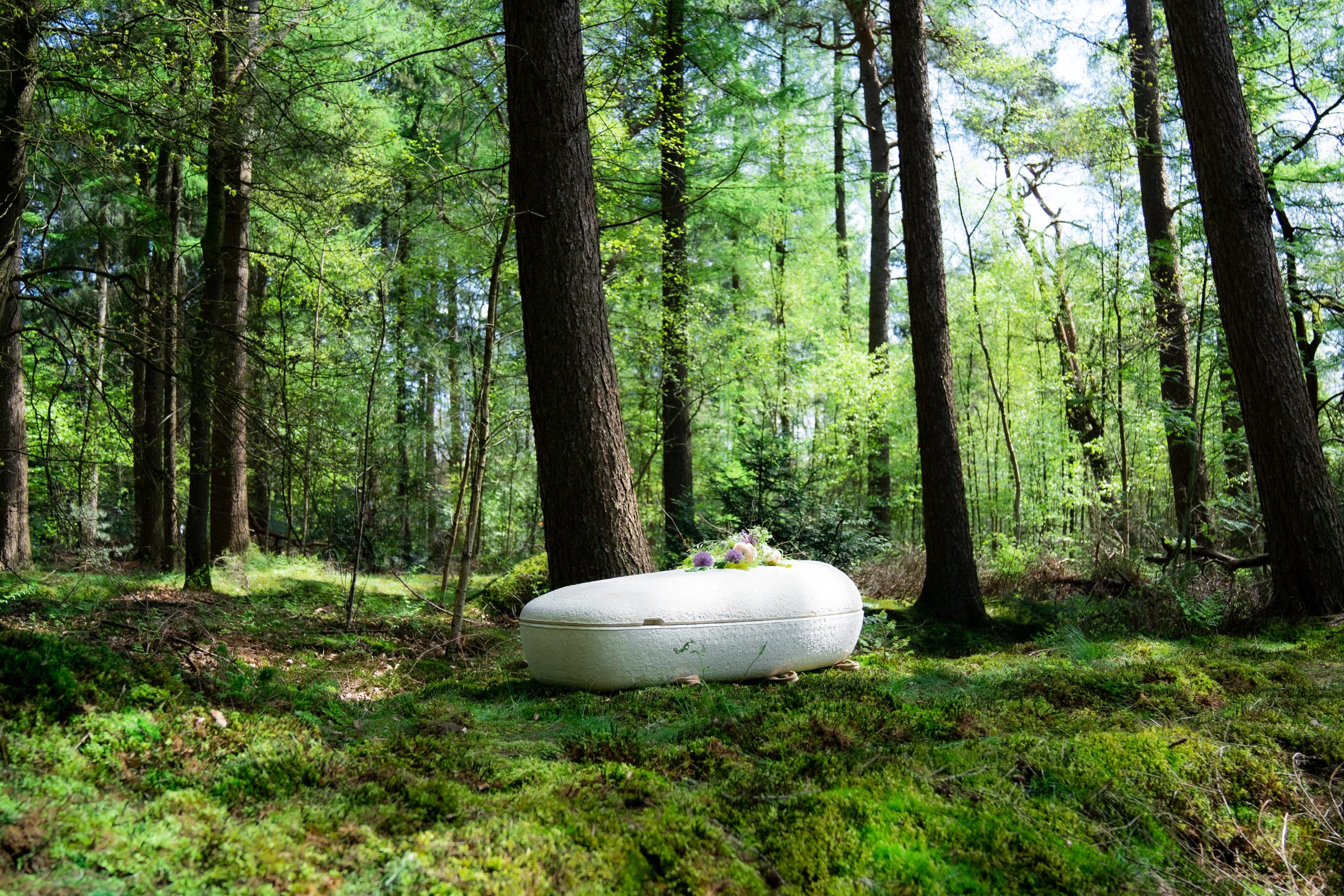
Photo: The Optimist Daily.
Website the Optimist Daily says, “Mushroom caskets offer an earth-friendly goodbye in North America’s first burial of its kind.”

Blogger Will McMillan at A Musical Life on Planet Earth gave me the lead for today’s story. And because my husband and I just recently entertained two mushroom enthusiasts from a recent conference, I decided today was a good day to tell you how some folks take their love of mushrooms to the end — and beyond.

“Traditional burials,” writes the Optimist Daily, “though deeply meaningful, often come at a steep environmental cost. The chemicals, hardwood, and land use involved can have long-term ecological impacts. But a quiet revolution in burial traditions is beginning to bloom and its roots are made of mushrooms.

“In a first for North America, a burial using a fully biodegradable mushroom casket took place on a serene hillside in rural Maine. The Loop Living Cocoon, developed by Dutch company Loop Biotech, is made entirely from mycelium, the intricate root system of fungi. The casket is grown in just one week, naturally breaks down within 45 days, and enriches the soil it returns to.

“ ‘My father always told me that he wanted to be buried in the woods on the property that he loved so much,’ said Marsya Ancker, whose father Mark C. Ancker was laid to rest in the pioneering casket. ‘He wanted his final resting place to nourish the land and plants he cherished.’ …

“Though this was a first for North America, Loop Biotech has already facilitated more than 2,500 burials across Europe using mushroom caskets. Green burials are an alternative that avoids embalming fluids, hardwood caskets, and steel-reinforced concrete vaults, and they’ve been steadily growing in popularity since the 1990s.

“ ‘Since 2005, the Green Burial Council has certified over 250 providers and recorded 400+ green cemeteries across the U.S. and Canada: a clear sign of growing demand for environmentally conscious end-of-life choices,’ said Sam Perry, president of the Green Burial Council.

“The statistics are striking. According to the Council, conventional U.S. burials consume roughly 20 million board feet of wood, 4.3 million gallons of embalming fluid, and 1.6 million tons of concrete each year.

“Bob Hendrikx, founder of Loop Biotech, believes funerals can be more than a final goodbye. ‘We created the Loop Living Cocoon to offer a way for humans to enrich nature after death. It’s about leaving the world better than we found it.’

The Global Green Burial Alliance, founded in 2022, is helping reshape global perspectives on death. Entirely volunteer-run, the organization connects families with green providers and empowers people to reclaim their voice in end-of-life decisions. …

“Ed Bixby, founder of the Global Green Burial Alliance, believes these choices create a legacy of compassion. … ‘To embrace the living with our death becomes the final act of kindness we can bestow upon our planet.’

“With innovations like the mushroom casket and a groundswell of interest in sustainable options, a cultural shift appears to be underway. It asks that we reimagine death not as an ending, but as a way to nourish new life.”

So there’s that.

Sometime I’ll tell you about our mycologist visitors. Theirs is a whole different world. And when you live in a retirement community and are in danger of too much sameness, “different” is especially welcome.

Consider for example, how we learned from these guys that truffles are actually all over the world but buried very deep. And how they might even have been the “manna” in the desert described in the Bible. They do grow in desert places like Saudi Arabia.

So says the CEO of MycoSymbiotics, William Padilla-Brown, who, we learned, was a speaker at the conference. His bio describes him as a “Multidisciplinary Citizen Scientist practicing social science, mycology, phycology, molecular biology, and additive manufacturing. William founded MycoSymbiotics in 2015, and has since developed it into the innovative practical applied biological science business it is today. William holds permaculture design certificates acquired through Susquehanna Permaculture and NGOZI, and a certificate from the Bigelow Laboratory for Ocean Sciences in algal culturing techniques. He has published the first English-language books on cultivating the cordyceps mushroom and regularly leads courses on their cultivation. William’s research has been sponsored by several organizations and his work has been featured in multiple publications, including Fantastic Fungi and VICE. He also founded and manages MycoFest, an annual mushroom and arts festival, now on its eleventh year.”

So many unusual pursuits in this world! I am not knowledgeable enough to recommend the ideas of any mycologists or herbalists, nor am I planning a mushroom burial, but I sure am a sucker for anything interesting.

Doesn’t curiosity keep us all going?

More at the Optimist, here.
Read Full Post »

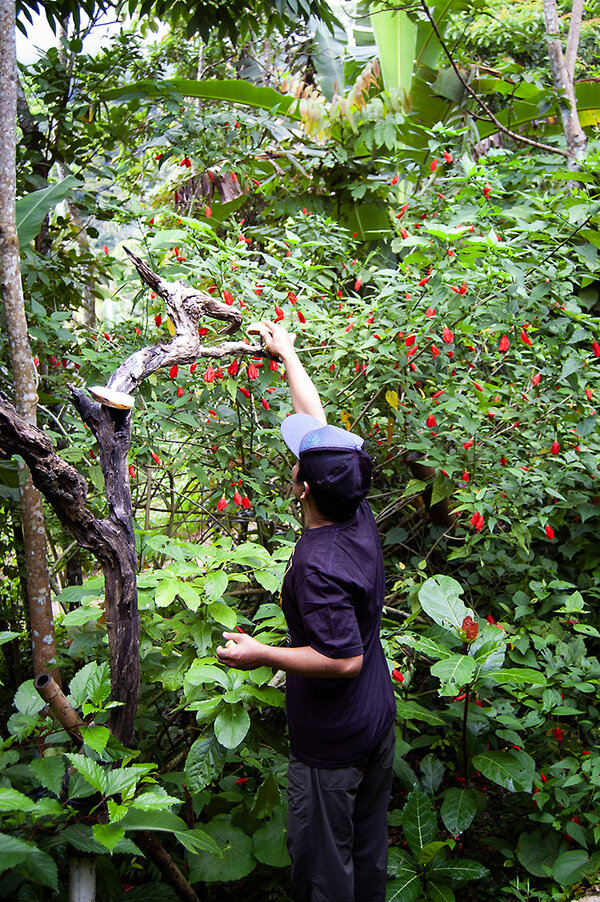
Photo: Lindsey McGinnis/The Christian Science Monitor.
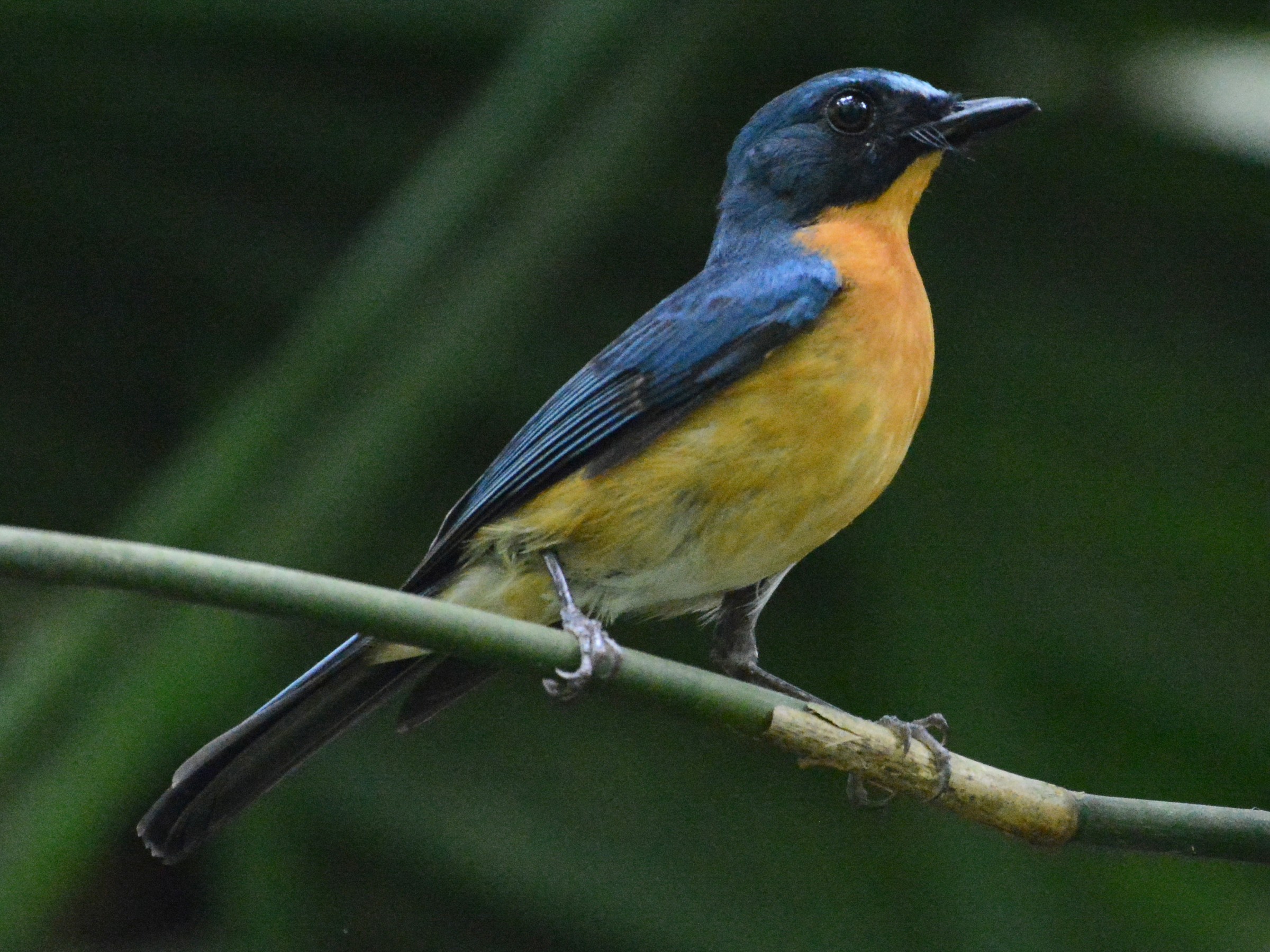
Kelik Suparno, a bird-hunter-turned-nature-guide, begins his day by loading fruit onto trees to attract birds to a viewing area near his home in Jatimulyo, Indonesia, March 1, 2025.

As I started to work on this post, I had an uneasy feeling that I’d written before about the birdsong competitions that are mentioned. Alas, yes. Click here to enjoy the charming side of today’s topic. Continue reading for the other side.

Lyndsey McGinnis writes at the Christian Science Monitor, “A decade ago, when Kelik Suparno heard the Javan blue flycatcher’s melodic whistle, he perked up at the promise of a payday. Knowing a single bird could earn him two months’ salary at one of Indonesia’s bustling bird markets, he set off to capture the critically endangered creature.

“Now, when he hears its distinct, high-pitched ‘twee-twoo sounds, he perks up for a different reason. It means he gets to introduce a group of outsiders – researchers, photographers, tourists – to his favorite species.

Photo: Ari Noviyono via eBird.

“Like many other men in the mountain village of Jatimulyo, Mr. Suparno made the switch from bird hunter to nature guide shortly after the village banned poaching. And now, as increasingly popular birdsong competitions across Asia threaten the country’s wildlife, Jatimulyo could set an example for other communities.

“Indonesia is the epicenter of what ecologists describe as the Asian songbird crisis: the rampant, illegal trade of rare and endemic birds to the devastation of their wild populations. The crisis affects at least 26 threatened species within Indonesia, where it’s fueled by the rising popularity of high-stakes birdsong competitions. Everyone wants these species to thrive. The love of native songbirds runs deep, especially here on the island of Java, and many hope to pass that love on to younger generations. But protecting both the country’s biodiversity and its songbird culture will require balance.

“ ‘In Indonesia, all kinds of birds are being hunted, everywhere,’ says Mr. Suparno. ‘The competition accelerates the rate of bird extinction.’

“The practice of keeping caged songbirds originated centuries ago in Java, and among general collectors, competitors, and breeders, up to 84 million caged birds are believed to be kept on this island today.

“Six belong to Emmannuel Tantyo, head of a neighborhood in the heart of Yogykarta – a city about 20 miles away from Jatimulyo, and often described as Java’s cultural ‘soul.’ Here, in the mazelike streets surrounding the city’s historic palace, a kind of perkutut, or zebra dove, reigns supreme.

“For Javanese men, it’s a symbol of prosperity, Mr. Tantyo explains, and a source of calm.

“ ‘When I wake up from sleep and hear the “too too too too” …’ he says, pausing to find the right word to describe the feeling. He taps his fingers to his heart. ‘Peaceful.’

“After Indonesia gained independence in 1945, the Javanese passion for bird keeping spread, spurred further by the introduction of birdsong competitions in the 1970s.

“As the popularity of competitions steadily grew, so did the industry around them – bird markets cropped up in every major city, a network of birder associations flourished, and cash prizes ballooned. Today, Indonesia holds hundreds of competitions annually, drawing thousands of competitors from all walks of life, all hoping to win money and prestige with their champion crooners.

“The competitions help uplift the entire economy, says Susri, a Yogyakarta-based perkutut breeder who, like many Indonesians, goes by one name. …

“He didn’t snag these doves from the forests of central Java. ‘Even a bird like the perkutut has its own role in the ecosystem,’ he says, and that’s where he believes wild birds should stay.

“Competition coordinators generally agree. They are trying to phase out the use of wild-caught birds by requiring competitors to prove the origins of their flock, usually through special bands that are installed by breeders like Susri onto a bird’s leg when they’re young.

“Phasing out wild songbirds would mark a seismic shift. A survey of 24 different songbird markets found that 71.5% of the birds were believed to have been taken from the wild, according to a preliminary study by Birdlife International and the international wildlife regulation group CITES. The study, presented during a 2023 workshop, found that only 2.2% of the birds were believed to be bred in captivity. Conservationists say that lax law enforcement and consumer preferences for wild-caught songbirds (which are often cheaper and, some collectors believe, sing better) help buoy the wildlife trade.

“Ultimately, says Susri, it’s up to all sectors of society to preserve Indonesia’s wildlife. ‘We are all responsible,’ he says.”

More at the Monitor, here.

Read Full Post »

Photo: José Hevia.
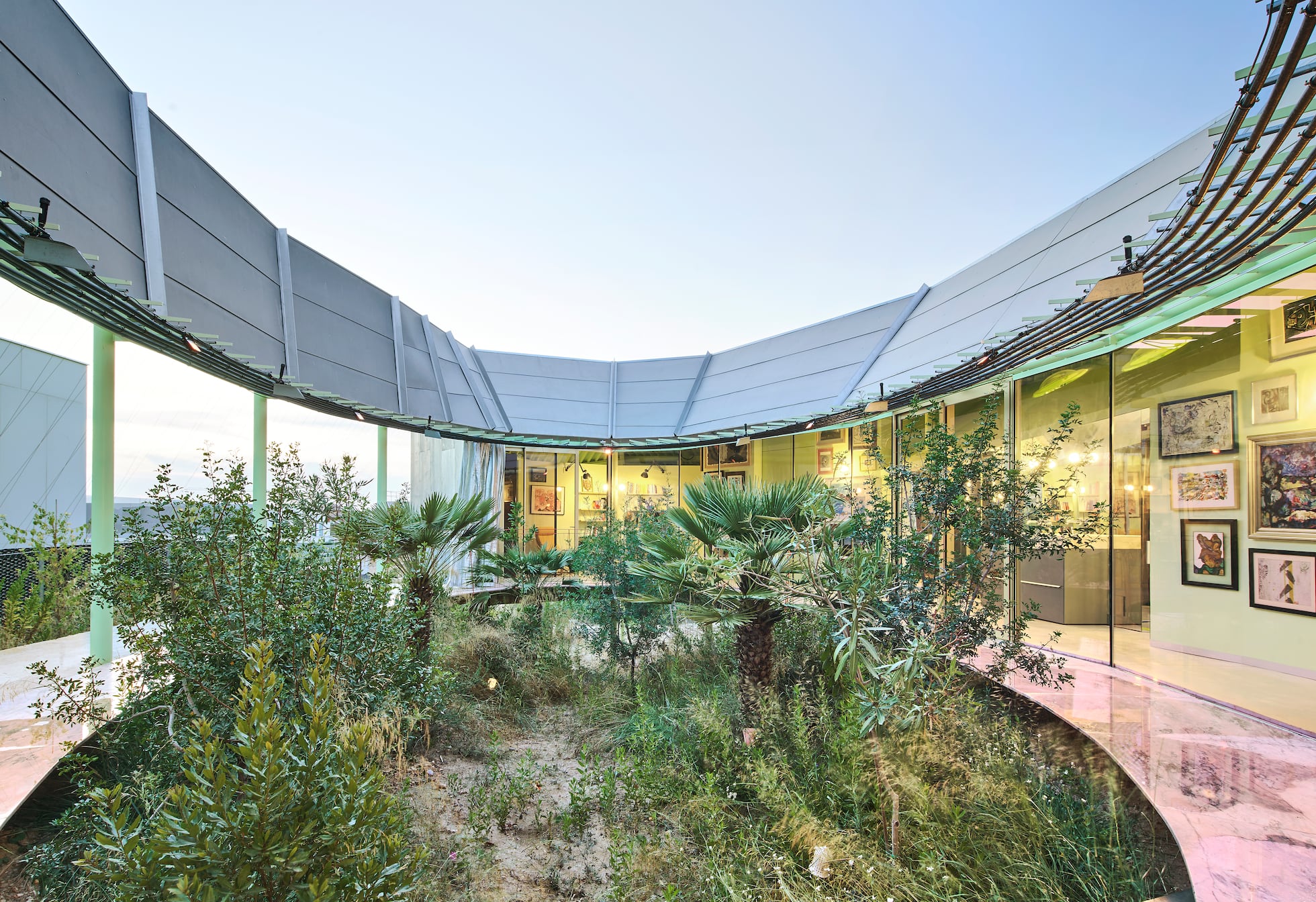
Rambla Climate-House by architect Andrés Jaque in Molina de Segura, Spain.

Today’s article addresses how architecture can and should repair our ecological system. How in cities, for example, a comprehensive vision would extend beyond beautifying downtown to embracing the understanding that we are not the only species on the planet.

At El País, Miguel Ángel Medina interviews architect Andrés Jaque about buildings that can be good for the environment.

“For three years,” he says, “Andrés Jaque, 53, has been dean of the Graduate School of Architecture at Columbia University, one of the most cutting-edge centers in architectural innovation. The Madrid-born architect is spending his time at the university rethinking how buildings and cities should face climate change. He believes that we must commit to an ‘interspecies alliance’ and that buildings, beyond just being sustainable, should also contribute to repairing our ecology.

“Jaque has proposed several projects with this concept in mind, such as the Reggio School in Madrid — designed to create life within its walls and attract insects and animals. …

Andrés Jaque
“Architecture is the discipline that has most clearly assumed the responsibility of responding to the climate crisis. In the last 15 years, there’s been a radical transformation [in the field]: materials have gone from being sustainable to [repairing the ecology]. And [the architectural field] has revised its own mission, which is no longer to just build new buildings, but to manage the built environment. Additionally, it has brought about an intersectional vision: understanding that the material, the social, the ecological and the political are inseparable and that climate action has to coordinate these fronts of transformation. This has placed architecture at the center of environmental action.

Miguel Ángel Medina
“Do architects share this interpretation?

Jaque
There’s a part [of the field] that’s anchored in a heroic vision of modernity and another that’s commercial… but there’s another that has a political commitment to the planet. And [those who adhere to this] understand that architecture must respond not only to the most immediate circumstances of a commission, but also to action for the planet. …

“There are two systems: a material world of extractivism — which is a mix of carbonization, colonialism, anthropocentrism, heteropatriarchy and racialization — that’s currently collapsing. And, in the cracks of this system, another kind of architecture is emerging, which seeks alliances between species based on symmetry, which pursues a global regime of solidarity and which advances along a line of decarbonization that marks the esthetics, the materialities [and] the types of relationships that constitute contemporary culture. This is gaining undeniable strength. In the future, we’ll see a change that’s as important as the one that modernity once represented.

Medina
“What do we do with urban planning, given so many extreme phenomena?

Jaque
“We’ve been pioneers in proposing a change of focus, from an emphasis on the city as a kind of stain on the territory, to a trans-scalar approach. This is a way of understanding [the physical structure that is] an urban block of apartments, the microbial relationships that occur in the bodies of those who live on that block, as well as the large networks of resource extraction that make life on that block possible.

“The city has lost the capacity to contain all realities, [which is necessary] in order to think in a climatic and ecosystemic way. And we need a new model that allows us to understand that what happens on a molecular scale has implications on the scale of bodies, buildings, streets, neighborhoods, the planet and the climate. Designing [cities] in a trans-scalar way requires changes in the methodologies of architecture, which we’re exploring. …

“Cities are going through a period of great transformation. A transformation in which the city has to be understood as something physically porous, which allows for the circularity of water, which contributes to multiplying life… a transformation of materiality that promotes a flow of materials that also contributes to the health of bodies. [We require] a very different way of urbanizing the air – in such a way that it’s understood that there’s a direct relationship between our lungs and the climate – and a commitment to the generation of diverse and empowered living environments. The main difficulty is how to do this quickly, so as to mitigate the impact of the climate and environmental crises.

Medina
“What’s this new ‘interspecies diplomacy’ that you advocate in favor of?

Jaque
“Humans are just one of many forms of life. And the idea that humans can decide to sacrifice the rest of the species to serve their own interests has been shown to be harmful. Understanding that we’re dependent on many other species — and that we’re actually inseparable from them — is more realistic. We depend on the quality of the soil, on the ecosystems. An interspecies alliance based on protecting the living conditions of diverse species is beneficial for all life on the planet.”

More at El País, here.

Read Full Post »

Photo: Wil Crombie/Organic Compound.
In a good example of agroforestry, hazelnut trees and tall grasses are seen growing in the chicken paddocks at the Organic Compound, a farm in Faribault, Minnesota. 

Something about connectedness is in the air these days. Those of us with aches and pains have had to learn how muscles and bones and nerves are connected in unexpected ways. And what about connections in the environment? Even ten years ago, I failed to appreciate how soil and fungus and insects connect or how forests and farms need each other.

Tom Philpott explains at Yale Environment 360 shows agroforestry leading the way to a healthier ecosystem.

“Drive through rural Minnesota in high summer and you’ll take in a view that dominates nearly the entire U.S. Midwest: an emerald sea of ripening corn and soybeans. But on a small operation called Salvatierra, 40 minutes south of Minneapolis, Reginaldo Haslett-Marroquin is trying something different. When he bought the land in 2020, this 18-acre patch had been devoted for decades to the region’s most prevalent crops. The soil was so depleted, Haslett-Marroquin says, he thought of it as a ‘corn and soybean desert.’ Soon after, he applied 13 tons of compost, sowed a mix of prairie grasses and rye, and planted 8,200 hazelnut saplings.

“While he won’t reap a nut harvest until 2025, the farmer and Guatemalan immigrant doesn’t have to wait to make money from the land. He also runs flocks of chickens in narrow grassy paddocks between the rows of the fledging trees, where they hunt for insects and also munch on feed made from organic corn and soybeans, which they transform into manure that fertilizes the trees and forage.

“Salvatierra is the latest addition to Tree-Range Farms, a cooperative network of 19 poultry farms cofounded in 2022 by Haslett-Marroquin. Chickens evolved from birds known as junglefowl in the forests of South Asia, he notes, and the co-op’s goal is to conjure that jungle-like habitat. Chickens crave shade and fear open spaces; trees shelter them from weather and hide them from predators. In 2021, Haslett-Marroquin’s nonprofit, Regenerative Agriculture Alliance, purchased a poultry slaughterhouse just south of the Minnesota border in Stacyville, Iowa, where farms in the Tree-Range network process their birds. You can find the meat in natural-food stores from the Twin Cities area to northern Iowa.

“By combining food-bearing trees and shrubs with poultry production, Haslett-Marroquin and his peers are practicing what is known as agroforestry — an ancient practice that intertwines annual and perennial agriculture. …

“It’s widely practiced across the globe, particularly in Southeast Asia and Central and South America. According to the U.N. Food and Agriculture Organization, 43 percent of all agricultural land globally includes agroforestry features.

“Bringing trees to the region now known as the Corn Belt, known for its industrial-scale agriculture and largely devoid of perennial crops, might seem like the height of folly. On closer inspection, however, agroforestry systems like Haslett-Marroquin’s might be a crucial strategy for both preserving and revitalizing one of the globe’s most important farming regions. And while the corn-soybean duopoly that holds sway in the U.S. heartland produces mainly feed for livestock and ethanol, agroforestry can deliver a broader variety of nutrient-dense foods, like nuts and fruit, even as it diversifies farmer income away from the volatile global livestock-feed market. In recognition of this potential, the U.S. Department of Agriculture (USDA), in late 2022, launched a $60 million grant program to help farmers adopt such practices. …

“Using satellite imagery, a team of University of Massachusetts researchers has calculated that a third of the land in the present-day Corn Belt has completely lost its layer of carbon-rich soil. And what’s left is washing away at least 25 times faster than it naturally replenishes. As prime topsoil vanishes, farmers become more dependent on fertilizers derived from fossil fuel.

“Not surprisingly, given those applications, the Corn Belt is also in the midst of a burgeoning water-pollution crisis, as agrichemicals and manure from crowded livestock confinements leach away from farm fields and into streams and aquifers. … As University of Washington geomorphologist David Montgomery noted in his magisterial 2007 book Dirt: The Erosion of Civilizations, ‘With just a couple feet of soil standing between prosperity and desolation, civilizations that plow through their soil vanish.’

“Breaking up the corn and soybean rotation with trees — and freeing some farm animals from vast indoor facilities to roam between rows, where their manure can be taken up by crops — could go a long way to addressing these crises, experts say.

“Trees actually have a much longer and more robust history in the Midwestern landscape than do annual crops. Think of the Midwestern countryside before U.S. settlers arrived, and you might picture lush grasses and flowers swaying in the wind. That vision is largely accurate, but it’s incomplete. Amid the tall-grass prairies and wetlands, oak trees once dotted landscapes from the shores of Lake Michigan through swathes of present-day Indiana, Illinois, Iowa, and Missouri, clear down to the Mexican border. These trees didn’t clump together in dense forests with closed canopies but rather in what ecologists call savannas — patches of grassland interspersed with oaks. Within these oak savannas, which were interlaced with prairies, tree crowns covered between 10 percent and 30 percent of the ground. They were essentially a transition between the tight deciduous forests of the East and the fully open grasslands further west.”

More at e360Yale, here. The long and interesting article is by Tom Philpott, a senior researcher at the Johns Hopkins Center for a Livable Future and author of Perilous Bounty. No firewall. Donations sought.

Read Full Post »

Photo: Ilan Ben Zion.
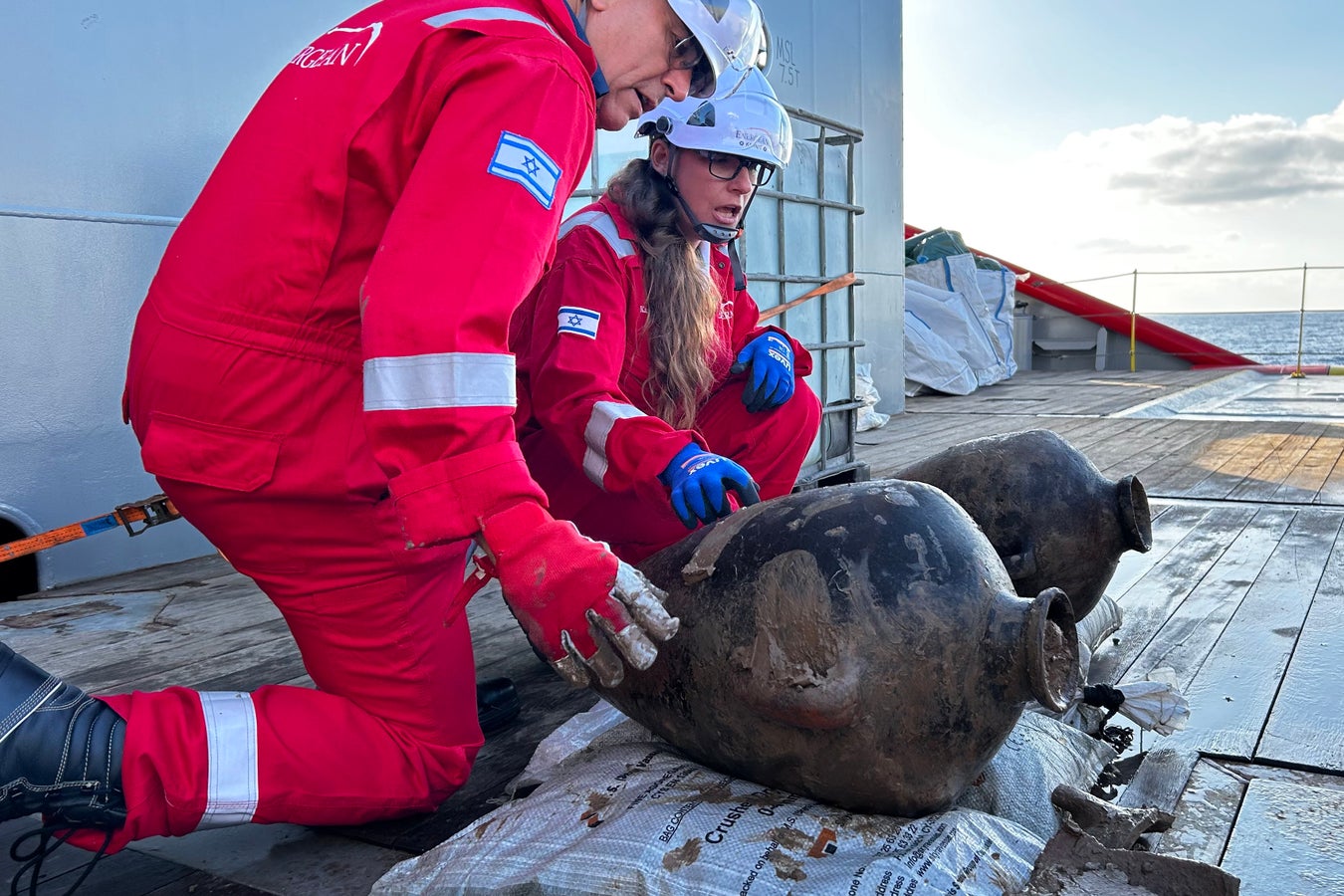
IAA archaeologist Jacob Sharvit (left) and Energean environmental lead Karnit Bahartan examine Canaanite storage jars retrieved from the seafloor of the Mediterranean on May 30, 2024. They are from the Bronze Age (which ran about 3300 to 1200 BC, according to Wikipedia). 

Judging from past comments here, we all like archaeology stories, especially those that explore the mysteries of shipwrecks. It must be something about realizing that nothing is ever completely lost.

At Scientific American, Ilan Ben Zion reports on the recent discovery of a Bronze Age shipwreck in the Mediterranean.

“Golden sunlight fell on the two amphorae, still caked in brown ooze, as they breached the Mediterranean’s waves. Their ascent from the seafloor, more than a mile down and 60 miles from land, had taken three hours. It was the first daylight they had seen in at least 3,200 years, and they came from the only Bronze Age shipwreck discovered in deep waters.

“Archaeologists retrieved these Canaanite storage jars, just two from a cargo of dozens located far off northern Israel’s coast in May.

” ‘It’s the only ship from this period that was found in the deep sea,’ one of the final frontiers of archaeology, says Jacob Sharvit, director of marine archaeology at the Israel Antiquities Authority. Only a handful of other Late Bronze Age ships have been discovered — all of them in shallow coastal waters of the Mediterranean Sea, including in the Aegean Sea.

“Sharvit helped spearhead a complex archaeological operation far offshore, along with the Israel Antiquities Authority (IAA) and offshore gas firm Energean to retrieve the jars from the seafloor.

“In the Bronze Age people shipped these storage jars across the Levant starting around 2000 B.C.E., when maritime trade in the Mediterranean exploded.

“ ‘They’re always either pointy or rounded at the bottom,’ so they rock with ship’s motion but don’t tip over and break, says Shelley Wachsmann, a nautical archaeology expert at Texas A&M University, who was not involved in the research.

“These workaday ceramics evolved so consistently over the centuries that they can be reliably dated with an examination of their shape and design. Based on the recently discovered jars’ neck, the pronounced angle of their shoulders and their pointed base, these amphorae are estimated to date to between 1400 and 1200 B.C.E., the IAA said in a recent press release.

“At that time, the ship and its crew sailed a world of prolific international trade, diplomacy and relative stability in the eastern Mediterranean, which was dominated by the Egyptian and Hittite empires. Merchant ships carrying olive oil, wine, ores, timber, precious stones and numerous other goods plied the seas between Greece, Cyprus, Anatolia, the Levant and Egypt.

” ‘This is the time that the Mediterranean is globalized,’ says Eric Cline, a professor of archaeology at George Washington University. ‘You’ve got lots of commerce, lots of diplomacy and lots of interconnections’ between the Egyptian, Hittite, and Assyrian empires and the lands between them, says Cline, whose newly published book, After 1177 B.C.: The Survival of Civilizations, explores the aftermath of the collapse of this Late Bronze Age international order.

In our own era of globalization, this disintegration draws particular interest among scholars looking for clues into how stable civilizations foundered in the past.

“The first signs of the shipwreck surfaced in 2023, during an environmental survey that Energean conducted ahead of its development of a new undersea natural gas field. The survey’s sonar scans were meant to locate and protect deep-sea ecological hotspots from undersea construction, says Karnit Bahartan, Energean’s environmental lead.

“Subsea surveys of the nearby Leviathan gas field conducted in 2016 by Noble Energy (now part of Chevron) reportedly turned up at least nine deep-sea archaeological sites, including a Late Bronze Age shipwreck. But details of the finds were never disclosed, and the sites were never excavated, according to a Haaretz report in 2020.

“ ‘What we were doing is looking for sensitive areas, sensitive habitats, anything that can be worth saving,’ Bahartan recalls.

“Closer examination of the sonar hits revealed that most were modern trash, Bahartan says as she flips through photographs taken by a remotely operated vehicle (ROV). The images show plastic bags, deck chairs, oil drums and a porcelain toilet, seat included. Occasionally, she says, she and her colleagues might find a solitary amphora or ceramic fragments.

“But one sonar blip turned out to be a large assemblage of jars jutting out of the seabed. ‘I didn’t know if it was something dramatic or not. I just sent it to the [Israel] Antiquities Authority,’ Bahartan says.

“Energean offered the IAA a ride onboard the Energean Star, an offshore supply and construction vessel. … Six hours out of Haifa’s port, the Energean Star hovered over the wreck’s coordinates, and a crane lowered a truck-sized, canary-yellow-and-black ROV into the sea. It took an hour to descend to the bottom. Nearing the seabed, operators released the ROV toward the site. …

“Dozens of jars, nearly identical and about half a meter long, clustered in an oblong patch roughly 46 feet long and 19 feet across. … The ROV circumnavigated the wreck, taking a high-resolution video that would be stitched into a photomosaic of the site. Sharvit picked out a couple jars from the fringes that could be extracted with minimal disturbance.

“Sharvit had hoped to find the ancient crew’s personal effects to help nail down the ship’s origin but spotted none. The IAA is running a so-called petrographic analysis of the ceramics to try to pinpoint where they came from; analyses of residue and trace elements could help identify their contents.

“Cline, who was not involved in the IAA mission or its preliminary study, says the proposed date ‘would place the wreck right in the middle of the most interconnected period of the Late Bronze Age in the Aegean and eastern Mediterranean, which is exciting.’ ”

More at Scientific American, here.

Read Full Post »

Photo: NOAA Fisheries.
Mako sharks are part of a study involving acoustic tags.

You have to move fast to get a tag on a shark, and you have to throw the shark back, even if you’re not done, if it starts showing any sign of weakness. Frank Carini has the story at ecoRI News.

“A South Kingstown-based nonprofit co-founded by a lifelong Rhode Islander [attaches tags to sharks].

Jon Dodd, the Atlantic Shark Institute’s executive director, said getting an acoustic tag, or any tag, for that matter, onto a shark works like a ‘NASCAR pit stop.’ A crew of four, sometimes six, has a maximum of 12 minutes to get a tag attached and take a blood sample and measurements. If a sharks begins to look lethargic, Dodd said the animal is immediately placed back in the sea, even if all the data hasn’t been collected or the tag fastened.

“A hose is put in the shark’s mouth to flush salt water through its gills, and a towel is often placed over the eyes to keep the animal calm.

“The Atlantic Shark Institute, an all-volunteer nonprofit, partners with other shark scientists and researchers, which allows collaboration to play a critical role in the research, management, and conservation of large predatory sharks in the northwest Atlantic Ocean, according to Dodd.

“ ‘We have to spend wisely to advance science,’ he said. The institute’s budget gets a helping hand from 20 local boat captains who provide their vessels and fuel free of charge for tagging research.

“Dodd noted tagging allows researchers and scientists to track where sharks go and when. … Given the vulnerability of most of the shark species they are tagging, studying, and tracking, Dodd said, they abide by strict protocols regarding the way the sharks are handled when they are being caught, tagged, and measured. He noted that traditional J hooks, which can fatally puncture an organ, have been replaced by circle hooks, which are more likely to lodge in the corner of a shark’s jaw, making removal easier. Fishery regulations also require hooks to be composed of corrodible metals which, unlike stainless steel, degrade faster and increase the chance of a shark’s survival if a hook can’t be removed.

“The type of tag used is determined by the species caught and the study being conducted, according to Dodd.

“The least expensive are national fisheries tags — an index card in a plastic tube attached to the base of the dorsal fin. These cards are provided by NOAA Fisheries for free. A shark swims around and ‘if somebody caught it someday, they say please unscrew the cap and the card rolls out and it says please call the National Fishery Service and tell us where you caught this shark, what size it was, et cetera.’ …

“Acoustic tags, which cost $425 and last about a decade, track a shark’s movement via signals picked up by acoustic receivers, which cost $2,500 each, that have been placed up and down the East Coast. Both the Atlantic Shark Institute and the Rhode Island Department of Environmental Management have placed receivers in local waters.

“Pop-up satellite archival tags — each with a price tag of up to $4,000 — provide even more detailed data beyond location, such as water depth and temperature. They last about two years before the battery dies and the tag corrodes and falls off the shark. …

“The Atlantic Shark Institute’s … mission, and that of its science partners, is ‘to do the highest quality shark research to help manage and conserve these magnificent animals.’ …

“During a recent conversation with ecoRI News, Dodd often used the words ‘beautiful’ or ‘awesome’ to describe a shark species — well, maybe not spiny dogfish.

“Dodd has spent much of the past 45 years, even while working full-time in a totally different field, thinking about, learning about, and studying sharks. He has caught, released, and tagged some 1,000 sharks for various research projects during the past four-plus decades. …

“ ‘When I saw my first shark, I was fascinated, and it just kept rolling,’ Dodd said. ‘But it quickly went from fascination to concern. It was just this realization that Man will take a lot of things out of an ecosystem, and it didn’t feel right.’

“His concern about the species grew during the 1980s and ’90s, especially as he watched the popularity of shark tournaments grow, the number massacred for their fins increase, and the amount killed in bycatch rise.

“ ‘We take over 100 million out of the ocean every year. It’s just too many,’ said the 62-year-old Dodd. ‘And the big problem is that a lot of these sharks are very slow growing and slow maturing. I’ll give you a perfect example. … It takes the female great white 33 years before she’s sexually mature. So we’re talking right now and it’s March 21, 2024, so if a white shark is born while we’re chatting that shark will finally reproduce when I’m 95 years old.

“ ‘For the first time she can finally replace herself, but what’s the chance that her pup [litter sizes range from 4-12 individuals] survives? A lot of things can eat you, you can bite the wrong hook, you can sit on a longline and die because you’ll basically suffocate. You can get dragged up somewhere. You can get caught by a recreational guy that poses with it too long and kills it. What’s the chance that you survived 33 years so you can reproduce?’ …

“Since 1975 the world’s shark populations have declined by 71%, according to the Save Our Seas Foundation. It’s a disturbing trend that Dodd said has major implications beyond the marine environment.

“He likes to tell people, ‘Shark health is ocean health and ocean health is our health. Sharks are the apex predator, and they regulate everything underneath them.’ “

More at ecoRI News, here. No firewall.

Read Full Post »

Photo: The Verge.
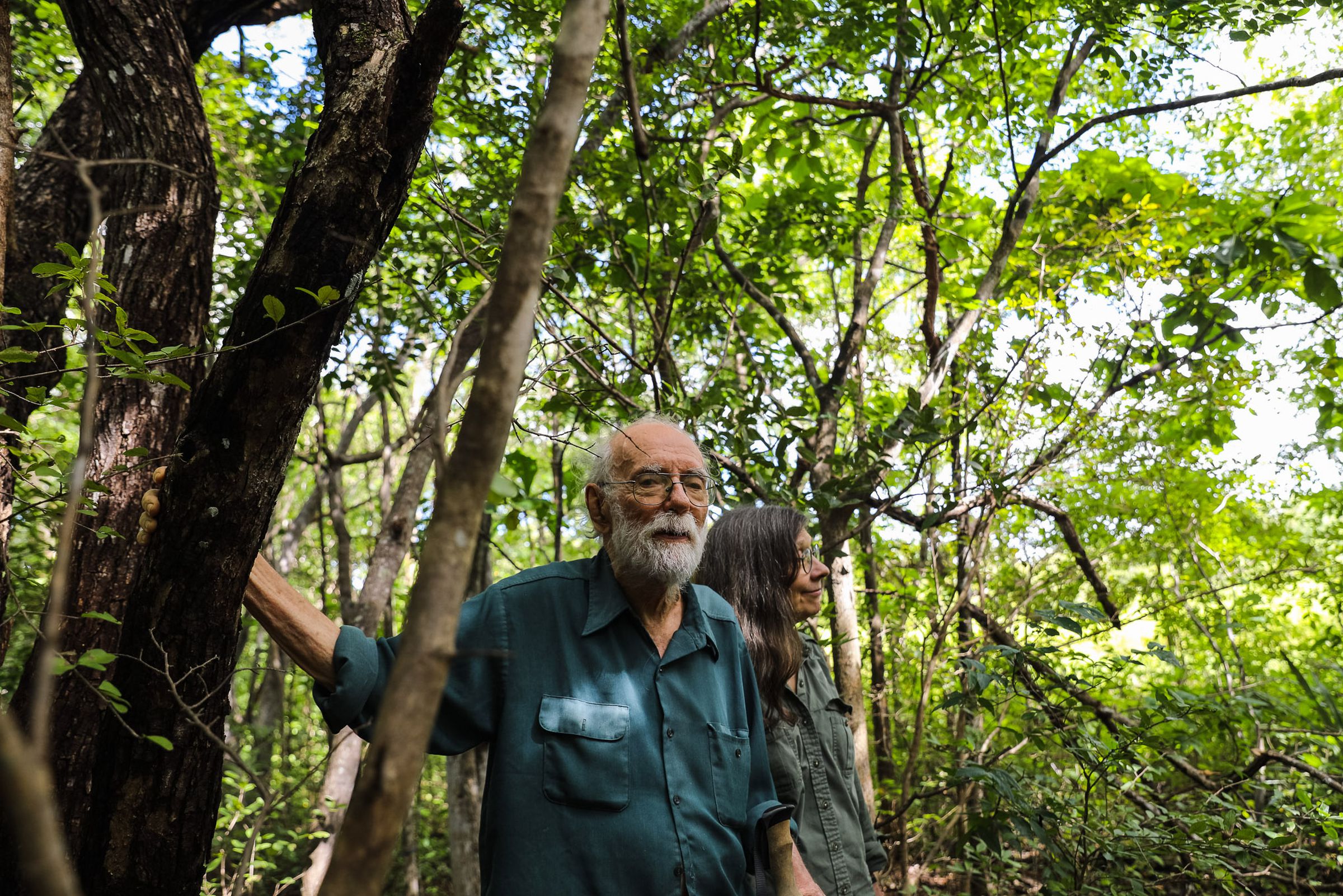
Daniel Janzen and Winnie Hallwachs, together with other conservationists, has brought forests back to the Area de Conservación Guanacaste (ACG) in Costa Rica — an area larger than the Hawaiian island of Oahu.   

Costa Rica, a beautiful country, has the right priorities. It has restored its forests and moved to renewable energy. Justine Calma at the Verge writes about the people behind the reforestation efforts and how climate change is starting to make their work more difficult.

“Ecologist Daniel Janzen wades into the field, clutching a walking stick in one hand and a fist full of towering green blades of grass in the other to steady himself. Winnie Hallwachs, also an ecologist and Janzen’s wife, watches him closely, carrying a hat that she hands to him once he stops to explain our whereabouts. 

“Together with other conservationists who have dedicated decades of their lives to this place, the couple has brought forests back to the Area de Conservación Guanacaste (ACG). It’s ​​an astonishing 163,000 hectares [~403,000 acres] of protected landscapes — an area larger than the Hawaiian island of Oahu — where forests have reclaimed farmland in Costa Rica. …

“ACG is a success story, a powerful example of what can happen when humans help forests heal. It’s part of what’s made Costa Rica a destination for ecotourism and the first tropical country in the world to reverse deforestation. But now, the couple’s beloved forest faces a more insidious threat.

“Across the road, the leaves are too perfect. It’s like they’re growing in a greenhouse, Janzen says. There’s an eerie absence among the foliage — although you’d probably also have to be a regular in the forest to notice. …

“There should have been bees, wasps, and moths along our walk, she explains. And plenty of caterpillar ‘houses’ — curled up leaves the critters sew together that eventually become shelter for other insects. …

“The bugs play crucial roles in the forest — from pollinating plants to forming the base of the food chain. Their disappearance is a warning. Climate change has come to the ACG, marking a new, troubling chapter in the park’s comeback story. … What’s happening here in the ACG says a lot about what it takes to revive a forest — especially in a warming world. …

“The dry season is about two months longer than it was when Janzen arrived in the 1960s. Climate change is making seasons more unpredictable and weather more erratic across the planet. …

“María Marta Chavarría, ACG’s field investigation program coordinator … explains it like this, ‘A big rain is the trigger. It’s time! The rainy season is going to start!’ Trees unfurl new leaves. Moths and other insects that eat those leaves emerge. But now, the rains don’t always last. The leaves die and fall. That has ripple effects across the food chain, from the insects that eat the leaves to birds that eat the insects. They perish or move on. And next season, there are fewer pollinators for the plants. ‘The big trigger in the beginning was false,’ Chavarría explains. …

“In 1978, Janzen … recalls in a 2021 paper he and Hallwachs published in the journal PNAS [his front wall was plastered with moths at night]. The title was ‘To us insectometers, it is clear that insect decline in our Costa Rican tropics is real, so let’s be kind to the survivors.’

“That observation in 1978 led the couple to focus their research on caterpillars and their parasites. In 1980, they used light traps to inventory moth species across the country, documenting at least 10,000 species. Since then, however, they’ve seen a steady decline in caterpillars. … 

“Hanging a white sheet and lights at the edge of a cliff overlooking a vast stretch of both old and new-growth forests, they photographed moths that came to rest on the sheet in 1984, 1995, 2007, and 2019. The first photograph is an impressive tapestry of many different winged critters. By 2019, that’s been reduced to a mostly white sheet speckled here and there with far fewer moths. Instead of an intricate tapestry of wings and antennae, the sheet looks more like a blank canvas an artist has only started to splatter with a brush. 

“Hallwachs and Janzen can see the same phenomenon now standing in broad daylight in the forest across from the field. Just because forests have come roaring back across the ACG doesn’t mean the struggle to survive is over. …

” ‘A lot of the reforestation projects are kind of assuming that trees are mechanical objects,’ Hallwachs says. But they don’t stand alone, not in a healthy forest. 

“Merely plant rows of trees, and the result is a tree plantation — not a forest. Bringing back a forest is a much different endeavor. It’s more about restoring relationships — reconnecting remaining forests with land that’s been cleared and nurturing new kinds of connections between people and the land.  

“In ACG’s dry forest, they didn’t have to plant trees by hand. By getting rid of the grass and stopping the fires, they cleared the way for the forest’s return. The first seeds blew in with the wind.

“Hallwachs and Janzen recognize them like old friends — stopping next to a Dalbergia tree that was one of the first to grow where they stomped out the fires. Its seeds are light and flat, allowing them to float on a breeze. When those trees start to grow, they attract animals in search of food or shelter. 

“Janzen measures each animal up by how many seeds they can hold and then spit or defecate onto the forest floor. ‘When you see a bird fly by, what you’re seeing is a tablespoon full of seeds,’ he says. ‘Every deer you see is a liter of seeds.’ ”

More at the Verge, here.

Read Full Post »

Photo: Jerry Neal/Colorado Parks and Wildlife.
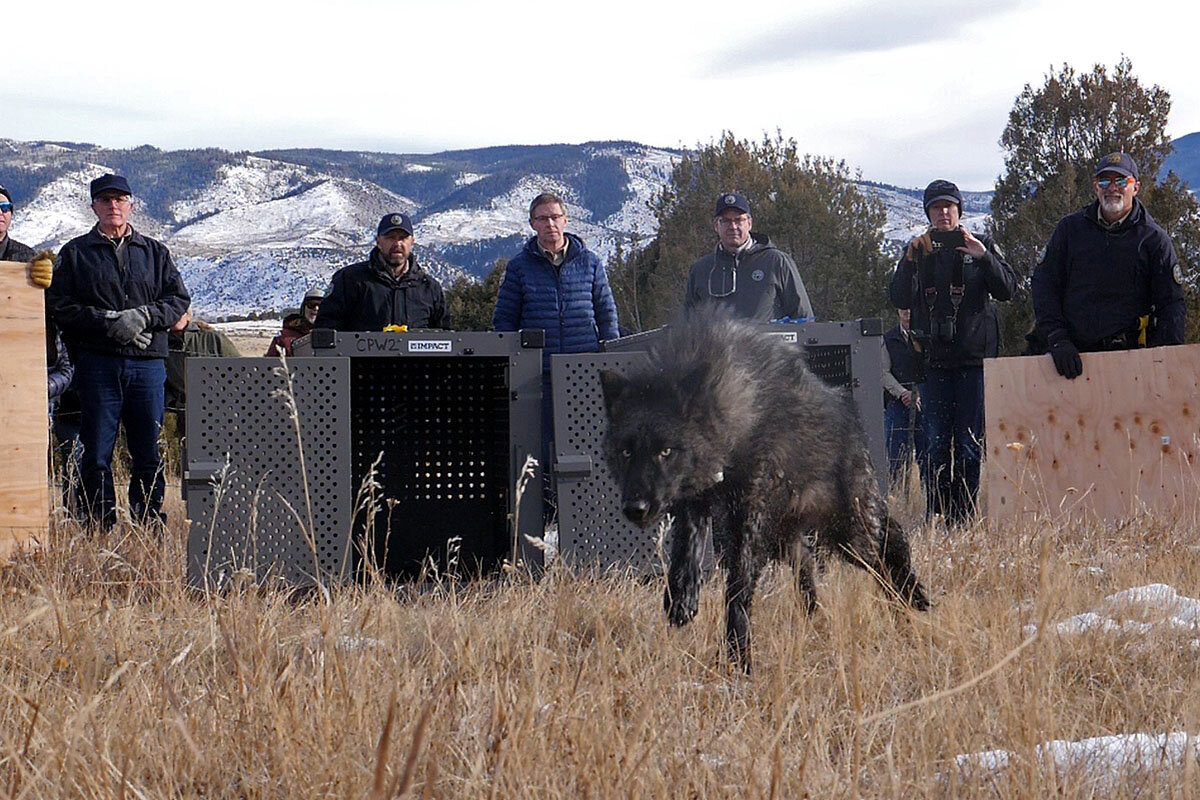
Via Christian Science Monitor: “Wolf 2302-OR runs into the wilderness as Colorado Parks and Wildlife released five gray wolves onto public land in Grand County, Colorado, on Monday, Dec. 18, 2023.”

Rewilding involves trade-offs. That’s why reintroducing the gray wolf with the scary eyes to its old haunts requires taking the needs of many constituencies into account.

As Sarah Matusek reports at the Christian Science Monitor, “A new era dawned in Colorado’s Rocky Mountains [in December] with the release of five gray wolves. 

“The reintroduction of the wild canines to Colorado fulfills a voter-passed plan to begin restoring the endangered species here by the end of 2023. The first batch of furry predators, flown in from Oregon, bounded out of crates in Grand County, Colorado, across an undisclosed meadow. 

“Wolves are contentious in the western United States, with disagreement about the threats they may pose versus their ecological benefit. A judge last week denied a last-minute lawsuit from the Colorado cattle industry seeking to block the release.  

“Despite the culture-war status of wolves, their release has also spurred cooperation. Many ranchers, wolf advocates, scientists, and wildlife officials have engaged in knowledge-sharing and strategizing around conflict reduction. …

“Gray wolves, wildlife experts say, are native to the Centennial State. Killed off in Colorado by the 1940s, some have since migrated here across state lines. Colorado biologists recorded the birth of wild wolf pups in the state’s north in 2021. 

“The animal is subject to a patchwork of protections. Listed as endangered in Colorado, for instance, the gray wolf loses that status once it crosses the northern border into Wyoming. Gray wolves are protected nationally under the federal Endangered Species Act, with exceptions in the northern Rocky Mountains. 

“After the 2020 vote, Colorado got special permission from the U.S. government for its state restoration plan. This generally allows management flexibility in Colorado, such as killing wolves that attack livestock.

“The Colorado cattle industry sued state and federal wildlife agencies last week seeking to block the rollout of the plan. The Gunnison County Stockgrowers’ and Colorado Cattlemen’s associations argued that the U.S. Fish and Wildlife Service failed to produce a certain environmental study on wolf impacts that federal law required.

“On Friday, a U.S. district judge denied the plaintiffs a temporary restraining order. Their arguments, the court found, didn’t merit halting Colorado Parks and Wildlife’s wolf plan, which ‘would be contrary to the public interest.’  

“Thirty to 50 wolves could be reintroduced on Colorado’s Western Slope over the next three to five years, according to the state’s wolf management plan. 

“The Western Slope, a largely rural area, sits west of Denver and several other population centers, which carried the pro-wolf vote. The outcome underscored an urban-rural divide in a Democratic-led state that used to trend more purple.

“Supporters, including environmentalists, argue for restoring a natural balance. ‘Wolves, for millennia, have been one of the primary engines of evolution and the drivers of ecological health throughout the Northern Hemisphere,’ says Rob Edward, strategic adviser at the Rocky Mountain Wolf Project. 

“He cites an example in Colorado’s Rocky Mountain National Park. An abundance of elk there has depleted vegetation ‘in the absence of their primary predator, gray wolves,’ says Mr. Edward,. …

“Critics, including agricultural producers, raise concerns about predation of wild and cultivated animals. ‘There’s obviously the concern with the impacts to our own livestock, both financial and emotional,’ says rancher Greg Peterson, a member of the Gunnison County Stockgrowers’ Association. ‘It’s traumatizing when that animal suffers.’ …

“Wolves may help reduce elk overbrowsing and bolster habitat diversity, [Kevin Crooks, director of the Center for Human-Carnivore Coexistence at Colorado State University] says, based on research in national parks like Yellowstone, which reintroduced gray wolves in 1995. But the science also suggests that ‘wolves were likely not solely responsible’ for ecosystem changes there.

“And while wolves could harm individual livestock, he says, in terms of ranching concerns, research shows that a rebound of wolves is unlikely to have a major economic impact on the cattle industry. Yet that’s cold comfort to one Colorado ranching family that’s already seen several livestock deaths and injuries from wolves since 2021, reports the Washington Post.

“In an effort to bridge trust gaps, Dr. Crooks’ center has compiled peer-reviewed research and crowdsourced funds for nonlethal wolf mitigation, like fencing or guard dogs. The university has also engaged Western Slope stakeholders like Jo Stanko, who runs a ranch with her husband near Steamboat Sp​​rings in northwestern Colorado.

“As a voter, Ms. Stanko says she cast her ballot in 2020 against wolf releases. Though she still has concerns, three years later she holds an attitude of acceptance – and hope for solutions around wolves and ranchers sharing land. Her family continues to train livestock dogs and install new fencing, and Ms. Stanko hosted a dialogue with wolf advocates and other ranchers last year. 

“ ‘We’ve got to learn to have – and relearn how to have – civil conversations with each other,’ she says.”

More at the Monitor, here.

Read Full Post »

Illustration: Elara Tanguy.
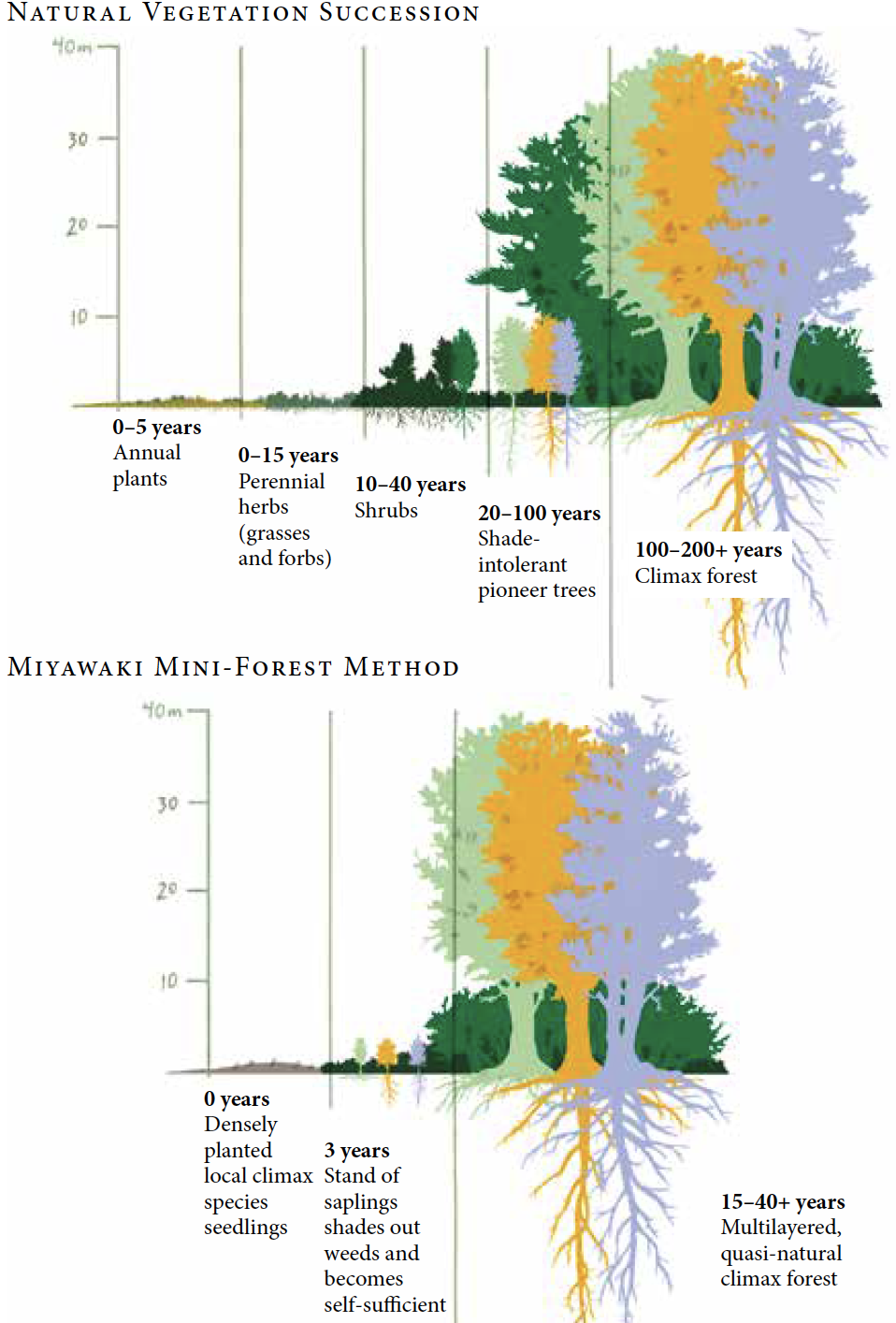
The Miyawaki Method (bottom) speeds up the process of natural ecological succession (top) through the planting of “climax species.”

Ideas on combating climate change through the planting of sustainable forests come today from an employee-owned publishing company called Chelsea Green. Here they focus on a book by Hannah Lewis about the Miyawaki Method.

“Author Hannah Lewis is the forest maker transforming empty lots, backyards, and degraded land into mini-forests and restoring biodiversity in our cities and towns to save the planet. …

“Most of us know the term old-growth forest, which refers to natural forests that are still mostly free of human disturbance (though not necessarily free of human presence). These forests have reached maturity and beyond — a process that often takes centuries. As a result, they host incredible biodiversity and sustain a complex array of ecosystem functions.

“The Miyawaki Method is unique in that it re-creates the conditions for a mature natural forest to arise within decades rather than centuries. 

At the heart of the method is the identification of a combination of native plant species best suited to the specific conditions at any given planting site.

“As we’ll see, determining this combination of special plants is not always so straightforward.

“More than just the species selection, the Miyawaki Method depends on a small collection of core techniques to ensure the success of each planting. These include improving the site’s soil quality and planting the trees densely to mimic a mature natural forest. It’s also necessary to lightly maintain the site over the first three years — which can include weeding and watering. Amazingly, though, if the simple guidelines are followed, after that point, a Miyawaki-style forest is self-sustaining.

“The trees grow quickly (as much as 3 ft per year), survive at very high rates (upward of 90 percent), and sequester carbon more readily than single-species plantations. The Miyawaki Method is also special for its emphasis on engaging entire communities in the process of dreaming up and planting a forest. Whether you are three years old or eighty-three, chances are you can place a knee-high seedling into a small hole in the ground. At the very least you can appreciate and cherish the return of quasi-wilderness to a space that was once vacant.

“The Miyawaki Method calls for planting native species, but not just any natives. In particular, the method involves a careful investigation of what’s known as potential natural vegetation (PNV). This unusual term refers to the hypothetical ecological potential of a piece of land. Or another way to say it is that potential natural vegetation is ‘the kind of natural vegetation that could become established if human impacts were completely removed from a site’ over an extended period of time. A site’s PNV depends on many factors, including current climate conditions, soil, and topography.

“How is potential natural vegetation different from the plants we see growing around us in towns and cities? For starters, in almost all developed landscapes, many of the plants are not native to the area, and as such may require maintenance to survive or reproduce.

“Given that most of Earth’s land surface is significantly altered by urbanization, agriculture, road construction, mining, and the like, it is far from obvious what the original vegetation of any given location would have been. (Original vegetation and potential natural vegetation are not necessarily exactly the same, but they are closely related.) Unraveling this mystery takes curiosity, patience, and persistence.

“However, thinking about land in terms of its potential natural vegetation is a powerful angle from which to approach ecosystem restoration, because it reveals which species and groups of species are best adapted to a particular environment and therefore more likely to thrive and to support a wider web of wildlife. …

“If left alone, previously forested land can grow back into mature forest via a process known as ecological succession, wherein the biological components of the ecosystem change over time as larger and longer-lived plant communities colonize the land. As mentioned, this process can take centuries to unfold. A foundational aspect of the Miyawaki Method is that it sidesteps the slow and capricious march of natural succession, instead focusing on those plants that mark the theoretical endpoint of succession.

“In nature, the successional process begins when lightweight seeds drift in and germinate on bare ground. Hardy, fast-growing plants — what scientists call pioneer species — such as clover, plantain, and dandelion take advantage of ample sunlight and space. They live short lives, produce a lot of seeds, and shelter the ground in the process. Next to show up are larger perennial herbs and grasses, followed by shrubs and pioneer trees, such as birch, poplar, or pine.

“ ‘Each new group of species arrives because the environmental conditions, especially the soil, have been improved; each new species becomes established because it is more shade tolerant than the previous species and can grow up under their existing foliage,’ Miyawaki wrote. He explains that just when a community of plants appears to be reaching its fullest potential, the seeds of the succeeding community are already germinating in its shade. The species making up each new successional stage tend to be bigger, more shade-tolerant, and longer living than those of the previous stage.

“ ‘The plant community and the physical environment continue to interact,’ Miyawaki explained, ‘until the final community most appropriate for the environment comes into being, one that cannot be replaced by other plant types. In regions with sufficient precipitation and soil, the final community is a forest.’

“Theoretically, this final community of plants, known as the climax community, is not easily superseded. Big trees that are considered climax species in their respective environments live for hundreds or thousands of years, forming canopies that shade the interior of the forest, keeping it cool and moist. Climax species shade out pioneer species and dominate the forest.

“ ‘In the absence of major environmental change, the climax is normally the strongest form of biological society and is stable in the sense that its dynamic changes are constrained within limits,’ Miyawaki wrote. Partly on account of the microclimate they create, such ecosystems tend to be more resistant to external conditions, such as heat or drought.”

More at Chelsea Green, here. No firewall.

Read Full Post »

Photo: Edwards’s Botanical Register.
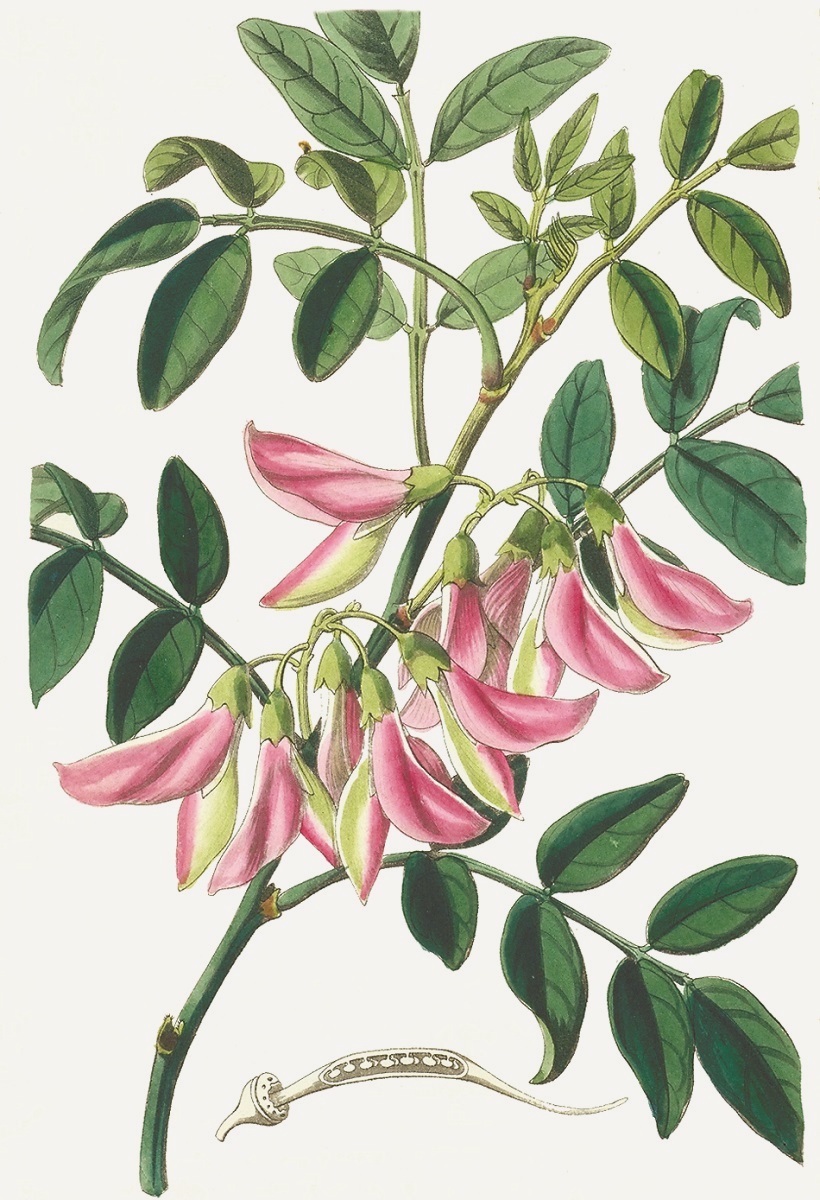
The Phillip Island glory pea, which once grew in Australia, is a leading candidate for de-extinction, according to e360

Do you get visions of Frankenstein’s monster when you hear about reversing extinction? Maybe we start with plants, but then what? Dinosaurs?

Well, it’s hard for me to be against anything that extends knowledge, so I’m keeping an open mind about the Yale Environment 360 report on the de-extinction of plants.

Janet Marinelli writes, “In January 1769, botanists Joseph Banks and Daniel Solander found a daisy in Tierra del Fuego, at the southern tip of South America. Later named Chiliotrichum amelloides, it is one of a thousand plant species unknown to European scientists that the two men collected during Captain Cook’s first voyage on the HMS Endeavor. … The plant was dried and pressed for future study. Today, the 254-year-old specimen is among the almost 8 million preserved plants in New York Botanical Garden’s William & Lynda Steere Herbarium.

“ ‘When a plant goes extinct,’ says Giulia Albani Rocchetti, a postdoctoral researcher at Roma Tre University and the lead author of the paper, ‘we don’t just lose a species, we lose a member of a habitat community with a specific role and relations with other species; … we lose genes which could have provided insight into the species and its community and yielded new pharmacological compounds and other products.’ …

“For nearly five centuries, herbaria have helped botanists identify, name, and classify the world’s floral diversity. Now these vast botanical libraries are being tapped to try to create a new chapter in the 500-million-year history of Earth’s terrestrial plant life. In Nature Plants in December, an international group of biologists published the first-ever list of globally extinct plants they believe can be returned from the dead, using seeds available in herbarium specimens. …

“In recent decades, the seeds of rare and imperiled species have been preserved in seed banks at low humidity and temperatures that ease the embryos inside into a kind of state of suspended animation to maximize their longevity. However, species already lost remain only as specimens in the collections of dried and pressed plants known as herbaria, and only in some (lucky) cases. … Only a few of these plants happened to be in fruit and in seed when they were collected. And even when herbarium seeds are discovered, there is no easy way to tell if the embryos inside are dead or lying dormant, waiting to sprout when conditions are right. …

“Abby Meyer, executive director of Botanic Gardens Conservation International in the United States, points to the rise in recent decades of the field of bioinformatics, which has transformed the trove of biodiversity information once locked up in natural history collections — such as herbarium specimens of extinct plants that contain seeds — into browsable digital databases. New York Botanical Garden (NYBG), for example, began digitizing its herbarium specimens in the mid-1990s, and today some 4 million, or about half of its preserved plants, have been scanned and can now be called up on a computer screen by anyone around the globe.

“Data aggregators such as the Global Biodiversity Information Facility provide researchers looking for seeds with instant access to millions of scanned specimens, along with associated ‘metadata’ such as the GPS coordinates where the plants were collected. At the same time, scientists have been refining in vitro embryo rescue techniques, increasing the odds that old or weak seed embryos can grow into viable plants. …

“While attempts to de-extinct the dodo, the woolly mammoth, and other charismatic megafauna continue to grab headlines, they would result at best in a hybrid, genetically engineered animal — a proxy of an extinct species. By contrast, recovering plants by germinating or tissue-culturing any surviving seeds or spores preserved in herbaria would result in the resurrection of the actual species. …

“One of the biggest hurdles is figuring out how to germinate the precious few seeds of often genetically unique plants found only on dried specimens. There is little margin for error, and before attempting to germinate the extinct species itself, scientists must perfect methods for germinating seeds of any closely related species that survive. …

“In December 2019, Giulia Albani Rocchetti sat in Florence’s Central Herbarium, marveling over the remains of Ranunculus mutinensis, an endemic buttercup that once grew in moist floodplain forests of the Po River, as it threads through northeastern Italy. … It was a thrill for her to find not just one but two Ranunculus specimens with numerous mature fruits called achenes. She then spent months at her desk in Rome, blowing up digitized images of extinct plants from herbaria across the globe on her computer screen in the improbable search for seeds.

“She was also spurred on by the knowledge that some seeds have the astonishing ability to survive adverse conditions and sprout after decades, even centuries — such as the Judean date palm, which a team of scientists successfully germinated in 2005 from a 2,000-year-old seed. …

“Albani Rocchetti and colleagues … identified 556 specimens that contained seeds, representing 161 of the extinct plant species [and] proceeded to devise a pioneering roadmap for prioritizing species for de-extinction. Assuming that species whose close kin produce long-lived seeds and newer specimens are the most likely to contain seeds that survive, they combined data on the seed behavior and longevity of closely related plants, as well as the age of each specimen, to create a DEXSCO, or best de-extinction candidate score for each species. …

Streblorrhiza speciosa, a spectacular member of the pea family, was [so] unique that it is considered the only member of its genus, or closely related group of plants. The species’ striking cascades of pink blossoms clambered exuberantly over trees on Phillip Island in the Pacific Ocean east of Brisbane, Australia. Collected in 1804 by Austrian botanist Ferdinand Bauer, the Phillip Island glory pea was an instant hit in Europe, coveted by every wealthy family with a conservatory. Meanwhile, however, Phillip Island was being overrun by pigs, goats, and rabbits introduced by British officers overseeing a nearby penal settlement, leaving barely a scrap of the remote island’s unique vegetation, and the glory pea was never seen in the wild again. …

“The glory pea is now presumed extinct, but at number three is near the top of the list of recommended de-extinction candidates. …

“Another challenge of plant de-extinction is the lack of financial support for pursuing it. But on the bright side, plant de-extinction has not kicked up the controversy surrounding attempts to resurrect, say, the wooly mammoth or passenger pigeon. ‘For whatever reason, the human brain doesn’t seem to be as concerned about plants as about animals,’ Knapp says. ‘But in this case, we’re literally just germinating seed. We’re not reconstructing a genome. And that’s way less intimidating. Everyone can understand that.’ “

More at e360, here. No firewall.

Read Full Post »

Photo: H Garrido/EBD-CSIC.
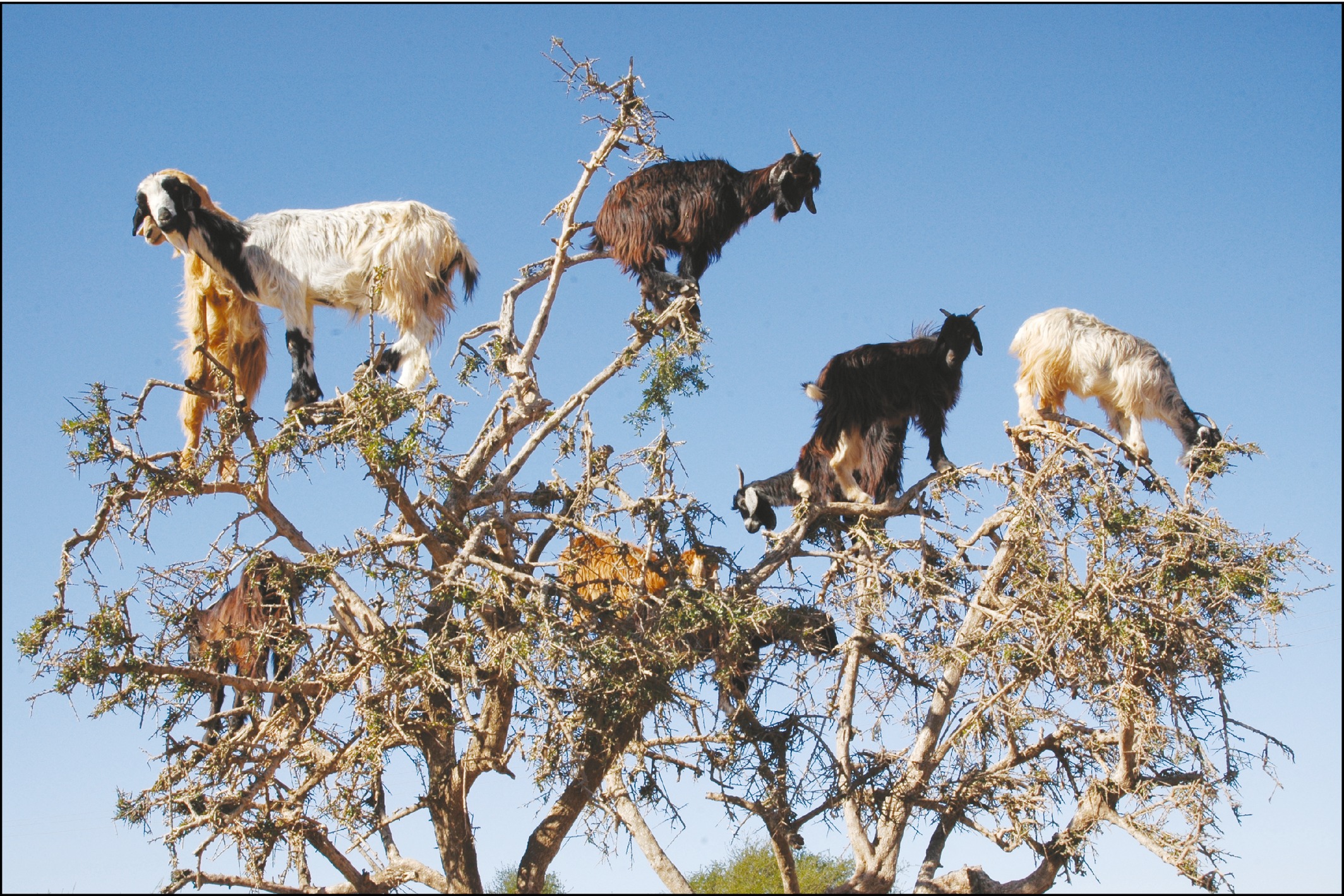
Goats grazing on an argan tree in southwestern Morocco. They disperse seeds during rumination, which is one of the ways the trees extend their presence.

When I first saw the picture above, I knew I needed it for the blog. An internet search revealed plenty of touring companies that offer customers photo ops with climbing goats.

But there is more to these guys than that.

Here’s a study by Miguel DelibesIrene Castañeda, and José M Fedriani from an Ecological Society of America journal called Frontiers in Ecology and the Environment. It explains that the goats’ role on the planet goes beyond being cute.

“Most people are familiar with domestic goats (Capra hircus) climbing on rocks,” the authors write, “but few know they are talented tree climbers too. In temperate countries where green pastures abound, goats do not need to climb trees to forage, but in arid regions the only available forage is sometimes found on the tops of evergreen shrubs and trees. Furthermore, goats often like seasonal fruits and collect them directly from fruiting trees when fallen fruits have been depleted.

“In southwestern Morocco, where the average annual rainfall is only 300 mm (~12 inches), goats climb the endemic argan tree (Argania spinosa).

Herders assist kid goats in learning to climb and even occasionally prune the trees to facilitate climbing.

“During the autumn, when herbaceous vegetation is lacking, goats devote 74% of their foraging time to ‘treetop grazing.’ …

“We previously observed Spanish and Mexican goats grazing on short trees or shrubs, but in Morocco we were astonished to see between 10 and 20 goats regularly climbing thorny 8–10-m-tall argan trees, mostly defoliated after intensive grazing. The purpose of our research was to verify that goats regurgitated the nuts of argan fruits while ruminating. …

“Argan forests are ecologically and economically important in southern Morocco, which is a developing country. The forests serve as an effective barrier for the Saharan Desert and provide local people with wood, fodder for livestock, cooking oil, medicine, and cosmetic materials. …

“To extract the oily kernels, the fleshy pulp of the tree fruits must first be removed and the hard nuts broken manually. Most popular accounts [say] that to remove the pulp, traditional Berbers feed the fruit to goats so the nuts pass through the digestive system and the seeds can be collected from the manure. However, goats do not usually defecate large seeds, so we were skeptical. …

“We wondered whether goats, which are ruminants, might spit out the nuts while chewing their cud, as we had seen goats do when fed with olive (Olea europaea) and dwarf palm (Chamaerops humilis) fruits in Spain (unpublished data). Moroccan goat herders confirmed that goats regurgitated most argan nuts while ruminating, although regurgitations and excrement found on the ground are usually mixed, resulting in misunderstandings about the way the nuts were expelled.

“Why is it important that goats regurgitate and spit out seeds from the cud? For plants there are well-known reproductive benefits associated with dispersing their seeds far from the maternal parent, including a greater probability of seed and seedling survival. To successfully disperse, many plant species produce edible fruits that attract frugivorous vertebrates, which ingest the fruits and transport the seeds inside their body until they are released elsewhere by regurgitation or defecation. …

“The possibility of ruminant ungulates spitting out some viable seeds from the cud is not even mentioned in [many] comprehensive reviews. … To illustrate the potential of domestic ruminants to spit viable seeds from their cud, we supplied Spanish domestic goats with fruits differing in size and structure, corresponding to five species (six varieties) of plants, including five drupes or pomes (fleshy fruits) and one legume (pods). …

“For all the plant species, we recovered appreciable numbers of seeds that the goats had regurgitated, despite not being able to find all of the seeds, since the goats were not subject to controlled conditions. As might be expected, larger seeds were more frequently spat out during rumination. …

“Our observations suggest that almost any seed could be ejected during mastication, spat from the cud, digested, or defecated. We tested the viability of regurgitated seeds by incubating them in a solution containing tetrazolium chloride; the embryo and endosperm of most seeds (71.5%) were stained red, indicating they were viable after processing by goats. …

“In conclusion, many previous studies that investigated the role of ruminants as seed dispersers were based exclusively on dung analyses and may have underestimated an important fraction of the total number of dispersed seeds. Moreover, this fraction of seeds should correspond to plant species with particular fruit and seed traits (eg large linear dimensions) differing from those of plant species dispersed exclusively or mostly through defecation. Importantly, the seeds of some species are unlikely to survive passage through the ruminant lower digestive tract so that spitting from the cud may represent their only, or at least their main, dispersal mechanism. It is therefore essential to investigate the effectiveness of this overlooked mechanism of seed dispersal in various habitats and systems.”

Don’t you love the language they use? “Processing by goats”! More at Ecological Society of America, here. No firewall. I have removed citations, so check out the original if you want to know who discovered what.

Read Full Post »

Photo: Corinne Staley, Flickr, CC BY-NC 2.0.
The Congo basin is home to numerous endemic plant and tree species, but today there are serious threats to the health of the ecosystem.

Peat bogs are the last thing I picture when thinking about the Congo. Shows how ignorant I am. Apparently, I am not alone. As the radio show Living on Earth reports, “Western scientists only learned about the Congo Basin peatlands in 2017. But indigenous communities have avoided disturbing the peatland while sustainably hunting and fishing in the area for generations. Raoul Monsembula grew up in the area and now works with Greenpeace Africa. He spoke with host Bobby Bascomb for a local perspective on the region.

BOBBY BASCOMB: “This area is new to the western world but, of course, local people have known about it for generations. Can you tell me a bit about your relationship with the peatlands and how the communities surrounding it used the area?

“RAOUL MONSEMBULA: The elders said to us it was a productive area for the fish and animals, and we could only do seasonal fishing and hunting, and collect some firewood because it’s a fragile area, where the fish and animals reproduce. We only use it during the dry season. We don’t go there during the wet season when the animals are reproducing.

We were advised by our elders to never start a fire in these areas, because these areas were essential for food. It’s also an area where we practiced traditional ceremonies.

“And you don’t see a lot of hospitals here but you don’t see people dying a lot because they’re using medicinal trees from the peatland and eating forest fruit.

“BASCOMB: So as a scientist from the DRC who grew up there, you spent your life in this region, how surprised were you to learn about the enormous amount of carbon locked up in the soil there?

“MONSEMBULA: When the scientists came here and we learned about the peatland, that night it was one of the biggest celebrations I’ve ever had in my life, we danced and we drank with the villagers because even if we didn’t know about the peatlands for a long time we knew that they were special. Even as we now begin to scientifically understand what this area means, the elders knew for a long time that this area would benefit humanity. This discovery made us very happy even if we were unsure if carbon would have any financial significance or not! It’s as though we are helping the world fight against climate change. …

“The problem is in Indonesia they are growing a lot of rice and palm oil crops in the peatlands, so the youth think why not grow them here too because it’s easy money. Most of the young people, the ones who are less than 25 years old, some of whom are unemployed or not well educated, want to do things like that.

“BASCOMB: Well you know the Congo Basin, the rain forest there, is second only to the Amazon of course in terms of being the largest rainforest in the world but unlike Brazil the Congo basin hasn’t really seen a whole lot of development but what are you seeing on the horizon in terms of possible development and threats to the integrity of the peatlands?

“MONSEMBULA: Logging is nearing the peatlands and agribusiness is growing. And the growing population can be problematic because it will encourage the development of more rice crops or palm oil crops in the peatland.

“That can be a problem because with a larger population if people can’t make a living, send their kids to school or go to the hospital they will damage the peatland by logging ecologically valuable trees to sell the wood and once they do that the peatland can dry. …

“BASCOMB: How can the Western world, do you think, support people living in the Congo Basin to preserve this thing that’s so important for all of us but at the same time support the people that need development?

“MONSEMBULA: The problem is that we need donors. We need western countries who are creating a lot of pollution to give some money for peatland protection. But another thing is corruption. You know how bad governance is in Central Africa. Like right now in the DRC we are hearing about millions of dollars going to the Central Africa Forest Initiative, they are giving a lot of money but when you’re in the field you don’t see anything. There is now a very big forest community project which is funded by international NGOs like Greenpeace, not the DRC government. We don’t want people to donate through the government ministry. With the corruption and bad governance that money will not go to the field.”

Reading this story on the day after the US elections, I am struck but something. I may be overgeneralizing, but it seems to me that the elders in the Congo have the wisdom, but in the US, it’s the youth. Whoever shows wisdom, I hope we can give them all the support they need.

More at Living on Earth, here.

Read Full Post »

Photo: Chris Linder.
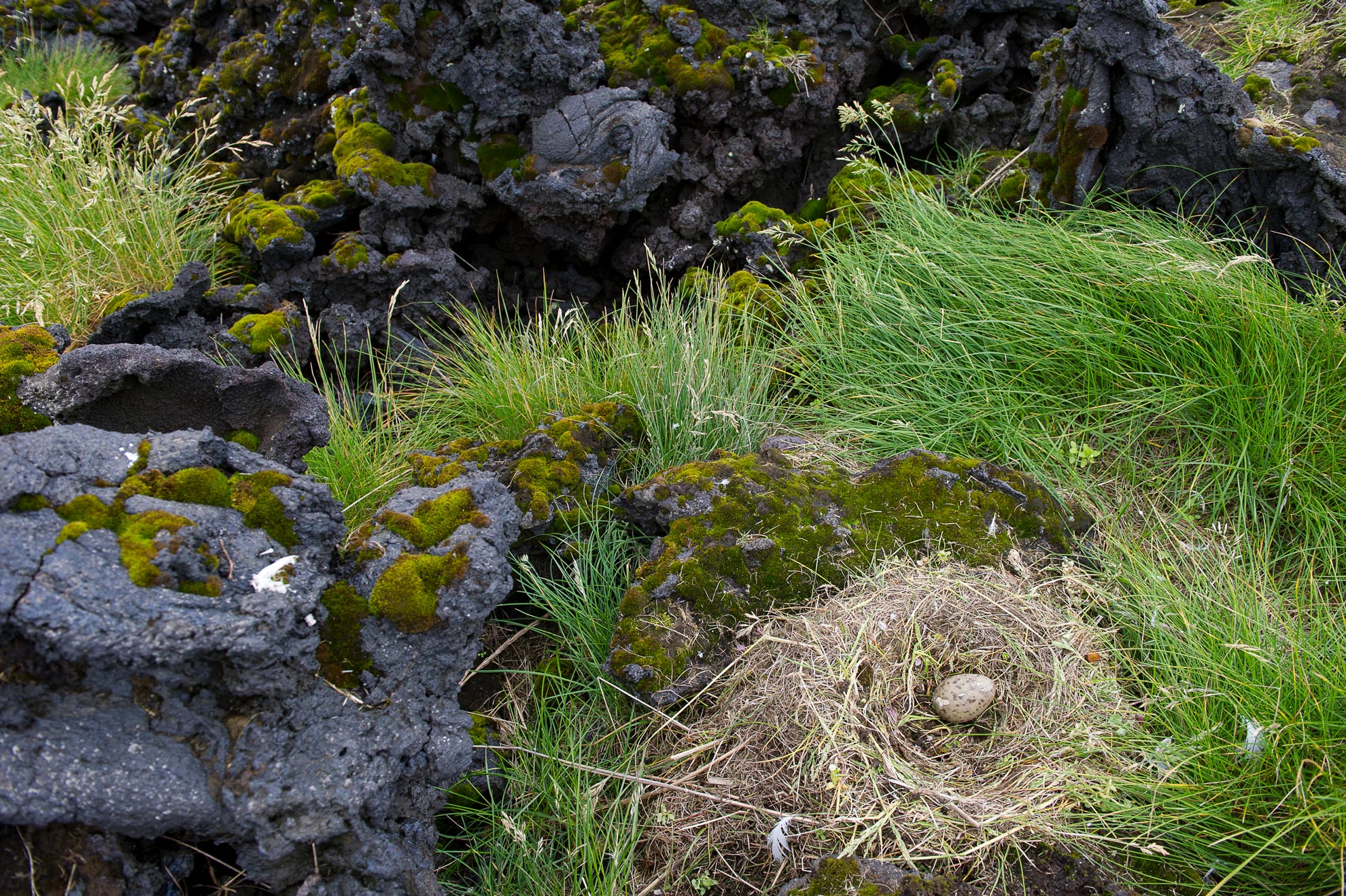
“Though most of [volcanic Surtsey] island is barren,” writes Hugh Powell at Living Bird, “a heart-shaped patch of green in the southwest corner supports lush growth and hundreds of bird nests.”

Anyone who has tried to combat weeds by putting black plastic under paving stones knows how futile that is. The life force has a mind of its own. Weed seeds will blow onto the plastic and colonize it within weeks.

Similarly, a brand-new island of volcanic rock that formed in the North Atlantic is in the process of creating a complex world of its own.

Hugh Powell reports at Living Bird. “Now just shy of 60 years old, the new island of Surtsey, off Iceland, holds clues to a fundamental mystery: What did the Earth look like when it was just born? How does life colonize bare rock?

“In 1963, a volcano erupted underneath the cold waters of the North Atlantic, 10 miles off Iceland’s southwest coast. The eruption lasted for four years. Eventually, the lava and ash cooled into a black-and-tan island named Surtsey, and the first fragile seeds of life started to wash ashore.

“Every year since the island came into being, scientists have visited Surtsey to track its ecological development. Visits to Surtsey require a permit — casual sightseeing stops are strictly prohibited — in order to preserve the island’s ecological integrity. Even today, a researchers’ red-roofed hut and an abandoned lighthouse foundation are the only buildings on Surtsey. …

“The scientists’ annual visits have generated a fascinating timeline of the pace of colonization by plant, bird, and even insect species.

“The first plant to arrive, a sea rocket (Cakile maritima), washed ashore in 1965, while the island was still erupting. By 1970, Black Guillemots had begun to nest, using the black volcanic cliffs as a foothold while getting their food from the sea.

“Over the next two decades, about 20 other plant species arrived, some by wind and some on the feet or in the stomachs of seabirds. A few additional birds set up nests as well, including Northern Fulmars and Black-legged Kittiwakes. But it wasn’t until 1985 that both plant and animal diversity started to shift into a higher gear, thanks to the arrival of an unexpected hero: the humble seagull. …

“Plant diversity had plateaued by the 1970s with fewer than 20 species established, and it didn’t take off again until a gull colony developed in 1986. The gulls — mostly Lesser Black-backed along with Great Black-backed, Herring, and Glaucous — carried with them not just new kinds of seeds, but also fertilizer in the form of nitrogen-rich guano.

“At first the gulls nested on bare black rock, but soon a lush green meadow encircled the colony, fed by gull droppings. By 2013 the meadow spread across 12 hectares (about 30 acres), supporting twice as much plant diversity and five times more biomass than the rest of the island. The number of plant species soared to 64 by 2007. …

“A more complex food web started to develop. Graylag Geese first arrived in 2001 and fed on the thick grasses. As insects like springtails, moths, and beetles began to thrive among the plant growth, insect-eating birds began to appear as well, such as Snow Buntings, White Wagtails, and Meadow Pipits. In 2008 the first ravens arrived, feeding in part on stolen seabird eggs.

“At almost 60 years old, Surtsey is still a geologic infant — its sister islands in Iceland’s Westman archipelago are about 40,000 years old. Researchers think much of the island will erode away. …

“The hard crater walls will become steep-sided seacliffs where murres and Razorbills will nest alongside the fulmars and kittiwakes already present. Atop the island, a thick turf will develop, dominated by just a few grass species. In perhaps a century or two, Atlantic Puffins will nest in the deep soil that develops.

“For now, researchers describe Surtsey as living in something of a golden age. Plant diversity has peaked at 64 species, but it’s beginning to decline as ecological competition starts to squeeze out some of the initial colonists. As the plant community develops, birds continue to find footholds. Some 17 species have nested here so far, with nearly 100 species recorded overall — including tired or off-course migrants for which jagged Surtsey is a welcome piece of terra firma in the North Atlantic.”

More at Living Bird, here. No firewall.

Read Full Post »

Photo: Katherine Rapin.
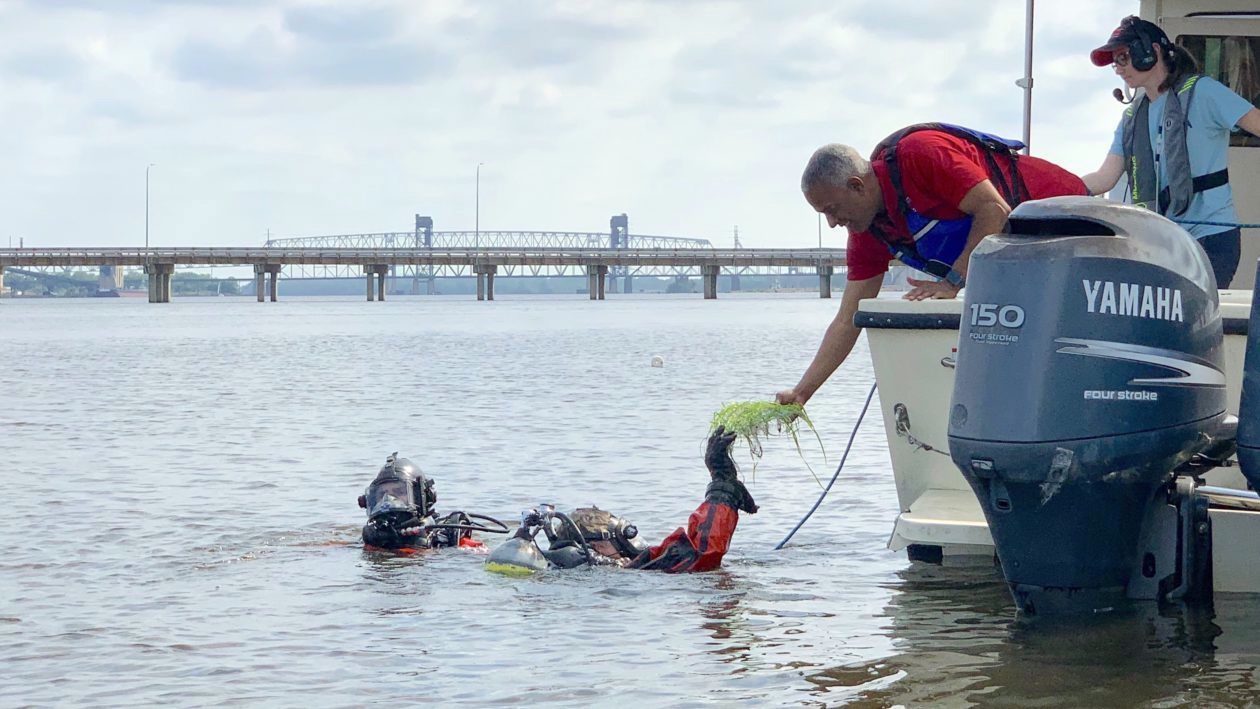
Camden Mayor Vic Carstarphen hands a flat of wild celery to an EPA diver for transplant. Local grasses and oysters are bringing hope to rivers.

We can rescue our environment if we try. Even the infamous city Camden is getting into the act.

Katherine Rapin writes at YaleEnvironment360, “On a recent summer morning near Camden, New Jersey, two divers from the U.S. Environmental Protection Agency hovered over a patch of sediment 10 feet below the surface of the Delaware River. With less than two feet of visibility in the churning estuary, they were transplanting a species crucial to the ecosystem: Vallisneria americana, or wild celery grass. One diver held a GoPro camera and a flashlight, capturing a shaky clip of the thin, ribbon-like blades bending with the current.

“Watching the divers’ bubbles surface from the EPA’s boat was Anthony Lara, experiential programs supervisor at the Center for Aquatic Sciences at Adventure Aquarium in Camden, who had nurtured these plants for months in tanks, from winter buds to mature grasses some 24 inches long. …

“This was the first planting of a new restoration project led by Upstream Alliance, a nonprofit focused on public access, clean water, and coastal resilience in the Delaware, Hudson, and Chesapeake watersheds. In collaboration with the Center for Aquatic Sciences, and with support from the EPA’s Mid-Atlantic team and the National Fish and Wildlife Foundation, the alliance is working to repopulate areas of the estuary with wild celery grass, a plant vital to freshwater ecosystems. It’s among the new, natural restoration projects focused on bolstering plants and wildlife to improve water quality in the Delaware River, which provides drinking water for some 15 million people.

“Such initiatives are taking place across the United States, where, 50 years after passage of the Clean Water Act, urban waterways are continuing their comeback, showing increasing signs of life. And yet ecosystems still struggle, and waters are often inaccessible to the communities that live around them. Increasingly, scientists, nonprofits, academic institutions, and state agencies are focusing on organisms like bivalves (such as oysters and mussels) and aquatic plants to help nature restore fragile ecosystems, improve water quality, and increase resilience.

Bivalves and aquatic vegetation improve water clarity by grounding suspended particles, allowing more light to penetrate deeper

“They also have exceptional capacity to cycle nutrients — both by absorbing them as food and by making them more available to other organisms. Thriving underwater plant meadows act as carbon sinks and provide food and habitat for scores of small fish, crabs, and other bottom-dwellers. Healthy bivalve beds create structure that acts as a foundation for benthic habitat and holds sediment in place.

“ ‘Why not take the functional advantage of plants and animals that are naturally resilient and rebuild them?’ says Danielle Kreeger, science director at the Partnership for the Delaware Estuary, which is spearheading a freshwater mussel hatchery in southwest Philadelphia. …

“One hundred miles north of Philadelphia, the Billion Oyster Project has been restoring the bivalves in New York Harbor since 2010, engaging more than 10,000 volunteers and 6,000 students in the project. [See my post on that here and search on ‘oyster’ for related posts.] Oyster nurseries are being installed in Belfast Lough in Northern Ireland, where until recently they were believed to have been extinct for a century. And a hatchery 30 miles west of Chicago has dispersed 25,000 mussels into area waterways, boosting the populations of common freshwater mussel species.

“Underwater vegetation restoration projects have been underway in the Chesapeake Bay and Tampa Bay for years, and more recently in California where seagrass species are in sharp decline. (Morro Bay, for example, has lost more than 90 percent of its eelgrass beds in the last 15 years.) The California Ocean Protection Council’s 2020 Strategic Plan to Protect California’s Coast and Ocean aims to preserve the mere 15,000 acres of known seagrass beds and cultivate 1,000 more acres by 2025.

“Scientists stress that these projects must be implemented alongside strategies to continue curbing contaminants, mainly excess nutrients from sewage and fertilizers, flowing into our waterways — still the most critical step in improving water quality. After several decades of aquatic vegetation plantings in the Chesapeake Bay, for example, scientists say that the modest increase of plants is largely due to nature restoring itself following a reduction in nutrient pollution.

“And any human intervention in a complex ecosystem raises a host of compelling concerns, such as how to ensure sufficient genetic diversity and monitor competition for food and resources. Scientists say that, in many cases, they’re learning as they go.

“Still, in areas where the natural environment is improving, bringing back bivalves and aquatic plants can create a lasting foundation for entire ecosystems. And restoration initiatives are an active form of stewardship that connects people to their waterways, helping them understand the ecosystems we depend on for our survival.”

More at YaleEnvironment360, here. No firewall.

It’s surprising what can happen when people who didn’t care in the past start to care.

Read Full Post »

Photo: Robin Lubbock/WBUR.
Linnea Laux holds a blazing star seedling ready to plant in the sandplain grasslands near Edgartown, on Martha’s Vineyard. (“Linnea”! Perfect name for this calling. See Linnaeus.)

The popular Massachusetts island Martha’s Vineyard has been losing its biodiversity. That’s why, as Barbara Moran reports at WBUR radio, a concerned group is planting flowers. And not just any flowers.

“Tim Boland stood next to his black pickup on a dirt road in Edgartown, and waited for a moment. Then, he started handing out wildflowers. … Boland handed out black plastic trays, each holding fifty seedlings of New England blazing star.

” ‘It’s specialized to New England,’ said Boland, executive director of the Polly Hill Arboretum in West Tisbury. He held up a grassy-looking seedling, which did not look like a blazing star — at least not yet. ‘It’ll form these button-like flowers that are a deep indigo blue, that are just gorgeous. It’s a spectacular plant to see in bloom.’

“The New England blazing star is more than just a pretty blossom: it’s an integral part of a globally-rare ecosystem called a ‘sandplain grassland.’ Just like the name suggests, sandplain grasslands have sandy soil with tall grass, no trees and an exceptionally high number of rare plant and animal species. …

“As climate change threatens both human health and the natural world, experts say that protecting biodiversity hotspots like this one will offer the most bang-for-the-buck — protecting threatened species while offering other ecosystem benefits, like open space and flood protection.

“But restoration work is expensive: The Nature Conservancy in Massachusetts has been restoring Bamford Preserve from farm field to sandplain grassland for 15 years, at a cost of $15-$20,000 per year. …

” ‘In conservation, there are limited resources and you want them to have the greatest impact on biodiversity and on the function of ecological systems,’ said
Michael Piantedosi, director of conservation with the Native Plant Trust. Piantedosi is not involved with the Bamford Preserve restoration, but says sandplain grasslands are an ecosystem worth saving.

” ‘The reason for investing in that habitat now is so that it has the right makeup and conditions to be able to adapt to climate change going forward,’ he said. ‘All this ecology is connected and you don’t necessarily know what piece will tip the balance in what direction.’

“Sandplain grasslands are found only along the Atlantic Coast from New York to Maine, and most patches are in Massachusetts. Seven rare species of birds use this habitat, including grasshopper sparrows and short-eared owls, as well as beetles, butterflies and wildflowers, like the New England blazing star, found almost nowhere else.

” ‘These little systems right here hold a high concentration of rare and uncommon species in the region,’ said Mike Whittemore, stewardship manager for The Nature Conservancy in Massachusetts. ‘It’s not only the plants, but it’s the wildlife, the pollinators, the things that you don’t always see.’ …

“Tim Boland had to get a special permit to grow New England blazing star because it’s a ‘species of special concern’ in Massachusetts. He collected seed from native wildflowers on the island and carefully cultivated them for two years.

“And even after the intensive restoration wraps up in a couple years, Mike Whittemore says the grassland will require maintenance — like controlled burns and occasional mowing — indefinitely.

” ‘There was such a harsh land use history for so many years — it was planting of non-native plants and it was haying and it was plowing,’ he said. ‘When you come through here and plow, it does something in the soil. You need to stay on it to keep it open.’

“One of the volunteers, Janet Woodcock from Vineyard Haven, said it’s worth the hard work to preserve or restore the island’s remaining wild spaces, especially in the face of climate change.

‘I mean, the climate has been changing since the Earth started, whenever that was. But it’s happening so quickly that living things don’t have time to adjust to the changes. And so we’re losing species because of that,’ Woodcock said. ‘Anything has a hard time adapting if it happens too quickly.

“Mike Boland, from Polly Hill Arboretum, says stocking the grassland with native plants like the New England blazing star will give all plants and animals living here the best chance of surviving.

” ‘These plants — more than most — have a 14,000 year evolutionary advantage of growing in these ecosystems,’ he said. ‘So there will be plants that persist even with these rough conditions coming on.’

“Boland says preserving diverse ecosystems like this is one of our best defenses in the face of a changing climate. For him, he says, it’s an act of hope.” More at WBUR, here.

Interesting to me: the endangered Blazing Star seen on New Shoreham island in Rhode Island is pink, not deep indigo.

Read Full Post »

Older Posts »