Feeds:
Posts
Comments

Posts Tagged ‘elementary school’

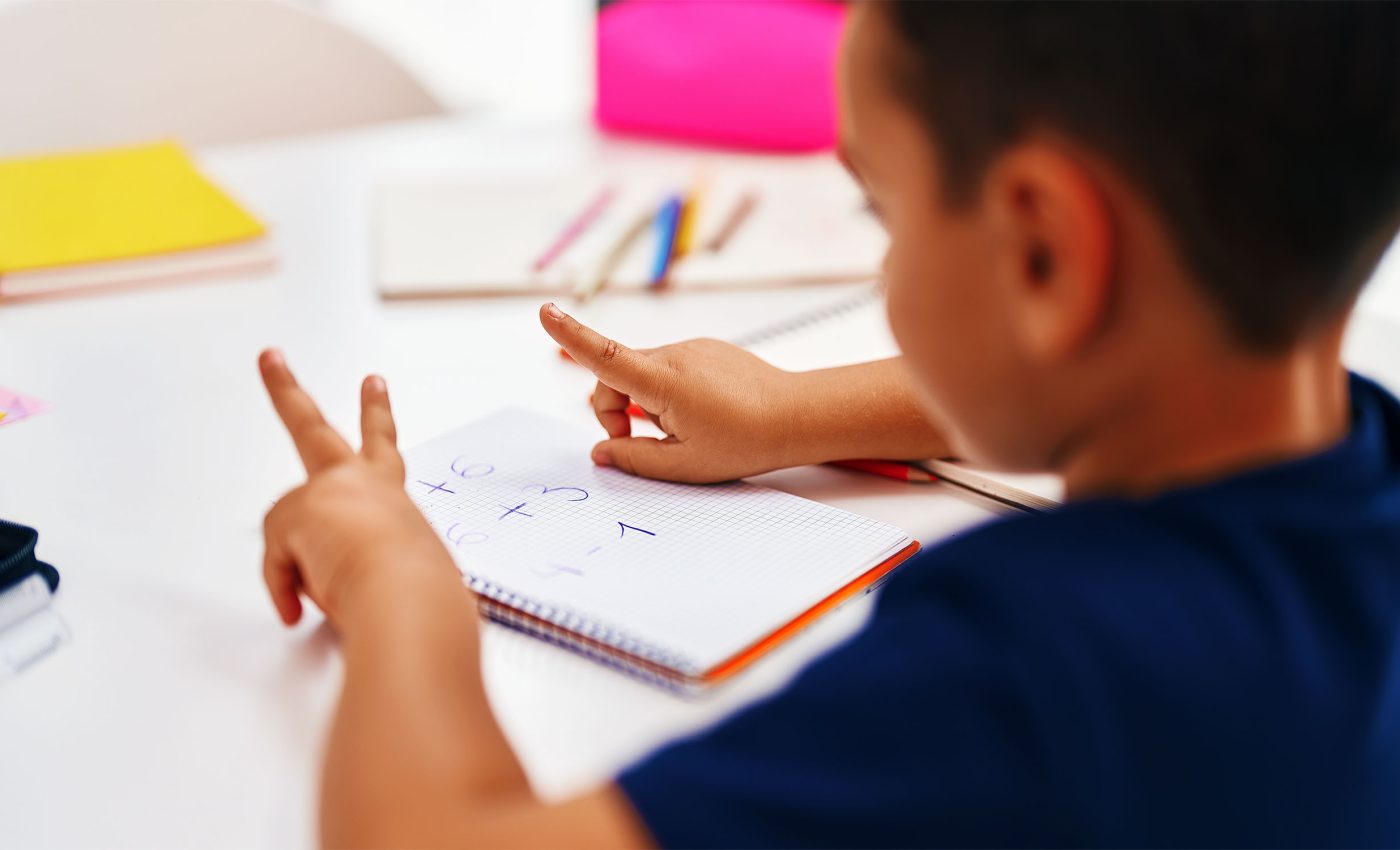
Photo: Earth.com.
In the bad old days, parents were misled about what was good for children. Remember forcing left-handed kids to use their right? Remember that counting on fingers was wrong? Fortunately, humans do learn from mistakes.

Everything old is new again. But you knew that. Here’s new old news from the world of elementary school arithmetic. Stephen Beech wrote the story at TalkerNews and many outlets carried it, including NBC.

“Counting on fingers really does help youngsters improve their math skills, according to a new study. The research is the first to show that children’s performance in arithmetic can show a ‘huge’ improvement through the teaching of a finger-counting method. …

“Swiss and French researchers explored whether finger counting can help primary school-aged children to solve maths problems in a new study, published in the journal Child Development. …

“Young children who use their fingers to solve such problems are recognized as intelligent, probably because they have already reached a level that allows them to understand that a quantity can be represented by different means.

“It is only from the age of eight that using finger counting to solve very simple problems can indicate math difficulties, according to the study.

“The research aimed to determine whether children who don’t count on their fingers can be trained to do so, and whether such training would result in enhanced arithmetic performance.

“The study focused on 328 five- and six-year-old children at kindergarten, mainly living in France, and tested their abilities to solve simple addition problems. Participating children were recruited through their teachers who voluntarily took part in the experiment.

“The study included a pre-test, training held over two weeks, a post-test closely after the training’s end, and a delayed post-test.

“The results showed an ‘important increase’ in performance between pre- and post-test for the trained children who did not count on their fingers originally — from 37% to 77% of correct responses – compared to non-finger users in the control group.

“The research team suggests that since children who use their fingers to help solve math problems outperform those who do not, teaching a finger-counting strategy could help reduce inequity among children in math.

“However, they say whether children who use finger counting are using it as an arithmetic procedure or understand something deeper about numbers will still need to be determined with future research.

“Study leader Dr. Catherine Thevenot said: ‘Our findings are highly valuable because, for the first time, we provide a concrete answer to the long-standing question of whether teachers should explicitly teach children to use their fingers for solving addition problems — especially those who don’t do so naturally. Our study demonstrates that finger calculation training is effective for over 75% of kindergartners.

” ‘The next step is to explore how we can support the remaining 25% of children who didn’t respond as well to the intervention.’

“Dr. Thevenot, of the Institute of Psychology at the University of Lausanne in Switzerland, says the study came about as a result of conversations with primary school teachers.

“She said: ‘They often asked me whether they should encourage or discourage children from using their fingers to solve calculations. Surprisingly, the existing research didn’t offer a clear answer, which left teachers understandably frustrated with my frequent response of “I don’t know.” …

” ‘The best way to provide a meaningful answer was through experimental studies — so that’s exactly what I set out to do.

” ‘When I first saw the results, I was amazed by the huge improvement in performance among children who didn’t initially use their fingers to solve the problems. Before our intervention, these children were only able to solve about one-third of the addition problems at pre-test.

” ‘After training, however, they were solving over three-quarters of them. The difference was striking, especially compared to the control groups, where gains were insignificant. The extent of this improvement truly exceeded my expectations. …

” ‘An important question now is to determine whether what we taught to children goes beyond a mere procedure to solve the problems. In other words, we want to know whether our intervention led to a deeper conceptual understanding of numbers, specifically whether children better grasp how to manipulate the quantities represented by their fingers.

” ‘In fact, we have already started addressing this question and the initial results are very promising. However, we still need to carry out additional experiments to confirm that these improvements are indeed a direct result of our training program.’ “

More at NBC, here, and at Earth.com, here.

Trust those Swiss to figure things out!
Read Full Post »

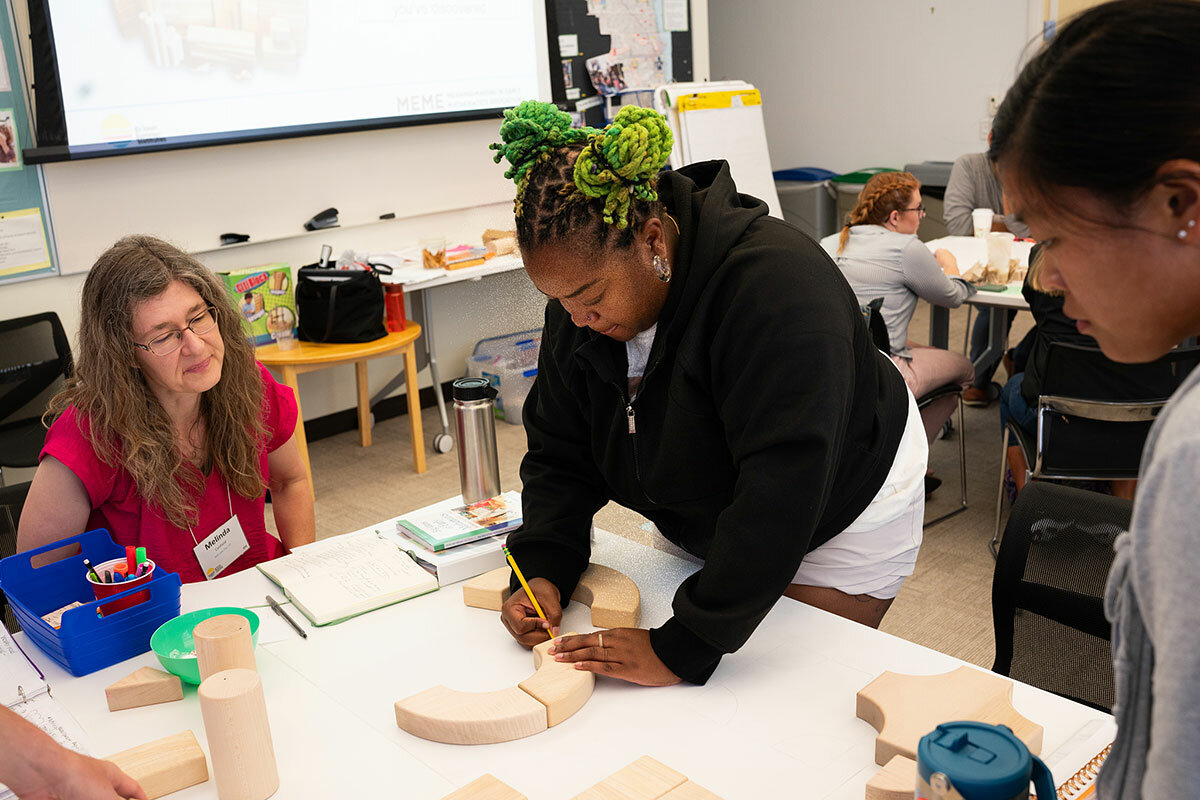
Photo: Camilla Forte/The Hechinger Report via CSM.
Ivory McCormick (center) attends a math conference July 12, 2023, in Chicago. The Atlanta teacher says her school’s math specialist helped change the way she feels about teaching the subject.

I can identify with the teachers in this story who have a math phobia. I had to teach all subjects to 10-year-olds for a couple years and was relieved that my school offered a math consultant. I had never trusted my math — although that had a lot to do with parental perceptions.

Ariel Gilreath, of the Hechinger Report, researched an interesting program designed to help teachers of young students gain confidence in the critical foundations of math. The story is shared at the Christian Science Monitor.

“In July, in a packed classroom in downtown Chicago, a group composed mostly of early elementary teachers and child care workers read a story about ‘Wendi,’ a fictional preschool teacher who loves reading but struggles in math. 

“Even though Wendi was drawn to early education where ‘math was so easy,’ she still felt unsure of her skills. In the story, she decided to skip math concepts, leaving them for the teachers her students would have next year. 

“Across the room, people nodded their heads as they listened.

“ ‘I am Wendi. Wendi is me,’ said Ivory McCormick, a kindergarten teacher from Atlanta. Several educators in the classroom identified with Wendi, and that was the point. Decades of research shows that math anxiety is a common problem for adults, and surveys show it particularly affects women, who make up nearly 90% of elementary teachers in the United States.

“Put simply, a lot of elementary school educators hate the prospect of teaching math, even when the math concepts are beginner level. 

“Researchers at the Erikson Institute, a child development-focused graduate school in Chicago, started the Early Math Collaborative 16 years ago to provide educators with research-backed professional development to help them better teach young students math. One of the goals of Erikson’s annual four-day summer math conference, where the teachers read Wendi’s story, is to assuage their anxiety by exploring how young children learn math and strategizing activities they can do in the classroom. 

“Because math competencies build on each other, with skills like counting and learning shapes forming the basis of later knowledge, it’s critical that students receive a solid foundation in the subject, education experts say. The U.S. has long trailed many other developed countries in terms of student math performance, and then scores tanked during the pandemic. …

“ ‘If you look at how a child is doing with math when they enter kindergarten, that’s the best way to predict how they’re going to be doing with math later, all the way up through eighth grade,’ says Jennifer McCray, an associate research professor at Erikson. …

“When Ms. McCormick started teaching preschool five years ago, she felt anxious about teaching a subject she didn’t feel confident in. ‘Math was something I always had to work really hard at, and it seemed like I never really got that much better at it,’ she says. 

“Teachers who doubt their math ability often worry they will transfer their math aversion onto impressionable students, educators say. There are studies that validate this fear: First grade students who were taught by teachers with heightened anxiety about math performed worse in the subject than their peers who were taught by less anxious teachers, one study from 2020 found.  

“Math specialists say it is a pervasive issue in elementary classrooms, where educators are typically expected to teach every subject, and it often leads to teachers spending less classroom time on math content. …

“At the Erikson Institute’s summer conference, teachers gained practice on concepts they’d use in their classrooms. They drew maps to describe directions: Rosie the hen traveled over the fence, and under the tree branch, and through the river, for example. They built large 10-sided shapes out of colorful blocks. The exercises benefited their own math skills, too. 

“ ‘There’s a misbelief that in order to teach early childhood math, you don’t really need to know math well,’ Lauren Solarski, a consultant and coach with the Early Math Collaborative at Erikson, told the group of educators. ‘But having that deep content knowledge, research finds, makes you then able to draw out what’s happening in a child’s play around math – what they’re doing – and know those trajectories, know the math inside and out so that you can be that expert when you’re with the child.’

“That doesn’t necessarily mean early childhood teachers need to be experts in advanced geometry or algebra, says Lisa Ginet, director of program design and operations at Erikson. But it does mean they need to know how different lessons that may not seem to be related to math are connected to mathematical thinking and to topics students will learn as they get older. …

“For Ms. McCormick, the early ed teacher from Atlanta, attending Erikson’s professional development conference was the next step in her journey to building up her math confidence. This year, Ms. McCormick moved up to teaching first grade at the Galloway School in Atlanta after teaching preschool and kindergarten classes at the school for several years. She credits her school’s decision to hire a math specialist last year with helping change the way she feels about teaching the subject. …

“ ‘This past year, I have kind of revamped my thoughts about what math can be and the ways that we teach it in order to make kids want to learn about it and be enthusiastic about it. Because the way we present it to them holds so much more weight than I think I ever realized.’ ”

More at the Monitor, here. No paywall, but your subscription will support good journalism.

Read Full Post »

090716-blackstone-valley-visitor-center

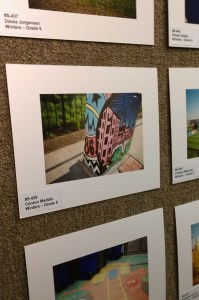
Pat Zacks at the Camera Werks in Providence feels compassion for inner-city kids whose schools can’t offer many enrichment activities. That’s why she volunteers every year to mount and hang 500+ juried photos by Pawtucket, Rhode Island, fifth graders (and a few grownups).

On Wednesday I stopped off at the gallery where the “Calling All Cameras” photos are on display until the end of September. The theme this year,  submitted by Linda C. Dugas, is “Pawtucket’s Color Palette.” Winners of this, the 18th, annual photo contest also get their work featured in the city calendar.

An impressive slate of judges are responsible for choosing this year’s winning photos (Butch Adams, Richard Benjamin, Christy Christopoulos, Jesse Nemerofsky, and Aaron Usher). Winners will be announced September 25.

I wish my photo of a child’s box turtle entry had turned out well enough to post, but I’m sharing a couple other favorites here.

Stop by the Blackstone River Valley National Heritage Corridor visitor center, just off Interstate 95 in downtown Pawtucket, to find the box turtle. The visitor center is opposite the historic Slater Mill, birthplace of America’s Industrial Revolution.

And if you are ever in Providence, please check out the Camera Werks on Hope Street. Pat’s Facebook page, here, has more information on the photo exhibit.

090716-pawtucket-calling-all-cameras

090716-pawtucket-photo-show-1


090716-pawtucket-photo-show-2


Read Full Post »

Having heard one too many panel discussions and lectures lately about the downsides of the “ageing population,” I was delighted that a few upsides were mentioned at today’s Harvard conference on “Ageing + Place” — a refreshing and intriguing event presenting the latest research and design ideas related to ageing.

Meanwhile, John was on my wavelength again, sending me a link to a story about someone who seems to be ageing remarkably well and making a contribution to society while she’s at it.

Katie Honan of DNAInfo.com writes at BusinessInsider about a 100-year-old woman who is still teaching children in a Brooklyn elementary school.

“Three days a week, Madeline Scotto walks across the street from her home to St. Ephrem’s elementary school, where she was part of the first graduating class.

“She climbs the stairs to her classroom, where she works to prepare students for the math bee. She pores over photocopied worksheets with complicated problems, coaching kids on how to stay calm on stage while multiplying and dividing in their head.

“She’s just like any other teacher at the school — except for one thing: She’s 100 years old.

” ‘I think it just happens, you know. You don’t even realize it,’ said Scotto, who marked her birthday on Thursday.

” ‘Last year I thought, “This can’t be, that I’m going to be 100.” I sat down and did the math actually. I thought, I could not trust my mind. This I had to put paper to pencil — I couldn’t believe it myself. It just kind of happened. I guess I’m very lucky.’ ” More here.

Is there a person of any age who isn’t astonished when they think of how old they are? I think if you are 21 or 40 or 65, you are still going to say to yourself, “How did that happen?”

Photo: DNAInfo
Madeline Scotto is 100-years-old and still teaches students in Dyker Heights.

Read Full Post »