Feeds:
Posts
Comments

Posts Tagged ‘endangered’

Photo: Avener Prado.
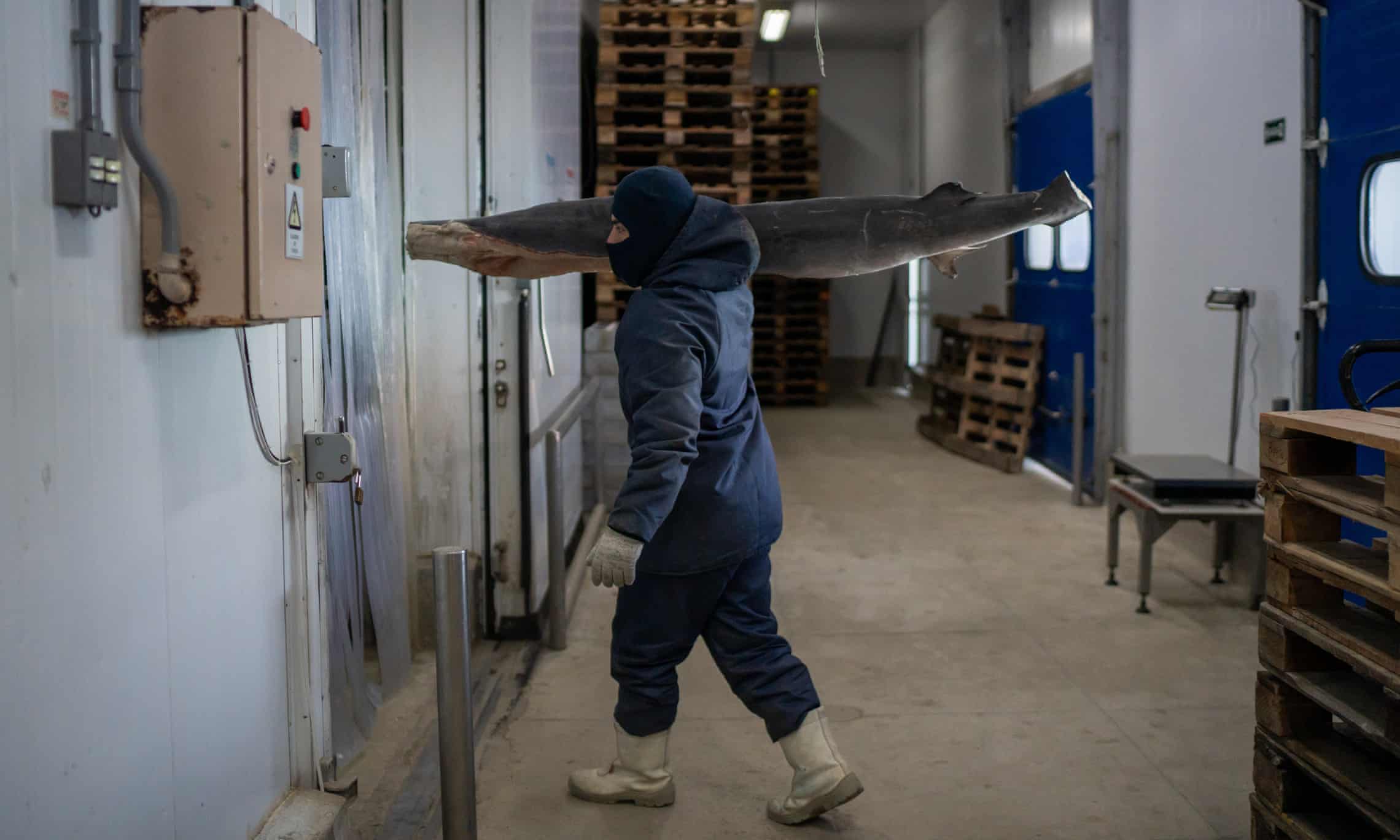
A trade that goes under the radar. Here, a blue shark is taken into cold storage in Cananéia, a fishing port in São Paulo state. Sharks reproduce slowly, but at least 80 million are killed annually
.

This is a sorry tale. Even if you don’t like the idea of swimming with sharks or keeping them as pets, I know you will be concerned that we are decimating their numbers. Today’s story explains that sometimes we are eating sharks without realizing it.

Constance Malleret reports at the Guardian that “worried conservationists say most people do not realize they are eating shark.

“The bright blue skies and calm waters of the estuary belie rough conditions at sea, and there is no sign of activity among the colourful fishing boats moored around the harbor of Cananéia, a sleepy fishing town 160 miles south of São Paulo.

“On the wharf, however, a delivery of frozen fish from Uruguay has just arrived and a few men in white gumboots are busy unloading pallets of beheaded specimens labelled Galeorhinus galeus – school shark. These thin grey fish will be kept in a cold store on shelves already stacked ceiling-high with carcasses of blue sharks, all awaiting processing and distribution to cities inland.

“ ‘Why do we work with shark?’ says Helgo Muller, 53, the company manager. ‘Because people like it; it’s good and cheap protein. It doesn’t give you crazy profits, but it’s decent enough.’

“Shark is just a small fraction of the firm’s business but they process about 10 tons a month, he says, mostly blue shark imported from countries including Costa Rica, Uruguay, China and Spain.

“Communities up and down Brazil’s 4,600-mile coastline have always eaten sharks. ‘It is part of our tradition,’ says Lucas Gabriel Jesus Silva, a 27-year-old whose grandfather moved to the area in the 1960s to fish sharks for their fins.

“However, the widespread appetite for shark meat that Muller’s company helps feed is now troubling scientists and environmentalists, who worry about unsustainable pressure on various species. …

” ‘Sharks are very vulnerable to overexploitation as they don’t reproduce as often or with as many offspring as bony fishes do,’ explains Prof Aaron MacNeil, of Canada’s Dalhousie University.

“Research published in April found that 83% of the shark and ray species sold in Brazil were threatened, according to the International Union for the Conservation of Nature (IUCN) classification.

“For years, conservation efforts focused on the fin trade with Asia and the barbaric practice of ‘finning’ – removing a shark’s fins and returning the wounded and helpless animal, often still alive, to the sea. But research from earlier this year suggests restrictions on finning have not reduced shark mortality, with at least 80 million sharks still being killed annually.

“ ‘Meat was kind of left by the wayside,’ says MacNeil, who is researching the global shark meat trade. ‘It’s only now we’re realizing how big the trade is. Its value has certainly exceeded that of fins.’ The pressure on sharks for food has risen in parallel with a decline in catches of other fish, he says.

“Traditionally, Brazilians ate shark in moqueca, a seafood stew from the states of Bahia and Espírito Santo. And many of Cananéia’s residents recall how their older relatives would use shark’s head broth and cartilage as homemade remedies. But now, sold in fillets or steaks, shark has been absorbed into Brazilians’ diet as it is cheaper than other white fish, boneless and easy to cook. It now appears in school and hospital canteens.

“The fact that few Brazilians realize they are eating shark has probably helped make it ubiquitous. While coastal people with a shark-eating tradition recognize the subtle differences in texture and flavor between shark species, to most Brazilians it is just cação – a generic term under which both shark and ray meat are sold. …

“Campaigners say the generic labelling prevents informed decisions by consumers, and this could even affect their health due to high concentrations of dangerous pollutants in these top predators. ‘If they knew, they might not eat it,’ says Ana Barbosa Martins, a researcher at Dalhousie University. …

“ ‘Fishers don’t cast their nets to catch shark specifically, but sometimes a [protected] hammerhead comes up. What can you do?’ says Lucia Rissato, who runs a fish stall in Peruíbe. … ‘We have to sell it in secret, like drugs.’ “

I guess, for vegans, getting tricked into eating shark meat is not an issue.

More at the Guardian, here. No paywall.

Read Full Post »

Photo: Minden Pictures/Alamy.
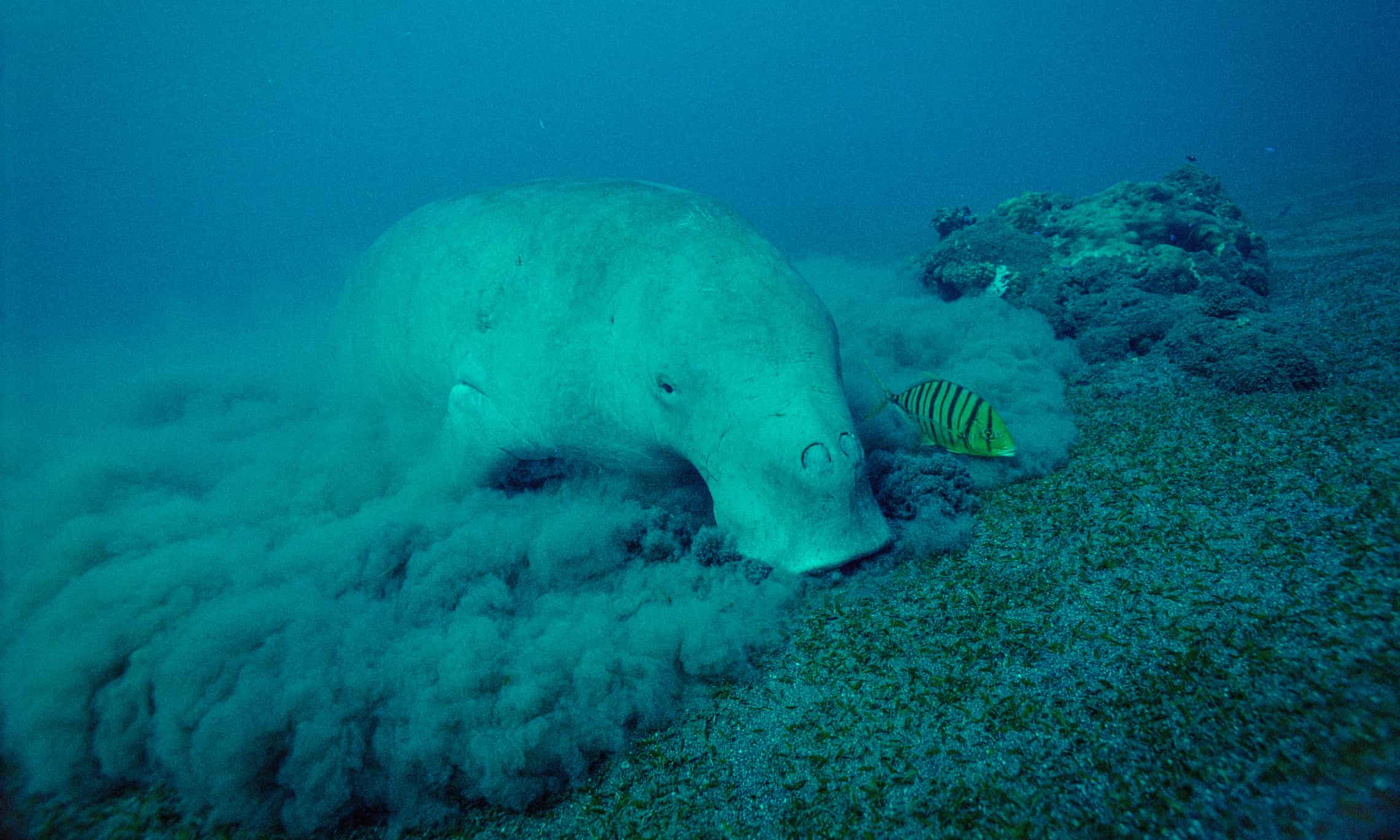
The rare sight of a dugong feeding on a seagrass meadow in Vanuatu. The gentle giants were once a common sight around the Melanesian archipelago.

Here’s an interesting story about a saltwater cousin of the shy freshwater manatee. It eats seagrass, and like most other living things in the ocean, it’s negatively affected by warming trends.

Rebecca Root writes at the Guardian, “In a bright spring day, the sun dances over the water of Havannah Bay on the island of Efate in Vanuatu. Below the surface, pockets of seagrass that can just about be seen from the shoreline, sway in the current. It’s here, if they are lucky, that onlookers may spot a dugong bobbing in the shallow water, orbiting the seagrass meadows they feed on.

“ ‘It’s wonderful seeing them swimming by and grazing off the seagrass in front of the resort,’ says Greg Pechan, the owner of a local hotel, the Havannah, which sits at the tip of the bay. Pointing out beyond the jetty that stretches into the Pacific Ocean, he says Vanuatu’s sea life is a big attraction for visitors to the Melanesian country.

“Light grey in color, dugongs, sometimes known as ‘sea cows’ and whose closest relatives are freshwater manatees, can grow up to four metres long and weigh up to 400kg (900lb). They are a ‘friendly species’ and respected by islanders, says Heidi Joy, a marine science student from Efate.

“A few years ago, it would not be unusual for Joy, who lives close to Havannah Bay, to spot a dugong in the morning and then again at sunset. That has since changed, she says. ‘We rarely see them now.’

“Dugongs are considered vulnerable to extinction by the International Union for Conservation of Nature. The exact number roaming Vanuatu’s waters is, however, unknown and this uncertainty is hindering conservation efforts, experts say.

“ ‘A lot of studies have been done where you’ve got large populations of dugongs in large seagrass meadows [such as] Australia or Abu Dhabi, but we’ve got a different dugong population. We’ve got small groups or individuals,’ says Christina Shaw, the CEO of the Vanuatu Environmental Science Society. She says that a national assessment of dugongs and seagrass in Vanuatu is urgently needed. …

“In 2023, the status of neighboring New Caledonia’s population was downgraded to ‘endangered‘ while east African dugongs have become ‘critically endangered.’ …

“In Vanuatu, however, only one aerial survey – in 1987 – has been carried out to assess the national distribution, abundance, cultural importance and threats, according to Helene Marsh, an emeritus professor in environmental science at James Cook University.

“Dugongs globally are threatened by gill-net fishing, boat traffic, coastal development and hunting. In Vanuatu, dugong meat used to be considered a source of protein, their oil used for cooking and other parts whittled into handicrafts.

“But since the 1980s, certain islands have introduced local prohibitions known as tabu, which mandates their protection. In 2010 the government also signed the Convention on Migratory Species’ dugong memorandum of understanding, committing it to protecting the sea cows and the seagrass they eat. This means hunting is now rare, says Shaw.

“Instead, another predator threatens the dugong: the climate crisis. On a spring evening in Efate, rain hammers relentlessly until nightfall, rendering the ocean a murky green. It’s downpours such as this, becoming more common, alongside storms and cyclones, that damage the seagrass so vital to the dugongs.

“Vanuatu sits in the Pacific ‘Ring of Fire,’ a tectonic belt of volcanoes and earthquakes, and a tropical cyclone region, making it prone to disasters. When these batter the bays and beaches of Vanuatu, the seagrass is swept up by the heavy winds, while the rain and debris creates sediment on the water surface, smothering the seagrass from the sunlight it needs to thrive. …

“Richard Leck, head of oceans at WWF Australia, says: ‘When that happens dugongs have no choice but to get on the move and sometimes they have to go into deeper water, expend much more effort to graze seagrass and when that happens they often get emaciated and lose condition really quickly.’ …

“As with dugongs, there is limited data on the prevalence and condition of seagrass in Vanuatu. This makes it hard, says Shaw, to advocate for investment in conservation. ‘Funders don’t like paying for studies,’ she says. ‘But how do we do [conservation] if we don’t know what’s there?’ ”

More at the Guardian, here.

Read Full Post »

Photo: D Rosengren/Global Rewilding Alliance.
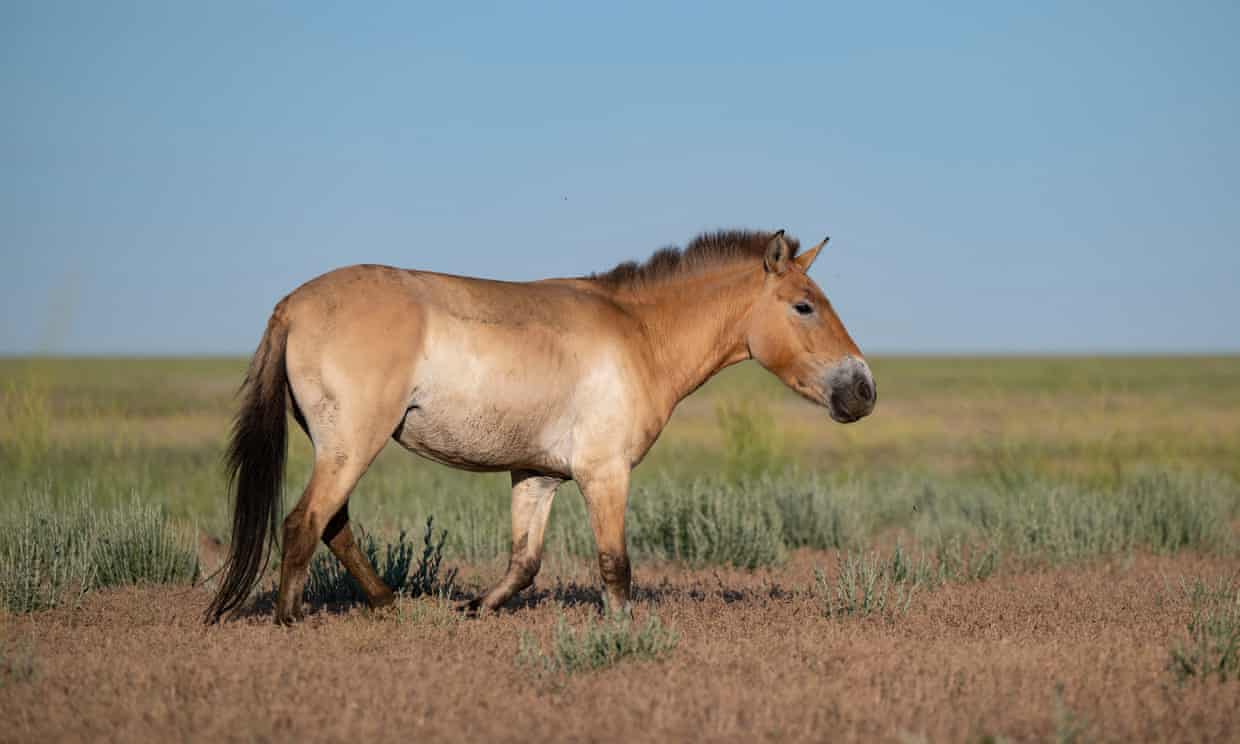
The wild Przewalski’s horses are said to be the only horses in the world that have never been domesticated. They are being reintroduced to the steppes of Kazakhstan.

The woman who cuts my hair has convinced me that, on the whole, zoos are bad for animals — that elephants shifting from one leg to the other for hours at a time are not doing a little happy dance but are bored witless.

Even so, we do hear of zoos doing good work to protect endangered species.

Sophie Kevany reports at the Guardian about some zoos’ recent win for biodiversity.

“A group of the world’s last wild horses have returned to their native Kazakhstan after an absence of about 200 years. The seven horses, four mares from Berlin and a stallion and two other mares from Prague, were flown to the central Asian country on a Czech air force transport plane.

“The wild horses, known as Przewalski’s horses, once roamed the vast steppe grasslands of central Asia, where horses are believed to have been first domesticated about 5,500 years ago.

“People are known to have been riding and milking horses in northern Kazakhstan nearly 2,000 years before the first records of domestication in Europe. Human activity, including hunting the animals for their meat, as well as road building, which fragmented their population, drove the horses close to extinction in the 1960s.

“Filip Mašek, Prague zoo’s spokesperson, said: ‘These are the only remaining wild horses in the world. Mustangs are domesticated horses that went wild.’

“The horses reintroduced into Kazakhstan are descended from two groups that survived in Munich and Prague zoos.

“Originally, eight horses had been scheduled to travel, said Mašek, but one horse sat down before the flight from Prague and had to be unloaded and returned to Prague zoo.

“ ‘He was just a little dizzy returning, but he is fine now. These horses have to stand for the entire journey – they can’t sit down, mainly because their blood needs to circulate properly. It is a 30-hour journey in total, and the horses will only survive if they stand all the way,’ he said.

“Returning the horses from Prague zoo would help increase biodiversity in the region, said Mašek. ‘The horses spread seeds in their dung and when they dig up plants, they help the water get down into the soil. They also fertilize the steppe with their dung.

“ ‘For me,’ he said, ‘the goal of a modern zoo is not just about protecting and breeding endangered species, it is about returning them to the wild where they belong.’ …

“In 2011, Prague zoo was involved in a reintroduction of Przewalski’s horses to Mongolia. The project, which involved nine flights of horses, continued until 2019 when the population stabilized, said Mašek, adding that there were now about 1,500 of the wild horses in Mongolia. Mašek said the plan was to transport a total of 40 horses to central Kazakhstan over the next five years.”

More at the Guardian, here.

Read Full Post »

Photo: New England Aquarium.
Endangered sperm whales — an adult and calf sighted in the Northeast Canyons and Seamounts Marine National Monument in October 2023.

This is the time of year that people like to go on whale watches. Responsible tour operators know that it’s vitally important not to stress out the whales. But what a thrill it is to see even one! And that can keep people engaged in their welfare.

Meanwhile, scientists are always trying to understand more about them. Consider the new research on sperm whales’ “phonetic alphabet.”

Will Dunham of Reuters wrote at US News and World Report, “The various species of whales inhabiting Earth’s oceans employ different types of vocalizations to communicate. Sperm whales, the largest of the toothed whales, communicate using bursts of clicking noises — called codas — sounding a bit like Morse code.

“A new analysis of years of vocalizations by sperm whales in the eastern Caribbean has found that their system of communication is more sophisticated than previously known, exhibiting a complex internal structure replete with a ‘phonetic alphabet.’ The researchers identified similarities to aspects of other animal communication systems — and even human language.

“Like all marine mammals, sperm whales are very social animals, with their calls an integral part of this. The new study has provided a fuller understanding of how these whales communicate.

” ‘The research shows that the expressivity of sperm whale calls is much larger than previously thought,’ said Pratyusha Sharma, a Massachusetts Institute of Technology doctoral student in robotics and machine learning and lead author of the study published [in May] in the journal Nature Communications.

” ‘We do not know yet what they are saying. We are studying the calls in their behavioral contexts next to understand what sperm whales might be communicating about,’ said Sharma.

“Sperm whales, which can reach about 60 feet (18 meters) long, have the largest brain of any animal. They are deep divers, feeding on giant squid and other prey.

“The researchers are part of the Project CETI (Cetacean Translation Initiative) Machine Learning Team. Using traditional statistical analysis and artificial intelligence, they examined calls made by about 60 whales recorded by the Dominica Sperm Whale Project, a research program that has assembled a large dataset on the species.

” ‘Why are they exchanging these codas? What information might they be sharing?’ asked study co-author Shane Gero, Project CETI’s lead biologist and Dominica Sperm Whale Project founder, also affiliated with Carleton University in Canada.

” ‘I think it’s likely that they use codas to coordinate as a family, organize babysitting, foraging and defense,’ Gero said.

” ‘All of these different codas that we see are actually built by combining a comparatively simple set of smaller pieces,’ said study co-author Jacob Andreas, an MIT computer science professor and Project CETI member. …

“For people, Sharma said, ‘There are two levels of combination.’ The lower level is sounds to words. The higher level is words to sentences.

“Sperm whales, Sharma said, also use a two-level combination of features to form codas, and codas are then sequenced together as the whales communicate. The lower level has similarities to letters in an alphabet, Sharma said. …

” ‘Human language is unique in many ways, yes,’ Gero said. ‘But I suspect we will find many patterns, structures and aspects thought to be unique to humans in other species, including whales, as science progresses — and perhaps also features and aspects of animal communications which humans do not possess.’

“If scientists can decipher the meaning of what the sperm whales are ‘saying,’ should people try to communicate with them?

” ‘I think there’s a lot more research that we have to do before we know whether it’s a good idea to try to communicate with them, or really even to have a sense of whether that will be possible,’ Andreas said.”

More at US News and World Report, here. See also the Smithsonian.

Read Full Post »

Photo: Josh Appel/Unsplash.
The New York City melting pot, where 700 languages are spoken — 150 of them endangered.

New York City attracts people from all over the world, so it’s perhaps not surprising that there are an extraordinary number of languages spoken — major languages and endangered languages.

Alex Carp’s impressive story at the New York Times digs into the details.

“Most people think of endangered languages as far-flung or exotic, the opposite of cosmopolitan. ‘You go to some distant mountain or island, and you collect stories,’ the linguist Ross Perlin says, describing a typical view of how such languages are studied. But of the 700 or so speakers of Seke, most of whom can be found in a cluster of villages in Nepal, more than 150 have lived in or around two apartment buildings in Brooklyn. Bishnupriya Manipuri, a minority language of Bangladesh and India, has become a minority language of Queens.

‘All told, there are more endangered languages in and around New York City than have ever existed anywhere else,’ says Perlin, who has spent 11 years trying to document them.

“And because most of the world’s languages are on a path to disappear within the next century, there will likely never be this many in any single place again.

“Language loss has been a natural part of human history for centuries, but it was typically small in scale and relatively confined. The lost language could sometimes leave traces in the language that overtook it, what linguists have called a ‘grammatical merger’ of intersecting societies.

“About 30 years ago, though, the linguists Ken Hale and Michael Krauss warned of a new, more dire form of loss in which a dominant language would ‘simply overwhelm Indigenous, local languages and cultures.’ Hundreds of languages were essentially gone, Krauss noted, and others were quickly fading. Several were spoken by as few as one or two people.

“As Perlin writes in his new book — Language City: The Fight to Preserve Endangered Mother Tongues in New York, out this month — what stands to be lost is more than mere words. ‘Languages represent thousands of natural experiments: ways of seeing, understanding and living that should rightly form a major part of any meaningful account of what it is to be human.’

“With Daniel Kaufman, also a linguist, Perlin directs the Endangered Language Alliance, in Manhattan. When E.L.A. was founded, in 2010, Perlin lived in the Chinese Himalayas, where he studied Trung, a language with no standard writing system, dictionary or codified grammar. (His work helped establish all three.) He spent most of his time in the valley where the largest group of remaining speakers lived; the only road in or out was impassable in winter.

“After three years, Perlin returned to New York City, where he had grown up. … In 2016, E.L.A. began to map the languages spoken in the city. A vast majority were not recognized by large businesses, schools or city government. Officially, Perlin said, they were simply not there. ‘None of the communities with whom we planned to partner were recorded as even existing in the census,’ Kaufman and Perlin later wrote.

“Since their project began, Perlin and Kaufman have located speakers of more than 700 languages. Of those languages, at least 150 are listed as under significant threat in at least one of three major databases for the field. …

“A language’s endangerment is not simply a function of its size but also a measure of its relationship to the societies around it. Sheer numbers ‘have always mattered less than intergenerational transmission, Perlin writes in Language City. Until recently, in many regions of the world, dozens of languages lived side by side, each with no more than a few thousand speakers. Gurr-goni, an Aboriginal Australian language, had long been stable with 70. A language survives, Perlin writes, by sharing life with those who speak it. …

“When Perlin and Kaufman document a language, they work alongside native speakers to transcribe and translate video interviews that are recorded locally and during trips to a language’s home region. …

“To document Seke, for example, Perlin works with Rasmina Gurung, a 26-year-old nurse who happens to be one of the youngest Seke speakers in the world. Most Seke speakers, about 500 people, live across five neighboring villages in northern Nepal, near Tibet. Though the villages are within walking distance, each has developed its own Seke dialect. Like many of the smaller languages of ‘traditional face-to-face societies,’ Perlin writes, Seke has no ‘formal, all-purpose hello,’ because villagers live among the same groups of people and rarely encounter a Seke-speaking stranger. Instead, a question — Where are you going? What are you doing? — would be more common. …

“As E.L.A. produced its first language maps, the institute’s work caught the eye of Thelma Carrillo, a research scientist in the city’s Health Department. Carrillo, who is part Zapotec, was working on a Latino health initiative, but the city had what Perlin and Kaufman found to be ‘no basic demographic information’ on New Yorkers from Indigenous communities in Latin America, even though they have been migrating here in large numbers since the 1990s.

“ ‘We found ourselves in this odd position of being a conduit between the Indigenous Latin Americans of the city and the city agencies, because other organizations that work with them see them as Mexican or Guatemalan,’ Kaufman says. …

“By the start of the pandemic, the city had begun official outreach in nine Indigenous languages and recorded videos in several other endangered languages. By reaching these communities in their own languages, New York City offered what is almost certainly the first official recognition that they exist.

“Still, Perlin and Kaufman are keenly aware that the corpus they are building — word by word and sometimes syllable by syllable — might someday turn out to be a kind of fossil record.

“Outside of the office, Gurung mostly speaks Seke in voice notes to elders overseas or to tell her mother a secret she doesn’t want her sister to hear. On her first trip to Nepal with E.L.A., she ended every interview with the same question: ‘Do you think our language will survive?’ ”

More at the Times, here. Terrific maps and graphics.

Read Full Post »

Photo: Riley Robinson/Monitor Staff.
Kawehnokwiiosthe teaches the Mohawk language to students from both sides of the US-Canada border at the Akwesasne Freedom School, St. Regis Mohawk Reservation, northern New York.

Today many languages are in danger of dying out as the elders who speak them die off and young people don’t learn them.

Fortunately, in some places there are efforts to educate new speakers. Consider this Mohawk language school at a reservation in upstate New York.

Sara Miller Llana writes at the Christian Science Monitor, “Students and teachers, as well as some parents, sit on two wooden benches running the length of the hallway of their school, organized not by age or grade but by their clans.

“They take turns reading from the Ohén:ton Karihwatéhkwen, which translates from the Mohawk language to ‘Words before all else.’ These words, which recognize all life forces in creation, mark the day’s start at the Akwesasne Freedom School.

“But the 60-odd students here wouldn’t understand these lessons if it weren’t for this little schoolhouse at the United States-Canada border that for decades has been fighting to preserve Mohawk language and culture. ‘This makes us who we are, and if we don’t have this, who are we going to be?’ asks teacher Kawehnokwiiosthe, whose name in English means ‘She makes the island beautiful.’ …

“Kawehnokwiiosthe turns to her young pupils, who introduce themselves by their clans – Wolf, Bear, and Eel – and state that they are wisk, or age 5. Every class in K-8 that students take is full language immersion.

When a child asks a question in English, Kawehnokwiiosthe responds in Mohawk.

“Most parents pay tuition with a quilt sold at an annual auction in August. The school is run as a co-op, where parents do the cleaning (along with the students) and the maintenance work. Students come from American and Canadian sides of the border, but the school has never accepted funds from either government, says Alvera Sargent, who heads the nonprofit Friends of the Akwesasne Freedom School and is one of the last first-language speakers of Mohawk.

“That makes her precious, says Waylon Cook, former teacher and now project manager of the school’s nonprofit arm. ‘We treasure our first-language speakers,’ he says. … ‘If you lose [Mohawk], you can’t go to France like you could to learn French. There is nowhere else to do it but here.’ More at the Monitor, here.

Meanwhile, in the state of Washington, there’s an effort to bring Native language teaching into public school, too.

Lauren Gallup wrote at Northwest Public Broadcasting, “A number of Washington state public schools are partnering with tribes to bring Indigenous languages into classrooms in an effort to rectify the marred history of Native American boarding schools.

“Rachael Barger is a teacher on special assignment with Bethel School District, one of the districts partnering with the Nisqually Tribe to bring its Southern Lushootseed language into the classroom for a small subset of students. 

“5% of Bethel’s student population identifies as American Indian, Alaskan Native, two or more races or Hispanic and Native. Barger serves over 200 Title VI Indian Education Program students for the district. Title VI is a federal program that aims to meet the specific needs of Native American students. 

“The tribe and district have partnered, so far, to bring the language classes to two elementary schools for students who qualify for Title VI. Bethel School District had 461 qualifying students this last school year, which is around 2% of its student population.  Barger said those students were excited to learn the language because it felt unique to them. …

“The tribe’s partnership with the Bethel schools is part of the Nisqually Language Resource Center which started two years ago.

“ ‘It makes  it chokes me up,’ said Catalina Sanchez, research coordinator for the center. ‘It’s just something new that we’ve always needed in our community. So I’m proud of us for finally getting our own program in our schools and in our community.’

“The language work being undertaken by the tribe is part of broader efforts to expand and uplift culture and identity for the tribe. 

“ ‘You’re starting to see everything kind of awakening right now here in Nisqually,’ said Willie Frank III, chairman of the Nisqually Tribe. …

“Frank said he thinks it’s a perfect time to focus again on the tribe’s cultural traditions. ‘What I was taught was to tell our story, and, you know, keep building our people up,’ Frank said, ‘and that’s what we’re doing with all this great work in here. I think about the art, the culture and the language; that’s going to be something that sustains us.’ ” 

More at Northwest Public Broadcasting, here. No paywall for either article.

Read Full Post »

Photo: Chris Crowe/Smithsonian National Zoo & Conservation Biology Institute.
The endangered white-naped crane is difficult to breed in captivity. But then a zoo keeper in Virginia bonded with one.

This year marked the death of a white-naped crane called Walnut, a bird unusual not only for her rarity but for her predilections. Let’s go back a few years and learn why she was unusual.

At the Washington Post in 2018, Sadie Dingfelder wrote about the crane that fell for a human.

“Early one summer morning, as rain is misting the foothills of the Blue Ridge Mountains, a middle-aged man is courting a crane. Chris Crowe, 42, bends forward in a slight bow and then flaps his arms slowly, like wings. ‘Hey, girl, whatcha think,’ he coos.

“Walnut has heard that line before. The stately bird ignores Crowe, reshuffles her storm-cloud-gray wings, and snakes her head gracefully to the ground, looking for something tasty to eat.

“ ‘Come on, now,’ Crowe says. The zookeeper grabs a fistful of grass and tosses it into the air. This is Crowe’s sexiest move — a sly reference to building a nest together. Walnut looks up, curiosity glinting in her marigold eyes, but then she returns to probing the soft, wet ground with her bark-colored bill. She’s simply not feeling romantic. …

” ‘Try getting in the van,’ Crowe calls to me. I follow his suggestion, and, almost immediately, Walnut starts responding to Crowe’s overtures. She returns his bows and then turns away from him and holds her wings loosely away from her body. Kneeling behind the bird, Crowe rests a hand gently on her back. …

“This strange cross-species seduction has helped ensure that white-naped cranes continue to exist, at least in captivity, says Warren Lynch, a fellow zookeeper at the Smithsonian Conservation Biology Institute.

‘It’s amazing, what Chris has accomplished with Walnut,’ Lynch says. ‘This isn’t something just anyone can do.’

“When Walnut arrived at the Front Royal, Va., endangered species breeding center, back in 2004, she was the most genetically valuable white-naped crane in captivity. At 23, she had yet to produce a single chick. … Walnut hatched on July 2, 1981, in an old horse barn in Baraboo, Wis. … Volunteers named her, somewhat randomly, after their favorite dessert at a nearby diner, a walnut cream pie.

“The foundation was in full-tilt crane-making mode, trying to churn out as many of the rare animals as possible, recalls former ICF ornithologist Michael Putnam. When a pair of cranes produced eggs, staff would put the eggs in an incubator, which would prompt the pair to make more.

“Walnut’s parents [were] captured illegally in China and smuggled to Hong Kong. … They were intercepted by local authorities and eventually shipped to the [International Crane Foundation].

“Though it would have been better to return the birds to the wild, international tensions in 1978 made that impossible, Putnam recalls. Plus, no one knew exactly where in China they had been captured, or what the birds might have been exposed to during transit. ‘We didn’t want to release birds that might carry diseases and put them back into the wild flock,’ Putnam says.

“This kind of poaching is less common today, but the white-naped crane population is falling fast because of a more relentless foe: booming human populations, which are overtaking, polluting or draining the wetlands that the birds need to survive. ‘One pair of cranes, to breed, usually requires huge wetland areas,’ Archibald says. ‘It may be several acres, it may be several hundred acres.’

“In addition to demanding vast areas of untrammeled wilderness, these difficult birds seem almost drawn to marginal places. For instance, one of the white-naped cranes’ most important wintering grounds is the 2.5-mile-wide demilitarized zone that separates North and South Korea. There, in a strange, de facto nature preserve, white-naped cranes and their even-more endangered cousins, red-crowned cranes, root for tubers among the land mines they are too light to trigger. If tensions between the Koreas subside, however, the cranes will be in trouble. Farmers are already clamoring for access to the nutrient-rich land, and developers are planning for a reunification city and deepwater port.”

The long and fascinating article at the Post is here, but paywalled. So check out Walnut’s history at the Guardian obit, here.

It reads in part, “Walnut, a white-naped crane and internet celebrity, has died at the age of 42. She is survived by eight chicks, the loving staff at the Smithsonian’s National Zoo and Conservation Biology Institute, and by Chris Crowe – a human zookeeper whom Walnut regarded as her proxy mate for nearly 20 years. …

“Walnut was hand-raised by people and bonded with her human caretakers. That preference continued when she came to the institute – she showed no interest in breeding and even attacked male crane suitors. … As the offspring of two wild-caught cranes, Walnut’s genes were not represented in US zoos. So convincing Walnut to breed was regarded as a priority.

“Crowe, according to a zoo statement, won her over by ‘observing and mimicking’ the institute’s male white-naped cranes’ actions during breeding season. … Once Crowe had gained her trust, he was able to artificially inseminate her using sperm from a male crane.

“The unique arrangement was very successful and Walnut laid fertilized eggs that eventually hatched eight chicks. The fertilized eggs were given to other white-napped crane pairs who tended to them as their own. …

“Earlier this month, keepers noticed that Walnut wasn’t eating or drinking, even her favorite treats, frozen-thawed mice, peanuts and mealworms, couldn’t spark her appetite. The bird declined and, surrounded by an animal care team, died peacefully, an autopsy revealing the cause of death to be renal failure. …

“Crowe said, ‘Walnut’s extraordinary story has helped bring attention to her vulnerable species’ plight. I hope everyone who was touched by her story understands that her species’ survival depends on our ability and desire to protect wetland habitats.’ ”

Makes me think of the book Birdy — only the guy really thought he was a bird. Remember that?

Read Full Post »

Photo: Melanie Stetson Freeman/CSM.
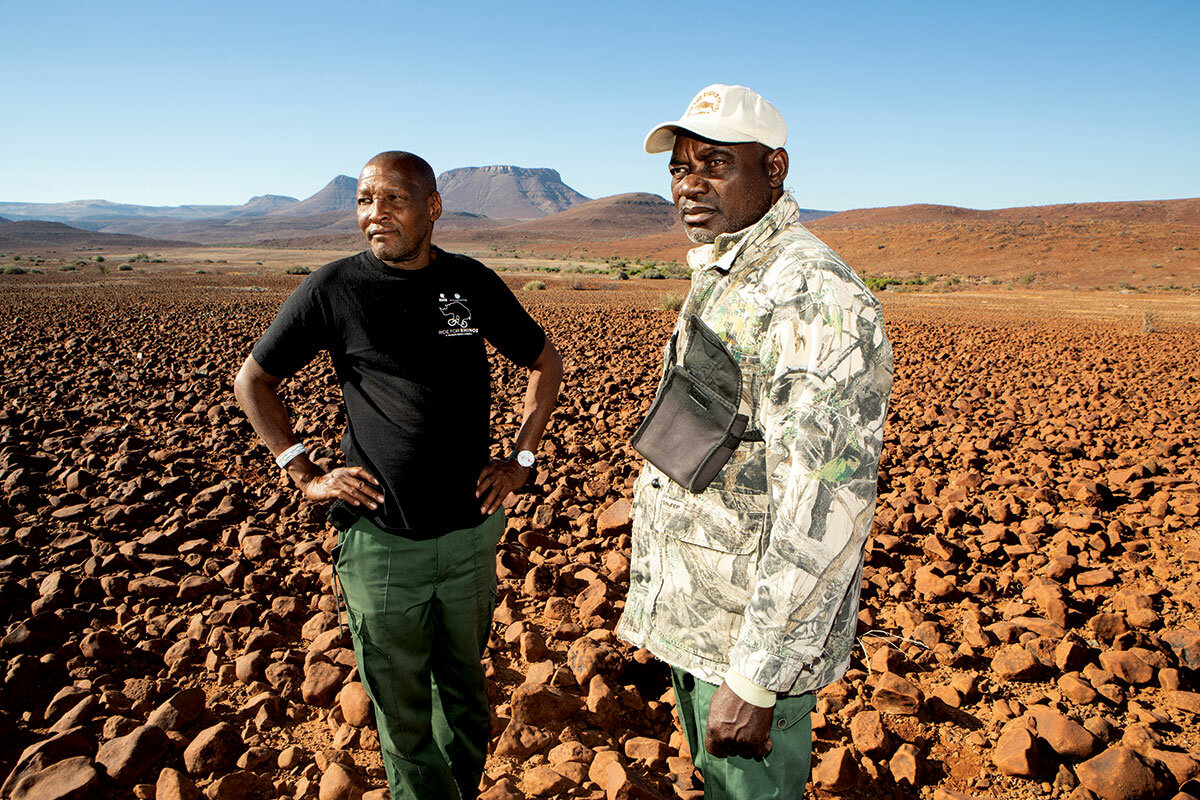
Ebson Mbunguha (right) and Sebulon Hoeb track endangered black rhinos in the Torra Conservancy near Palmwag, Namibia.

On Facebook and Instagram this past week, I’ve been following the adventures of an intrepid high school classmate who is in Africa for up-close and personal encounters with lions and elephants. I’m impressed at what a good traveler she is at our age, when I would be stressing over the time change, Covid exposure, what foods I can digest — every little thing. But, oh, the wonders she is seeing in Tanzania!

Today’s article is about one African wonder, the threatened black rhino. The people of Namibia truly love their rhinos and are doing all they can to protect them.

Sara Miller Llana writes at the Christian Science Monitor, “The rhino trackers trek a mile into the open desert plains of northwest Namibia. They stop 300 feet from a desert-adapted black rhinoceros grazing on the rocky hillside.

“Rhinos have poor eyesight, so the windy day works in the trackers’ favor, making it harder for the animals to locate them by sound or smell. Sebulon Hoeb, the principal field officer of Save the Rhino Trust Namibia, wants to get closer, but his partner today, Ebson Mbunguha, has his binoculars trained at the distance. He tells the group to back away. He has identified this rhino: Matty 2. She is 4 years old, which means her mother probably has a new baby and could appear on the open plain at any moment. There are no trees to climb if the crew is suddenly surrounded by creatures that can weigh as much as 3,000 pounds. Plus, they’ve identified her. Their job is now done. 

“Every day and every night, trackers from Save the Rhino Trust, alongside rangers from the local community, patrol 25,000 square kilometers (just under 10,000 square miles) in Namibia’s northwest, the only place in the world where this desert-adapted subspecies of the black rhino is still truly wild. Even if these animals are spotted from a distance, the trackers know them so well that they can identify them from their behaviors, roaming patterns, and physical features like birthmarks. It’s all documented on small pieces of paper that pile up back at Save the Rhino Trust headquarters in the pinprick of a town, Palmwag.

“The trackers are not just building a living database of conservation or scientific study; patrolling is the best tool they have against rhino poaching. And the work is paying off. 

“Rhino conservationists discourage publishing the price of horns on the black market, in order to deter criminal activity, but rhino horns are in high demand, especially in China and Vietnam. After years of successfully clamping down, Namibia saw rhino poaching increase by 93% last year over the year before, according to the Ministry of Environment, Forestry and Tourism. But here the community hasn’t logged a rhino poaching in three years. That’s because, within the structures of Namibia’s community conservation model, safeguarding the animals is more lucrative than selling them on the illegal market. …

“The desert-adapted rhino, one of the oldest mammals on Earth, has roamed this arid, red-earth region that glows at sunrise and sundown for millennia. Its presence is depicted in the ancient cave art found in nearby Twyfelfontein, a UNESCO World Heritage Site. But in the 20th century, European hunting all but eradicated its numbers. Between 1960 and 1995, black rhino numbers dropped by 98% to fewer than 2,500. 

“Save the Rhino Trust was established in 1982, when only 50 black rhinos roamed this area. Forty years later, Namibia hosts almost 35% of the world’s remaining black rhino population, although the exact number is tightly guarded. ‘That’s a state secret,’ says Simson Uri-Khob, the CEO who has dedicated his career to saving the rhino. 

“When Namibia gained its independence in 1990, it became the first country in Africa to protect the environment in its constitution. It also created community conservancies – lands with defined borders and governances outside the national park structure, where the communities themselves benefit from the resources, including animals, on their homelands. Today the government counts 86 communal conservancies covering more than 20% of the country’s territory. Many of these conservancies thrive by running lodges that draw tourists to see wildlife, in turn fueling local economies.

“Steve Galloway, chairman of the Community Conservation Fund of Namibia, says community conservation represents the best of both worlds. It puts large tracts of land under environmental protection – but not at the expense of people. ‘You bring in tourists, and you grow vegetables for those tourists and curios for those tourists. You do hiking trails, and you create a whole ecosystem,’ he says. …

“The rhino rangers start the day under a starry southern sky in the Namibian desert. … It’s no easy job. A 24/7 operation demands that the rangers live in tents for three weeks at a time, doing most of their tracking on foot. They get a bonus for how many kilometers they walk and how many sightings they log. It can be dangerous. ‘I’ve had to run for my life many times,’ says Mr. Hoeb.”

More at the Monitor, here. Good pictures. No firewall, but are subscriptions encouraged.

Read Full Post »

Photo: NOAA [National Oceanic and Atmospheric Administration].
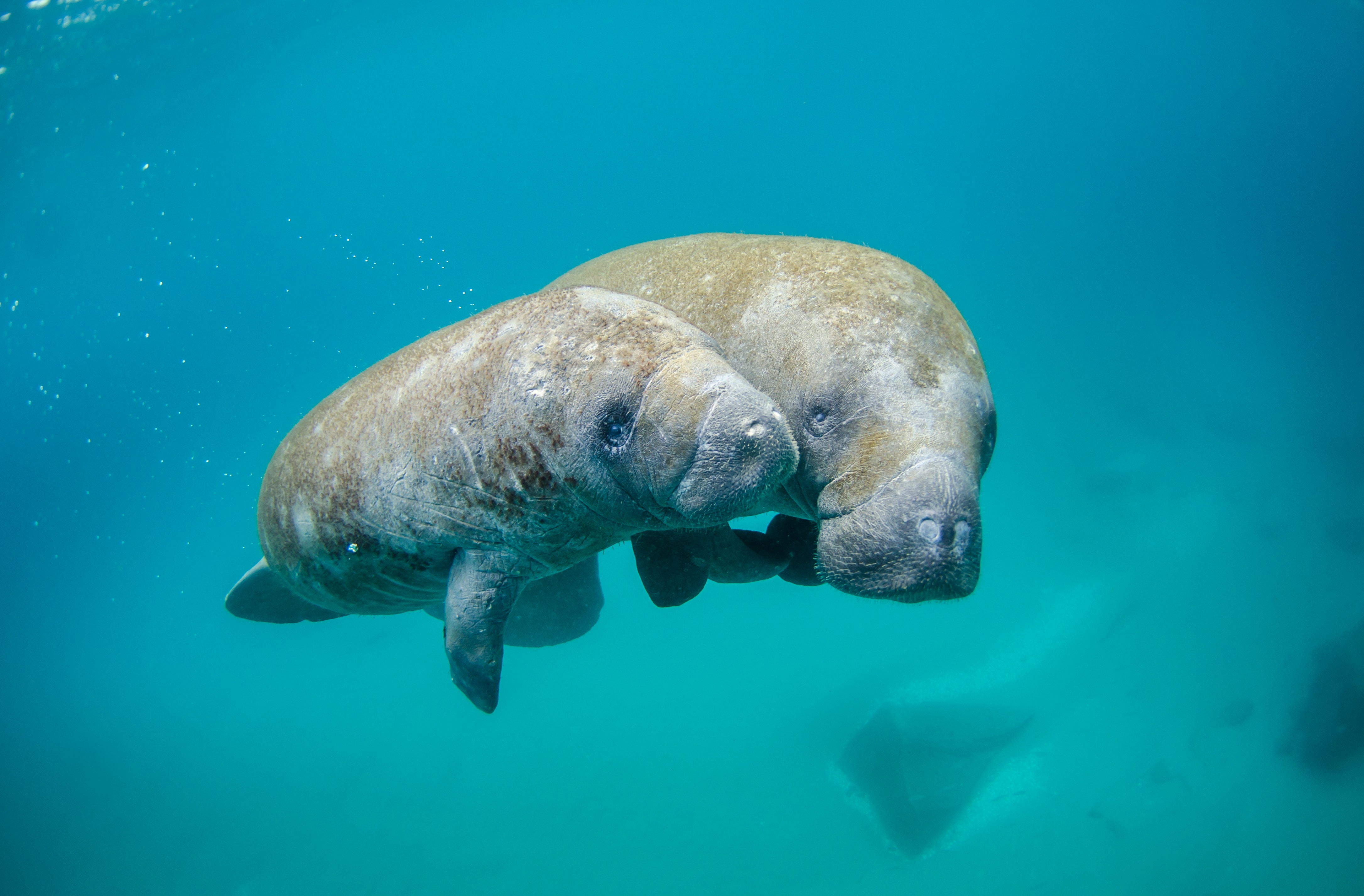
The return of seagrass in Florida is a hopeful sign for the embattled manatee.

One doesn’t normally think of Florida politicians as being big environmentalists, but whatever their motivations for supporting cleaner water, one has to cheer them for putting some funding behind it. Florida treasures like the manatee need the help.

Richard Luscombe reports for the Guardian, “A picturesque expanse of water along Florida’s space coast is offering a modicum of hope for the state’s embattled manatees as wildlife officials review whether to restore the beloved sea cows to the endangered species list.

“The recovery of seagrass, the manatees’ favorite food, in Mosquito Lagoon means that an emergency hand-feeding program that has kept many of the starving aquatic animals alive over the last two winters can be discontinued, at least temporarily.

“While scientists say this might be only a small step in the wider fight to rescue a species that has seen a record die-off in recent years from water pollution and habitat loss, what’s happened at Mosquito Lagoon offers signposts to how the manatees’ battle for survival might ultimately be won.

“ ‘At least in a portion of the lagoon, we are seeing a rather rapid resurgence of the Halodule variety of seagrass that, even if we don’t know exactly how it happened, does tell us that it’s much more resilient than we might have been thinking,’ said Dennis Hanisak, a professor of marine botany at Florida Atlantic University’s Harbor Branch Oceanographic Institute, and director of its seagrass nursery. …

“Hanisak and his team, in partnership with the Florida fish and wildlife commission (FWC), have focused their restoration efforts on the lagoon in northern Brevard county, one of the most popular feeding grounds for manatees during the colder winter months.

“That’s where the majority of manatee deaths, an unprecedented 1,100 in Florida in 2021, 10% of the population, and another 800 in 2022, occurred. They were part of what federal and state authorities classify as an ongoing unusual mortality event (UME) with the majority of fatalities through malnutrition and starvation, a reflection of the loss of about 90% of the lagoon’s seagrass to algae blooms and pollutants.

“It’s too early to say exactly what role the seagrass nursery project has had there; Hanisak says it has ramped up in size and resources in recent years as wildlife agencies respond to the disaster with improved funding.

“It’s one of several projects underway in Florida [and] a prominent component of a catalog of FWC manatee habitat restoration schemes, themed mostly around improvements in water quality and aquatic vegetation, that experts believe has potential to turn years of declining numbers into a robust recovery. …

“[In January], Florida’s governor Ron DeSantis announced a $100m award of state funds for water-quality improvements in the Indian River Lagoon, one of North America’s most biologically diverse waterways. The cleaner the water, the better the seagrass. …

“Hanisak and his students have steadily been building the capacity of the seagrass nursery at multiple locations. That seagrass will ultimately be transplanted into the Indian River Lagoon and elsewhere. …

“It remains to be seen if this year’s drop in manatee deaths in Florida is a one-off, or represents the start of a recovery. But more abundant seagrass in Mosquito Lagoon, which led to the welcome suspension of the experimental lettuce-feeding project, bodes well.

“Lawmakers also appear to be at least partly on board. Thompson said the Florida legislature provided an additional $20m in fiscal year 2022-23 to the FWC to enhance captive manatee support facilities and manatee habitat enhancement to supplement the previous year’s $8m. …

Patrick Rose, a veteran aquatic biologist and executive director of the Save the Manatee Club [said] the extra funding, which his group lobbied for, is welcome [but] ‘a drop in the bucket literally to what needs to be done.’ Ultimately, Rose said, manatees need clear, clean water to survive. Without it, seagrass will not flourish. …

“ ‘Nutrients are the direct cause of harmful algal blooms which have been so intense that they literally cut the light off to the seagrasses, and the seagrasses die,’ he said.”

More at the Guardian, here.

Read Full Post »

Photo: LaDameBucolique.
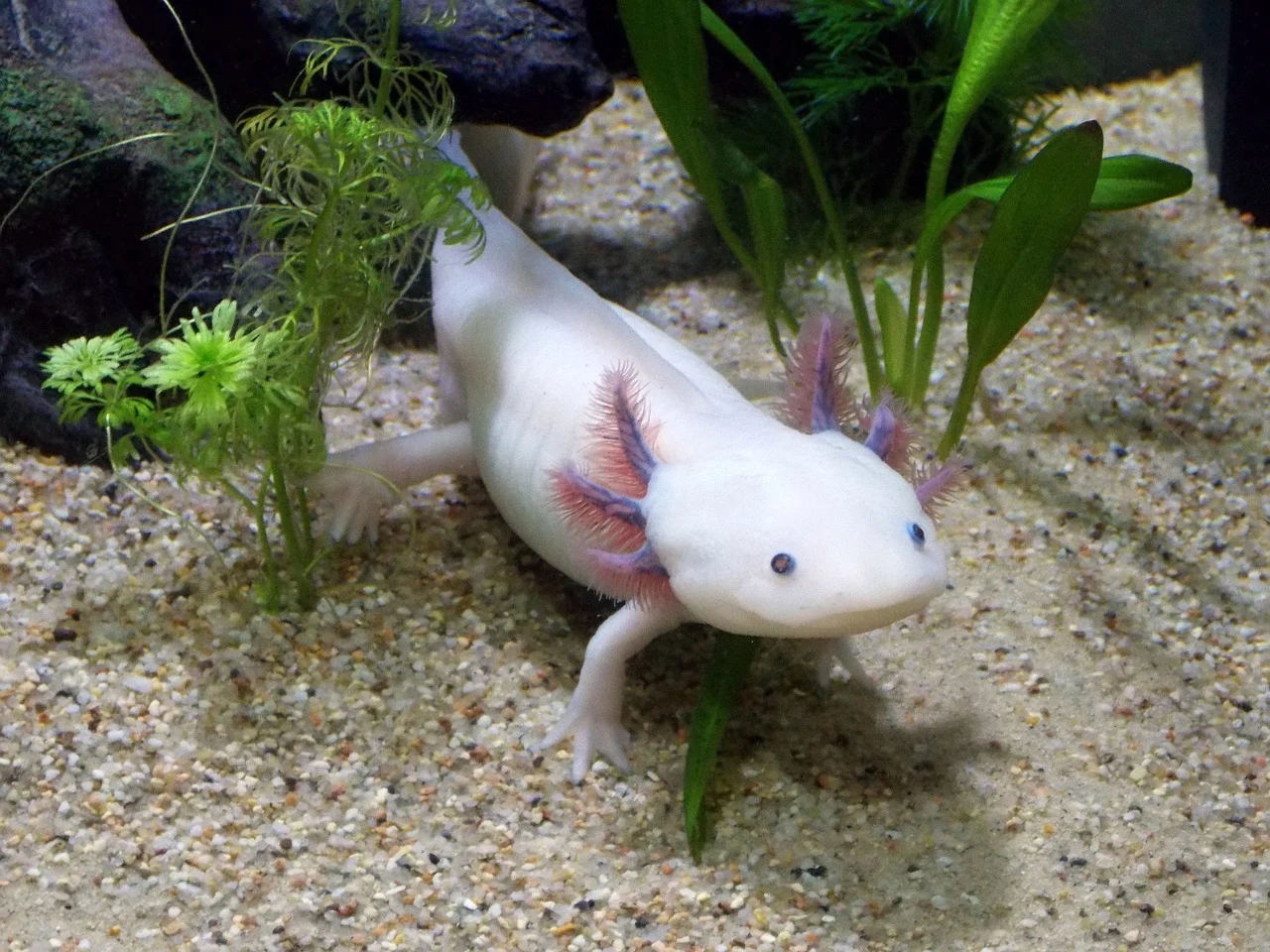
A Mexican Salamander in captivity.

People who put development before the natural environment are known to wax indignant at protections for small critters like the snail darter fish or the northern spotted owl. But what happens to the smallest of these effects us, too. Today’s article explains about pollution and the Mexican salamander.

The Associated Press (AP) reported on November 25th “Ecologists from Mexico’s National Autonomous University on Friday relaunched a fundraising campaign to bolster conservation efforts for axolotls, a native, endangered fish-like type of salamander.

“The campaign, called Adoptaxolotl, asks people for as little as 600 pesos (about $35) to virtually adopt one of the tiny ‘water monsters.’ Virtual adoption comes with live updates on your axolotl’s health. For less money, donors can buy a virtual dinner for one of the creatures, which are relatively popular pets in the US.

“In Mexican axolotls’ main habitat, the population density has plummeted 99.5% in under two decades, according to scientists behind the fundraiser.

“Last year’s Adoptaxolotl campaign raised just more than 450,000 pesos ($26,300) towards an experimental captive-breeding program and efforts to restore habitat in the ancient Aztec canals of Xochimilco, a southern borough of Mexico City.

“Still, there are not enough resources for thorough research, said Alejandro Calzada, an ecologist surveying less well-known species of axolotls for the government’s environment department. …

Despite the creature’s recent rise to popularity, almost all 18 species of axolotl in Mexico remain critically endangered, threatened by encroaching water pollution, a deadly amphibian fungus and non-native rainbow trout.

“While scientists could once find 6,000 axolotls on average per square kilometer in Mexico, there are now only 36, according to the National Autonomous University’s latest census. A more recent international study found less than 1,000 Mexican axolotls left in the wild.

“Luis Zambrano González, one of the university’s scientists announcing the fundraiser, told the Associated Press he hopes to begin a new census (the first since 2014) in March.”Luis Zambrano González, one of the university’s scientists announcing the fundraiser, told the Associated Press he hopes to begin a new census (the first since 2014) in March.

“ ‘There is no more time for Xochimilco,’ said Zambrano. ‘The “invasion” of pollution is very strong: soccer fields, floating dens. It is very sad.’

“Without data on the number and distribution of different axolotl species in Mexico, it is hard to know how long the creatures have left, and where to prioritize what resources are available. …

“Axolotls have grown into a cultural icon in Mexico for their unique, slimy appearance and uncanny ability to regrow limbs. Scientists in labs around the world think this healing power could hold the secret to tissue repair and even cancer recovery.

“In the past, government conservation programs have largely focused on the most popular species: the Mexican axolotl, found in Xochimilco. But other species can be found across the country, from tiny streams in the valley of Mexico to the northern Sonora desert.

“Mexico City’s expanding urbanization has damaged the water quality of the canals, while in lakes around the capital rainbow trout, which escape from farms, can displace axolotls and eat their food.”

More at AP via the Guardian, here, and at Wikipedia, here.

Invasive species that eat the food of native species are a problem everywhere. In a turtle presentation last week I learned that the red-eared slider, one of the 100 most invasive species in the world, is such a problem turtle that environmentalists often recommend killing it in the freezer. Sometimes called the “pet shop turtle,” it is an invasive pest in many parts of the world, making it hard for other turtles to survive.

Read Full Post »

Photo: Arthur Allen/Cornell Lab of Ornithology.
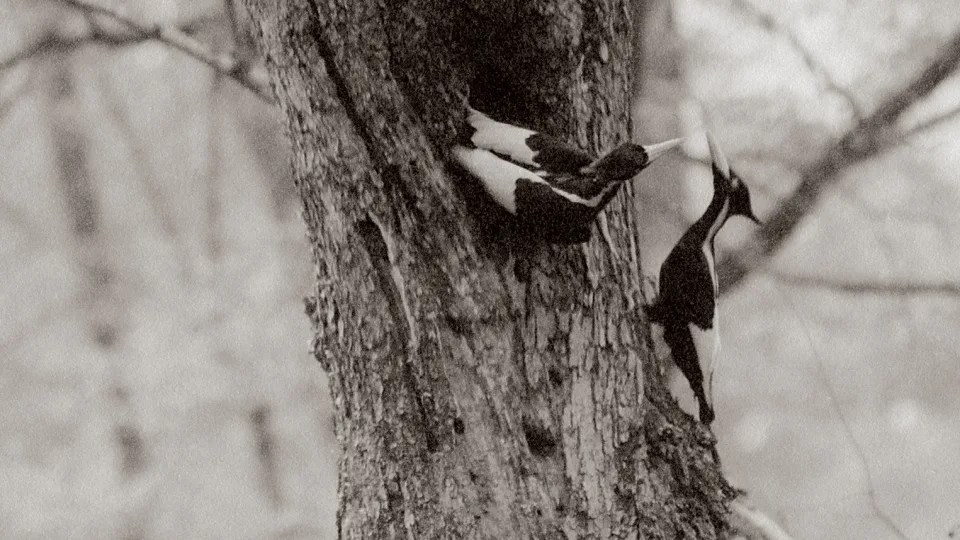
Ivory-billed woodpeckers in Louisiana in 1935.

When our younger granddaughter was in pre-school and learned about dinosaurs, she latched on to the word “extinct.” The idea of something being completely gone was powerful to her, and when she was angry at her brother she turned the word a verb: “I’m going to extinct you.”

Today I learned about the variety of reasons we keep some things off the extinct list even when they seem gone forever. As Rachel Ramirez reported at CNN, Federal wildlife officials “are delaying a long-awaited decision to declare the ivory-billed woodpecker extinct, months after grainy photos and videos emerged that purported to show the bird flying through a Louisiana forest.

“In 2021, the agency seemed ready to declare the so-called Lord God Bird extinct: The US Fish and Wildlife Service announced plans to remove 23 species, including the ivory-billed woodpecker, from the endangered species list due to extinction. Thorough scrutiny of ‘the best scientific and commercial data available’ had led to the conclusion the bird no longer exists, the agency told CNN.

“[But in October] Fish and Wildlife declared 21 of those species extinct — and the ivory-billed woodpecker is not among them. …

“The government’s last accepted sighting of the red-crowned bird species was in April 1944 by artist and birder Don Eckelberry.

“But expert biologists and birdwatchers have been adamant the nation’s largest woodpecker is still out there. Just after the feds announced the proposal to remove the bird, public comments poured in from ornithologists, amateur birders and even communities like the Cherokee Nation, whose leaders asserted the creature is a symbol whose ‘influence on our cultural activities remains to this day.’

“Amid the wave of testimony, the wildlife service invited more public comment and announced extensions to its decision that effectively postponed its ivory bill verdict into 2023. Now, that critical decision to delist the bird is once again delayed. …

“ ‘John Fitzpatrick, a renowned ornithologist and retired director emeritus of the Cornell Lab of Ornithology, told CNN, ‘Evidence of its persistence continues to emerge, albeit none of it 100% convincing to everyone.’

“Since the 1944 sighting, the only other ‘compelling evidence,’ according to the federal wildlife service, was 2005 research from Fitzpatrick and his associates that claimed ivory bill sightings in eastern Arkansas’ Cache River National Wildlife Refuge. …

“In 2022, CNN joined avid birdwatchers to search the Tensas River National Wildlife Refuge in Louisiana, where the ivory-billed woodpecker was last officially seen. Around the same time, a group known as Project Principalis — a nod to the ivory bill’s scientific name, Campephilus principalis — was gathering evidence observed over the prior decade by Steve Latta of the National Aviary and other colleagues.

“Using unmanned trail cameras and drones, they’d captured grainy pictures of what they claimed was the ivory bill.

“ ‘We have some of the best images, if not the best images, that have been produced in 80 years,’ Latta, who claimed he has seen the bird in 2019, told CNN at the time.

“This May, Project Principalis published peer-reviewed research that unveiled such recordings, which they submitted to the feds, including a drone video from October 2022 of two ivory bills quickly flying onto a tree branch.

“ ‘Our ultimate goal is the conservation of the species, its habitat, and the many other species relying on that habitat,’ Latta told CNN Monday. ‘Keeping the Ivory-billed Woodpecker on the Endangered Species list brings us one step closer to that goal.’ ”

More at CNN, here.

Read Full Post »

Photo: JJ Harrison/Wikimedia Commons.
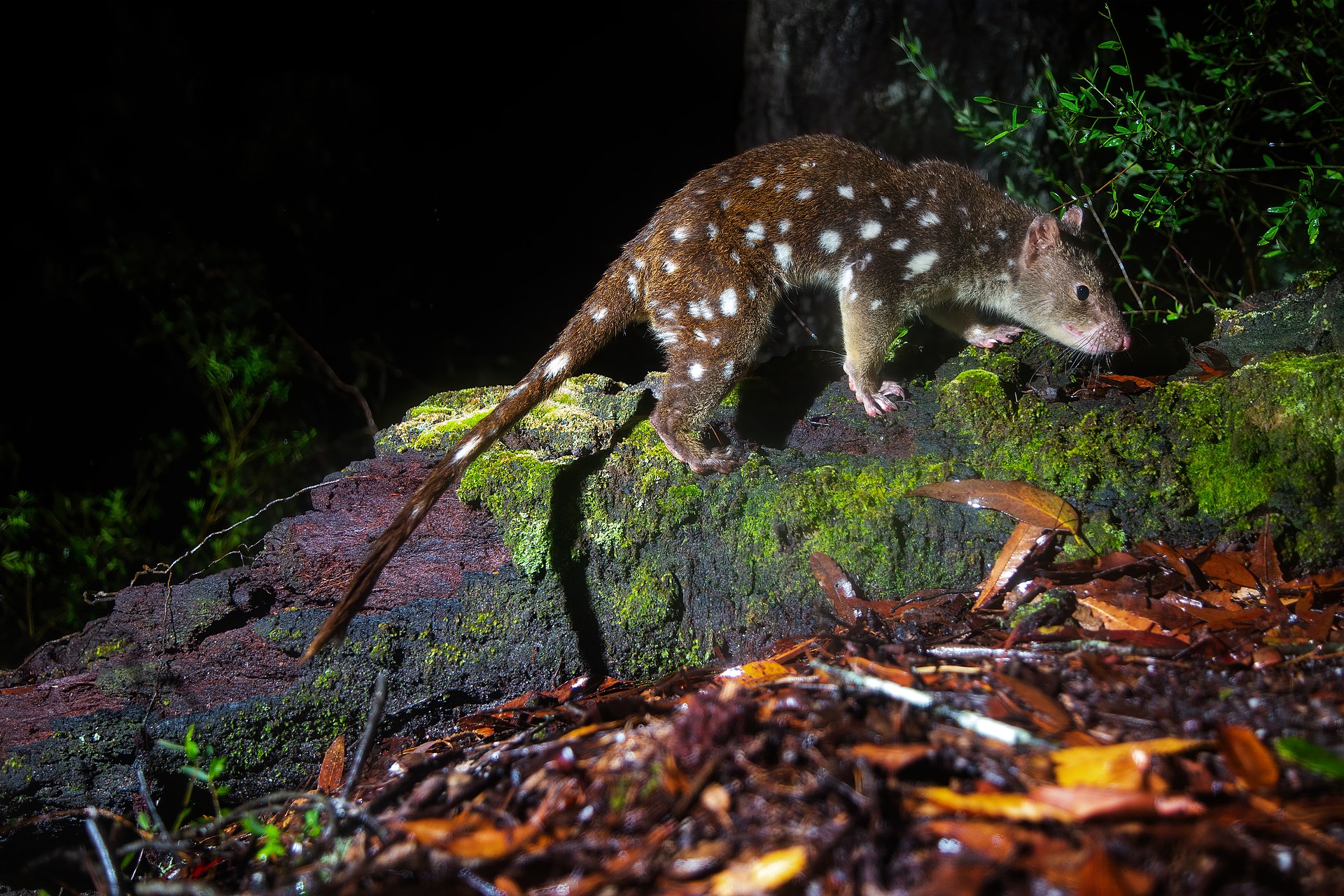
This tiger quoll (or spotted-tailed quoll) at Barren Grounds Nature Reserve, New South Wales, Australia, is similar to one a farmer caught harassing his chickens.

The creature of the day, the spotted-tailed quoll, is not extinct everywhere but was thought to be extinct in southern Australia. That is, until a farmer protecting his chickens caught one. Imagine how your perspective would change if an animal you just wanted to destroy suddenly turned out to be a rare find!

Aspen Pflughoeft reports at the Miami Herald. “A farmer in southern Australia captured an animal considered locally extinct for over a century while trying to protect his chickens. …

“Frank Pao-Ling Tsai, a trout farmer in Beachport, South Australia, heard a ‘panic’ from his chickens and rushed outside early in the morning on Tuesday, Sept. 26, he told McClatchy News in an email.

“Inside the coop, Tsai found a spotted creature and a dead chicken, he said.

“ ‘I had no idea what it was at first,’ Tsai told the Australian Broadcasting Corporation. ‘I expected to find a cat, but I found this little animal instead.’ …

“The captured animal [has] a furry brown body, long tail and smattering of white spots. … Tsai captured the creature in a plastic chicken cage, he told McClatchy News. He took photos and shared them in hopes of identifying the animal.

“Wildlife officials identified the animal as a spotted-tailed quoll, the National Parks and Wildlife Service of South Australia told McClatchy News.

“Quolls are ‘about cat-sized’ marsupials with a ‘cat-like shape but a lot stronger jaws and a lot longer canine teeth,’ Limestone Coast district wildlife ranger Ross Anderson told McClatchy News.

“The spotted-tailed quoll, also known as the tiger quoll, is an endangered quoll species and the ‘largest native carnivore left on the (Australia) mainland,’ according to the Australian Conservation Foundation. An estimated 14,000 spotted-tailed quolls are left in the wild, the organization said.

“The last officially documented sighting of a spotted-tailed quoll in South Australia was in the 1880s, Anderson said. The species has been considered locally extinct for over 130 years.

“ ‘It’s a once-in-a-lifetime event, really,’ Anderson told the Australian Broadcasting Corporation. …

“ ‘We can’t be sure where it’s come from,’ Anderson told the Guardian.

“The quoll Tsai originally captured managed to escape out a damaged corner of the cage, he said. Wildlife officials set up another trap and again captured a spotted-tailed quoll, Anderson said. …

“ ‘It could have been a relic population,’ Anderson told McClatchy News. ‘(Or) it could have been an animal that’s moved from other areas …. (or) it may have escaped from captivity.’

“ ‘We took some DNA to see if we can work out the likely origins,’ he said. ‘It’s a great opportunity for us to get some information and it would be fabulous if it turned out to be a relic population.’

“After being checked by a vet and DNA-tested, the captured quoll was released, Anderson said.

“Wildlife officials will set up cameras and traps to study the rediscovered quoll species and see if there are more quolls around Beachport, he said.”

See Tsai’s photos of a very angry beast at the Miami Herald, here. No firewall.

Read Full Post »

Photo: Zoo Leipzig.
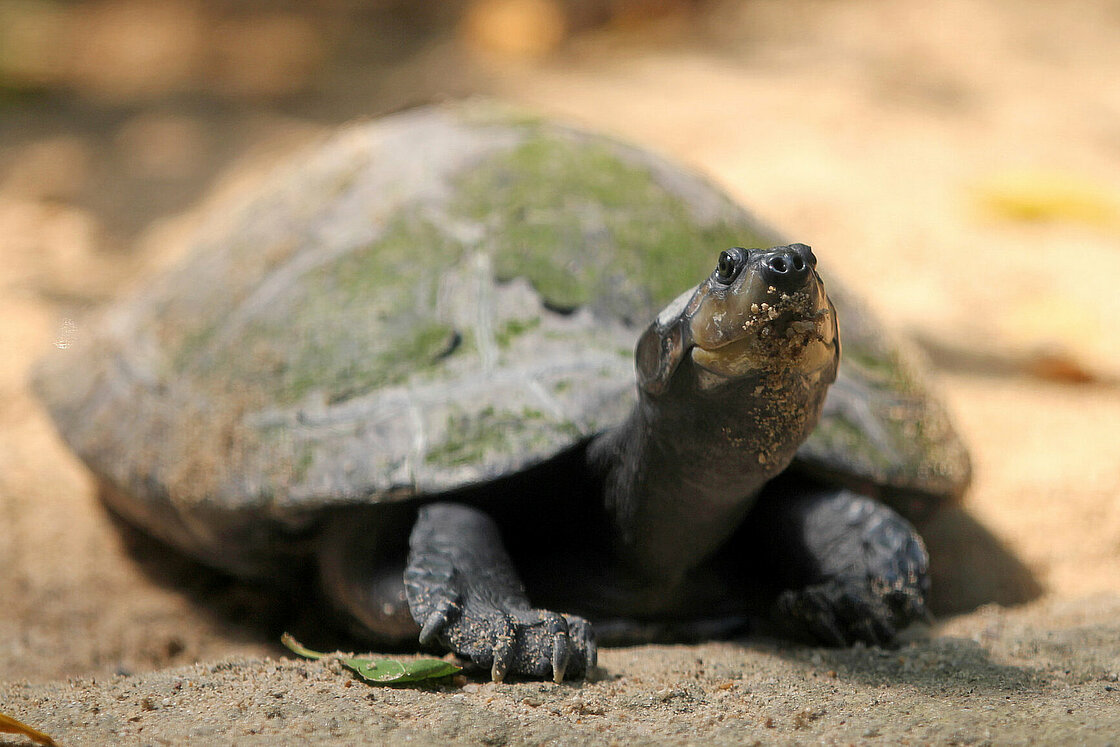
The endangered Arrau, a giant South American river turtle, has unusual conversational attributes.

I remember a fad (perhaps it wasn’t a fad, perhaps it’s still going strong) of expectant mothers exposing babies-in-the-womb to classical music, art museums, and breathtaking scenery. The idea was to inculcate certain interests before birth. Turns out, there’s a turtle mom that does something similar.

Dino Grandoni writes at the Washington Post about turtles that “talk” to their babies before they hatch.

“Camila Ferrara felt ‘stupid’ plunging a microphone near a nest of turtle eggs. The Brazilian biologist wasn’t sure if she would hear much. She was studying the giant South American river turtle, one of the world’s largest freshwater turtles.

“ ‘What am I doing?’ she recalled asking herself. ‘I’m recording the eggs?’

“Then Ferrara — who works for the Wildlife Conservation Society, a U.S.-based conservation group — heard it: a quick, barely audible pop within the shells.

“The hatchlings seemed to be saying to one another, she said, ‘ “Come on, come on, it’s time to wake up. Come on, come on.” And then all the hatchlings can leave the nest together.’

“Researchers for decades thought of aquatic turtles as hard of hearing and mostly mute. … But recent recordings of these turtles’ first ‘words’ — before they even hatch — challenge notions not just of the turtles’ capacity to communicate, but also of their instinct to care for young. Now the discovery has spurred an urgent count of this talkative turtle’s numbers, and may shape protections. …

“Known locally as the arrau or tartaruga da amazonia, the giant South American river turtle lives throughout the Amazon and its tributaries. During the dry season, thousands of females at once crawl onto beaches along the river to lay their eggs. For other kinds of turtles, the mothering usually ends at the beach. Many turtle hatchlings are left by their parents to fend for themselves.

“But that’s not the case with the arrau. After nesting, females often hover by the shore for up to two months waiting for their eggs to hatch.

“So Ferrara and her colleagues wondered: are mother turtle and child turtle communicating with one another? To test the idea, her team spent months taping the turtles — on land and underwater, in the wild and in a swimming pool. The team recorded a wide repertoire of whisper-quiet calls from arrau of all ages.

“Embryos appear to chirp together to coordinate hatching and digging up to the surface. With so many jaguars and other predators lurking, it is safer for baby turtles to move en masse toward the river.

“The mothers, meanwhile, approach and respond to the calls of their young. Once the hatchlings reach the water, the baby turtles migrate down the river with the adult females, Ferrara’s radio-tracking research shows.

“When her team published an early study on turtle vocalizations a decade ago, Ferrara said, academic journals resisted putting the phrase ‘parental care’ in the title of a study about turtles. …

“But Ferrara and her colleagues have gone on to record vocalizations from more turtle species, including the pig-nosed turtle in Australia, Blanding’s turtle in Minnesota and Kemp’s ridley sea turtle in Mexico, one of the world’s most endangered. …

“Other researchers may have missed turtle noises since they tend to be quiet, infrequent and low-pitched — just at the edge of human hearing. Leatherback sea turtles, for instance, appear to have ears tuned to the frequency of waves rolling ashore. Some species can take hours to reply to each other.

Some species can take hours to reply to each other.

“ ‘Had we had a bit more expansive imaginations, we might have caught this earlier,’ said Karen Bakker, a fellow at Harvard’s Radcliffe Institute for Advanced Study who wrote about turtle vocalization in her book, The Sounds of Life.

“ ‘We’re looking for sounds in the frequencies we can hear,’ she added. ‘We’re looking for sounds at a temporal rate that is as quick as we speak.’ …

“As a group, turtles are more ancient than dinosaurs, and are central to many cultures’ creation stories. Yet today they rank among the species at most risk of extinction. Nearly three in five species may vanish, according to a recent assessment, with climate change, habitat loss and hunting posing risks.

“The Amazon once teemed with so many turtles, it was difficult to navigate. While Indigenous people have long relied on turtles for meat, the arrival of Europeans accelerated their decline. …

“The species still faces serious threats. A boom in dam construction threatens to cull their numbers. And a continued appetite for turtle meat sustains a lucrative illegal trade, where middlemen can buy an arrau for $50 and sell it downriver for $450. …

“For [Ferrara], the real fight is not in the field, but in the cities, convincing regular Brazilians to refrain from eating turtle meat. For her, changing the minds of just a few folks would be a victory.

“ ‘What I want is to see two or three people stop.’ “

More at the Post, here.

Turtles that take a long time to answer another turtle are like Bob & Ray’s Slow Talkers of America.

Read Full Post »

Photo: Pandbambooguy.
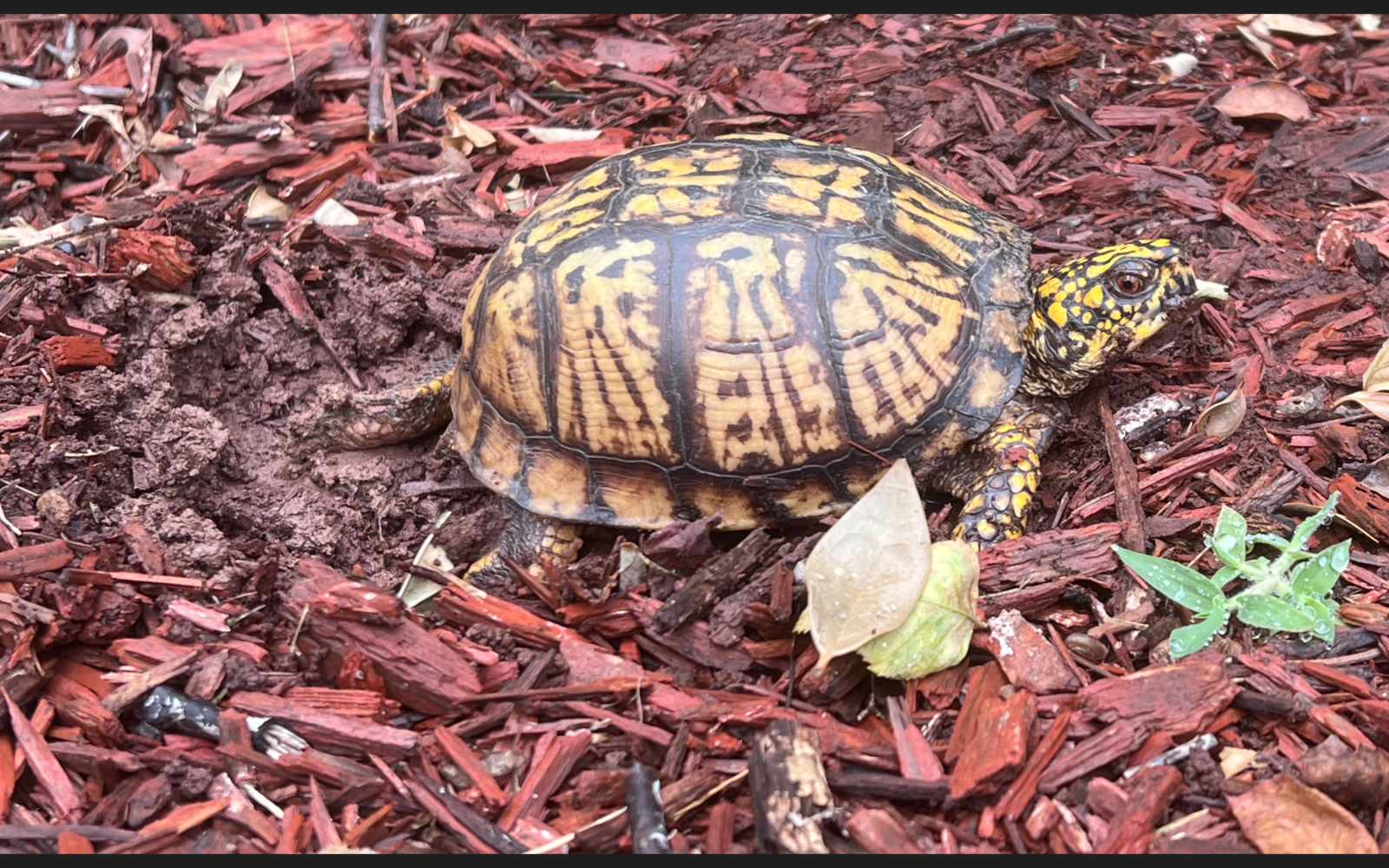
Female box turtle digging a hole with her back legs to lay eggs. Eastern box turtles are a popular species in the illegal world of wildlife poaching. 

Unsurprisingly, Erik couldn’t believe that global criminal gangs selling endangered species had ties to turtle thieves in little old Rhode Island. I know. It sounds pretty implausible — and grandmothers do tend to sensationalize news stories to entertain the kids.

But it’s all true. Just ask the state herpetologist. (Who knew Rhode Island had an official herpetologist?)

As Frank Carini reported at ecoRI News this month, “Rhode Island’s reptiles and amphibians face pressure from numerous threats, and for many species, removal of even a single adult from the wild can lead to local extinction, according to the state’s herpetologist.

“Since the local and/or regional future for many of these species — eastern spadefoot toad, northern leopard frog, northern diamondback terrapin, to name just a few — is in doubt, removing them from nature to keep as a pet or to sell is against the law. It’s illegal to sell, purchase, or own/possess native species in any context, even if acquired through a pet store or online, according to Rhode Island law.

“Turtles are especially vulnerable, according to Scott Buchanan, who became the state’s first full-time herpetologist in 2018, because some species must reproduce for their entire lives to ensure just one hatchling survives to adulthood. The Rhode Island Department of Environmental Management (DEM) staffer said it takes years, sometimes a decade or more, for turtles to reach reproductive age, if they make it at all.

“Buchanan recently told ecoRI News that ‘broadly, across taxa’ the illegal taking, or poaching, of wildlife is a ‘huge issue. … Globally, it’s considered one of the driving forces of population declines and even extinctions,’ he said.

“Wildlife trade experts and conservation biologists such as Buchanan point to poaching — driven by demand in Asia, Europe, and the Unified States — as a contributing factor in the global decline of some freshwater turtles and tortoises. …

‘Before you take a photo of a turtle in the wild, turn off the geolocation on your phone. If you post a turtle photo on social media, don’t include information about where you found it.’ 

“Of the 360 known turtle and tortoise species, 52% are threatened, according to the International Union for Conservation of Nature Red List of Threatened Species.

“A group of global turtle and tortoise experts published a 2020 paper that noted ‘more than half of the 360 living species [187] and 482 total taxa (species and subspecies combined) are threatened with extinction. This places chelonians [turtles, terrapins, and tortoises] among the groups with the highest extinction risk of any sizeable vertebrate group.’

“Turtle populations are ‘declining rapidly’ because of habitat loss, consumption by humans for food and traditional medicines, and collection for the international pet trade, according to the paper’s authors. Many could go extinct this century.

“Buchanan’s involvement in dealing with the impact of poachers is primarily around North American turtles. He noted turtle diversity is high globally and in the eastern United States — in the Southeast more than the Northeast, however.

“But state and federal law enforcement officials and wildlife biologists consider the illegal collection of turtles to be a conservation crisis occurring at an international scale, according to Buchanan, who is the co-chair of the Collaborative to Combat the Illegal Trade in Turtles (CCITT), formed in 2018 within Partners in Amphibian and Reptile Conservation. …

“In Rhode Island, Buchanan said, there are four turtle species of concern: the eastern box turtle; the spotted turtle; the wood turtle; and the northern diamondback terrapin.

Eastern box (species of greatest conservation need): This turtle spends most of its time on land rather than in the water. They favor open woodlands, but can be found in floodplains, near vernal pools, ponds, streams, marshy meadows, and pastures. They reach sexual maturity by about 10 years of age. Females nest in June and lay an average of five eggs in open areas with sandy or loamy soil. Eggs hatch in late summer.

Spotted (species of greatest conservation need): These turtles are sensitive to disturbance. They are usually found in shallow, well-vegetated wetland habitats, such as vernal pools, marshes, swamps, bogs, and fens. …

Wood (species of greatest conservation need): For part of the year they live in streams, slow rivers, shoreline habitats, and vernal pools, but in the summer they roam widely across terrestrial landscapes. …

Northern diamondback (state endangered): Their population has suffered greatly due to poaching and habitat loss. They are found in estuaries, coves, barrier beaches, tidal flats, and coastal marshes. They spend the day feeding and basking in the sun and bury themselves in the mud at night. They reach sexual maturity at about 6. Females lay a clutch consisting of 4-18 eggs. Some females will lay more than one clutch in a season and hatching usually occurs in late August. The young spend the earlier years of life under tidal wrack (seaweed) and are rarely observed. …

“Other turtle species that can be found in Rhode Island include eastern painted, common snapping turtle, and eastern musk. …

“ ‘We have a lot of turtles for a small state,’ Buchanan said. …

“In late September environmental police officers from DEM’s Division of Law Enforcement found 16 eastern musk turtle hatchlings, a species native to Rhode Island and the eastern United States, in the home of a West Warwick man suspected of illegally advertising them for sale on Craigslist and Facebook.

“The case resulted from a week-long investigation, during which the suspect offered two hatchlings to undercover environmental police officers for purchase, according to DEM. The suspect was charged with 16 counts of possession of a protected reptile or amphibian without a permit. The turtles were taken to the Roger Williams Park Zoo, which has a room and equipment dedicated to the care of turtles seized from the illegal turtle trade. The turtles will be released back into the wild after clearing health screenings and disease testing, according to DEM. …

“To help protect Rhode Island’s native species, you can submit observations of amphibians and reptiles to DEM scientists online.”

More at ecoRI News, here. No firewall.

Read Full Post »

As the website Right Whale Festival notes, “The North Atlantic right whale (Eubalaena glacialis) is a federally protected ​endangered species.” Fewer than 350 exist today. Recovery is hampered by a slow reproduction rate and threats from entanglement in fishing nets and collisions with vessels.

Last week, I was talking to my younger grandson about elephants, and the conversation morphed into the topic of endangered species. He told me that the most endangered marine animal is the vaquita. I mentioned the right whale.

Today’s story is about an ocean scientist who is using drones and satellites to protect whales. Tatiana Schlossberg wrote about him for the Washington Post.

“Just yards from the Fish 1, a 22-foot research vessel, a humpback whale about twice the size of the boat hurled itself out of the water, sending shimmering droplets in a broken necklace of splash. In the other direction, a hulking cargo ship, stacked high with containers, crept closer.

“Aboard the Fish 1 … ocean scientist Douglas McCauley wanted to see whether the near real-time detection system he and his colleagues had developed, Whale Safe, could avert collisions between whales and ships in the Santa Barbara Channel.

“The tool represents one of the ways McCauley, who heads the Benioff Ocean Science Laboratory at the University of California Santa Barbara, is working to protect the ocean even as it becomes more industrialized. By collecting data from several sources — an acoustic monitoring buoy that listens for whale songs, identifies them according to species with an algorithm and sends that information to satellites; a predictive habitat model for blue whales; and sightings logged in an app — Whale Safe forecasts to ships the chances of meeting a whale. Then, it grades shipping companies on whether they actually slow down to 10 knots or less during whale migrations, from May 1 to Dec. 15.

‘We can literally watch all of the ships in California and across the whole ocean; we are better positioned than ever before to try to track damage as it occurs, or before it occurs,’ McCauley said. …

“Humans have worked in the seas for centuries: fishing, seafaring and more recently, drilling for oil and gas and the development of offshore wind farms. Shipping lanes cross almost every surface of the sea, except for shrinking swaths of the Southern and Arctic Ocean. …

“In meetings with corporate executives and political leaders, McCauley has made a consistent argument: Protecting the sea is in our interest, since it already does a lot of the work for us.

“In 2020 McCauley led a report that provided a framework for marine protected areas on the high seas, finding that such refuges could be powerful tools for biodiversity conservation, carbon sequestration and climate resilience. Even port and fishing communities, he argued, depend on an ocean that is still wild and alive. …

“The encounter in late September, amid one of the world’s busiest shipping channels and a vibrant ecosystem, offered a glimpse of how to do just that. Minutes after the container ship had passed McCauley’s boat, the whale — possibly the same one, but it is hard to tell — had found another [whale], and the two sent up exhales of spray.

“It was as if a bulldozer operator had plowed through a herd of elephants without stopping, not too far from a major city’s downtown, hoping to avoid a crash. And it happens many times a day here in the Santa Barbara Channel, even though barely anyone sees it. …

“The ocean is, by far, the world’s largest carbon sink, having absorbed about 40 percent of the excess greenhouse gasses from burning fossil fuels. But it comes at a cost: more acidic and warmer waters, which may not soak up as much carbon going forward. The fact that ocean animals evolved to a narrow range of conditions, McCauley and others found, makes them more vulnerable to climate change. …

“He learned through experience: What is good for the ocean is also good for people, and possibly business too. Slowing down ships means fewer ship strikes, which means more whales. That is good for biodiversity and climate change: Whales themselves are carbon sinks and fertilize plant growth (another carbon sink). …

“Three shipping companies contacted for this article, as well as an industry association, said that they supported such programs. CMA CGM, among the world’s largest shipping container companies, is sending alerts above medium directly to their captains, and Hyundai Heavy Industries is working with Whale Safe to incorporate its data directly onboard new ships.

“But some of the firms tracked by the tool, which has recently expanded its use to include San Francisco, have received F grades. Matson Navigation, for example, only slowed down roughly 18 percent of the time.

“Lee Kindberg, the head of environment and sustainability for Maersk, which received a B for slowing down in about 79 percent of cases, said the company supports Whale Safe. But she added that shippers must balance safety and speed restrictions against weather and demands from companies — and their customers — who want everything faster.”

More at the Post, here.

Read Full Post »

« Newer Posts - Older Posts »