Feeds:
Posts
Comments

Posts Tagged ‘environment’

Photo: BLM.
“The US California Condor Recovery Program, initiated in the 1970s, represented an enormous change in the strategy of species conservation,” writes Knowable Magazine.

They are not as appealing as, say, hummingbirds, but the California condors had a lot of environmentalists worried in the 1970s, including a young boy I knew who grew up to be a respected biologist and scientific photographer.

I remember him talking a lot about condors when we were carpooling. And I thought, “Well, condors. An odd obsession for a child.”

Thank goodness people get obsessed about the least beautiful denizens of our planet.

Iván Carrillo tells the condor story at Knowable Magazine via the Tucson Sentinel.

“The spring morning is cool and bright in the Sierra de San Pedro Mártir National Park in Baja California, Mexico, as a bird takes to the skies. Its 9.8-foot wingspan casts a looming silhouette against the sunlight; the sound of its flight is like that of a light aircraft cutting through the wind. In this forest thick with trees up to 600 years old lives the southernmost population of the California condor (Gymnogyps californianus), the only one outside the United States. Dozens of the scavenging birds have been reintroduced here, to live and breed once again in the wild.

“Their return has been captained for more than 20 years by biologist Juan Vargas Velasco and his partner María Catalina Porras Peña, a couple who long ago moved away from the comforts of the city to endure extreme winters living in a tent or small trailer, to manage the lives of the 48 condors known to fly over Mexican territory. Together — she as coordinator of the California Condor Conservation Program, and he as field manager — they are the guardians of a project whose origins go back to condor recovery efforts that began in the 1980s in the United States, when populations were decimated, mainly from eating the meat of animals shot by hunters’ lead bullets.

“In Mexico, the species disappeared even earlier, in the late 1930s. Its historic return — the first captive-bred condors were released into Mexican territory in 2002 — is the result of close binational collaboration among zoos and other institutions in the United States and Mexico.

“Beyond the number on the wing that identifies each individual, Porras Peña knows perfectly the history and behavior of the condors under her care. … She captures her knowledge in an Excel log: a database including information such as origin, ID tag, name, sex, age, date of birth, date of arrival, first release and number in the Studbook (an international registry used to track the ancestry and offspring of each individual of a species through a unique number). Also noted is wildlife status, happily marked for most birds with a single word: ‘Free.’ …

“The California condor, North America’s largest bird, has taken flight again. It’s a feat made possible by well-established collaborations between the US and Mexico, economic investment, the dedication of many people and, above all, the scientific understanding of the species — from the decoding of its genome and knowledge of its diseases and reproductive habits to the use of technologies that can closely follow each individual bird.

“But many challenges remain for the California condor, which 10,000 years ago dominated the skies over the Pacific coast of the Americas, from southern Canada to northern Mexico. Researchers need to assemble wild populations that are capable of breeding without human assistance, and with the confidence that more birds are hatched than die. It is a tough battle against extinction, waged day in and day out by teams in California, Arizona and Utah in the United States, and Mexico City and Baja California in Mexico.

“The US California Condor Recovery Program, initiated in the 1970s, represented an enormous change in the strategy of species conservation. After unsuccessful habitat preservation attempts, and as a last-ditch attempt to try to save the scavenger bird from extinction, the United States Fish and Wildlife Service and the California Fish and Game Commission advocated for a decision as bold as it was controversial: to capture the last condors alive in the wild and commit to breeding them in captivity. …

“On April 19, 1987, the last condor was captured, marking a critical moment for the species: On that day, the California condor became officially extinct in the wild.

“At the same time, a captive breeding program was launched, offering a ray of hope for a species that, beyond its own magnificence, plays an important role in the health of ecosystems — efficiently eliminating the remains of dead animals, thus preventing the proliferation of diseases and environmental pollution.

“This is what is defined as a refaunation project, says Rodolfo Dirzo, a Stanford University biologist. … Refaunation, Dirzo says, involves reintroducing individuals of a species into areas where they once lived but no longer do. He believes that both the term and the practice should be more common. …

“The California Condor Recovery Program produced its first results in a short time. In 1988, just one year after the collection of the last wild condors, researchers at the San Diego Zoo announced the first captive birth of a California condor chick.

“The technique of double or triple clutching followed, to greater success. Condors are monogamous and usually have a single brood every two years, explains Fernando Gual, who until October 2024 was director general of zoos and wildlife conservation in Mexico City. But if for some reason they lose an egg at the beginning of the breeding season — either because it breaks or falls out of the nest, which is usually on a cliff — the pair produces a second egg. If this one is also lost or damaged, they may lay a third. The researchers learned that if they removed the first egg and incubated it under carefully controlled conditions, the condor pair would lay a second egg, which was also removed for care, leaving a third egg for the pair to incubate and rear naturally.

“This innovation was followed by the development of artificial incubation techniques to increase egg survival, as well as puppet rearing, using replicas of adult condors to feed and care for the chicks born in captivity. That way, the birds would not imprint on humans, reducing the difficulties the birds might face when integrating into the wild population.

“Xewe (female) and Chocuyens (male) were the first condors to triumphantly return to the wild. The year was 1992, and the pair returned to freedom accompanied by a pair of Andean condors, natural inhabitants of the Andes Mountains in South America. Andean condors live from Venezuela to Tierra del Fuego and have a wingspan about 12 inches larger than that of California condors. Their mission here was to help to consolidate a social group and aid the birds in adapting to the habitat. The event took place at the Sespe Condor Sanctuary in the Los Padres National Forest in California. In a tiny, tentative way, the California condor had returned.

“By the end of the 1990s, there were other breeding centers, such as the Los Angeles Zoo, the Oregon Zoo, the World Center for Birds of Prey in Boise, Idaho, the San Diego Zoo and the San Diego Zoo Safari Park. Then, in 1999, the first collaboration agreements were established between the United States and Mexico for the reintroduction of the California condor in the Sierra de San Pedro Mártir National Park. The number of existing California condors increased from just over two dozen in 1983 to more than 100 in 1995, some of which had been returned to the wild in the United States. By 2000, there were 172 condors and by 2011, 396.

“By 2023, the global population of California condors reached 561 individuals, 344 of them living in the wild.” Lots more at Knowable Magazine via the Tucson Sentinel, here.

I salute the cleverness and devotion of scientists. May they live long and prosper!

Read Full Post »

Photo: Charles Krupa/AP.
Workers harvest cranberries at the Rocky Meadow bog in Middleborough, Massachusetts, ahead of Thanksgiving. 

Recently, I read about a federal program paying “farmers to convert the land of bogs that is not efficient for growing” into wetlands that can alleviate climate change consequences. Whether or not the federal program will continue, Massachusetts is on the case, helping its own farmers with restoration.

Gloria Oladipo wrote at the Guardian last November, “As millions of cranberries were being harvested for Thursday’s US Thanksgiving holiday, Massachusetts farmers were working to convert defunct cranberry bogs back to wild wetlands, amid climate crisis woes. Several restoration projects were awarded $6m in grants to carry out such initiatives, state officials announced this week.

“The grants, provided by the New England state’s department of fish and game division of ecological restoration (DER), will ‘increase resilience to climate change for people and nature, restore crucial wildlife habitat, and improve water quality’ in 12 communities, said the Massachusetts governor, Maura Healey, in a statement. …

“ ‘These initiatives will enhance our ability to store and sequester carbon with nature and help us meet our net zero goals,’ said Rebecca Tepper, secretary of the state’s office of energy and environmental affairs. …

“The grants are being awarded through two state programs: the DER’s wetland restoration program and the DER’s cranberry bog restoration program, which converts defunct cranberry bogs into wetlands and streams.

“To date, scientists and government officials have converted 400 acres of retired cranberry bogs into wetlands, the Washington Post reported. State officials have said they hope to restore an additional 1,000 acres of bogs within the next decade. …

“As sea levels rise in Massachusetts because of the climate crisis caused by humans burning fossil fuels, scientists are looking to develop bogs into wetlands to improve coastal resilience and slow down erosion.

“Wetlands can hold more water and filter out pollutants amid increased storms that bring potential flooding. They also have other environmental benefits, acting as wildlife habitats and storing carbon dioxide from the atmosphere in their soil.

“More farmers have been drawn to the prospect of transitioning their former cranberry bogs into wetlands. The climate crisis and economic factors, including the high cost of modernizing bogs, can make cranberry farming more difficult. …

“ ‘We are in an upward trend in terms of interest in retiring cranberry bogs,’ said Brian Wick, executive director of the Cape Cod Cranberry Growers Association, to the Post. … But getting land for restoration remains a competitive process, as other businesses – such as housing developers – vie for undeveloped coastal land.

“ ‘This opportunity won’t be here in 25 years,’ said Christopher Neill, a senior scientist at the Woodwell Climate Research Center and an expert in restored bogs, to the Post. ‘These growers are not going to hang on, they’re going to make decisions and the land won’t be available forever.’

“While conservation projects have steadily increased in southeastern Massachusetts, restoration initiatives are still relatively new. The majority of finished projects are only a few years old, with 14 restoration initiatives still being designed and implemented, the Post reported.”

In addition to benefits like carbon storage and habitat for wildlife, converted cranberry bogs can be lovely for walkers.

More at the Guardian, here. Nice photos. No firewall.

Read Full Post »

Photo: Rhode Island School Recycling Club via ecoRI News.
The nonprofit’s mission is to help reduce school food waste.

My Rhode Island grandson has inhaled environmental lessons at home and in school to the point that he requests only such clothes as are made of recycled material and eschews beef. He’s in charge of composting the family’s fruits and vegetables, at least when the bin isn’t frozen solid.

Today I’m sharing news on a composting story involving both public and private Rhode Island schools.

Veteran environmental reporter Frank Carini writes at ecoRI News, “Rhode Island’s 450 or so public and private schools generate a lot of food waste, nearly 28,000 pounds every school day, according to more than a dozen food-waste audits conducted by a local nonprofit.

“Among the food wasted daily is some 4,000 pounds of milk, fruit, granola bars, yogurt, baby carrots, and other sustenance that is unopened and perfectly edible.

Here are some other findings from the Rhode Island School Recycling Project’s 15 lunch audits:

  • “About 5 million pounds, some 2,500 tons, of school food scrap is sent to the Central landfill in Johnston every year. Of that, some 750,000 pounds is edible.
  • “Each high school student generates an average of 0.23 pounds of food waste daily, and 41 pounds every school year.
  • “Each middle school student generates an average of 0.39 pounds of food waste daily, and 70 pounds every school year.
  • “Each elementary school student generates an average of 0.48 pounds of food waste daily, and 86 pounds every school year.

“The Rhode Island School Recycling Project was co-founded in 2001 by James Corwin, in partnership with the Rhode Island Resource Recovery Corporation (RIRRC) and the state Department of Environmental Management, to improve school recycling.

At that time, the number of schools recycling properly was 18%, which was among the lowest in New England. Today, it is close to 70%.

“The nonprofit quickly incorporated diverting cafeteria food from the state’s waste stream into its work. That’s where much of the Project’s focus is now centered. … The nonprofit’s mission is to reduce, recover, and recycle to help protect the environment and develop the next generation of environmentalists through project-based learning, according to Corwin.

“Currently, there are 21 schools participating in the Project’s waste-reduction efforts. Since its inception, the program has diverted nearly 150 tons of food and food scrap from the Central Landfill, according to Corwin.

“The cost per school is about $5,000 annually. The Project pays for the first year, and buys participating schools a refrigerator to store recovered food. Students can take food from the refrigerator when they are hungry.

“ ‘So we’re saying to custodians, listen, when you see that that dumpster is only half full let’s talk to the facilities director about reducing the amount of pickups to, you know, instead of one a day, one every other day, so that you can offset the cost of the organics hauling,’ Corwin said. …

“The Project’s program starts with an educational presentation by RIRRC, which operates the Central Landfill, about the many problems associated with food waste. Corwin and Warren Heyman, the nonprofit’s organizing director, then visit the participating school to discuss what the students learned during the RIRRC presentation and start training them, and staff, on a new waste-sorting system.

“Participating students — in groups called Green Teams in middle school and Cafeteria Rangers in elementary school — go to lunch early so they can spend the last 8 minutes of the period managing the station and making sure everything is sorted correctly. There’s usually four to five students working a sorting station. …

“Each station features a ‘share table’ that repurposes uneaten food. On the table is a cooler where students place leftover perishable items such as milk and yogurt. There’s a basket for leftover fruit. These provisions are then moved to the refrigerator.

“A 5-gallon bucket is where students pour out leftover milk. There’s a compost bin for food scrap and a recycling bin for milk cartons and plastic bottles. A landfill bin holds the trash that can’t be eaten, composted, or recycled. The compostable material is picked up weekly by one of two local composting outfits — Black Earth Compost or Bootstrap Compost. …

“Heyman noted that after Richmond Elementary School implemented the Project’s waste-reduction system, cafeteria trashed was reduced from eight bags a day to one. He also noted that the state Department of Education has been a supportive advocate of the Project’s work.

“Nearly 1 in 3 Rhode Island households can’t afford adequate food, according to the Rhode Island Community Food Bank. … About 40% of U.S. food is wasted, either buried or incinerated. In schools, the amount of wasted food increases. A 2019 study of school cafeteria waste found that 27% to 53% of the food served was thrown away. Another study has estimated that U.S. schools waste some 530,000 tons of food annually — about 39 pounds of food and 29 cartons of milk per student per year — costing $1.7 billion nationally.”

More at ecoRI News, here.

Read Full Post »

Photo:WindFloat Atlantic.
Portugal’s WindFloat Atlantic – the world’s first semi-submersible floating offshore wind farm – is now four years old.

We keep learning that our innovations to save the environment often have unexpected effects, both positive and negative. That’s why more research is always necessary.

Studies of offshore windmills, for example, need to be expanded to include a new variety — one that floats.

Michelle Lewis writes at Electrek, “The 25 megawatt (MW) WindFloat Atlantic, which came online in July 2020, was also continental Europe’s first floating offshore wind farm. … WindFloat Atlantic’s electricity production has steadily increased, reaching 78 GWh [gigawatt hour] in 2022 and 80 GWh in 2023. In July 2024, it recorded a total cumulative production of 320 GWh, providing power annually to over 25,000 households in Viana do Castelo, north of Porto [Portugal] while preventing more than 33,000 tons of CO2 emissions and creating 1,500 direct and indirect jobs.

“The offshore wind farm sits 20 km [~12 miles] off the Portuguese coast. It comprises three 8.4 megawatt (MW) Vestas wind turbines that sit on semi-submersible, three-column floating platforms anchored by chains to the seabed. A 20 km-long (12.4-mile) cable connects it to an onshore substation.

“Here’s how the semi-submersible floating platform works:

  • “Each triangular floating platform is semi-submersible and anchored to the seabed. It consists of 3 vertical columns, interconnected/solidary to each other, and one of them is attached the base of the wind turbine tower.
  • “The lateral distance of the platform (between the center of the columns) is about 50m. Its stability is reinforced by a system of gates that are filled with water at the base of the three columns, associated with a static and dynamic ballast system.
  • “This active ballast system moves the water between columns to compensate for the stresses caused by the wind thrust on the wind turbine. This moving ballast compensates for significant differences in wind speed and direction. Its purpose is to keep the wind turbine tower upright to optimize its performance.

“WindFloat Atlantic has an operations and maintenance base in the port of Viana do Castelo, where the team receives the wind farm’s information in real-time so they can address issues immediately. Onsite intervention can be complex, due to adverse weather and sea conditions in the area where it’s sited.

“At the end of 2023, WindFloat Atlantic was resilient in the face of Storm Ciarán, weathering wave heights of 20 meters (66 feet) and wind gusts up to 139 km/hr (86 mph).

“Ongoing surveys have found that over 270 species are successfully coexisting with WindFloat Atlantic, and the floating structures have fostered marine life, contributing to a conservation and reef effect underwater.” More at Electrek, here.

Of course, as we know, all offshore windmills have reef-making effects. And the mixed environmental impacts are the reason many conservationists have had mixed feelings about windmills. But now the benefits seem to outweigh the concerns.

Jared Brey wrote at Sierra Club magazine in 2022, “Historically, many environmental groups have worked to slow down the permitting process for development until possible impacts to wildlife have been studied. Today, the environmental consequences of not speeding up offshore wind development are arguably worse than delaying it. In August 2021, the most recent report from the Intergovernmental Panel on Climate Change (IPCC) emphasized how urgent the stakes are: Unless countries around the world cut their carbon emissions drastically in the next few years, climate change will devastate ecosystems around the world within our lifetimes. …

“[Environmental] groups will decide what research needs to be done and who will fund it, says Emily Shumchenia, director of the Regional Wildlife Science Entity. The group is making research plans for different topics; a marine mammal subcommittee held its first meeting in December, for example. Then it will begin researching existing wildlife and how it might be affected by offshore wind farms. ‘This is a huge opportunity to collect information about the ocean and learn about the ecosystems out there that we wouldn’t have otherwise,’ Shumchenia says.

“It’s important, Shumchenia adds, to push past the ‘data paralysis’ that sometimes delays decision-making, especially for something as critical as renewable energy. The government and offshore wind industry have a responsibility to understand how wind turbines will affect sea life. But the human footprint is already offshore, in everything from commercial fishing to shipping to anthropogenic climate change.

“ ‘I think there’s this perception that the ocean is this vast untapped wilderness, which in some ways it is — it’s vast,’ Shumchenia says. ‘But especially in the Northeast [US] and probably the entire Mid-Atlantic, it’s a lot busier than people perceive.’ ” 

See Sierra Club, here.

Read Full Post »

Livestock produces a lot of methane, which is unlikely ever to be balanced out by carbon captured in the soil. The Soil Association Exchange wants you to know about a few positive effects, however. 

It’s an ongoing process to keep up on the latest, especially when it comes to protecting the planet. I myself once thought that massive tree planting had the biggest bang for the charitable buck. Then I learned that, although trees are important, they can’t help much without due consideration given to where and how they are planted, and what varieties of trees they are.

Today I’m trying to bone up on the situation with cows, which we all know (including a young grandson who has cut beef out of his diet) produce too much climate-warming methane gas.

James Tapper reports at the Guardian, “New data shows [cows] may play an important role in renewing farm soil. Research by the Soil Association Exchange shows that farms with a mixture of arable crops and livestock have about a third more carbon stored within their soil than those with only arable crops, thanks to the animals’ manure.

“This also has an effect on biodiversity: mixed arable and livestock farms support about 28 grassland plant species in every field, compared with 25 for arable-only and 22 for dairy-only.

“Joseph Gridley, chief executive of SAE, which was set up by the Soil Association in 2021 to support and measure sustainable farming, said it was unlikely that carbon captured in soil would balance out the enormous amounts of methane created by cattle. Farm livestock around the world creates about 14% of human-induced climate emissions.

“ ‘It’s pretty unequivocal in the data that having livestock on your farm does mean you have more emissions – five or six times more emissions,’ he said. ‘But if you integrate livestock into the system, on every metric on soil health, there’s an improvement, and on a lot of the biodiversity measures as well.’

“Soils are degrading, but by how much exactly is unclear. In 2015, the UN Food and Agriculture Organization claimed that the world had only 60 harvests left, but researchers at Oxford University and Our World In Data said in 2021 that there was a complex picture. …

“Lee Reeves, UK head of agriculture at Lloyds bank, which helps fund SAE … suggested ministers should create a decarbonization strategy, and a standardized carbon calculator, so that farmers and other businesses could use a single tool to calculate their carbon impacts.

“ ‘Moving from traditional to regenerative farming can see a dip in profitability for the first five years, so the government needs to support farmers and banks in that,’ he said.

“[In the UK] the Department for the Environment, Food and Rural Affairs has been investigating so-called methane blockers as a way to reduce emissions. Adding substances such as essential oils, probiotics and even seaweed to cattle feed can reduce the amount of burps and wind they generate.

“Last month the Green Alliance charity said that feeding Bovaer, a methane blocker, to a third of the UK’s dairy cows would cut the country’s emissions by about 1%. Yet this is not happening, the campaign group warned, because farmers were unwilling to pay extra for something they did not benefit from. It said methane blockers should be subsidized, as other green farming schemes were.”

More at the Guardian, here. The Natural Resources Defense Council explains more about regenerative farming here.

Read Full Post »

Photo: Giacomo Augugliaro/Getty Images.
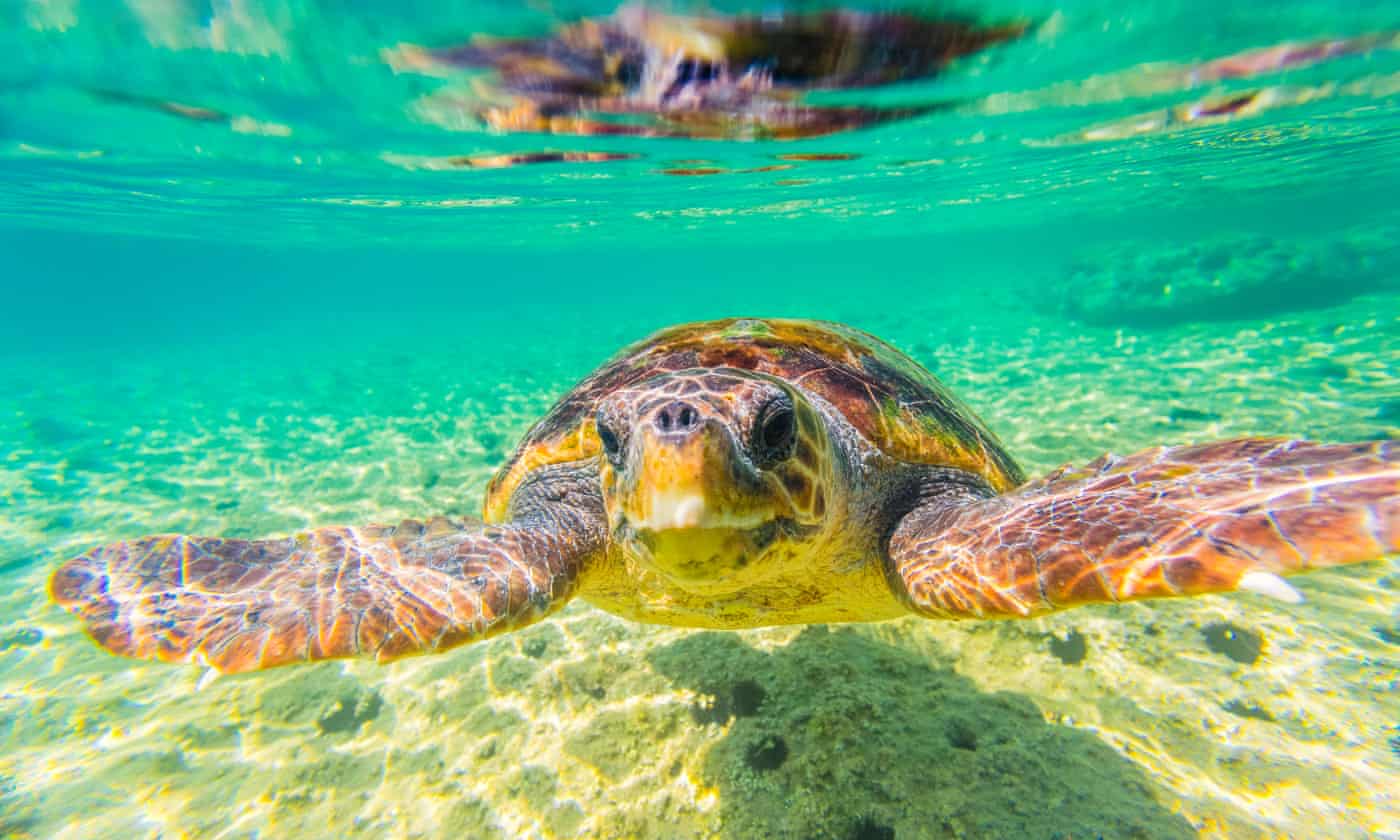
A loggerhead turtle (Caretta caretta) off Elafonissos island in Greece, where the rebound in population has been called “phenomenal.”  

Today’s article is about the resurgence of turtles in Greece. But before I get into it, I need you to indulge my current train of thought about turtles.

There are the chocolate, caramel, and pecan-footed “turtles” that my sister-in-law makes every Christmas, turtles that this week have gotten certain farflung relatives wildly excited.

There are songs about turtles like one I just found out my exercise teacher made for a fundraiser years ago, here.

And there are turtle fans all over the world who are bringing real turtles back from the brink of extinction. Slowly but surely.

Helena Smith writes for the Guardian about that.

“After nearly a quarter of a century observing one of the world’s most famous sea turtle nesting grounds,” she reports, “Charikleia Minotou is convinced of one thing: nature, she says, has a way of ‘sending messages.’

“Along the sandy shores of Sekania, on the Ionian island of Zakynthos, what she has seen both this year and last, has been beyond her wildest dreams. The beach, long described as the Mediterranean’s greatest ‘maternity ward’ for the Caretta caretta loggerhead sea turtle, has become host to not only record numbers of nests, but record numbers of surviving hatchlings as the species makes an extraordinary resurgence.

“ ‘The message sea turtles are sending is very clear,’ said Minotou, who coordinates the WWF program in the protected area. ‘And that is the measures we have taken over the past 25 years to ensure conditions are right for the marine turtles to nest here are working … It’s fantastic.’

“One of the oldest living species, sea turtles are believed to have existed for more than 100m years. Although highly migratory – over a lifetime, the reptiles cross thousands of miles of seas and oceans – female turtles always return as mature adults, about 20 to 25 years later, to the habitat where they were born to lay eggs. It is a reproductive cycle that happens with perfect synchronicity. In Sekania and other nesting grounds in Zakynthos and around Greece, turtles tagged at birth by conservationists a quarter of a century ago are now reappearing to nest.

“ ‘It’s hugely moving,’ says Minotou, a sustainable development expert who highlights the importance of technological advances, including the installation of CCTV cameras, in helping to ward off seagulls, ghost crabs and other predators. ‘This year more than 1,200 nests have been recorded in Sekania, which is one every 50cm [~20 inches] of beach. An amazing number.’

“From Spain in the west to Cyprus in the east, the Mediterranean has witnessed a record rise in sea turtle nesting – testimony to the painstaking efforts of environmentalists determined to save an ancient mariner that not that long ago was on the verge of extinction. Only one in 1,000 turtle hatchlings makes it to adulthood, making the turnaround even more remarkable.

“In Greece, which hosts 60% of Caretta caretta nests, the rebound has been phenomenal: from an average of 5,000 to 7,000 nests per year, since 2023 over 10,000 nests have been recorded annually, according to Archelon, the Sea Turtle Protection Society of Greece. …

“Thirty years ago, before the creation of a state-funded marine park on Zakynthos – the country’s biggest sea turtle nesting ground after the bay of Kyparissia in the Peloponnese – Greek authorities appeared oblivious to the plight of a species whose survival is now widely recognized as vital for marine ecosystems and the region’s ecological biodiversity.

“Few have more vivid memories of the dangers the creatures once faced than Lily Venizelos, who founded the UK-based Mediterranean Association to Save the Sea Turtles (Medasset) in the 1980s.

“The doughty campaigner, now in her 90s, spent years lobbying successive Greek governments to legislate policies to protect Caretta caretta from the then nascent threat of tourism and other perils posed by speedboat propellers, beach furniture and human activity in marine turtle habitats, conservationists say. …

“ ‘It’s been the most wonderful news, at my age, to find out that the Caretta caretta are no longer so threatened, but it’s crucial protective measures continue to be enforced. One false move and everything could be lost.’ ”

Do you have any thoughts on why turtles are so beloved? I think for me it’s their patience, the way they get everything done that they need to do while moving slowly.

More at the Guardian, here. No firewall.

Read Full Post »

Photo: Wil Crombie/Organic Compound.
In a good example of agroforestry, hazelnut trees and tall grasses are seen growing in the chicken paddocks at the Organic Compound, a farm in Faribault, Minnesota. 

Something about connectedness is in the air these days. Those of us with aches and pains have had to learn how muscles and bones and nerves are connected in unexpected ways. And what about connections in the environment? Even ten years ago, I failed to appreciate how soil and fungus and insects connect or how forests and farms need each other.

Tom Philpott explains at Yale Environment 360 shows agroforestry leading the way to a healthier ecosystem.

“Drive through rural Minnesota in high summer and you’ll take in a view that dominates nearly the entire U.S. Midwest: an emerald sea of ripening corn and soybeans. But on a small operation called Salvatierra, 40 minutes south of Minneapolis, Reginaldo Haslett-Marroquin is trying something different. When he bought the land in 2020, this 18-acre patch had been devoted for decades to the region’s most prevalent crops. The soil was so depleted, Haslett-Marroquin says, he thought of it as a ‘corn and soybean desert.’ Soon after, he applied 13 tons of compost, sowed a mix of prairie grasses and rye, and planted 8,200 hazelnut saplings.

“While he won’t reap a nut harvest until 2025, the farmer and Guatemalan immigrant doesn’t have to wait to make money from the land. He also runs flocks of chickens in narrow grassy paddocks between the rows of the fledging trees, where they hunt for insects and also munch on feed made from organic corn and soybeans, which they transform into manure that fertilizes the trees and forage.

“Salvatierra is the latest addition to Tree-Range Farms, a cooperative network of 19 poultry farms cofounded in 2022 by Haslett-Marroquin. Chickens evolved from birds known as junglefowl in the forests of South Asia, he notes, and the co-op’s goal is to conjure that jungle-like habitat. Chickens crave shade and fear open spaces; trees shelter them from weather and hide them from predators. In 2021, Haslett-Marroquin’s nonprofit, Regenerative Agriculture Alliance, purchased a poultry slaughterhouse just south of the Minnesota border in Stacyville, Iowa, where farms in the Tree-Range network process their birds. You can find the meat in natural-food stores from the Twin Cities area to northern Iowa.

“By combining food-bearing trees and shrubs with poultry production, Haslett-Marroquin and his peers are practicing what is known as agroforestry — an ancient practice that intertwines annual and perennial agriculture. …

“It’s widely practiced across the globe, particularly in Southeast Asia and Central and South America. According to the U.N. Food and Agriculture Organization, 43 percent of all agricultural land globally includes agroforestry features.

“Bringing trees to the region now known as the Corn Belt, known for its industrial-scale agriculture and largely devoid of perennial crops, might seem like the height of folly. On closer inspection, however, agroforestry systems like Haslett-Marroquin’s might be a crucial strategy for both preserving and revitalizing one of the globe’s most important farming regions. And while the corn-soybean duopoly that holds sway in the U.S. heartland produces mainly feed for livestock and ethanol, agroforestry can deliver a broader variety of nutrient-dense foods, like nuts and fruit, even as it diversifies farmer income away from the volatile global livestock-feed market. In recognition of this potential, the U.S. Department of Agriculture (USDA), in late 2022, launched a $60 million grant program to help farmers adopt such practices. …

“Using satellite imagery, a team of University of Massachusetts researchers has calculated that a third of the land in the present-day Corn Belt has completely lost its layer of carbon-rich soil. And what’s left is washing away at least 25 times faster than it naturally replenishes. As prime topsoil vanishes, farmers become more dependent on fertilizers derived from fossil fuel.

“Not surprisingly, given those applications, the Corn Belt is also in the midst of a burgeoning water-pollution crisis, as agrichemicals and manure from crowded livestock confinements leach away from farm fields and into streams and aquifers. … As University of Washington geomorphologist David Montgomery noted in his magisterial 2007 book Dirt: The Erosion of Civilizations, ‘With just a couple feet of soil standing between prosperity and desolation, civilizations that plow through their soil vanish.’

“Breaking up the corn and soybean rotation with trees — and freeing some farm animals from vast indoor facilities to roam between rows, where their manure can be taken up by crops — could go a long way to addressing these crises, experts say.

“Trees actually have a much longer and more robust history in the Midwestern landscape than do annual crops. Think of the Midwestern countryside before U.S. settlers arrived, and you might picture lush grasses and flowers swaying in the wind. That vision is largely accurate, but it’s incomplete. Amid the tall-grass prairies and wetlands, oak trees once dotted landscapes from the shores of Lake Michigan through swathes of present-day Indiana, Illinois, Iowa, and Missouri, clear down to the Mexican border. These trees didn’t clump together in dense forests with closed canopies but rather in what ecologists call savannas — patches of grassland interspersed with oaks. Within these oak savannas, which were interlaced with prairies, tree crowns covered between 10 percent and 30 percent of the ground. They were essentially a transition between the tight deciduous forests of the East and the fully open grasslands further west.”

More at e360Yale, here. The long and interesting article is by Tom Philpott, a senior researcher at the Johns Hopkins Center for a Livable Future and author of Perilous Bounty. No firewall. Donations sought.

Read Full Post »

Photo: César Rodríguez.
The New York Times says, “Illegal deforestation for avocado crops points to a blood-soaked trade with the United States involving threats, abductions and killings.

Today’s story about Mexico’s environment-destroying avocado production and thoughtless US demand was concerning. If anyone knows where I can get sustainably grown avocados, please let me know.

Meanwhile, here is the New York Times story. The authors were Simon Romero and Emiliano Rodríguez Mega.

“First the trucks arrived, carrying armed men toward the mist-shrouded mountaintop. Then the flames appeared, sweeping across a forest of towering pines and oaks.

“After the fire laid waste to the forest last year, the trucks returned. This time, they carried the avocado plants taking root in the orchards scattered across the once tree-covered summit where townspeople used to forage for mushrooms.

“ ‘We never witnessed a blaze on this scale before,’ said Maricela Baca Yépez, 46, a municipal official and lifelong resident of Patuán, a town nestled in the volcanic plateaus where Mexico’s Purépecha people have lived for centuries.

“In western Mexico forests are being razed at a breakneck pace and while deforestation in places like the Amazon rainforest or Borneo is driven by cattle ranchinggold mining and palm oil farms, in this hot spot, it is fueled by the voracious appetite in the United States for avocados.

“A combination of interests, including criminal gangs, landowners, corrupt local officials and community leaders, are involved in clearing forests for avocado orchards, in some cases illegally seizing privately owned land. Virtually all the deforestation for avocados in the last two decades may have violated Mexican law, which prohibits ‘land-use change’ without government authorization.

“Since the United States started importing avocados from Mexico less than 40 years ago, consumption has skyrocketed, bolstered by marketing campaigns promoting the fruit as a heart-healthy food and year-round demand for dishes like avocado toast and California rolls. Americans eat three times as many avocados as they did two decades ago.

“South of the border, satisfying the demand has come at a high cost, human rights and environmental activists say: the loss of forests, the depletion of aquifers to provide water for thirsty avocado trees and a spike in violence fueled by criminal gangs muscling in on the profitable business.

“And while the United States and Mexico both signed a 2021 United Nations agreement to ‘halt and reverse’ deforestation by 2030, the $2.7 billion annual avocado trade between the two countries casts doubts over those climate pledges.

“Mexican environmental officials have called on the United States to stop avocados grown on deforested lands from entering the American market, yet U.S. officials have taken no action, according to documents obtained by Climate Rights International, a nonprofit focused on how human rights violations contribute to climate change.

“In a new report, the group identified dozens of examples of how orchards on deforested lands supply avocados to American food distributors, which in turn sell them to major American supermarket chains.

“Fresh Del Monte, one of the largest American avocado distributors, said the industry supported reforestation projects in Mexico. But, in a statement, the company also said that ‘Fresh Del Monte does not own farms in Mexico,’ and relied on ‘industry collaboration’ to ensure growers abided by local laws.

“In western Mexico, interviews by the Times with farmers, government officials and Indigenous leaders showed how local people fighting deforestation and water theft have become targets of intimidation, abductions and shootings.

“Like deforestation elsewhere, the leveling of Mexico’s pine-oak and oyamel fir forests reduces carbon storage and releases climate-warming gases. But clear-cutting for avocados, which require vast amounts of water, has ignited another crisis by draining aquifers that are a lifeline for many farmers.

“One mature avocado tree uses about as much water as 14 mature pine trees, said Jeff Miller, the author of a global history of the avocado.

“ ‘You’re putting in deciduous forests of a very water hungry tree and tearing out conifer forests of not so very water hungry trees,’ Mr. Miller said. ‘It’s just wrecking the environment.’

“In parts of Mexico already on edge over turf wars among drug cartels, forest loss is fueling new conflicts and raising concerns that Mexican authorities are largely allowing illegal timber harvesters and avocado growers to act with impunity.”

Bad as things are in Mexico, you know they would not be happening if there was no demand. That’s on us. Read more at the Times, here.

Because I still hope to have an avocado from time to time, I went looking for advice. The Eco Experts in the UK say, “Although avocados aren’t the worst food for the environment, growing them on a mass scale isn’t sustainable. This is because of the large amount of water they need to grow, and the fact that they can’t be grown locally in countries like the UK, where they are in high demand. The solution isn’t to cut avocados out of our diets altogether, but to reduce the amount that we consume.” More from the experts, here.

Read Full Post »

Photo: Top Africa News.
One of the benefits of having Kenyan farmers raise butterflies for a living is that they are protecting East Africa’s largest coastal forest.

I’m reading a strange British novel called Ash Before Oak in which the protagonist is keeping a diary about the natural world he encounters on leaving London for England’s West Country. As a kind of self-therapy for the impending breakdown he senses, he makes lists of — and tries to focus on — all the flora and fauna he sees. Starting with butterflies.

Who knew there were so many butterflies in the world? Who knew there were so many in southwest England? They do have a mesmerizing quality. Today’s article is about how unsuspecting butterflies are mesmerizing people in Africa while doing good work for the planet.

Evelyn Makena wrote at Top Africa News, “Before becoming a butterfly farmer, Dickson Mbogo made a living by selling charcoal from trees he cut in the forest.

“ ‘In my search for food and an income, I was destroying the forest,’ he said.

“Now, after getting involved in butterfly farming, Mbogo’s weekly routine involves visiting sections of Kenya’s eastern Arabuko-Sokoke Forest to capture butterflies using trapping nets.

“Home to some of the world’s endangered animals and plants, the Arabuko-Sokoke Forest Reserve is the most extensive indigenous forest on the east African coast. Once part of an extensive coastal forest that ran from southern Somalia to northern Mozambique, the forest is visible for miles along Kenya’s north coast highway.

“It is home to several threatened bird species, including Clarke’s weaver bird and the Sokoke scops owl, as well as endemic animals like the Aders’s duiker, the golden-rumped elephant shrew and the bushy-tailed mongoose. It is also home to elephants and other members of the ‘big five.’

“The forest also hosts almost 300 butterfly species. For local communities living adjacent to the forest, these butterflies are now the source of a sustainable livelihood, enhancing the conservation of a forest previously threatened by illegal logging.

“At home, Mbogo places the butterflies in a netted cage that houses different varieties of trees for the butterflies to feed on and lay eggs.

“ ‘Butterflies can lay up to 300 eggs. After a few days, eggs hatch to caterpillars and feed on specific food plants until they develop into pupae,’ explained Mbogo.

“After the pupae stage, farmers take the insects to Kipepeo Center in Gede town, a few kilometers from their homes.

“ ‘Here, the insects are sorted according to species, graded, carefully wrapped in cotton for protection and packaged in boxes. They are then exported to markets in the United Kingdom,’ said Hussein Abdulahi Aden, Project Manager of the Kipepeo Butterfly Project.

“From an initial 141 members when the project started, [in 2022, there were] 872. … Farmers are paid for every pupa delivered, depending on the species type. Pupae can attract between Ksh. 90 – 225, (US$0.75 – 1.8) with farmers making collective earnings of up to Ksh.15 – 20 million (US$124,000 – 166,000) per year.

“According to Aden, the Kipepeo project was started in 1993 by the National Museums of Kenya and other stakeholders to reduce pressure on the forest while offering an alternative source of income to locals. Initially, the project was met with resistance from the community.

“ ‘For a community used to subsistence farming of maize, cashew nuts and coconuts, the idea of butterfly farming was strange and perceived as mystical. There was also fear that this was a government project aimed at evicting them from their farms,’ Aden explained. But other community members followed suit as the pioneer farmers began reaping the project’s benefits. …

“Among the butterfly species reared are the colourful African Swallowtail, Silver Stripped Charaxes and Taita Blue-banded Swallowtail. There are also other less colorful species, like the African Migrant.

“The project buys all the pupae brought by the farmers. When supply is higher than the demand, the surplus is released to the Kipepeo Butterfly Exhibition House at Gede to educate the public on the insects. Some are released back into the forest for the continuity of species – ensuring that the forest is not only protected from the charcoal burners but is also well pollinated. …

“In many ways, Kipepeo project members have become champions of conservation within the community. Sofia Saidi, a member of the Mkongani group, said that members report any suspicious activities they may come across in the forest to the relevant authorities, including Kenya Forest Service and Kenya Wildlife Service. The project has also trained volunteer community scouts who patrol the forest and deter illegal activities.

“The Kipepeo project has also been crucial in improving food security in the community. Specific butterfly species play a vital role in pollination. According to Aden, a survey conducted within a five-kilometre radius of the forest boundary found that farms closer to the forest had better yields, indicating the impact of the butterflies on plant reproduction.”

More at Top Africa News, here. For an audio story about Kenyan butterfly growers, check out The World, here.

Read Full Post »

Photo: Claudia Morales.
The
Guardian reports from Bolivia: “The founders of Team Uru Uru found that totora reeds – which have long been used by their Indigenous community to build houses, boats and even floating islands – can absorb heavy metals.”

“One and two and 50 make a million.”

I still believe in that line from the Pete Seeger folk song about righting wrongs. Today I want to point out that, when it comes to protecting the environment, it’s often indigenous people who see what’s going wrong and decide to do something about it.

Sarah Johnson writes at the Guardian, “Looking out over Lake Uru Uru in the Bolivian highlands, it is hard to imagine that it once supported thousands of people, and was a sanctuary for wildlife, including 76 species of birds.

“Plastic waste now stretches as far as the eye can see, the water is tinged black or brown, and the stench is overwhelming.

“But in among the filth that chokes the water are submerged rafts that hold thousands of native reeds called totora – a bulrush that can grow to 6 metres [~20 feet] and was used to make Lake Titicaca’s famous floating islands. This aquatic plant, Schoenoplectus californicus, has been shown to be very effective at absorbing heavy metals and contaminants.

“Made of recycled plastic collected from the lake, the rafts were placed there by the Uru Uru Team, a group of about 50 Indigenous people.

“For years, lakeside communities have faced pollution from the mining industry, and from the waste of the nearby city of Oruro. The pollution also threatens flora and fauna in the lake, an internationally recognized wetland under the Ramsar convention.

“ ‘It’s very difficult to live and work in these conditions,’ says Dayana Blanco, 25, an Aymara woman who is co-founder of the Uru Uru Team and a Fulbright fellow studying peace-building at the University of Massachusetts in the US.

“ ‘The smell here is very strong and affects our health. When the sun rises and sets, it is intolerable. I had stomach ache from it once. Who knows what illnesses we could get in the future?’

“People living around the lake … used it for drinking water, fished in it, irrigated their crops with it and watered their cattle, says Blanco. This is no longer possible and many of the community have been forced to migrate.

“The lake used to be home to about 120,000 flamingos but only half that number remain. Years of damage to the lake’s fragile ecosystem has pushed wildlife into a small area of unspoiled habitat.

“Changing temperatures and rain patterns have seen Lake Uru Uru’s shoreline recede dramatically over recent years and, as Oruro city has grown, people have built houses in what were protected areas. Bolivia’s other highland lakes, all protected under Ramsar, face similar threats. …

‘Indigenous people know that if a lake dies, it’s as if the soul of a people dies,’ says Tatiana Blanco, 30, Dayana’s sister and in the Uru Uru Team.

“ ‘With colonialism and globalization, new generations have lost their way,’ she says. ‘They’ve forgotten where they’ve come from and that we are not superior to animals, plants, mountains, lakes and rivers. It is because of this lack of respect and care for nature and mother Earth that there’s an imbalance.’

“Fed up with the ever-increasing pollution, the sisters and other young women formed the Uru Uru Team in 2019.

“The first step was to clean the water. Their forebears used totora and so they decided to do the same. As well as being used to build floating platforms and houses, totora is important for treating sewage and mining wastewater as it traps minerals in its roots, leaves and stems.

“They transplanted about 600 young totora from a place where they grow in abundance and placed them on top of rafts made out of plastic bottles and a grid of sticks.

“ ‘We didn’t think the totora would grow, because the pollution is so strong. The water has a lot of heavy minerals,’ says Dayana. ‘But we’ve seen the plants remediating nature little by little and having an effect.’

“The team commissioned laboratory tests from Juan Misael Saracho University in Tarija, which found that areas in the lake with totora had reduced pollution by 30%. Flamingos and other birds have begun to return.

“The Uru Uru Team has planted about 3,000 totora plants so far. … The team’s aim is to plant 4,000 totora a year and completely clean up the lake to bring back the birds and allow the community to grow vegetables again.

“A 2023 Future Rising fellow, she is writing a graphic novel that tells the Uru Uru Team’s story from the perspective of a lake flamingo. The group has a Facebook page and international organizations, such as the United Nations children’s agency, Unicef, have provided technical support.

“Last year, the Uru Uru Team won the UN Development Programme’s 14th Equator prize, which celebrates initiatives by Indigenous peoples and other communities in adapting to and mitigating the climate crisis.”

Read more at the Guardian, here. No paywall but donations encouraged.

Read Full Post »

Photo:  Patrick T. Fallon/AFP via Getty Images.
Researcher Danielle Stevenson digs up California buckwheat grown at a brownfield site in Los Angeles.

Given the mess we humans make of the environment, I have to be grateful that we can learn ways to clean things up. And to be fair, we don’t always realize we’re making a mess until it’s too late.

Richard Schiffman at Yale Environment 360, explains one new technique for cleaning things up: harnessing the power of fungus.

“The United States is dotted with up to a million brownfields — industrial and commercial properties polluted with hazardous substances. These sites are disproportionally concentrated near low-income communities and communities of color, according to the Environmental Protection Agency, and researchers predict that heavy rains and flooding due to climate change are likely to both spread and increase exposure to these contaminants.

“For more than 15 years, Danielle Stevenson, who holds a PhD in environmental toxicology from the University of California, Riverside, has been pioneering a nature-based technique for restoring contaminated land, using fungi and native plants to break down toxins like petroleum, plastics, and pesticides into less toxic chemicals.

“The usual way of dealing with tainted soil is to dig it up and cart it off to distant landfills. But that method is expensive and simply moves the problem somewhere else, Stevenson says in an interview with Yale Environment 360, ‘typically to another state with less restrictive dumping laws.’

“In a recent pilot project funded by the city of Los Angeles, Stevenson, 37, working with a team of UC Riverside students and other volunteers, significantly reduced petrochemical pollutants and heavy metals at an abandoned railyard and other industrial sites in Los Angeles. While her research is still in its early stages, Stevenson says she believes her bioremediation methods can be scaled up to clean polluted landscapes worldwide.

Yale Environment 360: I understand that you grew up on the shores of Lake Erie in a highly polluted area.

Danielle Stevenson: The Cuyahoga River, near Lake Erie, used to catch on fire from oil spills. There’s a huge amount of industrial agricultural runoff that leads to toxic algae blooms. The second-largest floating plastic island of the Great Lakes is in Lake Erie.

“But I was surprised to see abandoned oil refineries and factories with trees, plants, and mushrooms growing. I mean, they’ve found fungi growing in Chernobyl in a melted down nuclear reactor. I’ve been on sites that look so desolate and bleak, where the air smells like diesel. It looks like nothing could possibly live there. But when we sample the soil, we always find life, and we especially find fungi that are really resilient and have found a way to live in those conditions and get some sort of food from the pollution.

e360: So you became interested in fungi, eventually founding your own mycoremediation company, D.I.Y. Fungi. What are fungi?

Stevenson: They are their own kingdom of life. They are not bacteria, not a type of plant or animal. Some fungi form mushrooms [as their fruiting bodies], like the ones we like to eat. Other fungi do not form mushrooms but create these beautiful dynamic networks throughout forests and grasslands that connect to the roots of plants. Fungi are largely overlooked, but it is a really important kingdom without which we wouldn’t have soil or the carbon cycle or so many other really important functions in our ecosystems.

e360: How do fungi help restore contaminated soil?

Stevenson: Decomposer fungi can degrade petrochemicals the same way they would break down a dead tree. And in doing so, they reduce the toxicity of these petrochemicals and create soil that no longer has these contaminants or has much reduced concentrations of it. They can also eat plastic and other things made out of oil, like agrochemicals. …

e360: You worked at industrial sites in Los Angeles that were highly contaminated with heavy metals: How did the fungus help there?

Stevenson: Unfortunately, most metals don’t break down because they’re not carbon-based. In nature, it’s actually plants that pull metals out of soil. And so there are fungi, they’re called arbuscular mycorrhizal fungi, that can help plants do that better. And so on Taylor Yard [the Los Angeles railyard] and other sites, I’ve worked with a combination of decomposer fungi, arbuscular mycorrhizal fungi, and plants that we previously found to be able to pull metals like lead and arsenic out of the soil into their aboveground parts. These plants can then be removed from the site without having to remove all of that contaminated soil.

e360: How did the sites look different after the work that you did on them?

Stevenson: They became basically beautiful meadows of native plants that were flowering, and now there are bees and birds and all sorts of life coming through. We had a very high success rate. In three months we saw a more than 50 percent reduction in all [petrochemical] pollutants. And then by the 12-month period, they were pretty much not detectable.”

The rest of this article — on reusing some metals, on working with tribes — is fascinating. Read at e360, here. No paywall.

Read Full Post »

Photo: Epli Photography via Eli Nixon.
Multidisciplinary artist Eli Nixon poses in a homemade cardboard horseshoe crab costume at Barrington Beach in Barrington, Rhode Island.

There is an ancient form of life that lives in the waters along our shores — the horseshoe crab. The horseshoe crab is in danger from big pharma, which harvests them because their blood can reveal toxins in chemicals. Fortunately, people of all backgrounds are learning about this treasure and hope to save it.

Oli Turner writes at the Christian Science Monitor, “With its dome shape and spiky tail, the horseshoe crab might at first look like a fearsome visitor from another planet. But for artists like Heidi Mayo, the ancient creature is an approachable muse.

“A collection of 13 brightly painted horseshoe crab shells hangs along her back fence here. On her kitchen table sits a novel she wrote, inspired by encounters with the living fossil. Upstairs, in the top-floor studio where she teaches art classes, two spiny molt serve as figure-drawing models. [Crabs molt shells.] …

“A few miles away, at the Plymouth Center for the Arts, the public can see more of her work – and that of other artists, similarly inspired – at a new exhibit, ‘The Horseshoe Crab: Against All Odds.‘  

“The exhibition, featuring representations in watercolor, metal, and textiles, is part of a broader effort to save and conserve the once-misunderstood sea animal, which is now facing new threats. 

“ ‘The essence of this show [is] that horseshoe crabs are in trouble,’ says Joan Pierce, one of the curators, her silver horseshoe crab earrings swaying as she speaks. …

Pharmaceutical companies use their unusual blue blood to test products for toxins. 

“The Atlantic States Marine Fisheries Commission reports that the Northeast horseshoe crab population is currently in a ‘neutral,’ or stable, state. But the population remains vulnerable, according to advocates. On March 19, the Massachusetts Marine Fisheries Advisory Commission approved protections preventing the harvest of horseshoe crabs during their spring spawning season. …

“The horseshoe crab isn’t actually a crab, despite its name. More closely related to ticks and spiders, it walks on 10 spindly legs in the coastal shallows, feeding on worms, algae, and other inhabitants of the ocean floor. The long, pointed tail protruding from its hardened exoskeleton is often mistaken for a stinger. At times, the public has seen them only as a nuisance … not understanding that their eggs, which migratory shorebirds eat, help the coastal ecosystem.

“But the tide is turning. The curators of ‘Against All Odds’ felt an urgency to raise awareness about the crabs’ plight. They issued invitations to artists to highlight ‘the beauty of these ancient creatures, their ecological importance, and the threats they face.’ They hoped for 35 submissions. Then more than 160 offerings rolled in from more than 70 artists. Of those submitted, 74 works made it into the final show. …

“ ‘This is not just pretty pictures on the wall,’ Ms. Pierce says. ‘This is about education and advocacy. … We want to see stricter regulations.’ …

“Elsewhere in New England, other artists are also trying to raise awareness. In Rhode Island, another horseshoe crab hub, multidisciplinary artist Eli Nixon hopes that learning about the animal can create a new culture of compassion and responsibility. [Nixon offers a] 2021 illustrated manual and field guide Bloodtide: A New Holiday in Homage to Horseshoe Crabs [and] often wears a homemade cardboard horseshoe crab costume to parades. …

“Back in Massachusetts, Mark Rea remembers in his youth, before tourism swept the shores of Nantucket, when horseshoe crabs drifted along the seafloor undisturbed. …

“For the past 18 years, Mr. Rea has made ceramic casts of the exoskeletons of horseshoe crabs when he finds their remains on Cape Cod beaches. He fires the lifelike molds, glazing them with vibrant, glossy colors. While most of his creations look peaceful, several of them depict the toll the bait and pharmaceutical industries have had. Creating the ceramic horseshoe crabs is now his full-time job – he makes 600 a year and sells his work online and in local galleries.”

More at the Monitor, here (no firewall; subscriptions reasonable). Use the Search box on this blog to find more horseshoe crab info.

Read Full Post »

Photo: Mikkel Rolighed.
A bucket set made from sugarcane is an improvement on bioplastics, though the ocean won’t thank you if this is lost at sea – it won’t safely biodegrade (ditto recycled plastic toys). 

Now that we know that plastics have been found in the human brain, are we motivated to fight harder or are we despairing? Michelle O, you know, exhorts us to “do something” and not give in to despair, so here’s a place to start: the beach.

Fleur Britten at the Guardian has put together an impressive list of plastic substitutes you might take to the beach.

She writes, “Pre-1950, we just didn’t take plastic to the beach. Now it’s virtually impossible not to, even if it’s just you and your swimmers.

” ‘If you’re looking for plastic-free nirvana, you may never find it,’ says Anne-Marie Soulsby, aka the Sustainable Lifecoach. Matters are improving – though there’s usually a premium to pay if you want to minus cheap plastic from the mix. So why not borrow the plastic that already exists from friends, family or your local Library of Things. And don’t forget your reusable cutlery and containers for eating and drinking à la plage. If you can’t track down beach essentials from these sources, these are the other best ways to avoid seaside plastic pollution.

“ ‘The most sustainable swimwear is what you already own,’ says Soulsby. If you’re in need of new togs, they’ll most likely contain plastic. However, some brands are minimizing that: Italian label Isole & Vulcani’s swimwear for women and kids uses 93% GOTS-certified organic cotton jersey, with 7% elastane (which is fossil fuel-derived). …

“Inflatables and body boards: ‘Inflatables are a nightmare,’ says Lucy Johnson, founder of the Green Salon consultancy. ‘There isn’t a solution.’ According to one study, UK holidaymakers abandoned around 3 million [pool floats] in 2018. Even the genius Inflatable Amnesty is at capacity and can’t accept any more broken pool toys (though you can still buy its upcycled accessories). So borrow, or look after what you have. … 

“If you do need new toys, she advises silicon: ‘You can squish it into your bag and it doesn’t go brittle or rust’ (Johnson recommends Liewood’s silicon beach set from Kidly). Bioplastic toys are an improvement on regular plastic – for example, Dantoy’s bucket set made from sugarcane.”

As for sun screens, “ ‘There is no perfect solution,’ says Jen Gale, author of The Sustainable(ish) Living Guide. If you want to be absolutely plastic-free – including those pervasive nano-plastics – then your safest option is a zinc oxide-based formulation. …

“It is actually possible to find plastic-free eyewear, provided that you are one very careful person, because we’re talking glass lenses. The Marylebone-based brand Monc’s sunglasses feature wire and bio-acetate frames (made from wood pulp) and mineral glass lenses. …

“Flipflop pollution is real. Hardly surprising, given that about 3 billion are produced annually. According to the charity Ocean Sole, 90 tonnes of flipflops wash up annually on East Africa’s beaches alone. One alternative, suggests [Wendy Graham of the blog Moral Fibres], is Waves Flipflops, made from FSC-certified natural rubber. They also take back old Waves flipflops for recycling into, for example, children’s playground matting, and offer a free TerraCycle recycling programme for plastic flipflops from any brand.”

There’s lots more, including information on dry robes and wetsuits, at the Guardian, here. No paywall. Donations encouraged.

Read Full Post »

Photo: MassAudubon.
The invasive multiflora rose forms dense thickets in fields and field edges, crowding out other species.

The problem with invasive species that aren’t native to a region is that they crowd out the local species, and that has a snowball effect. We colonists crowded out indigenous people, which among other things, undermined wisdom about protecting nature. In the plant world, local pollinators don’t get what they need to pollinate. The list goes on.

Frank Carini reports at ecoRINews on how invaders hurt both the environment and the economy: “Invasive Asian shore crabs are outcompeting young lobsters. Invasive snake worms and hammerhead worms are burying themselves deeper into southern New England, where the former consumes the top layer of soil and dead leaves where the seeds of plants germinate, and the latter is toxic and transmits harmful parasites to humans and animals.

“Invasive multiflora rose and oriental bittersweet have long been embedded in the region, crowding out native vegetation and strangling trees. …

“Last summer, the Intergovernmental Science-Policy Platform on Biodiversity and Ecosystem Services (IPBES) for the United Nations issued a global assessment providing clear evidence of this growing threat.

“In a paper recently published in the journal Nature Ecology & Evolution, the authors of last year’s assessment — 88 experts representing 101 organizations from 47 countries — outline the main findings from that report and echo the need for urgent action.

Laura Meyerson, a University of Rhode Island professor of invasion science and habitat restoration ecology and editor-in-chief of the journal Biological Invasions, is a contributing lead author on the IPBES assessment and a lead author on the recent paper. …

“She said, ‘Our research produced overwhelming and unequivocal evidence that the negative impacts of biological invasions far outweigh any benefits and that those who depend most on nature suffer the worst consequences.’

“The researchers documented some 37,000 invasive species that had been introduced by people to areas around the world. Of those, about 3,500 species were considered harmful invaders that negatively affect nature and people’s quality of life. 

“The number of invasive species — major drivers of global biodiversity loss, according to Meyerson — are expected to continue to grow. Some 200 new species are expected to be added annually by human activities in regions that have not recorded such invaders before, according to the June 3 paper. And established invasives will continue to expand their ranges, spreading into new countries and choking out native species.

“The paper also noted that simple extrapolations from current impacts from invasive species are likely to underestimate the level of future impacts, and drivers of biodiversity loss, such as the climate crisis, are acting in concert and those interactions are increasing biological invasions. …

“ ‘It’s critically important that we all do our part to reverse current trends,’ Meyerson said. ‘The public can make sure that the plants they are buying for their gardens are native species. Pet owners should not release animals, like rabbits or Burmese pythons, that are no longer wanted into the wild.’

“For example, red-eared sliders — native to the Southeast, the south-central United States, and northern Mexico — are the most popular pet turtle in the United States and available at pet shops around the world. But this turtle species lives for about 30 years, so they are often released where they don’t belong after pet owners tire of them. As a result, they are considered one of the world’s 100 most invasive species.

“Meyerson is also the senior author on a global study that explored the extent of biological invasions on lands owned or managed by Indigenous people. The study was published in Nature Sustainability in late May.

“The spread of animal and plant species into new regions by humans is increasing rapidly worldwide, with thousands of species now present in regions outside their native range. The research team, which included scientists from Australia, Austria, Germany, Hungary, and the United States, investigated the spread of invasive species to lands managed by Indigenous people and found significantly fewer invaders in those areas compared with other natural areas.

“ ‘This was a really important finding because even after controlling for the remoteness and accessibility of Indigenous peoples’ lands and how land is used, in general, the numbers of invasive species are lower, as is biodiversity loss,’ Meyerson said. …

“Researchers analyzed millions of available data points from around the globe on the distribution of non-native plant and animal species. On average, there were 30% fewer non-native species on Indigenous lands. The study suggested the enormous difference is primarily due to sustainable land use, a higher proportion of forests, and lower accessibility to humans.

“Indigenous people represent ethnic groups that settled in regions long before the arrival of Europeans, such as Native Americans, the Aborigines of Australia, and the Sami in Scandinavia. About 28% of the land surface around the globe is inhabited by Indigenous people. Most of these areas are in remote regions and many have enormous importance for conservation of biodiversity such as the Amazon basin and wilderness areas in the Arctic.”

More at ecoRI News, here. No firewall. Donations solicited.

Read Full Post »

Photo: Michel Doutemont.
“European bison disappeared from Romania more than 200 years ago,” says the Guardian, “but the species was reintroduced to the southern Carpathian mountains in 2014.” 

We think of bison as iconically North American. Who knew about the bison in Europe — also nearly wiped out by humans? It turns out they are worth bringing back, if only to store carbon.

Graeme Green explains at the Guardian, “A herd of 170 bison reintroduced to Romania’s Țarcu mountains could help store CO2 emissions equivalent to removing 43,000 US cars from the road for a year, research has found, demonstrating how the animals can help mitigate some effects of the climate crisis.

“European bison disappeared from Romania more than 200 years ago, but Rewilding Europe and WWF Romania reintroduced the species to the southern Carpathian mountains in 2014. Since then, more than 100 bison have been given new homes in the Țarcu mountains, growing to more than 170 animals today, one of the largest free-roaming populations in Europe. The landscape holds the potential for 350-450 bison.

“The latest research, which has not been peer-reviewed, used a new model developed by scientists at the Yale School of the Environment and funded by the Global Rewilding Alliance, with the bison paper funded by WWF Netherlands. The model, which has been published and peer reviewed in the Journal of Geophysical Research: Biogeosciences, calculates the additional amount of atmospheric CO2 that wildlife species help to capture and store in soils through their interactions within ecosystems.

“The European bison herd grazing in an area of nearly 50 sq km [~19 square miles] of grasslands within the wider Țarcu mountains was found to potentially capture an additional 54,000 tonnes of carbon a yearThat is nearly 9.8 times more carbon than without the bison – although the report authors noted the 9.8 figure could be up to 55% higher or lower, so making the median estimate uncertain. This corresponds to the yearly CO2 released by a median of 43,000 average US petrol cars, or 84,000 using the higher figure, or a median of 123,000 average European cars, due to their higher energy efficiency, the researchers said.

“Prof Oswald Schmitz of the Yale School of the Environment in Connecticut in the US, who was the lead author of the report, said: ‘Bison influence grassland and forest ecosystems by grazing grasslands evenly, recycling nutrients to fertilize the soil and all of its life, dispersing seeds to enrich the ecosystem, and compacting the soil to prevent stored carbon from being released.

“ ‘These creatures evolved for millions of years with grassland and forest ecosystems, and their removal, especially where grasslands have been plowed up, has led to the release of vast amounts of carbon. Restoring these ecosystems can bring back balance, and “rewilded” bison are some of the climate heroes that can help achieve this.’

“[Alexander Lees, a reader in biodiversity at Manchester Metropolitan University, who was not involved with the study] said more in-the-field research would help validate the models and assist understanding of how long it would take for bison benefits to accrue, adding: ‘This study reinforces an emerging consensus that large mammals have very important roles in the carbon cycle.’ …

“A keystone species, bison play an important role in ecosystems – their grazing and browsing helps maintain a biodiverse landscape of forests, scrub, grasslands and microhabitats. In the Țarcu mountains, their return has also inspired nature-based tourism and businesses around rewilding. Schmitz noted that the Carpathian grasslands have specific soil and climate conditions, so the effect of the European bison could not necessarily be extrapolated internationally – American prairies, for example, have much lower productivity.

“ ‘This research opens up a whole new raft of options for climate policymakers around the world,’ said Magnus Sylvén, the director of science policy practice at Global Rewilding Alliance. ‘Until now, nature protection and restoration has largely been treated as another challenge and cost that we need to face alongside the climate emergency. This research shows we can address both challenges: we can bring back nature through rewilding and this will draw down vast amounts of carbon, helping to stabilize the global climate.’ …

“Schmitz said the team had looked at nine species in detail, including tropical forest elephants, musk oxen and sea otters, and had begun to investigate others. He added: ‘Many of them show similar promise to these bison, often doubling an ecosystem’s capacity to draw down and store carbon, and sometimes much more. This really is a policy option with massive potential.’ “

More at the Guardian, here.

Read Full Post »

« Newer Posts - Older Posts »