Feeds:
Posts
Comments

Posts Tagged ‘environment’

Photo: Philip Brown/Unsplash.
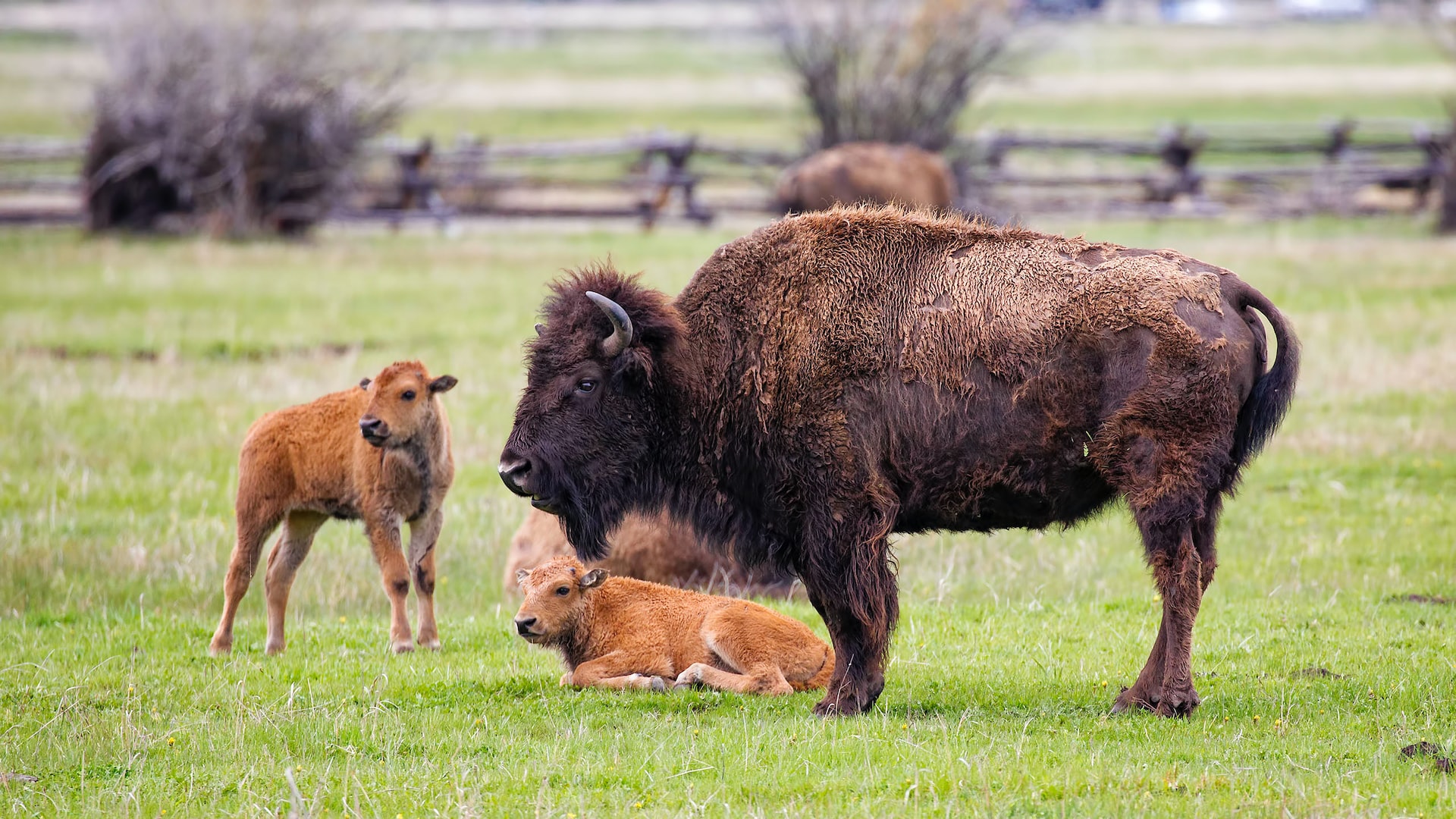
Bison are being brought back in the US West.

Recently on Twitter, @LakotaMan1 shared a photo of a rare white buffalo, sacred to some indigenous tribes. Its location was being kept secret from the modern version of those hunters who nearly wiped out bison in the West. I was excited to see Lakota Man’s picture as I remember the white buffalo in the old television show Rin Tin Tin — and even the words to the song about it.

Janet Marinelli writes at YaleEnvironment360 that large mammals like the bison are being deliberately brought back around the world to create healthier ecosystems.

“For thousands of years, bison herds thundered freely throughout the Chihuahuan Desert on both sides of what is now the U.S.-Mexico border. In November 2009, after three frantic months of chasing down the required permits, Rurik List and Nélida Barajas watched as 23 bison from Wind Cave National Park in South Dakota arrived by tractor-trailer at the Santa Teresa international cattle crossing in southeastern New Mexico.

“The animals, 20 females and three males, galloped through the dusty stockyards, across the border, and into the state of Chihuahua. A permanent herd of wild bison had been missing from Mexico for more than 150 years. ‘It’s hard to describe the feeling,’ says Barajas. ‘We were bringing the bison back home.’

“Two weeks later, 140 miles southwest of the border crossing, the bison were released from a quarantine corral at El Uno ranch, a 46,000-acre oasis of recovering grasslands in a Chihuahuan Desert landscape severely degraded by the overgrazing of domestic livestock.

“List, a conservation biologist at Mexico’s National University who had drafted the bison restoration plan for northern Mexico, and Barajas, a Nature Conservancy scientist and the ranch manager at the time, were joined by 700 government officials and local ranchers and farmers and their families to witness the event. When the gates opened, a bull led the herd into an iconic Western tableau of big sky and luminous sweeps of golden desert grasses backed by the rugged peaks of the Sierra Madre Occidental.

“Bison, which can reach six and a half feet at the shoulder and weigh as much as 2,000 pounds, are critical to the continued recovery of the desert grasslands. Unlike cattle, which graze grasses to the root, bison roam while they graze, leaving enough of each plant to enable it to continue to grow. They also wallow, sculpting depressions in the ground where water can accumulate and sustain healthy stands of grass.

In the past two or three decades, research has underscored the importance of large mammals like bison as ecosystem engineers, shaping and maintaining natural processes and sequestering large amounts of carbon.

“But the world’s large herbivores and predators continue to suffer alarming losses. Researchers estimate that almost two-thirds of the world’s large carnivores are threatened with extinction. Fewer than 6 percent of 730 ecoregions worldwide studied by scientists still have the extensive, intact large-mammal communities that were dominant 500 years ago.

“After several decades of research refining the understanding of the importance of large mammals to healthy ecosystems, scientists are now proposing a concrete plan about which herbivores and predators to reintroduce and where, and how this might best be done, given the challenges.

“In a paper published earlier this year, a global team of researchers led by the U.N. Environment Programme World Conservation Monitoring Centre and the U.S. nonprofit organization RESOLVE proposed a detailed strategy to reverse the global decline of large mammals and the ecoregions they once inhabited. …

“According to the study, published in the journal Ecography, reintroducing just 20 large mammals — 13 herbivore and seven predator species — can help biodiversity bounce back around the world and tackle climate change in the process. Among these candidates for rewilding are brown bears, bison, wild horses, jaguars, reindeer, Eurasian beavers, elk, moose, wolverines, tigers, and hippopotamuses.

“The researchers also identify 30 priority ecoregions on five continents that meet key criteria: They lack no more than one to three of the large herbivores and predators historically present, provide extensive habitat, and can feasibly be restored in the coming decade. These areas range from the flooded grasslands of South Sudan and the dry puna of the Central Andes to the xeric grasslands and shrublands of the Chihuahuan Desert, where intact communities of large mammals could be restored in the next five to 10 years, the scientists say. …

“Restoring intact communities of large mammals such as these won’t be easy. Throughout history people have feared large animals, particularly predators, justifying politically expedient measures to minimize their numbers — or even eliminate them altogether. Oregon State University researchers Christopher Wolf and William J. Ripple calculate that 64 percent of the world’s remaining large carnivores are at risk of extinction and 80 percent are declining. According to Jens-Christian Svenning, a professor of ecology at Denmark’s Aarhus University and co-author of the Ecography paper, the state of the world’s large herbivore species is almost as dire, with 59 percent of the 74 species of large herbivore species weighing 220 pounds or more threatened with extinction.

“The body of scientific literature documenting the importance of top predators and herbivores has revealed how their loss destabilizes and even unravels ecosystems. In the absence of predators, for example, populations of herbivores often explode. In the eastern U.S., deer were once kept in check by wolves and mountain lions. Today, booming deer populations are preventing keystone species such as oaks from reproducing and have literally devoured the understory habitat of hooded warblers and other birds.

“Research has also demonstrated that healthy animal populations play an important role in sequestering carbon. Yale School of the Environment ecologist Oswald J. Schmitz notes that even if we could completely stop all our emissions, switch to renewables, and stop deforestation, it wouldn’t keep global temperature rise under the tipping point of 1.5 degrees Celsius.

” ‘We have to draw out a significant amount of CO2 and store it on the planet to stabilize the temperature,’ he says. ‘Animals can help us get to this goal a lot faster.’ Schmitz and colleagues in the Global Rewilding Alliance calculate that rewilding, restoring, and conserving endangered and threatened animals could increase carbon uptake by 1.5 to 3 times or more around the world.”

More at E360, here.

Read Full Post »

Photo: Katherine Rapin.
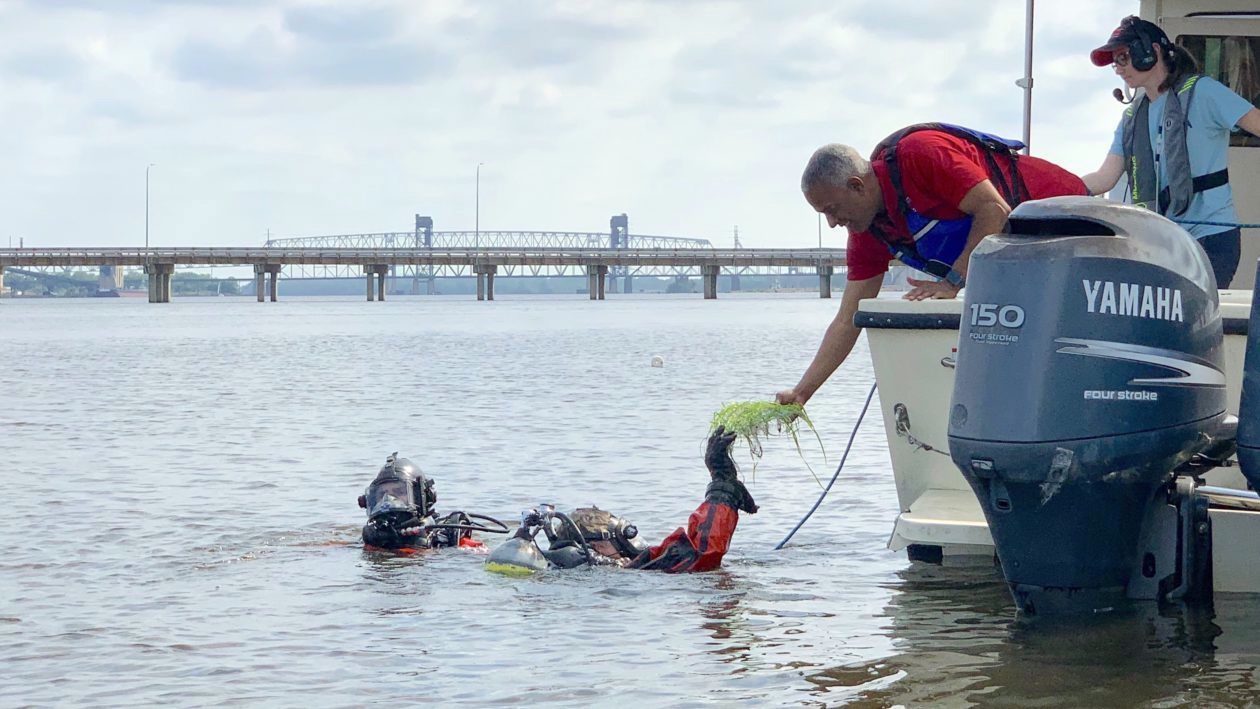
Camden Mayor Vic Carstarphen hands a flat of wild celery to an EPA diver for transplant. Local grasses and oysters are bringing hope to rivers.

We can rescue our environment if we try. Even the infamous city Camden is getting into the act.

Katherine Rapin writes at YaleEnvironment360, “On a recent summer morning near Camden, New Jersey, two divers from the U.S. Environmental Protection Agency hovered over a patch of sediment 10 feet below the surface of the Delaware River. With less than two feet of visibility in the churning estuary, they were transplanting a species crucial to the ecosystem: Vallisneria americana, or wild celery grass. One diver held a GoPro camera and a flashlight, capturing a shaky clip of the thin, ribbon-like blades bending with the current.

“Watching the divers’ bubbles surface from the EPA’s boat was Anthony Lara, experiential programs supervisor at the Center for Aquatic Sciences at Adventure Aquarium in Camden, who had nurtured these plants for months in tanks, from winter buds to mature grasses some 24 inches long. …

“This was the first planting of a new restoration project led by Upstream Alliance, a nonprofit focused on public access, clean water, and coastal resilience in the Delaware, Hudson, and Chesapeake watersheds. In collaboration with the Center for Aquatic Sciences, and with support from the EPA’s Mid-Atlantic team and the National Fish and Wildlife Foundation, the alliance is working to repopulate areas of the estuary with wild celery grass, a plant vital to freshwater ecosystems. It’s among the new, natural restoration projects focused on bolstering plants and wildlife to improve water quality in the Delaware River, which provides drinking water for some 15 million people.

“Such initiatives are taking place across the United States, where, 50 years after passage of the Clean Water Act, urban waterways are continuing their comeback, showing increasing signs of life. And yet ecosystems still struggle, and waters are often inaccessible to the communities that live around them. Increasingly, scientists, nonprofits, academic institutions, and state agencies are focusing on organisms like bivalves (such as oysters and mussels) and aquatic plants to help nature restore fragile ecosystems, improve water quality, and increase resilience.

Bivalves and aquatic vegetation improve water clarity by grounding suspended particles, allowing more light to penetrate deeper

“They also have exceptional capacity to cycle nutrients — both by absorbing them as food and by making them more available to other organisms. Thriving underwater plant meadows act as carbon sinks and provide food and habitat for scores of small fish, crabs, and other bottom-dwellers. Healthy bivalve beds create structure that acts as a foundation for benthic habitat and holds sediment in place.

“ ‘Why not take the functional advantage of plants and animals that are naturally resilient and rebuild them?’ says Danielle Kreeger, science director at the Partnership for the Delaware Estuary, which is spearheading a freshwater mussel hatchery in southwest Philadelphia. …

“One hundred miles north of Philadelphia, the Billion Oyster Project has been restoring the bivalves in New York Harbor since 2010, engaging more than 10,000 volunteers and 6,000 students in the project. [See my post on that here and search on ‘oyster’ for related posts.] Oyster nurseries are being installed in Belfast Lough in Northern Ireland, where until recently they were believed to have been extinct for a century. And a hatchery 30 miles west of Chicago has dispersed 25,000 mussels into area waterways, boosting the populations of common freshwater mussel species.

“Underwater vegetation restoration projects have been underway in the Chesapeake Bay and Tampa Bay for years, and more recently in California where seagrass species are in sharp decline. (Morro Bay, for example, has lost more than 90 percent of its eelgrass beds in the last 15 years.) The California Ocean Protection Council’s 2020 Strategic Plan to Protect California’s Coast and Ocean aims to preserve the mere 15,000 acres of known seagrass beds and cultivate 1,000 more acres by 2025.

“Scientists stress that these projects must be implemented alongside strategies to continue curbing contaminants, mainly excess nutrients from sewage and fertilizers, flowing into our waterways — still the most critical step in improving water quality. After several decades of aquatic vegetation plantings in the Chesapeake Bay, for example, scientists say that the modest increase of plants is largely due to nature restoring itself following a reduction in nutrient pollution.

“And any human intervention in a complex ecosystem raises a host of compelling concerns, such as how to ensure sufficient genetic diversity and monitor competition for food and resources. Scientists say that, in many cases, they’re learning as they go.

“Still, in areas where the natural environment is improving, bringing back bivalves and aquatic plants can create a lasting foundation for entire ecosystems. And restoration initiatives are an active form of stewardship that connects people to their waterways, helping them understand the ecosystems we depend on for our survival.”

More at YaleEnvironment360, here. No firewall.

It’s surprising what can happen when people who didn’t care in the past start to care.

Read Full Post »

Photo: PriyaShakti.com.
Indian superhero Priya Shakti was named Gender Equality Champion in 2014 by UN Women.

Superheroes are not all brawn these days, bending steel and throwing cars around. They are not all white males, and they don’t spend all their time chasing gangsters. Gangsters may be bad, but there are other problems in the world that need to be addressed just as urgently.

Chhavi Sachdev writes at the radio show the World, “India’s first female comic superhero has previously tackled issues like masking up during COVID-19, surviving assault, trafficking and acid attacks. On Earth Day, Priya [returned] — astride her faithful flying tiger — to show young children the power of collective action in tackling air pollution.

“When Ram Devineni decided to create India’s first female comic superhero, he had plenty of inspiration.

“Indian mythology is full of gods and goddesses who come to the aid of mortals in trouble. The goddess of fortune, Laxmi, shows up riding an owl. The goddess of knowledge, Saraswati, travels on a peacock.

“Devineni’s hero, Priya, travels around the world on a flying tiger named Sahas, helping people find solutions to the problems they face. In the seventh comic of the series, Priya and the Twirling Wind, she tackles climate change in northern India and the toxic haze that affects New Delhi.

“The comic book is 18 pages long, but there are also puppets and a short animated film online. And the physical comic book itself has an extra element: augmented reality. If you scan certain panels, you can see and hear the puppets on a smart device.

“The story is fairly simple. Little Somya’s asthma is so critical that she ends up in a hospital. Her cries for her mother catch Priya’s attention, who is passing by with Sahas. So, Priya takes her to a magical land where the air is clean and easy to breathe. But unfortunately, there’s trouble even there — miners are cutting down trees. 

“ ‘And then, it becomes up to Somya, Priya and the women in the village to stop deforestation of this forest that Priya and they live in,’ Devineni said. 

“Somya, Priya and the village women put their arms around the tree trunks, forming a human chain so that the miners’ henchmen cannot cut them down — a direct homage to what’s known as the chipko movement that began in 1973 in the Himalayan region of Uttarakhand, referring to how women pressed their bodies against trees to defend them. It’s been hailed as one of the earliest women-led environmental movements.  

“Devenini said that they found images from the 1970s in northern India. Village women had realized that deforestation was affecting not only their food chain and natural resources, but also causing unprecedented flooding, so they decided to take a stand.  

“In her first five comics, Priya tackled gender issues — like women who survive acid attacks and trafficking. …

“Priya survives an assault and finds herself being judged and blamed. She flees to the jungle, where she notices a tiger stalking her. Finally one day, she finds her shakti, or ‘power,’ and looks it in the eye. Since then, the tiger (whose name Sahas means courage) remains her loyal companion in the fight against injustice. …

“Devineni is a documentary filmmaker, but he chose to address these issues in graphic novel format to reach wider audiences.  

‘I felt it was important that Indian men needed to talk to teenage boys about how we treat or mistreat women,’ he said. ‘And I know teenage boys just don’t watch documentaries.’ …

“The new comic, Priya and the Twirling Wind, is for younger children. And the goal is to make the problem of air pollution feel less overwhelming. … Devineni hopes that children will channel their own superpowers to find a solution.”

More at the World, here, where you can also listen to the news report. No firewall.

Read Full Post »

Photo: Regional Conservation Needs.
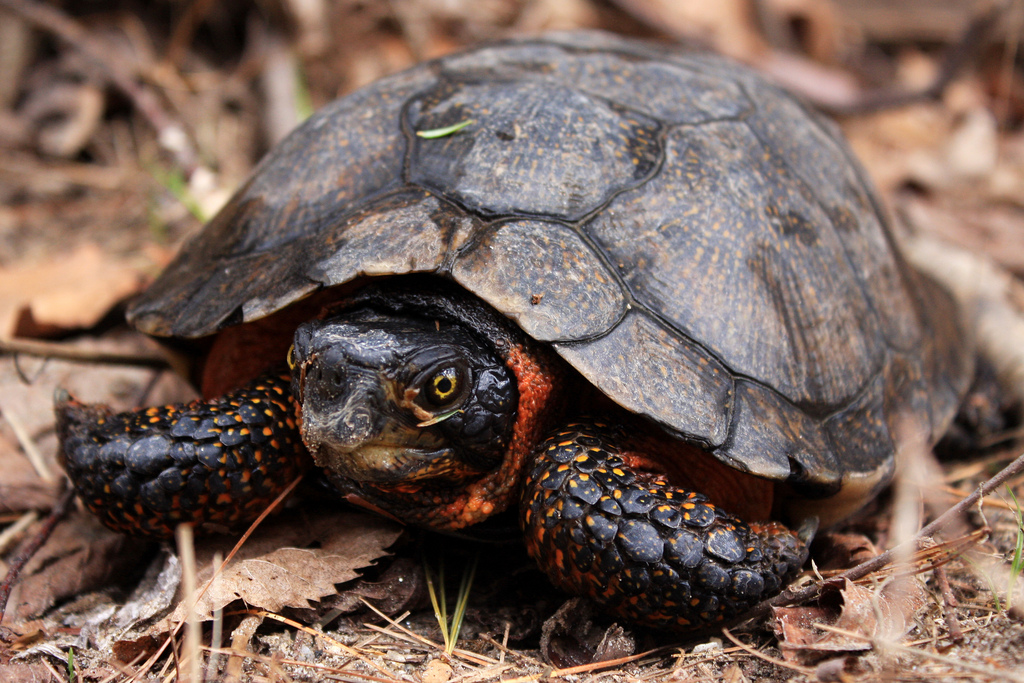
Wood turtles are said to make nice pets. Too nice for their own good: their reputation leads to poaching.

There’s a popular kind of turtle that’s losing habitat, like so many species these days. Here’s a story about a man who was determined to preserve his own land for these turtles, particularly for one specimen — his friend Stumpy.

Sadie Dingfelder reports at the Washington Post, “With his brow furrowed, Tom, 70, stomps on the damp leaf litter — thump, thump, thump, thump — and then we wait. A woodpecker cackles; bluebells tremble in the breeze. Stumpy is nowhere to be found. …

“A wild turtle, Stumpy has been meeting up with Tom in these West Virginia woods every spring for more than 30 years. Like his fellow wood turtles, Stumpy spends his winters brumating (the reptile equivalent of hibernating) in a clear, fast-moving stream. As days warm, he emerges from his aquatic home and roams the nearby woods in search of food ⁠— first tender leaves, then flowers and, finally, berries. Early on Stumpy’s circuit is Tom’s former house, where the human tosses him huge, juicy strawberries — months before the wild berries are ready to eat.

“It took a while for Tom to figure out Stumpy’s species, because Stumpy’s shell is worn and scuffed. Usually, wood turtles have gorgeous shells that appear to have been hand-carved from mahogany.

‘He was already old when I first saw him, so he must be really old now,’ says Tom. ‘Of course, he could say the same thing about me.’

“Curious, personable and uncommonly pretty, wood turtles are highly sought-after as pets, says Andrew Walde, chief operating officer of the Turtle Survival Alliance, whom I called after my first visit to Stumpy Acres. This combination of characteristics makes them vulnerable to poachers, who sell them as pets. ‘Whenever anything gets published about a particular population, that population is done for,’ Walde says. (To protect Stumpy and the other wood turtles from poachers, we aren’t publishing his exact location or his human friends’ last names.)

“The eastern panhandle of West Virginia is among wood turtles’ last strongholds, Walde says. Across most of their range, they are in steep decline. Indeed, half of the world’s 357 turtle species are threatened with extinction due to habitat loss, poaching and other human pastimes. This is an animal that survived not one, but two mass-extinction events. …

“Tom no longer lives in Stumpy’s territory. Last spring, he sold his house and moved to a more remote spot, high on a nearby mountain. He loved being by the river, but the pandemic brought an influx of tourists and new homeowners. The noise and traffic were bad enough, but worst of all was their aggressive landscaping.

‘One family clear-cut all the way down to the river,’ Tom says. ‘They didn’t want any brush or shrubbery — they are afraid of snakes or this or that — and they kinda destroyed the habitat.’

“He was determined to find a buyer who would be a good steward of the land — not just for vague environmental reasons, but for Stumpy’s sake, too. Luckily, the first person who came to look at the house fit the bill. Tommy, a 28-year-old computer programmer from D.C., told Tom about the sea turtle conservation project he had worked on one summer in Costa Rica, and he promised not to clear-cut the property to get a river view or better internet access. …

“Does Stumpy represent nature? Survival against the odds? The relentless ravages of time? Tom dismisses all these possibilities. ‘Stumpy is just Stumpy,’ Tom says. ‘He’s an individual. That’s what makes him special.’

“We drive to Tommy’s house and commence stomping. Stumpy should really be out of hibernation by now, but he’s not in their meeting spot near a large fallen tree, and he’s not on the berm by the river. He’s not basking on his basking log, and neither is he napping beneath the papaw trees. …

“If you spend time outdoors, you’ll eventually see something brutal, and you’ll be forced to accept it with equanimity, because nature is obviously beyond our judgment. Loving nature also feels a little tragic, because no matter how much you care about it, it will never care about you.

“But perhaps I’m wrong, because suddenly I hear a rustle in the leaves. Tom makes an excited sound. ‘There he is!’ he says, pointing. About 10 feet in front of us, a little brown turtle is running on his tiptoes — who knew turtles could run? And even though I’m closer and I’m also carrying strawberries, he’s beelining straight to Tom. …

“Pretty soon, Stumpy’s face is covered in pink pulp, and he’s got half a strawberry hanging from his chin. His species may be threatened, his habitat may be imperiled, but in this moment Stumpy seems delighted. ‘He’s such a messy eater,’ says Tom. ‘Do you see that? What a pig.’ Stumpy usually hangs out for a few weeks, making intermittent appearances, Tom says. As to where he goes afterward, no one knows — but Tom has a theory. ‘Maybe he visits lots of people, up and down the river, and we all think he’s ours.’ ”

More at the Post, here.

Read Full Post »

Photo: Murdo MacLeod/The Guardian.
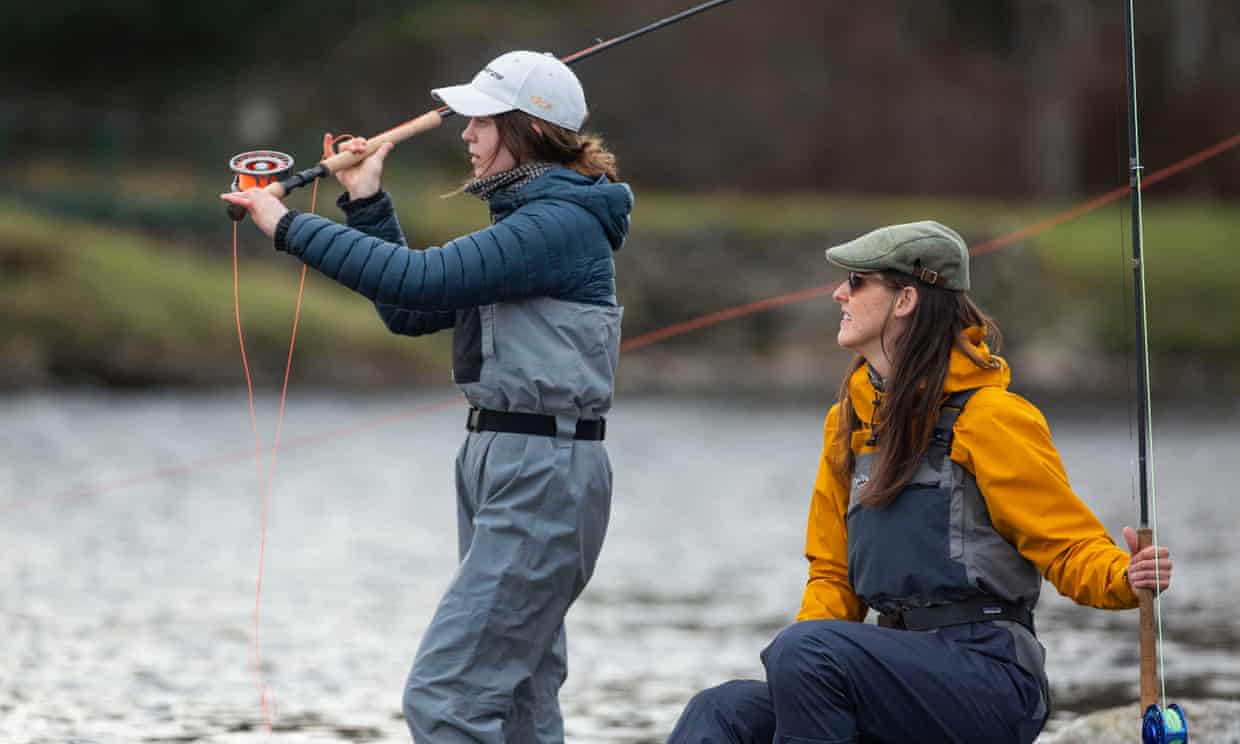
Camryn Stewart, 14, and Naomi Bell (right) open the salmon season on Scotland’s River Dee with the first casts.

So many good people trying to make the world better! Each one has their own area of action. It may be health, sports for kids, peace, housing, justice, the environment, art, teaching school. You name it. Today’s story is on people doing something about the effects of global warming where they live — along Scotland’s rivers.

Severin Carrell reports at the Guardian that “millions of trees are being planted beside Scotland’s remotest rivers and streams to protect wild salmon from the worst effects of climate heating.

“Fisheries scientists have found rivers and burns in the Highlands and uplands are already too warm in summer for wild Atlantic salmon as they head upstream to spawn, increasing the threat to the species’ survival.

“Fisheries on the River Dee in Aberdeenshire, one of the country’s most famous salmon fishing rivers, have planted 250,000 saplings along key tributaries. They plan to plant a million in the Dee’s catchment by 2035. …

“In 2018, the year Scotland recorded the lowest rod catch for salmon since records began, climatic changes meant water temperatures in 70% of salmon rivers were too warm for at least one day that summer. They exceeded 23C [73.4 Fahrenheit], a temperature that induces stress and behavioural change. …

“Marine Scotland scientists found that only 35% of Scotland’s rivers, which stretch for 64,000 miles (103,000km), have adequate tree cover.

“Lorraine Hawkins, the river director for the Dee District Salmon Fishery Board, a statutory body, said: ‘These rivers and burns are the nursery grounds for young fish and it’s the young fish which will be affected by summer temperatures – their feeding and growth rates are affected. If it gets hotter, we will see fish dying.’

“Fishery boards across Scotland have similar tree-planting programs, to provide essential shade to lower water temperatures. Many will be fenced off to prevent the saplings from being eaten by deer. Hawkins said these projects improved the overall health and biodiversity of rivers across the uplands, increasing insect life, leaf fall, managing essential nutrients and flood control.

“Alan Wells, the director of Fisheries Management Scotland, an industry body, said climate forecasts were clear that water temperatures would continue to climb, even if governments succeed in limiting climate heating. …

“He said, ‘This will get worse. We need to grow trees now to create that cooling shade.’

“The dramatic decline in wild salmon numbers is blamed on numerous factors: climate change affecting food availability; weirs and other obstructions in rivers; predation by soaring seal populations; sea lice attracted by fish farms; bycatch by trawlers at sea and poor river quality. Wells said that while Scottish ministers were proposing new conservation strategies, he remained frustrated with the slow pace of change.

“The Dee marked the start of its angling season [in February] by inviting two female anglers who won a fundraising competition last year to make the first cast, an annual ceremony at Banchory. …

“Camryn Stewart, 14, one of the first cast fishers, said she had been brought up fishing by her parents, Deirdre and Jim. The sport is targeting women and children as it strives to expand its participation and appeal. …

“ ‘I have been surrounded by people who fish, and I’ve wanted to fish all my life,’ she said. ‘We need more people fishing. … We gain so much from it. Just being outside and being in the wild. Even if you don’t catch anything, you come back from the day fulfilled.’ ”

More at the Guardian, here. No firewall.

Read Full Post »

Photo: Dorothea Oldani via Unsplash.
Divers get to see wonders the rest of us only dream about.

I’m always intrigued by all the different kinds of work that exist. Today we learn about the work of a diver who is also a successful author.

From the environmental radio show Living on Earth: “Underwater explorer Craig Foster dives nearly every day in the near-shore waters of South Africa, and it’s here that he befriended an octopus, a relationship captured in the 2020 Academy Award-winning documentary My Octopus Teacher. His 2021 book Underwater Wild: My Octopus Teacher’s Extraordinary World brings the kelp forest to life with stunning photographs and gripping prose. Craig Foster joined Host Steve Curwood for a recent Living on Earth Book Club event to discuss the power of connecting with wild nature. …

“STEVE CURWOOD: Oceans cover about 70 percent of our planet and hold 95 percent of our biosphere, that is, places where life can thrive. … Befriending and learning from creatures with gills and without back bones is an unusual pastime for humans, unless you are Craig Foster. Diving virtually every day for years into the near shore waters of South Africa with just a mask, snorkel and flippers, Craig eventually became friends with an octopus and told the story in his 2020 academy award winning documentary, My Octopus Teacher. …

“With friend and diving partner Ross Frylinck, he wrote the 2021 book, Underwater Wild: My Octopus Teacher’s Extraordinary World. [It] tells the stories of the kelp forest with stunning photographs and gripping prose. Craig joined me from Cape Town for a recent Living on Earth Book Club event. I started by asking him to describe where he dives in this underwater world just offshore.

“CRAIG FOSTER: The Great African Sea Forest stretches from right up Namibia all along the West Coast of South Africa, and then turns around the point and goes a few hundred kilometers up the East Coast. It’s about 1,400 kilometers in length. And the actual kelp itself grows to up to 15 meters, or 45 feet, in length. … There are an enormous number of animals in the kelp [and] a great biodiversity of animals living around the forest itself. …

“CURWOOD: One of the most remarkable moments in [My Octopus Teacher] is when she actually extends her arm, a tentacle, and touches your hand. Why do you suppose a wild animal would make contact with a human in this way? …

“FOSTER: In the case of octopus, or cephalopods, they have a natural curiosity. So their whole lives are balanced between this fear and curiosity. And they’re almost like a cat — you know how curious cats are, they just can’t help themselves. …

“CURWOOD: You introduce us to another cephalopod in the kelp forest there: the cuttlefish. And you were lucky enough to witness an incredible display of how cuttlefish have mastered the art of mimicry. …

“FOSTER: I remember very clearly the first day that I saw a tuberculate cuttlefish. This is a small species of cuttlefish that only occurs in South Africa. And they are such masters of camouflage that [when] I looked at this creature, I had no idea what it was. I thought maybe it’s a strange piece of algae. … And it was mimicking the algae. And this animal then changed into a cuttlefish and jetted off and left a puff of ink in front of my face. [This] animal is even better at camouflage than an octopus, if you can imagine that. It’s very small, very vulnerable, soft bodied. So it’s got this incredible way of pretending to be a hard-shelled whelk.

It changes its whole body shape, and it points its arms, and it changes its color, and even tiny details of these little polychaete worms that grow on the backs of the whelk shells, it even mimics those.

“So it fools predators into thinking it’s a hard shell. It even then sometimes pretends to be a hermit crab living in that hard shell, and drags itself along slowly, when it can actually swim, you know, relatively fast. And then if it has to swim, it can actually mimic a fish called a klipvis that lives in this environment. So this animal is truly the master of mimicry and camouflage, it’s quite incredible. …

“CURWOOD: [Living on Earth listener] Nathalie Arias, who’s in the eighth grade asks, ‘How have you used what you’ve learned from the octopus and the experience in your personal life? …

“FOSTER: When you start having relationships with wild animals, and a lot of wild animals, it takes a lot of pressure, strangely enough, off your human relationships. You know, we rely very heavily on human relationships for our well being. But as you start having the relationships with these wild animals, and spending time with them, and I like sometimes spending time alone with them, you kind of feel that — it’s a wonderful feeling — the pressure off the human relationships. … It’s improved, I think, my human relationships.

“CURWOOD: So to what extent does the ocean heal you? I mean, you and your co-author Ross mention in this volume that you’ve been recovering from emotionally traumatic experiences you, you’ve had; you talk about divorce, Ross mentions a sad, difficult relationship with his father. So how has the ocean healed you?

“FOSTER: I think in actually in a number of ways. As I say, the daily immersion, almost anybody can be in a, not a very good mood, or quite tired, lethargic. And I promise you, I’ll take you into that water, 20 minutes later, you’re going to feel completely different. It almost works for everybody. And that’s because there is actually a big brain chemistry shift and a physiological shift, and that can last for many hours of the day. And then of course, having a relationship with wild animals changes one dramatically. You feel connected to your environment, you know their behaviors, you have a sense of place, you don’t feel so separate a lot of the time, you know, so separate; you feel like you are connected to an environment. And that, psychologically, is very empowering.”

Read about Foster encountering a Great White Shark, an amazing clawless otter, and other wonders at Living on Earth, here. Nice pictures. No firewall.

Photo: Craig Foster and Ross Frylinck.
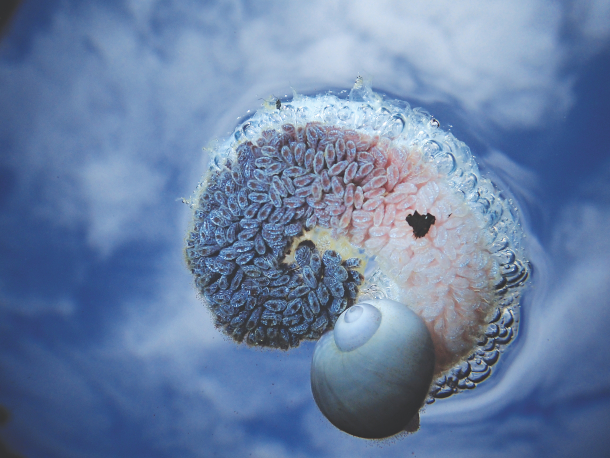
This image of a global bubble-raft shell was taken from below, looking up to the surface. This animal creates a stiff raft out of a stream of bubbles so it can float. They lay their eggs on the raft, too, and that’s what’s visible here: the darker eggs were laid first and have developed more than the newly laid pink ones.

Read Full Post »

Photo: Naturskyddsforeningen.
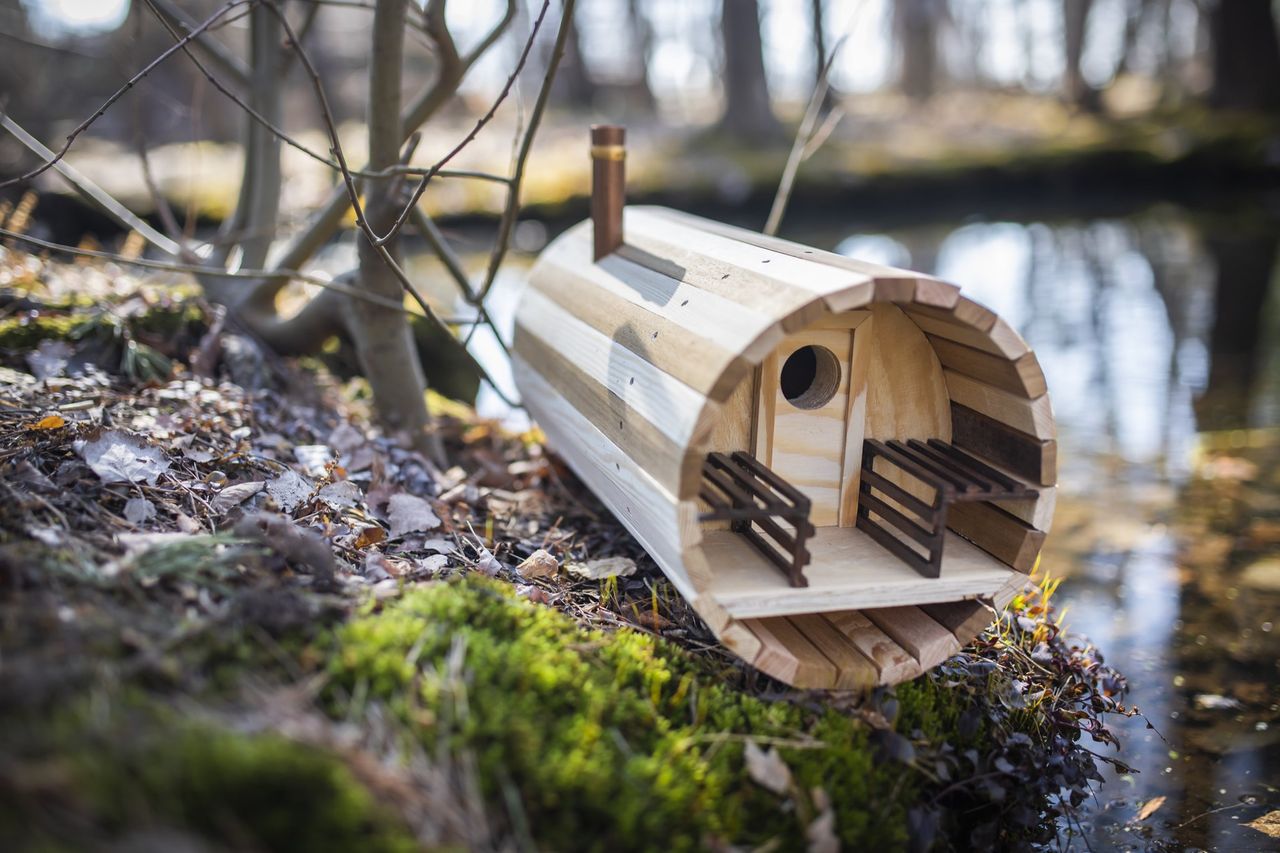
The aim of the Swedish birdhouse championship is to encourage birds’ nest building and children’s commitment to nature.

I follow @swedense on Instagram, which is where I learned about an annual birdhouse competition for students.

The Swedish birdhouse championship, says Swedense, “is for primary and secondary school classes and is organized by the Swedish Society for Nature Conservation, @naturskyddsforeningen. The aim is to encourage birds’ nest building and children’s commitment to nature.

“This year’s special prize goes to the special school at Sanda education centre in Huskvarna for their contribution ‘Trafikljuset’ (traffic light). The birdhouse has a built-in camera that lets students follow a nesting bird’s yearly cycle from eggs to flight-ready birds in the schoolyard.

“Birdhouses have come to play an important role in the biodiversity of the forest. The lack of older deciduous trees means that many birds in Sweden are currently suffering from a housing shortage.”

Meanwhile, others are getting into the act.

“Bee Breeders Competition Organizers is excited to announce the results for its Legendary Bird Home / Edition 2 competition! This is the second competition in a series aiming to raise awareness for the global environmental crisis. This competition was held in collaboration with Birdly – a socially-responsible start-up that aims to support environmental activism worldwide through funds raised by selling bird homes.

“Bee Breeders worked with an international jury panel consisting of: Marco Barba, Mexican industrial designer and founder of Marco Barba Design and designer of the KUKU birdhouse product; Andris Dekants, project manager at the Latvian Ornithological Society; Farid Esmaeil, co-founder of Dubai based X Architects and winner of the Aga Khan award for the Wasit Natural Reserve Visitor Center project; Mark Gabbertas, founder of West-London based Gabbertas Studio with a portfolio that includes the Gloster Birdhouse; James Krueger, Design Principal in HMC Architects’ in San Diego studio; Heike Schlauch of Heike Schlauch raumhochrosen which has designed the ‘Vorarlberger Baukunst’ birdhouse series; Jolanta Uczarczyk, who runs Uczarczyk, through which she produces original, handmade works such the Mocak Bird Feeder; and Chad Wright, founder of Studio Chad Wright with a portfolio that includes the Attic birdhouse.”

Last year Sofia Wickström, then a 9th grade student at Futuraskolan International Bergtorp, was one of the finalists with Naturskyddsforeningen. The school’s profile on her says she had “been working on her birdhouse during wood shop since the end of 8th grade totaling about 50 work hours. Her entry is called ‘Bergsprängaren’ (Boom Box).

“When designing her birdhouse, she was inspired when seeing two old boomboxes on the floor of the woodshop room where the project got started, she decided then and there on her design. According to Sofia, the hardest part and what actually took the longest time in making the ‘Boom Box’ birdhouse was getting the edges round and smooth. … In researching birds for this project, Sofia found that small birds actually love bright colors; this was perfect as she herself is a big fan of bright colors, hence the pretty pink/green look to the birdhouse.”

More here and here. Good photos here. I especially love the birdhouse with stones embedded in plaster and a handy woodpile. Who can resist designing a birdhouse after seeing these pictures?

Read Full Post »

Photo: Kathryn Palmer/The Hechinger Report
Fifth graders were asked to envision the future. “Everyone will have a new house to live in. It won’t matter how much money you have,” said Falhat Hassan, a student at John B. Wright Elementary School in Tucson, Arizona
.

I loved working with fifth graders back when I was a teacher. They are funny, aware of the world, but not yet as rebellious as they are likely to be in a few years.

In a report at the Christian Science Monitor, fifth graders were asked to describe what they expected the world to be like in the future. If you ever get discouraged, hang out with some ten-year-olds.

“One student envisions a watch that tells you when you’re polluting – a sort of eco-nanny on your wrist. Another suggests that teachers might show up in classrooms, not in person, but as holograms. There’s talk of colonies on Mars, and people commuting in flying cars. 

“These are among the ideas to emerge from the fertile imaginations of fifth graders across the country thinking about what the world will – or should – look like in 20 years. As the calendar flips to a new year, the Monitor, in collaboration with the Hechinger Report – a nonprofit education news site – had reporters sit down with students in four cities to give us their predictions of and aspirations for the future. …

“What we found is that they harbor plenty of concerns about tomorrow, sure, but they also exude an innate optimism, a sense of delight and possibility. Their visions represent a journey into cybersecurity and space travel, racism and robots.”

Contributor Lillian Mongeau, of the Hechinger Report, wrote about Hillsboro, Oregon. “One idea, for when we colonize Mars, is that all of humanity could spend a few years on the Red Planet to let Earth ‘rest.’

“ ‘And then when we come back, we’ll try better to not pollute as much,’ says Chandler Stark, a fifth grader at Paul L. Patterson Elementary School in Hillsboro, Oregon.

“Chandler estimates it will take two to five years for Earth to recover from what we’ve done to it, at which point we can all return. The idea was met with nods by three of Chandler’s classmates as they sat discussing the future. … Since Mars is not yet ready for human habitation, these kids agreed that cleaning up our current planet was a top concern.

“ ‘The time to fix it is now,’ says Caden Sorensen. ‘It’s not going to fix itself. And if we do end up colonizing Mars, don’t ruin Mars, too.’

“But while the technology necessary to move to Mars seems likely to be a net positive, these children aren’t interested in every new advancement.

“Technology ‘can bring really amazing good things, but those things could bring some other bad things,’ Caden says, noting that he would warn his future children about the downsides.

“Noelani Velasco Polley agrees. She hopes to one day own an iPhone 21, ‘with 21 cameras on it,’ but for now she’s OK not having a phone at all. …

“ ‘I’m really concerned that there’s going to be more electronics … that people can hack, so more identity theft,’ says Fatima Abdi, who prefers to be called Fati. She also worries about artificial intelligence. … Fati worries racism will get worse, and thinks steps should be taken, short of going to Mars, to save the environment. …

“Chandler hopes to one day compose music for TV shows and video games. Fati plans to be a business owner – she already has an Instagram shop where she sells jewelry. Caden is currently aiming to be a lawyer, but figures he’ll probably change his mind. And Noelani wants to be a scientist or an engineer.

“ ‘I think there won’t be that many jobs in fast-food places’ in the future, she says. ‘I think they’re going to be like, bigger jobs, and people are going to want to be in jobs where they can get more money, because in the future everything is going to be more expensive.’ …

“They say the power to create the future rests in human hands. ‘I think there can be more equality in the world if we just work hard for it,’ Fati says.”

Christina A. Samuels interviewed fifth graders in Woodbridge, Virginia, and saw some of the same concerns.

“In 25 years, schools could be multiple stories, connected by elevators and moving walkways. Scientists will have made greater strides in exploring the uncharted ocean depths and the edges of the galaxy. Humans may even have settlements on other planets. … 

“Belmont’s math and science focus fosters the students’ interest in the environment, as does their location: Less than 2 miles away is Occoquan Bay National Wildlife Refuge, a habitat for migrating birds and butterflies. At Belmont, fourth and fifth graders get extra lessons in STEM subjects, such as robotics and hands-on science experiments.

“The coronavirus has affected the lives of these children since third grade – Prince William just returned to full-time, in-person learning this school year – but the fifth graders don’t like to imagine the pandemic in their future. 

“ ‘Let’s hope the pandemic is over,’ says Jason Rivera. Other viruses may appear, ‘but maybe not very big.’

“Or maybe there will be more warning, Jashua [Alvarado] says. ‘Scientists would be able to tell if a pandemic is going to come to the world like two years before, or one year, or – I don’t know – months,’ she says. …

“The six students … take each question seriously and answer thoughtfully. That’s perhaps not surprising from a group of students who see themselves playing ambitious roles in building a new world in the future – as engineers, doctors, and scientists. …

“ ‘I’m kind of a science nerd and my mom tells me if I want to be a scientist, I have to be working hard for it,’ says Jashua.

“Yanet Hundessa and Anjelica [Jabbie] will be helping other people. ‘I really want to be a doctor because I want to help the elderly,’ Yanet says. 

“ ‘I also wanted to be an engineer or a doctor because I love helping people, and I love building things,’ says Anjelica.

“They also plan to take on problems that grown-ups are now leaving behind. ‘Why don’t we focus on other people that live in different places?’ says Ethan [Ong]. ‘There’s people that are poor that don’t have lots of resources and that don’t have food.’ …

“ ‘People could donate to countries that have poor resources,’ says Sam Aphayvong. ‘If the people didn’t get the resources they need, they could become jealous and start wars.’ …

“ ‘I think people should be kind to each other,’ Yanet says. ‘No racism, and they should help out poor people and everybody will be equal.’ ”

More at the Monitor, here. No firewall.

Read Full Post »

Photo: Kate Evans, CIFOR, Flickr, CC BY-NC-ND 2.0.
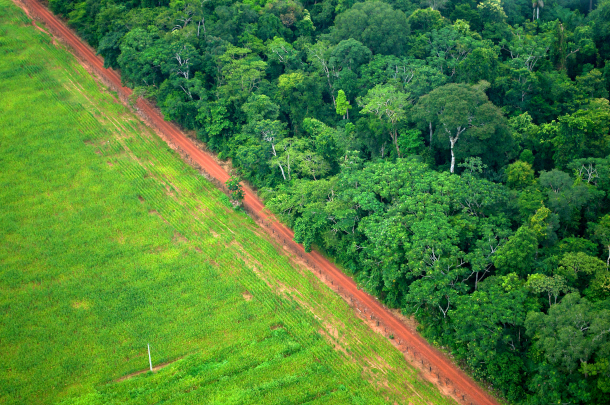
Note the contrast between forest and agricultural landscapes near Rio Branco in Brazil. Learn how you can have the products you love without damaging the environment.

We all love chocolate, but it’s important to be mindful in our interconnected world to think about the potential consequences of producing the foods we love. I have written before about how you can avoid buying chocolate that relies on child labor (click here). Today we turn to the environmental radio show Living on Earth to learn about saving the rain forest and other critical ecosystems from the wrong kind of cultivation.

Host Steve Curwood talks to Anke Schulmeister of the World Wildlife Fund about the European Union’s decision to stop importing a half-dozen agricultural products from newly deforested areas.

“STEVE CURWOOD: When someone takes a bite of a hamburger or tofu or has a cup of coffee or chocolate bar, it’s hard to know if those foods added to the destruction of tropical forests that are so key for biodiversity and climate stability. …

The EU is moving to ban the importation of certain agricultural products from any newly deforested areas. And they are starting with soy, beef, palm oil, wood, cocoa and coffee.

“The EU laws would compel purveyors to prove their products didn’t come from any newly deforested land. The proposed laws are projected to reduce greenhouse gas emissions by some 32 million tons a year and help the EU meet its goal of net zero emissions by 2050. It requires final approval by the European Parliament as well as each of the 27 EU member states. … How will people be able to understand that the cocoa that was used to make [chocolate] came, in fact, from a place that’s not being deforested, at least in contravention of this proposed set of regulations? …

“ANKE SCHULMEISTER: What this law is trying to do is that there is no choice for a consumer on whether the product is made with deforestation or not; it’s just simply you’re making sure that no matter which chocolate you buy, it is going to be free from deforestation. And to achieve that, there are measures in this legislation proposed that will ask a company to check down the whole supply chain. [No] environmental impact … neither human rights violation taking place. …

“For example, in Brazil, deforestation is still legal in certain aspects. … What the EU at the moment is proposing is to say, even if the Brazilian law allows that, we in the EU do not want to buy this. …

“CURWOOD: So beef is part of this, which of course, at the end of the day means leather. So let’s say an American shoemaker, who has a contract with somebody in China is now selling that label in the European Union, once this rule goes into effect, what kind of challenge would they would they face?

“SCHULMEISTER: This is a very good question, because that goes really much into the depth of it. So normally, what the commission has proposed is that you would need to know where it was produced no matter whether it came by China, or else. So if this American shoemaker would like to actually sell in Europe, he would need to get from his Chinese supplier information that tells him where he actually bought the leather. And then in the end where the cow was fed that produced that leather.

“CURWOOD: Sounds very complicated.

“SCHULMEISTER: Yes and no. Because let’s put it like this: we’re asking something rather simple in stating, is there still land where there’s forest or has this forest been converted to something else? And for this, there’s a lot of satellite data these days available. So you know, it’s very clear, very regularly updated. What is making it a bit more complicated is that there is a need for more transparency about your supply chains. …

“CURWOOD: What are the numbers? What kind of reductions in emissions, carbon emissions, do you think these rules, this legislation, will create? …

“SCHULMEISTER: If there’s no law, there will still be about 248,000 hectares a year of deforestation, and about 110 million tons of C02 emitted until 2030 per year. … We think that European Commission is on the right track. But you know, what our plea would be now to the European member states and the parliament is that, you know, to close some of the gaps which we see. One is that for example, other ecosystems — savannas or grasslands — are not included from the beginning.

“We [call] savannas ‘the inverted forests,’ meaning that their roots store nearly as much carbon as actually forests do, you know. On the landscape that they are they have such a dense root system, you know, that they really store a lot of carbon in there and that is then if it’s converted to agricultural land lost. [Also] it is not very strong on human rights violations or actually ensuring that there are no human rights violations. [Further] it is not addressing the finance sector. …

“And what for us is important is that this law applies the same to all companies so that we do not make a differentiation between sourcing from a high-risk region–so where there’s a high risk of deforestation–or a so-called low risk region. … And even if a company is sourcing from a high-risk region, there can be companies who have a good traceability and a good transparency.”

More at Living on Earth, here.

Read Full Post »

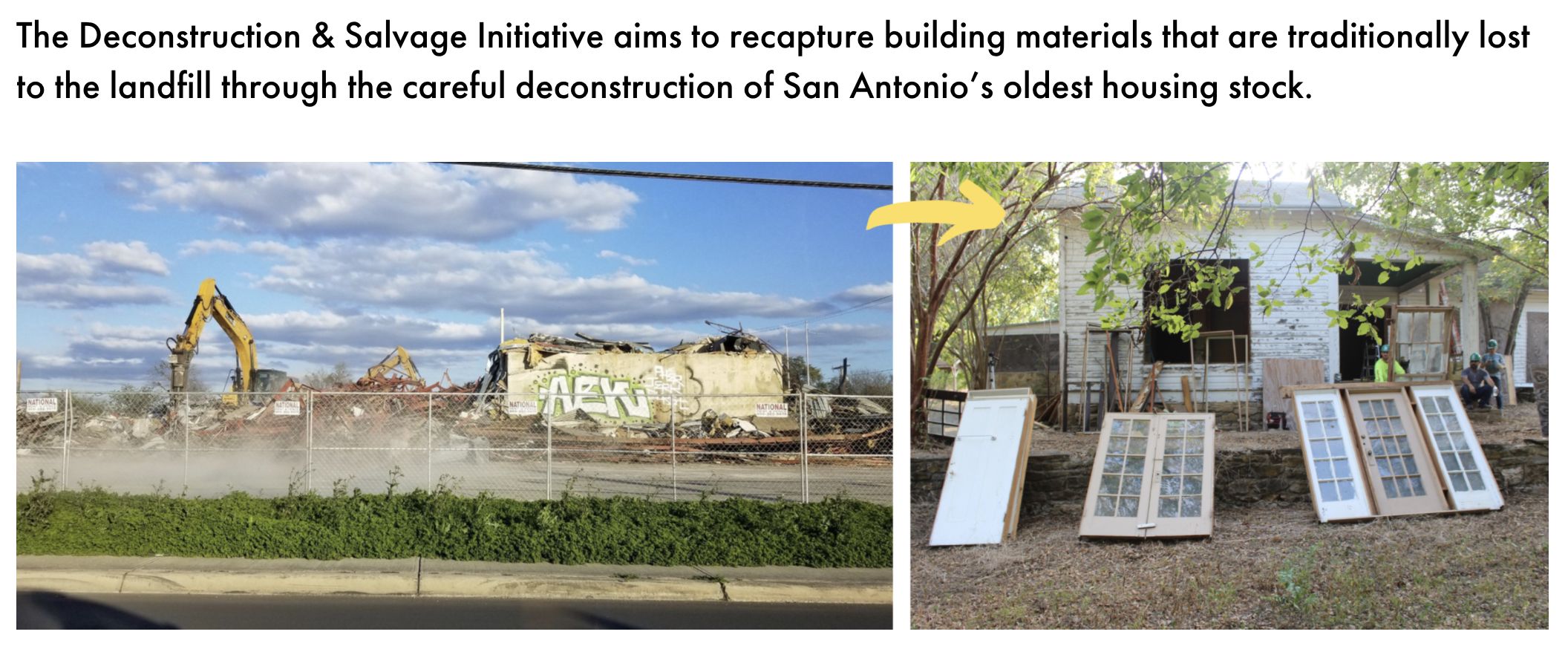
Photo: City of San Antonio.

There are so many beautiful pieces of buildings that end up in the dump when individuals or municipalities choose demolition: “wavy” glass from old homes, priceless woods, marble, stained glass, historical artifacts, and more. Fortunately, in the spirit of Reduce, Reuse, Recycle, a different approach is being tested around the country.

Aarian Marshall writes at Wired, “Emily Christensen knows this sounds a little West Coast, but when she enters the old houses her company has been hired to take apart, she senses an energy. ‘It’s intense,’ she says. ‘These houses have seen decades of human drama.’

“Christensen and her partner, David Greenhill, started their firm, Good Wood, in 2016. Portland, Oregon, where they live, had just become the nation’s first city to require houses of a certain age to be deconstructed rather than demolished. That means that, instead of using an excavator and backhoe to crush an old building, anyone scrapping an older structure in the city must hire a deconstruction crew, which takes it apart delicately — almost surgically — by hand. Rather than a jumble of smashed wood, plaster, fixtures, insulation, concrete, and dust, deconstruction firms can extract cabinetry, masonry, windows, marble, brick, and beautiful old-growth lumber. The idea is that these materials can be sold and eventually reused locally. …

“Using old materials to make new things feels meaningful. It helps, too, that reclaimed wood tends to be very pretty. But a growing number of US cities think the idea makes good policy too. In the past five years, cities as disparate as Baltimore, Cleveland, Boise, and San Jose and Palo Alto in California have adopted their own deconstruction policies; San Antonio has been working on one for four years.

“Deconstruction, city officials say, is a green alternative to demolition, sending up to 85 percent less material to landfills. Building materials and construction account for just under 10 percent of the world’s energy-related global carbon emissions, according to the Rocky Mountain Institute.

Using salvaged materials eliminates emissions associated with making and transporting new building materials. Plus, it’s not as noisy as knocking down a house, and doesn’t spew dust or toxic materials, such as asbestos, into the air.

“Backers say it creates jobs even for those without high-tech skills, while highlighting the importance of sustainability. As the climate warms, ‘the circular economy is one promising alternative,’ says Felix Heisel, an architect, assistant professor, and director of the Circular Construction Lab at Cornell University.

“Good Wood illustrates Portland’s success. Over the past four years, the city has deconstructed more than 420 single-family and duplex homes that were registered as historic places or built before 1940. Good Wood has taken apart 160 of them. Today, 19 contractors are licensed to deconstruct in the city, thanks in part to a city-sponsored training. …

“But all that manual labor comes at a cost. Deconstructing a building can be more than 80 percent more expensive than demolishing it, according to a report from Portland State University, though selling some of the recovered material can offset part of the cost.

“And sometimes the labor isn’t available. In 2018, Milwaukee required many of the city’s older structures to be deconstructed instead of demolished. But the rule is still on ice, through at least 2023, as officials still struggle to find local contractors who can take apart homes by hand.

“The delay ‘is in hopes of building a bigger pool of potential contractors,’ says Chris Kraco, supervisor of the condemnation section at the city’s Department of Neighborhood Services. Kraco and his colleagues continue to hold training sessions. … Many places also need to update their local building codes to allow contractors to build with salvaged materials.

“The complexity has prompted some cities to tackle deconstruction slowly. Pittsburgh just launched a year-long pilot project, in partnership with a local nonprofit construction materials and appliances business, to see whether taking apart old, condemned structures on city land makes financial sense there. …

“San Antonio’s Office of Historic Preservation, which has spearheaded the city’s deconstruction efforts, plans to propose an ordinance to city council later this year. In the meantime, it’s helping with demonstration projects, including one on a 1930s homestead that uncovered a basement full of moonshine bottles — something that might have otherwise been crushed in a demolition. …

“Most cities, Portland included, have targeted old buildings for deconstruction. It’s partly because limiting the pool of homes required to use the technique gives local deconstruction economies time to develop. But also, starting in the 1970s, builders tended to use materials that haven’t held their value, like second- or third-growth lumber, or particle board. Construction also used more glue, spray foam sealant, and other adhesives, which make it harder to take apart new buildings by hand.” More at Wired, here.

Read Full Post »

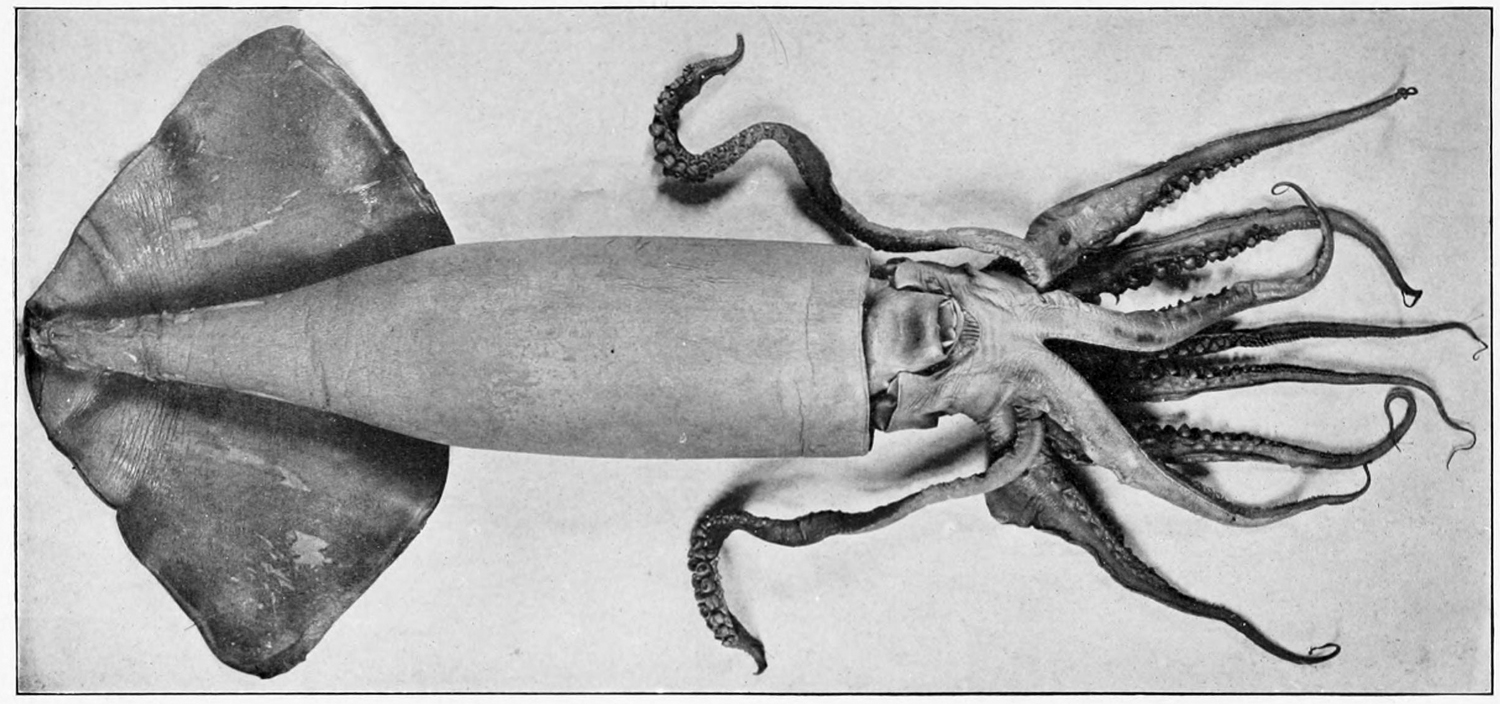
Photo: Bulletin of the US Fish Commission.
The massive Humboldt squid has adapted to climate change. But that’s a challenge for fishing communities who depended on it.

Climate change is forcing the creatures of the Earth to adapt or perish. This is the story of one creature that adapted but, in doing so, forced a more painful adaptation on some human creatures.

Michael Fox reports at PRI’s the World, “On a late afternoon in Kino Bay, Mexico, Gerardo Hernandez is repairing his fishing nets. He strings them out in front of his home, made from old pieces of plywood and corrugated tin. 

“He lives along the Gulf of California, the body of water that separates most of Mexico from the Baja California peninsula. Hernandez, a seasoned fisherman now in his 60s, can still remember the time of the giant Humboldt squid — a massive invertebrate that used to grow up to 6-feet long. Their abundance made for a robust squid industry fueled by 2,000 fishing boats — the vast majority being small pangas like Hernandez’s.

‘There were always a ton of squid,’ Hernandez said. ‘You would go out, and you’d see them on the surface of the water. The more squid you took, the more there were.’

“The days of the giant jumbo squid are over now. About 13 years ago, after a hurricane and an abnormally warm El Niño year, the squid disappeared from the Gulf. Eventually, they returned. But by 2015, they were gone again. Scientists attribute the shift to animal adaptation amid a rapidly changing climate. 

“Hernandez’s kids say they want him to retire now. But he still goes out fishing every night with other members of his small fishing cooperative, and they mostly catch Pacific Sierra fish and crab. He said he brings home enough — but not nearly as much as he did in the days of the Humboldt squid. 

“ ‘They’ve left,’ Hernandez said. ‘They’ve emigrated. Only God knows where they’ve gone.’

“But scientists think they have an idea. They say they haven’t actually disappeared. Instead, the Humboldt Squid that live in the Gulf have shrunk from about 6-feet long to less than a foot, and they’re sticking to deeper depths and cooler waters offshore. 

“Stanford University biologist William Gilly said the squid seem to have developed this strategy long ago to deal with fluctuating water temperatures that come with El Niño cycles. … It’s a species that seems evolved to adapt to the warming waters brought on by climate change. At least, that’s the theory.

“ ‘There’s a lot we don’t know,’ said Rufino Morales, a fisheries biologist and the coordinator of the Producto Calamar subcommittee, a Mexican group that researches and supports squid fishers. ‘We assume that the shift is due to climate change, or global warming, or because it coincides with El Niño, but these are scientific theories. We haven’t been able to prove them yet.’

“The squid seem to be adapting.  The fishing communities they used to support are trying to as well.

“On a warm afternoon in La Manga, a fishing village about an hour west of the port city of Guaymas, a handful of residents gutted a stack of manta rays, whitefish and parrotfish caught that morning. …

“ ‘When the squid was abundant, this was another Guaymas,’ said Maria Collins, a member of the Francisco Flores small fishing cooperative in town. ‘We lived well.’ When the squid left, a lot of people lost their jobs. …

“Many fisherfolk now work in factories off the highway on the northern side of town. Others are doing construction, gardening or plumbing. 

“Some boats began to hunt for jellyfish, which they sell to Asian markets. But the season is short. Locals up and down the coast say none of the catches are doing well. They blame the large sardine ships for overfishing and depleting stocks. 

“ ‘We are fishermen in danger of extinction,’ said Hernandez as he repaired his fishing net. ‘I think everything that’s happening in the ocean is our fault. Like, we aren’t taking care of it. Or, we don’t care for it, and there’s the proof.’ ”

More at PRI’s the World, here.

Fondly remembered fantasy squid.

This is just pretend, you know.

Read Full Post »

Photo: Casa Dei Pesci.
A sculpture named ‘Acqua’ by Giorgio Butini is one of 39 underwater sculptures helping to deter illegal fishing off the coast of an Italian port.  

Here’s a creative idea to thwart illegal activity: attract enough sightseers to make it too public to pursue. Today’s story shows how environmentalists, artists, and a fishing community in Italy are collaborating on shared goals.

Veronique Mistiaen writes at National Geographic, ” ‘The stone is asking me to give it the right face: it is thoughtful, quiet,’ says British stone sculptor Emily Young. She carves boldly, clad in a thick jacket, leather hat, sturdy boots, face mask and ear plugs, but no gloves because ‘you need to feel what’s happening with the stone through the tool.’ …

“Young, who has been called ‘Britain’s greatest living stone sculptor,’ has work exhibited and collected around the world, but it is the first time that one of her creations reposes at the bottom of the sea.

“Young’s 18-tonne Weeping Guardian and two other colossal faces (The Gentle Guardian and the Young Guardian), which she carved in Carrara marble with the help of two associates over five days, were lowered down on the sea bed off the coast of Tuscany at Talamone, a town between Florence and Rome, in 2015. There, her massive stone guardians are protecting marine life against gangs trawling illegally at night.

“Young’s unusual work is part of an on-going project by local fisherman Paolo Fanciulli and his non-profit Casa dei Pesci to try to protect the sea in a creative way. There are now 39 underwater sculptures and marble blocks at Talamone, placed in 2015 and 2020, and another 12 are ready to join them as soon as necessary funds can be raised.

“Bottom trawlers drag their heavy-weighted nets multiple times over the sea floor, scraping it bare and destroying the Posidonia (Posidonia oceanica), known as Neptune grass, a flowering seagrass endemic to the Mediterranean, which forms large underwater meadows and acts as a nursery and sanctuary for all marine life.

The Posidonia also soaks up 15 times more carbon dioxide annually than a similar sized piece of the Amazon rainforest.

“For these reasons, the Posidonia is a protected species included in the EU’s Habitats Directive and the Marine Strategy Framework Directive, and bottom trawling is illegal within three nautical miles from the coast in Italy. But because it is very profitable, and impossible to police the 8000km of Italian coastline, boats carry on at night regardless. 

“Now in his 60s, Fanciulli has been fishing around Talamone since he was a teenager.  In the 1980s, he started noticing the devastation caused by bottom trawlers and the impact it had on his and other local fishermen’s catch and livelihood. He has been trying to fight them ever since.

“In 2006, he joined force with the municipality of Talamone and a few environmental organizations to drop big concrete bollards on the bottom of the Mediterranean to ‘serve as secret agents under the sea.’ The action received media attention and he became a national hero – but it wasn’t enough to deter the trawlers. The local mafia also retaliated by making sure he couldn’t sell his fish at the market, and threatening him.

“He needed to find another way. ‘He thought: “This is Italy. We do art. If we could put art and conservation together, we might have more impact,” ‘ explains Ippolito Turco, a friend of Fanciulli and president of the non-profit Casa dei Pesci, which they created together for that purpose with the support of several cultural and environmental associations.

“They asked nearby Carrara quarries if they could donate a few stones. Franco Barattini, the president of one of Carrara’s best-known quarries – Michelangelo cave, the very place where the eponymous artist came at the turn of the 16th century to select stones for his iconic David and Pietà statues – promised to donate not a few, but 100 huge blocks of marble.

“Young, along with Italian artists Giorgio Butini and Massimo Lippi, and other artists from four countries, was asked to carve the marble blocks. ‘We all donated our time. I thought it was a brilliant project: it would attract more attention to the problem,’ says Young. …

“The sculptures were placed in a circle, four metres apart around a central obelisk, carved by Massimo Catalani, another Italian artist. A bit further sleeps a mermaid, a collaboration by sculptor Lea Monetti and young artist Aurora Vantaggiato, and a reclining figure by Butini, among other works.

“The marble sculptures create both a physical barrier for the trawlers’ nets and a unique underwater museum, open to anyone either through arranged scuba diving tours or their own dive. “It’s really beautiful and it’s amazing to see how easy it is for nature to recover. …

“The scheme has completely stopped illegal trawling within three miles off shore in front of Talamone as far south as the mouth of the Ombrone river, Turco says. ‘But now the pirate boats have moved north of the Ombrone. Casa dei Pesci plans to protect this stretch of sea as well.’ “

More at the Geographic, here. Needless to say, the photos are wonderful. No firewall.

Read Full Post »

Photo: Chris Linder.
National Audubon Society government affairs coordinator Tykee James (second from left) has been leading monthly bird walks for congressional staff on Capitol Hill since 2019.

A while back I wrote how the Swiss ambassador in Washington, DC, got people there interested in birding (here). Today a story from Cornell Lab’s All About Birds touts the ability of bird walks to build common ground among government opponents.

Ariel Wittenberg writes, “It’s a busy morning on Capitol Hill when the gaggle of congressional staffers and their boss, U.S. Rep. Alan Lowenthal, gather on the back lawn. … This morning’s meeting isn’t about legislation in the House of Representatives. It’s about three visitors perched atop the chamber’s roof, backlit by the Capitol Dome’s soft gold glow.

“ ‘Will you look at that, House Sparrows sitting on the people’s House!’ exclaims Tykee James, the government affairs coordinator for National Audubon Society, eliciting a muffled chuckle from the dozen legislative aides and interns assembled. …

“He started the walks in 2019 as a way to forge connections with lawmakers and their staff who might work on bird-related legislation. … [And] they serve another purpose: building common ground in a place that is perhaps more partisan now than it’s ever been.

‘If you take down the political barriers and you just bird a little bit, if you calm down, smell the flowers, and look for some feathers, then I think that you can genuinely find where people are coming from and that gives you a better opportunity to find where you can meet in the middle,’ he says. …

” ‘I do no kind of lobbying on these walks.’ Instead, he gives pointers on using binoculars, fields questions about the difference between male and female House Sparrows, and mimics the different caws of Fish Crows and American Crows. …

“ ‘It’s not about me being an expert, it’s about me trying to find ways to connect people with the excitement of it all,’ he says. ‘Being present for moments like this makes you feel connected to birds and to their issues.’

“Congressman Lowenthal is no stranger to bird policy. He (a California Democrat) joined with Rep. Brian Fitzpatrick (a Pennsylvania Republican) to coauthor the that’s being considered in the 117th Congress. The Act would permanently codify protections for migratory birds that were rolled back. …. Reps. Lowenthal and Fitzpatrick have also reintroduced legislation calling for the U.S. to join the Agreement on the Conservation of Albatrosses and Petrels, a conservation treaty that covers 31 species of seabirds.

“But this is Lowenthal’s ‘first bird walk,’ he says, and he is genuinely surprised when James tells him that American Robins aren’t actually robins at all, but a type of thrush.

“ ‘Where are the robins, then?’ Lowenthal asks.

“ ‘They are in Europe,’ James says.

“To Lowenthal, participating in a bird walk is a means to escape the grind of the Capitol, where later in the day he will pay his respects to victims of the Covid-19 pandemic at a ceremony near the Washington Monument before returning to the House chamber for more debate on spending bills.

“ ‘There is so much going on, so much uncertainty and stress,’ Lowenthal says. ‘It’s nice to have a focus outside of ourselves.’

“Even though he doesn’t talk politics on his bird walks, James believes they do have policy impact. For example, the legislative director at Lowenthal’s office, Shane Trimmer, has been on almost every bird walk James has offered. And James says that he ‘suspects’ some cosponsors of Lowenthal’s bipartisan migratory bird legislation may have been inspired by the walks. …

“Today’s bird walk is full of first-timers. One aide from Long Beach, California, tells James he is only experienced at ‘identifying pigeons and seagulls,’ and another confesses she has ‘absolutely no birding experience.’ …

“James says he actually prefers to bird with people ‘who are picking up the bins [binoculars] for the first time. … It’s all about meeting people where they are with the birds,’ he says.

“That, and James hopes observing birds can help staffers and politicians think about their own environments in new ways. That was the case for James, when he started birdwatching during his first job out of college at the Cobbs Creek Environmental Center in West Philadelphia. …

“People of color in the United States are less likely to have adequate access to parks and green space. Lack of green space in communities of color often means those neighborhoods of mostly concrete feel hotter than areas with parks and ample tree cover. The phenomenon, called the heat island effect, can exacerbate health disparities because high temperatures can lead to heat exhaustion and stress, which complicate heart and respiratory conditions.

“The lack of access to green space is no accident, James notes, due to historic discriminatory mortgage lending and other practices that segregated neighborhoods. That’s one reason why, outside of his day job, James advocates for increasing diversity within the outdoors community. Last year, he cofounded Black Birders Week to promote the work of Black naturalists and raise the visibility of Black people within the birding community.”

More at All About Birds, here. For something extra entertaining about ornithology, read my post on so-called “birbs,” here.

Read Full Post »

Photo: Randall Hyman.
The Christian Science Monitor: “Activist Nicole Horseherder, who heads a nonprofit that seeks to protect water supplies on the reservation, stands on a ridge near Black Mesa in northern Arizona, the site of past disputes over coal mining.”

I’m grateful for the environmental leadership of indigenous people. They were environmentalists centuries before anyone used that word, and I think that paying attention to them will help us learn how to protect our planet.

Randall Hyman reports at the Christian Science Monitor about Navajo women who instinctively understand the importance of the natural world and their community’s place in it — and who don’t give up.

“One who has a master’s degree in linguistics,” Hyman says, “has made green energy a crusade on a reservation where coal, gas, and uranium have reigned supreme for decades, leaving tainted groundwater in their wake.

“Another returned to the Navajo reservation from Chicago to find that fracking had marred large sections of her native land – something she now works to stop in one of the largest methane hot spots in the United States. 

“A third was so distraught by the lack of ballot access on the reservation that she organized getting voters to the polls on horseback – her version of saddle-up democracy. 

“Two others have immersed themselves in politics directly – one as the youngest member of the Arizona State Legislature and the other as one of three women on the 24-member Navajo Nation Council. …

“Their efforts come at a particularly fraught time. Last year, from the vermilion sands bordering the Grand Canyon to the oil-rich scrublands east of Chaco Canyon, the Navajo Nation was hit by a perfect storm – a convergence of soaring pandemic deaths, dwindling energy revenues, and rising unemployment. Amid the chaos, Native women stepped up in what some see as an unprecedented wave. While one COVID-19 relief group raised $18 million in a matter of months, other women redoubled efforts to dismantle policies that have left Navajo (Diné) people vulnerable. 

“ ‘I think that you’re actually seeing a return to the way that Diné society has always been,’ says Nicole Horseherder, executive director of Tó Nizhóní Ání (Sacred Water Speaks), an organization pushing for new energy policies and water protection across the Navajo Nation. ‘Women are coming forward and saying, “I am a leader too. I can make these decisions. I can make better decisions.” ‘ …

“Underneath all the narratives is another factor – the dominant presence of women in Navajo society, where taking charge is rooted in a matrilineal culture. 

“ ‘When you see the destruction in your community, you realize you have to do something,’ says Wendy Greyeyes, assistant professor of Native American studies at the University of New Mexico in Albuquerque. ‘So, women are empowered. A lot of that harks back to our own creation stories. Changing Woman was a very powerful deity who reflected thinking about the longevity of our existence, of the Diné people. This ideology is baked into our DNA as Navajo women – our need to care and nurture and protect our communities, our families.’ …

“A year ago, on a chilly December morning, Nicole Horseherder marked an explosive turning point in her long battle against coal mining. Standing on a slope overlooking the towering smokestacks of the coal-fired Navajo Generating Station in northern Arizona, Ms. Horseherder set her cellphone on livestream and gazed at the 775-foot monoliths glowing in the sunrise a mile away.

“The stacks had been a landmark of the high desert for nearly half a century, symbols of fleeting prosperity and persistent pollution. The power plant serviced major cities of the Southwest and ran the huge Colorado River pumps supplying much of their water, but was among the top 10 carbon emitters in the United States. At precisely 8:30 a.m., a thunderous rumble shattered the clear morning and clouds of smoke mushroomed as 1,500 pounds of dynamite collapsed the stacks. …

“When I caught up with her last August on the Second Mesa of the Hopi reservation deep within the encircling borders of the Navajo reservation, [Horseherder] recalled her journey’s start. Driving to an overlook, she pointed north toward distant Big Mountain. For her, it stirred painful memories. 

“Ownership of the hardscrabble land surrounding Big Mountain, called Black Mesa, had long been an unresolved intertribal treaty issue. It remained in limbo until the 1950s and ’60s, when a Utah lawyer named John Boyden persuaded a minority of Hopi litigants to take it to court.

“True to its name, Black Mesa is underlain by rich coal seams. It is also sacred to the Navajos and Hopis, many of whom opposed outsiders tapping their minerals. But the lawsuit prevailed, eventually forcing the removal of some 10,000 Navajo residents while dividing mineral rights equally between the tribes. Boyden subsequently leased land and mineral rights for Peabody coal company. A half-century of coal mining and environmental controversy ensued. 

“Ms. Horseherder’s epiphany came when she returned home from Vancouver, British Columbia, with a master’s degree in the 1990s and discovered that her dream of leading a pastoral life had turned to dust. The springs that her family’s livestock depended on had run dry. ‘My whole attention and focus shifted,’ says Ms. Horseherder. ‘It became, “How am I going to protect the place where I live – how am I going to bring the water back? And where did the water go in the first place? ” ‘

“Ms. Horseherder became a vocal activist and founded Tó Nizhóní Ání, or Sacred Water Speaks. At the time, Peabody was pumping billions of gallons of water from deep aquifers, mixing it with pulverized coal, and sending the slurry through 273 miles of pipeline to a Nevada power plant. It assured tribal officials that the technology was safe, and many supported the operation because coal mining was a pillar of the Navajo and Hopi economies for nearly 50 years, providing tax revenues and well-paying jobs. 

“But environmentalists contended that depressurizing the aquifer was lowering the water table. While Ms. Horseherder fought Peabody for years – and others lost scores of animals to stock ponds they said were tainted by slurry – the power plant and related activities were only closed when the economics of the operations no longer worked. Wells never recovered, and impacts endure to this day, critics say. ‘What we’d like to see them do first,’ she says, ‘is fully reclaim those lands that they’ve mined, and reclaim the water as well.’ “

More at the Monitor, here.

Read Full Post »

Photo: Mark Boss.
The Hoover Dam on the Colorado River, on the border between Arizona and Nevada, is one of the 2,400 hydroelectric plants that produce energy in the United States.

I toyed with calling this post “The Farmer and the Cowman Should Be Friends,” from a song in Oklahoma, but I didn’t think anyone besides Will would get it. I just wanted to convey the idea that when opposing sides negotiate in good faith, it’s possible to come to mutually satisfactory agreements. In the case of the energy-sector and environmental adversaries in today’s story, it took a couple of years.

Brad Plumer at the New York Times begins by saying, “The industry that operates America’s hydroelectric dams and several environmental groups announced an unusual agreement [in 2020] to work together to get more clean energy from hydropower while reducing the environmental harm from dams, in a sign that the threat of climate change is spurring both sides to rethink their decades-long battle over a large but contentious source of renewable power.

“The United States generated about 7 percent of its electricity [in 2019] from hydropower, mainly from large dams built decades ago, such as the Hoover Dam, which uses flowing water from the Colorado River to power turbines. But while these facilities don’t emit planet-warming carbon dioxide, the dams themselves have often proved ecologically devastating, choking off America’s once-wild rivers and killing fish populations.

“So, over the past 50 years, conservation groups have rallied to block any large new dams from being built, while proposals to upgrade older hydropower facilities or construct new water-powered energy-storage projects have often been bogged down in lengthy regulatory disputes over environmental safeguards.

“The new agreement signals a desire to de-escalate this long-running war. In a joint statement, industry groups and environmentalists said they would collaborate on a set of specific policy measures that could help generate more renewable electricity from dams already in place, while retrofitting many of the nation’s 90,000 existing dams to be safer and less ecologically damaging.

“The two sides also said they would work together to accelerate the removal of older dams that are no longer needed, in order to improve the health of rivers. More than 1,000 dams nationwide have already been torn down in recent decades.

“The statement, the result of two years of quiet negotiations, was signed by the National Hydropower Association, an industry trade group, as well as environmental groups including American Rivers, the World Wildlife Fund and the Union of Concerned Scientists. Another influential organization, The Nature Conservancy, listed itself as a ‘participant,’ signaling that it was not prepared to sign the full statement but would stay engaged in the ongoing dialogue over hydropower policies.

“Bob Irvin, the president of American Rivers, which has long highlighted the harm that dams cause to the nation’s waterways, said that growing concern over global warming had caused some environmentalists to reassess their longstanding opposition to hydropower.

“ ‘The climate crisis has become a lot more acute and we recognize that we need to generate carbon-free energy whenever and wherever we can,’ Mr. Irvin said. ‘And we do see that hydropower has a role to play there.’

“Mr. Irvin emphasized that his group would still oppose any effort to build new dams on rivers. But that still left plenty of room for compromise.” More at the Times, here.

Devon Ryan has an update from the Stanford Woods Institute for the Environment, where the work of compromise took place: “Key ideas and proposals from an agreement between the hydropower industry and environmental community, facilitated through a Stanford Woods Institute for the Environment Uncommon Dialogue, have been included in the $1 trillion infrastructure package adopted by the U.S. Senate.

“President Biden signed the infrastructure bill, ‘Infrastructure Investment and Jobs Act,’ into law on November 15, 2021, which included over $2.3 billion for the ‘3Rs’ dam infrastructure priorities set by agreements that came out of the Uncommon Dialogue led by Dan Reicher and hosted by the Stanford Woods Institute for the Environment.

In the fall of 2020, [amid] one of the most divisive periods in American history, the hydropower and river conservation communities, traditionally at odds, reached an agreement to work together to address the nation’s more than 90,000 dams.

“The momentous agreement was the result of a two-and-a-half-year Uncommon Dialogue, an ongoing process organized by the Stanford Woods Institute for the Environment that brings public and private sector leaders and researchers together to develop practical solutions to pressing sustainability challenges.

“Now, key ideas from that pact and a subsequent detailed proposal are incorporated into the bipartisan Senate infrastructure bill, including $2.3 billion for the ‘3Rs’ of U.S. dams: Rehabilitation for safety, Retrofit for power and Removal for conservation.”

More at Stanford, here.

Read Full Post »

« Newer Posts - Older Posts »