Feeds:
Posts
Comments

Posts Tagged ‘environment’

Photo: Josh Miller via American Rivers.
Klamath River, California.

We have a lot of dams in this country that are now under consideration for removal, sometimes to restore land to tribes, sometimes to benefit wildlife, often for a combination of reasons.

Debra Utacia Krol of the Arizona Republic writes at AZCentral, “Tribes and environmentalists cheered last month as crews blasted out the concrete plugs holding water behind the JC Boyle and Copco I dams, the largest of four decommissioned dams on the Klamath River, allowing silt-filled water to flow down the ancient riverbed.

“Hope also flowed downstream alongside the muddy waters that the gigantic removal project supercharges the goal of restoring the environmental health of the river basin that traverses Northern California and southern Oregon.

“The water that once covered over 2,000 acres of land surrounding the river has begun to recede, revealing artifacts like old farm equipment, foundations and bridge pilings left over from pre-dam days. But local residents worry about the fate of local wildlife like deer and eagles that get stuck in the muddy grounds and mourn the loss of non-native fish that inhabited the reservoirs’ warm-water layers.

“The tribes, environmentalists and their allies celebrated the shrinking waters as an essential next step in what they say will be a decades-long process of restoring one of the West’s largest salmon fisheries and a region the size of West Virginia back to health.

“Yurok tribal member and fisheries director Barry McCovey was amazed at how fast the river and the lands surrounding the Copco dam were revealed. …

“The 6,500-member tribe’s lands span the Klamath’s final 44 miles to the Pacific Ocean, and the Yurok and other tribes that depend on the Klamath for subsistence and cultural activities have long advocated for the dams’ removal and for ecological restoration.

“Amid the largest-ever dam removal in the U.S., rumors and misunderstandings have spread through social media, in grange halls and in local establishments. In the meantime, public agencies and private firms race to correct misinformation by providing facts and real data on how the Klamath is recovering from what one official called ‘major heart surgery.’ …

“Residents and curious tourists were alarmed to see gray, sticky mud flats and masses of dead fish where the reservoirs once filled the canyons. They also were shocked to see brown, silty water running down the now-exposed river bed, miring deer in the mud. Social media feeds lamented the scene and claimed the ecosystem had been destroyed, possibly forever.

“But the people and organizations that had planned the removal had also forecast what would most likely happen after draining the reservoirs and said what looked like a gruesome scene was expected — and temporary.

” ‘Everything we’re seeing is exactly what has been predicted,’ said McCovey, adding that the large amounts of sediment moved by waters pouring out of two tunnels blasted underneath JC Boyle and Copco I dams were accounted for during the planning process. …

“The sediment now making its way to the Pacific was always destined to wind up in the ocean, he said, just as the fish convey nutrients upstream. McCovey likened the system to how the human body works.

” ‘The river is like the arteries of the earth, and the water would be the blood,'”‘ he said. And just as how a human body functions, blood transports vital elements throughout the body, McCovey added. When arteries are blocked, blood can’t convey nutrients or carry off waste, resulting in disease. ‘When you have such a blockage, you need to have surgery to have that blockage removed,’ McCovey said. …

” ‘After the river makes a full recovery, it’ll be much healthier,’ McCovey said.

“The Yurok Tribe also contracted with Resource Environmental Solutions to collect the billions of seeds from native plants needed to restore the denuded lands revealed when the waters subsided.

“The company, known to locals as RES, took a whole-ecological approach while planning the project. In addition to rehabbing about 2,200 acres of land exposed after the four shallow reservoirs finish draining, ‘we have obligations for a number of species, including eagles and Western pond turtles,’ said David Coffman, RES’ Northern California and Southern Oregon director.

“The plan included anticipating the effects removal and restoration could have on water quality and temperature, aquatic species and other species. … The company also plans to support important pollinators like native bumblebees and monarch butterflies and protect species of special concern like the willow flycatcher. And, Coffman said, removal of invasive plant species like star thistle is also underway. In some cases, he said, workers will pull any invasives out by hand if they notice them encroaching on newly planted areas.”

The long and interesting article at AZCentral, here, covers complaints by people who felt they were not in the loop and were adversely affected, what was done to compensate them and also rescue trapped wildlife, and goals for the future.

Read Full Post »

Photo: Adri Salido.
From the Christian Science Monitor: “Elsa Cerda (with spear) leads Yuturi Warmi, a group of Indigenous women who guard against illegal mining in the community of Serena in the Ecuadorian Amazon.”

As a group of indigenous women in the Ecuadorian Amazon have shown, when something is wrong in your neighborhood, it pays to join with others and fight.

Al Jazeera wrote a good report on this last year.

“As a child, Leo Cerda would spend his mornings helping his family cultivate cassava, plantains and other fruits and vegetables in their chakra, a traditional garden in Kichwa communities.

“In the Ecuadorian village of Napo, traditions form a large part of family and spiritual life. At around 3 am each morning, before heading to their chakras, many families take part in a traditional tea ceremony. Once freed from his farming duties at around midday, Cerda recalled running to the river to swim and fish with friends. Fish would later be grilled on an open fire and eaten with large amounts of fruit.

“ ‘As a kid, I got to enjoy nature,’ Cerda told Al Jazeera.

“These days, however, the 34-year-old spends his days chasing gold miners from his community and campaigning against those who threaten to destroy his ancestral lands. …

“ ‘Within three years, everything changed,’ Cerda said. ‘The land has been poisoned. There are no more fish, except ones that are contaminated. People eat them, and they get sicker and sicker.’

“A recent study carried out in mining areas of the northeastern Andean foothills of the Ecuadorian Amazon, close to where Cerda lives, revealed high concentrations of toxic metals. They are up to 352 times above permissible limits established by environmental guidelines. …

“Mariana Capparelli, a researcher who contributed to the study, told Al Jazeera it was ‘very sad to see the conditions these communities are exposed to as well as the total degradation of an ecosystem that is so important for the entire planet.’ …

“Due to what critics say is an absence of sufficient government regulation, mining in Ecuador has led to environmental pollution and adverse effects on the health of Indigenous communities. In recent months, authorities have carried out several raids against illegal miners.

But with widespread state corruption and tip-offs given to miners, machinery is sometimes withdrawn immediately before police operations take place, activists say. …

“Ecuador has a national system of protected areas that aims to safeguard biodiversity and local ecosystems in national parks, wildlife refuges, marine reserves and other designated areas throughout the country. Although the government has taken some steps to protect local water systems, rivers have traditionally not been included in this system. …

“According to Andres Tapia, a spokesperson for the Confederation of Indigenous Nationalities of the Ecuadorian Amazon, illegal mining has become ‘uncontrollable’ in parts of the country. …

“ ‘I thought I would always be able to drink from this river,’ Eli Virkina, a member of an Indigenous Kichwa community in Napo, told Al Jazeera. ‘Now I’m at this point where maybe I shouldn’t even swim in the water. That is really heartbreaking for me.’ …

“Across Napo, Indigenous communities and organizations have been monitoring, mobilizing and resisting mining activities. To defend their land, they have formed alliances and connections across riverine communities, including the Amazon’s first women-led Indigenous guard.

“In February 2022, a landmark Constitutional Court ruling recognized the rights of Indigenous communities to have a final say over extractive projects that affect their territories. The ruling ‘offers one of the strongest legal precedents in the world, which upholds the rights of Indigenous peoples to decide on the futures of their ancestral territories,’ according to the Amazon Frontlines advocacy group.

“But in December [2022], the ruling was disregarded when the government approved a mining project in Las Naves in Bolivar province without gaining the consent of affected communities.

“In the meantime, Napo has installed four alarm systems around the village to signal when miners are close by.

“ ‘In our territory, spears were not used anymore, but now we have one in at least every house because it’s part of the way we have to defend ourselves,’ said Majo Andrade, a member of the female-led Indigenous guard Yuturi Warmi. …

“Virkina says Indigenous resistance is vital to the region’s future. ‘Once [Indigenous people] disappear, it is way easier for miners and people to come in and access the river,’ she said. ‘When we have stronger Indigenous communities, we have stronger forests and a stronger river.’ More at Al Jazeera, here.

Adri Salido has a collection of beautiful pictures at the Christian Science Monitor and adds a few more comments to the story of Yuturi Warmi: “Yuturi Warmi refers to a type of ant (Paraponera clavata) that will attack when an enemy enters its territory.

“The group, which formed in 2020, joined with other Ecuadorian and international organizations to urge the government to enforce laws against illegal extraction and to restore habitat. But officials have not acted, according to Yuturi Warmi. Since then, the group has worked to ensure that no illegal mining takes place in its community. It patrols the riverbank, conducts canoe inspections, and maintains constant surveillance. So far, it has kept intruders out of Serena. 

“The situation is far different upstream, in Yutzupino, where illegal extraction has destroyed the basin of the Jatunyacu River, a tributary of the Amazon River.”

More at the Monitor, here. No firewall. Great collection of photos.

Read Full Post »

Photo: Mitchell Joachim/Terreform ONE.

Most builders rely on steel and concrete in construction, but the production of those materials is bad for the environment. That’s why innovative thinking in architecture is so important. At Fast Company, Nate Berg describes one unusual experiment.

“In a forest along the Hudson River north of New York City, a strange new building is slowly rising. The strangeness of the building is that it’s meant to be occupied by humans, animals, and plants. The slowness of the building is that it’s made out of — made by, really — growing trees.

Fab Tree Hab is a 1,000 square foot tent-shaped pavilion that uses grafted white willow trees to form its walls and roof. Using a computer-designed scaffolding system to precisely guide their growth, these trees are bent to create a living canopy that will, through specifically placed tree grafts and planter boxes, fill out the form and structure of the almost-entirely bio-based building. The scaffold can eventually be removed and reused elsewhere. Within 10 years, it would be a kind of multi-armed and interconnected mega tree house. It’s a prototype that could show how buildings may eventually be grown rather than built.

“The project comes from Terreform One, a nonprofit art, architecture, and urban design research group led by architect Mitchell Joachim. The idea behind this project has had a tree-like maturation period, starting from seed around 2002. Habitat for Humanity had launched a design competition looking for new approaches to building suburban housing. At the time, Joachim was pursuing a PhD in architecture at the Massachusetts Institute of Technology, exploring the application of ecological processes to design.

“Along with fellow doctoral researchers Lara Greden and Javier Arbona, he began to explore new ways ecological processes might be applied to the design brief of getting massive amounts of housing built. …

“The idea of shaping trees into usable structures goes back thousands of years. ‘You can find examples of this within illuminated manuscripts, within the bible,’ Joachim says. The main problem, though, is that these structures take a long time to grow.

“Joachim and his collaborators began thinking of ways to accelerate the process. Initially they explored growing trees hydroponically, and transplanting them into a scaffold. This would have given them height very quickly, but the strength of the trees would have been less than naturally grown trees. With hopes of turning this tree-based system into a viable approach to building, Joachim and his collaborators decided they also needed that strength.

“By this point, Joachim was years into the research process, and had launched Terreform One. In looking at other methods for growing trees quickly, the team learned about biomass farms, which grow trees that are harvested and burned to create electricity. These farms grow tightly packed rows of trees that rise dozens of feet in height within just a few years. The tall, slender trees seemed perfect for use in the scaffold Joachim and his team envisioned. The design shifted and the project was reoriented around replanting white willows harvested from a commercial biomass farm.

“The Fab Tree Hab pavilion that’s now standing in the forest in New York is made up of these replanted trees. Planted together in clusters, the trees make up a few dozen vertical ribs of the pavilion. Designed to graft together over time into a thicker tree, each cluster forms what will be a pillar of the building.

“While they’re still young and pliable, the clusters have been bent into the mass timber scaffold, which is itself a unique piece of architecture, appearing somewhat like an upside-down boat hull. The ribs of the scaffold guide the trees upwards and along the path of what will eventually be a sloping pitched roof. In the wall space between the vertical trees, the scaffold is outfitted with planters and habitat for other plant and animal species, each made from biodegradable materials like hand-crocheted jute and bioplastic. After a year’s growth, it’s estimated that the tree elements will be able to physically support the weight of these planters and habitat structures.

“ ‘It is kind of a land coral, or a terrestrial reef. It attracts all kinds of things to live inside it and around it and underneath it and then thrive in that section of the forest,’”’ Joachim says.

‘On day one we had frogs move into the shelter.’

“About halfway up the arched pavilion, additional planters create space for the Fab Tree Hab’s key architectural element. This is where additional trees can be grafted onto the tree structure as it matures, enabling the building to rise even taller. …

“ ‘The point of the entire structure is a prototype to really get this right so that this could be replicated anywhere,’ Joachim says. He envisions the system being scaled up, made into a kit of parts people could use to grow, say, a garage or a backyard pergola, and eventually even a house. There could be tree-walled museums grown over a decade, or even opera houses with resonant walls of willow timber that are alive and still growing.”

More at Fast Company, here. No paywall.

Read Full Post »

Photo composite: Alessio Mamo.
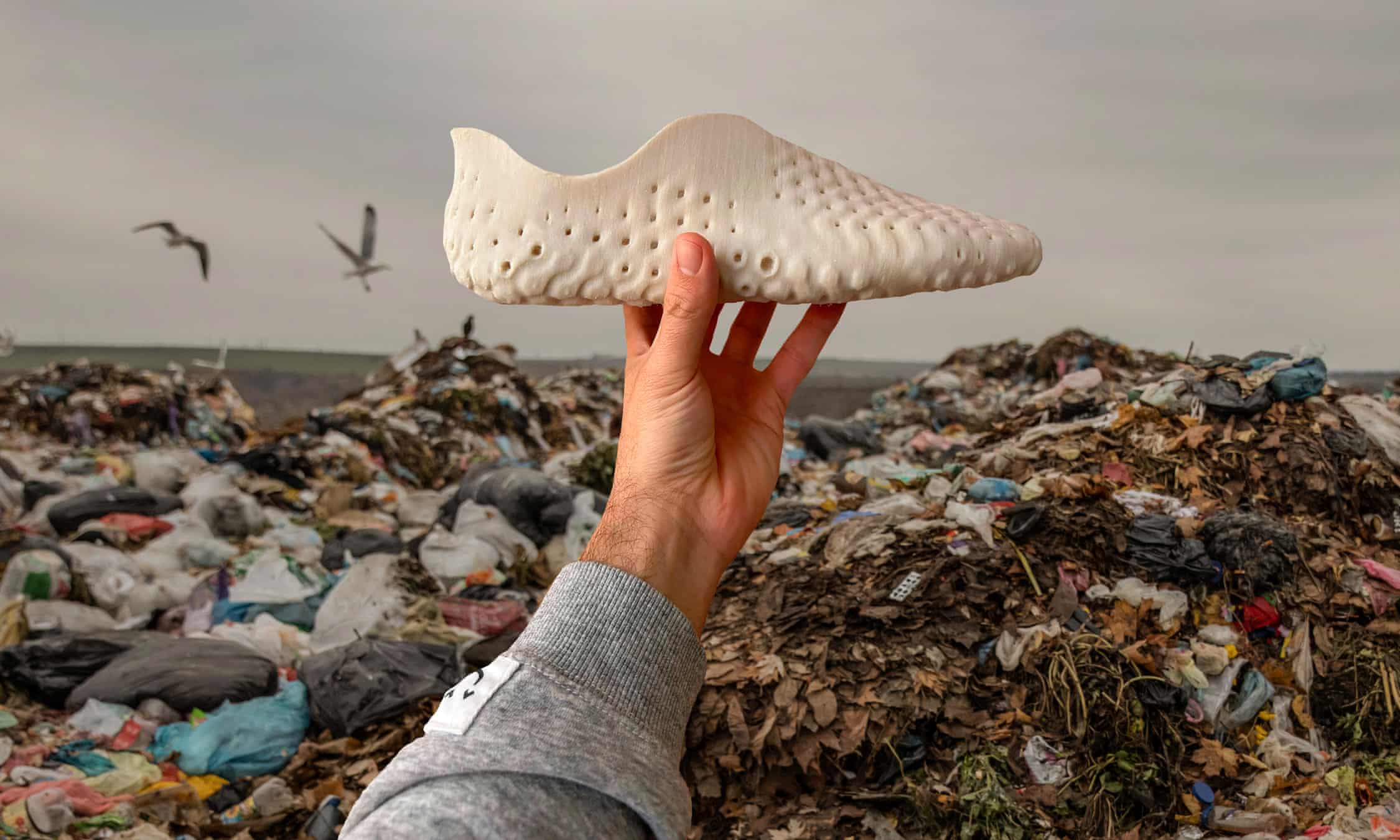
Compostable shoes are being created using 3D printing. 

Overthinking things can lead to a kind of paralysis. You want to do the right thing for the environment, you look for clothes not made with synthetics, wear the clothes many years, finally give them to Goodwill for others to use, and recycle raggedy textiles safely. But you know that a lot of this is still going to end up on the beaches of some African country. How can you do more? Do enough?

And what about shoes?

Well, one step at a time. You have to trust that every little bit helps.

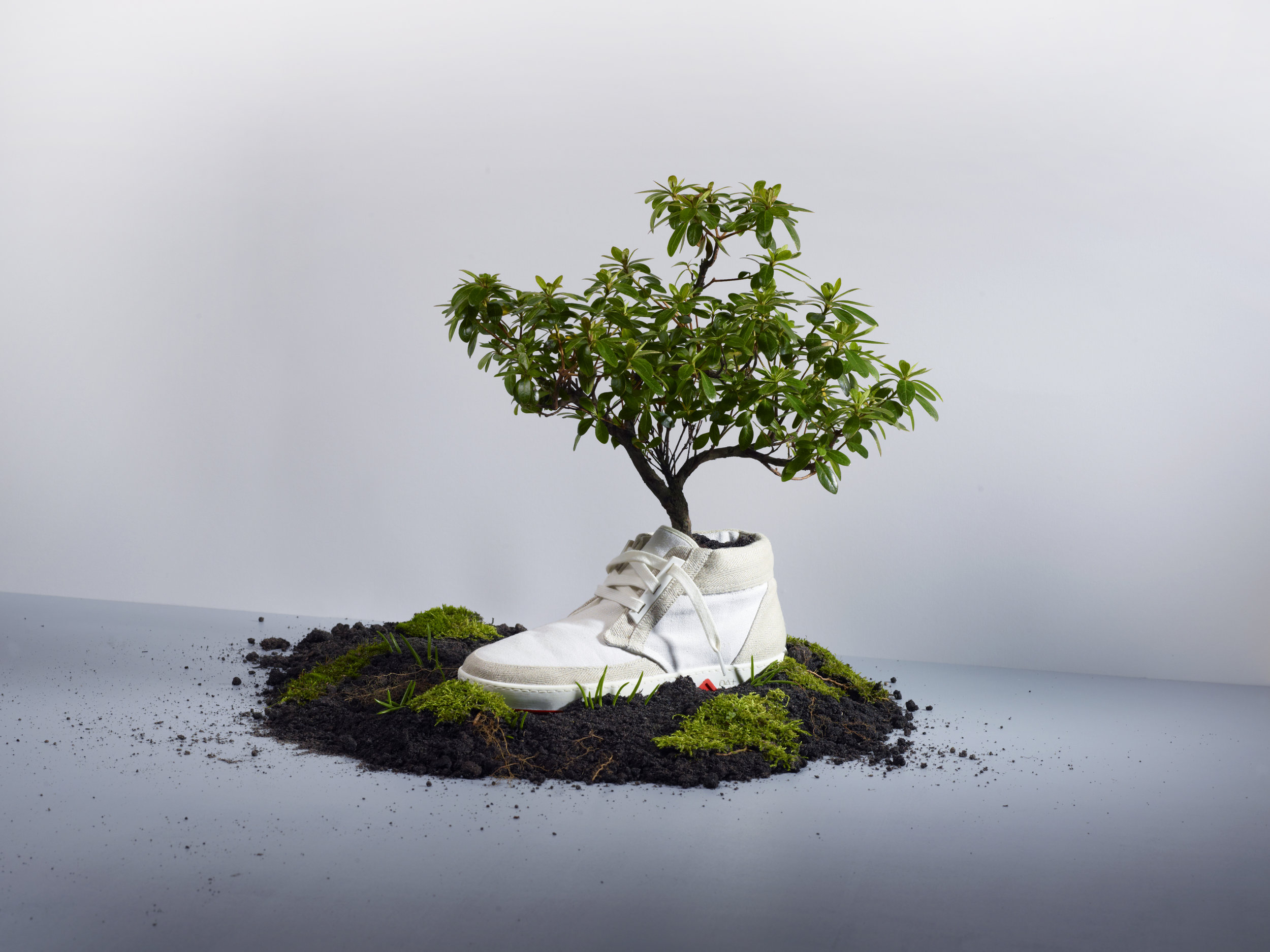
At the Guardian, Patrick Greenfield writes that there is now such a thing as a compostable shoe. “The shoes may not immediately strike you as the future of mainstream fashion. Pale and porous, they resemble a cross between a beige Croc and the long-net stinkhorn fungus found on forest floors. Their creators, however, hope this will be the next huge breakthrough in sustainable footwear: the world’s first 3D printed, made-to-measure, compostable shoe, which can be broken down at the end of its life, in an attempt to stem the flow of millions of shoes into landfill each year.

“Fashion is among the world’s top polluting industries. It is responsible for about 10% of global carbon emissions and consumes huge amounts of water and land for production. Modern shoes are among the hardest items to produce sustainably because of their complexity, say industry experts, and there are few reliable statistics about the number manufactured every year for the world’s 8 billion humans. There is an almost total dearth of statistics about their environmental impact.

“Most shoes are composed of a mixture of synthetic fabric, rubber, plastic and metal, which is often held together with strong adhesives, and they are incredibly difficult to dispose of. The vast majority are bound for landfill once used, where they could take hundreds of years to break down. There are efforts to pioneer recyclable trainers [sneakers] for the world’s $70bn (£55bn) industry, with some brands offering services if customers post back.

“To produce its new compostable model, the London-based shoe company Vivobarefoot has joined forces with a material science company, Balena, to create prototypes of the shoes, which are not yet available for sale. They will be manufactured based on in-store foot scans and then printed over 30 hours. Once they have worn down, the footwear can be returned for composting at an industrial facility. …

“Says Asher Clark, a co-founder of Vivobarefoot. ‘This is about reimagining the way things are done from linear, offshore production to the world’s first scan-to-print-to-soil footwear. It is a vision for cutting out a lot of waste in supply chains and providing an end of life solution for the footwear industry.’

“There are caveats to the sustainability claims of the shoes, says Clark, which will be sold for between £200 [$255] and £260 [$331]. BioCir flex, the patented thermoplastic used to make them is 51% biological materials, 49% petrochemical. It cannot be thrown on a compost heap at the end of the garden to break down – it needs to go to a composting plant. …

“ ‘There is a trade-off between the biodegradability and durability: that is the key tension. The external factors that break down physical products are things like light, heat and moisture,’ he says. ‘The challenge is to make a shoe that will handle all those elements but also respond to the elements that start to break it down at the end of its life.’ …

“Glue and other binding materials can make shoes difficult to recycle, even when new substances are used for their main components, such as cactus ‘leather’ – a material made from the leaves of the nopal cactus – and grape-skin derivatives, says Luca Mosca, fashion lead at the sustainability consultancy Quantis. He says it is still hard to say what constitutes an environmentally friendly shoe, and that consumers should use them for as long as possible. … ‘Shoes are very complicated products.’ ”

More at the Guardian, here.

Read Full Post »

Photo: Institute For Figuring.
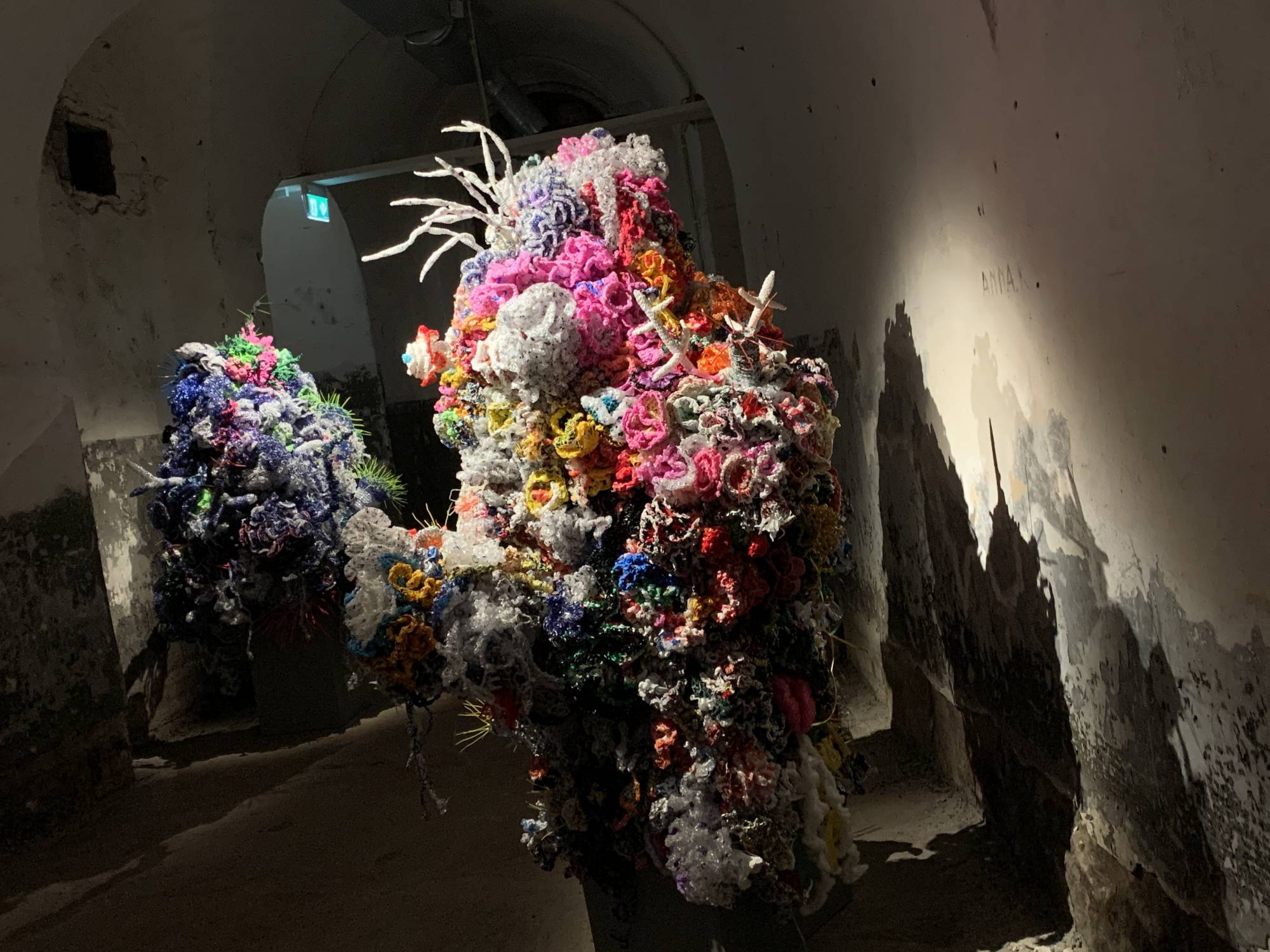
Coral Forest – Helsinki, crocheted from recycled plastic. A collaboration between Christine and Margaret Wertheim and the Helsinki Satellite Reefers, hosted by Helsink Art Museum and Helsinki Biennial 2021.

Remember my post on how crochet art was drawing attention to dying coral reefs? (See it here.) Well, after my friend Kristina told me about seeing some of the new additions to the crochet project, I decided to post a follow-up.

Siobhan Roberts reported at the New York Times in January, “Every year after the full moons in late October and November, Australia’s Great Barrier Reef begins its annual spawning — first the coral species inshore, where waters are warmer, then the offshore corals, the main event. Last year, this natural spectacle coincided with the woolly propagation of two new colonies of the Crochet Coral Reef, a long-running craft-science collaborative artwork now inhabiting the Schlossmuseum in Linz, Austria, and the Carnegie Museum of Art in Pittsburgh.

“To date, nearly 25,000 crocheters (‘reefers’) have created a worldwide archipelago of more than 50 reefs — both a paean to and a plea for these ecosystems, rainforests of the sea, which are threatened by climate change. The project also explores mathematical themes, since many living reef organisms biologically approximate the quirky curvature of hyperbolic geometry. …

“The surface of a sphere displays constant positive curvature; at all points, the surface bends inward toward itself. And a hyperbolic plane exhibits constant negative curvature; at all points, the surface curves away from itself. Reef life thrives on hyperbolism, so to speak; the curvy surface structure of coral maximizes nutrient intake, and nudibranchs propel through water with frilly flanges.

“In the artworks, marine morphologies are modeled — crocheted — with loopy verisimilitude. A bit like Monet’s water lilies, the crochet corals are abstract representations of nature, said Christine Wertheim, an artist and writer now retired from the California Institute of the Arts. Dr. Wertheim is the driving artistic force behind the project, which she created with Margaret Wertheim, her twin sister, a science writer who is in charge of scientific and mathematical components as well as management. …

“Crochet Coral Reef exhibitions typically have two main components: The Wertheims provide an anchor, of sorts, with works from their collection that they have crocheted over the years. They also incorporate pieces by select skilled international contributors. One is a ‘bleached reef,’ evoking corals stressed by increases in ocean temperature; another, a ‘coral forest’ made from yarn and plastic, laments the debris that pollutes reef systems.

“Then in response to an open call, volunteers far and wide crochet a pageant of individual specimens that agglomerate in a ‘satellite reef,’ staged by a local curatorial team with guidance from the Wertheims. … All contributors are credited.

“The largest satellite reef thus far coalesced in 2022 at the Museum Frieder Burda in Baden-Baden, Germany, with some 40,000 coral pieces by about 4,000 contributors. The Wertheims call this the Sistine Chapel of crochet reefs (documented in a splashy exhibition catalog). But the show at the Linz Schlossmuseum, which is dedicated to natural science as well as art and culture, is reminiscent of the work of the painter Giuseppe Arcimboldo, whose collage portraits from depictions of fruits, vegetables and flowers are ‘fantastically heterogeneous, also very funny and clever,’ Ms. Wertheim said.

“The Linz satellite reef unites some 30,000 pieces by 2,000 crocheters. The disparate parts take colorful inspiration from traditional Austrian ‘craftswomanship,’ as the exhibit text puts it, and there is a vast, glittery coral wall that gives a nod to the artist Gustav Klimt. In the Wertheims’ view, however, the crochet coral project is proof that it is not always lone geniuses who create great art, but also communities. In the art world, that is a radical idea, they noted, yet in science big collaborative projects and papers with thousands of authors are not unprecedented. …

“The mathematical dimension of the story intersects (from afar) with research by the applied mathematician Shankar Venkataramani and his students at the University of Arizona. They use idealized models to study hyperbolic surfaces in nature. [The] benefit, he said, is that it helps optimize processes like circulation and nutrient absorption. …

“When Margaret Wertheim, who studied math, physics and computer science at university, learned hyperbolic geometry, she found it ‘a bit bamboozling.’ She took the principles more on faith than understanding. Yet through crocheting models, she said, ‘you really do learn in a very deep way what a hyperbolic structure is, and in a way that I think is very powerfully pedagogical.’ “

More at the Times, here. Gorgeous photos.

See also Crochet Coral Reef, here. As the website notes, “Every crafter who contributes to the project is free to create new species of crochet reef organisms by changing the pattern of stitches or working with novel materials. Over time, a Darwinian landscape of wooly possibility has been brought into being. What started from simple seeds is now an ever-evolving, artifactual, hand-made ‘tree of life.’ “

Read Full Post »

Photo: Joel Sartore/Photo Ark.
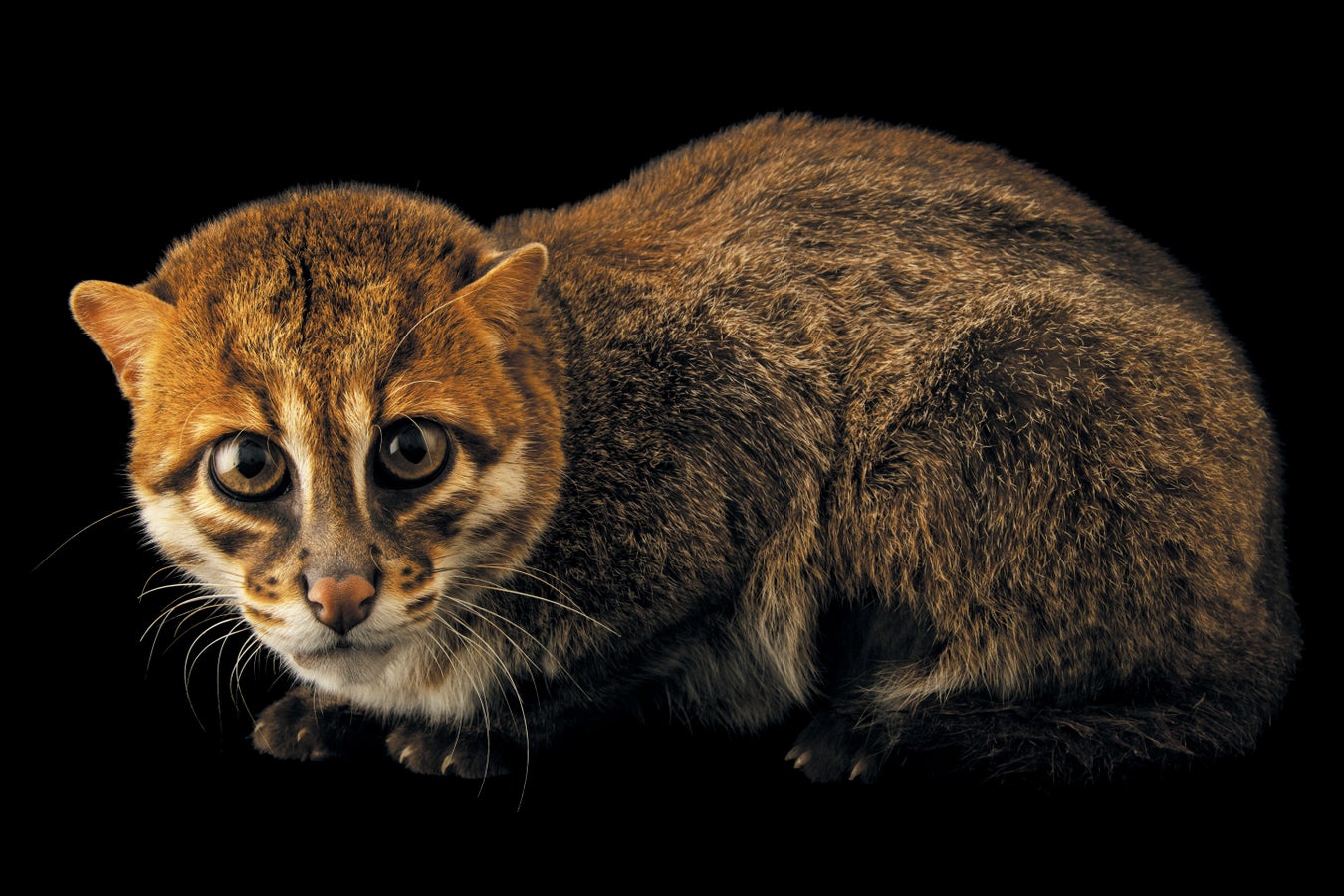
Rare flat-headed cats were declared “lost” before the species was rediscovered in 1995.

Lady Macbeth says, “What’s done cannot be undone.” Similarly, when a species is truly extinct, it’s done, never mind random talk of bringing back a wooly mammoth from its DNA. What is more feasible is bringing back to its former range a species that is merely extinct in that region.

Remember our post on the tiger quoll, thought to be extinct in southern Australia? And how about that gray whale, thought to be extinct in the Atlantic Ocean? It just showed up, although that was probably a sign of melting ice that could have opened a passage from the Pacific.

You might like Daniel Shailer’s related story at Scienific American on species that scientists think may yet be found. He explains how researchers will go about prioritizing their searches.

“Gison Morib was home lying in bed, sick from exhaustion after a month-long jungle expedition, when his phone buzzed and a black-and-white photograph appeared. Morib ran outside, jumped on his motorbike and sped through the city of Sentani on Indonesian New Guinea to his colleagues’ expedition and research base — where he broke down in tears.

“ ‘I cannot believe we found it,’ was all he could say, over and over. The photograph showed the first recorded sighting in more than 60 years of an Attenborough’s long-beaked echidna, an egg-laying mammal. After the researchers had spent three years of research and four weeks of trekking through the island’s remote Cyclops Mountains … the team’s camera trap had finally captured an image of the echidna. ‘Even now I can’t describe the feeling,’ … says Morib, a biology undergraduate student at nearby Cenderawasih University. …

“It can be painful for scientists to conclude that an entire species is gone forever. So after at least a decade without recorded sightings, local researchers sometimes simply declare a species temporarily ‘lost’ — hoping it may eventually be found again — instead of giving up entirely. In 2023 that hope led to rediscoveries of animals that included Attenborough’s echidna, De Winton’s golden mole in South Africa and the Victorian grassland earless dragon, a type of Australian lizard that went unseen for half a century. Such hope also fuels ongoing, decades-long searches for species such as the American Ivory-billed Woodpecker, which was last seen in 1944.

“Now an international study published [in] Global Change Biology aims to ‘bring a bit of science back to the search’ for all mammals, amphibians, reptiles and birds playing hide-and-seek, according to senior study author Thomas Evans, a conservation scientist at the Free University of Berlin. In a span of two years, Evans and a team of researchers across the globe — from the U.S. to China, Ecuador and South Africa — compiled what they call the most exhaustive catalog ever of four-limbed creatures that were considered lost to science and those among these animals that were later rediscovered. …

“Although there has been plenty of research into lost species, the study authors say that rediscoveries haven’t been thoroughly assessed since 2011. Analysis tallying losses and rediscoveries across animal groups is even rarer, Evans says.

“His team’s catalog suggests that 856 species are currently missing and that the number of lost species is growing around the world faster than expedition parties can keep up. And this is occurring even though researchers are finding animals through the use of increasingly sophisticated technology, including systems that detect environmental DNA (eDNA) traces of burrowing birds near the South Pole, software that disentangles the noises of different nocturnal species, and even techniques used to spot microscopic traces of rare frogs in ship rats’ stomachs.

“Adding up losses and rediscoveries also suggests that roughly a quarter of lost species are likely already extinct. … Analysis shows that many rediscovered species fit a certain profile: they are big, charismatic mammals or birds that tend to live across a range of habitats, often near humans and in more-developed countries. So, Evans says, if an animal fits the bill for the kind of species that is usually found more easily but continues to evade researchers after long searches, it is probably gone forever. The thylacine, or Tasmanian tiger, is a good example: since the last captive thylacine died in a zoo in 1936, the wolflike species has taken on huge cultural significance across Australia and inspired decades of searching, but it remains lost. The paper argues that precisely because the thylacine is a perfect candidate for rediscovery, the fact it remains lost strongly suggests that it is actually extinct. The same goes for more than 200 other lost species that have been thoroughly searched for as well, Evans says.

“On the other hand, creatures that don’t fit the profile for easy rediscovery, especially reptiles, could still be out there. Because they’re often hard to find and inspire less search effort, small, uncharismatic species are more likely to genuinely be lost but still alive, Evans says. His optimism is backed up by the numbers: new species of small reptiles continue to be discovered at a steady rate, and rediscoveries have boomed, with more than twice as many lost reptiles found between 2011 and 2020 than in the decade before.

“The thylacine has acquired a Bigfoot-like status, complete with amateur hunters and highly questionable sightings. Meanwhile reptiles such as the Fito leaf chameleon of Madagascar are probably sitting pretty and waiting to be found. …

“A probability analysis of some factors also rang ‘alarm bells’ in different ways for different classifications of lost species, Evans says. Mammals classified as lost on islands, such as the Bramble Cay melomys, a rat lost in 2009 and declared extinct in 2016, are disproportionately likely to be gone for good, compared with mammals in other environments. There’s also a sweet spot for finding birds after they’ve been lost: 66 years, on average. This time span is long enough to raise interest in search expeditions but not so long that the animals are considered extremely likely to be extinct. So the odds are not good for the more than a dozen bird species that were lost more than a century ago.

“Evans hopes such details about what may be simply unseen versus what is more likely extinct will help conservationists.”

More at Scientific American, here.

Read Full Post »

Photo: Philippe Ruault.
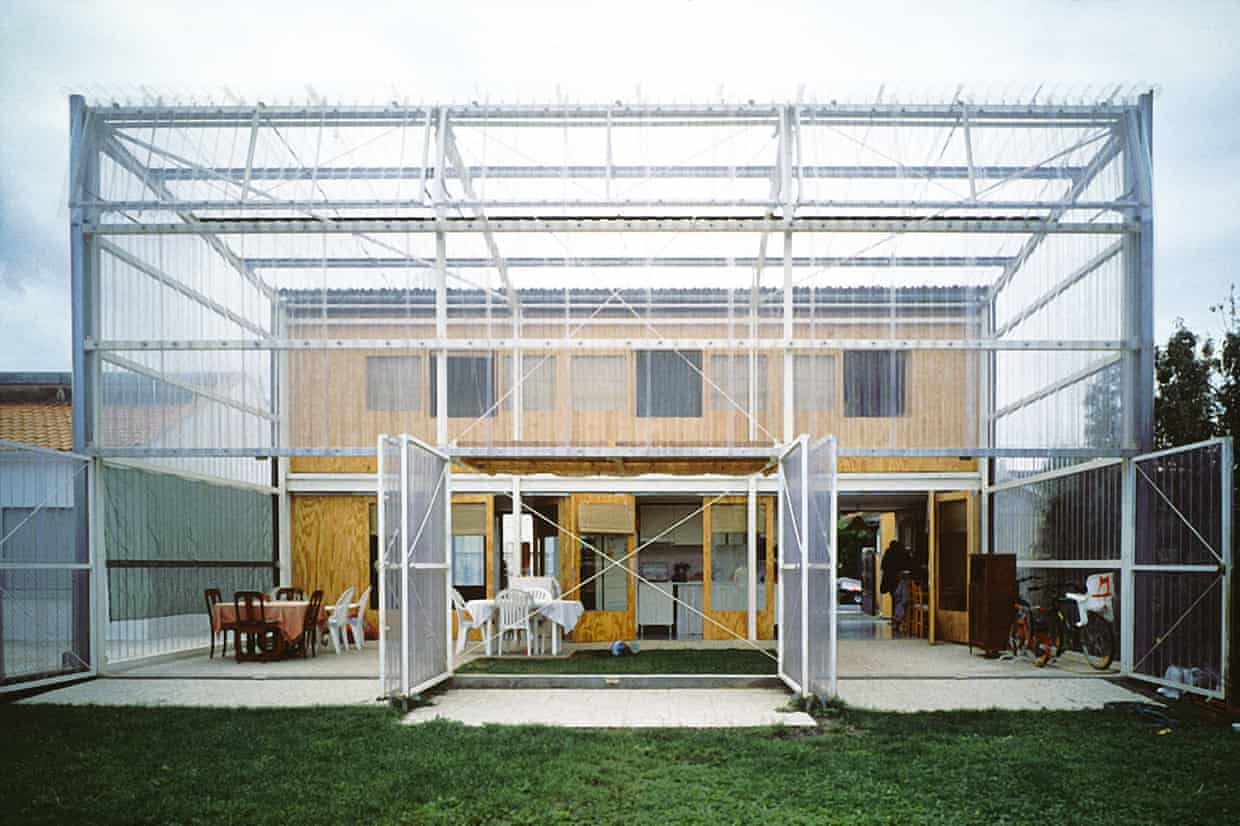
By adding a double-height conservatory at a family home in Floirac, Bordeaux, the architects “doubled the floor area their clients expected, while staying within a very limited budget,” the Guardian reports.

It’s generally considered cheaper and more efficient to tear down a building and build new than to renovate or reuse. Two acclaimed French architects have found the opposite, and their insights are timely. More people are realizing that standard construction practices are unnecessarily wasteful — and damaging to the planet.

Rowan Moore describes the architects’ approach at the Guardian. “The French architects Anne Lacaton and Jean-Philippe Vassal are famous for their belief in keeping existing buildings whenever possible, no matter how unpromising or unloved they may be. They follow, in effect, an architectural version of the Hippocratic oath – ‘first, don’t demolish.’ It’s a message that has never been more pertinent, as it dawns on the construction industry that constant demolition and rebuilding is an environmentally devastating activity.

“The husband-and-wife team have been putting this idea into practice for decades. … Keeping the already-there is not, though, their only concern, nor is it to do with sustainability alone. They like to use words such as ‘generosity,’ ‘kindness’ and, above all, ‘freedom,’ which means that they are always looking to find and create spaces additional to those asked for in a brief, ‘with no utility, no function,’ as Vassal puts it, ‘in which the user will feel the possibility to be inventive for themselves.’ …

“ ‘We really feel enclosed in a brief,’ says Lacaton, ‘that has so many rules, so many recommendations and impositions.’ … They strive against an attitude that ‘in architecture everything must be quantified… everything should be uniform.’ …

“In the early 1990s, they designed a new family house in their home city of Bordeaux, where they doubled the floor area their clients expected, while staying within a very limited budget. Their secret was to erect a double-height conservatory built like a simple greenhouse, which gave a sense of generosity and freedom to the rest of the house, a two-story structure with also basic construction. …

“[They have] a fondness for adapting humble and disregarded ways of building. ‘We found we were conditioned by our education as architects,’ says Lacaton, ‘to say that one way of constructing is the right one and the other one is not good. We discovered that we could use any tool, any material, anything if it’s used in an intelligent way.’ They also developed the idea of reusing the already-there, as with a seaside house in Gironde, south-west France. which was built among 46 pine trees, along with arbutuses and mimosas, without cutting any down. With the Palais de Tokyo in Paris, a 1930s building remodeled as a centre of contemporary art in two phases, in 2001 and 2012, they took pleasure in making only minimal alterations to its damaged interior. …

“Where they differ from other architects is in their attitude to control. In the John Soane museum, every detail and experience is minutely managed and directed. Contemporary practitioners often photograph their works unpopulated, at the precise moment between completion and inhabitation, where the perfection of their idea is most immaculate. For Lacaton and Vassal, it’s important to know when to stop, when to leave it to residents to occupy and embellish their homes. They enjoy and photograph the different things that people do to their spaces.

“Their way is humane and intelligent. It’s also invaluable. In Britain and elsewhere, there’s a desperate need to create more homes without incurring unacceptable bills for carbon emissions and energy consumption. Reuse is an obvious answer.”

More at the Guardian, here.

Read Full Post »

Photo: LaDameBucolique.
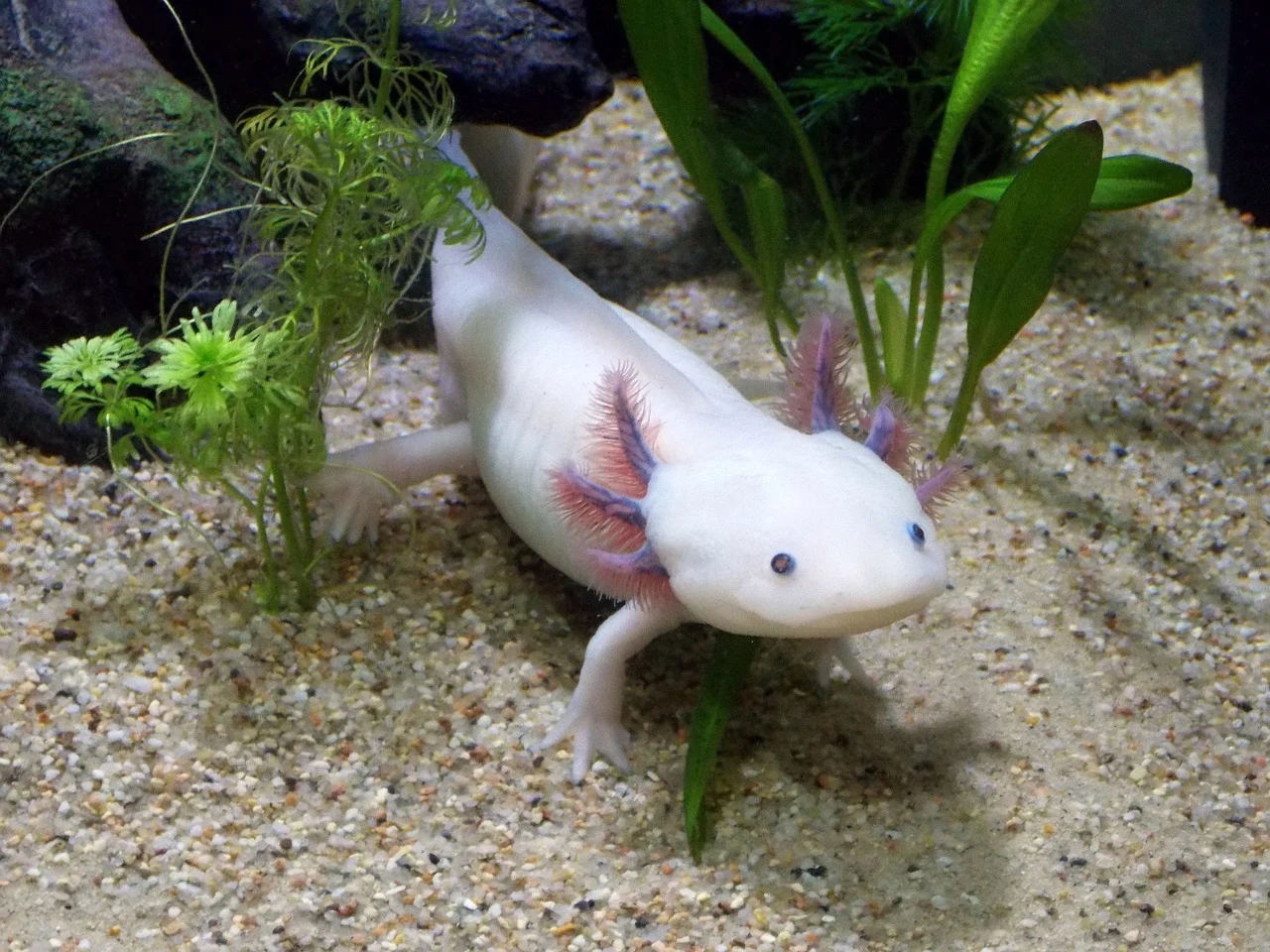
A Mexican Salamander in captivity.

People who put development before the natural environment are known to wax indignant at protections for small critters like the snail darter fish or the northern spotted owl. But what happens to the smallest of these effects us, too. Today’s article explains about pollution and the Mexican salamander.

The Associated Press (AP) reported on November 25th “Ecologists from Mexico’s National Autonomous University on Friday relaunched a fundraising campaign to bolster conservation efforts for axolotls, a native, endangered fish-like type of salamander.

“The campaign, called Adoptaxolotl, asks people for as little as 600 pesos (about $35) to virtually adopt one of the tiny ‘water monsters.’ Virtual adoption comes with live updates on your axolotl’s health. For less money, donors can buy a virtual dinner for one of the creatures, which are relatively popular pets in the US.

“In Mexican axolotls’ main habitat, the population density has plummeted 99.5% in under two decades, according to scientists behind the fundraiser.

“Last year’s Adoptaxolotl campaign raised just more than 450,000 pesos ($26,300) towards an experimental captive-breeding program and efforts to restore habitat in the ancient Aztec canals of Xochimilco, a southern borough of Mexico City.

“Still, there are not enough resources for thorough research, said Alejandro Calzada, an ecologist surveying less well-known species of axolotls for the government’s environment department. …

Despite the creature’s recent rise to popularity, almost all 18 species of axolotl in Mexico remain critically endangered, threatened by encroaching water pollution, a deadly amphibian fungus and non-native rainbow trout.

“While scientists could once find 6,000 axolotls on average per square kilometer in Mexico, there are now only 36, according to the National Autonomous University’s latest census. A more recent international study found less than 1,000 Mexican axolotls left in the wild.

“Luis Zambrano González, one of the university’s scientists announcing the fundraiser, told the Associated Press he hopes to begin a new census (the first since 2014) in March.”Luis Zambrano González, one of the university’s scientists announcing the fundraiser, told the Associated Press he hopes to begin a new census (the first since 2014) in March.

“ ‘There is no more time for Xochimilco,’ said Zambrano. ‘The “invasion” of pollution is very strong: soccer fields, floating dens. It is very sad.’

“Without data on the number and distribution of different axolotl species in Mexico, it is hard to know how long the creatures have left, and where to prioritize what resources are available. …

“Axolotls have grown into a cultural icon in Mexico for their unique, slimy appearance and uncanny ability to regrow limbs. Scientists in labs around the world think this healing power could hold the secret to tissue repair and even cancer recovery.

“In the past, government conservation programs have largely focused on the most popular species: the Mexican axolotl, found in Xochimilco. But other species can be found across the country, from tiny streams in the valley of Mexico to the northern Sonora desert.

“Mexico City’s expanding urbanization has damaged the water quality of the canals, while in lakes around the capital rainbow trout, which escape from farms, can displace axolotls and eat their food.”

More at AP via the Guardian, here, and at Wikipedia, here.

Invasive species that eat the food of native species are a problem everywhere. In a turtle presentation last week I learned that the red-eared slider, one of the 100 most invasive species in the world, is such a problem turtle that environmentalists often recommend killing it in the freezer. Sometimes called the “pet shop turtle,” it is an invasive pest in many parts of the world, making it hard for other turtles to survive.

Read Full Post »

Photo: BBC News.
Rooted in Hull, a nonprofit that teaches people how to grow produce in urban areas, flourishes in the industrial heartland of Hull, UK.

Here’s a city in the UK that is essentially giving residents permission to save the planet in those small ways that can add up. It’s about growing healthful food where polluting industry once held sway.

Kevin Shoesmith writes at BBC News, “Hull looks set to become the first UK city to give people the ‘right to grow’ food on disused council land.

“Council bosses say the move would bring communities together, reduce antisocial behavior and make places look better, as well as put quality food on dinner plates. As campaigners call for the idea to be adopted nationally, BBC News visited one Hull-based community group that is ahead of the curve, growing healthy food in the shadows of factories. …

“In multiple raised beds on a graveled patch of land off St Peter’s Street, plants flourish, irrigated using a system which collects and stores rainwater from the roof of the Royal Mail’s sorting office next door.

“Stopping to inspect an apple tree as an HGV rattles by, Martin King, manager of Rooted in Hull, a not-for-profit community organization, said staff and volunteers have proven food can be grown almost anywhere.

” ‘You don’t need a lot at all,’ he says, grinning. ‘Joinery students at Hull College made the raised beds for us.’

“The organization acquired the land in 2015, with Mr King explaining it was once a basin used to hold ships delivering timber to a nearby dock. A stipulation of the lease, he told me, is that no foundations must be dug, hence the presence of containers, a compost toilet and even a reed bed that filters dirty dishwater. …

“[King is] supportive of Hull councillors who recently unanimously passed a ‘right to grow’ motion. If approved by the city council’s scrutiny committee, a map would eventually be produced showing suitable land it owns that could be used by those who want to grow their own fresh food.

“Hull would become the first city in the UK to give people a right to grow on unused council land. …

“Inside a grocery box before us is an abundance of autumnal vegetables destined for the dinner plates of volunteers. Glancing over the road towards the muddy banks of the River Hull, [King] says: ‘Let’s wash away the idea that Hull is some rundown backwater.’

“Incredible Edible, a network of more than 150 community growing groups, is pressing for more councils to do the same. The group insists unused land could ‘with a little TLC be turned into oases for food and wildlife.’ …

” ‘Land already earmarked for building in the future could be temporarily used to grow food,’ [Councillor Gill Kennett] says. ‘Years pass before the foundations are laid and fruit and vegetables could be grown over several seasons.’

“Councillor Mark Ieronimo, the council’s infrastructure portfolio holder, says the city is ‘blessed with green areas,’ adding there are also spaces that are no longer used, such as former car parks. … ‘This will bring people together and it’ll improve mental health and reduce food waste.’

“Back at Rooted in Hull, two volunteers beaver away, weeding and removing the remains of wilted, summer crops. Kale and butternut squash are in plentiful supply.

“Mr King agrees community gardening projects such as this one can help boost mental wellbeing. He says the group works with many vulnerable members of society, including Hull All Nations Alliance (HANA), which helps refugees.

” ‘We had a group of kids from HANA come down,’ he points out. ‘They made chips and pizzas using produce grown here. We help tackle social isolation.’

“At the back of the yard, there are three beehives. ‘A man serving a sentence at HMP Hull used his graphic skills to design labels for the honey,’ Mr King informs me.

“Mr King is content but conscious that more spaces, not just in Hull, could be used in a similar way for food production.”

More at BBC News, here.

Read Full Post »

Photo: Alexandra Ionescu/Rhode Island Collective.
This floating wetland, an artificial island hosting a human-made ecosystem, was scheduled to remain in Ice Pond in Southborough, Mass., until Sept. 17.

Here’s a new thing under the sun: a floating wetland. Art and science join forces, and Frank Carini at ecoRI News has the story.

“Floating in a circle around a pond in Massachusetts is a mini-wetland built by six Rhode Islanders. Earlier this summer, the mostly natural creation was chosen as the winning installation in the seventh annual Art on the Trails outdoor art and poetry program.

“But the freshwater wetland, built by a group of Ocean State artists, designers, and a botanist, wasn’t commissioned to win an award. It was designed to raise awareness about the importance of wetlands and show how they work. Mission accomplished.

“Art juror Sarah Alexander, who chose ‘Below and Above: A Floating Wetland Supports Life” by the Rhode Island Collective as the best installation, said, ‘The amount of careful research and thoughtful response to the space, along with the combined efforts of its dedicated creators, blew me away.’ …

“The wetland has been floating in Ice Pond in Southborough since June 11. It was created by sourcing native plants, and experiments with natural cordage. It shows how pollutants could be sucked from stressed waterbodies with a little help from human hands. A single anchor line keeps the wetland floating in a 15-foot circle, and not all over the popular skating pond.

“Members of the Rhode Island Collective include Holly Ewald (visual artist), Maxwell Fertik (interdisciplinary artist), Alexandra Ionescu (ecological artist), Hope Leeson (botanist), and August Lehrecke and Matthew Muller (co-founders of an inflatable architecture studio), who led the project’s construction. …

“ ‘The floating wetland ecosystem creates a habitat for the more-than-human world below and above the water line through the growth of native macrophytes. Through the plants’ life cycles, they regenerate the food web, amplifying the natural processes between sunlight, water, and microorganisms,’ according to the Collective. …

“Their structure was built using dried Japanese knotweed, broadleaf cattails, and bamboo for buoyancy, as alternatives to petroleum-based materials such as plastic and foam typically used to construct floating wetlands. A small amount of stainless steel wire mesh and cable holds the craft together.

“The knotweed used to create the floating wetland was harvested in late winter as dry stems from Mashapaug Pond and Gano Park in Providence. Fertik said repurposing invasive species for the project’s pontoons removed some of their biomass from the environment and transformed the nonnative plants into a vessel to improve water quality and promote biodiversity. (The dead stalks weren’t capable of spreading.) …

“The craft is home to 18 native wetland plant species: American bur-reed; bayonet rush; brown fruited rush; Canada rush; common cattail; Alleghany monkey-flower; blue flag iris; boneset; cardinal flower; flat-topped goldenrod; Joe-Pye weed; New York ironweed; northern water horehound; pickerelweed; swamp milkweed; buttonbush; silky dogwood; and steeplebush. …

“Suspended in water, the plant roots provide a home for diverse communities of algae, bacteria, fungi, and protozoans, known as periphyton. As the plants upcycle nutrients from the water into their roots, stems, leaves, and flowers, the periphyton provide nutrient uptake, filtration, oxygenation, and toxin removal.

“Southern New England’s freshwater lakes and ponds, especially the shallow ones, are being stressed by development, wastewater overflows, old and failing septic systems, antiquated cesspools, and stormwater runoff carrying nutrients such as nitrogen and phosphorous from fertilizers and roadway pollutants such as polycyclic aromatic hydrocarbons. …

“The Collective’s 48-page PowerPoint presentation noted Indigenous communities built floating islands for hundreds of years by harvesting natural materials found in their surroundings. ‘By incorporating native plants from freshwater marsh and pond ecosystems, we are supporting a variety of other life forms,’ they said.

“Ice Pond, part of the 58.5-acre Elaine and Philip Beals Preserve, is a healthy ecosystem in little need of a floating wetland to pull pollutants out of the water, but it did give the Collective an opportunity to learn how floating wetlands create a habitat, observe the decay of the natural materials used to build the craft, and document the growth of the native wetland plants. … The Providence Stormwater Innovation Center has requested the craft’s presence for the ponds at Roger Williams Park. …

Art on the Trails is an annual site-specific ecological sculpture park exhibition. To watch a video about the project, click here.

More at ecoRI News, here.

Read Full Post »

Photo: The Guardian.
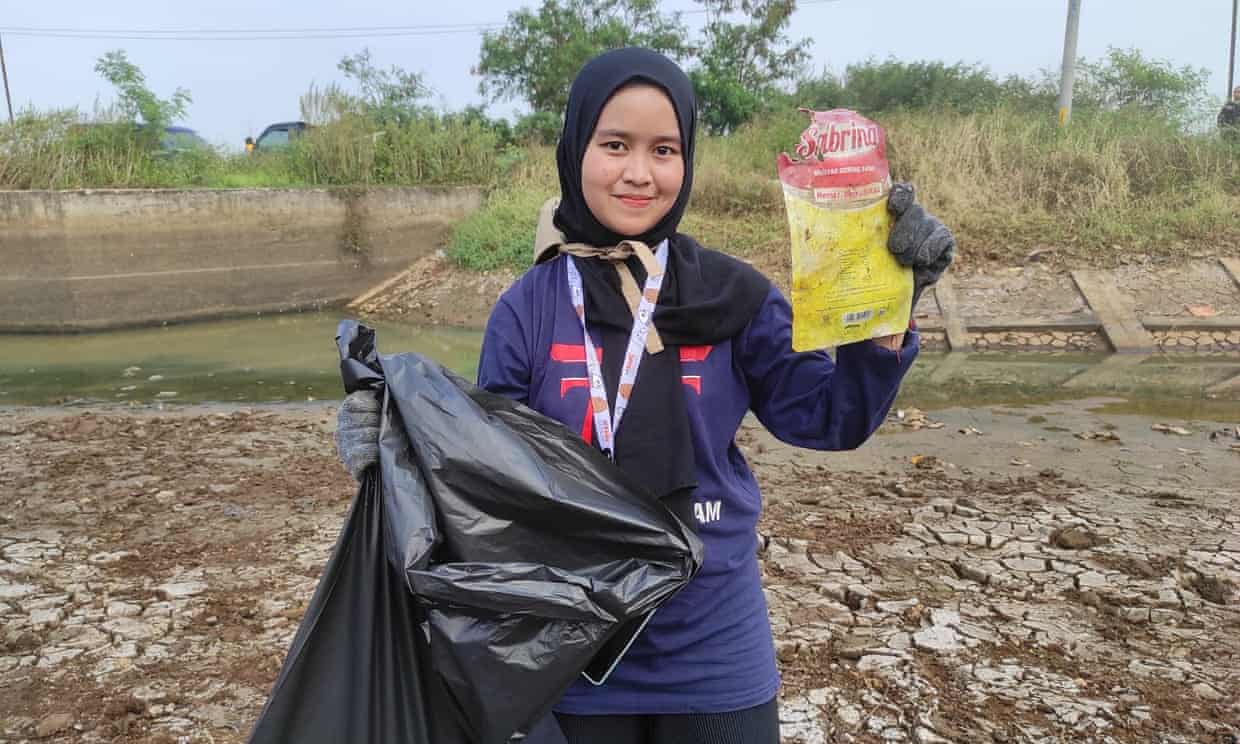
Resti Khairunnisa, 22, is a follower of Pandawara on TikTok. She joins other followers in collecting plastic waste from the Bandung dam in Indonesia. 

The young people will save us all. They certainly shouldn’t have to, but it restores our faith in humanity when we see them taking “arms against a sea of troubles” and not wasting time blaming those of us who deserve blame.

What is the secret of their strength? Perhaps not knowing what’s “impossible” enables people to do it anyway.

Guardian reporter Ardila Syakriah has this story from Indonesia.

“They started as flood victims, now they are touted as local heroes for cleaning up the rivers and beaches of Indonesia’s third largest city, Bandung in West Java, amassing over 9 million followers on TikTok and Instagram in the process and influencing others across the country to join the fight against pollution.

“The Pandawara group is five men in their early twenties and was formed in 2022 after flooding caused by rivers clogged with rubbish damaged their homes. … On TikTok, their profile – @pandawaragroup – contains over 100 short videos of their river and beach clean ups, earning them millions of views and totalling over 100 million likes.

“ ‘We have a team of river hunters who identifies rivers with urgent trash issues, where flooding can happen after rainfall,’ Pandawara member Gilang Rahma told the Guardian.

“The Greater Bandung area where they live produces 2,000 tons of waste each day, 10 to 20% of which doesn’t make it to landfill and often ends up in rivers. The vast mountain of waste produced in the region has exceeded landfill capacity by 800%, according to West Java official Prima Mayaningtyas. …

“Pandawara began modestly in 2022, cleaning up rivers around their neighborhood, protected by rubber hand gloves and boots. As they became full-time online celebrities-slash-activists, they were invited to meet government officials and receive partnership deals. As their popularity grew, so did their cleanups, which spread to other islands in Indonesia. 

TikTok went as far as to deem some videos as sensitive content because the sight of decaying rubbish might be considered disturbing by some viewers. …

“ ‘Sometimes when we call for volunteers, thousands would sign up but we could only select dozens due to limited space. At other times we don’t limit the number. These are for when we can’t clean up by ourselves,’ Gilang said, adding that the group hoped to use the social media platform to raise gen Z’s awareness of pollution.

“Pandawara’s latest call saw 600 people, including local government staff and officials, join the clean up of 17 tons of waste from the Bugel dam in Bandung regency, which is connected to West Java’s longest river, on 27 July.

“One of them was 22-year-old Resti Khairunnisa, who went straight to volunteering after finishing a night shift. Resti, who lives nearby the dam, said she had been inspired by Pandawara’s videos and would not hesitate to jump in even with limited protective gear.

“ ‘I haven’t slept at all. I’ve been concerned about waste pollution, but this is my first time taking action,’ she said after three hours of cleaning up, her sandals fully covered by mud.

“Another volunteer, 21-year-old university student Imam Ahmad Fadhil, himself a victim of floods, said he had been following Pandawara since before they became famous and lauded the group’s consistency. But he maintained that community-based initiatives were not enough.

“ ‘Some people know littering is wrong, but there is no waste facility in their village, nor do they have the tools to transport the waste, so they are left with no other options,’ he said.

“West Java official Prima Mayaningtyas acknowledged the need to improve waste management and people’s behaviors amid growing waste volumes, as the government looks to complete the construction of its estimated [$265 million] waste to energy plants by 2030.”

More at the Guardian, here.

Read Full Post »

Photo: Wikipedia.

There are so many things on this beautiful planet that we’ve never given much thought — things that turn out to be important for our future. Insects, for example, fungi, seagrass.

Allyson Chiu , with Michaella Sallu contributing from Sierra Leone, has written about seagrass research for the Washington Post.

“From the deck of a small blue-and-white boat, Bashiru Bangura leaned forward and peered into the ocean, his gaze trained on a large dark patch just beneath the jade-green waves.

“ ‘It’s here! It’s here! It’s here!’ crowed a local fisherman, who led Bangura to this spot roughly 60 miles off the coast of Freetown. ‘It looks black!’

“Bangura, who works for Sierra Leone’s Environment Protection Agency, tempered his excitement. After two unsuccessful attempts to find seagrass in this group of islands, he questioned whether the shadowy blotches were meadows of the critical underwater greenery he and other researchers have spent the past several years trying to locate along the coast of West Africa.

“It was only once he was standing in the waist-high water, marveling at the tuft of scraggly hair-like strands he’d uprooted to collect as a sample, that he allowed himself to smile.

“The wet, reedy plants Bangura held in his hands were unmistakably seagrass, and the green blades stretched past the plastic 12-inch ruler he’d been using to measure specimens. His grin grew even wider.

“The dense grass swaying in the current appeared to be healthy, and the water teemed with schools of small, silvery fish, making it the best site researchers have documented in these islands since the existence of seagrass was first confirmed in Sierra Leone in 2019. …

“Seagrasses — which range from stubby sprout-like vegetation to elongated plants with flat, ribbon-like leaves — are one of the world’s most productive underwater ecosystems. The meadows are vital habitats for a variety of aquatic wildlife.

Sometimes described as ‘the lungs of the sea,’ the grasses produce large amounts of oxygen essential for fish in shallow coastal waters.

“But, long overlooked, these critical ecosystems are vanishing. In fact, researchers don’t know exactly how many exist or have been lost. One recent study estimated that since 1880, about 19 percent of the world’s surveyed seagrass meadows have disappeared — an area larger than Rhode Island — partly as a result of development and fishing.

“ ‘When you lose foundation species like seagrasses … then you lose fisheries really quickly,’ said Jessie Jarvis, a marine ecologist who, until recently, headed the World Seagrass Association. …

“But locating grasses in the world’s vast oceans is a formidable task. While some researchers are using drones and satellite imaging, in countries such as Sierra Leone, where resources are scarce, the search is painstaking and tedious.

“Without these efforts, though, seagrasses would probably be disappearing even faster.

“ ‘What we don’t know, we can’t protect,’ said Marco Vinaccia, a climate change expert with GRID-Arendal, an environmental nonprofit that helped put together West Africa’s first seagrass atlas. …

“Similar to terrestrial plants, seagrasses have roots, leaves, flowers and seeds. Seagrasses have been discovered in the waters off more than 150 countries on six continents. The meadows are estimated to cover more than 300,000 square kilometers, an area the size of Germany. Along with mangroves, kelp forests and coral reefs, these grasses play a vital role in maintaining healthy oceans, Jarvis said. But unlike those other ecosystems, she notes, the meadows can exist in a wider range of ocean environments and tend to be more resilient than most species of seaweed.

“Critters, such as sea horses, crabs and shrimp, along with juvenile fish — some of which are critical species for fishing — often lurk within the thick meadows, seeking refuge beneath the underwater canopy. Other creatures, including sponges, clams and sea anemones, can be found nestled between the blades of grass or in the murky sediment at the base of the plants. And much as mosses coat trees, many species of algae grow directly on the leaves.

“Seagrass beds can in turn attract larger animals, including turtles and manatees, that stop by to munch on the leaves and stems. …

“From the leaves down to the roots, these unassuming plants work as ‘ecosystem engineers.’ Through photosynthesis, they help fill the surrounding water with oxygen. The leaves also absorb nutrients, including those in runoff from land, while their roots stabilize sediment, which helps to reduce erosion and protect coastlines during storms.

“Seagrasses also have the potential to play a significant role in combating climate change. Just as trees pull carbon from the air, seagrasses do the same underwater. Then, as the carbon-filled parts of the plants die, they can wind up buried in the sediment on the seafloor. Over time, this can help create sizable carbon deposits that could remain for millennia.

“But the grasses aren’t showy like coral reefs or immediately recognizable like mangroves, and they’ve become one of the least protected coastal ecosystems.”

Read more about what is being done here, at the Post.

Read Full Post »

Photo: Annas Radin Syarif / AMAN at Medium.
A Kajang elder in Indonesia demonstrates the wearing of a passapu headwrap and the passing of knowledge to the next generation.

While most of the world was going full-steam on nature-destroying “progress,” many indigenous groups were quietly protecting whatever was left.

Peter Yeung at the Washington Post writes about the Kajang people in Indonesia.

“By midmorning, beams of tropical sun cut through the rainforest canopy, illuminating a bamboo hut in a rare clearing of trees. Inside, a wrinkled old man, sitting cross-legged with his eyes shut, whispers blessings to the Earth.

“After the spiritual leader, the Ammatoa, goes silent, groups of men wearing dark indigo sarongs jump to their feet and head into the forest carrying an offering of rattan baskets full of rice, bananas and lighted candles.

‘The Earth is angry with us,’ said Budi, a barefoot boy crouching on the hut’s edge. ‘That is why the weather is getting worse. There are more rains and floods. It is getting hotter. It is because we have sinned.’

“This ritual is known as the Andingingi, held once a year by the Kajang, a tribe from the Indonesian island of Sulawesi. Like many parts of the world, their land has been hit by more extreme weather because of climate change. But as satellite imagery shows, the Kajang’s dense primary forest is free from roads and development, soaking up violent rains that devastate other parts of the island.

“As global deforestation continues at alarming rates, the empowerment of Indigenous peoples such as the Kajang is emerging as a key way to protect the world’s rainforests. A spate of recent research suggests that when armed with land rights, these communities, whose members manage half the world’s land and 80 percent of its biodiversity, are remarkably effective custodians. …

“The Kajang [community] lives according to the Pasang Ri Kajang, an ancestral law passed down orally through legends and tales. It tells of how the first human fell from the sky into their forest, making it the most sacred place on Earth.

“In practice, that means the forest is at the center of life. The Kajang rely on subsistence agriculture, with no industry or commerce to speak of. Cutting trees, hunting animals and even pulling up grass is prohibited on most of the land. Modern technology, such as cars and mobile phones, is not allowed within the traditional territory.

“ ‘The tree is just like a human body,’ said Mail, a 28-year-old Kajang. … ‘If the forest is destroyed, there will be nothing for the bees, nothing for the flowers and nothing for life.’

“So far, Indigenous tribes have received little legal, financial or institutional backing, advocates say. A 2021 report by the nonprofit Rainforest Foundation Norway found that over the past decade, Indigenous peoples received less than 1 percent of donor funding for fighting deforestation.

“Yet policy is now beginning to shift in recognition of the role they can play in protecting the land. …

“At the U.N. Climate Change Conference in 2021, also known as COP26, world leaders pledged $1.7 billion of funding for these communities, calling them ‘guardians of forests.’ …

“In December 2016, the Indonesian government officially recognized more than 50 square miles of rainforest as belonging to nine of the country’s tribes — including the Kajang — following a landmark ruling by the nation’s highest court. … In a case brought by the Alliance of Indigenous Peoples of the Archipelago (AMAN), an Indonesian nonprofit, the Constitutional Court ruled in 2013 that the state should transfer ownership of what are called customary forests to the Indigenous peoples who had historically governed them according to custom. …

“The rate of primary forest loss in Indonesia has declined every year since 2016, according to the most recent data available, and is now at its lowest level since at least 2002.

“The recognition of customary forests, along with government efforts to protect peatlands and mangroves and to tighten regulations on logging, oil palm and mining permits, has helped drive that reduction. …

“The Kajang are a showcase of Indonesia’s experiment. For years, local forest rangers have helped protect a wealth of native wildlife, including deer, monkeys, wild boars and tropical birds, as well as four rivers, whose watersheds supply several villages outside Kajang land. ..

“The philosophy of Kamase Mase, living simply and taking no more than needed to subsist, underpins their lifestyle here. …

“ ‘We must keep the tradition,’ said Jaja Tika, a weaver. … ‘As long as we live, the forest will exist.’ ”

More at the Post, here.

Read Full Post »

Photo: Alfredo Sosa/CSM Staff.
Students from Thorpe Gordon Elementary in Jefferson City, Missouri, at the Runge Conservation Nature Center in April.

It’s not a new idea, but it’s gaining traction: Getting kids outside into nature benefits their learning.

Jackie Valley writes at the Christian Science Monitor, “Down a hiking path and through the woods, giggles and chatter echo from a clearing where elementary students have just finished constructing makeshift shelters.

The challenge blended environment with engineering, hence this visit to the Runge Nature Center from third, fourth, and fifth graders. They’re part of a STEM (science, technology, engineering, and math) club at nearby Thorpe Gordon Elementary in Jefferson City, Missouri. …

“A boy announces he saw a turkey, while another student proclaims ‘teamwork’ her favorite part. The scene portrays what conservation leaders and educators in Missouri are hoping to instill in the state’s youngest residents: an appreciation for the outdoors, a new experience, and some learning along the way.

“ ‘I think it’s so important,” says Melanie Thompson, a librarian from the elementary school who’s leading the STEM group on this day. ‘Kids don’t spend enough time playing outside.’

“In Missouri, efforts to connect children with nature date back to 1939. That’s when the Nature Knights program launched, giving children recognition for conservation practices. Three years earlier, the state’s residents approved an amendment that created an apolitical conservation agency.

“Today, terms such as nature education, outdoor learning, and environmental education refer to instruction that, in many ways, takes students out of traditional classroom settings. Subtle nuances exist, though, depending on the location and programming. The Environmental Protection Agency defines environmental education as a type of learning that allows people to ‘explore environmental issues, engage in problem solving, and take action to improve the environment’ – while also not advocating a particular viewpoint.

“The Missouri Department of Conservation, meanwhile, sees nature education as a way to ‘inspire and educate individuals about nature so they appreciate and ultimately protect our resources and wild places,’ says Brian Flowers, a regional supervisor for the agency’s education branch. …

“ ‘You introduce them to it,’ says Mr. Flowers, referring to conservation, natural resources, and wildlife. ‘You show them why it’s important, and, eventually, that leads to that they care about it. They protect it.’

“A study called The Nature of Americans, conducted in 2015 and 2016, found that more than 80% of children surveyed said time in nature made them feel creative, happy, healthy, and smarter. …

“ ‘Once they’re there, there’s so much that happens – curiosity and creativity and just enjoyment of being outside,’ [Megan Willig, a program coordinator for the National Environmental Education Foundation] says. It can also introduce students to career pathways in the natural resource, conservation, and STEM fields.

“In a grassy field not far from an elderberry patch, a sustainably designed building with large windows and a gently sloping roofline is under construction. It’s the future Boone County Nature School, which occupies land in the Three Creeks Conservation Area and will welcome a rotating cast of 12,000 to 13,000 students each year, says Mr. Flowers.

“The project represents a partnership among the Missouri Department of Conservation, Columbia Public Schools, community organizations, and other school districts in Boone County.

“Columbia Public Schools has hired a teacher to lead instructional efforts at the Boone County Nature School, which fits into the district’s overall mission to pour more resources into place-based learning, says Michelle Baumstark, the chief communications officer. About half of the district’s students qualify for free or reduced-price lunch.

“ ‘These may not be experiences that they would have any other way and when you can create an access to an enriching opportunity, that can change the trajectory of a kid,’ she says.

“The land surrounding the nature school will feature a food forest, pollinator plots, a prairie restoration area, trails, a pavilion, and a council house with three tiers of stadium seating. The karst topography of the conservation area – caves, springs, and hills – is typically only found in southern Missouri near the Ozarks, making it an ideal exploration area for local children, Mr. Flowers says. …

“The Missouri Department of Conservation also operates programs that teach students archery and how to fish, among other things. And, in St. Louis, pavement will be removed and replaced with a green schoolyard at Froebel Literacy Academy. Picture a park-like setting with trees and wildflowers, where students can play and learn through STEM activities.

“The schoolyard project represents a step toward outdoor equity for children who grow up in urban areas that have more concrete and asphalt than lush, green recreation space, says Aaron Jeffries, deputy director of the Missouri Department of Conservation. …

“There’s no national standard for outdoor learning or environmental education, says Ms. Willig of NEEF, which was congressionally chartered in 1990 to complement the work of the EPA. So efforts differ by state and local jurisdiction, though she has seen more interest in making it a formal part of the curriculum.

“If barriers such as time or transportation exist, Ms. Willig recommends that school systems seek community partnerships. For instance, a local nonprofit that supports watershed health, she says, may be keen on helping with programming.

“ ‘The school doesn’t need to reinvent the wheel or start from scratch,’ she says.”

More at the Monitor, here. No firewall, nice pictures.

You can read another of my posts on kids benefiting from nature at school, here.

Read Full Post »

Photo: Goldman Environmental Prize.
Chilekwa Mumba took on a UK mining giant that was polluting Zambia — and won.

Today’s story shows how one person can make a difference, even when the goal is considered impossible. It’s also a cautionary tale, because you can win the battle and not the war. The irony is that powerful entities can excuse polluting a region in order to meet “green economy” needs.

Jocelyn C. Zuckerman reported at Yale Environment 360, “The southern African nation of Zambia is home to a wealth of minerals — in particular, lots of the copper and cobalt that the world will require to power a green economy. Among its largest operations is the Konkola Copper Mines (KCM), located in the country’s Copperbelt Province.

“In 2004, U.K.-based Vedanta Resources acquired the controlling stake in KCM, whose operations span 11 square miles along the Kafue River. Soon after, residents noticed that the Kafue was emitting foul odors. Fish began dying. Crops began to wither.

Livestock fell ill. And villagers came down with mysterious headaches, nose bleeds, rashes, and burns.

“Chilekwa Mumba, who had grown up in the region but since moved to the Zambian capital, Lusaka, learned of the problem and vowed to do something about it. In an interview with Yale Environment 360, he talks about how he spent the next several years facilitating meetings between the communities and British lawyers, gathering water samples, and convincing former mine workers to provide evidence for a lawsuit that made its way through the British court system. Finally, in 2019, its Supreme Court found that KCM’s parent company could be held accountable in the U.K. for environmental damage from the mine’s operations.

“Not only had Mumba, 38, who was awarded a Goldman Environmental Prize [in April], helped win significant financial compensation for the 2,000 villagers involved, but his case set a legal precedent that British companies can be held accountable for the environmental fallout of their operations overseas. …

Yale Environment 360: KCM was already a presence when you were growing up in the town of Chingola. … You did your primary schooling in Chingola, so you got a good education in part thanks to the mine, which funded the schools? …

Mumba: They had excellent schools. We moved to Lusaka when I was 15, but I still went to school under the mine system. I went to a boarding school that was supported by the mines, including KCM.

e360: In 2004, Vedanta Resources, which is headquartered in the U.K., acquired a controlling stake in KCM. What happened after that?

Mumba: When they took over, there was too much collusion with government. They were not being held to account on many different issues. Based on what I was reading in the media, I started talking to residents in Chingola. We’ve got family and friends there, and my parents still maintain a home there. I used to go back occasionally, but it became almost a permanent home when I started to find out about the reports [of pollution]. I began realizing that what I’d been hearing was correct. And I started to do my own investigation. …

“I went to the same spot I used to go to as a child to fish. … There were basically no fish, and the smell of chemicals was quite evident. The soil makeup was different from what I remembered when I was young.

e360: Did you confront the company? …

Mumba: I had a couple of meetings with a local lawyer representing the villagers, and he was telling me that nothing would happen, that I shouldn’t waste my time. But he did give me quite a bit of information, and I put it in my file.

e360: You wrote letters to something like 100 law firms?

Mumba: A combination of law firms and environmental NGOs, all over the world. I was just randomly sending them out from my Yahoo address. I got a lot of automatic replies. And then there was an automatic reply from [British law firm] Leigh Day, followed up with an actual email from a person, Katie Gonzalez. I can never forget that name. I happened to find it in my email and was surprised. They told me they would be there in two weeks.

e360: How did the community respond to this British lawyer coming in? Did they trust him?

Mumba: Not immediately. But the way he is — Oliver Holland, I have to absolutely mention him — he was a white guy in a remote village, but he has this aura about him where he is very friendly, so they warmed up to him.

e360: What sort of evidence did you bring to court?

Mumba: We gathered water samples and soil samples and found that copper, iron, cobalt, and dissolved sulfates were present far beyond legal limits. We also took in — though we did not put that to the court — blood tests for various clients, to test for the presence of heavy metals. We already had overwhelming evidence from the water and the soil.

e360: Did you have help from anybody inside the company?

Mumba: A former mine manager, who knew the whole process and how there was gross negligence on the part of pollution control, gave us a lot of documents. He, of course, did not want to be named, so we videoed his testimony using certain means where his identity could be withheld. …

“Because of my connection to the case, I would get random calls and they would say, ‘Can we meet you? We want to help you. But protect our identity.’ So I would meet as many as possible. I would talk to everyone. It was part of the investigation, to get all that evidence together. …

“At the time, funnily enough, I was working for a local law firm, as a business development consultant. But I abandoned that work and decided to do this. I honestly didn’t even think that I was doing an investigation per se. It all came together when I was just simply inquiring into all these issues. …

e360: We know that copper and cobalt will be critical to the new green economy. Lots of people, including in the United States, want Zambia’s minerals. How does that help or hinder your position?

Mumba: I see it as a very dangerous position, especially the thirst for cobalt. I feel like the communities around the mines have never gotten a fair share of the deal. America says the end game of mining is they want clean energy. Cobalt is one of the components for that. So right now we need to be more watchful about how these mining operations are taking place and what benefit goes to the community.”

More at Yale Environment 360, here. No firewall.

Read Full Post »

« Newer Posts - Older Posts »