Feeds:
Posts
Comments

Posts Tagged ‘exercise’

Photo: Travel Blog
Crow Hop dance, one of several being adapted for exercise classes on the reservation.

A fitness program for members of a tribe in Idaho is showing results with its combination of exercise and spirituality.

Emily Schwing reports at National Public Radio, “In Indian Country, a gym membership is not a cultural norm and the incidence of heart disease and obesity are high. Native Americans are 60 percent more likely to be obese than non-Hispanic whites. The Coeur D’Alene tribe, whose headquarters is in northern Idaho, is trying to combat the problem by incorporating culture into fitness programs.

“The tribe has created an exercise routine — called ‘Powwow Sweat’ — based on traditional dancing. The program features a series of workout videos that break down six traditional dances into step-by-step exercise routines.

” ‘Drop the pringles and let’s jingle,’ commands Shedaezha Hodge, as she demonstrates the steps that make up the women’s ‘Jingle Dress’ dance.

“High steps, box steps, cross steps and kicks combine into a routine that would give any Zumba class a run for its money. …

“All the dances in the exercise program are typical at powwows, including the ‘Men’s Fancy Dance’ — which features four basic steps and a hip move. The hip move involves lifting your knee up, then circling it out to the side, all the while bouncing to the drum beat.

” ‘I lost 13 1/2 pounds,’ says Ryan Ortivez, who attends the weekly ‘Powwow Sweat’ classes at the Coeur D’Alene Wellness Center, in Plummer, Idaho. …

“The CDC [Centers for Disease Control and Prevention] has given the Coeur D’Alene tribe $2 million to develop ‘Powwow Sweat.’ It also supports a community garden on the reservation and a project that stocks the gas station market with healthy food options. …

“Mainstream fitness and nutrition programs don’t meet the needs of tribal members, [LoVina Louie, director of the tribe’s wellness center] says.

” ‘What they lack is spirituality,’ says Louie. ‘Most programming is only physical, or it’s only nutrition. It’s in these compartments — whereas we’re more holistic,’ Louie says. …

“It’s this combination of tradition and exercise that keeps tribal member Ryan Ortivez and his neighbors coming to class each week, to watch the videos and dance alongside each other.

” ‘It’s a lot more attractive than doing jogging or the bicycle for me, because it also relates to my culture,’ says Ortivez.

I’m in love with my community, first and foremost,’ he says. ‘My people. I love to see my community get involved and get active and be healthy.’ “

More here. Be sure to see the great little videos.

Read Full Post »

Photo: Milwaukee Public Schools
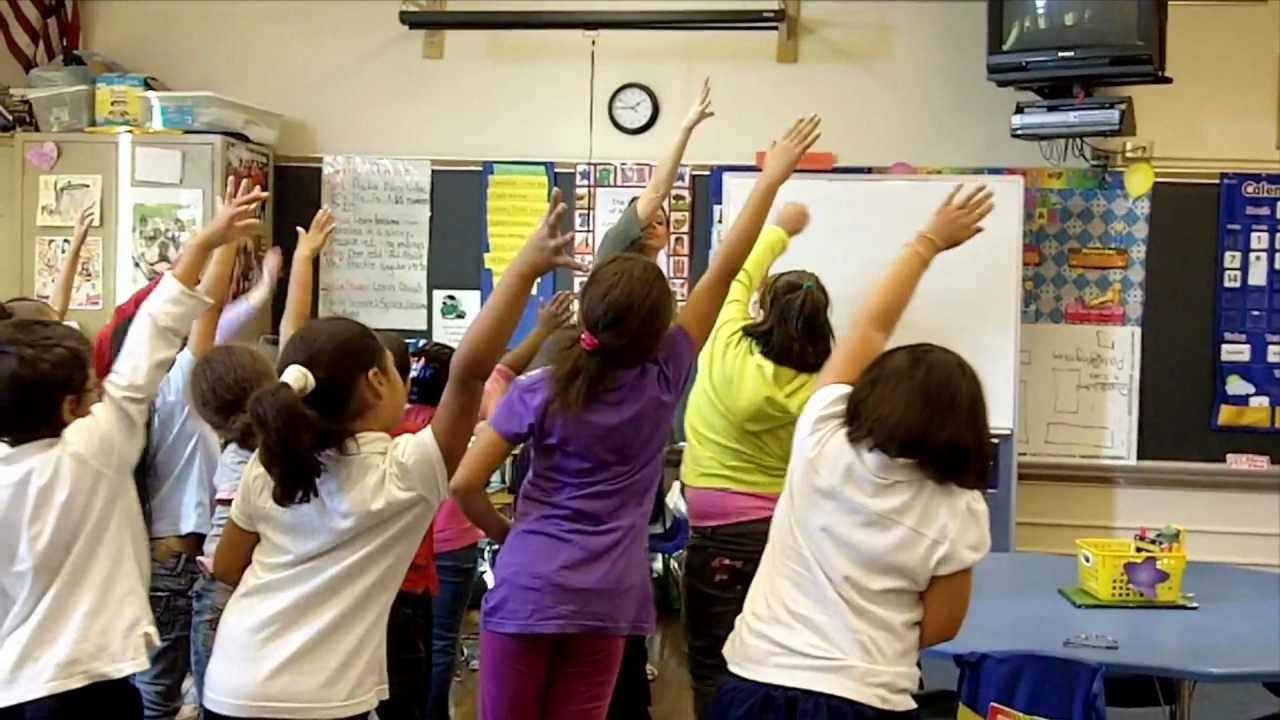
Sarah Wenzel and her class at Forest Home Elementary demonstrate a series of poses from the YogaKids cards, http://www.yogakids.com.

When I was in kindergarten, someone would come to play the piano and we children would walk in a circle pretending to be giraffes (re-e-eaching!) and elephants (swinging gently while bent over).

Just the other day, I realized that those kindergarten stretches were the same as stretches I’ve been doing for my back.

Decades ago, schools like mine were helping kids exercise for health. Now an increasing number of studies suggest that moving while in class helps children’s brains learn better, too.

Donna de la Cruz writes at the NY Times, “Sit still. It’s the mantra of every classroom. But that is changing as evidence builds that taking brief activity breaks during the day helps children learn and be more attentive in class, and a growing number of programs designed to promote movement are being adopted in schools. …

“A 2013 report from the Institute of Medicine concluded that children who are more active ‘show greater attention, have faster cognitive processing speed and perform better on standardized academic tests than children who are less active.’ And a study released in January by Lund University in Sweden shows that students, especially boys, who had daily physical education, did better in school.

“ ‘Daily physical activity is an opportunity for the average school to become a high-performing school,’ said Jesper Fritz, a doctoral student at Lund University and physician at the Skane University Hospital in Malmo, who was the study’s lead author. …

“ ‘Kids aren’t meant to sit still all day and take in information,’ said Steve Boyle, one of the co-founders of the National Association of Physical Literacy, which aims to bring movement into schools. ‘Adults aren’t wired that way either.’

“Mr. Boyle’s association has introduced a series of three- to five-minute videos called ‘BrainErgizers‘ that are being used in schools and Boys and Girls Clubs in 15 states and in Canada, Mexico, Ireland and Australia, he said. A version of the program is available to schools at no charge. …

“ ‘At the end of the week, kids have gotten an hour or more worth of movement, and it’s all done in the classroom with no special equipment,’ Mr. Boyle said. ‘We’re not looking to replace gym classes, we’re aiming to give kids more minutes of movement per week. And by introducing sports into the videos, giving kids a chance to try sports they may not have ever tried before.’ ”

To read more at the NY Times, click here.

Read Full Post »

Germany is opening a 62-mile bike path. That’s what I call a long ride.

See what Charlie Sorrel (“previously found writing at Wired.com, Cult of Mac and Straight No filter”) has to say about it at Fast Company.

“Germany, the country famous for its speed-limit free stretches of Autobahn, is building car-free Autobahns for bikes. The Radschnellweg (‘fast bike path’) RS1 runs 62 miles between the cities of Duisburg and Hamm, passing through eight other cities along the way.

“Cycling is big and growing in Germany. In Berlin, the school run is more likely to consist of a parent on a bike with two child seats than in an SUV. Cycling is done for pleasure, but also as just another way to get around. Cities already have extensive cycling infrastructure, and in the countryside, you can find wide, smoothly-paved bike highways.

“According to the ADFC, one kilometer of road costs around €10 million. One kilometer of bike highways runs to just €1.8 million. …

Says the ADFC’s (Germany’s bike association and advocate group) Ulrich Syberg. ‘When it’s ready, the world will look upon the Ruhr area and wonder, how many people can you motivate to switch from the car to the bike, and much this will relieve congestion in city centers.’

“How much congestion? A 2014 study into the lane by the Federal Ministry of Transport says that it could replace up to 52,000 car journeys. But that’s not even the best part. The study also estimated that savings due to the health benefits of cycling could be as much as five times the cost of building the bikeway.” More here.

Photo: via Radschnellweg
The Radschnellweg (“fast bike path”) RS1 runs 62 miles between the cities of Duisburg and Hamm, passing through eight other cities along the way.

Read Full Post »

It’s getting chilly around here. Thirty degrees this morning. I’m getting wimpier about taking my walk outside and just go ’round and ’round indoors. I need to toughen up. The NY Times health columnist Jane Brody is older than I am and not only swims every day (vigorously, I’m sure) but walks five miles. Whoosh. I would have to walk back and forth to the high school — twice — to do five miles. It would take me half the day.

Here are photographs from the last couple weeks: shadows at the zoo, where my grandson ran into a friend he usually sees only in summer; milkweed and shadows; leaves casting shadows; an abandoned bird nest; overdevelopment reflecting on the waters of Fort Point Channel; and a burning sunset.

110815-John-at-zoo

110815-giraffes-at-Roger-Wms-Zoo


111515-milkweed-sun-and-shadow

110715-empty-nest


110815-leaf-shadow

111715-reflecting-on-Ft-Pt-Channel


111515-sunset-concord-MA

Read Full Post »

Claire swims in Walden Pond before work. I take a lazy walk. Other people run or go to the gym. But in Brooklyn, you have the option of a dance party at a club.

Stacey Anderson has the story at the NY Times: “It was a typically raucous scene in Williamsburg, Brooklyn … . However, not all was familiar at this rave called Daybreaker, held at the club Verboten. For a start, the 400 young participants wore athletic clothing and pressed office wear rather than skimpy dresses and droll T-shirts. Some were bright-eyed, but just as many yawned and clutched cups of coffee. …

“The Daybreaker dance party, which runs from 7 to 9 a.m. three times a month, is one of two new early electronic diversions finding audiences in Brooklyn and Manhattan. Branded as both a morning workout option and a wholesome inversion of dance culture, the events are novel beyond their sunrise start times: They are alcohol-free, with coffee and fruit-infused water distributed at the bar instead of the customary club libations. The event, which had its debut in December and moves from place to place, darkens its spaces to mimic the typical rave experience, quite convincingly.

“ ‘It’s like a casino in here; there’s no idea of time,’ said Malcolm Ring, 24, a financial analyst. He woke at 5:30 a.m. to attend this Daybreaker party, his first. ‘I would normally go for a run right now, but this is more enjoyable.’ ”

More here.

Photo: Willie Davis for The New York Times
The rap artist Salomon Faye at a Daybreaker party at Verboten, a club in Williamsburg, Brooklyn. 

Read Full Post »

Photo: Thomas Ondrey/The Plain Dealer
Zumba instructor Kelly Perkins, center, leads a group dance-walking  through Shaker Heights on Friday. The local version of the craze was organized by Shaker resident Jennifer Lehner.

Mary Ann is one of Cleveland’s biggest boosters. This week she’s been posting on Facebook about a dance-walk outing she joined Friday.

Janet Cho at the Cleveland Plain Dealer interviewed dance-walk organizer Jennifer Lehner.

“The idea came out of a backyard barbecue,” Cho writes. Lehner “was chatting with her friend Karen Katz, wife of Fire Food & Drink’s Doug Katz, about the fun YouTube video where WNBC television reporter Ben Aaron convinces New Yorkers to strut their stuff with him down the city streets.

” ‘We should do that!’ Katz said.

” ‘About one hour later I went home and bought the dancewalkfitness.com domain, set up the website and the Facebook page,’ she said. ‘You know, that’s just how I roll.’ …

“Lehner envisions tying the dance-walks in with her monthly Flash Cashers events, since the group might end up having lunch at a local restaurant after the workout.

“Flash-Cashers summons consumers to descend upon a local Shaker Heights-area business to spend at least $20 each during the cash mob event, giving the merchant a welcome one-night boost and increasing awareness among residents who may never have stepped foot in the store before.” Read more at the Cleveland Plain Dealer, here.

And here is Ben Aaron, who started the whole thing.

Read Full Post »

Boston Medical Center is an inner-city hospital that takes a special interest in immigrants and the poor. It also treats patients holistically, offering a referral service for problems that get in the way of good health.

With the support of the City of Boston, Boston Medical Center has added a new item to its medicine cabinet: bike sharing.

Catalina Gaitan writes at the Boston Globe, “The City of Boston has announced a program to subsidize bike-sharing memberships for low-income residents, in partnership with Boston Medical Center.

“The program, ‘Prescribe-a-Bike,’ would allow doctors at Boston Medical Center to prescribe low-income patients with a yearlong membership to Hubway, a bike-share program, for only $5.

“Participants would be allowed unlimited number of trips on the bicycles, provided they use them for 30 minutes or less at a time. They will also be given a free helmet, the mayor’s office said in a joint statement with Boston Medical Center.

“ ‘Obesity is a significant and growing health concern for our city, particularly among low-income Boston residents,’ said Kate Walsh, chief executive of Boston Medical Center, in the statement. …

“Statistics show that 1 in 4 low-income residents in Boston is obese, almost twice the rate of higher-income residents, the statement said.

“To qualify for the prescription, participants must be 16 years or older and be enrolled in some form of public assistance, or have a household income of no more than four times the poverty level.”

More here.

bikes-in-boston

Read Full Post »

As the lowest of the “higher belts,” I’m exhibit A demonstrating that anyone can learn tai chi chuan.

It was really hard getting started. I couldn’t relate the moves to anything I knew before: not ballet, modern dance, yoga, ballroom dancing, folk dance … .

Then I learned that this kind of movement relates to nature. We practice moves called White Crane Spreads Wings and Ocean Breathing. We breathe like a tortoise taking a dive, we float our arms like a butterfly, and from a crouch postion, we rise like a phoenix. Now I get it.

For someone who nearly every year discovers that the lower back or a knee or the neck is far enough gone to require physical therapy, tai chi chuan has been a big help. It’s also great for exercising all your muscles and for balance. It’s constantly flowing.

Longevity in the class pays. If you just stick with it, eventually you can do some of the routines moderately OK, and you get to be referred to as a “higher belt” in front of brand-new students. Which is nice, even though you know it won’t last.

Photo: Zhen Ren Chuan

Read Full Post »

In the UK, retirees are taking up ballet.

Emma Ailes writes for BBC Scotland, “In a locker room at Scottish Ballet, a group of dancers are lacing up their ballet shoes. Only one thing marks them out from the other dancers here. These dancers are all in their 60s and 70s.

“Today, they are rehearsing ‘Swan Lake.’

“Among them is Alicia Steele. She danced when she was young. Now, nearly 80, she’s back.

” ‘I went to keep-fit classes, but I found them a bit boring,’ she says. ‘And I love the music with the piano. I just love it and it makes you feel a bit young again. It doesn’t make you look young, but it makes you feel young inside.’

“There’s been a 70% jump in the number of adult dancers signing up for classes in recent years, according to the Royal Academy of Dance. Some, like Alicia, danced when they were young. Others are complete beginners.

“Their oldest ballerina is 102.” More.

I took ballet both as a child and as an adult. But for now, I am sticking with tai chi chuan. Today the teacher had me learning complicated new moves with the advanced students. “You deserve it,” he said to me.

I’m not sure how to take that.

Photo: BBC Scotland

Read Full Post »

If sitting at work is bad for you, try walking at work. That’s what I did today, and I think I’m hooked. I love the “walk station.”

I’ve been to physical therapists for my back off and on for years, and they tell me to get up from the computer every 45 minutes and move. I try to remember. After all, I’ve always known I think better if I walk.

Turns out it’s not just me that shouldn’t sit too long. Lately the news has been full of warnings.

Here, for example, is what Olivia Judson, at the NY Times blog The Opinionator, has to say.

“It doesn’t matter if you go running every morning, or you’re a regular at the gym. If you spend most of the rest of the day sitting — in your car, your office chair, on your sofa at home — you are putting yourself at increased risk …

“You may think you have no choice about how much you sit. But this isn’t true. Suppose you sleep for eight hours each day, and exercise for one. That still leaves 15 hours of activities. Even if you exercise, most of the energy you burn will be burnt during these 15 hours, so weight gain is often the cumulative effect of a series of small decisions: Do you take the stairs or the elevator? Do you e-mail your colleague down the hall, or get up and go and see her? When you get home, do you potter about in the garden or sit in front of the television? Do you walk to the corner store, or drive?” Etc.

Getting back to my workplace: we have three walk stations that we can reserve by sending them an invitation through our e-mail system. I was lucky when I went to the walk station today, because two experienced colleagues were walking and working on the other machines. They explained how you clear the speed setting from the last person, how you raise and lower the work table, how you set your walk speed.

At first I kept slipping backwards, but I think I’ll improve with time, and I’m already signed up to go back there with my laptop on Monday. Too bad we can’t have one all the time.

Photos: Zack Canepari for The New York Times, left; Chris Machian for The New York Times, right
Sitting at a cubicle vs. walking while clicking and talking.

Read Full Post »

Photo: nfait.wordpress.com

New research featured at WBUR radio’s “Only a Game” suggests that frequent physical activity in school boosts learning.

“Mid-morning on Tuesday at the South Lawrence 5th Grade Academy in Lawrence, Mass., a row of students prepares to learn science more efficiently…by stepping.

“At this kind of school within a school, the daily schedule for these fifth graders includes not one physical education class, but three. The students break during the day for physical activity, which, according to Kevin Qazilbash, the school’s principal, is not to say academics are being de-emphasized.” More.

“The curriculum at the South Lawrence 5th Grade Academy is based in part on the notion that exercise improves brain function and stimulates learning. According to Dr. Majid Fotuhi, the Chairman of the Neurology Institute for Brain Health and Fitness in Baltimore, studies support the idea that exercise can improve learning efficiency for children. …

“ ‘It’s so exciting,’ Fotuhi told Bill on … Only A Game. ‘There are actual new cells that are born in the memory parts of your brain. Literally, new cells are born, this has been shown in animal studies. So exercise is the best thing for [the] brain, especially for the memory part of the brain.’ …

“Though no study prescribes a perfect amount of exercise, Fotuhi offers guidelines to parents and educators.

“ ‘My recommendation would be at least one hour a day for children who are 6-12 and for high school kids, two hours a day,’ Fotuhi said. ” More.

I myself find that walking around helps me think, and I remember my father doing that, too. He was a writer. There is something about moving around while puzzling out how to express a complicated thought that is more productive than sitting in front of a computer (or in his case, a typewriter).

Photo of Dr. Fotuhi, Johns Hopkins

Read Full Post »

Feel like dancing? I’d love to see this sort of thing in every town in America. How nice it would be to walk a few blocks on a summer evening, and there it would be!

“It’s Monday night in Boston. Under the locust trees of the Blackstone Community Center surrounded by basketball games, tight parking spaces, and children playing, the dance floor heats up in the park as the night air cools off and the stars come out.

“Many salseros in Boston claim [Salsa in the Park] as their favorite event of the city, not only for the appeal of dancing outside ‘al aire libre’, but as a way to give back to the community. Dancers volunteer all summer, donating their time to teach dance lessons to adults and children, set up dance floors, assist with event staffing, maintain a recycling program, and clean up from the festivities until late into the evening.

“This event is staffed in collaboration with the Mayor’s Program of Cambridge, and the Blackstone Community Center Youth Summer Programs. We emphasize healthy lifestyle choices for the individual and the community, through dancing, healthy food options, and greening our event as much as possible with educational materials and interactive information.”

Read Full Post »

I know that if you find the exact right picture to capture something, it is worth a thousand words. But sometimes the right word is worth a thousand pictures. Not that I can think of an example.

A better photographer than I probably could have captured what I wanted to convey by taking a few pictures on my walk: how wonderful it is to have spring after winter, sunshine after rain, and a pleasant walk after the routine medical procedure we all love to hate.

How good everything smells, how many new bird calls, how the leaf shadows are moving. How many people are smiling.


Read Full Post »

Back when my sister was teaching tai chi and before she decided to go to medical school, I was skeptical of Eastern health practices.

I should have taken lessons then, but I’ve learned the error of my ways and am more open to trying new things. I told John I’d been trying to find a weekend tai chi class that might be good for back pain.

Last week, he called about a sign he saw in Arlington:  Zhen Ren Chuan, a martial arts studio, had begun to offer tai chi.

Saturday I went.

Tai chi is not as easy as I thought watching ladies in San Francisco and Boston parks. So many things to think about at once! In that sense alone it is a great way to clear your mind of everything else. I will go again.

Read Full Post »

« Newer Posts