Feeds:
Posts
Comments

Posts Tagged ‘experiment’

Photo: Peter Ellzey.
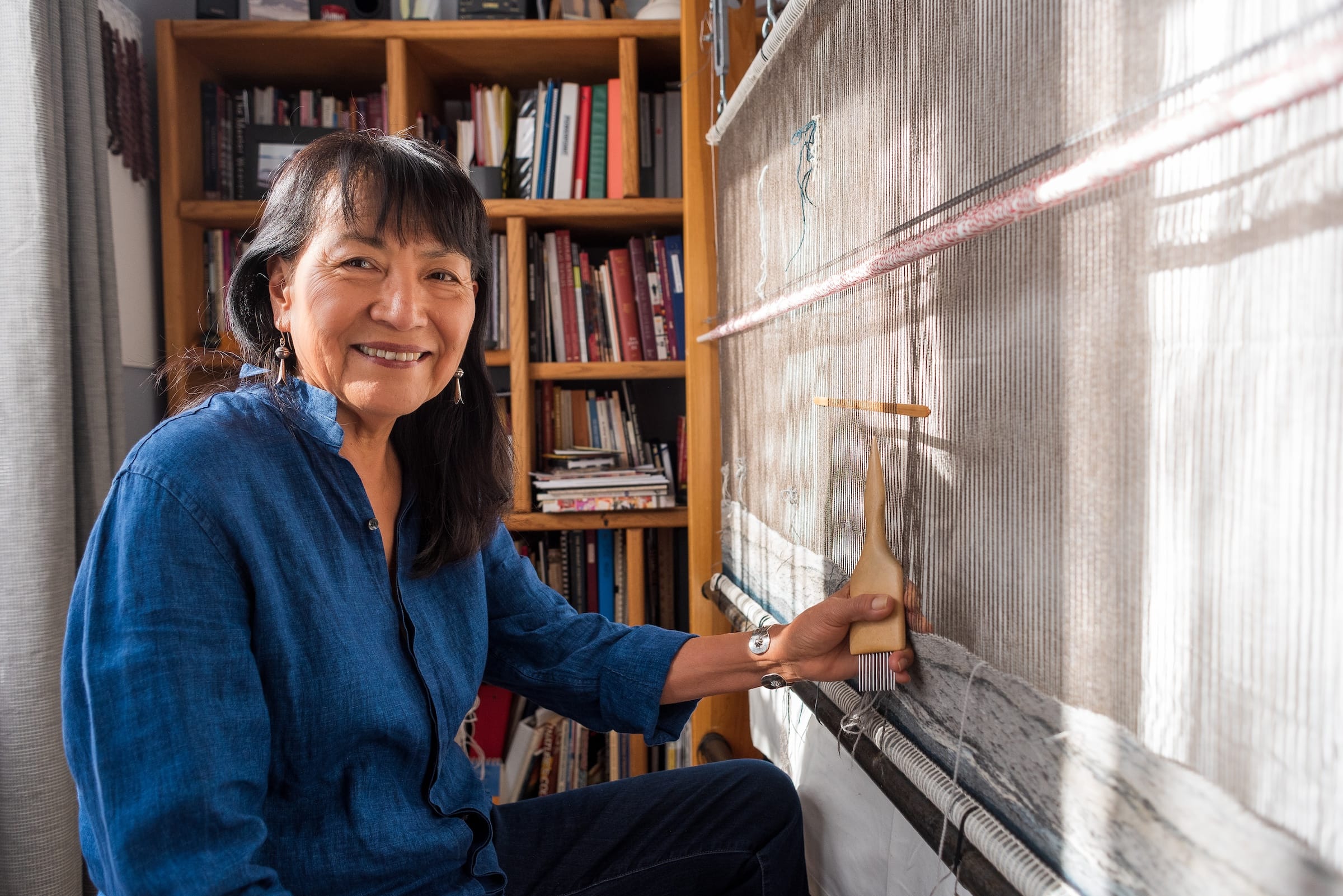
DY Begay in her weaving studio in Santa Fe, New Mexico, in 2022.

Traditions often gain strength and durability when the spirit behind them is reinterpreted through a new generation’s sensibilities. A case in point: the way the weaving and dyeing of Diné artist DY Begay has enriched a traditional Navajo craft.

Sháńdíín Brown and Zach Feuer at Hyperallergic recently interviewed the artist.

They write, “For over four decades, artist DY Begay expanded the expressive range of Diné (Navajo) weaving, transforming the form into a language that is entirely her own. She is a Diné Asdzą́ą́ (Navajo woman), born to the Tótsohnii (Big Water) clan and born for the Táchii’nii (Red Running into Water/Earth) clan. Her maternal grandfather is of the Tsénjíkiní (Cliff Dweller) clan and her paternal grandfather is of the Áshįįhí (Salt People) clan. 

“Begay is a fifth-generation weaver who was raised in Tsélání (Cottonwood) on the Navajo Nation, where her family’s sheep flock still resides. Rooted in Diné Bikéyah (Navajo homelands) — from the cliffs of Tsélání to the horizon of the Lukachukai Mountains — her work reflects the blended hues of sunsets, mesas, and mountain ranges, while her use of wool from her family’s flock and natural dyes binds her practice to the land she seeks to honor and protect.

“After graduating from Arizona State University in 1979, Begay moved to New Jersey and immersed herself in the fiber art world of New York City. She studied historic Diné textiles at the Museum of the American Indian, whose collections later became part of the Smithsonian’s National Museum of the American Indian (NMAI). Most of these pieces were created by Diné weavers whose names were not recorded, likely women. She also took inspiration from the work of artists such as Anni Albers, Sheila Hicks, and Lenore Tawney — all of whom trained in modern Western traditions yet studied Indigenous weaving practices. …

“When she returned to Tsélání in 1989, her grandmother, Desbáh Yazzie Nez (1908–2003), saw her weavings and urged her to develop her own compositional sensibility. Begay quickly gained recognition at the Heard Museum Guild Indian Fair and Market as well as the Santa Fe Indian Market, yet she felt restless in her practice. By 1994, that questioning crystallized into a breakthrough: She began developing color hatching, a method of creating subtle gradations and nuanced color interactions that transformed the solid, banded designs of conventional Diné weaving. …

“In August, Begay spoke with us over Zoom from her home in Santa Fe. The interview has been edited and condensed for clarity.

Sháńdíín Brown and Zach Feuer
“In Sublime Light: Tapestry Art of DY Begay, the first book dedicated to you and your recent retrospective at the NMAI, you write about watching your mother and grandmother weave in the hogan. …

DY Begay
 “I don’t remember the very first time I picked up weaving tools and set a loom on my own. I was very young. I do remember standing behind my mother’s loom, watching her pull colored yarns over and around the warps. Her fingers moved swiftly in and out, pressing the wefts into place. Within minutes, geometric shapes stacked and formed into the outline of a Ganado-style weaving. At that age — maybe four or five — I could not quite comprehend how those shapes came together. I was always perplexed and in awe. Everything happened so fast in front of me as her hands composed lines and rows of colored yarn. 

“I grew up surrounded by weavers: my maternal grandmother, my mother, and my aunts. Someone was always at the loom, often positioned in a very central place inside the hogan. And we lived in the hogan when I was growing up, and everybody else did too.

“I watched my mother create stepped patterns with hand-dyed yarns, moving with precision and grace. Teaching came through showing. It was a physical action. The word that I always remember, and is still used today, is kót’é — ‘like this.’ My mother said ‘kót’é, kót’é.’ …

SB & ZF
“Do you remember the moment when you first began weaving yourself — whether your family set up a loom for you or you started working on theirs?

DB
“I was very curious. I tried to hold my mother’s tools, but they were too big for my hands. … Eventually, she allowed me to sit with her once in a while and said ‘kót’é, kót’é.’ I began to get used to the natural action of tapping with the combs. I was about eight years old when I had my own loom. I don’t remember its size. My mother prepared the warp and I used leftover yarn from her bin. I do remember finishing my first weaving, maybe two colors. It was pretty decent for a first attempt. It was a good learning situation because my mother was there. She would sometimes unweave certain parts and we would go on. …

“Most finished weavings, maybe two by three or three by three feet, and some saddle blankets, were taken by my father and my grandfather to the local trading posts to exchange for food, fabric, or whatever was needed. My mother never went to the trading post herself — we didn’t have a vehicle then, so transportation was by wagon or horses. They would roll up the weavings, pack them, and take them to the trading post. …

“In weaving ‘Pollen Path,’ I wanted to share a cultural belief. Among the Diné, we sprinkle corn pollen to honor a new day, to seek blessings, and to bring balance into our lives. Corn itself is a sacred plant. The pollen is collected in late summer, when the tassels of the corn begin to pollinate. We gather it in the early morning, just before the sun rises. For me, ‘Pollen Path’ reflects peace, beauty, and gratitude for life.

“The project began in the summer of 2007, a very good year for growing plants that I use in dyeing my wool. My sister, Berdina Y. Charley, planted local corn seeds she received from our Táchii’nii (Red Running into Water/Earth) relatives. I believe these were heirloom seeds from our Táchii’nii family. …

SB & ZF
“How do you translate the experience of walking in beauty, through the landscapes of Diné Bikéyah (Navajo Country) and more specifically your home of Tsélani (Cottonwood), into the two-dimensional form of weaving?

DB
“Not only do I have my Tsélani landscape embedded in my mind, but I frequently photograph the surrounding textures at various times of the day to capture different lighting as it reflects on the terrain. …

SB & ZF
“Can you tell us about your color palette and the process of dyeing the wool? Is it essential for you to use and make dyes that are from the earth?

DB
“I have been practicing and experimenting with natural dyes for quite a while, and I love using local plants to create my color palette. It is both essential and traditional in my culture to use what the earth provides to create dyes for our yarn.

“My palette comes from many sources. I work with common plants such as cota (Navajo tea), chamisa, rabbitbrush, and sage. I also use non-native materials like insects, fungi, foods, and flowers. Each has its own season, and I collect plants according to the time of year.

“The process itself is an experiment every time. I’ve studied many dyeing methods and learned to be attentive to formulas that help obtain and preserve the colors. For me, making dyes from the earth is not only practical but also deeply connected to tradition and creativity.”

More at Hyperallergic, here. No paywall. Subscriptions encouraged.

Read Full Post »

Photo: Mark McGuinness.
Mark McGuinness, a photographer, said the income from Ireland’s government allowed him to devote two days a week to making work for exhibitions.

It’s hard to say which part of the story on Ireland’s experiment with guaranteed income for artists I love most, but “cross-party support” sure feels like heaven.

Alex Marshall reports at the New York Times, “Ian Fay had toiled for years to make it as a comic book artist and illustrator, and last fall, he was ready to call it a day.

“Fay, 32, who lives in Kilkenny in southern Ireland and specializes in drawing muscly superheroes, was only earning enough money to pay his bills, he recalled recently. He couldn’t afford vacations. He was considering boxing up his art supplies and getting a job in a grocery store.

“Then, in September, a lifeline appeared in his email inbox. A message from Ireland’s government said that Fay had been selected for a program guaranteeing 2,000 artists a basic income. For three years, participants — including musicians, novelists and circus performers — would be paid 16,900 euros a year, about $18,200, no strings attached.

“Fay stared at the email in disbelief. The payments — in weekly installments of €325 — would cover his rent, and lower his anxiety about making ends meet, he said. For the first time in years, he added, he would have ‘time to practice and develop my craft.’ …

“The Irish pilot project is the latest sign of growing international interest in universal basic income — when governments pay ‌their citizens, employed or not, a lump sum each month. Proponents of the idea, including antipoverty groups, left-wing politicians and libertarian organizations, say guaranteed income ensures a population’s sustenance and health better than other social welfare policies. Opponents say it’s simply giving the work-shy cash for nothing.

“In early experiments in Finland, California and Germany, people were paid regardless of their profession. But several pilots are now focused on cultural workers, who can spend months, or even years, on unpaid projects. Painters, dancers and musicians often rely on precarious, part-time jobs to fund their passions, and basic incomes are seen as a way to let them focus on artistic pursuits.

“Last year, in the United States, a privately funded initiative called Creatives Rebuild New York began giving 2,400 artists $1,000 a month. Similar programs are underway in San Francisco and Minnesota. But of these artist-focused efforts, Ireland’s stands out because it is government-run and involves rigorous analysis of the recipients’ finances, work patterns and well-being to gauge the handouts’ impact. The recipients’ livelihoods will be compared with those of 1,000 artists in a control group, who are not receiving any payments.

“Catherine Martin, Ireland’s culture minister — a trained singer and former street busker — said in a telephone interview that the idea for the policy emerged three years ago during the coronavirus pandemic. With Ireland’s music venues, theaters and museums shuttered, Martin commissioned a task force to explore how the government could help cultural workers survive. Its main recommendation was a basic income trial. …

The pilot, which has cross-party support, has a budget of €33.8 million a year — and that’s on top of the €130 million that Ireland spends on culture via the Arts Council, its main arts funding body.

“Applications opened last April for people working in the visual arts, theater, literature, music, dance, opera, movies, circuses and architecture. … The applicants had to submit two pieces of evidence to show they were genuine cultural workers, such as membership in a professional body, proof of income from art sales or newspaper reviews. Martin said the government didn’t consider the quality of the applicants’ work.

“More than 9,000 people applied, with 8,200 deemed eligible. From that pool, 2,000 were randomly selected to receive payments and 1,000 for the control group. …

“Lydia Mulvey, 47, a screenwriter, said that she quit her job in a telecommunications firm as soon as she heard she’d made it into the program. Now she spends her time writing pilot scripts for thrillers and sci-fi shows, rather than trying to squeeze that into evenings and weekends. ‘I knew it’d be transformative and give me my life back,’ Mulvey said, although she added that, if she didn’t already own her own home, she’d struggle to live on such a low income, especially in Ireland’s squeezed property market.

“Mark McGuinness, 31, a photographer, said that before receiving the basic income he had spent the whole week seeking commercial photography work to pay his rent and the cost of supplies, and had let his artistic practice slip away. Now, he’d ‘clawed back’ two days a week to make work for exhibitions, he said. …

“Ireland’s government is sending recipients questionnaires every six months that ask about the state of their finances, artistic career and health. … Last year, those taking part received a survey to collect baseline data. It asked if they could adequately heat their homes, replace worn furniture or ‘afford a meal with meat, chicken or fish every second day.’ …

“Aengus Ó Snodaigh, a spokesman on cultural issues for the opposition Sinn Fein party, which supports the program, said he wanted data long before the trial concluded so artists didn’t face a ‘cliff edge’ at the end. He added that he had many questions about the program, including whether payments benefited early-career artists more than established names, and whether the handouts were having unintended consequences, like causing tensions in rock bands if some members were selected, but others weren’t.

“ ‘Maybe the money would be better spent on hardship funds for artists who can prove they can’t afford the mortgage, or can’t rent a studio,’ Ó Snodaigh said.

“Few recipients are taking the windfall for granted. Mulvey, the screenwriter, said she’d recently met television companies about developing shows, and was often working long into the night. ‘I keep reminding myself that three years is a really short time, and we’ve already had six months,’ she said, adding that she wanted to make sure ‘I don’t have to go back to a day job when this stops.’ ”

More at the Times, here.

Read Full Post »

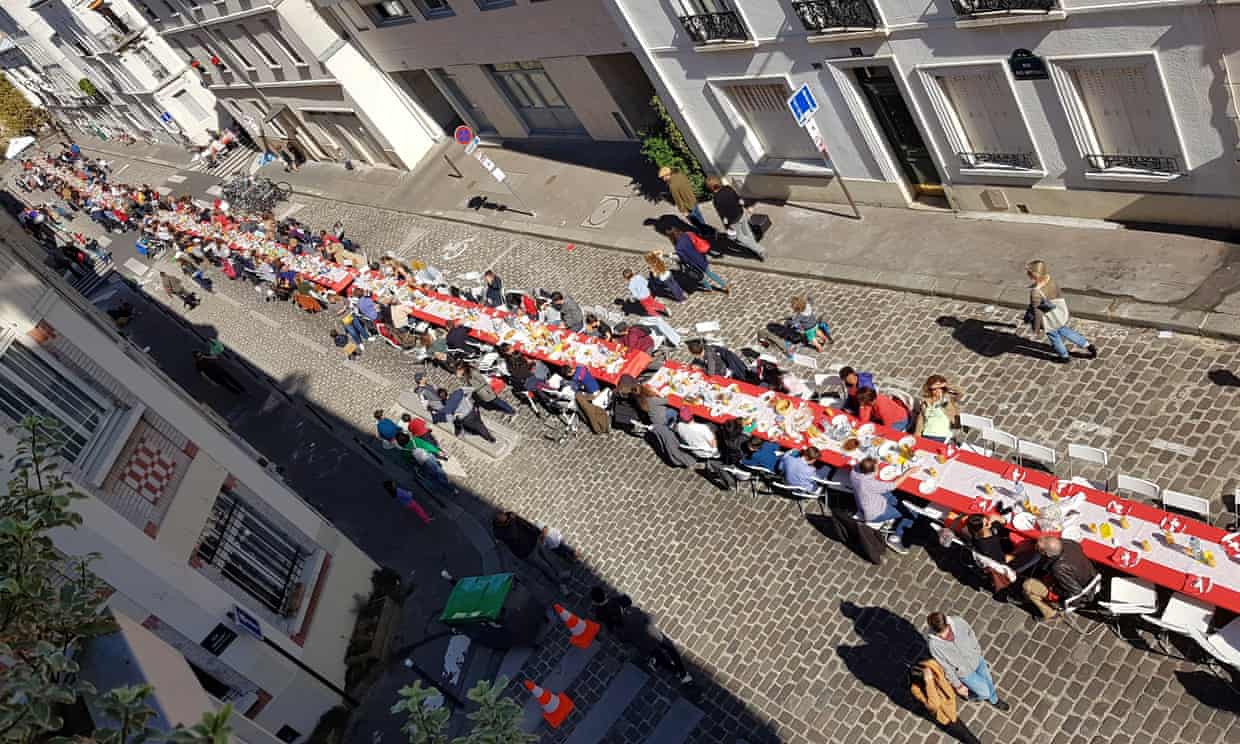
Photo: Hyper Voisins.
A 705-foot banquet table meant to seat 648 people in a Paris neighborhood that’s seeking a more neighborly lifestyle.

It’s that time of year again — time for our valiant but hopeless block party, when we smile and reintroduce ourselves to neighbors that we will look right through when we bump into them in the market in January. If New England can’t make mutual support and cooperation work, how in the world can Paris?

Peter Yeung at the Guardian describes an experiment in France.

“It was a distinctly un-Parisian revolution although it began on an inner city street. No barricades were assembled to block the nearby boulevards and no radical students hurled cobblestones ripped from the pavement. …

“Instead, a 215-meter-long [about 705 feet] banquet table, lined with 648 chairs and laden with a home cooked produce, was set up along the Rue de l’Aude and those in attendance were urged to openly utter the most subversive of words: bonjour.

“For some, that greeting led to the first meaningful exchange between neighbors. ‘I’d never seen anything like it before,’ says Benjamin Zhong who runs a cafe in the area. ‘It felt like the street belonged to me, to all of us.’

“The revolutionaries pledged their allegiance that September day in 2017 to the self-styled République des Hyper Voisins, or Republic of Super Neighbors, a stretch of the 14th arrondissement on the Left Bank, encompassing roughly 50 streets and 15,000 residents. In the five years since, the republic – a ‘laboratory for social experimentation’ – has attempted to address the shortcomings of modern city living, which can be transactional, fast-paced, and lonely.

“The experiment encourages people not just to salute each other more in the street but to interact daily through mutual aid schemes, voluntary skills-sharing and organized meet ups.

“ ‘The stereotype of a Parisian is brusque and unfriendly,’ says Patrick Bernard, the former journalist and local resident who launched the project. ‘But city living doesn’t have to be unpleasant and anonymous. We want to create the atmosphere of a village in an urban space. [Conviviality] can become a powerful asset, an essential economic and social agent in the construction of tomorrow’s cities.’

“Nearly 2,000 people now attend weekly brunches and apéritifs in local restaurants, cultural outings, memory exchanges, children’s activities and more. During the pandemic, residents mobilized to make masks, deliver shopping to vulnerable neighbors and bake cakes to support a local charity. Crucial, too, is the digital aspect: dozens of WhatsApp groups include those dedicated to repairing broken devices, selling second-hand goods, and sharing healthcare resources. …

“Mireille Roberdeau, an 86-year-old widow who moved to the area in 2000, says the scheme has given her a reason to get up in the morning. ‘I was quite timid before,’ she adds. ‘I wouldn’t speak to anyone. I would scowl at people. But now I look forward to going out. It’s good because my doctor says I need to get out.’

“Roberdeau, now a keen user of the WhatsApp groups was hospitalized in March but says neighbors delivered her groceries when she got home. …

“Beyond the ‘eating, drinking and celebrating as social engineering,’ in the words of Bernard, that defined the initial stages of Hyper Voisins, the long-term targets – aimed at transforming the very nature and functioning of an urban neighborhood – come under four pillars: environment, healthcare, public spaces and mobility.

“It has, for example, collaborated with non-profit Les Alchimistes to install organic waste disposal points in former parking spaces and to turn the matter into compost. Perhaps more radically at a time of strained healthcare provision in France, it is launching a health clinic geared towards local needs. [It] will have a staff of 10 and offer extended opening hours, consultations without appointment and home visits. …

“To reduce local car use by residents and traders, Hyper Voisins plans to buy electric bikes with trailers and install a communal electric bike charger. It is also in talks with the mayor to potentially levy a local tax on unwanted businesses such as estate agents, banks and delivery hubs and give residents a vote on whether they can even move in. ‘We want to promote stores that improve our daily life,’ adds Bernard. ‘If not, like a polluter, they should pay.’ …

“A study by sociologist Camille Arnodin found that Hyper Voisins – and two other community volunteer projects in Paris – had reinforced pandemic resilience, transformed weak neighbourly links into strong bonds, improved social mixing and reduced social isolation. …

“[But it] noted issues over inclusion: the scheme could risk leaving out either those who don’t wish to participate in activities or those who ‘don’t feel included or informed.’ ”

What do you think? Several readers are more intimate with Paris than I am, having been there only once, decades ago. So I would love to hear what you think of the experiment. Good idea? Can’t possibly survive?

More at the Guardian, here.

Read Full Post »

Erik’s Swedish/Danish niece and nephews live in Copenhagen and went back to school quite a long time ago. The youngest went first, taking his seat in a classroom full of Covid-19 protections. Meanwhile, in other parts of Denmark, outdoor learning is getting increased attention.

Rick Noack writes at the Washington Post, “On a balmy Monday afternoon earlier this month, Sebastian Lukas, 27, watched from across a clearing as his third- and fourth-grade students whittled branches into spearheads with sharp knives.

“His gaze turned to another group, who were supposed to be working on math problems. Two students, perched on a log, scrambled to produce their textbooks, just in time to look busy.

“Lukas began the year teaching in a classroom like any other, in Samso Frie Skole, a school on the Danish island of Samso. But when the novel coronavirus pandemic struck, the school, like many across the country, embraced a new way to hold certain classes: almost entirely outdoors.

“Instead of sitting at desks, Lukas’s students wander through a rambling woodland, lush with trees and crisscrossed by dirt tracks. …

“Some countries, including Germany, have a tradition of outdoor preschools and kindergartens, which have begun to catch on in the United States as well. The pandemic may drive more countries to experiment with the model for older students. …

“Samso, a sparsely populated, energy self-sufficient and carbon-neutral 44-square-mile island that was once a meeting point for Vikings, is a windy, hour-long trip by ferry from the mainland village of Hou.

“The Samso Frie Skole — a private school funded, like many others in Denmark, in large part through public grants — first pondered the move outdoors long before the pandemic. Coronavirus accelerated those plans.

“The new, forested area, surrounded by grain fields, includes old farmhouses, where students will be able to take shelter in bad weather, according to principal Anna Mattsson.

“ ‘It’s going to be a combination of indoors and outdoors,’ she said. The aim is to have students learn outside several times a week, with fluctuations based on weather.

“No one at the school said they were worried about the impending winter.

“ ‘We’re used to it,’ said Rikke Ulk, the chair of the school’s support association. ‘It’s a matter of dressing well.’

“Until the new buildings are ready, students must walk or bike more than a mile from their old classrooms to their new forest school. Teachers haul some of the younger children in carts affixed to bicycles.

“Milling about before one such shuttle ride on a September morning, Noa, 11, said she liked the new school setup. It’s ‘just so beautiful — it makes me happy,’ she said. …

“Some said they preferred certain aspects of learning inside. ‘Sometimes, it’s better just being in the classroom, so we can focus,’ said Sally, 12.

“Cian, 9, an aspiring cook or robot engineer, disagreed. ‘It’s better to be here,’ he said, holding his math book. ‘It’s cozier.’

“Lukas said outdoor class works better for some students than others. ‘But some kids who have a hard time sitting love to come out here,’ he said, and some students who struggled to focus on math indoors have shown aptitude outside. …

“One of the most commonly accepted Danish arguments in favor of outdoor schooling centers on health benefits, said Mads Bolling, a researcher at the Steno Diabetes Center Copenhagen. Students are able to avoid the adverse affects of sitting still all day.

“But he cautioned that potential disadvantages are not yet fully understood, and some research suggests outdoor schooling appears to provide the most for children who are already highly motivated. …

“Even if outdoor class may not be practical for all schools or in all climates, said Bolling, it is not an all-or-nothing proposition. Samso Frie Skole plans to be flexible about which classes meet outside and which do not.” More here.

Read Full Post »

Photo: Foodandmore

Dear Readers, You know that you have been wondering why the taste of cheese changes depending on what music it was exposed to during the aging process. So much more agreeable than wondering who the next president will be or “why the sea is boiling hot,” to quote the prescient Lewis Carroll!

Well, wonder no more. Jason Daley at the Smithsonian has the musical cheese story covered.

The creation of good cheese involves a complex dance between milk and bacteria. In a quite literal sense, playing the right tune while this dance unfolds changes the final product’s taste, a new study shows.

“Denis Balibouse and Cecile Mantovani at Reuters report that hip-hop, for example, gave the cheese an especially funky flavor, while cheese that rocked out to Led Zeppelin or relaxed with Mozart had milder zests.

“Last September, Swiss cheesemaker Beat Wampfler [whose day job is as a veterinarian] and a team of researchers from the Bern University of Arts placed nine 22-pound wheels of Emmental cheese in individual wooden crates in Wampfler’s cheese cellar. Then, for the next six months each cheese was exposed to an endless, 24-hour loop of one song using a mini-transducer, which directed the sound waves directly into the cheese wheels.

“The ‘classical’ cheese mellowed to the sounds of Mozart’s The Magic Flute. The ‘rock’ cheese listened to Led Zeppelin’s ‘Stairway to Heaven.’ An ambient cheese listened to Yello’s ‘Monolith,’ the hip-hop cheese was exposed to A Tribe Called Quest’s ‘Jazz (We’ve Got)’ and the techno fromage raved to Vril’s ‘UV.’ A control cheese aged in silence, while three other wheels were exposed to simple high, medium and low frequency tones.

“According to a press release, the cheese was then examined by food technologists from the ZHAW Food Perception Research Group, which concluded that the cheese exposed to music had a milder flavor compared to the non-musical cheese. They also found that the hip-hop cheese had a stronger aroma and stronger flavor than other samples.

“The cheeses were then sampled by a jury of culinary experts during two rounds of a blind taste test. Their results were similar to the research group’s conclusions and the hip-hop cheese came out on top. …

“Michael Harenberg, director of the music program at Bern University of the Arts says he was skeptical of the whole project when Wampfler first approached him. ‘Then we discovered there is a field called sonochemistry that looks at the influences of sound waves, the effect of sound on solid bodies.’

“It turns out that Wampfler was rooting for the hip-hop cheese to win all along. Now, reports Reuters, he and his collaborators want to expose cheese to five to ten different types of hip-hop to see if it has similar effects.”

More here.

Read Full Post »

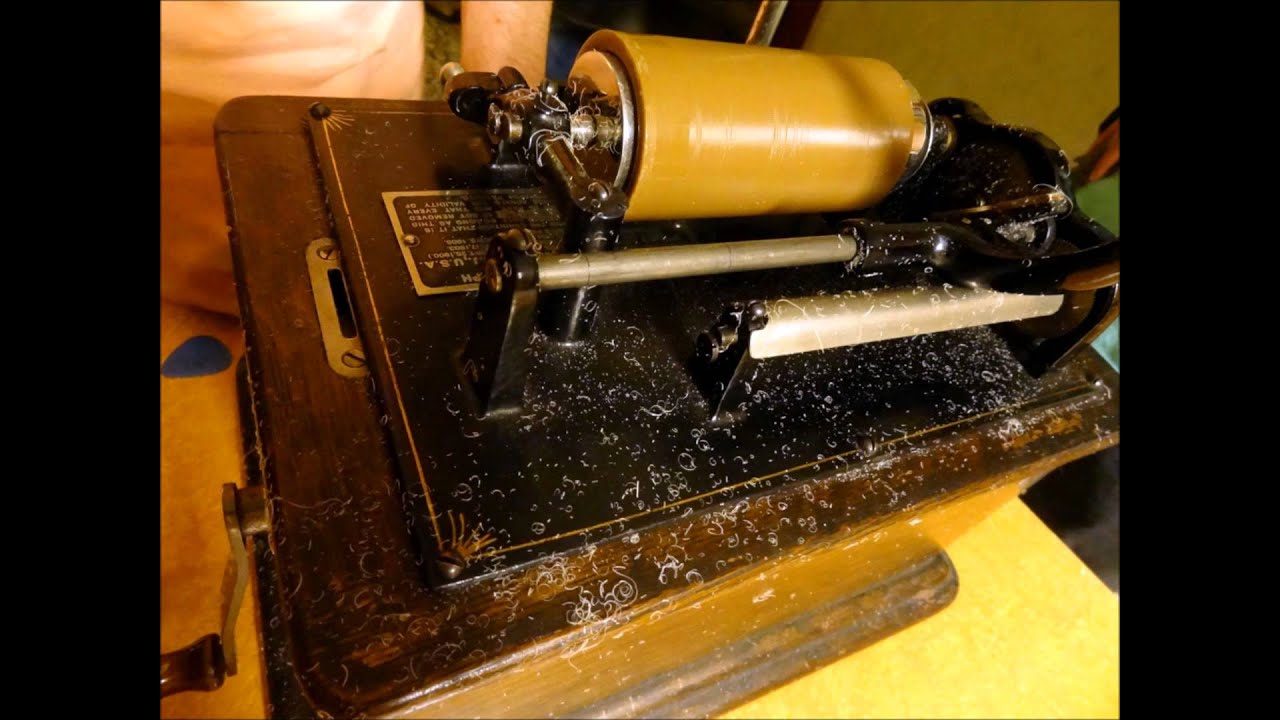
Photo: YouTube
Long ago, music was recorded on a wax cylinder like this. Out of curiosity, contemporary opera singers experimented with wax recording at Lincoln Center’s New York Public Library for the Performing Arts.

Once at my old job, we tried an ice-breaker game in which we said our first name and an adjective describing ourselves. My first name begins with “c,” and the first adjective that popped into my head was “curious.” Since then, I’ve often thought that was the right word for me. I am curious.

And I admire people whose curiosity takes them interesting places. Recently the curiosity of a Met tenor led to a fun experiment with wax recording that you can listen to online.

Anthony Tommasini writes at the New York Times, “Whenever Luciano Pavarotti was asked to name the greatest tenor ever, he always answered Enrico Caruso, who became a household name from his recordings, made from 1902 until his death in 1921.

“But how did Pavarotti know? Especially on Caruso’s breakthrough records, the sound is scratchy, wiry and wobbly. The same holds true for early recordings of Nellie Melba, Luisa Tetrazzini and other luminaries of that era. While there are entrancing hints of astonishing voices, it’s hard to tell what they were really like. If only we could record a singer today on the equipment used back then and compare the playbacks to modern recordings.

“Well, that precise experiment took place earlier this month at the New York Public Library for the Performing Arts at Lincoln Center, thanks to the curiosity of Piotr Beczala, a leading Met tenor.

“Touring the Met’s archives a couple of years ago, Mr. Beczala mentioned that his dream was to record some arias under early-20th-century conditions. He wanted to learn firsthand how faithful — or far-off — the results would be.

“Peter Clark, the company’s archivist, mentioned Mr. Beczala’s fantasy to Jonathan Hiam, the curator of the performing arts library’s Rodgers and Hammerstein Archives of Recorded Sound; Mr. Hiam then contacted Jerry Fabris, from the Thomas Edison National Historical Park in New Jersey, who knows a collector in Illinois who makes wax cylinders like those Edison once produced. …

“The material surrounding the wax cylinders is not really wax, [Mr. Fabris] said, but something called metallic soap. Before using the cylinders, he had to warm them up under a light to make the material soft enough for the stylus to cut grooves as the disc spun. …

“Mr. Beczala was first up, singing ‘Quando le sere al placido’ from ‘Luisa Miller,’ accompanied by Gerald Moore, who played on a small upright piano so as not to compete with the voices. Putting the cylinder in place, Mr. Fabris was careful not to touch the surface: Even a slight thumbprint can create an impression. While Mr. Beczala sang, Mr. Fabris held a small brush in one hand and a little squeezable air bag in the other to disperse the dustlike shards of wax that are created when the stylus cuts into the cylinders.

“Since the machine has no meter to check levels, Mr. Beczala tried out the opening of the aria twice, the second time moving closer to the machine. Both times, the ringing, virile quality of his sound came through fairly well, though dynamic variations essentially disappeared. Mr. Beczala was most rattled that his intonation sounded off — though this was a flaw of the equipment, not of his solid technique. …

“Listening to the playback, he commented that the resonance was not bad and that the high notes were O.K. But his softer singing sounded faint and distant, and the consonants, he said, ‘are nonexisting,’ though in the room his diction was excellent.”

Read more about this at the New York Times, here, and listen to the wax cylinder recordings the experiment produced.

Read Full Post »