
Feeds:
Posts
Comments

Posts Tagged ‘explore’

Photo: Emil Widlund/Unsplash.

Funny how quiet, unassuming institutions like libraries keep getting in the news! Today’s story is one example. But it’s not about libraries as sanctuaries during riots or about mild-mannered librarians standing up to book banning. It’s about the way libraries run themselves and how companies could learn something from them.

Criag Shapiro writes at Fast Company, “Walk into a library and you’ll feel it right away. It’s quiet but alive. People are reading, learning, applying for jobs, finding shelter, escaping for a moment into a story. No one’s selling anything. Yet the value being created is enormous.

“In 2022 (the most recent year for which we have data), there were 671 million visits to public libraries in the United States. … Despite changes in media habits, younger generations use libraries more than any other cohort (54% of Gen Zers and millennials in the U.S. reported visiting a physical library in the past year). And that’s not counting the millions more who use the myriad digital services public libraries offer. …

“We’re living in a time of rapid change. Trust in institutions is slipping. … AI is transforming the nature of work. Economic pressure is rising for employees, founders, and leaders alike. Against that backdrop, it’s tempting to think only in terms of efficiency, cost-cutting, and optimization.

“But there’s a deeper opportunity. What if long-term success is more about building environments where people feel inspired, curious, and connected? That’s what libraries do. And that’s what the best organizations of any kind are learning to do, too.

“Libraries don’t ask you to justify your interests. You can check out a book on astrophysics or attend a poetry reading. No one’s measuring your productivity. The door is open, and the invitation is simple: Explore.

“Great companies operate with a similar principle. They give people space to think. To chase ideas that might not have an immediate return. Not because it’s soft or unfocused, but because it leads to better breakthroughs. 

“On the way to becoming a company worth more than $2 trillion, Google famously gave employees ‘20% time,’ encouraging them to pursue passion projects without immediate commercial goals. This freedom led directly to innovations like Gmail, Google Maps, and AdSense. …

“A library is not about monetization. Yet its value shows up everywhere: literacy rates, employment readiness, civic health. The best organizations understand this. They offer more than a product. …

“Patagonia demonstrates this principle powerfully through its environmental activism, which goes far beyond selling outdoor gear. The company’s bold stances — from suing the government over environmental policies to donating profits to climate causes — might seem risky from a traditional business perspective. Yet Patagonia’s sales have quadrupled in the past decade to more than $1 billion annually. Patagonia’s commitment to meaning over pure profit resonates deeply with its community, strengthening brand loyalty and trust. …

“Libraries recognize that people are more than readers or borrowers. They offer after-school programs for children, job training for adults, and social services for those in need. They understand visitors have complex lives, and that growth rarely follows a single, predictable path.

“The best organizations understand this, too. Work is not just work. It’s identity. It’s purpose. It’s how people spend the majority of their waking hours. When leaders recognize that … people stay longer. They perform better. They build things they’re proud of. …

“Healthy people build healthy organizations. The modern library is more than books. It hosts résumé workshops. Offers tax help. Provides warmth in the winter. It meets people where they are. That’s a powerful concept for any organization.

“Consider Airbnb. What began as a way to find short-term lodging is steadily evolving into something broader: a platform for travel, connection, and cultural exchange. Now the company is expanding from where you stay to how you explore, offering everything from pasta-making in Rome to wildlife walks in Nairobi. It’s a bold attempt to transform a transactional service into a layered, participatory ecosystem that reflects the ways travelers want to feel at home in the world. 

“What if you stopped thinking of your offering as a single product or service? What if you thought of it as a foundation people could build from?

“Libraries remind us that value isn’t always immediate or measurable in quarterly reports. But it’s real. The impact accumulates over time, quietly compounding. The same can be true for any organization willing to think more expansively.

“Invest in culture. Make room for imagination. Support your people. Serve your community. Not because it looks good, but because it works.” More at Fast Company, here.

At this moment of pervasive anxiety in the US, I’m not sure businesses or employees can relax enough to experiment with being like libraries and librarians. What do you think? Is the analogy a stretch?
Read Full Post »

Photo: Thor Pedersen.
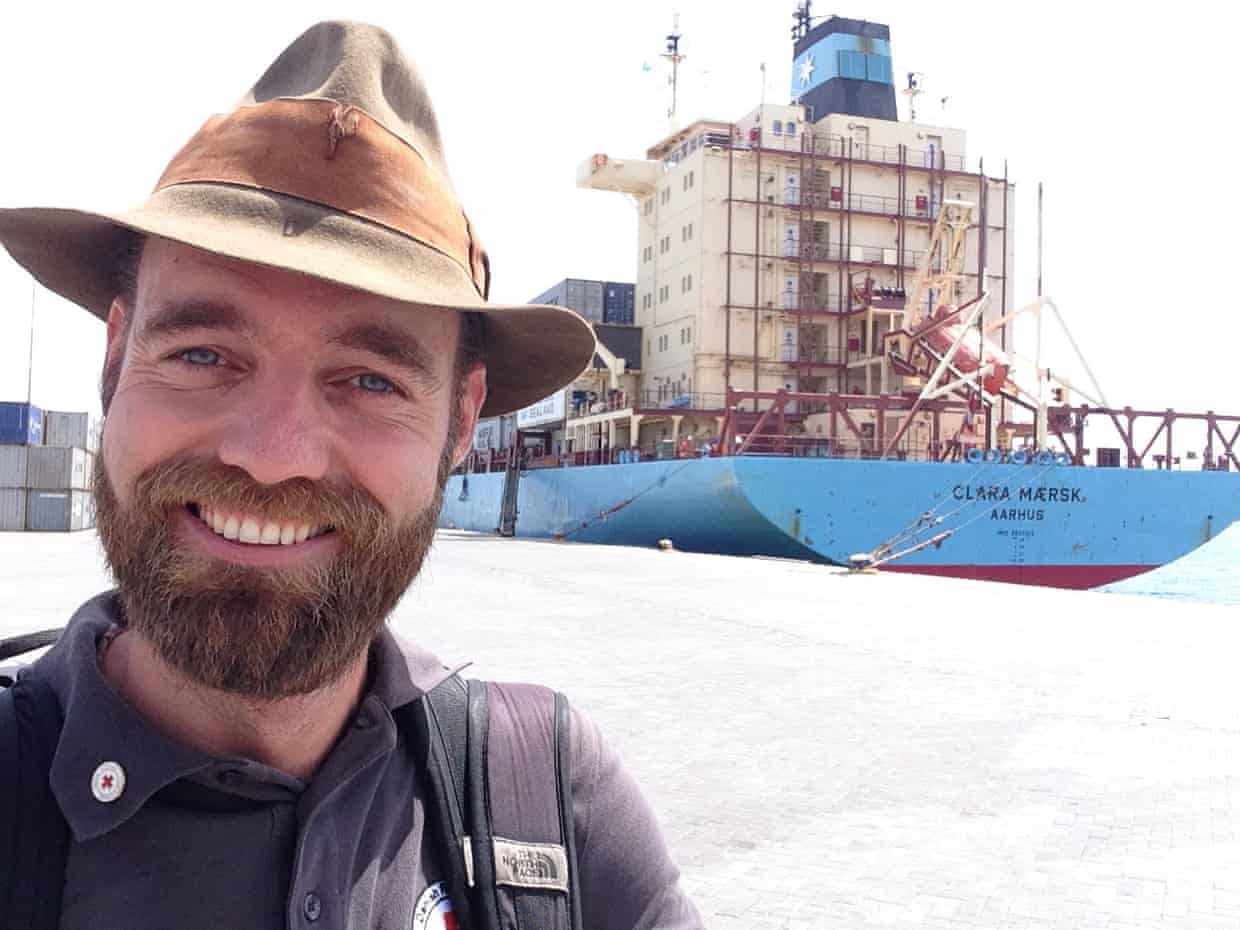
Thor Pedersen took a container ship from Praia, Cape Verde, to Guinea Bissau — one step in his quest to travel the world without flying. 

I recently met a couple who are unusually thoughtful about their footprint on Planet Earth, to the point of investigating how they could get to Europe without flying. There are ways to travel without flying, as we learn from today’s story in the Guardian, but they all have a cost in carbon emissions — ocean-going vessels especially. Unless you’re talking sailboats, which are not practical for most people.

Nevertheless, experiments in avoiding airplanes are consciousness raising — and often fun. Thor Pedersen reported on his own effort to travel everywhere without flying. It took him 10 years!

He writes, “Growing up, it seemed as if all the great adventures had happened before I was born. But in 2013 I discovered that – although it had been attempted – no one had made an unbroken journey through every country without flying. I had a shot at becoming the first to do it. …

“At 34, I set off – and didn’t return home until almost a decade later. These are the lessons I learned along the way.

“1. Human generosity can be astounding. It was a cold, dark night in December. A train had brought me to Suwałki, which people say is the coldest city in Poland. It was quiet. Snow was falling, but otherwise everything was still. I was carrying a piece of paper with a name, a phone number and an address for where I was supposed to be staying. But I had no sim card, so I began walking, looking for someone who could help me.

“Just as I was beginning to wonder if I would ever meet anyone, a woman opened her front door. I dashed over. Luckily, she spoke English and invited me in. She was happy to host me and convinced me there was no point in heading back out into the cold.

“I was quickly given a full plate of food and a spare bed. All this from a stranger. The next day, I was served breakfast and taken to the bus that would carry me to Lithuania.

“2. There are still some hidden and spectacular natural wonders. Lesotho was country No 106 on my very long journey. Its natural beauty was immediately apparent. … The mountains of Lesotho are horse country. Every now and again, riders draped in thick blankets would pass. Then I reached Maletsunyane Falls. The nearly 200-metre waterfall was glistening in the sun at the end of a canyon. And I had it all to myself.

“3. People’s resilience is powerful. In 2015, I travelled through western Africa. At the time, Guinea, Sierra Leone and Liberia were dealing with the world’s largest Ebola outbreak. A taxi driver in Guinea said to me: ‘Here we have everything, but we have nothing.’ These countries are rich in many ways – from natural resources to beautiful landscapes – yet most of the people are not.

“But after only an hour in Sierra Leone, I had been invited to a wedding: loads of music, lots of people in fancy clothes, an abundance of food and drink, small talk and dancing.  …

“4. Isolating yourself is a mistake. When you take public transport in Denmark, where I’m from, you always pick the seat farthest from everyone else. We value our privacy and respect the privacy of others. But in much of the world, the best seats are the ones next to other passengers. Where else will you find conversation?

“In west and central Africa, I found that everyone in a bus or a bush taxi would immediately form a unit, sharing food and stories and holding babies for one another. …

“5. What you want and what you need are not the same thing. … I hit a wall after about two years, but had to push through it to reach my goal. I learned the difference between what I want and what I need. I learned to live on a rock and how to engage in conversation with absolutely anyone. Once I returned home, I realized the only things that had kept their value were the relationships and conversations I had had. Everything else seemed perishable.

“6. You can form connections without sharing a language. I once had a 12-hour train journey from Belarus to Moscow during which no one else spoke anything but Russian. It didn’t seem to bother them that I didn’t know the language beyond nyet or da; they sat and spoke to me in Russian for several hours, while we shared food and vodka.”

To see more of Pedersen’s photos and his life lessons from this kind of travel, click at the Guardian, here. No paywall.

Read Full Post »

As a kid of 10 or so, I played in the woods, frequently all alone. It was magical.

As an adult, I wonder if it’s no longer considered safe. I don’t ever hear of children playing in the woods. That’s why I was interested to read about a growing movement called Forest Schools.

Siobhan Starrs writes for the Associated Press, “In the heart of north London lies the ancient Queens Wood, a green forest hidden away in a metropolis of more than 8 million residents. The sounds of the city seem to fade away as a group of children plays in a mud kitchen, pretending to prepare food and saw wood.

“These aren’t toddlers on a play date — it’s an unusual outdoor nursery school, the first of its kind in London, following a trend in Scandinavia, Germany and Scotland. It allows local children to learn, and let their imagination run free, completely surrounded by nature. …

“Each morning a group of children gather at the Queens Wood camp, which the nursery team prepares each morning before the children arrive. A circle of logs provides a place to gather for snacks, stories and songs. The mud kitchen provides an opportunity to make a proper mess and have a sensory experience, a rope swing provides some excitement and a challenge, and several tents are set up for naps and washing up.

“In a clearing in the woods, a fallen tree trunk can be transformed by imagination into a rocket train, calling at the beach and the moon, with leaves for tickets.

“A 2-year-old, Matilda, finds a stick — but in her mind it’s not a stick. It’s a wand. She says she is a magic fairy who can fly. Then suddenly the stick has become a drum stick, and a gnarled tree stump her drum. She taps away contentedly, the rhythm all her own.” Read more here.

Speaking of fallen tree trunks, I particularly remember a big tree that fell in the forest after a storm and the fun a friend and I had making up stories on it.

Photo: Matt Dunham/AP
Forest schools are increasing in popularity in the United Kingdom.

Read Full Post »