Feeds:
Posts
Comments

Posts Tagged ‘extinct’

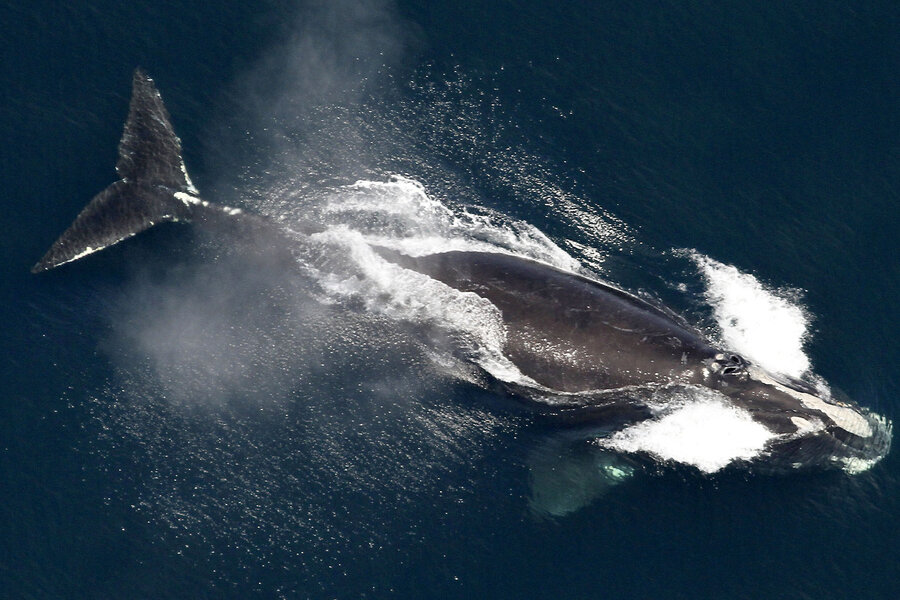
Photo: NOAA/AP file.
A North Atlantic right whale swims in New England waters.

Can we save treasured wildlife if we try? I can’t help thinking that before we pushed dodos and passenger pigeons to extinction, humans were not as aware. Now that we understand the dangers of losing species, can we put in the extra effort to preserve them?

Some humans are all in on protecting one particular species — the North Atlantic right whale.

Nate Iglehart reports at the Christian Science Monitor, “By the time Herman Melville wrote Moby Dick in 1851, New England was already famous for its whaling industry – hunting the North Atlantic right whale to near extinction. …

“Today, the once-targeted whales are prized conservation targets as New England leads efforts to bring them back from the brink. An emerging linchpin to their survival is taking form in a small but mighty network of coastal signaling devices.

“North Atlantic right whales are one of the most endangered large whale species in the world, with only about 370 left. Although whaling was almost entirely banned worldwide in 1986, the whales’ numbers have not recovered. Eleven new right whales were born this year, far below the 50 per year needed to create a stable population. Some models predict their extinction by 2035. …

“Now, everyone from fishers and marine ecologists to maritime corporations and coastal residents [is] leaning into technology to help stem the decline. …

“Mariners already try to avoid whales to protect the animals and their ships. But they don’t always know when one is around. When a whale is spotted, the National Oceanic and Atmospheric Administration (NOAA) sets up a slow zone, in which mariners are asked to slow their speed to 10 knots (11.5 mph) or less to reduce the likelihood of hitting a whale and the risk of fatally injuring it. The zones are separate from seasonal management areas, which have mandatory speed rules.

“Boaters are mainly alerted through email and text updates, and an app called WhaleAlert, which acts as a database for whale sightings and slow zones, says Greg Reilly, the International Fund for Animal Welfare’s marine campaigner. However, both need an internet connection, which is not required for boaters and is often spotty at sea.

“That’s where Moses Calouro, CEO of Maritime Information Systems, comes in. Over the last two years, Mr. Calouro has partnered with businesses, nonprofits, and coastal towns to install devices called StationKeepers along the entire Atlantic coast. These small 20-pound boxes sit high on coastal buildings and lighthouses. Using an Automated Identification System (AIS), they transmit locations of whales and speed zones directly to the navigation screens of ships. …

“Mr. Calouro’s 2024 pilot program focused on the Stellwagen Bank National Marine Sanctuary, an underwater plateau and feeding ground for right whales off the coast of Cape Cod. Upon entering, over 85% of ships slowed down, with an additional 10% doing so after receiving an automatic message warning.

Pete DeCola, the sanctuary’s superintendent, says the StationKeepers, combined with other efforts already under way to protect right whales, have reduced the risk of ships encountering whales by over 80%. …

“In 2010, NOAA researchers at the sanctuary created a program with the Massachusetts Port Authority and the International Fund for Animal Welfare that grades boaters and companies on their compliance. Last year, 91% of the 104 companies … that passed through slowed their boats appropriately. …

“Vessels that didn’t slow down were mainly new to the area. … That lack of knowledge is another challenge Mr. Calouro’s system aims to address. Mariners are skilled at avoiding hazards; it’s what they do for a living, says Mr. Reilly. But ‘they have to know where the hazard is.’ …

“But perhaps the biggest threat to North Atlantic right whales is entanglements, often in fishing gear. Even if the whale survives the tangle, the damage and stress of thrashing in the lines hurt their ability to give birth, says Courtney Reich, coastal director of the Georgia Conservancy.

“Technological advancements can reduce the need for buoy lines. Mike Lane, a lobsterman based out of Cohasset, Massachusetts, has worked with the underwater technology company EdgeTech to create prototypes of ropeless fishing gear. Typically, rope connects traps with buoys at the surface. But with ropeless gear, the traps use pop-up buoys, lift bags, or buoyant spools that, when remotely triggered, inflate or detach and bring the trap to the surface for collection.

“The gear is not perfect, Mr. Lane says, but it allows lobster fishers to keep working during the months that fisheries close due to the whales’ migration paths. He says that extra work can help lobster fishers financially, and it helps to know their gear is not snagging whales.

“But this gear, compared with a buoy and rope, is costly and can stress the fishers’ thin profit margins. There’s also a learning curve. … One of the biggest issues, he says, is keeping track of the traps so they don’t interfere with other fishers. If you tried to plot hundreds of ropeless traps in the water, the mapping data would be too cluttered to use effectively. Losing the expensive gear would be devastating. …

” ‘I’m not a huge fan of it,’ he says. ‘It’s not the way I prefer it. … The [mapping] technology is there; someone’s just got to package it properly.’ “

More at the Monitor, here. No paywall, but supporting this great news source is reasonable.

Read Full Post »

Photo: Wonders of the Mekong.
Recent sightings of the “Mekong ghost” fish in Cambodia offer hope for a creature once presumed extinct.

Today’s report on the reappearance of a giant fish in the Mekong River near Cambodia is a little piece of good news in an era when governments are shrugging off saving the planet and leaving it all to those of us who care.

I first saw the good news at Yale Environment 360: “Recent sightings of the ‘Mekong ghost’ fish in Cambodia offer hope for a creature once presumed extinct. The giant salmon carp, so named because it resembles a large salmon, had not been documented by science since 2005. But scientists have now confirmed that three fish caught between 2020 and 2023 in the Mekong and Sesan rivers are members of this elusive species.

“Giant salmon carp can measure up to 4 feet long and weigh more than 60 pounds, making them a type of ‘megafish.’ The carp are in good company in the Mekong basin, which is home to some of the largest freshwater fish on the planet, including the giant catfish and giant freshwater stingray. Such creatures have been victims of excessive fishing, pollution, and the construction of massive dams.

“In the new study, published in Biological Conservation, scientists call for scanning river waters for giant salmon carp DNA and for working with local fishers to track its potential whereabouts — first steps, they say, toward protecting the imperiled species.” More at Yale e360, here.

At the Mekong Fish Network website, I found additional detail: “Dr. Zeb Hogan, who leads USAID’s ‘Wonders of the Mekong’ project, says, ‘Giant fish are flagship species that symbolize the ecological integrity of the Mekong River. The disappearance of these animals is a warning that we need to take urgent action to improve the ecosystem health of this remarkable river.’

“Several Mekong megafish species are now endangered and both the number and size of fish caught have declined. The biggest include the Mekong freshwater stingray (Urogymnus polylepis), which can have a wingspan of up to 4.3 m [14 feet], Pangasianodon gigas (Trey Reach), Catlocarpio siamensis (Trey Kolriang), and Pangasius sanitwongsei (Trey Popruy), which can grow up to about 3 meters [10 feet] in length … and Aaptosyax grypus (Trey Pasanak), Probarbus jullieni (Trey Trasak) and Wallago attu (Trey stourk), which can grow up to 20 kilograms [44 pounds]. All of these are listed by the IUCN as Critically Endangered, and current and future threats may put these species at risk of population extirpation or extinction.

“Based on a recent study by Wonders of the Mekong on traditional ecological knowledge about large and endangered fish, megafishes in the northern Cambodian Mekong Basin in Kratie and Stung Treng are very rare, decreasing in population abundance, at high risk of extinction, and decreasing in body size. Also, the population of three giant species of Mekong River fishes (C. siamensis, W. micropogon, and P.jullieni) previously thought to be in serious decline can still be found, although, their body sizes are significantly decreasing.

“Unfortunately, the Mekong Giant Catfish, P. gigas, considered critically endangered by IUCN, is still rare in this stretch of the Mekong. The presence of giant and endangered species in Mekong River deep pools demonstrates the importance of these habitats in fish conservation and provides a starting point for the preservation of these species. The decline of Mekong megafish in northern Cambodia can be attributed to a variety of causes such as threats from multiple anthropogenic pressures. These threatened fishes are all rapidly declining and could ultimately face extinction. The impact of these threats could be minimized by proper management and an effective conservation plan, such as the sustainable management of fishing.

“In light of this, since 2017, approximately 100,000 larvae of endangered fish such as Mekong giant catfish (Pangasianodon gigas), giant barb (Catlocarpio siamensis), striped catfish (Pangasianodon hypophthalmus) and other species have been confiscated from illegal fishing operations or collected during research activities. These juvenile fishes are kept in a rearing facility before being released back into the river at a larger size. During rearing in ponds at Cambodia’s Freshwater Aquaculture Research and Development Center (FARDC), Mrs. Hoy Sreynov, an official of the Department of Aquaculture Development of the Fisheries Administration, does monthly monitoring to observe fish growth, feeding, and lifespan. Running this catch, raising and release program requires an understanding of conservation importance and a strong network to promote effective conservation management.”

More at Mekong Fish Network. You may also be interested in my previous post about the Mekong’s revival, here.

Read Full Post »

Photo: Joel Sartore/Photo Ark.
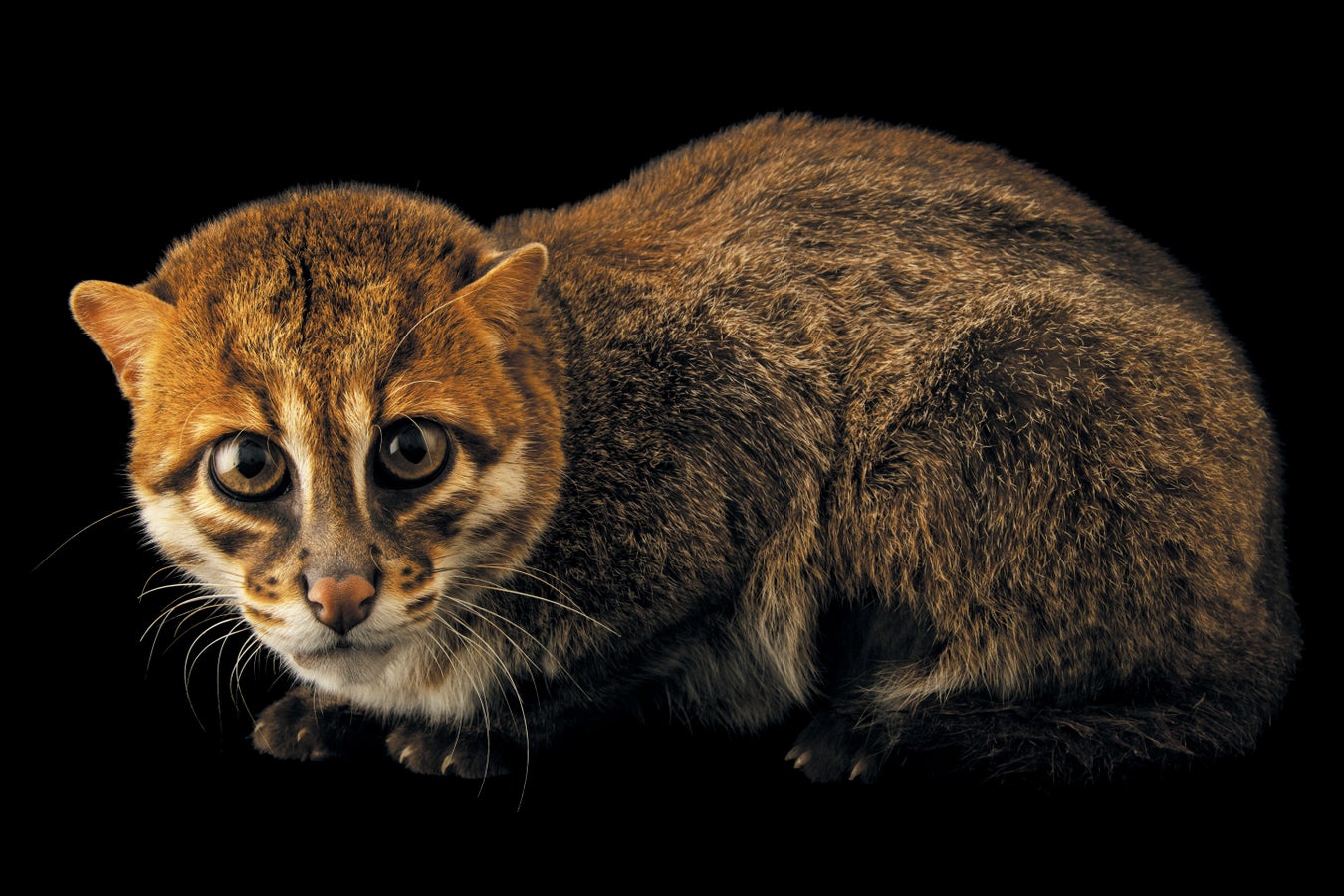
Rare flat-headed cats were declared “lost” before the species was rediscovered in 1995.

Lady Macbeth says, “What’s done cannot be undone.” Similarly, when a species is truly extinct, it’s done, never mind random talk of bringing back a wooly mammoth from its DNA. What is more feasible is bringing back to its former range a species that is merely extinct in that region.

Remember our post on the tiger quoll, thought to be extinct in southern Australia? And how about that gray whale, thought to be extinct in the Atlantic Ocean? It just showed up, although that was probably a sign of melting ice that could have opened a passage from the Pacific.

You might like Daniel Shailer’s related story at Scienific American on species that scientists think may yet be found. He explains how researchers will go about prioritizing their searches.

“Gison Morib was home lying in bed, sick from exhaustion after a month-long jungle expedition, when his phone buzzed and a black-and-white photograph appeared. Morib ran outside, jumped on his motorbike and sped through the city of Sentani on Indonesian New Guinea to his colleagues’ expedition and research base — where he broke down in tears.

“ ‘I cannot believe we found it,’ was all he could say, over and over. The photograph showed the first recorded sighting in more than 60 years of an Attenborough’s long-beaked echidna, an egg-laying mammal. After the researchers had spent three years of research and four weeks of trekking through the island’s remote Cyclops Mountains … the team’s camera trap had finally captured an image of the echidna. ‘Even now I can’t describe the feeling,’ … says Morib, a biology undergraduate student at nearby Cenderawasih University. …

“It can be painful for scientists to conclude that an entire species is gone forever. So after at least a decade without recorded sightings, local researchers sometimes simply declare a species temporarily ‘lost’ — hoping it may eventually be found again — instead of giving up entirely. In 2023 that hope led to rediscoveries of animals that included Attenborough’s echidna, De Winton’s golden mole in South Africa and the Victorian grassland earless dragon, a type of Australian lizard that went unseen for half a century. Such hope also fuels ongoing, decades-long searches for species such as the American Ivory-billed Woodpecker, which was last seen in 1944.

“Now an international study published [in] Global Change Biology aims to ‘bring a bit of science back to the search’ for all mammals, amphibians, reptiles and birds playing hide-and-seek, according to senior study author Thomas Evans, a conservation scientist at the Free University of Berlin. In a span of two years, Evans and a team of researchers across the globe — from the U.S. to China, Ecuador and South Africa — compiled what they call the most exhaustive catalog ever of four-limbed creatures that were considered lost to science and those among these animals that were later rediscovered. …

“Although there has been plenty of research into lost species, the study authors say that rediscoveries haven’t been thoroughly assessed since 2011. Analysis tallying losses and rediscoveries across animal groups is even rarer, Evans says.

“His team’s catalog suggests that 856 species are currently missing and that the number of lost species is growing around the world faster than expedition parties can keep up. And this is occurring even though researchers are finding animals through the use of increasingly sophisticated technology, including systems that detect environmental DNA (eDNA) traces of burrowing birds near the South Pole, software that disentangles the noises of different nocturnal species, and even techniques used to spot microscopic traces of rare frogs in ship rats’ stomachs.

“Adding up losses and rediscoveries also suggests that roughly a quarter of lost species are likely already extinct. … Analysis shows that many rediscovered species fit a certain profile: they are big, charismatic mammals or birds that tend to live across a range of habitats, often near humans and in more-developed countries. So, Evans says, if an animal fits the bill for the kind of species that is usually found more easily but continues to evade researchers after long searches, it is probably gone forever. The thylacine, or Tasmanian tiger, is a good example: since the last captive thylacine died in a zoo in 1936, the wolflike species has taken on huge cultural significance across Australia and inspired decades of searching, but it remains lost. The paper argues that precisely because the thylacine is a perfect candidate for rediscovery, the fact it remains lost strongly suggests that it is actually extinct. The same goes for more than 200 other lost species that have been thoroughly searched for as well, Evans says.

“On the other hand, creatures that don’t fit the profile for easy rediscovery, especially reptiles, could still be out there. Because they’re often hard to find and inspire less search effort, small, uncharismatic species are more likely to genuinely be lost but still alive, Evans says. His optimism is backed up by the numbers: new species of small reptiles continue to be discovered at a steady rate, and rediscoveries have boomed, with more than twice as many lost reptiles found between 2011 and 2020 than in the decade before.

“The thylacine has acquired a Bigfoot-like status, complete with amateur hunters and highly questionable sightings. Meanwhile reptiles such as the Fito leaf chameleon of Madagascar are probably sitting pretty and waiting to be found. …

“A probability analysis of some factors also rang ‘alarm bells’ in different ways for different classifications of lost species, Evans says. Mammals classified as lost on islands, such as the Bramble Cay melomys, a rat lost in 2009 and declared extinct in 2016, are disproportionately likely to be gone for good, compared with mammals in other environments. There’s also a sweet spot for finding birds after they’ve been lost: 66 years, on average. This time span is long enough to raise interest in search expeditions but not so long that the animals are considered extremely likely to be extinct. So the odds are not good for the more than a dozen bird species that were lost more than a century ago.

“Evans hopes such details about what may be simply unseen versus what is more likely extinct will help conservationists.”

More at Scientific American, here.

Read Full Post »

Photo: Arthur Allen/Cornell Lab of Ornithology.
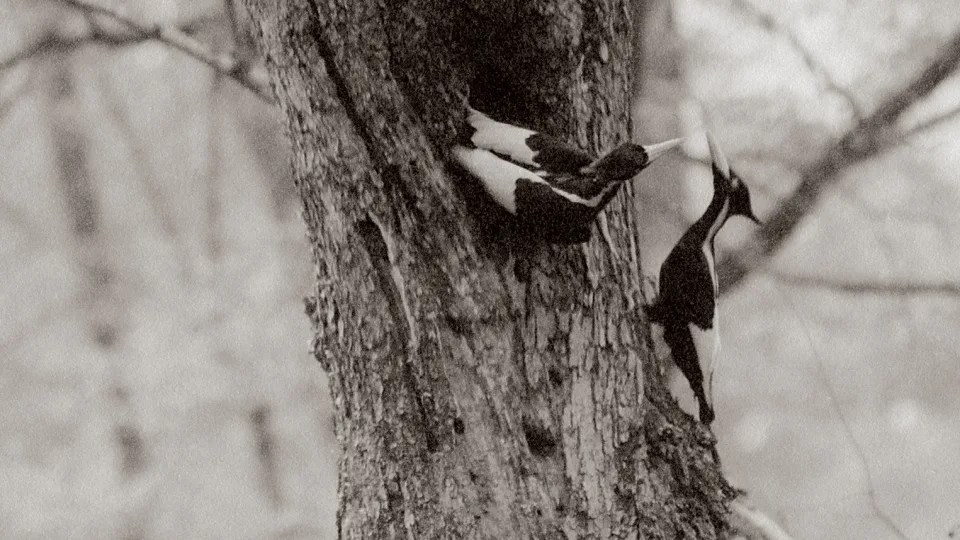
Ivory-billed woodpeckers in Louisiana in 1935.

When our younger granddaughter was in pre-school and learned about dinosaurs, she latched on to the word “extinct.” The idea of something being completely gone was powerful to her, and when she was angry at her brother she turned the word a verb: “I’m going to extinct you.”

Today I learned about the variety of reasons we keep some things off the extinct list even when they seem gone forever. As Rachel Ramirez reported at CNN, Federal wildlife officials “are delaying a long-awaited decision to declare the ivory-billed woodpecker extinct, months after grainy photos and videos emerged that purported to show the bird flying through a Louisiana forest.

“In 2021, the agency seemed ready to declare the so-called Lord God Bird extinct: The US Fish and Wildlife Service announced plans to remove 23 species, including the ivory-billed woodpecker, from the endangered species list due to extinction. Thorough scrutiny of ‘the best scientific and commercial data available’ had led to the conclusion the bird no longer exists, the agency told CNN.

“[But in October] Fish and Wildlife declared 21 of those species extinct — and the ivory-billed woodpecker is not among them. …

“The government’s last accepted sighting of the red-crowned bird species was in April 1944 by artist and birder Don Eckelberry.

“But expert biologists and birdwatchers have been adamant the nation’s largest woodpecker is still out there. Just after the feds announced the proposal to remove the bird, public comments poured in from ornithologists, amateur birders and even communities like the Cherokee Nation, whose leaders asserted the creature is a symbol whose ‘influence on our cultural activities remains to this day.’

“Amid the wave of testimony, the wildlife service invited more public comment and announced extensions to its decision that effectively postponed its ivory bill verdict into 2023. Now, that critical decision to delist the bird is once again delayed. …

“ ‘John Fitzpatrick, a renowned ornithologist and retired director emeritus of the Cornell Lab of Ornithology, told CNN, ‘Evidence of its persistence continues to emerge, albeit none of it 100% convincing to everyone.’

“Since the 1944 sighting, the only other ‘compelling evidence,’ according to the federal wildlife service, was 2005 research from Fitzpatrick and his associates that claimed ivory bill sightings in eastern Arkansas’ Cache River National Wildlife Refuge. …

“In 2022, CNN joined avid birdwatchers to search the Tensas River National Wildlife Refuge in Louisiana, where the ivory-billed woodpecker was last officially seen. Around the same time, a group known as Project Principalis — a nod to the ivory bill’s scientific name, Campephilus principalis — was gathering evidence observed over the prior decade by Steve Latta of the National Aviary and other colleagues.

“Using unmanned trail cameras and drones, they’d captured grainy pictures of what they claimed was the ivory bill.

“ ‘We have some of the best images, if not the best images, that have been produced in 80 years,’ Latta, who claimed he has seen the bird in 2019, told CNN at the time.

“This May, Project Principalis published peer-reviewed research that unveiled such recordings, which they submitted to the feds, including a drone video from October 2022 of two ivory bills quickly flying onto a tree branch.

“ ‘Our ultimate goal is the conservation of the species, its habitat, and the many other species relying on that habitat,’ Latta told CNN Monday. ‘Keeping the Ivory-billed Woodpecker on the Endangered Species list brings us one step closer to that goal.’ ”

More at CNN, here.

Read Full Post »

Photo: JJ Harrison/Wikimedia Commons.
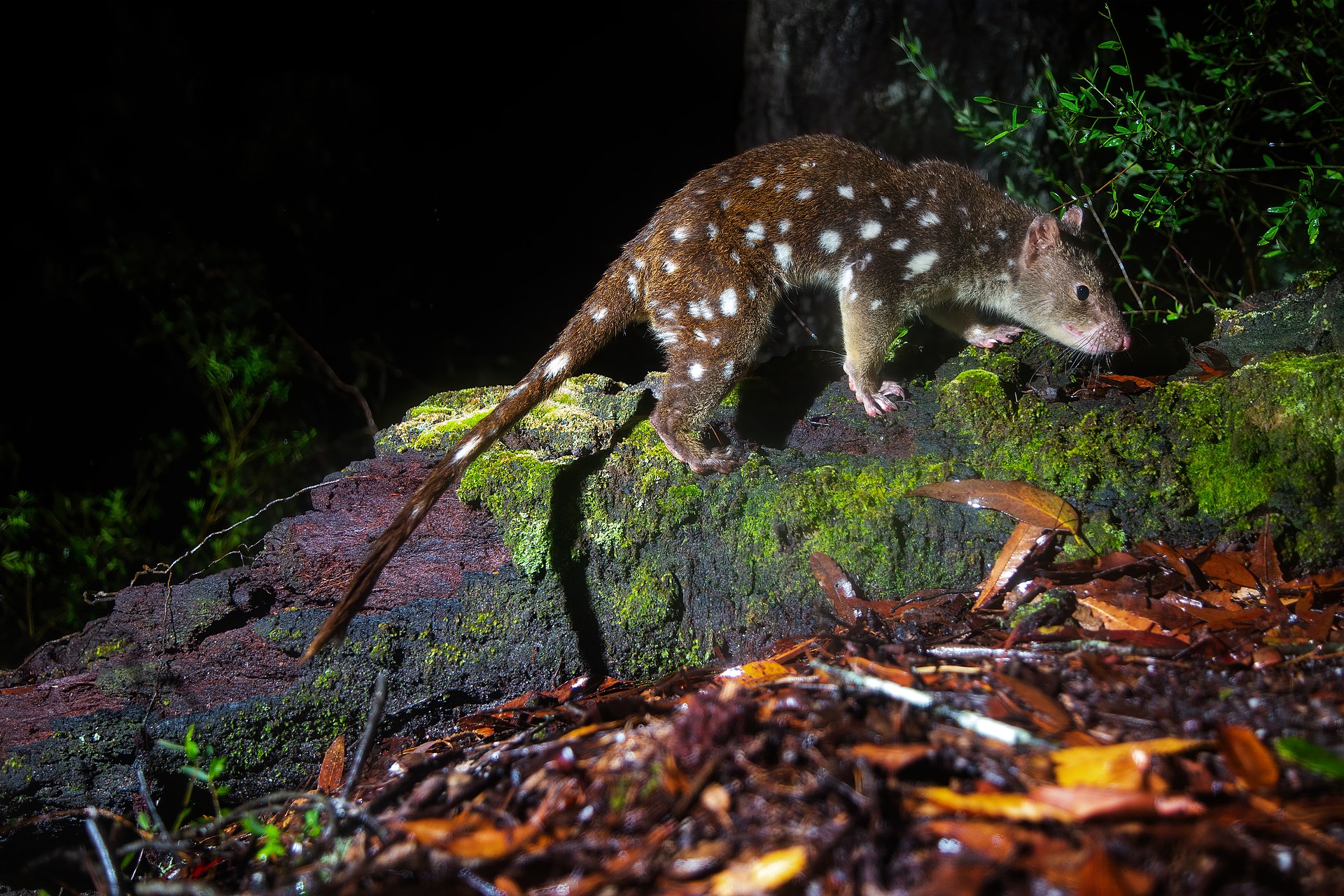
This tiger quoll (or spotted-tailed quoll) at Barren Grounds Nature Reserve, New South Wales, Australia, is similar to one a farmer caught harassing his chickens.

The creature of the day, the spotted-tailed quoll, is not extinct everywhere but was thought to be extinct in southern Australia. That is, until a farmer protecting his chickens caught one. Imagine how your perspective would change if an animal you just wanted to destroy suddenly turned out to be a rare find!

Aspen Pflughoeft reports at the Miami Herald. “A farmer in southern Australia captured an animal considered locally extinct for over a century while trying to protect his chickens. …

“Frank Pao-Ling Tsai, a trout farmer in Beachport, South Australia, heard a ‘panic’ from his chickens and rushed outside early in the morning on Tuesday, Sept. 26, he told McClatchy News in an email.

“Inside the coop, Tsai found a spotted creature and a dead chicken, he said.

“ ‘I had no idea what it was at first,’ Tsai told the Australian Broadcasting Corporation. ‘I expected to find a cat, but I found this little animal instead.’ …

“The captured animal [has] a furry brown body, long tail and smattering of white spots. … Tsai captured the creature in a plastic chicken cage, he told McClatchy News. He took photos and shared them in hopes of identifying the animal.

“Wildlife officials identified the animal as a spotted-tailed quoll, the National Parks and Wildlife Service of South Australia told McClatchy News.

“Quolls are ‘about cat-sized’ marsupials with a ‘cat-like shape but a lot stronger jaws and a lot longer canine teeth,’ Limestone Coast district wildlife ranger Ross Anderson told McClatchy News.

“The spotted-tailed quoll, also known as the tiger quoll, is an endangered quoll species and the ‘largest native carnivore left on the (Australia) mainland,’ according to the Australian Conservation Foundation. An estimated 14,000 spotted-tailed quolls are left in the wild, the organization said.

“The last officially documented sighting of a spotted-tailed quoll in South Australia was in the 1880s, Anderson said. The species has been considered locally extinct for over 130 years.

“ ‘It’s a once-in-a-lifetime event, really,’ Anderson told the Australian Broadcasting Corporation. …

“ ‘We can’t be sure where it’s come from,’ Anderson told the Guardian.

“The quoll Tsai originally captured managed to escape out a damaged corner of the cage, he said. Wildlife officials set up another trap and again captured a spotted-tailed quoll, Anderson said. …

“ ‘It could have been a relic population,’ Anderson told McClatchy News. ‘(Or) it could have been an animal that’s moved from other areas …. (or) it may have escaped from captivity.’

“ ‘We took some DNA to see if we can work out the likely origins,’ he said. ‘It’s a great opportunity for us to get some information and it would be fabulous if it turned out to be a relic population.’

“After being checked by a vet and DNA-tested, the captured quoll was released, Anderson said.

“Wildlife officials will set up cameras and traps to study the rediscovered quoll species and see if there are more quolls around Beachport, he said.”

See Tsai’s photos of a very angry beast at the Miami Herald, here. No firewall.

Read Full Post »

Photo: National Park Service.
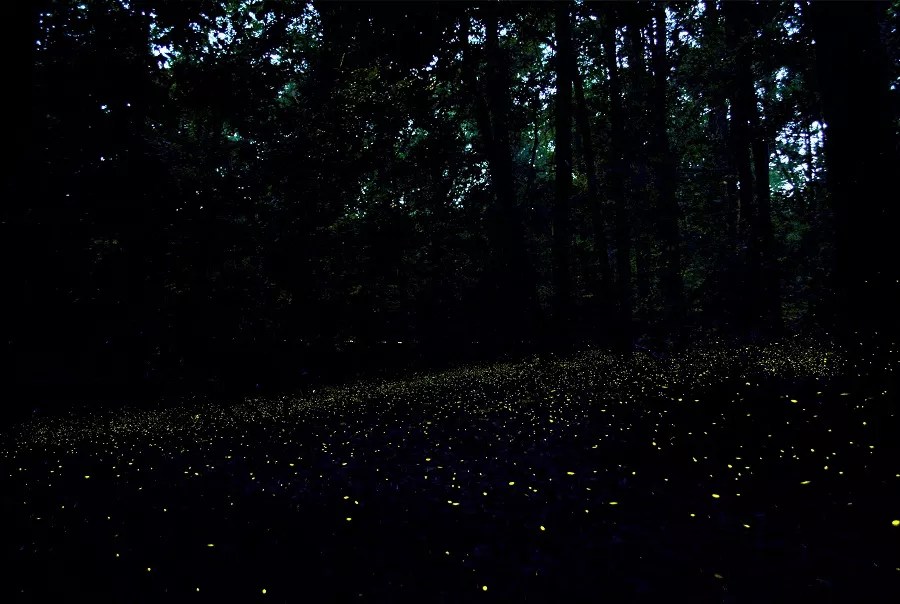
Mid-May to mid-June, synchronous fireflies light up the forest at dusk in Congaree National Park, South Carolina.

I used to love seeing fireflies as a kid, and now they are rare where I live. It makes me sad. What’s it all about? What is to be done?

Dino Grandoni at the Washington Post has this to say about the dangers to fireflies and possible ways to help bring them back.

“As a younger man, Joe Cicero saw ‘thousands and thousands of them.’ Swarms of fireflies put on a soundless fireworks show for him every summer in southern Arizona. The sight of the fireflies flashing in unison was so mysterious and mesmerizing that the entomologist made the study of the flickering insects his life’s work.

“Four decades later, Cicero, now retired, still goes back to those oak woodlands. Today, though, they’re mostly dark. The fireflies have been decimated, Cicero lamented. ‘Down to just a trivial few relative to the big population they had back then.’

“For many Americans, their otherworldly glow signals the start of summer. But across the country, many of these harbingers of summer may be blinking out of existence. What was once a series of tales from old-timers about the decline of fireflies from the days of their youth is coalescing into a disturbing scientific truth.

“Nearly 1 in 3 firefly species in the United States and Canada may be threatened with extinction, firefly experts estimate in a recent comprehensive assessment. … New research is shedding light on how these ethereal insects are struggling to thrive in the brightly lit world we have built around them.

“And the problem is bigger than a single type of bug. … In so many spots where scientists look, insects of all sorts are vanishing, … leading to fears of a potential-though-still hotly debated ‘bugpocalypse,’ which could unravel food webs for birds and other insect-eating animals and cause calamity for farmers who need pollinators to grow crops.

“ ‘I know a lot of people who hate insects. I’ve never met a single person who didn’t like fireflies,” said Sara Lewis, a Tufts University biologist and author of Silent Sparks: The Wondrous World of Fireflies.

“To understand the threats to fireflies, start underground. Fireflies in the United States spend the vast majority of their lives in their larval state, roaming the dirt to consume snails, worms and other soft-bodied grub several times their size. In contrast to their gentle summertime image, baby fireflies are vicious predators.

“But much of the swampy soil young fireflies need to thrive is increasingly being bulldozed for golf courses, suburban subdivisions and other types of development, making habitat loss a top threat. …

“ ‘These wetlands only occur right along the beach along the Mid-Atlantic,’ said Christopher Heckscher, an environmental scientist at Delaware State. … In Arizona, the Southwest synchronous firefly that Cicero studies is being trampled by different threats. Cattle and all-terrain vehicles in Coronado National Forest are stomping out its riverside habitat, he said. …

“When the time is right in the spring, juvenile fireflies seek a spot to pupate. Much like how a caterpillar transforms into a butterfly, a young firefly rearranges its body to turn into an adult. Then they take flight.

“The adults live for only a few weeks — with one thing on their minds. Fireflies flicker at each other to find their mates. …

“Males of certain species work together to woo mates by synchronizing their pulses. Other varieties are more ruthless, imitating the flashes of smaller fireflies to lure them in — and eat them. There are more than 2,000 species of fireflies globally, each doing a different dance.

“Even in the best conditions, males drifting in the air struggle to find females on the ground. ‘Mating success rate in darkness is not especially high,’ said Avalon Owens, a research fellow at Harvard. …

“Increasingly, we’re the ones making it harder. The artificial light we pour into the night is interrupting these bioluminescent courtships.

“To test the impact of light pollution, Owens set up a mating arena on her porch in her home outside Boston in 2020 during the height of the coronavirus pandemic. …

“In a study published last year, Owens and Lewis found exposing a semi-nocturnal firefly species called Photinus obscurellus to a bright light on the porch completely prevented it from mating. Out in the wild, the [researchers] found males of a related species, P. greeni, preferred LEDs meant to imitate females that were bathed in darkness.

“Brightening the night not only makes it harder for fireflies to see each other, it may also trick them into thinking it is daytime, Owens said. ‘It erases their habitat,’ she added. …

“Not every type of firefly is in peril. Some are actually thriving in our well-lit world.

“The big dipper firefly, named for the swooping arc it draws in the sky, evolved to come out at dusk and does not seem to mind modern streetlights. In their field experiments, Owens and Lewis found artificial lighting had little impact on the big dipper’s mating. Plenty can be found in well-lit corners of Central Park in New York.

“For many fireflies, there is a painful lack of data on even baseline populations. While some species remain abundant, overall, we risk the loss of firefly biodiversity. …

“While reversing climate change and other environmental threats is monumentally difficult, saving fireflies from light pollution is relatively easy. ‘You literally can just turn off the light, and the threat is gone,’ said Candace Fallon, a senior conservation biologist with the Xerces Society, a nonprofit conservation group pressing the federal government to extend endangered-species protections to fireflies. …

“For now, firefly aficionados are trying to inspire the next generation. Nearly 30,000 people flock to the Great Smoky Mountains each year to watch the park’s fireflies light up in sync. In Arizona, Cicero stages similar nightwatch parties for the few synchronous fireflies that remain there.”

More at the Post, here.

Read Full Post »

Photo: Edwards’s Botanical Register.
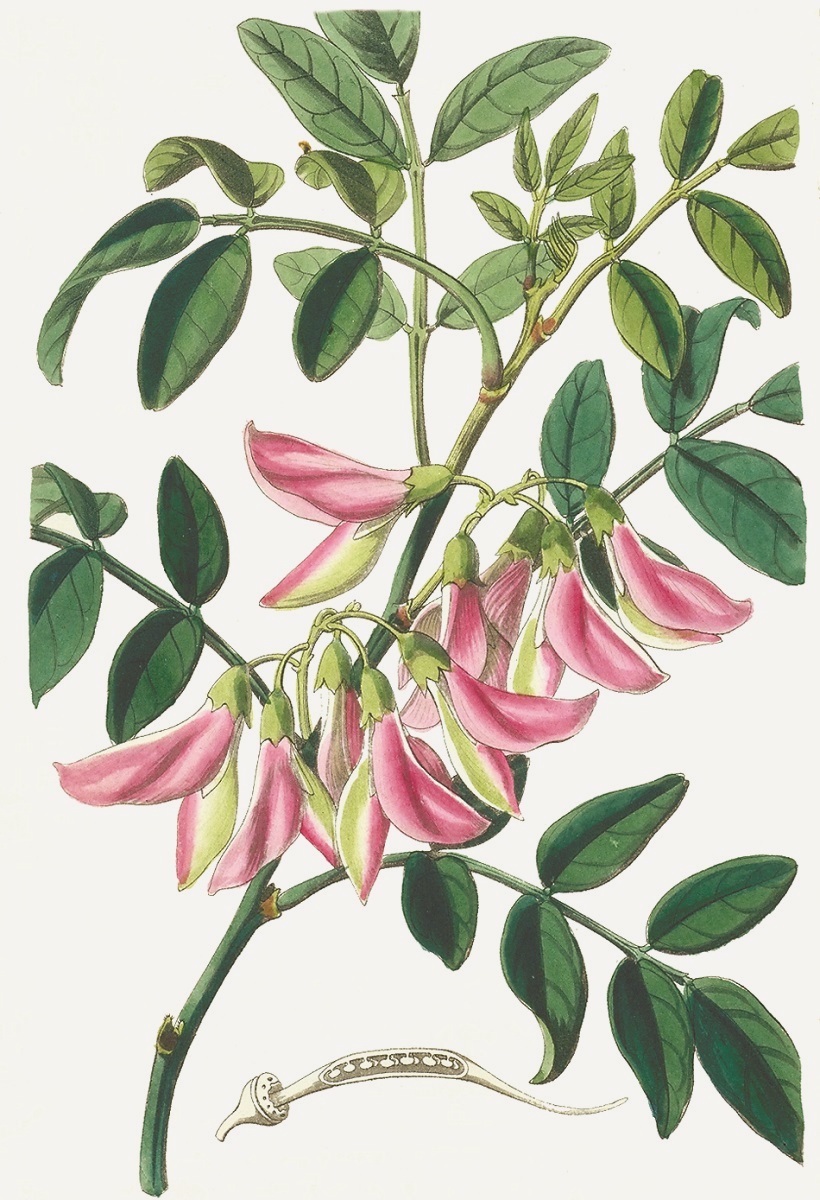
The Phillip Island glory pea, which once grew in Australia, is a leading candidate for de-extinction, according to e360

Do you get visions of Frankenstein’s monster when you hear about reversing extinction? Maybe we start with plants, but then what? Dinosaurs?

Well, it’s hard for me to be against anything that extends knowledge, so I’m keeping an open mind about the Yale Environment 360 report on the de-extinction of plants.

Janet Marinelli writes, “In January 1769, botanists Joseph Banks and Daniel Solander found a daisy in Tierra del Fuego, at the southern tip of South America. Later named Chiliotrichum amelloides, it is one of a thousand plant species unknown to European scientists that the two men collected during Captain Cook’s first voyage on the HMS Endeavor. … The plant was dried and pressed for future study. Today, the 254-year-old specimen is among the almost 8 million preserved plants in New York Botanical Garden’s William & Lynda Steere Herbarium.

“ ‘When a plant goes extinct,’ says Giulia Albani Rocchetti, a postdoctoral researcher at Roma Tre University and the lead author of the paper, ‘we don’t just lose a species, we lose a member of a habitat community with a specific role and relations with other species; … we lose genes which could have provided insight into the species and its community and yielded new pharmacological compounds and other products.’ …

“For nearly five centuries, herbaria have helped botanists identify, name, and classify the world’s floral diversity. Now these vast botanical libraries are being tapped to try to create a new chapter in the 500-million-year history of Earth’s terrestrial plant life. In Nature Plants in December, an international group of biologists published the first-ever list of globally extinct plants they believe can be returned from the dead, using seeds available in herbarium specimens. …

“In recent decades, the seeds of rare and imperiled species have been preserved in seed banks at low humidity and temperatures that ease the embryos inside into a kind of state of suspended animation to maximize their longevity. However, species already lost remain only as specimens in the collections of dried and pressed plants known as herbaria, and only in some (lucky) cases. … Only a few of these plants happened to be in fruit and in seed when they were collected. And even when herbarium seeds are discovered, there is no easy way to tell if the embryos inside are dead or lying dormant, waiting to sprout when conditions are right. …

“Abby Meyer, executive director of Botanic Gardens Conservation International in the United States, points to the rise in recent decades of the field of bioinformatics, which has transformed the trove of biodiversity information once locked up in natural history collections — such as herbarium specimens of extinct plants that contain seeds — into browsable digital databases. New York Botanical Garden (NYBG), for example, began digitizing its herbarium specimens in the mid-1990s, and today some 4 million, or about half of its preserved plants, have been scanned and can now be called up on a computer screen by anyone around the globe.

“Data aggregators such as the Global Biodiversity Information Facility provide researchers looking for seeds with instant access to millions of scanned specimens, along with associated ‘metadata’ such as the GPS coordinates where the plants were collected. At the same time, scientists have been refining in vitro embryo rescue techniques, increasing the odds that old or weak seed embryos can grow into viable plants. …

“While attempts to de-extinct the dodo, the woolly mammoth, and other charismatic megafauna continue to grab headlines, they would result at best in a hybrid, genetically engineered animal — a proxy of an extinct species. By contrast, recovering plants by germinating or tissue-culturing any surviving seeds or spores preserved in herbaria would result in the resurrection of the actual species. …

“One of the biggest hurdles is figuring out how to germinate the precious few seeds of often genetically unique plants found only on dried specimens. There is little margin for error, and before attempting to germinate the extinct species itself, scientists must perfect methods for germinating seeds of any closely related species that survive. …

“In December 2019, Giulia Albani Rocchetti sat in Florence’s Central Herbarium, marveling over the remains of Ranunculus mutinensis, an endemic buttercup that once grew in moist floodplain forests of the Po River, as it threads through northeastern Italy. … It was a thrill for her to find not just one but two Ranunculus specimens with numerous mature fruits called achenes. She then spent months at her desk in Rome, blowing up digitized images of extinct plants from herbaria across the globe on her computer screen in the improbable search for seeds.

“She was also spurred on by the knowledge that some seeds have the astonishing ability to survive adverse conditions and sprout after decades, even centuries — such as the Judean date palm, which a team of scientists successfully germinated in 2005 from a 2,000-year-old seed. …

“Albani Rocchetti and colleagues … identified 556 specimens that contained seeds, representing 161 of the extinct plant species [and] proceeded to devise a pioneering roadmap for prioritizing species for de-extinction. Assuming that species whose close kin produce long-lived seeds and newer specimens are the most likely to contain seeds that survive, they combined data on the seed behavior and longevity of closely related plants, as well as the age of each specimen, to create a DEXSCO, or best de-extinction candidate score for each species. …

Streblorrhiza speciosa, a spectacular member of the pea family, was [so] unique that it is considered the only member of its genus, or closely related group of plants. The species’ striking cascades of pink blossoms clambered exuberantly over trees on Phillip Island in the Pacific Ocean east of Brisbane, Australia. Collected in 1804 by Austrian botanist Ferdinand Bauer, the Phillip Island glory pea was an instant hit in Europe, coveted by every wealthy family with a conservatory. Meanwhile, however, Phillip Island was being overrun by pigs, goats, and rabbits introduced by British officers overseeing a nearby penal settlement, leaving barely a scrap of the remote island’s unique vegetation, and the glory pea was never seen in the wild again. …

“The glory pea is now presumed extinct, but at number three is near the top of the list of recommended de-extinction candidates. …

“Another challenge of plant de-extinction is the lack of financial support for pursuing it. But on the bright side, plant de-extinction has not kicked up the controversy surrounding attempts to resurrect, say, the wooly mammoth or passenger pigeon. ‘For whatever reason, the human brain doesn’t seem to be as concerned about plants as about animals,’ Knapp says. ‘But in this case, we’re literally just germinating seed. We’re not reconstructing a genome. And that’s way less intimidating. Everyone can understand that.’ “

More at e360, here. No firewall.

Read Full Post »

Photo: Stanley Forman.
A bear seen in Middleton in August represents the surprising Massachusetts black-bear comeback.

I’m sure you know it’s Fat Bear Week and time to vote on your favorite grizzly based on how successful the bear has been fattening up to hibernate.

Everybody loves bears — almost as much as dinosaurs. The advantage is that bears are still around. In fact, in today’s story we learn about a bear comeback. One caveat: it’s not safe to play with bears, anymore than with dinosaurs.

Billy Baker at the Boston Globe reports that black bears, once nearly extinct in Massachusetts, have staged their comeback without any help from wildlife officers.

“The story of the black bear that is coming to a suburb near you begins one day in the fall of 1969,” Baker reports, “when two bears showed up along a road in the northern Berkshires, in the tiny town of Florida, and appeared to be drunk.

“Back then, black bears were barely hanging on in Massachusetts, at the losing end of a 12,000-year fight with humans and [development], and the tiny population of survivors was believed to live somewhere nearby, along the border with Vermont.

“Still, these two bears were different. They hung around, happy for the crowds that came to watch them. Game wardens said the ‘tipsy bears,’ as they became known, were drunk from too many apples fermenting in their bellies.

Wardens even went so far as to briefly close the hunting season to give the bears time to ‘sober up’ before someone took a shot at them.

“Ultimately, it turned out the bears were comfortable around humans because they were semi-tame, raised by a guy in Shelburne as a roadside attraction for his gift shop on the Mohawk Trail, then released when he couldn’t afford to feed them. But all the fanfare forced the state’s wildlife experts to acknowledge that ‘we didn’t really know anything about bears in Massachusetts, other than there are some,’ according to Jim Cardoza, then a young biologist for MassWildlife.

“Thus began a five-decade effort to understand and conserve black bears in the state, a project that has succeeded beyond most people’s wildest dreams. …

“Starting in 1970, just after the ‘tipsy bears,’ the state shortened the bear hunting season to a single week, from 10 weeks since the early 1950s, and tasked Cardoza with figuring out how many bears lived in Massachusetts and the history that brought them there.

” ‘I was able to learn that at the time of Colonial settlement, bears were widespread in the state, except for very Southeastern Massachusetts and the islands,’ Cardoza said. But as settlement advanced inland to the Connecticut River Valley and the Berkshires, bears saw their forest habitat turned into farms, and their status lowered from king to pest; farmers could, and still can, legally kill any bear destroying their crops, at any time.

“They nearly disappeared in the decades between the end of the Civil War and the onset of hunting regulations in the early 20th century. By the mid-1970s, when Cardoza finished his study, he estimated there were only 80 to 100 bears in the state, all in the Berkshires. With such a small base, conservation goals were modest.

“ ‘The dream would have been to see them get established in western Franklin and Hampshire County,’ he said, but worried even that was a stretch. It wasn’t.

“By the early 90s, bears were thriving in the western part of the state, with an estimated 1,000 throughout the Berkshires and nearby hill towns. At the time, the Connecticut River was seen as a natural barrier to the east for all but the most adventurous young males. Yet over the next three decades, as the bear population in Western Massachusetts became more concentrated, females crossed the river in search of unoccupied territories, spreading throughout Central Mass., crossing endless natural and man-made barriers, including highways here, there, and everywhere.

“By 2011, the last time the state attempted a proper bear census, their numbers had grown to about 5,000. More incredible was how they were doing it, showing time and again an incredible resourcefulness, especially among breeding females, who figured out how to raise young in the woods behind a Target. …

“ ‘The expansion east is just a natural phenomenon of population expansion,’ said John Organ, a conservation scholar and former University of Massachusetts professor who recently joined the board of MassWildlife. ‘Bears are territorial, so those bears that are entering the population are looking for new unoccupied territories, and much of the state has returned to habitat where they can do quite well, even into Eastern Massachusetts.’ …

“If there’s anything biologists have learned in these five decades of studying bears, it’s that there is no overestimating their resourcefulness.

” ‘We had very little to do with [their success]. Bears are just extraordinary animals,’ said John McDonald, a professor at Westfield State University who did his doctoral research on Massachusetts black bears three decades ago. ‘What’s been satisfying is to see our predictions come true.’ …

“They’ve learned to live around people almost entirely without incident. The reverse cannot be said; with no natural predators, humans remain the chief source of bear mortality. Between 25 and 65 are killed by vehicle collisions each year, according to state environmental police records, but the actual number is likely much higher.

“Hunters now have three seasons when they can target black bear, but it remains a fringe pursuit, largely due to the extreme difficulty, after the state outlawed the use of traps, snares, bait, and dogs to hunt them. Most of the 200-250 bears harvested each year are by opportunistic hunters in tree stands waiting for deer.

“Yet as the number of bears increases, MassWildlife has stepped up efforts to get more hunters into the woods pursuing them, both to thin the population and to keep them from losing their fear of humans. …

“The best way to keep the bears at bay is exceedingly simple, specialists said: Get rid of birdfeeders and put electric fencing around chicken coops. They are the two biggest attractants to backyards and hardly anyone had either a few decades ago.”

Oh, dear! Give up my birdfeeder? I am a block from the train and my town is almost urban. Probably I will never see a bear here. If I do, good-bye birdfeeder. More at the Globe, here.

Read Full Post »

Photo: Far Western Anthropological Research Group.
Archaeologists and members of the Muwekma Ohlone Tribe worked together on a project that revealed the longstanding genetic roots of some of the region’s Native peoples. 

As I learn more about what our dominant culture has done to native tribes, the thing that really gets me is how recent some of the travesties have occurred — and for what stupid reasons. For example, a 1927 California official deciding they “didn’t need land.” Read on.

Jane Recker writes at the Smithsonian Magazine that “for decades, a misperception that the San Francisco Bay Area’s Muwekma Ohlone Tribe was ‘extinct’ barred its living members from receiving federal recognition.

“Soon, however, that might change. As Celina Tebor reports for USA Today, a new DNA analysis shows a genetic through line between 2,000-year-old skeletons found in California and modern-day Muwekma Ohlone people.

“The research, published in Proceedings of the National Academy of Sciences, flies in the face of more than a century of misconceptions about the tribe and its people’s long history.

“ ‘The study reaffirms the Muwekma Ohlone’s deep-time ties to the area, providing evidence that disagrees with linguistic and archaeological reconstructions positing that the Ohlone are late migrants to the region,’ write the authors in the paper.

“Members of the tribe, scholars and the public are hailing the work as a chance to correct the record — and perhaps open up opportunities for the tribe to regain federal recognition. …

“The tribe’s history mirrors that of other Native Californians. After more than 10,000 years in the area, Native people were forced to submit to colonization and Christian indoctrination — first by the Spaniards, who arrived in 1776, and then, beginning in the 19th century, by settlers from the growing United States.

“As a result, the Ohlone and other Native groups lost significant numbers to disease and forced labor. Before European contact, at least 300,000 Native people who spoke 135 distinct dialects lived in what is now California, per the Library of Congress. By 1848, that number had been halved. Just 25 years later, in 1873, only 30,000 remained. Now, USA Today reports, there are just 500 members of the Muwekma Ohlone Tribe.

“The Ohlone people once lived on about 4.3 million acres in the Bay Area. But federal negligence and anthropologist A.L. Kroeber’s 1925 assessment that Native Californians were ‘extinct for all practical purposes’ caused the federal government to first strip the Muwekma Ohlone of their land, then deny them federal recognition, writes Les W. Field, a cultural anthropologist who collaborates with the Muwekma Ohlone, in the Wicazo Sa Review.

“Even though Kroeber recanted his erroneous statement in the 1950s, the lasting damage from his diagnosis meant the very much not-extinct members of the Muwekma Ohlone Tribe never regained federal recognition, according to the New York Times’ Sabrina Imbler.

“The new research could change that. It arose after the 2014 selection of a site for a San Francisco Public Utilities Commission educational facility. The area likely contained human remains, triggering a California policy that requires developers to contact the most likely descendants of people buried in Native American sites before digging or building. When officials contacted the Muwekma Ohlone Tribe, its members requested a study of two settlement areas — Síi Túupentak (Place of the Water Round House Site) and Rummey Ta Kuččuwiš Tiprectak (Place of the Stream of the Lagoon Site).

“Experts from Stanford University, the University of Illinois Urbana-Champaign, cultural resources consulting firm Far Western Anthropological Research Group and other institutions led the research. But members of the Muwekma Ohlone Tribe were involved in every aspect of the study. …

“Researchers and tribe members alike commented on the unique nature of the collaboration.

“ ‘When you’re a student doing the work, it’s not common to have this kind of direct connection to the people who are “the data” that you’re working with,’ says lead author Alissa Severson, a doctoral student at Stanford University at the time of the research, in a statement. ‘We got to have that dialogue, where we could discuss what we’re doing and what we found, and how that makes sense with their history. I felt very lucky to be working on this project.’ …

“The team analyzed the DNA of 12 individuals buried between 300 and 1,900 years ago, then compared the genomes to those of a variety of Indigenous Americans. They found ‘genetic continuity’ between all 12 individuals studied and eight modern-day Muwekma Ohlone Tribe members. …

“Tribe members hope the new evidence of the Muwekma Ohlone Tribe’s longstanding connection to the land — and their ancestors — will spur politicians to finally recognize the tribe. According to an official tribal website, Muwekma Ohlone families started the reapplication process in the early 1980s and officially petitioned the U.S. government for recognition in 1995. Despite filing a lawsuit against the Bureau of Indian Affairs, the tribe is still not recognized by the U.S. government.

“Co-author Alan Leventhal, a tribal ethnohistorian and archaeologist who works with the Muwekma Ohlone Tribe, tells USA Today he’s hopeful this new research will help cut through some of the bureaucratic red tape that’s been delaying the tribe’s petition.”

There’s more at the New York Times, where Sabrina Imbler notes, “The Muwekma can trace their ancestry through several missions in the Bay Area and resided on small settlements called rancherias until the early 1900s, Leventhal said.

“The tribe had once been federally recognized under a different name, the Verona Band of Alameda County. But it lost recognition after 1927, when a superintendent from Sacramento determined that the Muwekma and more than 100 other tribal bands did not need land, effectively terminating the tribe’s formal federal recognition, Mr. Leventhal said. ‘The tribe was never terminated by any act of Congress,’ he added. …

” ‘The cost of living is pushing us out,’ Ms. Nijmeh, the tribe’s chairwoman, said. ‘Recognition means that we will be able to have a land base and have a community village and have our people stay on our lands in their rightful place.’ “

More at the Smithsonian, here, and at the Times, here.

Read Full Post »


Photo: Library of Congress/Wikimedia
Frances Densmore at the Smithsonian Institution in 1916 during a recording session with the Blackfoot tribal leader called Mountain Chief for the Bureau of American Ethnology.

I can understand that one might be able to resurrect a mastodon that was frozen in ice, but how do you resurrect an extinct language? Turns out the answer is lasers and wax recordings. (Takes me back to my father’s clunky wire recorder and what I had to say in my 6-year-old voice on the static-filled recording we call “The Birth of Willie.”)

Allison Meier writes at Hypoallergic, “Among the thousands of wax cylinders in the University of California (UC) Berkeley’s Phoebe A. Hearst Museum of Anthropology are songs and spoken-word recordings in 78 indigenous languages of California. Some of these languages, recorded between 1900 and 1938, no longer have living speakers. The history on the cylinders is difficult to hear. The objects have deteriorated over the decades, mold eating away at their forms, cracks breaking through the sound.

“A project underway at UC Berkeley is using innovative optical scan technology to transfer and digitally restore these recordings. … The initiative aims to preserve about 100 hours of audio. he collaborative restoration project involves linguist Andrew Garrett, digital librarian Erik Mitchell, and anthropologist Ira Jacknis, all at UC Berkeley, and utilizes a non-invasive scanning technique developed by Lawrence Berkeley National Laboratory physicists Carl Haber and Earl Cornell. …

“Anthropologist Alfred Kroeber began his field audio collecting in 1901, a month after becoming the curator of the then-new museum. Although the recordings are limited, each only a few minutes long, and were captured at a subjective start and stop by Kroeber, they are invaluable for understanding the diverse languages of indigenous life in California.”

According to Hypoallergic, the project website warns that “due to ‘the culturally sensitive material of the content on these cylinders, and out of respect for the contemporary descendants of many of the performers on the recordings, access to the majority of the audio being digitized is currently restricted.’ One of the publicly available recordings is that of Ishi, recognized as the last surviving member of his Yahi tribe, who lived out his final years at Hearst Museum. His voice, among many being recovered from the noise of the wax cylinders, leads the recently-shared video from [National Science Foundation] below.”

More at Hyperallergic, here.

Read Full Post »

Photo: Rafael Bessa
The Blue-eyed Ground-Dove was rediscovered in Brazil in 2015 after a 74-year absence from the scientific record. It was rediscovered more than 600 miles away from where it had last been seen in 1941.

Our birder friend Gene laughed at me when I told him that a woman I knew had spotted a Carolina Parakeet in New Shoreham. “Believe me,” he said. “She didn’t see a Carolina Parakeet. It’s extinct.”

Well, I suppose he was right, but I’ve always wanted to see a bird thought to be extinct — the Dodo, say, or the Ivory-billed Woodpecker.

It turns out, hope is possible.

Sarah Gilman reported the story for Cornell Lab of Ornithology’s Living Bird.

“The song was a surprise: A succession of coos like water drops, both monotonous and musical. They sounded sleepy, familiar, and yet just foreign enough to catch ornithologist Rafael Bessa’s attention.

“It was a brilliant June afternoon in 2015, and the song fluted from some rock outcroppings near the verdant palms of a vereda, or oasis, in an expanse of shrubby grasslands in southern Brazil.

“The country’s Amazon rainforest has long captured conservation headlines, but the cerrado — as this mixed savanna of grass, brush, and dry forest is called — covers 20 percent of the country’s landmass, and is more threatened.

“Bessa himself was there in the state of Minas Gerais to conduct an environmental assessment for a proposed agricultural operation. He had stumbled on the vereda while driving from his hotel to a distant survey site. There was no time to investigate the plaintive call, but the ‘woo-up … woo-up … woo-up’ sounded a bit faster and deeper than the Ruddy Ground-Doves that occur in abundance in the area. Bessa decided to return.

“The next day, he managed to record the mysterious call and summon its maker into a nearby bush with the playback. He aimed his camera and took a series of photographs, then zoomed in on the images.

“It was indeed a small dove — not necessarily the sort of quarry birders get twisted up over. Its back was an unspectacular greenish-brown, and its head, tail, and breast were a muted ruddy orange, blending to a creamy belly and a set of bony pink feet. But its eyes were arresting pools of spectacular cobalt blue, echoed by little half moons of the same dabbed across its wings.

“Bessa’s hands began to shake. ‘I had no doubt that I found something really special,’ he says.

“Seeking confirmation, he texted his friend Luciano Lima, the technical coordinator at the Observatório de Aves of the Instituto Butantan, São Paulo’s biological and health research center. Lima had done his master’s degree in a museum with an extensive specimen collection, and agreed to drive to his office to pull up the photos on his computer and see if he could identify the mystery dove.

“ ‘I was in my car,’ Lima recalls, ‘and he suddenly sent me one of the pictures, and I almost crashed!’ ”

Read more of this real-life detective story here. It contains a bonus in the form of new vocabulary words:

Just as there is a recently coined term for the last individual of a species — an endling — so too is there a much older phrase for those that reemerge — a Lazarus taxon.”

Read Full Post »

Don’t you love it when something that is extinct turns out not to be extinct at all? Like coelacanths, which, according to Wikipedia, “were thought to have become extinct in the Late Cretaceous, around 66 million years ago, but were rediscovered in 1938 off the coast of South Africa.”

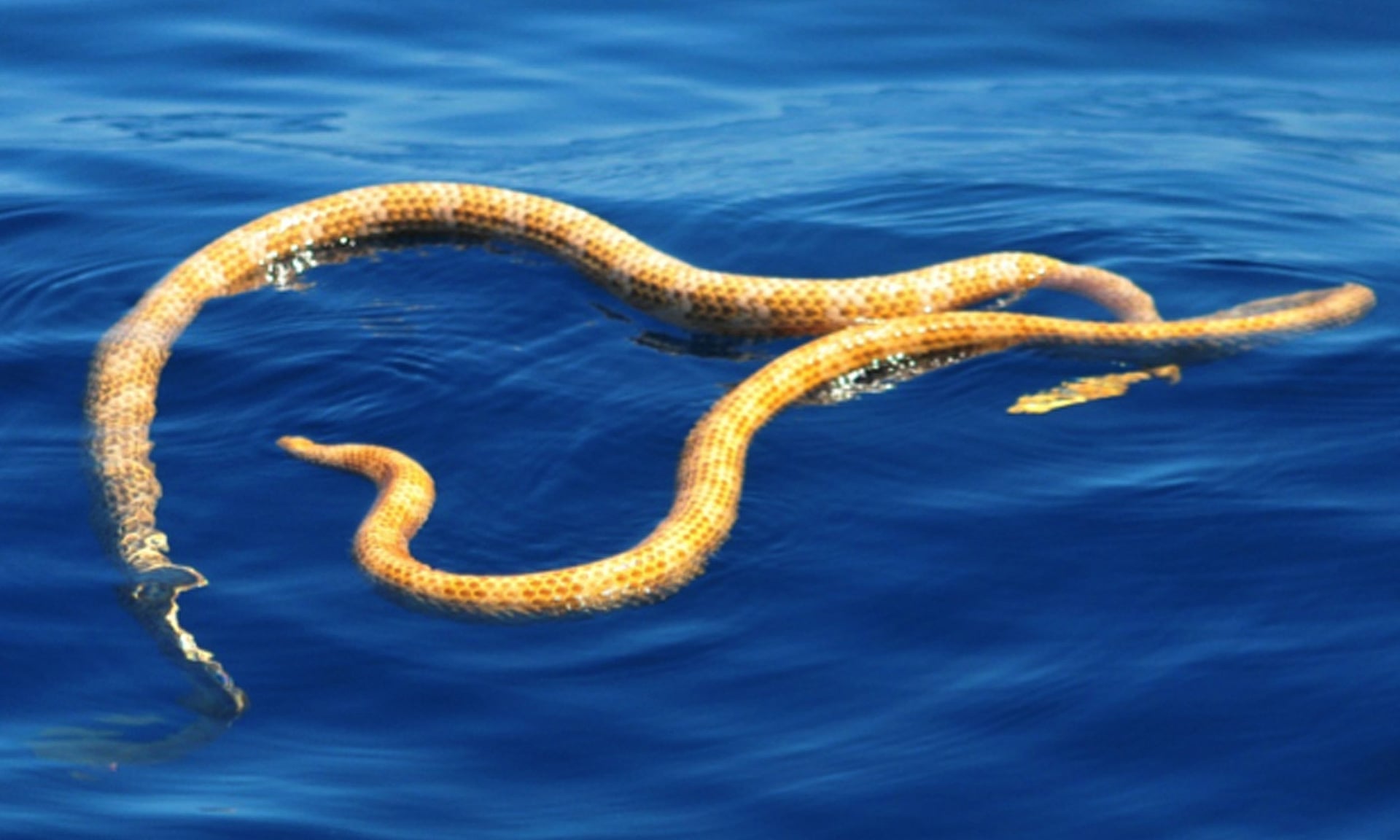
While I’m waiting for someone to prove unequivocally the existence of the Ivory Billed Woodpecker, I will regale myself with Lazarus-like sea snakes in Australia.

I saw this Australian Associated Press story at the Guardian: “A species of sea snake thought to be extinct has been rediscovered off the Western Australian coast. A wildlife officer spotted two courting short-nosed sea snakes while patrolling in Ningaloo marine park on the state’s mid-north coast. …

“The Western Australian environment minister, Albert Jacob, said the discovery was especially important because they had never been seen at Ningaloo reef.

“A Department of Parks and Wildlife officer photographed the snakes on Ningaloo Reef and James Cook university scientists identified them.”

Maybe marine creatures such as sea snakes and coelacanths are more likely to be preserved than woodpeckers — hidden away in the ocean’s unexplored depths. Still, as a movie I reviewed, Revolution, made clear, the seas are threatened, too.

More on courting sea snakes at the Guardian.

Photo: Grant Giffen/AFP/Getty Images
The discovery of the short-nosed sea snake, previously thought to have been extinct, is significant because the species had never been seen in the Ningaloo marine park in Western Australia before.

Read Full Post »

An old, falling-apart film of a heath hen has been unearthed.

Why is that thrilling? The heath hen is extinct.

Writes Carolyn Y. Johnson in the Boston Globe, “The bird stamps its feet on the ground, taking mincing dance steps through the corn stubble. Neck feathers flare like a headdress, and the male puffs out his neck, making a hollow, hooting call that has been lost to history.

“These courtship antics are captured on a silent, black-and-white film that is believed to be the only footage of something not seen for nearly a century: the extinct heath hen.

“The film, circa 1918, is the birding equivalent of an Elvis sighting, said Wayne Petersen of Mass Audubon — mind-blowing and transfixing to people who care. It will premier Saturday [March 8] at a birding conference in Waltham.

“Massachusetts officials commissioned the film nearly a century ago as part of an effort to preserve and study the game bird, once abundant from Southern New Hampshire to Northern Virginia. Then, like the heath hen, the film was largely forgotten.

“Martha’s Vineyard is where the last known heath hens lived, protected in a state preserve. But the last one vanished by 1932. …

“Jim Cardoza, a retired wildlife biologist who worked for the Division of Fisheries and Wildlife, said that for him, the film holds lessons about how conservation efforts have evolved.

“ ‘The thing that is striking to me is the habitat of the animal — it looks like they’re out in corn fields and open areas and things like that,’ Cardoza said. ‘That isn’t what the birds really inhabited — they were a scrub-land species.’ Conservationists at the time, he said, ‘didn’t know what the habitat requirements of the species even was.’  ”

Read the rest of the article and watch the film here.

I love the idea of a long-rumored, valuable film finally being found. It’s a great story. It’s also an argument for better filing systems.

State of Massachusetts woodcut, 1912. The fancier heath hens are males.

Read Full Post »

When you consider all the minority languages that are endangered today — many of which I’ve blogged about (for example, here) — it seems a bit perverse to be bringing back Latin on the radio. But as one more way to interest people in languages, how bad can it be?

For the Finns, who have to speak many languages because hardly anyone speaks theirs, it’s just one more.

As John Tagliabue wrote in yesterday’s New York Times, the Internet has given a boost to “a weekly summary of world events and news broadcast by Finnish state radio — not in Finnish, but in classical Latin. …

“In recent weeks, the subjects have included the financial crisis in Cyprus, an unusually brilliant aurora borealis and the election of Pope Francis. …

“It may be no coincidence that the broadcast began in 1989, the year Communism collapsed in Eastern Europe and the Finns turned toward Western Europe. For educated Finns, Latin had long been the country’s link to Western culture, and they were required to study the language in school. …

“While the broadcasts once went out over the airwaves, with shortwave reception for listeners outside Finland, more and more listeners tune in to the program’s Web site, through podcasts and MP3 downloads.” More.

Image: Wikipedia
Cicero Denounces Catiline, fresco by Cesare Maccari, 1882–1888. It’s what Suzanne’s Mom thinks of when she thinks “Latin.”

Read Full Post »

I’ve been reading Jason Elliot’s book Mirrors of the Unseen, which is about time he spent in Iran (not long before the green revolution of June 20, 2009, was trampled).

He’s a lovely writer if a bit overwhelming with his ability to compress centuries of history. I liked his earlier book, too, on Afghanistan, An Unexpected Light.

In the car on Sunday I read aloud a section of Mirrors that describes Elliot’s extended stay with Louise Firouz, an American who married an Iranian in the 1960s and has lived in Iran ever since — despite stints in prison and twice having all her family’s property confiscated.

The part I read aloud was about how she had researched, rediscovered, and bred a small horse thought to be extinct, one that turned out to have an ancestor going farther back than the Arabian horse. It’s the little Caspian, which was finally found, in pitiful shape, near the Caspian Sea and in Turkmenistan.

Nowadays you can find lots of videos of these horses on YouTube. I thought I would include this video, which is from a Caspian stud farm in Sweden.

Read Full Post »