Feeds:
Posts
Comments

Posts Tagged ‘fashion’

Photo: Maria Lupan via Unsplash.

At one of Suzanne’s first adult jobs she got to name some product colors. We always thought that sounded like fun. We still remember a pink color she named Flirt.

Heather Schwedel at Slate recently edited a submission by the woman behind some wild nail polish names: Amy Fisher at Butter London, which carries polishes called Yummy Mummy , Molly Coddled, Waterloo Blue, to name a few.

“My name is Amy Fisher, and I’m the senior brand and marketing manager for Butter London. I’ve been with the brand for about three years now. I do everything from naming our nail polishes and other products to creating them. I also help with some of our sales and retail. But everyone is always curious about the naming part.

“When we’re coming up with a new product — I’ll use our nail lacquers as an example — we usually start with a color. We’ll take a look at our full assortment: What do we think is missing and what is the white space in that category? Each season, we physically take our nail lacquers and our product and lay them out in front of us and see what colors are missing. We like to keep a very unique and curated assortment. So sometimes if we’re going to launch a new shade, that means we have to discontinue another one.

“Once we review that, we also look at trend data. What’s the trend right now? What’s the trend going to be in a year from now when we’re launching this? We’ll also look at past sales data. If we had a shade a couple seasons ago: How did that perform? Do we want to bring that shade back or a similar color? And we look at feedback from our customers. We get a lot of inquiries from customers about old shades that they want us to bring back.

“The naming really comes along once we have those shades or colors, whatever the product might be. Typically we come up with the name once we have the final-final shade. …

“We typically have a theme or general story that we want to tell with the shades, so we’ll do a small brainstorm with our copywriter. We’ll take that theme and then bounce ideas off of each other. It might take three to five days before we’re ready to come back to the table with some ideas. But it doesn’t really take that long to come up with a name, honestly. Sometimes it’s a brainstorm meeting. Sometimes it’s an email chain. …

“I, along with Julie Campbell, who’s the general manager of the brand, will choose the final name that we would like to proceed with and then our copywriter takes it to our regulatory team. The regulatory team makes sure that we can use the name from a legal standpoint. Sometimes there are trademarks and things of that nature that we need to be careful of. If we have to go back to the drawing board we do so, but usually for shade names, it’s pretty seamless.

“The brand was founded in 2005 in London. It was acquired by an American company a few years ago, but we really do want to stay true to those British roots and keep things cheeky and fun and really British-inspired. In my opinion, an example of a perfectly named Butter London product is All Hail the Queen, which is one of our hero nail lacquers. I absolutely love that name. It’s British, the color is beautiful — it’s like a shimmery taupe. Some other names include Cotswold Cottage — that one’s also a taupe—and Bang On!, a deep teal.

“We’ll sometimes utilize British dictionaries, and we do lots of Googling since everyone is actually American. … And then we also have a team that helps with our search engine optimization keywords. Sometimes they’ll come to the table with words that we can incorporate for a more 360-marketing approach when people are searching for different nail lacquers online. …

“I can point to our Fall 2021 holiday collection. I helped with two names in particular. One was Tickety Boo, and it was a very fun, shimmery pink overcoat. And then Proper Do was another one. That was a really beautiful, deep purple.

“I’m still developing a sense of what words sound like what color. One of our shades that we launched this past spring was called Bespoke Lace, and lace is obviously very indicative of white. That was this beautiful white sort of matte glitter overcoat. It kind of looks like lace when you apply it. But sometimes the names have absolutely nothing to do with the shade. With Tickety Boo, which means something like ‘in a jiffy,’ it’s just such a fun saying that it seemed to go well with the fun glittery overcoat. But Proper Do, which is slang for a fancy social event, that doesn’t really scream purple.

“At any rate, you just want to be fun, whimsical, and British. You really have to nail that. Sometimes a darker shade is a little bit more serious. Something like that can be a little bit harder than maybe a glitter or something like that. …

“Naming is definitely one of the more fun things I get to do, I would say, because I get to be creative. But I know there are probably people who think I sit around all day naming nail polish. Even my mom, sometimes she’ll be like, ‘What do you do again?’ It’s way more than just coming up with fun names. You know, there’s the research, there’s the retail side of it that I have to do. I think maybe people would be surprised by the amount of research that we have to do and staying on top of the trends. … But at the end of the day, it is fun. I can’t lie — it is fun.”

Can’t help thinking all this is going to be done better by ChatGPT, especially since Tickety Boo does not mean “in a jiffy.” What do you think?

More at Slate, here. No firewall.
Read Full Post »

Photo: Dominique Soguel.
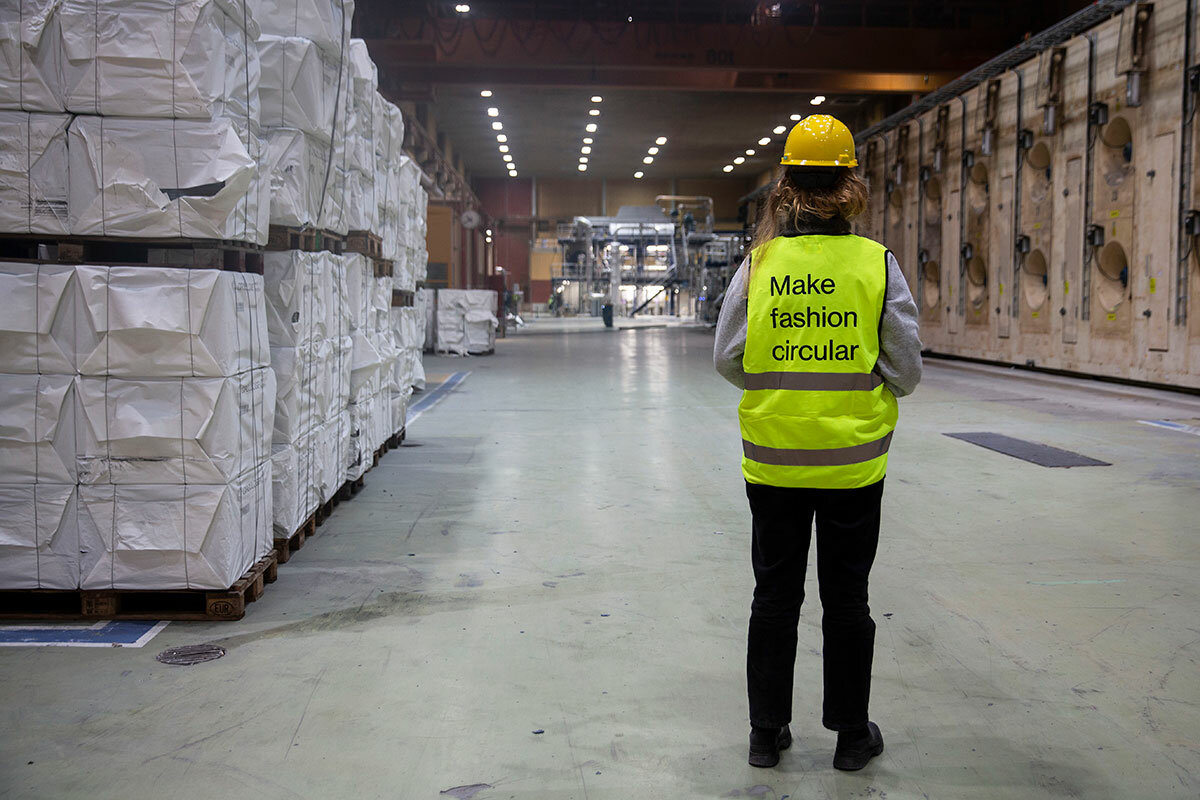
An employee stands in the industrial-scale plant of textile-to-textile recycling company Renewcell in Sundsvall, Sweden, Feb. 7, 2023.

After my youngest granddaughter toured a recycling facility in Rhode Island, she told me that one thing the state recycles is textiles. But in Massachusetts, where a new law forbids putting textiles in landfills, there are few towns that offer services for recycling worn-out clothes. At least there are plenty of outlets for reusable clothes.

In Sweden, some folks are trying to make all clothes — and the materials that go into them — reusable. That’s according to today’s article from the Christian Science Monitor.

Dominique Soguel writes, “Discarded, sorted clothes arrive by ship on the shores of Sundsvall, in the Gulf of Bothnia inlet of the Baltic Sea. But they aren’t bound for a landfill.

“Rather, they are destined for the city’s Renewcell plant, where they will be dissolved and processed into a new substance: Circulose. This material looks like white cardboard, feels like watercolor paper, and – most importantly – can be spun into yarns for textile manufacturers. …

“Renewcell’s patented technology, now available commercially, and successful launch of the world’s first industrial-scale textile recycling plant in Sweden offer a beacon of hope to brands and consumers who care about environmental sustainability.

“ ‘From an environmental perspective, it means that every year, instead of huge swaths of forest being cut down, millions of old jeans and T-shirts are being used rather than them degrading into methane in landfill,’ says Nicole Rycroft, director of the environmental nonprofit Canopy.

“The fashion industry relies primarily on three fibers – polyester, cotton, and viscose rayon – each of which is problematic for the environment.

“Polyester, made from plastic, takes hundreds of years to break down. … Soft-to-touch cotton is grown on vast, water-intensive monoculture farms using large quantities of fertilizers and pesticides. The Aral Sea, once the world’s fourth-largest lake, dried up almost completely, drained by cotton fields in Uzbekistan and Kazakhstan. …

“Viscose rayon is made from tree wood, which sometimes comes from ancient forests. Ms. Rycroft points to the 300 million trees cut down yearly to make viscose rayon, among other textiles. That consumption is slated to double within the next decade.

“On top of all this, much of what the fashion industry produces with these materials ends up as waste. Global production of textile fibers and all apparel creates 110 million metric tons of waste. On average, Europeans produce 33 pounds per year per capita, and Americans about 70 pounds per year.

“Solutions for controlling fashion’s consumption rate range from reducing overproduction and overconsumption to making longer-lasting clothes and embedding circularity into product design. But experts consider fiber-to-fiber recycling – converting textile waste into new fibers that can be used to make clothes or other textile goods – as one of the most sustainable and scalable levers available. …

“The Nordics stand out in Europe for their efforts to reduce the fashion industry’s impact on the planet. Copenhagen Fashion Week imposes sustainability requirements on brands before they hit the runway. Multiple Nordic brands offer recycling options and sell used clothes on their shelves at reduced prices.

“Sweden boasts an impressive secondhand clothes market scene; the world’s first recycling mall, Retuna; and innovative companies like Nudie. Nudie offers customers free repairs on their jeans and a 20% discount on new ones if they trade in old ones. It’s a much-loved service.

“ ‘I really like clothes, but I don’t think it’s necessary for me to buy something new to get the kind of clothes that I like to wear,’ says Tomas Persson after bringing his jeans in for repair to the Nudie shop in Gothenburg. Apart from underwear, he says has not bought a new item of clothing in years – not an uncommon claim in Sweden.

“The development of sustainable textiles is also part of Sweden’s national strategy. That keeps the Swedish School of Textiles and Science Park Borås, both part of the University of Borås, abuzz with the development of high-tech prototypes and design experiments focused on recycling, reuse, and upcycling.

“ ‘We have to find more efficient production processes … and ways of consuming garments,’ says Susanne Nejderås, textile strategist at Science Park Borås. ‘The mean use of a clothing item is around two years. We need to add another eight years to that.’ ”

I’ll just add that consumers are not only demanding sustainability these days, but human rights. There is widespread concern about China using Uyghur forced labor for cotton products. That’s why I buy cotton towels at Patagonia and fair trade cotton clothes from Fair Indigo in Peru (thanks to blogger Rebecca).

More at the Monitor, here. No firewall. Subscriptions welcomed.

Read Full Post »

Photo: Maria Spann/The Guardian.
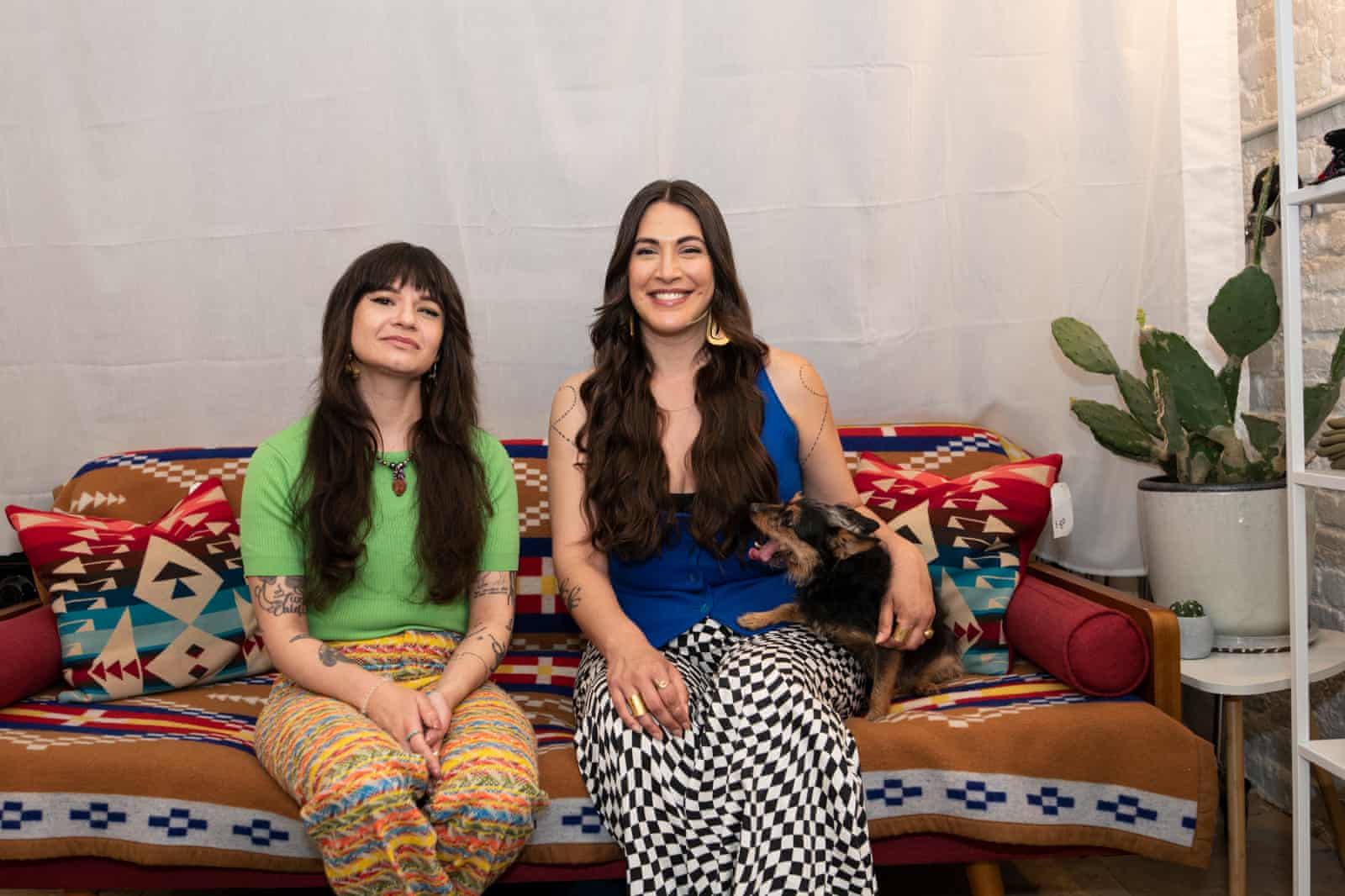
Liana Shewey and Korina Emmerich run a forward-thinking indigenous store in New York.

A friend who had just read Rinker Buck’s Life on the Mississippi was telling me recently how stunned she was to learn details of the Trail of Tears and related horrors visited on natives. Most of us know very little about that and have hardly been aware that indigenous people have been living among us all along.

At the very least, we are noticing them more now, learning more.

In today’s article, Sophia Herring of the Guardian interviews two very visible indigenous women with a new kind of shop in New York City.

“Location, location, location. It can make or break a business,” Herring says. “For Liana Shewey and Korina Emmerich, it was a call to action. When a mutual friend told the activists and creatives – Shewey is an educator and Emmerich is a fashion designer – about a newly vacant storefront on the ground floor of her mother’s Manhattan co-op building, the pair … visited the space. … ‘We jumped on it,’ said Shewey.

“The co-op board wasn’t willing to hand the keys over to just anyone. But their friend’s mother is Navajo, and also the board president. Within days the building had its newest tenant: Relative Arts NYC, a boutique that carries pieces by Indigenous designers and also hosts literary readings, album releases and art installations featuring work by Indigenous artists.

“ ‘It just felt so important for us to have a space, as grassroots organizers in the city,’ said Shewey, who was raised in Stillwater, Oklahoma, and is a member of the Mvskoke (Creek) Nation. Building a store that specializes in goods from Indigenous and many female-owned labels was a natural way to support their community. …

“The merchandise builds on their mission to shatter stereotypes. The entrepreneurs speak to ‘Indigenous futurism,’ an emerging art and design movement that leans away from cliches. …

“Emmerich, who grew up in Eugene, Oregon, and whose father is of Puyallup descent, focused on her own fashion label, EMME Studio, in her late 20s and early 30s. Her work has appeared on the cover of InStyle magazine and in the Lexicon of Fashion exhibition at the Metropolitan Museum of Art. She still makes pieces by special order, and the shop doubles as an atelier. When she spoke with the Guardian, she was rushing to complete a dress that she was making for a producer of Killers of the Flower Moon, the new Martin Scorsese film, to wear to the Cannes film festival. Shewey, whose day job is as an outreach educator at the New-York Historical Society, was speaking from her car, where she was taking a break from a marathon day of teaching four sixth-grade classes.

“The entrepreneurs, who can be found at their shop every weekend, relied on crowdfunding to convert the space into a store. An initial round of fundraising garnered $6,465, which covered shelving units and a sofa from Craigslist. They found a handful of industrial school chairs on the side of the road.

“The pair are breaking even, and still debating whether to form a nonprofit or operate as an LLC. ‘We want Relative Arts to be a greater incubation hub for people to be able to learn, create and work out of,’ said Shewey. …

Sophia Herring: Tell me about what led you both here.

Liana Shewey: I lived in Portland for about a decade and got really integrated into the local rock’n’roll scene. I bartended, worked at a local Starbucks, and then eventually started a music production company of my own with a few friends. In 2014, I moved to the Czech Republic and started organizing around the refugee crisis. I came back in 2016 when everything was happening with Standing Rock. It made me realize my struggle is here and I need to be with my community.

“Korina Emmerich: At 13, I made my first jingle dress regalia, and got very into sewing. I came to New York with two suitcases, a cat and $75. I worked in a boutique and I had my own line. I actually had a lot of success, thanks to a company called Brand Assembly that helps support smaller designers. But you slowly realize with everything in the fashion industry, if you want to do it ethically, you will be poor. I just dreamed that one day I would have a space to be able to share everybody’s work.

“Herring: How do you work as a team?

“Emmerich: We’ve been planning and organizing together for so long that we just naturally gravitate towards each other in our work style. Liana is analytical and does the logistical things as well as planning, and organizing when it comes to programming. I have this more creative, community outreach part of my work where building relationships is such an important aspect. …

“Herring: How do you choose what goes in the store?

“Emmerich: Our goal is to showcase contemporary Indigenous designers who are doing fun, subversive, wearable work, as opposed to the assumption of what Indigenous design has to look like. I want to talk about how Indigenous people exist here and now and we’re doing contemporary work here and now. There’s no rule that says we have to only exist in a historical context.

“Herring: What is it like operating an Indigenous business within a community that so rarely acknowledges it’s on Indigenous land to begin with?

“Emmerich: Even though Relative Arts may be the first of its kind, we are not the first ones to be doing this work. It was amazing to have the American Indian Community House come to open the space on our first day, to say a prayer and give us their blessing.

“Shewey: I’m thinking about how many people come off the streets and buy one of our pieces just because they like the garments themselves. Then they look at the basketball jersey and ask: what is the Salish Sea? [The Salish coast, along the north-western US and Canada, is home to Indigenous nations.] If they didn’t know, they walk out having learned about decolonization. …

“Herring: What is your long-term goal?

“Emmerich: We like to think of Relative Arts as a hub. The plans that we have are so much bigger than just a store. …

“Shewey: We’ve mused that we want it to kind of look like an Indigenous-futurist version of Andy Warhol’s Factory. It would be so wonderful to have thousands of feet, although I doubt Andy ever had to apply for funding.”

More at the Guardian, here. No firewall. Donations encouraged.

Read Full Post »

Photo: Minot Daily News
Norma Baker-Flying Horse is owner of Red Berry Woman, a fashion designing business that was accepted into Paris Fashion Week.

Yesterday I mentioned that APiermanSister was a blogger whose writing I admired. She says she is shy, but as far as I can tell, one of her personal characteristics is fearlessness.

As a regular visitor to and connoisseur of Paris, she had always wanted to attend Fashion Week. In a recent post, she describes how she wrangled an invitation — finding a publication back in the US that would take an article and help to justify her admission to the show as a writer.

This is from Alison’s February Minot Daily News report on designer Red Berry Woman, an enrolled member of the Mandan Hidatsa Arikara (MHA) Nation and member of the Dakota Sioux and Assiniboine tribes.

“Norma Baker-Flying Horse has been having a whirlwind of fashion success.

“ ‘I recently had a dress walk the red carpet at the Grammy’s earlier this month and I’m also preparing to show in France,’ said Baker-Flying Horse of Mandaree, Oklahoma.

“Baker-Flying Horse said she will be the only Native American who will be showing in a show for the opening of Paris Fashion Week. …

“Baker-Flying Horse’s fashion line, Red Berry Woman, incorporates Native American traditional garment styles into contemporary couture garments for both men and women. She also creates different types of Native American traditional-style garments,’ according to her Red Berry Woman website at redberrywoman.com. …

“Baker-Flying Horse also was an invited designer for the international fashion showing in Vancouver, British Columbia, during Vancouver Fashion Week this past September.

“Another event in past months includes being the designer for a fashion show in Cornwall, Ontario, where actor Adam Beach was a guest. His wife, Summer, was Baker-Flying Horse’s guest runway model. One of Baker-Flying Horse’s creations also was worn by Alice Brownotter, an activist from the Standing Rock Reservation, for an event held by actress Jane Fonda who invited young people to participate who have had leadership rolls in their community. …

“Last March Baker-Flying Horse had the special honor of having one of her fashion designs worn at the Academy Awards show, the Oscars. She was the first contemporary Native American fashion designer to have a gown worn at the Oscars.”

More on Red Berry Woman at the Minot Daily News, here, and at the Smithsonian, here. But the most fun piece to read is Alison’s blog post about crashing Paris Fashion Week, here.

Photo: kfyrtv.com
The 2018 Native American Cultural Celebration closed with a Red Berry Woman Fashion Show.

Read Full Post »

e169ea18-af31-11e8-b224-884456d4cde1_1280x720_122041

Photo: Didem Tali
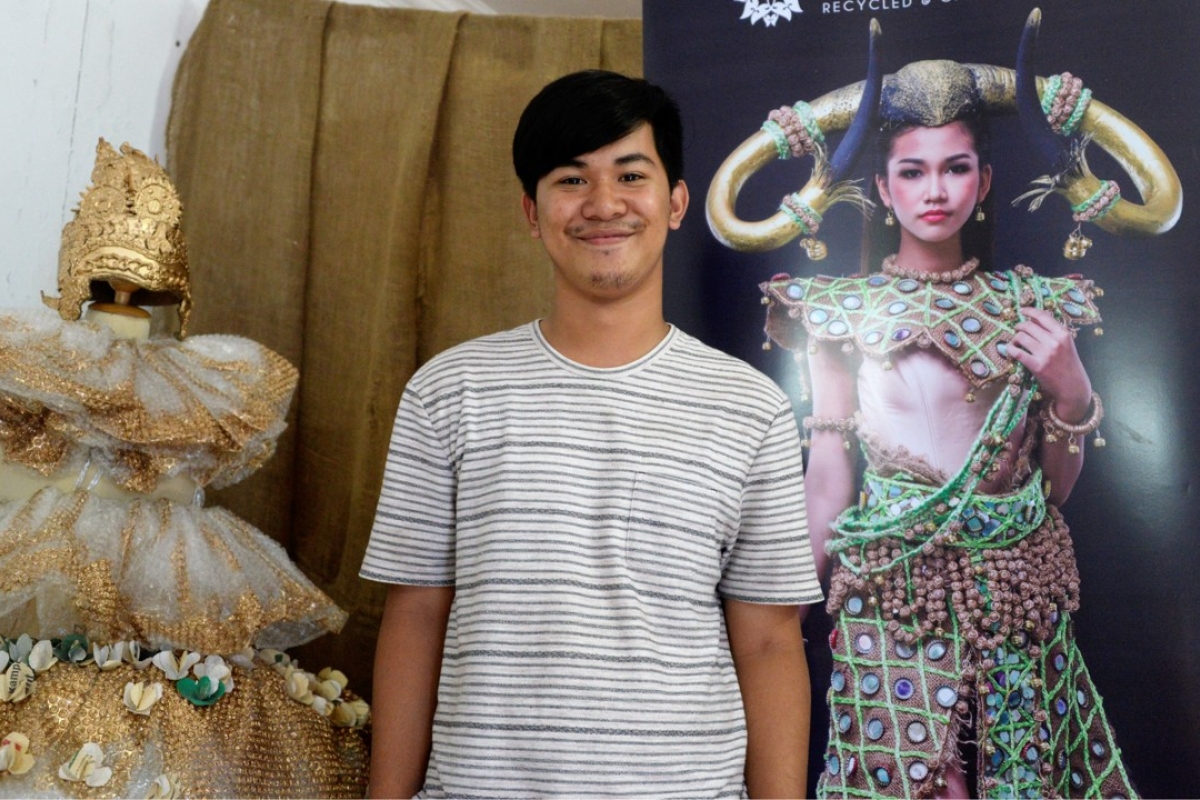
Seng Super is a co-founder of La Chhouk, a Cambodian creative fashion initiative that makes clothing out of recyclables. The group, which includes gay and straight designers, hopes to both encourage people to reduce trash and also “show people that LGBT individuals are capable of creating beautiful things.”

Never underestimate the power of a creative mind to make something lovely out of something ugly. I remember surprising myself with how much I loved certain luminous oil paintings of factories spewing out air pollution. The sad Depression-era photos of Appalachian poverty also have a certain beauty. These works draw you to them without any undertone of “poverty is good” or “pollution is good.”

In Cambodia, young designers aren’t repurposing plastic to praise it but, you might say, to bury it.

Didem Tali writes at the South China Morning Post, “Members of the recycling collective La Chhouk started with a dress made from brown rice sacks decorated with beer bottle tops and broken CDs which was later worn by a Miss Cambodia runner-up at an international beauty pageant.

“Most visitors to Cambodia are eager to see the ancient temple complex of Angkor or the beaches of Sihanoukville, but there is one sight they may want to shield their eyes from: mountains of plastic bags, bottles and styrofoam boxes. …

” ‘Plastic waste is everywhere,’ says Seng Super, a 22-year-old Cambodian designer. ‘It’s in the streets, rivers, lakes. It’s very upsetting.’

“Seng Super studied at the Royal University of Fine Arts in Phnom Penh. He was born in the 1990s, a time when millions of Cambodians were beginning to lift themselves out of extreme poverty, bringing environmental degradation in its wake.

“For many young and urban Cambodians, pollution is a huge concern. So when it was time to prepare for the university’s annual art show in 2014, Seng Super and his classmates decided to create a project that would challenge people to rethink their wasteful ways. The result, La Chhouk, is a creative fashion initiative geared towards making clothing out of trash and other recyclable materials. …

“Seng Super and his classmates wanted not only to challenge the way Cambodians think of waste, but also capture their attention in the most remarkable and elegant way. Using only recyclable materials they found in the trash, they created several flamboyant dresses of the sort usually worn by traditional apsara dancers. …

“Many people thought the goal was too far-fetched and ambitious – especially as none of them had any training in fashion. That is why the designers named their collective La Chhouk, which means ‘lotus’ in Cambodia’s Khmer language.

“ ‘The lotus is a beautiful flower that can grow in muddy or dirty waters,’ Seng Super says. ‘We thought it was a beautiful metaphor for what we wanted to do with trash and our dresses.’ …

“Last year the members of La Chhouk were given a vote of confidence for what many regarded as a wacky project when Em Kunthong, first runner-up in the Miss Cambodia 2016-17 beauty pageant, opted to wear the dress for the Miss Earth environmental awareness beauty competition held in the Philippines.

“ ‘This dress represents the perfect Cambodian woman,’ Seng Super says … ‘She’s empowered, close to the Earth and strong like a bull. She has the soul of a wild cow, which is a very important element of Cambodian identity and culture.’ …

“Since the creation of that first apsara dress, La Chhouk has gone on to design dozens of other dresses inspired by Cambodian culture and mythology. In a recent project called Saving Wild, they sought to bring attention to animals facing extinction in Cambodia, such as the Indochinese tiger, river dolphins and various bird species. Seng Super designed dresses representing these animals using plastic waste.

“The project is ongoing, and the collective recently held an exhibition in collaboration with the WWF and Tiger Beer.

“The collective’s members still hold down day jobs to pay the bills, and work on their recycled fashion projects in the evenings and on weekends.” More here.

Hat Tip: @BeingFarhad onTwitter

Read Full Post »

101917-giant-spiders-ConcordMA

We join John’s family or Suzanne’s family for Halloween on alternate years. This year, we were scheduled to hang out in John’s neighborhood, where a park at the end of the street bubbles over with festivity and John serves as the master of ceremonies for the costume fashion show.

Leading up to that event, I took pictures of the fun ways Halloween lovers decorated this year — noting, for example, the proliferation of giant spiders on houses and some upside-down zombies in an otherwise innocent-looking yard.

Suzanne’s family cut Jack O’Lantern designs using templates from the Internet. I’m posting the cute owl, but they also carved a crocodile, an octopus, and a cat.

the costume parade


103117-skeleton-Halloween

103117-fierce-fighter-Halloween


103117-Waldo-Park-Halloween

103117-costumes-Halloween

Read Full Post »

Shows how far we have come from ancestors who let nothing go to waste that making clothes out of leftover fabric is a novelty. But it’s a good idea nevertheless.

Katherine Martinko at TreeHugger writes that Beru Kids is a children’s clothing company in downtown Los Angeles that makes use of textiles that would otherwise be landfilled.

“The garment workers are mostly female,” she says, “and are paid higher than minimum wage (not per-garment, as is usual in the fashion industry).

“What’s really interesting about Beru is that it repurposes deadstock fabrics to make its clothes. ‘Deadstock’ refers to surplus fabric that has not been used by other factories. In LA, it is sent to a warehouse, where Beru’s founder Sofia Melograno goes on a regular basis to purchase whatever textiles catch her eye. Beru has also begun recently incorporating organic, traceable cotton into its garments.”

Traceability means the cotton can be traced back to its original source so it’s possible to assess whether all steps in the supply chain are environmentally and ethically sound.

Martinko adds that because the fashion industry is a huge polluter, finding a use for fabric that would otherwise get thrown away is good for the planet.

More here.

Photo: Beru Kids (via Facebook)
Beru-Kids-Molly-Bee-dress

Read Full Post »

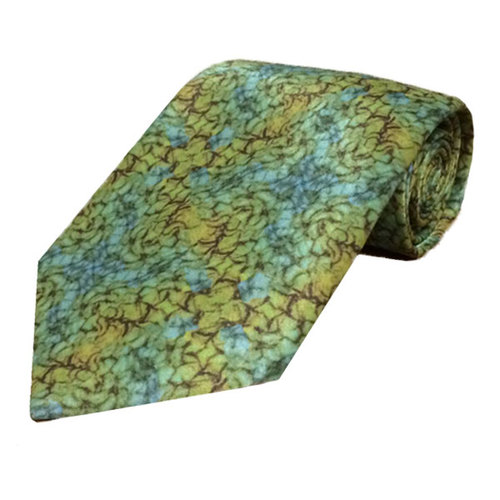
If you are a scientist who wears ties, or if you know one, consider designing your own at Vermont-based Cerebella. Past design ideas have resulted in frog-skin, moon-jellyfish, pollen-tetrad, and obelia (a tiny marine animal) neckties.

At Cerebella’s blog, Lucy Partman wrote on October 13 about how she ended up Chief Curator for the company.

“I grew up in New York City … going to museums— and I mean a lot of museums —especially the Met. … My parents … are designers and own a clothing store in Manhattan so dinner table discussions often involved fabric prints, shirt designs, sizes, quantities, and window displays …

“At LaGuardia High School of Music & Art and Performing Arts … I went from biology to painting, from art history to calculus.

“At Yale, I tried to continue this interdisciplinary education. I majored in both history of art and biology and constantly sought to intertwine these interests, passions. For example, I worked with conservators — who work in a hybrid art studio and science lab — at the Yale Center for British Art to conserve paintings …

“I founded an organization at the Slifka Center called Slifka Arts to provide students the opportunity to curate and exhibit student art. … Shortly after the opening of an exhibit I curated at the Slifka Center called Only in a Woman: Microscopic Images by Harvey Kliman, MD, PhD — which will soon be exhibited at Brown Medical School — Ariele [Faber, Cerebella founder,] contacted me regarding the exhibit and Cerebella. Our conversation has continued ever since.” More here.

Photo: Cerebella
Frog-skin Necktie. Each Cerebella textile pattern is designed by finding inspiration under the microscope.

Read Full Post »

Erik sent along this lead, and John sent it to him. Both are guys who started tech companies, and I’m learning that requires a certain kind of attire.

To signal you are a laid-back but savvy entrepreneur, wear cool socks.

Claire Cain Miller and Nick Bilton write at the NY Times, “For barristers in 18th-century London, it was shoulder-grazing wigs. For the Mad men of 1950s New York, it was briefcases and fedoras. For the glass-ceiling-shattering women of the 1980s, it was shoulder pads.

“And for today’s tech entrepreneurs in high-flying Silicon Valley, it is flamboyantly colored, audaciously patterned socks.

“In a land where the uniform — jeans, hoodies and flip-flops — is purposefully nonchalant, and where no one would be caught dead in a tie, wearing flashy socks is more than an expression of your personality. It signals that you are part of the in crowd. It’s like a secret handshake for those who have arrived, and for those who want to. …

“Some say the craze took hold because socks are an acceptable shot of flair in a dressed-down, male-dominated culture — and peek out when entrepreneurs present their latest apps onstage at the tech world’s frequent conferences. Others offer a perhaps more universal explanation. ‘Girls notice,’ said Matt Graves, 37 …

“Travis Kalanick, 35, co-founder and chief executive of Uber, the on-demand taxi service, began wearing statement socks at his previous company, which sold software to businesses.

“ ‘I started having to suit up for meetings with Fortune 500 companies,’ said Mr. Kalanick (his favorite: hot pink). ‘I wanted to keep a little of my geeky computer engineering flair without people thinking I was nuts.’  …

“Sometimes I will even browse the women’s section and get the XXL, because they have all the fun colors,” said Andrew Trader, 42, an investor at Maveron who helped found Zynga. (He is partial to wool socks with bright stripes as well as a pair with an American flag pattern.)”

Read more at the NY Times, here, and check out their slide show.

Erik adds, “And here is a Swedish retail start-up (featured in article) that apparently designs and sells them.”

I can’t tell you how happy I am to know about socks. Father’s Day gifts for the men in the family are settled for the foreseeable future.

Now, can I give Suzanne, the Luna & Stella entrepreneur, socks as gifts, too?

Photo: Peter DaSilva for The New York Times

Read Full Post »