Feeds:
Posts
Comments

Posts Tagged ‘fiction’

Photo: Steve Annear.
In October 2014, the Edgar Allan Poe Foundation of Boston officially unveiled the long-awaited statue of a literary phenomenon known for his dark personality and craft. Note the raven.

Why do generations of fiction readers love the creepy stories of Edgar Allan Poe? I for one, was so infatuated with “The Cask of Amontillado” as a teen that I wrote a theatrical adaptation and talked my high school into letting me cast a couple students to perform it for Halloween.

It was not a success. One of the actors couldn’t remember lines and spent most of the show hiding under a chair.

But we probably didn’t kill anyone’s love for Poe.

Recently at the Washington Post, Louis Bayard reviewed a new Richard Kopley biography of the horror-genre master. He compares the lack of control Poe seemed to have over his daily life with the utter mastery of the craft he essentially defined.

He writes in part, “A long and not always edifying tale of success and setback, temperance and bacchanals, playing out across the Atlantic seaboard and end-stopped by a death no less tragic for being in the cards. It’s exhausting stuff, and the only reason to strap ourselves in once more is the chance to see a genius being born.

“A good thing it happened, too, because if anybody desperately needed to be a genius, it was Poe. Born to indigent actors and orphaned at 2 years old, he was brought into the home of John Allan, a proud Richmond merchant. From the start, Poe’s foster father called the arrangement ‘an experiment,’ which meant that young Edgar was never formally adopted and lived in plain view of Allan’s disapproval. By the time Poe had withdrawn from the University of Virginia and been court-martialed out of West Point, the experiment was over.

“Lacking any other option, he embarked on the then-novel career path of becoming a working writer. …

“To the first editor who would listen to him, Poe declared: ‘I am young — not yet twenty — am a poet — if deep worship of all beauty can make me one — and wish to be so in the more common meaning of the word. I would give the world to embody one half the ideas afloat in my imagination.’ Journal by journal, he managed to carve out a fugitive living as poet, critic and short-story writer. Along the way, he found the family he’d been looking for: a doting aunt and a young cousin, Virginia, whom, according to then-common practice, Poe married when she was 13. The marriage wasn’t immediately consummated, but they remained deeply devoted to each other until her death at the age of 24.

“By then, Poe had become a real, if controversial, figure in the literary hierarchy with tales of grotesquerie like ‘The Fall of the House of Usher,’ ‘William Wilson’ and ‘The Masque of the Red Death.’

“ ‘Poe follows in nobody’s track,’ one admirer wrote. ‘His imagination seems to have a domain of its own to revel in.’ From that ferment, ‘The Raven’ emerged like a hit tune, immediately entering the zeitgeist. …

“Yet his fortunes never materially improved. In the words of one editor, he was ‘unstable as water,’ a gambler and serial debtor and inveterate drunk who fell off every wagon and was fired from every job and antagonized as many people as he befriended. In the wake of his wife’s death, he embarked on a chain of doomed platonic alliances and finished his days violently delirious in a Baltimore medical college. So few mourners showed up at his funeral that the minister dispensed with a eulogy. …

“By adhering [strictly] to chronology, Kopley opens the door to discontinuities, awkward transitions and numbing repetition.

“To his credit, though, he’s a good sight fonder of his exasperating subject than [previous biographer] Silverman was, and he does a fine job of recasting Poe’s alcoholism not as a moral problem but a medical one — ‘a terror equal to some of the terrors in his fiction.’

“Kopley also benefits from the privately held letters of Flora Lapham Mack, stepdaughter to Poe’s closest friend, who proffers such startling visions as Poe kicking up his heels in a Richmond parlor: ‘He would come with a sort of running leap in to the parlor & landing on the toes of his right foot twirl rapidly around for a moment & then he would dance most gracefully & rhythmetically an intricate a[nd] Spanish fandango.’

“Where Kopley really excels is in connecting the life back to the work. I always knew, for instance, that ‘The Cask of Amontillado’ was a revenge fantasy against one of Poe’s literary rivals, but it had never occurred to me that ‘The Tell-Tale Heart’ was a revenge fantasy against John Allan. Nor did I grasp how heavily Poe’s dead brother and mother figure in Poe’s lone novel, The Narrative of Arthur Gordon Pym (a superb book that remains shockingly underread). …

“There’s no disputing Kopley’s central argument: ‘As out of control as Poe’s life could sometimes be, his literary work was utterly in control.’

“That may explain why, despite all evidence to the contrary, I find Poe’s example not cautionary but inspirational. Through all his binges and bankruptcies, through every setback and depressive spell, he kept making art because he knew that’s where the best of him lay.”

More at the Post, here.
Read Full Post »

Photo: Sony Pictures Classics/Manolo Pavon/Allstar.
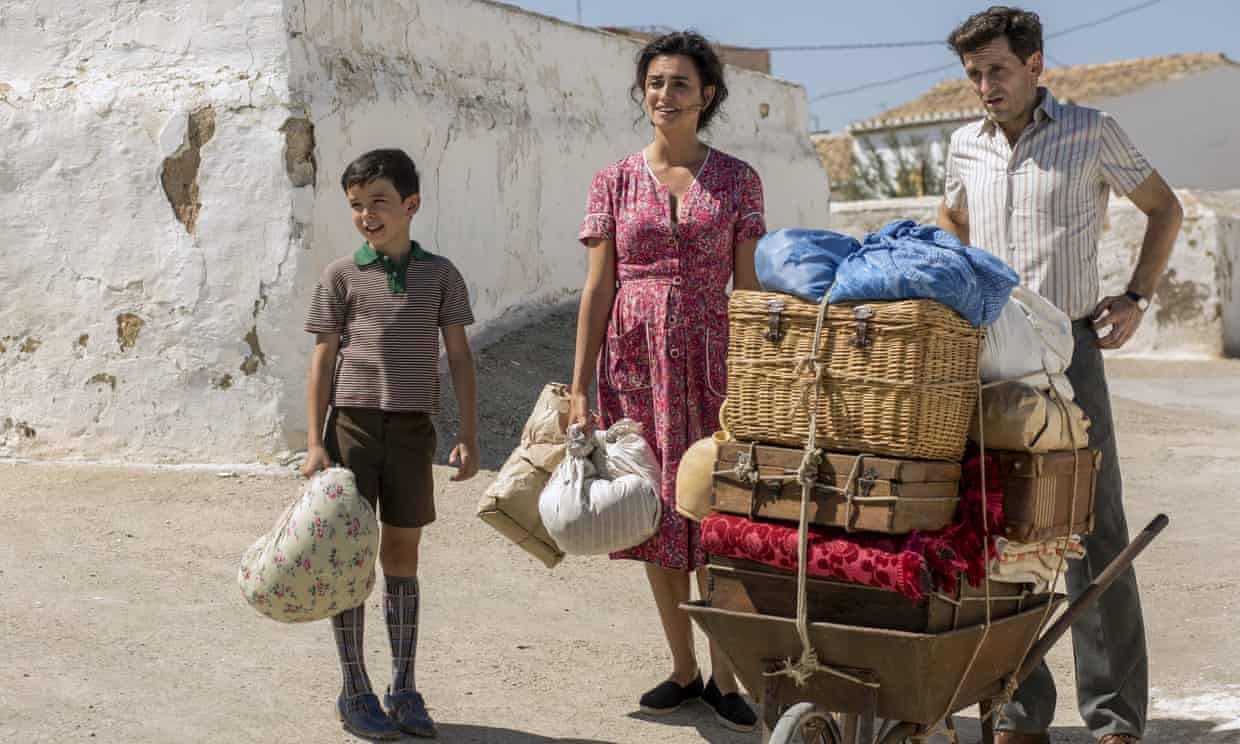
From left: Asier Flores, Penélope Cruz, and Raúl Arévalo in a scene from Pain and Glory (2019), a film by Pedro Almodovar.

Today’s story is about how Spanish film director Pedro Almodóvar wrote a collection of short stories as a kind of memoir. And it zeroes in on his mother’s influence on his life’s work.

Sam Jones writes at the Guardian, “One day when he was nine years old and living in a small Extremaduran town of makeshift adobe houses, steep slate streets and dusty, meagre horizons, Pedro Almodóvar caught his mother out in a lie.

“The family had recently moved south from La Mancha and Francisca Caballero was making ends meet by reading and writing letters for her illiterate neighbors. As he read over his mother’s shoulder, Almodóvar realized the words on the page did not correspond to the words on her lips.

“ ‘She was improvising and saying things that weren’t in the letters,’ he says. ‘My mum knew all the neighbors – she knew the grandmother and the granddaughter and how they got along. And so she made stuff up. For example, if she noticed that no one had asked after the grandmother, she’d say, “I hope Granny is very well and knows that I think about her a lot.” That wasn’t in the letter.’

“When they got home, he asked why she had made up the reference to the grandmother. His mother looked at him and replied: ‘Did you see how happy it made her?’

“At the time, Almodóvar was most struck by the fact of the lie. But, as the years passed and he began writing stories on the Olivetti typewriter his mother gave him when he was 10, he came to understand the meaning of her actions. ‘I realized just what a huge lesson she’d taught me: that life needs fiction to make it bearable. We need fiction so that we can live a bit better.’

“The truth his mother imparted that day lies at the heart of El último sueño, the short-story collection-cum-memoir now published in English as The Last Dream. Almodóvar, 74, has travelled an almost unfathomable distance from the house in Orellana La Vieja whose bare earth floors would turn to mud under his mother’s mop. The smart central Madrid offices of his production company, which sit near a yoga studio and a short walk from the neo-Moorish splendor of the city’s Las Ventas bullring, are lined with film posters – Tie Me Up! Tie Me Down!, High Heels, Live Flesh, All About My MotherVolver – that describe a singular director now in the sixth decade of his career.

“Just as those films have become time capsules of his life and his era, so the dozen stories that make up The Last Dream, which has been translated by Frank Wynne, are snapshots of his development as a person, a writer and a filmmaker. … There are fictional tales of misfits, outsiders, actors and the odd supernatural entity.

“One tells of a writer whose life is lived backwards, beginning with his burial … another of a wounded soul out for revenge on the priest who abused them as a child; another of a world-weary vampire seeking solace in a monastery. There is a cult film director in the throes of a crisis … and, at the book’s conclusion, a melancholic sense of the director’s retreat from the hedonism and delightful chaos of the 1970s, 80s and early 90s, as chronicled in his early films. …

“A mix of fiction, observation and autobiography, the collection exists largely thanks to the care and efficiency of Almodóvar’s long-serving assistant Lola García, who assiduously grabbed and filed the pieces over the decades, preserving them from house move to house move. Some were written in his late teens and early 20s, others during his first years in Madrid, and some as recently as last year. …

“As the collection progresses, you can almost see the artist develop: the kitsch, riotous and transgressive early work giving way to something calmer, sadder and increasingly self-reflective. Over the course of 211 pages, the exuberant, coal-haired enfant terrible of Spanish cinema becomes the salt-and-pepper-haired auteur of the late 90s and then, finally, the thoughtful, white-haired sage who sits on the other side of the desk on a merciless Madrid summer afternoon and explains, over bottled water, why the 12 tales tell a more honest story than would a straightforward memoir.

“ ‘There’s a biographical line that runs through them, even though some of them are pure fiction,’ he says. ‘It’s a way of looking back at something I found interesting, because I recognized myself in all those stories: even if some were written when I was 17 or 18, I’m still the same person. Yes, things change, time passes and biology changes – there’s nothing you can do about that – but I’m exactly the same person now as I was when I came to Madrid forty something years ago.’ …

“Although Almodóvar is modest about his literary abilities, writing was his initial vocation and one that he has pursued from the early days of tapping away on his Olivetti ‘under a grapevine with a skinned rabbit hanging from a string, like one of those revolting flycatchers,’ to the scripts he wrote on the sly while working for Telefónica in Madrid.

“ ‘I’ve wanted to write from the very beginning, and I thought about devoting myself to literature, but from the time I was about 18 or 19 – when I’d bought a Super 8 camera – I immediately turned all those literary ideas into images,’ he says. ‘I also discovered that I was better at telling stories with images than with words. Very often, I’d start writing a story but it would end up as a film script.’

“Cinema had long been an escape from the claustrophobic confines of his provincial upbringing. ‘I’d already learned from living in small communities that I was different,’ he says. ‘People made me see that I was different. Life there horrified me. I started going to the cinema when we lived in Orellana and I continued going when we moved to a nearby village. From the moment I discovered cinema, I discovered a parallel reality that interested me far more than daily reality.’ …

“ ‘My references still come from outside – from a book I read, or a conversation I overhear, or something I see on TV – but over the past few years, I’ve been resorting much more to myself as inspiration,’ he says. ‘Well, perhaps not for inspiration, but as a document store.’ …

“That autumnal, autobiographical approach is most apparent in the collection’s titular story, which sees Almodóvar seeking to make sense of his mother’s life, death, and the epiphany contained in her embellished letter readings. The Last Dream is also a letter of love, gratitude and a belated effort to settle an old debt.

“ ‘My mother always used to get very worked up when people talked about Pedro Almodóvar or just Almodóvar,’ he remembers. ‘She used to say, “You’re Pedro Almodóvar Caballero because I’m the one who gave birth to you!” She wanted me to use my full name in my films.’ …

“Better late than never – the six pages that make up ‘The Last Dream’ are signed: Pedro Almodóvar Caballero.”

More at the Guardian, here.

Read Full Post »

I’ve been an inveterate reader of mysteries since my Nancy Drew days, and Asakiyume, who follows my mini reviews of mysteries and other books at GoodReads, suggested that I blog about what I think makes a good mystery. Maybe other readers of these books will chime in.

I like a book that is literate by normal fiction standards. There should be at least one likable character, several plausible perps, no cliches, and loose ends tied up in the conclusion. You should be able to look back in the story and see that clues were carefully laid, and not just in the last quarter. But the clues should be puzzling as you read along. The reader’s brain should be engaged at all times, trying to figure out where the plot is headed.

I like the bad guys or gals to be caught, not to die a natural death or commit suicide, which always feels like a cop-out.

Some people say that Bleak House was the first detective mystery. Dickens certainly sets a high standard for all the measures I value.

I am often drawn to a mystery because of a locale that’s exotic, at least to me, and I find that many authors, even if they have a weak plot, do research into the setting that I appreciate. Still, I may have to take a long break from this genre as I am getting extremely frustrated with increasing inconsistencies, carelessness about plots, typos, and the hostility to readers that starts to appear when authors feel too much pressure to keep churning out more books.

It’s hard to define what I mean by hostility to readers. I noted it, for example, in Martha Grimes, Walter Mosley, and others I once loved but had to stop reading. It has something to do with throwing favorite characters at the reader in a perfunctory way with no new shades. It has something to do with the bones of the formula being too visible, to the point that you can almost see the writer at her desk with her chart of what has to happen in each chapter. And it has something to do with endings that fail to tie up loose threads. I often feel resentment from an author about the pressure from readers to keep delivering this exact sort of book when perhaps the author would prefer to tackle a completely different genre.

Inspector Bucket in Bleak House, by Charles Dickens.

Read Full Post »

Over at the Brain Pickings blog, Maria Popova has a review of a book that features photos of famous meals in fiction.

“Food and literature have a long and arduous relationship … But nowhere does that relationship come alive more vividly and enchantingly than in Fictitious Dishes: An Album of Literature’s Most Memorable Meals  … an ingenious project by designer and writer Dinah Fried, who cooks, art-directs, and photographs meals from nearly two centuries of famous fiction. Each photograph is accompanied by the particular passage in which the recipe appeared, as well as a few quick and curious factlets about the respective author, novel, or food.

“The project began as a modest design exercise while Fried was attending the Rhode Island School of Design a couple of years ago, but the concept quickly gripped her with greater allure that transcended her original short-term deadline.

“As she continued to read and cook, a different sort of self-transcendence took place. [Although] a near-vegetarian, she found herself wrestling with pig kidney for Ulysses and cooking bananas eleven ways for Gravity’s Rainbow. …

“All of Fried’s photographs are immensely thoughtful (Ishmael’s austere dinner from Moby-Dick is not only a nautically appropriate serving of clam chowder, but also appears lit by candlelight), and some bear a distinct undertone of cultural meta-satire (representing A Confederacy of Dunces is the ultimate edible Americana, a hot dog on a classic All-American diner tablecloth).”

Check out Popova’s review here, and revel in photographs that include Sylvia Plath’s avocado and crabmeat salad, Oliver Twist’s request for “More,” Proust’s petite madeleine, Alice’s Mad Tea Party, and Heidi’s toasted cheese.

Photo: Dinah Fried
“On buffet tables, garnished with glistening hors-d’oeuvre, spiced baked hams crowded against salads of harlequin designs and pastry pigs and turkeys bewitched to a dark gold.” — The Great Gatsby, by F. Scott Fitzgerald, 1925

Read Full Post »

No, I’m not thinking of the 19th century, of George Eliot (Mary Ann Evans), Currer Bell (Charlotte Brontë), or George Sand (Amantine-Lucile-Aurore Dupin). Masculine names are taken more seriously than feminine ones nowadays, too.

Here is a woman who put it to the test.

Catherine Nichols writes at the Jezebel blog, “The plan made me feel dishonest and creepy, so it took me a long time to send my novel out under a man’s name. But each time I read a study about unconscious bias, I got a little closer to trying it.

“I set up a new e-mail address under a name—let’s say it was George [Suzanne’s Mom asks, ‘What is it about the name George?’] Leyer, though it wasn’t—and left it empty. Weeks went by without word from the agents who had my work. I read another study about how people rate job applicants they believe are female and how much better they like those they believe are male. …

“So, on a dim Saturday morning, I copy-pasted my cover letter and the opening pages of my novel from my regular e-mail into George’s account. I put in the address of one of the agents I’d intended to query under my own name. I didn’t expect to hear back for a few weeks, if at all. It would only be a few queries and then I’d close out my experiment. I began preparing another query, checking the submission requirements on the agency web site. When I clicked back, there was already a new message, the first one in the empty inbox. Mr. Leyer. Delighted. Excited. Please send the manuscript.

“Almost all publishers only accept submissions through agents, so they are essential gatekeepers for anyone trying to sell a book in the traditional market rather than self-publishing. …

“I sent the six queries I had planned to send that day. Within 24 hours George had five responses — three manuscript requests and two warm rejections praising his exciting project. For contrast, under my own name, the same letter and pages sent 50 times had netted me a total of two manuscript requests. …

“I wanted to know more of how the Georges of the world live, so I sent more. Total data: George sent out 50 queries, and had his manuscript requested 17 times.

He is eight and a half times better than me at writing the same book.

“Fully a third of the agents who saw his query wanted to see more, where my numbers never did shift from one in 25. …

“Most of the agents only heard from one or the other of us, but I did overlap a little. One who sent me a form rejection as Catherine not only wanted to read George’s book, but instead of rejecting it asked if he could send it along to a more senior agent. Even George’s rejections were polite and warm on a level that would have meant everything to me, except that they weren’t to the real me. George’s work was ‘clever,’ it’s ‘well-constructed’ and ‘exciting.’ No one mentioned his sentences being lyrical or whether his main characters were feisty. …

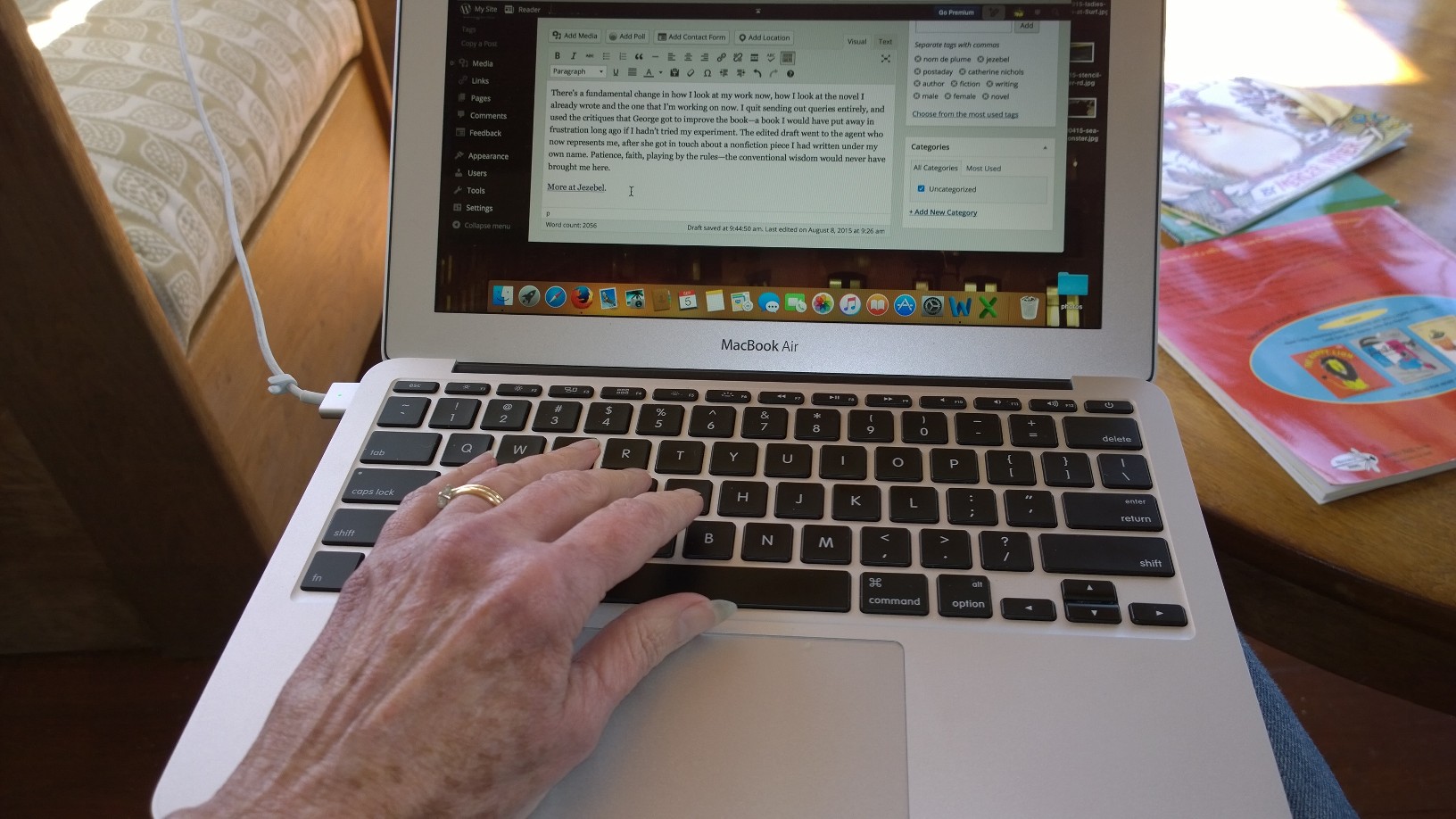
“I quit sending out queries entirely, and used the critiques that George got to improve the book — a book I would have put away in frustration long ago if I hadn’t tried my experiment. The edited draft went to the agent who now represents me, after she got in touch about a nonfiction piece I had written under my own name. Patience, faith, playing by the rules—the conventional wisdom would never have brought me here.” More at Jezebel.

Whew. Now I’m wondering if the fantastic (male) nonfiction writer ML Elrick got some rejection letters because recipients thought he was a female masquerading as a male.  Like JK Rowling. Who now writes mysteries as Robert Galbraith.

090515-typing

Read Full Post »

As an icebreaker at lunch Monday, a colleague asked us all to go around the table and name a New Year’s resolution. I said I was going to emulate the phone-reading guy in the comic who tells his friend, “Yes, I just got a text, but I think there’s also a subtext.”

I meant that I want to go beneath the surface of things, to listen to what people are really saying. You know how you can sharpen your skills in that department? Read fiction.

That’s according to an Emory University study written up at MicGabe Bergado has the story. “It’s not news that reading has countless benefits: Poetry stimulates parts of the brain linked to memory and sparks self-reflection … But readers of fiction? They’re a special breed.

“The study: A 2013 Emory University study looked at the brains of fiction readers. [Neuroscientist Gregory Berns and coauthors] compared the brains of people after they read to the brains of people who didn’t read. The brains of the readers — they read Robert Harris’ Pompeii over a nine-day period at night — showed more activity in certain areas than those who didn’t read.

“Specifically, researchers found heightened connectivity in the left temporal cortex, part of the brain typically associated with understanding language. The researchers also found increased connectivity in the central sulcus of the brain, the primary sensory region, which helps the brain visualize movement. When you visualize yourself scoring a touchdown while playing football, you can actually somewhat feel yourself in the action. A similar process happens when you envision yourself as a character in a book: You can take on the emotions they are feeling. …

“Need more proof? Psychologists David Comer Kidd and Emanuele Castano at the New School for Social Research focused on the effect of literary fiction, rather than popular fiction, on readers.  For the experiment, participants either read a piece of literary fiction or popular fiction, followed by identifying facial emotions solely through the eyes. Those who read literary fiction scored consistently higher, by about 10%.

” ‘We believe that one critical difference between lit and pop fiction is the extent to which the characters are complex, ambiguous, difficult to get to know, etc. (in other words, human) versus stereotyped, simple,’ Castano wrote to Mic.” More here.

Thank you, Claire, for sending this. You know what I like.

WP_20141231_17_28_21_Pro

Read Full Post »

My friend Ronnie is a former broadcaster, a poet, and a food maven, who lived in France for years and later wrote a book called Eat Smart in France. Recently Ronnie interviewed the mystery writer Cara Black for a blog called My French Life. Black writes about Paris. Her latest novel is Murder in Pigalle.

Ronnie asks, “What drew you to this part of town?

Black: “There are two worlds in Pigalle. The world of the day with families and people who work in the shops, and the world of the night, where people work in the clubs. …

“I really like Pigalle. I discovered so much I didn’t know. [But] I get intrigued by different districts, their flavor and feeling. If I ever figure them out, I’ll probably stop writing about them.” More of the interview here, including a observations on the German occupation of Paris during WW II.

For a wonderful, unusual book with the occupation of Paris as a setting, I recommend Léon and Louise. It’s an odd love story taking place over many decades in France, written by a Swiss and translated into English. I haven’t read many books by Cara Black, but if you like novels that teach you something about a different part of the world in a rather fanciful way, I recommend Léon and Louise, by Alex Capus.

Photo of Ronnie Hess

Read Full Post »

Thank you, Gwarlingo, for tweeting this. Looks like there’s hope for us all.

“All your excuses are invalid,” says Dustin Kurtz in an article at the Melville House site about “the seventy-five year old winner of a prize for emerging writers.

“The semiannual Akutagawa prize was awarded in Japan this past Wednesday, and this season’s winner was Natsuko Kuroda. The Akutagawa prize, begun in 1935, is awarded for stories published in newspapers or magazines by new or emerging authors. Kuroda is seventy-five years old.

“Her story, ‘ab Sango’ (it can be previewed and purchased here) is unusual in that it uses no pronouns for its young principle characters, and is written horizontally across the page from left to right, rather than the standard top to bottom. The result is strange and beautiful, and hints at a genealogy of Popper-esque fairy tale formulae, of mathematics or of sociology, and all of which is given subtle cultural freight by Kuroda’s horizontal lines. But again — because it bears repeating — this intriguing emerging writer is seventy-five years old.

“Kuroda is in fact the oldest writer ever to be given the Akutagawa prize, and she is nearly as old as the prize itself. Ryunosuke Akutagawa, the award’s namesake and perhaps Japan’s most celebrated story writer, famously killed himself when he was less than half her current age.

“Upon receiving the prize, Kuroda said, ‘Thank you for discovering me while I am still alive.’ ” More.

Photograph: Melville House, an independent book publisher in Brooklyn, NY.

Read Full Post »

It took me a while to get into twitter, but I’m hooked now. In fact, some readers  of this blog follow me by way of @LunaStellaBlog1 instead of signing up for e-mails. (Luna & Stella is Suzanne’s company.)

The abortive revolution in Iran showed me the power of twitter and was a turning point for me. I still know the date by heart, June 20, 2009. If you searched on , the tweets came so fast with offers of new servers when sites were blocked in Iran, with up-to-the-minute photos and recordings, with citizens getting the word out that I got hundreds of tweets per minute and the U.S. president had to ask twitter not to do maintenance one night because it was a critical time of day in Iran.

Now I learn a completely different thing about twitter. It seems that people have been writing fiction in 140-character bites and that the practice has matured to the extent that twitter fiction is ready for a festival.

Writes Jennifer Schuessler at the NY Times, “The participants, some two dozen published and neophyte authors from five continents chosen by a panel of American publishing insiders, are posting in five different languages, often with input solicited from readers. The Iowa-based writer Jennifer Wilson is posting photographs of gravestones and then writing ‘flash fiction’ in response to epitaphs submitted by followers. The South African author Lauren Beukes is writing mashups, gathered under the hashtag , based on ‘incongruous suggestions (the weirder the better!),’ according to the festival’s showcase page.

“The French fantasy novelist Fabrice Colin is writing a serialized story of five strangers trapped on a bus. And an anonymous Chinese author is contributing ‘Censortive,’ a story exploring the limits of free speech in the People’s Republic, tweeted out in a series of late-night installments.” Read more here.

It’s not War and Peace, of course.

Read Full Post »

I remember trying some years ago to persuade a certain lobster fisherman I know that fiction has value. A recent Boston Sunday Globe article has left me feeling validated.

Washington & Jefferson College’s Jonathan Gottschall writes, “Fiction seems to be more effective at changing beliefs than nonfiction, which is designed to persuade through argument and evidence. Studies show that when we read nonfiction, we read with our shields up. We are critical and skeptical. But when we are absorbed in a story, we drop our intellectual guard. We are moved emotionally, and this seems to make us rubbery and easy to shape. But perhaps the most impressive finding is just how fiction shapes us: mainly for the better, not for the worse. Fiction enhances our ability to understand other people; it promotes a deep morality that cuts across religious and political creeds.”

Read more here.

As Dickens said in Hard Times, it’s important to make room for Queen Mab among all the hard facts.


Read Full Post »