Feeds:
Posts
Comments

Posts Tagged ‘football’

Photo:  Shereefdeen Ahmad.
“Today you do not play as rivals, but as brothers,” a match organizer tells the men from Nigeria and Benin.

One of the worst things about colonialism is the way it arbitrarily separates ethnic groups and plunks families down in different countries. Today we see how a sport is bringing relatives back together.

Shereefdeen Ahmad writes for the Christian Science Monitor, “It’s game day at the village soccer field, and spectators bunch along the sidelines with banners and drums to support their teams.

“They watch as the captains of the two squads walk to the center of the field for a coin flip to determine who kicks off first. …

“This match is part of a festival celebrating the culture of the Borgu, an ethnic group that straddles the border between Benin and its eastern neighbor, Nigeria. The teams and fans gathered here today have come from both countries, part of an effort to use soccer to bridge the divide imposed by colonial powers more than a century ago.

“ ‘I believe that football can reconnect us beyond those lines,’ says organizer Adam Kabirou, who regularly hosts cross-border matches.

“Mr. Kabirou grew up hearing stories about the Borgu kingdom, a civilization tracing its roots to the late 15th century. He also learned how colonial powers carved up his people’s lands in the late 19th century, splitting the Borgu between present-day Benin and Nigeria.

“Today, the majority of Borgu, approximately 1.4 million, reside in Benin, with a smaller population in Nigeria.

“As a child, Mr. Kabirou saw firsthand how that border created a rift between his community and the Borgu people living just 15 miles away on the other side. For one thing, the two groups often literally didn’t have the words to speak to one another.

Borgu in Nigeria learned English, the colonial language there, while Borgu in Benin spoke French, the language of their former rulers.

“These languages mingled with Batonu, the Borgu language, changing the way it was spoken on each side of the border.

“Meanwhile, Western-style schooling in both countries had pushed the Borgu people away from their shared customs and traditions, says Lafia Hussaini, a Borgu ethnographer and adjunct lecturer at the Centre for Cultural Studies and Creative Arts at the University of Ilorin in Nigeria. [Simultaneously] the border created an administrative division that made close ties practically difficult. …

“Sometimes the division even cut through a single community. For instance, half of the village of Chikanda sits in Benin, the other half in Nigeria. The difference is most clear at night. Electric lights illuminate the houses on the Beninese side of the border, while the Nigerian side, which doesn’t have an electricity connection, is dark.

“Over the years, Mr. Kabirou, a farmer, occasionally attended cross-border soccer matches, and saw how the game shrank the distances between the two communities. So in 2022, he decided to organize a tournament.

“In its most recent edition, in 2024, the Tournoi Brassage Culturel – the Cultural Blend Tournament – drew five teams from Nigeria and 15 from Benin. Mr. Kabirou estimates that more than 4,000 fans attended the final match between Gwanara, Nigeria, and Tchatchou, Benin.

“For the players who participate in these matches, the importance stretches beyond soccer.

“Bashiru Adamu, a Nigerian player, says he barely knew his paternal family in Benin before crossing the border to play a match here in 2023. Now, whenever he comes to play a game, he pays them a visit as well. …

“Today, there are three separate tournaments bringing together Borgu teams from Nigeria and Benin. … They have been important not only for the players, but for spectators as well.

“Watching these matches ‘has really brought us together,’ says Souaibou Seko, a resident of Nikki, Benin. In addition to the soccer itself, he says, he appreciates the cultural performances from Borgu artists that often take place before matches or at halftime.

“These performances ‘stress our newfound cultural unity,’ says Sanni Sika Gounoun, chairman of the organizing committee for the Solidarity Tournament. ‘This camaraderie is growing organically.’ “

This article is published in collaboration with Egab,” which focuses on stories from lesser known areas.

More at the Monitor, here.
Read Full Post »

Photo: Michael Briones via Vancouver Island Free Daily.
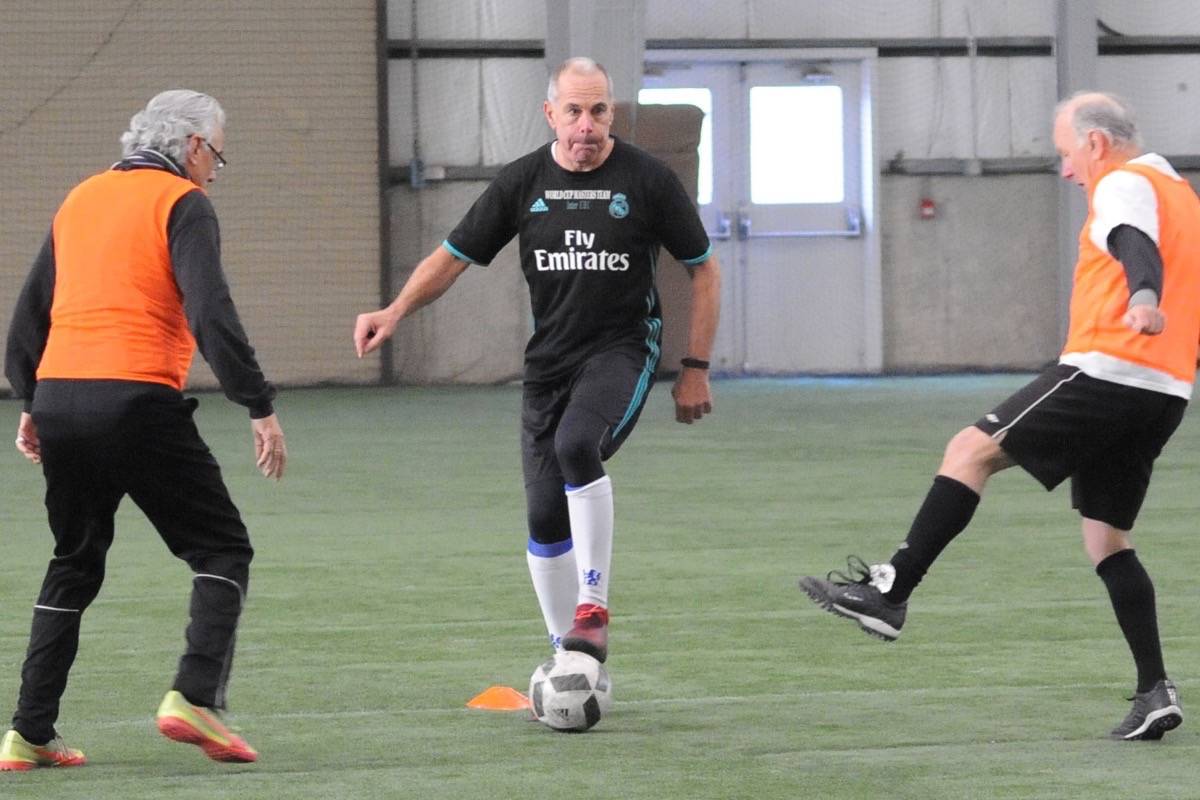
Vancouver Island Walking Soccer Alternate’s Rob Jonas (left) and Bob Unwin try to stop Harry Hubbal of UBC Masters.

The second time my neighbor Ralph broke his leg playing pick-up soccer with other old folks, he decided maybe it was time to give it up. But he loved playing the game. Giving it up was going to be hard.

Wait! There’s hope for people like Ralph! Meeri Kim describes the interesting alternative at the Washington Post.

“Aside from his wife, soccer is the love of Gary Clark’s life. He started playing at age 7 and kept it up for more than four decades, even representing his home country Canada at the international level.

“His involvement in the sport, though, was cut short at age 48, following a knee replacement surgery. When Clark asked about getting back on the field, his doctor told him to go ahead — but only if he wanted another knee replaced.

“He dipped his toe in the water by joining a pickup game and tore the cartilage in his other knee.

“ ‘There was a sense of loss at not being able to go out and partake in my passion,’ said Clark, now 68, of Coquitlam, B.C. ‘And I knew that if I tried, I would injure myself again.’ …

“The game requires rapid accelerations, decelerations, turns and stops, which take a toll on players’ knees and ankles. A standard soccer pitch, at 115 yards long and 74 yards wide, is larger than an American football field. Players cover, on average, nearly seven miles, in a single match.

“So when a variant of the sport with no running allowed emerged in 2011, some laughed it off as a joke. Walking soccer, however, has become a global phenomenon.

“In 2011, Chesterfield FC Community Trust launched its walking football program in Derbyshire, England, as part of an initiative for older adults.

“Players can’t run or jog, with or without the ball, and one foot must be in contact with the ground at all times. Other rules also differ from regular soccer, to prioritize players’ health and safety. For example, tackling is only allowed with no contact; all free kicks are indirect; and the ball must never go over head height.

“Walking soccer is played on a smaller field (55 to 65 yards long, and 35 to 45 yards wide) and with six people on each team instead of 11.

“There are about 600 walking football clubs in England alone, for men and women.

“The country is also home to the international governing body for walking football, the Federation of International Walking Football Associations (FIWFA), which includes member organizations from countries such as Italy, Nigeria, Australia, South Korea and India. And the inaugural World Nations Cup — the equivalent of the World Cup for walking soccer — will take place in August in the United Kingdom.

Clubs have cropped up in Seattle, Chicago, Southern California, Vancouver and a few other cities and regions in the United States and Canada. …

“ ‘I have lost weight playing, so I think that’s a good sign,’ said Clark, who has played with the Tri-City Walking Soccer Club for about a year. He logs up to 13,000 to 18,000 steps in a single game, but notes that most players average around 3,500 to 7,000 steps.

“George Gorecki, 62, started Walking Soccer Chicago in early 2019, after hearing about the sport from a U.K.-based friend. The Chicago resident used to play competitive amateur soccer with a club before arthritis in his left knee and right hip slowed him down. Many older members of Walking Soccer Chicago found themselves in the same boat — unable to play because of medical conditions. …

“ ‘The guys really took to it because they were able to reconnect with their teammates, both on the field and in a social setting after the game,’ Gorecki said. …

“Most studies on walking soccer have small sample sizes, but a 2020 review of research on the sport determined that it may have health benefits and help build social connections. A 2015 study found that 12 weeks of walking soccer, in the form of a two-hour training session per week, significantly reduced body mass and percentage body fat in 10 older men. Participants, with an average age of 66, had various comorbidities, including hypertension, knee osteoarthritis and Type 2 diabetes.

“The researchers concluded that walking football is safe and effective as a public health intervention — for not only healthy individuals but also those with various exercise-limiting medical conditions.

“Other research has focused on the mental and social aspects of the sport. In a 2022 study, seven men with mental health conditions such as depression or anxiety underwent a walking football intervention. It involved up to an hour playing a game, followed by an opportunity to meet and socialize. The men reported several positive effects on their well-being. They enjoyed socializing, developed new friendships and felt a renewed sense of purpose.” More at the Post, here.

I don’t know why I am chuckling my way through this story. I do think it’s a great idea for soccer lovers — maybe even less dangerous than pickleball.

Read Full Post »

In one of the Rhode Island English classes where I volunteer, there’s a former soccer pro. I do not know if he’s following this blog, but I would love to hear from any soccer player about the topic for today: ballet for sports agility and strength.

From an article by Toby Bryant in the Irish Times: “It’s November 29th, 2020, and Manchester United are 2-0 down at Southampton. Bruno Fernandes skews a shot goalward, it’s off target. Defeat seems inevitable.

“Out of nowhere, gliding across the box unnoticed with long black locks flowing, Edinson Cavani springs into the air and nods the misfired shot into the back of the net. With movement so stealthy and so swift, you’d easily mistake Cavani for a ballet dancer.

“As it happens, two months earlier the striker had swapped the football boots for the pointe shoes of ballet to train in his homeland of Uruguay at the Ballet Nacional de Sodre (BNS). … The images shared by the ballet company had soccer fans’ heads turning when they emerged. Such a sports star dabbling in ballet may have seemed unheard of, but it wasn’t a new trend.

“In 2017, over in the United States, St Paul Ballet and Element Gym’s boxers formed a partnership. The premise was simple: the ballet dancers box and the boxers dance ballet. Not simply as a social experiment but, for the boxers, to enhance footwork and balance. …

“American Footballer Eddie George spent hours forcing his 245lb body into demi-pliés and spins so it would become second nature on the field. England women’s rugby star Zoe Aldcroft spent her formative years balancing rugby with ballet and is now the Rugby Players’ Association England player of the year. … Former England rugby league international Darrell Goulding now coaches Wigan Warriors’ under-19 squad, another group who have dipped into ballet in the past.

“ ‘The season before we started we had quite a lot of ankle injuries and stability issues, so it was something we were keen to look at.’

Goulding tells the Irish Times, ‘Obviously our lads are not built for some of the ballet work, so a lot of the delicate stuff we didn’t progress to, but we used a lot of the simple drills to focus on that ankle area.’ …

” ‘Pound for pound, ballet dancers are the strongest athletes you will find,’ remarks ballet physiotherapist Luke Abnett, who believes the cross-sport benefits that ballet can offer are evident. ‘In ballet, there’s a need to not only have strength of movement but precision of movement. It’s a combination of the strong movement muscles with the fine-tuning stability muscles. …

“ ‘When you get to more advanced levels of ballet skills, you’re working on jumping, turning, pirouettes, control and rotation,’ Abnett says. ‘Landing in interesting positions and transferring your weight as you move into the next step – all of that would apply to situations like that.’

“Injury prevention is another benefit. While ballet can’t help stop the collisions that come with sports such as rugby and soccer, its muscle development can reduce the risk of any overuse injuries.

“One study compared basketballers, prone to ACL problems, and ballet dancers. Even though dancers would land at more difficult angles, their training meant they suffered far fewer ACL injuries. …

“ ‘Cavani’s movements have always been sharp but at his age and with the physical demands of the Premier League, it’s impressive,’ one fan tells the Irish Times. ‘Cavani’s spatial awareness and manoeuvrings are so incredible, it has me wishing he’d make ballet a thing in the United dressingroom too,’ another admits. …

“As well as the physical benefits, mainstream sports stars are entering the ballet studio to improve mentality and actively combat stereotypes.

“When speaking of his Wigan Warriors youth team, Goulding believes that ‘people only grow when they are outside of their comfort zone.

“ ‘As you can imagine, the idea of these physical rugby lads from tough working-class areas is a total contrast from ballet and how graceful it is. From the first session there was a lot of embarrassment – it wasn’t a comfortable situation for the lads. They grew a lot of respect, even from just trying the basics. They came back really sore and couldn’t believe some of the muscle they used.’ ”

More at the Irish Times, here.

Photo: ESPN.
Manchester United fans’ hopes of seeing … Edinson Cavani dancing through Premier League defenses may be helped by the striker’s passion for ballet,” says ESPN.

Read Full Post »

01-airport-welcome

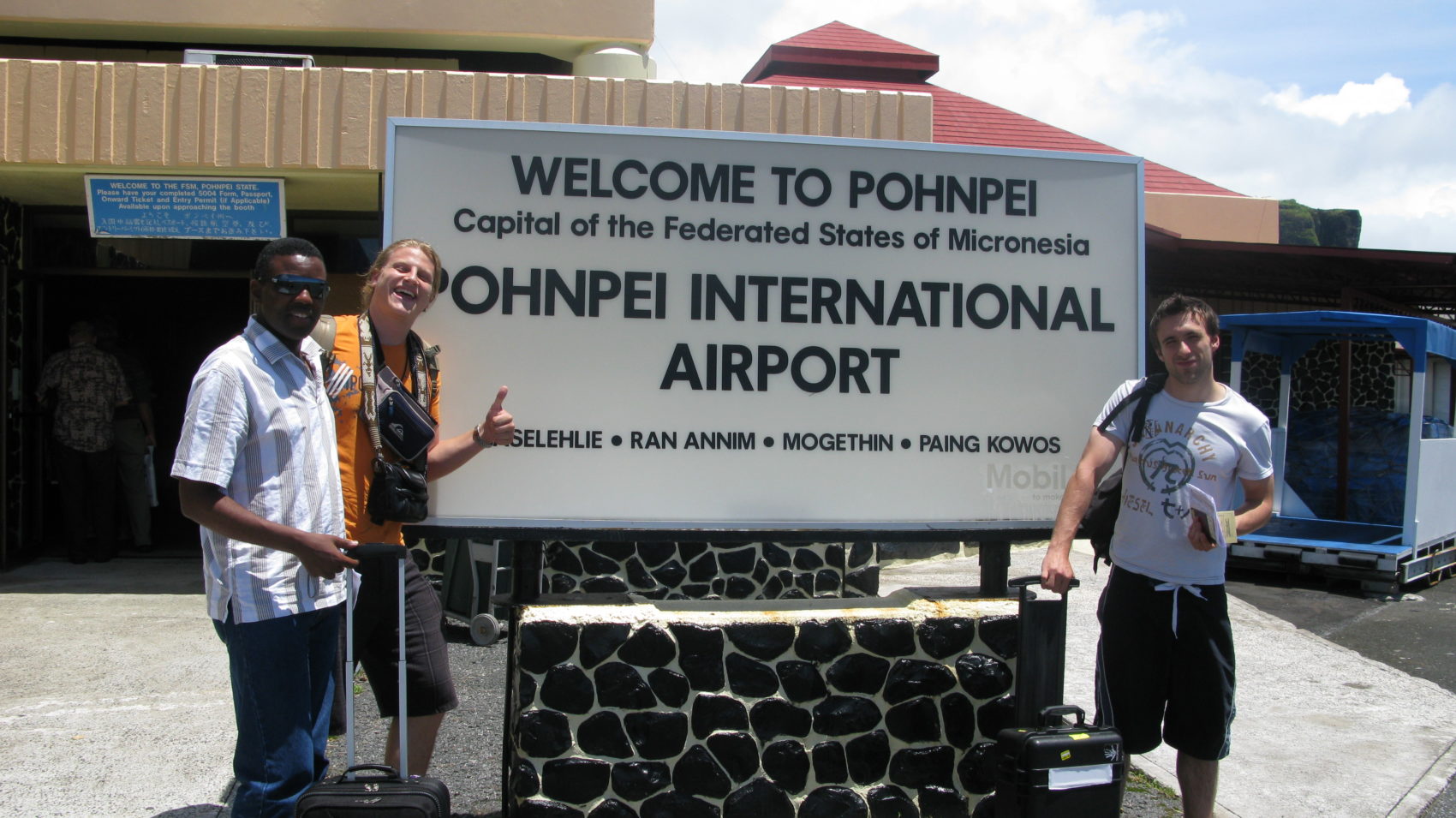
Paul Watson (right) and Matthew Conrad arriving in Pohnpei to reenergize Micronesian soccer. Previous coach Charles Musana, from Uganda, came along to do introductions.

Sometimes giving up on your dream lands you in the wrong profession. That’s what happened to Paul Watson. He wasn’t good enough to play Olympic soccer. So he tried soccer journalism, but it bored him. Then he and his friend, just for fun, started researching teams they could have qualified for had they been born in those countries.

James Parkinson reports at the WBUR radio show Only a Game, “From the time he was very young, Paul Watson had one dream: to play soccer.

” ‘My first passion was that I would play for England,’ he says. ‘You know, that was the dream. Despite not having any talent, really. No discernible sort of natural talent. [As] the years went on, it got less and less likely.’ …

“So he became a football [soccer] journalist who kept his dream alive by playing for a semi-pro team. But he says, that wasn’t enough. …

“In 2008, Paul Watson and his flatmate Matthew Conrad found themselves reflecting on their footballing dreams, wondering what life could have been like if they had made it in the professional game.

” ‘We would sit around in the evenings and kind of watch Brazilian second division football and sort of lament our lack of talent,’ Paul remembers. ‘And, one day, like a lot of fans probably around the world, we came up with the thing of saying, “Well, what team could we have played for if we’d been born there?” … We trawled through the FIFA rankings, got to the very, very bottom. … That was when we found the non-FIFA rankings — you know, places that aren’t recognized by FIFA. At the bottom of that was this island, Pohnpei.’

“Pohnpei: it’s an island in Micronesia. Population: just over 36,000. …

” ‘We sent them an email to the address that we could find for them. And that was it. That was supposed to be the end of it. But it was only actually when their head of their FA got back to us and said, “You know, I’d love to help you, but I’ve just moved to London.” ‘ …

“That man was Charles Musana, a Ugandan who had spent 15 years on the island of Pohnpei playing and coaching football.

” ‘And he said to us: “You can’t go there and play. It’s harder to get a Micronesian nationality than it is to get a British one. … Why don’t you come over and coach? The team’s basically disbanded, so come over and coach the team.” And I think he thought we’d laugh about that and go home. But instead, we said, “Yes.”  …

” ‘It was a good sort of 13 months ’til we actually were able to leave because, you know, we had to save up money, we had to give up jobs,’ Paul says. …

” ‘My long-term girlfriend — and now wife, amazingly — Lizzie, basically said, “You should do this. It’s something you want to do.” …

‘Crazy as it might seem, the thing I was most worried about, that gave me sleepless nights, was that someone would get their first,’ Paul says. …

“After 13 months of research, Paul and Matt finally booked their flights to Pohnpei. They were only planning to stay for three weeks to assess the situation. …

“Charles Musana, the man who proposed the idea of coaching the team in the first place, would come along to make introductions. …

“After 24 hours in the air, Paul and Matt arrived in Pohnpei.

” ‘It’s a U.S. protectorate, so it has a bit of a U.S. feel to it,’ Paul says. “Uses the dollar. But in many ways, it’s a tropical paradise. You know, it’s this incredible, shocking greenery and beautiful blue ocean. It’s absolutely stunning. It’s just such a friendly island. Everyone nods to everyone. It’s incredibly laid back. You drive at about 10 mph, and you swerve around all the potholes.’ …

” ‘We met the head of the Olympic committee in Micronesia — he’s called Jim Tobin, a really amazing American man who’s administrated sport there for years. … We were going down to the field every day and just seeing what level of interest there was.

” ‘And it would range. You know, some days we had a five-on-five kick around on this sort of flooded field. Other days, it would get up to sort of 20 people kicking around. Some days, we’d arrange everyone to turn up at 6:00 — they’d get there at 8:00. You know, it was a mess. But there was interest, and there were kids coming out and kicking a football who’d never done it before. There was some who were actually clearly really good.’ …

“When their three weeks on the island were up, Paul and Matt returned home to plan their next move. For Matt, that decision was taken out of his hands. He had gotten into film school — something he’d always wanted to do. But Paul decided to return to Pohnpei and take the coaching job.

“There was no pay. …

” ‘In a weird way, I felt more comfortable that way. Because if I’d taken on a professional role and commanded a salary, it wouldn’t have felt particularly ethical. Because I would have felt I was painting myself as something I wasn’t. … I was getting more out of this than they were in many ways. So it felt like a deal that made sense.’…

“When he returned to Pohnpei, he met a young man named Dilshan Senarathgoda.

” ‘He had been coaching this group of young kids. So I met up with him, and he was absolutely over the moon that I was there,’ Paul says.”

Read what happened next at WBUR, here.

Read Full Post »

Photo: Pete Norton/Getty Images
Reuben Reid (front) of the Forest Green Rovers in England went fully vegan after the team’s owner introduced healthful food. He says it’s made a huge difference in his life.

Even after the retirement of founding host Bill Littlefield, the WBUR show Only a Game continues to have stories that appeal to sports lovers and lay people alike. I got a kick out of this one about England’s vegan soccer team.

Gary Waleik was the reporter.

“The menu at sports events has traditionally been a bit limited … and unhealthy. Especially at soccer games in England.

” ‘On a match day, you’re looking at a lot of sausages, burgers, bacon sandwiches. Quick and easy fried food,’ says Forest Green Rovers striker Reuben Reid. His team is broadening its menu with healthier fare. But that’s just one part of a much larger mission.

“In 2010, Forest Green Rovers, then a fifth-tier football club in Nailsworth, England, was in financial trouble. Dale Vince, who loved the sport as a kid, was approached by the team.

” ‘They said they needed a little bit of help to get through the summer,’ Vince says. ‘And I thought it would be a nice thing to do — because we could, so we should. But within a couple of months, it was clear that they needed much more than just a little bit of money.

” ‘And they said to me, “You really need to be the Chairman.” And I said, “I really don’t. I’ve got so much else to do.” But I then faced the choice — if I walked away, they would fold.’

“It was heady stuff for a guy who, two decades before, was living a hermit’s life on a hill in England’s bucolic Cotswolds region.

” ‘I had an old U.S. Air Force radar trailer that I rescued from a scrap yard and converted into a home,’ Vince says.

“In 1991, he was traveling in Cornwall. And something caught his eye.

” ‘It was England’s first modern, proper wind farm,’ Vince says. … That inspired him to build his own windmill farm, beginning in 1996. He called his new company Ecotricity. It was a big risk.

” ‘When I got started, renewable energy powered about 2 percent of Britain,’ Vince says. ‘Last year, it was 30 percent. And we’ve grown to be a company of about 700 people supplying about 200,000 customers.’ …

” ‘I saw the opportunity to use football as a new channel to speak to a new audience of people about sustainability,’ Vince says. ‘It’s still a football club, but it’s become something else, as well.’ …

” ‘We cut red meat out of the menu straight away for the players. We did it across the whole ground at the same time, so staff and fans and visitors as well. And then we took a series of other steps over the next couple of years toward full-on veganism.’

“The team dropped all meat, fish and dairy. By 2015, Dale Vince was the Chairman of the world’s first vegan sports team.

‘There were people at the time that said, “You’re gonna kill the club. Nobody’s gonna eat it. This kinda stuff,’ Vince remembers.”

Read more here.

Read Full Post »

Photo: Steven Senne/AP
New England Patriots 23-year-old rookie wide receiver Malcolm Mitchell joined a suburban women’s book club when he was at the University of Georgia.

Here’s great story that John sent me. He had been to an event at Life is good and heard a young football player talk about the sequence of events that followed his joining a women’s book club.

Emmett Knowlton wrote about the football player at Business Insider.

“New England Patriots 23-year-old rookie wide receiver Malcolm Mitchell is perhaps the biggest book lover in the NFL and, now, a published children’s-book author — all thanks to a chance encounter in a bookstore.

“In a fun story in The Boston Globe back in May, Mitchell said that when he was a junior at the University of Georgia, he decided to join a suburban, all-women’s book club after a serendipitous meeting with one of the members in the stacks of a Barnes & Noble.

” ‘I was there picking up “Me Before You,” the next book for the club,’ Silverleaf Book Club member Kathy Rackley told The Globe. ‘Malcolm walked up to me and said: “Can I ask you something? Can you recommend a book?” ‘

“Rackley had no idea that Mitchell was a star receiver on the Georgia Bulldogs, but the two got to chatting. When Rackley revealed that she was in a book club, Mitchell asked if he could join, and the two exchanged contact information. …

“Two days later, Mitchell showed up to the meeting. From The Globe

‘ “I didn’t mind [inviting him] at all,” [the hostess] recalled. “Because I didn’t think there was any way he’d show up!” But he did and [impressed] the group with his thoughts and opinions — and his own life experiences. …

“Mitchell continued to participate in the club, and he became a real book lover. According to The Globe, he was often found reading at his football locker, and when it was his turn to recommend a book he made his new friends read Marcus Luttrell’s ‘Lone Survivor.’

” ‘The book club helped me grow into a better individual, a person who learns and grows throughout life in general,’ Mitchell said.

“Mitchell’s current lifestyle has made it difficult for him to regularly attend the club. But he remains an avid reader, and he recently published a children’s book, ‘The Magician’s Hat,’ about the magical powers of reading. He started a foundation, too, called Read With Malcolm, that encourages childhood literacy.” More here.

I love the openness and enthusiasm of a guy who would ask a stranger for a book recommendation and then ask to attend the book club!

Read Full Post »

If you’re a country called Ireland and your soccer team doesn’t make it into the 2014 World Cup competition in Brazil, what do you do?

Change the “r” in your name to “c” and adopt another team.

I like David Trifunov’s headline at the Global Post, where you can read the background: “Iceland closes in on World Cup bid. Wait … Iceland has a soccer team?”

He continues, “Iceland is now one game away from becoming the smallest nation ever to advance to a World Cup. … It started in 2008 when the national economy, under the weight of an inflated currency, tanked.

“The modest Iceland soccer league cut ties with nearly all its more expensive foreign players, leaving the door wide open for homegrown talent. They took advantage, getting the experience they needed. …

“Ireland is one frustrated World Cup nation that has taken notice. At least the fans have. Eoin Conlon and friends were lamenting their country’s failed attempt to reach Brazil when he realized there’s only one nation that deserves their support now.

“ ‘And we kind of laughed, saying: “Well, that’s as close as Ireland’s going to get to Brazil. It’s only a letter difference. A ‘c’ for an ‘r.’ We might as well be brothers,” Conlon told Public Radio International.

“So they struck up a website and Twitter profile to encourage Irish football fans to back tiny Iceland.

“ ‘There are only about 320,000 people in Iceland,’ Conlon told PRI. ‘So if they were a county in Ireland — I’m calling them the 33rd county — it would [be] only the fifth-largest county in Ireland.’ ”

More here.

Photo: (AFP/AFP/Getty Images)
Iceland’s striker Kolbeinn Sigthorsson, right, and Croatian defender Vedran Corluka vie for the ball during their World Cup playoff in Reykjavik on November 15, 2013. 

Read Full Post »

The Manhattan Paris Saint-Germain soccer team is made up of both rich and poor boys from many cultures. Coach Wilson Egidio thinks the team’s diversity is part of its success.

Vivian Yee has the story at the New York Times. She writes that Amara, for example, “joined the team after an eagle-eyed former player for Mr. Egidio spotted him playing on a Bronx playground. [He] wound up scoring the goal that made Paris Saint-German the first Manhattan youth club to reach the national playoffs.

“For the players, their coaches and parents, the team’s diversity is a source of success as well as pride. Their international styles, they say, add fluidity and creativity to their game.

“Combined with Mr. Egidio’s Brazilian approach — he grew up in Brazil and played professional soccer there — that could be key in the national tournament.”

Click here to read about this week’s competition and the backgrounds of the players.

Photograph: Christopher Gregory, New York Times

Read Full Post »