Feeds:
Posts
Comments

Posts Tagged ‘global warming’

Photo: Rebecca Kordas/UBC
Limpets are easy to overlook — so too is their effect on the environment. But careful consideration of how all the life forms in an area interact is key to understanding how ecosystems thrive.

I’ve been reading a small book called The Sound of a Wild Snail Eating. A friend offered to lend it to me, and much to my surprise, I’m finding it fascinating. It’s by a woman with a debilitating illness who describes her growing interest in a snail brought to her on a wild violet plant. As the author learns, there is more to snails than meets the eye. A lot more.

The same may be said of limpets. Christopher Pollon explains why at Hakai Magazine.

“As the ocean temperature rises, it may be the little things that make the biggest difference to the survival and resilience of living things.

“Take the limpet, a tiny snail-like gastropod with a hefty appetite for the minute plants that live in the intertidal — the space between low and high tide. In 2014, Becca Kordas, then a zoology doctoral candidate at the University of British Columbia, tested the effect these creatures have on the ecosystem when exposed to ocean warming. She found that their influence was huge.

“Kordas launched her project by sinking four sets of settlement plates in the intertidal zone of Saltspring Island, British Columbia, about 55 kilometers southwest of Vancouver. For 16 months, Kordas and her colleagues tracked which plants and animals established themselves on the four different types of plots. Kordas controlled the limpets’ access to half of the plates, while they were free to graze on the other half. She also simulated the effects of ocean warming by tinting some of the plates black to attract the sun’s heat.

“By the end of the study, the differences between the four sets of plates were stark. Kordas found that when limpets’ access is restricted, the artificially warmed intertidal ecosystem collapsed — the diversity of life largely replaced by a mat of microalgae. Limpets with access to the plates, however, maintained a healthier ecological community, even in a warming environment.

“What is it about limpets that helps maintain a diverse and complex community, even when their environment warms?

“Kordas says limpets eat huge amounts of microalgae, including microscopic diatoms and the spores of larger algal species. This clears the terrain for a variety of life.

“ ‘When limpets are allowed in, they make space for things like barnacles, and then those barnacles in turn create little condos for other animals to live in,’ she says.

“In a sense, limpets are tiny ecosystem engineers. … The study comes at a critical time for intertidal life in the northeast Pacific Ocean. In this area, the summer low tide typically occurs around noon, which exposes intertidal species to warm summer temperatures. The heat shakes up the intertidal community, but shakes it up more without limpets around.

“The lesson of Kordas’s study, however, is not about limpets per se. It’s about the need to better understand the role of every organism in an ecosystem.”

Hat tip: Pablo Rodas-Martini, @pablorodas, on Twitter.

More here.

Read Full Post »

Photo: Buzzfeed
Reducing our intake of meat, especially beef, can reduce global warming. Want to help me find quick non-meat recipes that work for the whole family?

Back in the 1970s, my sister gave me Frances Moore Lappé‘s Diet for a Small Planet. So even back then, I was hearing that eating meat was bad for Planet Earth. But I never gave it up completely. I had a few non-meat recipes that I liked, including a delicious Eggplant Parmesan from that book, but my commitment wavered.

Lately, there’s been a lot in the news about what the individual can do to fight global warming, and one of the most frequently mentioned ideas is to give up meat, especially beef. There are lots of reasons, including the fact that livestock gives off too much methane and requires extensive grazing land that could be better used. Also, destroying trees in the rainforest and elsewhere is like destroying the lungs of the planet.

Photo: One Green Planet
Many environmentalists say that beef production is killing rainforests, which are the lungs of the planet in that they absorb carbon dioxide and give off oxygen.

Suzanne and I are giving meatless meals another shot. We’re unlikely to get as far as a true vegan diet, but we can start by serving smaller and smaller amounts of meat and larger and larger amounts of grains, nuts, fruits, eggs, veggies, and dairy products. (Dairy cows are just as flatulent as cattle raised for meat, so in California, scientists are experimenting with seaweed added to food to cut down on the methane released.)

Both Suzanne and I value prep speed. We have meat-centered meals we make quickly on autopilot. Now we need to retrain our muscle memory to make vegetarian recipes quickly.

I’ve started searching the web and would be open to ideas from readers, many of whom probably had this whole concept nailed down years ago. John’s family has an ongoing Tofu Tuesday, so I hope to get a favorite recipe from them.

BuzzFeed offers a list of 30 intriguing meals here. They’re a bit heavy on the bean component, which won’t work for me, but how do you like the one pictured at the top of the post, which BuzzFeed found at the Bojon Gourmet? It involves tofu and shiitake mushrooms roasted in a mixture of toasted sesame oil, tamari, and sriracha and transferred to a miso soup containing noodles, ginger, and kale. Mmmm.

Photo: Yale Environment 360
According to environmentalists, when humans destroy the rainforest to graze cattle, they are shooting themselves in the foot.

Read Full Post »

Photos: Greg Davis/OPB
Oregon State University doctoral student Hankyu Kim sets up a decoy of a hermit warbler. Songbird populations have been declining, and rising temperatures are one reason.

Nearly all birds are “canaries in the coal mine,” in the sense that when they’re in trouble from habitat destruction, rising temperatures, pollutants, and so on, they’re heralding trouble for all species, including the human one. For that reason, among many others, I love to hear of efforts to protect even one kind of bird.

Consider this story by reporter Jes Burns at National Public Radio (NPR).

“Each spring, songbirds migrate thousands of miles to breed in Oregon’s Cascade Mountains. Deep in a forest, Oregon State University researcher Hankyu Kim feels he has gotten inside the head of one species, the hermit warbler.

” ‘These birds are territorial in the breeding ground, they set up their territories, and they fight with each other to defend it,’ he says.

“Armed with this knowledge, a nearly invisible net strung between two repurposed fishing poles, a lifelike plastic warbler decoy and a looped recording of birdcalls, Kim’s trap is set. …

” ‘We have these long-term population monitoring routes across the Northwest. And a surprising number of species are declining,’ says Oregon State professor Matt Betts. ‘Actually, more than about half of the species that live in a forest like this are in decline.’

“Rising temperatures can shrink where some birds can live and where they can find food. For the hermit warbler, those declines are up to 4 percent each year.

“Research by Oregon State’s Betts and Sarah Frey found warblers declined in areas with young forests, including those replanted after clear-cut logging. But hermit warblers are doing better in other areas.

” ‘In landscapes that had more older forest, their population declines were lowered, or even reversed, even though the climate has been warming,’ Frey says.

“The Pacific Northwest has had a decades-long push to preserve its old-growth forests, and the warblers thrived in them. That suggests these forests somehow shielded them from the ill effects of rising temperatures. The question is why, and that is where this new study comes in.

“Kim and fellow Oregon State researcher Adam Hadley move the trapped hermit warbler’s feathers aside and attach a tiny radio tag to its back using nontoxic glue (the kind used for fake eyelashes). Then they release the bird, and it flies away. …

“They walk down a drainage though a 50-year-old tree plantation, a remnant of the logging past at the H.J. Andrews Experimental Forest. Then they cross into a grove of much older trees, some close to 300 years old.

“Hadley explains that the temperatures can be different at various heights of a tree. ‘It’s possible that when it’s warmer, [songbirds] may be only using the bottom and more shady parts of the trees,’ he says. He guesses they may move up higher when it becomes cooler.

“He says the complex layers and sheer biomass of old-growth keeps the temperature in these forests up to 5 degrees lower. But the researchers can’t fully understand what’s going on without knowing more about how the birds use the forests. …

“Hadley waves the antenna through the air trying to pinpoint the warbler’s location. … He and the others will compare the hermit warblers’ movements with temperature data they’ve also been gathering. They hope to get another step closer to understanding how this native songbird species might cope with the warming climate.”

More. This seems like an extra reason to protect old-growth forests, not just replant after logging. But how long will five degrees cooler be enough?

Kim, do you know about this? And are you seeing these warblers at your banding station?

Oregon State scientists are tagging and tracking hermit warblers in hopes of learning why their numbers have stabilized in places with old-growth forests, despite declines in other areas.

Read Full Post »

Photo: Reuters/Bob Strong
Cities consume more than two-thirds of the world’s energy. Copenhagen is a city that’s determined to become the first carbon-neutral capital and, in the process, is showing that sustainability improvements are good for the economy.

Copenhagen, where Erik’s Swedish-Danish relatives live, is showing the world that cutting carbon emissions to fight global warming can actually reduce energy prices and boost the economy. In a win-win for all concerned, big steps by the local energy company are complemented by the small steps of individuals who know that biking everywhere is good for both the environment and personal health.

Lin Taylor writes for the World Economic Forum, “Around the world, more than 70 major cities have pledged to end their reliance on fossil fuels and stop pumping out climate-changing emissions by 2050.

“But Copenhagen — a city of wind turbines, bicycles and reliable public transportation – thinks it can go even further: It intends to accomplish that shift in just seven years. It will require a complete reimagining of how the Danish capital is powered and designed — and a lot of cyclists. …

“While other cities have parking garages for cars, Copenhagen has them for bicycles. Virtually all its 600,000 residents own a bicycle, and the city has 375 kilometres of dedicated cycle lanes.

“The harbour-rimmed municipality also is mostly powered by clean energy — and it has its own renewable energy company and wind turbines. Running its own energy systems is one of the reasons Copenhagen is already well on track to being carbon neutral – meaning it will produce no more carbon emissions than it can offset elsewhere. …

“In 2017, Copenhagen produced about 1.37 million tonnes of climate-changing gases, down 40 percent from 2005, according to city figures. That’s about 2.2 tonnes of emissions per capita, one of the lowest rates for a European city. The city said the reduction in emissions was largely due to a switch to wind energy under HOFOR, the city’s own utility company. …

“Around the world, cities consume more than two-thirds of the world’s energy and account for about three-quarters of carbon dioxide emissions, according to the United Nations. That means finding ways for cities to become carbon neutral will be key to meeting the Paris commitment to keep the rise in global temperatures to ‘well below’ 2 degrees Celsius above pre-industrial levels. …

“In its quest to cut emissions, Copenhagen has another distinct advantage: For over 100 years, the city — and Denmark as a whole — has relied on district heating, a system where heat is produced and supplied from one neighbourhood or area plant, instead of per household. That means the city itself can make the switch to cleaner energy for large numbers of residents, cutting carbon emissions by over half compared to the use of individual gas or oil boilers, HOFOR says.” It adds:

“The city also has a newly-built district cooling system, which uses seawater to cool buildings and households, cutting energy consumption up to 80 percent compared to traditional methods of air-conditioning.

“By 2025, the city aims to be powered entirely by wind, sun, geothermal energy, waste, and wood and other biomass. Yet despite its huge investment in new, clean technologies, one of the city’s big priorities is cutting prices for energy users. …

“[Jørgen Abildgaard, director of the city’s climate programme,] said it was crucial to work closely with industries such as construction and transport to devise business models and technologies that work both to meet business goals and cut emissions. …

“As the city’s emissions-cutting commitments have grown, so has its economy, which has seen 25 percent growth over the past two decades.” More at the World Economic Forum, here.

Photo: Thomson Reuters Foundation/Lin Taylor
On a typical day in August, numerous bicycles are parked on a street in central Copenhagen, Denmark.

Read Full Post »

Our New Year’s Eves are quiet these days. We watched an Agatha Christie on television and went to sleep. But I’ve been saving a suitable tile from the New York subway system since my October trip to visit my sister, so here it is and Happy New Year!

2018 was not a good year for my sister, who was diagnosed with a bad brain cancer in July. But it was also a year we learned to be grateful for things like a clean surgery and cancer treatments without bad side effects. My perspective changed.

My perspective on the nation and on the future of the planet and my own role in it has also been evolving. I began to suspect that, other than our Bill of Rights, our country may not be as special as we thought. After all, all countries think they are special. And even the Bill of Rights can’t survive unless we commit to protecting it and interpreting it justly. Surely none of those rights were intended to lead to the deaths of thousands of innocent Americans every year. Perhaps 2018 was a turning point.

I’ve also been giving more thought to my role in global warming. Do I make too many unnecessary car trips when I could walk or take public transportation? Do I serve the family too much meat, especially beef? Should I find a way to plant more trees? I know I need to stop sneaking around the local laws against plastic bags and find a sustainable alternative.

I will be writing more about initiatives to protect the planet and will be looking for ideas to apply in my own life from you and from websites like 1MillionWomen. By the way, I learned about 1MillionWomen from a wonderful book called Climate Justice, by Mary Robinson. I hope you will put it on your list. It shows how the poorest communities are the first to feel the crunch of global warming and how, if we pay attention to those communities, we will also be taking arm against the sea of troubles that threatens us all.

Even better, the book shows how extraordinarily effective ordinary people can be when they have simply had enough.

Read Full Post »

091720nc20boats

Photo: Patrik Jonsson/Christian Science Monitor
At Swan Quarter, North Carolina, shrimp boats cluster on the shore ahead of hurricane Florence in September. The town’s protective dike represents cooperation among practical people, who put aside politics to solve a serious problem.

Even when people believe global warming is only a cyclical blip, they can find common cause with others to solve a problem that affects everyone. Residents of a small town in North Carolina did just that after years of dangerous floods.

From the Christian Science Monitor: “As staff writer Patrik Jonsson began traveling the Carolinas after hurricane Florence, he came across a town that put aside its differences over politics and global warming to find a solution to chronic flooding. …

“Neighbors J.W. Raburn and Henry Williams are political polar opposites. … But the two lifelong friends – along with about 300 or so other North Carolinians who call Swan Quarter home – stood united [in September] against hurricane Florence.

“Nearby Oriental, New Bern, and large parts of central North Carolina were devastated when up to 40 inches of rain fell. … Tens of thousands of residents were displaced, and at least 23 people died.

” ‘There is no doubt that dike has saved us. It gives us a little bit of hope,’ says Raburn. His friend nods.

“The dike, completed in 2010, is a piece of political pragmatism that has gained stature as it held up well against during hurricanes Irene and Matthew, superstorm Sandy. …

“There is also growing evidence that mounting property losses, declines in property values, and threatened historical landmarks are wearing away resistance to preparedness. That common purpose might sometimes be hard to see on the national stage. But locally, people are putting aside politics in favor of practical solutions.

” ‘Working in Swan Quarter, flooding is not an ideological issue there. It is a way of life. Same with sea level rise. People have watched it happen within that lived environment. If you watch forests turn to marshland and the roads flood, the politics fade away,’ says Jason Evans, an environmentalist from Stetson University in DeLand, Fla., who worked on the dike project.

“Raburn and Williams, former bandmates, show the human side of the debate. Raburn believes that finding solutions to manmade climate change is vital. Williams, a farmer and volunteer firefighter, does not believe that humans are altering the temperature of the planet, calling it ‘a phase we are going through.’ But he is the one who cares for and maintains the dike – a job he takes very seriously. …

“In Swan Quarter, local taxes are likely to go up. The county needs to purchase pumps to help clear water that seeps through the dike. Across the sound on Ocracoke Island, county leaders are working on bolstering dunes. …

“At the same time, the dike played a role in the county investing millions in a new courthouse and fire station. The state credit union has felt confident enough in the dike to build a new branch. A critical ferry service runs from the docks to the Ocracoke Island. Inside the local gas station, a line drawn at head level shows the height of Isabel’s surge. Thus far, Florence has left no mark at all.

“The size of the town and the lean budgets mean, ‘the kind of interventions that can be done there and how we think about it is much different than thinking about New York City or Miami,’ says Evans. ‘Hyde County is a hardscrabble place trying to build a dike. Nothing solves anything forever. … But it clearly has helped with certain floods. I wouldn’t want to be in Swan Quarter during a big hurricane event without that dike being there. …

‘Whatever legislators want to do, whatever presidents want to do, it’s in the end not relevant in terms of trying to work through the facts. We have scientific understanding that can apply to all these places,’ says Evans. ‘But I have also seen over and over again – whether in the Florida Keys or in Swan Quarter – that within areas facing substantial problems, all the political stuff that we all get drawn into fades away.’ ”

Speaking of political stuff fading away, I want to do a post sometime on the fact that the divisions among us may make lively and urgent headlines but aren’t always replicated on the ground. Don’t we all interact regularly with people whose politics we know differ from ours? Would love to hear your examples to add to my own.

More at the Christian Science Monitor, here.

Read Full Post »

Photo: Australia Nuclear Science and Technology Organisation
Australian wetlands researchers behind the Feather Map invite citizen scientists to send feathers and include an explanation of where the feathers were found.

I recently saw a great quote on twitter from a Rhode Islander about what he learned years ago when he visited post-apartheid South Africa: “I learned that the power that you have to change big things is entirely about how strong of a community you can form.”

That quote came to mind as I was reading about how researchers in Australia are enlisting the enthusiasm of citizen scientists to address the challenges of wetlands protection. That may not sound as important as ending apartheid, but wetlands are expected to play a big role in the fight against global warming.

Livia Albeck-Ripka had a report at the New York Times.

“One day in April 2016, Kate Brandis opened a weathered envelope, mailed to her from suburban Sydney. Instead of a letter inside, she found the feathers of an Australian white ibis. A day or so later, another envelope arrived, stuffed with more feathers. In the days following, more began to come.

“Soon, Dr. Brandis, who is a research fellow at the University of New South Wales’s Center for Ecosystem Science, was receiving three to four envelopes a day containing the feathers of birds from across Australia, including those of pelicans, wood ducks, cormorants, herons and spoonbills. …

“Two years before, she had put out a call to the public to send her fallen feathers of wetland birds so she could analyze where they came from, in an effort to map how the birds are moving between the country’s disappearing wetlands. …

“Wetlands — which include swamps, marshes, lakes, mud flats and bogs — are biodiverse ecosystems that can improve the quality of water and mitigate damage from flooding and pollution. But since the beginning of the 20th century, some estimates say, more than half the world’s wetlands have been lost, largely because of human activities. …

“Now, the impacts of climate change — which can include less rainfall in some areas, changing river flows and flood patterns, and potential saltwater intrusion into inland bodies of water — are further threatening some of Australia’s wetlands, and the birds that rely on them for breeding. …

“ ‘When our floodplains flood, which is only every couple of years, these birds come together in the hundreds of thousands to breed,’ Dr. Brandis said. But when the water recedes, the birds disband. …

“Where do the birds come from, and where do they go afterward? ‘Because we don’t track our birds, we have no idea,’ she said.

“Traditional tracking methods, like banding birds, have not fared well in Australia. … Many birds, like the ibis, have a high mortality rate. Another factor is simply Australia’s size: Inland birds often go to places where people do not.

“For that reason, Corrie Kemp, a 73-year-old retiree from Queanbeyan, New South Wales, made a special effort to collect feathers for Dr. Brandis’s project from among the most remote corners of Australia, in western Queensland. ‘We made a point of going places where no other people where going,’ Mrs. Kemp said, adding that she and her husband, Peter, had devoted an entire three-month trip to collecting feathers, during which she kept a diary of her discoveries and often corresponded with Dr. Brandis. …

“Bird feathers, like human hair and nails, are made of a protein called keratin. As the feathers grow, the keratin keeps a record of the bird’s diet, much like the rings of a tree. By analyzing a section of a feather, Dr. Brandis and her team can get a snapshot of the bird’s diet while the feather was developing.

“Feathers from chicks — which have spent their entire lives at one wetland — are particularly useful to researchers, providing what Dr. Brandis and her team call a ‘fingerprint’ of each place. By comparing the diet record of adult feathers against this information, researchers hope to map which wetlands the birds have been using, and how healthy those wetlands are. …

“Dr. Brandis said the possibilities were endless when studying animals’ tissue for clues about their environments, their habits and their origins. ‘It’s like the tip of the iceberg.’ ”

Read more about the Feather Map of Australia here and here.

Read Full Post »

Photo: Marcus Teply/PRI
Dr. Andre Niemann with a partial model of his plan to turn Prosper-Haniel into a pumped storage system (basically a giant, water-powered battery). “It shows responsibility. It shows that if mining is over you’re not leaving the place.” 

Recently I read a sad story about a coal miner in the U.S. who once thought he and his infant son would have secure jobs long into the future. Now his mine is closing and he’s off to find another.

What’s sad to me is that although there are opportunities to retrain in up and coming industries, he and his family are chasing a dead one. But I can understand that he wants to keep earning six figures, a salary unlikely in most fields for which he might train.

Meanwhile, in Germany, people in an old coal town are biting the global-warming bullet and moving on.

Valerie Hamilton reports at PRI’s the World, “For most people, the top of the mine shaft at the Prosper-Haniel coal mine in Bottrop, Germany, just looks like a big black hole. But Andre Niemann looked into that hole and saw the future.

“Niemann leads the hydraulic engineering and water resources department at the University of Duisberg-Essen, in the heart of German coal country, western Germany’s Ruhr Valley. For more than 150 years, Germany mined millions of tons of anthracite, or hard coal, from coal mines here that at their peak employed half a million miners. But that’s history now — Germany’s government decided a decade ago to end subsidies that made German hard coal competitive with imports. …

“The end of hard coal mining in Germany comes just as Germany is working to slash its CO2 emissions by replacing fossil fuels with renewable energy sources like wind and solar. The country calls it the Energiewende, or ‘energy transition.’ But wind and solar aren’t always there when they’re needed, so a key challenge of the Energiewende is to find ways to store sun and wind energy for later use.

“One way to do that is with a pumped energy storage system — basically a giant, water-powered battery. When the sun is shining or the wind is blowing, the excess energy is used to pump large amounts of water uphill into a reservoir. When the sun goes down or the wind dies, that excess energy can be released by letting the water flow back downhill, through turbines that generate electricity like in a hydroelectric dam.

“Existing pump storage systems make use of hills or mountains for the necessary difference in altitude. But Niemann says the depth of a coal mine — like Prosper-Haniel — would work just as well.

“He and a team of researchers have worked up a plan to turn the mine into a pumped energy storage system that could generate 200 megawatts of power, enough for almost half a million homes. Water would be pumped through a closed system of pipes from 2,000 feet below ground level up to the surface and fall back down again on demand, regenerating 85 percent of the renewable energy used to pump the water up in the first place — energy that would otherwise be wasted. …

“Niemann, who grew up in a coal-mining family in the coal city of Ibbenbueren, says it would be a powerful symbol that as Germany transforms its energy landscape, coal regions won’t be left behind. …

“[Miner Ernst] Mueller explains the deal offered to him and every other mine worker in 2007, when the German government moved to end the subsidies that kept Germany’s hard coal mines afloat. …

“Underground workers over 50, and above-ground workers over 55, like Mueller, can retire early, paid by a company fund, as long as they have 20 years on the job. About 400 of their younger co-workers can stay on to maintain the mine area after it closes. The rest get job placement and training. Beike says [the company] promises to find every worker a new job. …

“The hope is, eventually, green business will pick up where coal left off. To prepare, the region has opened a new technical college in Bottrop to train the next generation of workers — not in coal, but in fields like green tech, water management and electro-mobility.”

More at Public Radio International, here.

Read Full Post »

061817-new-shoreham-bluffs


On the principle that “one and one and 50 make a million,” a better world relies on everybody pitching in. Ordinary people can help scientists and other leaders of worthy initiatives.

Lisa Mullins and Lynn Jolicoeur report at WBUR on one example.

“It’s a cloudy, cool July morning, and we’ve come to the docks at Fairhaven Shipyard, near New Bedford, to meet Chris Parks. She’s a tall, elegant, retired Boston banker in jeans and a sweatshirt.

“Parks is a volunteer with the Buzzards Bay Coalition. Residents formed the group 30 years ago to help the struggling bay.

“She’s got a plastic bottle attached to a long metal pole. She submerges it and fills it with sea water. Then she pulls out her tool box full of vials and chemicals. She mixes and measures.

“Parks determines the water is pretty cool on this day — 67 degrees. … In addition to temperature and clarity, Parks tests the water for how much salt and oxygen are in it. She’s been coming to this dock, fastidiously, one or two mornings a week for 17 years.

” ‘I’m doing it because it’s one of the few things that I can do that is a tangible task towards helping the environment,’ Parks says. ‘It’s a little bit of science that helps tell us what’s going on in Buzzards Bay.’

“What’s going on is that the water is warming — and that may be contributing to long-lasting pollution problems in the bay.”

Buzzards Bay Coalition science director Rachel Jakuba says, ” ‘If you have too much algae in the water, that’s when you get cloudy, murky water, loss of eel grass, low oxygen levels that make it hard for fish and shellfish to survive … Bay scallops are very rare now because part of their life cycle depends on eel grass blades.’

“The Buzzards Bay Coalition is attacking that pollution aggressively. It’s working with homeowners to upgrade their septic systems with technology that reduces nitrogen. …

“Jakuba says as researchers figure out how global warming fits into the bay pollution picture, citizen scientists will be key.

“Mark Sweitzer, 68, is a citizen scientist and lobsterman based at Point Judith in Galilee, Rhode Island. …

“Six times a month while he’s catching lobster, Sweitzer lowers a device to the bottom of the ocean — about 200 feet. It tracks the temperature and other characteristics of the water at every depth, and it syncs the data to an iPad on board. …

” ‘I’m just happy to do it, because I feel like I’m providing some information — even though it might not have immediate effect on my boat, but in long-term trends in the fishery and how it might influence policy or regulations,’ Sweitzer says. …’

” The settlers — the tiny little ones that are four days old that have reached the bottom — there is a temperature at which they will not survive … and there are temperatures at which we have an influx of fish. Black sea bass used to be primarily a mid-Atlantic fish. And now … the black sea bass are down there gobbling up these little lobsters that don’t have much of a chance to make it in the first place.’ ”

Read how other fishermen are noticing ocean changes before scientists do and reporting back, here.

We have a friend who sets lobster pots off New Shoreham, Rhode Island. His catch has gone down steadily over the past few years, so I know there is a problem.

Photo: Mark Degon/WBUR
Lobsterman Mark Sweitzer works out of Point Judith, Rhode Island.

Read Full Post »

Photo: Simon Peter Fox 
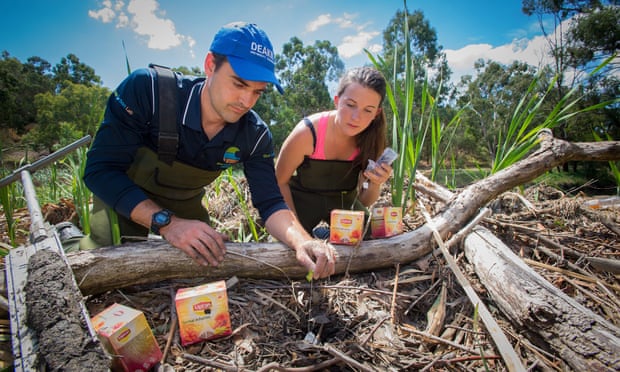
Deakin University researchers bury the first of 50,000 teabags to be placed in wetlands around the globe as part of a project to monitor which wetlands do best at soaking up the carbon that causes global warming.

It’s reassuring to know that people will keep doing whatever they can for the environment no matter what. The increased carbon dioxide that contributes to global warming will not go away by itself. One approach to breaking it down could come from preserving wetlands.

Melissa Davey writes at the Guardian about Australian scientists who are using Lipton green tea bags and red tea “rooibos” bags to study how wetlands capture carbon and make it harmless.

“Australian scientists have launched a project to bury tens of thousands of teabags in wetlands around the world. …

“Lipton green tea and red tea ‘rooibos’ varieties will be used in the project, which already involves more than 500 scientists in every continent except Antarctica.

“Leader of the project, Peter Macreadie from Deakin University’s Blue Carbon Lab, said wetlands were important for carbon capture and storage, a process known as carbon sequestration, holding up to 50 times as much carbon by area as rainforests.

” ‘But some wetlands are much better at carbon storage than others, and some are in fact carbon emitters, so they’re not all fantastic,’ Macreadie said.

“ ‘We need to find out the best wetland environments for carbon sequestration so we know where we should invest our energy.’

“That’s where scientists have come up against barriers in the past. There are hundreds of thousands of wetlands around the world. A standardised technique for monitoring the carbon is needed for accurate comparison, and monitoring devices can cost thousands of dollars to install.

“But Macreadie had been reading scientific research about teabags being buried and used to measure the rate at which carbon was being released from soil into the atmosphere.

“Fast decay of the tea inside the bag meant more carbon was being released into the atmosphere, while slower decay meant the soil was holding the carbon.

“ ‘I thought, “Jeez this is a bloody good idea. Why aren’t we using it in wetlands?” ‘ Macreadie said.

“ ‘People think of innovation as involving fancy new technology, but sometimes the best ideas are the most simple ones.’ ” More here.

I wonder if this property of tea relates to another thing I’ve noticed. Loose tea seems to absorb the aroma of whatever is around it. I’ve often thought that if you wanted to remove, say, a burned smell from upholstery or clothing, tea (not brewed) could do the trick.

Read Full Post »

What is it about Nordic countries that they seem to find more solutions to global challenges than the rest of us? Do they have fewer challenges to worry them, better education, more ability to focus?

Here are some of their successful and replicable tactics for combating global warming.

Christian Bjørnæs writes at Cicero, “By scaling up just 15 proven Nordic solutions, countries all over the world can save 4 [gigatons] of emissions every year by 2030, which is as much as the EU produces today. The costs for this scale-up equal the amount spent in just 9 days on fossil fuel subsidies.

“These results come from the Nordic Green to Scale study which was launched during the UN Climate Conference in Marrakech. …

“ ‘The main concern decision makers have is that it’s either too difficult or too expensive to rapidly reduce emissions,’ says Senior Advisor Oras Tynkkynen, who led the Nordic Green to Scale analysis on behalf of [the Finnish Innovation Fund Sitra].

“ ‘Our objective with this study is to highlight what different countries have already achieved on climate action and what other countries can learn from their successes.’ …

“Urban Danes cycle on an average almost 3 km every day. If other countries followed the example of Denmark and promoted cycling in cities, it would reduce emissions by almost as much as Slovakia produces in a year.

“In Finland, most of industrial and district heating is provided with energy efficient combined heat and power production (CHP). If other countries used CHP like this, it would reduce emissions by almost as much as Japan produces in a year.

“Iceland produces almost 30% of its electricity and most of its heat with geothermal energy. If countries with significant geothermal potential started using it like Iceland does, it would reduce emissions by more than Denmark produces in a year.

“Last year, almost every fourth new car sold in Norway was an electric or plug-in hybrid vehicle. If other wealthy countries used as many electric vehicles as Norway does, it would reduce emissions by almost as much as Denmark produces in a year.

“Sweden has the world’s highest number of heat pumps per population. Scaling up the solution to selected European countries would cut emissions by as much as Cuba produces every year.

“In addition to direct emission reductions, the 15 solutions also create considerable co-benefits. These include improved air and water quality, higher energy security, more local jobs, lower fuel bills, less traffic jams, and sustained biodiversity.”

More here.

Photo: Cicero
Biking can help reduce global warming.

Read Full Post »

As costs come down, solar and wind energy are being embraced in interesting places. Stereotypes about Texas and Big Oil will have to go.

Matthew Rozsa reports at Salon, “The notion that Texas might become a hub for renewable energy innovation isn’t that new. As Forbes noted earlier this month, Texas — which produces 37 percent of America’s crude oil and 28 percent of its natural gas — has more than 10,000 wind turbines, allowing it to produce more power from wind than the combined power produced by 25 other states from all energy sources.

“Similarly, The Wall Street Journal reported [in 2015] that Texas expects more than 10,000 megawatts of solar-generating capacity to be installed across the state by 2029, which is almost the size of all the operational solar farms in the United States today.”

Rozsa quotes Texans who were interviewed by Voice of America in October:

“ ‘A lot of wind companies have evolved to include solar and wind because solar has become so cheap. It is quite competitive with not only wind, but with fossil [fuel] generation,’ said Andy Bowman, chairman of Pioneer Green Energy.

“This point of view was echoed by Jennifer Ronk, a renewable energy expert at the Houston Advanced Research Center. ‘There is a lot of research being done, a lot of development being done,’ she argued. … ‘I think there is a mix of solutions that are going to be the optimal outcome.’ ”

I’m pretty sure that cost factors will ensure the continuation of renewable-energy research — if only at the state level.

Photo: Getty/Spencer Platt
Turbines at a wind farm in Colorado City, Texas, Jan. 21, 2016.

Read Full Post »

Small tree farms are now eligible to sell carbon credits, which can supplement or even replace logging income. But to many owners, getting into the market looks pretty daunting. In a recent article in the New York Times, Erica Goode explains how the obstacles can be overcome.

“Lately, [Eve] Lonnquist, 59 and recently retired, has been thinking about the future of her family’s land. Like many small-forest owners, they draw some income from logging and would like to keep doing so. But they would also like to see the forest, with its stands of Douglas fir, alder and cherry, protected from clear-cutting or being sold off to developers.

“ ‘For us, the property is our family’s history,’ she said.

“More than half of the 751 million acres of forestland in the United States are privately owned, most by people like Ms. Lonnquist, with holdings of 1,000 acres or less. These family forests, environmental groups argue, represent a large, untapped resource for combating the effects of climate change.

“Conserving the trees and profiting from them might seem incompatible. But Ms. Lonnquist is hoping to do both by capitalizing on the forest’s ability to clean the air, turning the carbon stored in the forest into credits that can then be sold to polluters who want or need to offset their carbon footprints.

“ ‘Trees are the No. 1 way in which carbon can be removed from the atmosphere and stored in vegetation over the long term,’ said Brian Kittler, the western regional office director for the Pinchot Institute for Conservation, which has a program in Oregon to help the owners of family forests develop potentially profitable carbon projects. …

“The carbon credits from Ms. Lonnquist’s forest could bring an estimated $235,000 over the first six years, and about $6,000 a year after that, said Kyle Holland, the managing director of Ecological Carbon Offset Partners, a California firm that helps small-forest owners enter the carbon markets. …

“Recent developments in forestry may help make the prospect more appealing by lowering the initial costs to landholders. Mr. Holland’s company, for example, has developed a digital tool — a smartphone equipped with a laser to measure distance and an inclinometer to measure height — that he believes will greatly reduce the expense of conducting a forest inventory, which typically costs $40,000 to $100,000 or more, depending about the amount of land.

“With the specialized smartphone, landholders can take an inventory themselves, photographing and measuring the diameters and heights of their trees. The photos and data are sent to the company’s office in California, where an expert forester goes through the images, identifying the species and checking for damage to the branches or crowns, among other things. Probability models are used to calculate the amount of carbon stored in the forest.”

Hmmm. I wonder if this smartphone app could also be used by towns like Arlington, where John and other volunteers are conducting a tree inventory, not for selling carbon credits but for beautification plans.

More at the New York Timeshere.

Photo: American Forest Foundation

Read Full Post »

Is it possible for a group of people to collaborate effectively enough to make their quaint English village carbon neutral?

Tatiana Schlossberg has an answer at the New York Times: “Ashton Hayes is different in an important way when it comes to one of the world’s most pressing issues: climate change. Hundreds of residents have banded together to cut greenhouse emissions — they use clotheslines instead of dryers, take fewer flights, install solar panels and glaze windows to better insulate their homes.

“The effort, reaching its 10th anniversary this year, has led to a 24 percent cut in emissions, according to surveys by a professor of environmental sustainability who lives here.

“But what makes Ashton Hayes unusual is its approach — the residents have done it themselves, without prodding from government. About 200 towns, cities and counties around the world — including Notteroy, Norway; Upper Saddle River, N.J.; and Changhua County, Taiwan — have reached out to learn how the villagers here did it.

“As climate science has become more accepted, and the effects of a warming planet are becoming increasingly clear, Ashton Hayes is a case study for the next phase of battling climate change: getting people to change their habits.

‘We just think everyone should try to clean up their patch,’ ” said Rosemary Dossett, a resident of the village. ‘And rather than going out and shouting about it, we just do it.’

Oh, ye-es! One and one and 50 make a million.

More here.

Read Full Post »

A friend from my childhood called Caroline has been following this blog, sometimes making comments related to her field, which is architecture.

Today Caroline sent me a link that she knew would be a perfect fit here. The story is about a design competition to address New York City’s rising seawater.

Kayla Devon wrote about it at Builder Online, “In the next 30 years, roughly 30% of Manhattan is expected to sink below sea level, according to a climate study by the NASA Goddard Institute for Space Studies. Instead of trying to stop the inevitable, Brazilian architect Walmir Luz focused on embracing it.

“After studying climate predictions from the United States Landfalling Hurricane Probability Project and the history of Manhattan’s edge, Luz designed a utopian/dystopian future for New York (depending if you’re a glass half-full or half-empty kind of person).

“Luz’s NYC 2050 concept makes flooding a part of city life by taking inspiration from Venice. Luz designed structures as levels that could allow water to move through lower levels as the sea rises. Streets would become permeable so water can wash over the roads instead of flooding them, and more barriers would surround the city’s edges.

“Luz completed the concept as his thesis for his Bachelor of Architecture degree from Cornell University, and won a Silver award in the urban planning and urban design category at the A’Design Award & Competition. He now works as an architect for Gensler.” More at Builder Online.

I love it when people who read the blog come upon topics that they know will fit and then send them along. I like being able to share the cool stuff with a wider audience. Thank you, Caroline.

Design: Walmir Luz
Luz won a design award for a concept making the best of rising sea levels in New York City.

Read Full Post »

« Newer Posts - Older Posts »