Feeds:
Posts
Comments

Posts Tagged ‘good works’

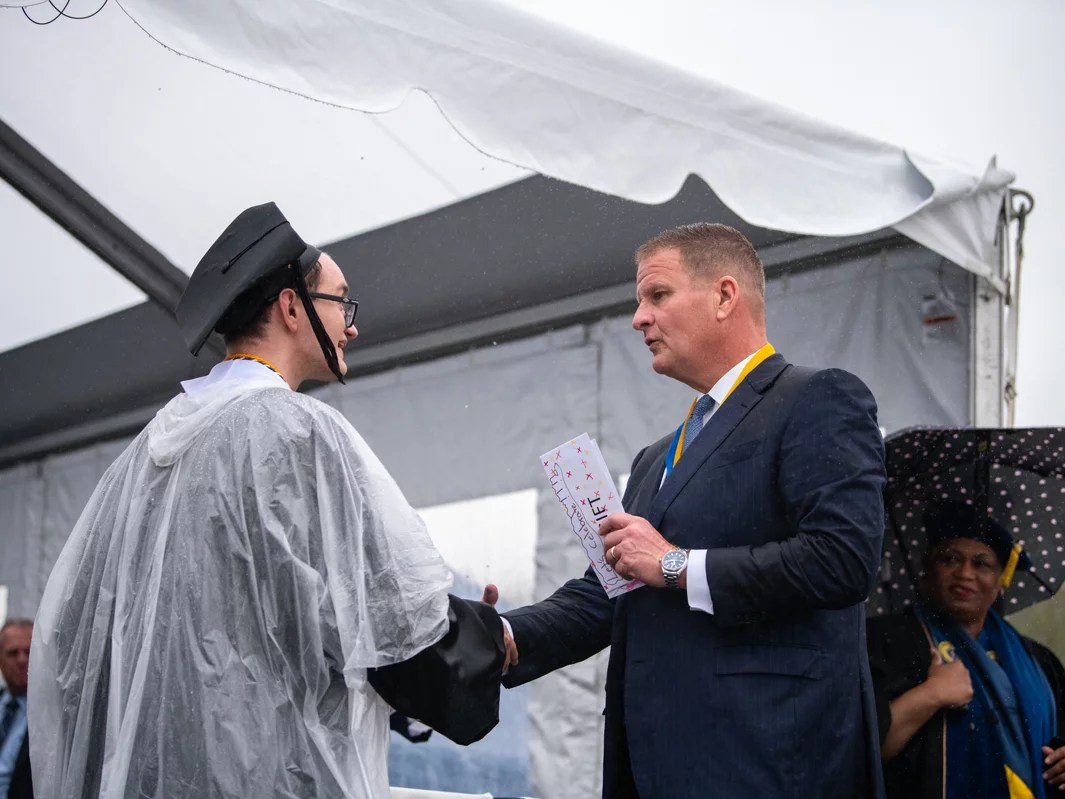
Photo: Karl Christoff Dominey/University of Massachusetts Dartmouth via NPR.
Robert Hale gives an envelope with cash to a graduating UMass Dartmouth student at commencement. Each of the 1,200 graduates received $1,000 onstage, half to keep and half to donate.

Here’s a story from the most recent graduation season: a speaker who gave graduates the inspiration and also the means to start being productive members of society right away.

Jenna Russell reported at the New York Times in May, “Until the final minutes of their commencement ceremony last Thursday, the 1,200 graduates of the University of Massachusetts Dartmouth thought they knew what they would remember most about it: the supremely bad weather during the outdoor ceremony, where they sat drenched and shivering in a torrential rainstorm.

“Then, as they prepared to collect their diplomas, their commencement speaker, Rob Hale, a billionaire philanthropist from Boston, returned to the dripping podium. He brought along two cash-stuffed duffel bags, he announced, and would hand every graduate $1,000 as they crossed the stage — $500 to keep for themselves, and $500 to give to any good cause. …

“Hale, the co-founder and chief executive of Granite Telecommunications … told the graduates at UMass Dartmouth he has never forgotten the experience of losing everything, when the first company he built went bankrupt in the dot-com crash more than 20 years ago.

” ‘Honestly, have you guys ever met someone who lost a billion dollars before?’ Mr. Hale, a part owner of the Boston Celtics, asked in his speech, which he cut short because of the rain.

“Since that disaster, he said in an interview this week, he and his wife have found deep joy and satisfaction in giving their money away. In granting college students a chance to experience the same feeling, he said he hoped to light a spark that they will carry with them — even if he had no guarantee that they will honor his request. …

“ ‘If they get to feel that joy themselves, then maybe it becomes something they want to do again, and make part of their own lives,’ Mr. Hale, 57, said.

‘In America and the world, these are times of turmoil, and the more we help each other, the better off we’ll be.’

“In the week since a businessman they had never met handed them two damp envelopes onstage — one labeled ‘GIFT and the other ‘GIVE’ — the new graduates have packed up dorm rooms, fine-tuned résumés and snapped last campus selfies. They have also pondered where to send what for most will be the largest charitable gift they have ever had the chance to give.

“Tony da Costa, a graphic design major who graduated with high honors, considered giving his $500 to a charitable organization but decided instead to hand it over to an acquaintance of his mother, someone he has never met, who is suffering from an illness and struggling to pay bills. …

“Kamryn Kobel, an English major, gave her $500 to the Y.W.C.A. in Worcester, Mass., where she learned to swim as a child, to support its programs for young women and survivors of violence. Her donation felt like something to be proud of, she said — once it sank in that the envelopes she tucked under her rain poncho contained exactly what Mr. Hale had promised. …

“UMass Dartmouth enrolls about 5,500 undergraduates, more than half of them first-generation college students. Eighty percent come from Massachusetts; 80 percent receive financial aid. It is the fourth Massachusetts college campus in the last four years where Mr. Hale has thrilled graduates with his signature split gift. Each time, he has selected a public school with high concentrations of first-generation and lower-income students who have ‘worked their tails off to get there,’ he said. …

“In an interview … he briefly grew emotional describing how one of the UMass Dartmouth graduates had given her $500 to a local group that provides holiday gifts for children in need — a program that had helped her family when she was a child.

“ ‘Seeing things like that is very cool,’ he said.”

More at the Times, here. There’s a story on this at NPR, too, where there’s no paywall.
Read Full Post »

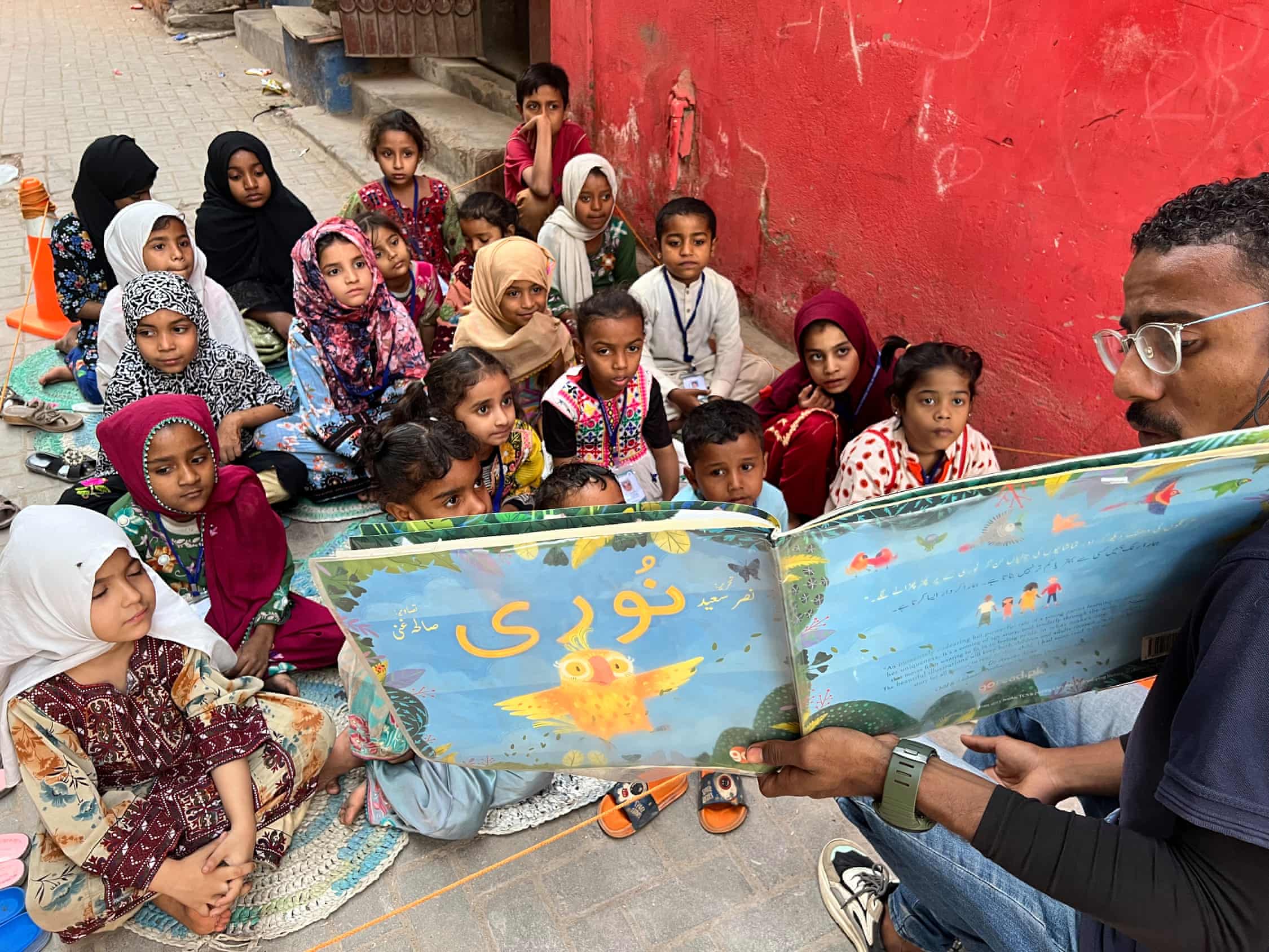
Photo: Zofeen T Ebrahim/The Guardian.
A GoRead worker helps to educate children in Pakistani slums through storytelling. The GoRead director says, “We cannot expect children to want to read if we don’t read to them first.”

If it’s true that Sauron is always collecting his strength to rise again, it’s also true that people who do good never stop doing good. Whatever happens, you can’t completely stamp out kindness or good works. They gather strength, too.

I hate hearing decent people’s defeatism. I like focusing on stories like today’s, stories of people trying to make the world a little better wherever they are.

Zofeen T Ebrahim writes at the Guardian, “Pedaling down a narrow alleyway in Karachi’s crowded Lyari Town, Saira Bano slows as she passes a group of children sitting on the ground, listening to a man reading aloud from a book. The eight-year-old gets off her bike, slips off her sandals, and sits on the mat at the back.

“She has already heard the story from Mohammad Noman, who is entertaining more than a dozen children with the tale of Noori, an insecure yellow parrot. ‘I don’t mind listening to it again,’ says Saira. ‘He’s so funny.’

“Noman, 23, is spending two weeks in Lyari pedaling an old ice-cream cart through its lanes, stopping to read his stories and leaving behind books for the children to borrow. He dropped out of school himself as a teenager but has returned to education and is now studying for his high school certificate.

“He is also one of two storytellers working part-time for the Kahaani Sawaari (Stories on Wheels) program, run by GoRead.pk, which is working to improve literacy among underprivileged communities in Karachi, Pakistan’s largest city.

“ ‘I become a kid when I am around the children,’ says Noman. In the past 18 months, he has visited 30 areas of Lyari, one of the most densely populated and deprived neighborhoods of Karachi, with more than 660,000 residents, mostly from the marginalised Baloch ethnic group.

“ ‘I have learned so much,’ says Noman. ‘It has brought a change in me as well. I’ve become more tolerant of people and developed patience. I think I have a certain rapport with children and they listen.’ …

“Education is free and compulsory in Pakistan yet, according to the UN, it has the world’s second-highest rate of children absent from school, at 44% of five to 16-year-olds. And 77% of 10-year-olds are unable to understand simple text, according to the World Bank. Books and uniforms can be prohibitively expensive in Pakistan. Saira dropped out of school a year ago when her father, who worked in a toy shop, lost his job as Pakistan’s economy was hit by rocketing food and fuel prices. …

“Erum Kazi, GoRead’s program director, says parents have told her how their children have developed a love for reading since the scheme began. …

“Nusser Sayeed, GoRead’s director [and] a former teacher, was inspired to set up the program after seeing ‘very little joy in the lives of children studying in schools in underprivileged neighborhoods.’ Children were growing up without anyone reading them stories, she says, adding: ‘We cannot expect children to read if we don’t read to them first.’ “

More at the Guardian, here. And in a related Guardian story, read about how a camel delivered books to poor children in Pakistan when Covid closed schools, here.

Read Full Post »

Photos: Demetrius Freeman for The New York Times
Annette Phuvan (left, with Janet Victors) said that
Amahl and the Night Visitors spoke to her of “miracles. Blessings. Generosity. Community.” She and others who have struggled with homelessness are performing the touching opera about poverty and hope.

In today’s story, two organizations that do good works all year-round have chosen an especially appropriate way to enhance the “comfort and joy” they deliver to others.

Tim Teeman writes at the Daily Beast, “The rich, collective sound of a choir warming their voices up filled the 15th-floor rehearsal room, Broadway and Times Square, a rainy, fogged-up blur outside the windows. Standing in a circle, and accompanied by a pianist, the group of tenors, basses, altos and sopranos practiced their scales, and then, as if in an urgent incantation, spoke the words of the score they would next sing.

“ ‘Free the body,’ instructed Michael A. Ciavaglia, the chorus master, eliciting much loose-limbed waving of arms, as the choir and soloists continued their preparations for On Site Opera’s production of Gian Carlo Menotti’s 45-minute Christmas Nativity opera Amahl and the Night Visitors, written for television and first performed on NBC in 1951.

“The show will be presented in the Holy Apostles Soup Kitchen in Chelsea, and will feature professional musicians and vocalists alongside a chorus made up of people who have experienced homelessness and who now live at the 43rd Street site of Breaking Ground, New York City’s largest provider of permanent supportive housing for the homeless. …

” ‘The object is to find that perfect intersection of piece and place that speaks to us as producing artists and what we want to do in the greater arc of the company and then find the right place to do it in,’ said Eric Einhorn, the general and artistic director of On Site Opera. …

“They all sang in rousing unison: ‘How cold is the night, how icy is the wind.’ As formerly homeless people, they would know the meaning of those words more powerfully, and literally, than many.

“One of the choir, soprano Christine Flood, told The Daily Beast she had been a resident at Breaking Ground since New Year’s Eve 2016. She said she suffered from PTSD, resulting from ‘terrifying and violent’ childhood abuse while growing up in southern Ohio. She had been homeless in her late teenage years, and then suffered from drug and alcohol addiction. She has been sober for 12 years. …

“The opera was an excellent way to bring members of Breaking Ground together, she said, and had inspired Flood to suggest to those that run the community that she begin classes in teaching English to non-English speaking residents. ‘Language is both a big barrier, and a big invitation,’ the former teacher and dancer said.

“ ‘I’m much better than I was a year ago,’ Flood said of her general health. ‘Two years ago I couldn’t have done this opera. Last year at this time I wouldn’t have had the confidence to do it even, or this interview.’ Next, Flood wants to finish her master’s degree, and use her passion for theater and acting to ‘build positive change in my city and community.’ ”

More at the Daily Beast, here. At the New York Times, here, you can find some nice pictures of singers rehearsing for the production.

Menotti’s Amahl and the Night Visitors is my all-time favorite — guaranteed to get me in the Christmas spirit.

From left: Kristine Flood, Wanda Ferrerias, Maya Lehmann, and Annette Phuvan join On Site Opera’s production of Amahl, thanks to Breaking Ground, a homeless-support organization in New York.

Read Full Post »

dsc_3650_slide-adf3c56246374ea7e29af95dbfad1830205ced52-s600-c85

Photo: Furkan Latif Khan/NPR
Jadav Payeng, “The Forest Man of India,” has planted tens of thousands of trees over the course of nearly 40 years. He has made bloom a once desiccated island that lies in the Brahamputra river, which runs through his home state of Assam.

When we are pummeled by the evil around us, as we have been this past week, it’s hard to hold on to the credo that small acts of good move mountains. But they do. There are way more people practicing random acts of kindness every day than there are shooters, and when good people stand up, they make a difference.

Consider the “Forest Man of India,” a humble farmer from a marginalized community who made the desert blossom like a rose, and the Vancouver immigrant whose can collection has been contributing thousands of dollars to fighting cancer.

Leyland Cecco writes at the Guardian about the Canadian immigrant who gets a big kick out of raising money to fight cancer — one disposable can at a time.

“Nearly every weekday over the past two decades, a Canadian woman has dropped by the offices of a cancer foundation in Vancouver to make a donation. The money, earned by collecting cans and bottles, rarely comes to more than $10 a time.

“But staff at the BC Cancer Foundation recently calculated that Gia Tran’s 21 years of donations have totaled more than $15,000 – a testament to what they say is the ‘kindness of her heart.’ …

“Each day, Tran, 62, walks the streets of downtown Vancouver, hunting for discarded cans and bottles.

“Summer is a more bountiful time for her, when most of the city is out in the sun, enjoying the parks. But she persists with the task even in the damp, chilly winters of Canada’s west coast.

“ ‘My kids say: ‘”Mom, I don’t want you to go outside. It’s too cold,” ‘ Tran told the CBC. ‘I say: ‘”No, I go. I want to help people. I want to go to the hospital – cancer. I help people.” ‘ …

“Sarah Roth at the BC Cancer Foundation told the CBC: ‘No matter what kind of day you’re having, when Gia comes in, you forget about it and you just focus on her warmth and her laughter and her true benevolence.’ ” More.

And here is Julie McCarthy of National Public Radio on the Forest Man of India.

“Jadav Payeng has single-handedly changed the landscape in his state of Assam. Payeng, 58, is reclaiming an island in the mighty Brahmaputra river where increased flooding has changed the flow and built up sandbars along the long stretch of the river that runs through the middle of Assam. …

“When Payeng was a boy, the son of poor a buffalo trader, this strip of land in the middle of the river was attached to the mainland. Erosion from powerful river waters of the Brahmaputra severed it. He bends down to pick up a handful of earth to explain how the island’s landscape has changed.

” ‘Earlier, this was all sand. No trees, no grass — nothing was here. Only driftwood. Now, seeds of grass carried downriver from China wash up, and pollinate, on their own.’

“Today fields of swaying grasses stretch into the distance. Along with emerald pastures dotted with cows, cotton trees stand straight in rows as far as the eye can see — ‘excellent plywood,’ Payeng says. …

” ‘First with bamboo trees, then with cotton trees. I kept planting — all different kinds of trees,’ Payeng says.

‘It’s not as if I did it alone,’ says the self-styled naturalist.

‘You plant one or two trees, and they have to seed. And once they seed,’ he adds reverentially, ‘the wind knows how to plant them, the birds here know how to sow them, cows know, elephants know, even the Brahmaputra river knows.’ “

Photo: LifeDaily
Gia Tran has donated $15,000 to the BC Cancer Foundation over 21 years in $10 increments from recycled cans. She takes them to the return depot on foot. “On the bus, I only get one bag, not two bags. I walk, I don’t care.” 

09-gia-tran-story-620x415

Read Full Post »

otherwiseman4

Art: Robert T. Barrett
The “other” wise man, meeting the needs that cross his path, is too late to present gifts to the baby in the manger. But “Inasmuch as thou hast done it unto one of the least of these my brethren, thou hast done it unto me.” (Matthew 25:40)

I loved this story as a child. Just for you, I present a summary from Wikipedia, slightly edited.

“The Story of the Other Wise Man,” by Henry van Dyke, was initially published in 1895. The story is an expansion of the account of the Biblical Magi. It tells about a “fourth” wise man, a priest of the Magi named Artaban, one of the Medes from Persia. Like the other Magi, he sees signs in the heavens proclaiming that a King had been born among the Jews. Like them, he sets out to see the newborn ruler, carrying treasures to give as gifts to the child — a sapphire, a ruby, and a “pearl of great price.”

However, he stops along the way to help a dying man, which makes him late to meet with the caravan of the other three wise men. Because he missed the caravan, and he can’t cross the desert with only a horse, he is forced to sell one of his treasures in order to buy the camels and supplies necessary for the trip. He then commences his journey but arrives in Bethlehem too late to see the child, whose parents have fled to Egypt. He saves the life of a child at the price of another of his treasures.

He then travels to Egypt and to many other countries, searching for Jesus for many years and performing acts of charity along the way. After 33 years, Artaban arrives in Jerusalem just as Jesus as been condemned to death. He spends his last treasure, the pearl, to ransom a young woman from being sold into slavery. He is then badly injured in an accident and realizes he is dying. He has failed to meet Jesus because he has been busy meeting the needs that appear before him.

Then he hears a voice: “Verily I say unto thee, Inasmuch as thou hast done it unto one of the least of these my brethren, thou hast done it unto me.”(Matthew 25:40) His treasures have been accepted.

Read Full Post »

The Christian Science Monitor recently ran a story by Bryan Kay about an ongoing  community service project.

“Not even the recent furlough of federal workers was enough to snuff out the latest community outreach effort of Masjid al Islam mosque in Dallas.

“On a weekend in early October, the mosque was participating in a national initiative known as the Day of Dignity, an annual event during which mosques feed, clothe, and equip people living in poverty. But federal workers who had been scheduled to attend to speak about the details of the Affordable Care Act …  had been forced to cancel because of a partial federal government shutdown.

“It was a blow to the mosque’s boosters, says Muhammad Abdul-Jami, treasurer of Masjid al Islam and coordinator of the Day of Dignity event. But it didn’t deter them from pursuing the same purpose they have had for the last several years, he says: aiding homeless people … .

“Masjid al Islam is in an area where the homeless are a ubiquitous sight. … Because of the great need every weekend, the mosque seeks to do what the Day of Dignity event, organized in conjunction with the national charity Islamic Relief USA, does on an annual basis. Through its Beacon of Light community center, Masjid al Islam feeds approximately 300 individuals in need on Saturdays and Sundays each week, Mr. Abdul-Jami estimates. That’s more than 15,000 meals per year, paid for with donations from individuals and other mosques and served by volunteers, he says. …

” ‘There are millions of Muslims in this country who are very regular people, people who [other] Americans might consider much like them,’ Abdul-Jami says. …  ‘These events help us showcase that we are concerned about the rest of humanity, not just wanting to help Muslims.’ ”

Read more here.

Photo: Walid Ajaj

Read Full Post »

If you had to guess one church in San Francisco that would be all over the idea of rooftop gardening to feed whoever needs feeding, which one would it be?

Right. Glide. I like its garden’s name: Graze the Rooftop.

“Graze the Roof is an edible, community-produced vegetable garden on the rooftop of Glide Memorial Church, a progressive church and nonprofit located in the Tenderloin district of San Francisco.

“Graze the Roof features lightweight (upcycled) raised garden beds made from milk crates; a worm composting system and an educational mural which ties the whole project together. Glide youth and volunteers from throughout the Bay Area maintain the garden and host monthly tours and workshops.”

Do you live in the San Francisco area? Looks like there are a lot of fun workshops available, such as Designing Sustainable Habitats, Introduction to Permaculture, and Urban Fruit Tree Stewardship. Read more here.

Photo: Graze the Roof

Read Full Post »

The 2012 Curry Stone Design Prize winners have been announced. The awards, given to “social design pioneers,” will be presented at the Harvard Graduate School of Design on November 15.

How cool are these winners?

According to the Curry Stone website, New York City’s “Center for Urban Pedagogy (CUP) collaborates with teachers and students, policy experts and community advocates, and artists and designers to visually communicate complex urban-planning processes and policy-making decisions.”

Liter of Light, Manila, Philippines, uses water in bottles to create solar lamps for people living in dark tenements.

“Model of Architecture Serving Society — aka MASS Design — is a Boston-based architecture firm that has created a niche practice in designing healthcare facilities in resource-limited settings, primarily in countries emerging from crisis.”

The Riwaq Center for Architectural Conservation in Ramallah “has spent more than two decades documenting Palestinian heritage and culture through restoration of the built environment.”

“Jeanne van Heeswijk is an artist who facilitates the creation of lively and diversified public spaces, typically from abandoned or derelict sites.”

More here. Be sure to check the pictures here.

Photograph: Jeminah Ferrer
The Liter of Light project uses water  in bottles to create solar lamps for the poor.

Read Full Post »

David Karas writes at the Christian Science Monitor, “When Danielle Gletow adopted her daughter Mia, she began to learn about the American foster care system – and the challenges faced by more than 100,000 children and young adults who are part of it.

“Determined to do something to help them, Ms. Gletow made it her mission not only to educate others about the challenges these children and teens face, but also to give people an easy way to lend a helping hand.

“That’s how One Simple Wish was born.

“Founded in 2008 out of Gletow’s home office, One Simple Wish is a nonprofit organization that connects foster children and vulnerable families with potential donors who grant their wishes online or at the organization’s Ewing, N.J.-based ‘Wish Shop.’

“The wishes, which typically cost from $5 to $100 to grant, encompass everything from a desire for a musical instrument to a movie ticket, new clothes, or horseback riding lessons. …

“To date, Gletow has seen more than 2,800 wishes granted by her organization. And while each is special, Gletow enjoys remembering some of the first wishes that she herself helped to grant. …

“When Sarah, a girl who had grown up in foster care, was graduating from basic training in the US Army, Gletow was able to help arrange for her caseworker to fly to South Carolina. … Sarah was the only student who didn’t have family coming to the graduation, Gletow says. ‘She had no way to pay for [her caseworker] to come.’ ”

Read more.

Suzanne’s friend Liz has been something like a Big Sister and Legal
Guardian for many years to a girl in foster care who is now a young woman. Liz says that the transition out of foster care is an especially vulnerable period, as young people are thrilled to be “free” but still need the kinds of support that young adults with families have.

Photograph: Ann Hermes/The Christian Science Monitor
Danielle Gletow, founder of One Simple Wish, stands next to a wall of thank-you notes.

Read Full Post »

“Indiana University’s trustees voted [in June] to create a school of philanthropy, the first in the nation and a sign of both the growing amount of scholarship on the nonprofit world and intense demand to offer rigorous training to people who work at charitable institutions.”

So writes Maureen West in the Chronicle of Philanthropy.

“Leslie Lenkowsky, a professor of public affairs and philanthropic studies at Indiana University, said the decision to start a school was a profound development for nonprofits.

“ ‘It’s a coming of age for the study and teaching of philanthropy — just as we have schools for government and business, this will be the first school for the nonprofit sector.’ …

“Indiana has long been building a serious academic program in philanthropy. It created the first philanthropy doctoral program, and last month it graduated the first students in the United States to earn bachelor’s degrees in philanthropy.”

Time will tell how much innovation the program inspires. As William Schambra, director of the Bradley Center of Philanthropy and Civic Renewal for the Hudson Institute, says, it needs to be more than a “technical training school for nonprofit managers or fundraisers.”

Read more. I think they are making a great start.

Photograph: Nguyen Huy Kham/Reuters/File
S
tudents in Hanoi were glad to perform for philanthropist (and New York City Mayor) Michael Bloomberg during an event marking the donation of motorcycle helmets.

Read Full Post »

I liked NY Times columnist Jim Dwyer’s recent article “A Billionaire Philanthropist Struggles to Go Broke.”

“Charles F. Feeney, 81, a man with no romantic attachment to wealth or its trappings, said the world had enough urgent problems that required attention now, before they became even more expensive to solve.

“ ‘When you’ve got the money, you spend it,’ Mr. Feeney said. ‘When you’ve spent it all, let someone else get going and spend theirs.’ …

“Last fall, Mr. Feeney gave his alma mater, Cornell University, $350 million to seal its bid to build a new campus for advanced engineering that New York City has commissioned for Roosevelt Island. …

With “grand philanthropy often comes public glory for wealthy donors, as buildings and institutes are dedicated to benefactors, their names embedded above doorways like graffiti tags chiseled in marble. No building anywhere bears Mr. Feeney’s name. Among tycoons, he has been a countercultural figure of rare force, clinging to his privacy far more fiercely than to his money.

“He set up the philanthropies in Bermuda, in large part because that would allow him to escape United States disclosure requirements. That also meant he could not take tax deductions when he contributed his holdings.”

More recently, he decided to tell his story in order to encourage other people of means to share the wealth.

“Mr. Feeney, who grew up in a working-class family in Elizabeth, N.J., served as a radio operator in the United States Air Force and attended Cornell on the G.I. Bill. He sold liquor to sailors in ports, then formed a company that ran airport duty-free shops around the world. He secretly turned over the duty-free business to the philanthropies in 1984 and continued to invest. …

“He has given away essentially everything he has made, apart from decent, though not extravagant, provisions for his four daughters and one son. They all worked through college as waiters, maids and cashiers.

“ ‘I want the last check I write to bounce,’ Mr. Feeney said.”

Read the article.

“Charles F. Feeney, 81, has already given away $6 billion through his foundations.” Photograph: Brad Vest, NY Times

Read Full Post »

Pamela Boykoff at CNN has a nice story about a ballet school in the Philippines and the hope it offers children from very poor families.

“Jessa Balote is 14-years-old and training to be a professional ballerina in Manila,” writes Boykoff.

“It is a task that takes enormous amounts of dedication for even the most determined of young women, but Balote’s challenge is nothing compared to life outside the dance studio where she has to support her entire family.

” ‘I’m the only one they expect to bring the family out of poverty,’ she says.

“Balote is one of 54 students enrolled in ‘Project Ballet Futures,’ a program run by Ballet Manila to provide free ballet training to children from some of the city’s most deprived neighborhoods.

“Balote lives in Tondo, a slum built next to a major waste dump in Manila. Her parents make what little money they have by selling trash. If Balote was not involved in the dance program, she says she wouldn’t be able to eat everyday.

” ‘They want to earn money to be able to survive,’ says Lisa Macuja-Elizalde, founder of the program and the Philippines’ first prima ballerina. She believes in her students, personally paying for their lessons and uniforms.

“Macuja-Elizalde’s goal is to help these children become professional members of the company with incomes to match. They are among her most focused students, she says, not afraid to work hard and to push themselves and their bodies.”

Read more.

Photograph: CNN

Read Full Post »

The Christian Science Monitor has a regular feature on people doing good works.

Here Jennifer C. Kerr writes that some baby boomers are solving the problems facing their communities by becoming volunteers. But, she says, more are needed.

“Local charities and nonprofits are looking for a few good baby boomers – well, lots of them, actually – to roll up their sleeves to help local schools, soup kitchens, and others in need.

“Boomers are attractive volunteers, and it’s not just the sheer strength of their numbers – 77 million. They are living longer. They are more educated than previous generations. And, especially appealing: They bring well-honed skills and years of real-world work and life experience.

” ‘This generation, this cohort of Americans, is the healthiest, best-educated generation of Americans across this traditional age of retirement,’ says Dr. Erwin Tan, who heads the Senior Corps program at the Corporation for National and Community Service (CNCS), a federal agency in Washington. ‘The question for us is how can we as a country not afford to mobilize this huge source of human capital to meet the vital needs of our communities.’ ” Lots more to read.

Photographer: Erik

Read Full Post »