Feeds:
Posts
Comments

Posts Tagged ‘green’

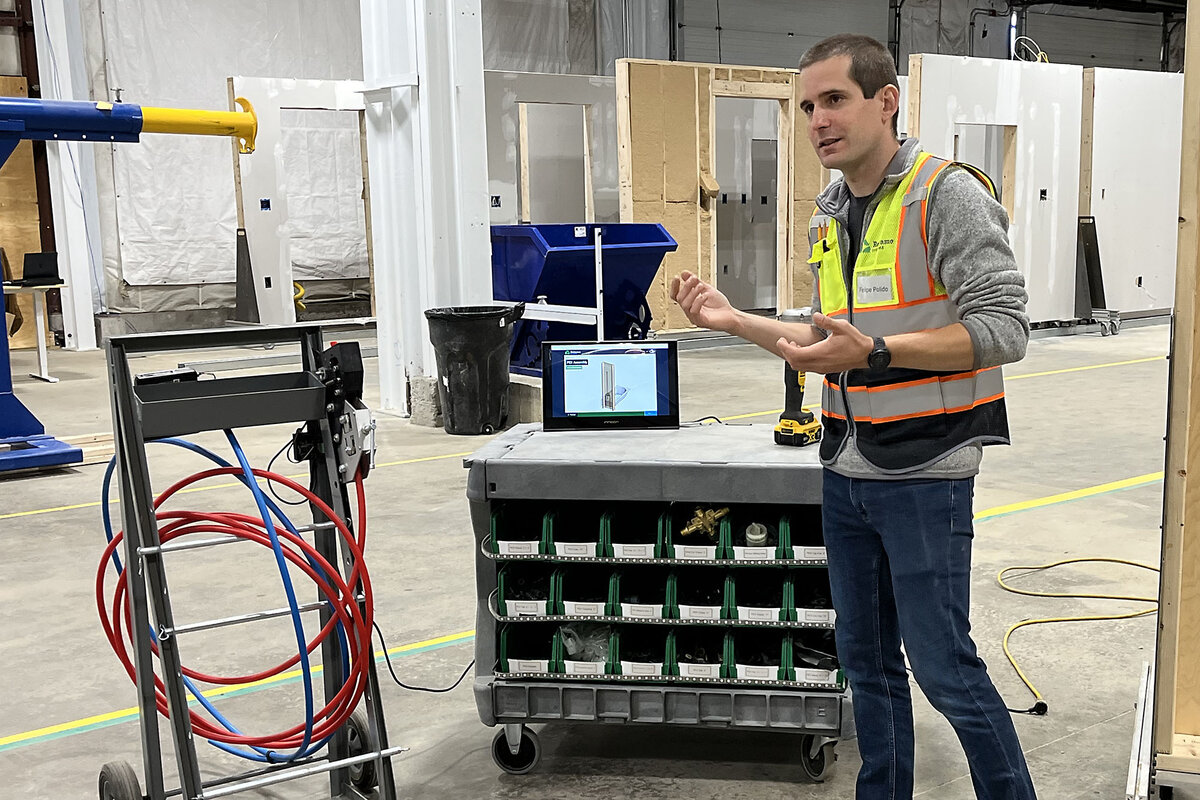
Photo: Jacob Posner/Christian Science Monitor.
Felipe Polido, co-founder and head of technology at Reframe Systems, explains how the company uses robots and simplified processes in construction.

Innovations of the kind we continue to need in areas such as medicine, housing, and carbon reduction will probably rely more on entrepreneurs and businesses than on government for years to come.

I won’t be the one to begrudge any visionary a reasonable profit. In fact, the only thing that worries me about today’s story is the reduced need for human workers. See what you think.

Jacob Posner writes at the Christian Science Monitor about one company aiming to do so by benefiting others.

“A growing number of startups are trying to reinvent the U.S. homebuilding industry, with big goals of making it both more efficient and more climate-friendly. It is a disruption that many say is past due. The construction industry is not only struggling to meet housing needs but also is one of the country’s largest emitters of greenhouse gases. …

“Massachusetts-based Reframe Systems is among the new companies hoping to change one of the nation’s largest industries. Reframe is developing a ‘next generation’ modular construction method to build high-efficiency housing. Employees follow instructions on iPads to install plumbing and electrical components into robot-made walls, then transport these modules to construction sites, where they are stacked into multifloor units.

“But the challenges are myriad. Despite a huge influx of investor funding, the share of housing stock built through high-tech modular construction remains small. …

“[Recently a crowd] gathered to see a robot build a house. In a concrete-and-steel factory in Andover, Massachusetts, yellow-vested consultants, sustainable builders, and possible investors strain to see past a clear fence. Behind the barrier, a giant blue arm jutting from the floor comes to life.

“Its sensor-covered hand analyzes a pile of wood before emitting a loud hiss, then carefully suctions a two-by-four. Rotating at the shoulder and extending its elbow, the robot methodically delivers the plank to a partially completed wall.

“On the other side of the factory – about the size of a hangar for small planes – a few human workers are on their lunch break. They are employees of a three-year-old company called Reframe Systems, which is one of a growing number of startups across the United States scrambling to reinvent the homebuilding industry. …

“More than 100 startups have entered the industry in the past two decades, according to estimates by Tyler Pullen, a senior technical adviser at the Terner Center for Housing Innovation at the University of California Berkeley. He says there are likely more than 200 construction innovation companies currently doing business in the U.S.

“Like many of these, Reframe is focused on a new form of modular construction to upend one of the county’s largest industries. The company aims to create affordable, net-zero houses, which generate the same or more energy than they consume. Reframe CEO Vikas Enti says he can deliver a hefty return to investors – all while making a significant dent in the housing and climate crises. The next step, he says, is to build a factory that can produce 500 apartment units per year using lessons learned from his small, pilot factory in Andover. Then, he hopes to build a network of facilities across the country, varying their sizes to meet the demands and needs of their region. …

“So far, Reframe has completed one two-bedroom house. …

“The current model for modular construction – using assembly-line technologies to build homes – has its origin in the period after World War II. … But federal support for the movement dwindled, and in recent years, modular construction companies have mostly focused on the luxury housing market and sustainability-focused buyers. …

“The need for companies like Reframe is clear, modular boosters say.

“Energy consumed by residential buildings is responsible for around 15% of all U.S. emissions. Fossil fuels warm most of the country’s roughly 145 million apartment units and houses, in addition to keeping their stoves running and heating water. …

“Reframe was founded by roboticists who used to work at Amazon. Following instructions on iPads, its human employees insert plumbing and electrical wiring into the robot-made walls, turn them into ‘modules,’ and bring them to construction sites, where they are stacked into multifloor, highly energy-efficient homes. Because the iPad instructions are akin to a Lego or Ikea manual, Reframe can employ fewer high-cost, high-skill laborers.

“Having most of the needed professionals – electricians, plumbers, architects, engineers – under the same roof solves a problem of communication Mr. Pullen sees as endemic to the traditional construction industry. Every different professional involved must work together, but they are all ‘masters of their own kingdom,’ he says.

“While not all companies offer net-zero buildings like Reframe, Mr. Pullen says building in a factory setting lends itself to tighter structures that hold their temperature better. Plus, factory construction results in less waste. Companies know what they need to order for hundreds of projects at once; in traditional building, ad hoc orders require far more trucks and often leave behind excess material like piping and drywall.”

More at the Monitor, here. No paywall.

Read Full Post »

Photo: EcoForge.
Startup EcoForge’s lead scientist, Jiale Han, working on making sustainable building products.

Sometimes the Boston Globe features interviews with founders of startup companies. This company is in Rhode Island, and it makes alternative building products for a greener future.

Alexa Gagosz has the story.

“Brown University graduates Rongyu Na and Myung Bender are the founders of EcoForge, a startup that is developing local and sustainable building materials from agricultural residues and plants.

Alexa Gagosz: How does EcoForge work?
“Rongyu Na: We start by providing our solutions, such as material binding agents and fire-resistant agents, to materials like hemp — a bio-based material that’s carbon-negative — to interested companies and manufacturers.

“Unlike traditional materials that harm both people and the planet, our materials significantly improve sustainability and ensure material health. EcoForge’s bio-based building products help construction projects secure permits, reduce carbon emissions by up to 40 percent, and save on future energy costs, estimated at more than 15 percent on heating and cooling.

“AG: How does EcoForge fit into both of your experiences?
“RN: With my extensive experience in industrial design at NASA and at Subaru, Nissan, and Amazon, I’ve worked on future clean mobility concepts and innovative products like the Kindle, and led global initiatives focused on sustainable materials. My passion for sustainability is complemented by a strong background in innovation and design excellence.

“My cofounder, Myung Bender, is a seasoned entrepreneur. Her startup was acquired by Apple, and as the former head of product at Bumble, she brings strong business acumen and operational expertise. We’ve both developed numerous products, and we are now focusing on products that significantly impact our health and the planet.

“AG: What kinds of ‘agricultural residues’ are you using? And what kinds of building materials can they be transformed into?
“RN: Our technology is highly compatible with various plants, allowing us to form building products by leveraging their natural material structures.

Agricultural residues like hemp/cannabis waste, sunflower husks, sugarcane waste, corncobs, and invasive plants like Arundo donax [giant reed] are of particular interest to us.

“We’re currently focusing on creating solutions such as zero-VOC [no volatile organic compounds], 95 percent bio-based binders, and highly compatible sustainable fire-resistant technology that work with hemp and cannabis waste. We’re looking to collaborate with interested companies and manufacturers to transform these faster-growing plants and agricultural residues into various building products.

“AG: Who are your customers?
“RN: Our primary customers are large manufacturers seeking innovation and reduced carbon footprints through selling or licensing our ecologically safe material solutions. Secondary customers include corporate owners and real estate firms who renovate frequently to meet ESG [Environmental, Social, and Governance] goals.

“AG: Who or what is your greatest competition? How do you plan on breaking into the market?
“RN: Our greatest competition comes from traditional material solution suppliers using petroleum-based materials that employ green-washing strategies and lack transparency. These companies are also energy-intensive and cause harm to both the planet and human health. They still have a strong influence in the market, with established market presence, customer bases, and industry equipment tuned for their specifications, making it challenging for new entrants.

“To break into the market, we plan to leverage our unique value propositions. … Our hemp recipes tackle cost, supply, fire safety, performance, recyclability, or degradability issues. Our adaptable products are compatible with existing manufacturing lines and can be used for various building products like ceiling tiles, drywall, insulation panels, and flooring. …

“AG: What challenges are you facing currently, and how do you plan to overcome them?
“RN: One of the biggest challenges has been overcoming the industry’s struggle with greenwashing and false claims. Many companies claim to be sustainable but fall short in practice. This makes it difficult for genuinely sustainable products to stand out and gain trust. … We’re committed to maintaining maximum transparency and conducting rigorous testing to ensure our materials are genuinely sustainable and healthy.”

Read about the cost of their products and their funding sources at the Globe, here.

Read Full Post »

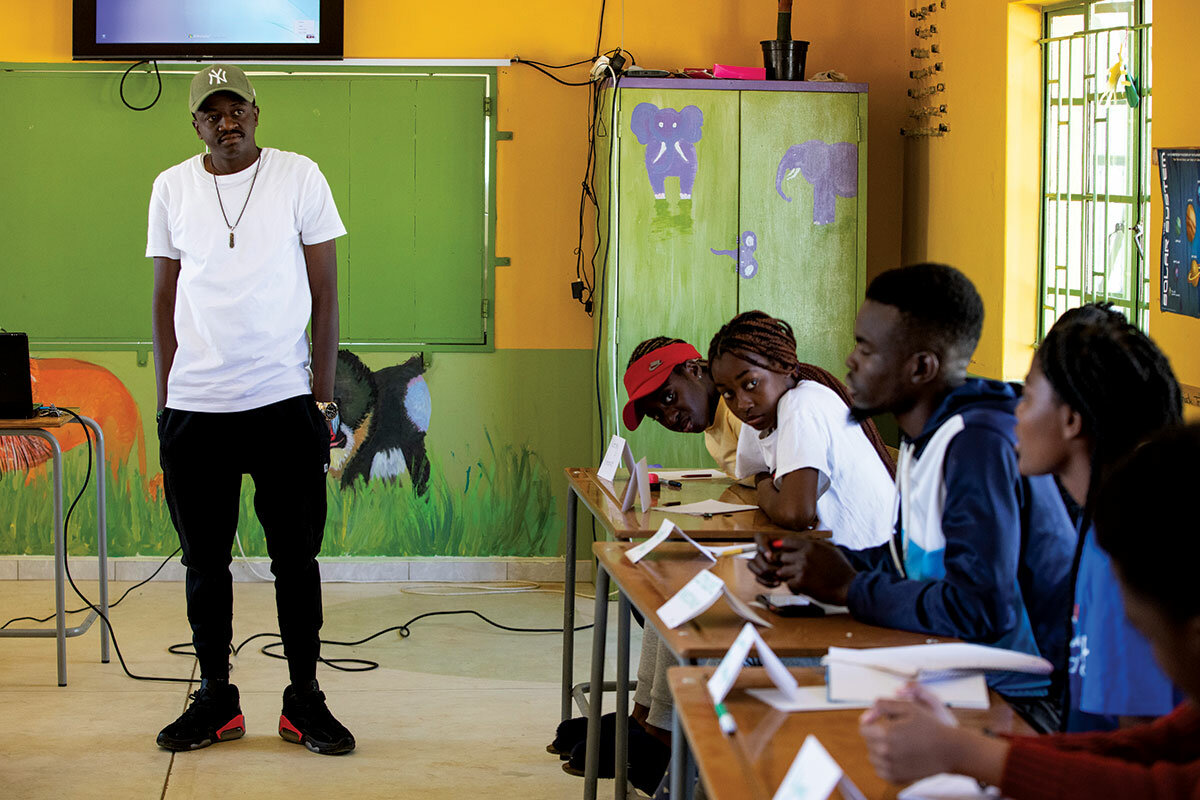
Photo: Melanie Stetson Freeman/CSM Staff.
The Christian Science Monitor says, “Deon Shekuza is a peripatetic presence at climate summits as well as at the grassroots – like the class on green hydrogen he taught to young teens in an informal settlement in Windhoek, Namibia, last July.”

Climate activism is no longer mainly the purview of the industrialized Northern Hemisphere or those with enough income and time to worry about it. Now people on the front lines are leading the way. For them it’s a matter of survival.

Sara Miller Llana writes at the Christian Science Monitor about Deon Shekuza, a climate influencer in Namibia, who is “as comfortable proselytizing green energy to youth on the hardscrabble roads and villages of this former German colony as he is in Namibia’s government ministries and the halls of United Nations conferences.

“Paid with respect if not a salary, he’s part of a rising breed of young climate activists across the Global South whose work, suggests one climate expert, may well determine the temperature of your world.

“Africa, which has contributed least to climate warming, is the continent most threatened by the droughts, floods, and heat intensified by climate change. In that extremity, the relentlessly positive Mr. Shekuza sees great opportunity for progress for Namibia.

“In the dusty chaos of an informal settlement on the edge of this capital city one recent morning, he faces his biggest challenge: capturing the imaginations of young teens on a complex topic. The kids have gathered in a bright community center classroom, not for school credit and certainly not for fun on their Saturday off, but to hear Mr. Shekuza teach green hydrogen 101. Namibia has staked its future on this next big solution for a global clean energy transition. …

(The process, simply put, would use solar or wind power to extract hydrogen molecules from desalinated seawater, producing green ammonium that would be used for regional and global fuel markets to power transportation and electricity production.)

“No one here knows what green hydrogen is, let alone how it might be the route to social justice that Namibia’s leaders proclaim.  Grasping for something understandable, Mr. Shekuza gestures out the window at the ancient and humble street scene of women laden with bushels of branches gathered from the forest for heating and cooking fuel. ‘This is exactly what we do not want for our people, right? Some energy sources keep you in the past, and some energy sources move you into the future. This is why we are here talking about green hydrogen.’

“After 90 minutes, Mr. Shekuza is satisfied. These kids might not exactly understand Namibia’s renewable energy policy, but they understand green hydrogen potential: jobs for them in a new economy that could turn Africa’s perpetual sunlight into clean fuel for electricity and transportation here and for export. …

“For activists across Namibia – like the Inuit in the Arctic, or youth from small island nations – caring and conserving is the easy part. These youth grew up living sustainable lives well before it was trendy. Many were born on the land, in the bush, on the coast, with no playgrounds except the natural environment around them. They conserved not for environmentalism, but for survival. …

“Mr. Shekuza and young African activists like him across the continent who are part of the Climate Generation, as we’re calling it, see a chance – the kind Mr. Shekuza tells the children in the informal settlement to seize, the kind he has seized for himself. …

“Mr. Shekuza can barely afford to do the work he has cut out for himself. For all his social confidence, he hesitates at the doorstep of his home before inviting visitors in for the first time ever. Descending from sunny daylight down a step at the side of a large old house, he enters the tiny basement space he shares with his mother.

“With a revealing flourish of humility, he pulls the worn blue curtain separating his mother’s bed from his floor space: ‘This,’ he says, ‘is climate activism in Africa.’

“In his windowless corner lies his bed. … On the chipped yellow paint of a cement wall are dozens of badges from U.N. conferences. A single business suit hangs from the curtain rope.

“This is the headquarters of his nongovernmental organization. With just the grants and fees he cobbles together from government and U.N. funding, the 33-year-old college dropout educates himself, hatches ideas for mentoring youth, and speaks via Zoom to august groups, all on the floor here. For an online speech on climate justice for a British Museum conference, he had no option but to give his speech right there, cross-legged on his sleeping pad, dressed in a traditional African tunic, surrounded by clothes, caps, shoes, and [policy] documents. …

“The environment, he says, was always a part of his interest: Nature was his escape from the noise and dilapidation of poverty in his rural hometown of Grootfontein. … ‘We are people who never look at the environment like something that is separate, because you grew up looking at it as part of you,’ he says. …

“He co-founded the NGO Namibian Youth on Renewable Energy (NAYoRE); gave himself the title ‘youth advocate for sustainable development’; worked with other organizations and networks on biodiversity, farming, and climate change; and started crisscrossing the globe on invitations to attend and address government, U.N., and private conferences. …

” ‘[Young people] may see me with a fancy English up here, but my lifestyle is no different from that kid in the shack. So when I speak for the youth, I’m coming from experience and I’m speaking something solid.’

“He pulls out a binder on agriculture in Namibia and how to use regenerative practices in one of the most water-stressed nations on the planet. It’s the latest document he’s read, and he’s read all of it: ‘I have dedicated hours and hours and hours … like trying to upgrade and up-skill myself. And I did that in and out of school, but I found the most benefit came out of it.’ …

“On a late Friday afternoon, Mr. Shekuza meets at a cafe with Micky Kaapama, whom he has been tutoring to be a climate activist, or, as they put it, a ‘biodiversity enthusiast.’ The glamorous fashion model studied biology and, crucially, has 12,000 Instagram followers. …

“As if trying to convince her of what she has to gain, he pulls out his phone to show an invitation from the Namibian president’s office that he’s just received. Addressed to Deon Shekuza, ‘Youth Advocate for Sustainable Development,’ it’s for a luncheon with Hyphen, a German- and British-financed Namibian company that signed a deal last May with Namibia to build the largest green hydrogen project in the country. It’s an $11 billion agreement.

“But there’s a hitch in the impressive invite. He has no idea how he can even afford to get to the event five hours away in Keetmanshoop.”

Find out what happens at the Monitor, here. No firewall.

Read Full Post »

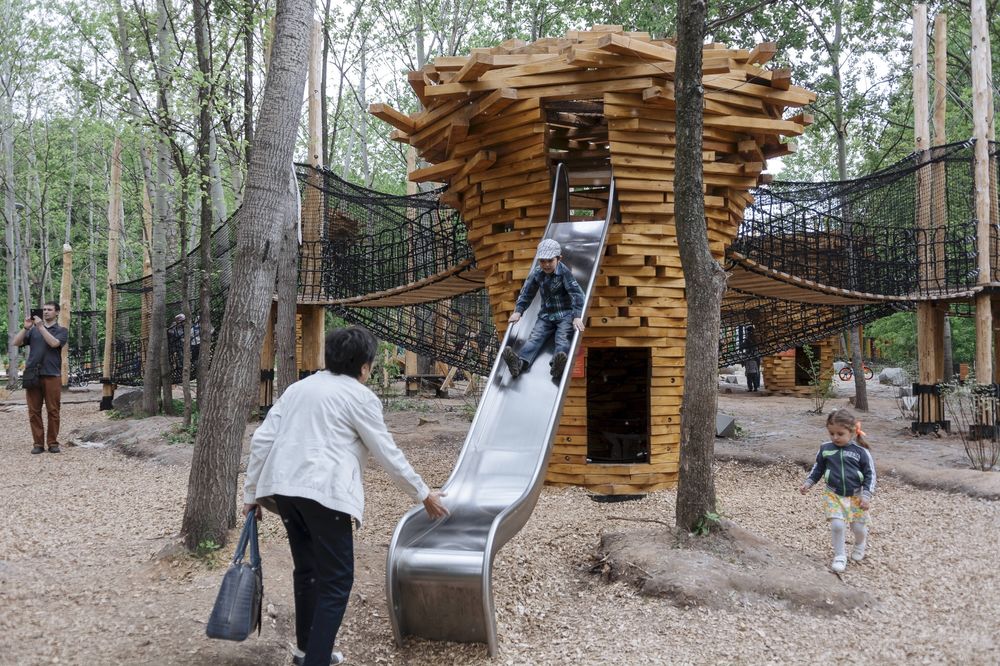
Photo: Daniil Shvedov.
An eco-playground in the Gorkinsko-Ometyevsky Forest near Kazan.

The problem with headlines is that they tend to focus on bad stuff — a bad leader, say, planning bad moves in a country we know about only from headlines. But a leader can’t be everywhere all the time, and no country is a monolith. Especially not one as big and diverse as Russia.

Alex Ulam has a Bloomberg City Lab story about something going on way out in the semi-autonomous Russian republic of Tatarstan.

“In 2015, Natalia Fishman-Bekmambetova arrived in [Kazan] to oversee a large public works program. Then only 24 years old, she found a city with a population of 1.7 million, a renowned university, grand boulevards and major historic sites, including a Unesco-listed walled Kremlin from which Mongols once ruled.

“But Kazan also was a typical post-Soviet city — surrounded by drab concrete tower complexes and parking lots. Since the fall of the Soviet Union in 1991, little attention had been devoted to revitalizing derelict public open spaces or to building new ones.

“Six years after Fishman-Bekmambetova’s arrival, a massive initiative often referred to as a ‘green revolution‘ has dramatically reshaped this city 450 miles east of Moscow. Tatarstan’s Public Space Development Program, launched by Fishman-Bekmambetova and Tatarstan President Rustam Minnikhanov, has created or upgraded more than 420 projects throughout the republic, including parks, walkways, gardens and other kinds of landscaped areas.

“You don’t have to walk far in Kazan to see how the new public space program has changed the city. Near the center of the city is the Lake Kaban Embankments, designed by the Chinese-Russian consortium Turenscape +MAP and completed in 2017. The project transformed a formerly deserted postindustrial site around three lakes into a waterfront promenade with rows of trees, beds of wild grasses and wooden decks. At night, the area is illuminated by lights inside glowing red benches of diaphanous resin. Huge fountains rise on the lakes; restored wetlands help clean the once-heavily polluted water.

“Southeast of the city, Fishman-Bekmambetova’s team oversaw the rebirth of the 87-hectacre Gorkinsko-Ometevsky Forest, a new park that features a ski hill and an eco-playground along with preserved woodlands and performance spaces, located on a site where local activists successfully defeated the construction of medical centers and a planned road that would have bisected the park.

“The most ambitious project in the works for Fishman-Bekmambetova’s team is the Kazanska River Strategy, a plan for a 22-kilometer stretch of urban river and 68 kilometers of embankment running the entire length of Kazan; it’s one of the largest landscape projects in Russia. More at CityLab, here.

And while we’re feeling surprised about Russia, here’s a story by Fred Weir at the Christian Science Monitor about environmental action in the far north.

Arkhangelsk, a Russian region almost as big as France that borders the White Sea, is a land of permafrost and marshy tundra, with stunted Arctic forest, rolling hills, and labyrinthine lakes and rivers. It’s been inhabited by Russians for almost a thousand years; Indigenous peoples, some related to Finnish Laplanders, have been there much longer.

“People here are very conscious of history. Much of it revolves around their fragile Arctic habitat and the need to preserve it.

“About two years ago, mass popular protest forced Moscow authorities to abandon plans to build a giant waste dump near the village of Shiyes in this Arctic region that had been intended to receive 2 million tons annually of the garbage overflowing from heavy-consuming Moscow. The success of that ‘Stop Shiyes’ struggle launched a lasting ecological movement and ushered in the election of a more environment-friendly local leadership. It also planted surprisingly divergent ideas in some peoples’ minds about how to take that newfound consciousness and turn it toward a permanent transformation. ….

“For Oleg Mandrykin, a local real estate developer from the closed naval shipyard city of Severodvinsk, it served as inspiration to try and get into national politics in order to raise ecological awareness in Moscow. Anastasia Trofimova, an Arkhangelsk doctor, went a different direction, eschewing politics for [business]. And Alexandra Usacheva heads Clean North, a group that interfaces between the public and local authorities to promote ecological education.”

More at the Monitor, here.

Photo: Fred Weir.
Anastasia Trofimova, a doctor, in her shop in Arkhangelsk, Russia. She was inspired by protests against a proposed landfill to launch a business that sells around 700 products made from natural or recycled materials.

Read Full Post »

Photo: Donnel Baird.
Donnel Baird is the founder and owner of BlocPower, a Brooklyn-based energy technology startup that markets, engineers, and finances renewable energy and energy efficiency technologies to buildings in underserved market segments.

This article starts by showing how a professor and a college friend helped motivate a young man depressed about race in America and then describes how he turned himself into a force for change.

Sarah Kaplan writes at the Washington Post, “Donnel Baird kept his coat on while he toured the aging sanctuary. His breath froze on his face mask as he took in the peeling plaster, the dusty basement, the failing boiler that never seemed able to make Bright Light Baptist Church warm.

But when he peered into the kitchen, the shiver he felt was one of recognition. Every burner on the stove was lit. The oven door was open, its temperature set on high. It was exactly how Baird’s family tried to heat his childhood home more than three decades earlier, in another Brooklyn building with a dysfunctional HVAC system.

“The landlord wouldn’t address the problem, and the family couldn’t afford to move. So they stayed, the need to keep their children warm outweighing the danger of toxic fumes and open flames.

“Baird, 40, has made it his life’s work to ensure other people don’t have to make that choice.

“That’s why he launched BlocPower. Since its inception in 2012, his Brooklyn-based start-up has brought clean energy to more than 1,100 low-income buildings across the New York area. Baird’s business plan is simple: the company replaces heating and cooling systems that run on fossil fuels with greener, more efficient alternatives such as electric heat pumps and solar panels. That reduces the pollution driving climate change while also making indoor air healthier. The gains in efficiency generate enough savings to lower costs for property owners and deliver a profit to BlocPower investors. And the renovations create jobs and increase property values, building wealth in neighborhoods that have long been marginalized. …

“The foundations for BlocPower were laid during Baird’s childhood in Bedford-Stuyvesant, a Brooklyn neighborhood just a few miles from Bright Light. It was a community with a spirit of civil rights activism — the center of school integration protests; the home district of Rep. Shirley Chisholm, the first woman and African American to seek a major party’s presidential nomination in 1972. But the area had also been depleted by predatory real estate practices and ravaged by the crack epidemic.

“By the 1980s, when Baird’s parents emigrated from Guyana, the neighborhood was at a nadir. Buildings were in disrepair, jobs were hard to come by, tensions with police were high. As an elementary-schooler, Baird witnessed a fistfight escalate into a deadly shooting. That taught him about desperation, he says; when someone pulls the trigger, it’s because their back is already against the wall.

“Baird’s family eventually moved to Atlanta, where Baird got scholarships to attend a private high school and then Duke University. Surrounded by Whiteness, wealth and privilege, ‘I really started to see the structural elements of racism in America,’ Baird said.

“Then police in the Bronx killed an unarmed Black man named Amadou Diallo, firing 41 shots at him. The immigrant from Guinea was only a few years older than Baird and had been standing in front of his apartment building when he was killed.

“Baird sank into a deep depression. He might have stayed there if he hadn’t wound up in a course at Duke about social movements taught by historian Larry Goodwyn. He became close with the professor, who called the struggling sophomore into his office one day and told him, Baird recalled, to ‘get my s— together.’

“ ‘He said, “You’re so smart, there’s no excuse for you not to figure out how to plug in and get active on the issue of race,’ ” Baird said. …

“After graduation, Baird moved back to New York to work as a community organizer, then got a job partnering with the Department of Energy to retrofit low-income houses so that they used less energy and cost less to heat.

“Roughly a third of U.S. households have trouble paying energy bills, according to the Energy Information Administration. Wealth disparities and decades of racist housing policies mean that Black and Latino Americans are disproportionately likely to live in homes with broken or inefficient HVAC equipment that is more expensive to operate.

“This energy inequality is a public health crisis: aging gas and oil furnaces — as well as the stoves and ovens used to supplement them — can fill homes with dangerous pollutants. A recent MIT study found that ozone and lung-irritating particles from buildings are the nation’s biggest cause of premature death from air pollution. In the neighborhood around Bright Light, where 67 percent of rented homes suffer from maintenance defects, children are hospitalized for severe asthma at twice the citywide rate.

“It’s also an environmental crisis. The energy needed to heat, cool and operate buildings produces almost a third of the United States’ planet-warming emissions.

” Working on buildings ‘brought all the themes of my life together,’ Baird said. ‘The racial justice stuff, the economic justice, the climate stuff.’ …

“Baird began to envision a company that could raise huge amounts of capital and use it to finance green retrofits in low-income buildings. Investors would be paid back out of a portion of the utility bill savings. Baird would make the venture profitable by embracing technology and seeking out partnerships every step of the way.”

Read how he established his company, BlocPower, here, and what it has accomplished so far.

Read Full Post »

Sometimes progress on global warming is made not by idealistic environmentalists but by pragmatists thinking about long-term costs. That was the case in a rural Kansas town that was badly damaged by a tornado.

Annie Gowen reported recently at the Washington Post, “A wind-swept farming community in southwestern Kansas, Greensburg rebuilt ‘green’ after an EF5 tornado — the most violent — barreled through at more than 200 miles per hour and nearly wiped it off the map in 2007.

“A decade later, Greensburg draws 100 percent of its electricity from a wind farm, making it one of a handful of cities in the United States to be powered solely by renewable energy. It now has an energy-efficient school, a medical center, city hall, library and commons, museum and other buildings that save more than $200,000 a year in fuel and electricity costs, according to one federal estimate. The city saves thousands of gallons of water with low-flow toilets and drought-resistance landscaping and, in the evening, its streets glow from LED lighting. …

“Greensburg is no liberal bastion. [But] leaders there now are routinely consulted by communities around the world grappling with devastating weather events from wildfires, tsunami, earthquakes and floods. …

“Greensburg’s journey has not always been easy, residents say, nor did it unfurl perfectly. A fancy rainwater irrigation system for its Main Street has never worked. Wind turbines installed for city and other local buildings were costly to maintain — and one toppled into a field. A business park built to attract companies and clean-energy jobs remains empty.

“ ‘There are lessons learned that we can share,’ said Bob Dixson, a retired postmaster who served as mayor during much of the rebuilding. ‘I totally believe that we’re a living laboratory here with a plethora of architectural design and sustainable environmental practices to share.’ …

“Environmentalists around the world are now arguing that this moment is crucial for local governments — whether they’re trying to rebuild a town burned by a wildfire or figuring out ways to revitalize their economies after a pandemic, said Katharine K. Wilkinson, a climate strategist and co-editor of the recent anthology ‘All We Can Save: Truth, Courage, and Solutions for the Climate Crisis.’ …

“ ‘[There] are opportunities to rethink the systems we create at a local level, and that’s where a lot of climate solutions happen,’ Wilkinson said. …

“[In Greensburg in 2007] more than 90 percent of the buildings and trees had been swept away in a matter of minutes. Twelve people died. Amid the chaos of rescue and recovery, town leaders began contemplating early on how to rebuild — and the idea of building back in a sustainable way emerged almost immediately, they said in interviews with the Post. …

“City leaders worked to build community consensus around the concept — and persuade homeowners to also embrace green as they rebuilt their homes. But it wasn’t always easy to convince some in the rugged farm community where conservative politics predominate. …

‘We tried to approach it in a practical way, not tree-hugger green, but economic green. Ramming stuff down people’s throats — especially in this part of the world — doesn’t work.’

John Janssen

“By the end of 2007, Greensburg became the first city in the country to require all municipal buildings over 4,000 square feet to be certified LEED (Leadership in Energy and Environmental Design) platinum by the U.S. Green Building Council, a nonprofit organization. That means the buildings meet certain standards for saving energy, reducing the greenhouse gas emissions that are linked to global warming. …

“The city was able to halve its carbon footprint by shifting to 100 percent wind energy from a 10-turbine wind farm south of town that is owned and operated by Exelon Corp. The turbines, which began operating in 2010, are capable of producing 12.5 megawatts of electricity, enough to power about 4,000 homes, according to Exelon. …

“An NREL [National Renewable Energy Lab] study from 2011 showed that 13 of the city’s ‘smart’ buildings save about a combined $200,000 a year in utility costs, and the homes consume about 40 percent less energy on average than before the tornado. …

“Not everything the town has tried has worked. Some of the buildings, including the school and the hospital, used to have their own smaller wind turbines to use along with solar panels, but the turbines proved costly to maintain. The hospital took its down after one toppled over, officials said. Luckily, no one was injured.

“ ‘You can build the greenest buildings in the world but if you can’t afford to live with them, that’s not sustainable,’ Dixson said. ‘You have to look at long-term maintenance also.’ ”

More tips on how to rebuild greener are here, at the Post.

Read Full Post »

Photo: Library of Congress.
A New York City school around the time of the flu pandemic. History shows it’s possible to hold classes outdoors when the safety of breathing indoors is uncertain.

Photos taken in the 1918 flu pandemic show some schools holding classes with all the windows open or even outdoors. Could we do that today? Reporter Nate Berg at Fast Company looked into the question.

“Sharon Danks has been working for more than 20 years to get schoolkids outdoors,” he writes. “As a trained landscape architect and urban planner, she says too many schools across the country ignore the educational and health benefits offered by the outdoor spaces of their campuses. This is something she’s been trying to change through her nonprofit Green Schoolyards America, based in Berkeley, California. …

“In April, Danks began having conversations about reopening local schools with three other organizations in the San Francisco Bay Area. … In early June, the organizations cohosted a webinar on responding to COVID-19 by using outdoor spaces for education. More than 1,000 people from 40 states and eight countries registered.

“[The organizations then] created the National COVID-19 Outdoor Learning Initiative, an effort to create guidelines schools can follow to use their outdoor spaces more effectively in order to bring back face-to-face learning. Volunteers from across the country are now participating in 10 working groups focused on different aspects of moving classes outdoors, from funding to safety to the physical infrastructure needed to seat and teach students outside.

‘The central problem that we were looking at is that none of our schools were built to be able to accommodate kids 6 feet apart inside the building,’ Danks says.

“But what most schools are equipped with is outdoor space and playgrounds — spaces that can be adapted for outdoor learning. Through the use of physical objects such as shade structures and weatherproof seating and adjusted lesson plans that reduce teachers’ reliance on computer screens and overhead projectors, outdoor classrooms can allow classes to continue with the space and fresh air that epidemiologists believe prevents transmission of the virus.

“Outdoor learning can move all students outdoors, or at least shift enough of the student population outside to make indoor classrooms safe with smaller class sizes. Distance learning, with its inherent difficulties, inequities, and access challenges, may become just a rainy day backup plan. …

“In 2017, the San Mateo County Office of Education started an Environmental Literacy and Sustainability Initiative that focuses on increasing knowledge about environmental issues. It does so partly by integrating natural and outdoor spaces into school curricula. Andra Yeghoian, the initiative’s coordinator, says the program has been working to ensure that students at every grade level in its roughly 270 schools have daily access to outdoor learning and play spaces. … ‘Now COVID-19 has really flipped that to be that every kid at every grade level in every subject area can do the majority of their learning outside.’ …

“Danks estimates that only about 15% to 20% of schools in the U.S. have these kinds of facilities. ‘The other 80%, 85% of schools have probably never taken a class outside to do hands-on learning on their own site,’ she says.

“This is where the initiative’s working groups come in. Each is developing a set of two-page recommendations that will provide simple instructions for dealing with common outdoor complications like cold and hot weather, spatially distanced seating arrangements, dust, and insects. Eventually, the recommendations will be published as a free online guidebook. …

“Claire Latané is an assistant professor in Cal Poly Pomona’s landscape architecture department and is leading a group of volunteer landscape architects who are working directly with school officials to identify optimal spaces and sizes of outdoor classrooms. She says about 100 designers have signed up to help, and the first teams are using aerial imagery of campuses to find places with adequate shade, either under trees or carports, and ensuring any changes to school grounds comply with local fire and accessibility codes. They’re also advising on how the locations of outdoor classrooms can address weather concerns. …

“Three case studies have been published on Green Schoolyards America’s website, and offer suggestions for schools in different climates. … At a low cost of just a few thousand dollars, schools use only their existing outdoor shade and tree-covered areas, augmented with affordable seating such as hay bales and additional clothing for unexpected cold or wet weather. …

“The whole process of transitioning to outdoor education doesn’t have to be tortuous, Danks says.

‘In the last pandemic in 1918 to 1920, with tuberculosis and the Spanish flu, schools around the world went outside … even just moved their desks right outside their buildings,’ Danks says. ‘They didn’t overthink it, they just moved their space to where the air was fresher.’ ”

More at Fast Company, here.  Hat tip: ArtsJournal.

Read Full Post »

Photo: Philadelphia Water Department
A rain garden manages stormwater runoff in Philadelphia’s Germantown section. 

When I was at the magazine, I solicited several articles about Philadelphia and what people there were doing to bring more of the natural environment into urban living. It’s not easy for any city as budgets are often strained. But when you can make the case that environmental improvements ultimately save costs (or when an EPA is serious about quality of life), you have a better chance of getting things done.

Bruce Stutz at Yale Environment 360 (a great publication I recommend following on twitter @yaleE360) has the story.

“Benjamin Franklin, Philadelphia’s favorite son, described his city’s stormwater problem well: By ‘covering a ground plot with buildings and pavements, which carry off most of the rain and prevent its soaking into the Earth and renewing and purifying the Springs … the water of wells must gradually grow worse, and in time be unfit for use.’

“When he wrote this in 1789, many of Philadelphia’s water sources, the scores of streams that ran into the Schuylkill and Delaware rivers, were already cesspools of household and industrial waste. As they became intolerable eyesores and miasmic health hazards, the city simply covered them with brick arches, turned the streams into sewers, and on top constructed new streets, an expanding impervious landscape that left the rains with even fewer places for ‘soaking into the Earth.’

“Crude as it was, this network of underground-to-riverfront outfalls through ever-larger pipes was pretty much the way Philadelphia and other U.S. cities coped with their stormwater for the next 200 years.

“But Ben Franklin’s town has decided to take the lead in undoing this ever-more costly and outdated system that annually pours huge volumes of polluted stormwater runoff and untreated sewage into the Delaware and the Schuylkill. Instead of building more and bigger sewers and related infrastructure, Philadelphia has adopted a relatively new paradigm for urban stormwater: Rather than convey it, detain it — recreate in the urban streetscape the kinds of pervious places where, instead of running into surrounding waterways, rainfall and the contaminants it carries can once again soak into the earth.

“The city is now in the seventh year of a 25-year project designed to fulfill an agreement with the U.S. Environmental Protection Agency (EPA) to reduce by 85 percent Philadelphia’s combined sewer overflows. … Rather than spending an estimated $9.6 billion on a ‘gray’ infrastructure program of ever-larger tunnels, the city is investing an estimated $2.4 billion in public funds — to be augmented by large expenditures from the private sector — to create a citywide mosaic of green stormwater infrastructure. …

“At nearby Villanova University, the Urban Stormwater Partnership, founded in 2002 under environmental engineering professor Robert Traver, had begun experimenting with green stormwater infrastructure. [Howard Neukrug who served as the city’s water department commissioner from 2011 to 2015] developed a couple of low-impact pilot design projects, and in 2009, the Philadelphia Water Department released a revision — 12 years in the making — to its stormwater and sewage management plan….

The city is working now to standardize the construction of green infrastructure and monitor its effectiveness. Costs are coming down as green infrastructure becomes more widely adopted. …

“As the Water Department’s planners expand the network of greened acres, they are bringing social, economic, and environmental investment to often marginalized neighborhoods. [Marc Cammarata, the Water Department’s deputy commissioner of planning and environmental services] says that green stormwater infrastructure projects now support 430 jobs. … Residents already report that green infrastructure projects have reduced crime as green spaces proliferate, says Cammarata.

The Water Department’s website map is crowded with green infrastructure sites across the city. Visitors can zoom in on their neighborhood and see what’s there.”

More here.

Read Full Post »

Photo: Marcus Teply/PRI
Dr. Andre Niemann with a partial model of his plan to turn Prosper-Haniel into a pumped storage system (basically a giant, water-powered battery). “It shows responsibility. It shows that if mining is over you’re not leaving the place.” 

Recently I read a sad story about a coal miner in the U.S. who once thought he and his infant son would have secure jobs long into the future. Now his mine is closing and he’s off to find another.

What’s sad to me is that although there are opportunities to retrain in up and coming industries, he and his family are chasing a dead one. But I can understand that he wants to keep earning six figures, a salary unlikely in most fields for which he might train.

Meanwhile, in Germany, people in an old coal town are biting the global-warming bullet and moving on.

Valerie Hamilton reports at PRI’s the World, “For most people, the top of the mine shaft at the Prosper-Haniel coal mine in Bottrop, Germany, just looks like a big black hole. But Andre Niemann looked into that hole and saw the future.

“Niemann leads the hydraulic engineering and water resources department at the University of Duisberg-Essen, in the heart of German coal country, western Germany’s Ruhr Valley. For more than 150 years, Germany mined millions of tons of anthracite, or hard coal, from coal mines here that at their peak employed half a million miners. But that’s history now — Germany’s government decided a decade ago to end subsidies that made German hard coal competitive with imports. …

“The end of hard coal mining in Germany comes just as Germany is working to slash its CO2 emissions by replacing fossil fuels with renewable energy sources like wind and solar. The country calls it the Energiewende, or ‘energy transition.’ But wind and solar aren’t always there when they’re needed, so a key challenge of the Energiewende is to find ways to store sun and wind energy for later use.

“One way to do that is with a pumped energy storage system — basically a giant, water-powered battery. When the sun is shining or the wind is blowing, the excess energy is used to pump large amounts of water uphill into a reservoir. When the sun goes down or the wind dies, that excess energy can be released by letting the water flow back downhill, through turbines that generate electricity like in a hydroelectric dam.

“Existing pump storage systems make use of hills or mountains for the necessary difference in altitude. But Niemann says the depth of a coal mine — like Prosper-Haniel — would work just as well.

“He and a team of researchers have worked up a plan to turn the mine into a pumped energy storage system that could generate 200 megawatts of power, enough for almost half a million homes. Water would be pumped through a closed system of pipes from 2,000 feet below ground level up to the surface and fall back down again on demand, regenerating 85 percent of the renewable energy used to pump the water up in the first place — energy that would otherwise be wasted. …

“Niemann, who grew up in a coal-mining family in the coal city of Ibbenbueren, says it would be a powerful symbol that as Germany transforms its energy landscape, coal regions won’t be left behind. …

“[Miner Ernst] Mueller explains the deal offered to him and every other mine worker in 2007, when the German government moved to end the subsidies that kept Germany’s hard coal mines afloat. …

“Underground workers over 50, and above-ground workers over 55, like Mueller, can retire early, paid by a company fund, as long as they have 20 years on the job. About 400 of their younger co-workers can stay on to maintain the mine area after it closes. The rest get job placement and training. Beike says [the company] promises to find every worker a new job. …

“The hope is, eventually, green business will pick up where coal left off. To prepare, the region has opened a new technical college in Bottrop to train the next generation of workers — not in coal, but in fields like green tech, water management and electro-mobility.”

More at Public Radio International, here.

Read Full Post »

In September, Victoria Lynden tweeted about Costa Rica’s clean electricity. Although hydroelectric and geothermal approaches sometimes have issues of their own and cars in Costa Rica still use gas, two months without using fossil fuels to generate electricity sounded pretty good to me.

Brad Plumer wrote at Vox, “Costa Rica is pulling off a feat most countries just daydream about: For two straight months, the Central American country hasn’t burned any fossil fuels to generate electricity. That’s right: 100 percent renewable power.

“This isn’t a blip, either. For 300 total days last year and 150 days so far [in 2016], Costa Rica’s electricity has come entirely from renewable sources, mostly hydropower and geothermal. Heavy rains have helped four big hydroelectric dams run above their usual capacity, letting the country turn off its diesel generators.

“Now, there’s a huge, huge caveat here: Costa Rica hasn’t eschewed all fossil fuels entirely. The country still has more than 1 million cars running on old-fashioned gasoline, which is why imported oil still supplies over half its total energy needs. The country also has cement plants that burn coal.

“What Costa Rica’s doing is nevertheless impressive — and a reflection of how serious the tiny Central American country is about going green. At the same time, a closer look at the story shows just how difficult it would be for other countries to pull off something similar.

“When many people think of ‘renewables,’ they tend to think of giant wind turbines or gleaming solar panels. But that’s not what Costa Rica is relying on. For years, roughly 80 percent of the nation’s electricity has come from a technology that’s more than a century old — hydroelectric dams …

“Another 12 percent or so of Costa Rica’s electricity comes from geothermal plants, which tap heat deep in the Earth’s crust and can also run around the clock. …

“So if Costa Rica can get 100 percent of its electricity from renewable sources, why couldn’t other countries do the same? Why can’t the United States, which is far richer?

“One obstacle here is that hydropower and geothermal are very location-specific — and only a few countries are lucky enough to have such rich resources. Iceland gets nearly 100 percent of its electricity from these two sources. Paraguay gets almost all of its electricity from the massive Itaipú Dam. Brazil gets more than 75 percent of its power from hydropower. But those are exceptions. For most countries, hydropower can only satisfy a portion of their power needs.” Read on.

Seems to me that when a country wants to be greener (whether for the environment or to save money or both), it has already taken the first step to finding solutions that work for its own geography.

Chart: Observatory of Renewable Energy in Latin America and the Caribbean


Read Full Post »

At Public Radio International, Jason Margolis and Ari Daniel reported recently on a Massachusetts business incubator focused on helping green startups by providing them with inexpensive space and shared tools.

“A few years ago, when Sorin Grama had just finished graduate work at MIT and was looking for a place to build his new solar electricity startup, he came across an old abandoned warehouse.

“ ‘My partner and I were looking at it and said, ‘Well, it’s a lot of space here, maybe others can join, it’s kind of lonely,” Grama says. ‘We put out a call to the MIT community.’

“Within weeks, a handful of startups were sharing that cavernous space.

“ ‘And we bonded. All the companies created a nice community, and we started sharing tools, people and ideas, and reading each other’s proposals for funding, things like that,’ Grama says. ‘We had a great Christmas party one year.’ …

“Today, their home is a massive old mid-19th century pipe factory in Somerville, just outside of Boston. It’s called Greentown Labs, and it’s one of the most successful in a new wave of what are called green business incubators, clusters of startups looking to build a business by helping cut carbon emissions and fight climate change. …

“They’re saving money [by getting started] at Greentown. If you need a power saw or an industrial press, no need to buy your own — just sign up for a time slot in the machine shop. The incubator also brings shared intellectual resources, like software, human resources, even PR help. …

“Outgrowing the incubator is part of the point, showing there’s money to be made tackling the world’s climate and energy challenges.

“It’s a growth area that the Commonwealth of Massachusetts is betting on, putting millions in grants and loans toward a network of green tech incubators. Steven Pike, interim CEO of the Massachusetts Clean Energy Center, says it’s an efficient way to spend.

“ ‘We can try and go out and try to support individually 50 different companies,’ Pike says. Or, Massachusetts can invest in an incubator that supports 50 companies under one roof.

“He says Massachusetts has an audacious goal: ‘We want to be the Silicon Valley of clean energy, renewable energy.’ ”

More here.

Photo: Greentown Labs
Shared workspace at Greentown Labs.

Read Full Post »

You haven’t heard the last word on tiny houses from this blog yet. Just check out Treehugger reporter Kimberley Mok’s amazing story about using a 3D printer to create a tiny house and SUV that can create, store, and share energy. Unreal but true.

“Designers from architecture firm SOM, University of Tennessee and researchers from the US Department of Energy’s Oak Ridge National Laboratory are cleverly tackling the energy issue by using a concept they call ‘integrated energy.’

“Their innovative design features a 3D printed house, that comes with a 3D printed SUV, which each generate, store and share energy — boosting energy efficiency both ways, while benefiting from the reduced construction waste and quick turnaround that comes with additive manufacturing techniques. …

“The design of both home and car uses carbon-fiber-reinforced ABS plastic (admittedly not the greenest of materials). The home was printed in separate modules that are assembled together and reinforced with steel rods, and insulated with a modified, highly efficient atmosphere insulation panels, resulting in a surprisingly strong and insulated structure.

“Certainly the most intriguing thing about the design is the reciprocal energy relationship that the car has with the house. … The 3D printed SUV is a hybrid that uses both electricity and natural gas to power itself. It’s parked on an inductive charging pad that allows it to send or receive energy from the solar-powered house — thus significantly solving the electricity issue on cloudy days. If there’s no electricity at all from either solar panels or car, the house can still tap into the energy grid. …

“Thanks to the additive manufacturing process, the prototype took only one year to realize from start to finish.” Read more here.

Photo: ORNL (Oak Ridge National Laboratory)

Read Full Post »

As an official member of his town’s tree committee, John has been working hard to promote the many benefits of an urban tree canopy both for quality of life and for the business environment.

Now here comes a really unusual idea for fans of urban greenery. You just need a large body of water.

At the website “Pop Up City,” describes Rotterdam’s floating forest, thought up by (who else?) an artist.

“Rotterdam will get its first ‘bobbing forest’ in 2016: a collection of twenty trees that are floating in the Rijnhaven, a downtown harbor basin.

“Inspired by Jorge Bakker’s artwork ‘In Search of Habitus‘, an aquarium filled with bobbers that grow small trees, Dutch designers and entrepreneurs from Mothership decided to carry out this idea in ‘real life’. After experimenting with a sample tree last year, an entire floating forest of twenty trees is scheduled to be ‘planted’ on March 16, 2016.” Check out some intriguing photos here.

My only question as a person who grew up in a hurricane corridor: What happens if there’s a storm?

Photo: Popupcity.net

Read Full Post »

One of the better aspects of the 2015 Massachusetts Conference for Women was hearing speakers like Candy Chang, an artist who engages ordinary people in public discourse.

At the December conference, Chang focused on Neighborland, a service co-founded with Dan and Tee Parham, that helps “residents and organizations collaborate on the future of their communities.”

This is how it works. Organizations start by posing a question. For example, they might hand out cards that say, “I want [blank] in my neighborhood,” and a resident might write in, “a night market.” Next, using Neighborland tools, ideas are collected from workshops, public installations, SMS, and Twitter. They are then discussed and voted on. The website says Neighborland has “sophisticated moderation, clustering, and de-duplication tools for organizers to aggregate all of the data from residents. Our reports make it easy for organizers to see trends in the data, make decisions, allocate resources, and keep participants involved in the fun part – making their neighborhoods better places.”

In this example, National Gardening Association’s Jenna Antonio DiMare reports on Adam Guerrero,  his Memphis, Tennessee, team of blight-busting ″Smart Mules,″ and their efforts to create a greener and more sustainable city.

“During the month of October, National Gardening Association (NGA) partnered with Neighborland to challenge Memphis residents to propose innovative projects to make their city and neighborhoods more sustainable. With a $1,000 grant awarded to the most promising project, Neighborland’s simple platform empowered local Memphis residents to ‘connect and make good things happen.’

“Despite receiving many inspiring project proposals, from founding an urban agriculture school to growing a newly established community garden, it was clear to NGA that the ‘Smart Mules’ project would have the greatest impact with the $1,000 award. …

″ ‘We are fighting [urban] blight, raising neighborhood morale, engaging our local government, and investing in a future for the neighborhood, all at the same time,’ writes the ‘Smart Mules’ team. To accomplish these goals, ‘Smart Mules’ provides work for many young, at-risk males who have been ‘largely dismissed’ or disenfranchised, according to team leader Guerrero.” More here about the work these young men are doing for sustainability.

(A couple years ago, I wrote about Candy Chang’s “Before I Die” interactive street art.)

Photo: Neighborland.com

Read Full Post »

And speaking of schools that develop a love of the natural world, check out this story from the radio show Living on Earth.

“On the other side of the world, in the tourist paradise of Bali, there’s a school that the U.S. Green Building Council named the greenest school on Earth for 2012. It’s called the Green School, and it educates some 300 students from 25 different countries. Living on Earth’s Bobby Bascomb went to check out what’s so green about the school.”

Among the people he spoke with was Charis Ford, director of communications for the Green School.

“BOBBY BASCOMB: It rains a lot in Bali. Humidity and bugs typically destroy a bamboo structure in about 4 years, but the Green School buildings should survive 20 years or more.

“CHARIS FORD: We use treated bamboo, but it’s been treated with salt essentially. We heat water and we submerge the bamboo poles into the saltwater and it makes the bamboo unpalatable to termites and mold and funguses and other things that would biodegrade the bamboo. …

“FORD: All the building companies that he spoke with were like well, ‘You have to have walls. All schools have to have walls,’ and John [Hardy, a Canadian jewelry designer who moved to Bali in the 1970s and founded the school] said, ‘Why do they have to have walls?”’ They rubbed their chins and scratched their heads and said, “’Well, where are the kids going to hang the art?’ As it turns out, you don’t have to have walls. And we don’t have walls and we’re quite happy about it.

“BASCOMB: Just outside the classroom, a chicken wanders through a patch of green beans. Gardens are everywhere, integrated throughout the campus. They mimic a natural forest ecosystem using edible plants, a design called permaculture.

“FORD: When you wander around Green School’s campus, you might think it looks kind of like it’s wild, but then as you tune in and look at the plants that you’re around, you’ll see that that’s a bean trellis, and that’s a guava tree, and that’s ginger. Even though it looks like a jungle setting, you get a little closer and you see that’s chocolate — cacao pods — hanging from a tree next to you.” Lots more here. You also can listen to the recording of the radio interview.

Photo: Mark Fabian
On extremely hot days a canvas envelope can be pulled around a wall-less Green School classroom so cool air can be piped in to keep kids comfortable. 

Read Full Post »

Older Posts »