Feeds:
Posts
Comments

Posts Tagged ‘habitat’

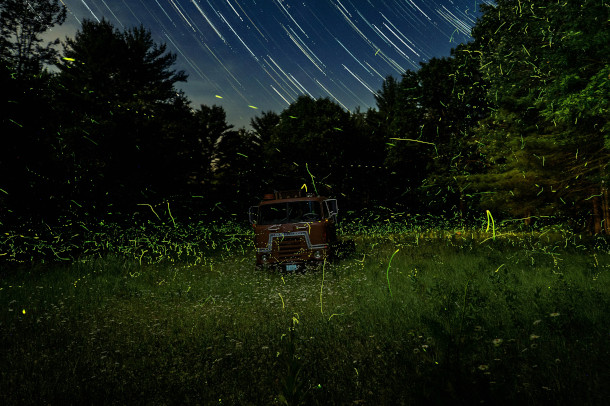
Photo: Robert Ritchie, Unsplash via Living on Earth.
The streaks of light in this 30-minute timelapse image show fireflies in a Wisconsin field.

Where are the fireflies of our childhood? Although the population perked up around here this past summer, possibly because of all the rain, firefly lovers have reason to be worried about the long term. Today’s story explains what’s going on — and how we can all help.

Eric Berger writes at the Guardian, “Max Vogel, a 29-year-old public defense attorney, was picnicking with friends in early August at Prospect Park in Brooklyn, New York, when he noticed flashes of light appear in the air around him.

“They were fireflies, bioluminescent insects that the Washington DC native had not seen while living in Oregon, where there are few, if any. For many Americans who live where fireflies do, their flashing lights at dusk are a tangible rite of summer – though one that may now be under threat. …

“Vogel said, ‘It’s like a shooting star that just is surprising and gives you the childlike wonder of how you felt when you first saw fireflies in your yard.’

“Even in areas of the US where there are typically fireflies, people are especially excited to see them this year because there appear to be more this summer after a steady decline in recent years, according to scientists.

“Despite that welcome news, researchers caution that it does not necessarily signal a reversal of the downward trend. They remain concerned about the long-term viability of the firefly family, which includes more than 2,000 species, some of which are at risk of extinction due to factors such as light pollution and climate change.

“ ‘It’s been really uplifting to hear all of the reports of huge increases in fireflies,’ said Candace Fallon, senior endangered species conservation biologist for the Xerces Society for Invertebrate Conservation. ‘But they are also insects, and insects are notorious for having populations that bounce up and down each year, and so it’s hard to say that their populations are increasing from a single year of data.’

“Fireflies, also known as lightning bugs, are beetles that come out at night during summer and produce a bioluminescent gleam, primarily to attract a mate.

“Cultures around the world treasure the bugs, including in Japan, where they are symbols of love and fallen soldiers.

“ ‘Catching fireflies is a relatively harmless thing that you can do that really connects you to your natural world,’ said Matt Schlesinger, chief zoologist with the New York Natural Heritage Program, which is participating in a project to identify which firefly species occur in state parks.

“Scientists in the US and Canada do not have baseline data on firefly species, which makes it difficult to quantify how much the population has decreased, and they must instead rely on anecdotal reports and documented habitat loss, which point to a downward trajectory, Fallon said.

“She and other researchers conducted a study published in the journal PLOS One which found that 18 species in North America are threatened with extinction. But the scientists also did not have enough data on more than half of the assessed species to determine their extinction risks. …

“The primary factor behind fireflies’ decline is habitat loss and degradation, according to the Xerces Society. That includes land being disrupted by development, light pollution and pesticide use. Artificial lighting at night makes it hard for the bugs to communicate and mate, Fallon said.

“Climate change, including an increase in droughts and rising sea levels, also affect firefly populations, she said.

“Still, there are some firefly species that appear to be doing ‘just fine,’ Schlesinger said [adding that] the kinds that specialize in particular habitats are the ones struggling. …

“ ‘If they can still have a big year, at least those species are probably doing fine and have the potential to recover,’ Schlesinger said. That said, ‘any single year doesn’t tell you about the long-term trajectory of firefly populations. …

“Kids should continue the tradition of venturing out with jars in the summer but should then release the bugs rather than collecting them, Schlesinger said.

“Other ways to help fireflies survive include: not using pesticides, reducing artificial lighting at night, and allowing the grass to grow long and the leaves to pile up in your yard.

“ ‘A lot of fireflies pupate in leaves, and so when we rake those and put them in bags, we’re destroying their habitat at a very small scale,’ Schlesinger said.

“Despite the concerns about extinction, Fallon is encouraged by master gardeners in Arkansas who created a firefly sanctuary, and by lawmakers in Maryland who approved legislation earlier this year which introduces new regulations on what type of lighting can be bought with state funds. …

“ ‘I think we have enough time to make a difference.”

More at the Guardian, here. See also the radio show Living on Earth, here.

Read Full Post »

Photo: Gianmarco Di Costanzo.
Lek Chailert devoted her life to rescuing abused elephants. Now caring for 120 of them, she fears for their future in Asia.

The stylist at my salon sometimes talks about her love for elephants. She’s the one who opened my eyes to what elephants and other animals suffer from captivity. I had never thought much about it, assuming that zoos were good, helping children to learn about the wild and saving endangered animals from extinction. Those things may be true to some extent, but not always.

Today’s story is about a woman who set up a rescue operation for elephants in her homeland.

Patrick Greenfield writes at the Guardian, “Saengduean Lek Chailert was five years old when she saw an elephant for the first time. It was in chains, lumbering past her home in rural Thailand on its way to help loggers pull trees from the forest. Back then, she saw the giant mammals like everyone else – as animals that served humans. But that changed the day she heard a scream from the forest.

“Chailert was 16 when she heard the terrible noise. She scrambled through the trees until she found the source: a bull elephant scrabbling in the mud as it tried and failed to drag a log out of a ditch. Every failed attempt was met with punishment from the loggers and mahout, the elephant keeper. …

“ ‘The elephant looked at me and I felt the fear and anger. I felt helpless and confused. My heart hurt a lot,” says Chailert. …

“The incident changed the direction of Chailert’s life forever. She was from a poor family – there was no electricity or school in her village – but she vowed to do something for the animals she loved.

“Before a ban on logging in natural forests in Thailand in 1989, elephants were a key part of the industry. In the early 20th century, there were an estimated 100,000 elephants in Thailand. Thousands were worked to death or left with severe injuries. …

“After the ban, many elephants were used by the country’s rapidly growing tourism industry to give performances and rides. …

” ‘Camp owners were competing with each other for tourists,’ she says. ‘They would train their elephants to dance, ride a motorbike, play darts or hula hoop, walk on a rope or play a harmonica. This brought more suffering to elephants.’

“It took Chailert a few attempts to fulfill her dream of finding a way to care for Thailand’s elephants. In 1996, she sold everything she had and borrowed money to set up an elephant sanctuary. She paid $30,000 for four hectares (10 acres) of land to provide a home to nine elephants.

“She insisted that there would be no elephant rides or performances. Her family invested money to help but after disagreements over how to run the park, she left the project, taking the elephants with her.

“Then, Chailert got lucky. National Geographic was filming a documentary with the Hollywood star Meg Ryan about Thailand’s wild elephants, which were estimated to number 4,000 to 4,400 by 2023; Chailert and her newly released elephants featured in it.

“In the US, a Texas couple, Bert and Christine Von Roemer, saw the TV program and contacted Chailert, donating enough money to buy a 20-hectare parcel of land in the Mae Taeng district of northern Thailand, near Chiang Mai. In 2003, Elephant Nature Park was born.

‘Today, about 120 rescue elephants are at the park, which has grown to more than 1,000 hectares, home to a small fraction of the 3,900 or so domesticated elephants in the country. The sanctuary’s work has an enormous social media following on Instagram and Facebook.

“Elephants arrive from all over Thailand. …

” ‘Some arrive with huge mental issues. Some stand like a zombie; some are aggressive, they swing their head back and forth. When they arrive, we do not allow our staff to use any tools or do anything that might make them feel threatened. We are gentle. We have to give them our love to make them trust us. We have to be patient,’ she says.

“New arrivals are almost always put into quarantine and slowly introduced to the herd. Over time, they are accepted. When their ears start to flap and their tails start to whirl, the elephants are happy, says Chailert. …

“Today, the conservation scheme is funded by visitors and volunteers who pay to work on the project. But despite the success of the sanctuary, Chailert fears for the future of Asian elephants, which she believes are decreasing in Thailand, despite official figures showing a steady increase in the population.

“ ‘Throughout Asia, many people are starting to hate elephants. Human-wildlife conflict is a big problem. Many died from being shot and poisoned,’ she says.

“ ‘Many have lost their habitat and water sources so they have to go to golf clubs and rice fields – places that don’t belong to them. So, people get angry and make the elephant into a monster. The future will depend on the government policy to resolve this,’ she says.”

More at the Guardian, here. PS. The Guardian doesn’t have a paywall. Please consider donating to keep their journalism alive.

Read Full Post »

Photo: Washington State Department of Corrections.
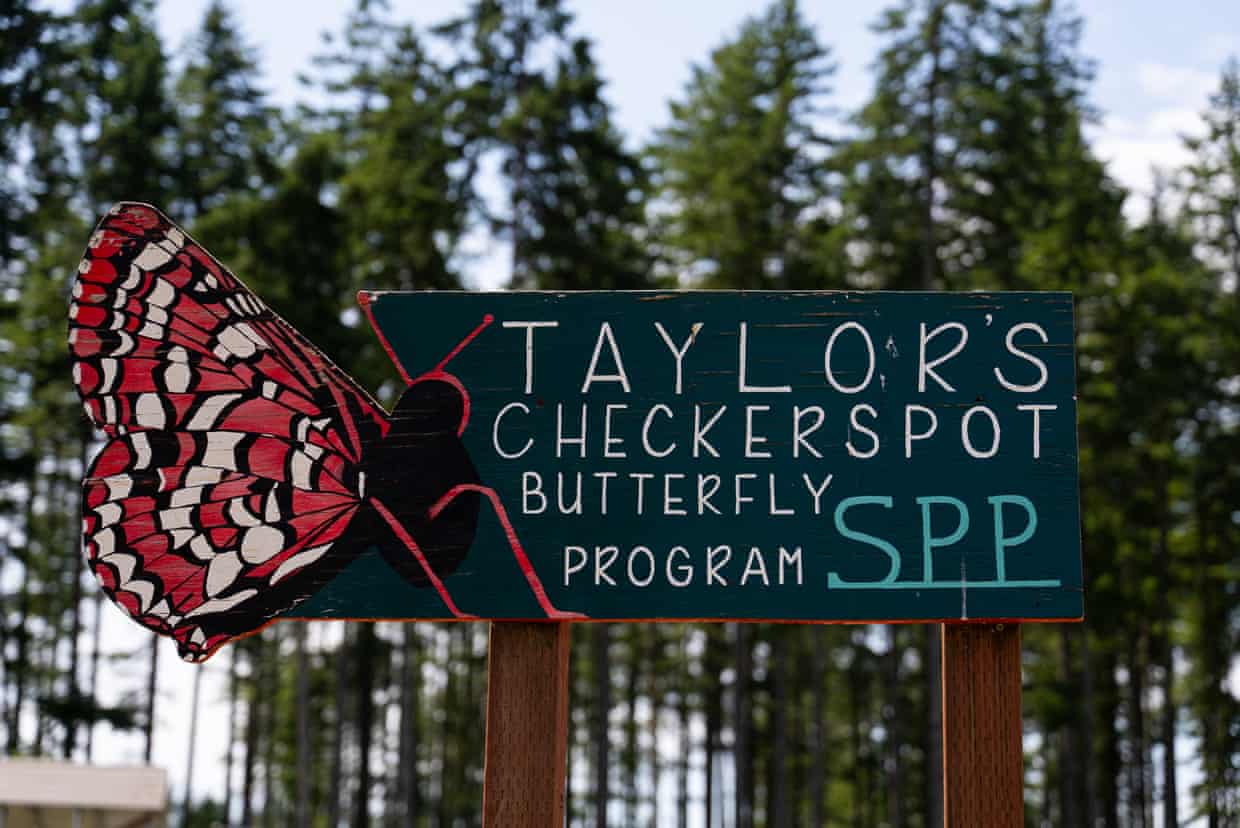
Last year, scientists working with a team of incarcerated women released more than 67,000 larvae of a beautiful, endangered butterfly.

Today’s story about incarcerated women helping scientists reminds me that you don’t have to be in prison to get satisfaction from working for a cause. These women are gaining confidence, self-esteem, and hope for a better future.

Andrew Buncombe reports at the Guardian, “Trista Egli was standing in a greenhouse, tearing up strips of plantain and preparing to feed them to butterfly larvae.

“Of the many things the team here has tried to tempt larvae of the Taylor’s checkerspot [with], it is the invasive English plantain they seem to love the most.

‘The big thing for me is being part of an effort to save an endangered species,’ says Egli, 36. ‘It is a big thrill.’

“Egli is one of seven women incarcerated at the Mission Creek correctional facility, located a two-hour drive from Seattle, who are part of a year-long program that takes captured butterflies, harvests their eggs, and oversees the growth of the larvae before they are released into the wild where they will turn into adults.

“Last year, scientists working with the team released more than 10,000 larvae. The adult butterflies live for just a handful of fabulous, wing-fluttering days. …

“Many of the women speak of their pride working on a project that feels like it is making a positive contribution to the world.

“Lynn Cheroff, 42, said she had been thrilled to talk about it with her two young children when they come to visit. When she telephones her mother about the work, her mother tells her she is proud. Another woman, Jennifer Teitzel, appreciates the sense of order and discipline the program demands and instills.

“Every detail about the eggs and larvae has to be collated and recorded. It is the women’s responsibility, and nobody else’s, seven days a week.

“[While] the program run by Washington state department of corrections (DOC) is part of an effort to prepare the women for life once their sentences are over and to smooth the path to work or college, there is no sugar-coating their predicament.

“Egli, who has three young children, is serving a nine-year sentence for a 2020 drunken hit and run that left a woman with permanent brain damage.

“ ‘I am paying the price for that every day. I can never go back and undo what happened,’ she says. ‘But I can try to make sure the rest of my life is about making the world a better place.’

“The program at Mission Creek has been operating for 10 years. Kelli Bush, the co-director of Sustainability in Prisons Project, a partnership between the DOC and the Evergreen State College in Olympia, says a crucial component are graduate students who visit to offer educational support.

“Bush says in addition to providing the women something to feel proud about as many deal with shame and guilt, the program also gives them confidence about their own capabilities. …

“She says, ‘It’s routine to hear people say “I didn’t think I was smart and I’m realizing I’m doing science.” … Pretty soon people find themselves reading peer-reviewed scientific journals and saying, “I can do this too.” ‘

“The Taylor’s butterfly’s preferred habitat is open grasslands and prairie. For thousands of years, such landscapes were created and maintained by active burning by Indigenous communities. Without such native stewardship, and with ever-increasing threats from developers and town planners, the amount of grassland has drastically diminished. …

“A favored place is Joint Base Lewis-McChord (JBLM), operated by the US army and situated 10 miles from Tacoma. Training with heavy artillery has long kept the prairie free of unwanted vegetation. Yet when the Taylor’s was added to the US Endangered Species Act list in 2013, it presented military officials with a challenge; how could they continue to make use of the base without harming a species now protected by federal law?

“Dan Calvert, of the Sentinel Landscape Partnership, a coalition of federal and state groups that works with landowners to promote sustainable land use around military installations, says JBLM contains ‘90% of the prairie habitat in western Washington.’ …

“One of the efforts to boost the numbers of Taylor’s checkerspot in locations off-base – and thereby allow the military to work unimpeded at the base – led to funding for the Mission Creek project by the Department of Defense (DoD). …

“The collaboration has helped boost the Taylor’s checkerspot. This year could be a record year for releases of adults. In 2024, the program released about 10,900 larvae.

“However, there’s a dark cloud looming over the program. Mission Creek is set to close in October because of budget cuts. There is a plan to transfer the women and the program to a prison at Gig Harbor, located 25 miles away, but there is some concern among current participants it could simply be cut entirely.

“Egli, who is set to become eligible for a work-release program under which she would serve the last 18 months of her sentence working outside the jail and returning to do what’s known as a DOC re-entry facility every night, says the program changed the person she was.”

More at the Guardian, here. No firewall. Donations support his valued news outlet.

Read Full Post »

Photo: Peter Ryan.
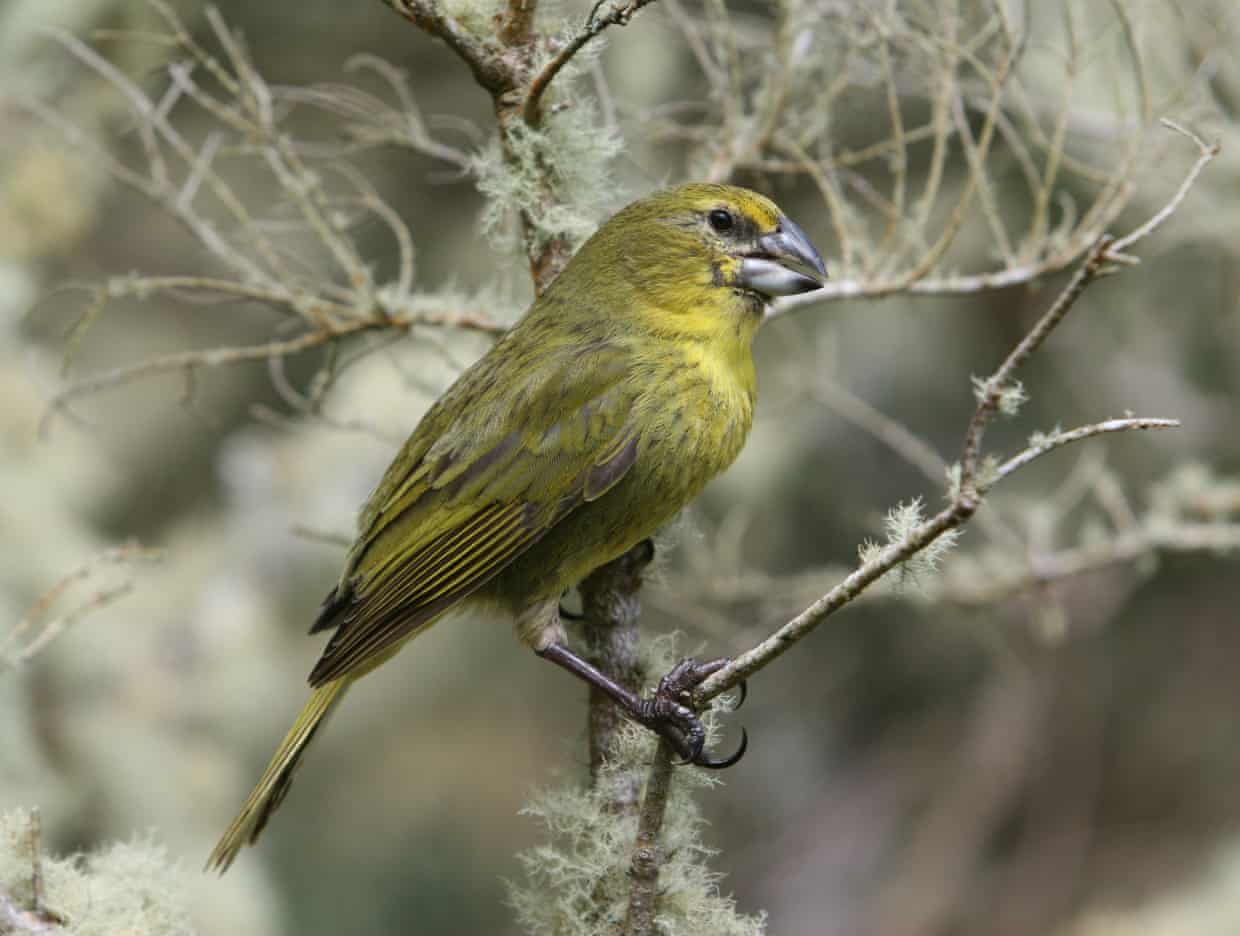
Surveys before 2019 found that the number of breeding pairs of Wilkins’ bunting was 120 and going down. Then a wasp got involved.

Before I get into today’s story about efforts to save the habitat of a rare bird, I want to explain where this is happening. Nightingale Island is in the South Atlantic, a bit closer to Cape Town, South Africa, in the east than to Buenos Aires, Argentina, in the west.

Wikipedia says, “Nightingale Island is an active volcanic island in the South Atlantic Ocean, 3 square kilometres (1.2 sq mi) in area, part of the Tristan da Cunha group of islands. They are administered by the United Kingdom as part of the overseas territory of Saint Helena, Ascension and Tristan da Cunha.

“Nightingale Island is [uninhabited but] regularly visited for scientific purposes and research. It is one of the only stops for birds in the Atlantic and sees millions of them visit it annually.” More.

I read the following report on saving the island’s threatened Wilikins’ bunting and couldn’t help wondering how we balance two goods: the need to save species and the need to prevent introduced species (in this case a wasp) from creating unanticipated future havoc.

Helena Horton wrote at the Guardian, “A tiny parasitic wasp has given a lifeline to one of the world’s rarest bird species by killing off an invasive insect that was threatening its survival.

“The Wilkins’ bunting lives on Nightingale Island, part of the Tristan da Cunha \ group; the world’s most remote inhabited archipelago. It eats the fruit of the Phylica arborea, the island’s only native tree.

“But around 2011, scientists began to notice signs of an unwelcome visitor. An invasive, sap-sucking scale insect had been, it seems, accidentally introduced on to the island by humans. These insects secrete honeydew, which encourages the growth of a sooty mould that weakens and eventually kills Phylica arborea. Their arrival threatened to destroy the forest, and the tiny bird population among with it.

“This news was devastating to the scientists who study and protect the little yellow bird, as its numbers had been suffering. Huge storms in 2019 destroyed much of the forest, and surveys before the storm found there were only about 120 breeding pairs of the bird remaining.

“The RSPB, Centre for Agriculture and Bioscience International, Food and Environment Research Agency and Tristan da Cunha Government hatched an unorthodox plan to save the buntings, releasing a small parasitoid wasp called Microterys nietneri, which prevents the scale insects from breeding. They would also set up a tree nursery to boost the number of trees and improve the biosecurity on the island to stop invasive species coming in future.

“But first, the wasps had to survive the trip from London – almost a month by land, sea and air. Dr Norbert Maczey, an entomologist at CABI, said: ‘The wasps faced an epic journey. Firstly, a flight from London to Cape Town, in a cool bag, followed by an enforced stay in a hotel room as part of a staff member’s Covid quarantine. Next came a week-long boat journey to Tristan with temperatures sometimes dropping below zero. Finally, there was a further boat trip to Nightingale Island. It seemed like luck and time was against us but some of the wasps made it.’

“Fewer than 10% of the wasps survived the trip, but in April 2021 the first release took place, and there were more over the next two years. Slowly a population of wasps has started to establish itself. …

“Surveys in February this year showed that despite losing approximately 80% of the forest, there are still an estimated 60-90 pairs of Wilkins’ bunting on Nightingale. Although the population has reduced, the forest has recovered in the short period since the wasps were released, and the scientists think numbers of buntings should stabilize and will have a chance to recover over the next few years.

“David Kinchin-Smith, the RSPB’s UK overseas territories project manager, said: … ‘Hopefully we, and the wasps, have given the buntings a much-needed lifeline.’ ” More at the Guardian, here.

Do you have an opinion on this approach?

And from Wikipedia, something curious about the remote islands: “Edgar Allan Poe‘s The Narrative of Arthur Gordon Pym of Nantucket alluded to Nightingale Island, Inaccessible Island, and Tristan da Cunha.”

Read Full Post »

Photo: Carlton Ward Jr.
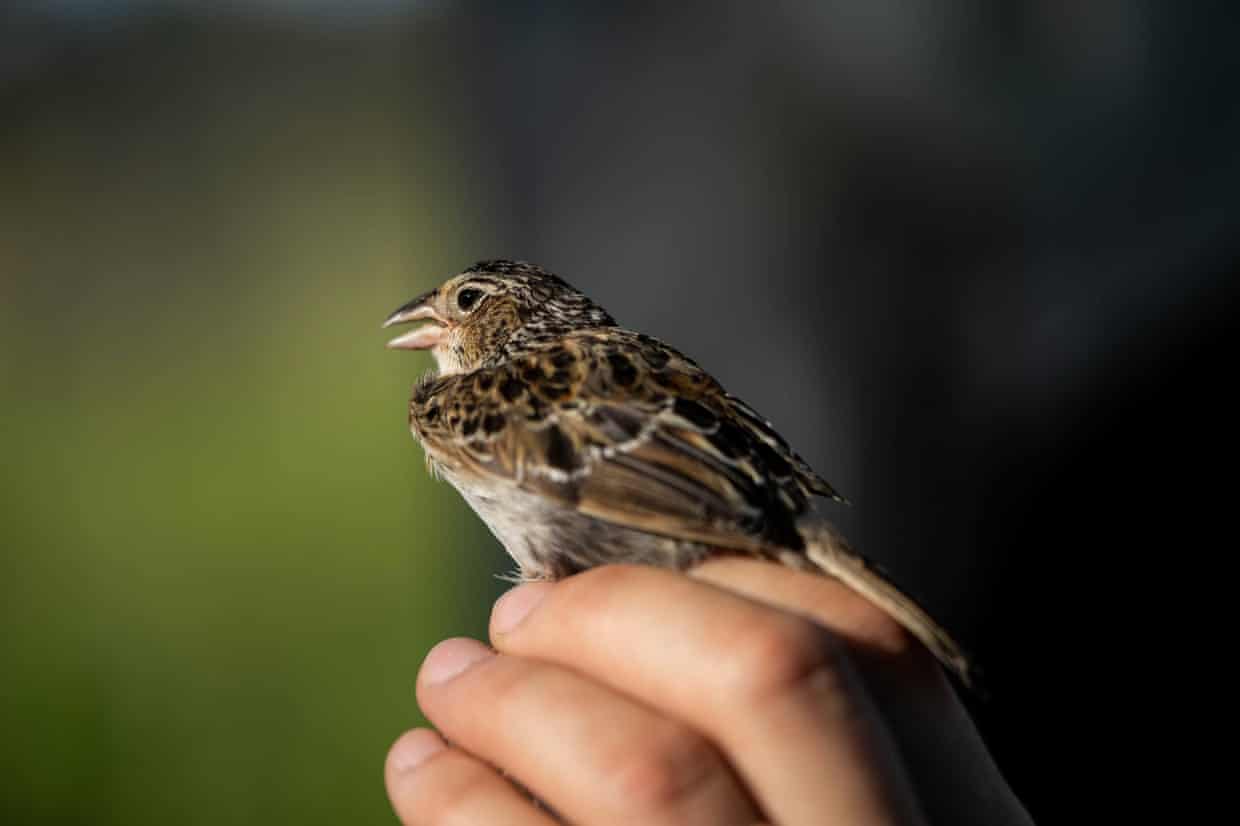
A grasshopper sparrow in Florida. 

Continuing on the subject of endangered birds, let me introduce Florida’s grasshopper sparrow. Now, you may think that with all the troubles in the world, the future of the grasshopper sparrow is the least of your worries.

But I like how the story represents bigger things — how we can make the world better if we try, how there are people who devote their lives to some small area that has big implcations.

Richard Luscombe writes at the Guardian, “Scientists in Florida are hailing the landmark release this week of a tiny bird only 5 inches tall as an oversized success in their fight to save a critically endangered species.

“Numbers of the Florida grasshopper sparrow, seen only in prairies in central regions of the state, dwindled so severely by 2015, mostly through habitat loss, that authorities took the decision to remove remaining breeding pairs into captivity. Their wager was that a controlled repopulation program would be more successful than leaving the birds to their own devices.

“[Their] gamble was rewarded. Partners joined the Florida Fish and Wildlife Conservation Commission (FWC) to release into the wild the 1,000th bird bred under controlled conditions, adding to an increasingly stable population that researchers believe has turned the tide towards the species’ survival.

“ ‘The recovery and release program diverted the extinction of the Florida grasshopper sparrow,’ said Adrienne Fitzwilliam, lead sparrow research scientist at the FWC’s fish and wildlife research institute.

“The fear was we might just be expediting their demise by bringing in proven breeders, so to see these birds making it in the wild, breeding with wild birds and other release birds, and their offspring going on to breed, has just been incredibly rewarding.’ …

‘Releases, which began in 2019, have taken place at three sites, with the newly freed birds monitored by patient teams of observers with binoculars and lawn chairs at two more. Birds are released in batches at about 40 days of age and, Fitzwilliam said, quickly set about setting up their ‘territory.’

“ ‘There’s a lot of sitting and waiting and watching because their nests are incredibly hard to find,’ she said.

“At the Avon Park military range south of Orlando where the milestone release took place this week, researchers have this year recorded 16 nesting pairs and 30 ‘singing’ males looking for a mate.

“At Three Lakes wildlife management area, the program’s first release site where once only 11 pairs were present, the observers found 40 pairs and 68 males, and are hopeful of more with the breeding season still in progress. …

“ ‘These numbers mean released birds successfully survive, breed and raise young in the wild, which is a huge success,’ Fitzwilliam said. ‘It has diverted extinction and allows partners to research possible landscape-level solutions.’

“Grasshopper sparrows, per their name, eat mostly grasshoppers and seed, and according to the FWC, the loss of large areas of prairie habitats to agriculture fields has vastly reduced their range and numbers. … FWC’s program partners, which include Audubon, White Oak Conservation and the Fish and Wildlife Foundation of Florida (FWF), are researching potentially beneficial land management practices such as roller chopping, which prepares land for controlled burns and speedier regeneration of native grasses. …

“News of the recovery of grasshopper sparrow numbers follows an upbeat report by a coalition of prominent universities for the future of Florida’s wildlife, if the climate emergency is mitigated properly.

“Andrew Walker, FWF president and chief executive, said: ‘These little birds represent a big beacon of hope that our commitment, partnership and holistic approach can save vulnerable wildlife from the brink of extinction.’ “

More at the Guardian, here.

Read Full Post »

Photo: Kang-Chun Cheng.
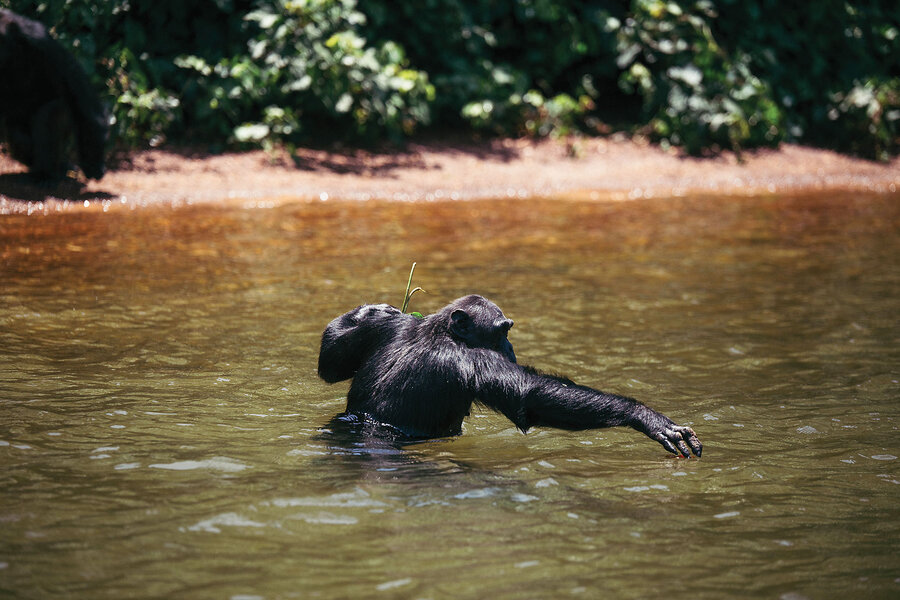
A chimpanzee swimming near the Ngamba Island sanctuary in Uganda.

Exercise instructors like to tell you how everything in your body connects to everything else. For example, moving your eyes as if trying to look behind you can help your neck turn a little farther in a neck exercise.

Interconnectedness is also true of nature. Consider Uganda, where work is being done to simultaneously protect chimpanzees, tropical forests, small-farm agriculture, and families.

Kang-Chun Cheng writes at the Christian Science Monitor, “From the shade of a banana tree, Samuel Isingoma explains why he is sacrificing his precious jackfruit to chimpanzees.

“ ‘Since I support and give fruit to the chimps, they don’t disturb anything else,’ says Mr. Isingoma, who has planted 20 jackfruit trees on his 17-acre plot in the western Ugandan village of Kasongoire. The trees’ bounty is solely for the primates. …

“Uganda is East Africa’s largest sugar cane producer and has one of the fastest-growing populations on the continent. The need to make space for homes and farms is reducing the forest cover that helps sustain chimpanzees.

“James Byamukama, an executive director at the Jane Goodall Institute, says it’s critical to have discussions within communities rather than try to impose solutions. Community monitors from the institute’s Uganda chapter have recommended that farmers plant crops that aren’t so palatable to wildlife. So about eight years ago, Mr. Isingoma started planting coffee beans, leaving behind the maize he used to cultivate.

“Now he is taking the institute’s advice one step further by giving his fruit over to hungry chimps.

“As a result, Mr. Isingoma says, ‘I feel there isn’t much of a human-wildlife conflict.’ “

The nonprofit We Stand for Wildlife expands on the connections between farming and forests.

“When over 1000 Ugandan small holder farmers adopted WCS conservation farming practices they increased crop-based income 15 fold and halted clearing on 2700 hectares [6671.845 acres] of riverside forest.

“Following the end of the civil war in 1986 refugee families began to return to their lands in the Murchison-Semliki region of Uganda that contain the last remaining natural forest in the country outside of protected areas. These riverside forests form corridors connecting the national parks and are vital habitat for chimpanzees.

“To feed their growing families farmers began to clear the forest to plant crops. Traditional agricultural practices quickly exhaust the soil and farmers are forced to deforest new areas. Between 2006 and 2010 WCS sound science showed that farmers were clearing nearly 8,000 ha of forest each year. Unless this changed the forest and its resident chimpanzee would soon disappear.

“In an attempt to avert this deforestation trend WCS joined forces with the Jane Goodall Institute and the Chimpanzee Trust. Initially we hoped that we could help farmers to capture the value of their trees by selling their stored carbon in the voluntary REDD+ market place. But the high cost of certifying the carbon for sale and the low price of forest carbon made this idea untenable.

“At WCS we adapted our plans and began offering farmers training in zero tillage farming that conserves nutrients and soil moisture, which is critical as rains become less predictable with climate change.

Farmers who adopted the less capital intensive conservation farming methods saw their maize yields increase 2-fold and their net revenue by 15-fold.

“Today over 1000 farmers are using conservation farming technique that preserve soil fertility and crop productivity dramatically reducing the need to clear more forest. Analysis of forest cover change using the Global Forest Watch interactive mapper shows that deforestation has visibly declined in areas under conservation farming. In lila was forest before the start of the REDD+ project; in green the forest still today and although it is difficult to quantify a 1 to 1 cause and effect relationship it show that deforestation was a lot less where our Private Forest Owners/conservation farmers live.”

More at the Monitor, here, at WCS, and at the Jane Goodall Institute. No firewalls.

Read Full Post »

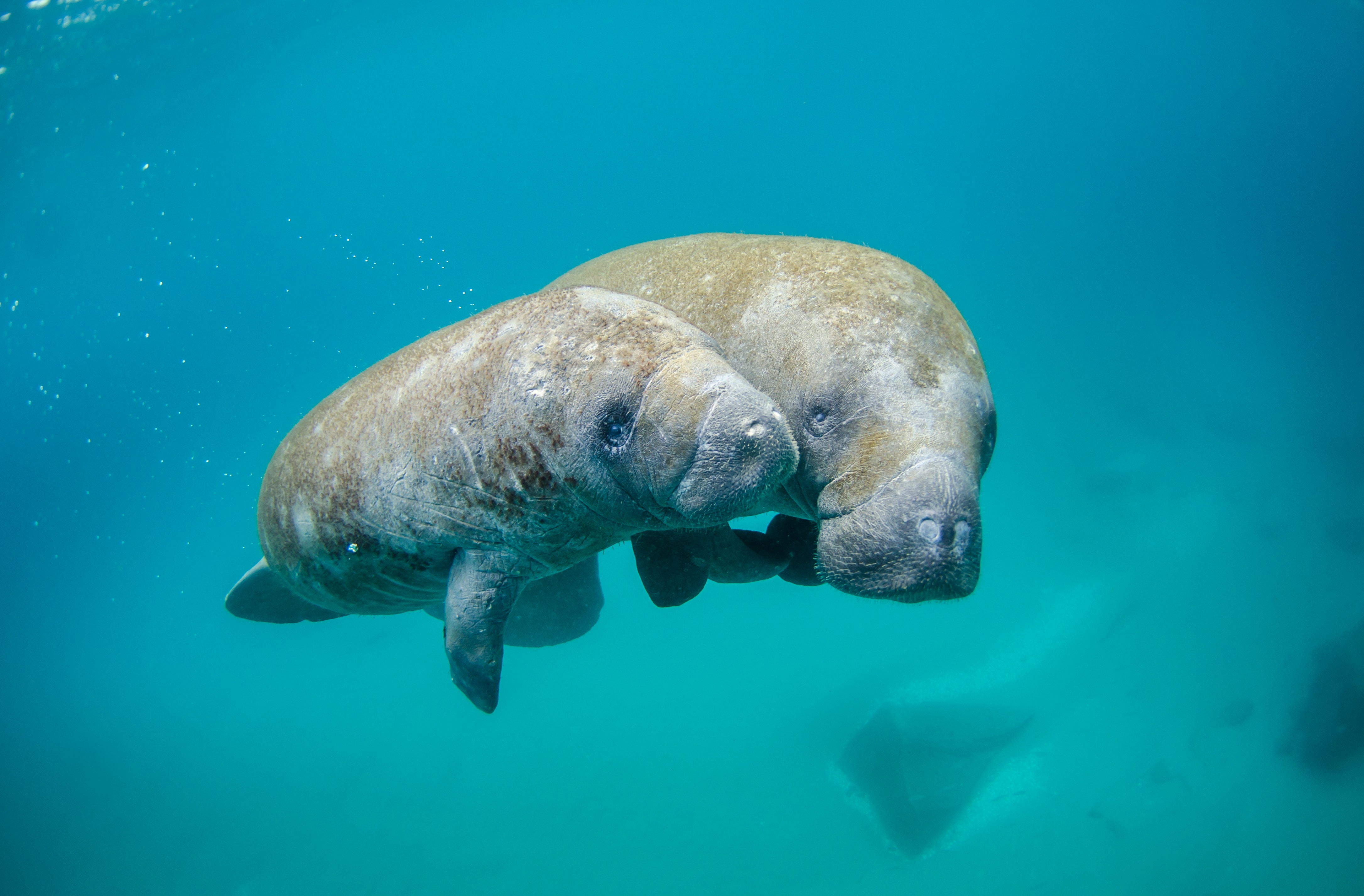
Photo: NOAA [National Oceanic and Atmospheric Administration].
The return of seagrass in Florida is a hopeful sign for the embattled manatee.

One doesn’t normally think of Florida politicians as being big environmentalists, but whatever their motivations for supporting cleaner water, one has to cheer them for putting some funding behind it. Florida treasures like the manatee need the help.

Richard Luscombe reports for the Guardian, “A picturesque expanse of water along Florida’s space coast is offering a modicum of hope for the state’s embattled manatees as wildlife officials review whether to restore the beloved sea cows to the endangered species list.

“The recovery of seagrass, the manatees’ favorite food, in Mosquito Lagoon means that an emergency hand-feeding program that has kept many of the starving aquatic animals alive over the last two winters can be discontinued, at least temporarily.

“While scientists say this might be only a small step in the wider fight to rescue a species that has seen a record die-off in recent years from water pollution and habitat loss, what’s happened at Mosquito Lagoon offers signposts to how the manatees’ battle for survival might ultimately be won.

“ ‘At least in a portion of the lagoon, we are seeing a rather rapid resurgence of the Halodule variety of seagrass that, even if we don’t know exactly how it happened, does tell us that it’s much more resilient than we might have been thinking,’ said Dennis Hanisak, a professor of marine botany at Florida Atlantic University’s Harbor Branch Oceanographic Institute, and director of its seagrass nursery. …

“Hanisak and his team, in partnership with the Florida fish and wildlife commission (FWC), have focused their restoration efforts on the lagoon in northern Brevard county, one of the most popular feeding grounds for manatees during the colder winter months.

“That’s where the majority of manatee deaths, an unprecedented 1,100 in Florida in 2021, 10% of the population, and another 800 in 2022, occurred. They were part of what federal and state authorities classify as an ongoing unusual mortality event (UME) with the majority of fatalities through malnutrition and starvation, a reflection of the loss of about 90% of the lagoon’s seagrass to algae blooms and pollutants.

“It’s too early to say exactly what role the seagrass nursery project has had there; Hanisak says it has ramped up in size and resources in recent years as wildlife agencies respond to the disaster with improved funding.

“It’s one of several projects underway in Florida [and] a prominent component of a catalog of FWC manatee habitat restoration schemes, themed mostly around improvements in water quality and aquatic vegetation, that experts believe has potential to turn years of declining numbers into a robust recovery. …

“[In January], Florida’s governor Ron DeSantis announced a $100m award of state funds for water-quality improvements in the Indian River Lagoon, one of North America’s most biologically diverse waterways. The cleaner the water, the better the seagrass. …

“Hanisak and his students have steadily been building the capacity of the seagrass nursery at multiple locations. That seagrass will ultimately be transplanted into the Indian River Lagoon and elsewhere. …

“It remains to be seen if this year’s drop in manatee deaths in Florida is a one-off, or represents the start of a recovery. But more abundant seagrass in Mosquito Lagoon, which led to the welcome suspension of the experimental lettuce-feeding project, bodes well.

“Lawmakers also appear to be at least partly on board. Thompson said the Florida legislature provided an additional $20m in fiscal year 2022-23 to the FWC to enhance captive manatee support facilities and manatee habitat enhancement to supplement the previous year’s $8m. …

Patrick Rose, a veteran aquatic biologist and executive director of the Save the Manatee Club [said] the extra funding, which his group lobbied for, is welcome [but] ‘a drop in the bucket literally to what needs to be done.’ Ultimately, Rose said, manatees need clear, clean water to survive. Without it, seagrass will not flourish. …

“ ‘Nutrients are the direct cause of harmful algal blooms which have been so intense that they literally cut the light off to the seagrasses, and the seagrasses die,’ he said.”

More at the Guardian, here.

Read Full Post »

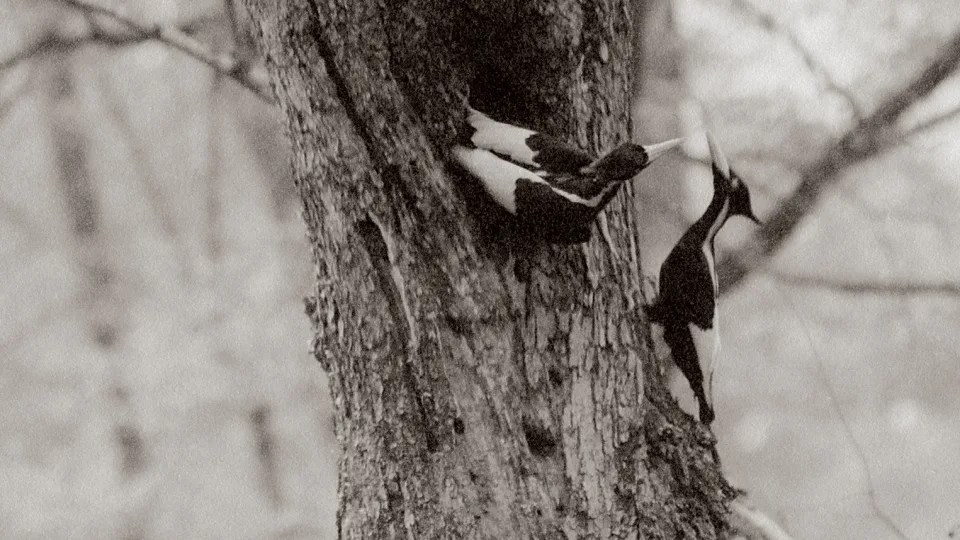
Photo: Arthur Allen/Cornell Lab of Ornithology.
Ivory-billed woodpeckers in Louisiana in 1935.

When our younger granddaughter was in pre-school and learned about dinosaurs, she latched on to the word “extinct.” The idea of something being completely gone was powerful to her, and when she was angry at her brother she turned the word a verb: “I’m going to extinct you.”

Today I learned about the variety of reasons we keep some things off the extinct list even when they seem gone forever. As Rachel Ramirez reported at CNN, Federal wildlife officials “are delaying a long-awaited decision to declare the ivory-billed woodpecker extinct, months after grainy photos and videos emerged that purported to show the bird flying through a Louisiana forest.

“In 2021, the agency seemed ready to declare the so-called Lord God Bird extinct: The US Fish and Wildlife Service announced plans to remove 23 species, including the ivory-billed woodpecker, from the endangered species list due to extinction. Thorough scrutiny of ‘the best scientific and commercial data available’ had led to the conclusion the bird no longer exists, the agency told CNN.

“[But in October] Fish and Wildlife declared 21 of those species extinct — and the ivory-billed woodpecker is not among them. …

“The government’s last accepted sighting of the red-crowned bird species was in April 1944 by artist and birder Don Eckelberry.

“But expert biologists and birdwatchers have been adamant the nation’s largest woodpecker is still out there. Just after the feds announced the proposal to remove the bird, public comments poured in from ornithologists, amateur birders and even communities like the Cherokee Nation, whose leaders asserted the creature is a symbol whose ‘influence on our cultural activities remains to this day.’

“Amid the wave of testimony, the wildlife service invited more public comment and announced extensions to its decision that effectively postponed its ivory bill verdict into 2023. Now, that critical decision to delist the bird is once again delayed. …

“ ‘John Fitzpatrick, a renowned ornithologist and retired director emeritus of the Cornell Lab of Ornithology, told CNN, ‘Evidence of its persistence continues to emerge, albeit none of it 100% convincing to everyone.’

“Since the 1944 sighting, the only other ‘compelling evidence,’ according to the federal wildlife service, was 2005 research from Fitzpatrick and his associates that claimed ivory bill sightings in eastern Arkansas’ Cache River National Wildlife Refuge. …

“In 2022, CNN joined avid birdwatchers to search the Tensas River National Wildlife Refuge in Louisiana, where the ivory-billed woodpecker was last officially seen. Around the same time, a group known as Project Principalis — a nod to the ivory bill’s scientific name, Campephilus principalis — was gathering evidence observed over the prior decade by Steve Latta of the National Aviary and other colleagues.

“Using unmanned trail cameras and drones, they’d captured grainy pictures of what they claimed was the ivory bill.

“ ‘We have some of the best images, if not the best images, that have been produced in 80 years,’ Latta, who claimed he has seen the bird in 2019, told CNN at the time.

“This May, Project Principalis published peer-reviewed research that unveiled such recordings, which they submitted to the feds, including a drone video from October 2022 of two ivory bills quickly flying onto a tree branch.

“ ‘Our ultimate goal is the conservation of the species, its habitat, and the many other species relying on that habitat,’ Latta told CNN Monday. ‘Keeping the Ivory-billed Woodpecker on the Endangered Species list brings us one step closer to that goal.’ ”

More at CNN, here.

Read Full Post »

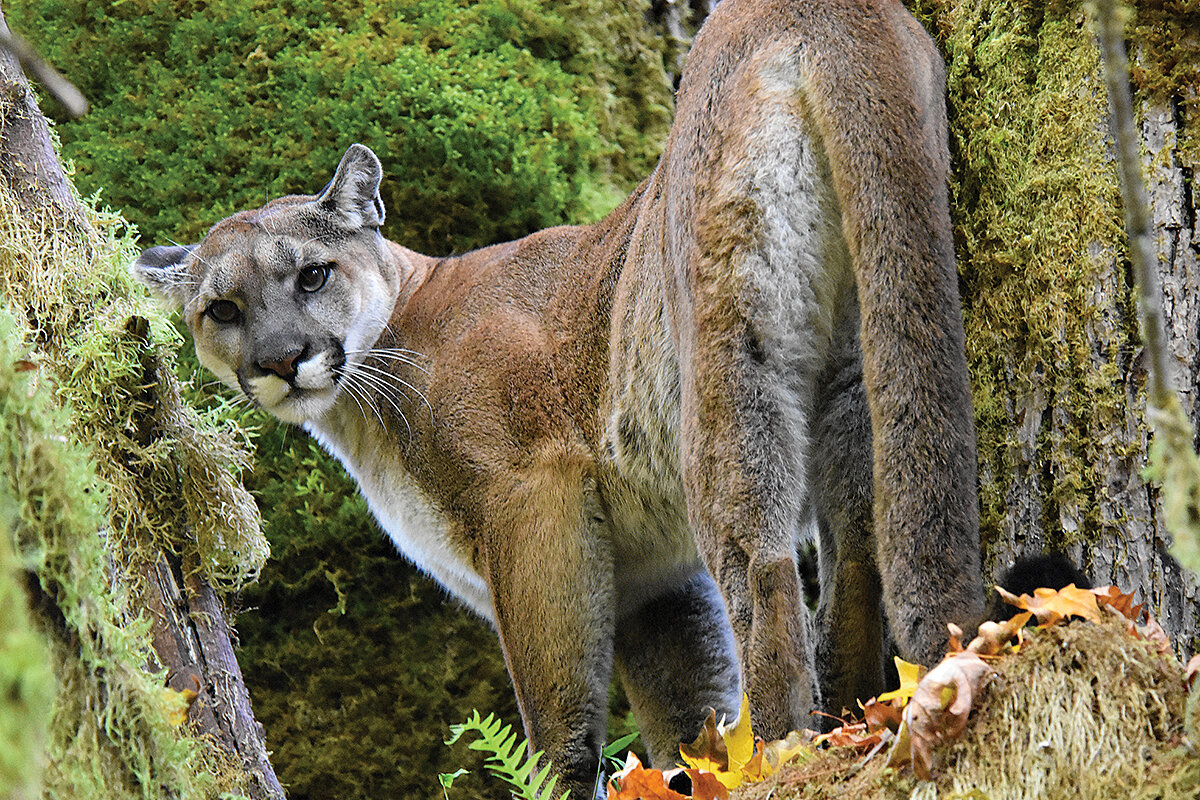
Photo: Mark Elbroch.
Since 2018, the collaborative Olympic Cougar Project has tagged 111 individual pumas, including Charlotte, above.

How many names do you know for the animal in the picture above? I learned four from today’s article.

Stephen Humphries writes at the Christian Science Monitor, “If Kim Sager-Fradkin didn’t have to write a grant proposal, she’d be spending her afternoon on the trail of a killer. 

“The biologist leads a team that’s researching cougars in Washington’s Olympic Peninsula. (The big cat is also referred to as a puma or a mountain lion. Not to mention wild cat, or panthera.]) Today, the team is tracking a cougar named James. It suspects he recently hunted an animal in a nearby forest. 

“ ‘Visiting cougar kill sites is really fun and like being sort of a forensic scientist,’ says Ms. Sager-Fradkin … wildlife program manager for the Lower Elwha Klallam Tribe. She’s overseeing the Olympic Cougar Project in partnership with Panthera … and five other Native American tribes. They’ve pooled their talents and resources to help an apex predator that has become effectively imprisoned in the westernmost part of Washington. 

“The region’s cougars are penned inside a geographical island roughly shaped like a square. Three sides are bordered by the ocean and bays. To the south there’s the expansive Columbia River as well as Interstate 5. The barriers on all four sides collectively form a de facto fence. Unable to easily connect with other big cats in the Pacific Northwest, cougars in the Olympic Peninsula are inbreeding. The lack of genetic diversity poses health challenges for them, scientists say. By collecting data on the big cats, the Olympic Cougar Project is bolstering the case for constructing a wildlife overpass over I-5 so that the species is less confined.

“ ‘Humans love wildlife stories, and humans love wildlife movements,’ says biologist Jim Williams, author of Path of the Puma: The Remarkable Resilience of the Mountain Lion. ‘What’s really neat about this project is it’s going to create information that will be translated through story that will keep humans excited and caring about the species.’ …

“When Ms. Sager-Fradkin began working for the tribe in 2007, her primary role was to plan sustainable subsistence hunting and fishing for current and future generations. A year later, she initiated a small-scale study of cougars in the region. She called in cougar expert Mark Elbroch. In 2018, they expanded the scope and scale, incorporating the five other tribes in the region and adopting the Olympic Cougar Project name. 

“ ‘The tribes on the peninsula aren’t always working together on a lot of things,’ says Ms. Sager-Fradkin, adding that there are sometimes disagreements over issues such as hunting jurisdictions. ‘So it’s really amazing that we’ve all come together and are working on a big project like this.’  To get all the partners on board, she had to get them to see the big picture. …

“The cougars are considered an ‘umbrella species’ because so many other creatures in the ecosystem depend on them. ‘Where there are frequent kills, the grass is literally more nutrient rich,’ explains Ms. Sager-Fradkin. …

“It was this fact that helped her persuade the region’s tribes that it was in their common interest to study the feline carnivore. 

“For his part, Dr. Elbroch, director of the puma program at Panthera, adds that Ms. Sager-Fradkin used her natural skill of engaging with people. …

“Working in concert, the Skokomish, Makah, Quinault, Jamestown S’Klallam, and Lower Elwha Klallam tribes have created a grid consisting of 550 cameras. Artificial intelligence catalogs animals photographed in the peninsula – including bobcats, bears, coyotes, deer, and elk – and helps estimate their populations. Research technicians, such as Lower Elwha Klallam tribe member Vanessa Castle, analyze the patterns of 127 individual cougars. There’s also the less glamorous task of analyzing animal scat. 

“ ‘A lot of our ancestral knowledge was lost,’ says Ms. Castle, who praises how Ms. Sager-Fradkin has mentored her and other employees in the project. ‘So we’re having to relearn those things. Like how wildlife all is intertwined with each other. … I had no idea the role that mountain lions played in the system as a whole.’ …

“ ‘The first thing that is needed is to protect the habitat on either side, because you can’t spend all the money on a wildlife bridge and then end up with a Walmart parking lot right on one side,’ says Ms. Sager-Fradkin. 

“The Olympic Cougar Project is not just liberating the big cats, she adds, but also creating a sustainable ecosystem for the tribes for the next seven generations.”

More at the Monitor, here. No paywall. Subscriptions encouraged.

Read Full Post »

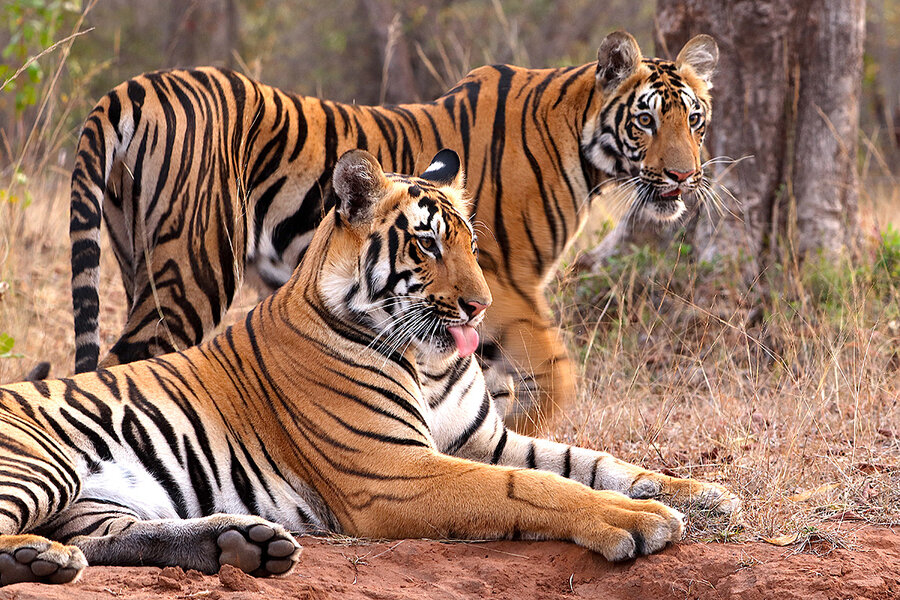
Photo: Charukesi Ramadurai.
Tigers at Kanha National Park in central India.

With its huge population, extremes of wealth and poverty, and religious suppression, India has more than its share of challenges. But one thing it seems to be getting right is its approach to protecting the national animal, the tiger.

Charukesi Ramadurai reports for the Christian Science Monitor, “On a misty winter morning in a central Indian forest, a soft caw-caw punctuates the silence. Dozens of grazing deer perk up their ears, then join in the staccato warning screeches of the langur monkeys and birds high up in the trees. As the chorus of animal alarms reach a crescendo, a frisson of excitement runs through the humans seated on the safari jeeps, bulky cameras and pricey binoculars at the ready. The urgency of these calls can only mean that a predator has been spotted. 

“The tourists let out a collective gasp when the tiger finally emerges from the thickets, the orange and black fur gleaming in the muted morning sunlight. …

“All eyes are on the king of Indian jungles as the country marks the 50th anniversary of Project Tiger, a program founded in April 1973 to save the species from extinction. Five decades later, India houses the world’s only stable and growing tiger population … with numbers expected to pass 3,000. India also now boasts 53 tiger reserves across 18 states, encompassing about 2.4% of the country’s total land. It’s a success story marked by unwavering hope. 

“ ‘Back when it started, nobody could have imagined that we would have more than 50 protected tiger reserves in this country,’ says conservationist and wildlife tourism expert Amit Sankhala, who is also the grandson of Kailash Sankhala, the first director of Project Tiger. ‘These habitats exist just for the tiger to exist.’ …

“India’s tiger population dwindled from over 40,000 in the 1930s to a mere 1,827 by the end of the 1960s, due to organized hunting and habitat destruction. Spurred on by the World Wildlife Fund (WWF), the Indian government announced the landmark Wildlife Protection Act in 1972, paving the way for Prime Minister Indira Gandhi to launch Project Tiger the following year. Authorities established nine tiger reserves and implemented a blanket ban on hunting, and the tiger was declared India’s national animal.

“Despite the program’s early success, progress has been inconsistent. In fact, tiger numbers dipped to an all-time low of 1,411 in 2008 because of continued habitat loss outside protected areas, as well as unchecked poaching, which wiped out tiger populations in major reserves such as Panna in the central state of Madhya Pradesh and Sariska in the west Indian state of Rajasthan.

“That sparked an urgent push to increase public awareness through celebrity campaigns, and the conservation reins were handed over to a special task force known as the National Tiger Conservation Authority. With stricter wildlife policies and improved monitoring, numbers have been rising slowly but steadily since then. Every consecutive four-year census has shown an increase of a few hundred tigers; according to the 2018 census, India has a tiger count of 2,967, a figure which accounts for nearly 75% of all tigers in the wild.

“Reputed naturalist and wildlife guru Hashim Tyabji calls India’s success in preventing tigers’ extinction ‘a miracle in conservation.’ The project, he says, is a testament to India’s expertise in capturing and relocating tigers from their home areas to forests where numbers are lower and more space is available for these solitary, territorial animals to roam freely. … ‘We have modern tools like camera traps to track tigers. And not to forget, there are many many people who are hugely committed to conservation, and practice responsible tourism.’ …

“The uptick in tiger populations is especially impressive considering India’s rapid rate of development, says Aly Rashid, director at Jehan Numa Wilderness, which operates sustainable wildlife lodges in Madhya Pradesh. 

“ ‘We have 1.4 billion people living here, and the [human] population has doubled since 1973. Given all this pressure on land and resources, I would say this is a huge achievement,’ he explains.

“Although the WWF reports that wild tiger populations are growing globally, the solitary predator isn’t out of the woods yet. It’s still classified as endangered, and in India, degradation of critical tiger corridors and human-tiger conflict pose serious challenges. But Mr. Rashid is hopeful that with community buy-in, India can overcome these challenges. …

“That hope extends beyond tigers, which Mr. Sankhala, the conservationist, calls ‘poster boys for wildlife.’ The apex predator has also helped draw attention to India’s other endangered species, he says, including red pandas and Asiatic lions. Recent amendments in the original 1972 wildlife act have made it possible to protect and nurture various animals, from the barasingha (swamp deer) and gaur (Indian bison) in the heart of the country, to the one-horned rhinoceros in the eastern reaches. …

“ ‘Once you save the tiger, you save everything around it,’ Mr. Sankhala says.”

More at the Monitor, here. No firewall.

Read Full Post »

Photo: AllAboutBirds.
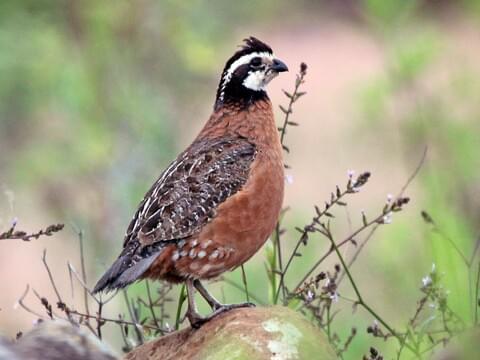
The northern bobwhite quail has a hopeful story.

This is a comeback story. When habitat is lost through ignorance, knowledge can restore that habitat — and the wildlife that used to live there. Humans can learn.

At the Washington Post, Dana Hedgpeth reports on a charming bird that says its name.

‘I don’t want to shoot them anymore — I just like to see them around and hear them whistle,’ said a landowner

“In his teen years, when Joe Graves heard the unique call of quail on his family’s 800-acre farm in rural Virginia, he and his brother Clark would often go out with their dogs and hunt them.

“But due to development and a shift in agricultural practices, the birds that once flourished on their farm in Halifax County and in the state have become harder to find. Now Virginia wildlife experts, hunters and landowners, including the Graves brothers — who are now in their 70s — are working to restore quail habitats in an effort to increase their population.

“ ‘We want to see quail be a part of the Virginia landscape, so we’re trying to create habitats that are critical for their survival,’ said Graves.

“Northern bobwhite quail, which are roughly the size of a softball, have short legs, short wings and don’t fly much. From afar they look like small, plump chickens that walk with their chests puffed out. Male quail typically have a white coloring on their neck area. Quail are best known for their unique sound — similar to a sharp whistle, which they make to communicate with each other and as a way to attract a mate.

“Because they spend most of their life on the ground — much like pheasants and turkeys — quail need a mix of habitat: Honeysuckle and briers provide protection from predators, and they walk among shrubby patches, between weeds and grasses, pecking at seeds. In the fall and winter, quail typically live in flocks, or coveys, with about a dozen birds. They roost in a circle, shoulder-to-shoulder to stay warm, and face outward to watch for predators.

“When a snake, hawk or raccoon approaches, a quail’s defense mechanism is to escape by leaping into the air, flying fast for a few seconds, though they don’t go far — about half the length of a football field. The longer they’re in the air, the more exposed they are to a predator. …

“Quail habitats have been ruined by several factors, including encroaching development and farming practices that have changed because many landowners want neat, well-kept fields between planting seasons. Justin Folks, a wildlife biologist for the Virginia Department of Wildlife Resources, said simply, ‘Quail like weeds and brush, and farmers don’t.’

“Hudson Reese, 84, who owns 1,000 acres in Halifax County, said as a teen, he could regularly find eight coveys of quail on his farm, and now that’s down to one or two. ‘People have tractors, bush hogs and mowers now,’ Reese said. ‘They want to keep their property looking like a golf course. You don’t have quail on a golf course.’ …

“With the destruction of their habitats, the quail population in Virginia has plunged nearly 80 percent since the 1960s, and so too has interest in hunting them. …

“Nationally, experts said quail were once in the mid-Atlantic region, Southeast and Midwest but are now considered one of the top birds suffering a major population decline.

“ ‘It’s amazing we have any because our environment of modern, manicured land doesn’t suit them,’ [John Morgan, director of the National Bobwhite & Grassland Initiative at Clemson University] said. ‘They’re just hanging on and slowly slipping away.’

“While northern bobwhite quail are not considered an endangered species, they are a ‘species of concern,’ according to Jay Howell, a wildlife biologist and small-game project leader who works on the quail recovery team for the Virginia Department of Wildlife Resources. He is worried that continued population declines could make them even more rare.

“Over the past 13 years, Virginia wildlife officials have made a concerted effort with hunters and more than 3,300 landowners to revive their population, and there are signs of success. Howell said the state’s quail population, though still low, is starting to reach equilibrium, and the rate of decline is slowing.

“Landowners are trying to improve quail habitat through controlled burns of forest areas. That process gets rid of pine needles, leaf debris and dead vegetation, leaving more easily walkable areas for quail. The more open ground encourages the growth of new plants and seeds and attracts insects — all of which in turn appeal to quail.

“There are similar efforts in neighboring Maryland. Officials have conducted timber harvests and controlled burns in Pocomoke State Forest since 2013, and last year quail were heard for the first time in decades, according to a 2022 report by the National Bobwhite and Grasslands Initiative, a group that promotes quail conservation.

“Overton McGehee, who owns 150 acres in Virginia’s Fluvanna County, is also working with state wildlife experts to bring quail back.

“ ‘Quail are one more of the species in Virginia that we don’t want to see disappear,’ he said. ‘They’re like a canary in a coal mine,’ he said. ‘If we don’t have the right habitat for quail, then we probably don’t have the right habitat for a variety of birds and pollinators — from whippoorwills and goldfinches to monarch butterflies and bumble bees.’ ”

When I was a kid, I was surprised that organizations of people who fish and hunt were great supporters of conservation, but it stands to reason they need places to hunt. Today I’m grateful for this example of how very different ideologies can work together for common goals.

More at the Post, here.

Read Full Post »

Photo: Bobby Bascomb.
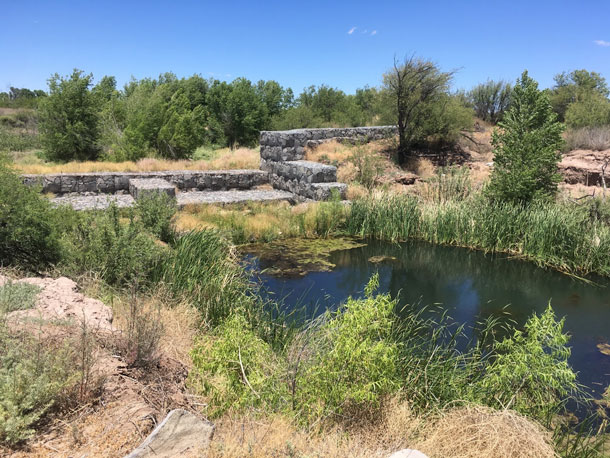
Gabions are baskets of rocks that Valer Clark places in stream beds to hold onto infrequent and precious rainfall at her ranch in Agua Prieta, Mexico.

Today I’m passing along some ideas for conserving water in dry areas. They come from a rancher in Mexico but could work elsewhere.

At the environmental radio show Living on Earth, “Bobby Bascomb visits acclaimed land preservationist Valer Clark at her ranch, Cahone Bonito, in Agua Prieta, Mexico. Valer has been a steward of dried-up lands in Mexico and the southwestern US since she purchased this property in the 1970’s, and she’s dedicated herself to finding ways to restore and maintain it. …

“BOBBY BASCOMB: For a couple months each year the region is awash with water from the seasonal monsoons. The normally dry river beds fill with flood water and swell to create habitat for all manner of water birds and amphibians. The watery paradise is short-lived though, and most of those streams dry up in a matter of weeks. But that wasn’t always the case. A network of streams, rivers and wetlands once crisscrossed the landscape. In fact, more than 150 years ago, around the time of the Civil War, people in the region struggled with malaria, a mosquito-born illness typically associated with tropical wet climates. Last year, I went to Mexico and I found a ranch owner that’s working on ways to keep some of that water on the land longer.

“My journey starts at the Gadsden Hotel in Douglas, Arizona. … The opulence of the hotel hints at an earlier time of prosperity and wealth. Valer says the whole region, north and south of the border, was made rich more than 100 years ago by the same things.

“VALER CLARK: This was copper, cotton, and cattle. The three Cs, you know, all in the early 1900s.

“BASCOMB: Those three Cs made a lot of money but heavily degraded the land. Before the arrival of settlers the region didn’t have much water but there were some dense grasslands. Forests grew alongside rivers that meandered across the open landscape. And wetlands popped up every 20 or 30 miles along those rivers. But when Valer first visited back in the 70s, decades of mining and agriculture left the arid soil dry and cracked, few trees remained and the river beds were deeply eroded.

“Valer [and] her husband at the time were traveling in Mexico and fell in love with the austere land. The wildness of the open parched landscape drew them in.

“CLARK: We just came across this ranch, by accident. And he said, Well, why don’t we bid on it, and I bid so low, I didn’t think we’d ever get it. … When I got here and started seeing the lack of water and seeing the situation, what it looked like, and the hills were bare, and there was no grass. And I thought I wonder if you could make a change. …

“BASCOMB: Valer eventually bought and rehabilitated some 150,000 acres of land in northern Mexico and the Southwest US. [Her] work here has been transformative, says Ron Pulliam.

“RON PULLIUM: There are four great geological forces: there’s volcanism, plate tectonics, there’s erosion. And there’s Valer. …

“BASCOMB: Ron is an ecologist, formerly with the US Department of Interior, and founder of the nonprofit Borderlands Restoration Network. … I pile into a pickup truck with Ron. Valer, in her own truck, leads the way out of Douglas, Arizona and across the border to Agua Prieta, … We leave behind the maquiladora factories in the duty-free trade zone of Agua Prieta and drive an hour southeast to Valer’s ranch. Pavement and two-story buildings give way to dusty soil and brittle pale green grass. To me, as a New Englander, the landscape looks rather inhospitable, but Ron says this is prime cattle grazing territory.

“PULLIAM: Generally speaking now, the stocking ratios are on the order of one cow to one hundred or two hundred acres in this area. And then think of around the turn of the century, 100 times that number of cows. … If you put hundreds of cows out on a small area here you basically reduce all the ground cover. So, when the rain comes it just runs off the land rather than being caught up in the vegetation.

“BASCOMB: And keeping that rainwater on the land is the fundamental key to what Valer is doing to rehabilitate her property. More water will mean more grass and trees, habitat for the wildlife that was once common here. … She takes me on a walk around her property. …

“CLARK: This is what we call a gabion, which is a wire basket that is filled with rocks. …

“BASCOMB: They’re about 3 feet tall, some just 5 or 6 feet wide, others more than a hundred feet across. Valer and her crew have built more than 20,000 of them on her property. They all sit in riverbeds which are dry most of the year until the monsoon rains come. That’s when the gabions get to work. They slow down the water rushing through the river bed so silt can accumulate behind them, like a sponge.

“CLARK: And that sponge holds the water. And so the water, instead of just whipping through fast, when it rains, 30% of it’s held back and goes into the ground. And so it filters down very slowly. …

“BASCOMB: Those pools of water are home to insects, birds, rare frogs, and endangered fish species.

“CLARK: And trees, all these trees coming up, they’re a result of having water here. … Some of them grow 10 feet a year. … We’ve seen ocelot, we’ve seen bobcats and lions and bears and coatimundis and javelinas, ring tailed cats.”

More at Living on Earth, here.

Read Full Post »

Photo: Stanley Forman.
A bear seen in Middleton in August represents the surprising Massachusetts black-bear comeback.

I’m sure you know it’s Fat Bear Week and time to vote on your favorite grizzly based on how successful the bear has been fattening up to hibernate.

Everybody loves bears — almost as much as dinosaurs. The advantage is that bears are still around. In fact, in today’s story we learn about a bear comeback. One caveat: it’s not safe to play with bears, anymore than with dinosaurs.

Billy Baker at the Boston Globe reports that black bears, once nearly extinct in Massachusetts, have staged their comeback without any help from wildlife officers.

“The story of the black bear that is coming to a suburb near you begins one day in the fall of 1969,” Baker reports, “when two bears showed up along a road in the northern Berkshires, in the tiny town of Florida, and appeared to be drunk.

“Back then, black bears were barely hanging on in Massachusetts, at the losing end of a 12,000-year fight with humans and [development], and the tiny population of survivors was believed to live somewhere nearby, along the border with Vermont.

“Still, these two bears were different. They hung around, happy for the crowds that came to watch them. Game wardens said the ‘tipsy bears,’ as they became known, were drunk from too many apples fermenting in their bellies.

Wardens even went so far as to briefly close the hunting season to give the bears time to ‘sober up’ before someone took a shot at them.

“Ultimately, it turned out the bears were comfortable around humans because they were semi-tame, raised by a guy in Shelburne as a roadside attraction for his gift shop on the Mohawk Trail, then released when he couldn’t afford to feed them. But all the fanfare forced the state’s wildlife experts to acknowledge that ‘we didn’t really know anything about bears in Massachusetts, other than there are some,’ according to Jim Cardoza, then a young biologist for MassWildlife.

“Thus began a five-decade effort to understand and conserve black bears in the state, a project that has succeeded beyond most people’s wildest dreams. …

“Starting in 1970, just after the ‘tipsy bears,’ the state shortened the bear hunting season to a single week, from 10 weeks since the early 1950s, and tasked Cardoza with figuring out how many bears lived in Massachusetts and the history that brought them there.

” ‘I was able to learn that at the time of Colonial settlement, bears were widespread in the state, except for very Southeastern Massachusetts and the islands,’ Cardoza said. But as settlement advanced inland to the Connecticut River Valley and the Berkshires, bears saw their forest habitat turned into farms, and their status lowered from king to pest; farmers could, and still can, legally kill any bear destroying their crops, at any time.

“They nearly disappeared in the decades between the end of the Civil War and the onset of hunting regulations in the early 20th century. By the mid-1970s, when Cardoza finished his study, he estimated there were only 80 to 100 bears in the state, all in the Berkshires. With such a small base, conservation goals were modest.

“ ‘The dream would have been to see them get established in western Franklin and Hampshire County,’ he said, but worried even that was a stretch. It wasn’t.

“By the early 90s, bears were thriving in the western part of the state, with an estimated 1,000 throughout the Berkshires and nearby hill towns. At the time, the Connecticut River was seen as a natural barrier to the east for all but the most adventurous young males. Yet over the next three decades, as the bear population in Western Massachusetts became more concentrated, females crossed the river in search of unoccupied territories, spreading throughout Central Mass., crossing endless natural and man-made barriers, including highways here, there, and everywhere.

“By 2011, the last time the state attempted a proper bear census, their numbers had grown to about 5,000. More incredible was how they were doing it, showing time and again an incredible resourcefulness, especially among breeding females, who figured out how to raise young in the woods behind a Target. …

“ ‘The expansion east is just a natural phenomenon of population expansion,’ said John Organ, a conservation scholar and former University of Massachusetts professor who recently joined the board of MassWildlife. ‘Bears are territorial, so those bears that are entering the population are looking for new unoccupied territories, and much of the state has returned to habitat where they can do quite well, even into Eastern Massachusetts.’ …

“If there’s anything biologists have learned in these five decades of studying bears, it’s that there is no overestimating their resourcefulness.

” ‘We had very little to do with [their success]. Bears are just extraordinary animals,’ said John McDonald, a professor at Westfield State University who did his doctoral research on Massachusetts black bears three decades ago. ‘What’s been satisfying is to see our predictions come true.’ …

“They’ve learned to live around people almost entirely without incident. The reverse cannot be said; with no natural predators, humans remain the chief source of bear mortality. Between 25 and 65 are killed by vehicle collisions each year, according to state environmental police records, but the actual number is likely much higher.

“Hunters now have three seasons when they can target black bear, but it remains a fringe pursuit, largely due to the extreme difficulty, after the state outlawed the use of traps, snares, bait, and dogs to hunt them. Most of the 200-250 bears harvested each year are by opportunistic hunters in tree stands waiting for deer.

“Yet as the number of bears increases, MassWildlife has stepped up efforts to get more hunters into the woods pursuing them, both to thin the population and to keep them from losing their fear of humans. …

“The best way to keep the bears at bay is exceedingly simple, specialists said: Get rid of birdfeeders and put electric fencing around chicken coops. They are the two biggest attractants to backyards and hardly anyone had either a few decades ago.”

Oh, dear! Give up my birdfeeder? I am a block from the train and my town is almost urban. Probably I will never see a bear here. If I do, good-bye birdfeeder. More at the Globe, here.

Read Full Post »

Photo: Regional Conservation Needs.
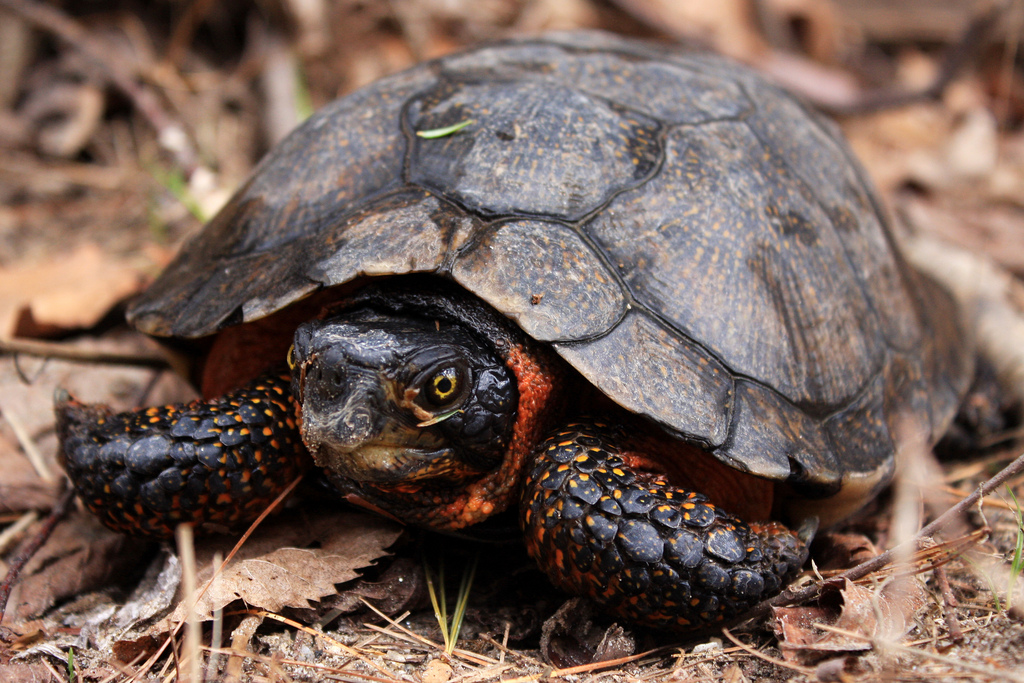
Wood turtles are said to make nice pets. Too nice for their own good: their reputation leads to poaching.

There’s a popular kind of turtle that’s losing habitat, like so many species these days. Here’s a story about a man who was determined to preserve his own land for these turtles, particularly for one specimen — his friend Stumpy.

Sadie Dingfelder reports at the Washington Post, “With his brow furrowed, Tom, 70, stomps on the damp leaf litter — thump, thump, thump, thump — and then we wait. A woodpecker cackles; bluebells tremble in the breeze. Stumpy is nowhere to be found. …

“A wild turtle, Stumpy has been meeting up with Tom in these West Virginia woods every spring for more than 30 years. Like his fellow wood turtles, Stumpy spends his winters brumating (the reptile equivalent of hibernating) in a clear, fast-moving stream. As days warm, he emerges from his aquatic home and roams the nearby woods in search of food ⁠— first tender leaves, then flowers and, finally, berries. Early on Stumpy’s circuit is Tom’s former house, where the human tosses him huge, juicy strawberries — months before the wild berries are ready to eat.

“It took a while for Tom to figure out Stumpy’s species, because Stumpy’s shell is worn and scuffed. Usually, wood turtles have gorgeous shells that appear to have been hand-carved from mahogany.

‘He was already old when I first saw him, so he must be really old now,’ says Tom. ‘Of course, he could say the same thing about me.’

“Curious, personable and uncommonly pretty, wood turtles are highly sought-after as pets, says Andrew Walde, chief operating officer of the Turtle Survival Alliance, whom I called after my first visit to Stumpy Acres. This combination of characteristics makes them vulnerable to poachers, who sell them as pets. ‘Whenever anything gets published about a particular population, that population is done for,’ Walde says. (To protect Stumpy and the other wood turtles from poachers, we aren’t publishing his exact location or his human friends’ last names.)

“The eastern panhandle of West Virginia is among wood turtles’ last strongholds, Walde says. Across most of their range, they are in steep decline. Indeed, half of the world’s 357 turtle species are threatened with extinction due to habitat loss, poaching and other human pastimes. This is an animal that survived not one, but two mass-extinction events. …

“Tom no longer lives in Stumpy’s territory. Last spring, he sold his house and moved to a more remote spot, high on a nearby mountain. He loved being by the river, but the pandemic brought an influx of tourists and new homeowners. The noise and traffic were bad enough, but worst of all was their aggressive landscaping.

‘One family clear-cut all the way down to the river,’ Tom says. ‘They didn’t want any brush or shrubbery — they are afraid of snakes or this or that — and they kinda destroyed the habitat.’

“He was determined to find a buyer who would be a good steward of the land — not just for vague environmental reasons, but for Stumpy’s sake, too. Luckily, the first person who came to look at the house fit the bill. Tommy, a 28-year-old computer programmer from D.C., told Tom about the sea turtle conservation project he had worked on one summer in Costa Rica, and he promised not to clear-cut the property to get a river view or better internet access. …

“Does Stumpy represent nature? Survival against the odds? The relentless ravages of time? Tom dismisses all these possibilities. ‘Stumpy is just Stumpy,’ Tom says. ‘He’s an individual. That’s what makes him special.’

“We drive to Tommy’s house and commence stomping. Stumpy should really be out of hibernation by now, but he’s not in their meeting spot near a large fallen tree, and he’s not on the berm by the river. He’s not basking on his basking log, and neither is he napping beneath the papaw trees. …

“If you spend time outdoors, you’ll eventually see something brutal, and you’ll be forced to accept it with equanimity, because nature is obviously beyond our judgment. Loving nature also feels a little tragic, because no matter how much you care about it, it will never care about you.

“But perhaps I’m wrong, because suddenly I hear a rustle in the leaves. Tom makes an excited sound. ‘There he is!’ he says, pointing. About 10 feet in front of us, a little brown turtle is running on his tiptoes — who knew turtles could run? And even though I’m closer and I’m also carrying strawberries, he’s beelining straight to Tom. …

“Pretty soon, Stumpy’s face is covered in pink pulp, and he’s got half a strawberry hanging from his chin. His species may be threatened, his habitat may be imperiled, but in this moment Stumpy seems delighted. ‘He’s such a messy eater,’ says Tom. ‘Do you see that? What a pig.’ Stumpy usually hangs out for a few weeks, making intermittent appearances, Tom says. As to where he goes afterward, no one knows — but Tom has a theory. ‘Maybe he visits lots of people, up and down the river, and we all think he’s ours.’ ”

More at the Post, here.

Read Full Post »

Photo: Living Habitats and National Wildlife Federation.
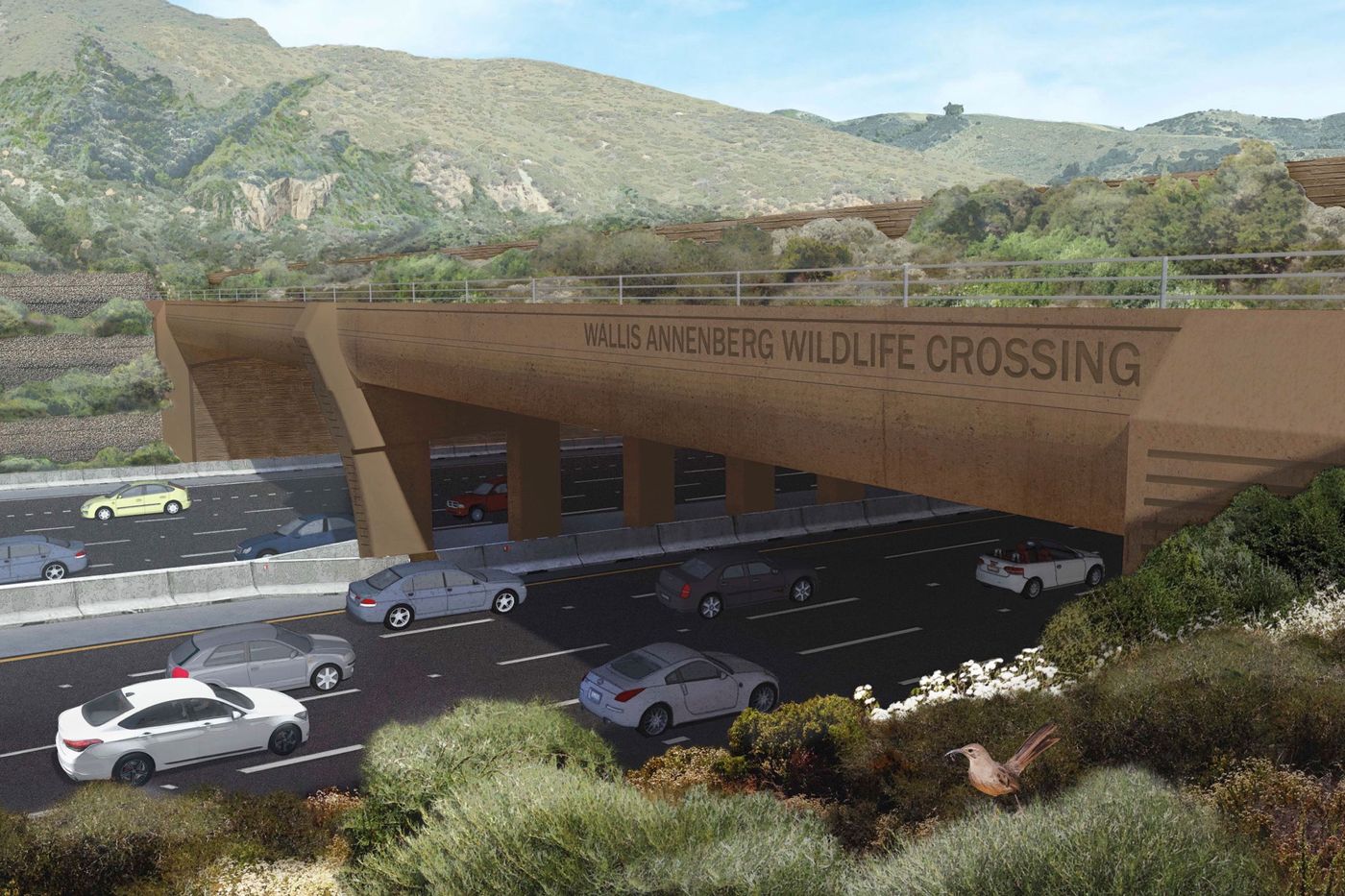
The Wallis Annenberg Wildlife Crossing should be completed over the Route 101 freeway on the western side of Los Angeles County by 2023, allowing mountain lions to easily cross eight lanes of traffic.

As the human species userps habitat from other species, there are at least a few efforts to mitigate the damage. At Curbed, Alissa Walker reports on California’s plans to build a freeway overpass that by 2023 should substantially expand the habitat of local mountain lions. It will be the largest animal crossing anywhere.

At the Guardian, Patrick Greenfield has an overview of safe passages around the world for elephants, tigers, sloths, and more.

Greenfield writes, “From a tiny railway bridge for dormice in the UK to elk, deer and bears benefiting from a slew of new animal crossings in Colorado, wildlife bridges are having a moment. …

“In January [2021], we reported on Sweden’s plans to build a series of ‘renoducts‘ to help reindeer traverse the country’s main roads. … In southern California, work is due to begin on the largest wildlife bridge in the world in 2022, to connect isolated mountain lion populations north of Los Angeles that are becoming dangerously inbred. [And there’s $350m of the] $1.2tn infrastructure package for wildlife bridges to lessen the multibillion annual cost of collisions.

” ‘Ten years ago, wildlife bridges were experimental. We didn’t know whether they would work or not. Now they’ve shown they get huge reductions in collisions. In some cases, 85% to 99% reductions,’ says Rob Ament, a road ecology expert at Montana State University. ‘You can design them for many species. Even out in the plains, we’re getting moose crossings in North Dakota.’

“Wildlife bridges are found on every continent: there is an elephant underpass near Mount Kenya; the Netherlands has a network of ecoducts that may help the country’s first wolf pack in more than 140 years gain a foothold across the densely populated country; suspended water pipes are helping Java’s endangered lorises; [below]; and a bison bridge may help the animals cross the Mississippi.

“Here are five projects from around the world helping animals make their way.

“Alligator Alley, Florida. The 129km (80-mile) stretch of road between Naples and Fort Lauderdale bisects the Everglades, an enormous wetland that is home to thousands of alligators, deer and the endangered Florida panther. … Dozens of underpasses and fencing help wildlife navigate the road.

A camera trapping exercise found panthers, black bears, skunks, deer, bats, birds and even fish use the crossings. …

” ‘Fencing is critical along Alligator Alley. It is a 10ft-high chain link fence with three-strand barbed wire on top. That’s to keep the wildlife off the roadway and on the crossing,’ says Brent Setchell, a design engineer at Florida Department of Transportation, who identifies potential crossing sites by monitoring road collisions with panthers and bears. ‘The fascinating thing is we just started monitoring the crossings four or five years ago. We found an abundance of wildlife.’

‘The tunnel of love’ on the Great Alpine Road, Australia. Stretching through the Victorian Alps in south-east Australia, the Great Alpine Road posed an existential threat to a colony of critically endangered mountain pygmy possums. Even though there are only about 150 of the marsupials on Mount Little Higginbotham, testing revealed genetic differences between sub-groups separated by the road, which are also threatened by fire, disappearing food sources and invasive species. Conservationists decided to build a ‘tunnel of love’ between the isolated groups to improve mixing and strengthen their chances of survival. …

“India’s tiger corridor. India’s first dedicated wildlife underpasses were a hard-fought victory for environmental campaigners. The nine crossings in the Pench tiger reserve were a court-ordered mitigation measure on the country’s longest road, the 4,112km National Highway 44, which runs down the middle of the country. Collisions with big cats still happen on the multi-lane motorway, but environmentalists say the underpasses have highlighted the need for more wildlife crossings on India’s road network. A 2019 camera trapping exercise found at least 18 species use the crossings, including tigers, wild dogs, sloth bears, civets and leopards. …

“Bhutan’s elephant crossing. Nearly 700 Asian elephants roam Bhutan’s forest on the eastern edge of the Himalayas. The small Buddhist country sandwiched between China and India is known for its dramatic landscapes and environmental leadership, as one of the few carbon negative countries in the world. On the 183km east-west motorway, Bhutan’s first elephant underpasses were constructed to help the threatened animals move through the landscape. Monitoring from 2015 to 2017 found that 70 groups of elephants were recorded near the passes, with three-quarters passing through the structures.

“Sloth bridges in Costa Rica. Wildlife passes are not always bridges or underpasses. In Costa Rica, canopy bridges are used to help sloths, monkeys and other wildlife cross roads to combat collisions, dog attacks and electrocutions on power lines. The rope bridges, which cost about [$200], are installed by the Sloth Conservation Foundation in areas where rainforest has been interrupted by human development on the country’s Caribbean coast. Crossing roads is often deadly for the slow-moving creatures and the canopy bridges also help combat inbreeding. ‘People look at them and think that they’re so poorly equipped to survive because you see them crossing roads and trying to move around and they look so awkward and useless,’ Rebecca Cliffe, head of the Sloth Conservation Foundation, told Bloomberg earlier this year. ‘But if you put them in a well-connected rainforest, then they are masters of survival.’ ”

Read the Guardian story here. Want more? The article at Curbed on the world’s longest animal bridge is here. Both of these publications are free although donations are encouraged.

Read Full Post »

Older Posts »