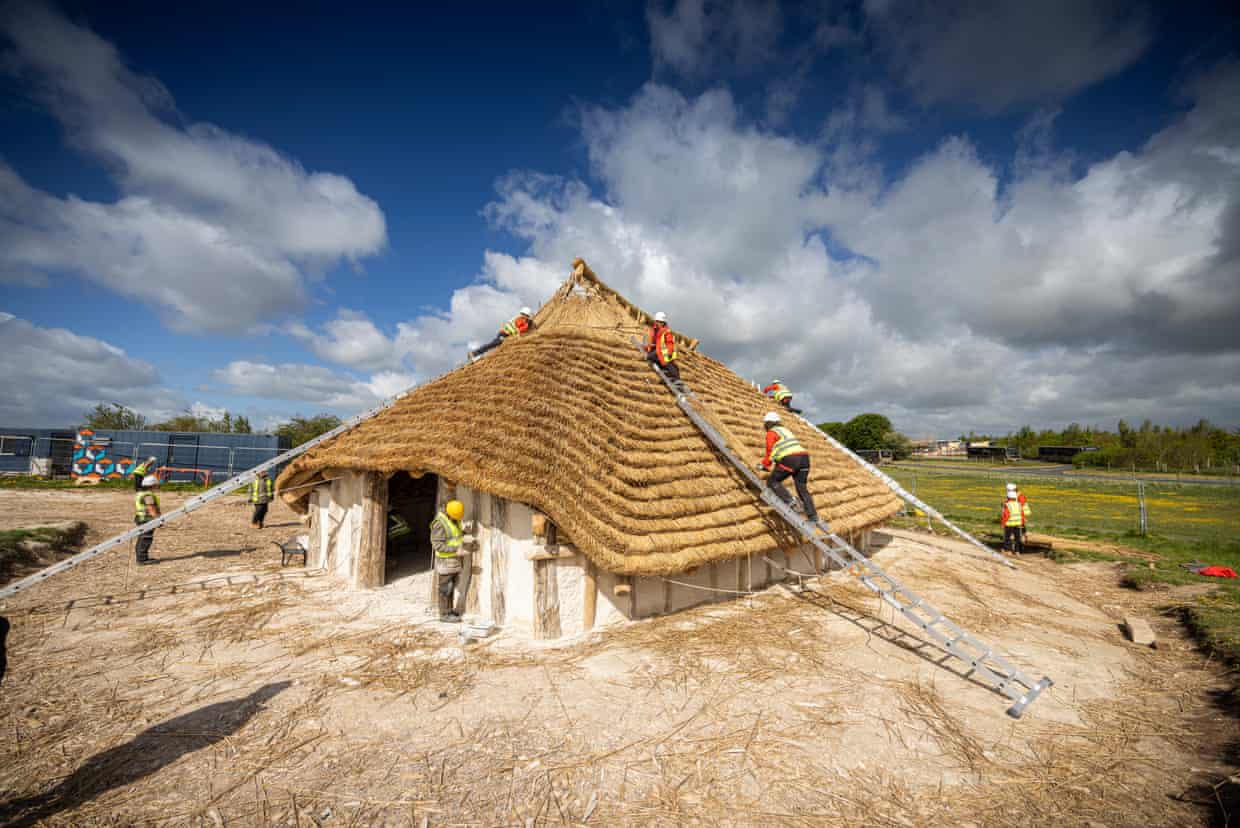
Photo: Christopher Ison/English Heritage/PA.
The seven meter-high Kusuma Neolithic Hall is based on archaeological evidence of a large prehistoric structure that was discovered two miles away from Stonehenge.
(My older granddaughter noticed I had no post on July 17, which meant that I broke my streak: 15-plus years of daily posts. It had to happen someday. Here is the entry I finished but somehow failed to schedule.)
There’s always something new to learn about the people who built Stonehenge.
Jamie Grierson wrote recently at the Guardian about a nearby structure from the same time period.
“It may have been a place for ceremony or a barn for pack animals. It could have been a place for weary laborers to rest their heads. Or perhaps there was no building at all.
“English Heritage has unveiled a 7-meter-high [~23-foot] reconstruction of what a 4,500-year-old Neolithic hall may have looked like at Stonehenge, offering visitors a glimpse into the lives of the prehistoric builders who raised the world’s most famous stone circle.
“The £1m [~$1.4 million] project is in its final stages of construction near the Stonehenge visitor centre on Salisbury Plain. Built entirely by hand over nine months by a team of more than 100 volunteers, the Kusuma Neolithic Hall will open to the public this summer before transforming into an immersive, historical learning space for schools.
“The structure is based on the archaeological footprint of an anomaly known as Durrington 68, a unique ‘square in the circle’ building discovered two miles away near Woodhenge, another Neolithic site. First excavated in 1928 by Maud Cunnington, and re-examined in 2007 by the Stonehenge Riverside Project, the original site features a horseshoe-shaped ring of post holes surrounding four massive internal roof support pillars.
“Because centuries of ploughing destroyed the original floor and hearths, its true purpose remains a mystery. However, discoveries of animal bones and grooved ware pottery nearby point towards winter feasting, ritual gatherings or even communal storage.
“Luke Winter, an experimental archaeologist, who analyzed European Neolithic carpentry and prehistoric pollen data to design the hall, explained the construction’s rigorous scientific backing.
“ ‘Everything in that building was growing in this landscape 5,000 years ago,’ he said. …
“Like the nearby stone circle, the building perfectly aligns with the winter solstice. ‘When we got the frame in on the solstice morning, I was here, and I stood there, my shadow cast on the middle post at the back,’ Winter said.
“The project forms the first phase of an educational expansion by English Heritage. Alongside the hall, a new learning center housing the Clore Discovery Lab and Weston Learning Studio is scheduled to open by the end of 2026. …
“ ‘The Neolithic period is firmly on the national curriculum,’ [Iona Keen, English Heritage’s head of learning and interpretation] said, adding that the interactive hall would allow children to ‘step back in time’ by gathering around an open fire to make prehistoric cheese and pinch pots. …
“Stonehenge’s curator, Win Scutt, said Stonehenge and the barrows and dwellings surrounding the Neolithic monument were driven by a ‘society that wanted connection. … This whole thing is about social society, not science,’ with the camaraderie and ‘feeling of belonging’ generating the motivation to build. Rather than being ‘obsessed with individualism’ like modern society, these groups used massive cooperative projects as a medium for collective representation, he said.”
More at the Guardian, here. No firewall. Please consider donating to the Guardian.


