Feeds:
Posts
Comments

Posts Tagged ‘health’

Erik keeps tabs on health-related issues and just got an email that he thought would interest me.

He was right. I was reminded of a visit from a “laugh doctor” back when I was editor of Minnesota Physician. The laugh doctor showed us how we could get ourselves laughing. He talked about the endorphins produced and how good they were for health.

In apparent agreement, a Rhode Island clinic that serves low-income people is putting on a comedy show May 7 and inviting neighbors, patients — anyone who is up for a good laugh and willing to make a donation.

The comedy will be performed by the Providence Improv Guild at the Fête Event Space in Olneyville, RI, May 7th, 5:30 – 8:30 p.m.

Says the Laugh for Health invitation, “Suggested donation for tickets: Giggle $10 – Chuckle $ 25 – Laughing out Loud $100 ($150 per couple). Belly Laugh $1000 and above! …

“Here at Clínica Esperanza/Hope Clinic — we believe in laughter and joy. We celebrate health. We laugh at ourselves. We applaud our patients. We take joy in volunteering. We consider health, not wealth, to be the most valuable asset in our community.

“And since many of our neighbors do not have the resources to receive proper healthcare, or don’t know where to be seen for their health problems and how they’ll manage to pay for it all, we are there for them.

“Clínica Esperanza/Hope Clinic welcomes our neighbors in need with open arms. We celebrate health, and with our patients, laugh out loud as they make the journey from illness to good health. … It’s simple to RSVP – click here.”

To learn more about Hope Clinic, visit http://www.aplacetobehealthy.org.

Photo: Hope Clinic
Members of the Providence Improv Guild will perform at a benefit for Clínica Esperanza/Hope Clinic May 7.

Read Full Post »

Germany is opening a 62-mile bike path. That’s what I call a long ride.

See what Charlie Sorrel (“previously found writing at Wired.com, Cult of Mac and Straight No filter”) has to say about it at Fast Company.

“Germany, the country famous for its speed-limit free stretches of Autobahn, is building car-free Autobahns for bikes. The Radschnellweg (‘fast bike path’) RS1 runs 62 miles between the cities of Duisburg and Hamm, passing through eight other cities along the way.

“Cycling is big and growing in Germany. In Berlin, the school run is more likely to consist of a parent on a bike with two child seats than in an SUV. Cycling is done for pleasure, but also as just another way to get around. Cities already have extensive cycling infrastructure, and in the countryside, you can find wide, smoothly-paved bike highways.

“According to the ADFC, one kilometer of road costs around €10 million. One kilometer of bike highways runs to just €1.8 million. …

Says the ADFC’s (Germany’s bike association and advocate group) Ulrich Syberg. ‘When it’s ready, the world will look upon the Ruhr area and wonder, how many people can you motivate to switch from the car to the bike, and much this will relieve congestion in city centers.’

“How much congestion? A 2014 study into the lane by the Federal Ministry of Transport says that it could replace up to 52,000 car journeys. But that’s not even the best part. The study also estimated that savings due to the health benefits of cycling could be as much as five times the cost of building the bikeway.” More here.

Photo: via Radschnellweg
The Radschnellweg (“fast bike path”) RS1 runs 62 miles between the cities of Duisburg and Hamm, passing through eight other cities along the way.

Read Full Post »

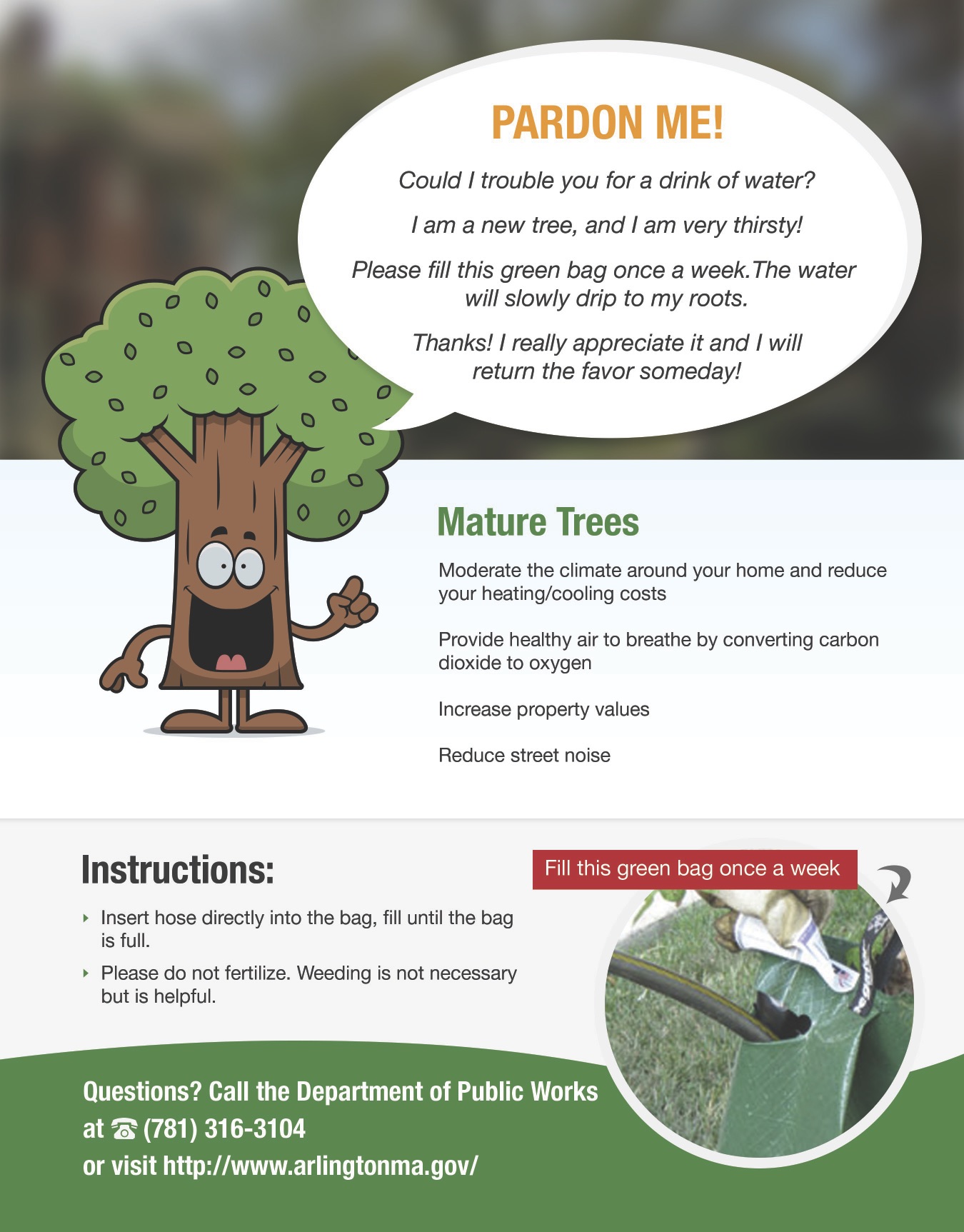
John (founder of www.mistersmartyplants.com) is a member of Arlington Tree Committee. He figured out a way to use Google Maps to identify heritage trees in town and got a sign made to encourage residents to adopt a thirsty tree.

Now that so many urban and suburban areas have taken down their trees to make construction projects easier, people are realizing what they’re missing.

Many have noted that trees play a role in residents’ mental and physical health.

University of Washington research social scientist Kathy Wolf has studied the health aspects and also has economic arguments. She has shown that an “urban canopy”  makes local shopping more agreeable for customers and lends vitality to downtown business districts. Read what she has learned, here.

Chris Mooney at the Washington Post notes other research. “In a new paper published Thursday, a team of researchers present a compelling case for why urban neighborhoods filled with trees are better for your physical health. The research appeared in the open access journal Scientific Reports.

“The large study builds on a body of prior research showing the cognitive and psychological benefits of nature scenery — but also goes farther in actually beginning to quantify just how much an addition of trees in a neighborhood enhances health outcomes. The researchers, led by psychologist Omid Kardan of the University of Chicago, were able to do so because they were working with a vast dataset of public, urban trees kept by the city of Toronto — some 530,000 of them, categorized by species, location, and tree diameter — supplemented by satellite measurements of non-public green space (for instance, trees in a person’s back yard). …

“Controlling for income, age and education, we found a significant independent effect of trees on the street on health,” said Marc Berman, a co-author of the study and also a psychologist at the University of Chicago. “It seemed like the effect was strongest for the public [trees]. Not to say the other trees don’t have an impact, but we found stronger effects for the trees on the street.”

Thank you to my high school classmate, Susie from Cleveland, for putting the Washington Post article on Facebook.

071115-Arlington-Tree-Watering

Read Full Post »

A New York Times blog called “Well” recently had a post on the value of a walk at lunch.

Gretchen Reynolds wrote, “A new study finds that even gentle lunchtime strolls can perceptibly — and immediately — buoy people’s moods and ability to handle stress at work.

“It is not news, of course, that walking is healthy and that people who walk or otherwise exercise regularly tend to be more calm, alert and happy than people who are inactive. But many past studies of the effects of walking and other exercise on mood have focused on somewhat long-term, gradual outcomes, looking at how weeks or months of exercise change people emotionally.”

For a new study “published in the Scandinavian Journal of Medicine and Science in Sports … researchers at the University of Birmingham and other universities began by recruiting sedentary office workers at the university.

“A common problem with studies of the effect of exercise on mood, [researcher Cecilie] Thogersen-Ntoumani said, is that they rely on recall. People are asked to remember hours or days after the fact how exercise made them feel.” So participants were given a special app to record how they felt in the moment.

“On the afternoons after a lunchtime stroll, walkers said they felt considerably more enthusiastic, less tense, and generally more relaxed and able to cope than on afternoons when they hadn’t walked and even compared with their own moods from a morning before a walk.” More here.

Makes perfect sense to me. But until we get rid of some of our ice, my own lunchtime walks are indoors in South Station — under the disconcerting fish eye of the suspicious security guard.

Photo: Getty Images
I love the cobblestones here. But where I am at lunchtime may not get down to cobblestones for many, many weeks.

Read Full Post »

Research highlighted at Pacific Standard sometimes strikes me as a little lightweight, but I am happy to endorse a study that Tom Jacobs covered recently, because I have some personal experience. It’s about the benefits of both cultural activities and Internet usage for older people.

Jacobs writes, “A new British study of people age 50 and older finds a link between health literacy — defined as ‘the capacity to obtain, process and understand basic health information’ — and two specific behaviors: Regular use of the Internet, and participation in cultural activities.

“ ‘Loss of health literacy skills during aging is not inevitable, a research team led by Lindsay Kobayashi of University College London writes in the Journal of Epidemiology and Health. ‘Internet use and engagement in various social activities, in particular cultural activities, appear to help older adults maintain the literary skills required to self-manage health.’

“The study used data on 4,368 men and women age 50 or older who participated in the English Longitudinal Study on Aging. Their health literacy was measured two years after they joined the project, and again five years later, by having them read a fictitious medicine-bottle label and then answer four reading-comprehension questions.”

I am over 50, enjoy cultural events and the Internet, and understand most medicine bottle labels. So there you go. It’s all true.

Get the key details at Pacific Standard.

Photo: Popova Valeriya/Shutterstock 

Read Full Post »

Boston Medical Center is an inner-city hospital that takes a special interest in immigrants and the poor. It also treats patients holistically, offering a referral service for problems that get in the way of good health.

With the support of the City of Boston, Boston Medical Center has added a new item to its medicine cabinet: bike sharing.

Catalina Gaitan writes at the Boston Globe, “The City of Boston has announced a program to subsidize bike-sharing memberships for low-income residents, in partnership with Boston Medical Center.

“The program, ‘Prescribe-a-Bike,’ would allow doctors at Boston Medical Center to prescribe low-income patients with a yearlong membership to Hubway, a bike-share program, for only $5.

“Participants would be allowed unlimited number of trips on the bicycles, provided they use them for 30 minutes or less at a time. They will also be given a free helmet, the mayor’s office said in a joint statement with Boston Medical Center.

“ ‘Obesity is a significant and growing health concern for our city, particularly among low-income Boston residents,’ said Kate Walsh, chief executive of Boston Medical Center, in the statement. …

“Statistics show that 1 in 4 low-income residents in Boston is obese, almost twice the rate of higher-income residents, the statement said.

“To qualify for the prescription, participants must be 16 years or older and be enrolled in some form of public assistance, or have a household income of no more than four times the poverty level.”

More here.

bikes-in-boston

Read Full Post »

In the UK, retirees are taking up ballet.

Emma Ailes writes for BBC Scotland, “In a locker room at Scottish Ballet, a group of dancers are lacing up their ballet shoes. Only one thing marks them out from the other dancers here. These dancers are all in their 60s and 70s.

“Today, they are rehearsing ‘Swan Lake.’

“Among them is Alicia Steele. She danced when she was young. Now, nearly 80, she’s back.

” ‘I went to keep-fit classes, but I found them a bit boring,’ she says. ‘And I love the music with the piano. I just love it and it makes you feel a bit young again. It doesn’t make you look young, but it makes you feel young inside.’

“There’s been a 70% jump in the number of adult dancers signing up for classes in recent years, according to the Royal Academy of Dance. Some, like Alicia, danced when they were young. Others are complete beginners.

“Their oldest ballerina is 102.” More.

I took ballet both as a child and as an adult. But for now, I am sticking with tai chi chuan. Today the teacher had me learning complicated new moves with the advanced students. “You deserve it,” he said to me.

I’m not sure how to take that.

Photo: BBC Scotland

Read Full Post »

If sitting at work is bad for you, try walking at work. That’s what I did today, and I think I’m hooked. I love the “walk station.”

I’ve been to physical therapists for my back off and on for years, and they tell me to get up from the computer every 45 minutes and move. I try to remember. After all, I’ve always known I think better if I walk.

Turns out it’s not just me that shouldn’t sit too long. Lately the news has been full of warnings.

Here, for example, is what Olivia Judson, at the NY Times blog The Opinionator, has to say.

“It doesn’t matter if you go running every morning, or you’re a regular at the gym. If you spend most of the rest of the day sitting — in your car, your office chair, on your sofa at home — you are putting yourself at increased risk …

“You may think you have no choice about how much you sit. But this isn’t true. Suppose you sleep for eight hours each day, and exercise for one. That still leaves 15 hours of activities. Even if you exercise, most of the energy you burn will be burnt during these 15 hours, so weight gain is often the cumulative effect of a series of small decisions: Do you take the stairs or the elevator? Do you e-mail your colleague down the hall, or get up and go and see her? When you get home, do you potter about in the garden or sit in front of the television? Do you walk to the corner store, or drive?” Etc.

Getting back to my workplace: we have three walk stations that we can reserve by sending them an invitation through our e-mail system. I was lucky when I went to the walk station today, because two experienced colleagues were walking and working on the other machines. They explained how you clear the speed setting from the last person, how you raise and lower the work table, how you set your walk speed.

At first I kept slipping backwards, but I think I’ll improve with time, and I’m already signed up to go back there with my laptop on Monday. Too bad we can’t have one all the time.

Photos: Zack Canepari for The New York Times, left; Chris Machian for The New York Times, right
Sitting at a cubicle vs. walking while clicking and talking.

Read Full Post »

I’m hoping someone from my deep past will remember the name of the man who used to travel to my growing-up neighborhood in a blue-painted school bus to sell fruits and vegetables. The name “Mr. Mackey” is clawing itself to the surface, but I may have that wrong.

I had flashbacks about the huckster today when I read about the Fresh
Truck, an old idea made new in a time of urban food deserts and locavore sensibilities.

Christina Reinwald wrote the story for the Boston Globe.

“A food bus began to roll down the city’s streets Thursday. The retrofitted school bus, the brainchild of a Boston start-up called Fresh Truck, is expected to visit Boston communities that don’t have nearby grocery stores, selling fruits and vegetables.

“Fresh Truck founders Josh Trautwein and Daniel Clarke, recent Northeastern University graduates, came up with the idea last year and work full time now to serve neighborhoods in need of more healthful food options. …

“Fresh Truck raised more than $32,000 from over 300 contributors to its Kickstarter crowdfunding campaign earlier this year. It also received private donations to get started.

“Starting Monday outside the New England Baptist Hospital in Roxbury, Fresh Truck will sell its produce for about 20 percent less than average grocery prices, Trautwein said.

“Avoiding the traditional brick-and-mortar shop eliminates many operating costs for Fresh Truck.” More.

Photo: Yoon S. Byun/ Globe Staff
A food bus run by Fresh Truck, a Boston start-up, aims to serve neighborhoods in need of more healthful food options.

Read Full Post »

Once upon a time, mine workers were paid in paper chits that could be redeemed at the company store. (Remember the song “Sixteen Tons,” by Tennessee Ernie Ford and “I owe my soul to the company sto’ “?)

A while back I saw a story in the NY Times about refugee gardens, and there was a picture of someone using wooden coins to buy produce. It turned out that people were not being paid in wooden coins as miners were paid in paper. Instead, the City of San Diego was encouraging poor residents to pursue good nutrition by giving them wooden coins for shopping at farmers markets.

The coins were really just a footnote to Patricia Leigh Brown’s story, which focuses on a national movement to help immigrant farmers get back into the occupation they know best.

“Among the regular customers at [San Diego’s] New Roots farm stand are Congolese women in flowing dresses, Somali Muslims in headscarves, Latino men wearing broad-brimmed hats and Burundian mothers in brightly patterned textiles who walk home balancing boxes of produce on their heads.

“New Roots, with 85 growers from 12 countries, is one of more than 50 community farms dedicated to refugee agriculture, an entrepreneurial movement spreading across the country. American agriculture has historically been forged by newcomers, like the Scandinavians who helped settle the Great Plains; today’s growers are more likely to be rural subsistence farmers from Africa and Asia, resettled in and around cities from New York, Burlington, Vt., and Lowell, Mass., to Minneapolis, Phoenix and San Diego.”

Read how it works. (And click on the slide show to see the wooden coins. My eyes were drawn to them because my father’s favorite “good-bye” line to toddlers always was, “Don’t take any wooden nickels”!)

Photo: Sandy Huffaker for The New York Times
Khadija Musame, right, with a customer from Somalia at the New Roots Farm stand in San Diego.

Read Full Post »

It should be obvious that being out in nature is good for us, but today it often seems like a foreign concept.

“Take Two Hours of Pine Forest and Call Me in the Morning” is a lovely article, coming to you from Outside magazine. (I got the link from Andrew Sullivan’s blog.)

“These days, screen-addicted Americans are more stressed out and distracted than ever. And nope, there’s no app for that. But there is a radically simple remedy: get outside. [Outside magazine’s] Florence Williams travels to the deep woods of Japan, where researchers are backing up the surprising theory that nature can lower your blood pressure, fight off depression, beat back stress —  and even prevent cancer. …

“If the Japanese embrace of forest therapy can be attributed to one man, it’s [Yoshifumi] Miyazaki, a physiological anthropologist and vice director of Chiba University’s Center for Environment, Health, and Field Sciences, located just outside Tokyo.

“Miyazaki believes that because humans evolved in nature, it’s where we feel most comfortable, even if we don’t always know it. …

“Miyazaki has taken more than 600 research subjects into the woods since 2004. He and his colleague Juyoung Lee, also of Chiba University, have found that leisurely forest walks, compared with urban walks, yield a 12.4 percent decrease in the stress hormone cortisol, a seven percent decrease in sympathetic nerve activity, a 1.4 percent decrease in blood pressure, and a 5.8 percent decrease in heart rate. On subjective tests, study participants also report better moods and lower anxiety. …

“The science is so convincing that other countries are following Japan’s lead in studying and promoting nature as a cure. Lee just got hired away by the South Korean government, which is pouring more than $140 million into a new National Forest Therapy Center, expected to be completed in 2014. Finland, an empire of boreal spruce and pine, is also funding numerous studies. ‘Japan showed us that there could be cooperation between forestry and medical fields,’ says Liisa Tyrvainen of the Finnish Forest Research Institute” More.

Apart from just feeling better when I step outside for my walk and breathe the outdoors air, I note that a couple of my hero writers (Dickens and Asakiyume) are known for ruminating on long walks. Nature nourishes creative thought. P.S. Asakiyume also takes great pictures on her walks and posts them on her blog.

May 27, 2013, update from John: Mononoke creator Hayao Miyazaki on how he thinks about his art, here.

Photograph: Casey Yee
Mononoke forest, Yakushima Island, a
long the Kusugawa Trail. This is the forest that inspired Ghibli studio’s “Princess Mononoke.”

[University of Chiba‘s Yoshifumi Miyazaki] believes that because humans evolved in nature, it’s where we feel most comfortable, even if we don’t always know it. “Throughout our evolution, we’ve spent 99.9 percent of our time in natural environments,” he says. “Our physiological functions are still adapted to it. During everyday life, a feeling of comfort can be achieved if our rhythms are synchronized with those of the environment.”

To prove it, Miyazaki has taken more than 600 research subjects into the woods since 2004. He and his colleague Juyoung Lee, also of Chiba University, have found that leisurely forest walks, compared with urban walks, yield a 12.4 percent decrease in the stress hormone cortisol, a seven percent decrease in sympathetic nerve activity, a 1.4 percent decrease in blood pressure, and a 5.8 percent decrease in heart rate. On subjective tests, study participants also report better moods and lower anxiety.

Read Full Post »

Cathryn J. Prince has a story in the Christian Science Monitor about a research ecologist who thinks we can have our cake and eat it too: that is, have a strong economy and a sustainable future.

Prince writes, “As head of the conservation biology department at Antioch University New England in Keene, NH, [Tom] Wessels isn’t against chopping down trees or clearing land to farm. He just wants to see more people embrace sustainable forest and land management practices.

“Wessels, trained as a research ecologist, says economics plays as much a role in protecting the environment as does saving energy. Think how the adoption of fair trade principles for growing and selling coffee have changed the economics of that industry. Forests can benefit in the same way.

“ ‘Adam Smith, the father of modern economic theory, wrote about this in Wealth of Nations,’ Wessels says. ‘People will act out of self-interest, but they can support each other doing it. …

“Market forces can help to conserve forests and farmlands, says Wessels, who also serves as chair of the Vermont-based Center for Whole Communities. …

“ ‘We are incredibly frivolous about our energy use,’ Wessels says. ‘Any organism or population that is energy wasteful gets selected out of the system.” Charles Darwin explained this when he wrote about survival of the fittest, he says. Survival of the fittest also means survival of the most adaptable, and the most energy efficient, he says. …

“Partnering with more than 400 organizations in 47 states, Whole Communities aims to help create communities where people rely on each other for their food and other needs.

“For example, Wessels would like to see Detroit become a different kind of urban jungle. The city has lost about 50 percent of its population since the late 1980s. Empty lots abound. But now community gardens have begun to fill these open tracts with food crops. The Detroit Food Policy Council and the city government want to make Detroit food secure by 2020 – meaning that everyone will have access to sufficient, safe, and nutritious food.

“ ‘A lot of our focus is around food security,’ Wessels says. ‘Detroit will become a model for other urban areas.’ ” More here.

Photograph: Cathryn J. Prince

Read Full Post »

In last week’s Boston Globe, Bella English had a sad-happy story about a nonprofit that reaches out to families impoverished by their children’s cancer, Family Reach Foundation.

English writes that Carla Tardif once promised a friend who died of cancer that she would help families who were struggling with a child’s treatment. In searching for the best way to do that, she ended up at Family Reach, which helps families get back on their feet. The stories she hears are heartbreaking.

“ ‘On top of watching your child suffer, people get threatening eviction notices, calls from collection agencies, or they can’t make a car payment so they lose the car and can’t get their child to treatment,’ says Tardif.

“Medical hardship is one of the leading causes of personal bankruptcy in the nation,” writes the Globe‘s English. “According to a Harvard University study, more than 62 percent of bankruptcies are caused by overwhelming medical expenses — and cancer is the most costly. ‘It’s because a parent needs to stop working to take care of the child,’ says Tardif. ‘The average cancer treatment without complications is two years.’ …

“ ‘What I’ve learned is that it’s about so much more than money,’ Tardif says [of her work]. ‘That someone cares and gets it, has a really profound effect on families.’

“Just ask Raquel Rohlfing, who at fund-raisers tells her story. Homeless, with a son [Mikalo] who had undergone a bone marrow transplant, she got a call from Tardif, who arranged payment for a year’s rent on a Winchester apartment, not far from her own house.”

In Rohlfing’s case, Tardif really went the extra mile.

English writes, “Tardif’s husband, a builder, put in a new kitchen and floors, and fixed the bathroom in the apartment. But Tardif wasn’t finished. She is also executive director of Music Drives Us, the nonprofit founded by car magnate Ernie Boch Jr. Rohlfing needed a job, and Tardif needed help, so she hired her at Boch’s foundation.”

Read more.

Read Full Post »

Feel like dancing? I’d love to see this sort of thing in every town in America. How nice it would be to walk a few blocks on a summer evening, and there it would be!

“It’s Monday night in Boston. Under the locust trees of the Blackstone Community Center surrounded by basketball games, tight parking spaces, and children playing, the dance floor heats up in the park as the night air cools off and the stars come out.

“Many salseros in Boston claim [Salsa in the Park] as their favorite event of the city, not only for the appeal of dancing outside ‘al aire libre’, but as a way to give back to the community. Dancers volunteer all summer, donating their time to teach dance lessons to adults and children, set up dance floors, assist with event staffing, maintain a recycling program, and clean up from the festivities until late into the evening.

“This event is staffed in collaboration with the Mayor’s Program of Cambridge, and the Blackstone Community Center Youth Summer Programs. We emphasize healthy lifestyle choices for the individual and the community, through dancing, healthy food options, and greening our event as much as possible with educational materials and interactive information.”

Read Full Post »

Like most Americans, I don’t know much about the multibillion-dollar Farm Bill, which is up for renewal this year. NYU professor Marion Nestle talks about its enormous complexity in the Boston Globe.

“I’d like to bring agricultural policy in line with health policy. Health policy tells us that we ought to be making fruits and vegetables inexpensive.” Her biggest concern is that those who produce and sell processed foods benefit most from current policy, which has had the effect of lowering prices for processed food and increasing the prices for the fresh fruits and vegetables people really need.

I have blogged before about the related problem of “food deserts,” localities where there is no reasonably priced market and people end up eating too much junk food. (Check out this post and this one.)

Today I would also like to point you to a National Public Radio story by Nancy Shute.

“Increasingly, metropolitan areas are creating or bolstering their food policies, recognizing the need to ensure that healthful and affordable foodstuffs are available for residents. Baltimore fashioned a food policy initiative in 2009 which involves multiple city departments and an advisory group of over 30 organizations. Priorities included the reduction of ‘food deserts’ and the support of projects that allow low-income residents to order groceries online and pick them up at the local library. New York and San Francisco have also created their own food policy initiatives, and mayors across the U.S. have met to launch a food policy task force.”

“In the summer, Shirley and Ewald August grow blueberries at their Windsor Mill, Md., farm and sell at Baltimore farmers markets.” Photograph: Amy Davis/MCT/Landov

Read Full Post »

« Newer Posts - Older Posts »