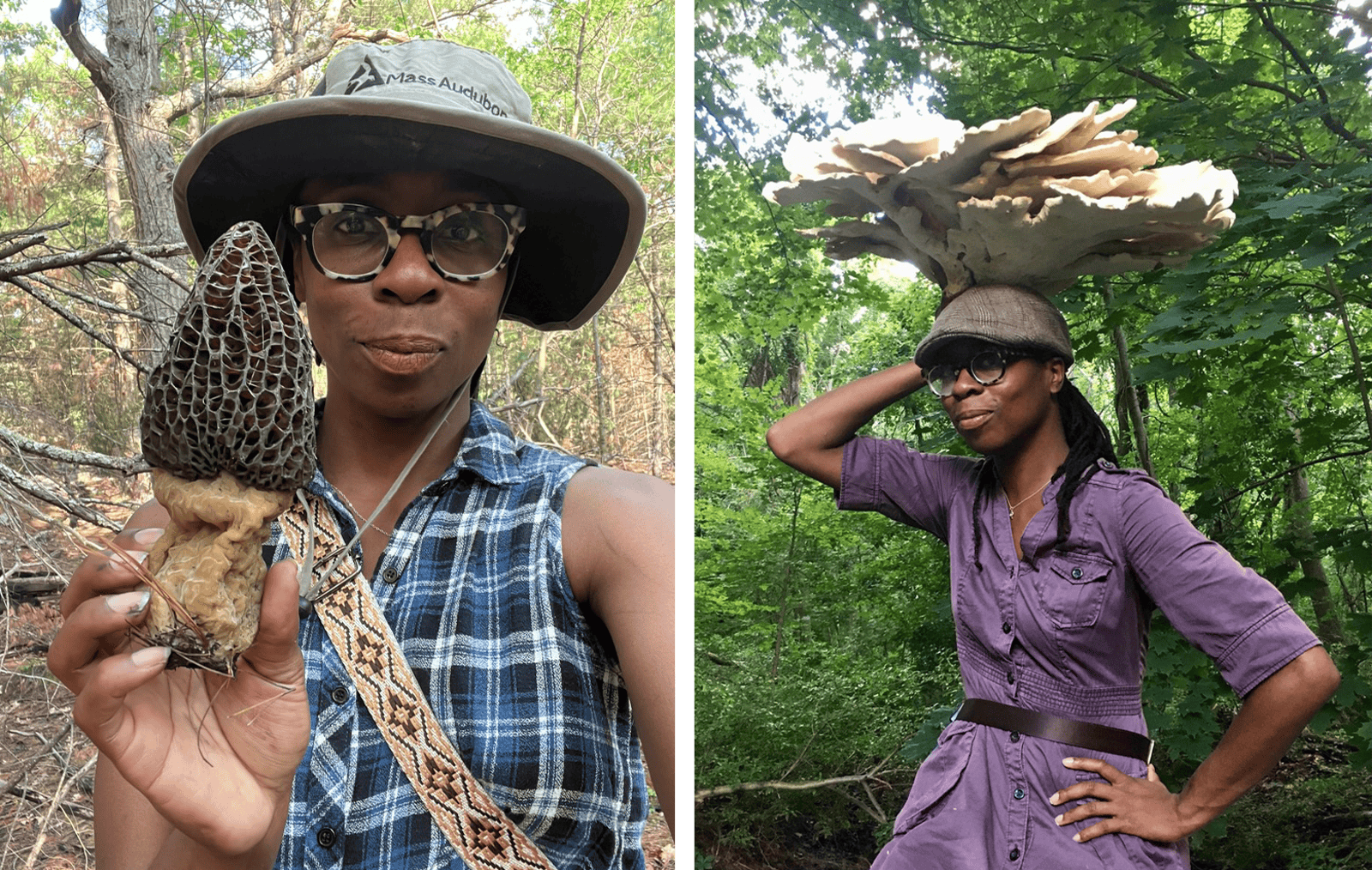
Photo: Maria Pinto.
Maria Pinto with a burn morel mushroom, on Boston’s North Shore; right, Pinto with a Berkeley’s polypore mushroom in Weston, Massachusetts.
Last fall, when my second cousin stopped by with his mycologist friend, they inspired in me a new interest in wild mushrooms. I don’t feel motivated enough to find and eat them, but I am definitely paying more attention to what pops up after a rainstorm.
Melissa Hellmann wrote recently at the Guardian about some serious mushroom hunters.
“On her typical walk in the woods in Newton, Massachusetts, something stopped Maria Pinto in her tracks. She spotted what appeared to be a glowing yellow figure with a metallic sheen among the pine needles on the ground. It was the first time Pinto was enthralled by a mushroom – the American yellow fly agaric, a poisonous fungus. …
“ ‘It forced me down on my knees to examine it further, because it didn’t look real,’ Pinto, a naturalist and writer, said. … More than a decade later, Pinto has dedicated much of her life to mycology, the burgeoning study of fungi.
“As a Jamaican American woman, Pinto stands apart in the mostly white hobby through her pursuit of exploring the African diaspora’s connection to mushrooms. In her recent book, Fearless, Sleepless, Deathless: What Fungi Taught Me about Nourishment, Poison, Ecology, Hidden Histories, Zombies, and Black Survival, Pinto interviewed Black people who are growing and documenting mushrooms throughout the Americas. …
“Pinto, Elan Hagens in Oregon and William Padilla-Brown in central Pennsylvania are a few Black mushroom enthusiasts contributing to the understanding of fungi and humans’ connection to them. …
“Fungi are essential to ecology. They act as decomposers, and without them, the earth would be filled with dead trees and animals. Mycorrhizal fungi, which grow in the soil, supply plants with additional nutrients and water. The organisms also have a storied role in African diasporic history and culture. Prior to the outlawing of slavery in the US, Africans who were escaping enslavement would consume an underground fungus to sustain themselves. …
“Pinto became interested in mushrooms by accident. As a self-identified ‘swamp rat; a little feral child,’ growing up in Jamaica and south Florida, she loved to pick fresh food from the ground and off of trees. A few years after her run-in with the yellow mushroom in 2013, there was a mushroom boom in the north-east US [that] reminded Pinto about her love for foraging wild food. …
“A friend of Pinto’s who grew up foraging for mushrooms in Poland taught her the basics of identifying and cataloging fungi. Pinto’s social media posts were soon filled with pictures of mushrooms she’d foraged, leading the University of North Carolina Press to approach her to write a book about fungi. …
“In her book, Pinto wrote about self-emancipated formerly enslaved people who consumed Wolfiporia, a fungus that produces an underground source of nutrients that resemble a small coconut. The organism uses the ball of nutrients to sustain itself during drought and cold seasons. Native Americans would help the formerly enslaved people find and dig up the underground food source.
“ ‘In these moments of being on the run and not wanting to make smoke or any indication that you’re hiding away,’ Pinto said, ‘this nutrient store underground, especially in the wintertime, was probably an incredible food.’ The fungi is still used in traditional Chinese medicine to promote calmness and to enhance digestion. …
“Hagens’ interest in mushrooms began when she was a young child growing up in the Portland [Oregon] area, where she attended environmental and nature-based classes starting in elementary school. Her love for fungi grew when she became a dog trainer in her mid-20s, after she participated in a CBS reality television show called Greatest American Dog in 2008. Though she didn’t win the $250,000 promised for the owner of the best-trained dog, Hagens learned during her time on the show that dogs could be trained to locate the odoriferous underground fungi, truffles. ‘This whole boom of truffles in Oregon and the United States was at its infancy,’ Hagens, 41, said.
“In 2011, she created her company, Temptress Truffles, to sell truffles found by her dogs and other foragers. … In her decades of foraging for mushrooms, one spring day in 2020 stands out the most.
“While walking her dog alongside a river in the Portland metropolitan area, she spotted a large oyster mushroom twice the size of her face. The fan-shaped fungi with sprawling gills rested high up on a tree several meters away. ‘People were walking and jogging in front of me, and nobody is seeing this mushroom,’ Hagens said. ‘It’s like the biggest thing I’ve ever seen in my life. I’m flipping out.’ It began raining, so Hagens returned in the evening to remove the mushroom with a knife fastened to a long stick. She cut out the parts infested with worms and made the rest into potstickers that she ate for days.”
Lots more at the Guardian, here. The Guardian is free, but please consider donating. They are doing an amazing job.