
Feeds:
Posts
Comments

Posts Tagged ‘illinois’

Did you ever hear the 1946 song by the Nat King Cole Trio about America’s most iconic highway? The chorus went, “Get your kicks on Route 66.” To some extent the song captures the feeling people have for a road that traverses both land and history.

Route 66 is celebrating a big birthday now, and the Christian Science Monitor thought it would be interesting to look at the changes the highway has seen over 100 years. In today’s feature, Joliet, Illinois, is the focus.

Reporter Harry Bruinius writes, “Route 66 courses through American cities that once flourished before their economies faded or were forced to change. The story of Joliet, Illinois, reflects the high times, the hardships and the reinvention found along the century-old road.

“Just a few blocks from the Old Joliet Prison, Johnny Williams is standing outside a tire shop, waiting for a repair. He’s a lifelong resident of the Joliet area, a father of six and grandfather of 10, and he remembers back in the day when the prison was part of the economic engine that made Joliet run.

” ‘I remember when people used to sit out there visiting their people — on the buses, you know?’ Mr. Williams says. ‘I have plenty of people whose parents and uncles worked there.’ He gestures toward the 25-foot limestone walls, still topped with razor wire. …

“He still marvels at how the once imposing former state penitentiary has been transformed over the past decade. Today, the people walking through its front gate are not prisoners or staff, but tourists and Americana-lovers there to have fun and celebrate the centennial of Route 66 [which] passed right by the prison until 1940, when it was rerouted a few blocks away.

“The prison once housed such infamous criminals as Richard Speck, James Earl Ray, and John Wayne Gacy. But since its closing in 2002, it has become a site for concerts, film viewings, and today, an event dubbed ‘The Big House Ballgame.’ …

“Said Quinn Adamowski, board president of the Joliet Area Historical Museum, which now runs the prison … ‘This site defined Joliet in many ways.’

“After the prison closed, it was largely abandoned, becoming a liability, Mr. Adamowski said, especially in this neighborhood. ‘In 2017, 160 years after the first inmates arrived, we had the opportunity to wonder what this site could be,’ he added. ‘It was our time – Joliet’s time – to define the prison.’

“The Big House Ballgame on April 30, which is the 100th anniversary of the naming of Route 66, featured the Joliet Slammers, a Frontier League baseball team co-owned by actor Bill Murray. It was one of the featured events of an official five-city kickoff of events commemorating America’s ‘Mother Road.’

“Baseball was also part of the prison’s history. In the early 20th century, inmates formed teams and played games against one another and against outside clubs, part of a broader effort to impose order and routine within the prison. The Big House Ballgame today is, in part, an attempt to revive that history — to connect the present moment to something that had once taken place on the same ground.

“What happened to Joliet over the past century and a half happened, in some version, to nearly every city and town along Route 66. The collapse of jobs, travel routes, and movement west – and then a slow, uncertain reinvention.

The roadway passed through working America, and then through America after the work was gone.

“The centennial is, among other things, a celebration of the survival of places that kept going when the economies that made them no longer existed.

“Curt Herron, like Mr. Williams, has lived in this part of Will County his whole life, growing up in Lockport, a small city just north of Joliet, before spending 45 years as a sports reporter covering high schools, the Slammers, and nearly every sporting event in between. Today, he’s an assistant at the historical museum.

” ‘Joliet was always a real working-class city,’ he says, pausing in the shadow of a guard tower as a group of tourists photographs the cellblock windows above him. ‘The second biggest steel city in the country after Pittsburgh. And then, on top of that, a prison city — two prisons within a few miles of each other, running simultaneously for 75 years.’ …

“The steel came first. In 1869, the Joliet Iron and Steel Works opened along the Des Plaines River, drawing on the region’s coal deposits and its limestone – the same blue-gray stone that built the prison walls, the same stone quarried from just beneath the city’s surface – to become one of the great industrial enterprises of the Gilded Age. At its height, it employed thousands of men and produced the railroad rails that stitched together the American West.

“Joliet drew immigrant workers in successive waves: first, the Irish who dug the Illinois and Michigan Canal in the 1840s; then Poles, Lithuanians, and Eastern Europeans; then African Americans and Mexican migrants during the First World War. Joliet became, in the language of the era, a city of stone and steel – proud of its grit and defined by its labor, built on the conviction that hard work in a hard place was its own kind of American story.

“Then, the steel left. By the early 1980s, the mill was gone, and the unemployment rate in Joliet climbed to 26% – among the highest of any city in the United States at the time. The limestone ruins of the ironworks sat empty along the river for decades, overgrown with vegetation, before the Forest Preserve District turned them into a heritage trail. A wound, converted in time into a park.

“ ‘We were known for being a hardscrabble place,’ Mr. Herron says. ‘Because of the prisons and the steel industry and a lot of working-class people. But that’s not a bad thing. It’s also led to a real competitive area – a lot of great athletes have come from here, a lot of people who’ve gone on to do remarkable things.’ ”

More at the Monitor, here. No firewall. Consider an inexpensive subscription.
Read Full Post »

Photo: National Park Service.
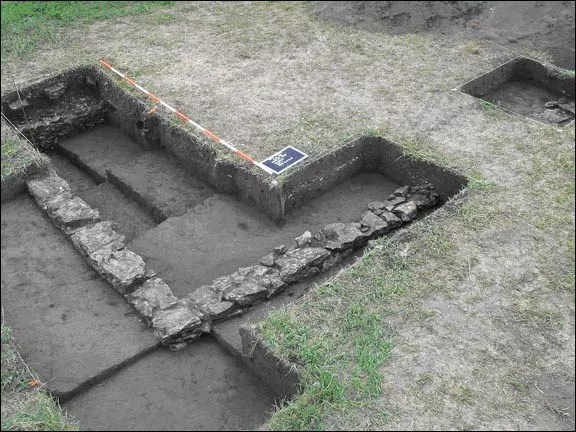
Archeological excavation at an integrated community founded by a former slave in Illinois.

One thing that’s interesting about today’s story is that political differences have been set aside in the restoration of an abandoned town founded by a former slave.

Mark Guarino reports at the Washington Post, “As a child, Gerald McWorter often listened to his father tell stories about growing up on a farm in New Philadelphia, Ill. But it wasn’t until a family reunion in 2005 that he fully understood the significance of his lineage: Everyone he met that day was in some way affected by the story of his great-great-grandfather, a formerly enslaved man from Kentucky who in 1836 became the first Black person in the United States to plat and register a town.

“During Frank McWorter’s time, New Philadelphia thrived as a community where Black and White families worked together as equals long before the Civil War was fought to preserve — or destroy — that possibility.

“The revelations have emerged through three decades of archaeological digs, advocacy by local community members, oral histories and family artifacts, letters and research. The momentum was enough to convince Gerald McWorter, 78, that he and other relatives ‘had an obligation’ to ‘become stewards of a story that is bigger than us.’

“Also convinced was Rep. Darin LaHood (R-Ill.), who introduced a bill that would designate the site of New Philadelphia a part of the National Park Service. …

“Frank McWorter was born into slavery in 1777 and grew up on a Kentucky plantation. His White enslaver, George McWhorter, was also his father. Frank was an entrepreneur of sorts whose father allowed him to earn wages outside his hours of slavery in a cave where he foraged and sold materials used for gunpowder.

By 1817, Frank had saved enough money to buy freedom for his wife, Lucy, who was pregnant with their fifth child. Two years later, he was able to buy his own freedom.

“Emancipating 15 other family members would follow, a process that lasted through 1857 — three years after the death of Frank, who came to be known as Free Frank. …

“ ‘It’s often hard for people to get out of their heads that it would take 40 years to buy your family back from slavery. It’s a really heroic story that captured the imagination,’ said Gerald McWorter, a professor emeritus at the University of Illinois at Urbana-Champaign, where he taught African American studies.

“The first person in the McWorter family to actively document Frank’s life was Gerald’s aunt, Thelma McWorter Kirkpatrick Wheaton, who collected family documents, letters and photos as well as interviewed older descendants. Her daughter used that material to write her doctoral dissertation about Frank McWorter, and the University of Kentucky Press published it as a book in 1983.

“Frank McWorter’s dream included buying his own land, and he eventually purchased 80 acres, sight unseen, in Pike County, Ill., along the Missouri border. It was thick prairie then, and the McWorters arrived in 1831 to clear it for growing crops and constructing a town. Descendants of McWorter remained in the area until the late 1990s.

“New Philadelphia existed for half a century. Named after the eastern metropolis that symbolized brotherly love for all races, it was a prosperous frontier town that had a post office, a school, a store, a blacksmith shop and two shoemakers, presumably to supply footwear for runaway enslaved people who passed through on their way to Canada. The town was home to as many as 29 households, and neighboring farmsteads used its services.

“But what distinguished the community was where it was located: just 20 miles from Hannibal, Mo., a bustling river town that served as a major site for auctions of enslaved people. Just over the Mississippi River, African Americans were human chattel and subject to horrific violence, but in New Philadelphia, they freely owned guns, earned good livings and worked the land with their White neighbors. …

“The renewed interest in New Philadelphia began in 1996 after a community group formed to enshrine McWorter’s story on a sign at a rest stop along a state highway next to the cemetery where he is buried. Group founder Phil Bradshaw, a farmer and longtime Republican who is White, said that early on, he would receive ‘nasty notes and nasty comments’ from townspeople about the advocacy. Eventually, those subsided. …

“The community group, the New Philadelphia Association, bought more than 30 acres that Frank McWorter had owned and allowed archaeologists from the University of Illinois and the University of Maryland to dig over several summers to unearth remnants of the town. Although no original buildings remain, the area has walking trails with smartphone-enabled kiosks that tell McWorter’s story. …

“For Gerald McWorter, the integrated town his great-great-grandfather built gives him hope.

“ ‘If New Philadelphia was possible, maybe [racial harmony in] America is possible,’ he said.”

More at the Post, here.

Read Full Post »

Cousin Claire sent me a good link. I had heard about the trend of tying farms to housing developments, but according to the Smithsonian magazine, Development Supported Agriculture is striking a chord with Millenials in particular.

Shaylyn Esposito writes, “A new fad in the housing world is a concept called Development Supported Agriculture (DSA), or more broadly, ‘agrihoods.’

“DSA is the child of Community Supported Agriculture (CSA), in which consumers pledge money or resources to support a farm operation, and in turn, receive a share of what it produces, but take the concept one step further by integrating the farm within residential developments. Instead of paying for access to a golf course or tennis courts, residents pay to be a part of a working farm—helping with the growing process and reaping the crops it produces. …

“The largest demographic of those trying to reconnect with the farm is Millennials, those born from the 1980s to the 2000s who ironically grew up farthest from the farm. As the average age of farmers continues to rise, it is this generation that is stepping in to fill the gaps.” More here.

Among the cohort of Millennial farmers are Sandy and Pat’s niece, now at the the Letterbox Farm Collective in the Hudson Valley. I blogged about her here and here.

Photo: Willowsford
This DSA community in Ashburn, Virginia, is hoping to fill 2,200 homes. Sounds like too many to be serious about the farming side of things.

Read Full Post »

The day after Thanksgiving is a day that many people’s thoughts turn from an unusually wonderful and gigantic meal to fitness.

In an increasing number of locales, people who have never worked out before are now working out with their dogs. Because dogs need fitness, too.

Bill Littlefield’s sports show on WBUR radio, which covers both traditional and offbeat sports, sends Only A Game‘s Karen Given to Hinsddale, Illinois, to interview K9 Fit Club president and founder Tricia Montgomery.

Says Montgomery, “K9 Fit Club is a place where pooches and peeps get together and have a healthy and happy lifestyle. We do exercises, we do workouts, we bond, we socialize and most of all we have fun.

“K9 Fit Club was originally developed in 2008 but we didn’t open the doors here until Aug 5, 2012. We started in Hinsdale, Illinois in our first location and now we have corporate facilities, we also have locations starting all the way from Monterrey City, Mexico, all the way to New York, into Raleigh- Durham, North Carolina, up into Florida, St. Louis, all across the country. …

“Our programs were developed by veterinarians, by personal trainers, by dog trainers, and by doctors and psychologists, actually. So we’re not just a bunch of people running around with a bunch of dogs jumping up beside us. Our programs have really been developed for people who have never worked out a day in their lives to people who are very, very fit. …

“I love what I do, how cool is this? I get to come to work every day with my dog and I get to have the coolest job working with dogs and people and helping change their lives and feel better about themselves.” More.

Photo: K9 Fit Club

Read Full Post »