Feeds:
Posts
Comments

Posts Tagged ‘indiana’

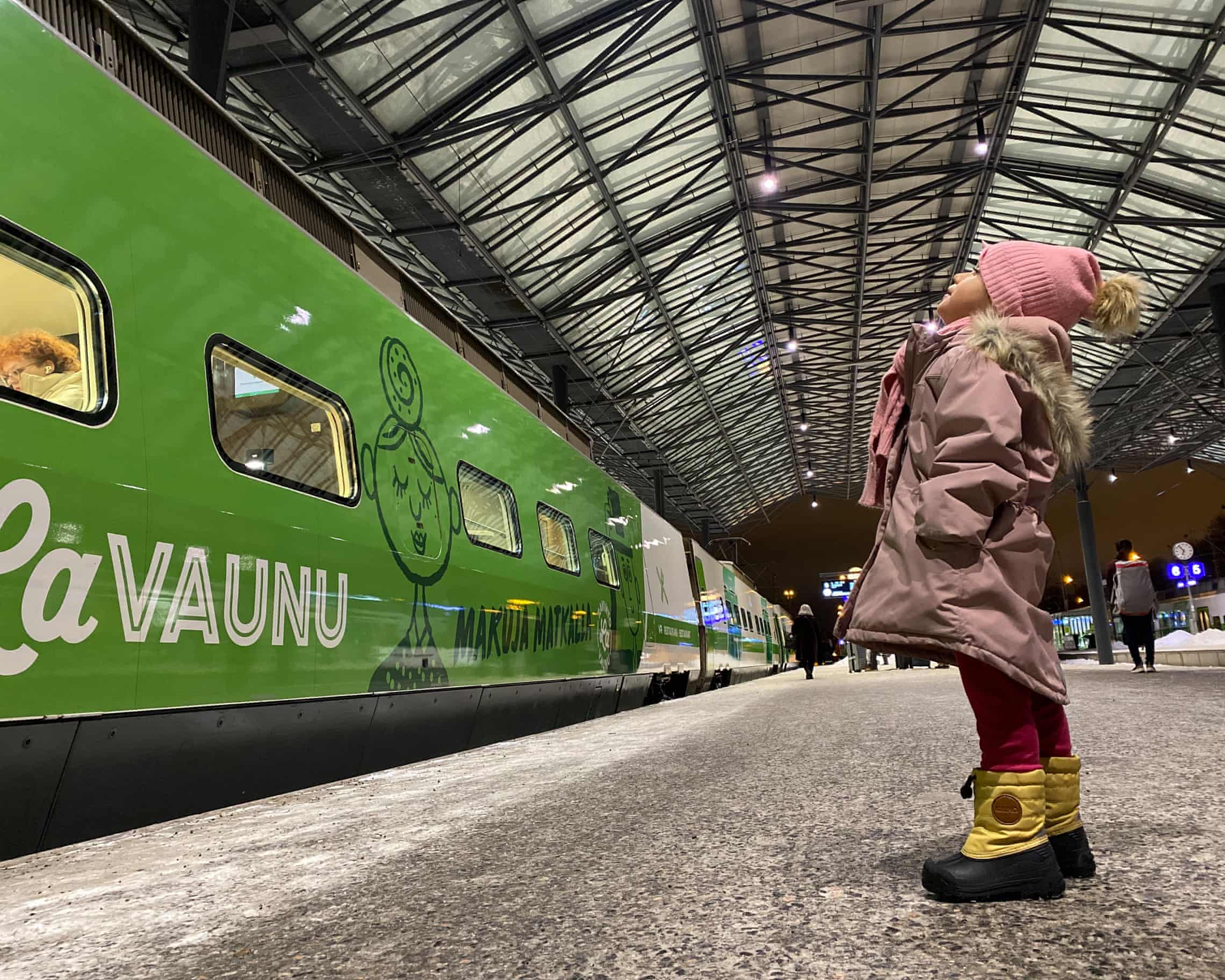
Photo: The Guardian.
The Santa Claus Express sleeper ready to leave Helsinki station on its journey north to Rovaniemi in Finnish Lapland.

When Suzanne and John were small, we somehow acquired a large poster of Finnish Lapland that purported to show the way to Santa’s headquarters. I had always assumed Santa lived at the North Pole, but I was beginning to learn about marketers with other ideas.

Natasha Geiling and Kayla Randall have the story at the Smithsonian magazine, starting with Alaska’s claim: “It wasn’t the actual North Pole. But the fact that it was over 1,700 miles from it, smack in the heart of interior Alaska, was a minor detail.

“When Bon and Bernice Davis came to Fairbanks in early April 1944, they weren’t looking for the North Pole. As they drove their rental car out of town, they had something else on their mind: finding 160 acres on which to make their homestead, something Alaska law allowed if they used the area for trading or manufacturing purposes. … In the summer, nearby streams might attract grayling fish and waterfowl, but in the snow-covered month of April, it was hard to see that potential. The area did boast one unique quality: consistently cooler temperatures, about seven to ten degrees colder than anywhere else in interior Alaska. …

“With its proximity to both the highway and Fairbanks, the Davis’ homestead soon attracted neighbors. … By the early 1950s, the homestead had also attracted the attention of the Dahl and Gaske Development Company, which purchased the land — nearly in its entirety — in February 1952. … If they could change the homestead’s name from ‘Davis’ to ‘North Pole,’ they reasoned, toy manufacturers would flock from far and wide. …

“Things didn’t go according to plan — even with its location right on Richardson Highway, the Alaskan North Pole was too remote to sustain manufacturing and shipping. However, part of Dahl and Gaske’s vision eventually did take shape at a local trading post, which became one of several places that claimed to be Santa Claus’ home during the 20th century. Now a tourist destination, the town of North Pole in Alaska calls itself the place ‘where the spirit of Christmas lives year round’ and boasts the Santa Claus House, a holiday-themed family business.

“The real Santa Claus — the historical figure upon which the legend is based — never lived anywhere near the North Pole. Saint Nicholas of Myra was a fourth-century bishop who lived and died far from the Arctic Circle, in what is now Turkey. Born into a wealthy family, Nicholas is said to have loved giving gifts. …

“Santa’s red robes and gift-giving habits were based on Saint Nicholas, but his chilly home base is the invention of cartoonist Thomas Nast, whose famous depiction of Santa Claus in a December 1866 issue of Harper’s Weekly set the precedent for our modern image of the jolly fellow. Before Nast, Santa had no specific home, though by the 1820s, he was already associated with reindeer and, by extension, the frigid climes in which those reindeer live.

“In 1866, Nast’s cartoon ‘Santa Claus and His Works‘ featured the words ‘Santaclaussville, N.P.’ alongside Santa performing the tasks people now associate him with, from making toys to making his list (and checking it twice, of course). The ‘N.P.’ stood for North Pole, where Nast had placed his workshop and residence. …

“In 1949, [Santa’s home] took physical form for the first time, 13 miles from Lake Placid, New York. While trying to keep his daughter occupied during a long drive, Julian Reiss, a New York businessman, reportedly told her a story about a baby bear who went on a great adventure to find Santa’s workshop at the North Pole. Reiss’ daughter demanded he make good on his story and take her to the workshop. …

“He teamed up with the artist Arto Monaco — who also helped design Disneyland in California — to create a physical version of Santa’s workshop on 25 wooded acres around Lake Placid. Santa’s Workshop in North Pole, New York, with its novel depiction of Santa’s magical workplace, brought visitors by the thousands. …

“Other businesspeople found success drawing tourists with the Santa Claus legend without borrowing the Arctic landmark. America’s first theme park, now Holiday World & Splashin’ Safari in Santa Claus, Indiana, actually operated as ‘Santa Claus Land‘ until 1984. …

“[Paul Brown — who today runs Alaska’s Santa Claus House along with his wife, Carissa] acknowledged that other places that claim equal ownership to Santa’s legend. ‘From a competitive standpoint, if you want to call it that, Rovaniemi, Finland, would be our biggest competition.’

“Rovaniemi — the administrative and commercial capital of Lapland, Finland’s northernmost province — wasn’t much of a tourist destination before Santa Claus came to town. Lapland had served as a sort of nebulous home base for Santa Claus in the European tradition ever since 1927, when a Finnish radio host proclaimed to know the secret of Santa’s hometown. He said it was in Korvatunturi, a mountainous region in Laplan. … Like the North Pole of Nast’s creation, however, Korvatunturi was real in theory but not necessarily to be visited.

“Santa’s home later moved over 225 miles south to Rovaniemi, thanks to an American visitor. During World War II [Rovaniemi burned] to the ground, leaving Lapland’s capital city in ruins. From those ashes, Rovaniemi rebuilt itself according to design plans that dictated its streets spread like reindeer antlers through the city. In 1950, on a tour of postwar reconstruction, former first lady Eleanor Roosevelt paid Rovaniemi a visit, allegedly saying she wanted to see Santa Claus while in the Arctic Circle. The town hastily constructed a cabin, and Santa’s Village in Rovaniemi was born. But tourism to Rovaniemi really took off in 1984. …

“From North Pole, Alaska, and North Pole, New York, to Rovaniemi, Finland, the mythology of where Santa Claus lives creates an economy. [But] Brown, for his part, sees himself as safeguarding the legend of Santa Claus. ‘We are very protective of the magic of Christmas and allowing kids to have that for as long as they can have it,’ Brown said. ‘Just like Santa is the embodiment of joy and goodwill, we think of ourselves as one of the embodiments of the spirit of Santa.’ ”

More at the Smithsonian, here. Check out a trip on Lapland’s Santa Express at the Guardian, here.

Read Full Post »

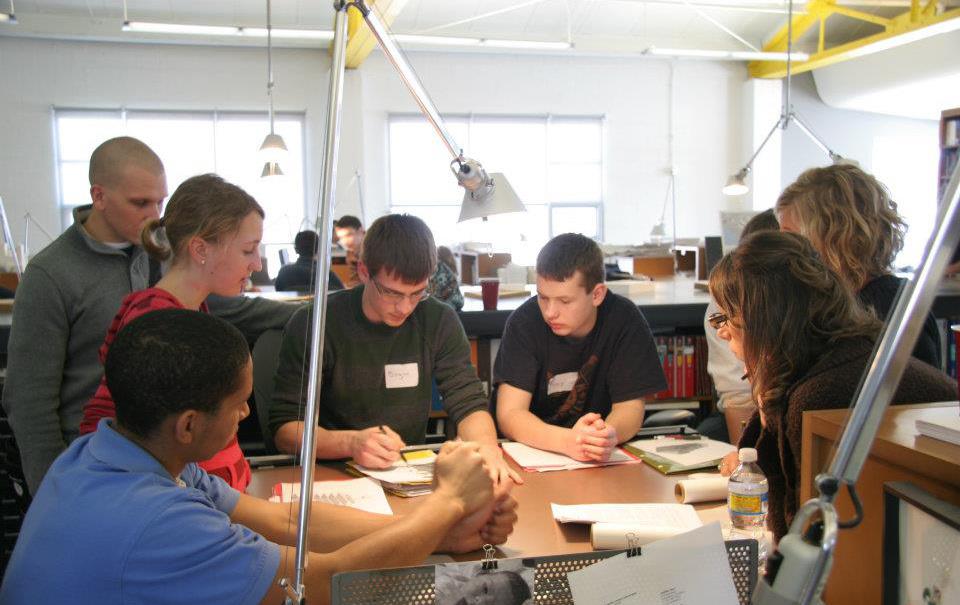
Photo: IHISADC.
Participants in the 2021 Indiana High School Architectural Design Competition.

It makes a difference when professionals offer their expertise to school students. In today’s story we see what happened when an architect returned to his old high school to teach in its STEM [Science, Technology, Engineering, and Math] program.

Victoria St. Martin reports at the Washington Post, “It can happen in an instant: that moment when you go from not knowing what you want to do for the rest of your life, to having absolute certainty about it. For Tarik El-Naggar, it happened in 1970, when he was in the seventh grade working on a project for English class.

“The assignment? Construct a reproduction of Shakespeare’s Globe Theatre out of everyday objects. He built a 2-foot-diameter cardboard model — and an architect was born. … Says El-Naggar, who’s now 63 and co-owner of an architecture and interior design firm, ‘I don’t know what it was about the building. It had all the seating, the stage and the open roof — it was just awesome. It was a lightbulb moment.’

“El-Naggar’s life came full circle when he added ‘high school teacher’ to his résumé nine years ago — building a STEM curriculum with members of the administration at his former school in northwest Indiana. Inside his Valparaiso High School classroom, students have their own lightbulb moments by creating projects using ping-pong balls, cardboard, computers and 3-D printers. ‘Instead of just teaching the basics of architecture, I’m actually really teaching them design theory,’ says El-Naggar, whose class is similar to what he taught at a nearby college.

“And he’s gotten results: [In 2021] his Valparaiso students swept the Indiana High School Architectural Design Competition, winning all nine awards out of 72 entries from eight schools. …

“Valparaiso, a middle-class community about 55 miles southeast of Chicago, began incorporating more STEM courses into its curriculum about six years ago. A school official said the district wanted to place more emphasis on skills such as critical thinking, communication, creativity and problem-solving, and secured several grants from the county redevelopment commission to bolster tools across K-12 classrooms. The high school roughly ranks in the top 10 percent in Indiana, and its standardized test scores in reading and math significantly outpace the rest of the state.

‘There are schools around the country that have great basketball programs. So, what do parents do? You move there because you want your son or daughter to go there,’ says El-Naggar. ‘I want people to look at what we’re doing here and say, “My kids are going to be engineers, architects. They need to be here.” ‘

“For high-schoolers who want to pursue architecture as a career, taking classes with El-Naggar is paying off: In the past three years, all five of the students who applied to university-level architectural programs have been accepted. ‘People were really impressed that I had already had this experience,’ says Henry Youngren, now a freshman at Carnegie Mellon University in Pittsburgh. … ‘It’s really guided me on how I want to live the rest of my life.’

“Brandon Farley, an architect who is the chair of the high school design competition, says he has some records that date back to the 1970s and he’s ‘never seen anything where one school won all the awards.’ It’s rare that judges see high school teachers with formal architectural training, he adds. With Valparaiso High School’s entries, he says, ‘you can see it immediately in the way the students address the problems and their solutions, and in the way that they talk about their designs. It really raised the bar on the competition.’

“Seventeen-year-old Olivia Lozano received one of the awards. ‘It kind of got the ball rolling for me,’ she says of the contest, for which she created a reading room filled with glass windows that opened to the outdoors. ‘Then it turns into a vortex and you’re down in El-Naggar’s classroom like four hours a day, and then you’re here after school, and then you’re here on the weekends and over spring break.’

“El-Naggar says the lightbulb moment for his students today really happens when they first see a 3-D view of their building. ‘The ones that go, “Oh, my gosh,” and they start “walking” through it and they’re telling other people, “Look at this.” ‘ …

“When the University of Notre Dame, near South Bend, Ind., asked him to critique student projects, he met a fellow architect and professor who would help him get his first teaching gig, at Andrews University in Michigan. Once he started, he knew he’d discovered a second passion. Several years later, he was asked to fill in and teach architecture in his hometown at the high school. He welcomed the opportunity to teach five minutes from his home.

“Now his fervor for teaching is gaining more attention, earning him a teacher of the year award from a national project-based-learning group this past fall. ‘We consider ourselves very blessed to have a teacher like him in the classroom,’ says Nick Allison, the school district’s assistant superintendent for secondary education.”

More at the Post, here.

Read Full Post »

Last Sunday, Pam and I walked over to the library to hear an acclaimed poet read at the poetry series. Ross Gay, who lives in Indiana, had just published his poetry collection Catalogue of Unabashed Gratitude and was doing readings around New England.

Glenn Mitchell, who organizes the library’s poetry series, was able to publish an advance interview with Gay in the local paper.

She wrote, “Gay says his inspiration for writing poems is a determination to practice joy as a discipline. He is a finalist for the 2015 Kingsley Tufts Poetry Award and the National Book Critics Circle Award and was a finalist for the 2015 National Book Award in Poetry and the NAACP Image Award in Poetry.

“Gay also works in the field of literary sports writing. He is a founding editor of the online sports magazine Some Call it Ballin’, a publication of reflective essays written by well-known poets, essayists and fiction writers along with podcasts of contributors.

“He serves on the board of the Bloomington Community Orchard, a nonprofit, food justice project.

“An associate professor of poetry at Indiana University, Gay is residing in Cambridge while a 2015-16 Fellow at the Radcliffe Institute for Advanced Study.”

Here is what Gay told Mitchell about the poet that inspired him to write poetry: “[Amiri] Baraka’s poems were such a clear articulation of the kind of alienation I was experiencing when I went off to college — a kind of racial alienation and class alienation — that I had no idea how to begin to talk about other than wanting to break things. I knew I was full of rage (which I later knew was a version of sorrow, too), but I didn’t know how to put it into words, which Baraka’s work made it possible for me to understand was possible.”

To her question about gardening coming into his life and the difference it made, he says, “I think close looking, paying attention, going slow, a kind of training in receptivity — I think those are things I learn from the garden … I approach poems like that, usually. I like to listen to them as much as I try to impose my own will on them. … A garden or a poem is potentially a device for pulling people together, they are both food, I’m saying, which we might feed to each other.”

In his Sunday reading, Gay included a poem about strangers sharing figs from a tree unexpectedly flourishing near his Philadelphia home — a poem that expresses some of his thoughts about our history of racism and the possibility of goodness.

He says, “The poem ‘To the Fig Tree at 9th and Christian’ gets at it—gets at what it means for us to come together despite the brutal history we’ve inherited, or even enacted. I think that fig tree is a kind of mercy.”

More here.

Read Full Post »

I’m grateful to Scott, a former colleague, for putting this cool thing on Facebook. Looking at these healthy, growing plants is especially warming today, now that the temperature has gone back to 15 F.

Tim Blank at Future Growing LLC (which produces vertical aeroponic food farms) writes, “When you hear about a farm that supplies all-natural, sustainable produce, using 90% less water and 90% less land, one that utilizes the most advanced vertical aeroponic technology on earth, you surely would not guess it would be an Amish farm.

“Yet in Topeka, Indiana, you cannot get produce that is more local, fresh, healthy, and sustainable — even in the middle of an Indiana blizzard — like you can get at Sunrise Hydroponics, an Amish farm.

“Sunrise Hydroponics is owned and operated by husband-and-wife team Marlin and Loretta Miller on their rural farm in Topeka. I have had the privilege of working with the Amish community for more than half a decade, and have come to learn that, while their lives seem simple to many outsiders, their homes, farms, and businesses are highly innovative. The Amish utilize cutting-edge and creative forms of technology to improve their lives, while still falling within the guidelines of their belief system.” Read more here.

Greenhouse at Sunrise Hydroponics

Read Full Post »