Feeds:
Posts
Comments

Posts Tagged ‘indigenous’

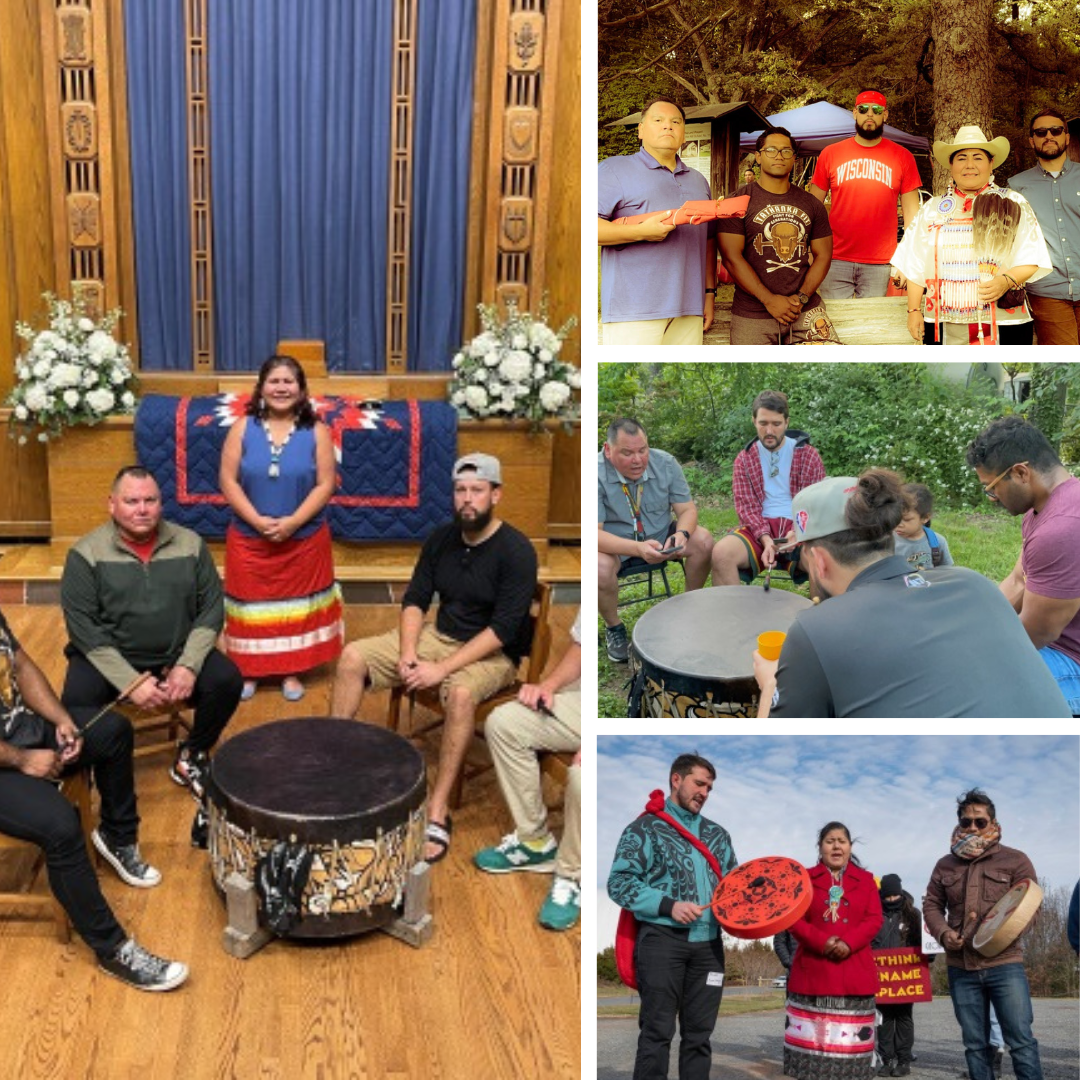
Photo: The Nicholson Project.
The Uptown Singerz are a DC-based intertribal Native American Northern powwow drum group that performs powwow, ceremonial, and in some cases political songs.

We are all enriched when previously below-the-radar groups begin to share their culture more widely. The featured article for today is from the Washington Post and highlights a cultural collaboration by members of several indigenous tribes.

Dana Hedgpeth writes, “When Nick Courtney came to D.C. seven years ago to work on education issues, he missed his Native American tribe in Washington state.

“Longing to connect with other Native Americans in the region, the 31-year-old member of the Makah Tribe helped form the Uptown Singerz, a Native American drum group that shares and celebrates their heritage.

“ ‘D.C. is a transient city because folks come and go, so that can be hard,’ said Courtney, who lives in Baltimore. ‘I still long for my own culture, but this fills my cup. It’s a bond, and I’m a part of something that’s allowed me to build a community here. It’s like a family for me.’

“In the United States, roughly 9.7 million people — or about 3 percent — of the overall population — identified themselves as being American Indian or Alaska Native in the 2020 Census. Fewer than 1 percent of people in the District, Maryland and Virginia said they are American Indian or Alaska Native.

“There are more than 500 federally recognized tribes in the country, and more than 70 percent of American Indians live away from their tribal reservations or communities.

“Being a part of Uptown Singerz gives members who are far from their tribes’ home ‘a renewed sense of community and family every time we sing, every time we drum,’ said Mary Phillips, the group’s lady backup singer (as the role is officially called by Native Americans), who is from the Omaha Tribe in Nebraska and the Laguna Pueblo Tribe in New Mexico. …

“The Uptown Singerz … practice several times a month and perform up to 20 events a year in theaters, rallies, community events and Native American gatherings and powwows in the D.C. region to showcase their talents and educate the public. They, along with the Zotigh Singers — who are from the Kiowa Tribe of Oklahoma and live in Waldorf, Md. — are one of the few American Indian drum groups in the D.C. region.

“ ‘Having the Uptown Singerz is so important because they help keep our culture alive here in D.C.,’ said Angela Gladue, 38, who is a powwow and hoop dancer. A Cree and a member of the Frog Lake First Nation in Alberta, Canada, Gladue moved to Northeast Washington six years ago and got to know other American Indians in the area, along with the drum groups. …

“The Uptown Singerz typically play around one large drum made from wood and dried animal hide. Sometimes they play smaller hand drums. Considered sacred and often used at events and some ceremonies, the drum for many American Indians represents the heartbeat of Mother Earth.

“They follow the Native American tradition of having only men sit around the drum. Women stand behind them and join in the singing because ‘women carry the sacred water of life,’ empowering them to ‘absorb or change the energy of the people around them or the energy of the drum,’ Phillips said. …

“For Gladue, hearing the drum and seeing American Indians from different tribes gather and dance was a special moment. … ‘People will ask, “Indians are still here?” To be around other Natives and not have to explain myself makes me feel good.’ “

More at the Post, here.

Read Full Post »

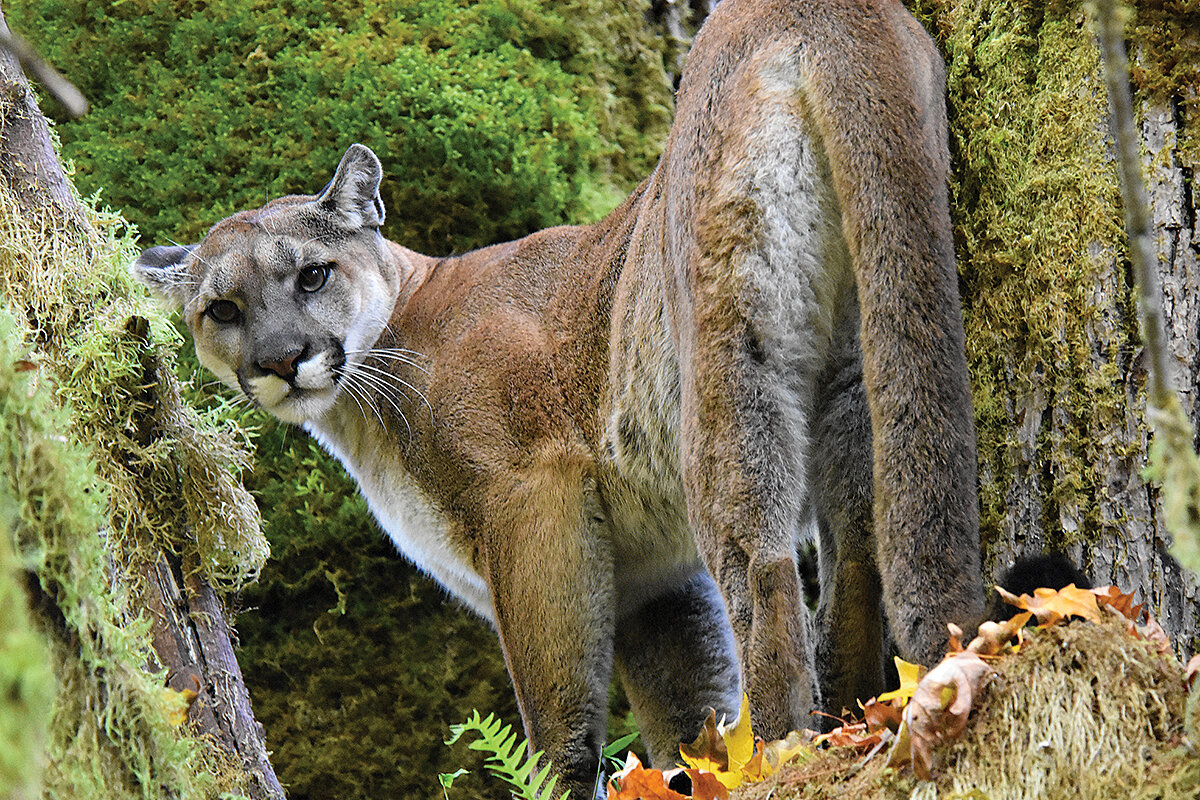
Photo: Mark Elbroch.
Since 2018, the collaborative Olympic Cougar Project has tagged 111 individual pumas, including Charlotte, above.

How many names do you know for the animal in the picture above? I learned four from today’s article.

Stephen Humphries writes at the Christian Science Monitor, “If Kim Sager-Fradkin didn’t have to write a grant proposal, she’d be spending her afternoon on the trail of a killer. 

“The biologist leads a team that’s researching cougars in Washington’s Olympic Peninsula. (The big cat is also referred to as a puma or a mountain lion. Not to mention wild cat, or panthera.]) Today, the team is tracking a cougar named James. It suspects he recently hunted an animal in a nearby forest. 

“ ‘Visiting cougar kill sites is really fun and like being sort of a forensic scientist,’ says Ms. Sager-Fradkin … wildlife program manager for the Lower Elwha Klallam Tribe. She’s overseeing the Olympic Cougar Project in partnership with Panthera … and five other Native American tribes. They’ve pooled their talents and resources to help an apex predator that has become effectively imprisoned in the westernmost part of Washington. 

“The region’s cougars are penned inside a geographical island roughly shaped like a square. Three sides are bordered by the ocean and bays. To the south there’s the expansive Columbia River as well as Interstate 5. The barriers on all four sides collectively form a de facto fence. Unable to easily connect with other big cats in the Pacific Northwest, cougars in the Olympic Peninsula are inbreeding. The lack of genetic diversity poses health challenges for them, scientists say. By collecting data on the big cats, the Olympic Cougar Project is bolstering the case for constructing a wildlife overpass over I-5 so that the species is less confined.

“ ‘Humans love wildlife stories, and humans love wildlife movements,’ says biologist Jim Williams, author of Path of the Puma: The Remarkable Resilience of the Mountain Lion. ‘What’s really neat about this project is it’s going to create information that will be translated through story that will keep humans excited and caring about the species.’ …

“When Ms. Sager-Fradkin began working for the tribe in 2007, her primary role was to plan sustainable subsistence hunting and fishing for current and future generations. A year later, she initiated a small-scale study of cougars in the region. She called in cougar expert Mark Elbroch. In 2018, they expanded the scope and scale, incorporating the five other tribes in the region and adopting the Olympic Cougar Project name. 

“ ‘The tribes on the peninsula aren’t always working together on a lot of things,’ says Ms. Sager-Fradkin, adding that there are sometimes disagreements over issues such as hunting jurisdictions. ‘So it’s really amazing that we’ve all come together and are working on a big project like this.’  To get all the partners on board, she had to get them to see the big picture. …

“The cougars are considered an ‘umbrella species’ because so many other creatures in the ecosystem depend on them. ‘Where there are frequent kills, the grass is literally more nutrient rich,’ explains Ms. Sager-Fradkin. …

“It was this fact that helped her persuade the region’s tribes that it was in their common interest to study the feline carnivore. 

“For his part, Dr. Elbroch, director of the puma program at Panthera, adds that Ms. Sager-Fradkin used her natural skill of engaging with people. …

“Working in concert, the Skokomish, Makah, Quinault, Jamestown S’Klallam, and Lower Elwha Klallam tribes have created a grid consisting of 550 cameras. Artificial intelligence catalogs animals photographed in the peninsula – including bobcats, bears, coyotes, deer, and elk – and helps estimate their populations. Research technicians, such as Lower Elwha Klallam tribe member Vanessa Castle, analyze the patterns of 127 individual cougars. There’s also the less glamorous task of analyzing animal scat. 

“ ‘A lot of our ancestral knowledge was lost,’ says Ms. Castle, who praises how Ms. Sager-Fradkin has mentored her and other employees in the project. ‘So we’re having to relearn those things. Like how wildlife all is intertwined with each other. … I had no idea the role that mountain lions played in the system as a whole.’ …

“ ‘The first thing that is needed is to protect the habitat on either side, because you can’t spend all the money on a wildlife bridge and then end up with a Walmart parking lot right on one side,’ says Ms. Sager-Fradkin. 

“The Olympic Cougar Project is not just liberating the big cats, she adds, but also creating a sustainable ecosystem for the tribes for the next seven generations.”

More at the Monitor, here. No paywall. Subscriptions encouraged.

Read Full Post »

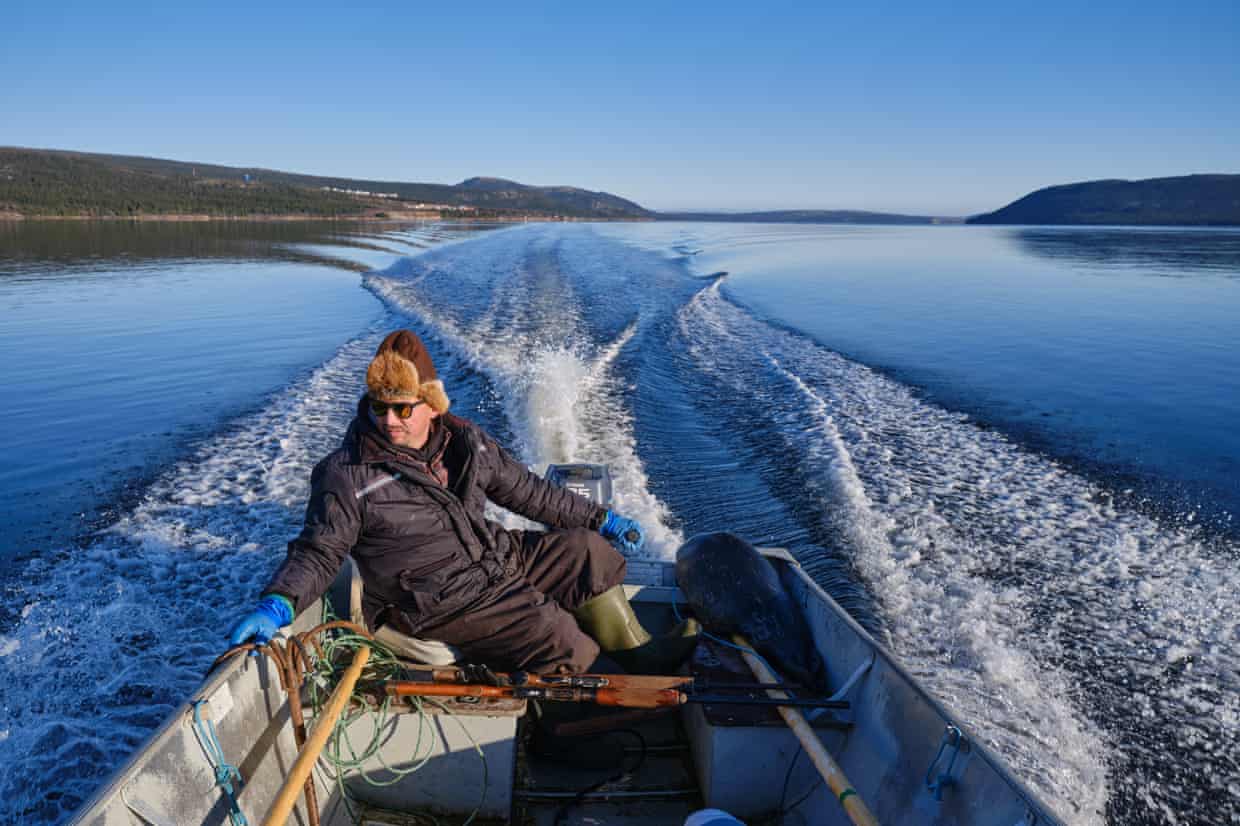
Photo: Eldred Allen.
Martin Shiwak, an Inuit, with his hunting rifle in his boat, on Lake Melville, near Rigolet in Nunatsiavut, Canada.

Can you handle another story about how we are finally learning that indigenous ways are better for everyone in a changing climate? I don’t mean we all need to hunt and fish. I’m talking about protecting land and water from resource exploitation.

Ossie Michelin writes at the Guardian that “the environment Inuit have lived in for millennia is changing fast. Canada’s government once ignored Indigenous knowledge of it but now they are jointly creating the Nunatsiavut conservation area. …

“Martin Shiwak accelerates his boat to grab the seal he has shot before the animal sinks out of sight. Shiwak has hunted for years in the waters of Lake Melville, by the Inuit community of Rigolet in Nunatsiavut.

“As he hauls the ringed seal into the vessel, he says he counts himself lucky to have found one so quickly. ‘Sometimes you have to drive around here in the boat nearly all day to find a seal,’ Shiwak says. ‘Nowadays you can’t even afford to – C$60 only gets you five gallons of gas.’

“Nunatsiavut – one of four Inuit homelands in Canada – is where the subarctic becomes the Arctic. An autonomous region of Labrador-Newfoundland province, it is located at the extreme north-east corner of North America.

“Winter temperatures here can average -30C (-22F) with the windchill, as the Labrador current brings Arctic ice floes down along the coast, and a host of marine life from, plankton to polar bears. From November to June, shipping is impossible because sea ice covers the entire 9,320-mile (15,000km) coastline, so all food and supplies must be flown in. In Rigolet, a frozen 1.5kg (3.3lb) chicken will set you back C$25 (£15). Hunting is not just a tradition but a necessity. …

“As a young boy, he learned to hunt and fish with his father and grandfather, who in turn had learned these vital skills from their elders. It is also how Shiwak learned the core Inuit values of taking only what is needed, sharing, sustainability and respect for nature – values he is passing down to his own children. …

“But while traditional knowledge has allowed Inuit to survive in this harsh environment for so long, the climatic conditions they rely on are changing quickly. Since 1950, Nunatsiavut has lost 40 days of ground snow a year. Its sea ice is vanishing faster than anywhere in the Canadian Arctic. …

“There is very little local people can do about that: although the region is roughly the size of the Republic of Ireland, Nunatsiavut’s population is less than 3,000, spread among five small towns. What they can do, however, is work to protect what they have. That’s why Nunatsiavut is partnering with the Canadian government to co-develop the world’s first Inuit Protected Area of this type.

“While there are other Inuit-led marine conservation programs in Canada, this will be the first to bear the title of Inuit Protected Area. … Built on Inuit values and culture, this type of conservation area would allow Indigenous people to continue traditional practices of hunting and fishing.

“That was not always the case. Past conservation policies saw Inuit at best only consulted and at worst completely ignored. Many Inuit hunters and fishers faced fines, had their equipment confiscated and their catches from hunting and fishing taken.

“Despite being granted the power to self-govern in 2005 (after 30 years of negotiations with the Canadian government), Nunatsiavut still lacked the final say over conservation in its waters. Final decisions defaulted to federal or provincial ministers.

“Now, at last, Nunatsiavut can jointly create and co-manage the protected area, based on Inuit priorities, as an equal authority. This will allow Inuit to practice traditional hunting and fishing in the area, while protecting the waters from industry and development.

“ ‘Just because we’re small doesn’t mean we can’t do something,’ says James Goudie, deputy minister of lands and natural resources in the Nunatsiavut government. ‘We can show the world that a small region can protect a massive amount of biodiversity.’

“The Inuit Protected Area would only cover about a third of Nunatsiavut’s nearly 50,000 sq km of offshore waters, but the region is home to important populations of fish such as salmon and Arctic char, the breeding grounds for many migratory birds, and the habitat of Arctic marine mammals including polar bears, beluga whales and seals.

“Establishing a protected area is also a pre-emptive strike against resource exploitation. Significant natural gas deposits have been found offshore along the Labrador shelf, but it has remained largely unexplored because of the ice. As the climate warms, however, the region is becoming more accessible – the Inuit Protected Area would prevent such resource exploration. …

“The borders of the new area have not been finalized, with the feasibility report expected in 2024 or 2025. But [Rodd Laing, Nunatsiavut’s environment director] notes: ‘You don’t need lines on a map to recognize the great work that happened already with Inuit relative to conservation and the management of ecological resources.’

“After all, he says, for countless generations of Inuit, conservation was not an option that could be ignored: it was a way to ensure there would be enough to eat, and enough next time as well.”

More at the Guardian, here. Nice photos. No firewall.

Read Full Post »

Photo: Alexandra Ionescu/Rhode Island Collective.
This floating wetland, an artificial island hosting a human-made ecosystem, was scheduled to remain in Ice Pond in Southborough, Mass., until Sept. 17.

Here’s a new thing under the sun: a floating wetland. Art and science join forces, and Frank Carini at ecoRI News has the story.

“Floating in a circle around a pond in Massachusetts is a mini-wetland built by six Rhode Islanders. Earlier this summer, the mostly natural creation was chosen as the winning installation in the seventh annual Art on the Trails outdoor art and poetry program.

“But the freshwater wetland, built by a group of Ocean State artists, designers, and a botanist, wasn’t commissioned to win an award. It was designed to raise awareness about the importance of wetlands and show how they work. Mission accomplished.

“Art juror Sarah Alexander, who chose ‘Below and Above: A Floating Wetland Supports Life” by the Rhode Island Collective as the best installation, said, ‘The amount of careful research and thoughtful response to the space, along with the combined efforts of its dedicated creators, blew me away.’ …

“The wetland has been floating in Ice Pond in Southborough since June 11. It was created by sourcing native plants, and experiments with natural cordage. It shows how pollutants could be sucked from stressed waterbodies with a little help from human hands. A single anchor line keeps the wetland floating in a 15-foot circle, and not all over the popular skating pond.

“Members of the Rhode Island Collective include Holly Ewald (visual artist), Maxwell Fertik (interdisciplinary artist), Alexandra Ionescu (ecological artist), Hope Leeson (botanist), and August Lehrecke and Matthew Muller (co-founders of an inflatable architecture studio), who led the project’s construction. …

“ ‘The floating wetland ecosystem creates a habitat for the more-than-human world below and above the water line through the growth of native macrophytes. Through the plants’ life cycles, they regenerate the food web, amplifying the natural processes between sunlight, water, and microorganisms,’ according to the Collective. …

“Their structure was built using dried Japanese knotweed, broadleaf cattails, and bamboo for buoyancy, as alternatives to petroleum-based materials such as plastic and foam typically used to construct floating wetlands. A small amount of stainless steel wire mesh and cable holds the craft together.

“The knotweed used to create the floating wetland was harvested in late winter as dry stems from Mashapaug Pond and Gano Park in Providence. Fertik said repurposing invasive species for the project’s pontoons removed some of their biomass from the environment and transformed the nonnative plants into a vessel to improve water quality and promote biodiversity. (The dead stalks weren’t capable of spreading.) …

“The craft is home to 18 native wetland plant species: American bur-reed; bayonet rush; brown fruited rush; Canada rush; common cattail; Alleghany monkey-flower; blue flag iris; boneset; cardinal flower; flat-topped goldenrod; Joe-Pye weed; New York ironweed; northern water horehound; pickerelweed; swamp milkweed; buttonbush; silky dogwood; and steeplebush. …

“Suspended in water, the plant roots provide a home for diverse communities of algae, bacteria, fungi, and protozoans, known as periphyton. As the plants upcycle nutrients from the water into their roots, stems, leaves, and flowers, the periphyton provide nutrient uptake, filtration, oxygenation, and toxin removal.

“Southern New England’s freshwater lakes and ponds, especially the shallow ones, are being stressed by development, wastewater overflows, old and failing septic systems, antiquated cesspools, and stormwater runoff carrying nutrients such as nitrogen and phosphorous from fertilizers and roadway pollutants such as polycyclic aromatic hydrocarbons. …

“The Collective’s 48-page PowerPoint presentation noted Indigenous communities built floating islands for hundreds of years by harvesting natural materials found in their surroundings. ‘By incorporating native plants from freshwater marsh and pond ecosystems, we are supporting a variety of other life forms,’ they said.

“Ice Pond, part of the 58.5-acre Elaine and Philip Beals Preserve, is a healthy ecosystem in little need of a floating wetland to pull pollutants out of the water, but it did give the Collective an opportunity to learn how floating wetlands create a habitat, observe the decay of the natural materials used to build the craft, and document the growth of the native wetland plants. … The Providence Stormwater Innovation Center has requested the craft’s presence for the ponds at Roger Williams Park. …

Art on the Trails is an annual site-specific ecological sculpture park exhibition. To watch a video about the project, click here.

More at ecoRI News, here.

Read Full Post »

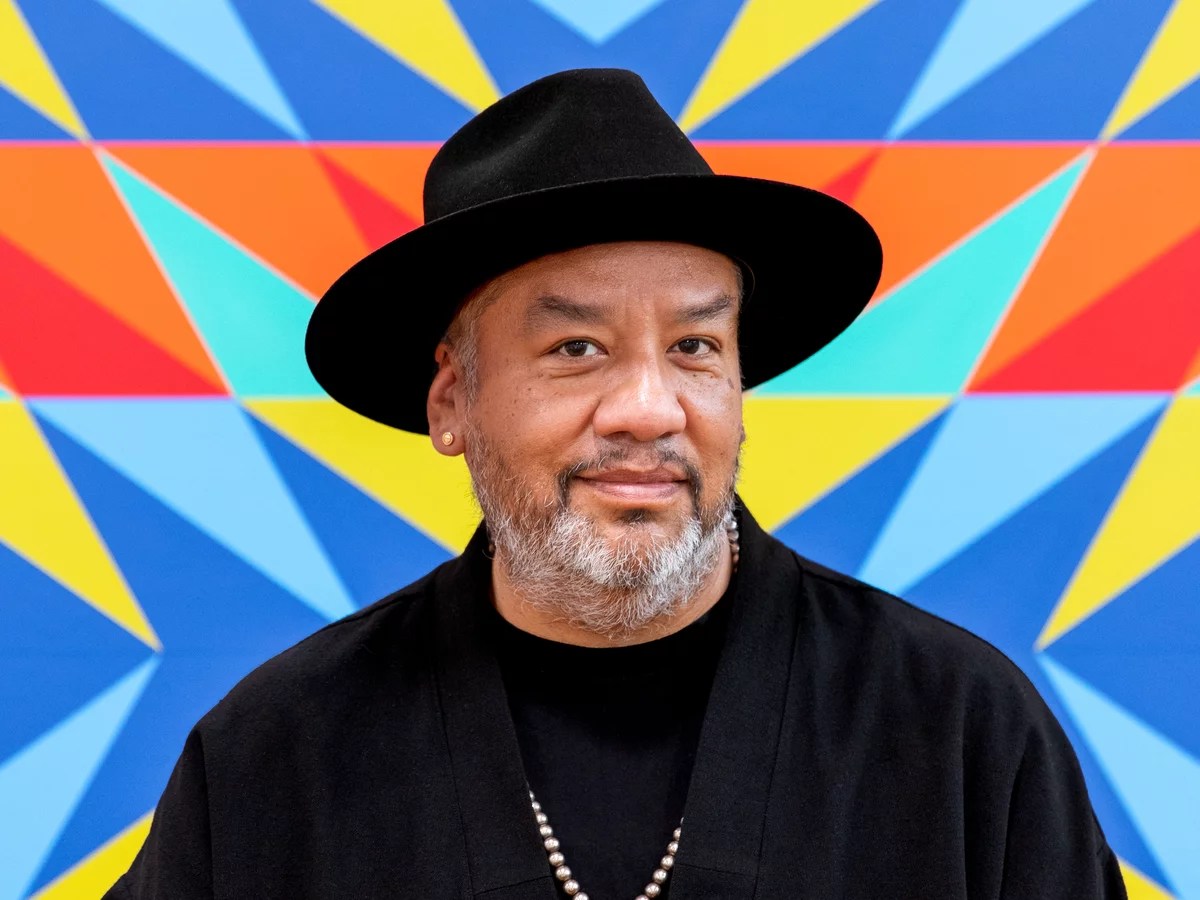
Photo: Brian Barlow.
Artist Jeffrey Gibson will represent the U.S. at the Venice Biennale in 2024, the first Indigenous artist to have a solo exhibition in the U.S Pavilion at the international art event.

One doesn’t think of State Department functionaries as knowing who in the US art community would be best to represent the country in an international exhibition, but if they tap knowledgable consultants and look at recipients of MacArthur “genius” grants, that should help them decide.

Chloe Veltman writes at National Public Radio (NPR), “The U.S. State Department has selected an Indigenous artist to represent the country at the 2024 Venice Biennale.

“Jeffrey Gibson, a member of the Mississippi Band of Choctaw Indians and of Cherokee descent, will be the first such artist to have a solo exhibition in the U.S. Pavilion at the prestigious international arts event.

“That’s according to a statement this week from the U.S. Department of State’s Bureau of Educational and Cultural Affairs, the government body responsible for co-curating the U.S. Pavilion, alongside Oregon’s Portland Art Museum and SITE Santa Fe in New Mexico. …

“The last time Indigenous artists appeared in the U.S. Pavilion at the Biennale was in 1932 — and that was in a group setting, as part of a mostly Eurocentric exhibition devoted to depictions of the American West. …

“Said Kathleen Ash-Milby, curator of Native American Art at the Portland Art Museum, and one of the co-commissioners of Jeffrey Gibson’s work in the U.S. Pavilion at the Venice Biennale, ‘It grouped native people together and didn’t really focus on their individuality as much. There were Navajo rugs on the floor. There were displays of jewelry. Many of the artists were not named.’

“Ash-Milby, who is also the first Native American curator to co-commission and co-curate an exhibition for the U.S. Pavilion at the Venice Biennale, told NPR her team selected Gibson because of the artist’s wide-ranging, inclusive and critical approach to art-making.

” ‘His work is multifaceted. It incorporates all sorts of different types of media,’ the curator, a member of the Navajo Nation, said. ‘But to me, what’s most important is his ability to connect with both his culture and different communities, and bring people together. At the same time, he has a very critical lens through which he looks at our history as Americans and as world citizens. Pulling all those things together in the practice of an American artist is really important for someone who’s going to represent us on a world stage.’

“Born in Colorado and based in New York, Gibson, 51, focuses on making work that fuses together American, Native American and queer perspectives. In a 2019 interview with Here and Now, Gibson said … ‘There’s this gap historically about these histories existing on the same level and being valued culturally. … My goal is to force them into the contemporary canon of what’s considered important.’

“A MacArthur ‘Genius’ Grant winner, Gibson has had his work widely exhibited around the country. Major solo exhibitions include one at the Portland Art Museum last year and, in 2013, at Boston’s Institute of Contemporary Art. His work is in the collections of high-profile institutions like the Museum of Modern Art in New York, the San Francisco Museum of Modern Art and the National Gallery of Art. Gibson participated in the 2019 Whitney Biennial. …

“The details of Gibson’s contribution for the 2024 Biennale are mostly under wraps. Curator Ash-Milby said the artist is working on a multimedia installation with the title ‘the space in which to place me’ — a reference to a poem by the Lakota poet Layli Long Soldier.”

Check out his art at NPR, here. No paywall.

See also Mark Trecka’s comments on poet Long Soldier at the Los Angeles Review of Books: “In ‘Three,’ Long Soldier writes: ‘This is how you see me the space in which to place me / The space in me you see is this place / To see this space see how you place me in you / This is how to place you in the space in which to see.’ The lines of this poem form a box on the page, in which the negative space is the center of attention.”

Read Full Post »

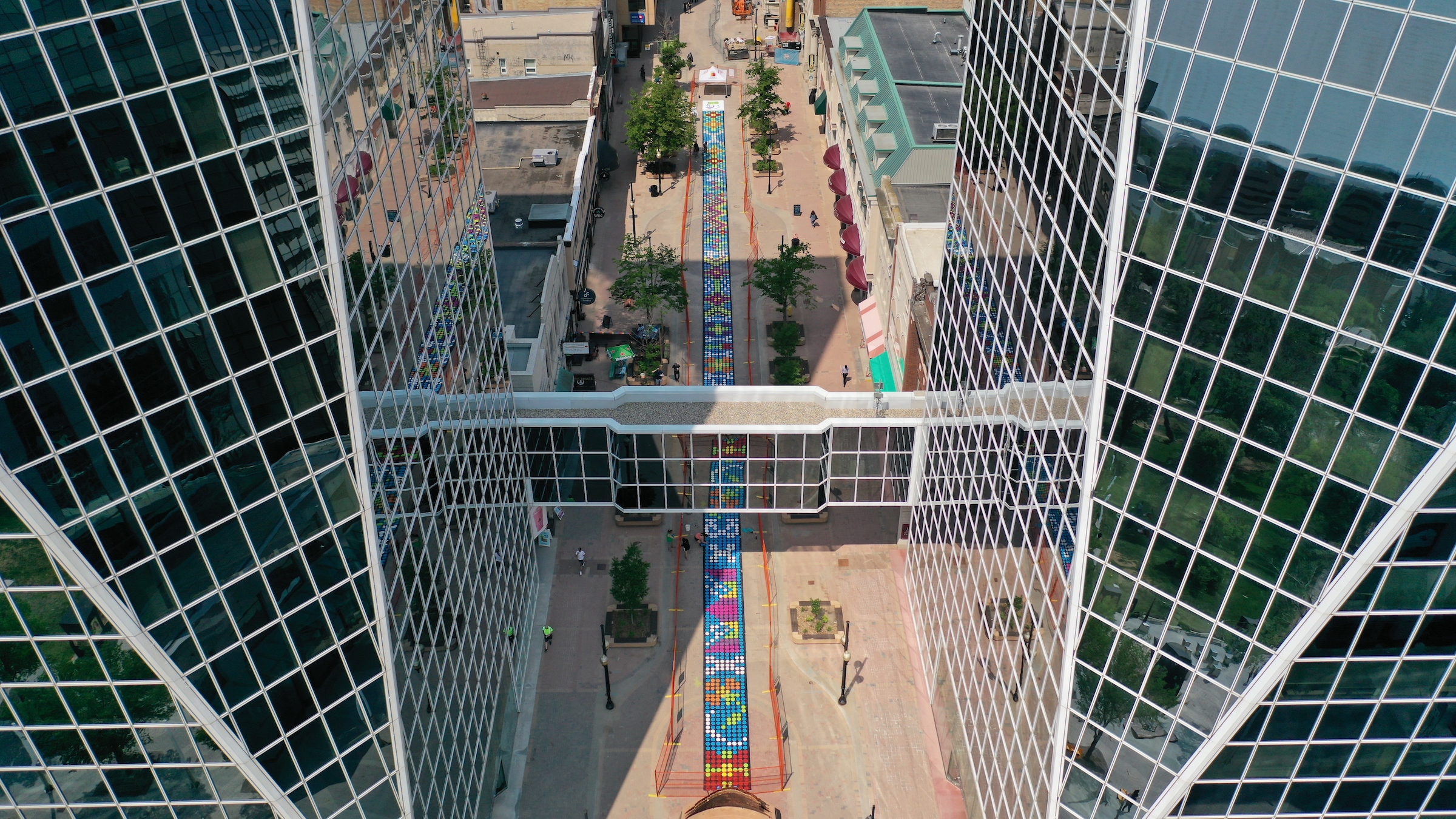
Photo: Dan Plaster/CBC News/Creative City Centre.
An aerial view of “The Path to Reconciliation” (2023) in downtown Regina, Saskatchewan.

There’s a new effort in Canada to make the art of indigenous people more visible to all. At Hyperallergic, Rhea Nayyar reports on one public project, “The Path to Reconciliation,” a pavement mural painted in the style of traditional beadwork.

“Hundreds gathered in downtown Regina, the capital city of the Canadian province of Saskatchewan,” writes Fayyar, “for the unveiling of a new public artwork on National Indigenous Peoples’ Day last Wednesday, June 21. Cree-Métis artist Geanna Dunbar and Inuvialuit-Gwich’in artist Brandy Jones designed ‘The Path to Reconciliation’ (2023), a 300-foot-long and eight-foot-wide footpath mural on pavement rendered in the style of traditional First Nations beadwork. The piece featured over 2,600 painted circular ‘beads,’ also referencing the significance of the circle as a broader Indigenous symbol rooted in healing, community gatherings, and mutual support without hierarchies.

“The mural occupies a stretch of a downtown pedestrian-only city block at the F.W. Hills Mall on Scarth Street. Dunbar and Jones incorporated motifs such as flowers for their ubiquitous representation in every culture; bison bones to honor how First Nations peoples use every part of an animal for sustenance and survival and in acknowledgment of their near extinction due to colonial overhunting; and the colors of the aurora borealis that represent late ancestors looking down and offering guidance to those still on Earth. The path begins in front of late artist Joe Fafard’s buffalo sculpture, ‘oskana ka-asasteki’ (1998), and is marked by a painting of a white buffalo, which signifies the sacred loop of life for several Indigenous cultures. …

“ ‘Reconciliation begins with starting these conversations and improving education around these subjects,’ Jones said, reflecting on her community work on top of this project. ‘There’s so much interest in wanting to learn more and help out.’ …

“Dunbar and Jones sought guidance and knowledge from Muscowpetung First Nation Elder and residential school survivor Brenda Dubois as well as Indigenous cultural art advisor Audrey Dreaver for this endeavor.

“ ‘Dubois told us a very powerful story about how river water and ocean water pass through obstacles to meet each other, and that really resonated with us so we made blue background beads to represent the journey of water along the path,’ Dunbar noted. Jones mentioned that Dubois had a grounding presence that helped the artists tone down their perfectionistic tendencies for this project and that Dreaver was a great resource for historical knowledge about the ubiquity of beadwork as a post-colonial impact on First Nations cultures across North America.

“The artists joined forces on this project through the Creative City Centre (CCC), an artist-run community space in Regina that provides employment opportunities and professional development assistance to independent creative workers, and the Regina Downtown Business Improvement District.

“ ‘It was interesting to see a bunch of people coming together from different places, financial classes, cities, and so on really endure the harsh weather of an extreme heat wave for this,’ Dunbar said of the public turnout. ‘We were all uncomfortable, and that also represents the path of reconciliation — to feel what it’s like to be uncomfortable in situations and work together as a team.’ She stated that reconciliation for non-Indigenous people to foster and maintain respectful relationships with First Nations people means knowing where your money is going, and ‘putting in the work and creating jobs.’

“ ‘You can wear an orange shirt for Every Child Matters Day (September 30), or you can come out on Indigenous Peoples’ Day (June 21), but where did you get your orange shirt?’ Dunbar asked. ‘Did you buy your shirt at Walmart, or did you purchase it from an Indigenous artist?’ “

We do not seem to have enough colors for all the serious issues dyed T-shirts represent nowadays. Today I am learning about orange for indigenous children, but I know orange is also used in MS ribbons and, separately, for ending gun violence.

More at Hyperallergic, here. Nice pictures. Subscriptions welcome.

Read Full Post »

Photo: Mie Hoejris Dahl.
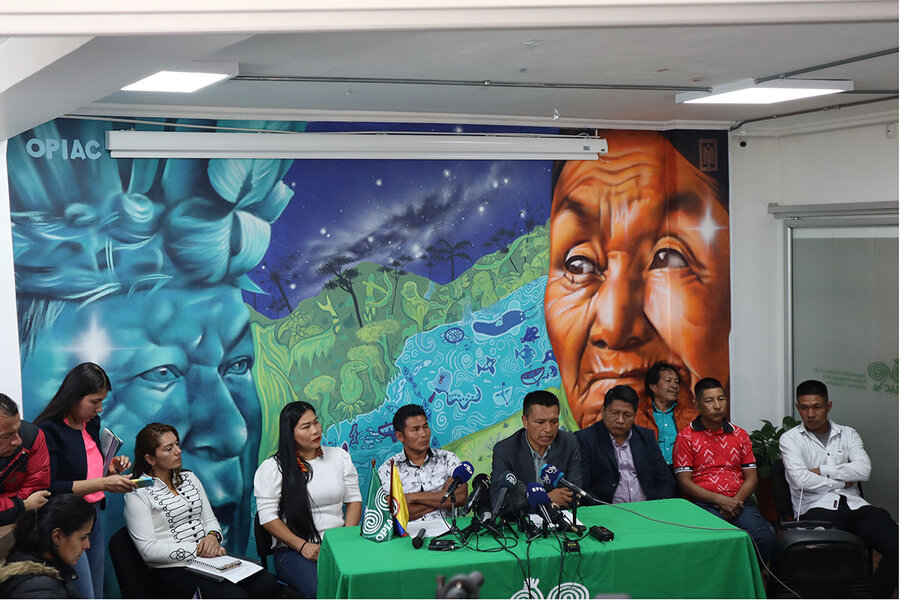
An indigenous leader and indigenous
guards and family members of four lost children meet at the office of the National Organization of Indigenous People of the Colombian Amazon, in Bogotá, Colombia, June 15, 2023.

You may have heard about the kids who were in a plane crash in the jungle and survived largely because of their indigenous skills. Today I share a story about how an unusual collaboration among searchers led to their being found.

Mie Hoejris Dahl reports at the Christian Science Monitor, “Few things have united the Colombian population like the recent successful rescue of four young Indigenous children following a deadly plane crash – and their ability to survive alone in the jungle for 40 days.

“The story of Lesly Jacobombaire Mucutuy, Soleiny Jacobombaire Mucutuy, Tien Ranoque Mucutuy, and Cristin Ranoque Mucutuy, who ranged in age from 11 months to 13 years at the time of the crash, grabbed hearts and headlines [recently] for their incredible resilience. The plane wreck killed all three adults on board, but against great odds, the children survived alone in the jungle by tapping into ancestral education about the animals, edible plants, and survival tactics in the wild jungle.

“Their survival is an inspiration, but the saga also put a spotlight on challenges faced by Colombia’s Indigenous populations, who fight to preserve their culture amid historical marginalization. …

“A promising thread has emerged in the days since the children’s discovery, which is the unparalleled, collaborative search efforts by the Colombian military and Indigenous guards that led to their rescue in the first place.

“It has many here looking to what the future of respect and partnership might look like between the government and Indigenous communities.

“ ‘This was a lesson … to look for commonalities’ between the government and Indigenous groups, says Rufina Román, a leader in the National Organization of Indigenous People of the Colombian Amazon, a nongovernmental organization. ‘We are going to need to rely on joint action for many other issues … like climate change’ and environmental protection. …

“On May 15, two weeks after an engine failure caused a flight carrying three adults and the four children to crash in the dense Amazon jungle, rescuers found the front part of the plane stuck between trees in the southern Colombian state of Caquetá. The pilot, an Indigenous leader, and the children’s mother were found dead.

“Although the search team saw signs of life – a baby bottle, half-eaten fruit, and dirty diapers – the children were nowhere to be found.

“The Colombian government deployed search-and-rescue planes and helicopters, as well as land and river teams to the crash site. They scoured for the kids in an area of about 1,650 miles and used sound systems to play a recording of the children’s grandmother speaking in their native language, Huitoto, telling them that people were looking for them and that they should stay in one place.

“The children kept moving, some close to them speculate out of fear of who exactly was looking for them. Armed dissident guerrilla groups are a threat for many Indigenous communities in the jungle.

“But even so, the search was challenging from the start.

“ ‘It’s a very remote zone that requires special capacity,’ says Pedro Sánchez, the general who led the government search operation. Some 16 hours of rain a day, humidity, dense vegetation, and dangerous animals make the terrain hard to penetrate even for the country’s best-trained soldiers. It’s hopeless trying to see anything from the air due to tree coverage, and it’s hard from the ground, too. …

“Eventually, General Sánchez authorized Indigenous volunteers from across the country to participate in the operation: a decision that almost certainly saved the children’s lives.

“ ‘Without them, we still wouldn’t have found the kids,’ he says of the approximately 80 Indigenous volunteers.

“Working with the guard helped multiply eyes and ears on the ground, but also contributed important, deep-seated knowledge about the jungle. Spiritual knowledge, too, General Sánchez says.

“He describes the collaboration as ‘very fluid,’ which stands in contrast to the historical mistrust between Indigenous people and the government’s armed forces. Indigenous communities are often stigmatized as uneducated, violent, and out of touch with modern society. And the absence of the state in many of these remote communities, lack of public services like roads and running water or electricity, and few security measures in a region overrun by armed groups mean that many mistrust and feel abandoned by the state. …

“There’s hope that the unprecedented collaboration that took place between the armed forces and the Indigenous guard in Operation Hope, as the rescue mission was dubbed, can blaze a new path for relations between the government and Indigenous groups here.

“When the soldiers and Indigenous guards were deep in the jungle, on several occasions their technology, like GPS satellites and compasses, stopped working. ‘What do you say?’ General Sánchez asked the Indigenous guards.

“That simple question was ‘something spectacular,’ says Janer Quina, regional coordinator of the Indigenous guard in Cauca … who participated in the search. It contrasts with his experience with non-Indigenous Colombians in the past. Historical knowledge around nature, for example, is often met with skepticism from outsiders, he says. …

“In the long, emotional search, the soldiers and Indigenous guards shared food, personal questions, and survival techniques. Indigenous guards shared ancestral knowledge, like medicinal plants, while soldiers taught them to use their high-tech equipment. … What was perhaps even more surprising was the kids’ ability to survive in such precarious conditions.

“ ‘We taught them how to survive in the Amazon jungle,’ says Eliecer Muñoz, one of the Indigenous rescuers, of the education that children in many remote Indigenous communities are brought up with about plants, animals, and how to construct a shelter. …

“Thus, ‘Lesly [the 13-year-old] knew what to do,’ says Ms. Román, including which plants or insects were edible and how to care for a baby without any of the tools many Westerners rely on, like formula or a crib.’ “

More at the Monitor, here. No firewall.

Read Full Post »

Photo: Maria Spann/The Guardian.
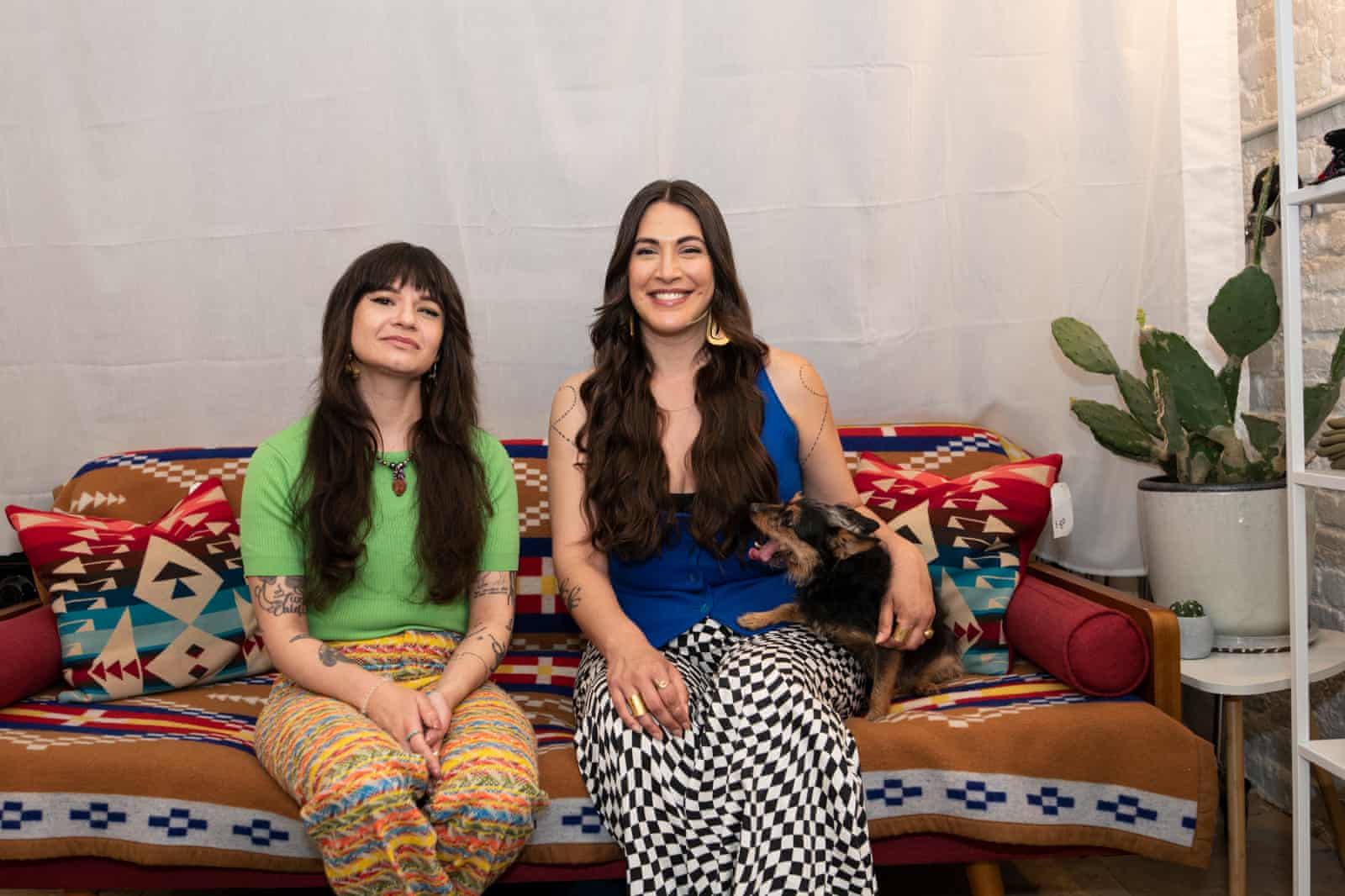
Liana Shewey and Korina Emmerich run a forward-thinking indigenous store in New York.

A friend who had just read Rinker Buck’s Life on the Mississippi was telling me recently how stunned she was to learn details of the Trail of Tears and related horrors visited on natives. Most of us know very little about that and have hardly been aware that indigenous people have been living among us all along.

At the very least, we are noticing them more now, learning more.

In today’s article, Sophia Herring of the Guardian interviews two very visible indigenous women with a new kind of shop in New York City.

“Location, location, location. It can make or break a business,” Herring says. “For Liana Shewey and Korina Emmerich, it was a call to action. When a mutual friend told the activists and creatives – Shewey is an educator and Emmerich is a fashion designer – about a newly vacant storefront on the ground floor of her mother’s Manhattan co-op building, the pair … visited the space. … ‘We jumped on it,’ said Shewey.

“The co-op board wasn’t willing to hand the keys over to just anyone. But their friend’s mother is Navajo, and also the board president. Within days the building had its newest tenant: Relative Arts NYC, a boutique that carries pieces by Indigenous designers and also hosts literary readings, album releases and art installations featuring work by Indigenous artists.

“ ‘It just felt so important for us to have a space, as grassroots organizers in the city,’ said Shewey, who was raised in Stillwater, Oklahoma, and is a member of the Mvskoke (Creek) Nation. Building a store that specializes in goods from Indigenous and many female-owned labels was a natural way to support their community. …

“The merchandise builds on their mission to shatter stereotypes. The entrepreneurs speak to ‘Indigenous futurism,’ an emerging art and design movement that leans away from cliches. …

“Emmerich, who grew up in Eugene, Oregon, and whose father is of Puyallup descent, focused on her own fashion label, EMME Studio, in her late 20s and early 30s. Her work has appeared on the cover of InStyle magazine and in the Lexicon of Fashion exhibition at the Metropolitan Museum of Art. She still makes pieces by special order, and the shop doubles as an atelier. When she spoke with the Guardian, she was rushing to complete a dress that she was making for a producer of Killers of the Flower Moon, the new Martin Scorsese film, to wear to the Cannes film festival. Shewey, whose day job is as an outreach educator at the New-York Historical Society, was speaking from her car, where she was taking a break from a marathon day of teaching four sixth-grade classes.

“The entrepreneurs, who can be found at their shop every weekend, relied on crowdfunding to convert the space into a store. An initial round of fundraising garnered $6,465, which covered shelving units and a sofa from Craigslist. They found a handful of industrial school chairs on the side of the road.

“The pair are breaking even, and still debating whether to form a nonprofit or operate as an LLC. ‘We want Relative Arts to be a greater incubation hub for people to be able to learn, create and work out of,’ said Shewey. …

Sophia Herring: Tell me about what led you both here.

Liana Shewey: I lived in Portland for about a decade and got really integrated into the local rock’n’roll scene. I bartended, worked at a local Starbucks, and then eventually started a music production company of my own with a few friends. In 2014, I moved to the Czech Republic and started organizing around the refugee crisis. I came back in 2016 when everything was happening with Standing Rock. It made me realize my struggle is here and I need to be with my community.

“Korina Emmerich: At 13, I made my first jingle dress regalia, and got very into sewing. I came to New York with two suitcases, a cat and $75. I worked in a boutique and I had my own line. I actually had a lot of success, thanks to a company called Brand Assembly that helps support smaller designers. But you slowly realize with everything in the fashion industry, if you want to do it ethically, you will be poor. I just dreamed that one day I would have a space to be able to share everybody’s work.

“Herring: How do you work as a team?

“Emmerich: We’ve been planning and organizing together for so long that we just naturally gravitate towards each other in our work style. Liana is analytical and does the logistical things as well as planning, and organizing when it comes to programming. I have this more creative, community outreach part of my work where building relationships is such an important aspect. …

“Herring: How do you choose what goes in the store?

“Emmerich: Our goal is to showcase contemporary Indigenous designers who are doing fun, subversive, wearable work, as opposed to the assumption of what Indigenous design has to look like. I want to talk about how Indigenous people exist here and now and we’re doing contemporary work here and now. There’s no rule that says we have to only exist in a historical context.

“Herring: What is it like operating an Indigenous business within a community that so rarely acknowledges it’s on Indigenous land to begin with?

“Emmerich: Even though Relative Arts may be the first of its kind, we are not the first ones to be doing this work. It was amazing to have the American Indian Community House come to open the space on our first day, to say a prayer and give us their blessing.

“Shewey: I’m thinking about how many people come off the streets and buy one of our pieces just because they like the garments themselves. Then they look at the basketball jersey and ask: what is the Salish Sea? [The Salish coast, along the north-western US and Canada, is home to Indigenous nations.] If they didn’t know, they walk out having learned about decolonization. …

“Herring: What is your long-term goal?

“Emmerich: We like to think of Relative Arts as a hub. The plans that we have are so much bigger than just a store. …

“Shewey: We’ve mused that we want it to kind of look like an Indigenous-futurist version of Andy Warhol’s Factory. It would be so wonderful to have thousands of feet, although I doubt Andy ever had to apply for funding.”

More at the Guardian, here. No firewall. Donations encouraged.

Read Full Post »

Photo: Annas Radin Syarif / AMAN at Medium.
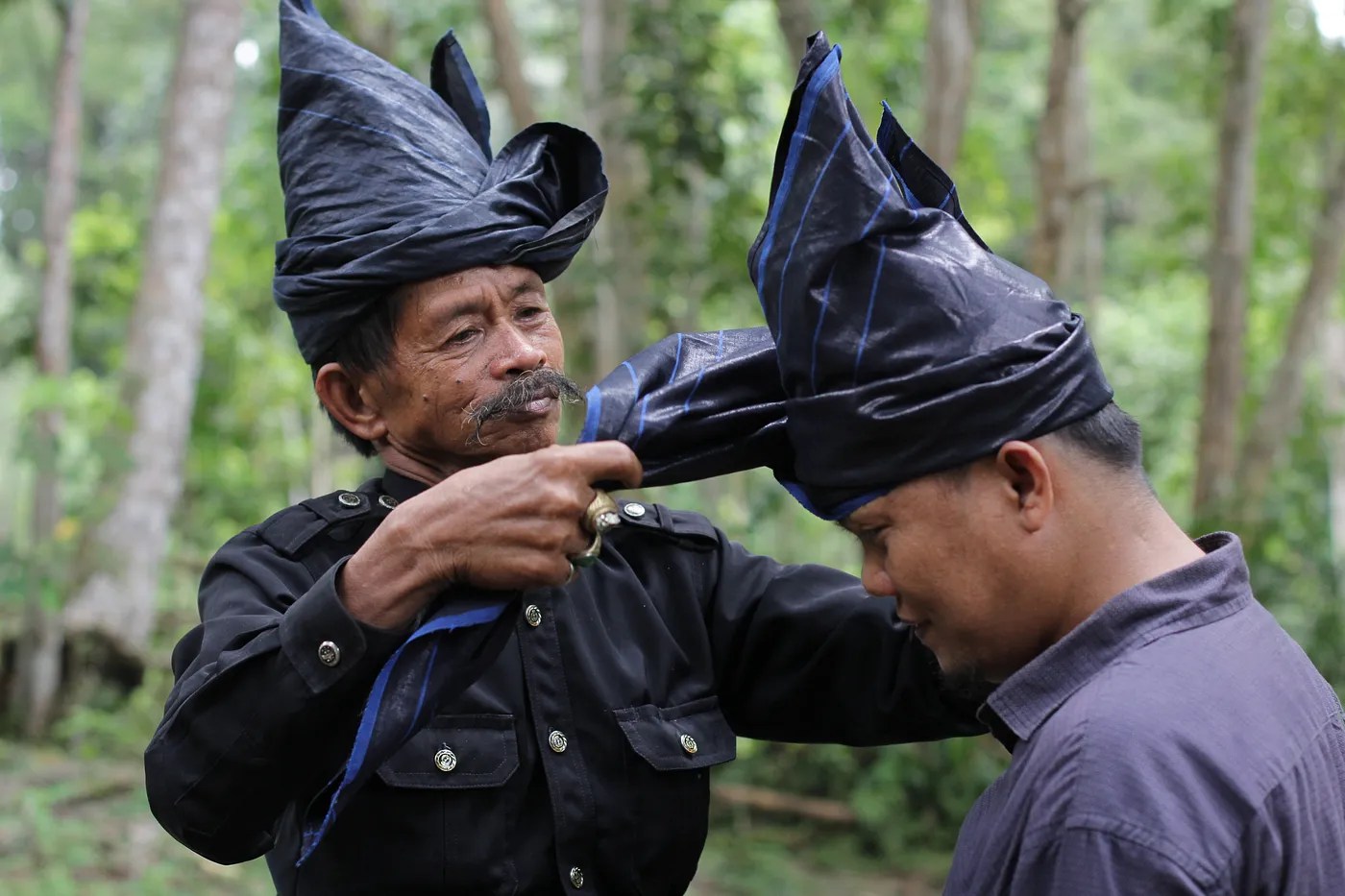
A Kajang elder in Indonesia demonstrates the wearing of a passapu headwrap and the passing of knowledge to the next generation.

While most of the world was going full-steam on nature-destroying “progress,” many indigenous groups were quietly protecting whatever was left.

Peter Yeung at the Washington Post writes about the Kajang people in Indonesia.

“By midmorning, beams of tropical sun cut through the rainforest canopy, illuminating a bamboo hut in a rare clearing of trees. Inside, a wrinkled old man, sitting cross-legged with his eyes shut, whispers blessings to the Earth.

“After the spiritual leader, the Ammatoa, goes silent, groups of men wearing dark indigo sarongs jump to their feet and head into the forest carrying an offering of rattan baskets full of rice, bananas and lighted candles.

‘The Earth is angry with us,’ said Budi, a barefoot boy crouching on the hut’s edge. ‘That is why the weather is getting worse. There are more rains and floods. It is getting hotter. It is because we have sinned.’

“This ritual is known as the Andingingi, held once a year by the Kajang, a tribe from the Indonesian island of Sulawesi. Like many parts of the world, their land has been hit by more extreme weather because of climate change. But as satellite imagery shows, the Kajang’s dense primary forest is free from roads and development, soaking up violent rains that devastate other parts of the island.

“As global deforestation continues at alarming rates, the empowerment of Indigenous peoples such as the Kajang is emerging as a key way to protect the world’s rainforests. A spate of recent research suggests that when armed with land rights, these communities, whose members manage half the world’s land and 80 percent of its biodiversity, are remarkably effective custodians. …

“The Kajang [community] lives according to the Pasang Ri Kajang, an ancestral law passed down orally through legends and tales. It tells of how the first human fell from the sky into their forest, making it the most sacred place on Earth.

“In practice, that means the forest is at the center of life. The Kajang rely on subsistence agriculture, with no industry or commerce to speak of. Cutting trees, hunting animals and even pulling up grass is prohibited on most of the land. Modern technology, such as cars and mobile phones, is not allowed within the traditional territory.

“ ‘The tree is just like a human body,’ said Mail, a 28-year-old Kajang. … ‘If the forest is destroyed, there will be nothing for the bees, nothing for the flowers and nothing for life.’

“So far, Indigenous tribes have received little legal, financial or institutional backing, advocates say. A 2021 report by the nonprofit Rainforest Foundation Norway found that over the past decade, Indigenous peoples received less than 1 percent of donor funding for fighting deforestation.

“Yet policy is now beginning to shift in recognition of the role they can play in protecting the land. …

“At the U.N. Climate Change Conference in 2021, also known as COP26, world leaders pledged $1.7 billion of funding for these communities, calling them ‘guardians of forests.’ …

“In December 2016, the Indonesian government officially recognized more than 50 square miles of rainforest as belonging to nine of the country’s tribes — including the Kajang — following a landmark ruling by the nation’s highest court. … In a case brought by the Alliance of Indigenous Peoples of the Archipelago (AMAN), an Indonesian nonprofit, the Constitutional Court ruled in 2013 that the state should transfer ownership of what are called customary forests to the Indigenous peoples who had historically governed them according to custom. …

“The rate of primary forest loss in Indonesia has declined every year since 2016, according to the most recent data available, and is now at its lowest level since at least 2002.

“The recognition of customary forests, along with government efforts to protect peatlands and mangroves and to tighten regulations on logging, oil palm and mining permits, has helped drive that reduction. …

“The Kajang are a showcase of Indonesia’s experiment. For years, local forest rangers have helped protect a wealth of native wildlife, including deer, monkeys, wild boars and tropical birds, as well as four rivers, whose watersheds supply several villages outside Kajang land. ..

“The philosophy of Kamase Mase, living simply and taking no more than needed to subsist, underpins their lifestyle here. …

“ ‘We must keep the tradition,’ said Jaja Tika, a weaver. … ‘As long as we live, the forest will exist.’ ”

More at the Post, here.

Read Full Post »

People from the Maasai community, one of the oldest tribes in East Africa, live in a semi-nomadic state and have had to go to the UN to try to preserve a pastoral way of life.

I love reading about other cultures. Today’s article is about Maasai people living in Tanzania. It is unfortunately a worrisome story, the only upbeat aspect being that forums exist where indigenous people can fight for rights and that they are starting to use those resources.

Joseph Lee’s Grist article was reprinted at Salon.

“In Tanzania, the Indigenous Maasai face an ongoing, violent campaign to evict them from their lands and make way for protected conservation areas and hunting reserves. [In April, several were] in New York to ask the U.N. Permanent Forum on Indigenous Issues, or UNPFII, to tell Tanzania to stop taking their cattle, remove its security forces, establish a commission to investigate disputed lands and displaced people, and allow international human rights monitors to visit without restrictions. 

” ‘We, the Maasai people of Loliondo and Ngorongoro in Tanzania, are fighting against the Tanzanian government and wildlife trophy hunters who are threatening our livelihood, culture, ancestral wisdom, legacy, and basic human rights,’ Edward Porokwa, executive director of the Pastoralists Indigenous Non Governmental Organization’s Forum, said. …

“The Maasai land conflict in Tanzania is focused on two main areas: the Ngorongoro Conservation Area and Loliondo. The Ngorongoro Conservation Area is a UNESCO World Heritage Site that attracts over half a million visitors every year for safaris to see the park’s ‘Big 5’ game — elephants, lions, leopards, buffalo, and rhinoceros. Around 80,000 Indigenous Maasai call the park home, but have faced decades of government efforts to push them off their land.

“In a statement delivered at the Permanent Forum, Porokwa said that, since June 2022, the government has closed four nursery schools, nine water sources, and six mobile health clinics. The government says that Maasai are voluntarily leaving the area for resettlement sites, but the Maasai say that they are essentially being forced out. ‘It is a forceful relocation by ensuring that people don’t get the basics,’ Porokwa said. ‘They are there to die.’ 

“And in Loliondo, which is legally demarcated Maasai village land, state security forces shot at Maasai in a violent campaign to drive them from their lands [in June 2022]. In the attack, dozens of Maasai were injured and many fled across the nearby border to Kenya for medical attention. At least two dozen others were arrested, while some were not permitted to leave their homes. 

“[Nine] United Nations experts raised concern about forced evictions and resettlement plans, but the Maasai representatives at the United Nations say that the government has not changed its approach. … Tanzania has taken or killed over 600,000 of their cows and demanded over $2.5 million in fines for grazing. This is all part of what Maasai say is a massive campaign to destroy their pastoralist way of life. 

“At the Permanent Forum, a representative from the Tanzanian government pushed back on the Maasai’s claims, pointing to the East African Court of Justice’s 2022 dismissal of an eviction case brought by the Maasai, stating that the Maasai could not prove their claims about violent evictions. …

“In January, the African Commission on Human and Peoples’ Rights conducted a monitoring visit to investigate the situation. But Maasai community organizations say that at every step, the visit was controlled by the government. Commission representatives were shepherded around by state security forces who intimidated Maasai and excluded them from some meetings. Some Maasai waited for hours to speak with the Commission, only for them to never show up. While the Commission’s final report on the visit did express concern about the situation, it also commended Tanzania’s commitment to protecting human rights. The Commission also recommended starting new consultations with the Maasai, as well as addressing their concerns about the resettlement program. 

“In December, José Francisco Calí Tzay, the United Nations Special Rapporteur on the rights of indigenous peoples was scheduled for a week-long visit to Tanzania, but the visit was indefinitely postponed. Maasai leaders believe that the visit was scuttled out of concern that the Special Rapporteur would not be given full access to investigate. …

“With few options remaining, the Maasai have turned to the Permanent Forum to raise their concerns. Briane Keane is the director of Land is Life, an international organization that works with Indigenous peoples, including providing travel funding, medical assistance, and security assessments to the Maasai. Keane says that the United Nations is an important platform for the Maasai. ‘It’s a place where they can be heard. The government of Tanzania is not listening,’ he said. 

“The Maasai hope that international pressure may convince the government to finally listen to their concerns. But speaking out on the international level also comes with risks for the Maasai. Several leaders who spoke out against government abuses were forced to flee the country for their safety

” ‘Indigenous peoples are the most among the most criminalized peoples of the world,’ said Keane. ‘There’s people being thrown in jail. There are threats. So it’s very dangerous work sticking up for your rights when you’re as marginalized as the Maasai are in Tanzania.’ “

Man, if your gripe is against the government, you really don’t want the government’s security forces leading the tour for the human rights inspectors! That should be a given. More at Grist, here. No firewall.

Read Full Post »

Photo: Conférence PPL 2022.
Brian Maracle shares his technique for teaching the Mohawk language at Canadian conferences such as Multidisciplinary Approaches in Language Policy and Planning (LPP or in French, PPL).

I love learning about other languages and sometimes pick up tidbits through my volunteering with ESL teachers. But languages in danger of dying out are especially interesting to me. If they die out, we lose too much about the ways others see the world.

Today’s story is about a technique for teaching a particular endangered language.

Ian Austen wrote at the New York Times from Ontario, Canada, “When Brian Maracle returned in his mid-40s to the Mohawk community near Toronto that he had left when he was just 5, he didn’t have a job and knew almost no one there.

“But perhaps the biggest challenge facing him was that he neither spoke nor understood much Kanyen’keha, the Mohawk language. More than a century of attempts by Canada’s government to stamp out Indigenous cultures had left Mr. Maracle and many other Indigenous people without their languages.

“Now, 30 years later, Mr. Maracle has become a champion of Mohawk, and is helping revive it and other Indigenous languages, both in Canada and elsewhere, through his transformation of teaching methods.

“ ‘I never studied linguistics, don’t have any teacher training, my parents weren’t speakers,’ he said in his office at an adult language school he founded about two decades ago in his community, the Six Nations of the Grand River territory, southwest of Toronto. Yet, linguistics academic conferences now feature him as a speaker. …

“From the 19th century into the 1990s, thousands of Indigenous students were taken from their homes, sometimes by force, and placed into Canada’s residential schools system. There, they were forbidden from speaking their languages and from practicing their traditions in what a national commission later characterized as ‘cultural genocide.’

“The system failed to entirely eradicate Indigenous languages, but its effect was nevertheless devastating for the 60 Indigenous languages found in Canada.

“Today restoring Indigenous languages has been a component of Canada’s push for reconciliation with its Indigenous people. … Four years ago, the government passed the Indigenous Languages Act, which formally recognizes the importance of these languages and requires the allocation of money — more than 700 million Canadian dollars to date — for teaching them.

“But none of that was around when Mr. Maracle arrived at Six Nations, and the program that was available, he found, was ill-suited for adult students.

“ ‘Indigenous languages are extremely different from English,’ said Ivona Kucerova, the director of the Center for Advanced Research in Experimental and Applied Linguistics at McMaster University in Hamilton, Ontario. ‘But typically what you see is that the local Indigenous language teaching methodologies are designed to teach Western languages.’

“Mr. Maracle said the problem with his first, unsuccessful lesson was that the instructors, generally Mohawk elders without training as language teachers, were tossing out ‘whole words.’

“ ‘They just expected by dropping a word on you and saying it louder that you’d somehow figure it out,’ Mr. Maracle said. ‘They didn’t understand how the language really is structured.’ …

“Mr. Maracle found the answer about 25 years ago in the office of David Kanatawakhon-Maracle, no direct relation, a lecturer at the Western University in London, Ontario.

“ ‘There were little bits of paper all over this big table,’ Mr. Maracle recalled. The lecturer told Mr. Maracle words he had been longing to hear: ‘He said: “I think I’ve got a new way of teaching the language.” ‘

“There were about 60 slips of paper on his office table, and they ‘were the Rosetta Stone of all the things that you need to be a competent beginning speaker,’ Mr. Maracle said.

“Kanyen’keha is a polysynthetic language, where a single word can function as an entire sentence. Those words are made up of morphemes, small elements that change their meaning depending on how they are combined. …

“Understanding that these elements were the key to unlocking the language was the breakthrough Mr. Maracle needed to attain fluency. But other students at the school he helped start in 1999 were still struggling. It became apparent that someone needed to build a curriculum and teaching program around the morphemes, including a color-coded system for grouping them, which Mr. Maracle did through trial and error.

“One essential discovery was figuring out that learning Kanyen’keha requires ‘looking at the world with Mohawk language eyes,’ he said. In comparison with other languages, Kanyen’keha relies heavily on verbs.

Objects are generally described by what they do. The word for ‘computer,’ for example, roughly translates as ‘it brings things up.’

“ ‘We don’t teach you how to say “pencil,” “chair,” ”shoe” for six months,’ Mr. Maracle said. ‘Because the language is a verb-based language, the names of things are less grammatically important.’

“Prof. Kucerova, the director of the linguistics center in Hamilton, regards Mr. Maracle as a linguist despite his lack of formal training. She said tests showed that his students emerged with a university-level fluidity in two years.

“ ‘I have never seen anyone else bring adult learners to that level of language, to be able to speak at this level after two years,’ she said, adding that Mohawk ranks with Arabic in terms of difficulty for English-speaking students. ‘That’s really astonishing.’

“ ‘I became literally mesmerized by the extent of his work,’ Prof. Kucerova said. ‘He’s figured out this improbable, but linguistically extremely smart, method of delivering this radically different language to adults.’ ”

More at the Times, here.

Read Full Post »

Photo: Whitney Eulich.
Angel del Rosario Hau Paat, who raps as ADR Maya, is seen here with his mother in Tulum, Mexico. He grew up resistant to speaking Maya but now embraces it.

When a new generation decides that the old folks’ way of speaking could actually be cool and even powerful, a language that is in danger of dying out may get an extension.

Whitney Eulich writes at the Christian Science Monitor, “Angel del Rosario Hau Paat leans over the rainbow-colored hammock where his grandmother lies and speaks directly into her ear: ‘What do you think of my singing?’ he shouts in Maya, the Indigenous language of Mexico’s Yucatan.

“Hard of hearing, she strokes his face as she responds. ‘She’s happy,’ he translates, with a bashful laugh. ‘She says my Maya is good.’

“Growing up in the southern Mexican state of Quintana Roo, Mr. del Rosario says he wasn’t interested in learning Maya, the only language his grandmother speaks and which his mother grew up speaking. Spanish is what was useful for him at school and among friends.

“But today he is part of a growing trend among young people – here and across the Americas, from Canada to Chile – who are rapping in Indigenous languages. It’s strengthened his connection to the language his mother raised him speaking (and to which he grew up responding in Spanish) and to his family’s traditions.

“ ‘I never imagined myself using Maya so much. I’m making more connections with my culture and with people from other countries also rapping in Indigenous languages,’ says Mr. del Rosario, a pool technician in the resort town of Tulum who records music under the name ADR Maya in his free time. ‘It feels really good.’ 

“Mexico is home to more than 60 officially recognized Indigenous languages. Many of them, and their associated cultures, are at risk – despite a 2002 law protecting the right to use one’s Indigenous language and education reforms in recent years that require some languages be taught in public schools.

“At least 40% of the world’s Indigenous languages are also in danger of disappearing, according to the United Nations. But, for young artists like Mr. del Rosario, the discovery of rap in Maya is serving as a motivation to double down on learning more. …

“Says José Antonio Flores Farfán, a professor of linguistics and anthropology at the Center for Research and Higher Studies in Social Anthropology in Mexico City, ‘Treasures that human beings have accumulated for centuries are encrypted in language. … It’s these kids, these rappers, these artists who give me hope. … They are talented, doing something about it from the bottom up, and they’re inspiring younger kids and new generations to see value in the language in the process.’

“In the Yucatec-Maya-speaking region of southern Mexico, Jesús Cristobal Pat Chablé, more popularly known as ‘Pat Boy,’ could be considered the Johnny Appleseed of Indigenous rap. The artist, in his early 30s, started playing music when he was 5 years old and experimented with different genres, from rancheras (Mexican ballads) to rock to reggae, launching his solo rap career in 2009. 

“Today, he travels internationally, rapping in Maya; collaborates with artists who speak other Indigenous languages; and encourages young Maya speakers to write and record their own music, some of which ends up on albums he produces through his label ADN Maya. He’s currently building a recording studio in the town of Felipe Carrillo Puerto, about 140 miles south of Cancun. 

“Themes of daily life in Maya communities – customs, education, love, and traditions – populate his lyrics. His efforts have won him international recognition, including the 2022 Linguapax Award.

Last year, a song Pat Boy collaborated in writing and singing was featured on the ‘Wakanda Forever’ soundtrack.

“[It brought] the Maya language to theaters around the world with lyrics like: ‘They say we disappeared from this earth, what do you think? / It isn’t true … years passed, we became stronger. / Today I treasure the Mayan culture.’

“It’s a far cry from how he started.

“ ‘It was tough. I’d try to get a spot in a public festival and people would say, “But what do your songs say?” ‘ he recalls of his early years performing in Quintana Roo. ‘I was in my right to speak and sing in my maternal language, but there was this fear [among organizers] that I was motivating people to do things against the government, to rise up, because it was written in Maya and they didn’t understand the words,’ he says.      

“ ‘People in the city say, “You can’t achieve things if you’re Maya, you come from the countryside. You can’t be an artist or a painter or a writer,” ‘ he says. ‘When I started there wasn’t a lot of interest in what I was doing. Now, everywhere I go I meet young people dreaming of singing in Maya.’ ”

More at the Monitor, here. No firewall.

Read Full Post »

Photo: Dave Herasimtschuk, US Fish & Wildlife Service/Wikimedia.
In Washington State, the Yakama Nation Fisheries crew routinely teams up to catch lamprey at an “eeling” hole that’s fed tribal members for generations. Lamprey use the suction of their oral discs to climb rocks at the eeling hole.

I like to explore social media and recently added Mastodon to the places I visit. At Mastodon, you have to join a group (what they call an instance), and I chose the Climate Justice instance. Being with Climate Justice has exposed me to people I haven’t followed before on social media. You won’t be surprised to learn that a topic like climate justice has attracted quite a few indigenous people. They are from all over the world: Sámi from the Nordic countries, Aborigine people from Australia, among others.

B. “Toastie” Oaster is one, a citizen of the Choctaw Nation in Oklahoma. From Toastie, I learned about a publication called High Country News and an article on the Pacific lamprey, an ugly fish with a long, important history.

“Lamprey have lived on Earth for 450 million years. To them, dinosaurs were a passing fad, and the North American continent is a fairly recent development. Lamprey swim out to sea as juveniles, looking for hosts like salmon to parasitize until they are mature enough to swim up some other river to spawn. Adult lamprey are calorie-dense and slow, protecting their hosts and cousins, the salmon, by acting as a predation buffer in another gesture of reciprocal care. 

“Though lamprey play a key role in Pacific watershed ecosystems, they remain understudied outside of tribal fisheries. They’re the target of misplaced disdain, in part because they’re easily confused with sea lamprey, an Atlantic species that caused ecological havoc in the Great Lakes after a 19th century shipping canal allowed them to invade. Pacific lamprey are a different species, in a different ecosystem; they belong here, just like the people they sustain.

“As far back as the memory archive reaches, people have fished for eels in this watershed. Lamprey climb wet rocks with their sucker mouths, so waterfalls are good places to catch them. Celilo Falls was a dangerous place for eeling, so people went to places like Willamette Falls, Celilo’s younger cousin. In its heyday, it was an international destination for summer eeling. Elders remember elders who remember trails that connected the falls to central Oregon. Camps lined both sides of the Willamette and the Clackamas River, which branches off below the falls. 

“Wewa [an elder and tribal councilman of the Confederated Tribes of Warm Springs] and other elders are clear that their ancestors were not nomads. Families returned to permanent homes, making seasonal trips to where food thrived. This non-European approach to agriculture ensures that both people and ecosystems flourish. In its healthy state, the Willamette Valley was a food-producing white oak savanna, bright blue in springtime with flowering carpets of delicious camas roots. That’s where it got its name: ‘Willamette’ is a French corruption of lámt, the Ichishkíin word for blue, Wewa said. ‘They ruined it.’

“For the millions of lamprey that returned from the ocean to spawn in the Willamette Valley, the first obstacle they faced was Willamette Falls. In the late 1800s, settler accounts described the 1,500-foot-long, four-story-high falls as ‘completely covered‘ in eels during the summer runs — three layers deep, in some places. Historical photos give an idea of how the rocks looked blanketed in eels, some latched onto each other’s backs, rendering the boulders as shaggy as mastodons. In the 1940s, European settlers commercially harvested as many as 500,000 lamprey a year, but tribal harvests until that point had kept the population in careful balance. …

“Since industrialization, lamprey numbers have dropped by 90%, largely because of dams. According to some Natives, public antipathy toward the species hasn’t helped. Willamette Falls is one of the last places where there are still enough lamprey to harvest. There, the Confederated Tribes of the Umatilla Indian Reservation, the Confederated Tribes of Warm Springs, the Confederated Tribes and Bands of the Yakama Nation and the Nez Perce Tribe — all of whom retain treaty fishing rights at Willamette Falls — boat upriver between industrial structures to harvest lamprey at the falls. These four tribes comprise the Columbia River Inter-Tribal Fish Commission (CRITFC), an organization that enforces treaty rights and promotes conservation of the basin’s aquatic life. Every year, CRITFC coordinates eeling trips with tribes.

“Eeling teams consist of at least two people: one to hold the net, the other to catch the eels. Plucking them off the rocks is easy enough with cotton work gloves, which provide the best traction against eels’ dolphin-smooth skin. …

“To work a waterfall, crews start at the bottom; eels will spook and stampede if they sense danger or smell blood in the current. Sometimes, eelers use this to their advantage, sticking a net or a trap at the downspout of a rockpool and scaring the eels into it from behind. When a dipnet is full, the crew transfer the catch eel by eel into burlap bags, then carry the pulsing, writhing sacks over the boulders to the boat. …

“While any tribal member can organize eeling trips, the fisheries department conducts its own trips to get eels for elders, those in need and ceremonial uses. The boat’s driver, a teddy-bear-faced man in his mid-50s with a bandanna tied over a loose knot of gray hair, lit a cigarette, apparently the only person unfazed by the cold or the early hour.

“ ‘All this is pretty tame to me,’ he laughed. He said he used to work ’30-hour days’ running a commercial salmon fishing operation at Lake Celilo, where Celilo Falls used to be. He reminisced about his glory days at Willamette Falls in the late ’80s and early ’90s, claiming, with a sly smile, that he caught so many eels, he’s probably the reason they’re in decline. Five thousand pounds in a day, he said. ‘I’ve been there, done that, 30 years ago, 40 years ago.’

“The boat driver is Evans Lewis Jr., a veteran fisherman now serving as the assistant manager of the Yakama Nation Fisheries’ sturgeon hatchery. … Lewis said he knows the best eeling holes from previous generations, where lamprey still gather by the thousands. He pointed out the best route along the boulders: Don’t hug the ridge, he said. Swing out in a wide arc, closer to the water line. He described techniques no one uses anymore: Drilling drainage holes in a metal trash can is easier, he said, than hauling gunny sacks of eels back across the rocks. ‘Nobody fishes like I do,’ Lewis told me and grinned.’ “

Toastie’s long, fascinating article is at High Country, here. You may read four High Country articles for free each month.

Read Full Post »

Photo: Felipe Milanez via Wikimedia.
Fire at the National Museum of Brazil, in Rio de Janeiro, on 2 September 2018.

Do you remember reading about the disastrous fire at Brazil’s national museum? It was before Covid. Many irreplaceable artifacts were destroyed. I recall, for example, that the curator of entomology at the University of Texas, Austin, was devastated by the loss of that museum’s priceless insect collection.

Also lost were indigenous artifacts. But since that part of the collection had been created without tribes’ input, the rebuilding is a chance to make something better.

Mariana Lenharo and Meghie Rodrigues report at the New York Times, “In the evening of Sunday, Sept. 2, 2018, the National Museum of Brazil in Rio de Janeiro was closed, and its hallways were empty. Silent activity, however, coursed within its walls. Electricity hummed through wires connected to computers; climate-controlled storage and three air-conditioning units connected, improperly, to a single circuit breaker in the ground-floor auditorium. When one unit most likely received a surge of electricity it couldn’t handle, the overburdened system sparked. The museum’s smoke-detector system was not set. There were no sprinklers or fire doors, and a flame bloomed.

Seeing the news, staff members rushed to the building and pleaded with firefighters to let them enter and rescue something — anything. …

“Much of what was lost or severely damaged was irreplaceable: the mummy of an Ancient Egyptian priestess, a 110-million-year-old fossilized turtle, a vast collection of butterflies, the oldest known human remains in Latin America.

“The fire also obliterated an enormous assemblage of artifacts representing the cultural history of Brazil’s Indigenous populations. Masks, vases, weapons, mortars and elaborately feathered ceremonial capes dating back at least a century from the Ticuna, the Kadiwéu, the Bororo, the Tukano — at least 130 peoples in all — were gone. Researchers worked to salvage what they could from the ashes. Astonishingly, a few ceramic vases kept their original paint. One Karajá animal sculpture was found almost intact. But most ‘were fragments, scraps that would no longer be recognized by the people who made them,’ says João Pacheco de Oliveira, the head of the museum’s ethnology and ethnography division. When Ananda Machado, a social historian at the Federal University of Roraima, told members of the Wapichana people about the fire, they were devastated. ‘To them, these objects were much more than material,’ she said; they carried with them the strength of the people who made them. …

“In 2018, after 40 years with the museum, Oliveira planned to retire. But the fire pushed those plans aside. Even while mourning the tragedy, he saw possibility. Yes, the ethnographic collection was in some ways unparalleled, but he had long been vexed by what was missing from it. Many objects were collected by European travelers in the 19th and early 20th centuries who didn’t grasp the purpose that the objects served. A pot or a cape might have been chosen simply because it seemed beautiful or peculiar to a Western eye. As a curator, he found this lack of cultural context deeply frustrating.

“As an anthropologist, Oliveira was even more troubled. Since the 1970s, he has spent long periods with the Ticuna in northern Brazil trying to understand them on their own terms and to communicate their culture to a wider world. The museum was an important vehicle for his aims, but the institution came with its own inglorious history. As with other 19th-century museums, the National Museum was a repository of items plucked, purchased or plundered from Indigenous communities and had presented the people themselves as curiosities, papier-mâché figures in dioramas alongside taxidermied animals. And sometimes worse. …

“With no building to return to, Oliveira met with his team members on park benches and in cafes and explained his vision for a new collection. Indigenous people would be consulted not only about what items would go into the museum but also on how they should be identified, stored and exhibited. One of the first people he turned to was a former student named Tonico Benites.

“Benites grew up in Mato Grosso do Sul in midwestern Brazil on a reserve for the Guarani-Kaiowá, one of the country’s 305 surviving Indigenous groups. His parents never learned to read and write, but he finished high school and went on to study for a degree in education, picking up work on the side as an interpreter for anthropologists. Drawn to the questions the researchers asked, he applied to a master’s program in social anthropology offered at the museum.

“Benites’s first visit to the museum in 2006 was also his first day as a student there. Entering the ethnographic exhibition area, he saw a collection of spears and arrows and then rounded a corner. He froze, sickened. Covering an entire wall was an outsize reproduction of a woodcut from a 1557 book by the German explorer Hans Staden. The account of Staden’s captivity by the Tupinambá was immensely popular in its day, and some scholars now assert that its sensational depictions of cannibalism were used to justify European conquest of Indigenous peoples. …

“Benites raised his concerns with Oliveira, who was his research adviser. Oliveira sympathized but suggested that Benites use his research to change people’s minds. The image was removed months later, but almost a decade would pass before Benites, who had just finished his anthropology Ph.D. — the first Indigenous person to do so at the museum — began research for what he hoped would be a Guarani-Kaiowá exhibition. The fire decimated his plans. …

“The absence of Indigenous perspectives in exhibitions about Indigenous people has been acknowledged, if rarely remedied, at natural-history museums. … Unlike Indigenous groups in other countries, those in Brazil have traditionally maintained a sense of ownership over the museum, which was conceived as a museum of the nation’s history as well as of natural history, Oliveira says. Even the Wapichana, so distraught by the loss of their heritage, have committed to working with curators. Had there been arguments over ownership of older objects, the fire, in its indiscriminate destruction, made them moot. The National Museum has a unique opportunity, says Mariana Françozo, an associate professor of museum studies at Leiden University in the Netherlands. Museums in Europe would find it difficult to build a collection entirely based on collaboration, she says, ‘because they still have the old collections that carry the weight of colonialism.’ ”

More at the Times, here.

Read Full Post »

Photo: Piscataway Indians.

Our history with indigenous tribes is dark, and reconciliation must start with facing facts. In this endeavor, archaeology can help.

From St. Clement’s Island, Maryland, Dana Hedgpeth writes for the Washington Post on recent discoveries about a tribe’s long-ago presence.

“The small pieces of oyster shells and ceramic shards in the palm of archaeologist Julia King don’t look like much. But her team’s discoveries of roughly 1,500 pounds of shells and 200 pieces of ceramics bring new and more concrete evidence of the dominance of Native Americans who once lived at St. Clement’s Island and along the surrounding Potomac River shoreline in Southern Maryland. Native American leaders said their archaeological findings shed fresh light on their tribes’ historic presence in the state — which continues to this day but is often unknown, forgotten and ignored.

“ ‘This work is showing a reclamation of the long history of Native Americans in that area and what it means to our people,’ said Gabrielle Tayac. Tayac is a historian and member of the Piscataway Indian Nation, which considers the area its tribal homelands. ‘There’s been a willful and problematic negligence in the record about us.’

“St. Clement’s Island — an uninhabited 40-acre plot of land only accessible by boat — sits where the Potomac and Wicomico rivers meet, about half-mile off the shoreline of St. Mary’s County. There are roughly 4,500 Native Americans who are part of two state-recognized tribes — the Piscataway Conoy Tribe and the Piscataway Indian Nation — who trace their roots to the area. Piscataway means ‘the people who live where the waters meet’ in the Algonquian language.

“To many, St. Clement’s Island is best-known as the spot where roughly 150 European colonists arrived on March 25, 1634, and held the first Roman Catholic Mass in the British American colonies. …

“Few people had explored the sandy shores and grassy lands of the island until King’s research team spent several months this summer carefully digging up grass and sifting through dirt. … They found scores of Native American artifacts at the site and in collections of area residents and of a small museum on the mainland. The items included stone tools, tobacco pipes, ceramics and oyster shells, along with bits of copper, polished tubes and stone beads. All of it is evidence, said King, an archaeologist with St. Mary’s College of Maryland, of the ‘extensive exchange and network of trade’ between Piscataways and tribes from areas now known as Virginia, New York and as far away as Ohio andWest Virginia — centuries before Europeans came. …

“For Native American leaders in Southern Maryland, King’s work is a validation of their long history and continued presence in the area that’s rarely highlighted.

‘History was not written for us — or about us,’ said Francis Gray, chairman of the Piscataway Conoy Tribe. …

“Archaeological records show Native Americans were in the St. Clement’s Island area as far back as 3500 B.C., according to King. The island itself was once 400 acres, but erosion shrank it. Historians say there were an estimated 5,000 Piscataways living in the Potomac Valley area in the 1600s. …

“Rico Newman, an elder in the Choptico Band of Piscataways, said he remembers when growing up that he heard oral histories from his elders of how Piscataways followed the shad and herring runs along the nearby Wicomico River and went to St. Clement’s Island. Native Americans called it Heron Island after the bird that is fond of nesting in the area.

“ ‘There was no better place to live off the water and the land than there,’ Newman said. He recalled how his grandfather used to tell him, ‘if the heron isn’t fishing, then you weren’t fishing.’ It meant there was ‘something wrong with the fish or the water that day.’ …

“In the early 1600s, Piscataways traded with Europeans from the sister colony in Jamestown, Va. For the Piscataways, the trade meant protection for their homeland from Iroquois. English copper, beads and metal tools ‘made the newcomers useful that they need not be killed or left to starve,’ according to Piscataway leaders and historians.

“The Piscataways’ homeland changed dramatically when in March 1634, two ships — the Ark and the Dove — arrived with colonists looking to create a settlement. To celebrate their arrival, the colonists held the first Catholic Mass in the New World.

“The colonists knew of the disagreements and slayings between Native Americans and settlers at Jamestown, so they planned a different approach. The Calvert family, who founded Maryland as a colony, ‘didn’t want to pay for the costly kinds of wars experienced in Virginia,’ King said, ‘so they made the decision to forge diplomatic relationships with the Indians.’

“They went from St. Clement’s upriver to see the Piscataway tayac — the word for leader in the Algonquian language. They told Wannas, the Piscataway tayac at the time, they’d ‘come not to make war, but out of good will toward them,’ according to records at the St. Clement’s Island museum.

“Wannas, the tayac, cautiously responded to them, saying the Native Americans did not welcome the colonists, but also was not going to force them to leave. The colonists decided St. Clement’s was too small and well-established as ‘Indian country,’ so they returned and went down the river to what would become St. Mary’s City, where they bought land from the Yaocomicos and set up the first English settlement in Maryland.

“By 1650, more colonists moved to the area, and they created a reservation for the Piscataways, but eventually, King said, the Native Americans were pushed out as colonists took over. Some Piscataways went north to what’s now Frederick. Others went to Virginia. And some stayed, but they were ‘no longer considered a sovereign nation,’ King said. …

“Karen Stone, the executive director of the St. Clement’s Island museum, said a major renovation will start early next year with new exhibits that will tell Maryland’s history from the points of view of the colonists and the Piscataways. She said local Native American leaders are involved in designing the materials and exhibits for the new museum to give a more complete story and more accurate history of the Piscataways.”

More at the Post, here.

Read Full Post »

« Newer Posts - Older Posts »