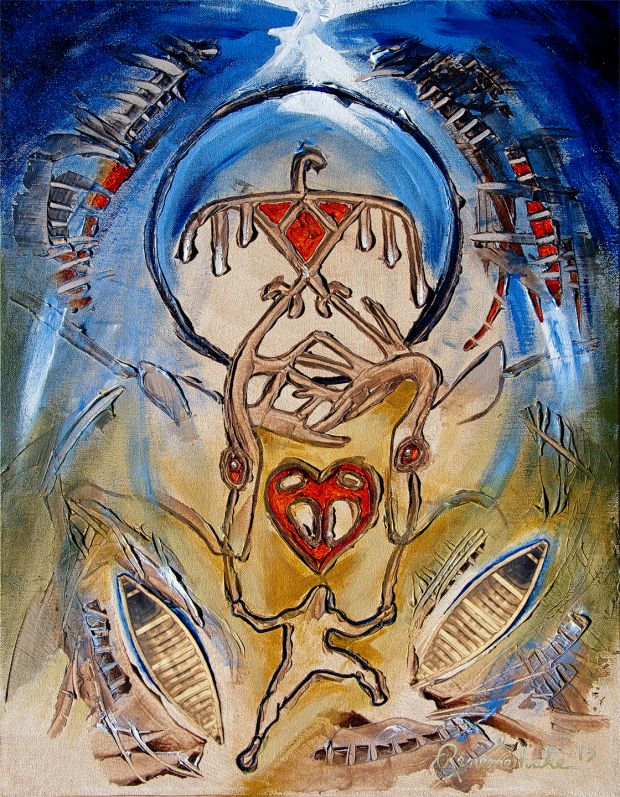
Art: Rene Meshake
Ojibwe artist Rene Meshake was part of a group of indigenous storytellers from Canada who attended the Untold Stories conference in Ireland in May.
As many people know, there was a dark period in US history when authorities thought is would be a good idea for indigenous children to be separated from their language, families, and culture. The same thing happened in Canada. Today, those children and their children are reclaiming their voices and telling their own stories.
Here is Catherine Conroy at the Irish Times: “On a Friday morning in a house in Dublin, I sit down to speak with three indigenous storytellers from Canada. They are here for a conference called The Untold Stories of the Past 150 Years/Canada 150 at [University College Dublin]. …
“Maria Campbell, Rene Meshake, and Sylvia Maracle, from Canada’s ‘Indian Country,’ accompanied by indigenous historian Kim Anderson, tell me a story of pain, resilience and the rebuilding of a shattered community through stories.
“Sylvia Maracle is an activist and storyteller from the Tyendinaga Mohawks. She believes their stories will resonate with Irish people, ‘with colonisers having come and disrupted what was probably the natural order.’ …
“She tells me of a conversation she had with an Irish taxi driver when she arrived. ‘He asked, “Are people recovering their memories?” I said, “They were always there, we just didn’t have the conversation.” He said, “That’s what happened here.” ‘ …
“Maracle believes in the power of storytelling as a force for rebuilding their communities. She feels privileged to have been ‘old woman raised’ by her traditional grandmother. …
“Maracle tells me that people now visit Maria Campbell ‘because they want this good medicine, this traditional stuff.’
“Campbell agrees that storytelling is medicine. ‘I grew up with a great grandmother and she never spoke English, she was a total “savage” according to the priest because she never converted.’
“But while Campbell grew up with stories, she always felt split between her traditional home life and her life outside. It was only after she stopped using drugs and attended her first ceremony in her late 20s that she realised the healing power of the stories, which came from ‘the old ladies, always women laughing.’ It was a revelation to realise ‘that you’d got this medicine, everything you need to help put yourself back together.’
“Campbell tells a story about the effects of colonisation that she learned from her teacher, the Old Man. …
“He had been trying to explain to her the effect of colonisation on their community’s wahkotowin, which in English means kinship, ‘but if you look at the word bundle, it’s all of our laws, it’s the way that we talk to each other, the way that we laugh.’
“He threw [a] jigsaw in the air. ‘He said, ‘”That’s what happened to us, everything was shattered and wahkotowin flew. Maybe you have three pieces, maybe she’s got half of one, if we come back together and we start to rebuild that, you bring your three pieces, you bring yours, and soon we’ll make the picture.” ‘…
“She recalls one story she wanted from her father that he would not give. ‘Then he got diagnosed with a terminal illness and I had to do the translating for him [in hospital]. I kind of went to pieces when we were driving home. He pulled to the side of the road, rolled me a cigarette, and he said, “That story you want, I’ll give it to you now.” He retold it and she understood now that it was a story about death, not the funny story she’d always thought it was.
“She translated and published the story. ‘In my family’s way, they were telling me that they trusted that I would treat it with integrity.’ ”
More at the Irish Times, here.


 Suzanne's Mom's Blog