Feeds:
Posts
Comments

Posts Tagged ‘jews’

Photo: It’s Time.
Jewish Israeli singer Achinoam Nini and Palestinian Israeli singer Mira Awad take the stage at the People’s Peace Summit in Jerusalem, May 9, 2025.

You wouldn’t know it from the headlines, but in Israel there are actually quite a few Jewish and Palestinian individuals who refuse to give up on peaceful coexistence.

Dina Kraft reports at the Christian Science Monitor, “For Israelis and Palestinians, May 28 marked 600 days of the most devastating period either side has known since Israel’s foundation. And yet amid it all, there are people trying to build bridges from one side to the other, attempting – together – to create a different reality.

“Some of them gathered recently for a well-attended two-day People’s Peace Summit in Jerusalem, forged by a coalition of Jewish and Palestinian peace-building and coexistence organizations. They sought to demonstrate that a peace movement is a viable and growing notion, and that joint Jewish-Palestinian activism is withstanding the raging war and shattered trust.

“ ‘The way to peace will not be short, but it is better than endless war,’ Sally Abed, a Palestinian citizen of Israel, called out from the Jerusalem stage to an auditorium packed with over 3,000 people. She is a leader of Standing Together, a fast-growing group uniting Jewish and Palestinian Israeli citizens.

“One outspoken Israeli peace activist is Maoz Inon, whose parents were burned to death in their home near Gaza in Hamas’ Oct. 7, 2023, attack that sparked the war. He and his siblings responded with a vow to seek peace, not revenge.

“ ‘Yes, we are devastated from the horrors that are happening in Gaza and the West Bank, and we acknowledge the ongoing trauma both peoples are enduring,’ he says in an interview. ‘But we know the only way to end the bloodshed and the cycle of violence, revenge, and hate is shaping and creating a new reality. We are learning from spiritual and faith leaders, security leaders, and from other conflict areas that were resolved.’

“In the aftermath of Oct. 7, Mr. Inon paired with a fellow entrepreneur, Aziz Abu-Sarah, a Palestinian from East Jerusalem whose older brother died soon after being imprisoned and beaten in the first intifada. Together they have been advocating reconciliation, equality, and justice.

“They say they can see their growing impact in their growing list of invitations to speak, not only at peace-related events but also in public schools, at universities, and at conferences. Their joint TED Talk has gone viral, and their work caught the attention of the late Pope Francis, leading to a Vatican meeting.

“It can be difficult for Israelis and Palestinians to work together openly. Activists are called naive at best, traitors at worst. But, Mr. Abu-Sarah argues, ‘We are offering the only viable answer to the current reality. As Maoz told me after his parents were killed, “Right now, we are in the desert – no food, no water. We’re lost. And when you’re lost in the desert, you call out for water.”

” ‘We are calling out for peace. … In times like these, we must work with Israelis who oppose the bombardment of Gaza and genuinely support peace. [But] bridge-building must be rooted in clear principles: equality, justice, recognition, healing, and safety for all. It’s not just about dialogue. It must lead to real action and tangible change. We do have strong, principled allies on the Israeli side. … They need us, and we need them, because without each other, we’re weaker – and the killing won’t stop.’

“[Standing Together] sees the recent surge in activism as the sign of an awakening among Israeli Jews who view the war as endangering Palestinian civilians alongside Hamas-held Israeli hostages and soldiers. …

“Illustrating both the challenge and the potential for peace activists, throngs of ultranationalist young Israelis swept through Jerusalem’s Old City on May 26, shouting hateful slogans in a sometimes-violent march marking the day in 1967 when Israel captured East Jerusalem.

“Volunteers from Standing Together and the Free Jerusalem collective, a group of predominantly Jewish Jerusalem residents that works with Palestinians in the city, acted as a ‘humanitarian guard’ to prevent violence. In a scene captured on video, a Jewish Israeli volunteer can be seen rushing into a crowd of far-right marchers surrounding a Palestinian man. …

“ ‘We always have something we can do and a way we can do it,’ wrote Rula Daoud, co-director of Standing Together, herself a Palestinian citizen of Israel.

“Mohammad Darawshe, director of strategy at Givat Haviva, Israel’s oldest and largest organization working for a shared Jewish-Arab society, says bridge-building is challenging for Palestinian Israelis. They face systemic discrimination and are often seen as a fifth column in Israel, he says, and while they have an ethnic and cultural affinity for West Bank and Gaza Palestinians, they have limited political influence.

“ ‘As peacemakers they have a very underutilized role. But if empowered by Israel and by Palestinians on the other side, then they could play a significant role in peacemaking thanks to our bilingualism and dual identity,’ he says. …

“Mika Almog, creative director of the It’s Time movement that organized the peace summit, says that it is hard to counter the general Israeli mindset that there are no Palestinian partners for peace, especially in the wake of the Oct. 7 atrocities. …

“She says Israelis have been told that the conflict could be contained through periodic wars, but not resolved. ‘We have been taught that this is a reasonable price,’ she says. ‘In order for Israelis to be able to sustain and build faith [in the prospects for peace] we need to see Palestinian partners within Israel but also partners in Gaza and the West Bank.’

“At the summit, a view of life in Gaza came in the form of a brief video of a Palestinian woman walking through the rubble. She details the difficulties of her life: living in a tent, subsisting on limited food and water.

“ ‘We are living a tragedy,’ she says. ‘Most people in Gaza are against extremism and terrorism. We want peace.’ ”

More at the Monitor, here. No firewall. Subscription prices are reasonable.

Read Full Post »

110520maghreb20jews20yashiba

Photo: Taylor Luck
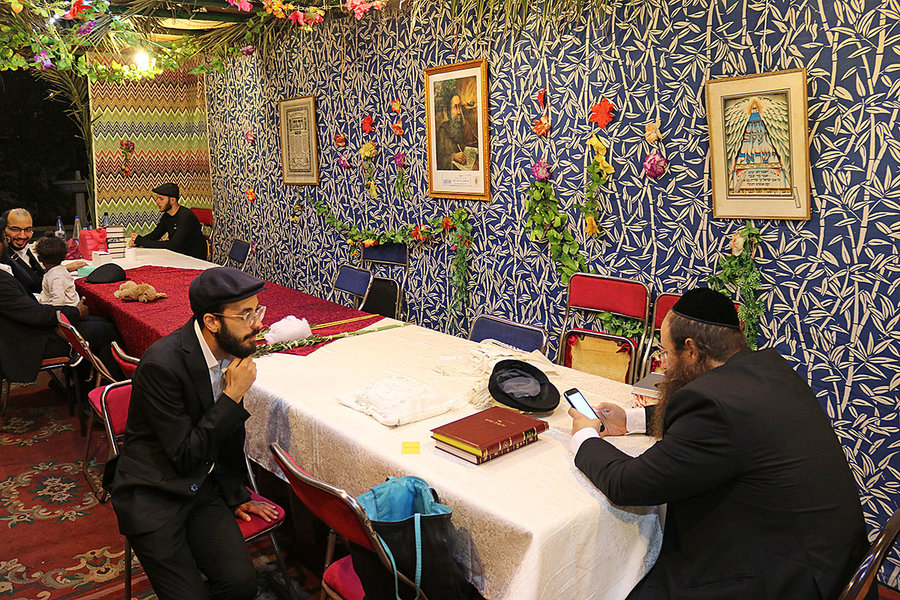
Yeshiva students are seen studying in a Casablanca sukkah hut last October. “Jews and Muslims have a long history of amity in Northern African countries like Morocco and Tunisia,” says the
Christian Science Monitor.

It seems to me that when people want to get along, they do. In the following story, we see how two religions usually depicted at odds have coexisted comfortably in Northern Africa for generations. What isn’t clear to me is how communities can start this kind of positive relationship if they haven’t had it before. There has to be a way.

Taylor Luck reports at the Christian Science Monitor from Morocco, “Even as congregants recite evening prayers at Temple Beth El, the Muslim call to prayer rings out from minarets across the city and into the courtyard, a mix of Arabic and Hebrew filling the dusk sky with praises to God. And as the yeshiva students file out of Beth El (literally, House of God), Mohammed, the gatekeeper, kneels down in Muslim prayer at the synagogue’s entrance.

“This is not a mirage; this is Casablanca. After decades of economic migration and geopolitical tensions that reduced North African Jewish communities from hundreds of thousands to a few thousand people, hope is being rekindled in Morocco and Tunisia that as Jews keep the light of their communities alive, so too does the region’s unique model of Muslims and Jews living side by side.

“For even in a time of global polarization, Moroccans and Tunisians are proving that historical bonds bind, rather than divide, Jews and Muslims, whose shared past they say paves the way for a shared future. …

“In Morocco, a country that is 99% Muslim, whose monarch carries the title ‘commander of the believers,’ a distinct Hebrew culture nevertheless permeates practically every town today. … Moroccans will be quick to tell you that this is not only Jewish heritage, but Moroccan heritage.

“ ‘We have Jewish life from the cradle to the grave in Morocco,’ says Zhor Rehihil, an anthropologist specializing in Moroccan Judaism and curator of Casablanca’s Museum of Moroccan Judaism. …

“King Mohammed VI has promoted the return of the Moroccan Jewish diaspora and Israeli tourism to the country, funding the preservation and renovation of 162 ancient Jewish cemeteries and several synagogues across the country. Under Moroccan law, anyone with Moroccan Jewish ancestry can claim citizenship.

The preamble to Morocco’s 2011 post-Arab Spring constitution enshrines Moroccan Jews as integral to the national fabric, stating that Morocco ‘is a sovereign Muslim state … whose unity is nourished and enriched by its African, Andalusian, Jewish, and Mediterranean constituents.’ …

“ ‘Visiting Arabs and Israelis see the atmosphere in the [Casablanca] streets, signs in Hebrew, Jewish and Muslim families living together in the same apartment building, and they can hardly believe it,’ says Serge Berdugo, secretary-general of the Council of Jewish Communities of Morocco and a community leader. ‘But the fact is, it is not a slogan or some dream, it is daily life for us, and that is a model we need to preserve for the world.’ ”

Meanwhile in Tunisia, “The demand for kosher meat – seen as even more meticulously prepared than by Islamically halal butchers in the capital – is high among Tunisian Muslims as well as Jews.

“On a rainy Friday this October, men and women lined up at the kosher butchery of Amran Fennech, the store name in Hebrew and Arabic, red spicy merguez sausage hanging from the storefront. Ask anyone in central Tunis; hands down, Amran has the best cuts in town. …

“ ‘We are Jews and we are Tunisians – we have specific cuisine, a specific dress, and a specific way of life – you can’t separate one from the other,’ Mr. Fennech says. …

“Historians say the high-water mark of Jewish-Muslim relations may have been over a millenium ago at the time of Al-Andalus, or Islamic Iberia, when the Muslim empire stretched across the Mediterranean to modern-day southern Spain.

“Jews and Muslims had become an intertwined community that was a beacon of science, philosophy, art, and enlightenment while much of Europe was in the Dark Ages. They flourished as the leading scientists and writers: philosopher Moses ben Maimon (Maimonides), diplomat and physician Abu Yusuf ibn Shaprut, poet Moses ibn Izra. …

“For Tunisia’s Jews, communal tensions arose in the second half of the 20th century amid regional crises and the birth of Israel. …

” ‘Every time there was a war in the region, tensions would increase and certain people would direct their anger toward their Jewish neighbors,’ says one 50-year-old Jewish resident, preferring not to speak in the name of the community.

“But in the 21st century, particularly after the 2011 revolution, Jewish Tunisians say they have noticed a marked difference. …

“ ‘At the time of the revolution, there were bigger issues than the Jewish community and the question of Israel; the troublemakers left us alone,’ says Mr. Fennech, the butcher. ‘Now we are all living in a new Tunisia together.’ …

“Officially there are no diplomatic relations between Morocco and Israel, forcing Israeli visitors to receive visas in a third-party country such as Spain. Israeli tourists to Tunisia must fly to the island of Djerba; there are no direct flights to Tunis. But Israeli and European Jewish tourism to Morocco and Tunisia is on the rise; as is the demand for kosher foods and Jewish religious tourism experiences. Locals hope visitors come away with a lesson as well.

“ ‘For the good of the community, for the good of the world, for the good of Morocco, and for the good of Judaism, we must remain to maintain this link between peoples,’ says Mr. Berdugo, the Moroccan community leader.”

More here.

Read Full Post »

In case you missed it (ICYMI, as they say on twitter), National Public Radio had a delightful story about Irish Jews last weekend:

“St. Patrick’s Day in New York now means parades and green beer. But 50 years ago, it also meant green matzo balls at the annual banquet of the Loyal League of Yiddish Sons of Erin. The league was a fraternal organization of Irish-born Jews.

“The major migration of Jews to Ireland started in the 1880s and ’90s, says Hasia Diner, who teaches history and Judaic studies at New York University. Thousands moved [to Ireland], primarily from Lithuania. …

” ‘Then the Irish Jews, as Jews historically did, they went to where there were better economic opportunities,’ Diner says.

“A lot of Irish Jews found those opportunities in New York. Like many immigrant groups, they kept their culture alive in the New World. And in the early 1960s, they formed the Yiddish Sons of Erin.

“According to member Rosalyn Klein, the whole thing started as a joke. … A restaurant took out a newspaper ad for a meeting of Irish Jews. Klein thinks they didn’t really expect people, but a lot of them showed up.

” ‘And most of them had lived in Dublin, so it was kind of this mishpocha getting together again,’ she says.”

For many years after, a big Jewish St. Patrick’s Day celebration was held in New York and was de rigeur for politicians and celebrities.

More here.

Photo: SmittenKitchen.com.
This is a normal matzo ball. I couldn’t find a green one.

Read Full Post »